“He’s lost his mind, hasn’t he?”
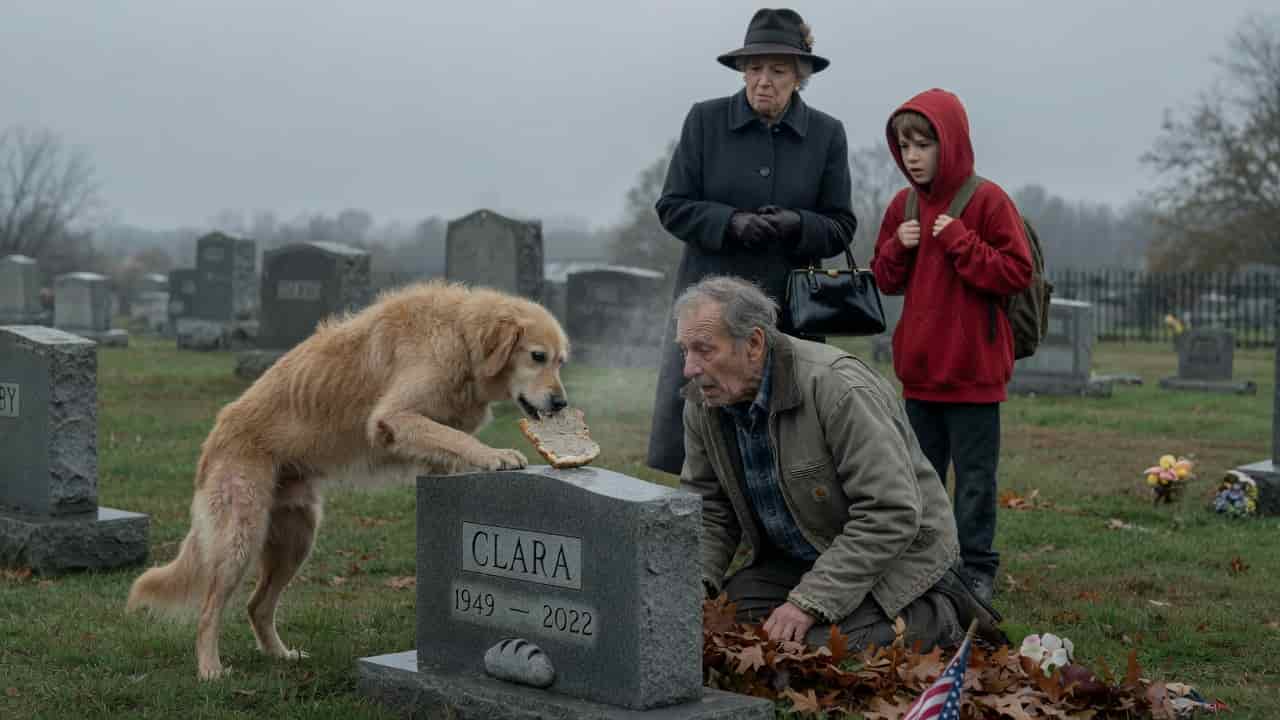
Mrs. Thorne didn’t even try to lower her voice. She stood there in her expensive wool coat, looking at me like I was a spill on a clean floor. I was on my knees in the mud of the Highland View Cemetery, my fingers inches away from the matted fur of the dog they all wanted the county to haul away.
“Gabe, honey,” she said, that fake-sweet tone that feels like a razor blade. “Clara wouldn’t want you out here in the cold, chasing a mongrel. Look at you. You’re a mess. People are starting to talk.”
I didn’t look at her. I looked at Barnaby. The dog was nothing but skin and bone, his ribs looking like a birdcage under his skin. But he wasn’t there for the scraps I’d brought. He was standing on top of my wife’s grave, and in his mouth, he held a jagged, dried-up piece of bread. He leaned down, as gentle as a priest, and placed it right on the word Beloved.
“He’s bringing her an offering,” I whispered.
“It’s a stray, Gabe,” she snapped, her patience finally disappearing. “It’s a dirty, dangerous animal. It’s been a year. The bakery is closed. Clara is gone. Stop trying to feed a ghost.”
The whole town thinks I’ve snapped. They see a broken old man and a ‘monster’ haunting the graveyard. But they don’t know what that bread is. They don’t know the recipe. And they don’t know why I haven’t turned the ovens on in twelve months.
I looked at that dried crust and realized the dog wasn’t the one who was starving. I was.
Chapter 1: The Cold Kitchen
The pilot light on the Hobart mixer had been out for three hundred and eighty-two days. Gabe knew the number because he’d scratched a tally mark into the underside of the stainless steel prep table every morning when he walked into the kitchen to make his coffee. It was a ritual of stagnation. He didn’t use the Hobart anymore—the giant, three-speed beast that had once kneaded a hundred pounds of sourdough at a time—but he couldn’t bring himself to call the repairman to reignite the flame. A cold kitchen was a silent kitchen, and silence was the only thing Gabe felt he deserved.
The air in the bakery, Clara’s Crumb, still held the faint, stubborn ghost of yeast and scorched sugar, though it was mostly buried now under the smell of floor wax and old newspapers. Gabe sat at the small bistro table by the front window, the one Clara used to decorate with seasonal gourds or silk flowers. Now, it just held his mug and a stack of bills he hadn’t opened. Outside, the town of Oakhaven was waking up in that sluggish, grey-skies way that Pennsylvania towns do in October.
He watched a leaf tumble across the asphalt of Main Street. It was the kind of morning where the cold didn’t just nip; it seeped into your marrow and stayed there.
A sharp rap on the glass made him flinch, his coffee slopping over the rim of the mug. Standing on the sidewalk was Leo, the neighbor’s kid. Leo was ten, but he wore a permanent expression of cautious observation, like he was constantly checking for exits. He was wearing an oversized red hoodie that made him look even smaller than he was.
Gabe sighed, pushed himself up with a grunt of protest from his lower back, and unlocked the door. The bell above the frame gave a pathetic, muted jingle.
“Store’s closed, Leo. You know that,” Gabe said, his voice gravelly from disuse.
“I know,” Leo said, stepping just inside the threshold but staying near the door. “My mom sent me over. She said you didn’t answer your phone again.”
“I don’t like the way it rings. It sounds impatient.”
Leo looked around the darkened shop, his eyes lingering on the empty glass display cases that used to hold bear claws and cinnamon rolls. “She says you need to come over for dinner. Pot roast.”
“Tell her thanks, but I’ve got things to do.”
“Like what?” Leo asked. It wasn’t a challenge; it was a genuine question. The boy looked at the tally marks on the table, then back at Gabe. “You haven’t been to the cemetery, have you?”
Gabe froze. He reached for a rag and started wiping the spill on the table, his movements mechanical. “That’s none of your business, Leo.”
“People are talking about the monster,” Leo whispered, his voice dropping an octave. “The guys at the bus stop say there’s a hellhound living in the back section of Highland View. They say it guards the graves and eats the flowers people leave. They say it’s gonna bite someone.”
Gabe’s hand stopped moving. “There are no monsters in Oakhaven, Leo. Just hungry things.”
“Mr. Miller from the hardware store says he saw it. He said it’s huge and its eyes glow. He said the Altar Guild is calling the animal control people today because it growled at Mrs. Thorne when she was putting out the new mums.”
Gabe felt a cold prickle at the base of his neck. Barnaby. He hadn’t seen the dog in weeks—not since the day of the funeral when the Golden Retriever had slipped out of the backyard and vanished into the woods. He’d searched for three days, whistling until his lungs burned, but the dog had never come home. Gabe had taken it as a sign. Even the dog knew he was a failure. Even the dog couldn’t stand the smell of a man who’d let his wife’s last year be defined by silence and hospital beige.
“They’re calling the warden?” Gabe asked.
“Mrs. Thorne says it’s a public safety hazard. She says it’s ‘disrespecting the sanctuary.’ My mom says you should go get him, if it’s really Barnaby.”
“I can’t,” Gabe said, his voice cracking. “I don’t have anything for him.”
“You have the bread,” Leo said, pointing toward the back of the kitchen.
“I don’t bake anymore, Leo. The oven is cold.”
“So he’s just gonna starve? Or get shot?” Leo’s eyes were wide, reflecting the grey light of the street. “The warden doesn’t use nets for the ‘dangerous’ ones, Mr. Gabe. He uses the rifle.”
The silence in the bakery suddenly felt heavy, pressing against Gabe’s chest like a physical weight. He looked at the Hobart mixer, the giant iron heart of his old life. He remembered Clara’s hands, always dusted in flour, the way she’d laugh when the flour poofed up and caught in her eyelashes. She’d loved that dog more than she’d loved the shop. On her last good day, she’d asked Gabe to make sure Barnaby got the “heel” of the loaf, the part with the thickest crust.
“Go home, Leo,” Gabe said, his voice flat.
“But—”
“Go home.”
Gabe watched the boy leave, the red hoodie disappearing around the corner. He stood in the center of his dead bakery for a long time, the smell of yeast mocking him. He looked at his hands—calloused, dry, and shaking. He hadn’t touched a bag of flour in a year. To bake was to remember. To smell the cinnamon and the proofing dough was to bring Clara back into the room, and he wasn’t sure he could survive that again.
But the thought of Barnaby—skinny, scared, and guarding a piece of granite while Mrs. Thorne called for his execution—it twisted something in Gabe’s gut that wasn’t quite dead yet.
He walked to the back of the kitchen and pulled a heavy, rusted key from a hook. He didn’t go for the flour. Instead, he went to the pantry and found a stale, store-bought loaf of white bread he’d bought for toast three weeks ago. It was dry and tasteless, a pale imitation of anything real. He shoved it into a plastic bag and headed for his truck.
The 1998 Ford F-150 groaned as it turned over, the engine coughing out a plume of blue smoke into the October chill. Gabe drove through the town, past the closed-down textile mill and the diner where the morning rush was already thinning out. He felt like a ghost driving a ghost. He was part of the scenery now, one of those old men people waved at out of habit but didn’t actually see.
As he pulled into the gates of Highland View Cemetery, the wind picked up, rattling the iron bars. The cemetery was a rolling hill of grey and brown, dotted with the occasional splash of plastic flowers or a weathering American flag. The back section, where the newer graves were, was exposed to the wind.
He parked on the gravel path and stepped out. The cold hit him like a physical slap. He tucked the bag of bread under his arm and began the long walk toward the “C” section. His knees ached with every step, a rhythmic reminder of all the years spent standing on concrete bakery floors.
He saw the group before he saw the dog.
Mrs. Thorne was there, standing with two other women from the Altar Guild. They were huddled together like a murder of crows in their dark overcoats. A few yards away, a man in a tan uniform—the county warden—was leaning against his truck, checking a clipboard.
“It’s about time someone did something,” Mrs. Thorne was saying, her voice carrying on the wind. “It’s a disgrace. Digging around the headstones, scaring the children. It’s probably rabid.”
Gabe slowed his pace. He felt a familiar surge of social anxiety, that tightening in his throat that always happened when the “good” people of Oakhaven turned their gaze toward him. Since the bakery closed, they treated him like a charity project or a cautionary tale.
“Gabe?” Mrs. Thorne turned, her eyes narrowing as she spotted him. “What are you doing out here? You look like you’ve been sleeping in your clothes again.”
Gabe didn’t answer. He looked past her, toward the row of headstones that marked the boundary of the new section. There, sitting atop a flat granite marker, was Barnaby.
The dog was unrecognizable. His once-lustrous golden coat was a tangled mess of burrs and mud. His ears were notched, likely from a fight with a coyote or a stray cat, and his frame was so thin his spine looked like a row of knuckles. But it was his posture that stopped Gabe’s heart. He wasn’t cowering. He was sitting perfectly still, his eyes fixed on the entrance to the cemetery, his tail tucked tight but his head held high.
And there, right on the edge of the stone, was a small, greyish object.
“He won’t let anyone near it,” the warden said, stepping toward Gabe. “Every time I move in with the pole, he snaps. He’s guarding that stone like it’s a fortress. We’re gonna have to take him down, Mr. Vance. He’s too far gone.”
Gabe ignored them all. He walked forward, his boots crunching on the dead leaves.
“Gabe, don’t be a fool,” Mrs. Thorne called out. “He’ll bite you. He doesn’t know you anymore.”
“He knows me,” Gabe whispered, though he wasn’t sure if he was lying to her or to himself.
He stopped ten feet from the grave. Barnaby’s head turned. The dog’s eyes were clouded, rimmed with red, but there was a flicker of recognition in the depths of them. A low, vibrating growl started in the dog’s chest—a sound of warning, not of malice. It was the sound of a creature that had nothing left to lose but its duty.
Gabe looked down at the headstone. Clara Elizabeth Vance. 1954 – 2025. Beloved.
On top of the stone, right next to the dog’s paws, sat a jagged piece of dried bread. It looked like a heel from a sourdough loaf, weathered by the rain and bleached by the sun.
“Where did he get that?” Gabe asked, his voice trembling.
“He’s been scavenging,” Mrs. Thorne said, stepping closer, her voice dripping with that cloying, judgmental pity. “Probably found it in a dumpster behind the Food-Way. He’s been bringing trash to the grave, Gabe. It’s pathetic. He’s a scavenger. He’s making a mockery of this place.”
Gabe felt a hot flash of rage—the first thing he’d felt in months that wasn’t just cold grey ash. He looked at the bread, then at the dog. Barnaby wasn’t eating the bread. He was protecting it. He was offering it.
“He’s not a scavenger,” Gabe said, his voice gaining strength. “He’s a baker’s dog.”
“He’s a nuisance,” Mrs. Thorne snapped. “Warden, do your job. My grandson is coming here for the memorial service this weekend, and I won’t have him seeing this… this skeletal thing.”
The warden reached into the cab of his truck and pulled out a long, heavy-duty tranquilizer rifle. “Sorry, Gabe. He’s had his chances. If he won’t come for food, he’s gotta go.”
Gabe looked at the plastic bag in his hand. The store-bought white bread. It felt like a confession of his own cowardice. He’d brought the easy thing, the cheap thing, the thing that didn’t require him to open his heart or his oven.
“Wait,” Gabe said, stepping between the warden and the grave. “Give me until tomorrow. One day.”
“He’s starving, Gabe,” the warden said. “Another day won’t help.”
“I’ll bring him something he’ll eat,” Gabe said. He looked at Barnaby, and for a second, the dog’s tail gave a single, weak thump against the granite. “I’ll bring him something real.”
Mrs. Thorne scoffed, a sharp, ugly sound in the quiet cemetery. “You haven’t baked a loaf of bread since the funeral, Gabe. You can’t even take care of yourself. Look at your coat. Look at your hands. You’re a ghost trying to feed a ghost.”
The words landed like a physical blow. Gabe looked down at his shaking hands. She was right. He was a mess. He was a failure who had spent a year hiding from the scent of his own life. But as he looked at Barnaby, who was still guarding that single, dried-out crust of bread, he realized the dog was the only one in Oakhaven who hadn’t given up on Clara.
“Tomorrow morning,” Gabe said to the warden, ignoring Mrs. Thorne. “If I can’t get him in the truck by ten o’clock, you do what you have to do.”
The warden looked at the dog, then at Gabe’s desperate face. He sighed and lowered the rifle. “Ten o’clock, Gabe. Not a minute later.”
Gabe turned and walked back to his truck. He could feel Mrs. Thorne’s eyes on his back, a weight of social judgment that felt heavier than the Pennsylvania sky. He could hear her whispering to the other women, something about “senile dementia” and “a tragedy of the mind.”
He didn’t care. He got into the truck and drove back toward the bakery. His heart was hammering against his ribs, a frantic, rhythmic beat. He had less than twenty-four hours to do the one thing he’d sworn he’d never do again.
He had to bake.
Chapter 2: The Residue of Pity
The drive back to the bakery felt longer than the trip out. Every pothole in the Oakhaven roads seemed to jar Gabe’s teeth, reminding him of his age, his frailty, and the sheer absurdity of what he’d promised. He was a man who couldn’t remember to buy milk half the time, and here he was, promising to lure a “monster” out of a cemetery with a loaf of bread he hadn’t made in a year.
As he pulled the Ford into the alley behind the shop, he saw Miller from the hardware store leaning against a stack of crates. Miller was a big man, a former high school linebacker who had gone soft around the edges but still carried a certain physical authority. He was nursing a lukewarm coffee in a Styrofoam cup.
“Saw you at the cemetery, Gabe,” Miller said, his voice booming in the narrow alley. “Thorne’s already on the warpath. She’s at the diner now, telling everyone you’ve finally lost the plot.”
Gabe climbed out of the truck, his legs feeling like they were made of lead. “She’s always on a warpath, Miller. It’s her primary mode of transportation.”
Miller chuckled, but there was no humor in it. He stepped closer, dropping his voice. “Look, Gabe. We all liked Clara. And we all liked that dog. But that thing out there… it’s not Barnaby anymore. It’s a coyote in a retriever’s skin. You saw his eyes. He’s gone wild.”
“He’s not wild,” Gabe said, fumbling with his keys. “He’s loyal. There’s a difference.”
“Is there? At some point, loyalty just becomes a slow way to die.” Miller put a heavy hand on Gabe’s shoulder. It was meant to be supportive, but Gabe felt the weight of it as a dismissal. “Don’t go back there tomorrow, Gabe. Let the warden handle it. It’ll be quick. Better than the dog starving to death or getting hit by a coal truck.”
Gabe pulled away, the key finally catching in the lock. “I gave my word, Miller.”
“To who? The dog? Or the headstone?”
Gabe didn’t answer. He stepped inside and slammed the door, the jingle of the bell sounding like a mocking laugh.
The bakery was freezing. The October chill had settled into the flour bins and the cooling racks, making the whole place feel like a tomb. Gabe didn’t turn on the lights. He sat on a stool in the dark, the only illumination coming from the streetlamp outside, casting long, distorted shadows across the checkered floor.
He thought about what Mrs. Thorne had said. A ghost trying to feed a ghost.
He looked at his hands in the dim light. They were the hands of a baker, but the skin was cracked and the nails were bitten down to the quick. He hadn’t felt the “tug” of the dough in so long. He’d spent forty years knowing exactly how the weather would affect the rise—knowing that a humid Tuesday required a touch more flour, that a dry Friday needed a longer proof. He’d been a master of the living world of yeast. And then Clara had died, and the living world had become an insult.
He stood up and walked to the back, toward the heavy wooden door of the walk-in freezer. It hadn’t been turned on in months, but it was where he kept the “Mother”—the sourdough starter that had been in his family for three generations.
He opened the door. The air inside was stale and smelled of cold metal. He found the ceramic crock in the corner. He’d stopped feeding it the day after the funeral. A sourdough starter is a living thing; it requires regular feeding of flour and water to stay active. If you neglect it, it dies. Or it goes dormant, a grey, vinegary liquid forming on the top—a “hooch” that signaled the end of the line.
Gabe lifted the lid. The smell hit him instantly—sharp, sour, and fermented. It didn’t smell like life. It smelled like rot. There was a thick layer of dark liquid on the surface.
“Dead,” he whispered. “Just like everything else.”
He went to the sink and began to tip the crock, ready to wash the last of his family’s history down the drain. He felt a strange, hollow sense of relief. If the starter was dead, he couldn’t bake. If he couldn’t bake, he didn’t have to face the memory. He could go back to the cemetery tomorrow, tell the warden he failed, and watch them take Barnaby away. He could finally be as empty as the shop.
But as the liquid began to pour, he saw a sliver of creamy white underneath the grey.
He stopped. He grabbed a spoon and scraped away the top layer. Deep in the heart of the crock, protected by the very rot that sought to consume it, was a small pocket of pale, sticky dough. It was faint, and it smelled more like vinegar than bread, but it was there.
A remnant.
Gabe felt a sudden, frantic urge to save it. He grabbed a clean bowl, some fresh flour, and a pitcher of lukewarm water. His movements were clumsy at first, his fingers forgetting the rhythm. He measured by eye, the way he always had, his instincts flickering like a dying candle.
Clara’s Cinnamon Rolls. That’s what Barnaby loved. Not the fancy sourdough, not the rye. Barnaby had been a connoisseur of the sweet, buttery rolls that Clara used to pull from the oven at six in the morning. She’d always “accidentally” drop a piece of the dough on the floor for him, or let him lick the sugar-cinnamon mix from the bottom of the bowl.
Gabe started to work. He fed the starter, whisking it into a slurry, then adding the flour. He covered the bowl with a damp cloth and set it near the pilot light of the oven—the only warmth in the building. Now, he had to wait. He had to see if the life in the bowl was strong enough to wake up.
He spent the night on the floor of the kitchen, leaning against the Hobart mixer. He didn’t sleep. He listened to the sounds of the building—the settling of the floorboards, the hum of the streetlamps, the occasional car passing by.
At 2:00 AM, the bell jingle-jangled.
Gabe sat up, his heart racing. He grabbed a heavy rolling pin from the table. “Who’s there?”
The door creaked open, and a small figure stepped in. It was Leo.
“My mom’s gonna kill me,” the boy whispered, his breath visible in the cold air.
Gabe lowered the rolling pin. “Leo? What the hell are you doing? It’s the middle of the night.”
“I couldn’t sleep,” Leo said, walking toward the back. He was still wearing the red hoodie. “I went back to the cemetery. On my bike.”
Gabe stood up, his joints popping. “You went back? Alone?”
“I wanted to see if he was okay. The dog.” Leo looked at the covered bowl on the table. “He’s not okay, Mr. Gabe. The coyotes were out there. I heard them. They were circling the back section. Barnaby was standing on the headstone, barking. He sounded… he sounded like he was crying.”
Gabe felt a cold dread settle in his stomach. “Did they get to him?”
“No. I threw some rocks. Scared them off for a bit. But they’ll be back. And the warden… he was there too. Checking his truck. He had the rifle in the front seat.” Leo looked at Gabe, his eyes red-rimmed. “Are you making it? The bread?”
Gabe looked at the bowl. He reached out and touched the side of it. It felt warm. He lifted the cloth.
The slurry was bubbling. Tiny, frantic bubbles were breaking the surface, releasing a scent that was no longer rotten. It was sweet, tangy, and undeniably alive.
“It’s waking up,” Gabe said.
“Will it be enough?”
“I don’t know, Leo. I haven’t done this in a long time.”
“My mom says you were the best,” Leo said. “She says people used to drive from Scranton just for the rolls. She says you stopped because the smell made you sad.”
Gabe looked at the boy. “The smell doesn’t just make me sad, Leo. It makes me remember the last year. It makes me remember the way she looked when she couldn’t eat anymore. The way she’d look at the bread I brought her and just… turn away. I spent my whole life feeding people, and I couldn’t feed the one person who mattered.”
Leo didn’t look away. He didn’t offer the easy pity of the church ladies. “Maybe you weren’t supposed to feed her,” he said quietly. “Maybe you were just supposed to be there.”
Gabe was silent. The boy’s words felt like a key turning in a lock he’d forgotten existed. He’d spent a year punishing himself for his helplessness, for the fact that his “art” couldn’t cure cancer. He’d seen his failure in every loaf he didn’t bake.
“I’m gonna need more than just flour,” Gabe said, his voice firming. “I need the cinnamon. The real stuff. And the butter. The high-fat stuff from the dairy.”
“The store doesn’t open until six,” Leo said.
“The back door of the dairy opens at four,” Gabe countered. “Go home, Leo. Get some sleep. If you’re at the cemetery at nine, you can help me.”
“Really?”
“Really. But don’t tell your mother I let you wander around a cemetery in the middle of the night. I’ve got enough problems without being the neighborhood kidnapping suspect.”
Leo grinned—a quick, nervous flash of teeth—and disappeared back into the night.
Gabe turned back to the kitchen. He began to move with a purpose he hadn’t felt in a year. He scrubbed the prep table until the stainless steel gleamed. He polished the rolling pins. He checked the temperature of the oven.
The residue of the pity he’d felt from Mrs. Thorne and Miller was still there, a bitter coating on his tongue, but it was being pushed back by the sensory reality of the work. The grit of the flour, the coldness of the water, the rhythmic ticking of the wall clock.
He was no longer a ghost. He was a baker with a deadline.
As the sun began to bleed a pale, watery orange over the horizon, Gabe pulled the butter from the fridge. It was time to start the dough. He began to knead, his palms pushing into the sticky mass, feeling the resistance, the elasticity, the life.
Every push was a memory. The day they opened the shop. The time Barnaby stole a whole tray of muffins. The way Clara would hum while she braided the challah.
He didn’t fight the memories. He let them flow into his arms, into the dough. He let the sadness mix with the flour.
By seven AM, the bakery was filled with a scent that hadn’t been there in three hundred and eighty-three days. It was the scent of cinnamon, sugar, and yeast—the scent of Clara’s Crumb.
And for the first time in a year, Gabe didn’t want to run away from it.
Chapter 3: The Hunger and the Offering
The scent of the cinnamon rolls was so thick in the cab of the truck that Gabe felt lightheaded. He’d wrapped the tray in heavy towels to keep the heat in, the steam rising in small, fragrant plumes. It felt like he was carrying a living thing in the passenger seat—a warm, breathing heart made of sugar and memory.
He pulled into the cemetery at 9:15 AM. The sky was a bruised purple-grey, and the wind was whipping the dead leaves into frantic little cyclones.
The scene was worse than the day before.
The warden’s truck was parked right by the entrance to Section C, and he was already out, standing with a long catch-pole and the tranquilizer rifle slung over his shoulder. Mrs. Thorne was there again, along with two men Gabe recognized from the town council. They looked like they were attending a trial.
“You’re late, Gabe,” the warden said, checking his watch. “I was just about to head in.”
“I said ten,” Gabe said, climbing out of the truck. His legs were shaking, not from the cold, but from the lack of sleep and the sheer stakes of the moment. “I’ve got forty-five minutes.”
“What is that smell?” Mrs. Thorne asked, her nose wrinkling as she stepped toward the truck. “Is that… are those rolls?”
Gabe didn’t answer her. He reached in and grabbed the warm bundle.
“You’re joking,” one of the councilmen said, a short, balding man named Higgins. “You think you’re going to lure a vicious animal with breakfast pastry? This isn’t a cartoon, Vance. That dog is dangerous. He growled at the groundskeeper this morning when he tried to clear the leaves.”
“He’s protecting her,” Gabe said, his voice flat.
“He’s protecting a piece of rock!” Mrs. Thorne snapped. “Gabe, this is embarrassing. Look at you. You haven’t shaved, your clothes are covered in flour… you’re making yourself a laughingstock for a dog that’s already dead in every way that matters.”
Gabe stopped. He turned to look at Mrs. Thorne. He saw the way she looked at him—the mixture of contempt and that awful, superior pity. She wanted him to be the broken old man. She wanted him to be the tragic figure she could talk about at her bridge games. If he succeeded, if he brought Barnaby home, it meant he wasn’t broken. It meant he had power. And Mrs. Thorne hated people who had power she couldn’t control.
“You know what the difference is between you and that dog, Martha?” Gabe asked quietly.
Mrs. Thorne blinked, her mouth dropping open. “I beg your pardon?”
“The dog knows what love costs,” Gabe said. “You just know what it looks like from the outside.”
He turned and walked toward the grave, leaving her sputtering in the wind.
He saw Barnaby immediately. The dog was lying flat on his belly on top of the headstone now, his chin resting on the granite. He looked even smaller than he had the day before. The piece of dried bread was still there, tucked under his paw.
Barnaby’s ears flicked. He didn’t growl this time. He just watched Gabe with those clouded, ancient eyes.
Gabe stopped ten feet away. He could hear the crunch of boots behind him—the warden and the others following at a distance, the gallery of skeptics.
“Hey, Barnaby,” Gabe whispered.
The dog’s tail gave a single, almost imperceptible twitch.
Gabe knelt in the mud. He felt the dampness seep into his trousers, but he didn’t care. He slowly unwrapped the towels. The steam billowed out, carrying the intense, sweet-spiced aroma of the cinnamon rolls.
He took one out. It was still hot, the white icing beginning to melt and run down the sides. It was perfect. It was the best thing he’d ever made.
“Remember these?” Gabe asked. “She used to give you the middle piece. The gooey part.”
He tore the roll in half. The sound of the crust yielding was like a soft sigh. He held it out in his palm.
Barnaby’s nose began to work. His nostrils flared, his whole body tensing. He didn’t move from the stone, but his eyes locked onto the bread. A low, whining sound started in the back of his throat—a sound of pure, unadulterated hunger. Not just the hunger for food, but the hunger for the life that smell represented.
“Come on, boy. It’s okay. It’s her recipe. I made it for you.”
Barnaby stood up. His legs were shaky, his ribcage heaving. He looked at the piece of dried bread under his paw—the offering he’d been guarding for weeks. Then he looked at the fresh, steaming roll in Gabe’s hand.
It was a choice between the memory of the dead and the promise of the living.
Barnaby stepped off the stone. He moved slowly, his head low, his tucked tail beginning to wag in a frantic, desperate rhythm. He walked toward Gabe, his paws soft on the damp grass.
“That’s it. That’s my boy.”
Barnaby reached Gabe. He didn’t snap. He didn’t growl. He leaned his head into Gabe’s chest, his whole body trembling. Gabe felt the heat of the dog, the fragility of the life he’d almost let slip away. He felt the rough, matted fur against his flannel shirt.
Barnaby took the piece of roll from Gabe’s hand. He ate it with a frantic, messy desperation, his tail thumping against Gabe’s leg.
“Good boy,” Gabe sobbed, his face buried in the dog’s neck. “I’m sorry. I’m so sorry I left you out here.”
Behind him, the silence was absolute. Even Mrs. Thorne had nothing to say.
The warden stepped forward, but he didn’t raise the rifle. He reached down and gently placed a hand on the dog’s back. “Well, I’ll be damned,” he whispered. “He really did just want home.”
Gabe stood up, his knees screaming, but his heart feeling lighter than it had in a year. Barnaby didn’t leave his side. The dog stayed glued to Gabe’s leg, his eyes never leaving the tray of rolls.
Gabe walked back toward the truck, the dog following faithfully. He stopped at the headstone one last time.
He looked at the piece of dried, grey bread Barnaby had left behind.
“Wait,” Gabe said.
He walked back to the grave. He picked up the dried crust—the scavenger’s offering. He looked at it for a long moment, then he placed it in his pocket, right over his heart.
Then, he took the last fresh cinnamon roll from the tray and placed it on top of the headstone.
“For you, Clara,” he whispered. “The first of the new batch.”
He walked to the truck and opened the door. Barnaby jumped in without hesitation, curling up on the passenger seat where the warm tray had been.
Gabe climbed into the driver’s seat. He looked out the window at the group of people standing in the cold. Mrs. Thorne looked small. Higgins looked confused. Miller, standing at the back, gave a slow, respectful nod.
Gabe started the engine. The Ford roared to life, the heater finally beginning to blow warm air.
As he drove out of the cemetery, he didn’t look back. He had a dog to feed. He had a bakery to clean. And he had a life that, for the first time in three hundred and eighty-three days, didn’t feel like a ghost.
The hunger was still there, deep in his chest, but it was no longer the hunger of the starving. It was the hunger of a man who was ready to start the next day’s bake.
Chapter 4: The Sound of the Oven
The return to Clara’s Crumb wasn’t a triumphant parade. It was a quiet, gritty process of reclaiming a battlefield.
Gabe spent the first two hours after returning from the cemetery at the local vet’s office. Barnaby was dehydrated, malnourished, and riddled with parasites, but the vet—a young woman with tired eyes and a gentle touch—assured Gabe that the dog was strong.
“He’s a survivor, Gabe,” she said as she hooked Barnaby up to an IV drip. “He was living on sheer will. Whatever you fed him this morning… it saved him.”
“It was just bread,” Gabe said, sitting in the corner of the exam room, his hands still dusted with flour.
“It wasn’t just bread,” she countered. “It was a reason to come back.”
Gabe left Barnaby at the clinic for the night and headed back to the bakery. He had work to do. He couldn’t bring the dog home to a dead house and a cold kitchen.
The bakery felt different now. The smell of the morning’s bake still lingered, but it was being overtaken by the smell of industrial-strength soap and hot water. Gabe was on his hands and knees, scrubbing the floor behind the cooling racks. He was purging the year of neglect, the layers of dust that had settled like ash over his life.
A knock on the door made him look up.
It was Leo. The boy looked hesitant, his hands shoved deep into the pockets of his red hoodie.
“Is he okay?” Leo asked as Gabe let him in.
“He’s at the vet. He’s gonna be fine. Needs some medicine and a lot of sleep.”
Leo looked around the shop. The lights were all on now, the fluorescent tubes humming with a bright, clinical energy. “You’re cleaning.”
“Can’t bake in a pigsty, Leo.”
“So you’re… you’re opening back up?”
Gabe stopped scrubbing. He looked at the Hobart mixer. He looked at the tally marks he’d scratched into the table. “I don’t know if I’m opening a shop, Leo. But I’m baking. There’s a difference.”
“What’s the difference?”
“A shop is a business. Baking… baking is a conversation.” Gabe stood up, wiping his brow with the back of his hand. “I’ve spent a year being silent. I think it’s time I said something.”
Leo walked over to the prep table. He reached out and touched the tally marks. “Are you gonna keep doing these?”
“No,” Gabe said. He picked up a metal scraper and, with a few sharp, decisive movements, he planed the wood of the table’s underside until the marks were gone. The raw, fresh wood smelled like cedar and potential. “Tomorrow is day one.”
“Can I help?” Leo asked. “My mom says I have ‘excessive energy’ and I need a hobby that doesn’t involve video games.”
Gabe looked at the boy. He saw the loneliness in Leo’s eyes, the same quiet observation he’d seen in himself. Leo didn’t have many friends; he was the kid who watched from the sidelines, the one who noticed the “monsters” in the cemetery because he was looking for something that understood him.
“Can you crack an egg without getting the shell in the bowl?” Gabe asked.
“I can try.”
“Trying gets you messy. Doing gets you bread. Get over here.”
For the next four hours, Gabe taught Leo the basics. He showed him how to weigh the flour, how to feel the temperature of the water with his wrist, how to respect the yeast. He found himself explaining things he hadn’t thought about in years—the science of the gluten bonds, the way the sugar fed the fermentation.
He realized he wasn’t just teaching Leo. He was reminding himself of the rules of the world. The world wasn’t just grief and social pressure and the pinched faces of women like Martha Thorne. The world was also the way a handful of dust and a splash of water could become something that sustained life.
“Why does it have to sit so long?” Leo asked, looking at a bowl of dough they’d just mixed.
“Because you can’t rush the good stuff, Leo. The dough needs to find its own strength. If you force it, it’ll be tough. If you leave it too long, it’ll go sour. You have to listen to it.”
“How do you listen to bread?”
“With your hands,” Gabe said. “And your nose. And the way the air feels in the room.”
As the evening wore on, the town of Oakhaven settled into its nighttime rhythm. Gabe could see the lights in the apartments across the street flickering on. He knew people were talking. He knew the story of the cemetery rescue was already making its way through the phone lines and the diner booths.
He didn’t care. For the first time in a year, the social pressure felt like a distant hum, like the sound of a lawnmower three blocks away. It was there, but it didn’t define the room.
Around 8:00 PM, a shadow appeared at the front window. Gabe looked up, expecting the warden or maybe Miller.
It was Mrs. Thorne.
She didn’t knock. She just stood there, looking through the glass at the brightly lit kitchen, at Gabe and Leo standing over the prep table. She looked tired. The sharpness in her face had been replaced by something else—a flicker of uncertainty, perhaps even a hint of shame.
Gabe didn’t open the door. He just looked at her, his hands covered in a fresh layer of flour.
She stayed for a long minute, then she turned and walked away into the shadows.
“Was that the mean lady?” Leo asked.
“That was a woman who’s forgotten how to be hungry,” Gabe said.
He walked to the back of the kitchen and stood before the great deck oven. It was a massive, brick-lined beast, the heart of the bakery. He reached for the dial.
He hesitated.
This was the final step. To turn on the oven was to fully commit. It was to invite the heat back into the building, to declare that the winter of his soul was over.
He thought about the piece of dried bread in his pocket. He reached in and touched it. It was cold, hard, and jagged. It was a piece of the past he would always carry.
Then he looked at the bowl of fresh dough on the table, bubbling with life.
Gabe turned the dial.
The igniter clicked. Click. Click. Click.
Then, with a low, powerful whoosh, the blue flame roared to life. The sound filled the kitchen—a deep, resonant vibration that Gabe felt in his teeth, in his bones, in his very soul.
“Is it supposed to be that loud?” Leo asked, his eyes wide.
“That’s the sound of the world waking up, Leo,” Gabe said, a small, genuine smile tugging at the corners of his mouth.
He stood there for a moment, basking in the growing warmth of the kitchen. The oven was heating up. The dough was rising. Barnaby was safe.
He wasn’t okay—not yet. The grief was still there, a shadow in the corner of the room. But he was no longer a ghost. He was a man with a tray of rolls and a boy who needed to learn how to bake.
Gabe picked up a rolling pin and handed it to Leo.
“Alright, kid. Let’s get to work. We’ve got a dog coming home tomorrow, and he’s gonna be expecting the middle piece.”
Chapter 5: The Rising Heat
The bell above the door of Clara’s Crumb didn’t just jingle the next afternoon; it announced a shift in the local atmosphere. It was a crisp Tuesday, the kind of day where the Pennsylvania wind felt like it was trying to peel the paint off the Victorian houses lining Main Street. Gabe was behind the counter, his hands white with a fresh dusting of King Arthur flour, watching Barnaby.
The dog had come home two hours ago. He was still thin—his ribs looked like the structural beams of a forgotten barn—but he was clean. The vet had shaved out the worst of the mats, leaving Barnaby looking a bit patchy and lopsided, but his eyes were clear. He was currently curled on a rug Gabe had placed behind the counter, right near the warmth of the oven’s pilot light. Every time the door opened, Barnaby’s ears would swivel, but he didn’t growl. He just watched, his tail giving a tentative, rhythmic thump-thump against the floorboards.
“He looks different,” Leo said. The boy was perched on a flour bucket, wearing a clean apron Gabe had found in the back—one of Clara’s old ones, shortened with a few safety pins. “He looks like a dog again, not a ghost.”
“He is a dog, Leo. Ghosts don’t shed this much,” Gabe grunted, though there was no heat in it. He was shaping loaves of sourdough, his movements fluid and practiced. The “Mother” starter was vibrant now, bubbling with a fermented energy that seemed to fill the room.
The door opened again, and this time it wasn’t a curious neighbor or a kid looking for a cookie. It was Miller from the hardware store, followed closely by a man in a dark suit Gabe recognized as Arthur Penhaligon, the town’s zoning officer. Behind them, hovering like a specter of civic duty, was Mrs. Thorne.
Gabe didn’t stop kneading. He felt the familiar tightening in his chest—the social weight he’d tried to outrun—but he kept his eyes on the dough. “Miller. Arthur. Martha. The shop isn’t officially open for business yet. I’m just testing the humidity.”
“We’re not here for a bear claw, Gabe,” Miller said. He looked uncomfortable, his eyes darting toward the dog. “There’s been a formal complaint filed with the township.”
Penhaligon stepped forward, clearing his throat. He held a clipboard like a shield. “Mr. Vance, it’s come to our attention that you’re harboring a stray animal in a food-preparation facility. Furthermore, there are questions about your current business license. It’s been expired for ten months.”
Gabe stopped. He looked at the dough, then at the three of them. His hands were shaking, just slightly. “The dog isn’t a stray. He’s mine. He’s been seen by a vet, he’s up on his shots, and he stays behind the line.”
“It doesn’t matter,” Mrs. Thorne said, her voice sharp and brittle. She wasn’t wearing the wool coat today; she was in a tailored suit that made her look like a bank manager. “It’s unsanitary, Gabe. That animal was living in a graveyard. It’s a health hazard. And frankly, considering your… recent history, the town council is concerned about the stability of this establishment.”
‘Stability,'” Gabe repeated. He felt a slow, hot coal of anger beginning to glow in his gut. “You mean you’re worried the crazy old man is going to burn the place down?”
“Nobody said that,” Miller muttered, though he wouldn’t look Gabe in the eye.
“You didn’t have to,” Gabe said. He wiped his hands on his apron and stepped around the counter. Barnaby stood up instantly, his hackles rising just a fraction, but he stayed by Gabe’s heel. “I spent forty years feeding this town. I’ve never had a health violation. I’ve never had a complaint. And suddenly, because I decide to stop being a hermit, I’m a public menace?”
“It’s about the rules, Gabe,” Penhaligon said, his voice reaching for a professional neutrality he didn’t quite possess. “The bakery is in a residential-adjacent zone. If you’re reopening, you need a full inspection. Until then, you can’t have that dog in here, and you certainly can’t be giving away food.”
“I haven’t sold a thing,” Gabe said.
“We saw the boy leaving with a bag this morning,” Mrs. Thorne said, pointing a gloved finger at Leo.
Leo shrunk back on his bucket, his eyes wide. Gabe felt a surge of protectiveness that surprised him. He’d lived his life avoiding conflict, letting Clara be the “face” of the shop because she was the one with the soft edges and the easy laugh. He’d been the man in the back, the one who stayed in the heat and the flour. But Clara wasn’t here to handle the Marthas of the world anymore.
“The boy is an apprentice,” Gabe said, his voice low and dangerous. “And the bag had his lunch in it. Since when did Oakhaven start policing what a kid eats for his break?”
“It’s not just the food, Gabe,” Miller said, stepping closer. “People are worried about you. They see you out at the cemetery, talking to yourself, chasing a wild dog… it doesn’t look right. Martha thinks you’re having a breakdown.”
“Martha thinks anything she can’t control is a breakdown,” Gabe countered. He looked at Mrs. Thorne. “You’re not worried about the health code, Martha. You’re worried because I didn’t play the part you assigned me. You wanted me to be the tragic widower, the one you could pity while you bought your muffins. You liked seeing me broken because it made you feel superior. Well, I’m done being your Sunday morning charity project.”
The silence in the shop was thick. Leo was holding his breath. Barnaby let out a low, vibrating growl—not at Miller or the zoning officer, but at Mrs. Thorne.
Her face turned a mottled red. “How dare you. I’ve spent years supporting this business. I was the one who organized the flowers for the funeral!”
“And you made sure everyone knew it,” Gabe said. “You’re a good woman, Martha, in the worst kind of way. You do the right thing so you can feel the right way. But you don’t care about the dog, and you don’t care about the bread. You just want the world to stay the way you like it—quiet, predictable, and beneath you.”
Penhaligon coughed, looking at his clipboard. “Regardless of the… personal dynamics here, Mr. Vance, the law is the law. I’m going to have to issue a cease-and-desist on any commercial activity until the inspection is complete. That means the ovens stay off.”
“And the dog?” Gabe asked.
“The dog cannot be in a licensed kitchen. Period.”
They turned to leave, Mrs. Thorne leading the way with a triumphant tilt of her chin. Miller lingered for a second, looking at Gabe with a mix of regret and cowardice.
“Sorry, Gabe. It’s just how it is.”
The door closed, the bell giving a final, sharp jingle.
Gabe stood in the center of his clean kitchen, the smell of the rising dough suddenly feeling like a mockery. He looked at the Hobart mixer, the massive iron heart that he’d worked so hard to restart. He looked at Barnaby, who was looking up at him with a cocked head, waiting for a cue.
“Are they gonna take him?” Leo whispered.
“No,” Gabe said. He sat down on the stool, his legs finally giving out. “They’re not taking anything.”
“But they said the ovens—”
“I heard what they said, Leo.”
Gabe reached into his pocket and pulled out the dried, jagged piece of bread he’d taken from the cemetery. He turned it over in his hand, feeling the rough edges. It was a piece of the past, a remnant of a time when he was starving and didn’t even know it.
He thought about the “Mother” in the back, the living thing that had survived a year of neglect. He thought about the way the dough felt under his hands this morning—strong, elastic, and ready.
The town of Oakhaven wanted him to stay in the cold. They wanted him to be the man he was a week ago—a man who tally-marked his days like a prisoner. But the heat was already in the room. The oven was warm. The dog was home.
“Leo,” Gabe said, his voice steadying. “Go get your mom. Tell her to call her sisters. And the ladies from the PTA.”
“Why?”
“Because if we can’t sell the bread,” Gabe said, a slow, determined light appearing in his eyes, “we’re going to give it away. All of it. We’re going to feed this town until they’re too full to complain.”
“What about the dog?”
“The dog is the baker’s assistant,” Gabe said. “And the kitchen isn’t a ‘commercial facility’ if I’m just making dinner for a few hundred friends.”
He stood up and walked to the oven. He didn’t turn it off. Instead, he turned the dial up. The blue flame roared, the heat radiating out in a powerful, defiant wave.
Gabe picked up his rolling pin. He had twelve hours until sunrise. He had a hundred pounds of flour, a gallon of honey, and a year’s worth of things he needed to say.
“Let’s get to work, kid,” Gabe said. “The conversation is just getting started.”
Chapter 6: The Breadcrumb Trail to Heaven
The sun hadn’t quite cleared the ridge of the Appalachian foothills when the first car pulled up to the curb in front of Clara’s Crumb. It was a battered old Subaru belonging to Mrs. Gable—no relation, just a woman who’d been buying sourdough from Gabe since the eighties. She sat in the car for a moment, the heater blowing a white mist against the glass, watching the light spill out from the bakery windows.
Inside, the air was a thick, humid tapestry of smells: toasted grain, caramelized sugar, and the sharp, bright tang of lemon zest Gabe had added to the morning’s brioche.
Gabe was moving with a frantic, focused grace. He was seventy-two, his joints were screaming, and his vision was blurry from a lack of sleep, but he felt more alive than he had in a decade. He was pulling trays from the oven, the heat blooming against his face like a physical blessing.
Leo was at the front counter, his red hoodie sleeves pushed up, stacking loaves into brown paper bags. He was humming—a low, buzzing tune that Gabe recognized as the one Clara used to sing.
“They’re coming, Mr. Gabe,” Leo said, his voice cracking with excitement. “There’s three cars now. And I see Mr. Miller’s truck at the end of the block.”
“Let ‘em come,” Gabe said. He slid a tray of cinnamon rolls onto the cooling rack. They were huge, spiraled things, dripping with a glaze that looked like melted pearls.
By 7:00 AM, there was a line. It wasn’t a line of customers; it was a line of witnesses.
Gabe didn’t open the door. He walked to the front window and flipped the sign. It didn’t say Open. He’d taken a piece of cardboard and a black marker and written one word in thick, bold letters: FREE.
The bell jingle-jangled as Mrs. Gable stepped inside. She looked around the shop, her eyes widening at the sight of the dog. Barnaby was sitting by the counter, wearing a festive red bandana Leo had tied around his neck. He looked healthy, his tail giving a slow, regal wag.
“Gabe?” she whispered. “Is it true? About the dog? And the township?”
“The dog is fine, Sarah,” Gabe said, handing her a warm loaf of sourdough. “And the township can come and get their share when they’re ready. Take this. And some rolls for your grandkids.”
“I can’t take this for free, Gabe. You’ve got bills.”
“I’ve got plenty of bills, Sarah. What I don’t have is any more time to waste being afraid of ‘em. Just eat the bread.”
As the morning wore on, the shop filled up. People who hadn’t spoken to Gabe in a year found themselves standing at his counter, forced to face the man they’d spent months pitying from a distance. The social pressure that had felt so heavy a week ago was dissolving into the warmth of the room. It’s hard to maintain a posture of judgmental distance when you’re holding a warm cinnamon roll in your hands.
Around 9:30 AM, the crowd parted. Mrs. Thorne stepped inside.
She looked different today. She wasn’t wearing a suit or a wool coat. She was in a simple cardigan, her hair slightly mussed by the wind. She looked at the line, at the dog, and then at Gabe.
The room went quiet. Leo stopped bagging rolls. Barnaby stood up, his ears pricking forward.
Mrs. Thorne walked to the counter. She didn’t have her purse. She didn’t have her posture of authority. She looked at the tray of cinnamon rolls—Clara’s recipe—and her eyes filled with a sudden, unexpected moisture.
“My mother used to bring me here,” she said, her voice so low Gabe almost didn’t hear it over the hum of the Hobart. “Before you and Clara even owned it. It used to be a dry goods store. But the smell… the smell was always the same.”
Gabe looked at her. He saw the girl she used to be, before the wool coats and the Altar Guild and the need to control the world. He saw the hunger in her—not for bread, but for the life that had passed her by while she was busy being “proper.”
He picked up a roll. He didn’t use a bag. He just held it out to her.
“It’s the middle piece, Martha,” Gabe said. “The gooey part.”
She reached out, her fingers trembling as she took the roll. She didn’t say thank you. She didn’t apologize. She just took a bite, right there in front of the whole town. Her eyes closed, and for a second, the mask of the town bully fell away, revealing a woman who was just as lonely and just as tired as Gabe was.
“It’s perfect, Gabe,” she whispered.
She turned and walked out, the roll still in her hand. She didn’t look back.
Gabe watched her go. He felt a strange, quiet sense of closure. He’d defended his territory, not with anger, but with the very thing he’d been most afraid of—his own heart.
By noon, the bakery was empty of bread, but full of the residue of human connection. The “Mother” starter was resting in its crock, ready for tomorrow. Leo had been sent home with a box of treats and a promise of a “real” job starting Monday.
Gabe sat on his stool, leaning his head against the cool stainless steel of the prep table. Barnaby walked over and rested his head on Gabe’s knee.
“We did it, boy,” Gabe whispered.
He reached into his pocket and pulled out the dried piece of bread from the cemetery. He looked at it for a long time, then he walked to the back, to the small patch of dirt behind the shop where Clara used to grow her herbs.
He knelt in the soil. He dug a small hole with his fingers and placed the dried crust inside.
“The offering is accepted,” he said.
He covered the bread with the dark, rich Pennsylvania earth. He didn’t need to carry it in his pocket anymore. He didn’t need to carry the shame or the silence. He had the smell of the oven in his clothes and the weight of the dog at his side.
As he walked back into the kitchen, the sun was beginning to set, casting long, golden fingers of light across the floor. He turned off the big lights, leaving only the soft glow of the pilot lights.
Gabe looked at the tally marks he’d planed away. The wood was clean. The kitchen was warm.
He wasn’t okay—not fully. He still missed Clara with a sharp, stabbing ache every time he saw a silk flower or heard a certain song. But he was no longer a ghost haunting a dead bakery. He was a man who knew how to wake up in the morning.
He walked to the front door and flipped the sign one last time.
It didn’t say Closed.
It said: Baking tomorrow at 5:00 AM.
Gabe locked the door, whistled for Barnaby, and walked toward the stairs. He had four hours of sleep to catch up on before the next batch of sourdough needed to be fed.
The breadcrumb trail had led him home. And for the first time in a long, long year, home didn’t feel like a cemetery. It felt like a kitchen.