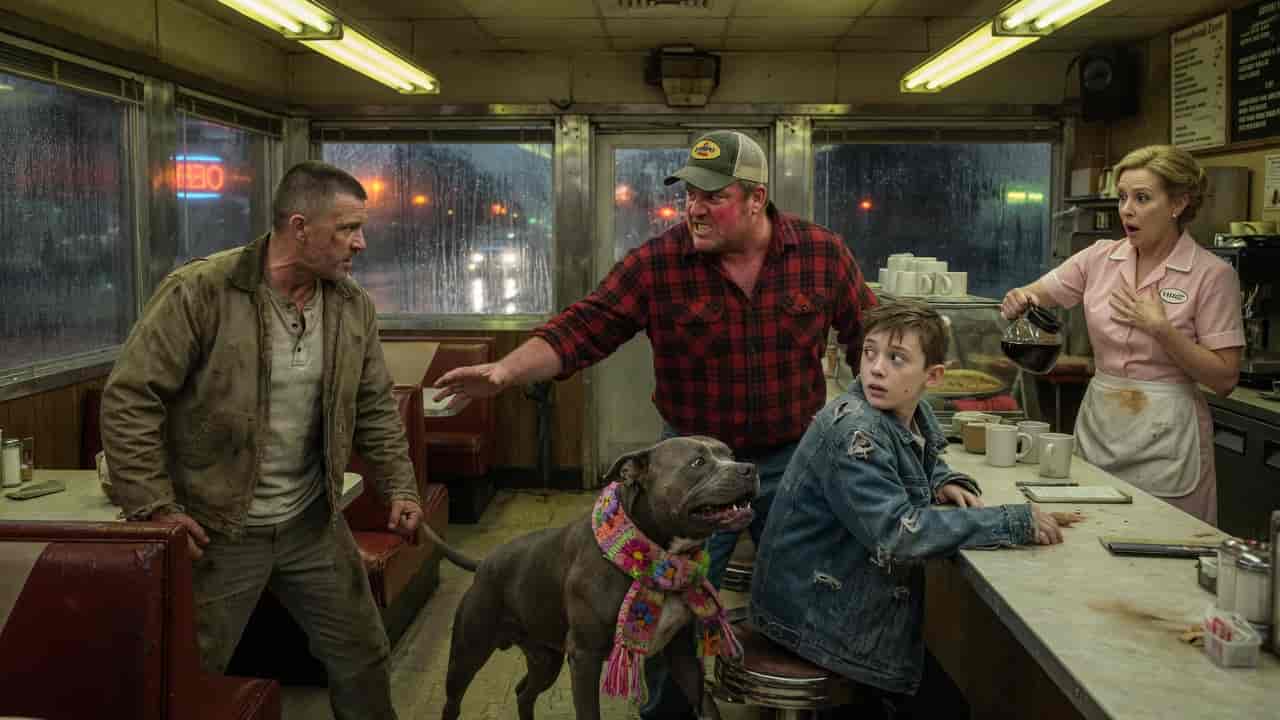
“Say it again, Caleb. Say it so the whole room can hear what kind of man you really are.”
Sam didn’t move fast. He didn’t have to. The air in the diner had already turned brittle the moment his brother put a hand on that boy’s shoulder. Everyone in Oakhaven knew the boy, Leo. They knew his father was the man who had torn Sam’s life apart three years ago on a rain-slicked highway.
They expected Sam to hate the kid. They expected him to want blood.
But when Caleb sneered and called the boy ‘trash’ in front of the morning coffee crowd, Sam felt a different kind of burn. It wasn’t the old grief. It was the weight of the ledger sitting in his truck—the one that proved his late wife had been protecting this boy long before she died.
“He’s just a kid, Caleb,” Sam said, his voice a low, dangerous vibration.
“He’s a murderer’s brat, Sam! He’s wearing Beth’s scarf! You’re going to let him spit on her memory?”
The room went silent. Every eye turned to the scarred Pitbull at the boy’s feet, wearing the floral wool scarf Beth had knitted the winter before the accident.
Sam stepped out of the booth. He knew what was coming. He knew that by protecting the son of his enemy, he was declaring war on his own blood. But some debts aren’t paid in vengeance. Some are paid in mercy.
Chapter 1: The Ghost at the Gate
The rain in Pennsylvania coal country didn’t just fall; it saturated the world in a relentless, iron-grey weight. It turned the slate heaps into slick mountains of misery and made the air taste like wet soot. Sam adjusted the collar of his canvas jacket, the fabric stiff with years of motor oil and sawdust, and stared through the rhythmic slap of his windshield wipers at the gates of St. Jude’s Cemetery.
It was October 14th. Three years to the day.
Sam didn’t believe in ghosts, but he believed in routines. Routine was the only thing that kept the tremors in his left hand from traveling up to his chest. Check the oil. Sharpen the chisels. Visit the grave. Eat the ham sandwich. Sleep. Repeat. If he drifted from the pattern, the sounds of the Middle East came back—the specific, hollow thud of an IED, the screaming that sounded like tearing metal.
He killed the engine of the Ford F-150 and sat in the silence. His breath fogged the glass. Usually, the cemetery was empty on a Tuesday morning, especially in a downpour that could drown a frog. But as he looked toward the plot under the weeping willow—Beth’s spot—he saw something that shouldn’t have been there.
A flash of blue. And something grey and low to the ground.
Sam’s hand went instinctively to the space between the seats where he used to keep a sidearm, then he forced his fingers to flatten against his thigh. “Easy,” he muttered. He climbed out of the truck, the mud sucking at his work boots.
As he got closer, the shape resolved. It was a boy. He couldn’t have been more than eight or nine, sitting cross-legged on the sodden grass, leaning his back against Beth’s headstone as if it were a sofa. He wore a denim jacket three sizes too big, the sleeves rolled up into thick cuffs. Huddled against his legs was a Pitbull, a massive, block-headed beast with ears notched by old fights and a coat the color of a thundercloud.
But it was the scarf that stopped Sam’s heart.
Wrapped around the dog’s thick neck was a hand-knitted wool scarf, a pattern of faded daisies on a forest-green background. Sam knew every stitch of it. He’d watched Beth knit it while they sat on the porch the summer he got back from his third tour. It had gone missing from the house a month before the accident.
“Hey,” Sam said, his voice cracking from disuse.
The dog was up in an instant. It didn’t bark. It just lowered its head, a low, tectonic rumble vibrating in its chest. It stepped in front of the boy, shielding him with a wall of scarred muscle.
The boy didn’t run. He looked up, and Sam saw eyes that were too old for a face that small. They were sunken, ringed with the kind of exhaustion Sam usually only saw in the mirror.
“This is a private spot, kid,” Sam said, trying to find a balance between firm and terrified. “You shouldn’t be out here in this.”
“She doesn’t mind,” the boy said. His voice was thin, shivering.
“How do you know what she minds?”
The boy looked at the headstone—Elizabeth Miller, 1988-2023. Beloved Wife. “Because she told me. In the letters.”
Sam felt a coldness that had nothing to do with the rain. “What letters?”
The boy reached into the oversized pocket of his jacket and pulled out a small, plastic-wrapped bundle. It was a ledger—a common, black-and-white composition book. Sam recognized the handwriting on the spine immediately. It was Beth’s.
“Who are you?” Sam asked, stepping forward.
The dog snapped, a sharp, metallic sound of teeth meeting air inches from Sam’s knee. The boy laid a small hand on the dog’s head, and the animal subsided instantly, though the growl remained.
“I’m Leo,” the boy said. “This is Mercy.” He nodded at the dog. “My dad said if things got bad, I should come here. He said the lady here was the only one who ever treated us like people.”
Sam’s vision tunneled. He knew that name. Not Leo. But the father. He knew the man who had been driving the black sedan that crossed the yellow line three years ago. Silas Vane. The man who had spent the last three years in a state penitentiary for vehicular manslaughter.
“Your father is Silas?” Sam’s voice was a ghost of a whisper.
Leo nodded, his chin trembling. “He got out last week. But the men… the men he owed money to, they were waiting. He told me to run. He told me to find the Miller place.”
Sam looked from the boy to the dog wearing his dead wife’s scarf, then back to the grave. The irony was a physical weight, a crushing pressure in his lungs. Beth had died because of Silas Vane. And here was his son, seeking sanctuary at her headstone, carrying a book that looked like a confession.
“You can’t stay here, Leo,” Sam said, his mind racing. “The police—”
“No police,” the boy whispered, a sudden, sharp fear piercing through his exhaustion. “My dad said if the police get me, I go to the state. And the men will find him through me. Please. I just need to hide for a bit.”
Sam looked at the dog. Mercy. The name Beth used to talk about in her sleep. Mercy isn’t a feeling, Sam. It’s a debt. He’d always thought she was talking about his time in the service.
He looked at the boy’s blue, shivering lips. If he left him here, the kid would be hypothermic by nightfall. If he took him to the station, Silas Vane’s problems became the state’s problems, and the kid became a file number.
And then there was the scarf.
“Get in the truck,” Sam said, the words feeling like a betrayal of the woman buried beneath them.
The boy hesitated, looking at the dog.
“The dog too,” Sam grunted. “But if he bites my upholstery, he’s walking.”
As they trudged back to the Ford, Sam felt the eyes of the town on him, even though the cemetery was empty. Oakhaven was a place where everyone’s business was a public record. He was Sam Miller, the tragic hero, the vet who lost his world. And he was currently opening his door for the son of the man who took it.
He started the engine, the heater roaring to life. Leo huddled in the passenger seat, the dog curled at his feet, both of them radiating a damp, desperate heat. Sam looked at the ledger sitting on the dashboard. He wanted to throw it out the window. He wanted to drive to the next county and drop them at a bus station.
Instead, he put the truck in gear and headed toward the small, cedar-shingled house on the edge of the woods—the house that had been too quiet for three years.
“Why was she helping you?” Sam asked as they passed the ‘Welcome to Oakhaven’ sign.
Leo didn’t look at him. He was staring at the scarf around the dog’s neck. “She said she was sorry. She said nobody should have to grow up with a shadow for a father.”
Sam gripped the steering wheel until his knuckles went white. Beth hadn’t just been a victim. She’d been a secret keeper. And as they pulled into his gravel driveway, Sam realized that the routine was dead. The silence was over. And the man who had killed his wife was back in the world, looking for the one thing Sam now had in his kitchen.
Chapter 2: The Ledger of Sins
The house smelled of linseed oil and cold coffee. Sam watched from the kitchen doorway as Leo sat at the small pine table, his hands wrapped around a mug of cocoa like it was a holy relic. The dog, Mercy, lay across the linoleum, her eyes never leaving Sam. She was a silent, grey sentinel, a reminder of a world Sam didn’t want to belong to.
“Eat the sandwich, Leo,” Sam said, nodding toward the plate of ham and cheese.
The boy took a small, tentative bite, then another, his movements mechanical. He looked like he was waiting for the walls to collapse.
Sam walked to the counter where he’d placed the ledger. His heart was hammering against his ribs, a rhythmic, painful reminder of his own fragility. He picked up the book. The cover was damp, the edges frayed. He opened it to the first page.
May 12th. Met with Elena today. The boy is growing fast. Silas is still inside, but the money is getting tighter for them. I can’t let him pay for what his father did. I can’t let any of them starve because of one night of rain.
Sam felt a surge of nausea. Elena was Silas’s ex-wife. Beth had been meeting her. For two years, while Sam was drowning in his own grief, while he was sitting in VA waiting rooms and staring at the wall, his wife had been funneling their savings to the family of the man who had eventually—
No. The dates didn’t line up.
He flipped the pages, his thumb trembling. The entries went back two years before the accident.
August 4th. Silas called the house again. He’s scared. He says the people he worked for don’t let people just ‘quit.’ I told him I’d watch out for Leo if it came to it. Sam would hate me if he knew, but Sam doesn’t see the world the way I do. He sees targets. I see people.
Sam slammed the book shut. The sound echoed in the small kitchen, sharp as a gunshot. Leo flinched, his cocoa splashing onto the table. Mercy was up in a second, a low growl vibrating through the floorboards.
“You okay, kid?” Sam asked, his voice harsh.
Leo nodded quickly, wiping the table with his sleeve. “I’m sorry. I didn’t mean to spill.”
“It’s just a table,” Sam said, rubbing his face. “Go in the living room. There’s a blanket on the sofa. Get some sleep.”
He watched the boy scurry out, the dog trailing him like a shadow. Sam stayed in the kitchen, the ledger feeling like a live wire in his hand. He hadn’t just lost his wife; he was losing his memory of her. The Beth he knew was a kindergarten teacher who loved old movies and hated the cold. This Beth—this woman who was secretly navigating the criminal underbelly of their town, who was protecting the family of a man like Silas Vane—she was a stranger.
He grabbed his keys and went out to the porch. He needed air that didn’t smell like his own failure.
The rain had slowed to a drizzle, the kind that hung in the air like a shroud. He looked down the long, winding road that led to the highway. He knew what he should do. He should call his brother, Caleb. Caleb was a deputy in the next county over. He was a man who believed in clear lines and hard justice. Caleb would know how to handle this.
But as he reached for his phone, he remembered the look in Leo’s eyes. It wasn’t just fear. It was the look of a soldier who had been behind enemy lines too long.
A pair of headlights cut through the gloom, turning into the driveway. A silver Dodge Ram, the engine growling. Caleb.
Sam swore under his breath. He hadn’t called him, but Caleb had a sixth sense for when Sam was “spiraling,” as he called it.
Caleb climbed out of the truck, his heavy frame making the gravel crunch. He was wearing his uniform, the badge glinting under the porch light. He looked at Sam, then at the house.
“You weren’t at the shop today, Sam,” Caleb said, leaning against the porch railing. “Marge said she saw your truck at the cemetery. Said you looked like you’d seen a ghost.”
“Just a long day, Cale,” Sam said, trying to block the door with his body.
“Yeah? Well, news travels fast in this hole. There’s a BOLO out of the city. Silas Vane skipped out on his parole meeting. Word is, he’s headed this way. Looking for his kid.” Caleb stepped closer, his eyes narrowing. “You wouldn’t know anything about that, would you?”
Sam felt the familiar itch in his palms. “Why would I?”
“Because you’re a Miller. And Millers have a bad habit of picking up strays when they should be aiming for the head.” Caleb sniffed the air. “Smells like wet dog. You get a pet, Sam?”
“Go home, Caleb,” Sam said, his voice dropping an octave.
“I can’t do that, brother. Not when there’s a killer’s brat missing and my brother is acting like he’s hiding a body.” Caleb pushed past him, his shoulder clipping Sam’s.
Sam didn’t stop him. He couldn’t. Not without starting a fight he wasn’t sure he could win, not with the ghosts in his head already screaming.
Caleb walked into the living room. He stopped dead.
Leo was curled up on the sofa under the wool blanket. Mercy was sitting on the floor, her teeth bared, her eyes fixed on Caleb’s throat.
“Well, I’ll be damned,” Caleb whispered, his hand drifting toward his holster. “You actually did it. You brought the cancer right into the house.”
“He’s a kid, Caleb,” Sam said, standing in the doorway. “Just a kid.”
“He’s leverage, Sam! Do you have any idea who Silas was working for? Do you know why he was driving that night? He wasn’t just drunk. He was running. And now the people he was running from are looking for him. And they’re going to look for him where he looks for his son.”
Caleb turned to Sam, his face flushed with a mixture of anger and a strange, twisted kind of pity. “You’re putting a target on this house for the kid who belongs to the man who killed your wife. Are you that broken, Sam? Is there nothing left of you but a doormat?”
“I’m tired of things dying, Caleb,” Sam said quietly. “Now get out.”
“I’m calling it in,” Caleb said, pulling his radio.
“No, you aren’t.” Sam stepped forward, his body language shifting from weary vet to active threat. “Not tonight. Not until I figure out what was in that ledger.”
Caleb looked at his brother, seeing the cold, focused light in his eyes that usually only appeared in the middle of a flashback. He cursed, shoving his radio back into its clip.
“Fine. You want to play savior? Play it. But when the wolves come knocking, don’t expect me to be the one holding the door.”
Caleb stormed out, the door slamming behind him. The house shook. In the living room, Leo was sitting up, his face white, the blanket clutched to his chest.
“Is he going to take me?” the boy whispered.
Sam looked at the boy, then at the dog. He thought of the ledger, of Beth’s secrets, and the debt she’d left behind.
“No,” Sam said, and for the first time in three years, he meant it. “Nobody’s taking anyone.”
Chapter 3: The Price of Belonging
The next morning, the town of Oakhaven felt like a trap.
Sam needed supplies. He needed dog food, milk, and a sense of what the streets were whispering. He’d left Leo and Mercy at the house with strict instructions: Stay away from the windows. Don’t open the door for anyone but me. The dog seemed to understand better than the boy.
He pulled up to Miller’s Hardware and Supply. It was the heart of the town, a place where men sat on overturned crates and dissected the failures of the local high school football team and the rising price of heating oil. As Sam walked in, the bell above the door chiming, the conversation died a sudden, unnatural death.
Old man Henderson, behind the counter, didn’t look up from his ledger. “Morning, Sam.”
“Morning, Art. Just need some high-protein kibble and a gallon of 2%.”
Sam walked the aisles, his boots echoing on the worn wooden floor. He felt the eyes. They were in the reflections of the windowpanes, in the gaps between the shelves. In Oakhaven, silence was the loudest form of gossip.
“Hear you got company,” a voice drawled from the back of the store.
Sam froze. It was Miller—not his family, but a distant cousin named Miller-of-the-Hollow. A man who spent more time in the tavern than he did at work. He walked out from behind a rack of power tools, a sneer plastered across his face.
“Caleb says you’re running a daycare for the Vane kid,” the man said, loud enough for the three other patrons to hear. “The kid whose old man turned Beth into a headline.”
Sam didn’t turn around. He focused on the bag of dog food. “Caleb talks too much.”
“Does he? Or maybe he’s just the only one with enough sense to be offended.” The man stepped closer, his shadow falling over Sam. “That boy’s father is a rat and a killer. And you’re feeding him? What’s the matter, Sam? The war scramble your brains so bad you can’t tell your friends from your enemies?”
The store was tomb-quiet. This was the bullying of a small town—the slow, grinding pressure of social exile. It wasn’t just a comment; it was a challenge to Sam’s right to belong to the community that had mourned with him.
Sam turned slowly. He looked at the man—red-faced, smelling of stale beer and cheap tobacco. “The boy is eight, Miller. He didn’t drive the car. He didn’t make the choices.”
“The apple doesn’t fall far from the rot,” Miller spat. “You keep that kid in this town, you’re spitting on every person who stood at that funeral. You’re making a fool of yourself. People are starting to wonder if you were ever the hero they said you were.”
Sam felt the heat rising in his neck. It was the same heat he felt before the world went grey and the screaming started. He took a breath, grounding himself. “Are you done?”
“I’m done when that kid is gone. This is a clean town, Sam. We don’t need Vane’s filth clogging up our streets.”
Sam stepped into the man’s space. He didn’t touch him, but he used the “the vet’s stare”—the one that made people realize he’d seen things that made their little town drama look like a playground dispute. Miller flinched, stepping back into a display of lawn seed.
“The kid stays,” Sam said, his voice a low rasp. “And if you have a problem with it, you talk to me. Not the boy. Me.”
He grabbed his supplies, threw the money on the counter, and walked out. The silence followed him to the truck.
As he drove back, his heart was a drum in his ears. The social contract was broken. He’d defended the indefensible in the eyes of Oakhaven. But as he pulled into his driveway, he saw Leo standing on the porch, the dog beside him. The boy was holding something—a small wooden bird Sam had carved months ago and discarded in the scrap pile.
Leo looked up as Sam got out of the truck. “I found this in the shed,” the boy said. “It’s pretty. It looks like it wants to fly.”
Sam looked at the bird. It was a cedar waxwing, unfinished, the wings still rough. “It’s just scrap, Leo.”
“No,” the boy said softly. “It just needs a little more work.”
The irony wasn’t lost on Sam. He was the bird. The boy was the bird. They were both broken things trying to find a way to stay in the air while the world tried to ground them.
He spent the afternoon in the workshop, the smell of cedar and pine shavings providing a temporary sanctuary. Leo sat on a stool in the corner, watching with wide, curious eyes as Sam worked a piece of walnut. The dog lay by the door, a grey gargoyle guarding the entrance.
“My dad used to fix things,” Leo said after an hour of silence. “But then he started breaking them. He said it was the only way to pay the people.”
“What people, Leo?” Sam asked, not looking up from his lathe.
“The men with the suits. They came to the house a lot. They made my mom cry. Then they told my dad he had to drive the ‘ghost’ car. He said it was just a job, but he was always shaking when he got home.”
Sam stopped the lathe. The ‘ghost car.’ In the world of high-stakes transport, a ghost car was a vehicle used to move untraceable assets—drugs, cash, or people. Silas wasn’t just a drunk driver. He was a mule who had been terrified out of his mind.
He went back to the house and opened the ledger again. He skipped to the final pages, written only weeks before Beth died.
October 1st. Silas came to the school today. He was bleeding. He told me he’s out. He’s going to turn state’s evidence on the Rossi family. He said they’ll kill him, and they’ll kill Leo to make a point. He asked me to take the boy if he didn’t make it to the meeting. I’m scared, Sam. I’m so scared to tell you. I know how you feel about people like him. But I can’t let a child be the collateral for a man’s sins. If something happens to me, look in the lining of the old diaper bag. The proof is there. The names, the dates, the routes. Mercy is the key.
Sam sat in the dark kitchen, the only light coming from the moon filtering through the rain-streaked window.
Mercy is the key.
He looked at the dog. The dog wasn’t just a pet. She was the anchor. He walked over to the animal and knelt in the dust. The Pitbull watched him, her tail giving a single, tentative thump against the floor. Sam reached out and felt the thick, floral scarf. He ran his fingers along the inner seam.
There, tucked into the wool, was a small, hard rectangle. A micro-SD card.
The weight of the secret was so heavy Sam felt like he was sinking into the floorboards. Beth hadn’t died in a random accident. Silas had been running to a meeting to hand over this card, and the “accident” had been a hit—a targeted strike that went wrong and took Beth instead of Silas.
He wasn’t just protecting a kid. He was holding the evidence that could bring down the most dangerous family in the state. And he was holding the reason his wife was in the ground.
The sound of a car door closing in the driveway made him leap to his feet. He grabbed his shotgun from the rack by the door, his heart slamming against his ribs.
“Sam! Open up!” It was a voice he didn’t recognize. Not Caleb. Not a local.
He looked through the peephole. A man in a dark suit was standing on the porch, his face obscured by a black umbrella. Behind him, two other shadows hovered near a black SUV.
“We know the boy is inside, Mr. Miller,” the man said, his voice calm, professional, and utterly terrifying. “And we know about the scarf. Let’s not make this harder than it needs to be. We just want what belongs to us.”
Sam looked back at Leo, who was standing in the hallway, his eyes huge with terror. The boy knew. He’d lived in this shadow his whole life.
“Get in the cellar, Leo,” Sam hissed. “Now!”
“But Mercy—”
“Take the dog! Go!”
Sam turned back to the door, his finger finding the trigger. The routine was over. The war had followed him home.
Chapter 4: The Diner Stand-off
The dawn didn’t bring light, only a thicker, more suffocating version of the grey.
Sam had spent the night in a fever dream of tactical planning. The men in the suits hadn’t pushed. They were predators; they knew he was cornered. They had circled the house twice, then retreated to the end of the driveway, waiting for him to break.
He knew he couldn’t stay. They’d burn the house down with him in it if they had to. He needed a crowd. He needed witnesses. In a town like Oakhaven, the only thing more powerful than a gun was the collective gaze of the people.
He loaded Leo and Mercy into the truck. The boy was silent, a shell of a human being. The dog was a coiled spring of tension, her head resting on Leo’s shoulder.
“We’re going to the diner, Leo,” Sam said, his voice gravelly. “Stay close to me. Don’t let go of the dog.”
They pulled into the lot of Marge’s Diner at 7:00 AM. It was the busiest hour—the shift change for the local mill, the morning rush for the loggers. The black SUV followed them, parking across the street, a silent, predatory reminder of the stakes.
As Sam walked in, the atmosphere curdled. The usual clatter of silverware and the hum of the grill died out. Marge, behind the counter, froze with a coffee pot in her hand.
Caleb was there. He was sitting at a booth with two other deputies, their faces grim. He stood up as Sam entered, his hand instinctively resting on his belt.
“Sam,” Caleb said, his voice a warning. “What are you doing here?”
“Getting breakfast,” Sam said, sliding into a corner booth that gave him a clear view of both the front door and the back exit. Leo huddled next to him, the dog taking up the space on the floor.
“You brought the kid into a public place?” Caleb walked over, his face flushed. “After what I told you? People are talking, Sam. They’re saying you’ve lost your mind. They’re saying you’re harboring a fugitive’s brat.”
“He’s a child, Caleb. I told you that.”
But the room wasn’t on Sam’s side. A man at the counter—the same Miller who had challenged Sam at the hardware store—turned around, his lip curled.
“Look at that,” Miller sneered, pointing a greasy finger at Leo. “The hero of Oakhaven, sitting down with a killer’s legacy. Hey, kid! Does your daddy tell you stories about the people he runs over? Or is he too busy hiding in a ditch?”
Leo flinched, burying his face in Sam’s jacket. Mercy let out a low, visceral growl that made the man in the next booth slide away.
“Leave the boy alone, Miller,” Sam said, his voice vibrating with a dangerous edge.
“Why? Because he’s special? Because he’s got you wrapped around his little finger?” Miller stood up, emboldened by the silent approval of the room. He walked over to the booth, looming over the table. “You’re a disgrace, Sam. Beth is probably rolling in her grave knowing you’re feeding the mouth of the family that put her there.”
“Watch your mouth,” Sam said, his hand tightening on the edge of the table.
“Or what? You gonna hit me? In front of your brother the deputy?” Miller laughed, a harsh, ugly sound. He looked down at the dog, his eyes landing on the floral scarf. “And look at that. The dog is wearing it. The scarf Beth made. You gave a piece of your dead wife to a Vane? You’re pathetic.”
Miller reached down, his hand darting out to grab the edge of the scarf. “I think I’ll take this back. It doesn’t belong on a mongrel like this.”
The dog didn’t bark. She lunged.
Caleb moved faster, his heavy hand slamming into Miller’s chest, shoving him back. “That’s enough, Miller! Sit down!”
But the damage was done. The room was a powder keg. Every person in the diner was standing now, their faces a mask of judgment, anger, and a twisted kind of satisfaction. They were finally seeing the crack in the town’s hero.
“He’s right, Sam,” Caleb said, turning back to his brother, his voice low and pleading. “This is a mess. Give me the kid. I’ll take him to the station, we’ll call social services, and this all goes away. You can go back to your shop. You can have your life back.”
“Is that what you want, Caleb? To give him to the station so the men in the black SUV across the street can pick him up five minutes later?” Sam pointed through the window.
Caleb looked. His face went pale as he saw the tinted windows of the SUV, the engine idling, the exhaust a plume of grey in the rain.
“Who are they?” Caleb whispered.
“The people Silas was running from. The people who killed Beth.”
The silence that followed was different. It wasn’t the silence of judgment; it was the silence of a realization. The “accident” wasn’t an accident. The grief that had defined the town for three years was a lie.
“What are you talking about, Sam?” Marge asked from behind the counter, her voice trembling.
Sam stood up. He reached into his pocket and pulled out the small, black-and-white ledger. He threw it onto the table.
“Beth knew,” Sam said, his voice carrying to every corner of the room. “She was protecting this boy because she knew his father was trying to do the right thing. She was murdered because she was the only one in this town with enough mercy to see a human being instead of a target.”
He looked at his brother. “Whose side are you on, Caleb? The side of the people who killed our family? Or the side of the kid who’s the only thing left of her?”
Caleb looked at the ledger, then at the SUV outside, then at the trembling boy sitting in the booth.
The front door of the diner opened. The man in the dark suit walked in, the rain dripping from his umbrella. He didn’t look at the crowd. He looked only at Sam.
“Mr. Miller,” the man said, his voice cutting through the tension like a blade. “The time for talk is over. Give us the boy, and the card. Or we’ll start with the waitress and work our way through the room.”
The diner went cold. The bullying, the judgment, the small-town grudges—it all vanished, replaced by the raw, jagged edge of real violence.
Sam stepped out from the booth, his body shielding Leo. He didn’t have his shotgun. He only had his hands and the truth.
“Caleb,” Sam said, not taking his eyes off the man in the suit. “Tell Marge to get everyone into the kitchen.”
“Sam—”
“Do it!”
The man in the suit reached into his jacket.
“You think you can take this whole town?” Sam asked, his voice steady, his tremors gone. “Because that’s what you’re going to have to do.”
The dog stepped forward, her teeth bared, the floral scarf around her neck a bright, defiant flag in the dim light of the diner.
The stand-off had begun. And the residue of this moment would change Oakhaven forever.
Chapter 5: The Breaking of the Storm
The man in the suit stood in the doorway of Marge’s Diner like a smudge of ink on a clean page. Behind him, the Pennsylvania rain continued its grey, rhythmic assault on the asphalt, but inside, the world had gone perfectly, terrifyingly still. The smell of burnt coffee and maple syrup suddenly felt cloying, the kind of scent that sticks to the back of your throat when you’re trying not to gag.
Sam didn’t look at the gun the man was holding—a suppressed subcompact that looked more like a toy than a tool of execution. He looked at the man’s eyes. They were flat, devoid of the localized anger that had fueled Miller or the desperate frustration in Caleb’s face. This was a man doing a job, and the job was cleaning up a mess that Beth Miller had accidentally made three years ago.
“Marge,” Sam said, his voice barely a whisper but carrying the weight of a command. “Get them back. Now.”
Marge didn’t argue. She didn’t even scream. She just started ushering the mill workers and the regulars toward the swinging kitchen doors. There was no heroism in their movement, only the frantic, shuffling panic of people who realized the small-town drama they’d been enjoying had just turned into a slaughterhouse floor. Miller, the man who had been so bold just moments ago, was the first one through the door, his face the color of old chalk.
Caleb remained. He stood in the center of the aisle, his hand white-knuckled on the grip of his service weapon, but he hadn’t drawn it yet. The badge on his chest felt like a target. He was a deputy in a county that usually dealt with trespassing and petty theft; he wasn’t prepared for a professional hit squad.
“Put the weapon down,” Caleb said, though his voice wavered on the last syllable. “This is a public place. There are witnesses.”
“There are ghosts, Deputy,” the man in the suit replied. He stepped further into the room, the door clicking shut behind him. “And soon, there will be a few more. Give me the boy. Give me the card. We can leave the rest of these people to their breakfast.”
Sam felt Leo’s small hand clutching the back of his canvas jacket. The boy was shaking so violently Sam could feel it in his own spine. Mercy, the grey Pitbull, had moved to the edge of the booth. Her hackles were a jagged ridge of fur, and her upper lip was pulled back to reveal teeth that looked like ivory daggers. She wasn’t growling anymore. She was waiting for the distance to close.
“The card stays with me,” Sam said. “And the boy stays with me. You want them, you’re going to have to do it in front of the cameras Marge just installed last month.”
It was a lie. There were no cameras. But Sam knew the psychology of a professional—they hated variables. They hated the idea of a digital trail.
The man in the suit paused, his eyes flickering toward the ceiling corners. In that half-second of hesitation, Sam saw the opening. He didn’t go for a weapon. He went for the only thing in the room that had the weight to change the geometry of the fight. He grabbed the heavy, cast-iron napkin dispenser from the table and hurled it with every ounce of military-trained muscle he had left.
The dispenser caught the man in the shoulder, spinning him just as he fired. The muffled phut-phut of the suppressed shots echoed like a heavy stapler. One round shattered a plate on the counter; the other buried itself in the vinyl of the booth inches from Sam’s hip.
“Caleb! Move!” Sam yelled.
Caleb finally drew, his Glock roaring in the confined space of the diner. The sound was a physical blow, a thunderclap that shattered the windows and sent glass spraying across the tables. He wasn’t aiming to kill—his training was too ingrained for that—but the shots forced the man in the suit to dive behind the heavy oak counter.
Sam didn’t wait to see if the man was hit. He grabbed Leo by the collar of his denim jacket and hauled him toward the back exit. “Mercy! Come!”
They scrambled through the kitchen, the smell of industrial degreaser and raw onions hitting them like a wall. The mill workers were huddled in the walk-in freezer, their eyes wide and glassy. Sam didn’t stop to explain. He kicked open the heavy steel back door and burst into the alleyway.
The rain hit them, cold and sharp. The black SUV was already peeling around the corner of the building, the tires screaming on the wet pavement.
“Into the truck!” Sam pointed toward his Ford, which was parked near the trash bins.
He shoved Leo into the passenger side and Mercy scrambled in after him. Sam vaulted into the driver’s seat, the engine turning over with a desperate, metallic roar. He slammed it into reverse, the rear bumper clipping a dumpster as he spun the wheel.
As they accelerated out of the alley, Sam saw Caleb in the rearview mirror. His brother was standing in the diner doorway, his gun leveled at the SUV, but he wasn’t firing. He was a lawman caught in the middle of a war he didn’t understand, his loyalty to the badge wrestling with the terror of what he’d just invited into his town.
“Are they coming?” Leo asked, his voice small and high, lost in the roar of the heater.
“They’re coming,” Sam said, his eyes fixed on the road. “But they don’t know the backroads like I do. Not the ones that aren’t on the map.”
He drove like a man possessed, pushing the old Ford through the winding, slate-slicked curves of the ridge. He knew every pothole, every hidden driveway, every place where the trees overhung the road so thick the GPS would lose its mind. He wasn’t heading home. Home was a trap now. He was heading for the only place where he had the advantage.
The workshop. The old mill site on the edge of the creek, where the ground was unstable and the buildings were a labyrinth of rusted machinery and rotten timber.
“Why did they kill her?” Leo asked suddenly. He was looking at the floral scarf around the dog’s neck. “The lady. Why did they do it if she was helping us?”
Sam gripped the wheel so hard his palms felt like they were bruising. “Because they’re the kind of people who don’t see the difference between help and interference, Leo. They thought she was a part of your dad’s plan. They thought she was the one holding the evidence.”
“Was she?”
“She was holding the only thing that mattered,” Sam said. “The truth. And that’s the most dangerous thing in the world to people like them.”
He watched the side mirror. The black SUV appeared at the top of the rise, a dark shape cutting through the mist. They were gaining. The Ford was heavy and old, built for hauling lumber, not outrunning professional assassins in a high-performance vehicle.
Sam felt the familiar coldness settle over his mind. It was the “combat headspace”—the place where the tremors stopped and the world became a series of tactical problems to be solved. Distance. Velocity. Cover. Concealment. He reached over and patted the dog’s head. Mercy licked his hand, her tongue hot and rough.
“Hold on,” Sam said.
He slammed on the brakes, the truck fishtailing as he veered onto a narrow, gravel path that looked like it led into a sheer drop-off. It was an old logging trail, overgrown and treacherous. The SUV hesitated for a second, then followed, the high-end suspension bouncing violently as it hit the ruts.
Sam drove until the trail ended at the edge of the creek. The old mill stood there, a skeletal ruin of grey wood and rusted iron, its foundations half-submerged in the rising water.
“Out,” Sam commanded. “Into the mill. Stay in the shadows.”
He grabbed the heavy tool bag from the back of the truck—his “go-bag” from a life he thought he’d left behind. Inside weren’t just hammers and chisels. There were flares, a roll of blasting wire he’d kept from an old demo job, and the heavy-duty hunting knife his father had given him before he left for his first tour.
They ran across the slippery rocks, the roar of the creek drowning out the sound of their breathing. The mill was a cathedral of decay. Dust motes danced in the shafts of grey light filtering through the holes in the roof. The air smelled of damp earth and stagnant oil.
“Up the stairs,” Sam whispered, pointing toward a rusted iron catwalk.
He watched from a gap in the siding as the black SUV came to a halt by the creek. Two men climbed out. One was the man from the diner, his shoulder bandaged but his movements still fluid. The other was larger, wearing a tactical vest and carrying a short-barreled shotgun. They didn’t look like they were in a hurry. They looked like hunters who had cornered their prey and were now enjoying the final moments of the chase.
Sam looked at Leo. The boy was huddled behind a massive gear housing, his eyes wide, his hand buried in Mercy’s fur.
“Leo, listen to me,” Sam said, kneeling down so he was at eye level with the child. “I’m going to go down there. I’m going to make sure they can’t get to you. No matter what happens, you don’t move. You don’t make a sound. If I don’t come back, you take the dog and you follow the creek south. It leads to the highway. You find a trucker. You tell them you’re Sam Miller’s kid. You understand?”
“You’re coming back,” Leo said, his voice cracking. “You have to. My dad said you were the one who wouldn’t stop.”
Sam felt a sharp, painful pang in his chest. Silas Vane. The man who had taken everything was the only one who had seen what Sam was truly capable of.
“I’ll be back,” Sam lied.
He stood up and felt the weight of the SD card in his pocket. It was a tiny piece of plastic, but it felt like it weighed a thousand pounds. It was the price of Beth’s life. It was the debt of mercy.
He stepped out onto the catwalk, the rusted metal groaning under his weight. He didn’t have a gun, but he had the mill. He had the environment he’d spent the last three years mastering. He knew which floorboards were rotten. He knew which pulleys still moved. He knew how to use the shadows of his own grief to hide.
The man in the suit stepped into the mill, his suppressed pistol raised. “Sam! Let’s end this. Give us the boy and we’ll walk away. We have no quarrel with you anymore. The woman was an accident. Don’t make this another one.”
“An accident?” Sam’s voice echoed through the rafters, a hollow, ghostly sound. “You hunted her down like an animal because she showed a little kindness to a child. You didn’t just kill my wife. You broke the only good thing in this town.”
Sam reached out and grabbed a heavy iron chain hanging from a overhead crane. He pulled.
A massive, rusted saw blade—six feet in diameter—slid from its housing on the upper level. It didn’t fall; it swung like a pendulum, a ton of jagged steel slicing through the air.
The man in the suit dived to the side, but the larger man with the shotgun wasn’t as fast. The blade caught him in the shoulder, throwing him backward through the rotten floorboards and into the churning water of the creek below.
“One,” Sam whispered.
The man in the suit scrambled to his feet, his composure finally cracking. He started firing blindly into the rafters, the phut-phut of the shots splintering the wood around Sam’s head.
“I’m going to kill that boy!” the man screamed, the professional mask gone. “I’m going to make you watch!”
Sam didn’t answer. He was already moving, sliding through the shadows toward the back of the mill. He needed to lead the man away from Leo. He needed to finish this where the water was deep and the ghosts were waiting.
The psychological residue of the diner was still there, the memory of the town’s betrayal, the way they’d looked at the boy like he was a plague. It fueled Sam’s movements, giving him a clarity he hadn’t felt in years. He wasn’t just fighting for Leo. He was fighting for the memory of the man he’d been before the world went grey.
He reached the edge of the loading dock, the creek rushing beneath him. He could hear the man in the suit approaching, the heavy breathing of a predator who realized he was being outplayed.
“Sam!”
Sam stepped out into the light. He held up the SD card.
“You want it?” Sam asked. “Come and get it.”
The man raised his pistol, but before he could pull the trigger, a grey blur erupted from the shadows behind him.
Mercy.
The dog didn’t go for the throat. She went for the arm, her jaws locking onto the man’s wrist with the force of a hydraulic press. The pistol clattered to the floorboards. The man screamed, a high, thin sound of pure agony, as the dog dragged him toward the edge of the dock.
Sam didn’t move. He watched as the man struggled, his heels digging into the rotten wood, his face contorted in a mask of terror.
“Mercy!” Sam called out.
The dog stopped. She didn’t let go, but she looked back at Sam, her eyes amber and intelligent.
“Let him go,” Sam said.
The man in the suit looked at Sam, his breath coming in ragged gasps. “You… you’re going to let me walk?”
“No,” Sam said. “I’m going to let the law handle you. But first, you’re going to tell me who sent you. You’re going to give me the names. Every single one.”
The man laughed, a wet, rattling sound. “You think names matter? You think the people who pay me care about a small-town vet and a killer’s brat?”
“They’ll care when the FBI has the card,” Sam said.
He looked over his shoulder and saw a flash of blue and gold through the trees. Police lights. Caleb hadn’t just stood there. He’d followed. He’d brought the county, the state, and the storm with him.
The standoff was over, but as Sam looked at the man on the ground and the dog standing over him, he knew the silence wasn’t coming back. The residue of this night would stain Oakhaven for a generation.
But as Leo stepped out of the shadows and took Sam’s hand, the coldness in Sam’s chest finally began to thaw.
Chapter 6: The Residue of Mercy
The aftermath of the mill was a blur of blue lights, metallic voices on radios, and the endless, oppressive drip of rain. Sam sat on the tail-gate of his truck, a thermal blanket wrapped around his shoulders, watching as the paramedics checked Leo for shock. The boy looked smaller than ever, wrapped in a oversized orange coat, but he was holding a plastic cup of juice with a steady hand. Mercy sat at his feet, her grey fur matted with mud and creek water, her eyes never leaving the boy.
Caleb walked over, his uniform soaked, his badge pinned to a heavy rain slicker. He looked older. The events of the last few hours had carved new lines into his face, lines that wouldn’t go away with a good night’s sleep.
“The Feds are on their way, Sam,” Caleb said, his voice quiet. “They took the guy from the diner into custody at the hospital. The other one… the one the creek took… they found him two miles downstream.”
Sam nodded, staring at the churning water. “And the card?”
“It’s secure. My captain has it. He’s a good man, Sam. He knows what’s at stake.” Caleb sighed, leaning against the truck. “They found Silas Vane, too. Or what was left of him.”
Sam looked up. “Where?”
“In a motel three towns over. He didn’t make it. Looks like he was intercepted before he could get to you. He… he left a note, Sam. It was addressed to you.”
Caleb reached into his pocket and pulled out a damp piece of notebook paper. Sam took it, his fingers stiff.
Miller. I know you hate me. I’d hate me too. But Beth was the only one who didn’t look at me like I was a mistake. She told me once that everyone carries a debt they can’t pay. This is mine. Take care of Leo. Don’t let him become me. He has her eyes. Not mine. Her eyes.
Sam folded the paper and tucked it into his pocket. He didn’t feel the surge of triumph he expected. He didn’t feel like the score was settled. He just felt a profound, aching emptiness. Silas Vane was dead. The man who had killed Beth was gone, and yet the world didn’t feel any lighter.
“What happens to the kid, Cale?” Sam asked.
“He doesn’t have any other family. His mother died years ago. The state… they’ll put him in the system.”
“No,” Sam said. The word was final, a steel shutter closing.
“Sam, you can’t. You’re a single man with a history of PTSD, living in a house that’s practically a target. The court will never allow it.”
“Beth wanted this,” Sam said, looking over at Leo. “She spent years preparing for it. She knew this was coming. She left the money, the ledger, the plan. She didn’t die for a random accident, Caleb. She died for that boy. If I let him go now, then she died for nothing.”
Caleb looked at his brother, then at the child. He saw the way Leo looked at Sam—not with fear, but with the desperate, fragile hope of someone who had finally found a lighthouse in the dark.
“I’ll do what I can,” Caleb whispered. “I’ll talk to the judge. I’ll tell them about the diner. I’ll tell them how you stood up when the rest of the town was looking the other way.”
The weeks that followed were a slow, grinding crawl toward a new reality. The trial of the men from the Rossi family was a media circus that bypassed Oakhaven entirely, but the internal shockwaves within the town were massive. Miller-of-the-Hollow didn’t show his face at the hardware store for a month. Marge’s Diner became a pilgrimage site for reporters until Marge started chasing them off with a broom.
The bullying didn’t stop, but it changed. It became a silent, simmering resentment. People didn’t insult Sam anymore—they just didn’t speak to him. They looked away when he walked down the street with the boy and the grey dog. They couldn’t handle the mirror he was holding up to them. They couldn’t handle the fact that the “hero” they’d worshiped was now a reminder of their own cowardice.
But inside the house on the edge of the woods, things were different.
Sam sat in his workshop, the smell of fresh cedar filling the air. He was finishing the waxwing. He’d spent hours sanding the wings, carving the tiny, delicate feathers until they looked like they could catch the wind.
Leo was sitting on the stool, his face filled out, his eyes no longer sunken. He was holding a small piece of sandpaper, working on a block of pine.
“Does it have a name?” Leo asked, pointing to the bird.
“It’s a waxwing,” Sam said. “They’re migratory. They travel long distances to find what they need.”
“Like us?”
Sam paused, his chisel hovering over the wood. He looked at the boy—Beth’s eyes, Silas’s chin, and a spirit that was entirely his own.
“A lot like us, Leo.”
The door to the workshop creaked open. Mercy walked in, her tail thumping against the doorframe. She was wearing a new scarf—not the floral one, which was now framed in the living room next to Beth’s picture, but a simple, sturdy red wool one Sam had bought at the store.
“Lunch is ready,” Leo said, jumping off the stool. “Marge brought over a pie.”
“In a minute,” Sam said. “Go ahead. I just need to finish this.”
He watched the boy run toward the house, the dog bounding after him. The sound of their laughter was a strange, alien thing in the quiet woods, but it was a sound Sam was starting to get used to.
He picked up the bird and held it to the light. It was perfect. It was a piece of wood that had been shaped by a thousand tiny, painful cuts, but it was beautiful because of them.
He thought about the “residue” Beth used to talk about. The way a life leaves a mark on the people it touches. He’d spent three years trying to wash that residue away, trying to go back to the man he was before the highway. But he realized now that you can’t go back. You can only go forward, carrying the weight of what you’ve lost and the responsibility of what you’ve found.
He placed the waxwing on the shelf and walked out of the workshop, locking the door behind him. The rain had stopped. The sun was breaking through the clouds, casting long, golden shadows across the slate heaps.
The debt was paid. The mercy remained. And for the first time in a very long time, Sam Miller felt like he could breathe.
He walked toward the house, toward the boy and the dog and the memory of the woman who had seen the world not as a series of targets, but as a series of souls worth saving. The town of Oakhaven might never forgive him for showing them the truth, but Sam didn’t care. He wasn’t living for the town anymore.
He was living for the kid with her eyes.
And as he stepped through the front door, the silence of the house was finally, mercifully, gone.