“Look at this freak show! Is the dog broken too?”
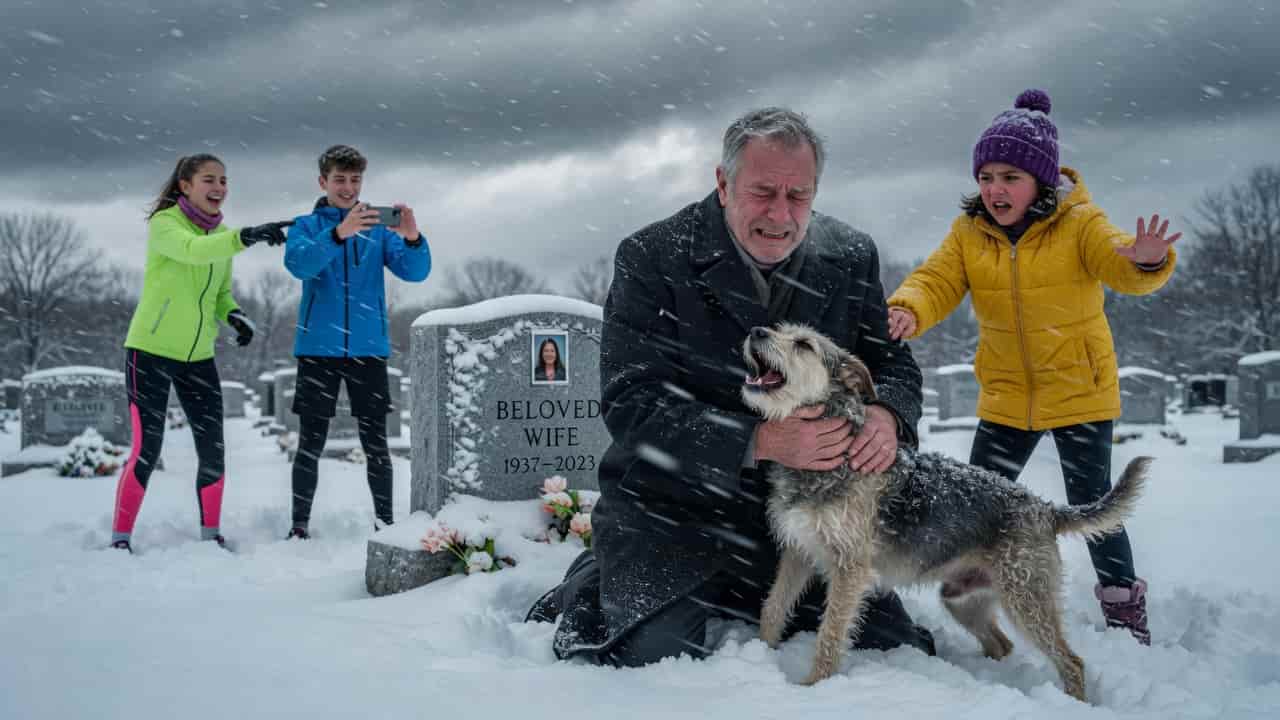
I watched the boy in the neon jacket hold up his phone, his face twisted into a cruel grin. He was recording a man who couldn’t even hear the insults being hurled at him. Arthur sat in the freezing New York slush, his knees soaked, his hands trembling as he reached for the dog. To the teenagers passing by, it looked like a joke—a man talking to a scruffy terrier that was yawning at a piece of granite.
But it wasn’t a yawn.
The dog’s mouth was wide open, her chest heaving with a force that shook her entire frame. She was howling with a grief so loud it should have echoed across the whole cemetery, but Arthur lived in a world of absolute, ringing silence. He had lost his hearing and his wife in the same year, and now, he was losing the last thing they had shared.
He didn’t know the boys were mocking him. He didn’t know the whole park was starting to stare. He just leaned forward and pressed his bare palm against the dog’s throat.
When he felt the vibration of that silent cry, his face broke. He wasn’t just a man in a cemetery anymore. He was a man finally hearing the only music he had left.
The boy kept filming, laughing about “the crazy old man,” until a small voice from the trees changed everything.
Chapter 1: The Weight of Quiet
The silence wasn’t empty. That was the first thing Arthur learned after the fever took his hearing and the cancer took Claire. People talked about silence as if it were a vacuum, a lack of something, but for Arthur, it was a physical weight. it was a thick, grey wool blanket draped over his head, pressing against his eardrums with a high-pitched, phantom ringing that never quite let go. It was a pressurized chamber that made every breath feel heavy in his lungs.
He sat at the small kitchen table of his Queens apartment, staring at the steam rising from a cup of tea he’d forgotten to drink. The apartment was too large now. Not in square footage—it was a cramped two-bedroom with peeling floral wallpaper—but in the way the space seemed to expand without Claire’s humming, without the clatter of her knitting needles, without the rhythmic thumping of Harmony’s tail against the floorboards.
Harmony sat by the radiator, her scruffy chin resting on her paws. She was a “Queens Special,” a mix of everything that had survived a winter on the streets before Claire had found her shivering behind a dumpster. Usually, Harmony was a percussion instrument. She barked at the mailman, whined at the fridge, and “sang” whenever Arthur sat at the Steinway in the corner.
Arthur looked at the piano. It was a model M, mid-century, with a finish that had been polished so many times the wood looked like dark water. It was the only thing of value they owned. It was also the thing currently killing him.
The debt didn’t care about art. The hospital bills from Claire’s final six months sat on the counter in a neat, terrifying stack, held down by a decorative glass bird. The collection agency didn’t care that Arthur had spent forty years teaching middle schoolers how to find Middle C. They didn’t care that his ears were now useless organs. They wanted thirty-two thousand dollars, and the Steinway was the only way to start that fire.
A sharp, rhythmic vibration traveled through the floor.
Arthur looked up. Someone was pounding on his door. He didn’t hear the sound, but he felt the wood frame rattling through the soles of his slippers. He stood up, his knees popping—a sensation he felt as a dull click in his joints—and walked to the door.
He looked through the peephole. It was Miller, the man from the piano restoration shop. Beside him stood two younger men in grey mover’s jumpsuits.
Arthur opened the door. The cold air from the hallway hit him like a physical blow. Miller was talking, his mouth moving in the exaggerated way people did when they knew Arthur was deaf. It made Arthur feel like a child, or an exhibit.
“Mr. Vance? We’re here for the pickup,” Miller’s lips formed.
Arthur nodded. He didn’t trust his voice. When you couldn’t hear yourself, you never knew if you were shouting or whispering, or if your tone sounded like a rusted hinge. He stepped back, gesturing for them to enter.
The movers didn’t look at him. To them, he was just a job, a tragic old man in a cardigan. They moved toward the Steinway with professional efficiency, laying out moving blankets that smelled of diesel and old dust.
Harmony stood up. Her ears peaked, her tail tucked between her legs. She walked over to the piano and let out a sharp, jagged movement of her jaw. Arthur knew she was barking. He could see the tension in her chest, the way her ribs expanded. She looked at Arthur, her eyes wide and pleading.
Stop them, she seemed to say. That’s our heart.
Arthur reached out and grabbed Harmony’s collar, pulling her back. He felt the vibration of her growl against his palm. It was a low, steady thrum, like a distant engine.
“I know,” he mouthed. He didn’t say it out loud.
He watched as they removed the legs of the piano. The instrument looked vulnerable, like a great black beast being butchered on his living room floor. When they tilted the body onto the skid, Arthur felt the floorboards groan. He closed his eyes. He tried to remember the sound of Claire playing Chopin’s Nocturne in E-flat major. He tried to summon the specific, bell-like clarity of the upper register.
Nothing came. Only the pressurized ringing in his head.
Miller handed him a clipboard. Arthur signed the release. His hand didn’t shake until the pen left the paper.
“The check will be mailed by Friday,” Miller’s lips said. “I’m sorry for your loss, Arthur. Truly. She was a beautiful instrument.”
Arthur nodded again. He wanted them to leave. He wanted the silence to stop being so loud.
When the door finally clicked shut—a vibration that felt like a final punctuation mark—the apartment felt hollow. The corner where the piano had stood was a glaring, pale rectangle on the floor where the sun hadn’t faded the wood.
Harmony didn’t go back to the radiator. She walked into the empty space and circled it three times. Then, she sat in the exact center of where the piano had been, lifted her head, and opened her mouth.
She didn’t make a sound Arthur could perceive. But her entire body began to tremble. Her throat strained, the tendons standing out under her fur. She was howling. It was a long, sustained note that seemed to pull from the very bottom of her soul.
Arthur watched her, his heart cracking. She was singing to the ghost of the music. She was calling out to the only person who had ever truly listened.
He went to the closet and pulled out his charcoal wool coat. It was Claire’s favorite. She used to say it made him look like a poet, even when he was just going to buy milk. He whistled—a sharp, piercing breath he hoped was loud enough for the dog to feel—and gestured to her leash.
They had to get out. The silence in the apartment was starting to taste like copper.
They walked toward the subway. The city was a pantomime of chaos. Yellow cabs swerved, their horns undoubtedly blaring, but to Arthur, they were just bright streaks of light. People rushed past, their mouths moving in invisible conversations. He felt the rumble of the R train through the sidewalk, a deep, tectonic shudder that traveled up his legs and settled in his hips.
He checked his pocket. He had the small, velvet bag. Inside was a handful of dried lavender from Claire’s garden and a small, silver tuning fork. It was a ridiculous thing to carry to a cemetery, but it was the only thing he had left that represented the pitch of her voice.
They reached St. Jude’s by mid-afternoon. The cemetery was a vast, rolling field of white and grey, the headstones peeking out from the snow like broken teeth. The wind was picking up, swirling the dry powder into miniature cyclones between the graves.
As they neared the section where Claire was buried, Arthur saw a group of people near the path. They were young, dressed in expensive, neon-colored running gear. One of them, a tall boy with a shock of blonde hair and a phone clutched in his hand, was looking at something near a headstone and laughing.
Arthur slowed down. Harmony’s ears were flat against her head. She was looking at the boys, then at the grave.
It was Claire’s grave.
The boy in the neon green jacket was pointing his phone at the headstone. He was saying something to his friend, his face contorted in a sneer.
Arthur didn’t need to hear the words to feel the weight of them. He knew that look. He’d seen it in the eyes of his students when they thought he wasn’t looking. It was the look of someone who had found something “other,” something broken that they could use to feel whole.
He tightened his grip on Harmony’s leash. The silence in his head suddenly felt very, very cold.
Chapter 2: The Snow at St. Jude’s
The wind at St. Jude’s didn’t just blow; it searched. It found the gaps in Arthur’s coat, the frayed edges of his scarf, the places where his skin met the biting air. He trudged through the six-inch drifts, his boots making a soft, rhythmic packing sensation he felt in his ankles.
The teenagers were still there. There were three of them—two boys and a girl. They looked like they belonged in a fitness commercial, all moisture-wicking fabric and high-end sneakers. The leader, the one in the neon green jacket, was practically dancing with amusement.
Arthur approached the grave. Claire’s name was etched in modest serif: Claire Vance. 1962-2025. The Music Never Ends.
The boy in the green jacket didn’t move. He stood right beside the headstone, his phone raised. He was filming Harmony.
Harmony had stopped five feet from the grave. She wasn’t sniffing the ground or looking for a place to settle. She was standing perfectly still, her head tilted back at an impossible angle, her mouth wide open. Her throat was pulsing.
She was doing it again. The silent howl.
The boy in green turned his camera toward Arthur as he approached. His mouth moved rapidly. Arthur could catch fragments: “…look… crazy… dog…”
Arthur stopped. He felt a flush of heat rise up his neck, a desperate, impotent anger. He reached out and touched Harmony’s shoulder, trying to coax her down. She wouldn’t budge. She was a statue of grief, her ribs vibrating with the force of a sound Arthur would never hear again.
The boy in green stepped closer, thrusting the phone toward Arthur’s face. He was shouting now, his expression mocking.
“Hey! Is she dying? Or is she just as mental as you are?”
Arthur could read the word “mental.” He could read the word “dying.” He stood there, his hands buried in his pockets, feeling the social pressure of the other two teenagers. The girl was giggling, her hand over her mouth. The other boy was recording too.
They weren’t just passing by. They had found a show. An old man who couldn’t defend himself and a dog that looked like it was having a seizure.
Arthur looked down at the grave. He felt a wave of profound shame. He had sold Claire’s piano today. He had let the heart of their home be hauled away by men in jumpsuits, and now he was standing here, letting children mock the only thing left that loved her.
He reached out his hand, palm open, signaling for them to back away.
The boy in green didn’t back away. He stepped onto the mounded snow of Claire’s grave, his expensive sneaker pressing down directly over where her heart would be. He leaned in, his face inches from Arthur’s.
“What’s the matter, Pops? Can’t hear me? Do I need to use sign language?” The boy made a series of crude, nonsensical gestures with his free hand, laughing at his own wit.
Arthur felt the vibration of the laughter. It wasn’t a sound; it was a rhythmic shudder in the air, a series of sharp, jagged pulses that felt like needles against his skin.
He looked at the boy’s feet on the grave. The disrespect was a physical weight. He wanted to shout, to roar, to tell them about the forty years of music, about the way Claire’s laughter sounded like a cello, about the debt and the silence.
But he couldn’t. His voice was a locked room.
He turned his back on them. It was the only defense he had—the refusal to participate in his own humiliation. He knelt in the snow beside Harmony. The cold seeped through his trousers instantly, a numbing bite that felt honest compared to the heat of the boy’s mockery.
He reached out and did the only thing he knew how to do. He pressed his bare palm against Harmony’s throat.
The vibration hit him like a lightning strike.
It wasn’t just a howl. It was a frequency. It was a deep, resonant thrum that bypassed his useless ears and went straight into the bones of his hand, traveling up his arm and settling in his chest. It was a minor key. It was the exact pitch of the low G on the Steinway, the one Claire used to strike when she was thinking.
Arthur’s eyes filled with tears. He wasn’t crying because of the boys. He was crying because he could feel her. Through the dog, through the vibration, the silence had finally broken.
Behind him, the boy in green was still filming. He moved around to get a better angle of Arthur’s face, of the tears.
“Oh, look! He’s crying! Viral gold, man. This is going to go crazy on TikTok.”
Arthur ignored him. He closed his eyes and leaned his forehead against Harmony’s damp fur. He felt the rhythm of her breath, the stutter of her vocal cords.
“I feel you,” he whispered. He didn’t care if it sounded like a croak or a scream. “I feel you, Harmony.”
The group of teenagers stayed for another minute, their shadows dancing on the snow in front of Arthur. They were waiting for a reaction, for a fight, for something they could edit into a punchline. When Arthur remained a statue, kneeling in the cold, they eventually grew bored.
“Come on, let’s go. This is depressing,” the girl said. Arthur saw her lips move as she turned away.
The boy in the green jacket took one last close-up of Claire’s headstone and Arthur’s kneeling form. He spat into the snow—a small, dark mark near the grave—and jogged off after his friends.
Arthur stayed there long after the vibrations of their footsteps had faded. The sun began to dip below the horizon, turning the snow into a bruised, purple landscape.
He reached into his pocket and pulled out the silver tuning fork. He struck it against the granite of the headstone. He couldn’t hear the note, but he held the base of the fork against his own jawbone.
The vibration hummed through his skull. An A-440. Perfect pitch.
He looked at Harmony. She had stopped howling. She was sitting now, her head resting on his knee. They were both soaked, both shivering, both lost in a world that had forgotten how to listen.
“We have to go home,” Arthur mouthed.
But as he stood up, his legs stiff and protesting, he realized he didn’t want to go back to the apartment with the pale rectangle on the floor. He didn’t want to go back to the stack of bills and the ringing silence.
He looked toward the cemetery gates. A man was standing there, leaning against a stone pillar. He held a violin case in one hand and a cardboard sign in the other.
Arthur adjusted his coat. He felt the residue of the humiliation like a layer of soot on his skin. He needed to find a way to make the world vibrate again.
Chapter 3: The Mirror on the Sidewalk
The street performer was a man who looked like he’d been carved out of driftwood. He wore a heavy, salt-stained peacoat and a fingerless glove on his left hand. He stood just outside the wrought-iron gates of St. Jude’s, where the foot traffic from the subway was heaviest.
Arthur stopped a few feet away. He watched the man’s bow arm. It was fluid, a graceful arc that suggested a melody Arthur’s mind desperately tried to fill in. He looked at the man’s face—eyes closed, head tilted, a look of absolute, agonizing peace.
It was the look Arthur used to have.
He felt a sharp pang of envy so intense it felt like physical pain. This man was pouring sound into the air, and even if no one was listening, the air was changing. The molecules were dancing.
Harmony walked up to the violinist and sat down. She didn’t bark. She didn’t howl. She just watched the bow move back and forth.
The violinist opened his eyes. He saw Arthur. He didn’t stop playing, but he nodded, a small, knowing movement. He looked at the dog, then back at Arthur’s eyes.
After a moment, the man drew the bow across the strings in a final, slow stroke. He lowered the violin.
Arthur stood there, feeling the sudden lack of motion. He pulled a crumpled five-dollar bill from his pocket and dropped it into the open violin case.
The man smiled. “Thank you,” his lips said. He had a thick, Russian accent that Arthur could almost see in the shape of his mouth. “Beautiful dog. She has the ear.”
Arthur pointed to his own ears and shook his head. He pulled a small notebook and a pen from his inner pocket—his constant companions since the fever.
I am deaf, he wrote. But she can hear you.
The violinist’s smile faded, replaced by a look of profound, heavy empathy. He set the violin down in the case and stepped toward Arthur. He didn’t speak with the exaggerated lip movements of the teenagers. He spoke normally, his eyes locked onto Arthur’s.
“I am Sergei,” he said. “I play for the ghosts. They are the only ones with time to listen.”
Arthur wrote: My wife is in there. I sold her piano today.
Sergei read the note. He looked at the grey gates of the cemetery, then back at Arthur. He reached into his pocket and pulled out a thermos, pouring a capful of steaming tea and handing it to Arthur.
The tea was bitter and smelled of bergamot. The heat of the plastic cup felt like a lifeline.
“The piano is wood and wire,” Sergei said, his mouth forming the words with a rhythmic precision. “The music is what stays in the floor. It stays in the dog. It stays in you.”
Arthur looked at his hands. The hands that had taught children for forty years. The hands that had held Claire’s while she died. The hands that had felt the vibration of a silent howl.
The boys in the park laughed at her, Arthur wrote. They filmed her. They thought she was a joke.
Sergei’s expression hardened. He looked at Arthur’s charcoal coat, at the way he held himself—the stoop of a man who had been told he was no longer part of the conversation.
“People are loud because they are empty,” Sergei said. “They make noise so they do not have to hear the silence. You? You have the deep quiet. That is where the real music starts.”
He picked up his violin again. He didn’t play a song. He tucked the instrument under his chin and looked at Arthur.
“Put your hand on the wood,” he signaled.
Arthur hesitated. He looked at the expensive-looking violin, then at his own rough, cold hands. He stepped forward and placed his fingertips against the body of the instrument, just below the f-holes.
Sergei began to play.
It wasn’t like the dog’s howl. This was a complex, shifting architecture of vibration. It was a series of rapid pulses, then a long, low moan that made the wood shiver. Arthur could feel the different strings—the sharp, thin bite of the E, the warm, round belly of the G.
He closed his eyes. For the first time in a year, the ringing in his head seemed to fade. He wasn’t hearing the music, but he was inside it. He was feeling the resonance of a man’s life being squeezed through four strings.
A shadow fell over them.
Arthur opened his eyes. A woman in a long, tan trench coat was standing there, her arms crossed. She looked impatient, her eyes darting between Sergei and Arthur.
“Excuse me,” she said. Arthur could see the sharp, percussive movement of her lips. “You’re blocking the sidewalk. People are trying to get to the train.”
Sergei didn’t stop playing. He just shifted his weight, turning his back to the woman.
The woman looked at Arthur. She saw the dog, the notebook, the old man with his hand on a violin. She sighed, a visible puff of air in the cold.
“This isn’t a theater,” she said, her mouth moving with a sense of entitlement that made Arthur’s stomach turn. “Some of us have real jobs.”
She walked past, intentionally bumping Arthur’s shoulder.
Arthur pulled his hand away from the violin. The music—the feeling of it—snapped. The silence rushed back in, heavier than before.
He looked at Sergei. The violinist stopped playing and sighed.
“The world is in a hurry to be nowhere,” Sergei said. “Go home, Arthur. Feed the dog. Tomorrow, you come back. We play more.”
Arthur nodded. He felt a strange, fragile connection to this man. A mirror of what he used to be, and perhaps a map of what he could become.
As he walked back toward the subway, Harmony trotting at his side, he felt the residue of the day. The loss of the piano, the mockery of the teenagers, the kindness of the violinist. It was a chaotic symphony of emotions, and for the first time, he didn’t try to shut them out.
He reached the subway entrance. The R train was pulling in—he felt the massive, grinding vibration in his teeth.
He was about to descend into the darkness when he felt a small, firm tug on his sleeve.
He turned around.
Standing there was a girl. She couldn’t have been more than ten years old. She wore a bright yellow puffer jacket and a blue knit beanie. Her eyes were wide and intelligent, and she was looking at him with a startling intensity.
She didn’t speak. She didn’t point.
She raised her hands and began to move them in a fluid, beautiful sequence.
Arthur froze. He didn’t know much sign language—he had struggled to learn after the fever, his old fingers refusing to move with the necessary grace. But he recognized these signs.
“I saw,” she signed. “I saw the boys. They are bad.”
Then, she pointed to Harmony.
“Your dog,” she signed, her hands moving like birds. “She is not broken. She is singing.”
Chapter 4: The Girl Who Sees
Arthur stood at the top of the subway stairs, the cold wind whipping his coat around his legs. The girl in the yellow jacket didn’t move. She waited for him to respond, her hands held in front of her chest, ready for the next thought.
Arthur’s heart hammered against his ribs. He felt a sudden, sharp vulnerability. This child had seen him. She had seen the humiliation at the grave. She had seen the dog’s silent howl.
He reached for his notebook, but his hands were trembling too much. He looked at her, his eyes searching her face.
“You…” he mouthed. He stopped. He tried to remember the sign for Thank you.
He touched his fingertips to his lips and moved his hand forward, toward her.
The girl smiled. It was a bright, uncomplicated expression that cut through the grey New York twilight.
“My name is Maya,” she signed. She spoke as she signed, her lips moving clearly. “My brother is like you. He doesn’t hear the world. He hears the light.”
Arthur swallowed hard. He felt a lump in his throat that made it hard to breathe. He knelt down so he was at her eye level, ignoring the protest of his joints.
“I am Arthur,” he mouthed.
Maya reached out and patted Harmony’s head. The dog leaned into the girl’s touch, her tail giving a single, tentative wag.
“Where are you going?” Maya signed.
Arthur pointed down toward the subway.
Maya shook her head. “The train is broken. Many people. Very loud. My mom is over there.”
She pointed to a small, silver sedan idling at the curb. A woman was waving from the driver’s seat.
“We can take you,” Maya signed. “We live near Queens Plaza.”
Arthur hesitated. The internal alarm of a lifetime spent in New York told him to decline. You didn’t get into cars with strangers. But then he looked at the girl’s yellow jacket, at the kindness in her eyes, and then at the dark, cold mouth of the subway entrance.
He felt tired. Not just in his body, but in his soul. He was tired of being a ghost in his own city.
He nodded.
The ride was quiet. Arthur sat in the back seat with Harmony and Maya. The woman, Maya’s mother, kept looking at him in the rearview mirror, her expression one of gentle curiosity. She spoke to Maya in sign language, her hands moving rapidly.
Maya turned to Arthur. “My mom says you have the face of a teacher.”
Arthur smiled. “I was,” he mouthed. “Music.”
Maya’s eyes lit up. “Music! Like the violin man?”
Arthur nodded.
When they reached his apartment building, the sun had fully set. The streetlights flickered on, casting long, orange shadows across the pavement.
Maya got out of the car with him. She walked him to the door of his building, her mother watching from the car.
“Arthur,” Maya signed, her expression becoming serious. “The boys at the grave. They are not the world. They are just the noise.”
She reached into her pocket and pulled out a small, laminated card. It was a list of American Sign Language basics—the alphabet, common phrases, and a diagram of the hand positions.
“Practice,” she signed. “So next time, you can tell them to go away.”
Arthur took the card. The plastic was warm from her pocket.
“Thank you, Maya,” he mouthed.
He watched the silver car drive away, its red taillights disappearing into the flow of traffic. He felt a strange, flickering warmth in his chest. It wasn’t hope—not yet—but it was something that felt like the beginning of a melody.
He went upstairs to the apartment. The silence was waiting for him, but it felt different. It didn’t feel like a weight anymore; it felt like a canvas.
He went to the corner where the piano had been. He sat down on the floor, in the center of the pale rectangle. Harmony came over and curled up in his lap.
He pulled out the card Maya had given him. He began to move his hands.
A. B. C.
His fingers were stiff, his joints aching. But he kept going.
D. E. F.
He looked at the glass bird on the counter. He looked at the stack of bills. He knew the debt wasn’t going away. He knew his hearing wasn’t coming back. But as he sat there in the dark, he realized something he had forgotten in the year since Claire died.
Music wasn’t something you heard. It was something you did. It was a choice to vibrate. It was a choice to respond to the silence.
He reached out and touched Harmony’s neck. She was breathing deeply, her heart beating a steady, rhythmic pulse against his palm.
“I’m still here,” he signed to the empty room.
He didn’t need to hear the words. He could feel the shape of them in the air.
He stayed there for a long time, practicing the signs. Hello. My name is Arthur. I am a musician.
He was just reaching the sign for Friend when he felt a sudden, sharp vibration through the floorboards.
It wasn’t the pound of a fist. It was a rhythmic, scratching sound.
He stood up and went to the door. He looked through the peephole.
There was an envelope taped to the wood.
He opened the door and took the envelope. It was heavy, made of thick, cream-colored paper. There was no return address.
Inside was a single photograph and a note.
The photograph was of the Steinway. It was sitting in a sun-drenched room, surrounded by bookshelves and large windows. It looked beautiful. It looked loved.
The note was written in a elegant, looping hand:
Mr. Vance,
I am the one who bought your piano. I wanted you to know that it is in a house filled with children who are learning their first scales. But I found something tucked behind the soundboard when we moved it. I think it belongs to you.
Arthur reached into the envelope. His fingers touched something small and cold.
He pulled it out.
It was a wedding ring. Claire’s ring. The one she had lost three years ago, the one they had searched for until their knees were bruised.
Arthur fell to his knees in the middle of the hallway. He clutched the ring to his chest, his eyes closing as a sob racked his body.
He couldn’t hear the sound of his own weeping. But he felt the vibration of it. It was loud. It was terrifying. It was the most beautiful thing he had ever felt.
And in that moment, in the hallway of a cramped Queens apartment, the silence finally, mercifully, broke.
Chapter 5: The Static in the Diner
The wedding ring sat on the scarred wooden surface of Arthur’s kitchen table, a small, defiant circle of gold that seemed to pulse against the dim light of the overhead bulb. It was Claire’s ring, the one with the tiny, inclusions-heavy diamond they’d bought with three months’ worth of his substitute teaching wages back in 1984. He hadn’t seen it in years, and yet, holding it felt like catching a glimpse of a ghost in a crowded room. It was cold, then it was warm, and then it was just a piece of metal that carried the weight of four decades.
Arthur didn’t put it on. His fingers were too thick now, the knuckles swollen with the quiet arrogance of age. Instead, he threaded a piece of sturdy black twine through it and looped it around his neck, tucking the gold beneath his undershirt. It rested against his sternum, a secret heartbeat.
The apartment felt different this morning. The pale rectangle where the Steinway had lived was still there, but it no longer felt like an open wound. It felt like a stage.
Harmony was restless. She paced the perimeter of the living room, her claws clicking against the linoleum—a sound Arthur couldn’t hear but could visualize with painful clarity. She kept stopping at the door, her ears swiveling toward the hallway. She was waiting for the vibration of a world that Arthur was only just beginning to learn how to touch.
He put on his charcoal coat and whistled for her. Today, they weren’t going straight to the cemetery. Today, Arthur needed to eat something that didn’t come out of a tin or a freezer bag. He needed to be among people, even if he couldn’t hear them. He needed to prove to himself that he wasn’t just a part of the architecture of the city.
They walked three blocks to The Silver Spoon, a diner that had survived the gentrification of the neighborhood by sheer stubbornness and a floor that was permanently sticky with spilled syrup. It was a place of low-frequency hums—the industrial refrigerator, the sizzle of the griddle, the rhythmic thud of the dishwasher.
Arthur sat at a corner booth, Harmony tucked neatly beneath the table. He pulled out Maya’s sign language card and propped it against the sugar shaker.
A-R-T-H-U-R.
He moved his fingers, feeling the stiffness in the tendons. He was trying to spell Claire when he felt the air in the diner shift. It wasn’t a sound, but a change in pressure, the way the atmosphere thickens just before a summer storm.
He looked up.
Standing by the register were the teenagers from the cemetery.
The boy in the neon green jacket—Tyler, Arthur had heard one of the others call him—was leaning against the counter, his phone out. He was showing something to the waitress, a woman named Martha who had been pouring Arthur’s coffee for fifteen years.
Tyler was laughing. It was a jagged, ugly motion of the mouth. He pointed toward the back of the diner, then realized Arthur was already looking at him.
The boy didn’t look away. He didn’t look ashamed. Instead, his grin widened into something predatory. He nudged his friend, a kid in a grey hoodie, and they began to walk toward Arthur’s booth.
Arthur felt the familiar, cold coil of shame in his gut. He looked down at his hands, at the sign language card. He wanted to be invisible. He wanted to be the ghost they thought he was.
But then he felt the ring against his chest. It was a hard, sharp reminder of a woman who had never allowed him to be small.
Tyler reached the booth and slammed his hand onto the table. The vibration rattled the sugar shaker and sent a jolt of adrenaline through Arthur’s spine.
The boy’s mouth was moving. Arthur didn’t need to hear the words to understand the contempt.
“Hey, look! It’s the conductor! Where’s your baton, Pops?” Tyler held up his phone. On the screen was the video from yesterday. There was Arthur, kneeling in the snow, his face twisted in grief, pressing his hand to Harmony’s throat. The video had a caption in bright, neon text: SCHIZO DOG OR SENILE MAN? YOU DECIDE.
A few people at the nearby tables turned to look. A middle-aged man in a suit glanced at the phone, let out a short, dismissive puff of air, and went back to his omelet. A group of construction workers in the next booth went silent, watching the scene with the detached curiosity of people watching a car wreck.
The humiliation was public, targeted, and intentional. Tyler was performing for the room, using Arthur’s silence as a stage.
“What’s the matter? Cat got your tongue? Or did you lose that too?” Tyler leaned over the table, his face inches from Arthur’s. He smelled of cheap cologne and energy drinks. He took a sip of his soda and then, with a deliberate, slow motion, he flicked his wrist. A spray of dark brown liquid splashed across Arthur’s sign language card and onto his charcoal coat.
Arthur froze. He looked at the wet, brown stain on the wool. He looked at the card—Maya’s gift—now wrinkled and stained with cola.
The room felt very small. The silence felt very heavy.
Tyler laughed, a silent, shaking motion of his shoulders. He turned to his friend, expecting a high-five, but the kid in the hoodie was looking at the floor, his face flushed.
Arthur reached down and touched Harmony’s head. He felt her trembling. She wasn’t howling now; she was growling, a low, tectonic vibration that traveled through his fingertips and into his marrow.
He didn’t look at Tyler. He looked at the man in the suit. He looked at the construction workers. He looked at Martha, who was standing behind the counter with a dishcloth in her hand, her mouth open in a silent O of shock.
No one moved. No one spoke. The social contract of the diner had been breached, but no one wanted to be the first to repair it.
Arthur felt a surge of raw, blistering anger. It wasn’t the anger of a victim; it was the anger of a man who had spent forty years teaching children how to find harmony in a discordant world.
He stood up. He did it slowly, using the table for leverage. He was taller than Tyler had expected. He stood with his shoulders back, his chin tilted up, the way he used to stand before the first chair violinists at the All-State orchestra.
He reached out and took the phone from Tyler’s hand.
It was a quick, decisive movement. Tyler was so shocked he didn’t even resist.
Arthur held the phone up so the whole diner could see the screen. He pointed to the video of himself in the snow. Then, he pointed to his ears. He shook his head.
He looked Tyler in the eye. He didn’t use sign language. He didn’t use his notebook.
He opened his mouth and spoke. He didn’t know how loud he was. He didn’t know if his voice was cracking or booming. He just let the air out of his lungs in a single, sustained note of truth.
“My wife… is dead,” he said. The words felt like stones in his mouth. “My dog… is grieving. You… are nothing.”
The silence that followed was absolute. Arthur could feel it—a thick, pressurized vacuum that seemed to suck the very air out of the diner.
Tyler’s face went from pale to a deep, bruised purple. He looked around the room, looking for the laughter he had cultivated, but he found only stony, uncomfortable stares. The man in the suit was looking at him with naked disgust. Martha was walking toward the booth, her face set in a hard, angry mask.
“Out,” Martha’s lips said. She didn’t need to shout. She pointed to the door with the dishcloth. “Get out of my diner. Now.”
Tyler snatched his phone back from Arthur’s hand. He tried to say something—a final insult, a parting shot—but the words seemed to die in his throat. He turned and practically ran for the door, his friend trailing behind him like a shadow.
The bell above the door didn’t make a sound for Arthur, but he felt the rush of cold air as they left.
He sat back down. His legs were shaking. He felt the residue of the encounter—the heat in his face, the thrumming of his heart, the sticky sensation of the soda on his coat. It was an ugly, jagged feeling. It wasn’t a victory. It was a collision.
Martha came over with a fresh pot of coffee and a clean cloth. She wiped the soda off the table, her hands moving with a gentle, rhythmic efficiency. She looked at Arthur, her eyes softening.
“I’m so sorry, Arthur,” her lips said. “He’s a punk. A nobody.”
Arthur nodded. He picked up the stained sign language card. The ink had run on the letter M.
M for Music. M for Maya. M for Mercy.
He realized then that the bullying hadn’t just been about his deafness. It had been about his perceived brokenness. Tyler had seen a man who had lost his voice and assumed he had lost his dignity.
Arthur reached into his shirt and felt the ring. It was still there. It hadn’t changed. It was still a circle.
He finished his coffee in silence. When he left the diner, he saw Sergei standing on the corner, his violin case at his feet.
Sergei wasn’t playing. He was watching the traffic, his face a map of old sorrows and new patience. He saw Arthur and Harmony and he raised a hand in greeting.
“I heard,” Sergei’s lips said as Arthur approached.
Arthur frowned. Heard what?
Sergei pointed to a group of people standing near the subway entrance. They were huddled around a phone, their faces illuminated by the blue light of the screen.
“The video,” Sergei signaled. “It is everywhere. But they are not laughing anymore, Arthur. Someone posted the truth. About the piano. About Claire.”
Arthur felt a strange, cold shiver. The privacy of his grief had been stripped away, turned into a digital commodity. He felt exposed, like a nerve ending.
“People are talking,” Sergei continued. “They want to help. They want to know where the music went.”
Arthur looked at the scruffy dog at his side. He looked at the grey New York sky. He didn’t want their help. He didn’t want their pity.
He wanted to hear the song Harmony was singing.
He took his notebook out and wrote a single sentence.
I need to play.
Sergei nodded. He didn’t ask how. He didn’t ask where. He just picked up his violin case and gestured toward the cemetery.
“Then we play,” he said. “For the ones who can hear us.”
Chapter 6: The Resonance of the Unseen
The walk back to St. Jude’s felt like a procession. Arthur, Sergei, and Harmony moved through the slush with a shared, rhythmic purpose. The wind had died down, leaving the air brittle and clear. The snow on the graves had frozen into a hard, sparkling crust that caught the pale afternoon light.
They didn’t go to Claire’s grave. Not yet.
Sergei led them to the center of the cemetery, to an old, Victorian-era gazebo that sat on a slight rise. It was a structure of wrought iron and weathered wood, its floorboards grey and splintered. It was a place designed for sound, for the small brass bands that used to play for the mourning families of a century ago.
Sergei climbed the steps and opened his violin case. He didn’t take out the instrument immediately. He looked at Arthur, his eyes searching.
“You have no piano,” Sergei’s lips said. “But you have the wood. You have the floor.”
He pointed to the gazebo floor.
Arthur understood. He walked to the center of the gazebo and sat down. He didn’t sit on a chair; he sat directly on the floorboards, his legs stretched out in front of him. He leaned back, pressing his palms and his spine against the wood.
Harmony sat beside him, her shoulder pressing against his thigh.
Sergei tucked the violin under his chin. He didn’t look at the music. He looked at the horizon, at the skyline of Manhattan rising up like a jagged graph of a heartbeat in the distance.
He began to play.
Arthur closed his eyes. At first, there was only the familiar, pressurized ringing in his head. Then, slowly, he felt it.
It started as a tickle in the base of his spine. A low, resonant hum that traveled through the floorboards and into his bones. It was a deep, mournful vibration, like the sound of a cello in a cathedral.
Then, it shifted. The vibration became faster, more intricate. It danced across his palms, a series of light, percussive taps that felt like rain on a tin roof. It was the high notes, the E-string, the sharp, bright clarity of the melody.
Arthur’s breath hitched. He wasn’t hearing it, but he was experiencing it. The music was a physical presence, a tide that was rising up around him, filling the empty spaces in his chest.
He began to move his hands. He wasn’t conducting; he was signing.
C-L-A-I-R-E.
He spelled her name over and over, his fingers moving with a new, fluid grace. Every letter was a note. Every movement was a chord.
Suddenly, the vibration changed. It became raw, jagged, and powerful.
He opened his eyes.
Harmony had stood up. She was facing the Manhattan skyline, her head tilted back, her mouth wide open.
She was howling.
But it wasn’t the silent howl of the cemetery. This was something else.
Arthur looked at Sergei. The violinist was playing with a desperate, frantic intensity, his bow a blur of motion. He was leaning into the music, his eyes closed, his face wet with tears.
Arthur pressed his hand to the floorboards. The vibration was overwhelming now. It was a roar, a tidal wave of sound that seemed to shake the very foundations of the gazebo.
And then, he felt it.
A second vibration.
It was coming from the stairs.
He turned around.
Maya was there. She was standing at the base of the gazebo, her yellow jacket a bright splash of color against the grey stone. Beside her was a tall, thin boy in a wheelchair—her brother. He had his hands pressed against the metal frame of his chair, his eyes closed, a look of absolute, radiant joy on his face.
Behind them, more people were gathering.
The construction workers from the diner. Martha, still in her apron. Even the man in the suit. They were standing in the snow, silent and still, watching an old man on a floor and a scruffy dog singing to the wind.
Arthur saw Tyler.
The boy was standing at the edge of the crowd, his neon jacket looking garish and out of place. He wasn’t filming. He wasn’t laughing. He was holding his phone in both hands, his head bowed, his shoulders shaking.
He was crying.
The music reached a final, soaring crescendo. Sergei drew the bow across the strings in a long, sustained note that seemed to pull the very air out of the gazebo.
The vibration stayed in Arthur’s bones long after Sergei had stopped playing. It was a resonance that refused to fade, a lingering echo of something that had been lost and then found again in a different form.
Sergei lowered the violin. The silence rushed back in, but it was no longer heavy. It was light. It was expectant.
Maya climbed the steps and sat down next to Arthur. She didn’t sign. She just took his hand and placed it on her chest.
Arthur felt her heartbeat. It was a steady, rhythmic thrum.
“I feel you,” Maya signed, her eyes locked onto his.
Arthur looked at the crowd. He looked at Tyler, who was still standing at the edge of the woods. He looked at Sergei, who was wiping his violin with a silk cloth.
He realized then that the music hadn’t stopped when he lost his hearing. It hadn’t stopped when Claire died. It had just changed medium. It had gone from the air into the wood, from the wood into the bone, from the bone into the heart.
He reached into his shirt and pulled out the ring. He took Maya’s hand and placed the ring in her palm.
She looked at it, her eyes widening. She looked at Arthur, a question in her expression.
“For the piano,” Arthur signed. It was a clumsy, difficult sign, but she understood. “For the children.”
Maya shook her head. She closed Arthur’s hand over the ring.
“No,” she signed. “It is yours. It is the music.”
She stood up and gestured to her brother. They began to walk back toward the gates, the yellow jacket disappearing into the deepening shadows.
The crowd began to disperse. They moved quietly, with a shared, somber reverence. Martha waved a hand at Arthur before disappearing behind a row of headstones.
Arthur stayed in the gazebo with Sergei and Harmony. The sun had set, leaving the sky a deep, bruised indigo. The lights of the city were beginning to twinkle, a silent, flickering symphony of glass and steel.
Sergei packed his violin away. He walked over to Arthur and put a hand on his shoulder.
“The silence is a gift, Arthur,” his lips said. “It is the place where we can finally hear ourselves.”
Arthur nodded. He stood up, his joints popping—a sensation he welcomed now. He whistled for Harmony.
They walked back to Claire’s grave.
Arthur knelt in the snow. He didn’t feel the cold. He reached out and touched the granite of the headstone.
“The music never ends,” he mouthed.
He felt the vibration of the words in his own throat.
Harmony sat beside him. She didn’t howl. She didn’t bark. She just rested her head on the mound of snow, her eyes closing as she drifted into a deep, peaceful sleep.
Arthur looked at the Manhattan skyline. He looked at the ring on the twine around his neck.
He wasn’t a ghost. He wasn’t a victim. He was a man who lived in a world of absolute, beautiful, vibrating silence.
And for the first time in a year, he didn’t need to hear the music to know that it was beautiful.
He closed his eyes and let the silence take him. It was a song he finally knew by heart.
The ringing in his head was gone. There was only the steady, rhythmic pulse of the city, the soft, cold breath of the wind, and the quiet, enduring resonance of a love that had never truly left the room.
Arthur stood up, brushed the snow from his coat, and walked toward the gates. He didn’t look back. He didn’t need to.
The music was already home.