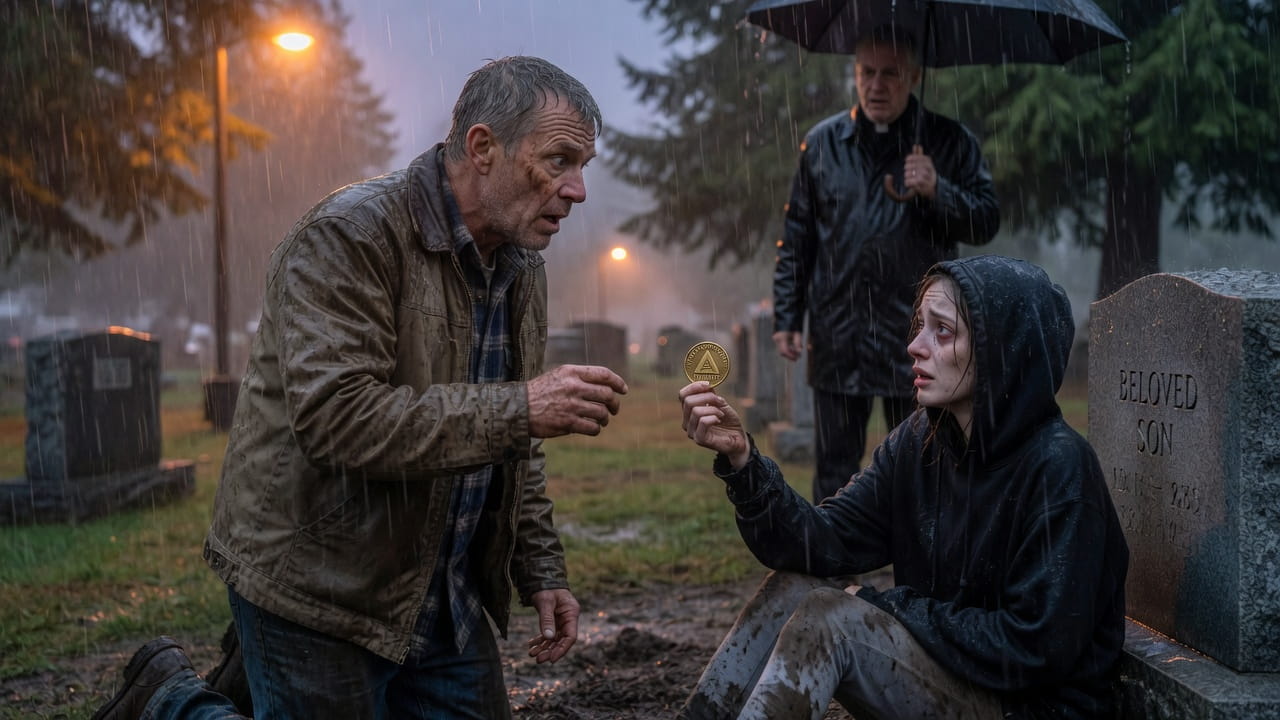
“She made it fifteen years,” the girl whispered, her voice shaking as much as her hands.
I stared at the small brass coin she was holding out. The rain was coming down hard, turning the cemetery dirt into a soup of mud, but I didn’t care about my boots. I only cared about the name etched into the back of that AA chip.
It was my wife’s name. Her real name.
“Why couldn’t she stay sober for me when I was a baby?” the girl asked, her eyes hollow and desperate.
I’ve been married to Linda for over a decade. I thought I knew everything about her. I thought we had the kind of boring, stable life that people like us dream of. But as I looked at this stranger—this girl who had Linda’s nose and Linda’s eyes—I realized I had been living with a ghost.
Linda wasn’t the woman I thought she was. She wasn’t the woman she told the whole town she was. And the secret she buried wasn’t just a lie—it was a person. A person who was currently shivering in the mud at my feet, looking for a mother who had vanished years ago to start a new life with me.
Chapter 1: The Weight of Clean Linens
The rain in Oakhaven didn’t just fall; it settled. It was a grey, pervasive weight that smelled of pine needles and old asphalt, a constant reminder that the Pacific Northwest didn’t care about your plans. Greg Stanton stood behind the counter of the Sunrise Diner, watching the droplets race down the plate glass. He liked the rain. It kept people inside, and the ones who did come in were usually quiet, grateful for the warmth and the smell of toasted sourdough.
At fifty-two, Greg had a face that looked like it had been carved out of a cedar stump—broad, lined, and generally immovable. He liked things that didn’t move. He liked the way the salt shakers felt in his hand when he refilled them, the specific clink of the heavy ceramic mugs, and the way his wife, Linda, looked when she walked through the front door at precisely 4:30 PM every day to help him close up.
“You’re staring again, Greg,” Carla said, wiping down the grill with a rhythmic, practiced motion. Carla had been the lead cook for fifteen years, and she knew the geography of Greg’s moods better than he did.
“Just thinking about the roof,” Greg lied. “The west corner is soft. I need to get up there before the real freezes start.”
Carla snorted, her spatula clacking against the metal. “You’re thinking about Linda. You always get that look about ten minutes before she shows up. Like a dog waiting for the mailman.”
Greg didn’t argue. There was no point. He loved Linda with a steady, unblinking devotion that sometimes embarrassed him. His first wife, Sarah, had left him twenty years ago because he was “stagnant.” She wanted neon lights and cities that never slept; Greg wanted a garden that didn’t die and a roof that didn’t leak. Linda was his reward for surviving the wreckage Sarah had left behind. Linda was soft-spoken, organized, and shared his craving for a life without surprises.
When the bell above the door chimed, Greg didn’t even look up. He knew the gait. He knew the scent of her rain-dampened wool coat.
“Hey, honey,” Linda said, sliding onto the end stool. She looked tired. There were shadows under her eyes that hadn’t been there a month ago, a subtle deepening of the lines around her mouth. She worked as an administrator at the local clinic, a job that suited her need for order.
“Rough day?” Greg asked, pouring her a cup of decaf without being asked.
“Just a lot of paperwork,” she said, her voice small. She didn’t look at him. She looked at the steam rising from the mug. “The flu season is hitting early. Everyone’s on edge.”
Greg reached across the counter and squeezed her hand. Her skin was cold. “We’ll go home, I’ll make that pot roast you like. You can be in bed by eight.”
Linda nodded, but she didn’t squeeze back. Her hand remained limp in his, a piece of driftwood. For the first time in twelve years, Greg felt a flicker of something that wasn’t safety. It was a cold, sharp needle of doubt. She had been distant for weeks—avoiding his eyes, taking long walks in the rain, staying up late in the living room with the lights off. He’d told himself it was the job, or the weather, or just the natural ebb and flow of a long marriage.
“I have to stop by the cemetery first,” Linda said, finally meeting his gaze. Her eyes were a pale, watery blue.
“The cemetery? For what?”
“Just… to check on Mrs. Gable’s plot,” Linda said. Mrs. Gable had been an elderly neighbor who passed two years ago. Linda had taken it upon herself to look after the woman’s final resting place since she had no family left. It was the kind of thing Linda did—quiet acts of service that made Greg proud to be her husband.
“In this rain? It’ll be a mud pit, Lin. Let’s go tomorrow.”
“I promised her,” Linda said, her voice hardening. It was a tone she rarely used, a sudden, jagged edge. “I’ll only be twenty minutes. Go on home, Greg. I’ll meet you there.”
She stood up, leaving the decaf untouched. Greg watched her walk out, the bell chiming a lonely, metallic note behind her. He stood there for a long time, the rag in his hand forgotten.
“She’s been going there a lot lately,” Carla said quietly from the grill. She wasn’t looking at him.
“She’s just being neighborly,” Greg said, his voice sounding hollow even to his own ears.
“Checking a headstone three times a week isn’t neighborly, Greg. It’s a vigil.” Carla finally looked up, and for the first time in fifteen years, Greg saw pity in her eyes. It was a look that made his stomach turn.
“Mind the shop, Carla,” Greg said, grabbing his tan canvas jacket from the hook.
“Greg, don’t,” Carla called out, but he was already through the door.
The drive to the Oakhaven Memorial Park took six minutes. The windshield wipers groaned against the heavy downpour, a rhythmic thump-shriek that grated on Greg’s nerves. He didn’t know why he was following her. He felt like a fool, a jealous husband chasing shadows, but the needle of doubt had turned into a dull ache.
The cemetery sat on a hill overlooking the grey expanse of the sound. It was a lonely place, filled with leaning markers from the logging days and newer, polished granite stones. He saw Linda’s silver sedan parked near the back gate. He pulled his truck into a stand of fir trees a hundred yards away and cut the engine.
He sat there, the rain drumming on the roof, feeling the heat from the heater vent die away. He could see her. She wasn’t at Mrs. Gable’s plot. She was standing near the older section, her head bowed, her shoulders shaking. She wasn’t checking a headstone. She was mourning.
Greg opened his door and stepped out. The cold air hit him like a physical blow, soaking through his flannel shirt in seconds. He walked softly, his boots squelching in the grass. He didn’t want to scare her; he wanted to understand.
But as he got closer, he realized Linda wasn’t alone.
A figure was huddled on the ground near a simple, weathered stone. It looked like a pile of wet laundry at first, but then it moved. A girl. Young, maybe twenty, with hair the color of straw plastered to her skull. She was wearing a black hoodie that was three sizes too big, and she was shivering so violently that Greg could hear her teeth chattering from ten feet away.
Linda was standing over her, her hands clenched at her sides. She wasn’t reaching out. She wasn’t helping the girl up. She was looking down at her with an expression Greg had never seen on her face. It wasn’t pity. It was terror.
“You can’t be here,” Linda’s voice drifted through the rain. It was high and thin. “I told you, you can’t come here.”
“I had nowhere else to go,” the girl sobbed. Her voice was raspy, the sound of someone who had been screaming or hadn’t spoken in days. “You were always here on Tuesdays. I remembered.”
“Go away,” Linda whispered. “Please. If you ever cared about me, just go away.”
Greg stopped. The world seemed to tilt on its axis. The rain felt heavier, colder. He saw Linda turn and run—not toward the girl, but away from her, toward her car. She didn’t see Greg standing in the shadows of the firs. She scrambled into her sedan, the tires spinning in the mud before she tore out of the cemetery gates.
The girl remained in the mud. She didn’t chase after the car. She just collapsed further into herself, a broken thing in a broken place.
Greg didn’t move for a long time. His heart was hammering against his ribs, a frantic, trapped bird. He thought about getting in his truck and going home. He thought about pretending he hadn’t seen anything. He could go home, wait for Linda, eat the pot roast, and go to bed at eight. He could keep the bubble intact.
But then the girl let out a low, keening moan, a sound of such pure, unadulterated agony that it bypassed Greg’s fear and hit his marrow.
He stepped out from behind the trees.
“Miss?” he said, his voice raspy.
The girl bolted upright, her eyes wide and bloodshot. She looked like a cornered animal, her hands clawing at the wet earth.
“Get away!” she shrieked. “I don’t have anything! Leave me alone!”
“I’m not going to hurt you,” Greg said, holding his hands out, palms up. “I’m Greg. I live here.”
The girl stared at him, her chest heaving. She was vibrating with cold, her skin a ghostly, translucent white. She looked like she was made of glass and might shatter if the wind blew too hard.
“She left,” the girl whispered, her eyes darting toward the empty gate. “She always leaves.”
“Who left?” Greg asked, though he already knew the answer.
The girl didn’t answer. Instead, she reached into the pocket of her soaked hoodie and pulled something out. She held it out to him, her hand shaking so hard she almost dropped it.
It was a small, brass coin. An AA sobriety chip.
“She made it fifteen years,” the girl said, her voice breaking into a thousand jagged pieces. “Why couldn’t she stay sober for me when I was a baby? Why wasn’t I worth fifteen years?”
Greg felt the ground go soft beneath him. He looked at the chip, then at the girl, then back at the road where his wife had disappeared. The silence of the cemetery was deafening, broken only by the rhythmic, hollow sound of the girl’s sobbing.
Chapter 2: The Brass Truth
The girl’s name was Mia, and she was dying. Not the quick kind of dying that comes with a car wreck or a heart attack, but the slow, agonizing evaporation of a human being who had run out of reasons to exist.
Greg had managed to get her into his truck. He’d had to lift her; she weighed nothing, just skin and bone and the smell of stale cigarettes and something chemical that made his eyes water. He’d wrapped her in his spare work jacket and turned the heater to full blast, the vents screaming as they tried to combat the chill in her marrow.
Now, they were sitting in the parking lot of the Oakhaven Urgent Care. The neon sign buzzed above them, casting a flickering red glow over Mia’s pale face. She was staring at the AA chip in her hand, her thumb rubbing the raised lettering with a frantic, obsessive motion.
“Who is she to you, Mia?” Greg asked. He kept his hands on the steering wheel, his knuckles white. He was afraid if he let go, he’d start shaking and never stop.
Mia didn’t look up. “She’s the woman who gave birth to me in a bathtub in Spokane while she was high on oxy. She’s the woman who left me at a fire station when I was four because she ‘couldn’t do it anymore.’ She’s the woman who sent me a birthday card every year until I turned ten, and then… nothing.”
Greg felt a cold sickness rising in his throat. Linda. His Linda. The woman who volunteered at the library and made sure the diner’s taxes were filed early. The woman who cried when she saw a dead squirrel in the road.
“Her name is Linda Stanton,” Greg said, his voice a flat, dead thing.
Mia laughed, a harsh, wet sound. “Is that what she calls herself now? Back then, she was Jolene. Jolene Miller. She had a tattoo of a hummingbird on her hip. She told me it was because she wanted to fly away.”
Greg closed his eyes. Linda had a tattoo on her hip. She told him it was a birthmark she’d had removed, a scarred-over remnant of a surgery she didn’t like to talk about. He’d never questioned it. He’d never questioned anything.
“How did you find her?”
“I didn’t,” Mia said, her voice dropping to a whisper. “I found the grave. My grandmother—her mother—died six months ago. In her stuff, I found a letter. It was from an attorney in this town. It was about a trust fund. A small one. Just enough to keep her mom quiet, I guess. I followed the money. And then I followed her.”
She looked at him then, and the raw, unfiltered pain in her eyes was almost too much to bear. “Who are you? You were with her at the diner. I saw you through the window.”
“I’m her husband,” Greg said.
Mia flinched as if he’d struck her. She looked at his wedding ring, then back at his face. A strange expression crossed her features—a mix of pity and contempt that made Greg feel suddenly, sharply ashamed.
“She looks happy,” Mia said. “Clean. Like she never touched the needle. Like she never let a man hit her for twenty bucks.”
Greg felt like he was drowning. Every word was a stone tied to his ankles. He looked at the urgent care doors. “You need help, Mia. You’re shivering, and your heart is racing. I can hear it from here.”
“I’m withdrawing,” she said simply. “I’ve been trying to get clean. I thought… I thought if I saw her, if she just said she was sorry, maybe I could do it. Maybe I wouldn’t need it anymore.”
“I’ll take you inside,” Greg said, reaching for the door handle.
“No!” Mia grabbed his arm. Her grip was surprisingly strong, her fingernails digging into his skin. “If you take me in there, they’ll call the cops. I have warrants. Just… take me somewhere I can sleep. Somewhere warm.”
“I can’t take you to my house, Mia. Linda is there.”
“Then take me back to the cemetery,” she said, her voice turning cold. “I’ll sleep with the people who can’t lie to me.”
Greg looked at her—really looked at her. She was a ghost of the woman he loved. She had the same high cheekbones, the same slight arch to her eyebrows. She was the physical manifestation of every lie Linda had ever told him. If he walked away now, she’d be dead by morning. The PNW rain didn’t grant second chances to the frail.
“I have a cabin,” Greg said. “It’s about twenty minutes out. It’s small, but it has a stove and a bed. My father used it for fishing.”
Mia let go of his arm. She slumped back into the seat, her eyes closing. “Fine. Whatever. Just stop the shaking, Greg. Please make it stop.”
He put the truck in gear and backed out of the lot. As he drove, his mind raced through the last twelve years. Every holiday, every anniversary, every quiet night on the porch. Was any of it real? Or was he just a prop in her play? A “boring” man who provided the perfect cover for a woman running from a life of needles and bathtubs.
He thought about his first wife, Sarah. She’d wanted excitement. Linda had wanted a fortress. He had built it for her, brick by brick, and all the while, the foundation was made of rot.
He reached the cabin—a small, cedar-shingle shack tucked into a ravine near the river. It smelled of woodsmoke and damp earth. He helped Mia inside, leaning her against the wall while he started a fire in the potbelly stove. The wood was dry, and soon the orange glow began to eat away at the shadows.
He laid her on the narrow cot and covered her with a heavy wool blanket. She was staring at the ceiling, her breath coming in short, ragged gasps.
“Why are you doing this?” she asked.
Greg sat on the edge of the hearth, his head in his hands. “Because I’m a boring man, Mia. And boring men do what’s right, even when it hurts.”
“She doesn’t deserve you,” Mia whispered.
“I don’t even know who ‘she’ is anymore,” Greg said.
He stayed with her for hours, watching her sweat through the withdrawal, listening to her mutter names he didn’t recognize. At one point, he took the AA chip from her hand. He turned it over.
Jolene M. 15 Years.
He gripped the coin until the edges bit into his palm. He wanted to throw it into the river. He wanted to scream. Instead, he tucked it into his pocket and stood up.
“I have to go home,” he said. “I have to talk to her.”
Mia didn’t answer. she was finally asleep, her face twitching in a dream.
Greg walked out into the rain. The drive home felt like a funeral procession. He pulled into his driveway and saw the lights on in the kitchen. He could see Linda through the window. She was standing at the sink, washing a dish that was already clean. Over and over, her hands moved in a frantic, mindless circle.
He walked through the front door. The house smelled of lavender and floor wax. It felt like a trap.
“Greg?” Linda said, turning around. She looked like a ghost. Her eyes were red-rimmed, her face devoid of color. “Where have you been? I was so worried. I called the diner, but Carla said you left hours ago.”
Greg didn’t say anything. He walked to the kitchen table and sat down. He felt a thousand years old.
“I went to the cemetery, Linda,” he said.
She froze. The dish she was holding slipped from her hand and shattered in the sink. The sound was like a gunshot in the quiet house.
“I told you,” she whispered, her back still to him. “I was checking on Mrs. Gable.”
“I found a girl,” Greg said, his voice dropping to a low, dangerous register. “She was shivering in the mud. She was holding a brass coin.”
Linda turned around. She looked like she was about to faint. She gripped the edge of the counter so hard her knuckles turned blue. “Greg, I can explain.”
“Can you?” Greg pulled the AA chip from his pocket and slammed it onto the table. The metallic clack echoed off the walls. “Can you explain Jolene Miller? Can you explain the girl in the bathtub? Can you explain why you’ve been lying to me for twelve years?”
Linda sank into the chair opposite him. She didn’t cry. She didn’t scream. She just looked at the chip as if it were a poisonous spider.
“I was going to die, Greg,” she said, her voice a flat, dead monotone. “If I didn’t leave that life, I was going to end up in a ditch. I had to become someone else. I had to.”
“And the girl?” Greg asked. “What about Mia?”
“She’s a reminder of everything I failed at,” Linda said, and for the first time, a flash of anger crossed her face. “I tried to help her, Greg. I sent money. I tried to find her a good home. But she’s just like her father. She’s chaos. And I couldn’t let the chaos back in. Not after I worked so hard to build this.”
“Build what?” Greg stood up, his chair screeching against the linoleum. “A lie? A fortress made of secrets?”
“A life!” Linda shouted, finally breaking. Tears began to stream down her face. “A life with a man who loved me! A man who made me feel safe! You don’t know what it’s like, Greg. You’ve always been solid. You’ve always been whole. I was broken into a million pieces, and I had to glue myself back together.”
“You left your daughter in the mud, Linda,” Greg said, his voice trembling with a mix of rage and sorrow. “You looked her in the eye while she was shivering and you told her to go away.”
“I had to protect us!”
“There is no ‘us’!” Greg roared. “There’s me, and there’s a stranger who’s been sleeping in my bed!”
He turned and walked toward the door.
“Where are you going?” Linda cried, stumbling after him.
“I’m going back to the cabin,” Greg said, his hand on the doorknob. “I’m going to make sure that girl doesn’t die. Because someone has to.”
“Greg, please! If you go, it’s over! People will find out! The town, the clinic… everyone will know!”
Greg looked at her. He saw the terror in her eyes—not for her daughter, not for him, but for her reputation. For the “clean” life she had stolen.
“Let them know,” Greg said. “I’d rather live in the dirt with the truth than in this house with you.”
He slammed the door behind him. The rain was waiting.
Chapter 3: The Residue of Betrayal
The cabin was silent except for the crackle of the woodstove. Mia was still asleep, but her breathing was shallower now, her face pale and waxy in the orange light. Greg sat in the old wooden chair by the fire, his jacket steaming as it dried. He felt a profound sense of dislocation, as if he had stepped out of his own life and into someone else’s nightmare.
He thought about Carla. Carla had known. He remembered the looks she’d given Linda over the years—the subtle hesitations, the way she never quite warmed up to her despite Linda’s constant efforts to be “neighborly.”
He needed to talk to her. He needed a tether to the world he thought he knew.
He waited until dawn, watching the grey light bleed through the trees. He checked Mia’s fever; it had broken, but she was still weak, her pulse thready beneath his thumb. He left a note on the table: Went to get supplies. Don’t leave. – Greg.
The diner was empty when he arrived, the “Closed” sign still facing the street. He saw Carla through the window, prep-cooking the morning’s bacon. He tapped on the glass.
She looked up, saw him, and didn’t even look surprised. She just walked over and unlocked the door.
“You look like hell, Greg,” she said, turning back to the grill.
“How long?” Greg asked, walking to the counter. He didn’t sit down.
“Six years,” Carla said. “I saw her at a pharmacy in Tacoma. I was there visiting my sister. She was coming out of a clinic. I didn’t say anything, but she saw me. She knew I knew.”
“Why didn’t you tell me?”
Carla stopped flipping the bacon. She looked at him, her eyes hard. “Because you were happy, Greg. For the first time in your miserable life, you weren’t looking over your shoulder. You were a different man. I thought… maybe people can change. Maybe she really was the woman you thought she was.”
“She’s a mother who abandoned her child, Carla.”
“She was a junkie who saved herself,” Carla countered. “There are no heroes in this story, Greg. Just people trying to survive the choices they made when they were young and stupid.”
“Mia is at the cabin,” Greg said. “She’s withdrawing. She’s twenty years old and she has nothing.”
Carla sighed, a long, weary sound. She reached into her apron pocket and pulled out a pack of cigarettes. She didn’t light one, just rolled it between her fingers. “What are you going to do?”
“I don’t know,” Greg said. “But I can’t go back to that house. I can’t look at her.”
“You still love her,” Carla said. It wasn’t a question.
“I love the woman I thought she was,” Greg corrected. “I don’t know who this other person is.”
“She’s the same person, Greg. She just has more ghosts than you do.”
Greg left the diner with a box of supplies—soup, Gatorade, clean blankets, and some basic medical supplies Carla had kept in the back. As he drove back to the cabin, he saw the local pastor, Miller, walking his dog near the church. Miller was a good man, a man of quiet faith who had always been a regular at the diner. He’d been at the cemetery the night before, watching from the shadows.
Greg felt a surge of shame. The town was small. Secrets here didn’t stay buried; they just fermented.
When he got back to the cabin, Mia was awake. She was sitting up on the cot, wrapped in the wool blanket, staring at the fire. She looked better, but there was a sharpness to her gaze that hadn’t been there before—a wary, predatory edge.
“I thought you weren’t coming back,” she said.
“I told you I would,” Greg said, setting the box on the table. “Eat some of this soup. You need your strength.”
“Strength for what?” Mia asked, her voice bitter. “To go back to the street? To find another fix?”
“To figure out what’s next,” Greg said.
“There is no ‘next’ for people like me, Greg. There’s just ‘now.’ And ‘now’ sucks.”
She ate the soup with a frantic, desperate hunger, her eyes never leaving Greg’s face.
“She called me chaos,” Mia said between mouthfuls. “Did she tell you that? That I was ‘just like my father’?”
“She said she was trying to protect the life we built.”
Mia laughed, a jagged, ugly sound. “She didn’t build it. You did. She just moved in and started decorating. She’s a parasite, Greg. She takes the best parts of people and uses them to hide her own rot.”
Greg didn’t defend Linda. He couldn’t. He felt a strange, uncomfortable kinship with this girl. They were both victims of the same architect.
“Who is your father, Mia?”
“A man named Razor,” she said, her expression darkening. “He’s the one who taught me how to use. He’s the one who told me my mother was a saint who’d come back for me one day. He used her memory to keep me in line for years. And when I found out she was here, living in a nice house with a nice man… he was the one who gave me the bus fare to Oakhaven.”
Greg froze. “He gave you the money? Why?”
“Because Razor doesn’t do anything for free,” Mia said, her voice dropping. “He’s coming, Greg. He wants a payday. He figures a woman with a ‘clean’ life has a lot to lose. And he’s right, isn’t he?”
Greg felt a cold dread settle in his stomach. This wasn’t just a family tragedy anymore. It was an invasion.
“When is he coming?”
“He’s probably already here,” Mia said, looking toward the window. “He’s not a patient man.”
As if on cue, the sound of a heavy engine rumbled in the distance. Not a truck like Greg’s, but something louder, more aggressive. A motorcycle.
Greg stood up and walked to the window. Through the trees, he saw the silhouette of a man on a blacked-out Harley, idling at the entrance to the ravine. The man was wearing a leather vest with patches Greg didn’t recognize, his long hair whipping in the wind.
“Is that him?” Greg asked.
Mia nodded, her face turning a sickly shade of grey. She pulled the blanket tighter around her shoulders. “That’s him. That’s the rest of the story, Greg. Are you still glad you found me?”
Greg didn’t answer. He reached into the corner and picked up his heavy iron fire poker. He felt a sudden, sharp clarity. He had spent his whole life being “boring” and “safe.” He had built a fortress for a woman who didn’t exist.
Now, the fortress was gone, and the wolves were at the door.
“Stay inside,” Greg said.
He walked out into the rain.
Chapter 4: The Public Altar
The man on the motorcycle was younger than Greg expected—mid-twenties, with a wiry, muscular build and a face that looked like it had been put together by someone who didn’t like faces. He had “RAZOR” tattooed across his knuckles in jagged, black ink. He didn’t look like a father; he looked like a debt collector.
“You the husband?” Razor asked, his voice a low, gravelly rasp. He didn’t kill the engine. The bike vibrated between his legs like a living thing.
“I’m Greg,” Greg said, keeping the fire poker at his side. “And you’re trespassing.”
Razor grinned, revealing a row of surprisingly white teeth. “Trespassing? I’m just here to pick up my girl. Mia has a habit of wandering off when she’s sick.”
“She’s not going anywhere with you,” Greg said.
“Is that right? And who decided that? You? Or the woman who’s been paying me five hundred a month for the last three years to keep Mia out of Oakhaven?”
The words hit Greg like a physical blow. He felt the air leave his lungs. “What?”
“Oh, did Linda forget to mention that part?” Razor laughed, a cold, mocking sound. “Yeah, she’s been real generous. ‘Support money,’ she called it. But with the inflation and all, five hundred doesn’t go as far as it used to. I figure a woman like that… she’s worth a lot more to stay ‘clean’ in this town.”
Greg felt the world start to blur at the edges. Linda hadn’t just been hiding her past; she’d been financing its silence. She’d been using their joint account—the money he earned at the diner, the money they were saving for retirement—to pay off a monster.
“Get off the property,” Greg said, his voice trembling with a rage so pure it felt like ice.
“Make me, old man,” Razor said, his eyes narrowing. He reached into his vest, and for a second, Greg thought he was going for a gun. Instead, he pulled out a cell phone. “I can have the whole town knowing the truth by noon. I’ve got photos, Greg. Photos of Jolene Miller that would make your pastor’s head spin. You want to see her in the bathtub? You want to see her with the needle in her arm?”
“I said get off!” Greg lunged forward, swinging the fire poker.
Razor was fast. He kicked the bike into gear and swerved, the tires throwing mud into Greg’s face. He didn’t leave, though. He circled Greg like a shark, the engine roaring.
“I’ll be at the diner at noon, Greg!” Razor shouted over the noise. “Tell Linda to bring the checkbook. Or I start posting. Your choice!”
He roared out of the ravine, the sound of the motorcycle echoing off the trees long after he was gone.
Greg stood in the mud, gasping for air. He felt humiliated, exposed. He looked back at the cabin. Mia was standing in the doorway, her eyes filled with a terrible, knowing sadness.
“I told you,” she said. “She’s a parasite. And she brought the disease with her.”
“We’re going to the diner,” Greg said, his voice flat.
“What? No! Razor will be there!”
“I know,” Greg said. “That’s the point.”
He drove back to Oakhaven in silence. He didn’t look at Mia. He didn’t look at the road. He only looked at the truth.
The Sunrise Diner was starting to fill up for the lunch rush. The smell of frying onions and coffee filled the air. It was a scene of perfect, ordinary Americana. Pastor Miller was sitting in his usual booth, reading the paper. A group of loggers were at the counter, laughing about a local football game.
And Linda was there. She was behind the counter, wearing her “Support Local” apron, refilling salt shakers. She looked up when Greg walked in, her face going through a rapid succession of emotions—hope, fear, and then, as she saw Mia behind him, utter devastation.
The room went quiet. The loggers stopped laughing. Pastor Miller looked up from his paper.
“Greg?” Linda whispered, her voice trembling.
Greg didn’t say a word. He walked to the center of the diner and pulled Mia forward. She was still wearing his work jacket, her face pale and her eyes darting around the room like a trapped bird.
“This is Mia,” Greg said, his voice booming in the small space. “She’s twenty years old. She’s an addict. She’s a ghost.”
“Greg, please,” Linda begged, coming around the counter. “Not here. Not in front of everyone.”
“Why not here, Linda?” Greg asked. “This is our life, isn’t it? This is the place where everyone knows us. The place where you’re the ‘perfect’ wife.”
He turned to the room. “Her name isn’t Linda. It’s Jolene. And this is her daughter. The one she left in a bathtub twenty years ago. The one she’s been paying a man named Razor to keep hidden.”
A collective gasp went up from the booths. Pastor Miller stood up, his face etched with a profound, sorrowful shock.
“Greg, is this true?” Miller asked, his voice soft.
Before Greg could answer, the bell above the door chimed.
Razor walked in. He looked out of place in the clean, bright diner—a smudge of grease on a white sheet. He saw the crowd, saw Greg, and smiled.
“Looks like the party started without me,” Razor said. He walked up to Mia and grabbed her by the arm, his fingers sinking into her thin flesh. “Come on, Mia. Time to go. You’ve caused enough trouble for your mom today.”
“Let her go,” Greg said, stepping forward.
“Or what?” Razor sneered, pulling Mia closer. She whimpered, her face twisting in pain. “You going to hit me in front of the preacher? You going to show everyone what a big, tough man you are?”
He looked at Linda, who was frozen in the middle of the floor, her hands covering her mouth. “Hey, Jolene. You got that check? Or do I start talking?”
The humiliation was complete. Greg looked at his neighbors, the people he had served coffee to for fifteen years. He saw their judgment, their confusion, their pity. He saw Linda, the woman he had loved, reduced to a trembling, exposed secret.
And then he looked at Mia. She was looking at him, her eyes pleading. Not for money. Not for safety. But for someone to finally see her.
Greg didn’t reach for the fire poker this time. He didn’t reach for his wallet.
He walked over to Razor and looked him dead in the eye.
“I’m a boring man, Razor,” Greg said, his voice low and steady. “I like things that don’t move. I like rules. And the first rule in this diner is that we don’t treat women like trash.”
“Get out of my face, old man,” Razor said, raising a hand to shove Greg back.
Greg didn’t move. He took the shove, his boots planting firmly on the linoleum. He reached out and grabbed Razor’s wrist, his grip like an iron vice.
“The second rule,” Greg said, his voice rising, “is that the truth is free. You can’t sell it here anymore.”
He turned to the room, to the witnesses of his own ruin.
“My name is Greg Stanton,” he said. “I’ve been a fool for twelve years. I’ve lived a lie. But today, the lie stops. Mia is staying with me. And if any of you have a problem with that, you can find another place to get your coffee.”
The silence that followed was absolute. Razor tried to pull away, but Greg didn’t let go. He looked at Linda, and for the first time, he didn’t see a stranger. He saw a broken woman who needed to decide who she was going to be.
“Well, Linda?” Greg asked. “Are you Jolene? Or are you my wife?”
Linda looked at Mia, then at the crowd, then at Greg. A slow, agonizing realization dawned in her eyes. She reached out, her hand trembling, and touched Mia’s cheek.
“I’m a mother,” Linda whispered.
Razor spat on the floor, his face twisting in rage. “You’re all crazy. You think this ends here? I’ll burn this whole town down!”
“Get out,” Pastor Miller said, stepping forward. His voice was no longer soft; it was a command. “Now.”
Razor looked around the room. He saw the loggers standing up. He saw the weight of the community turning against him. He ripped his arm free from Greg’s grip and backed toward the door.
“You’ll hear from me!” he shouted, then vanished into the rain.
The diner remained silent. Greg let out a long, shuddering breath. He felt the residue of the confrontation sticking to him like grease—the shame, the exposure, the irreversible change. He looked at his hands; they were shaking.
He looked at Mia. She was crying, but for the first time, her shoulders weren’t hunched. She looked… present.
“What now, Greg?” she asked.
Greg looked at the shattered remains of his perfect life. He looked at Linda, who was holding Mia’s hand. He knew the road ahead was going to be messy, chaotic, and painful. There would be no more quiet nights on the porch, no more “boring” safety.
“Now,” Greg said, picking up a stray rag and starting to wipe the counter, “we clean up the mess.”
Chapter 5: The Architecture of Ash
The drive back from the diner was a study in sensory deprivation. The heater in Greg’s truck groaned, pushing out a dry, dusty heat that smelled of old upholstery and floor mats. Rain lashed the windshield in rhythmic, violent bursts, the wipers struggling to keep up. In the passenger seat, Linda sat as rigid as a funerary statue, her hands clasped so tightly in her lap that her knuckles looked like polished ivory. In the back, Mia was a heap of damp denim and shivering limbs, her forehead pressed against the cold glass of the window.
Nobody spoke. The silence wasn’t the “deafening” kind found in cheap novels; it was heavy and functional, like a wet wool blanket. It was the silence of three people who had just watched their shared reality dissolve and were now trying to remember how to breathe in the vacuum left behind.
Greg kept his eyes on the road, his hands locked at ten and two. He felt a strange, vibrating numbness in his fingertips. He had just nuked his reputation in a town where reputation was the only currency that mattered. By dinner time, every person in Oakhaven would know that Greg Stanton’s wife was a reformed junkie named Jolene who had a secret daughter and a blackmailing ex-boyfriend. He could already feel the shifts in the local tectonic plates—the way the loggers would look away when he walked by, the way the women at the library would lower their voices.
He pulled the truck into their gravel driveway. The house—the fortress—stood waiting, its yellow porch light casting a sickly, jaundiced glow over the overgrown hydrangea bushes. It looked like a stranger’s home.
“I’m not going in there,” Mia said from the back. Her voice was thin, a wire vibrating in the wind.
Greg looked in the rearview mirror. Her eyes were wide, reflecting the porch light. She looked terrified of the trim, the mowed lawn, and the polished front door. To her, this wasn’t a home; it was the physical evidence of her mother’s betrayal.
“It’s warm, Mia,” Greg said. “You’re sick. You need a real bed.”
“I told you,” Linda whispered, her first words since the diner. She didn’t look at Greg. She looked at the dashboard. “She doesn’t want to be here. She wants to hurt me.”
“She’s your daughter, Linda,” Greg said, his voice level. “She’s not a weapon. She’s a person.”
“You don’t know her,” Linda snapped, finally turning toward him. Her face was a mask of grief and defensiveness. “You don’t know what she’s capable of. You don’t know what they’re both capable of.”
“I know what I saw in that diner,” Greg said. “I saw a girl who can barely stand up and a man who treats her like a paycheck. Now, get out of the truck. We’re going inside.”
The transition into the house felt like a trespass. Greg led them through the mudroom, the smell of lavender and lemon wax meeting them at the door. It was the scent of Linda’s curated peace, and now it felt suffocating. He directed Mia to the guest room—a space Linda had spent months decorating with soft linens and watercolor prints of the coast.
Mia stood in the center of the room, looking at the floral duvet as if it were a trap.
“Sit down, Mia,” Greg said. “I’ll get you some dry clothes.”
He walked into the master bedroom. Linda was standing by the window, staring out at the rain. She hadn’t taken off her coat.
“I need some of your old sweatpants,” Greg said. “And a sweatshirt. Something warm.”
Linda didn’t move. “She’s going to steal from us, Greg. She’ll wait until we’re asleep and she’ll take whatever isn’t bolted down. That’s what they do.”
Greg walked over to the dresser and pulled open a drawer. He grabbed a pair of grey fleece pants and a heavy navy hoodie. “Is that what you did, Linda? When you were Jolene? Did you steal from the people who tried to help you?”
Linda flinched as if he’d thrown a punch. “I was different. I wanted out.”
“Maybe she does too,” Greg said. He turned to leave, but stopped at the door. “Carla knew. She’s known for six years.”
The color drained from Linda’s face. She sank onto the edge of the bed, her shoulders finally sagging. “Carla… she never said a word.”
“Because she thought I was happy,” Greg said. “She thought the lie was worth the cost. But the bill just came due, Lin. And I’m the one who has to pay it.”
He went back to the guest room. Mia had stripped off the wet black hoodie and was sitting on the edge of the bed in a thin, grey undershirt. Her collarbones poked out like wings, her skin a map of bruises and old scars. She didn’t look at him as he set the clothes down.
“Your mom’s clothes,” he said. “They’ll be big, but they’re dry.”
“She hates me,” Mia said. It wasn’t an accusation; it was a statement of fact. “She looks at me and all she sees is the needle. She doesn’t see a kid. She sees a mistake she forgot to erase.”
Greg sat in the small wooden chair by the window. “I don’t think she hates you, Mia. I think she’s scared of you. You’re the only thing in the world that proves she isn’t perfect.”
“Being perfect is a lot of work,” Mia whispered. She pulled the navy hoodie over her head. It swallowed her. She smelled like Greg’s laundry detergent—sunshine and synthetic flowers—and it looked wrong on her.
“Get some sleep,” Greg said. “The bathroom is across the hall. If you need anything, I’ll be in the kitchen.”
He spent the next three hours at the kitchen table, a cold cup of coffee in front of him. He listened to the house. He heard the muffled sound of Linda crying in the bedroom. He heard the plumbing groan as Mia ran the water in the guest bath. He heard the wind rattling the loose pane in the back door.
Around midnight, the phone rang. It was a sharp, intrusive sound that made Greg’s heart skip. He picked it up on the first ring.
“Hello?”
“She still there, Greg?”
It was Razor. His voice was low, filtered through the static of a bad connection and the roar of background noise—a bar, maybe, or a crowded house.
“Don’t call here again,” Greg said, his voice a low growl.
“Just checking on my investment,” Razor said. He sounded soberer than he had at the diner, which made him more dangerous. “You think that little show at the diner changed anything? All you did was make it public. Now everyone knows. The leverage didn’t go away, Greg. It just changed shape. Now the price isn’t for silence. The price is for… peace of mind.”
“I’m not giving you a dime.”
“Then you better keep your doors locked,” Razor said. “And tell Jolene I said hi. Tell her I remember the hummingbird. I remember everything.”
The line went dead.
Greg put the phone back on the hook. He felt a cold, oily film of sweat on his neck. He got up and walked to the mudroom, checking the deadbolt. Then he went to the back door. Then the windows. He was a man who liked rules and safety, and he was realizing that those things were illusions. Razor didn’t play by rules, and safety was just something you felt until someone decided to take it away.
He went into the living room and sat on the sofa. He didn’t turn on the lights. He watched the shadows of the trees dancing on the wall, cast by the streetlamp outside.
An hour later, a floorboard creaked. Linda was standing in the hallway, her hair disheveled, her eyes puffy. She looked smaller, somehow—deflated.
“He called, didn’t he?” she asked.
“He called.”
“What did he say?”
Greg looked at her. He saw the woman he’d loved for twelve years, and he saw the ghost of the woman who had lived a thousand lives he’d never understand. “He said he remembers the hummingbird.”
Linda let out a jagged, broken breath. She walked over and sat on the other end of the sofa. The space between them felt like a canyon.
“I wanted to tell you,” she whispered. “A hundred times. On our wedding day. When we bought the diner. Every time you looked at me like I was the best thing that ever happened to you, I wanted to tell you that I was a lie.”
“Why didn’t you?”
“Because I knew you’d look at me exactly the way you’re looking at me right now,” she said. “Like I’m a specimen. Like I’m something broken that you can’t fix.”
“I didn’t want to fix you, Linda. I just wanted to know you.”
“You couldn’t have known me,” she said. “The woman you loved was someone I invented. She was the woman I wanted to be. Jolene… Jolene was a monster. She was hungry all the time. She’d do anything for the feeling. I had to kill her to survive.”
“You didn’t kill her,” Greg said. “You just buried her. And you buried Mia with her.”
They sat in the dark for a long time. The rain eventually slowed to a drizzle, the sound of it tapping against the glass like a thousand tiny fingers.
“What are we going to do, Greg?” Linda asked.
“I don’t know,” Greg said. “But Razor is coming back. He’s not going to stop until he gets what he wants, or until he burns everything down.”
“He wants Mia,” Linda said. “He uses her. He needs her to be sick so he can control her.”
“He’s not getting her,” Greg said.
“You can’t stop him, Greg. You’re a diner owner. You’re a good man, but you don’t know how people like him think.”
“Maybe not,” Greg said, standing up. He felt a sudden, cold resolve. “But I know how to protect what’s mine. And right now, that girl in the guest room is the only thing in this house that isn’t a lie.”
He walked past her into the kitchen. He didn’t look back. He went to the closet under the stairs and pulled out his old shotgun—a Remington 870 he hadn’t fired in five years. He sat at the kitchen table and began to clean it, the oily smell of the solvent filling the room. It was a grounded, physical task, and for the first time in twenty-four hours, the shaking in his hands stopped.
Chapter 6: The Sound of the River
The morning arrived with a pale, sickly light that did nothing to warm the house. Oakhaven was wrapped in a thick, grey fog that clung to the trees like wet wool. Greg hadn’t slept. He’d spent the night in the kitchen, the shotgun resting across his knees, listening to the silence of the woods.
Mia came out around 8:00 AM. She looked better—the tremors had subsided into a dull, constant shivering, and some color had returned to her lips. She was still wearing Linda’s navy hoodie, the sleeves rolled up several times. She saw the shotgun on the table and didn’t blink.
“He’s coming today,” she said, her voice flat. She sat down at the table across from him.
“How do you know?”
“Because he’s out of money,” Mia said. “He spent his last fifty on the gas to get here and a bottle of bourbon. He’s desperate. And when Razor gets desperate, he gets loud.”
“I’m not giving him anything, Mia. Not you, and not money.”
Mia looked at him, and for the first time, he saw a glimmer of something like respect in her eyes. “He’ll try to hurt you, Greg. He’s not like the guys you see in the diner. He doesn’t care about the law. He doesn’t care about anything.”
“I’ve lived in this town for fifty-two years,” Greg said. “I’ve seen plenty of men who thought they were bigger than the rules. They usually end up in the sound or the county lockup.”
Linda appeared in the doorway, her face tight. She was dressed for work, her administrator’s lanyard already around her neck. It looked absurd, a symbol of a life that no longer existed.
“You’re going to the clinic?” Greg asked.
“I have to,” Linda said, her voice trembling. “If I don’t show up, people will talk even more. I have to pretend… I have to try.”
“You shouldn’t be alone,” Greg said.
“I’ll be fine,” she said, though her eyes said something else. She looked at Mia, a long, searching look that held a decade of unspoken grief. “There’s food in the pantry. Make sure she eats.”
She left without saying goodbye. Greg watched her car pull out, the taillights disappearing into the fog. He felt a pang of something like pity, mixed with a deep, unreachable resentment. She was still trying to preserve the facade, even as the walls were crumbling.
The morning dragged on. Greg moved with a heavy, deliberate pace. He fed Mia some toast and eggs, which she ate in silence. He checked the perimeter of the house. He waited.
The confrontation didn’t happen at the house. It happened at the diner.
Around 11:30 AM, the phone rang again. It was Carla. Her voice was frantic, the sound of clattering plates in the background.
“Greg, he’s here. Razor. He’s in the diner, and he’s… he’s tearing the place apart. He’s demanding to see you. He’s got a knife, Greg. A big one.”
“Is anyone hurt?” Greg asked, already reaching for his keys.
“Not yet. But the boys are starting to get riled up. You need to get down here before someone does something stupid.”
“I’m on my way. Call the sheriff, Carla. Now.”
He hung up and looked at Mia. “Stay here. Lock the doors. Don’t open them for anyone but me or the police.”
“I’m coming with you,” Mia said, standing up.
“No.”
“He’s my problem, Greg! He’s only there because of me! If I go, maybe I can talk him down.”
“You can’t talk a man like that down,” Greg said, grabbing his jacket. “And you’re not his problem anymore. You’re mine. Stay in the house.”
He drove to the diner with a cold, focused intensity. The fog was so thick he could barely see the hood of his truck. He pulled into the parking lot and saw Razor’s motorcycle parked crookedly on the sidewalk. Through the window, he saw the chaos.
Razor was standing on top of the counter, his boots grinding into the Formica. He was swinging a heavy hunting knife, the blade catching the fluorescent light. Several of the regulars—big men, loggers and fishermen—were standing in a semi-circle around him, their faces tight with anger.
Greg walked through the door. The bell chimed, a small, cheerful sound that felt like a mockery.
“I’m here, Razor,” Greg said.
The room went silent. Razor turned, his eyes bloodshot and wild. He looked like a man who had reached the end of his rope and decided to use it as a whip.
“There he is!” Razor shouted, his voice cracking. “The hero of Oakhaven! The man who buys his wives from the scrap heap!”
“Get down from there,” Greg said, walking toward him. He didn’t have the shotgun. He didn’t have the fire poker. He only had his hands and the weight of fifty-two years of being a “boring” man.
“Where’s my money, Greg? Where’s my girl?”
“Mia is safe. And you’re not getting a dime.”
Razor jumped down from the counter, landing with a heavy thud. He stalked toward Greg, the knife held low. “You think you’re so much better than me, don’t you? With your clean apron and your little diner. But you’re just a sucker. You’ve been paying for Jolene’s sins for a decade, and you didn’t even know it.”
“I know it now,” Greg said. He didn’t back down. He felt the presence of the men behind him—the witnesses to his life. They weren’t looking at him with pity anymore. They were looking at him with the grim, silent expectation of a community that was tired of the noise.
“I’m going to bleed you, old man,” Razor whispered, stepping into Greg’s space.
“Go ahead,” Greg said, his voice a low, steady rumble. “But you better make it quick. Because if you don’t kill me with the first strike, I’m going to take that knife and show you exactly what a ‘boring’ man can do when someone threatens his family.”
Razor hesitated. He looked at Greg’s eyes—eyes that didn’t blink, eyes that didn’t show fear. He looked at the room full of men who were slowly closing the circle. He saw the sheriff’s cruiser pulling into the lot, the blue and red lights cutting through the fog.
His bravado collapsed. It didn’t end with a fight; it ended with a whimper. Razor dropped the knife onto the floor and slumped against the counter, his shoulders shaking. He wasn’t a monster; he was just a desperate, broken kid who had run out of people to bully.
“I just wanted a piece,” Razor sobbed. “I just wanted what she had.”
The sheriff, a man named Miller who had known Greg since high school, walked in and placed the cuffs on Razor’s wrists. He didn’t say a word. He just led him out into the rain.
Greg stood in the center of the diner. He looked at the shattered salt shakers, the spilled coffee, the ruined counter. He looked at Carla, who was leaning against the grill, her face pale.
“You okay, Greg?” she asked.
“I’m fine, Carla,” he said. He picked up a piece of broken glass and threw it in the trash. “Just… a lot of cleaning to do.”
He drove home slowly. The fog was finally starting to lift, revealing the dark, wet green of the forest. When he pulled into the driveway, he saw Linda’s car was back. She was standing on the porch, Mia beside her. They weren’t touching, but they were standing close enough that their shadows overlapped.
Greg got out of the truck. He felt a profound, bone-deep weariness. He walked up the steps and looked at the two women.
“It’s over,” he said. “Razor is with the sheriff. He won’t be coming back.”
Linda let out a long, shuddering sob and leaned against the railing. Mia just nodded, her eyes fixed on the ground.
“What happens now?” Mia asked.
Greg looked at his house. He looked at the woman who had lied to him and the girl who was the living proof of it. He thought about the “boring” life he had lost and the messy, uncertain life he was about to begin.
“Now,” Greg said, “we figure out who we are. All of us.”
He walked to the door and opened it. He didn’t hold it for them; he just left it open, a quiet invitation to the truth.
Inside, the house was quiet. The smell of lavender was gone, replaced by the scent of the rain and the damp earth. Greg walked into the kitchen and sat at the table. He picked up the brass AA chip—the only thing that hadn’t lied to him.
He looked at the name on the back. Jolene M.
He didn’t throw it away. He didn’t hide it. He placed it in the center of the table, right under the light.
A few minutes later, he heard the door close. He heard the footsteps in the hallway. Linda came in first, her face stripped of its mask, her eyes raw and honest. She sat down at the table. Then Mia followed, sitting in the third chair.
They sat together in the quiet of the Pacific Northwest afternoon. The river was roaring in the distance, the sound of a thousand years of water carving its way through the stone. It was a loud, chaotic, beautiful sound.
Greg reached out and took Linda’s hand. Then, after a moment of hesitation, he reached out and took Mia’s.
“It’s not going to be easy,” Greg said.
“No,” Mia whispered. “It’s not.”
“But it’s real,” Linda said, her voice stronger than it had been in years.
Greg looked at the two women. He saw the scars, the fear, and the hard-won sobriety. He saw the daughter he didn’t know he had and the wife he was finally starting to meet. He felt the weight of the past and the uncertainty of the future, and for the first time in his life, he didn’t feel the need to fix any of it.
He just sat there, a boring man in a broken house, holding onto the people who finally belonged in the room.
The rain stopped. The sun didn’t come out, but the light changed—a soft, grey clarity that settled over the ravine. Outside, the world was wet and cold and complicated, but inside, for the first time in twelve years, there were no ghosts. Just the sound of three people breathing, waiting for the next chapter to begin.