“She didn’t save us, Pastor. She sold us.”
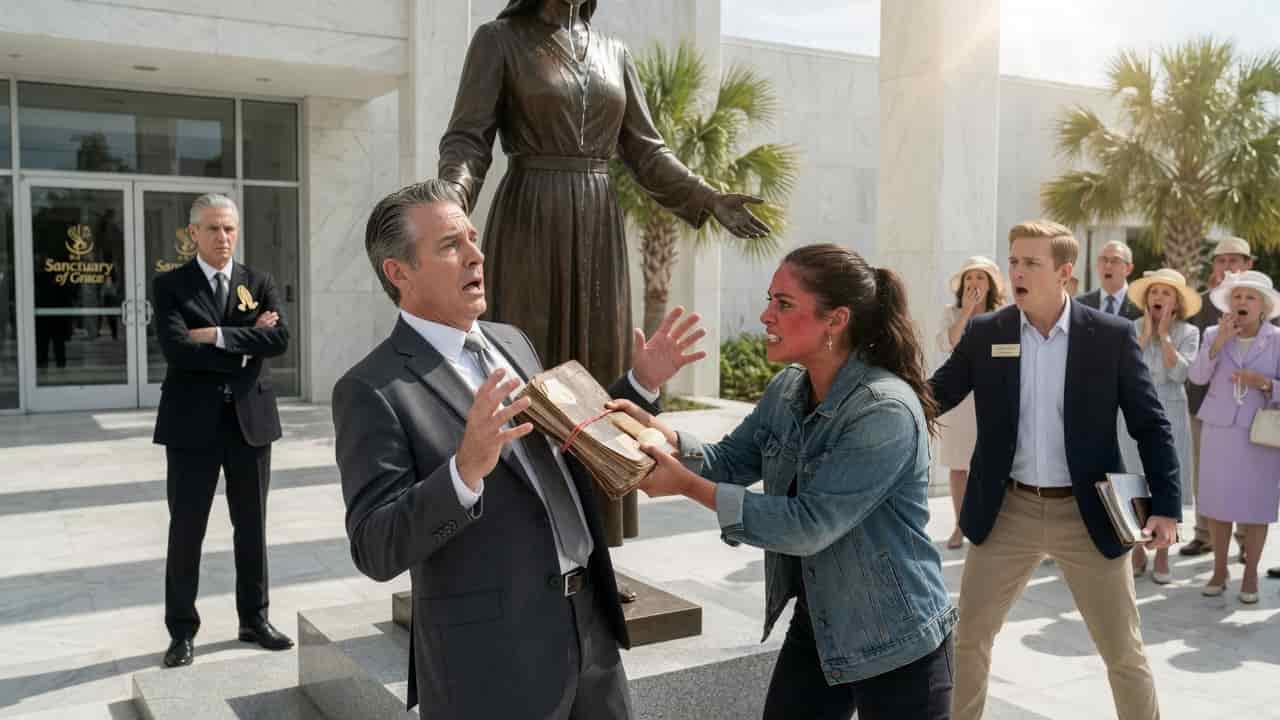
I stood there in my charcoal suit, the one Miriam bought me for our twentieth anniversary, watching a girl who looked like she hadn’t slept in a week spit right on my wife’s memorial statue. The bronze face of the ‘Saint of Oaxaca’ was streaked with it, and for a second, the thousand people gathered in the courtyard went so silent I could hear the hum of the AC units on the roof.
I tried to step forward, to be the shepherd everyone expects me to be. “Elena, please,” I whispered, reaching for her. “Whatever you’re going through, we can help.”
She didn’t want help. She wanted blood. She slammed a weathered black ledger against my chest, the weight of it knocking the wind out of me. It wasn’t just a book. It was a list. Names, dates, and dollar amounts—twenty thousand for her sister, fifteen for a boy named Mateo. All signed by the woman I’ve spent the last five years telling this congregation was an angel.
The church deacons were already moving in, their faces tight, their hands reaching to drag her away before she could say another word. But Elena didn’t flinch. She looked me right in the eye, surrounded by the empire I built on a lie, and told me the one thing I was never supposed to know.
The deacons are saying she’s crazy. The elders are telling me to burn the book. But I saw the names. And I recognized the handwriting.
Chapter 1
The air in the Sanctuary of Grace always smelled like expensive vanilla and the faint, ozone tang of high-end air filtration. It was a smell that cost eighty thousand dollars a year to maintain, but it was necessary. When you brought ten thousand people together in the Texas heat, you didn’t want them smelling like sweat and humanity. You wanted them to feel like they had stepped out of the world and into the waiting room of heaven.
Thomas Reed sat in his office, the mahogany desk between him and the rest of the world. It was a massive piece of furniture, carved with subtle ivy vines, a gift from the Board of Elders after Miriam passed. He ran his thumb over the edge of a gold-leafed Bible, but he didn’t open it. He hadn’t truly read the thing in three years. He knew the hits, the verses that made people feel like their mortgage debt was a spiritual trial and their SUV was a blessing. That was enough.
“Ten minutes, Pastor.”
Thomas looked up. Deacon Mark stood in the doorway, looking like a recruit for a Christian boy band. His hair was perfectly swooped, his teeth were blindingly white, and his eyes shone with a sincerity that made Thomas’s stomach turn. Mark was thirty-five and still believed every word that came out of Thomas’s mouth. It was a heavy burden, being an idol to a man who didn’t know he was worshipping a hollowed-out shell.
“The courtyard is full,” Mark said, his voice dropping into that hushed, reverent tone he reserved for Miriam’s memorial day. “The Governor’s people just arrived. They’re seated in the front row of the garden.”
“Thank you, Mark. I’ll be right there.”
“It’s a beautiful day for it,” Mark added, lingering. “The sun is hitting the statue just right. It looks like she’s glowing.”
Thomas forced a smile. It was the smile that had built a multi-million dollar campus and three satellite locations. It was warm, tired, and deeply humble. “She always did have a way with the light, didn’t she?”
When Mark finally closed the door, Thomas let the smile slide off his face. He stood and walked to the floor-to-ceiling window. Below him, the courtyard was a sea of pastel sundresses and sharp blazers. In the center of it all stood the bronze Miriam. She was eight feet tall, standing on a pedestal of Oaxacan stone. The sculptor had captured her exactly as the world remembered her: the ‘Mother of Orphans,’ her arms open, her head tilted slightly as if listening to the whisper of a suffering child.
Miriam had been the heart of the ministry. While Thomas handled the stage and the soaring oratory, Miriam had been on the ground in Mexico, building orphanages and “saving” the lost. When the cancer took her five years ago, the church hadn’t just mourned; they had canonized her. Every brick in this new campus had been paid for by people who wanted to be part of Miriam’s legacy.
Thomas turned away from the window. He felt the familiar pressure in his chest—the sensation of being a man standing on a very thin sheet of glass over a very deep canyon. He wasn’t a bad man, he told himself. He was just a man who had run out of things to say to a God who had stopped answering. He was a manager of a brand now. The Brand of Miriam.
He straightened his silver tie in the mirror. He looked exactly like what they wanted: a grieving widower who had turned his sorrow into a sanctuary. He picked up his iPad, checked his notes for the sermon—Miriam: The Light in the Dark—and stepped out of his office.
The hallway was lined with photos of their mission trips. Miriam holding a wide-eyed toddler. Miriam standing in the dust of a construction site. Miriam smiling at Thomas under a Mexican sunset. He walked past them quickly.
As he reached the heavy oak doors leading to the courtyard, he saw Elder Vance. Vance was sixty-five, with the kind of silver hair that looked like it belonged on a coin and eyes that never quite seemed to blink. He was the head of the Board of Elders, the man who handled the church’s “investments.”
“Thomas,” Vance said, his voice a low, gravelly rumble. He placed a hand on Thomas’s shoulder. The grip was a fraction too tight, a reminder of who actually held the keys to the kingdom. “The energy out there is incredible. We’ve already seen a twenty percent spike in the memorial fund through the app.”
“It’s not about the money, Bill,” Thomas said, the script rolling off his tongue.
“Of course not,” Vance replied, his smile not reaching his eyes. “It’s about the work. The legacy. Don’t keep them waiting. They need to hear from you.”
Thomas nodded and pushed the doors open.
The heat hit him first, followed by the sound. A murmur of thousands of voices that died down into a reverent hush the moment he appeared. He walked down the stone steps, moving toward the statue. The air was thick with the scent of lilies. He could see the Governor’s silver hair in the front row, the local news cameras perched on the edges of the courtyard.
He reached the pedestal. He looked up at the bronze face of his wife. For a split second, he felt a flicker of genuine grief, a memory of the woman she had been before the ministry became a machine. But the memory was short-lived. He had a job to do.
He tapped the microphone on the small podium. “Friends,” he began, his voice echoing through the high-fidelity speakers hidden in the palm trees. “We are gathered here not to mourn the sunset, but to celebrate the light that remains.”
He saw heads nodding. He saw women dabbing at their eyes. He was rolling now. He didn’t need the notes. He knew this story by heart. He was three minutes into a beautiful anecdote about Miriam’s first orphanage in Juarez when he saw her.
She wasn’t wearing a sundress. She wasn’t wearing a blazer. She was a jagged tear in the fabric of the afternoon. She was standing at the back of the crowd, wearing a faded denim jacket, her face a pale, hard mask. She wasn’t nodding. She was staring at him with a look of such concentrated loathing that Thomas felt his throat tighten.
He tried to look away, to focus on a sympathetic face in the third row, but she was moving. She was pushing through the crowd, ignoring the indignant murmurs of the people she jostled. She was coming straight for the statue.
Thomas faltered. “…and Miriam always said that every child is a…”
The girl reached the front. She didn’t stop. She stepped over the velvet rope that cordoned off the pedestal.
“Excuse me, miss,” Deacon Mark said, stepping forward from the side, his hand out. “We’re in the middle of a service.”
The girl didn’t look at Mark. She looked at the statue. She looked at the bronze face of the woman the world called a saint. Then, with a deliberate, slow motion, she leaned back and spat. A thick, wet glob landed right on the statue’s cheek.
The silence that followed was more than a hush. It was a vacuum. It felt like the entire world had held its breath.
“She didn’t save us, Pastor,” the girl said. Her voice wasn’t loud, but in that silence, it carried to the back of the courtyard.
Thomas felt his heart hammer against his ribs. “Elena?” he whispered, the name surfacing from a memory he hadn’t touched in years.
“She didn’t save us,” Elena said again, her voice shaking now, rising in volume. She reached under her denim jacket and pulled out a thick, weathered black ledger. She took two steps toward Thomas and slammed the book into his chest.
The weight of it was surprising. Thomas stumbled back, his shoulder hitting the bronze dress of his dead wife. He clutched the ledger to his chest, his fingers digging into the cracked leather.
“She sold us,” Elena screamed, her voice cracking. “She sold my sister for twenty thousand dollars to your ‘donors’! Look at the names, you coward! Look at the names!”
Deacon Mark lunged, grabbing Elena by the arms. Two more security guards in suits appeared from the wings.
“Get her out of here!” Vance’s voice barked from the back, no longer calm, but sharp as a whip.
The crowd erupted into chaos. People were standing, shouting, some crying. Elena was being dragged away, her boots scraping against the white limestone, but she never took her eyes off Thomas.
“Look at the book, Thomas!” she shrieked as they hauled her toward the side gate. “Ask Bill Vance where my sister is! Ask him!”
Thomas stood by the statue, the spit still glistening on its bronze cheek, the ledger heavy in his hands. He looked down at the book. His hands were shaking so hard he almost dropped it.
He looked toward the back of the courtyard. Elder Vance was staring at him. He wasn’t looking at the girl. He was looking at the ledger. And for the first time in fifteen years, Thomas saw something in Vance’s eyes that terrified him more than the girl’s rage.
It was a warning.
Chapter 2
The office felt different now. The vanilla scent was gone, replaced by the smell of old, damp paper and the cold, metallic sweat on Thomas’s palms. The ledger sat in the center of his mahogany desk like a live grenade.
Outside, the chaos had been “managed.” Mark and the security team had hustled the congregation toward the sanctuary for an unscheduled prayer session led by the associate pastor. The Governor had been escorted to his car with a flurry of apologies about “troubled individuals” and “the burdens of public ministry.” The machine was working. The Brand of Miriam was being buffeted by the storm, but the walls were thick.
Thomas reached out, his hand hovering over the ledger. His mind was a frantic loop of Elena’s face. He remembered her now. Oaxaca, twelve years ago. She had been a skinny thirteen-year-old, always lurking in the shadows of the orphanage Miriam was building. She had a younger sister, Lucia. A girl with a constant cough and a laugh like bells. Thomas remembered Miriam telling him that Lucia had been “placed with a wonderful family in the States.” A “miracle adoption” that had bypassed the red tape of the Mexican government.
He had believed her. He had always believed her.
He flipped the cover open.
The handwriting hit him like a physical blow. It was Miriam’s. The elegant, looped script he had seen on thousands of thank-you notes and grocery lists. But these weren’t grocery lists.
October 14th. Case #442. Girl, 6. Lucia M. Placement: Miller, G. Donation: $22,500. Processing: $2,500 (Vance).
Thomas felt the room tilt. He flipped the page.
November 2nd. Case #443. Boy, 4. Mateo R. Placement: Sterling, R. Donation: $18,000. Processing: $2,500 (Vance).
The names went on for pages. Dozens of children. Dates. Locations. And beside every entry, a “donation” amount and a “processing fee” for Vance.
“Pastor?”
Thomas slammed the book shut, his heart leaping into his throat.
Deacon Mark stood in the doorway. His blazer was rumpled, and there was a red scratch across his cheek where Elena must have caught him. He looked shaken, but his eyes were still searching for the man he thought Thomas was.
“The girl,” Thomas said, his voice sounding thin and foreign to his own ears. “Where is she?”
“In the security office. Elder Vance told us to hold her until the police arrive. He’s calling the DA’s office personally. He says she’s part of some extortion ring targeting large ministries.”
Thomas looked at the ledger. “An extortion ring.”
“She’s dangerous, Thomas,” Mark said, stepping into the room. “The things she was screaming… it’s blasphemy. To say those things about Miriam, after everything she did…” Mark’s voice cracked. “How can people be so cruel?”
Thomas looked at Mark—really looked at him. He saw the genuine pain in the younger man’s face. Mark was a true believer. He had built his life on the idea that people like Miriam and Thomas were the gold standard of humanity. If Thomas told him the truth right now, it wouldn’t just be a scandal. It would be a demolition.
“I need to talk to her,” Thomas said.
Mark blinked. “What? No, Elder Vance said—”
“I don’t care what Bill said,” Thomas snapped, the sudden sharpness in his voice surprising both of them. “She spoke to me. She threw this book at my chest. I’m the one who knew her family in Oaxaca. I have a responsibility to find out why she’s doing this.”
“But the police—”
“Tell the security team to give me ten minutes,” Thomas said, standing up and grabbing the ledger. “Just ten minutes, Mark. Please.”
Mark hesitated, his loyalty warring with his instructions. Finally, he nodded. “Okay. I’ll tell them. But be careful, Pastor. She’s… she’s not right in the head.”
Thomas didn’t answer. He walked past Mark and down the stairs to the basement level. The security office was a windowless room filled with monitors showing every corner of the campus. In the back was a small holding room used for shoplifters or the occasional drunk who wandered in from the nearby highway.
Elena was sitting on a metal chair, her hands cuffed to the rail behind her. She looked smaller here, away from the statue and the sun. Her denim jacket was torn at the shoulder, and her face was smudged with dirt and tears.
The security guard looked at Thomas, then at Mark, who gave a silent nod. The guard stepped out, closing the door behind him.
Thomas stood there for a long moment, the ledger clutched in his hands.
Elena didn’t look up. “Did you read it?”
“Elena,” Thomas said softly. “I remember you. Lucia… I remember her cough.”
Elena’s head snapped up. Her eyes were red-rimmed and fierce. “You remember her cough, but you don’t remember where she went. You didn’t care. You were too busy taking pictures for the brochures.”
“Miriam told me she was adopted. She told me it was a miracle.”
“It was a sale,” Elena spat. “My mother was told Lucia was going to a hospital in Mexico City for her lungs. She signed papers she couldn’t read. Then she never saw her again. I spent ten years looking for her. I found the woman who worked the desk at the Juarez office. She was dying of cancer and scared of hell. She gave me that book.”
Thomas looked down at the ledger. “Lucia M. Placement: Miller, G. Who is Miller?”
Elena leaned forward as far as the cuffs would allow. “George Miller. The oil man from Midland. One of your ‘Platinum’ donors. He didn’t have children. He bought my sister like she was a piece of furniture.”
Thomas felt a cold sweat break out across his back. George Miller. He remembered George. A quiet, heavy-set man who had given three million dollars to the building fund. He had died two years ago.
“Is she… where is she now?” Thomas asked.
“She’s in a state facility in Lubbock,” Elena said, her voice trembling. “Miller’s wife didn’t want her after George died. She said the girl was ‘difficult.’ Lucia doesn’t even know who I am, Thomas. She doesn’t speak Spanish. She’s drugged up on antipsychotics because she keeps trying to run away to find a mother she can’t even name.”
Thomas closed his eyes. The glass he was standing on didn’t just crack; it shattered. He saw the whole system in a flash—the mission trips, the “miracle” placements, the massive donations that followed. It wasn’t a ministry. It was a market.
The door behind him opened.
Thomas turned. Elder Vance stood there, his presence filling the small room like a suffocating fog. He wasn’t looking at Elena. He was looking at the ledger in Thomas’s hand.
“That’s enough, Thomas,” Vance said. His voice was calm, but there was a razor-edge underneath it. “The police are here. They’ll take it from here.”
“Bill,” Thomas said, his voice shaking. “Lucia Miller. I’m looking at the entry.”
Vance stepped into the room, closing the door behind him. He didn’t look at Elena. He looked at Thomas with the weary patience of a father dealing with a slow child.
“Miriam was a visionary, Thomas. She knew that some children were better off in homes where they would be provided for. She found ways to cut through the bureaucracy that leaves thousands of kids to rot in Mexican government warehouses. The ‘donations’ ensured the work could continue. They built this place. They saved this ministry when we were drowning in debt ten years ago.”
“You sold children,” Thomas whispered.
“We placed them,” Vance corrected him sharply. “And we protected this church. If you think for one second that you can open that book and not burn everything you’ve built to the ground, you’re more delusional than this girl.”
Vance stepped closer, his voice dropping to a low, lethal murmur. “Think about the ten thousand people in those pews, Thomas. Think about their faith. You tell them their saint was a trafficker? You tell them their donations bought babies? You won’t just destroy the church. You’ll destroy them. Their hope. Their lives.”
“What about my life?” Elena screamed from the chair. “What about my sister?”
Vance didn’t even blink. He looked at Thomas. “The girl is going to jail for assault and extortion. The ledger is evidence. Give it to me, Thomas.”
Thomas looked at Elena. She was watching him, her face stripped of hope, waiting for the final betrayal. He looked at Vance, the man who had been his mentor, his protector, his jailer.
He felt the weight of the book. It felt like a thousand pounds.
“I’ll take care of it, Bill,” Thomas said, his voice flat.
“Give me the book, Thomas.”
“I said I’ll take care of it,” Thomas repeated, his eyes meeting Vance’s. For the first time, he didn’t look away. “It’s my wife’s handwriting. It’s my responsibility. I’ll bring it to your office in an hour.”
Vance stared at him for a long, silent moment. The air in the room seemed to vibrate with the unspoken threat between them. Finally, Vance nodded once.
“One hour, Thomas. Don’t be late. We have a crisis to manage.”
Vance turned and walked out.
Thomas stood in the silence, the ledger clutched to his chest. He looked at Elena.
“They’re going to kill me, aren’t they?” she asked quietly.
“No,” Thomas said, though he wasn’t sure if he was lying. He reached into his pocket and pulled out a small set of keys he’d taken from the security desk earlier. He stepped behind her and unlocked the cuffs.
“What are you doing?” she whispered.
“Go out the back way,” Thomas said, pointing to a service door near the monitors. “There’s a laundry truck that leaves at five. Get in the back. I’ll meet you at the motel on Highway 6. The Blue Bonnet.”
“Why?”
Thomas looked at the ledger. “Because I’m tired of being a ghost, Elena. And I think it’s time we burned this temple down.”
Chapter 3
The Blue Bonnet Motel was a place where people went when they didn’t want to be found by anyone who mattered. It sat on a stretch of Highway 6 dominated by rusted equipment graveyards and low-slung warehouses. The neon sign buzzed with a dying, erratic rhythm, casting a sickly pink glow over the gravel parking lot.
Thomas sat in his Lexus, the engine idling, the climate control keeping the Texas dust at bay. He felt like a stranger in his own skin. He had left the church through the back service entrance, slipping away while Vance was likely in the board room, crafting the narrative of the “troubled girl.”
He looked at the ledger on the passenger seat. He had spent the last hour in a darkened corner of a Starbucks three towns over, reading every single entry. It wasn’t just George Miller. It was the head of the local hospital board. It was a prominent judge. It was people Thomas saw every Sunday, people he had prayed with, people who had sat in his office and talked about the “blessing” of their adopted children.
They all knew. Or they had paid enough not to ask.
And Miriam. He couldn’t wrap his mind around it. He thought of her in Oaxaca, coming home with dust in her hair and tears in her eyes, telling him about the “hopeless cases” she had finally found homes for. He had admired her. He had felt inferior to her. Her faith had seemed so practical, so active, while his was just a collection of well-rehearsed words.
But her faith had been a ledger. A balance sheet.
A knock on the window made him jump.
Elena stood there, her denim jacket pulled tight around her. She looked exhausted, her face gaunt in the flickering neon light.
Thomas unlocked the doors. She climbed in, the scent of the laundry truck—bleach and stale air—clinging to her. She looked at the Lexus, the leather seats, the polished wood trim.
“Nice car,” she said, her voice devoid of inflection. “How many kids did it cost?”
Thomas flinched. “Elena…”
“Don’t,” she snapped. “Don’t do the ‘Pastor’ voice. Not here. Not with that book between us.”
She reached out and touched the ledger. “What are you going to do?”
“I don’t know,” Thomas admitted. “Vance expects me to hand this over. If I don’t, he’ll come after me. He’ll come after you.”
“He’s already coming after me,” Elena said. “I’ve been looking for my sister for ten years, Thomas. I’ve been threatened, I’ve been followed, I’ve been told I’m crazy by every lawyer and cop from here to Juarez. Vance is just the one at the top of the pile.”
“He says… he says exposing this will destroy the faith of thousands of people.”
Elena laughed, a harsh, jagged sound. “Their faith is a lie. It’s a comfort blanket they bought with other people’s blood. If their God can’t handle the truth, then their God is as fake as that statue.”
Thomas looked at her. She was the mirror he had been avoiding for fifteen years. She was the reality of the “work” he had stayed in his air-conditioned office to avoid seeing.
“I have a friend,” Thomas said. “A journalist in Austin. He’s been trying to get a look at the church’s offshore accounts for years. If I give him this…”
“Vance will kill him,” Elena said. “And then he’ll kill you. You don’t understand how deep this goes, do you? It’s not just your church. It’s the donors. The people who bought the kids. They have everything to lose. They aren’t going to let a ‘disgruntled’ pastor and a ‘crazy’ girl ruin their lives.”
“I have to try,” Thomas said.
“Why? Because you want to feel like a good man again?” Elena turned toward him, her eyes burning. “You want to go out in a blaze of glory so you don’t have to live with what you let happen? That’s just another kind of cowardice, Thomas.”
Thomas felt the sting of her words because they were true. He wanted the ending. He wanted the resolution. He didn’t want the long, slow agony of the aftermath.
“What do you want, Elena?”
“I want my sister,” she said, her voice dropping to a whisper. “I want her out of that facility. I want the people who took her to pay. Not just Vance. All of them.”
Thomas looked at the ledger. He flipped to the back. There were several pages he hadn’t seen before. They weren’t entries. They were names of banks. Account numbers. Locations in the Cayman Islands and Switzerland.
“There’s more here than just the kids,” Thomas said, tracing the numbers with his finger. “This is the money trail. The ‘donations’ didn’t just go to the church. They went to a private shell company called Miriam’s Hope Holdings.”
“Vance,” Elena said.
“And Miriam,” Thomas added, the words like ash in his mouth. “She was a director. They were laundering the adoption fees into private accounts.”
Suddenly, Thomas’s phone buzzed in the center console. It was a text from Deacon Mark.
Pastor, please come back. Vance is calling an emergency board meeting. He’s telling them you’ve had a breakdown. He’s brought in the police to search your office for the girl and the book. He says you’re in danger. Thomas, what is going on?
Thomas showed the screen to Elena.
“The breakdown,” she said. “That’s the move. They make you the victim of a mental collapse. Anything you say after that is just the ramblings of a man who lost his wife and his mind.”
“He’s fast,” Thomas said, a cold dread settling in his gut.
“He’s had practice. How do you think they kept this quiet for twenty years?”
Thomas looked out the windshield. A black SUV had just turned into the gravel lot of the motel. It didn’t have a front plate. It drove slowly, its headlights sweeping over the parked cars.
“Is that them?” Elena whispered, shrinking down in her seat.
“I don’t know,” Thomas said, his hand going to the gear shift. “But I’m not staying to find out.”
He threw the Lexus into reverse, the tires spitting gravel as he backed out of the space. The SUV immediately accelerated, its tires screaming.
“Hold on,” Thomas said.
He swung the car around and floored it toward the highway. The Lexus’s engine roared, the needle climbing as they surged onto the dark ribbon of asphalt. In the rearview mirror, the SUV swung onto the road behind them, its high beams cutting through the dust.
Thomas gripped the steering wheel, his knuckles white. He was a fifty-year-old pastor in a luxury car, being chased through the Texas night by men who sold children. It was absurd. It was a nightmare.
And for the first time in years, he felt completely, terrifyingly awake.
“Where are we going?” Elena shouted over the wind.
“Back to the church,” Thomas said.
“Are you crazy? They’ll be waiting for us!”
“Exactly,” Thomas said, his face set in a grim mask. “Vance thinks he’s playing a game of shadows. He thinks he can contain this in boardrooms and security offices. He forgot one thing.”
“What?”
“Tomorrow is Sunday,” Thomas said. “And ten thousand people are coming to hear me speak. If we’re going to burn the temple, Elena, we’re going to do it in front of the whole world.”
Chapter 4
The Sanctuary of Grace at 3:00 AM was a ghost ship of white limestone and glass. The floodlights that usually bathed the campus in a heavenly glow had been dimmed, leaving the sprawling complex in a state of eerie, architectural half-light.
Thomas killed his lights a mile out and took the back entrance through the nursery school parking lot. He knew the blind spots in the security cameras—not because he was a criminal, but because he had designed the system with the security consultants to ensure “pastoral privacy.”
“We can’t just walk in,” Elena whispered as they crouched behind a line of manicured hedges near the side entrance of the main auditorium.
“We’re not walking in,” Thomas said. He felt a strange, cold clarity. The panic of the car chase had settled into a hard, brittle resolve. “There’s a service tunnel that runs from the mechanical room to the baptismal pool under the stage. Miriam and I used to use it to avoid the crowds after the big holiday services.”
“You used a secret tunnel to avoid your own people?”
“The Brand needs to remain distant to remain holy,” Thomas said, the cynicism sharp in his voice. “Come on.”
They slipped through a heavy steel door that Thomas unlocked with a master key he’d kept on his personal ring. The air inside the tunnel was cool and smelled of concrete and chlorine. They moved quickly, their footsteps echoing softly.
“What’s the plan, Thomas?” Elena asked as they reached the ladder leading up to the stage floor. “You’re just going to walk out there in the morning and start reading from the book?”
“No,” Thomas said, stopping at the base of the ladder. He looked at the ledger, then at her. “Vance will have the deacons patrolling the aisles. The moment I say something that isn’t on the teleprompter, they’ll cut the mic and drag me off. I’ve seen them do it to protesters before.”
“Then how?”
“I need you to get to the media booth,” Thomas said. “It’s at the very back, elevated above the balcony. If you can get the ledger onto the high-speed document scanner and patch it into the main video feed, the names will be on every screen in the building. Not just here, but at the satellite campuses and the livestream. Five hundred thousand people, Elena. He can’t cut all the wires at once.”
Elena looked up the ladder, then back at him. “How do I get to the booth? I’m the girl who spit on the statue. My face is on every security monitor in the place.”
“Deacon Mark,” Thomas said.
“The boy band guy? He’ll turn us in.”
“Maybe,” Thomas said. “But Mark doesn’t love Vance. He loves the idea of Miriam. If I show him the truth… if I make him look at what he’s been protecting… he’s the only one who can get you into that booth without being questioned.”
Thomas led her up the ladder and through a trapdoor that opened behind the massive velvet curtains of the main stage. The auditorium was a cavernous void, the thousands of empty seats looking like silent witnesses in the gloom.
“Stay here,” Thomas whispered. “I’m going to my office. If the light in the window flashes three times, it means the coast is clear.”
“Thomas,” Elena said, reaching out and grabbing his arm. Her grip was tight, her eyes searching his. “If this goes wrong… if they catch us…”
“Then at least I’ll die as a man, Elena. Not a mascot.”
Thomas slipped out from behind the curtain and moved through the darkened hallways toward the administrative wing. His heart hammered against his ribs with every shadow that moved. He reached his office and pushed the door open.
He froze.
The office had been ransacked. Files were strewn across the floor, his mahogany desk was scratched, and the wall hangings had been ripped down. Vance hadn’t just been looking for the book; he had been erasing Thomas’s life.
“He’s not coming back, Bill.”
Thomas spun around. Deacon Mark was sitting in the shadows of the corner, his head in his hands. He looked up, his face gaunt and tear-streaked.
“Mark,” Thomas breathed.
“Elder Vance said you were sick,” Mark said, his voice flat. “He said you’d been having visions. That you’d been talking to Miriam’s ghost. He said the girl was a demon sent to test us.”
“Is that what you believe, Mark?”
Mark stood up, his movements slow and shaky. “I didn’t know what to believe. But then I saw him. In your office. He wasn’t looking for a ‘troubled’ pastor, Thomas. He was looking for something to burn. He was laughing. He and the other elders… they were talking about ‘the inventory.’ About how lucky they were that Miller died before the girl found him.”
Mark stepped into the light. He was holding a shredded photo of Miriam. “She wasn’t who we thought she was, was she?”
Thomas walked over to him. He didn’t use the ‘Pastor’ voice. He used the voice of a man who was finally standing on the ground. “No, Mark. She wasn’t. And neither am I.”
Thomas pulled the ledger from his jacket and held it out. “Look at it. Read the names. Then decide whose side you’re on.”
Mark took the book with trembling hands. He opened it to the middle. He read for a minute, his eyes darting back and forth, his breath coming in short, ragged gasps.
“Oh God,” Mark whispered. “Oh God, no.”
“There is no God in this building, Mark,” Thomas said. “There’s just us. And the people who are coming here in four hours. Are you going to let them keep worshipping a graveyard?”
Mark looked at the ledger, then at the ruined office, then at Thomas. A hard, cold light entered the younger man’s eyes—the kind of light that only comes when an idol is shattered.
“What do you need me to do?”
“I need you to get a girl to the media booth,” Thomas said. “And I need you to make sure that when I stand on that stage, the whole world is watching.”
Outside, the first grey light of dawn began to bleed over the Texas horizon. The Sanctuary of Grace began to wake up. The coffee machines in the lobby started to hum. The choir began their early rehearsals. The security team began their final sweeps.
And in the center of the courtyard, the spit-streaked statue of Miriam stood in the shadows, her bronze arms open, waiting to welcome the thousands who were about to find out exactly what their sanctuary was built on.
Thomas stood at his office window, watching the first SUVs pull into the parking lot. He felt a strange, terrifying peace. He knew that by noon, he would be a ruined man. He would be a pariah, a traitor, and quite possibly a prisoner.
But as he watched the sun hit the white limestone, he realized he didn’t care. For the first time in his life, he wasn’t rehearsing a sermon.
He was preparing a confession.
Chapter 5
The green room of the Sanctuary of Grace was a masterpiece of psychological warfare disguised as luxury. It featured recessed lighting that mimicked the soft glow of a perpetual sunrise, plush velvet armchairs in a soothing slate blue, and a high-end espresso machine that hummed with the quiet efficiency of a German laboratory. It was designed to make a man feel like a king before he stepped out to tell ten thousand people they were servants.
Thomas sat on the edge of one of those chairs, his elbows on his knees, staring at his reflection in the darkened screen of a television monitor. He looked like a man who had been hollowed out and filled with cold ash. His charcoal suit felt like armor that had become too heavy to wear.
A sharp knock preceded the door opening. Elder Vance walked in, followed by two men Thomas didn’t recognize—men in dark suits with the thick necks and watchful eyes of professional security. Vance looked immaculate. His silver hair was a helmet of perfection, his black suit pressed to a razor edge.
“Thomas,” Vance said. His voice was warm, fatherly, and entirely lethal. “You look tired. It’s been a long twenty-four hours.”
“I’m fine, Bill,” Thomas said, not looking up.
“Are you?” Vance stepped closer, his shadow falling over Thomas. “The deacons found your office in quite a state. And they tell me the ledger—the one that girl used to assault you—is missing. Along with the girl herself.”
Thomas finally looked up. He forced his face into the mask he’d worn for fifteen years: the weary, slightly overwhelmed shepherd. “I put the book in the safe, Bill. And the girl… she got away. I didn’t have the heart to hold her like a prisoner. She’s grieving, in her own broken way.”
Vance’s eyes narrowed. The silence in the room stretched, punctuated only by the distant, rhythmic thrum of the bass from the worship band’s rehearsal in the auditorium. The floorboards vibrated with the sound of “Holy Is the Name,” a song about purity that was currently being sung by people who didn’t know the price of the limestone beneath their feet.
“The safe was empty, Thomas,” Vance said softly.
Thomas felt his heart skip a beat, but he didn’t let his expression flicker. “Then someone must have taken it. Maybe the girl found it before she ran. It doesn’t matter. The service starts in twenty minutes. I have a message to deliver.”
Vance leaned down, placing his hands on the arms of Thomas’s chair, pinning him in. The smell of Vance’s expensive cologne—something spicy and aggressive—filled Thomas’s lungs.
“Let’s be very clear, Thomas,” Vance whispered. “You are going to walk out on that stage. You are going to read the words on the teleprompter. You are going to talk about Miriam’s sacrifice and the ‘trials’ we face from those who wish to pull down the work of God. And then, you are going to announce your sabbatical. For your health. For your soul.”
“A sabbatical,” Thomas repeated.
“The board has already approved it. You’ll go to the estate in Sedona. You’ll rest. And while you’re resting, we will handle the ‘Elena problem.’ Permanently.”
Thomas looked past Vance at the two security guards. They weren’t church members. They didn’t have Bibles. They had earpieces and bulges under their jackets that weren’t prayer journals.
“And if I don’t?” Thomas asked.
Vance straightened up, smoothing the front of his jacket. “Then the narrative changes. We don’t talk about a ‘sabbatical.’ We talk about a tragic, mental collapse. We talk about how the loss of Miriam finally broke you. We might even find evidence that you were… involved in the girl’s delusions. Money missing from the mission fund. Inappropriate contacts. You know how the internet works, Thomas. By tomorrow morning, you won’t be a pastor. You’ll be a predator.”
Vance checked his gold watch. “Ten minutes. The Governor is in his seat. The cameras are live. Don’t make a mistake, Thomas. Think about your legacy. Think about what Miriam would want.”
Vance turned and walked out, the two guards lingering at the door.
Thomas closed his eyes. What Miriam would want. The phrase used to be his North Star. Now, it was a brand of hot iron. He stood up, his legs feeling like they belonged to someone else. He reached into his inner jacket pocket and felt the corner of the ledger. He hadn’t put it in the safe. He had kept it on him, a physical weight to keep him grounded in the truth.
He walked to the door. The guards stepped aside, but they trailed him at a respectful distance as he moved through the maze of backstage hallways.
In the media booth, a quarter-mile away and three stories up, Deacon Mark was sweating through his navy blazer. He was standing behind the head of video production, a twenty-two-year-old kid named Caleb who had four monitors in front of him and a headset that looked like it belonged to a fighter pilot.
“Hey, Caleb,” Mark said, his voice straining for casualness. “Pastor Reed wants to add a visual element to the opening. A surprise for the memorial section.”
Caleb didn’t look up from his board. “A bit late for that, Mark. We’re locked. The cues are already in the system.”
“It’s just one PDF,” Mark said, leaning over. He could feel Elena standing behind him in the shadows of the equipment rack. She was wearing a Sanctuary of Grace volunteer vest Mark had swiped from the laundry room, her hair tucked under a baseball cap. “He wants the ‘Sanctuary Covenant’ displayed on the main screen during his opening prayer.”
“The Covenant? We did that last year,” Caleb grumbled.
“He’s sentimental today,” Mark said, sliding a thumb drive into the console. “Just patch it into the ‘Special’ feed. I’ll trigger it from the remote tablet on stage.”
Caleb sighed, his fingers flying over the keys. “Fine. Whatever. Just don’t mess with the lighting cues. Bill Vance will have my head if the spotlight isn’t on the statue for the finale.”
Mark watched the progress bar on the screen. Uploading… 40%… 60%… Behind him, Elena’s hand found his elbow. Her grip was like a vice. She wasn’t looking at the monitors. She was looking through the glass at the auditorium below. It was a sea of humanity—ten thousand people in their Sunday best, waving their hands, singing, crying, all of them focused on the empty stage where a single spotlight hit the bronze statue of Miriam.
“They look like sheep,” Elena whispered, her voice barely audible over the roar of the music coming through the booth’s monitors.
“They’re not sheep,” Mark said, his eyes fixed on the upload. “They’re people who want to believe in something better than themselves. They’ve just been given the wrong thing to worship.”
Upload complete.
Mark pulled the drive and stepped back into the shadows. He looked at Elena. “The ledger is in the system. The moment Thomas hits the ‘Next’ button on his tablet, the first page of that book goes live to every screen in the building. And the livestream.”
Elena looked down at the stage. Thomas was walking out from the wings. He looked tiny against the backdrop of the massive LED walls and the towering pipe organ.
“He looks like he’s going to faint,” she said.
“He’s not going to faint,” Mark said, though he felt a surge of doubt. “He’s going to do the only thing he has left.”
Down on the stage, the music reached a crescendo and then dropped into a low, atmospheric pad. The lights dimmed, leaving only a warm, golden glow on Thomas.
The silence that followed was heavy. It was the silence of expectation.
Thomas stood at the plexiglass podium. He looked out at the faces. He saw the Governor. He saw the wealthy donors in the front rows—the Millers, the Sterlings, the Vances. He saw the families in the back who had saved their money for months to fly in for this service.
He looked at the tablet embedded in the podium. He saw the “Next” button. It was a small, blue square. The trigger for the end of the world.
“Friends,” Thomas began. His voice caught, and he cleared his throat. “We are here for a memorial. But as I sat in my office this morning, I realized that we cannot remember the dead until we are honest with the living.”
He saw Vance move in the wings. The Elder was standing just out of sight of the congregation, his face a mask of sudden, sharp suspicion.
“For fifteen years,” Thomas continued, his voice growing stronger, “this church has been built on a story. The story of a woman who gave everything for the ‘least of these.’ A woman we called a saint.”
He paused. He could feel the shift in the room. The warmth was evaporating, replaced by a confused, jagged tension.
“But stories can be walls,” Thomas said. “They can be beautiful, gilded walls that hide a very dark room. And I have been the gatekeeper of that room for a long time.”
He looked at the tablet. His finger hovered over the blue square.
“I came here today to tell you about Miriam’s legacy,” he said, his eyes meeting Vance’s in the shadows. “But I realized that the only legacy worth having is the truth. Even if the truth burns everything we love.”
He hit the button.
The massive LED screens behind him didn’t show the Sanctuary Covenant. They didn’t show a picture of Miriam smiling.
They showed a scan of a weathered leather ledger.
October 14th. Case #442. Girl, 6. Lucia M. Placement: Miller, G. Donation: $22,500.
The gasp that went through the auditorium wasn’t a sound. It was a physical shockwave. It was the sound of ten thousand hearts stopping at once.
Thomas didn’t wait. He didn’t look back at the screen. He kept his eyes on the crowd.
“That name you see,” Thomas said, his voice echoing through the speakers, “Lucia. She wasn’t an orphan saved from the streets. She was a child taken from her mother in Oaxaca. And the ‘donation’ next to her name wasn’t for the ministry. It was her price.”
He saw George Miller’s widow stand up in the second row, her face paper-white. He saw the deacons frozen in the aisles.
“Cut the feed!” Vance’s voice screamed from the wings, loud enough for the first few rows to hear. “Cut the mic! Now!”
The screens flickered, but the image stayed. Elena had locked the override from the booth.
“There are forty pages in this book,” Thomas said, his voice now a roar of righteous, desperate fury. “Forty pages of children sold like cattle to the people sitting in this room! We didn’t build a sanctuary of grace! We built a market of shame!”
He saw the security guards lunging onto the stage from both sides. He saw Vance running toward the podium.
Thomas grabbed the edges of the plexiglass, his knuckles white.
“The truth is here!” he screamed as the first guard tackled him to the ground. “Look at the names! Look at the names!”
The auditorium exploded.
Chapter 6
The aftermath of a disaster is rarely cinematic. It doesn’t end with a slow-motion montage and a soaring score. It ends with the smell of scorched electronics, the sound of weeping in cold hallways, and the relentless, clinical blue lights of police cruisers.
Three weeks after the “Sunday of Ash,” as the local papers had taken to calling it, Thomas Reed sat on a plastic chair in a windowless room in the Travis County Courthouse. He wasn’t wearing a charcoal suit. He was wearing an orange jumpsuit that was a size too large, and his salt-and-pepper hair was buzzed short.
He looked down at his hands. They were steady. For the first time in a decade, they didn’t shake.
The door opened, and a man in a rumpled suit walked in. It was the Assistant District Attorney, a man named Harris who looked like he hadn’t slept since the ledger went live.
“The grand jury came back,” Harris said, sitting across from Thomas. He laid a thick folder on the table. “Forty-two counts of human trafficking, sixty counts of money laundering, and twenty-eight counts of racketeering. That’s just for the church board and the ‘donors’ we’ve identified so far.”
“And for me?” Thomas asked.
Harris looked at him with a mix of professional curiosity and reluctant respect. “You’re being charged as an accessory after the fact for the first twelve years. But the DA is willing to offer a significant reduction in exchange for your testimony against Vance and the rest of the Board of Elders. Your ‘confession’ saved a lot of children, Thomas. But it didn’t undo the past.”
“I know,” Thomas said. “I don’t want a reduction. I want the truth to be complete.”
“We found the offshore accounts,” Harris continued. “Over fifty million dollars. Most of it came from the ‘adoption’ fees. Vance was trying to move the money the night you went to the motel. If you hadn’t triggered that broadcast, he’d be in Dubai by now.”
“And Elena?”
“She’s in Lubbock,” Harris said, his face softening slightly. “The state court granted her temporary guardianship of her sister. Lucia is out of the facility. She’s in a private clinic, starting the long process of… well, of learning who she is.”
Thomas felt a small, sharp pain in his chest—a ghost of the old grief. “Does she know about Miriam?”
“Elena told her some of it. But mostly, she just knows that someone came back for her. That’s what matters to a kid like that.”
Harris stood up. “Vance is claiming you coerced him. He’s saying the ledger was a forgery you created to cover up your own embezzlement. He’s going to fight this with every dollar he has left.”
“Let him,” Thomas said. “The names are out there now. You can’t un-ring a bell of that size.”
When Harris left, Thomas was escorted back to his cell. He walked past the other inmates, men who looked at him with a strange kind of awe. In the hierarchy of the jail, he was a celebrity—the “Crying Pastor” who had burned down a kingdom.
He sat on his bunk and looked at the small, high window. A sliver of Texas sky was visible through the bars. It was a bright, unforgiving blue.
He thought about the church. The Sanctuary of Grace had been shuttered by the feds. The accounts were frozen, the campus was a crime scene, and the massive bronze statue of Miriam had been hauled away to a scrap yard. The “Brand” was dead.
But as he sat in the silence, Thomas realized he could finally hear his own heart. It wasn’t the sound of a manager or a mascot. It was the sound of a man.
A month later, the trial began. It was a media circus that drew thousands to the courthouse steps every day. Thomas took the stand on the third day. He didn’t look at the cameras. He didn’t look at the Governor’s empty seat or the angry protesters outside.
He looked at the back row of the gallery.
Elena was there. She was wearing a simple white blouse, her dark hair pulled back. Beside her sat a young girl with large, cautious eyes and a faded scar on her chin. Lucia.
Elena caught Thomas’s eye. She didn’t smile. She didn’t nod. She just looked at him with a level, steady gaze. It wasn’t forgiveness. It was acknowledgment. He had done the work. He had paid the price.
Thomas turned to the judge.
“My name is Thomas Reed,” he began, his voice clear and resonant, filling the courtroom. “And I would like to tell you the truth about the Sanctuary of Grace.”
He spoke for six hours. He didn’t leave anything out. He talked about the first time he’d seen a ‘donation’ check for a child. He talked about the way Vance had manipulated the books. He talked about the way he had looked away because he was afraid of losing the life he’d built.
By the time he finished, the courtroom was as silent as the auditorium had been when Elena spat on the statue.
Vance was convicted on all counts. He was sentenced to life without parole. The other elders followed, one by one. The “donors” who had bought children were stripped of their assets and their reputations, their names forever linked to the ledger.
Thomas was sentenced to ten years. He didn’t appeal.
On the day he was moved to the state penitentiary, Deacon Mark met him at the transport bus. Mark looked different. He’d shaved his head and traded his navy blazer for a plain grey sweatshirt. He was working at a local community center, helping kids in the foster system.
“Thomas,” Mark said, handing him a small, worn Bible. It wasn’t gold-leafed. It was a cheap paperback. “I wanted you to have this.”
“Thank you, Mark. How is the campus?”
“It’s being turned into a municipal park and a regional headquarters for Child Protective Services,” Mark said. “They tore down the main sanctuary yesterday. They found another set of records buried in the foundation. More names.”
Thomas nodded. “The roots were deeper than we thought.”
“Elena sent this,” Mark said, pulling a small photo from his pocket.
It was a picture of Elena and Lucia standing on a beach. Lucia was laughing, her hair blowing in the wind. On the back, in Elena’s jagged, fierce handwriting, were three words:
We are here.
Thomas climbed onto the bus. He sat by the window as the engine roared to life. As the bus pulled away from the curb, he looked back at the courthouse, at the city of Austin, at the life he had once thought was the only thing that mattered.
He opened the small Bible. He didn’t look for a verse about blessings or SUVs. He looked for the passage about the truth setting you free.
He realized, as the bus hit the highway, that the verse was only half-complete. The truth doesn’t just set you free. It leaves you standing in the wreckage of everything you were, with nothing left but the skin on your back and the breath in your lungs.
And for Thomas Reed, that was finally enough.
The bus drove into the sunset, leaving the sanctuary of lies behind, moving toward a long, hard road that was, for the first time in fifteen years, paved with nothing but the truth.
The end.