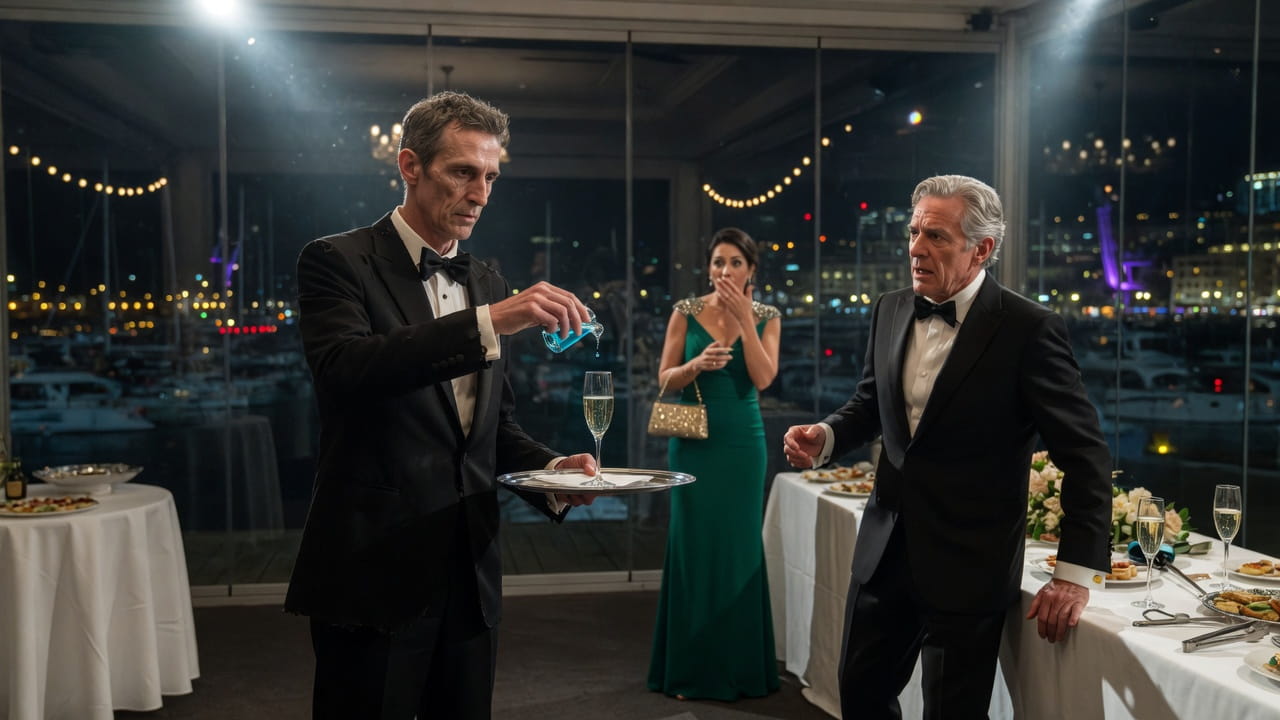
“Is it still negligence if I do it on purpose, Lawrence?”
Thomas stood there, his cheap tuxedo a jagged scar against the room full of silk and silver. He didn’t care about the security guards rushing the doors or the way the Board of Directors was already backing away toward the exits. He only cared about the man in the bespoke suit—the man who had signed the memo that called Thomas’s wife an “acceptable loss.”
For three years, Thomas had lived as a ghost, a “negligent employee” who had supposedly caused the leak that took Sarah away. But he wasn’t there to beg for his reputation back. He was there to show them exactly what the company had been brewing in the dark.
When the vial tipped and that single, glowing drop of blue hit the CEO’s vintage champagne, the silence wasn’t just quiet—it was heavy. It was the weight of every lie told to save a stock price.
“Drink it,” Thomas whispered, his hand like a vice on the CEO’s wrist. “Show the world there’s nothing to be afraid of.”
The look on the CEO’s face told the room everything the “Leak Report” never would.
Chapter 1
The air in the Level 4 containment wing didn’t just feel clean; it felt hollow. It was a pressurized, scrubbed vacuum that tasted of ozone and the faint, metallic tang of industrial bleach. Thomas stood at the stainless-steel workstation, his hands encased in three layers of nitrile, watching the centrifuge spin. It was a low, rhythmic hum—the heartbeat of Bio-Tech Global.
He had been at this station for fourteen years. He knew the vibration of the floor, the specific pitch of the ventilation, and the way the fluorescent lights flickered in a pattern that most people never noticed. To the world outside the Maryland campus, he was a high-level lab technician, a man of precision and protocol. To the people inside the building, he was the guy who had survived the “Incident.” They didn’t call it a leak. They didn’t call it a catastrophe. They called it an incident, like a spilled cup of coffee or a fender bender in the parking lot.
“Thomas. You’re still here.”
The voice came from the intercom, crisp and devoid of warmth. Thomas didn’t look up. He didn’t need to. Lawrence Thorne, the CEO, liked to do “fly-bys” via the internal camera system. It was his way of reminding the staff that even in the most sterile environments, there was an eye on them.
“Finishing the batch, Lawrence,” Thomas said. He kept his voice flat, professional. It was the only armor he had left.
“The Board is expecting the efficacy report by morning. Don’t let your… history… slow down the progress. We’ve invested a lot in your department’s recovery.”
Recovery. Thomas’s jaw tightened. He thought of the small colonial house in Silver Spring that sat empty every night. He thought of the way the air in that house felt thick and stagnant, the opposite of the lab. He thought of Sarah’s shoes, still sitting by the front door because he couldn’t bring himself to move them.
“I’m on schedule,” Thomas replied.
He waited until the red light on the camera dimmed. Only then did he allow his shoulders to drop a fraction of an inch. He reached into the pocket of his lab coat—a violation of protocol—and felt the hard edges of the encrypted drive he’d lifted from the archives the night before. It was a small thing, no bigger than a thumb, but it contained the “Leak Report” that wasn’t supposed to exist.
The official story, the one Thorne had sold to the press and the insurance companies, was that Thomas had left a seal unlatched on a Class-B incubator. They said he’d been distracted, perhaps tired, and that his “negligence” had allowed a mutated strain of the AV-9 virus to enter the local ventilation. Sarah had been a nurse at the clinic three miles down the road. She was the first to get sick. She was the only one who didn’t recover.
Thomas looked at the vial he was currently prepping. It was a harmless marker, a biological dye used to track fluid movement in synthetic vascular systems. It was a bright, translucent blue. To an untrained eye, it looked exactly like the concentrated AV-9 serum.
He remembered the meeting in Thorne’s office two weeks after the funeral. Thorne hadn’t offered a seat. He’d stood by the window, looking out over the manicured lawn of the corporate campus.
“We’re not going to fire you, Thomas,” Thorne had said, his back turned. “In fact, we’re going to give you a raise. You’re the best tech we have. But the narrative has to be consistent. The company cannot survive a systemic failure suit. The investors need a human error to point to. It’s cleaner. It’s… manageable.”
“You’re blaming me for her death,” Thomas had whispered. He remembered how cold his hands had been that day.
“I’m saving the company that pays for your health insurance, Thomas. I’m saving the jobs of three thousand people. Don’t be a martyr for a mistake that’s already been made. Just do your work.”
Thomas had stayed. He’d stayed because he needed the access. He’d stayed because he needed to know if it really was a seal he’d forgotten, or if the system he’d trusted had been broken long before he ever walked into that room.
He pulled the drive from his pocket and slotted it into the workstation’s secondary port, hidden behind the diagnostic monitor. The screen flickered. A folder appeared, titled Acceptable Losses.
He clicked. His breath hitched.
There were names. Dates. Sensor logs from three months before the “Incident.” The containment units in Section 4 had been flagging pressure drops for ninety days. Thorne had signed off on the maintenance delays himself. The cost of shutting down the wing for repairs would have cost the company four percent in quarterly dividends.
Under the entry for June 12th—the day Sarah collapsed—there was a single handwritten note in the digital margin, scanned from a physical ledger: Proceed with batch. Risk is within negotiable parameters.
Thomas felt a sudden, sharp heat in his chest. It wasn’t sadness. It wasn’t even grief. It was a cold, clarifying rage that made his vision narrow until all he could see was that blue liquid in the vial.
He began to work, his movements faster now, more purposeful. He wasn’t just prepping a marker. He was preparing a statement. He took a second vial, one that was supposed to be destroyed, and began to carefully pipette the marker fluid into a specialized carrier.
The door to the lab hissed open. Marcus, a younger tech with a bright, eager face and a brand-new Rolex on his wrist, walked in. Marcus was the one who had testified at the internal hearing. He’d said he “might” have seen Thomas look tired that morning. He’d received a “performance bonus” shortly after.
“Hey, Tom. Still at it?” Marcus asked, leaning against a counter. He smelled of expensive cologne and the steak he’d probably had for dinner. “You know, the rest of us are heading to the pub. You should come. Get some air.”
Thomas didn’t look up. “Air is overrated, Marcus. You should know that. You’re the one who told the Board how dangerous it is.”
Marcus’s smile faltered. He checked his watch—the gold links catching the light. “Look, man. It’s been three years. Everyone’s moved on. The company is doing great. We’re about to go public with the new vaccine. Why keep dragging the anchor?”
“Because the anchor is at the bottom of the ocean, Marcus. And I’m the one still holding the rope.”
“Suit yourself,” Marcus sighed, heading for the exit. “But Thorne is watching you. He doesn’t like people who can’t get over the past. It’s bad for morale.”
The door hissed shut. Thomas was alone again in the hollow silence.
He looked at the digital file one last time. Acceptable Losses. Sarah’s name was on page fourteen, under the heading Community Impact Assessment. They had quantified her life. They had calculated the cost of her absence and decided it was cheaper than a new set of gaskets.
He ejected the drive and tucked it back into his pocket. He took the vial of blue liquid and placed it into a small, insulated carrier designed for organ transport.
He wasn’t going to the pub. He wasn’t going home to the empty house.
He had an invitation to the “Global Health” fundraiser at the harbor tomorrow night. It was a black-tie affair. It was the night Thorne was going to announce the IPO.
Thomas looked at his reflection in the stainless steel of the workstation. He looked like a man who had already died. His skin was pale, his eyes were sunken, and his hands were steady.
He reached out and turned off the monitor. The lab went dark, except for the faint blue glow of the liquid in the carrier.
“Negligence,” he whispered into the dark. “Let’s see how you handle it when it’s intentional.”
He walked out of the containment wing, the pressure lock hissing behind him like a final breath. He didn’t look at the cameras. He didn’t look at the security guards. He just walked, his boots echoing on the polished white floors, carrying the truth in a small plastic box.
Outside, the Maryland night was humid and thick. The smell of the bay was salt and decay, a messy, human smell that didn’t belong in a lab. Thomas stood in the parking lot and breathed it in. It was the first time in three years he felt like he could actually fill his lungs.
He got into his car, an old sedan that smelled like Sarah’s perfume and the dry cleaning he’d never picked up. He sat there for a long time, watching the lights of the Bio-Tech Global tower. It looked like a beacon of progress, a gleaming monument to the future.
He reached into his pocket and touched the drive.
Tomorrow, the monument would fall.
Chapter 2
The hospital ward was a different kind of sterile. Where the lab was cold and calculated, the ward was frantic and desperate. It smelled of floor wax, stale coffee, and the sharp, stinging scent of rubbing alcohol.
Thomas walked down the hallway, his coat buttoned tight against the air conditioning. He found his sister, Elena, at the nurse’s station. She was hovering over a chart, her face lined with the kind of fatigue that sleep couldn’t fix.
“Thomas,” she said, looking up. She didn’t smile, but her eyes softened. “You’re late. I thought you weren’t coming.”
“Work ran over,” he said. He leaned against the counter, feeling the weight of the drive in his pocket. It felt like it was burning a hole through the fabric. “How is she?”
Elena sighed, tucked a loose strand of hair behind her ear. “The same. The flare-ups are getting more frequent. We’re seeing more cases, Tom. Not just from your area. It’s spreading, slowly. Whatever that ‘Incident’ was, it didn’t stay in the vents.”
Thomas felt a cold knot tighten in his stomach. “Thorne says the containment was total.”
“Thorne says a lot of things,” Elena snapped. She looked around to make sure no one was listening. “I’m treating kids who weren’t even born when your lab had its ‘glitch.’ They have the same respiratory scarring Sarah had. They have the same immune collapse. Don’t tell me it’s contained.”
“I know,” Thomas whispered.
“Then why are you still there?” she asked, her voice low and sharp. “Why are you still drawing a paycheck from the people who did this? It’s been three years, Tom. Every time I see you in that Bio-Tech jacket, I feel like I’m looking at a stranger.”
Thomas looked down at his shoes. “I’m not a stranger, El. I’m just… waiting.”
“Waiting for what? For Sarah to come back? For Thorne to grow a conscience?” She shook her head and handed the chart to a passing orderly. “I have to get back to the floor. There’s a new admission. Six years old. Same symptoms.”
She started to walk away, then stopped and turned back. “There’s a fundraiser tomorrow. Thorne is speaking. They’re calling it a victory lap for ‘Global Health.’ If you have any part of you that still remembers who you were before you became his puppet, you’ll stay away from that place.”
“I can’t stay away, El,” Thomas said.
She stared at him for a long moment, her eyes searching his face. Whatever she saw there made her go still. “What are you doing, Thomas?”
“I’m fixing a mistake,” he said.
“Don’t do anything stupid,” she whispered, her voice thick with sudden fear. “I can’t lose you too. I’m the only one left who knows you’re not the man they said you were in that hearing.”
“I know,” he said. “That’s why I have to do it.”
He left the hospital and drove to the mall. He needed a tuxedo. He didn’t want anything nice. He wanted something that looked like it belonged on a man who had been invited as an afterthought, a prop to show how “forgiving” the company was.
The clerk at the rental shop was a teenager who didn’t care about anything but his phone. He handed Thomas a suit that smelled of mothballs and old sweat.
“This okay?” the kid asked.
Thomas looked at himself in the three-way mirror. The jacket was too big in the shoulders, making him look smaller, more fragile than he actually was. He looked like the “negligent tech” the public had seen on the news—the man who had supposedly killed his wife with a loose seal.
“It’s perfect,” Thomas said.
He went back to the empty house and sat at the kitchen table. He opened the insulated carrier and looked at the blue vial. In the dim light of the kitchen, it seemed to pulse.
He thought about the “Acceptable Losses” file. He thought about the six-year-old girl Elena was treating right now.
He took out his phone and made a call.
“It’s me,” he said when the line picked up.
“You have it?” The voice on the other end was gravelly, filtered through an encryption layer. It was the data-miner he’d met in a dark corner of a Baltimore forum.
“I have the report. And I have the marker.”
“The marker isn’t enough to sink them, Thomas. It’s just a dye. Thorne will claim it’s a prank. He’ll call security and have you committed.”
“It’s not just a dye when people think it’s the virus,” Thomas said. “I’m not trying to kill him. I’m trying to make him feel the panic he’s been selling as ‘negligible risk’ for three years. I want the room to see him break. When he thinks he’s been exposed, he’ll reach for the antidote he claims doesn’t exist. That’s when you release the file.”
“It’s a suicide mission, man. You’ll never work again. You’ll probably spend twenty years in a federal cell for domestic terrorism.”
“I already live in a cell,” Thomas said, looking at the empty chair across from him. “At least this one has a view.”
“Fine. I’ll be in the system. As soon as the room goes dark or the alarm sounds, the report hits every major news outlet and the SEC. But you have to get him to admit it on record. The file is proof of negligence, but a confession is what closes the company.”
“He’ll confess,” Thomas said. “When he thinks he’s dying, he’ll say anything to save himself. That’s the only way people like him know how to speak.”
He hung up and put the phone on the table.
He spent the rest of the night practicing. He practiced the way he would walk. The way he would hold the vial. The way he would look at Thorne.
He didn’t sleep. He couldn’t. Every time he closed his eyes, he saw the pressure gauges in the lab dropping into the red. He saw the “Proceed” note in Thorne’s handwriting. He saw the color leaving Sarah’s face.
At 4:00 AM, he went into the bathroom and shaved. He moved the razor with clinical precision, leaving his face smooth and pale. He looked at the deep lines around his mouth, the grey at his temples. He was forty-five years old, but he felt like a hundred.
He put on the tuxedo. The fabric was stiff and uncomfortable. He fumbled with the bowtie, his fingers shaking only slightly.
He looked at the photo of Sarah on the vanity. She was smiling, her hair windswept, a beach in the background. It was from their honeymoon, ten years ago.
“I’m sorry it took so long,” he whispered.
He picked up the insulated carrier and the encrypted drive. He walked out of the house, leaving the lights on. He didn’t lock the door. He didn’t think he’d be coming back to worry about who might wander in.
The drive to the harbor was quiet. The city was just waking up, the sky a bruised purple over the water. The gala was being held at the Grand Harbor Pavilion—a palace of glass and steel that jutted out into the Chesapeake.
He parked in the back of the lot, away from the valets and the limousines. He sat in the car, watching the sun rise.
He felt a strange, detached peace. For three years, he had been a victim. He had been a headline. He had been a warning.
Now, he was just a man with a vial.
He waited until the first of the caterers arrived. He waited until the florist vans and the security teams began to set up the perimeter.
He saw Thorne’s black SUV pull up to the VIP entrance. Thorne stepped out, looking tan and energized, shaking hands with the head of security. He looked like a man who owned the world.
Thomas gripped the steering wheel until his knuckles turned white.
“Negligence,” he said again.
He checked the vial one last time. The blue liquid settled, calm and beautiful.
It was time to go to work.
Chapter 3
The fundraiser was a sea of excess. Crystal chandeliers hung from the soaring glass ceilings, reflecting the moonlight off the harbor. The air smelled of expensive lilies, sea salt, and the kind of perfume that cost more than Thomas’s monthly mortgage. Waiters in white gloves glided through the crowd with trays of vintage champagne and canapés that looked like tiny works of art.
Thomas stood near a pillar, his cheap tuxedo feeling like a lead weight. He was a shadow in a room full of light. He watched the Board members, the politicians, and the investors. They all looked so clean. So safe.
He saw Thorne in the center of a circle, his silver hair gleaming under the spotlights. He was holding a glass of champagne, laughing at something a senator was saying.
“You look like you’re attending a funeral, Thomas.”
Thomas turned. It was Marcus. He looked sharp in a midnight-blue tuxedo, his Rolex replaced by an even more expensive Patek Philippe. He had a glass in each hand.
“Maybe I am,” Thomas said.
Marcus handed him one of the glasses. “Drink up. It’s the good stuff. Five hundred a bottle. Thorne is in a great mood. The IPO is oversubscribed. We’re all going to be very rich men by Monday.”
Thomas took the glass but didn’t drink. He felt the cold condensation on his palm. “Rich. That’s the goal, isn’t it?”
“It’s the only goal that matters,” Marcus said, leaning in. “Look, I know you still have that… thing… about your wife. But look around. This is what her sacrifice bought. This facility, the new research wing, the vaccines we’re developing. It’s for the greater good.”
“She wasn’t a sacrifice, Marcus,” Thomas said, his voice dropping to a dangerous whisper. “She was a person. And she didn’t choose to die so you could buy a new watch.”
Marcus’s face hardened. He pulled back, his eyes darting around to see if anyone had heard. “You’re ungrateful, Tom. Thorne kept you on. He protected you when the press wanted your head. You should be thanking him.”
“Oh, I plan to,” Thomas said.
He turned away from Marcus and began to move through the crowd. He kept his eyes on Thorne. He could feel the vial in his inner pocket, pressed against his ribs.
He saw Elena near the bar. She was wearing a simple green dress, looking out of place among the socialites. She was there as a “guest of the company,” a token representative of the healthcare workers the gala was supposedly honoring.
When she saw him, her face went pale. She set her drink down and walked toward him, intercepting him near the buffet.
“Thomas. What are you doing here?” she hissed, grabbing his arm.
“I told you, El. I’m fixing it.”
“You look like a ghost. Your hands are shaking.”
“I’m fine,” he said, gently pulling his arm away. “Go to the balcony, El. In five minutes. Don’t stay in the main room.”
“Why? Thomas, talk to me. If you’re going to do something, tell me.”
“I love you,” he said. He didn’t look at her. If he looked at her, he might lose his nerve. “Just go to the balcony.”
He walked away, leaving her standing there in her simple green dress.
He saw Thorne moving toward the small stage at the end of the room. The lights began to dim, and a hush fell over the crowd. A spotlight found Thorne as he stepped up to the microphone.
“Ladies and gentlemen,” Thorne began, his voice smooth and authoritative. “Three years ago, this company faced a tragedy. We lost friends. We lost colleagues. And we faced the harsh reality of human error.”
He paused, his eyes sweeping the room. He found Thomas near the back and held his gaze for a second. It was a look of pure, cold dominance.
“But Bio-Tech Global did not break,” Thorne continued. “We learned. We grew. We implemented the most rigorous safety protocols in the industry. And tonight, we stand on the threshold of a new era. Our IPO isn’t just about financial growth; it’s about our commitment to global health. To ensuring that what happened three years ago can never, ever happen again.”
The room erupted in applause. Thomas felt a wave of nausea.
He began to walk. He didn’t rush. He moved with the steady, practiced gait of a technician entering a containment zone.
He reached the front of the stage just as Thorne was stepping down, accepting a fresh glass of champagne from a waiter.
“Lawrence,” Thomas said.
The voice wasn’t loud, but it had a frequency that cut through the applause. Thorne stopped. He turned, his smile remaining fixed for the crowd even as his eyes turned to ice.
“Thomas,” Thorne said, his voice low. “This isn’t the time. Go back to your station. We’ll talk in the morning.”
“We’re talking now,” Thomas said. He stepped closer, entering the circle of space around the CEO. The people nearby began to quiet, sensing the shift in the air.
Thomas reached into his pocket and pulled out the vial. He held it up, the blue liquid catching the spotlight.
“What is that?” Thorne asked. His voice was steady, but he shifted his weight, his eyes darting to the security guards near the doors.
“You know what it is, Lawrence,” Thomas said. “You’ve seen the reports. The ones you told me to bury. The ones that said the seals were failing months before the ‘Incident.'”
“You’re drunk, Thomas,” Thorne said, raising his voice so the nearby Board members could hear. “Security, please escort Mr. Miller out. He’s had a difficult few years.”
Two guards began to move through the crowd.
“Wait,” Thomas said. He held the vial over Thorne’s champagne glass. “If this is just the ‘negligence’ of a tired tech, then you have nothing to worry about. Right?”
The room went completely silent. The only sound was the faint lap of the water against the pavilion outside.
“Put it away, Thomas,” Thorne whispered. He was sweating now, a fine sheen appearing on his forehead. “You don’t want to do this. Think about your career. Think about your sister.”
“I am thinking about her,” Thomas said. “I’m thinking about the six-year-old she’s treating right now. The one who has the ‘negligible risk’ in her lungs.”
He tilted the vial.
“Stop him!” Thorne yelled, but he didn’t move. He was staring at the blue liquid. He was trapped by his own lies. If he ran, he was admitting the vial was dangerous. If he stayed, he was betting his life on the lie he’d sold the world.
A single drop of blue liquid fell. It hit the surface of the champagne and bloomed like a dark flower.
Thomas grabbed Thorne’s wrist, his grip surprisingly strong. He forced the glass toward Thorne’s face.
“Drink it, Lawrence,” Thomas said. His voice was a rasp, a sound from a grave. “Show them it’s safe. Show them that Bio-Tech Global doesn’t make mistakes.”
Thorne’s hand was shaking so hard the glass clinked against his teeth. He looked at the Board members. He looked at the cameras. He looked at the blue drop swirling in the bubbles.
He didn’t drink.
He shoved the glass away, the champagne splashing onto his expensive tuxedo. He backed away, his face contorted in a mask of pure, primal terror.
“It’s in the air!” Thorne screamed, his composure shattering like glass. “Seal the room! Get the protocols! I wasn’t supposed to be exposed! It was supposed to be the techs! Get me the serum!”
The room descended into chaos. People began to scream, pushing toward the exits. The Board members scrambled over chairs. The “Global Health” fundraiser turned into a stampede.
Thomas stood in the center of the storm, holding the empty vial.
He looked at Thorne, who was huddled on the floor, clawing at his throat, convinced he was dying from a drop of harmless blue dye.
“Negligence,” Thomas said, his voice lost in the noise.
He reached into his other pocket and pulled out the encrypted drive. He held it up for a second, then dropped it onto the floor next to the spilled champagne.
He saw Elena on the balcony, her hand over her mouth, watching him.
He didn’t run. He didn’t fight when the security guards finally tackled him to the ground.
He just closed his eyes and listened to the sound of the company falling apart.
Chapter 4
The interrogation room at the county precinct was a box of cinder blocks and cold air. It reminded Thomas of the lab, but without the pretense of progress. There were no cameras here, just a heavy steel door and a table that had been bolted to the floor.
He sat with his hands cuffed to a bar on the table. He was still wearing the tuxedo, though the jacket had been taken as evidence. The white shirt was stained with sweat and the faint blue residue of the marker.
The door opened, and a man in a tan windbreaker walked in. He didn’t look like a cop. He looked like an accountant who had seen too many crime scenes. He carried a digital tablet and a manila folder.
“Mr. Miller,” the man said, sitting across from him. “My name is Agent Vance. FBI. Bio-terrorism division.”
Thomas didn’t say anything. He watched the way the light reflected off the tablet screen.
“You caused quite a stir tonight,” Vance said. “We have forty-two people in the hospital for ‘acute panic symptoms.’ Mr. Thorne is currently in a private clinic, demanding a vaccine that our labs tell us doesn’t exist for the strain you claimed to have.”
“It was a marker,” Thomas said.
“We know that now. Our HAZMAT teams cleared the pavilion an hour ago. It’s harmless dye. Very effective, though. The way it reacted with the carbonation made it look quite biological.”
Vance leaned forward, his eyes sharp. “What I want to know is why. Why blow up your life for a prank? Because that’s what this looks like on paper. A disgruntled employee with a flair for the dramatic.”
“It wasn’t a prank,” Thomas said. “Did you find the drive?”
Vance opened the folder. He pulled out a printed copy of the Acceptable Losses report. “We found it. Along with the upload logs. Your friend the data-miner was very thorough. By the time we got to the pavilion, the report was on the front page of the New York Times.”
“Then you know,” Thomas said.
“I know what the report says. I know that Bio-Tech Global knew about the containment failure. I know they faked the maintenance logs. And I know they blamed you to protect their IPO.”
Vance sighed and tapped the tablet. “But here’s the problem, Thomas. The law doesn’t care about your motives. You entered a public gathering with a substance you claimed was a Class-A pathogen. You used physical force against a CEO. You caused a mass-casualty panic. The State is looking at twenty years. The feds? They might want more.”
“Was it worth it?” Thomas asked.
Vance paused. He looked at the report, then back at Thomas. “The SEC froze the IPO an hour ago. Bio-Tech’s stock is currently worth about as much as the paper this report is printed on. Thorne’s Board of Directors has already issued a statement saying they were ‘misled’ and are cooperating with all investigations. So, if your goal was to ruin the company… yes. It was worth it.”
“And Sarah?” Thomas asked. “Does the report say her name?”
“It does,” Vance said softly. “Page fourteen. We’ve already contacted the families of the other victims. There’s going to be a class-action suit that will likely bankrupt whatever is left of the company.”
“Good,” Thomas said. He felt a strange, hollow weight settle in his chest. The rage was gone, replaced by a vast, cold emptiness.
“You’re a hero to some people tonight, Mr. Miller,” Vance said, closing the folder. “But you’re still a criminal to the system. I have to process you. There will be a hearing in the morning.”
“Can I see my sister?”
“She’s outside. She’s been here since they brought you in. I’ll give you five minutes. But the cuffs stay on.”
Vance stood up and walked to the door. He stopped and looked back. “One more thing. Thorne’s lawyers are already claiming you coerced his ‘confession’ under duress. They’re saying he only said those things because he thought his life was in danger.”
“He did think his life was in danger,” Thomas said. “That was the point. For three years, he made everyone else live with the danger so he could stay safe. I just traded places with him for ten seconds.”
Vance nodded slowly, then opened the door.
Elena walked in. She looked small in the harsh light of the room. Her eyes were red, and she was clutching her purse like a shield.
She sat down across from him and reached out, her fingers brushing the cold steel of the handcuffs.
“You did it,” she whispered.
“I’m sorry, El,” he said. “For the mess.”
“The mess was already there, Tom. You just turned the lights on.” She looked at him, her face a mix of pride and devastating sadness. “The little girl I was treating… the parents saw the news. They know now. They know it wasn’t just ‘bad luck.'”
“Is she okay?”
“She’s fighting. Just like Sarah did.” Elena squeezed his hand. “What’s going to happen to you?”
“I don’t know,” Thomas said. “But for the first time in three years, I don’t have to go back to that lab. I don’t have to look at Thorne. I don’t have to be the man who left the seal open.”
“You never were that man,” she said.
They sat in silence for a long time. The clock on the wall ticked with a heavy, mechanical rhythm.
Thomas looked at the door. He knew what was coming next. The hearings, the trials, the long years in a cell. He knew the world would eventually move on to the next scandal, the next corporate disaster.
But he also knew that somewhere, in a digital archive that could never be deleted, Sarah’s name was no longer an “acceptable loss.” It was a fact.
He looked at his sister and gave her a small, tired smile.
“I’m ready,” he said.
The door opened, and Vance stepped back in.
“Time’s up,” the agent said.
Thomas stood up, the chains rattling against the table. He walked toward the door, his head held high.
Behind him, on the table, lay the empty blue vial. It was just a piece of glass now, cleared of its secrets.
He walked out into the hallway, leaving the sterile light of his old life behind.
Outside, the sun was fully up, shining over the Chesapeake Bay. The water was a deep, restless blue.
He didn’t know what the future held, but for the first time, he wasn’t afraid of the air.
Chapter 5
The transport van smelled of wet floor mats and a pine-scented air freshener that was losing its fight against the scent of old sweat and fear. Thomas sat on a metal bench, his wrists cuffed to a waist chain that rattled with every pothole the driver hit on the way to the Baltimore Detention Center. He wasn’t in a tuxedo anymore. They had given him a set of orange scrubs that were stiff with starch and slightly too short in the legs.
He stared at the small, reinforced window. The Maryland landscape blurred past—patches of industrial parks, skeletal trees, and the occasional neon sign of a roadside diner. It was the world he had lived in for forty-five years, yet it felt like he was looking at it through the wrong end of a telescope.
“Miller?”
The guard in the front seat didn’t look back. He was a thick-necked man with a shaved head and a voice like gravel.
“Yeah,” Thomas said. His own voice sounded thin, unused.
“You’re the guy. The lab tech.” The guard shifted in his seat, the leather of his holster creaking. “My cousin worked for Bio-Tech. Security at the loading docks. He lost his pension this morning. Company’s liquidating everything.”
Thomas looked at the back of the guard’s head. “I didn’t mean for the loaders to lose their pensions.”
“Didn’t say you did. Just saying. You set the whole damn hive on fire. People are talking about you on the radio like you’re some kind of saint, but my cousin is out looking for a job at fifty-two. Life’s a bitch, ain’t it?”
Thomas didn’t answer. The “saint” label felt as heavy as the handcuffs. He hadn’t done it for the loaders or the radio listeners. He’d done it for a woman who wasn’t there to hear the news. The residue of the gala was still sticky on his soul—the memory of Thorne’s face, the way the blue dye had looked in the champagne, the primal, ugly sound of a room full of people realizing they weren’t safe.
When they arrived at the detention center, the intake process was a slow, degrading grind. They took his prints again. They took a mugshot where he looked like a man who hadn’t slept in a decade. They searched him with a clinical indifference that reminded him of the way he used to handle biological samples. To the system, he was just another unit of work.
He was sitting in a holding cell, waiting for his court-appointed attorney, when the door opened. It wasn’t the lawyer. It was Marcus.
Marcus looked like he’d been dragged through a hedge. His midnight-blue tuxedo was gone, replaced by a rumpled button-down shirt that was missing a button. His hair, usually styled to perfection, was matted and greasy. He looked ten years older than he had twenty-four hours ago.
“They gave me five minutes,” Marcus said, standing on the other side of the plexiglass. He didn’t sit down. He gripped the edge of the counter until his knuckles turned white. “Because I’m ‘assisting with the internal audit.’ That’s the lie I told to get in here.”
“What do you want, Marcus?” Thomas asked.
“What do I want?” Marcus’s voice cracked. “I want my life back. I want my bank account back. The SEC froze everything, Tom. Every penny I made from the stock options. They’re saying it’s all tainted. They’re investigating me for perjury because of that hearing three years ago.”
“You did perjure yourself,” Thomas said quietly. “You lied for a Rolex and a promotion.”
“Everyone lied! Thorne told us we were saving the company! He said if we didn’t bury the report, the whole thing would go under and three thousand people would be on the street. I was just one guy, Tom. I wasn’t the one who signed the maintenance logs.”
“No. You were just the guy who watched me get buried so you could keep your seat at the table.”
Marcus slammed a hand against the glass. The sound echoed in the small room, sharp and violent. “You think you’re so much better than us? You’re in orange, Tom. You’re going to spend the rest of your life in a hole. Thorne is going to go to a spa-like federal prison for eighteen months and then retire to a villa in France. You didn’t win. You just burned down the house while we were all sleeping in it.”
Thomas looked at his old colleague. He saw the desperation in Marcus’s eyes—the fear of a man who had built his entire identity on the approval of a monster.
“I didn’t do it to win, Marcus,” Thomas said. “I did it because I couldn’t breathe. I did it because every time I looked at a vial in that lab, I saw Sarah’s face. You never saw her, did you? Even when she was in the clinic, dying. You never went to see her.”
“I… I was busy. The Board was meeting every day,” Marcus stammered, his gaze dropping.
“You were busy calculating your bonus,” Thomas said. “Go home, Marcus. If you still have one. But don’t come back here. We have nothing left to say to each other.”
Marcus stared at him for a long moment, his mouth working but no sound coming out. Finally, he turned and walked out, his shoulders slumped, looking like a ghost in a cheap shirt.
The residue of the conversation stayed in the cell long after Marcus left. It was a bitter, metallic taste. Thomas realized that the fallout of his choice wasn’t just hitting the men at the top. It was hitting the loaders, the secretaries, the technicians who had just been trying to pay their mortgages. He felt a flicker of guilt, a sharp pang in his chest, but then he thought of the “Acceptable Losses” file. He thought of the names on that list. Thorne had already decided those people were disposable. Thomas had just made the cost of that decision visible.
Later that afternoon, his lawyer arrived. Her name was Sarah—not his Sarah, but a woman named Sarah Jenkins. She was young, sharp, and looked like she hadn’t smiled since law school. She sat across from him and opened a thick file.
“You’re a nightmare, Mr. Miller,” she said, tapping her pen against the table. “Legally speaking. You’ve handed the prosecution everything they need for a dozen different charges. Reckless endangerment, assault, terroristic threats, theft of trade secrets… the list goes on.”
“I have the report,” Thomas said.
“The report is your only shield. But it’s a small one. The prosecution is going to argue that even if the company was negligent, your response was disproportionate and dangerous. They’re going to paint you as a man who snapped, a man who was looking for revenge and didn’t care who he hurt in the process.”
“I didn’t hurt anyone.”
“Forty-two people went to the ER with panic attacks, Thomas. A pregnant woman tripped in the stampede and broke her arm. That’s harm in the eyes of the law. And Thorne? His lawyers are filing a civil suit for emotional distress and defamation.”
“He thought he was dying,” Thomas said. “He finally felt what my wife felt.”
Jenkins looked at him over the rims of her glasses. “That’s exactly what I need you not to say in court. If you make this about revenge, you’re done. You have to make it about the public interest. You have to be the whistleblower who had no other choice.”
“I didn’t have another choice,” Thomas said. “I tried the internal channels. I tried the ethics board. Thorne owned them all.”
“I know,” she sighed, closing the file. “But the system doesn’t like people who take the law into their own hands. It sets a bad precedent. They want to make an example of you so the next tech who finds a dirty secret doesn’t walk into a fundraiser with a vial of blue dye.”
She stood up and adjusted her blazer. “I’m going to try to get you a plea deal. We give them the rest of the files you have—I know there are more—and we cooperate with the DOJ’s investigation into Thorne. If we’re lucky, we can get it down to ten years. With parole, maybe seven.”
“Seven years,” Thomas repeated.
“It’s better than twenty,” she said.
She left, and Thomas was taken back to his cell. He sat on the bunk and looked at the wall. Seven years. He would be fifty-two when he got out. Sarah would have been gone for ten years by then.
He thought about the house in Silver Spring. He pictured the dust settling on her shoes. He realized he would never go back to that house. The company would seize it, or the legal fees would eat it. Everything he had built with her was gone.
But as he lay down on the thin mattress, he felt a strange sensation. The air in the cell was cold and smelled of floor wax, but it didn’t feel hollow. For the first time in three years, he wasn’t hiding anything. He wasn’t carrying a lie in his pocket.
He closed his eyes and, for the first time since the “Incident,” he didn’t see the red gauges. He saw the harbor. He saw the moon reflecting off the water. And he saw the blue drop blooming in the champagne, a beautiful, clear truth that had finally cost him everything.
Chapter 6
The transition from the detention center to the federal facility in Cumberland was a slow, quiet death of the self. Thomas became a number. He became a routine. He learned the rhythm of the yard, the specific clatter of the cafeteria trays, and the way the sun hit the concrete walls at exactly 4:00 PM every afternoon.
Six months had passed since the gala. The world outside had moved on, as worlds always do. Bio-Tech Global was a memory, its assets stripped and sold to a competitor based in Switzerland. Lawrence Thorne was in the middle of a high-profile trial that was being covered as a “corporate greed” spectacle.
Thomas was sitting in the library, shelving books, when Elena came for her monthly visit. They sat in the visiting room, separated by a low wooden table. They weren’t allowed to touch, but they could see each other clearly.
Elena looked better. The lines of fatigue around her eyes had softened. She was wearing a new coat, a bright red one that stood out against the grey of the room.
“How are you, Tom?” she asked, her voice steady.
“I’m fine, El. The library is quiet. I get to read a lot.”
“I brought you some news,” she said. She reached into her bag and pulled out a folded newspaper clipping. She pressed it against the table so he could see.
It was a photo of a young girl, about seven years old now, sitting on a swing set. She was smiling, her cheeks rosy.
“That’s Maya,” Elena said. “The girl I told you about. The one with the respiratory scarring.”
Thomas leaned in, his heart skipping a beat. “She looks… healthy.”
“She is. After the gala, when the report came out, the CDC sent a team to the clinic. They realized the ‘marker’ you used wasn’t just a dye—it was a variant of the carrier protein they’d been using for the AV-9 research. Because of the panic you caused, they had to analyze the blood of everyone who thought they’d been exposed. They found a pattern in the antibodies. They found a way to stabilize the immune system’s overreaction to the latent virus.”
Thomas felt a lump form in his throat. “So it helped?”
“It did more than help, Tom. They’ve developed a treatment protocol. Maya was one of the first. She’s in remission. She’s going back to school in the fall.”
Thomas looked at the photo for a long time. He felt a warmth spreading through him, a quiet, glowing heat that he hadn’t felt in years. He thought of Sarah. He thought of how she would have stayed up all night with Maya, holding her hand, telling her stories.
“Does she know?” Thomas asked.
“Her parents know,” Elena said. “They asked me to tell you thank you. They know you’re not a saint, Tom. They know you did something dangerous. But they also know that without you, Maya wouldn’t be on that swing.”
They sat in silence for a moment, the weight of the news settling between them. It was a residue of a different kind—not the bitter taste of revenge, but the soft, healing touch of a consequence he hadn’t expected.
“Thorne’s trial ends next week,” Elena said, her voice dropping. “The word is he’s going to take a plea. Five years in a low-security facility. He’ll keep most of his personal fortune. He’s already writing a book.”
Thomas nodded. He wasn’t surprised. The system was built by men like Thorne, for men like Thorne. It was designed to absorb the shocks and protect the structure.
“It doesn’t matter, El,” Thomas said.
“Doesn’t it? He’s getting off easy while you’re here for seven years.”
“He has to live with who he is,” Thomas said. “He has to wake up every morning and know that he’s a coward. He has to know that everyone saw him huddling on the floor, clawing at his throat because of a drop of blue dye. He’s a joke now, El. A punchline. No one will ever trust him again.”
“And you?”
Thomas looked at his hands. They were steady. “I have Maya on the swing. I have Sarah’s name in the report. And I have you.”
He looked up and gave her a real smile. It was a small thing, but it was honest.
“I’m okay, El. Really.”
The guard called time, and Elena stood up. She pressed her hand against the air between them, a silent gesture of love and solidarity.
“I’ll see you next month, Tom.”
“I’ll be here,” he said.
He walked back to his cell, his boots echoing on the concrete. He didn’t feel like a number. He didn’t feel like a unit of work.
He sat on his bunk and looked out the small, barred window. The sun was setting over the Maryland hills, painting the sky in shades of orange and purple.
He thought about the “Acceptable Losses” file. He thought about how the company had tried to turn people into numbers, to turn lives into negotiable parameters.
He realized then that the truth wasn’t just a weapon. It was a seed. You plant it in the dark, in the cold, sterile earth of a lie, and you wait. You wait through the storms and the frost. And eventually, something grows. Sometimes it’s a report. Sometimes it’s a trial. And sometimes, if you’re very lucky, it’s a seven-year-old girl on a swing set.
He lay back on the mattress and closed his eyes.
He thought of Sarah. He pictured her not in the clinic, and not in the hospital bed, but on the beach from their honeymoon. He saw her hair windswept, her eyes bright with the sun.
“It’s done, Sarah,” he whispered.
He didn’t hear a voice back, but he felt a shift in the air. The cell didn’t feel so small. The bars didn’t feel so heavy.
He fell asleep to the sound of the wind through the Maryland trees, a long, steady breath that tasted of salt, of the bay, and of a world that was finally, painfully, breathing again.
He was a man in a cage, but for the first time in three years, he was no longer a ghost. He was Thomas Miller. And he was home.