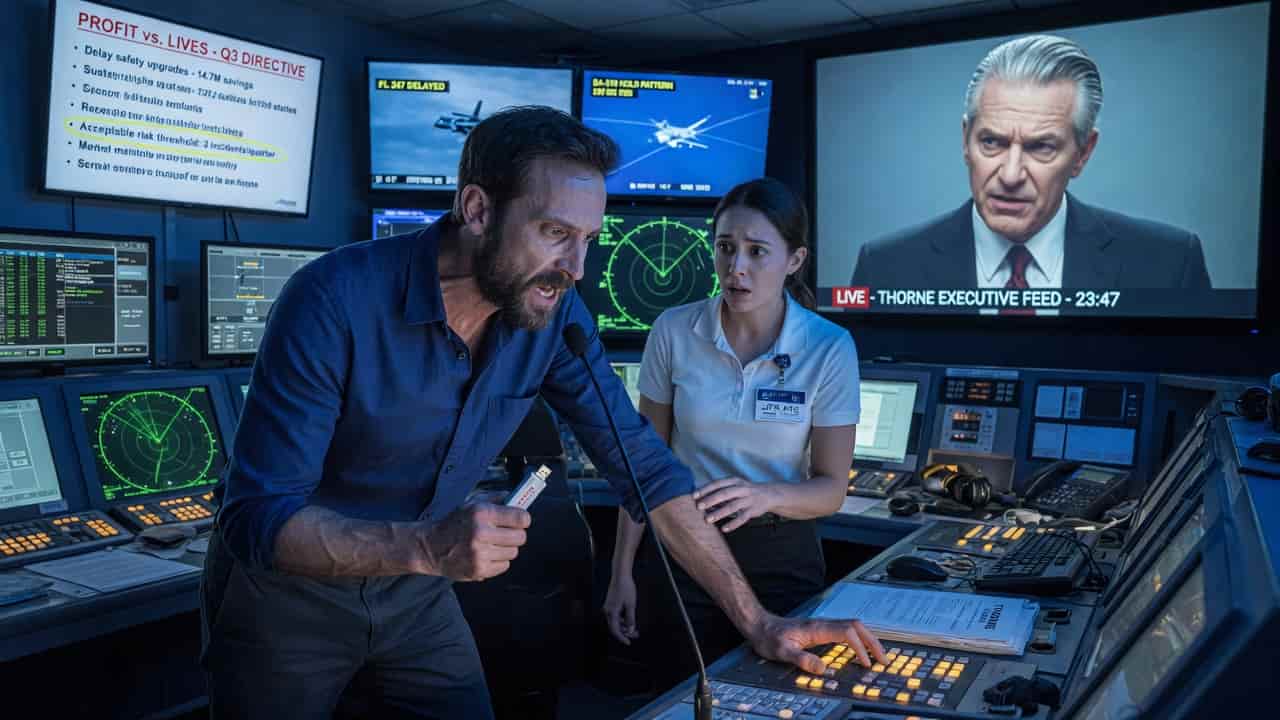
“Say it again, Mr. Thorne.”
David’s voice didn’t shake, but his hand was white where it gripped the edge of the control console. On the screen in front of him, Horizon Flight 44—a private Gulfstream—was a blinking green dot, 30,000 feet above the pavement.
“I told you to clear the lane,” Thorne’s voice crackled back, dripping with the kind of casual contempt that only comes from having too much money. “I have a board meeting in Chicago. I don’t pay for delays, and I certainly don’t explain myself to technical staff.”
David looked at the silver USB drive plugged into his station. It contained the “Profit vs. Lives” memo—the document Thorne had signed, knowing the software bug would eventually cause a disaster. The same disaster that took David’s little girl exactly 365 days ago.
The whole terminal at O’Hare went silent as David hit the patch. Every traveler, every gate agent, every family waiting for a loved one heard the billionaire’s next words: “You’re a service provider, David. You’re disposable. Now do your job.”
David leaned into the mic, his eyes fixed on the blinking dot. “The whole world is listening now, Richard. Tell them why my daughter never came home.”
The room went cold. Sarah, the controller at the next station, reached out to stop him, but she froze when she saw what was on David’s screen. It wasn’t a flight path anymore. It was a countdown.
Chapter 1
The air in the TRACON facility always smelled like ozone, stale coffee, and the quiet, vibrating hum of high-voltage electronics. It was a basement smell, subterranean and sterilized, designed to keep a man’s brain locked into a specific frequency. David sat in the dim glow of the Sector 4 monitor, the blue light etching deep lines into a face that had aged a decade in the last twelve months.
Today was the anniversary. April 13th.
On his desk, tucked just behind the primary radar scope, was a small, laminated photo of a six-year-old girl in a yellow sundress. Chloe. She was squinting at the sun, her smile missing a front tooth. To anyone else, it was just a photo. To David, it was an anchor. Without it, he feared he might simply float away into the green and blue vectors of the screen, becoming just another blip in the terminal airspace.
He adjusted his headset. The foam was starting to crumble, leaving little black flakes on his ears. He didn’t replace it. He liked the grit. It reminded him he was still physical, still present.
“Center, Horizon seven-two-niner, requesting descent to one-zero thousand,” a voice crackled in his ear.
“Horizon seven-two-niner, Chicago Center, descend and maintain one-zero thousand, altimeter two-niner-niner-two,” David said. His voice was a flat, professional monotone. It was the voice of a man who had mastered the art of being a ghost.
Behind him, the heavy steel door hissed open. He didn’t turn around. He knew the gait. Heavy, dragging, the sound of a man who had lost his center of gravity. It was Elliot.
Elliot had been the lead engineer at Horizon Air for twenty years before they’d scrubbed him from the payroll. They’d called it a “restructuring,” but everyone knew the truth. Elliot had found the rot in the code, and he’d been too loud about it. Now, he looked like a man who lived out of his car, which he mostly did. His jacket was stained with grease, and his hair was a wild thicket of gray.
“You’re early,” David whispered, his eyes never leaving the scope.
“I couldn’t sleep,” Elliot said, pulling up a rolling chair that squeaked loud enough to make Sarah, the controller three stations down, look over with a frown. “The air felt heavy. You know how it gets before a storm.”
“There’s no storm on the METAR, Elliot.”
“The physical kind, no. But the pressure’s dropping, David. I can feel it in my teeth.” Elliot leaned in closer, his voice dropping to a gravelly rasp. “The USB is ready. I’ve verified the checksums. It’s all there. The internal emails, the cost-benefit analysis on the pitch-trim actuator, Thorne’s digital signature on the ‘Acceptable Risk’ memo. It’s the whole funeral, packaged in six gigabytes.”
David felt a cold prickle at the base of his neck. He reached out and touched the photo of Chloe. “Did you find the specific log for Flight 182?”
Elliot went quiet. The hum of the room seemed to grow louder. “I did. The software tripped four times in ten minutes. The pilots fought it. They did everything right, David. But the code was written to win. It thought it was saving the plane by driving the nose into the ground. It was a math problem with a blood-red answer.”
David’s hand tightened on the armrest of his chair. He could almost hear it—the sound Chloe’s voice had made on that final black-box recording he’d spent his life savings to illegally acquire. Daddy, why is the floor going up?
“Thorne is on the jet,” David said. It wasn’t a question.
“Gulfstream G650. Tail number N44HT. He’s coming in from a donor retreat in Aspen. High on himself, probably drinking thirty-year-old scotch while he looks at the clouds,” Elliot said. “He’s due in your sector in forty minutes.”
David looked at the clock. 14:20. In forty minutes, the man who had decided Chloe’s life wasn’t worth the cost of a software patch would be under David’s direct command. For those few minutes, David wouldn’t be a grieving father or a disgraced controller. He would be the law of gravity.
“You’re sure about the hack?” David asked.
“It’s not a hack, David. It’s an override. I built the back door into the system five years ago as a safety measure. Ironic, right? It bypasses the ground-to-air encryption. Once you plug in, you’re not just talking to him. You’re the pilot. You can feed the jet’s flight computer whatever data you want. You can make it think it’s at fifty thousand feet when it’s at five hundred. You can make it think the engines are on fire.”
“I don’t want to kill him, Elliot,” David said, his voice finally cracking.
Elliot looked at him, his eyes hard and unsympathetic. “Then what do you want? Because I didn’t risk a federal prison sentence for a conversation.”
“I want him to feel it,” David said. “I want him to look at the ground and realize that all his money can’t buy a second of time. I want him to confess. And I want the terminal to hear it.”
David pulled the silver USB drive from his pocket. It felt heavy, like a lead weight. He looked at Sarah. She was busy with a string of United heavies, her face calm and focused. She was a good controller. She followed the rules. She believed the system worked.
David used to be like her. He used to believe that if you did your job, the world would keep turning. But the world had stopped turning a year ago, and now he was just going through the motions of a life that had already ended.
“Get out of here, Elliot,” David said. “Go to the observation deck. Watch the big screens.”
“David,” Elliot said, hesitating. “If you do this… there’s no coming back. They’ll have you in cuffs before the jet even touches the tarmac.”
“I haven’t been back in a year, Elliot,” David said. “I’m just finally finishing the trip.”
Elliot nodded once, a sharp, jerky movement, and disappeared back through the hissing door. David sat alone in the blue light, the USB drive resting on the console like a live grenade. He looked at Chloe’s photo.
“I’m almost there, honey,” he whispered. “I’m almost there.”
He reached out and plugged the drive into the maintenance port. The screen flickered, a momentary glitch that only a trained eye would notice. A small, red icon appeared in the corner of his radar scope. A skull? No. It was a simple, clean circle. An eye.
The eye was open. And it was looking for N44HT.
Chapter 2
The sector began to fill up. The afternoon rush at O’Hare was a choreographed ballet of aluminum and kerosene, and David was the lead conductor. He moved planes like chess pieces, his mind operating on three different planes of existence. There was the professional David, the one who gave headings and altitudes with surgical precision. There was the grieving David, the one who was perpetually hearing the sound of a crash that hadn’t happened yet. And then there was the new David—the one with the red eye on his screen.
“United 12-echo, turn left heading two-seven-zero, vector for the ILS runway one-zero center,” David said.
“Left to two-seven-zero, United 12-echo,” the pilot replied.
Everything felt normal. That was the most terrifying part. The world didn’t know the atmospheric pressure was dropping. The other controllers were chatting about their weekend plans. Sarah was laughing at a joke someone had made on the interphone.
“You okay, Dave?” Sarah asked, leaning over during a brief lull in her traffic. “You look like you’re vibrating.”
David forced a smile. It felt like a mask made of dried clay. “Just a long shift. Anniversary stuff, you know.”
Sarah’s expression softened instantly. The “Anniversary.” It was the universal pass in the ATC world. It was why David was allowed to be moody, why he was allowed to skip the office parties. “I’m so sorry, Dave. I forgot it was today. Do you want me to take your sector for a while? Go grab a real coffee?”
“No,” David said, a bit too quickly. “I need the work. Keeps the head straight.”
“Okay,” she said, though she didn’t look convinced. “But if you need to tap out, just say the word. We’ve got your back.”
We’ve got your back. The phrase rang hollow. The airline hadn’t had Chloe’s back. The FAA hadn’t had his back. They’d all closed ranks, protected the stock price, and left him to rot in a house full of empty rooms and unwashed laundry.
A new blip appeared on the edge of the scope.
N44HT.
It was high, level at flight level four-zero-zero. It was moving fast, cutting through the commercial lanes like a shark through a school of minnows.
“Chicago Center, Horizon four-four-hotel-tango, checking in at four-zero-zero,” a voice said.
David’s breath hitched. It wasn’t Thorne. It was the pilot. Professional, smooth, probably a former Air Force guy who thought he was flying the most important man in the world.
“Horizon four-four-hotel-tango, Chicago Center, loud and clear,” David said. “Maintain four-zero-zero. I’ll have a descent for you in five miles.”
“Roger that, Center. We’re in a bit of a hurry. Mr. Thorne has a tight schedule.”
David felt a surge of cold fury. A tight schedule. Thorne had a schedule. Chloe had a schedule, too. She was supposed to start first grade. She was supposed to learn how to ride a bike without training wheels. She was supposed to grow up.
David reached for the mouse. He hovered over the red eye icon. With a single click, the radar scope changed. The other planes faded into the background, becoming dim, translucent ghosts. N44HT turned bright, pulsing red.
Suddenly, a data window opened on the side of his screen. It wasn’t ATC data. It was the Gulfstream’s internal systems. Fuel levels, cabin temperature, oxygen pressure. And the intercom.
David could hear them.
The sound was crystal clear. No static. It was as if he were sitting in the leather seat right next to Thorne. He heard the clink of ice against glass. He heard the rustle of a newspaper.
“Is the car ready at the FBO?” a voice asked. It was Thorne. David recognized it instantly from the news segments, from the depositions. It was a voice that never had to ask twice.
“Yes, sir,” the pilot’s voice came over the internal line. “They’ll be waiting on the tarmac. We’re looking at a 15:00 arrival.”
“Good,” Thorne said. “I want to be in the city by 15:45. This merger isn’t going to sign itself, and I’m not spending another minute in this flying tin can than I have to.”
A flying tin can. David looked at the USB drive. He thought about the memo. Internal Document 402-B: Structural Integrity vs. Fleet Availability. Thorne had written in the margins of that document: “We can’t ground the fleet for a hypothetical sensor failure. The math doesn’t support the loss of revenue.”
The “math” had killed Chloe.
David glanced at Sarah. She was looking at her own screen, her brow furrowed. She hadn’t noticed the red eye. She hadn’t noticed that N44HT was now the center of David’s universe.
“Horizon four-four-hotel-tango,” David said, his voice dropping into a lower register. “Descend and maintain flight level two-four-zero. Turn left heading one-eight-zero.”
“Center, four-four-hotel-tango, confirming descent to two-four-zero and left to one-eight-zero? That’s taking us pretty far off the arrival, isn’t it?”
“Traffic flow, Hotel-Tango,” David said. “Big push coming in from the east. I need you in the box.”
“Roger, Center. Leaving four-zero-zero for two-four-zero, heading one-eight-zero.”
The red dot began to turn. David watched it. He was pulling Thorne away from the safety of the herd. He was bringing him into the kill zone.
On the internal feed, David heard Thorne’s voice again. “Why are we turning? Why did we just drop ten thousand feet?”
“Air traffic, sir,” the pilot said. “Just a standard vector.”
“I told you I was in a hurry,” Thorne snapped. “Get back on the radio and tell them who is on this plane. I don’t sit in holding patterns.”
David smiled. It wasn’t a happy expression. It was the smile of a man who had just found a crack in a dam.
He moved his hand to the secondary keyboard—the one Elliot had given him. He began to type. Commands flowed into the Gulfstream’s flight computer. He wasn’t changing the course yet. He was just… introducing himself.
In the cabin of N44HT, the lights flickered.
“What was that?” Thorne asked.
“Just a power surge, sir,” the pilot said, sounding confused. “Everything’s green on the panel.”
David typed another command.
The air conditioning in the cabin cut out. The sudden silence was punctuated only by the whistle of the wind against the fuselage.
“Captain?” Thorne’s voice had lost its edge. It was replaced by a sliver of irritation that bordered on anxiety. “The air is off. It’s getting hot in here.”
“I… I see that, sir. I’m resetting the breakers. One second.”
David watched the red dot. He was nearing the point of no return. He looked at the photo of Chloe. She seemed to be watching him, her missing tooth a silent testament to everything he had lost.
“Horizon four-four-hotel-tango,” David said. “Descend and maintain one-zero thousand. Expedite descent. I have a report of severe turbulence at your altitude.”
“Roger, Center. Expediting to one-zero thousand.”
David’s heart was hammering against his ribs. He was no longer just a controller. He was the weather. He was the mechanical failure. He was the ghost of Flight 182.
And he was just getting started.
Chapter 3
The Gulfstream was dropping like a stone. One-zero thousand feet. The air was thicker here, more turbulent. David could see the plane’s airspeed fluctuating on his screen.
“Dave,” Sarah said, her voice sharp. “What are you doing with the Horizon jet? You’re dumping him right into the O’Hare departure corridor. You’re going to cause a conflict with the Southwest heavy at nine thousand.”
“I’ve got it, Sarah,” David said, not looking at her. “I’m just creating some space.”
“You’re not creating space, you’re creating a mess. Move him back to the two-forty heading now.”
David didn’t answer. He was listening to the internal feed.
“Captain, the nose is pitching down,” the pilot’s voice was no longer calm. It was strained. “The autopilot just disconnected. I’m hand-flying.”
“Why?” Thorne yelled. David could hear the sound of the scotch glass hitting the floor. “What is happening?”
“I don’t know! The controls are heavy. It feels like the trim is running away!”
David felt a surge of adrenaline. The trim is running away. Those were the same words from the Flight 182 transcript. The last words the pilot had spoken before the scream.
David typed another command.
The Gulfstream’s nose stayed down. The airspeed began to climb. 350 knots. 400 knots. The airframe was starting to vibrate.
“Center! Center, Horizon four-four-hotel-tango, we have an emergency! We have a flight control malfunction! We need an immediate climb to clear the terrain!”
David didn’t key his mic. He let the silence hang. He wanted them to feel the isolation. He wanted them to understand that in the sky, you are only as safe as the people who built your wings.
“David!” Sarah yelled. She stood up, reaching for his headset. “Give me the mic! You’re freezing! Dave!”
David pushed her hand away. He did it with a strength that shocked her. She stumbled back, her eyes wide with a mixture of fear and confusion.
“Stay back, Sarah,” David said. His voice was cold, hollow. “This isn’t your business.”
“It’s everyone’s business! You’re going to kill those people!”
“No,” David said. “I’m going to make them talk.”
He keyed the mic. But he didn’t use the standard frequency. He used the override.
“Richard,” David said.
There was a long pause on the other end. The sound of the wind was deafening now, a roar that filled the internal feed.
“Who… who is this?” Thorne’s voice was small. Trembling.
“You don’t remember my name, do you?” David said. “I was in the third row of the deposition. I was the man holding the yellow sundress.”
The silence on the other end was absolute, even over the roar of the engines.
“David?” Thorne whispered. “David Miller?”
“You signed the memo, Richard. You knew the pitch-trim actuator was faulty. You knew it would trip under high-load conditions. You knew, and you let that plane take off anyway. You let Chloe get on that plane.”
“David, listen to me,” Thorne said. He was pleading now. The billionaire was gone, replaced by a man who realized he was made of meat and bone. “We can talk about this. I can help you. I can… I can reopen the investigation. We can make it right.”
“You can’t make it right,” David said. “You can’t bring her back. But you can tell the truth. Right now. In front of everyone.”
“What do you want?”
“I want you to admit it. Admit that you knew. Admit that you chose the money over the lives.”
“I… I can’t do that. The legal implications…”
“Look out your window, Richard,” David said.
David typed a final command.
The Gulfstream’s nose pitched up violently. The G-forces would be pinning Thorne into his seat, crushing the air from his lungs. Then, David cut the engines.
The roar died. The silence was more terrifying than the noise. The plane was gliding, a thirty-ton bird with broken wings.
“We’re going to crash!” the pilot screamed. “Mayday! Mayday! We’re going down!”
In the TRACON center, the alarms were going off. Sarah was screaming for the supervisor. People were running toward David’s station. But David didn’t care. He was locked in.
He reached for the patch toggle. This was it. The moment Elliot had built.
“Sarah,” David said, looking at her one last time. “I’m sorry. But someone has to hear this.”
He slammed his hand onto the “Public Patch” toggle.
The audio from the Gulfstream didn’t just go to David’s headset. It went to the entire TRACON facility. It went to the O’Hare tower. And it went to every speaker in Terminal 1, 2, and 3.
Thousands of people—travelers, families, children—suddenly heard the voice of Richard Thorne, the most powerful man in aviation, sobbing.
“Richard,” David’s voice boomed through the terminal, calm and terrifying. “Every person in this airport is listening. Tell them why she’s gone. Tell them why my daughter died.”
Chapter 4
The atmosphere in Terminal 3 of O’Hare International usually felt like a frantic hive. It was a place of missed connections, overpriced sandwiches, and the low-frequency anxiety of travel. But in an instant, the hive went still.
The overhead speakers, normally reserved for boarding calls and reminders about unattended luggage, crackled with a sound that didn’t belong. It wasn’t a voice. it was a scream. A raw, mechanical shriek of wind, followed by a man’s frantic sobbing.
“Please!” the voice cried out, echoing off the glass and steel of the terminal. “Please, I don’t want to die! I’ll give you whatever you want!”
People stopped mid-stride. A woman holding a toddler froze by a newsstand. A businessman dropped his briefcase. They all looked up at the ceiling, their faces a mirror of the same confusion and burgeoning horror.
In the TRACON center, David was a statue. He was surrounded by chaos. Supervisors were shouting, security guards were bursting through the door, and Sarah was weeping, her hands pressed against her ears as if she could shut out the reality of what was happening.
“David, shut it down!” the supervisor, a man named Henderson, yelled as he lunged for the console.
David didn’t move. He didn’t have to. Elliot’s code had locked the system. Henderson’s fingers flew across the keyboard, but the screen only flashed a single word: DENIED.
“It’s not going to stop, Henderson,” David said. He didn’t look up. He was watching the red dot on his scope. It was at 4,000 feet and falling. “Not until he says it.”
“Richard,” David said into the mic, his voice projected to thousands of people. “The world is waiting. Tell them about the memo. Tell them about the software bug.”
“I… I…” Thorne’s voice was thick with panic. David could hear the pilot in the background, grunting as he fought the dead controls. “It was a business decision! We had to keep the planes in the air! We couldn’t afford the grounding! It was only a two-percent failure rate! Two percent!”
A collective gasp went up in the terminal. The businessman who had dropped his briefcase stared at the speaker, his mouth hanging open. A group of travelers near Gate B12 huddled together, their eyes wide.
“Two percent,” David repeated. His voice was a whip. “My daughter was in that two percent, Richard. She was six years old. She liked to draw butterflies. She was afraid of the dark. And you decided her life was worth less than your quarterly dividends.”
“I’m sorry!” Thorne shrieked. “I’m sorry! Please, just turn the engines back on! I’ll fix it! I’ll recall them all! Just let me land!”
David looked at the USB drive. He felt the cold weight of it. He had the proof. He had the confession. He had everything he had set out to get.
But Chloe was still dead.
The red dot was at 2,000 feet. The Gulfstream was over the industrial parks south of the airport. In less than a minute, it would hit the ground.
“David,” Sarah whispered. She had crawled back toward him, her face streaked with tears. “You’ve done it. They heard him. Everyone knows now. Please… don’t do this. Don’t be like him.”
David looked at her. He saw the genuine terror in her eyes. She wasn’t a corporate memo. She wasn’t a failure rate. She was a person. And there were people on that plane, too. The pilot. The flight attendant. People who had nothing to do with Thorne’s greed.
He looked at the photo of Chloe.
Daddy, why is the floor going up?
The memory of her voice was like a knife in his gut. But then, he remembered something else. He remembered the way she used to hold his hand when they crossed the street. He remembered her kindness, her refusal to even step on a bug in the garden.
If he let that plane crash, he wouldn’t be honoring her. He would be erasing the last part of her that still lived inside him.
His hand hovered over the keyboard.
“David, move!” Henderson screamed, trying to shove him out of the chair.
David didn’t budge. He typed three words.
RESTORE SYSTEM DEFAULTS.
On the radar scope, the red dot turned green. The engines of the Gulfstream roared back to life, the sound captured by the intercom and broadcast through the terminal.
“I have power!” the pilot yelled. “I have the engines! We’re climbing! We’re climbing!”
David slumped back in his chair. He felt as if he had been carved out of wood. He was empty. He was hollow. He was finished.
The “Public Patch” was still live. The silence in the terminal was heavy, expectant.
“You’re going to land, Richard,” David said, his voice barely a whisper. “And when you do, the police will be waiting. And so will the families. You’re not a billionaire anymore. You’re just a man who killed a little girl for a bonus.”
David reached out and pulled the USB drive from the port. He stood up slowly, his legs shaking.
The security guards were on him in an instant. They slammed him against the console, pinning his arms behind his back. His face was pressed against the cold glass of the monitor.
But he didn’t fight them. He didn’t even blink.
He looked at the photo of Chloe. It had fallen onto the floor in the struggle. It lay there, face up, in the cold blue light.
He had done it. He had broken the system. He had exposed the truth.
But as the guards dragged him toward the door, through the shouting and the chaos and the weeping, David realized the hardest part was still ahead of him. He had spent a year fueled by rage. Now, the rage was gone.
And all that was left was the silence.
The heavy steel door hissed open. David looked back one last time at the radar scope. The Gulfstream was on final approach. It was landing.
Thorne would live. But the world he had built was gone.
David closed his eyes and let them lead him into the dark.
Chapter 5
The holding cell at the federal building in downtown Chicago didn’t have the high-tech, glowing hum of the TRACON facility. It smelled of floor wax, industrial-grade lemon cleaner, and the sharp, metallic tang of fear that seemed to seep out of the cinderblock walls. David sat on a narrow metal bench, his hands cuffed behind his back. The position was awkward, forcing his shoulders into a painful hunch, but he didn’t adjust himself. The physical discomfort was a grounding wire. It reminded him that he had finally landed.
The door, a heavy slab of steel with a reinforced glass window, opened with a mechanical thud. Two men walked in. One was Henderson, David’s supervisor, looking like he’d aged twenty years in the last three hours. His tie was loosened, his white shirt stained with sweat at the armpits. Beside him was a man in a charcoal suit that cost more than David’s car—Agent Marcus Vance of the FBI.
Vance didn’t look like a movie Fed. He was short, balding, with a pair of reading glasses perched on the end of a nose that had been broken at least twice. He carried a leather briefcase that he set carefully on the scarred wooden table in the center of the room.
“Leave us, Jerry,” Vance said to the officer at the door.
Henderson stayed, leaning against the far wall. He looked at David with a mixture of pity and absolute, unadulterated fury. “You threw it all away, Dave. Twenty years. A pension. Your freedom. For what? A stunt?”
David looked up. His eyes were bloodshot, the blue light of the radar screens still burned into his retinas. “It wasn’t a stunt, Jerry. You heard him. Everyone heard him.”
“The whole world heard him,” Vance interjected, his voice surprisingly soft. He sat down across from David and opened his briefcase. He pulled out a legal pad and a digital recorder, clicking it on with a deliberate thumb. “As of twenty minutes ago, the audio of Richard Thorne admitting to a two-percent ‘acceptable failure rate’ has been played on every major news network in the country. It’s trending on social media. The FAA has already issued an emergency grounding order for every Horizon Air Gulfstream and Boeing 737 with that specific trim configuration.”
David felt a cold shiver of relief, but it was quickly swallowed by the emptiness. “Good.”
“Is it?” Vance leaned forward. “Because while Mr. Thorne is currently being escorted to a safe house by his private security to avoid the mob forming at the FBO, you are sitting in a federal box facing charges of interference with flight crew, computer fraud, and approximately six different counts of domestic terrorism. You hijacked a multi-million dollar aircraft from a basement in Elgin, David. Regardless of the motive, the Department of Justice is going to want your head on a spike.”
“I didn’t hijack it,” David said, his voice level. “I directed it. I’m a controller. That’s what I do.”
“You cut the engines,” Henderson snapped, stepping forward. “You overrode the pilot’s authority. You bypassed encryption that shouldn’t have been bypassable. How did you do it, Dave? Who helped you?”
David thought of Elliot, likely sitting in a dive bar somewhere, watching the world burn on a flickering TV screen. He thought of the USB drive, currently in an evidence bag. “I’m an air traffic controller, Jerry. I know the systems. I know the back doors. I didn’t need help.”
Vance watched David’s face. He was a man who spent his life reading lies, but David wasn’t lying. He was simply omitting. “We know about Elliot Crane. We know he was fired from Horizon. We know you two have been meeting at a diner in Des Plaines every Tuesday for six months. Don’t protect him. He’s the one who gave you the keys to the castle.”
“I don’t know who that is,” David said.
Vance sighed and took off his glasses, rubbing the bridge of his nose. He looked less like an agent and more like a tired father. “David, look at me. I have an eight-year-old son. He’s obsessed with planes. He wants to be a pilot. Every time he gets on a flight to visit his grandmother in Florida, I stay awake until I see the flight-track app show him as landed. I know why you did this. I read the file on your daughter. Chloe, right?”
The mention of her name felt like a physical blow. David’s jaw tightened. “Don’t say her name.”
“I have to say it, because she’s the only reason you’re not in a black site right now. The public sympathy for you is… unprecedented. People are calling you a hero. They’re calling Thorne a murderer. But the law doesn’t care about heroes. It cares about the fact that you put a hundred tons of metal over a populated area and turned it into a glider.”
“I knew exactly where that plane was,” David said. “I knew the glide ratio. I knew the wind speed. I wouldn’t have let it hit anything.”
“You can’t know that!” Henderson yelled. “Systems fail, Dave! You of all people should know that! What if the restart hadn’t worked? What if the pilot had panicked and stalled the wing? You were gambling with lives to settle a score!”
“I was forcing a man to admit he was gambling with lives for a paycheck,” David countered. “There’s a difference.”
The room went quiet. The only sound was the hum of the overhead fluorescent light, a flickering, sickly buzz. David felt the exhaustion finally starting to settle into his marrow. He hadn’t slept in thirty-six hours. He hadn’t eaten. He felt like a hollow shell that had been scrubbed clean by a storm.
“Sarah gave a statement,” Vance said, shifting the papers on the table. “She’s a mess. She says you pushed her. She says you looked… possessed. She’s your friend, David. She’s the one who advocated for you to keep your job after the crash. And you used her station to commit a felony.”
David looked down at his cuffed hands. “I know. I’ll apologize to her. When I can.”
“You might not get the chance for a long time,” Vance said. “The U.S. Attorney is already drafting the indictment. They want to make an example of you. They can’t have every disgruntled employee with a technical background taking over the national airspace. If you cooperate—if you tell us how the override worked and give us the names of everyone involved—we might be able to talk about a plea that doesn’t involve you dying in a jumpsuit.”
David looked at the agent. He saw the child’s drawing tucked into the side pocket of Vance’s briefcase—a crude crayon sketch of a house and a sun with a face. It was the kind of drawing Chloe used to do.
“There’s a memo,” David said quietly. “In the USB drive. It’s titled ‘Profit vs. Lives.’ It’s a cost-benefit analysis of the pitch-trim actuator. It explicitly states that fixing the bug would cost four hundred million dollars, while the projected legal settlements for a ‘hull loss event’ would only be two hundred and fifty million. Thorne signed it in the margins. He wrote, ‘The math favors the status quo.'”
Vance stilled. He looked at the recorder, then back at David.
“My daughter was the math,” David said, his voice cracking for the first time. “She was the difference between two hundred and fifty and four hundred. If you want to put me in prison for showing the world that math, go ahead. I’ve been in a cell for a year already. It’s just been made of wood and drywall.”
Henderson looked away, his anger seemingly drained, replaced by a profound, heavy shame. He was part of the system too. He was the one who enforced the rules that Thorne had bought and paid for.
“I can’t promise you anything, David,” Vance said, his voice dropping to a whisper. “But I’ll make sure the U.S. Attorney sees that memo before they file the charges. And I’ll make sure the press knows it exists.”
“They already know,” David said. “I broadcast the confession. The terminal heard him. The world heard him. You can’t put the secret back in the box, Agent Vance.”
Vance nodded slowly. He stood up and packed his briefcase. “We’re transferring you to the Metropolitan Correctional Center tonight. It’s going to be a long road. Get some sleep if you can. You’re going to need your head straight for the arraignment.”
As they walked out, Henderson stopped at the door. He looked back at David, his hand on the heavy steel frame. “She was a great kid, Dave. I remember her at the Christmas party. She tried to feed the plastic reindeer her cookies.”
David closed his eyes. He could see her. The yellow dress. The missing tooth. The way she smelled like baby shampoo and strawberry jam.
“She was,” David said.
The door slammed shut, the sound echoing like a gunshot in the small room. David was alone again. He leaned his head back against the cold cinderblock. The physical pain in his shoulders was nothing compared to the weight in his chest, but for the first time in a year, the weight felt… stable. He hadn’t brought her back. He hadn’t fixed the world. But he had made the man in the sky look at the ground.
He sat there in the silence, listening to the muffled sounds of the building—the distant sirens, the hum of the city, the heartbeat of a world that was finally, finally starting to pay attention.
Chapter 6
Six months later, the world had moved on, as it always does, though the scars remained.
The “Thorne Confession” had become a landmark moment in corporate accountability. Horizon Air had filed for Chapter 11. The CEO was currently under house arrest in his mansion in Winnetka, wearing an ankle monitor while a team of high-priced lawyers fought a losing battle against a racketeering indictment. The software patch had been mandated globally. Three other airlines had discovered similar “acceptable risks” in their own systems, leading to a massive, industry-wide purge of cost-cutting measures.
David sat in a small, windowless office in the federal courthouse. He wasn’t wearing a jumpsuit. He was wearing a cheap, off-the-rack suit he’d bought for the trial. He looked thinner, his hair almost entirely gray now, but the hollow look in his eyes had been replaced by a quiet, focused stillness.
His lawyer, a sharp-featured woman named Elena who had taken the case pro-bono for the sheer publicity of it, walked in with a stack of papers.
“The judge accepted the plea,” she said, her voice bright. “Five years, suspended. Three years of probation. A permanent ban from working in the aviation industry, and five thousand hours of community service.”
David let out a breath he felt like he’d been holding for a decade. “I’m not going back?”
“The U.S. Attorney couldn’t find a jury in Illinois that would convict you of terrorism,” Elena said, sitting down. “Not after the ‘Profit vs. Lives’ memo went viral. You’re a folk hero, David. Every time they tried to push for jail time, the courthouse was surrounded by families of crash victims. The optics were a nightmare for the DOJ. They settled for the industry ban to save face.”
“I don’t want to work in aviation anyway,” David said. “I’ve seen enough screens.”
“Well, you’re free to go. We just have to sign the final paperwork and you can walk out the front door.”
David stood up, his joints popping. He felt like a man who had been underwater for a very long time, finally breaking the surface. The air in the courthouse felt different—less like ozone and more like the real world.
As he walked out of the courtroom, he saw Sarah waiting in the hallway. She looked tired, her airport ID badge clipped to a sensible blazer. She hadn’t gone back to TRACON either. She was working in administrative safety now, far away from the radar scopes.
“Dave,” she said, stepping forward.
“Sarah. I… I never got to apologize. For the push. For the mess I left you with.”
She shook her head, her eyes welling up. “Don’t. I spent a long time being angry, Dave. But then I looked at the stats. Do you know how many lives that patch is going to save? Thousands. Every year. You did what none of us had the guts to do. You broke the machine.”
“I just wanted him to say it,” David said.
“He said it. And the world heard him.” She reached out and squeezed his hand. “Where are you going now?”
“To the cemetery,” David said. “I have some news for Chloe.”
Sarah nodded, a small, sad smile on her face. “Tell her… tell her we’re looking out for the other kids now.”
David walked out of the courthouse and into the bright, biting chill of a Chicago autumn. The wind was whipping off the lake, smelling of rain and asphalt. He walked to his car—the same beat-up sedan he’d had for years—and drove south.
The cemetery was quiet, the trees turning shades of burnt orange and deep red. He walked past the rows of headstones, his shoes crunching on the fallen leaves, until he reached the small, simple marker under the willow tree.
Chloe Elizabeth Miller. 2017 – 2023.
He sat down on the grass, ignoring the dampness. He pulled a small, wooden butterfly from his pocket—something he’d carved during the long nights of his house arrest. He placed it at the base of the stone.
“Hey, honey,” he whispered.
The wind rustled the leaves of the willow, a soft, sighing sound.
“The man in the jet… he’s not in the sky anymore. Nobody’s going to get hurt the way you did. I made sure of it.”
He sat there for a long time, talking to the silence. He told her about the trial, about Sarah, about the way the terminal had gone quiet when his voice came over the speakers. He told her he was sorry he hadn’t been there to catch her, but that he was trying to be a better man now.
When he finally stood up, the sun was starting to set, casting long, golden shadows across the graves. He felt a strange sensation in his chest—not happiness, exactly, but a lack of pain. The jagged edges of his grief had been filed down. The residue of the last year was still there—the loss, the anger, the memory of the scream—but it was no longer a poison. It was just a part of him, like a scar from a surgery that had saved his life.
As he walked back to his car, his phone buzzed in his pocket. It was a text from an unknown number.
The math is different now, David. Drinks are on me. – E.
David smiled. Elliot was still out there, somewhere in the shadows, probably already looking for the next crack in the next dam.
David got into his car and started the engine. He didn’t turn on the radio. He didn’t want to hear any more voices. He just wanted to drive.
He pulled out of the cemetery and onto the highway, heading back toward the city. The skyline was glowing in the distance, a forest of light and steel. Above him, a heavy jet was climbing out of O’Hare, its landing lights blinking like a slow, steady heartbeat.
David watched it for a second, his eyes tracing the arc of its flight. It was level. It was stable. The code was clean.
He looked away from the sky and focused on the road ahead. He had a long way to go, and the sun was almost gone, but for the first time in a year, he wasn’t afraid of the dark.
He drove into the night, a man who had lost everything but his soul, finally heading home.