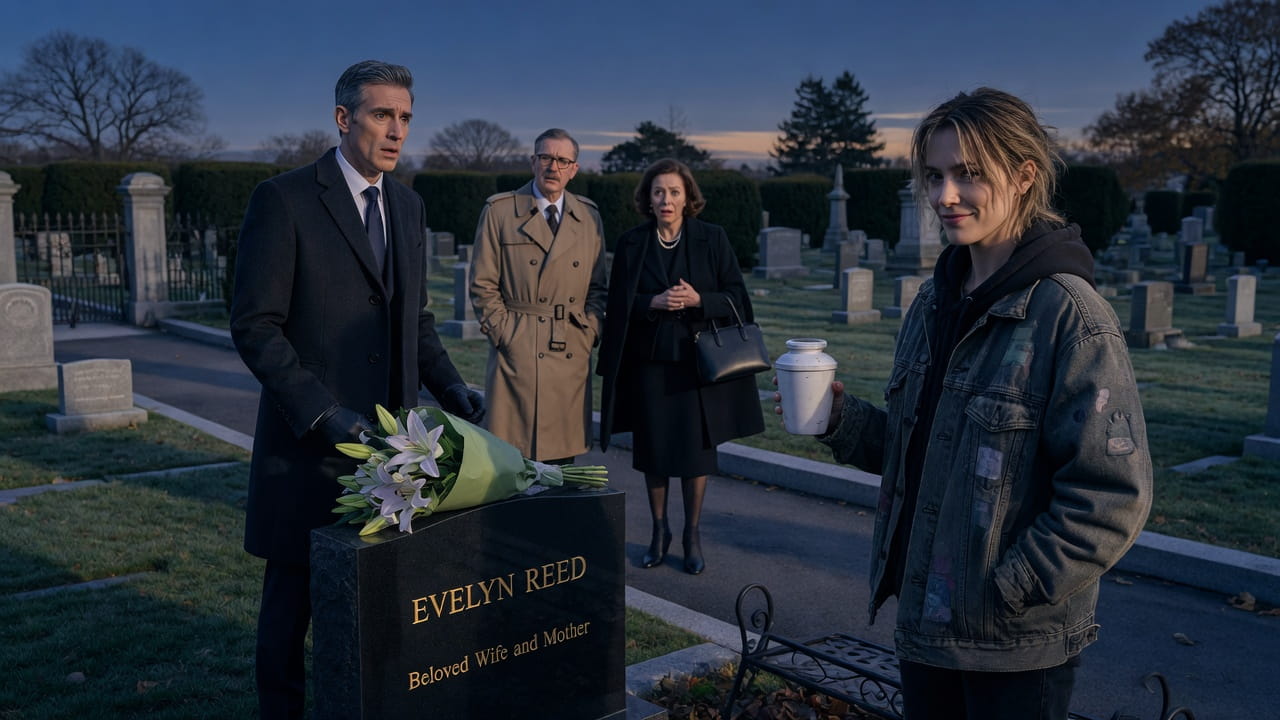
“Who are you?”
Alan’s voice was as sharp as the scalpels he used to keep his world in order. He stood by the fresh granite of his wife’s grave, his colleagues just steps away, watching the most prestigious man in the hospital crumble.
The girl didn’t flinch. She had Evelyn’s eyes—the same deep, haunting green—but they were filled with a jagged edge Evelyn never possessed. She held up a cheap plastic urn, the kind they give you when you can’t afford the mahogany.
“I’m the daughter of the woman you let disappear,” the girl said, her voice carrying across the silent rows of the cemetery. “I’m the secret your perfect wife spent ten years hiding from you so you wouldn’t leave her.”
Alan’s world didn’t just crack; it vanished. He looked at his fellow doctors, their expressions shifting from sympathy to scandal. He looked at the girl—the identical image of the woman he thought he knew.
He had spent thirty years cutting out anything that wasn’t perfect. He didn’t realize his wife had done the same, starting with her own blood.
Chapter 1: The Monument of Perfection
The white lilies cost eighty dollars, and they were worth every cent. They were crisp, architectural, and entirely devoid of the cloying, rotting scent of common carnations. Dr. Alan Reed placed them at the base of the black granite monument with the same clinical precision he used to close an aortic valve. He didn’t kneel. He didn’t cry. He simply adjusted the stems until the symmetry was restored.
Evelyn would have appreciated the symmetry. She had been a woman of clean lines and quiet rooms. In thirty years of marriage, they had never had a screaming match, never a slammed door, and certainly never a scandal. She was the anchor that kept him from drifting back into the chaotic, whiskey-soaked memories of his own childhood in the shadows of the Southie projects. He had spent his entire adult life building a fortress of logic and status, and Evelyn had been its most beautiful feature.
“She was a remarkable woman, Alan.”
The voice belonged to Dr. Aris, the Chief of Surgery. He and Dr. Thorne were standing a respectful five feet back, their breath hitching in the cold October air. They had followed Alan to the cemetery after the small, private memorial service. It was a gesture of solidarity, the kind of social ritual Alan navigated with practiced ease.
“Thank you, Marcus,” Alan said, his voice steady. He didn’t turn around yet. He wanted one more second of the silence. “She valued your friendship.”
“We all did,” Thorne added, her pearls clicking as she shifted her weight. “The hospital foundation won’t be the same without her touch. It’s… it’s just so sudden. A stroke at fifty-eight. It’s a tragedy.”
Alan finally turned. His charcoal overcoat was buttoned to the chin. He looked exactly like what he was: a man in total control of his grief. “Nature doesn’t care about our schedules, Sarah. It just acts. We, as physicians, should know that better than anyone.”
It was the perfect response. Distant, intellectual, and unassailable. He saw Aris nod, a look of profound relief crossing the older man’s face. They were afraid of a scene. They always were. In the elite circles of Boston medicine, emotion was a secondary infection, something to be managed and suppressed.
They began to walk toward the line of black SUVs idling near the cemetery gates. The gravel crunched under Alan’s polished oxfords. He felt the weight of their pity, but he also felt the familiar satisfaction of having performed his role correctly. The widower. The grieving professional. The man who had everything under control.
“Wait.”
The word didn’t come from Aris or Thorne. It was a flat, nasal rasp that sliced through the quiet.
Alan stopped. A girl was standing ten feet away, leaning against a rusted wrought-iron fence that separated the high-end plots from the older, overgrown section of the cemetery. She looked like a smudge of grease on a white sheet.
She was wearing a faded denim jacket that was three sizes too big, a black hoodie with the strings pulled tight, and combat boots caked in dried mud. Her hair was a tangled nest of dark blonde, tucked behind ears that were pierced with too many cheap silver hoops.
But it was her face that stopped Alan’s heart.
It wasn’t just a resemblance. It was a genetic theft. She had Evelyn’s high, sharp cheekbones. She had Evelyn’s narrow, aristocratic nose. Most of all, she had the eyes—a startling, translucent green that seemed to catch the dying afternoon light. It was like looking at a ghost that had been dragged through a gutter.
“Alan?” Aris whispered, stepping closer to him. “Do you know this girl?”
Alan couldn’t speak. His throat felt like it had been stitched shut. He watched as the girl pushed off the fence and began to walk toward them. She didn’t have Evelyn’s graceful, gliding step. She stomped, her shoulders hunched, a cigarette tucked behind her ear.
In her right hand, she clutched a white plastic urn. It was the kind of container a cut-rate crematorium used—disposable, utilitarian, and insulting.
“You the doctor?” the girl asked. She stopped five feet away, her eyes raking over Alan’s expensive coat with a look of pure, unadulterated contempt.
“I am Dr. Reed,” Alan said, his voice cracking on the last syllable. He cleared his throat, trying to find his surgical mask, the one he wore when a patient was dying on the table. “Can I help you? This is a private service.”
The girl laughed. It was a harsh, jagged sound that made Dr. Thorne flinch. “Private. Yeah, that sounds like her. Everything was always a secret, wasn’t it?”
She held up the urn. “I brought a guest. Figured it was time for a family reunion.”
“Young lady,” Aris stepped forward, his voice taking on the patronizing tone he used with difficult residents. “This is a time of mourning. If you have some sort of grievance, this is not the place.”
The girl didn’t even look at him. Her gaze remained locked on Alan. “My mom died three days ago. Same day as your wife. Funny, right? Like they were tethered by a string or something.”
She took another step, invading Alan’s personal space. The smell of cheap tobacco and stale sweat hit him, a violent contrast to the scent of the eighty-dollar lilies.
“My mom’s name was Elena,” the girl said, her voice dropping to a low, dangerous hiss. “She spent the last ten years in a basement in Revere, coughing up her lungs and screaming for a sister who never picked up the phone. She had a picture of your wife in her wallet. A newspaper clipping from some fancy gala. She used to stare at it while she was getting high.”
“Sister?” Thorne gasped, her hand flying to her throat. “Evelyn didn’t have a sister. She was an only child. We’ve known her for twenty years.”
The girl smirks, and the expression is so hauntingly familiar that Alan feels a wave of nausea. It was the same smirk Evelyn used when she had won a bridge game, only twisted into something cruel.
“Evelyn was a liar,” the girl said. She looked at Aris and Thorne, then back to Alan. “She was a closed-adoption twin. Found my mom ten years ago. Realized my mom was a mess—an addict, a loser, a ‘cancer,’ as she called it in the letters. So your perfect wife did what people like you do. She cut her out. She paid for a rehab once, and when it didn’t stick, she changed her number and pretended my mom didn’t exist.”
“That’s enough,” Alan snapped, his face flushing a deep, bruised purple. “This is slander. My wife was a saint. She was a pillar of this community.”
“She was a coward!” the girl screamed. The sudden volume made a flock of crows erupt from a nearby oak tree. “She let her own flesh and blood rot because she didn’t want you to see the dirt she came from! She knew you, Doc. She knew you’d dump her if you found out she wasn’t as ‘clean’ as you are.”
The girl stepped up to the black granite monument. Before Alan could move, she slammed the white plastic urn down onto the base, right next to the white lilies.
“Her name was Elena,” the girl panted, her eyes welling with angry, hot tears. “And she’s staying here. You can’t hide her anymore.”
Alan looked at Aris. The Chief of Surgery was looking at the girl, then at the urn, then at Alan with an expression of dawning horror. The scandal wasn’t just a possibility anymore; it was a physical presence, sitting on his wife’s grave in a plastic jar.
“Alan,” Aris said, his voice cold and professional. “Is there any truth to this?”
“Of course not,” Alan said, but the words felt hollow. He looked at the girl—at Evelyn’s face, Evelyn’s eyes, Evelyn’s bone structure. The resemblance was a conviction.
The girl reached into her pocket and pulled out a crumpled piece of paper. She shoved it toward Alan’s chest. “Look at the names, Doc. Go on. Look at the names.”
Alan took the paper. His hands were shaking so violently he could barely unfold it. It was a copy of a birth certificate.
Name: Evelyn Marie Vance. Date of Birth: June 12, 1966. Mother: Rose Vance.
He looked at the second page.
Name: Elena Rose Vance. Date of Birth: June 12, 1966. Mother: Rose Vance.
The silence that followed was heavy, wet, and final. It was the silence of a tomb. Alan looked at the girl, who was watching him with a look of predatory satisfaction.
“My name’s Sam,” she said. “And I don’t have a place to stay. So, what are we going to do, Uncle Alan?”
Chapter 2: The Paper Trail
The silence of the house had always been Alan’s favorite thing about it. It was a four-story brownstone on Beacon Hill, filled with crown molding, original hardwoods, and air that smelled faintly of expensive beeswax and lemon oil. It was a fortress of order.
Now, the silence felt like a predatory animal, waiting for him to turn his back.
Alan sat in his study, the birth certificates lying on the mahogany desk like two unexploded grenades. He hadn’t turned on the overhead lights. Only the green-shaded banker’s lamp cast a pool of light over the documents.
He hadn’t brought the girl home. He had handed her a hundred-dollar bill and told her to find a motel, his voice a ghost of itself. She had taken the money with a sneer, but she had gone. Aris and Thorne had left shortly after, their apologies so stiff and hurried they felt like insults.
She knew you’d dump her if you found out she wasn’t as ‘clean’ as you are.
The girl’s words echoed in the mahogany-paneled room. Alan stood up and walked to the built-in bookshelves. Behind a row of leather-bound medical journals was a small, keypad-operated safe. Evelyn had kept her jewelry there, her “good” pearls and the emeralds he’d bought her for their twenty-fifth anniversary.
He punched in the code—their wedding anniversary. The heavy door clicked open.
He pulled out the velvet-lined trays of jewelry. Beneath them was a false bottom he’d never noticed before, a small tab of leather peeking out. He pulled it, and a shallow compartment revealed itself.
Inside was a single, battered manila envelope.
Alan carried it back to the desk. His heart was hammering against his ribs in a way that made him feel like a patient instead of a doctor. He opened the envelope and emptied the contents.
A stack of letters. A dozen photographs. A burner phone, long dead.
He picked up the first photograph. It was a Polaroid, the colors bled out into yellow and sepia. It showed two little girls, perhaps four years old, sitting on a concrete stoop. They were identical—same round faces, same gap-toothed smiles, same matching sundresses. But one girl was holding a pristine doll, while the other was covered in what looked like motor oil, grinning at the camera with reckless abandon.
On the back, in a cramped, shaky hand: Evie and El. 1970.
Alan felt a cold sweat break out across his forehead. He picked up the letters. They weren’t in the shaky hand; they were in Evelyn’s elegant, slanted script. The paper was the heavy, cream-colored stationery she used for her charity invitations.
September 14, 2014.
Elena,
I am sending the money for the clinic. This is the last time. You cannot keep calling the house. Alan is a prominent man, a man of standing. He does not understand people like you. He has worked too hard to distance himself from the world you still live in. If he finds out who you are, what you’ve become, he will see me the same way. I cannot lose everything because you cannot stay clean.
Alan dropped the letter as if it had burned him. He does not understand people like you.
He remembered the way Evelyn used to talk about the homeless people they saw near the Common, or the “unfortunate” cases that came into the ER. She was never cruel, but she was clinical. She spoke of them as if they were a different species, a biological failure that needed to be managed but never touched.
He had agreed with her. He had loved that about her. He had grown up in a house where his mother’s bipolar episodes had turned their lives into a minefield of broken glass and unpaid bills. He had spent his life cutting out the chaos. He had thought Evelyn was his partner in that surgery.
He didn’t realize he was the reason she was terrified.
The doorbell rang. It was a sharp, aggressive sound that shattered the quiet of the brownstone.
Alan checked his watch. It was 11:30 PM. He walked to the front door, his hand hovering over the brass knob. He peered through the sidelight.
Sam was standing on the stoop. She looked smaller in the dark, her oversized denim jacket illuminated by the streetlamp. She was shivering, her breath blooming in white clouds.
Alan opened the door six inches. “I gave you money for a room, Samantha.”
“The motel was full of junkies, Uncle Alan,” she said, her voice lacking the bravado she’d shown at the cemetery. It was just tired. “And some guy followed me for three blocks. I’m not sleeping on the street.”
“You can’t stay here,” Alan said, his voice firm. “This is… this is not a suitable arrangement.”
“Suitable?” Sam let out a sharp, bitter laugh. “You’ve got twenty rooms in this museum. I just need a couch. Or a floor. I don’t care.”
She pushed against the door. It wasn’t a violent shove, but it was insistent. Alan, caught between his desire for order and the sheer, terrifying public optics of an eighteen-year-old girl shouting on his Beacon Hill doorstep, stepped back.
Sam walked into the foyer. She stopped, her eyes taking in the marble floors, the crystal chandelier, the antique umbrella stand. She looked down at her muddy combat boots, then back at Alan.
“Wow,” she whispered. “She really did okay for herself, didn’t she? No wonder she didn’t want the trash coming around.”
“Don’t speak about her that way,” Alan said, though the words felt like a script he was reading.
“Why not? It’s true.” Sam walked toward the living room, her boots leaving damp, grey smudges on the white silk rug. She stopped in front of the fireplace, where a portrait of Evelyn hung above the mantle.
In the painting, Evelyn was wearing a black velvet dress and her “good” pearls. She looked serene, untouchable, and infinitely wise.
Sam looked at the portrait, then reached up and touched her own cheek. “We have the same face. How did you not see it? How did you live with her for thirty years and not see that she was holding her breath every time she looked at you?”
Alan walked into the room, his hands clasped behind his back. “Your mother… the letters said she struggled with addiction.”
“She didn’t struggle with it,” Sam said, turning away from the portrait. “She embraced it. It was the only thing that made the basement feel like a palace. But she loved Evie. She talked about her every day. She thought if she just got clean enough, if she just stayed out of trouble for six months, Evie would let her come for dinner. Just once.”
Sam looked at Alan, her green eyes hard and unforgiving. “But Evie knew you wouldn’t have it. She told my mom you were a man who ‘dealt in absolutes.’ That you didn’t believe in second chances for people who weren’t ‘high-functioning.’ Is that true, Doc? Do you only love things that aren’t broken?”
Alan felt a familiar, cold rage bubbling up. It was the rage that had fueled his medical school years, the rage that had made him the best surgeon in his class. “I believe in responsibility. I believe in the choices we make. Your mother made hers.”
“And what about my choice?” Sam stepped closer, her voice rising. “I didn’t choose to be born to a woman who traded her food stamps for Oxy. I didn’t choose to have a ‘perfect’ aunt who sent fifty bucks and a ‘don’t call me’ note once a month. I’m eighteen, I have a GED, and I’m carrying my mother in a plastic tub. What’s my choice, Alan?”
Alan looked at her, and for a fleeting second, he didn’t see the grit or the anger. He saw a girl who was terrified of being invisible. He saw himself at eighteen, standing in the doorway of his mother’s apartment, realizing no one was coming to save him.
The silence returned, but this time, it was different. It wasn’t predatory. It was heavy with the residue of thirty years of lies.
“The guest room is on the third floor,” Alan said, his voice barely a whisper. “Don’t touch anything. I’ll… I’ll make arrangements for you in the morning.”
Sam didn’t say thank you. She just grabbed her duffel bag and headed for the stairs.
Alan watched her go, his gaze drifting back to Evelyn’s portrait. The woman in the painting looked back at him, her smile as perfect and as hollow as a surgical mask.
Chapter 3: The Surgical Mask Slips
The hospital was supposed to be his sanctuary. It was a world of white light, stainless steel, and the rhythmic beeping of monitors—a language Alan understood perfectly. Here, he was Dr. Reed. He was the man who fixed things that were broken.
But as he walked through the lobby of Mass General the next morning, the air felt different. The nods from the nursing staff were a second too long. The junior residents hushed their conversations as he passed.
The scandal had traveled faster than a virus.
“Alan. A moment.”
It was Nurse Jenkins. She was sixty, with iron-grey hair and eyes that had seen everything from miracle recoveries to messy malpractice suits. She was the only person in the hospital who didn’t treat Alan like a god, mostly because she’d seen him drop a suture during a particularly stressful bypass ten years ago.
She pulled him into an empty consult room. “You look like hell, Alan.”
“I’m fine, Martha. I have a three-vessel bypass at ten.”
“No, you don’t. Aris took you off the schedule for the day.”
Alan felt a jolt of pure, cold adrenaline. “He did what? On what grounds?”
“On the grounds that you’re a liability right now,” Jenkins said, leaning against the door. “There’s a girl in the lobby, Alan. She’s been there since eight a.m. She’s telling anyone who will listen that she’s your niece. She’s got a birth certificate taped to the back of her denim jacket like a protest sign.”
Alan’s stomach dropped. “I told her to stay at the house.”
“Well, she didn’t. She’s causing a scene, Alan. Security is ten seconds away from tossing her, and Aris wants to avoid a headline in the Globe that says ‘Surgeon’s Niece Dragged Out of Mass General.’”
Alan pushed past her, his pulse thumping in his ears. He reached the mezzanine overlooking the lobby.
Sam was sitting on a designer leather bench in the center of the atrium. She looked like a jagged piece of glass in a velvet jewelry box. She had her boots up on the coffee table, and she was eating a bag of Cheetos, the orange dust staining her fingers.
She wasn’t shouting. She was worse. She was being visible.
Alan descended the stairs, his face a mask of professional calm. He could feel the eyes of a hundred people on him. He walked straight to the bench.
“Samantha. We are leaving. Now.”
Sam looked up, her green eyes bright with a manic, desperate energy. “Hey, Uncle Alan! Just checking out the family business. It’s real nice. Lots of shiny things.”
“Get up,” Alan hissed, his hand reaching for her arm.
She pulled back, her voice suddenly loud enough to carry to the reception desk. “Don’t touch me! What, are you embarrassed? Is the ‘niece’ not part of the brand?”
A group of medical students stopped to watch. A woman in a lab coat slowed her pace, her eyes darting between Alan’s furious face and Sam’s hauntingly familiar one.
“The brand is fine,” Alan said through clenched teeth. “But your behavior is not. You are coming with me, or I am calling the police.”
“Go ahead. Call ‘em. I’d love to tell a judge why the most famous surgeon in Boston is trying to hide his dead wife’s twin sister’s kid.”
Alan saw Dr. Aris standing at the edge of the mezzanine, watching the scene with a look of profound disappointment. It was the look a mentor gives a student who has finally, irrevocably failed.
Alan grabbed Sam’s duffel bag from the floor. “Fine. You want to talk? We’ll talk. But not here.”
He practically dragged her out of the hospital and toward the parking garage. He didn’t speak until they were inside his Mercedes, the doors locked, the muffled hum of the city a world away.
“What do you want, Samantha? Money? A plane ticket? Tell me the number and let’s end this.”
Sam sat in the passenger seat, her bravado suddenly evaporating. She looked at the orange Cheeto dust on her fingers, then wiped them on her jeans. “I don’t want your money, Alan. Well, I do, but that’s not why I came here.”
“Then why?”
“Because my mom died thinking she was a mistake,” Sam said, her voice small and cracking. “She died thinking she was the ‘bad’ one and Evie was the ‘good’ one. And I wanted to see it for myself. I wanted to see the man who made my aunt so scared that she’d rather let her sister die in a basement than tell him the truth.”
She turned to him, her eyes searching his face. “Are you really that scary, Alan? Or was she just that weak?”
The question hit Alan harder than any of the insults. Was she just that weak? Or had he spent thirty years building a world so narrow, so rigid, that there was no room for anything human?
“I never asked her to hide anything,” Alan said, but the words felt like a lie as soon as they left his lips.
He drove them to a small, nondescript diner three miles away. It was the kind of place he usually avoided—plastic booths, greasy menus, and the smell of burnt coffee. It was a neutral territory.
They sat in a corner booth. Sam ordered a cheeseburger and fries, eating with a ravenous hunger that suggested she hadn’t had a real meal in days. Alan watched her, his coffee untouched.
“Your mother,” Alan said, his voice low. “The letters mentioned a child. You. Evelyn knew about you.”
Sam stopped chewing. “She knew. She sent a box of clothes once a year. Always brand name. Always a size too small. Like she wanted me to be a different person, even from a distance.”
“She never told me,” Alan whispered.
“Of course she didn’t,” Sam said, picking up a fry. “She knew you’d look at me and see ‘potential social services case.’ She knew you’d see a problem to be solved, not a kid to be loved.”
“You don’t know me,” Alan snapped.
“I know what she wrote about you, Doc. I read the letters, too. She said you were a man who ‘heals with a knife.’ That you don’t fix things, you excise them. She was terrified you’d excise her if she brought too much baggage into your life.”
Alan looked out the window. A bus went by, its side covered in an advertisement for a local law firm. He thought about his mother’s apartment. He thought about the day he had packed his single suitcase and left, never looking back, even when she had called him, crying, three months later. He had excised her. He had saved himself.
He looked at Sam. She was leaning back in the booth, her face softened by the exhaustion of the last forty-eight hours. Without the anger, the resemblance to Evelyn was staggering. It was like looking at a version of his wife that had been allowed to be messy.
“I need to see where she lived,” Alan said suddenly.
Sam frowned. “Why? It’s a dump, Alan. There’s nothing there but old needles and regret.”
“I need to see it,” he repeated. “I need to see what my wife was looking at when she decided to look away.”
Chapter 4: The Debt
The neighborhood in Revere was a graveyard of industrial ambition. Low-slung triple-deckers with peeling paint sat in the shadow of a rusted water tower. The air tasted of salt, diesel, and neglect.
Alan’s Mercedes looked like a spaceship in the driveway of the sagging house. Sam led him around to the side, down a set of concrete stairs that smelled of damp earth and rot.
“The landlord hasn’t cleared it out yet,” Sam said, her hand on the plywood door. “I owe him two months’ rent, so he’s keeping the TV as collateral. Not that it works.”
She pushed the door open.
The basement apartment was a single room, lit by a single bare bulb. It was crammed with the detritus of a life lived in survival mode. A stained mattress on the floor. A card table covered in empty soda cans. A small kitchenette with a stove that looked like it hadn’t seen heat in years.
But it was the walls that drew Alan’s attention.
They were covered in photographs. Not of Elena’s life, but of Evelyn’s.
There were clippings from the Boston Social Register. Photos from hospital galas. A grainy shot of Alan and Evelyn leaving the opera house. Every image of Evelyn had been circled in red pen. Some of them were worn thin, as if someone had spent hours rubbing their thumb over Evelyn’s face.
In the corner, near the mattress, was a small stack of heavy, cream-colored envelopes.
Alan walked over and picked them up. These weren’t the letters from the safe. These were the ones Elena had written back.
Evie, please. Sam has a fever and the heat is off. I don’t want your money, I just want to talk. I’m doing better. I’ve been clean for two weeks. Just let me see the house. Just let me stand in the garden. I won’t speak to him. I promise.
The next one was shorter.
I saw him on the news. Dr. Reed. He looks like a good man. Does he know about us? Does he know his wife has a twin who’s rotting in a cellar? Tell him, Evie. Please. Tell him so I don’t have to.
Alan felt a wave of cold, sharp shame wash over him. It was a physical sensation, like a needle being driven into his sternum. He turned to Sam, who was standing by the door, her arms crossed.
“She wanted to tell me,” Alan said.
“She thought you were the answer,” Sam said, her voice flat. “She thought a man who saves lives for a living might want to save hers. She didn’t realize you only save the ones that come with insurance.”
“That’s not fair.”
“Isn’t it?” Sam stepped into the room, her voice rising. “You’ve spent your whole life making sure you never had to see this, Alan. You built a world where people like my mom don’t exist. And Evelyn was your gatekeeper. She stayed ‘perfect’ so you could stay ‘perfect.’ But she paid for it. She lived in fear of you every single day.”
Sam walked to the card table and picked up a small, leather-bound journal. She threw it at Alan’s chest. He caught it, the leather soft and worn.
“Read the last entry,” Sam said. “It’s from the night she died. My mom, I mean.”
Alan opened the journal. The handwriting was a jagged scrawl, the letters trailing off into nothingness.
Called Evie one last time. She said she couldn’t help. Said Alan was being considered for the Board and any ‘instability’ would ruin it. She told me to stop being a ghost. So I guess I’ll be a ghost. Goodbye, Sis. I hope the Board is worth it.
Alan closed the journal. He felt as if the walls of the basement were closing in, the weight of the triple-decker above him pressing down on his lungs.
He had wanted the Board. He had wanted the prestige. He had told Evelyn, months ago, that they needed to be “immaculate” for the next year. He had used that word. Immaculate.
He had been the surgeon, and Evelyn had been the nurse, cutting away the “instability” so the patient—his career—could thrive.
“I have nowhere to go, Alan,” Sam said, her voice suddenly devoid of anger. It was just a statement of fact. “The landlord is kicking me out tomorrow. I have fifty dollars and a bag of clothes. And a jar of ashes.”
She looked at him, her face a mirror of his own buried grief. “Are you going to excise me too?”
Alan looked at the photographs on the wall. He looked at the woman circled in red—the woman he had loved, the woman who had been his anchor. He realized now that he had never really known her. He had only known the version of her he had demanded she be.
He looked at Sam. She was the residue of his wife’s secret. She was the consequence of his own arrogance.
“Pack your things,” Alan said, his voice sounding strange even to himself.
“What?”
“The duffel bag. Grab it.” Alan turned and walked toward the door.
“Where are we going?” Sam asked, following him into the salt-tinged air.
Alan stopped at the top of the stairs. He looked out at the sagging roofs of Revere, then at his own pristine car.
“You’re going to stay at the house,” Alan said. “Until we figure this out. I’m not losing another sister I didn’t know I had.”
“I’m not her sister, Alan. I’m the mess she left behind.”
“Then I’ll learn how to live with the mess,” Alan said.
He didn’t know if it was true. He didn’t know if he was capable of it. But as he looked at the girl with his wife’s face, he knew one thing for certain: the surgery was over. The fortress was gone. And for the first time in sixty years, Dr. Alan Reed didn’t have a plan.
Chapter 5: The Intrusion
The sun didn’t so much rise over Beacon Hill as it did cautiously negotiate its way through the heavy velvet drapes of the master bedroom. For thirty years, Alan’s mornings had been a choreographed ballet of silence. The automated espresso machine would hiss at exactly 6:15 AM. The New York Times would be fetched from the stoop. The shower would run for precisely seven minutes, the water temperature set to a therapeutic 104 degrees.
Today, the rhythm was broken by the sound of a heavy bass line thumping through the floorboards from the third floor. It was a rhythmic, industrial thud that seemed to vibrate the very foundations of the four-story brownstone.
Alan sat on the edge of his bed, his hands pressed into the Egyptian cotton sheets. He felt a phantom itch in his palms, the kind he got when he saw a jagged, uneven incision. The house felt infected. It wasn’t just the noise; it was the sudden, violent presence of a stranger who shared the bone structure of his dead wife.
He dressed in his usual charcoal suit, the fabric feeling like armor. He descended the stairs, his oxfords clicking against the marble with a sound that felt too loud, too aggressive.
When he reached the kitchen, he stopped.
Sam was sitting on the Carrara marble island, her combat boots swinging against the custom cabinetry. She was eating cereal directly out of the box—Lucky Charms, a brand that hadn’t crossed the threshold of this house in three decades. She was wearing a t-shirt that said REJECT in faded block letters, and her hair was a tangled mess of blonde that made his chest tighten.
“Good morning, Uncle Alan,” she said, her mouth full of marshmallow clovers.
“Get your feet off the cabinets, Samantha,” Alan said, his voice a low, controlled vibrato.
She hopped down, the thud of her boots echoing in the high-ceilinged room. “Sorry. It’s just so… quiet in here. I felt like I was in a tomb. Figured some music and sugar might wake the place up.”
Alan walked to the espresso machine. He didn’t look at her. “I have a meeting with the Hospital Board at noon. I expect you to remain in this house. Do not answer the door. Do not go out onto the balcony.”
“What, am I a prisoner now?” Sam leaned against the island, her green eyes—Evelyn’s eyes—narrowing. “Or are you just worried the neighbors will see the ‘instability’ walking the dog?”
“The neighbors are the least of my concerns,” Alan said, the steam from the machine hissing against his face. “There is a delicate process underway. My appointment to the Board of Trustees is being finalized. In the wake of Evelyn’s passing, there is already enough scrutiny. A mysterious teenager with her face appearing on Beacon Hill is not something I am prepared to explain yet.”
“Because you can’t explain it,” Sam said, her voice dropping the sarcasm. She sounded tired. “Because to explain me, you have to admit that your perfect wife was a liar. And that you were the reason she had to be.”
The phone on the counter vibrated. It was Dr. Aris.
Alan picked it up, stepping into the foyer for privacy. “Marcus.”
“Alan. We need to talk. Off the record.” Aris’s voice was strained, the usual professional warmth replaced by a sharp, jagged edge. “There’s a thread on the hospital’s internal forum. Someone snapped a photo of that girl in the lobby yesterday. The resemblance is… it’s being discussed, Alan. People are talking about a secret daughter. They’re talking about an affair. The Board is spooked.”
Alan closed his eyes. He could see the prestige he had spent forty years building beginning to fray at the edges, like an old suture. “She is not a daughter, Marcus. She is a niece. Evelyn’s twin sister’s child.”
“Twin? Evelyn didn’t have a twin, Alan. We’ve seen her background checks for twenty years. If there was a twin, she was scrubbed from the record.” There was a long pause. “The Board doesn’t like surprises, Alan. They like stability. They like the Reed brand because it represents the pinnacle of Bostonian reliability. If there’s dirt here, you need to bury it. Quickly.”
“I am handling it,” Alan said, though he had no idea what that meant.
“Handle it by noon,” Aris said and hung up.
Alan walked back into the kitchen. Sam was standing by the window, looking out at the narrow cobblestone street. She looked small, despite the heavy boots and the defiant t-shirt.
“He wants me gone, doesn’t he?” she asked without turning around. “Your friend. The one in the tan coat.”
“He is concerned about the optics,” Alan said, choosing his words with surgical care.
“Optics.” Sam turned, her face a mask of bitter amusement. “That’s a fancy word for ‘shame.’ You’re ashamed of me. You’re ashamed that the woman you loved came from a basement in Revere instead of a finishing school in Paris.”
“It’s not about shame, Samantha. It’s about truth. Or the lack of it.” Alan stepped toward her. “I lived with that woman for thirty years. I thought I knew every crease in her mind. And now, I find out she was playing a part. Every dinner party, every gala, every quiet night in this house—it was a performance. And you… you are the evidence of the lie.”
“No,” Sam said, her voice rising. “I’m the evidence of her sacrifice. She gave up her sister, her niece, her entire history—just to stay in this museum with you. She chose this over us. And she died terrified that you’d find out she wasn’t ‘immaculate.’ Do you have any idea what that does to a person? To spend every second of your life waiting for the mask to slip?”
The doorbell rang. It was a firm, rhythmic pounding—not the polite chime of a guest, but the insistence of a man with authority.
Alan walked to the door. He checked the security feed. It was Dr. Thorne. She was standing on the stoop, her face tight, a leather portfolio clutched to her chest.
Alan opened the door. “Sarah. This is a surprise.”
“Is it?” Thorne pushed past him, her perfume—something expensive and floral—filling the foyer. She stopped when she saw Sam standing in the hallway.
Thorne’s breath hitched. She looked at Sam, her eyes darting across the girl’s features with a frantic, clinical intensity. “My god. It’s like looking at a photograph from 1985.”
“Dr. Thorne, I presume,” Sam said, crossing her arms. “The one who thought my aunt was a saint.”
“Sarah, please,” Alan said, his hand on Thorne’s elbow. “Let’s go into the study.”
“No,” Thorne said, shaking him off. She walked right up to Sam. “Who are you? Really? Because Evelyn Vance was my best friend for twenty years. We shared everything. Or I thought we did.”
“She didn’t tell you because she was scared of you, too,” Sam said, her voice flat. “She was scared of all of you. You all sit around with your pearls and your tenure, judging everyone who doesn’t fit the mold. My mom didn’t fit. I don’t fit. So Evelyn cut us out like we were infected tissue.”
Thorne turned to Alan, her eyes bright with a mix of anger and hurt. “The Board has called an emergency session for one o’clock, Alan. They aren’t waiting for the noon meeting. They’ve seen the photos. They’ve heard the rumors. They’re asking for a full audit of Evelyn’s foundation funds. They think she was funneling money to a secret family.”
Alan felt a cold spike of fear. “She wasn’t. I’ve seen the letters. She sent fifty dollars a month. It was personal money.”
“It doesn’t matter,” Thorne hissed. “The perception of impropriety is enough to sink the appointment. And Alan… if there’s more… if there are more secrets… they’ll find them. They’re bringing in a private investigator.”
Alan looked at Sam. She was watching the two of them with a look of detached curiosity, as if she were watching a play she already knew the ending to.
“You need to send her away, Alan,” Thorne whispered, her voice trembling. “Give her whatever she wants. A trust fund, a house in another state, anything. But she cannot be here. She is destroying everything Evelyn built.”
“Evelyn didn’t build anything!” Sam shouted. The volume made Thorne jump. “She bought a life! She traded her soul for a zip code! And you’re all so obsessed with the ‘legacy’ that you can’t see the woman was drowning in her own lies!”
“Shut up, Samantha!” Alan snapped.
The silence that followed was absolute. Alan’s chest was heaving. He had never raised his voice in this house. Not once.
Sam looked at him, and for the first time, her green eyes weren’t angry. They were pitying. “You really are just like her, aren’t you? You’d rather kill the truth than let it mess up the rug.”
She turned and walked toward the stairs. “Don’t worry, Doc. I’m not staying where I’m not wanted. I’ll be out by noon. You can go to your meeting and tell them the ‘instability’ has been excised.”
She disappeared up the stairs, the sound of her boots a fading percussion.
Thorne looked at Alan, her expression softening. “It’s for the best, Alan. You know it is. Once she’s gone, we can frame this as a distant relative trying to extort the estate. We can save the appointment.”
Alan looked at the marble floor. He thought about the basement in Revere. He thought about the circled photographs on the wall. He thought about Elena Vance, who had died in a cellar because her sister was too scared of a man who ‘dealt in absolutes.’
“I need to go to the hospital,” Alan said, his voice hollow.
“Good,” Thorne said, patting his arm. “I’ll tell Aris you’re on your way. We can handle this, Alan. We can make it right.”
But as Alan watched her leave, he didn’t feel like a man who was making things right. He felt like a surgeon who had just realized he was operating on the wrong patient.
He went to his study and sat at the mahogany desk. He picked up the manila envelope Evelyn had hidden in the safe. He looked at the Polaroid of the two little girls on the stoop.
He realized then that he wasn’t just grieving a wife. He was grieving a version of himself that didn’t exist anymore. He had thought he was the hero of this story—the man who rose from the projects to become a king. But he wasn’t the king. He was the wall. He was the cold, unyielding barrier that had forced the woman he loved to live in a cage of her own making.
He heard a door slam upstairs. Sam was coming down.
He stood up and walked into the hallway. Sam was standing there with her duffel bag and the white plastic urn. She looked ready to vanish back into the grey streets of Revere.
“Samantha,” Alan said.
“Save it, Alan. I’m going. I’ll send you an invoice for the cereal.”
“I’m not going to the meeting,” Alan said.
Sam stopped, her hand on the brass doorknob. She turned, her brow furrowed. “What?”
“I’m not going to the meeting with the Board,” Alan repeated. He felt a strange, terrifying lightness in his chest. “I’m going to the cemetery. I’m going to finish the burial.”
“The burial? You already did that, Doc. Big monument, eighty-dollar lilies, remember?”
“No,” Alan said, walking toward her. “We buried Evelyn. But we didn’t bury Elena. And we didn’t bury the truth.”
He reached out and took the duffel bag from her hand. It was heavy, filled with the meager remains of a life he had helped destroy.
“Stay here,” Alan said. “I’m going to talk to Aris. Not as a candidate for the Board. But as a man whose wife was a twin.”
“They’ll ruin you, Alan,” Sam said, her voice a whisper. “They’ll take the office, the title, all of it.”
“Let them,” Alan said. He looked at the portrait of Evelyn in the living room. She was still smiling her perfect, hollow smile. “I’ve spent sixty years being ‘immaculate.’ I think it’s time I tried being human.”
He walked out the door, leaving Sam standing in the foyer of the museum. As he stepped onto the cobblestones of Beacon Hill, the air felt colder, sharper, and for the first time in his life, entirely real.
Chapter 6: The Resection
The Boardroom of Massachusetts General Hospital was a cathedral of high-stakes consensus. It was located on the top floor of the newest wing, all glass and brushed steel, with a panoramic view of the Charles River that made the city look like a scale model.
Dr. Aris sat at the head of the long glass table, flanked by twelve men and women who controlled the flow of billions of dollars and the reputations of five thousand physicians. They were the arbiters of “The Brand.”
Alan entered the room at 1:15 PM. He wasn’t wearing his overcoat. He had left his silk tie in the car. His shirt was unbuttoned at the collar, and he hadn’t shaved that morning.
The silence that met him was clinical.
“Alan,” Aris said, his voice flat. “You’re late. And you look… disheveled.”
“I had a realization, Marcus,” Alan said, pulling out a chair at the far end of the table. He didn’t sit. He stood, his hands resting on the cool glass. “I realized that for twenty years, I have been part of a collective delusion.”
One of the Trustees, a woman with sharp eyes and a sharper bob, leaned forward. “Dr. Reed, we are here to discuss the serious allegations regarding your late wife’s estate and the person claiming to be her relative. We expected a prepared statement regarding the extortion attempt.”
“It wasn’t an extortion attempt,” Alan said. The words landed like a heavy instrument on a tiled floor. “It was a confrontation with reality.”
He reached into his pocket and pulled out the two birth certificates. He slid them across the glass table. They spun like playing cards, stopping in front of Aris.
“Evelyn had a twin sister,” Alan said, his voice echoing in the sterile room. “Her name was Elena Rose Vance. They were separated at birth. Evelyn was adopted into a family of means. Elena was not. Ten years ago, they found each other.”
The room erupted into a low, frantic murmuring. Aris looked at the documents, his face pale.
“Alan, what are you doing?” Aris hissed. “We can handle this quietly. We don’t need to… to air this here.”
“That’s the problem, isn’t it, Marcus?” Alan said, looking around the room. “We handle everything quietly. We excise the messy parts. We cut out the history that doesn’t fit the brochure. And we call it ‘professionalism.’ But it’s not professionalism. It’s cowardice.”
He pointed to the birth certificates. “My wife spent the last decade of her life in a state of perpetual terror. She was terrified of me. She was terrified of you. She was terrified that if we knew she came from a woman who died of an overdose in a basement, we would stop believing in her. And she was right. Because look at your faces.”
He saw the disgust in their eyes. He saw the way they looked at the documents as if they were contaminated.
“Evelyn Vance was the best of us,” the woman with the bob said, her voice trembling with indignation. “She was the face of this institution. If this is true… if she was hiding this… it’s a betrayal of everything we stand for.”
“No,” Alan said, his voice dropping to a whisper that was more powerful than a shout. “It’s a reflection of everything we stand for. We created a world where a woman felt she had to choose between her own sister and her dignity. We created a world where ‘perfection’ is the only acceptable currency. I sat across from her at dinner for thirty years, and I never once asked her what she was afraid of. Because I didn’t want to know. I wanted the image. I wanted the ‘immaculate’ wife to match the ‘immaculate’ surgeon.”
He leaned over the table, his eyes locking with Aris’s. “I am withdrawing my name from consideration for the Board. And I am taking a leave of absence, effective immediately.”
“Alan, don’t be a fool,” Aris said, standing up. “You’re at the peak of your career. This… this is a temporary scandal. We can spin it. We can say Evelyn was a victim of her sister’s instability. We can protect the legacy.”
“The legacy is a lie, Marcus. And I’m tired of being the caretaker.”
Alan turned and walked toward the door.
“If you walk out that door, Alan, you’re done!” Aris shouted. “The Board won’t just pass you over. They’ll rescind your privileges. They’ll make sure you never pick up a scalpel in this city again!”
Alan stopped at the door. He didn’t turn around. “I’ve spent forty years cutting things out of people, Marcus. I think it’s time I tried to see what’s left behind.”
He walked out. He didn’t take the elevator. He took the stairs—fourteen flights of concrete and steel. By the time he reached the lobby, he was sweating, his heart pounding, and he felt more alive than he had in decades.
He drove back to Beacon Hill. The sun was setting, casting long, orange shadows across the Common. When he reached the brownstone, the lights were on in the living room.
He walked inside. The music was gone. The smell of Cheetos had been replaced by the familiar scent of lemon oil.
Sam was sitting on the sofa, looking at the portrait of Evelyn. She had her duffel bag next to her.
“You’re still here,” Alan said.
“I figured I’d wait for the funeral,” Sam said, her voice quiet. “The real one.”
“We’re going to the cemetery,” Alan said. “Now.”
They drove in silence. The cemetery was closed, but Alan had a key to the private gate—one of the many perks of his status. They walked through the silent rows of graves, the moonlight turning the marble monuments into silver ghosts.
They reached Evelyn’s grave. The eighty-dollar lilies had begun to wilt, their petals turning brown at the edges. The white plastic urn was still sitting on the base of the monument.
Alan knelt down. He didn’t care about his charcoal suit. He didn’t care about the damp earth. He picked up a small trowel he’d brought from the garage and began to dig.
He dug a small, neat hole right in front of the granite monument. It took twenty minutes. When he was done, he looked up at Sam.
“Give it to me,” he said.
Sam handed him the white plastic urn. Her hands were shaking.
Alan placed the urn into the earth. He didn’t say a prayer. He didn’t give a speech. He just looked at the plastic jar and thought about the woman who had lived in its shadow.
“She was your sister, Evelyn,” Alan whispered. “She wasn’t a cancer. She was your blood.”
He began to fill the hole, his hands moving with the same precision he used in the OR. When the earth was level, he smoothed it over with his palms.
He stood up and looked at Sam. She was crying, the tears tracking through the dirt on her face.
“What now, Alan?” she asked. “You’re out of a job. You’re the scandal of the century. You’ve got a niece who’s a mess and a house that’s a museum.”
Alan looked at the black granite monument. He looked at the name EVELYN REED and the space next to it, where his own name would one day be carved.
“The museum is closed, Samantha,” Alan said. “I think we’ll sell the house. It’s too big for two people, anyway.”
“Two people?” Sam wiped her eyes with her sleeve. “You’re serious?”
“I have a lot of things to learn,” Alan said, his voice steady. “I need to learn how to live in a room that isn’t silent. I need to learn how to look at a face that looks like my wife’s and not want to look away. And you… you need a home that isn’t a cellar.”
He reached out and put a hand on her shoulder. It was a stiff, awkward gesture—the gesture of a man who hadn’t touched another human being without gloves on in a very long time.
Sam leaned into him. She didn’t hug him, not yet. But she didn’t pull away.
“It’s going to be a disaster, Alan,” she whispered.
“I know,” Alan said. He looked up at the stars, which were cold and bright and entirely devoid of symmetry. “But it’ll be a real disaster. And that’s a start.”
They walked back toward the car, leaving the black granite monument behind. As they drove away from the cemetery, the lights of Boston blurred into a sea of flickering, imperfect life. Alan Reed, the man of absolutes, took a deep breath.
The silence was gone. And for the first time, he wasn’t afraid of the noise.