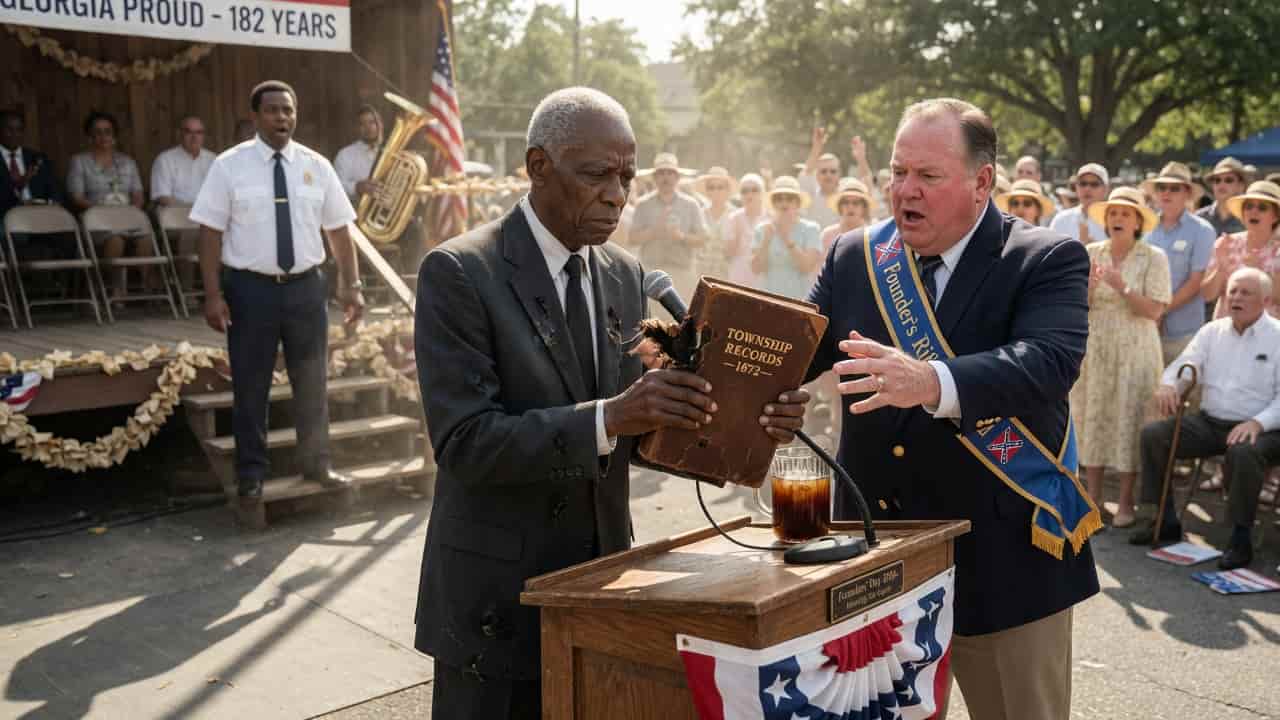
“Sit down, Arthur. Nobody here wants to listen to your fairytales.”
Mayor Halloway didn’t just say it; he spat the words, leaning so close I could smell the expensive scotch on his breath and the cheap desperation in his sweat. He reached out, his thick fingers bunching the fabric of my father’s old suit, trying to shove me away from the microphone while the whole town watched from the lawn.
They were all there—the Sterlings, the Benetts, the people who lived in the mansions built on the very land my grandfather was forced to leave behind. They thought I was just the quiet man from the archives, the one who filed their property taxes and smiled politely while they walked over my history.
“This isn’t a story, Mayor,” I said, my voice finally finding the weight it had been searching for since 1964. “It’s a deed.”
I didn’t back down. I didn’t let him push me into the shadows again. I slammed the heavy leather ledger onto the podium, the sound cracking like a gunshot across the quiet square. When I pulled my hands away, the Mayor froze. His face went gray as he looked at the jagged, blackened hole right through the center of the book.
He knew exactly what that hole meant. He knew who had put it there. And he knew that the man standing in front of him wasn’t going to be silent anymore. The whole room went cold, and for the first time in sixty years, the truth was the only thing anyone could see.
Chapter 1: The Dust of Belonging
The basement of the Oakhaven County Courthouse didn’t smell like history. It smelled like damp concrete, industrial-grade floor wax, and the slow, acidic rot of cheap paper. To most people, this was where records went to be forgotten—a purgatory of marriage licenses, tax assessments, and zoning disputes. To Arthur, it was a sanctuary. Or perhaps a tomb.
He moved through the stacks with a practiced, silent grace, his fingers trailing over the spines of gray Hollinger boxes. He knew the geography of this place better than he knew the layout of his own small house. He knew where the pipes leaked during the July thunderstorms and which shelves caught the morning light through the high, narrow windows that sat at street level.
Arthur checked his watch. 8:14 AM. In six minutes, the heavy steel door at the top of the stairs would groan open, and the world above would begin its daily business of pretending the past was a settled debt.
“Morning, Arthur,” a voice called out, echoing through the cavernous space.
Arthur turned to see Leo, his grandson, standing by the elevator. Leo was twenty-one, with the restless energy of someone who felt the walls were always leaning in. He was dressed for his internship at the public defender’s office—white shirt, a tie that Arthur had helped him knot that morning, and a look of mild perpetual confusion as to why his grandfather spent his life underground.
“You’re early, Leo,” Arthur said, his voice soft, a low baritone that seemed to carry the weight of the room’s silence.
“Dropped off some filings. Thought I’d see if you wanted a real coffee. Not the sludge they make in the breakroom.” Leo held up a cardboard carrier.
Arthur smiled, the lines around his eyes deepening. He stepped out from the shadows of the “Property Records: 1950–1970” section. “Real coffee is a dangerous temptation, Leo. It might make me think I’m too good for this place.”
Leo walked over, his eyes scanning the endless rows. “I don’t know how you do it, Pop. Thirty years down here. Doesn’t it feel… I don’t know, heavy? Like you’re breathing in people’s ghosts?”
Arthur took the cup, the heat seeping into his thin palms. “It isn’t the ghosts that are heavy, Leo. It’s the things they took with them. The things no one bothered to write down.”
He led Leo back to his desk—a massive oak beast that had survived three renovations of the floors above. It was covered in scraps of paper, microfiche slides, and a single, leather-bound ledger that looked older than the building itself.
Leo leaned over, squinting at a handwritten entry. “Is this for the Founders’ Day thing? I saw the Mayor on the news this morning. He was talking about ‘the proud lineage of Oakhaven’s architects.'”
Arthur’s hand tightened slightly on his coffee cup. “The Mayor has a very specific definition of an architect. He likes the people who held the pens, not the ones who cleared the trees.”
“You okay, Pop? You’ve been… different lately. Quieter. Even for you.”
Arthur looked at his grandson. Leo had his father’s eyes—the same eyes Arthur’s father had. Wide, observant, and filled with a dangerous kind of hope. It was the hope that had gotten people in this family into trouble for three generations.
“I’m just tired, Leo. The Historical Society is breathing down my neck for the gala displays. They want the ‘heroic’ stuff. The original charters. The portraits of the men in the high collars.”
“And what do you want?”
Arthur looked down at the ledger on his desk. Underneath a stack of yellowed land surveys sat a file he never opened when anyone else was in the room. It was labeled Shadow Files: Unverified.
“I want the truth to be as loud as the lies,” Arthur whispered, almost to himself.
“What?”
“Nothing. Go on to work, Leo. Don’t be late. Those lawyers won’t wait for you.”
After Leo left, the basement felt smaller. Arthur sat at his desk and pulled the Shadow Files toward him. For thirty years, he had been a scavenger. When the city “lost” records during the integration of the sixties, Arthur had found the carbon copies in the trash. When the “Fire of ’72” had supposedly wiped out the Black land grants in the valley, Arthur had spent his weekends in the attics of elderly women, collecting the family bibles where they had tucked away their tax receipts.
He was an archivist of the discarded.
He opened the leather-bound ledger. It was a beautiful thing, or it had been once. Now, it was a map of a crime. He turned to page 142. There, in the neat, sloping script of a man who knew he was being watched, was the entry for the Silas Plantation—the land that now sat under the town’s prestigious Country Club and the Halloway estate.
The record showed the land had been sold for “one dollar and other considerations” in 1964.
Arthur knew what the “other considerations” were. He remembered the night the trucks had come. He remembered his father’s voice, low and urgent, telling him to hide under the floorboards. He remembered the smell of gasoline and the way the orange light had danced through the cracks in the wood.
His father, Thomas, hadn’t just been a farmer. He had been the man people went to when they were being cheated. He had kept his own records. He had kept a ledger.
Arthur reached into the bottom drawer of his desk and pulled out a small, velvet-lined box. Inside was a piece of lead—a flattened bullet he had pried from the doorframe of their farmhouse before it was bulldozed.
The phone on his desk jangled, the sound sharp and intrusive.
“Records, Arthur speaking.”
“Arthur, it’s Diane Sterling.” The voice was like silk stretched over a razor blade. Diane was the head of the Oakhaven Historical Society and the unofficial gatekeeper of the town’s reputation. “I trust the artifacts for the gala are being crated? The Mayor is very anxious to have the original founding deed on display by tonight.”
“I’m working on it, Mrs. Sterling,” Arthur said, his voice level. “The parchment is delicate. It needs to be handled with care.”
“As do we all, Arthur. As do we all. We’re expecting a grand turnout. It’s important that we show the world the stability of Oakhaven. The continuity.”
Stability, Arthur thought. Continuity. Words used to describe a wall that was built to keep people out.
“I’ll have the crates ready by four o’clock,” he said.
“Good. And Arthur? Let’s keep the… supplementary materials to a minimum this year. We want to celebrate our successes, not dwell on the technicalities of the past.”
“I understand perfectly,” Arthur said.
He hung up and looked at the ledger. He thought about the secret he had carried for three decades. He thought about the deed he had found hidden in a hollowed-out family bible in a house three towns over—the original, unadulterated deed that showed the sale of the Silas land had never actually happened. The signatures were forgeries. The land had never been sold. It had been stolen.
Arthur felt a familiar tremor in his hands. He was a soft-spoken man. He had spent his life in the quiet, avoiding the storms that had claimed his father. But he was tired of the dust. He was tired of breathing in the rot of other people’s secrets.
He looked at the high, narrow window. He could see the feet of people walking on the sidewalk above. They were moving through their lives, oblivious to the fact that the very ground they walked on was a lie.
He began to pack the crate for the gala. He placed the official founding deed on top—the one the Mayor wanted to see. But underneath it, hidden between the layers of acid-free tissue paper, he placed the ledger.
The one with the bullet hole.
As he worked, he felt a strange, cold clarity. He wasn’t just a clerk anymore. He was the executor of a long-delayed estate. The debt was coming due, and Arthur was the only one who knew how much interest had accrued.
He thought of Leo, standing at the bottom of the stage tonight, watching the “architects” of the town receive their honors. He thought of the world Leo deserved—a world where he didn’t have to knot a tie for people who didn’t know his name.
Arthur closed the crate and hammered the lid shut. Each strike of the mallet felt like a heartbeat. The basement was silent again, but the air felt different. The ghosts weren’t heavy anymore. They were waiting.
Chapter 2: The Architect of Shadows
The Oakhaven Historical Society’s headquarters was a Greek Revival mansion that sat on a hill overlooking the town. It was white-pillared and immaculate, a monument to the kind of wealth that didn’t just buy things, but bought time itself.
Arthur arrived at the back entrance, the crate heavy in his arms. He was met by two young men in “Event Staff” shirts who took the box with the careless indifference of those who don’t understand the fragility of paper.
“Careful with that,” Arthur said, his voice sharpening. “That’s two hundred years of your history in there.”
One of the boys rolled his eyes. “Whatever you say, pops. Put it on the table with the others.”
Arthur followed them inside. The ballroom was a hive of activity. Florists were arranging white lilies, and caterers were polishing silver trays. In the center of the room, Diane Sterling was directing a crew of stagehands with the precision of a general.
She saw Arthur and glided toward him, her pearls clicking against her silk dress. “Arthur. Right on time. Is the deed in there?”
“It is,” Arthur said.
“Perfect. The Mayor wants to do a final walkthrough of the presentation. He’s very attached to the idea of the ‘Unbroken Line’ theme.”
Arthur watched as she opened the crate. She pulled out the official founding deed, encased in its protective UV-filtered glass. She held it up to the light, her eyes shining with a proprietary gleam.
“Look at this,” she whispered. “The ink hasn’t faded. It’s as if they just signed it yesterday.”
“Ink doesn’t fade when it’s kept in the dark,” Arthur said.
Diane glanced at him, her smile faltering for a fraction of a second. “Always the romantic, Arthur. Why don’t you go down to the kitchen and get some tea? You look a bit peaked. This weather is hard on everyone.”
Arthur nodded and turned away. He didn’t go to the kitchen. Instead, he slipped through a side door that led to the library. The Sterling library was famous in the county—a collection of first editions and family records that rivaled the courthouse archives. But unlike the courthouse, these records were private.
He moved to the far corner, where the local history section was kept. He wasn’t looking for books. He was looking for the gaps between them.
For years, Arthur had suspected that the Sterlings and the Halloways had shared more than just social circles. They had shared a secret ledger—a “Black Book” that recorded the true transactions of the 1960s. He had seen references to it in his shadow files, whispers in old letters between law firms.
He heard voices approaching and ducked behind a high-backed leather armchair.
“The archives are a mess, Halloway. I’m telling you, that old man knows more than he lets on.”
It was Diane Sterling’s voice. And the man she was with was Mayor Halloway.
“Arthur?” Halloway’s voice was a deep, gravelly rumble. “He’s a mouse. He’s been in that basement so long he’s probably forgotten what the sun looks like. He doesn’t have the stomach for trouble.”
“Don’t be so sure,” Diane said. “He’s been asking questions about the Silas tract again. He was seen at the probate office last week.”
“The probate office? What for?”
“He was looking for the original survey. The one from ’64. The one that was supposedly lost in the fire.”
There was a long silence. Arthur held his breath, the smell of old leather and floor wax suddenly stifling.
“It doesn’t matter,” Halloway said finally. “The deeds are filed. The titles are clear. Even if he found something, who’s going to listen to him? He’s a county clerk. I’m the Mayor of the fastest-growing town in the state. People want progress, Diane. They don’t want to hear that their Country Club sits on a graveyard.”
“It’s not just the graveyard, Bill. It’s the bloodline. If the Silas deed is invalid, then so is the Halloway Trust. Everything your family built is collateral for that land.”
“Then we make sure he doesn’t find anything. After the gala, we’ll talk about ‘retiring’ Arthur. He’s past his prime anyway. We can bring in someone younger, someone more… appreciative of the direction we’re heading.”
Their footsteps faded as they walked toward the ballroom.
Arthur sat in the shadows, his heart hammering against his ribs. It wasn’t just land. It was the Trust. It was the very foundation of the Halloway dynasty. His father hadn’t just been a farmer; he had been a threat to the entire economic structure of the county.
He stood up, his legs feeling heavy. He thought of his father’s face that last night—the way he had looked at the ledger, his eyes filled with a grim, quiet pride. “They can take the land, Arthur. But they can’t take the truth as long as you can read.”
Arthur walked back to the ballroom. He saw the crate sitting open on the table. The “Shadow Ledger”—the one with the bullet hole—was still hidden at the bottom, beneath the layers of tissue paper.
He looked at Mayor Halloway, who was laughing with a donor, his hand resting on the man’s shoulder in a gesture of easy, unearned authority.
Arthur felt a cold, hard knot form in his stomach. He had spent thirty years being the “mouse” Halloway described. He had been the quiet man who took the insults, the one who filed the papers and stayed in the basement because the world above was too bright and too dangerous.
But he wasn’t just filing papers anymore. He was building a case.
He left the mansion and drove back to his small house on the edge of town. It was a modest place, filled with books and the quiet hum of an old refrigerator. Leo was there, sitting at the kitchen table with a law textbook open in front of him.
“Hey, Pop. How was the setup?”
Arthur sat down across from him. He looked at his grandson, so young and full of the belief that the law was a shield.
“Leo,” Arthur said, his voice trembling slightly. “If you had the chance to change everything, but it meant hurting people who thought they were innocent… would you do it?”
Leo looked up, his brow furrowed. “What do you mean ‘thought they were innocent’?”
“People who are living on stolen ground. People who don’t know that their lives are built on someone else’s loss. If exposing the truth meant tearing it all down… is the truth worth the wreckage?”
Leo closed his book. He looked at Arthur with a seriousness that made him look older than his years. “My professor says the law is about order. But my heart tells me it’s about justice. And justice doesn’t care about the wreckage. It only cares about the balance.”
Arthur nodded slowly. “The balance.”
“Pop, what’s going on? You’re scaring me.”
Arthur reached across the table and patted Leo’s hand. “I’m just an old man thinking about old things, Leo. Don’t mind me. But I want you to do something for me.”
“Anything.”
“Tonight, at the gala… I want you to stand close to the stage. I want you to watch everything. And if anything happens… I want you to remember that I did it for you. And for your father. And for his father.”
“Pop—”
“Go on, get dressed,” Arthur said, standing up. “We have a history to attend to.”
Arthur went into his bedroom and opened his closet. He pulled out his charcoal suit. It was old, the elbows worn thin, but it was clean and pressed. He looked at himself in the mirror—a thin, silver-haired man who had spent his life in the shadows.
He thought of the ledger in the crate. He thought of the bullet hole. He thought of the night the trucks came.
He wasn’t a mouse. He was an archivist. And tonight, he was going to file the most important record of his life.
Chapter 3: The Price of Progress
The afternoon sun was a heavy, golden weight over Oakhaven. Arthur sat on a park bench across from the town square, watching the workers set up the stage for the evening’s festivities. The square was the heart of the town, a meticulously landscaped circle of green surrounded by boutiques and law offices. In the center stood a bronze statue of a man in a frock coat—the first Halloway.
A young man in a tailored navy suit approached the bench. It was Julian Vance, a developer who had recently bought up several blocks of the old downtown for a “luxury mixed-use” project. He was thirty-two, handsome, and carried himself with the effortless confidence of someone who had never been told “no.”
“Mr. Robinson,” Julian said, offering a hand. “I was hoping I’d find you here. I stopped by the courthouse, but they said you’d taken the afternoon off.”
Arthur didn’t take the hand. He looked at the statue in the center of the square. “The courthouse is for people who want to look at the past, Mr. Vance. I thought I’d come out and look at the future.”
Julian laughed, a bright, practiced sound. He sat down on the bench. “The future is looking good, Arthur. We just broke ground on the East Block. It’s going to be beautiful. We’re naming the main courtyard after the Historical Society.”
“And what was there before the East Block?” Arthur asked.
Julian shrugged. “A few derelict warehouses. Some old tenements. It was an eyesore, honestly. We’re bringing value back to this town.”
“Value,” Arthur repeated. “My father used to say that value is what you have left after everything else is taken away.”
Julian looked at him, his expression shifting to one of mild condescension. “Look, Arthur, I know you’re a man of tradition. But this town can’t survive on memories alone. We need growth. We need investment. That’s what tonight is about. Celebrating the people who made Oakhaven what it is.”
“The architects,” Arthur said.
“Exactly. The visionaries. Like Mayor Halloway’s grandfather. The man who saw a swamp and turned it into a city.”
Arthur turned to look at Julian. “He didn’t see a swamp, Mr. Vance. He saw a community. And he didn’t turn it into a city. He turned it into a profit center. There were three hundred families living in the valley before the ‘re-zoning’ of 1964. Where do you think they went?”
Julian sighed, the sound of a man who had heard this argument too many times. “That was a long time ago, Arthur. Social progress is messy. Mistakes were made, sure. But look at where we are now. Oakhaven is the crown jewel of the county.”
“A crown usually sits on a head that’s prone to aching,” Arthur said.
“Listen,” Julian said, leaning in. “I’m here because I want to make sure the gala goes off without a hitch. I heard there was some… confusion about the property records you’re displaying.”
“Confusion?”
“Diane Sterling mentioned you were bringing some ‘unverified’ materials. We want to keep the focus on the celebration, Arthur. No need to stir up old ghosts, right? It’s bad for business. Bad for the town’s image.”
Arthur felt the familiar coldness rising in his chest. “I’m an archivist, Mr. Vance. My job isn’t to protect the town’s image. It’s to protect the town’s record. If the record is uncomfortable, that’s not my concern.”
Julian’s face hardened. The charm vanished, replaced by a cold, transactional stare. “It should be your concern. You’re a county employee, Arthur. Your pension, your legacy… it all depends on you being a team player. Don’t be the man who tries to stop a train with a piece of paper. You’ll only get crushed.”
Julian stood up and smoothed his suit. “I’ll see you tonight. I hope you make the right choice.”
Arthur watched him walk away. The “train” of progress was indeed coming, and people like Julian Vance were the ones shoveling the coal. They believed that because they hadn’t held the matches, they weren’t responsible for the fire.
Arthur stood up and walked toward the stage. He saw the crate sitting near the podium, guarded by a lone security officer. He felt a sudden, sharp pang of fear. What if they were right? What if the truth didn’t matter? What if he was just an old man throwing stones at a fortress?
He walked to the edge of the square, where the older, poorer part of town began. Here, the sidewalks were cracked and the storefronts were boarded up. This was the “Old Valley,” the place where the people who had been “re-zoned” out of the center had ended up.
He stopped in front of a small, weathered house. An elderly woman was sitting on the porch in a rocking chair. It was Mrs. Gable, one of the few surviving witnesses to the events of 1964.
“Afternoon, Mrs. Gable,” Arthur said.
She looked up, her eyes cloudy with cataracts but still sharp with intelligence. “Arthur. You look like you’re carrying the weight of the world on your shoulders.”
“I might be, Mrs. Gable.”
“Is it tonight?” she asked, her voice a raspy whisper.
“It is.”
She reached out and took his hand. Her skin felt like parchment, thin and dry. “I remember your father, Arthur. He was a good man. He believed that the truth was like water—it always finds a way out. No matter how deep they bury it.”
“They buried it pretty deep, Mrs. Gable.”
“Then you just have to dig a little harder. Don’t you let them scare you. Those people on the hill… they’re built on sand. They know it. That’s why they’re so loud.”
Arthur nodded, a lump forming in his throat. “Thank you, Mrs. Gable.”
“You show them that ledger, Arthur. You show them what they did. For Thomas. And for all of us.”
Arthur walked away, his heart feeling lighter. He wasn’t just doing this for himself. He was doing it for Mrs. Gable, and for the three hundred families whose names had been erased from the official maps.
He went back to his car and drove to the cemetery. He walked to a far corner, past the ornate marble monuments of the founders, to a small, overgrown section where the headstones were simple and weathered.
He found his father’s grave. Thomas Robinson. 1922–1964. A Father. A Farmer. A Man of Truth.
Arthur knelt down and pulled a few weeds from the base of the stone. “It’s time, Dad,” he whispered. “I’m not hiding under the floorboards anymore.”
The evening air was cooling, and the first lights of the gala were beginning to twinkle on the hill. Arthur could hear the distant sound of an orchestra tuning their instruments.
He stood up and straightened his suit. He felt a strange sense of peace. He had spent his life in the basement, surrounded by the dust of belonging. But tonight, he was going to step into the light. And he was bringing the dust with him.
Chapter 4: The Founder’s Lie
The Oakhaven Founder’s Gala was a masterclass in choreographed prestige. The town square had been transformed into an outdoor ballroom, with white linens draped over tables and strings of fairy lights glowing in the oak trees. The scent of jasmine and expensive perfume hung heavy in the air.
Arthur stood in the shadows near the back of the stage, his charcoal suit feeling like a costume. He watched the elite of Oakhaven mingle—the men in their summer blazers, the women in their cocktail dresses, all of them smiling with the easy confidence of people who believed history was something that happened to other people.
Mayor Halloway was at the center of it all, holding a crystal glass of bourbon, his face flushed with the triumph of the moment. He was surrounded by the town’s wealthiest donors, including Julian Vance and Diane Sterling.
“Ladies and gentlemen,” Halloway’s voice boomed over the speakers, silenced the chatter. “If everyone could take their seats, we’re about to begin the presentation.”
Arthur saw Leo in the crowd, standing near the front of the stage as Arthur had asked. Leo looked nervous, his eyes darting between the Mayor and the wings where Arthur stood. Arthur gave him a small, barely perceptible nod.
The ceremony began with the usual platitudes. There were speeches about “vision,” “grit,” and the “pioneer spirit.” Diane Sterling spoke about the importance of preserving the town’s heritage, her voice dripping with the kind of reverence usually reserved for the divine.
“And now,” the Mayor said, returning to the podium. “We come to the highlight of the evening. The unveiling of the original founding deed of Oakhaven. A document that represents the very beginning of our journey. And to present it, we have our long-time county archivist, Mr. Arthur Robinson.”
There was a polite, perfunctory smattering of applause. Arthur stepped onto the stage, his legs feeling like lead. He walked to the crate that sat on a small table next to the podium.
He could feel the eyes of the town on him. He could feel the weight of Halloway’s gaze—a mixture of boredom and a silent warning.
Arthur opened the crate. He pulled out the UV-filtered case containing the official deed. He placed it on the podium, the glass catching the light.
“Thank you, Mr. Mayor,” Arthur said, his voice steady despite the roar of blood in his ears. “It’s an honor to be here tonight. To speak about history. To speak about the things we choose to remember.”
He paused, looking out over the sea of white faces. He saw Julian Vance leaning back in his chair, a smug smile on his face. He saw Diane Sterling adjusting her pearls.
“The document you see here,” Arthur continued, gesturing to the deed, “is the official record of Oakhaven’s founding. It tells a story of progress and prosperity. It tells a story of men who looked at the land and saw a future.”
Halloway nodded, a look of satisfied approval on his face.
“But,” Arthur said, his voice dropping an octave. “Every record has a shadow. And every future is built on a past. Sometimes, the past isn’t as clean as the glass we put it behind.”
The crowd shifted, a murmur of unease rippling through the rows. Halloway’s smile faltered. He stepped toward the podium, his hand reaching for the microphone.
“Thank you, Arthur,” Halloway said, his voice tight. “I think that’s enough of the history lesson. Let’s move on to the—”
“I’m not finished, Mr. Mayor,” Arthur said, his voice ringing out across the square.
He reached back into the crate. Instead of the “supplementary materials” Diane had expected, he pulled out the leather-bound ledger. It was heavy and scarred, a stark contrast to the pristine deed in its glass case.
“What is that?” Diane Sterling whispered from the front row, her face pale.
“This,” Arthur said, holding the ledger up for everyone to see, “is a record of the Silas tract. The land that now holds the Halloway estate, the Country Club, and the East Block development. The land that was supposedly sold in 1964.”
Halloway’s face turned a deep, angry red. He lunged for the ledger, but Arthur pulled it back, stepping away from the podium.
“Sit down, Arthur!” Halloway hissed, his voice amplified by the microphone he was still clutching. “Nobody here cares about your fairytales. This is a celebration, not a platform for your… grievances.”
He reached out and grabbed Arthur’s arm, his thick fingers digging into the worn fabric of Arthur’s jacket. He tried to shove Arthur toward the stairs, a look of pure, unadulterated contempt on his face.
“Get him off the stage!” Halloway yelled to the security guards.
But Arthur didn’t move. He planted his feet, his thin frame suddenly immovable. He looked Halloway directly in the eye, his gaze cold and unyielding.
“This isn’t a story, Mayor,” Arthur said, his voice calm and clear. “It’s a deed.”
With a sudden, forceful motion, Arthur broke Halloway’s grip and slammed the ledger onto the wooden podium. The sound was like a gunshot, echoing off the surrounding buildings. The square went deathly silent.
Leo lunged forward, stepping onto the first stage stair, his hand reaching out as if to catch the moment. The security guards froze, unsure of what to do in the face of such a public confrontation.
Arthur pulled his hands away from the ledger. He stood back, leaving the book open for the Mayor—and the cameras—to see.
Halloway looked down, his mouth hanging open. His expression shifted from rage to a paralyzed, gut-churning shock.
Right through the center of the leather cover, through the pages of names and dates, through the very heart of the Halloway family history, was a jagged, blackened hole.
“That’s a bullet hole, Bill,” Arthur said, his voice echoing in the silence. “It went through this ledger on October 14, 1964. The same night my father was taken from his home. The same night his land was ‘sold’ to your grandfather for a dollar.”
He looked out at the crowd. He saw the shock, the confusion, and the dawning realization on the faces of the people who had built their lives on that ground.
“You call yourselves the architects of Oakhaven,” Arthur said, his voice trembling with a lifetime of suppressed rage. “But you didn’t build this town. You stole it. And you did it with a gun and a pen.”
Halloway tried to speak, but no sound came out. He looked like a man who had suddenly realized the ground beneath him was gone.
“I’ve spent thirty years in the basement,” Arthur said, his voice dropping to a whisper that still carried to the back of the square. “Waiting for the dust to settle. But the dust doesn’t settle. It just waits for the wind. And the wind is here.”
Arthur turned and walked off the stage. He didn’t look back. He walked past Leo, who was staring at him with a mixture of terror and awe. He walked past the security guards and the silent, stunned elite of Oakhaven.
He walked out of the square and into the night. He could feel the eyes of the town on his back, but for the first time in his life, he didn’t feel the weight of them. He felt light. He felt free.
He had filed the record. And now, the town would have to decide what to do with the truth.
Chapter 5: The Residue of Truth
The night air didn’t feel like a victory. It felt like the aftermath of a controlled demolition—the dust still hanging thick in the air, the silence ringing with the ghost of the blast. Arthur walked away from the town square, his feet striking the pavement with a rhythmic, hollow sound. He didn’t look back at the lights or the white tents. He didn’t look back to see if Mayor Halloway had found his voice or if the security guards were coming for him.
He just walked. His father’s charcoal suit felt like lead across his shoulders, and the cold knot in his stomach had turned into a slow, spreading ache. He had done it. He had taken the thing he had carried in the basement for thirty years and thrown it into the light. But the light in Oakhaven was a fickle thing; it didn’t just reveal truth, it scorched anything that didn’t belong.
“Pop! Pop, wait!”
Leo’s voice cracked the stillness. Arthur stopped but didn’t turn immediately. He could hear his grandson’s heavy breathing, the frantic scuff of dress shoes on the asphalt. When Leo finally caught up, he grabbed Arthur’s arm, his eyes wide and vibrating with a mixture of terror and adrenaline.
“What was that?” Leo whispered, his voice hitching. “Pop, you just… you just called the Mayor a thief in front of the whole town. You just destroyed the gala.”
Arthur looked at his grandson. The orange glow of the streetlights caught the sweat on Leo’s forehead. “I didn’t destroy anything, Leo. I just described what was already broken. The gala was a lie. The lights were a lie.”
“They’re going to kill you,” Leo said, the words falling out of him like stones. “They’re going to come for you. Halloway, the Sterlings—they aren’t just going to let you walk away after that. Did you see his face? He looked like you’d stuck a knife in him.”
“It wasn’t a knife. It was a ledger,” Arthur said, his voice terrifyingly calm. “Let’s go home, Leo. I want to take this suit off.”
They drove back to the house on the edge of town in a silence so dense it felt like they were underwater. Arthur stared out the window at the passing oaks. He thought about the residue of the scene. He could still feel the way Halloway’s suit jacket had bunched under his fingers—the expensive wool, the smell of scotch and panic. He could still see the way the crowd had gone from polite boredom to a kind of primal, ugly shock.
When they pulled into the driveway, the small house looked different—vulnerable. Arthur walked inside and headed straight for the kitchen. He filled a glass with water but didn’t drink. He just stared at the surface of the liquid, watching it tremble.
“We need to call someone,” Leo said, pacing the small kitchen. He had loosened his tie, but he was still vibrating. “A lawyer. Someone from the city. Pop, that ledger… where is it?”
“It’s on the podium,” Arthur said.
Leo froze. “You left it there? You left the original evidence on the stage with the man who wants it destroyed?”
“I have the copies, Leo. I’ve had the copies for twenty years. But the original… it needed to stay in the light. If Halloway takes it now, he’s taking it in front of a thousand witnesses. If it disappears tonight, everyone knows who swallowed it.”
Arthur sat down at the kitchen table. He felt a sudden, crushing exhaustion. He thought about his father. He thought about the night the trucks came—the way the headlights had cut through the trees like blades. He remembered the sound of the engine idling in the driveway, a low, predatory growl. His father hadn’t run. He had stood in the doorway with that same ledger, believing that the law was a thing made of paper and ink. He hadn’t known that in Oakhaven, the law was made of blood and land.
“I’m scared, Pop,” Leo said, sitting down across from him. The bravado of the stage was gone. He looked like the boy who used to hide behind Arthur’s legs when the lightning was too close.
“I know,” Arthur said. “I’m scared too. But there’s a difference between being scared and being trapped. For thirty years, I was trapped in that basement. I was a man who worked for the people who killed his father. Every day, I filed their papers. I smiled at their children. I took their paychecks.”
Arthur looked at his thin, calloused hands. “The shame of that… it was heavier than the basement itself. Tonight, I finally put it down.”
The sound of a car door slamming in the driveway cut through the conversation. Leo bolted upright, his hand going to the back of the chair. Arthur didn’t move. He just watched the front door.
A heavy knock echoed through the house. Not the polite rap of a neighbor, but a directive.
“Arthur Robinson! It’s Sheriff Miller. Open up.”
Leo looked at Arthur, his face pale. “Don’t,” he whispered.
“I have to, Leo. He’s the law. Or what passes for it.”
Arthur walked to the door and opened it. Sheriff Miller stood on the porch, his uniform crisp but his face tired. Miller was a man who had grown up in Oakhaven, a man who knew exactly which families owned which corners of the county. He wasn’t a cruel man, but he was a practical one. And in Oakhaven, practicality usually meant loyalty to the hill.
“Arthur,” Miller said, stepping into the entryway without waiting for an invitation. He looked at Leo, then back at Arthur. “You caused quite a stir tonight.”
“I told the truth, Sheriff. Since when is that a stir?”
“The truth is a matter of record, Arthur. And you’re the one who keeps the records. But the Mayor is saying you brought stolen documents to a public event. He’s saying that ledger belongs to the Halloway estate and that you took it from the archives.”
“That ledger never belonged to the Halloways,” Arthur said, his voice dropping an octave. “It belonged to Thomas Robinson. My name is on the probate. The bullet hole in the cover? That belongs to the Halloways. They can have that back if they want.”
Miller sighed, rubbing the bridge of his nose. “Look, Arthur. I’ve known you a long time. You’re a quiet man. You do your job. Why now? Why do this in front of the cameras? You could have brought this to the board. You could have filed a grievance.”
“The board is made of Sterlings and Benetts, Sheriff. And a grievance is just a piece of paper for the shredder. I wanted the town to see the hole. I wanted them to know that the grass they’re sitting on is red.”
Miller looked around the small, tidy living room—the stacks of books, the framed photo of Arthur’s wife, the smell of old paper. “Halloway wants your head, Arthur. He’s talking about theft of public property, inciting a riot, defamation. He’s going to strip your pension by morning.”
“He can have the pension,” Arthur said. “It was paid for with the interest on my father’s life anyway.”
“He’s not just talking about the pension, Arthur,” Miller said, stepping closer, his voice lowering. “There are people in this town who are very invested in the way things are. They’ve spent sixty years believing they earned what they have. You start telling them their houses are built on a crime… people get desperate. And desperate people don’t go to the courthouse. They go to the garage. They find their old tools.”
Leo stepped forward, his face flushed. “Are you threatening him? You’re the Sheriff. You’re supposed to protect him.”
Miller looked at Leo with a pity that was more insulting than anger. “I’m telling him how the world works, son. I can sit a car in the driveway tonight, but I can’t stop the whole town from turning cold. Arthur, give me the copies. Give me whatever else you have in that house. Let me take it to the DA and we can handle this quietly. No more stages. No more speeches.”
Arthur looked at the Sheriff. He saw the man’s fear—the fear of a status quo being fractured. Miller didn’t want justice; he wanted the noise to stop.
“I don’t have anything for you, Sheriff,” Arthur said. “The records are where they belong. In the mind of every person who was in that square tonight. You can’t confiscate a memory.”
Miller stared at him for a long beat, then nodded slowly. “Fine. Have it your way. But don’t call me when the windows start breaking. I’ve only got so many deputies, and the Mayor’s got the keys to the budget.”
Miller turned and walked out. The screen door slammed with a tinny, final sound.
Arthur watched the Sheriff’s cruiser pull away, the red and blue lights fading into the dark. He felt a strange, hollow sense of peace. The retaliation had begun, but it wasn’t the physical blow he had expected. It was the isolation. The town was drawing a circle around him, pushing him out into the cold.
“Pop,” Leo said, his voice trembling. “What do we do now?”
Arthur turned to his grandson. “We do what we’ve always done, Leo. We wait for the morning. But tonight… tonight we don’t hide under the floorboards. We sit in the light.”
Arthur went to the kitchen and finally drank the water. It tasted like iron. He thought about the ledger sitting on that podium. He imagined Halloway’s hands on it, trying to wipe away the bloodstain, trying to fill the hole with excuses. But the hole was too big. It was the size of a family. It was the size of a century.
He stayed up all night, sitting in the armchair by the window. He watched the shadows of the oaks dance across the lawn. He thought about the “Shadow Files” in the basement—the fragments of names, the scraps of deeds, the whispered histories of a hundred different families.
He realized then that he wasn’t just Arthur Robinson, the clerk. He was the archive. And as long as he was breathing, the crime was still happening.
Around 3:00 AM, the first stone hit the house. It didn’t break a window; it just thudded against the siding, a blunt, heavy reminder of the world outside. Then came another, and another. No shouting, no names called. Just the sound of the town throwing itself at his walls.
Leo woke up and ran into the room, but Arthur held up a hand.
“Stay back from the glass, Leo,” Arthur said, his voice a low, steady anchor.
“They’re out there! Pop, we have to call the police!”
“We already did, Leo. The Sheriff told us what he’d do.”
Arthur stood up and walked to the front door. He didn’t open it, but he stood behind the wood, feeling the vibration of each impact. He closed his eyes and remembered his father’s voice. “They’ll try to make you feel small, Arthur. They’ll try to make you feel like you’re the one who’s wrong for remembering. But the land remembers. The trees remember. You just have to be the one who speaks for them.”
He stood there until the sun began to grey the horizon. The stones stopped. The silence returned, but it was a different silence now. It was the silence of a town that had realized its victim wasn’t going to scream.
Arthur looked at the floor. A piece of glass had shattered from the top of the door frame, a small, jagged diamond reflecting the morning light. He picked it up and held it to the sun.
The residue was everywhere. The shame, the anger, the history. But underneath it all, there was the truth. And for the first time in his life, Arthur Robinson felt like he finally owned the ground he was standing on.
Chapter 6: The Architecture of Justice
By 8:00 AM, the town of Oakhaven was a different machine. The news of the gala had spread like a fever through the digital arteries of the county. The “Oakhaven Truth” social media groups were a battlefield of outrage and denial. The “Shadow Ledger” was no longer a secret buried in a basement; it was a ghost that had begun to haunt every dinner table in the county.
Arthur sat at his kitchen table, drinking black coffee. The front of his house was pelted with mud and small rocks, and one of the porch chairs had been overturned. He looked tired, the skin beneath his eyes like bruised silk, but his back was straight.
There was a knock at the door—soft, hesitant.
Leo moved to open it, his hand hovering over the lock. He looked through the peephole and exhaled. “It’s Sarah.”
Sarah Vance was the radical young journalist Arthur had spoken to months ago, the only one who had been willing to look at his “Shadow Files” without laughing. She was twenty-six, with messy dark hair and a camera bag that seemed to be a permanent extension of her body.
She stepped into the house, her eyes scanning the damage. “Arthur. Are you okay? I saw the cruiser leaving last night.”
“I’m still here, Sarah,” Arthur said. “That’s the most I can say for most mornings.”
She sat down at the table, pulling a tablet from her bag. “It’s blowing up. Halloway issued a statement at 6:00 AM. He’s calling the ledger a ‘malicious forgery’ and says you’re being investigated for grand larceny of county records. He’s already filed for an emergency injunction to seize everything in your house.”
Arthur didn’t flinch. “He can file whatever he wants. A forgery? The man’s grandfather wrote his name in that book. I recognize the handwriting from a thousand tax returns. He knows it’s real. That’s why he’s screaming.”
“It’s not just Halloway,” Sarah said, her voice dropping. “The Historical Society is imploding. Diane Sterling resigned an hour ago. Apparently, three of the board members found out their family trusts are tied directly to the Silas land. If your deed holds up, they’re insolvent. The whole social structure of this town is built on a deck of cards, and you just pulled the bottom one.”
Leo leaned against the counter, his arms crossed. “So what happens? Does the land just go back? Does everyone get evicted?”
Arthur looked at his grandson. “Justice isn’t a wrecking ball, Leo. Or at least, it shouldn’t be. I don’t want to see families on the street. I want the name changed. I want the debt acknowledged. I want my father’s name on the square where they stood and cheered while he was erased.”
“The Mayor is coming here,” Sarah said suddenly.
Arthur paused, his cup halfway to his lips. “Here?”
“I have a source in the city manager’s office. He’s skipping the legal route for a moment. He’s coming to ‘settle’ this. He knows if this goes to a real court—a federal court outside this county—he’s done. He wants to buy you off before the sun goes down.”
“He doesn’t have enough money,” Arthur said.
“He doesn’t think in money anymore, Arthur. He thinks in power. Be careful.”
Ten minutes later, a black SUV pulled into the driveway. Mayor Halloway stepped out alone. He wasn’t wearing the navy blazer or the Founder’s Ribbon today. He was in a rumpled white shirt, his face sallow and his eyes bloodshot. He looked like a man who had spent the night staring into a mirror and seeing a stranger.
Arthur met him on the porch. He didn’t invite him in.
“Arthur,” Halloway said. His voice was stripped of its booming authority. It was thin, like old wire.
“Mayor.”
Halloway looked at the mud on the siding, the stones on the lawn. He looked at Arthur’s frayed suit. “This is a mess. For everyone.”
“It’s been a mess for sixty years, Bill. You’re just finally getting the smell on your clothes.”
Halloway stepped onto the first stair. He didn’t look angry. He looked desperate. “What do you want? I can give you the pension. I can give you double. I can set Leo up with a firm in Atlanta—full partnership track, no questions asked. We can rename a park. We can put a plaque up. Whatever it takes to get that ledger into a safe where it belongs.”
Arthur looked at the Mayor. He saw the calculation in the man’s eyes—the belief that everyone had a price, that history was just another commodity to be negotiated.
“You think I did this for a plaque?” Arthur asked. “You think I spent thirty years in a damp basement so I could get a better pension?”
“I’m trying to save the town, Arthur! If you push this, the lawsuits will take decades. The property values will tank. The investment will dry up. You’ll turn Oakhaven into a ghost town just to settle a score for a man who’s been dead since the LBJ administration.”
“My father isn’t a score to be settled, Bill. He’s a life that was stolen. And he wasn’t the only one. There are families in the Valley who don’t have heat because their land was taken to build your golf course. There are children who don’t know who they are because you burned their records.”
Arthur stepped closer to the edge of the porch, looking down at the Mayor. “You’re not trying to save the town. You’re trying to save your grandfather’s reputation. You’re trying to save the lie that says you’re better than us because you have a bigger yard.”
Halloway’s face hardened, the last of his civility snapping. “You’re a clerk, Arthur. You’re a footnote. You think you can take down a bloodline with a bullet hole? I’ll have you in a cell by tonight.”
“Then you’d better get started,” Arthur said. “Because Sarah Vance has the digital scans of the entire Shadow File. They’re sitting on a server in three different states. If I go to jail, she hits ‘send.’ And then it’s not just Oakhaven. It’s the DOJ. It’s the national news. It’s everyone seeing the architecture of your town.”
Halloway froze. He looked at Sarah, who was standing in the doorway with her tablet. He looked back at Arthur. The realization hit him—the mouse hadn’t just found the cheese; he had rigged the whole house to blow.
“You’d destroy everything,” Halloway whispered. “Everything.”
“I’m not destroying anything,” Arthur said. “I’m just filing the truth. What happens after that… that’s on the town.”
Halloway turned and walked back to his car. He moved slowly, his shoulders slumped. He looked like an old man. He looked like the ghost he had tried so hard not to be.
The SUV pulled away, leaving a cloud of dust in the driveway.
Arthur sat back down in his porch chair. He felt a strange, quiet thrumming in his chest. It wasn’t triumph. It was the feeling of a weight finally being distributed correctly.
The next few days were a blur of legal motions, interviews, and social pressure. The Historical Society was dissolved. The city council held an emergency session that lasted until 4:00 AM. There were protests in the square—some for Arthur, some against him. The town was fractured, the old lines of class and race vibrating with a new, dangerous energy.
But Arthur stayed in his house. He didn’t go back to the basement. He didn’t file any more papers.
Two weeks later, the city reached a settlement. They wouldn’t return the land—the legal knot was too tight, the displacement too vast—but they would establish a multi-million dollar trust for the descendants of the Silas tract. And more importantly, the central plaza of the town square would be officially renamed.
The day of the dedication was quiet. There were no white tents, no strings of lights, no scotch-soaked speeches. Just a small crowd of people from the Valley, Sarah Vance with her camera, and Leo in his white shirt and tie.
Arthur stood in the center of the square, looking at the base of the new monument. It was a simple slab of black granite. On it, in clean, deep letters, were the names of the three hundred families who had been erased.
And at the very top, in a font that matched the others: Thomas Robinson. Architect of the Truth.
Mayor Halloway wasn’t there. He had resigned a week earlier, citing “health reasons,” and moved to a house on the coast. Julian Vance was under investigation for racketeering. The “architects” were gone.
Arthur reached out and touched his father’s name. The stone was cool and smooth. He thought about the ledger, which was now in the state archives, preserved in a vault where no one could shove it into a drawer.
“We did it, Pop,” Leo said, standing beside him.
Arthur looked at his grandson. Leo was smiling, but it was a complicated smile. He had seen the wreckage. He had seen the cost of the balance.
“We started it, Leo,” Arthur corrected. “The truth doesn’t just happen once. You have to keep telling it, or the dust will just come back.”
Arthur looked up at the bronze statue of the first Halloway. It was still there, but it looked smaller now. It looked like what it was—a piece of metal in a world made of people.
He turned and walked away from the square. He didn’t head toward the courthouse. He headed toward the Valley, toward Mrs. Gable’s house, toward the people who were finally being seen.
He walked with a dignified, heavy grace. He was still a slender man in a frayed suit, a man of records and shadows. But as he moved through the streets of Oakhaven, the ground didn’t feel like a lie anymore. It felt like home.
He reached the edge of the square and stopped for a moment, looking back. The sun was setting, casting long, dramatic shadows across the granite monument. For the first time in sixty years, the shadows didn’t look like ghosts. They looked like foundations.
Arthur Robinson took a deep breath of the humid Georgia air. It didn’t smell like damp concrete or rot. It smelled like rain. It smelled like the future.
He turned the corner and disappeared into the neighborhood, a quiet man who had finally finished his work. The archive was closed. The story was told. And the town of Oakhaven was finally, painfully, beginning to breathe.