“Take off the toy, Frank. You look ridiculous.”
I stood there in the interrogation room, the air tasting like stale coffee and ozone, and I couldn’t breathe. The man sitting across from me wasn’t a stranger. He wasn’t the monster I’d been hunting for six months through the back alleys of Chicago. Or maybe he was, but he was a monster I had wept for every Christmas for two decades.
He sat there in a black tactical jacket, his hands cuffed to the same steel table where I’d broken a hundred low-level dealers. But he wasn’t broken. He was looking at my badge—the badge I’d earned to honor his name—and he was laughing.
“You were supposed to be gone,” I managed to say. My voice sounded like it belonged to a child, not a veteran detective.
“And you were supposed to be a man,” he snapped back, leaning into the light. “Not a lapdog for a city that doesn’t care if you live or vanish.”
Behind me, I heard the door creak. I didn’t have to turn around to know it was Leo. My partner. The kid who looked at me like I was some kind of saint because of who my father was. He was standing there with his body cam rolling, watching the man we thought was a hero treat me like trash in front of the whole precinct.
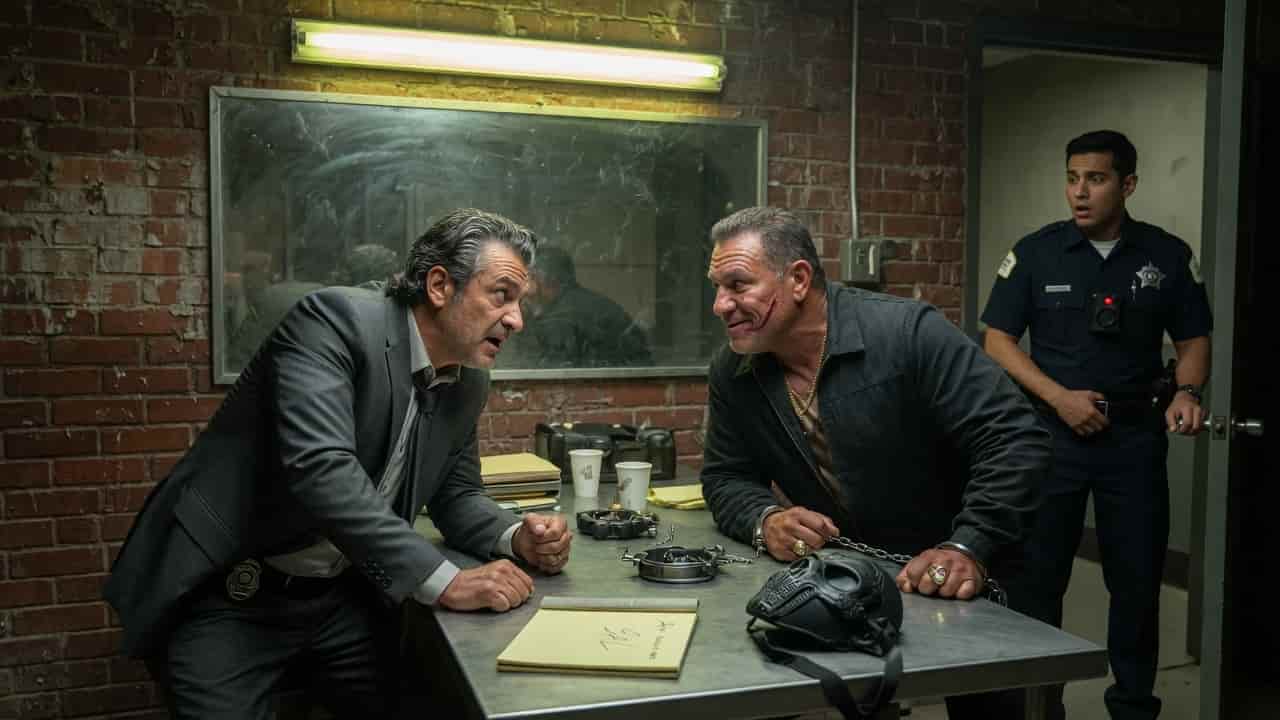
The gold academy ring on his finger caught the light—the same one the department gave my mother in a velvet box twenty years ago. The one I’d been carrying a replica of in my pocket for luck.
Everything I’ve done, every person I’ve put away, it was all for a ghost. But the ghost is alive, he’s running the very people I’m sworn to stop, and he just told me my life is a joke.
Chapter 1: The Weight of Gold
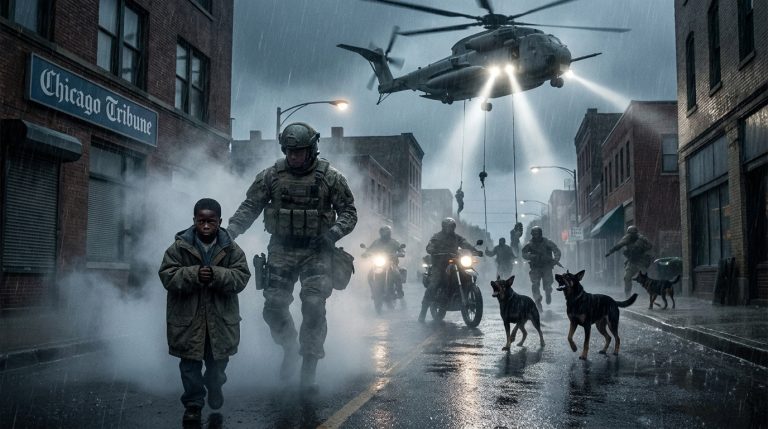
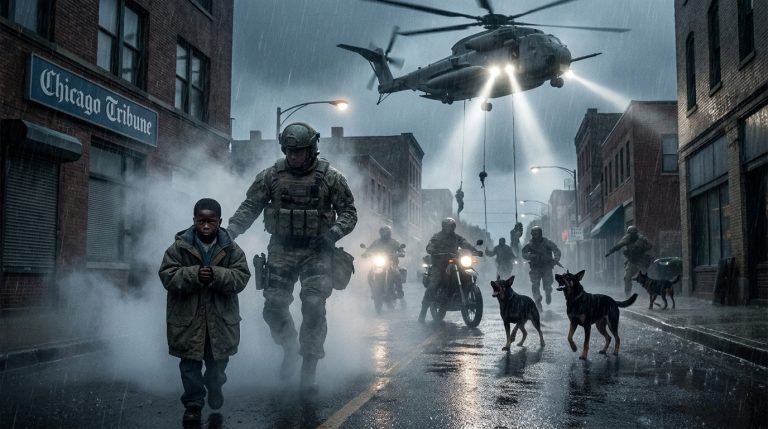
The rain in Chicago doesn’t just fall; it colonizes. It gets into the seams of your jacket, the cracks in the sidewalk, and the spaces between your ribs where you try to keep the important things dry. Detective Frank Russo stood on the edge of the Calumet River, his shoes sinking into the oily mud, watching the forensics team pick through the remains of what used to be a human being.
“He’s been here a couple of days,” Leo said, stepping up beside him. Leo was twenty-four, still possessed of that irritating rookie shine that hadn’t been buffed off by the reality of the 21st District yet. He was wearing a high-tech rain shell that actually repelled water. Frank, in his old charcoal wool coat, just soaked it up.
“It’s a message, Frank,” Leo continued, his voice tight. “Look at the way they positioned him. They wanted us to find him right here, in view of the bridge.”
Frank didn’t answer. He was staring at the victim’s right hand. It had been severed and placed neatly on the chest, a signature move of the Navarro cartel—or someone who wanted them to take the blame. But it wasn’t the hand that held Frank’s attention. It was the object glinting in the muck a few inches away.
“Leo, go back to the car and get the extra evidence bags,” Frank said. His voice was flat, the tone he used when he was about to do something he didn’t want a witness for.
“I got bags right here, Frank. In the kit.”
“The large ones,” Frank snapped. “The ones for the heavy clothing. Go.”
Leo hesitated, the confusion plain on his face, but he nodded and turned back toward the cruiser, his boots squelching in the mud.
As soon as the kid was twenty yards away, Frank knelt. His knees popped—a reminder of forty-five years of mileage and too many foot chases on concrete. He reached into the mud, his fingers trembling just enough to be embarrassing, and pulled out the object.
It was a ring. Gold, heavy, and encrusted with the grime of the riverbank. Frank rubbed his thumb over the face of it. The seal of the Chicago Police Academy stared back at him. On the inside of the band, worn smooth but still legible, were the initials: S.R.
Salvatore Russo.
Frank felt a coldness that had nothing to do with the rain. His father had been dead for twenty-two years. He’d seen the casket lowered into the ground at Mount Carmel. He’d stood in his dress blues, a nineteen-year-old kid with a breaking heart, and listened to the bagpipes play “Amazing Grace” while the Mayor talked about the ultimate sacrifice.
This ring should have been in the ground. Or in the small mahogany box on his mother’s mantle.
“Frank?”
Leo was coming back, holding the plastic bags like a bouquet. Frank shoved the ring into his pocket, the wet gold burning against his thigh.
“Find ’em?” Frank asked, standing up too quickly. His head swam for a second.
“Yeah. You okay? You look like you saw a ghost.”
“Just the smell,” Frank lied. He’d smelled a thousand bodies, but Leo was young enough to believe that even veterans had a breaking point. “Let’s get the techs to finish up. We need to get back to the precinct.”
The drive back was silent. Frank watched the wipers fight a losing battle against the deluge. Every time he shifted in his seat, he felt the ring. It was a physical weight, a piece of the past that had no business being in a present-day crime scene.
His father had been the gold standard. Sal Russo was the kind of cop they wrote about in the Sunday supplements—the guy who knew every shopkeeper’s name, the guy who took a bullet for his partner in a South Side warehouse. Frank had spent his entire career trying to fill those shoes, wearing the Russo name like a suit of armor. It was the only thing that kept him going when the job got ugly, when the internal affairs vultures started circling, or when the booze started looking like a better friend than his ex-wife.
“He was one of ours, wasn’t he?” Leo asked softly, breaking the silence as they pulled into the precinct lot.
“Who?”
“The guy at the river. Forensics thinks he was an undercover from the 12th. If the cartel is hitting UCs and leaving them for us to find, the rules just changed, Frank.”
“The rules never change, Leo,” Frank said, killing the engine. “People just get lazier about pretending to follow them.”
Frank didn’t go into the bullpen. He went to the locker room, splashed cold water on his face, and sat on the wooden bench. He pulled the ring out. Now that he was under the fluorescent lights, he could see the details. This wasn’t a replica. It had the slight nick on the eagle’s wing where his father had caught it on a fence during a chase in ’92.
He remembered his father coming home that night, laughing, showing Frank the scratch on the gold. ‘Details, Frankie,’ he’d said. ‘It’s the small things that catch you. Remember that.’
Frank felt a sudden, violent urge to throw the ring into the back of his locker and lock it forever. Instead, he pulled out his phone. He scrolled through his contacts until he reached ‘Mom.’
He hesitated. His mother lived in a quiet suburb now, paid for by the generous pension of a fallen hero. She spent her days gardening and going to Novenas at St. Jude’s. She was the keeper of the flame.
He didn’t call. If he called, he’d have to ask the question. And if he asked the question, the world might stop making sense.
“Russo! My office. Now.”
Frank looked up to see Lieutenant Miller standing in the doorway. Miller was a man who looked like he’d been carved out of a block of suet—pale, heavy, and perpetually greasy. He was the kind of supervisor who knew exactly where the bodies were buried because he’d helped dig the holes.
Frank tucked the ring into his palm and stood up.
Miller’s office smelled of cheap cigars and the kind of desperation that comes from a man who knows he’s one bad audit away from a prison cell. He didn’t ask Frank to sit.
“The river scene,” Miller said, leaning back. “Forensics found something interesting. Or rather, they noticed something was missing.”
Frank’s heart hammered against his ribs. “Missing?”
“The UC had a file. A list of contacts within the Navarro organization. It wasn’t on him. But more importantly, the techs say there were two sets of footprints near the primary evidence site that didn’t belong to the response team. One was the kid, Leo. The other… well, they’re thinking it might be someone with a heavy gait. Someone who knew exactly where to look.”
Miller leaned forward, his eyes small and calculating. “You find anything you forgot to log, Frank?”
“I logged everything that was there, Lou,” Frank said. The lie felt thick in his mouth.
“Good. Because this case is going to get a lot of sunshine. The Commissioner is breathing down my neck. We’re looking for a guy they call ‘The Ghost.’ He’s the one bridge between the street crews and the money men. Nobody knows his face. Nobody knows his name. But he’s been active for about twenty years.”
Twenty years. Since the year Sal Russo died.
“I’m on it,” Frank said, turning to leave.
“Frank,” Miller called out. Frank stopped, his hand on the doorknob. “Your father was a great man. Don’t let his legacy get tarnished by a messy investigation. Keep your eyes on the road.”
Frank walked out of the office, the gold ring cold in his hand. He didn’t go back to his desk. He went straight to the parking lot, got into his car, and drove toward the suburbs. He needed to see the mahogany box. He needed to know if the ring he was holding was a miracle, a curse, or a confession.
Chapter 2: The Pension of Silence
The house in Oak Park was too quiet. It was the kind of silence that felt curated, like a museum exhibit dedicated to a life that had ended in its prime. Frank let himself in with his spare key, the smell of lavender and floor wax hitting him like a physical blow.
“Frank? Is that you?” his mother called from the kitchen.
Mary Russo appeared in the doorway, wiping her hands on a floral apron. At sixty-five, she still had the beauty that had captivated the precinct all those years ago, but there was a fragility in her eyes now, a glassiness that Frank usually attributed to age.
“You’re early for Sunday dinner, honey. I haven’t even started the sauce,” she said, reaching up to kiss his cheek. She smelled like peppermint and gin—a combination she’d been favoring lately.
“I’m not here for dinner, Ma,” Frank said. He led her into the living room, the space dominated by a large framed photograph of Sal in his uniform. The hero’s shrine. Below it sat the mahogany box.
Frank didn’t waste time. He walked over to the mantle and picked up the box.
“Frank, what are you doing? That’s private,” Mary said, her voice rising an octave.
Frank opened the lid. Inside was his father’s watch, his commendation pins, and the blue velvet box that should have held the academy ring. He flicked it open.
The box was empty.
Frank felt the air leave the room. He turned to his mother, holding the empty box in one hand and the mud-caked ring in the other.
“I found this today, Ma. At a crime scene. Along with a dead undercover cop.”
Mary’s face didn’t go pale; it went gray. She sat down heavily on the plastic-covered sofa, her hands trembling in her lap. “You shouldn’t have been looking, Frank. I told him you were too much like him. I told him you’d look.”
Frank felt a roar of static in his ears. “Him? Told him? Ma, who are you talking about?”
“The money,” she whispered, looking not at Frank, but at the photo of Sal. “The pension wasn’t enough. Not for this house. Not for your tuition. Not for the life he wanted for us.”
“The department pension is one of the best in the state,” Frank said, his voice cracking. “What are you talking about, ‘not enough’?”
Mary reached into the side table and pulled out a stack of envelopes. They weren’t from the city. They were plain manila envelopes, no return address, postmarked from various cities in Mexico and the Southwest.
“Every month for twenty-two years,” she said. “The checks come. Thousands of dollars, Frank. More money than a cop makes in a decade. I tried to stop it at first. I tried to ask questions. But the man who brought the first one… he told me that if I talked, the hero would become a traitor. He said your father’s memory was worth more than the truth.”
Frank grabbed one of the envelopes, ripping it open. Inside was a cashier’s check for five thousand dollars. No note. No name. Just the cold, hard currency of a lie.
“Where is he?” Frank asked. The words felt like they were being dragged over broken glass.
“I don’t know,” she sobbed. “I swear, Frank. I haven’t seen his face since the night of the warehouse fire. They told me he was dead. They gave me a closed casket and a flag. And then the envelopes started coming. I thought… I thought maybe it was his life insurance. I tried to believe the lie because it was easier than the alternative.”
“The alternative is that he’s alive, Ma! He’s alive and he’s working for the people who are killing my friends!”
Frank slammed his hand against the mantle, the mahogany box skittering across the wood. The photo of Sal Russo tilted, the glass reflecting the light in a way that made the man in the picture look like he was winking.
“He did it for you,” Mary cried, her voice sharpening with a desperate, ugly kind of defense. “He didn’t want you growing up in a two-bedroom walk-up in Cicero. He wanted you to have the name. The Russo name. He bought that name with his life, Frank. One way or another.”
“He didn’t buy it,” Frank spat. “He stole it. He stole the person I thought I was.”
He turned and walked out of the house, ignoring his mother’s pleas. He got into his car and sat there, the rain drumming on the roof. He looked at the ring again. S.R. Salvatore Russo hadn’t died in a warehouse fire. He’d vanished into the shadows, leaving a grieving family and a golden reputation behind while he built something else. A kingdom of blood and checks. The “Ghost” Miller was looking for wasn’t a stranger. He was the man who had taught Frank how to throw a baseball. The man who had tucked him in at night and told him that a cop’s greatest weapon was his integrity.
Frank started the car and drove, aimlessly at first, then with a growing, cold purpose. He couldn’t go back to the precinct. Not yet. He needed to find the connection. If Sal was the Ghost, then the cartel wasn’t just moving drugs; they were moving through the city with the help of someone who knew every blind spot in the Chicago Police Department.
He thought of Lieutenant Miller. ‘Your father was a great man. Don’t let his legacy get tarnished.’
It wasn’t a warning. It was a threat. Miller was in on it. He had to be. The pension checks, the footprints at the river, the missing file—it was a system. And Frank was the only one outside of it, even though he’d been funded by it his entire life.
He pulled into a 24-hour diner, the neon sign buzzing in the rain. He sat in a back booth, the ring on the table in front of him. He needed a win. He needed a way to pull the thread without the whole department seeing him do it.
His phone buzzed. A text from Leo.
Got a lead on the driver from the river scene. Spotted at a motel in Harvey. I’m heading there now. Didn’t want to wait for Miller to shut it down. You coming?
Frank stared at the screen. Leo, the kid who worshipped the ground Frank walked on. The kid who was about to walk into a hornets’ nest because he thought he was working with the son of a hero.
Frank grabbed the ring and stood up. “I’m coming, Leo,” he muttered to the empty diner. “But you’re not going to like what we find.”
Chapter 3: The Interrogation of a Ghost
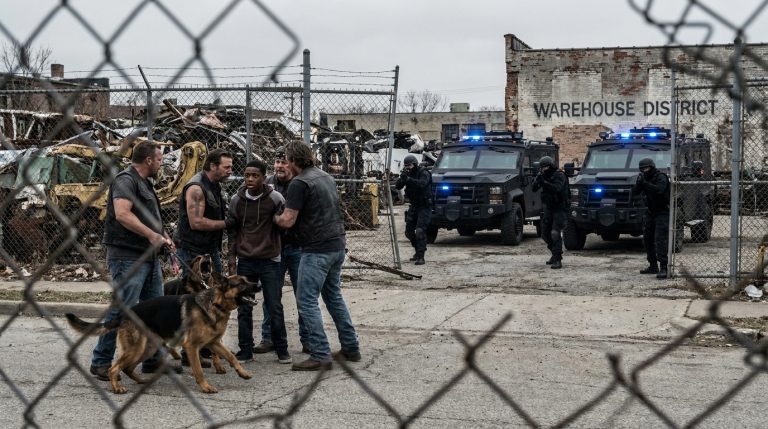
The motel in Harvey was a collection of peeling paint and broken dreams, a place where people went to disappear when they ran out of places to hide. Frank pulled his cruiser into the shadows across the street, his eyes scanning the windows. Leo’s car was already there, tucked behind a rusted-out dumpster.
Frank stepped out into the humid night, the rain finally reduced to a miserable mist. He found Leo crouching by the door of Room 14.
“He’s in there,” Leo whispered, his hand on his holster. “I saw him through the curtains. It’s him, Frank. The guy from the river. I tracked the plates from the bridge footage.”
“Leo, wait,” Frank said, grabbing the kid’s arm. “If we go in there, we go in alone. No radio. No backup. Not until I say.”
Leo frowned. “Why? We have the guy. This is the break we need.”
“Just trust me,” Frank said. It was a heavy thing to ask, but Leo nodded.
They breached the door at 2:00 AM. It was a short, violent scuffle—the suspect, a wiry man in his thirties with the vacant eyes of a long-term user, didn’t have the stomach for a fight. Within minutes, he was cuffed and sitting on the edge of the stained mattress.
“Who do you work for?” Frank asked, looming over him.
“I don’t know names, man. I just drive.”
“You drove a dead cop to the river,” Frank said, his voice dropping to a dangerous whisper. “That’s life in Joliet. Or you can tell me who gave the order.”
The man looked at Leo, then at Frank. He started to laugh, a high, wheezing sound. “You guys are funny. You really don’t know? The guy who runs the show… he’s one of you. Or he was. He calls himself the Ghost, but he talks like a flatfoot from the old school.”
Frank felt the ring in his pocket. “Where is he?”
“He’s meeting the buyers tonight. The South Works. The old steel mill. He’s closing the deal for the whole North Side territory.”
Frank looked at Leo. The kid’s face was set, his jaw tight. “Let’s go, Frank. Let’s call it in.”
“No,” Frank said. “We go there. We see it for ourselves. If we call it in, Miller will have the scene cleared before we can get through the gate.”
The South Works was a skeleton of a dead industry, towering rusted structures that looked like the ribcage of a fallen giant. They left the suspect cuffed to a radiator in the motel and drove in silence.
When they arrived, the air was thick with the smell of iron and decay. A single black SUV was parked in the center of the loading bay. Three men stood around it—two younger guys with tactical rifles, and one older man, his back to the entrance.
Frank and Leo moved through the shadows, their footsteps muffled by the layer of grit on the floor. Frank felt a strange sense of detachment, like he was watching a movie of his own life.
“Wait for my signal,” Frank whispered.
They watched as a second car pulled in. The exchange was quick—a duffel bag for a locked briefcase. The buyers didn’t stay long. As soon as their taillights faded, the older man turned around.
Even from fifty yards away, in the dim light of the rafters, Frank knew the posture. The way the man held his shoulders, the way he tilted his head when he checked his watch. It was a silhouette that had been burned into Frank’s memory since he was five years old.
“CPD! Don’t move!” Leo shouted, breaking cover before Frank could stop him.
The two gunmen raised their rifles.
“Drop ’em!” Frank yelled, stepping into the light, his service weapon leveled at the center of the older man’s chest.
The gunmen hesitated. The older man held up a hand, a casual, commanding gesture that stopped the violence before it began. He wasn’t wearing a mask. Not yet. He reached into his jacket and pulled out a black balaclava, tossing it onto the hood of the SUV.
“Frankie,” the man said. His voice was deeper than it had been in the memories, roughened by age and tobacco, but the cadence was unmistakable. “You always were a little too fast on the draw.”
Leo’s gun hand wavered. “Frank? Who is this guy? Why does he know your name?”
Frank didn’t answer. He couldn’t. His vision was tunneling, focusing only on the face of the man who had been a saint in a picture frame for twenty years. Sal Russo looked older—his hair was a silver buzz cut, and a scar ran along his jaw—but his eyes were the same. Cold, intelligent, and utterly devoid of remorse.
“Get the cuffs, Leo,” Frank said. His voice sounded like it was coming from miles away.
“Frank, what’s going on?”
“Get. The. Cuffs.”
The two gunmen looked at Sal. Sal nodded, a small, amused smirk on his face. “Do what the officer says, boys. I’ve been wanting to have a chat with my son for a long time. This seems like as good a place as any.”
The ride back to the precinct was a nightmare of blue lights and shattered reality. Frank drove. Sal sat in the back, cuffed, staring out the window like a tourist. Leo sat in the passenger seat, his eyes fixed on the dashboard, his world clearly collapsing in real-time.
They didn’t go through the main entrance. Frank used his private key to the back sally port, leading them directly into Interrogation Room 4.
He didn’t call Miller. He didn’t log the arrest. He just pushed Sal into the chair and slammed the door.
Chapter 4: The Unmasking of a Hero
The interrogation room felt smaller than usual. The walls, painted a depressing shade of eggshell, seemed to be leaning in, suffocating the three men inside. Frank stood by the steel table, his hands balled into fists to hide the shaking.
Sal Russo sat in the chair, his cuffs clinking against the metal. He looked around the room with the practiced eye of a man who had spent thousands of hours on the other side of the table.
“Nice precinct, Frank,” Sal said, his voice casual. “A little cleaner than the old 22nd. But the coffee still smells like battery acid, I bet.”
“Shut up,” Frank said.
“Frank,” Leo whispered from the doorway. He was holding his hand over his body cam, his face ashen. “Frank, is that… is that your father? The one from the wall?”
Sal turned his head, looking at Leo. “You must be the new partner. Leo, right? Frank’s mother mentions you in her letters. Says you’re a good kid. A little green, but loyal.”
Leo recoiled as if he’d been slapped. “Letters? You’ve been… you’re alive?”
Sal laughed, a dry, rasping sound. He looked back at Frank, his eyes narrowing. He leaned forward as far as the cuffs would allow, the light from the overhead fixture casting deep shadows into his eye sockets.
“Take off the toy, Frank,” Sal said. He nodded toward the silver badge clipped to Frank’s belt. “You look ridiculous wearing that thing. It doesn’t fit you. Never did.”
Frank felt the heat rise in his neck, a hot, prickly shame that burned more than the betrayal. “I earned this badge, Sal. I earned it by being everything you weren’t.”
“Everything I weren’t?” Sal mimicked, his voice sharpening. “You earned it with my name. You earned it with the reputation I built while I was breaking my back for this city. You think you’d be a lead detective at forty-five if your last name was Smith? You’re a legacy hire, Frankie. A charity case for a dead hero’s son.”
“You were supposed to be under the ground,” Frank said, stepping closer, his shadow looming over his father. “We buried you. I cried at your grave. My mother spent twenty years talking to a picture of a man who didn’t exist.”
“And she spent twenty years cashing checks from a man who did,” Sal snapped back. “Don’t play the martyr with me. You lived in a house paid for by the Navarro cartel. You went to college on money washed through the Cayman Islands. You’ve been wearing the badge, but you’ve been eating off my plate since the day I ‘died’.”
Frank pulled the academy ring from his pocket and slammed it onto the table. It skittered across the steel, stopping inches from Sal’s cuffed hands.
“I found this at the river,” Frank said. “Next to the body of a cop. A real cop. One who didn’t sell his soul for a house in Oak Park.”
Sal looked at the ring, then back at Frank. He didn’t flinch. “And you were supposed to be a man. A man understands that the world isn’t black and white, Frank. It’s gray. It’s all gray. I did what I had to do to protect my family. The department was going to hang me out to dry on that warehouse fire. I had a choice: go to prison and leave you with nothing, or die and leave you with everything. I chose you.”
“You chose yourself!” Frank yelled, the sound echoing off the cinderblock walls. “You chose the power! You’re the Ghost. You’ve been running the street crews, killing UCs, poisoning the city I’m trying to protect.”
“Protect?” Sal sneered. He leaned in, his face inches from Frank’s. “You’re not protecting anything. You’re a janitor. You pick up the mess we leave behind and you feel good about yourself because you have a piece of tin on your belt. But look at you, Frank. Look at your hands.”
Frank looked down. His hands were still trembling.
“You’re terrified,” Sal said, his voice dropping to a low, predatory purr. “You’re terrified because you realize that the man you worshipped is a monster. And you’re terrified because you realize that the monster is the only reason you’re anything at all.”
He looked past Frank toward the doorway. “And you, kid. Leo. You’re recording this, aren’t you? Good. Show the world. Show them what happens to the Russo legacy. But remember one thing: when you take me down, you take Frank with me. You take the whole department. Because I didn’t do this alone. Your Lieutenant Miller? He’s been on the payroll since he was a beat cop. The Commissioner? He knows exactly where the Ghost lives.”
Leo’s hand dropped from his body cam. He looked at Frank, his eyes searching for a denial, a plan, anything.
But Frank had nothing. He looked at his father—the man who had taught him how to be a man, the man who had lied to him for two decades—and saw the reflection of his own failure.
“Say it in front of him, Sal,” Frank whispered. “Tell him how you killed that cop at the river.”
Sal smiled. It was the most heartbreaking thing Frank had ever seen. “I didn’t kill him, Frank. Miller did. I just told him where to find the body.”
He leaned back, the chains rattling with a final, mocking finality. “Now, are you going to arrest me, or are we going to talk about how we’re going to get out of this room alive?”
The silence that followed was heavy, thick with the residue of a hundred secrets. Frank looked at the badge on his belt, then at the man in the chair. He felt the weight of twenty years of lies pressing down on his chest, and for the first time in his life, he didn’t know if he was the hero or the evidence.
Chapter 5: The Blue Wall Crumbles
The fluorescent lights in Interrogation Room 4 hummed with a low-frequency vibration that seemed to match the thrum of the panic rising in Frank’s throat. He looked at his father—the man he’d mourned, the man who was now a living, breathing stain on everything Frank believed in—and then he looked at Leo.
Leo was still standing by the door, his hand hovering near his holster, his face a pale mask of betrayal. He was a kid from a neighborhood where the cops were the only heroes left, and he’d chosen the biggest one to follow. Now, he was watching that hero’s father admit to being a ghost in the machine.
“Turn off the camera, Leo,” Frank said. His voice was a rasp, stripped of its usual authority.
“Frank, we can’t,” Leo whispered. “It’s already on the server. If I cut it now, IT will flag it. Miller will see.”
“Miller already knows,” Sal interjected, his voice smooth and devoid of the stress that was strangling the other two. He leaned back in the steel chair, the handcuffs clinking with a rhythmic, taunting sound. “He’s probably watching the feed right now, wondering if I’m going to tell you about the night he helped me clear out the evidence locker in the old 14th District. Or maybe he’s just wondering which one of you he’s going to have to bury to keep the secret.”
“Shut up, Sal!” Frank roared, slamming his hand onto the steel table. The academy ring he’d tossed earlier jumped, spinning in a tight circle before settling near Sal’s cuffed wrists. “You don’t get to talk about burying people. You’re a ghost. You don’t exist.”
“I exist enough to know that your Lieutenant is currently pulling a clean-up crew together,” Sal said, his eyes narrowing. “You think you’re interrogating me? Frank, you’re sitting in a trap. You brought the most wanted man in the city into a building owned by his business partners. How do you think this ends?”
The heavy steel door of the interrogation room groaned on its hinges. It didn’t open all the way—just enough for Lieutenant Miller to fill the frame. He wasn’t wearing his jacket. His white shirt was stained with sweat at the armpits, and his eyes were flat, devoid of the forced camaraderie he usually directed at Frank.
“Leo,” Miller said, his voice quiet. “Go to the front desk. Relieve Sergeant Higgins. He needs to take a call.”
Leo didn’t move. He looked at Frank, then back at Miller. “Sir, we’re in the middle of a high-value interrogation. Detective Russo has identified the suspect as—”
“I know who the suspect is, Officer,” Miller snapped, his tone sharpening into a blade. “And I know that Detective Russo has bypassed every arrest protocol in the CPD handbook to bring his father into this room. Now, do what you’re told before I have you stripped of your shield before the sun comes up.”
Leo’s chest hitched. He looked at Frank, a silent plea for an order, for a way out. Frank felt the weight of the silver badge on his hip. It felt like lead. It felt like a target.
“Go, Leo,” Frank said softly. “It’s okay.”
“Frank…”
“Go.”
Leo backed out of the room, his eyes never leaving Sal. As soon as the door clicked shut, Miller stepped inside and turned the deadbolt. He didn’t look at Frank. He looked at Sal.
“You were supposed to stay in the suburbs, Sal,” Miller said, leaning against the one-way mirror. “The deal was quiet. The deal was invisible.”
“The deal changed when your people started dropping UCs in the river, Lou,” Sal replied, his tone almost conversational. “My son has a nose for blood. I told you twenty years ago he was too much like me to be a good cop, but too much like his mother to be a bad one. He was bound to trip over the truth eventually.”
Frank felt like he was watching a play from the back of a dark theater. “You’re in on it,” he said, looking at Miller. “The pension checks. The missing files. You’ve been protecting him.”
Miller finally looked at Frank. There was no apology in his eyes, only a weary kind of contempt. “I’ve been protecting you, Frank. You think your career was built on merit? Every promotion, every ‘lucky’ break on a case, every time IA looked the other way when you got too rough with a suspect—that was the Russo legacy at work. Your father didn’t just leave you a name. He left you a security detail. And I’m the guy who’s been running it.”
Frank felt a wave of nausea. Every accolade he’d ever received, every handshake from the Commissioner, it was all dirty. He wasn’t a hero. He was a project.
“Why?” Frank asked. “Why the cartel? Why the Ghost?”
“Because the city was burning, Frank,” Sal said, taking over the explanation as if he were teaching a class. “In the nineties, the gangs were running the streets and the department was broke. We could either fight a war we were losing, or we could manage the outcome. I chose to manage. I became the bridge. I kept the violence in the alleys and the money in the right pockets. And in exchange, the Russo family lived like royalty.”
“We didn’t live like royalty!” Frank shouted. “We lived on lies! My mother is an alcoholic because she can’t look at your picture without seeing a ghost! I’ve spent my life trying to live up to a man who was already a criminal!”
“You’re alive, aren’t you?” Sal countered. “You’ve got a pension waiting for you. You’ve got a clean record. That’s what a father does, Frank. He takes the mud so his son can walk on the sidewalk.”
“You’re not my father,” Frank said. He reached for his handcuffs, the ones on his own belt. “Miller, step aside. I’m taking him to the 5th District. We’ll see how your ‘security detail’ works when the Feds get involved.”
Miller didn’t move. He reached into his waistband and pulled out his service weapon, keeping it low, pointed at Frank’s knees. “Nobody’s going to the 5th, Frank. And nobody’s calling the Feds. We’re going to walk Sal out of here, and you’re going to go home. You’re going to take a week of stress leave. When you come back, this room will be empty, the files will be gone, and we’ll go back to the way things were.”
“And Leo?” Frank asked. “What happens to the kid who saw everything?”
Miller’s face twitched. “Leo is a smart boy. He’ll understand that some secrets are too heavy to carry. Or he won’t. That’s up to him.”
Frank knew what that meant. He’d seen enough ‘accidents’ in the line of duty to know exactly how Miller handled loose ends. He looked at Sal. His father was watching him, a small, expectant smile on his face. He was waiting for Frank to break, to accept the gray, to join the family business of survival.
“No,” Frank said.
He didn’t draw his gun. Instead, he reached out and grabbed the academy ring from the table. He gripped it so hard the metal bit into his palm.
“I spent twenty years trying to be Sal Russo,” Frank said, his voice gaining a steady, dangerous edge. “But I’m not him. And I’m not you, Miller.”
In one swift motion, Frank kicked the leg of the steel table, shoving it hard into Miller’s midsection. The Lieutenant grunted, his aim wavering for a split second. Frank didn’t go for the gun; he went for the door. He slammed his shoulder into the deadbolt, the wood splintering, and burst into the hallway.
“Leo!” he yelled.
The precinct was quiet—too quiet for a Tuesday night. The night shift was small, but the bullpen should have been humming. Instead, the desks were empty. The shadows in the corners seemed to stretch, hiding the men Miller had brought in to finish the job.
Frank ran toward the front desk, his heart hammering. He found Leo standing by the dispatch terminal, his face ghostly white.
“Frank, they’ve locked the exits,” Leo said, his voice trembling. “The keycards are disabled. Miller’s guys… they aren’t cops, Frank. I saw them coming up from the basement. They’ve got tactical gear.”
“They’re cartel,” Frank said, grabbing Leo by the vest. “Listen to me. There’s a service tunnel under the old evidence locker. It leads to the alley behind the garage. We get out, we get to my car, and we don’t stop until we hit the FBI field office in Springfield.”
“What about your father?” Leo asked.
Frank looked back toward the interrogation room. He could hear Miller’s voice, shouting orders. He could hear the heavy boots of the clean-up crew hitting the linoleum.
“My father died twenty years ago,” Frank said. “That man in there is just a ghost. And it’s time he stopped haunting this city.”
They moved through the darkened precinct, a maze of cubicles and memories. Every shadow felt like a threat, every creak of the floorboards like a gunshot. Frank led the way, his knowledge of the old building serving as their only map.
They reached the evidence locker. The smell of dust and old paper was overwhelming. Frank found the hatch, hidden beneath a stack of archived files from the seventies. He yanked it open, the rusted hinges screaming.
“Go,” Frank hissed, ushering Leo into the dark hole.
As Frank prepared to follow, a hand gripped his ankle. He looked down and saw Sal. His father had somehow slipped his cuffs—or Miller had given him the key. He was crouched in the shadows, his face illuminated by a single flickering emergency light.
“Don’t do this, Frankie,” Sal said. There was no mockery in his voice now, only a desperate, final kind of plea. “If you go down that hole, you’re dead. Miller won’t let you reach the highway. Stay with me. I can fix this. I can make you the Commissioner. I can give you the world.”
Frank looked at the man who had built a kingdom on the bodies of his friends and the tears of his mother. He looked at the gold ring in his hand, the symbol of a legacy that was nothing but a gilded cage.
“You already gave me the world, Sal,” Frank said, his voice cold and final. “And it’s rotten.”
He kicked free of Sal’s grip and dropped into the darkness. He didn’t look back. He followed Leo through the cramped, damp tunnel, the sound of his own breathing the only company he had.
When they finally emerged into the cool night air of the alley, the rain had stopped. The city was silent, waiting for the storm that was coming. Frank looked at his badge, then at the ring. He took the ring and tossed it into a nearby sewer grate. It disappeared with a quiet, hollow splash.
“Where to, Frank?” Leo asked, his breath hitching in the dark.
“We go to the one person who can’t lie to us,” Frank said, heading for his car. “We go to the woman who’s been cashing the checks.”
The residue of the confrontation clung to him like the smell of the river. He felt older, heavier, as if the lies he’d shed had been the only thing keeping him afloat. He looked at his hands. They were steady now.
He wasn’t a hero. He wasn’t a legacy. He was just a man with a car, a terrified partner, and a truth that was going to burn the whole city down. And as he pulled out of the alley, he realized that for the first time in his life, he was finally a real cop.
Chapter 6: The Ghost in the Fire
The drive to Oak Park was a blur of neon lights and the persistent, low-level hum of the police scanner. Miller hadn’t put out a BOL yet—he was likely still trying to contain the mess inside the 21st District without alerting the rest of the department. But the silence on the airwaves was more terrifying than a siren. It meant the hunt was private. It meant there would be no witnesses.
“Frank, your mother’s house is the first place they’ll look,” Leo said, his eyes darting to the rearview mirror every few seconds. “If Miller is as deep in this as you say, he knows about the envelopes. He knows she’s the weak point.”
“She’s not the weak point, Leo,” Frank said, gripping the steering wheel until his knuckles went white. “She’s the evidence. Those checks are the only thing that links the Ghost to the department’s payroll. Without her, it’s just my word against a dead man and a decorated Lieutenant.”
They pulled into the driveway of the Oak Park house at 4:00 AM. The street was preternaturally still, the manicured lawns and silent SUVs of the suburbs feeling like a stage set for a tragedy.
Frank didn’t use his key. He kicked the front door in, the wood splintering with a violent crack that echoed through the quiet neighborhood.
“Ma! Get up! We have to go!”
Mary Russo appeared at the top of the stairs, wrapped in a silk robe, her hair a messy cloud of silver. She looked at Frank, then at the gun in his hand, and her face collapsed. She didn’t ask what was wrong. She knew.
“He found you, didn’t he?” she whispered.
“We found him, Ma. And Miller. Pack a bag. Now. Just the essentials.”
As Mary scurried back into her room, Frank turned to Leo. “Watch the perimeter. If a black SUV so much as slows down on this block, you tell me.”
Frank walked into the living room, heading straight for the mantle. He grabbed the mahogany box and the stack of envelopes. He needed everything. He needed the paper trail of his father’s sins.
“Frank,” a voice said from the shadows of the dining room.
Frank spun, his gun leveled.
Sal was sitting at the dining table, his tactical jacket dark against the floral wallpaper. He looked exhausted. The predatory smirk was gone, replaced by a hollow, aged weariness that made him look like the ghost he claimed to be.
“How did you get here?” Frank asked, his voice steady despite the hammer in his chest.
“I taught you how to drive, Frankie. I know which shortcuts you take when you’re in a hurry,” Sal said. He wasn’t holding a weapon. His hands were flat on the table, resting near a half-empty bottle of gin. “And I know where your mother keeps the spare key in the garden gnome. Some things never change.”
“Where’s Miller?”
“Miller is busy cleaning up the precinct. He thinks I’m here to finish the job. He thinks I’m going to kill my own son to save his pension.” Sal looked up at Frank, his eyes glassy in the dim light. “He doesn’t understand. A man like Miller… he does things for greed. I did them for legacy. And a legacy doesn’t work if the heir is in the ground.”
“You don’t get to talk about legacy,” Frank spat. “You destroyed it the second you didn’t die in that warehouse.”
“Maybe,” Sal said, standing up slowly. “Or maybe I saved it. Look at this house, Frank. Look at your life. You think you’d have any of this if I’d stayed a beat cop with a drinking problem and a gambling debt?”
Frank froze. “Gambling debt? You told me you were a hero. You told me you were the best of the best.”
Sal laughed, a bitter, rattling sound. “I was a mess, Frank. I was three weeks away from a departmental hearing and six months away from a loan shark’s basement. The warehouse fire… that wasn’t an accident. It was a payout. The cartel offered me a way out, and I took it. I gave them a cop, and they gave me a new life.”
“You burned yourself alive for money,” Frank said, the disgust rising in him like bile.
“I burned myself alive for you!” Sal roared, taking a step forward. “I knew what would happen if I went down. You’d be the son of a disgraced cop. You’d be trash in this city. But if I died a hero? You’d be royalty. I gave you the only thing I had left that was worth anything—my death.”
The stairs creaked. Mary was standing there, a small suitcase in her hand. She looked at Sal, her eyes filling with a mixture of terror and a terrible, lingering love.
“Sal?” she breathed.
“Hello, Mary,” he said, his voice softening for a heartbeat. “You look tired.”
“You were supposed to stay dead,” she sobbed. “I prayed for you. Every night for twenty-two years, I prayed for your soul. And all this time, you were just… you were just around the corner.”
“I was watching over you,” Sal said. “I was making sure the checks cleared. I was making sure Frank got his shield.”
“We didn’t want the shield, Sal!” Mary cried. “We wanted you!”
The sound of tires screeching on the pavement broke the moment. High-intensity headlights flooded through the living room windows, slicing through the darkness.
“They’re here,” Leo yelled from the porch. “Three SUVs. Miller’s in the lead.”
Frank grabbed his mother’s arm, pulling her toward the back door. “Sal, if you want to be a father for once in your life, you’ll help us get her out of here.”
Sal looked at the window, then at Frank. A slow, dark resolve settled over his features. He reached into the waistband of his trousers and pulled out a heavy black semi-automatic.
“Go out the back, through the neighbor’s hedge,” Sal said. “The keys to the SUV in the garage are in the drawer. It’s armored. It’ll get you past the first line.”
“And you?” Frank asked.
Sal looked at the photograph of his younger self on the mantle. He reached out and knocked it facedown.
“The Ghost needs to finally go into the ground, Frankie,” Sal said. “Go. Now!”
Frank didn’t argue. He led Mary and Leo toward the garage, the sound of boots hitting the porch echoing behind them. As they scrambled into the heavy SUV, Frank heard the first shots. The house—the shrine to a lie—became a battlefield.
Sal Russo stood in the center of his living room, a man who had been dead for twenty years, and began to fire. He wasn’t shooting to kill; he was shooting to draw them in. He was the bait, the distraction, the final sacrifice.
Frank floored the accelerator, the armored SUV smashing through the garage door. He saw Miller standing on the lawn, his face illuminated by the muzzle flashes. Their eyes met for a fraction of a second—a moment of pure, unadulterated residue. Miller saw the man he couldn’t break; Frank saw the man he was going to destroy.
As they cleared the driveway, a massive explosion rocked the house. The smell of gas and old wood filled the air. Frank looked in the rearview mirror and saw the Oak Park house—the lavender, the wax, the mahogany box—engulfed in a pillar of orange flame.
Sal had finished what he started in the warehouse twenty-two years ago. He had finally burned the evidence.
They drove in silence for miles. Mary sat in the back, staring out the window at the receding glow of her life. Leo was white-knuckled in the passenger seat, his eyes fixed on the road ahead.
Frank reached into his pocket and felt the empty space where the ring had been. He felt the badge on his belt. It was still there, but it felt different now. It didn’t feel like a legacy. It felt like a responsibility.
“Where are we going, Frank?” Leo asked quietly.
“To the Federal Building,” Frank said. “We’re going to tell them about the Ghost. We’re going to tell them about Miller. And then I’m going to resign.”
“Resign? Frank, you’re the only one who can fix the district.”
“No,” Frank said, his voice firm and clear. “The district is built on a foundation of Russo blood, Leo. And as long as I’m wearing this badge, the lie stays alive. It’s time for something new. It’s time for the city to have a cop who doesn’t have a hero for a father.”
They pulled up to the FBI field office just as the sun began to bleed over the Chicago skyline. The light was harsh, revealing every crack in the pavement, every stain on the city’s soul.
Frank helped his mother out of the car. She looked at him, her eyes finally clear of the gin and the lavender. She reached out and touched his cheek.
“You’re a good man, Frank,” she said. “You’re the man he couldn’t be.”
Frank watched her walk into the building, flanked by Leo. He stayed by the car for a moment, looking at his reflection in the window. He looked like his father—the same jaw, the same eyes—but the expression was his own.
He reached down, unclipped the silver badge from his belt, and looked at it. The gold plating was scratched, the eagle’s wings worn. It was just a piece of metal. It wasn’t a soul.
He walked to the edge of the sidewalk and placed the badge on the concrete. He didn’t drop it; he set it down with care, like a man laying a ghost to rest.
As he walked into the federal building to give his statement, he didn’t feel like a hero. He didn’t feel like a legend. He felt like a man who had finally paid his debts. And as the heavy glass doors closed behind him, the city of Chicago continued to hum, indifferent to the fact that the Russo legacy had finally, mercifully, turned to ash.