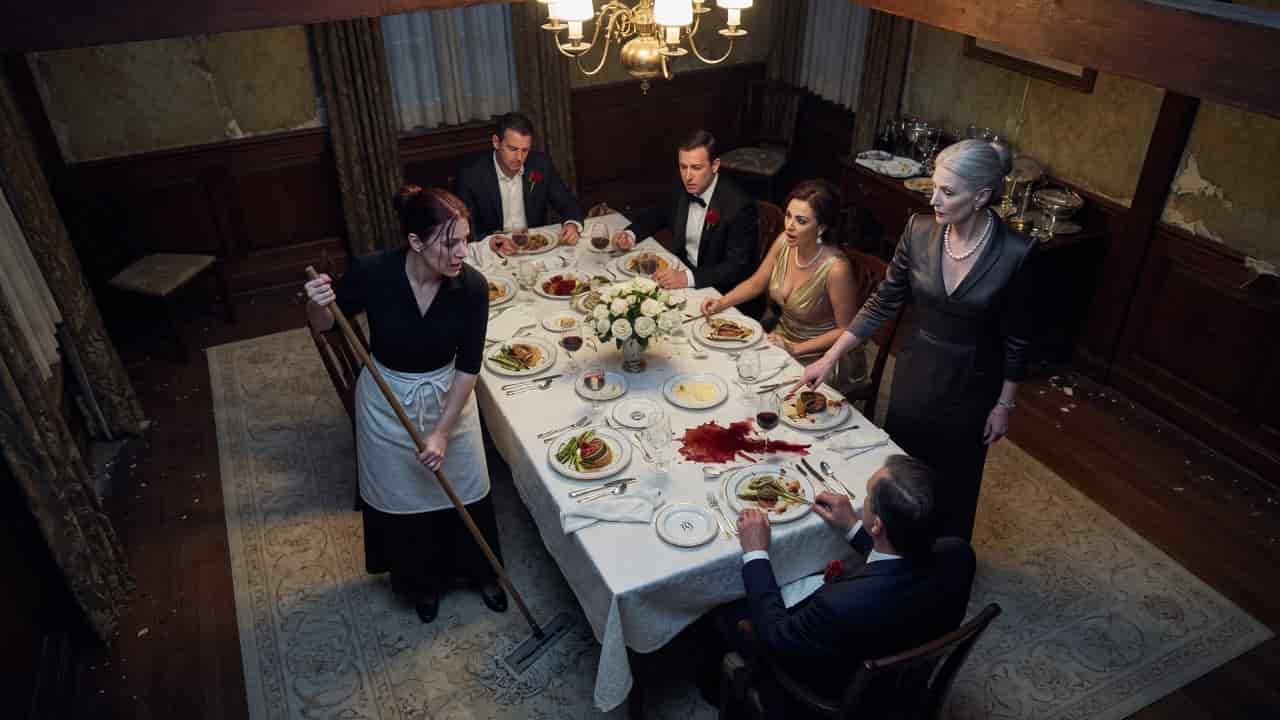
“The rug, Tess. Now.”
I looked at the wine soaking into the expensive Persian silk, then up at my mother-in-law. She wasn’t just asking for a cleanup; she was asking for my dignity.
“Eleanor, please,” I whispered, my voice cracking. “Not like this. Not in front of our guests.”
The room went silent. I could feel the eyes of our friends—people I used to host, people who used to respect me—burning into the back of my neck. My husband, Mark, sat at the head of the table, staring at his steak as if he could disappear into the plate. He didn’t know his mother held the note on his company. He didn’t know that every breath of his “success” was bought with my silence.
Eleanor leaned in close, her pearls clinking. Her voice was a cold scalpel. “Your husband’s dreams cost fifty thousand a month, dear. If you want the checks to keep clearing, you’ll start cleaning.”
She didn’t hand me a napkin. She handed me a mop. In front of everyone.
I realized then that Eleanor didn’t want a daughter-in-law. She wanted a trophy she could break over and over again. And the worst part? I was going to let her. Because if I didn’t, Mark would lose everything by morning.
I reached for the mop, and I heard the woman in the gold dress gasp. The humiliation was a physical weight, a thick heat climbing my throat.
Chapter 1: The Paper Trail
The air in the Blackwood estate always smelled like damp cedar and old money—the kind of money that doesn’t just sit in a vault, but breathes down your neck. It was a Tuesday morning in October, and the Massachusetts fog was thick enough to swallow the driveway. I was in my studio, a converted sunroom that was the only place in this house where the light felt honest. I was trying to paint, but the brush felt like a lead pipe in my hand.
I’d married Mark Blackwood three years ago. At the time, it felt like a fairytale. I was the girl from the wrong side of Worcester whose father had lost the family hardware business to a series of bad gambles and worse luck. Mark was the prince of the North Shore, all broad shoulders and easy smiles, promising me that my family’s history of bankruptcy didn’t matter. He told me he’d build his own empire, separate from his mother’s suffocating shadow.
And he had. His logistics firm was thriving. We had the house, the cars, the invitations to the right galas. Or so I thought.
The door to my studio clicked open. It wasn’t a knock; Eleanor didn’t knock. She entered a room as if she were reclaiming territory. She was dressed for a luncheon I wasn’t invited to—a sharp navy suit that probably cost more than my father’s last three cars combined.
“Tess,” she said. Her voice was like fine sandpaper on silk. “You’re still working on that same canvas? It’s been weeks.”
“It’s a process, Eleanor,” I said, not turning around. I kept my eyes on the abstract blue smear I’d been obsessing over. “Art doesn’t follow a quarterly schedule.”
“Neither do creditors,” she replied.
The brush stopped. I turned then. Eleanor was standing by my drafting table, her gloved hand resting on a manila envelope she’d brought in. She looked at me with a pity that felt like a slap.
“What is that?” I asked.
“Reality,” she said. “Mark is a wonderful boy, Tess. He has his father’s charm and his father’s… optimism. But he lacks the Blackwood instinct for the throat. He’s been over-leveraged for eighteen months. Did he tell you that?”
My heart did a slow, painful roll in my chest. “He’s doing fine. The new contract with the shipping port—”
“Was funded by a bridge loan from a private equity firm,” Eleanor interrupted. She slid a document out of the envelope. It was a foreclosure notice, stamped with a seal I didn’t recognize: E.B. Holdings. “A firm I happen to own. I’ve spent the last six months buying up Mark’s debt. Every line of credit, every personal guarantee, even the mortgage on this house. It’s all mine now.”
I felt the room tilt. The smell of cedar became overwhelming. “Why would you do that? He’s your son.”
“Exactly. And because he is my son, I won’t let him go to prison for bank fraud when he inevitably fails to cover his margins next month. But I also won’t have him married to a woman who thinks she can just sit in a sunroom and play with colors while the walls are caving in.”
She stepped closer. The scent of her expensive, floral perfume was suffocating. “Mark doesn’t know. He thinks he’s a self-made success. And he can keep thinking that. The funding will continue. The debt will stay buried. But only if you start earning your keep.”
“Earning my keep?” I whispered. “I’m his wife.”
“You’re a liability,” she corrected. “My previous daughter-in-law understood the value of service. She didn’t last, of course, but she was useful for a time. Starting tomorrow, my housekeeper, Mrs. Gable, is taking a ‘sabbatical.’ You will take over her duties. Not just the chores, Tess. You will be my companion. My assistant. You will be whatever I need you to be to ensure this family’s reputation remains intact.”
“You want me to be your maid,” I said, the words tasting like copper.
“I want you to be a Blackwood,” she said, her eyes narrowing. “And in this family, we pay our debts. If you tell Mark, I pull the funding. The firm collapses. He loses everything. Your family’s history of bankruptcy will look like a minor accounting error compared to what I’ll do to him.”
She left the envelope on the table. As the door closed, I looked at my painting. The blue smear didn’t look like the ocean anymore. It looked like a bruise.
That night, Mark came home late. He smelled like expensive scotch and triumph. He kissed me, his eyes bright. “We closed the deal, Tess! The expansion is a go. We’re finally out from under the thumb of the big banks.”
I looked at him—the man I loved, the man who thought he had finally won—and I felt the weight of the secret settle into my bones. It was a physical pressure, a dull ache in my jaw.
“That’s great, Mark,” I said, my voice sounding like it belonged to someone else. “That’s amazing.”
“What’s wrong?” he asked, his smile faltering. “You look pale.”
“Just a headache,” I lied. It was the first lie of many. “Just a long day.”
He pulled me into a hug, and for a second, I wanted to tell him. I wanted to scream that his mother owned his soul. But I saw the way his shoulders were set, the way his pride was finally, finally standing tall. If I told him, I wouldn’t just be breaking his heart; I’d be erasing the man he thought he had become.
“I love you,” I said into his chest.
“I know,” he whispered. “We’re going to be okay now, Tess. No more money talk. No more worrying.”
I closed my eyes and saw Eleanor’s icy face. I knew then that the debt wasn’t just money. It was a cage, and the door had just been locked from the outside.
Chapter 2: The Gilded Cage
The first day of my “sabbatical” from being a wife began at 5:00 AM. Eleanor’s instructions had been left on the kitchen island: a three-page, handwritten list that began with Silver Polish and ended with Archive reorganization.
Mrs. Gable, the woman I was supposedly replacing, had vanished without a word. The house felt different without her quiet presence—hollower, more predatory. I stood in the kitchen, wearing a pair of old leggings and a sweatshirt, looking at the mountain of silver trays that hadn’t been touched in decades.
“Tess?”
I jumped. Mark was standing in the doorway, wearing his gym clothes. He looked confused. “What are you doing? It’s five in the morning.”
“I… I couldn’t sleep,” I said, grabbing a rag and a tin of polish. “The house felt cluttered. I thought I’d help out while Mrs. Gable is away.”
Mark frowned, stepping into the kitchen. “Since when do you care about the silver? We have people for this. Even if Gable is off, Mom should have hired a temp agency.”
“She asked me to handle things for a few days,” I said, keeping my head down. “As a favor. You know how she is about ‘family privacy’ lately.”
Mark sighed, a sound of frustrated resignation. He knew exactly how his mother was. “She’s taking advantage of you. Just because your studio isn’t ‘work’ in her eyes doesn’t mean you’re the help.”
“It’s fine, Mark. Really. It’s just a few things.”
He walked over and kissed the top of my head, but I could feel the tension in him. “Don’t let her run over you, okay? I’m going to the office. I’ll be back late—there’s a dinner with the port authorities.”
“I know,” I said. I knew because I was the one who had to prep the dining room for it.
By noon, my fingers were black with tarnish and my back was screaming. Eleanor appeared at the top of the stairs, a vision in cream cashmere. She watched me for a moment, her silence more judgmental than any word.
“The tea service first, Tess,” she said. “Cynthia Thorne is coming at two. She has a nose for poor maintenance, and I won’t have her whispering about the state of this house.”
Cynthia Thorne was the queen of the local social circle—a woman whose tongue was as sharp as her diamonds. She had always treated me with a sort of amused condescension, as if I were a stray dog Mark had brought home.
“I’m almost done with the trays,” I said.
“Almost isn’t done,” Eleanor replied. “And you’ll need to change. You look like a common laborer. Put on that black dress I bought you last Christmas. And an apron. I want the service to be… seamless.”
“An apron? Eleanor, I’m your daughter-in-law. Cynthia knows me.”
“Cynthia knows what I tell her,” Eleanor said, her voice dropping to a dangerous low. “And right now, I’m telling everyone that you’ve taken an interest in the ‘domestic arts’ to support Mark’s busy schedule. It makes you look devoted. It makes him look successful. Don’t ruin the narrative, Tess. It’s a very expensive narrative.”
I changed into the black dress. The fabric felt like a shroud. When I tied the white lace apron around my waist, I caught my reflection in the hallway mirror. I didn’t look like an artist. I didn’t look like a wife. I looked like a ghost of a Victorian servant, erased by the architecture of the room.
The tea was an exercise in slow-motion torture. Cynthia Thorne sat on the velvet sofa, her eyes tracking me as I moved from the cart to the table.
“Tess, dear,” Cynthia said, her voice dripping with fake concern. “You look so… focused. Eleanor tells me you’ve quite given up the painting. Such a shame. Though I suppose with Mark’s business taking off, someone has to manage the estate properly.”
“I’m just helping out, Cynthia,” I said, my hands trembling as I poured the tea.
“Careful with the spout,” Eleanor snapped. “You’re dripping.”
I looked down. A single drop of amber liquid had landed on the lace tablecloth. Cynthia chuckled—a dry, brittle sound.
“It’s so hard to find good help these days, isn’t it?” Cynthia said, looking directly at me. “But there’s nothing like family to fill the gaps. It’s almost… charitable of you, Tess.”
The word charitable landed like a stone. I knew what she was doing. She knew. Or she sensed blood in the water. The socialites of the North Shore could smell a loss of status from miles away.
“Tess is learning the value of detail,” Eleanor said, taking a sip of her tea. “Something her own family struggled with, as I recall. It’s a long road from a bankrupt hardware store to a Blackwood drawing room.”
I felt the heat rise in my face, a stinging red tide of shame. I wanted to throw the teapot. I wanted to scream that my father was a better man than anyone in this room. But I thought of Mark. I thought of the foreclosure notice. I thought of the “E.B. Holdings” seal.
I wiped the drop of tea away with a cloth. “Is there anything else, Eleanor?”
“More lemon for Cynthia. And then you can begin the dining room. We have twelve for dinner.”
I retreated to the kitchen, the sound of their laughter following me like a swarm of insects. I leaned against the cold granite counter and took a shaky breath. The residue of the interaction stayed with me—a sense of being diminished, of being made small.
The psychological toll was beginning to set in. It wasn’t just the physical labor; it was the way Eleanor was systematically stripping away my identity. In her world, you were either the owner or the owned. And she had made it very clear which one I was.
I spent the rest of the afternoon setting the long mahogany table. Twelve plates. Twelve sets of silver. Thirty-six glasses. Each one had to be perfectly aligned. If a fork was a millimeter off, Eleanor would notice.
As I worked, I found myself thinking about the woman who had been here before me. Mark’s first wife, Sarah. He rarely spoke of her, and Eleanor had always dismissed her as “fragile.” I’d found a box of her things in the attic once—books on botany, a pressed flower collection. She hadn’t been fragile. She’d been suffocated.
I looked at the empty chairs and realized that this wasn’t a dinner party. It was a courtroom. And I was the one on trial.
Chapter 3: The Ghost in the Garden
By the third day, the exhaustion was no longer just in my muscles; it had moved into my mind. I was starting to see the house as a series of demands rather than a home. The molding needed dusting. The floors needed waxing. The windows needed to be clear enough to see the ocean, even though the view only reminded me of how trapped I was.
Mark was becoming a stranger. He was so caught up in the “success” of his expansion that he barely noticed my withdrawal. When we were in the same room, the silence was thick with the things I couldn’t say. He would talk about logistics and shipping lanes, and I would think about the price of the coffee I’d served his mother that morning.
“You’re so quiet lately, Tess,” he said that evening as he got ready for bed. He was looking at himself in the mirror, adjusting his tie. He looked powerful. He looked like a man who owned the world.
“I’m just tired, Mark. The house is a lot of work.”
“I’ll talk to Mom again. This is ridiculous. Gable should have been back by now.”
“No,” I said, a bit too quickly. “Don’t. It’ll just cause a scene. I can handle it.”
He turned, a flicker of concern in his eyes. “Since when are you afraid of causing a scene with her? You used to stand your ground.”
“I’m not afraid,” I lied. “I just… I want peace, Mark. For you. For us.”
He softened, walking over to wrap his arms around me. “I appreciate it. I really do. Just a few more months of this growth phase, and we’ll buy our own place. Away from here. Away from her.”
I leaned into him, wanting to believe it. But I knew the truth. We weren’t moving. We were staying right here, in the house Eleanor owned, in the life she had bought for us.
The next morning, Eleanor sent me to the garden. “The hydrangeas are a mess,” she said. “And I want the gravel paths raked. Mrs. Gable used to do it every Thursday.”
The garden was a sprawling, manicured labyrinth of boxwoods and perennials. It was beautiful in a cold, structured way. As I raked the gravel, my mind drifted back to my father. I remembered him in our small backyard in Worcester, his hands covered in grease from a lawnmower he was trying to fix. He’d lost everything, but he’d never lost his spirit. He’d never let anyone own him.
I felt a sudden, sharp pang of guilt. I was doing exactly what he’d told me never to do: I was letting fear dictate my life.
I stopped raking when I saw a figure at the edge of the property. It was a man in a dark suit—Mr. Henderson, the bank manager I’d met a few times at social events. He was walking toward the main house, looking uncomfortable.
I tucked my stray hair back and stepped toward the path. “Mr. Henderson?”
He stopped, squinting at me. It took him a moment to recognize me in my work clothes. “Mrs. Blackwood? I didn’t see you there.”
“Is everything okay? Are you here to see Mark?”
He looked down at his briefcase, his expression pained. “Actually, I’m here to see Eleanor. There are some… finalizations. Regarding the holdings.”
“The debt?” I asked, my voice barely a whisper.
Henderson looked around nervously. “I really shouldn’t discuss it with you. But… yes. The E.B. Holdings transition is complete. The bank has been fully paid out. Eleanor is now the sole lienholder for the Blackwood logistics firm.”
“The sole lienholder,” I repeated. “So she has total control.”
“In a manner of speaking, yes. If the payments aren’t met, or if she chooses to call the note… well, she has the legal right to seize all assets. Including this estate.”
He looked at me with a flash of genuine sympathy. “I’m sorry, Tess. I know Mark thinks this was a standard refinancing. I tried to tell him, but the paperwork was… ironclad. Eleanor is very thorough.”
“Thank you, Mr. Henderson,” I said.
As he walked away, the reality hit me with a fresh wave of nausea. It wasn’t just a threat. It was a finished act. Eleanor didn’t just have a leash on us; she had the collar, the cage, and the key.
I went back to the house, my heart hammering against my ribs. I found Eleanor in the conservatory, pruning a bonsai tree. She didn’t look up when I entered.
“Henderson is gone,” she said. “I assume you had a little chat.”
“Why are you doing this, Eleanor? If you love Mark, why would you want to hold this over him? Why would you want to destroy his confidence?”
She finally looked at me, her eyes as hard as diamonds. “I’m not destroying his confidence. I’m protecting his legacy. Mark is weak, Tess. He’s soft. He would have lost everything within a year. By owning his debt, I ensure he stays focused. I ensure the Blackwood name continues. And as for you… you are the price of that protection.”
“You’re a monster,” I said, the words coming out cold and steady.
“No,” she said, returning to her pruning. “I’m a mother. And mothers do what is necessary. Now, the dining room needs to be ready for tonight. The port authorities are coming, along with the mayor. This is Mark’s big night. Don’t let your ‘feelings’ get in the way of his success.”
I left the room, the sound of the pruning shears clicking behind me like a countdown.
The residue of the conversation was a hard, cold knot of resentment. I realized then that there was no “peace” to be had. There was only survival. But as I looked at the long table I’d set, the fine china and the silver, I felt a new emotion bubbling up through the shame.
Anger.
It was a small thing at first, a tiny spark in the dark. But as the hours passed and the guests began to arrive, it grew. I watched them from the kitchen—the men in their expensive suits, the women in their designer dresses—all of them here to celebrate a man who was essentially a puppet.
And I was the one pulling the strings from the shadows, making sure the puppet didn’t fall.
The dinner began at 7:00 PM. I stayed in the kitchen, helping the catering staff Eleanor had hired for the actual cooking. My job was to serve. To be the “companion” who ensured the evening went perfectly.
I could hear the laughter from the dining room. I heard Mark’s voice, confident and boisterous, telling a story about a shipping delay he’d “managed” to fix. I heard Eleanor’s smooth, supportive interjections.
And then, I heard my name.
“Tess has been so wonderful lately,” Eleanor was saying. “She’s really taken an interest in the heritage of the house. Haven’t you, dear?”
She was calling me. It was time for the final act of the day.
Chapter 4: The Dinner Party
I walked into the dining room carrying a silver tray of appetizers. The room was a blur of candlelight and expensive perfume. Twelve faces turned toward me. Mark was at the head of the table, his face flushed with wine and pride. He looked at me, and for a second, I saw a flash of confusion in his eyes.
I was wearing the black dress and the white apron. I looked exactly like what I had become: a servant in my own home.
“Tess?” Mark said, his voice hesitant. “What are you doing? I thought you were… I thought you were resting.”
“Your wife is being a saint, Mark,” Eleanor said, her voice cutting through the room. “She knew how important tonight was. She insisted on overseeing the service personally. Didn’t you, Tess?”
I stood there, the weight of the tray felt like it was going to snap my wrists. I looked at Mark, pleading with him to see the truth. To see the apron. To see the way his mother was looking at me.
But Mark was drunk on his own success. He gave me a sheepish, grateful smile. “You’re amazing, honey. Really. But sit down, have a drink with us.”
“She can’t sit just yet,” Eleanor said, her tone as sharp as a razor. “We had a little… accident earlier. Someone spilled a glass of Pinot Noir on the Persian rug. It’s a delicate weave, Mark. It needs immediate attention.”
The room went silent. The guests—the mayor, the port authorities, the socialites—all looked down at the floor. There, near Eleanor’s chair, was a dark, ugly stain.
“Oh, for heaven’s sake,” Mark said, his brow furrowed. “We’ll call a professional in the morning.”
“No,” Eleanor said, looking directly at me. “Tess knows how to handle it. She’s become quite the expert on ‘domestic arts,’ haven’t you, dear? And we wouldn’t want the stain to set. It would be such a waste of a family heirloom.”
I felt the blood drain from my face. She wasn’t just asking me to clean. She was asking me to kneel. Here. In front of everyone.
“Eleanor, please,” I whispered. My voice was small, cracked. “Not like this. Not in front of our guests.”
Eleanor leaned back in her chair, her pearls clinking against the mahogany. “Your husband’s dreams cost fifty thousand a month, Tess. That’s a lot of ‘rest’ you’ve been taking. I think it’s time you earned your keep.”
The room was so quiet I could hear the ticking of the grandfather clock in the hall. Mark looked at me, then at his mother, then back at his steak. He didn’t say a word. He didn’t move. He didn’t defend me. He just sat there, the “self-made man,” too afraid to challenge the woman who held the purse strings.
I looked at the woman in the gold dress, the one who had gasped during tea. She was looking at me with a mix of pity and disgust. I realized then that I wasn’t the only one who knew. They all knew. They saw the apron. They saw the way Eleanor treated me. They knew I was the price of Mark’s success.
Eleanor didn’t hand me a napkin. She reached under the table and pulled out a heavy, industrial mop. She’d had it hidden there. It was a calculated move. A public execution of my dignity.
“Start cleaning, Tess,” she said. “Or I stop paying.”
The words landed like a physical blow. I felt the heat of the humiliation climbing my throat, a thick, suffocating wave. My vision blurred. I looked at Mark one last time, but he wouldn’t meet my eyes. He was a coward. A beautiful, successful coward.
I reached for the mop.
My fingers closed around the cold, rough wood. I felt the eyes of the room burning into me as I slowly lowered the mop head to the Persian rug. I knelt down, the white lace of my apron dragging in the spilled wine.
I began to scrub.
The sound of the mop hitting the floor was the only sound in the room. I didn’t look up. I couldn’t. I just focused on the dark red stain, on the way the wine soaked into the yarn of the mop.
“There,” Eleanor said, her voice satisfied. “That’s better. Now, Mark, tell us more about that expansion. It’s so inspiring to see a man build something from nothing.”
The dinner continued around me. The clinking of silver, the laughter, the talk of millions of dollars. And there I was, on my knees, cleaning the floor like a ghost.
The residue of that moment was something I knew would never leave me. It wasn’t just the shame. It was the realization that the man I had married didn’t exist. The “prince” was just a puppet, and I was the one who had been broken to keep the show going.
As I finished, I stood up, the mop heavy and dripping with red wine. I looked at Eleanor. She smiled—a small, triumphant curl of the lip.
“Good girl,” she whispered, so low only I could hear.
I walked out of the room, the sound of the mop hitting the floor echoing in the hallway. I didn’t go back to the kitchen. I went to the sunroom. I looked at my painting, the blue bruise of a smear.
I picked up a palette knife and slashed it across the canvas.
The debt was paid for today. But the cost was more than I could ever afford. I stood in the dark, the smell of damp cedar and old money closing in around me, and for the first time in years, I didn’t feel like an artist. I didn’t feel like a wife.
I felt like a weapon. And I knew, with a cold, terrifying certainty, that Eleanor Blackwood had made a very big mistake. She had given me the mop, but she had forgotten that I still had the key to the archive.
And in that archive, I had seen more than just debt papers. I had seen the truth about what happened to the woman who came before me.
I sat in the dark, the white apron still tied around my waist, and I began to plan. If I was going to be the “help,” I was going to be the most dangerous help this family had ever seen.
Chapter 5: The Archive of Buried Things
The basement of the Blackwood estate was not a basement in the way normal people understood the term. It was a limestone crypt, a sprawling network of climate-controlled rooms that housed the literal and figurative bones of the family’s three-century reign. While the upper floors were curated for the gaze of socialites and port authorities, the basement was where the truth went to be filed away in acid-free folders.
I went down there at midnight, the white apron still tied over my black dress. I hadn’t taken it off. It felt like a part of my skin now, a reminder of the weight I was carrying. My knees were still damp from the wine-soaked rug, a cold, sticky sensation that made every step feel heavy.
Eleanor had given me the key to the “Family Records” room on my second day, a heavy brass thing that felt like an antique. She had wanted me to organize the transition of the physical ledgers into the new digital system for E.B. Holdings. She thought it was a way to keep me busy, to keep my hands occupied so my mind wouldn’t wander. She thought she was giving me a chore. She didn’t realize she was giving me a map.
The air down there was still, smelling of ozone and old paper. I flipped the switch, and the fluorescent lights hummed to life, flickering once, twice, before bathing the rows of steel filing cabinets in a sterile, unflattering glare.
I didn’t start with Mark’s files. I knew what was in those: the bridge loans, the high-interest notes, the carefully constructed debt trap. I knew the mechanics of his failure already. What I needed was the why.
I walked past the 1990s, past the 80s, all the way back to the cabinets marked Personal – Sarah L. Blackwood.
Mark’s first wife. The woman who had been “fragile.”
I pulled the first drawer. It was filled with mundane things at first: wedding invitations, correspondence with caterers, a few sketches of the garden. But as I dug deeper, I found a folder marked Trust Allocation – Independent Audit.
My breath hitched. Sarah hadn’t just been a wife; she had been a beneficiary. Her family had come with their own money, a significant trust that had been folded into the Blackwood accounts upon their marriage.
I sat on the cold concrete floor, the folders spread out around me. I spent the next three hours tracing the movement of money through Sarah’s accounts. It wasn’t a clean transfer. It was a slow, systematic siphoning. Eleanor, acting as the primary trustee for the “merged” family assets, had moved Sarah’s shares into a shell company—the same shell company that would eventually become E.B. Holdings.
It wasn’t just debt. It was embezzlement.
Sarah hadn’t left because she was fragile. She had been liquidated. Eleanor had used the girl’s own inheritance to buy the very leverage used to force her out. And the “divorce settlement” listed in the files? It was a pittance, a fraction of what she had brought into the marriage.
I leaned back against the steel cabinet, the cold metal seeping through my dress. I thought about the way Eleanor had looked at me during dinner, the way she had handed me that mop. She wasn’t just a mother protecting her son. She was a predator who had found a successful hunting strategy. She would use me until I was empty, then she would use my “failure” to justify taking everything else.
I heard a sound in the hallway—the faint, rhythmic thud of footsteps on the stairs.
I scrambled to my feet, shoving the folders back into the drawer. My heart was a frantic bird in my chest. I barely had time to slide the drawer shut before the door opened.
It was Mark.
He looked older in the harsh fluorescent light. His tie was undone, his shirt wrinkled. He looked like a man who had spent the last four hours trying to drink away the memory of his own cowardice.
“Tess?” he said, his voice thick. “What are you doing down here? It’s three in the morning.”
“Organizing,” I said, my voice steady despite the adrenaline. “Your mother wanted the archives ready by Friday.”
He walked into the room, his eyes scanning the cabinets. He looked at the drawer I’d just closed—Sarah’s drawer. “Why are you looking at her stuff?”
“I’m looking at everything, Mark. That’s what a complete audit is.”
He stepped closer, and I could smell the expensive scotch on his breath. He looked down at me, and for a second, the prince was gone. There was only a tired, frightened boy. “I’m sorry about tonight, Tess. I… I didn’t know how to stop her. She gets this look in her eyes, and I just—”
“You just what, Mark? You just let her humiliate your wife in front of the mayor?”
“She’s the only reason I still have a company!” he flared, his voice rising. “Do you have any idea how much pressure I’m under? The margins are razor-thin. If she pulls the funding, three hundred people lose their jobs. I lose everything we’ve built.”
“Everything she built,” I corrected. “You’re not a CEO, Mark. You’re an employee. And I’m the domestic help she’s using to pay your salary.”
He flinched as if I’d hit him. “That’s not fair.”
“Fair?” I laughed, a sharp, jagged sound that echoed in the limestone room. “You want to talk about fair? Let’s talk about Sarah.”
His face went pale. “What does Sarah have to do with this?”
“She wasn’t fragile, Mark. She was robbed. Your mother took her trust, moved it into E.B. Holdings, and used it to fund your first startup. You didn’t build this empire on ‘hard work.’ You built it on the bones of your first wife’s inheritance. And now, she’s doing the same to me.”
“You don’t know what you’re talking about,” he whispered, but he wasn’t looking at me. He was looking at the floor.
“Look at the files, Mark. They’re right here. The paper trail is three decades long. Eleanor doesn’t love you. She owns you. And she’s using me as the collateral to make sure you never realize it.”
He stepped back, his hands shaking. “I can’t… I can’t deal with this right now. You’re just angry because of the rug. You’re seeing things that aren’t there.”
“I’m seeing things that are exactly where they’ve always been,” I said. “I’m just the first person who bothered to look.”
He turned and walked out of the room, his footsteps heavy and uneven on the stairs. I stood there, alone in the archive, the hum of the lights the only sound.
I didn’t follow him. I went back to the cabinets. But I didn’t look at Sarah’s files anymore. I looked for the newest drawer. The one marked E.B. Holdings – Current Liabilities.
If Eleanor was siphoning money from the family trust to fund Mark’s business, she was violating a dozen federal statutes. The trust was governed by a board—a board that Eleanor had stacked with her friends, yes, but a board that was still legally responsible for the assets. If I could prove that the money she was using to “save” Mark was actually the trust’s money, moved without the board’s consent…
I found it. A series of transfers from the Blackwood Educational Fund—the money set aside for future generations—into a private account owned by Eleanor. It was dated last month. Fifty thousand dollars. The exact amount Eleanor had told me was the monthly cost of “Mark’s dreams.”
She wasn’t using her own money to pay his debts. She was stealing from her own grandchildren’s future to keep her son under her thumb.
The residue of the discovery was a cold, crystalline clarity. I wasn’t just a victim anymore. I was a witness.
I spent the rest of the night making copies. The old Xerox machine in the corner groaned and spat out page after page of evidence. I tucked the copies into the waistband of my leggings, under my dress, and then I did something I hadn’t done in weeks.
I went to my studio.
It was 5:00 AM. The fog was starting to lift. I looked at the slashed canvas, the blue bruise of a smear. I didn’t feel like painting. I felt like building something.
I took the copies and hid them behind the backing of a large, unfinished landscape. Then, I went back to the kitchen.
I made the coffee. I set the table for breakfast. I polished the silver that hadn’t been touched since yesterday. I put on the apron, the white lace a stark contrast against the black dress.
When Eleanor came down at 8:00 AM, I was standing by the stove, my face a mask of perfect, obedient calm.
“Good morning, Eleanor,” I said.
She looked at me, her eyes narrowed, searching for a crack in my armor. She didn’t find one. “The breakfast is five minutes late, Tess. Don’t let the ‘events’ of last night make you sloppy.”
“Of course not,” I said, pouring her coffee. “In fact, I’ve been quite productive. I’ve finished the first phase of the archive reorganization.”
“Have you?” she said, taking a sip. “Good. We’ll review the progress after Mark leaves for the office.”
“Actually,” I said, my heart pounding a steady rhythm against the hidden papers. “I think we should review it now. While Mark is still here. I’ve found some things I think he’d find very… inspiring.”
Eleanor froze, the coffee cup halfway to her lips. The silence in the kitchen was no longer empty. It was full of the weight of what was coming.
Chapter 6: The Exit Strategy
The breakfast table was a battlefield disguised as a domestic routine. Mark sat at one end, staring into his black coffee with the hollow eyes of a man who hadn’t slept. Eleanor sat at the other, her posture as rigid as the silver she’d forced me to polish.
I stood between them, the “companion” who was supposed to be invisible. But today, the white apron didn’t feel like a servant’s uniform. It felt like a flag of truce before the slaughter.
“Mark,” Eleanor said, her voice light, conversational. “Tess says she’s made some progress in the archives. She wants to share her ‘discoveries’ with us.”
Mark didn’t look up. “Mom, can we not do this now? I have a meeting with the port authorities at nine.”
“This won’t take long, Mark,” I said. I reached into the pocket of my apron and pulled out a single sheet of paper. Not a copy, but the original transfer notice from the Educational Fund. I laid it on the table between them. “I found this in the E.B. Holdings current liabilities file.”
Eleanor’s eyes flickered to the paper, then back to me. Her face didn’t move, but the temperature in the room seemed to drop ten degrees. “Tess, dear, you’re overstepping. That’s a private internal memo.”
“It’s a bank transfer, Eleanor,” I said. “Fifty thousand dollars. From the family trust into your private account. On the same day you paid the interest on Mark’s logistics bridge loan.”
Mark finally looked up. He looked at the paper, then at his mother. “Mom? What is this?”
“It’s a temporary reallocation, Mark,” Eleanor said, her voice perfectly calm. “The trust is under-performing. I’m moving assets to ensure the family’s long-term stability. It’s what I do.”
“No,” I said, stepping closer to the table. “What you do is siphon. You did it to Sarah. You used her inheritance to fund Mark’s startup, then you moved the shares into a company only you control. You’ve been doing it for thirty years, Eleanor. The Blackwood fortune isn’t a fortune anymore. It’s a Ponzi scheme where the only person who wins is you.”
“Tess, enough!” Mark yelled, slamming his hand on the table. “You don’t understand the business side of this. My mother has saved me—”
“She didn’t save you, Mark! She created the crisis!” I pulled the rest of the copies from behind the landscape I’d brought into the room. I threw them onto the table. They scattered like autumn leaves over the expensive linens. “Look at the dates. Every time you were about to close a major deal, a ‘random’ creditor would suddenly call in a debt. A debt that happened to be held by a firm your mother owns. She’s been sabotaging your margins for years to make sure you’d always need her to ‘save’ you.”
Mark began to shuffle through the papers. His face went from pale to a sickly, greyish hue. He saw the names of the shell companies. He saw the signatures. He saw the pattern.
“You… you sabotaged the Portland contract?” Mark whispered, looking at Eleanor. “That was three years ago. I thought I’d just messed up the bidding.”
“I did what was necessary to keep you here, Mark,” Eleanor said. She didn’t deny it. She didn’t even sound sorry. She sounded bored. “You were going to move to Chicago. You were going to take the family name and waste it on a mid-market logistics firm that wouldn’t have lasted five years. I kept you in Massachusetts. I kept you in this house. I kept you a Blackwood.”
“By making me a failure?” Mark asked, his voice breaking.
“By making you dependent,” she corrected. “Dependence is the only form of loyalty that lasts in this world.”
She turned her gaze to me, her eyes like twin daggers. “And you. You think a few pieces of paper give you power? I own the bank, Tess. I own the house you’re standing in. I own the car you’d use to drive away. If you walk out that door with those papers, I’ll have you in court for theft before you hit the highway. And Mark? He’ll be in the cell next to you for his ‘oversight’ of the logistics firm’s books. I’ve made sure he’s signed off on every ‘reallocation’ I’ve made.”
The room went deathly silent. This was the final move. The “Blackwood instinct for the throat.” She had tied us together in her crimes so we could never turn on her.
I looked at Mark. He was staring at the table, his shoulders slumped. He looked like a man who had already accepted his fate. He was ready to go back to being a puppet. He was ready to let her win.
But I wasn’t.
“You’re right, Eleanor,” I said. “You do own the bank. And you probably own the local judge. But you don’t own the Massachusetts Board of Overseers for the Trust. And you certainly don’t own the IRS.”
I reached into my other apron pocket and pulled out a small, digital recorder. I pressed stop.
“I’ve been recording our conversations since I started my ‘sabbatical,'” I lied. I hadn’t, but the look of pure, unadulterated panic that flashed across Eleanor’s face was the most beautiful thing I’d ever seen. “I have you on tape admitting to the sabotage. I have you admitting to siphoning the Educational Fund. And I have the paper trail to back it up.”
“You wouldn’t,” Eleanor whispered. “It would destroy Mark too.”
“Mark is already destroyed, Eleanor. You did that years ago. I’m just the one who’s going to stop the bleeding.”
I looked at Mark. “You can stay here and be her puppet until the house falls down around you. Or you can come with me. We have enough to get a lawyer. We have enough to fight back. But we have to go now. Right now.”
Mark looked at me, then at his mother. Eleanor reached out and touched his hand, her manicured fingers gripping his wrist like a claw. “Don’t listen to her, Mark. She’s a girl from Worcester who doesn’t understand the way the world works. Stay here. We’ll fix this. We’ll find a way to make the debt go away.”
“The debt never goes away with you, Mom,” Mark said. He slowly, deliberately, pulled his hand back.
He stood up. He didn’t look powerful. He didn’t look like a prince. He looked like a man who had just realized he’d been living in a graveyard.
“I’m leaving,” he said.
“Mark!” Eleanor screamed, her voice finally losing its composure. It was a shrill, ugly sound. “If you walk out that door, you have nothing! You’re a bankrupt failure with a criminal record! I will crush you!”
“You already did,” Mark said.
We walked out of the dining room. We walked past the silver trays, past the Persian rug with the wine stain, past the portraits of the Blackwoods who had built this cage.
I didn’t stop to pack. I had the papers. I had the truth. Everything else was just old money and damp cedar.
We got into my old, beat-up car—the one Eleanor hadn’t bothered to take because she thought it was beneath her notice. Mark sat in the passenger seat, his head in his hands. He didn’t say a word as I started the engine.
As we drove down the long, foggy driveway, I caught a glimpse of Eleanor in the rearview mirror. She was standing on the front porch, a small, dark figure in a cream cashmere suit. She looked like a ghost.
The residue of the exit was a strange, heavy peace. My heart was still racing, my hands were shaking on the wheel, but the physical pressure in my jaw was gone. I was still wearing the black dress. I was still wearing the white apron.
I pulled over at a gas station ten miles away. I got out of the car, untied the apron, and threw it into the industrial trash can by the pump. The white lace looked like a discarded shroud against the grease and the grime.
I got back into the car. Mark looked at me. “Where are we going?”
“I don’t know,” I said. “But we’re paying our own way from now on.”
He nodded, a slow, painful movement. He didn’t have a plan. He didn’t have a company. He didn’t have a mother who would “save” him. All he had was a wife who had stopped cleaning.
I put the car in gear and drove onto the highway. The sun was finally breaking through the fog, a pale, honest light that felt like a beginning.
The debt trap was empty. And for the first time in three years, I could finally breathe.