“Are you the one who looks after this place?”
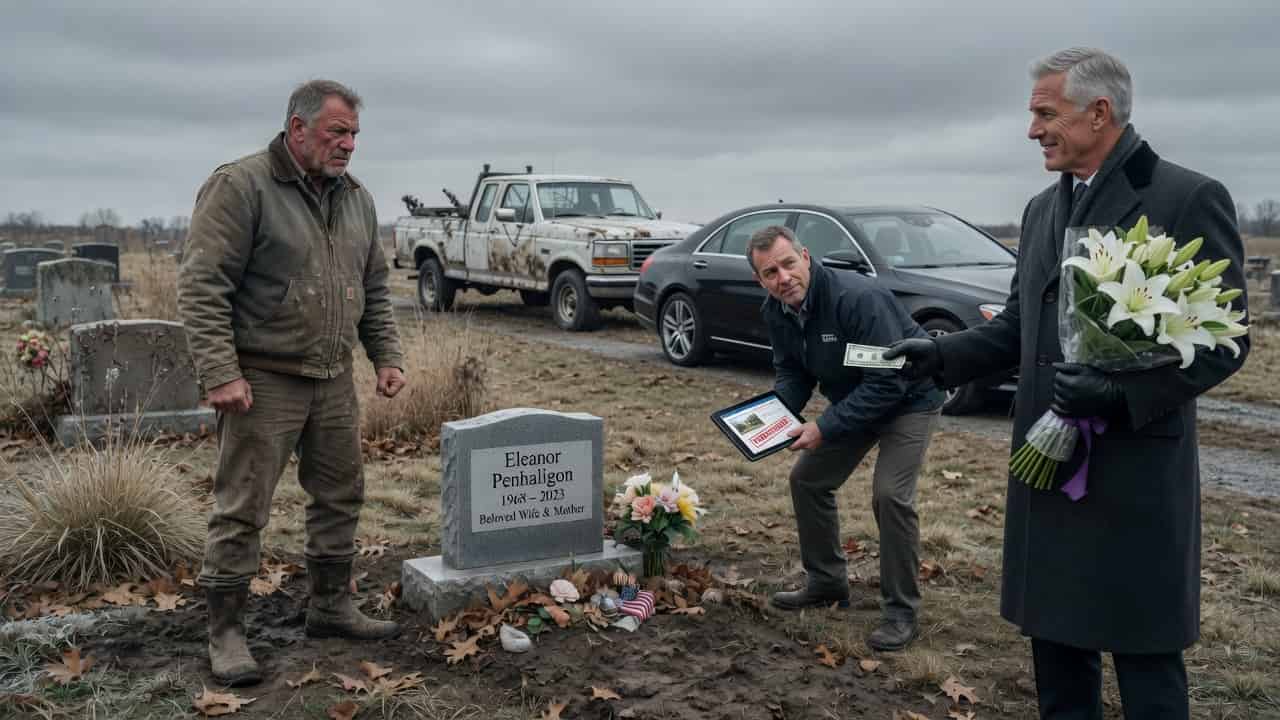
Arthur stopped. He didn’t look up from the headstone. He didn’t have the energy. He was forty-five years old, but his back felt eighty, and the bank appraiser standing five feet away was already mentally tagging the tractor and the north acreage for auction.
The man who had just climbed out of the black Mercedes looked like he belonged in a different zip code—or a different century. His coat cost more than Arthur’s truck. He was carrying a bouquet of lilies so white they made the Wisconsin snow look like trash.
“I asked you a question,” the man said, his voice dripping with the kind of pity that feels like an insult. He reached into his pocket and pulled out a twenty-dollar bill, extending it toward Arthur’s work-stained jacket. “Take it. Clean the mud off the base. My wife deserves better than this granite marker. I’m having a marble one shipped from the city.”
Arthur felt the blood drain from his head. He looked at the appraiser, who had gone pale. Then he looked at the man’s hand. On his ring finger was a heavy gold band. It was identical to the one Arthur had been wearing for fifteen years—the one he’d almost pawned last month to keep the heat on.
“Your wife?” Arthur whispered, his voice cracking like dry timber.
“Jane,” the man said, gesturing to the name carved in the stone. “I’m Martin. Her husband. Now, are you going to take the money or do I need to find the groundskeeper myself?”
Arthur looked at the man who had apparently been “husband number one” while Arthur was selling his soul to pay for a “cancer” that never existed.
Chapter 1
The wind in Oconto County didn’t just blow; it searched. It hunted for a gap in a man’s collar, a fray in a glove, or a crack in a window frame, and once it found a way in, it didn’t leave until it had settled in the bone. Arthur Penhaligon stood in the center of the family cemetery, a small plot of high ground hemmed in by rusted barbed wire, and felt that wind working its way through his Carhartt jacket. He didn’t move. He just stared at the dirt.
The dirt was hard. It had been a dry fall, followed by a snap freeze that had turned the loam into something resembling low-grade iron. Beneath that iron lay Jane. Or at least, the version of Jane that Arthur had known.
“Arthur, we really should keep moving,” Miller said. He was standing near the gate, shifting his weight from one foot to the other. Miller was a local guy, a few years younger than Arthur, but he’d gone to work for the bank in Green Bay a decade ago. He wore a navy windbreaker that was too thin for November and carried a tablet encased in a ruggedized rubber shell. “The appraiser from the machinery side is going to be at the barn in twenty minutes. We need to finish the land survey before the light goes.”
Arthur didn’t turn around. “The north forty is still the north forty, Miller. It hasn’t shrunk since the last time the bank looked at it.”
“It’s not about the size, Art. It’s about the condition. The lien is specific. We have to document the neglect.”
“Neglect,” Arthur repeated. The word tasted like copper in his mouth. He looked at the headstone—simple gray granite, the best he could afford after the final round of “experimental infusions” in Chicago had drained the last of the emergency fund. Jane Elizabeth Penhaligon. 1981–2025. Beloved Wife.
He had sold the dairy herd first. Then the combines. Then the southern timber lot that his great-grandfather had planted. He’d done it all with a grim, silent stoicism, believing he was buying her time. Five years of it. Five years of Jane leaving for weeks at a time to stay at that specialty clinic, coming back pale and exhausted, telling him stories of sterile hallways and kind nurses.
He’d been the hero of his own tragedy. The loyal husband who worked eighteen-hour days to fund a miracle. Now, the miracle was buried under six feet of frozen Wisconsin clay, and the bank was here to collect the carcass of the farm.
“I’m sorry, Art. I really am,” Miller said, his voice dropping an octave into that practiced, professional sympathy that made Arthur want to swing a shovel. “But the numbers are what they are. You’re over-leveraged by three hundred percent. There’s no path forward.”
Arthur finally turned. His face was a map of hard miles—deep lines around the eyes, a jaw that seemed permanently set against a blow. “I know the path, Miller. You’re standing on it.”
A low, sophisticated hum broke the silence of the country road. Both men looked toward the cemetery gate. A black Mercedes-Benz S-Class, its paint shimmering like an oil slick, slowed to a crawl and then turned onto the gravel shoulder. It looked alien here, parked next to Arthur’s rusted Ford F-150 with the mismatched tailgate.
The door opened, and a man stepped out. He was tall, lean in a way that suggested expensive gyms and a diet that didn’t involve gas station sandwiches. He wore a charcoal wool overcoat that fell perfectly to his knees, and he moved with a frantic, agitated energy. In his left arm, he cradled a massive bouquet of white lilies, their petals unnaturally bright against the gray afternoon.
The man didn’t see Miller or Arthur at first. He marched toward the gate, his leather dress shoes clicking on the frozen stones. He reached the gate, fumbled with the latch, and then stopped dead when he saw them.
“Oh,” the man said. He adjusted his glasses—thin, silver frames that caught the pale sun. He looked at Arthur, then at Arthur’s mud-caked boots, then at the shovel leaning against the fence. His expression shifted instantly from grief to a sharp, dismissive irritation. “Are you the groundskeeper? I’ve been trying to call the township office for three days. No one answers the damn phone.”
Arthur felt a strange, cold prickle at the base of his scalp. He didn’t answer.
“The marker,” the man continued, stepping into the cemetery and gesturing vaguely toward Jane’s grave. “It’s unacceptable. Granite is for state parks. I specifically requested the marble be ready for the first frost. I’m not having her stay under this… this pebble.”
Miller stepped forward, his tablet held like a shield. “Excuse me, sir? I think there’s a misunderstanding. This is a private family plot.”
The man in the overcoat ignored Miller entirely. He walked right up to the grave, standing on the opposite side of the mound from Arthur. He looked down at the name Penhaligon and his lip curled slightly.
“Who is responsible for this?” the man asked, looking at Arthur. He reached into the inner pocket of his coat and pulled out a slim leather wallet. He flicked it open and extracted a twenty-dollar bill. “Here. For your trouble. Clean the bird droppings off the base, at least. And tell whoever is in charge that Martin Vane is here, and I expect the new monument to be set by Friday.”
Arthur didn’t take the money. He didn’t even look at it. He looked at the man’s hand.
On Martin Vane’s right hand was a gold wedding band. It was thick, brushed gold with a tiny, recessed emerald on the inner curve. Arthur knew that ring. He had a matching one in his pocket, currently wrapped in a piece of oilcloth because his fingers had grown too thick from manual labor to wear it comfortably. He had bought them as a set from a jeweler in Milwaukee for their tenth anniversary. Or he thought he had.
“What did you say your name was?” Arthur asked. His voice was a low growl.
“Martin Vane,” the man said, his patience visibly evaporating. He waved the twenty-dollar bill. “Look, I don’t have time for the rural slow-walk routine. I’ve just driven six hours from Chicago. My wife is buried here, and I intend to see her treated with some modicum of dignity.”
“Your wife,” Arthur said. He stepped across the grave. He was shorter than Martin, but he was twice as wide, a wall of dense muscle and resentment.
“Yes,” Martin said, drawing himself up. “Jane. My wife.”
Miller made a small, choked sound in the background. “Uh, sir… Mr. Vane… this is Arthur Penhaligon. He’s the owner of this farm. And he’s… he was Jane’s husband.”
The silence that followed was absolute. Even the wind seemed to hold its breath.
Martin Vane looked at Arthur. He looked at the tan jacket, the grease under the fingernails, the tired, middle-aged slump of the shoulders. Then he laughed. It wasn’t a mean laugh; it was worse. It was a laugh of genuine, bewildered amusement.
“You’re joking,” Martin said. He looked at Miller. “This is some kind of local hazing? A shakedown?”
“I’m not joking,” Arthur said. He reached into his pocket and pulled out the oilcloth. He unwrapped it and held up the gold band. The emerald caught the light.
Martin’s face went from pale to a sickly, translucent white. He looked at the ring in Arthur’s palm. He looked back at his own hand. Then he looked at the headstone.
“Jane was in Chicago,” Martin whispered, his voice losing its edge. “She was there for three weeks every month. For her business. She’s a consultant for the trade board. She… we have a condo on Wacker Drive.”
“She was in Chicago for cancer,” Arthur said, the words feeling like stones in his throat. “She was at the Thorne Clinic. I paid for it. I’ve been paying for it for five years.”
Martin stared at him. The lilies in his arm began to slip. One by one, the white flowers fell onto the frozen mud. “There is no Thorne Clinic. Jane doesn’t have cancer. She was with me. We’ve been married for six years.”
Arthur felt the world tilt. The rows of corn stubble in the distance, the silo, the barn—it all seemed to shimmer and dissolve. He looked at the man in the charcoal coat, the man who had been living the life Arthur had been subsidizing with his family’s blood.
“You’re lying,” Arthur said, but the conviction was gone.
“I have the marriage certificate in the car,” Martin said, his voice trembling. “I have the photos. We were in Tuscany in August. She told me she was going to visit her ‘ailing aunt’ in the woods for a week.”
Arthur looked down at the dirt. The hard, frozen dirt that held the woman who had managed to be two people at once. He thought of the debt. The land he’d sold. The four generations of Penhaligons who had worked this soil, only for the last of them to trade it away so his wife could have a condo on Wacker Drive with a man who thought Arthur was the groundskeeper.
“Arthur?” Miller said, stepping closer, his voice full of genuine fear. “Art, don’t.”
Arthur didn’t hit him. He didn’t have the strength. He just looked at Martin Vane and saw the twenty-dollar bill still fluttering in the man’s gloved hand.
“Keep your money, Martin,” Arthur said, his voice dangerously quiet. “I think you’re going to need it.”
Chapter 2
The interior of the Oconto First National Bank smelled of stale coffee and the ozone of old printers. It was a sterile, fluorescent world that had always made Arthur feel too large, as if he were a bull allowed into a china shop on a temporary permit.
Clara sat behind her desk, her reading glasses perched on the end of a sharp, elegant nose. She had been the one to process every loan extension, every line of credit, and every desperate mortgage draw Arthur had made over the last half-decade. She was forty, cynical, and had a memory like a steel trap.
She didn’t look up when Arthur sat down. She just slid a folder across the mahogany-veneer desk.
“I heard about the graveyard, Arthur,” she said quietly. “Small towns. Miller called the branch manager before he even got back to his office.”
Arthur stared at the folder. It was thick. A record of his ruin. “Is it true, Clara?”
“Which part?” She looked up finally, her eyes softening just a fraction. “The part where a man in a Mercedes claims he’s been married to your wife for six years? Or the part where the Thorne Clinic in Chicago doesn’t exist?”
“Both.”
Clara sighed and opened the folder. She pulled out a stack of wire transfer confirmations. “After Miller called, I did some digging. I shouldn’t have, but I did. These transfers you were making, Arthur? The ones you thought were going to the billing department of a medical facility?”
“Yeah.”
“They weren’t going to a hospital. They were going into a private holding account. An LLC called ‘Blue Horizon Consulting.’ The registered agent for that LLC is a Jane Elizabeth Vane. Address: 300 Wacker Drive, Chicago.”
Arthur felt a dull throb behind his eyes. “Vane. Like the man in the coat.”
“Exactly like the man in the coat. It looks like Jane wasn’t just living a double life, Arthur. She was using your farm as a personal ATM to fund her life with him. Every time you sold a piece of equipment or a lot of timber, that money went straight into that account. And from what I can see, most of it was spent on high-end retail, international travel, and a mortgage on a property that isn’t in your name.”
Arthur leaned back in the chair. The plastic groaned under his weight. He thought of the nights he’d spent in the barn, repairing a leaking roof by flashlight because he couldn’t afford a contractor. He thought of the “treatment” side effects Jane would describe—the nausea, the hair loss that she managed to hide with expensive, realistic wigs he’d insisted on buying her. He’d held her hair back while she puked into the toilet, never realizing she was probably just hungover from a gala in the city.
“How much?” Arthur asked.
“Total? Over the five years?” Clara tapped a calculator. “With the land sales and the credit draws? Just shy of eight hundred thousand dollars, Arthur. That’s not including the interest you’ve been eating.”
Eight hundred thousand dollars. The value of his heritage. The price of four generations of sweat and calloused hands.
“The bank is moving forward with the foreclosure,” Clara said, her voice dropping to a whisper. “The board saw the report. With the fraud element involved, they’re worried about the collateral. They’re going to seize the equipment on Monday. They want the house by the end of the month.”
“I gave her everything,” Arthur said. He wasn’t talking to Clara anymore. He was talking to the empty air of the bank. “I would have died for her.”
“She knew that,” Clara said. She reached across the desk and put her hand over his. Her palm was cool and dry. “That’s why she picked you, Arthur. A man like Martin Vane… he’s got lawyers. He’s got accountants. He’s got eyes that look for the scam. But you? You’re a Penhaligon. You believe in the work. You believe in the bond. She knew you wouldn’t look at the receipts. She knew you’d just keep digging until there was nothing left.”
Arthur pulled his hand away. He felt a sudden, violent surge of nausea. He stood up, his chair clattering against the wall.
“Arthur, where are you going?”
“I have to see it,” he said.
“See what?”
“The life she bought with my dirt.”
He walked out of the bank, ignoring the curious stares of the tellers. The cold air hit him like a physical blow, but he welcomed it. He climbed into his truck and sat there for a long time, staring at the steering wheel.
He reached into the glove box and pulled out a small, framed photo. It was Jane, taken three years ago. She was sitting on the porch of the farmhouse, wrapped in a thick wool blanket, looking frail and beautiful. She’d told him that day that the “cancer” was in remission, but they needed one more “aggressive cycle” to be sure. That was the day he’d signed the papers to sell the north forty—the prime grazing land.
He looked at the photo now, really looked at it. He saw the way her skin glowed. He saw the expensive watch on her wrist—one she’d claimed was a “knockoff” she bought at a flea market to cheer herself up. It wasn’t a knockoff. It was a Cartier. He knew that now.
He started the truck. The engine turned over with a heavy, protesting roar. He didn’t head back to the farm. He headed south, toward the interstate.
The drive to Chicago took four hours. The further south he went, the more the world changed. The rolling hills and dead cornfields gave way to the sprawling, neon-lit suburbs, then the towering glass canyons of the city. Arthur felt like a ghost haunting a world he wasn’t meant to inhabit.
He found Wacker Drive. It was a world of polished stone and uniformed doormen. He parked his battered Ford between a Porsche and a Range Rover, the rust on his wheel wells looking like a disease.
He got out and stood in front of the building. 300 Wacker. A glass needle piercing the dark sky.
He didn’t go inside. He couldn’t. He didn’t have a key, and he certainly didn’t have the right clothes. He just stood on the sidewalk, a farmer in a tan work jacket, and looked up at the lighted windows. Somewhere up there, Jane had laughed. She had drank expensive wine. She had slept in silk sheets while he was sleeping in a chair by her “sickbed” back at the farm, waiting for her to come home from a “treatment” that was really just a cab ride from this building.
A black Mercedes pulled up to the curb. The same Mercedes from the graveyard.
Martin Vane got out. He looked different here. In the graveyard, he had been a grieving widower. Here, he was a king returning to his castle. He handed his keys to a valet without a word. He looked exhausted, his shoulders slumped, but there was still a precision to his movements.
Martin started toward the entrance, then stopped. He saw Arthur.
For a moment, the two men just looked at each other. The city noise—the sirens, the tires on wet pavement, the distant shouting—seemed to fade away.
“You followed me,” Martin said. It wasn’t an accusation; it was a statement of fact.
“I wanted to see the condo,” Arthur said.
Martin looked at the building, then back at Arthur. He seemed to age ten years in the span of a breath. “It’s empty. It’s been empty since the funeral. I can’t go in there for more than ten minutes without smelling her perfume. It’s killing me.”
“You’re lucky,” Arthur said.
Martin frowned. “Lucky? My wife is dead, Penhaligon. My wife of six years was a stranger. I’m finding out she had a whole other life in some… some godforsaken cow-town. I’m finding out my marriage was a lie.”
“Your marriage was a luxury,” Arthur said, stepping closer. “My marriage was a sacrifice. You lost a wife, Martin. I lost a wife, a farm, a future, and a name. You’re still wearing a three-thousand-dollar coat. I’m about to be homeless because I paid for your vacations.”
Martin opened his mouth to retort, but the words died. He looked at Arthur’s truck, then back at the farmer. He saw the sheer, crushing weight of the truth in Arthur’s eyes.
“I didn’t know,” Martin whispered. “I swear to God, Arthur. I thought she came from money. She told me her family owned a massive estate in the north. She said she went up there to manage the trusts.”
“The trusts,” Arthur laughed, a harsh, jagged sound. “That was the manure pits, Martin. That was the milking parlor. That was me, bleeding out so she could play princess with you.”
Martin reached into his coat and pulled out a key card. He held it out. “Come up. See it. If you’re going to hate me, at least hate me for the right things.”
Chapter 3
The elevator was silent and moved with a sickeningly smooth upward pull. When the doors opened, they were directly inside the foyer of the penthouse.
It was a cathedral of modern excess. Floor-to-ceiling windows looked out over the Chicago River, the lights of the city reflecting off polished white marble floors. There were no family photos on the walls—only abstract paintings that looked like splattered ink. The air smelled of expensive lilies and something metallic, like a new car.
Arthur walked to the center of the room. His boots left faint, dusty prints on the marble. He felt a strange sense of vertigo. This was where the money had gone. The north forty was the sofa. The southern timber lot was the kitchen island. His grandfather’s legacy had been traded for a view of a polluted river.
Martin went to a sleek black bar and poured a drink. He didn’t ask Arthur if he wanted one. He just downed a double shot of amber liquid and leaned against the counter.
“There,” Martin said, gesturing to a hallway. “Her office. Third door on the left. That’s where she kept the ‘trust’ files. I never went in there. She told me it was boring legal work. She said it was her private space.”
Arthur walked down the hall. His heart was hammering against his ribs like a trapped bird. He opened the door.
The office was small, windowless, and packed with filing cabinets. On the desk sat a high-end laptop and a stack of leather-bound ledgers. Arthur opened the top one.
It wasn’t a diary. It was a logbook.
Oct 12: A. convinced he needs the new meds. Transfer $15k. Told him the hair loss is starting. Need new wig.
Nov 4: M. wants to go to Aspen. Told A. the clinic moved the schedule. A. selling the tractor. Should cover the chalet.
Dec 20: Christmas at the farm was a bore. A. cried because he thought it was my last one. Got a diamond tennis bracelet from M. Hid it in the floorboard.
Arthur felt a coldness spread through his limbs that had nothing to do with the Wisconsin winter. It was a manual. She hadn’t just lied; she had choreographed it. She had measured his pain and converted it into currency. She had watched him cry at the kitchen table and calculated how much more she could squeeze out of his grief.
He looked at the bottom of the page. There was a small, hand-drawn sketch of a farm—his farm. Over the house, she had drawn a large, red ‘X’.
“Find what you were looking for?” Martin was standing in the doorway. He looked smaller now, his bravado stripped away by the silence of the room.
Arthur closed the ledger. “She hated me.”
“She didn’t hate you, Arthur,” Martin said, taking a step inside. “Hate requires an investment. She used you. There’s a difference. To Jane, we weren’t people. We were resources. I provided the status, the city life, the excitement. You provided the safety net. You were the place she went when she needed to disappear, and you were the bank she robbed when my accounts got too monitored.”
“She told me she loved the smell of the hay,” Arthur whispered. “She told me she couldn’t imagine living anywhere else.”
“She told me she hated the country,” Martin countered. “She said it smelled like death and failure. She said her family was trapped there, and she was the only one who got out.”
Arthur looked at the desk. Under the laptop was a thick manila envelope. He picked it up and opened it.
Inside were two marriage certificates. One from Oconto County, Wisconsin. One from Cook County, Illinois. There was also a life insurance policy. A big one.
Arthur scanned the document. Beneficiary: Martin Vane.
“Did you know about this?” Arthur asked, holding up the policy.
Martin shook his head. “I didn’t think we needed it. I’m the one with the money, Arthur. Why would I need a policy on her?”
“Because she wasn’t planning on being the one who died,” Arthur said. He pointed to a clause in the policy. It was a double-indemnity clause for accidental death. And there was a second policy. This one was hidden in the back of the envelope.
Beneficiary: Jane Elizabeth Vane. Insured: Arthur Penhaligon.
Arthur’s breath hitched. He remembered signing those papers. She’d told him it was a “protective disability” policy for the farm. She’d told him that if he got hurt in the fields, the bank wouldn’t be able to take the house. He’d signed it without reading it because his eyes had been blurry from eighteen hours of baling hay.
She wasn’t just waiting for the farm to die. She was waiting for him to die.
“She was going to kill me,” Arthur said. The realization was as sharp and clear as a bell. “The ‘cancer’ wasn’t the end game, Martin. The ‘cancer’ was the way she explained why I was getting sicker. She was poisoning me. Those ‘special teas’ she used to make me… the ones she said would help my heart…”
Martin’s face went slack. He looked at the ledgers, then at Arthur. “You’re serious?”
“Look at my hands, Martin,” Arthur said, holding them out. They were shaking—a fine, persistent tremor that he’d attributed to exhaustion and stress. “I’ve been having dizzy spells for two years. The doctor in town couldn’t find anything. He just said I was working too hard.”
Arthur grabbed the ledger again and flipped to the back. There, in the very last entry, dated two weeks before her aneurysm, was a single line:
A. is stubborn. The dosage needs to go up. He’s taking too long to fail.
The room felt like it was shrinking. Arthur looked at the marble floors, the expensive furniture, the white lilies. It was all built on a foundation of his slow, systematic murder.
“I need to go,” Arthur said. He shoved the ledger and the insurance papers into his jacket.
“Arthur, wait,” Martin said, reaching out to stop him. “If this is true… if she was doing this… we need to call the police. We need to report the fraud.”
Arthur turned on him, his eyes burning with a terrifying, cold light. “The police? The police can’t give me back my grandfather’s land. They can’t give me back the five years I spent dying for a ghost. The bank is taking my farm on Monday, Martin. Your wife—our wife—spent all my money. But she left me one thing.”
“What?”
“The truth,” Arthur said. “And the truth is, I don’t have anything left to lose. Which makes me a very dangerous man for someone like you to be standing next to.”
Arthur pushed past him and walked out of the penthouse. He didn’t take the elevator. He took the stairs, his boots thudding against the concrete, a rhythmic, predatory sound that echoed in the hollow heart of the building.
Chapter 4
The drive back to Oconto County was a blur of gray highway and white-knuckle silence. Arthur didn’t stop for coffee. He didn’t stop for gas until the light was screaming red. He just drove, the tremor in his hands now a steady, vibrating roar of adrenaline and rage.
He reached the farm at three in the morning. The house was dark, a skeletal shadow against the snow. He pulled into the driveway and sat there, the engine ticking as it cooled.
He looked at the barn. In forty-eight hours, the bank would come. They would take the tractors. They would chain the gates. The Penhaligon name would be stripped from the mailbox, and the land would be carved up into hobby farms for people like Martin Vane.
Unless.
Arthur got out of the truck and walked to the barn. He didn’t turn on the lights. He knew this place by touch, by smell, by the way the floorboards groaned under his weight. He went to the tool room and reached behind a stack of old seed bags.
He pulled out a heavy, rusted metal box. He opened it.
Inside was a folder of deeds—the original land grants from 1890. And beneath them, something else. A set of keys and a legal document he’d forgotten he even had.
It was a contingency deed. His father had been a paranoid man, a man who didn’t trust banks or lawyers. Before he died, he’d set up a private trust. It wasn’t much—just a twenty-acre plot on the western edge of the property, the part with the old quarry. It was separate from the main farm’s legal structure. It was the one piece of land the bank couldn’t touch because it wasn’t listed as collateral.
And more importantly, it sat directly over the main access road for the entire township’s drainage system.
Arthur looked at the map. If he controlled that twenty-acre plot, he controlled the water flow for the three largest farms in the county—farms that were currently owned by the holding company Jane had been “consulting” for.
He saw the shape of it then. The revenge wasn’t going to be a physical blow. It was going to be a strangulation.
A pair of headlights swept across the barn door. Arthur froze. He tucked the metal box under his arm and stepped into the shadows.
A car pulled into the yard. Not a Mercedes. A Tahoe. Sheriff Brody’s vehicle.
The Sheriff got out, his heavy boots crunching on the snow. He didn’t come to the barn. He went to the front porch of the house and stood there for a moment, looking at the empty swing. Then he turned and saw Arthur’s truck.
“Art?” Brody called out, his voice weary. “I know you’re out here. I saw the lights.”
Arthur stepped out of the barn. “It’s late for a social call, Jim.”
Brody walked toward him, his hands in his pockets. He was a man of sixty, with a face that looked like it had been carved out of an oak stump. He’d known Arthur since they were kids. “The bank called me, Art. They’re worried. Miller said you had a… situation at the cemetery. And then you disappeared for twelve hours.”
“I went to the city,” Arthur said.
“I heard. I also heard about the other husband.” Brody stopped a few feet away. He looked at the barn, then at the man standing in the doorway. “Art, look at me.”
Arthur looked.
“You’re a good man. The best I know. But you’re vibrating like a downed power line. Whatever you’re thinking… whatever you found out in Chicago… don’t let it destroy what’s left of you.”
“There’s nothing left, Jim,” Arthur said. “That’s the part you’re not getting. She took it all. She was poisoning me. She was waiting for me to die so she could collect a check and go back to her penthouse.”
Brody went still. “Poisoning? You have proof of that?”
Arthur held up the ledger. “It’s all in here. In her own hand. Dates, dosages, the whole thing. She was a professional, Jim. She turned my life into a business plan.”
Brody reached for the ledger, but Arthur pulled it back.
“No,” Arthur said. “If I give this to you, it becomes evidence. It goes into a file. It takes three years to go through the courts. By then, the farm is gone. The land is sold. I’m living in a trailer in the next county over.”
“Arthur, if she tried to kill you, that’s a criminal matter. Even if she’s dead, the estate is liable. We can freeze the assets. We can stop the bank.”
“The bank doesn’t care about a dead woman’s secrets,” Arthur said. “They want their money. And the only way I get my money back is to take it from the man who’s currently sitting in the house she built with my blood.”
“Martin Vane didn’t do this, Art,” Brody said softly. “He was a victim too.”
“He’s a victim who gets to keep the condo,” Arthur spat. “He’s a victim who gets to keep the jewelry and the cars and the life insurance. I’m the victim who gets the foreclosure notice.”
Arthur stepped closer to the Sheriff, the metal box clutched to his chest. “I’m going to reclaim my land, Jim. All of it. And I’m going to do it in a way that makes that man in Chicago wish he’d never heard the name Jane Penhaligon.”
“Arthur, don’t make me come back here with handcuffs,” Brody said, his voice full of a deep, aching regret.
“Then don’t come back,” Arthur said.
He turned and walked back into the darkness of the barn. He went to the back, where his father’s old tractor sat—the one the bank didn’t know about because he’d never reported it as an asset. It was a 1960 John Deere, a beast of iron and oil.
He climbed into the seat. He reached into his pocket and pulled out the matching wedding ring. He looked at it for a long second, the gold glinting in the moonlight. Then he dropped it onto the dirt floor and crushed it under the heel of his boot.
He started the engine. The roar was deafening in the enclosed space, a guttural, primal scream that drowned out the wind.
He didn’t head for the fields. He headed for the old quarry. He had work to do. He had a world to break.
The first step of the revenge was simple: if he couldn’t have the land, no one would. He was going to flood the valley. He was going to turn the “estate” Jane had promised the holding company into a swamp. And then, he was going to invite Martin Vane down to see the results.
Arthur Penhaligon wasn’t a farmer anymore. He was a debt collector. And he was starting with the interest.
Chapter 5
The old quarry on the western edge of the Penhaligon land was a jagged, limestone throat that had been silent for thirty years. It was a place of gray shadows and stagnant water, a geological wound that Arthur’s father had always warned him away from. “That ground don’t know how to hold a secret, Artie,” his father used to say, leaning on a fence post with a cigarette dangling from his lip. “You drop something in there, the whole county’s gonna feel the splash sooner or later.”
Arthur sat in the vibrating seat of the 1960 John Deere, the engine’s rhythmic thrumming rattling his teeth and aggravating the fine, persistent tremor in his right hand. The headlights of the tractor cut weak, yellow tunnels through the swirling snow. It was four in the morning, the deadest part of the Wisconsin night, when the only things moving were the coyotes and the men who had run out of choices.
The mechanics of the plan were simple, rooted in the crude, effective engineering of a century ago. The quarry sat at the highest point of the local water table. Below it ran a series of limestone culverts and natural subterranean channels that fed the drainage tiles for the entire valley. In the fifties, the county had installed a massive steel gate system—a bypass designed to prevent the spring melts from drowning the lower townships. Over the decades, the county had forgotten about it, assuming the modern pumping stations five miles east were doing all the heavy lifting.
But Arthur hadn’t forgotten. He knew exactly where the rusted manual override wheel was buried under a pile of rotted timber and shale.
He climbed down from the tractor, his knees popping with a sound like dry kindling. His head spun for a moment—a wave of vertigo that tasted like copper and old batteries. He leaned against the cold iron of the rear tire, waiting for the world to stop tilting. The dosage needs to go up. The words from Jane’s ledger burned in his mind like a brand. Every dizzy spell, every night he’d woken up drenched in a cold sweat while she stroked his forehead and whispered about “rest,” had been a step toward the grave. She hadn’t just been stealing his money; she’d been harvesting his life, one milligram at a time.
He reached the bypass wheel and began to clear the debris. The wood was slick with ice and decay. He used a crowbar to wedge the locking pin free, the screech of metal on metal sounding like a dying animal in the frozen silence. When the pin finally gave way, Arthur grabbed the wheel with both hands.
He pulled. Nothing moved. He adjusted his stance, digging his boots into the frozen muck, and threw his entire weight into the turn. He felt the muscles in his back scream, a sharp, white-hot pull that made his vision blur. The wheel groaned, shifted an inch, and then began to spin with a slow, grinding inevitability.
Deep underground, he heard the first thud of the sluice gates shifting. It was a heavy, resonant sound that vibrated through the soles of his boots. Then came the water. It didn’t rush; it hissed, a low-pressure growl as the redirected flow began to back up into the drainage tiles of the north acreage—the land the bank was planning to auction off on Monday.
Arthur stood back, wiping grease and rust onto his thighs. By dawn, the lower fields of the “Penhaligon Estate” would be a frozen marsh. By Monday, the foundation of the barn and the silo would be sitting in two feet of standing water, rendering the structural integrity of the buildings “compromised” for any potential buyer. He was devaluing the prize while the hunters were still circling.
“Arthur!”
The voice came from the rim of the quarry. Arthur looked up, squinting against the snow. A figure stood there, silhouetted against the pale, pre-dawn light. It wasn’t the Sheriff. It was too thin, the movements too frantic.
Martin Vane scrambled down the rocky slope, his expensive leather shoes sliding on the shale. He looked like a man who hadn’t slept in a week. His charcoal overcoat was stained with salt, and his face was drawn and haggard. He reached the bottom and stopped ten feet away, breathing hard, his breath blooming in the air like white smoke.
“I went to the house,” Martin panted. “The Sheriff was there. He told me you were out here. He told me what you said… about the poisoning.”
Arthur didn’t move. He kept the crowbar in his hand, letting it hang at his side. “You’re a long way from Wacker Drive, Martin.”
“The accounts are frozen,” Martin said, his voice cracking. “The feds… they showed up at my office yesterday afternoon. They have the wire transfers from Blue Horizon. They think I was in on it, Arthur. They think I was laundering money through her ‘consulting’ firm.”
Arthur felt a grim, cold satisfaction. “Were you?”
“No! I didn’t even know the firm existed until you showed me that ledger. I thought the money was coming from her family’s trust. I never asked questions because… because I didn’t want to know. I liked the life, Arthur. I liked that she was successful and independent.” Martin stepped closer, his hands outstretched in a gesture of desperate pleading. “They’re going to take everything. The condo, the cars, the business. I’m ruined.”
“Ruined,” Arthur repeated. He looked at the man’s trembling hands. “You still have your health, Martin. You still have a heart that isn’t full of lead and a brain that hasn’t been fried by ‘special tea.’ You’re doing a hell of a lot better than I am.”
“I can help you,” Martin said, his voice dropping to a frantic whisper. “I have a lawyer. A specialist in forensic accounting. If we work together, we can prove she was the sole architect. We can show that she defrauded both of us. We can save what’s left.”
Arthur looked at the tractor, its engine still idling with a steady, mindless roar. He thought about the four generations of men who had worked this land, men who had died with dirt under their fingernails and their names intact. He thought about his father’s trust—the twenty acres the bank couldn’t touch.
“I don’t want to save what’s left, Martin,” Arthur said. “I want to bury it. I want to make sure that when the bank finally walks onto this property, they find exactly what Jane left behind: a hollowed-out shell that isn’t worth the paper the deed is printed on.”
“You’re crazy,” Martin whispered, backing away. “You’re flooding the land. You’re destroying your own heritage.”
“My heritage was gone the second she signed the first mortgage draw,” Arthur said. He stepped toward Martin, the crowbar glinting in the yellow light. “The only thing I have left is the ability to choose who goes down with me. Now, you’re going to get back in your car and you’re going to drive back to Chicago. You’re going to tell the feds exactly what was in those ledgers. And then you’re going to tell them that Arthur Penhaligon died three years ago, and there’s nothing left to subpoena.”
“Arthur, please—”
“Go,” Arthur roared, the sound echoing off the limestone walls.
Martin turned and fled, stumbling up the slope, his polished shoes useless against the Wisconsin earth. Arthur watched him go until the taillights of his rental car vanished into the gray morning.
He turned back to the wheel. He gave it one last, punishing turn, locking the sluice gate in the open position. He felt a sudden, sharp pain in his chest—a jagged reminder of the damage Jane had done. He slumped against the wheel, gasping for air, his forehead pressed against the cold metal.
The water continued to hiss below him, a steady, invisible tide of retribution. He had broken the world, just like he’d promised. Now, all he had to do was wait for the harvest.
Chapter 6
The Monday morning of the foreclosure auction arrived with a sky the color of a bruised plum. The air was still, a heavy, expectant silence that felt more like a threat than a peace.
By eight o’clock, the gravel driveway of the Penhaligon farm was crowded with vehicles. There were the white SUVs of the bank’s legal team, the rusted pickups of local scavengers looking for a deal on scrap metal, and the Sheriff’s Tahoe, parked like a sentinel near the barn.
Arthur stood on the back porch, a tin mug of black coffee in his hands. He hadn’t slept. He’d spent the weekend moving the last of his personal belongings—his father’s journals, a few old photos, and his grandfather’s rifle—to the small cabin on the twenty-acre trust land. He’d left the house exactly as Jane had kept it: pristine, empty, and smelling of the expensive lavender candles she’d used to mask the scent of the chemicals she’d been feeding him.
Miller, the bank appraiser, climbed out of his SUV and stopped at the edge of the driveway. He was wearing hip waders. He looked at the front yard, which was now a shallow, gray lake of standing water and slush.
“What the hell happened here, Art?” Miller called out, his voice echoing across the water.
Arthur leaned against the porch railing. “Drainage failure. Told you the system was old, Miller. Looks like the main line collapsed under the weight of the frost.”
Miller sloshed through the water, his face a mask of professional fury. He reached the porch and held up his tablet. “This isn’t an accident. We had a survey done three weeks ago. The water table was stable.”
“Mother Nature don’t care about your surveys,” Arthur said, taking a slow sip of coffee. “Ground shifted. Pipes broke. It happens.”
“It happens right before an auction?” Miller snapped. “The inspectors were supposed to sign off on the structural integrity of the barn this morning. They can’t even get inside without a boat. The foundation is sitting in eighteen inches of ice-water, Arthur. We can’t sell a property with active flooding and potential subsidence issues.”
“Shame,” Arthur said. “Guess the bank’s stuck with a lemon.”
Clara stepped out from behind a group of lawyers. She wasn’t wearing her bank uniform; she was in a thick parka and hiking boots. She walked up to the porch and looked Arthur in the eye.
“The holding company pulled their bid, Arthur,” she said quietly. “The group Jane was ‘consulting’ for? They saw the footage Miller sent this morning. They’re not interested in a reclamation project. They’ve officially withdrawn.”
Arthur felt a flicker of something he hadn’t felt in years: hope. It was a small, painful thing, like a spark in a cold hearth.
“What about the other bids?” he asked.
“There are no other bids,” Clara said. “The bank is looking at a total loss on the land. They’re going to have to write it off or spend two hundred thousand dollars on a drainage overhaul they can’t justify.”
She leaned in closer, her voice dropping so the lawyers couldn’t hear. “The Sheriff found the sluice gate, Arthur. He knows what you did.”
“Did he close it?”
“No,” Clara said, a faint smile touching her lips. “He said the mechanism was too rusted to move. He said it would take a specialized crew and a court order to fix it. He’s currently filing a report stating that the flooding is a natural disaster.”
Arthur looked toward the Sheriff’s Tahoe. Brody was leaning against the hood, watching the bank lawyers argue in the middle of the flooded yard. When he saw Arthur looking, he gave a single, slow nod before turning away to light a cigarette.
The crowd began to disperse by noon. The bank’s legal team realized there would be no auction today, or any day in the near future. The “Penhaligon Estate” had become a liability, a toxic asset in a landscape that only valued certainty.
As the last of the cars pulled away, Arthur saw a black Mercedes pull up to the gate. It sat there for a long time, its engine idling. Martin Vane didn’t get out. He just sat behind the glass, looking at the flooded fields, at the ruined farmhouse, and at the man standing on the porch.
After a few minutes, the Mercedes turned around and drove away, heading south toward the highway. Martin was going back to a life that was being dismantled piece by piece, a mirror image of the ruin Jane had brought to the farm. They were both survivors of a war they hadn’t known they were fighting, left with nothing but the debris of a woman who had never truly existed.
Arthur walked down the porch steps and into the water. It was freezing, the cold biting through his boots, but he didn’t care. He walked toward the barn, his shadow long and sharp on the gray surface of the flood.
He reached the center of the yard and stopped. He looked at the house. He remembered the first day he’d brought Jane here, how she’d stood in the kitchen and talked about “new beginnings.” He remembered the way he’d looked at her and felt like the luckiest man in the world.
He reached into his pocket and pulled out the small, framed photo he’d taken from the truck. He looked at her face one last time. He saw the lie, but he also saw the man he’d been—the man who had loved her enough to give her everything. That man was gone, buried somewhere in the limestone and the muck, but he hadn’t died the way she’d planned.
He dropped the photo into the water. It floated for a second, Jane’s smiling face looking up at the bruised sky, before it sank beneath the surface, settling into the silt.
Arthur turned his back on the house and started toward the west acreage. He had twenty acres of high ground. He had his father’s trust. He had a tractor that still ran and a name that, while tarnished, still belonged to him.
The tremor in his hand was still there, a reminder of the poison that would likely shorten his life, but his grip was steady. He walked toward the trees, toward the old quarry, and toward the only thing he had ever truly owned: the dirt beneath his feet.
The wind picked up, searching for a gap in his collar, but Arthur didn’t flinch. He just kept walking, a farmer returning to a land that had finally stopped keeping his secrets.
END OF STORY