Elias has played his guitar in the same corner of the Chicago transit terminal for ten years. He doesn’t ask for much, just enough to pay for the heart meds that keep him upright and the quiet apartment where he keeps his memories.
Tonight was different. Tonight, the city’s elite were out in force for the Winter Gala, draped in silk and arrogance. Brock Harrison, a man who has never known a day of hunger, decided the old “charity case” was his evening entertainment.
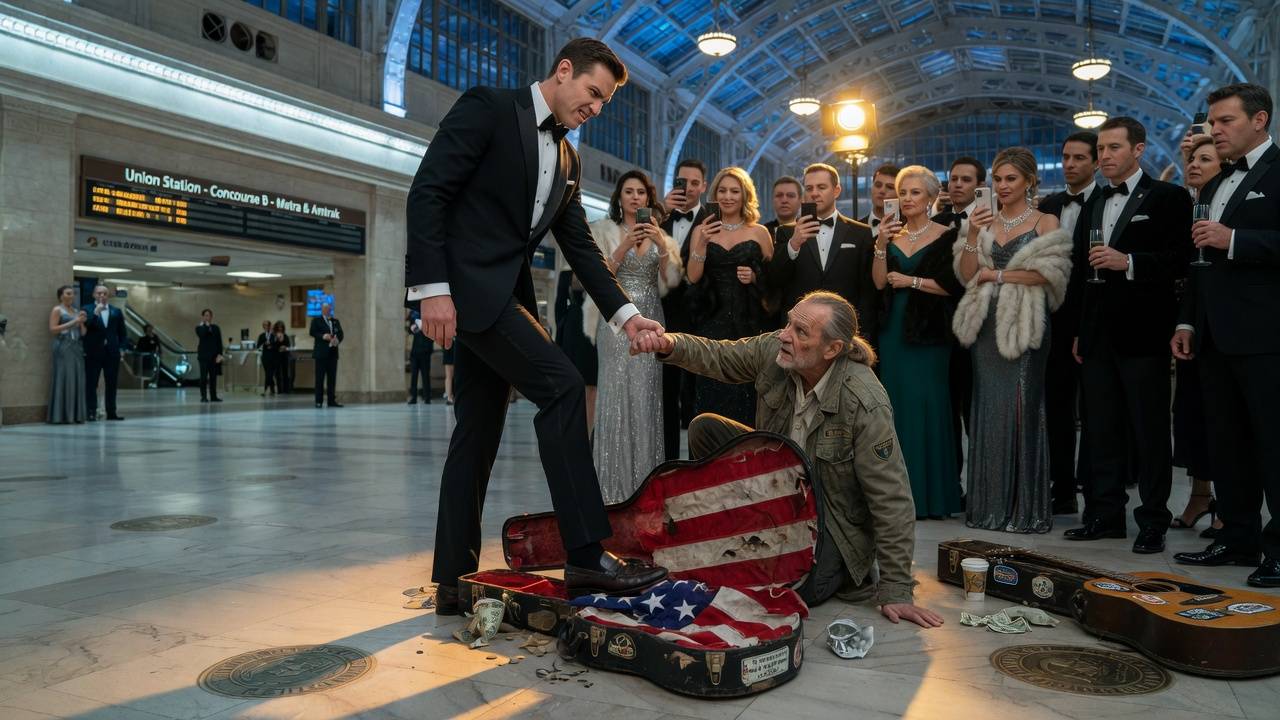
It started with a few tossed pennies and a mocking laugh. But then Brock went for the one thing Elias has left—a tattered, folded American flag resting in his guitar case. A flag Elias carried through the humid hell of the central highlands while Brock’s father watched from a safe distance.
When Brock stepped his $900 loafers onto that fabric and grabbed Elias by the collar, he thought he was bullying a ghost. He didn’t realize that under that faded olive jacket is a man who was trained to survive things Brock can’t even imagine.
In front of a dozen witnesses with their phones out, Brock crossed the final line. He thought Elias was too old, too broken, and too invisible to fight back. He was wrong.
The terminal went dead silent when the “broken tool” finally stood up. What happened next wasn’t a fight—it was a lesson in respect that Brock will feel in his bones for the rest of his life.
The full story is in the comments.
Chapter 1
The damp cold of the Chicago transit terminal didn’t just sit on the skin; it worked its way into the joints like a slow-moving flood. Elias sat on a plastic milk crate, his back against the polished marble pillar that had been his office for the better part of a decade. He adjusted the strap of his 1964 Gibson Melody Maker—the finish worn down to the bare wood where his forearm rested—and began the nightly ritual of tuning.
He didn’t need a tuner. He could feel the tension in the strings through the tremors in his fingers, a souvenir from a year spent in the A Shau Valley that the VA doctors liked to call “residual nerve damage.” To Elias, it was just the rhythm of his life.
“You’re late, Elias,” a voice called out.
Elias looked up, squinting through the smudged lenses of his glasses. Marcus, the young security guard with a uniform three sizes too big, was leaning against a trash can. Marcus was twenty-two, roughly the age Elias had been when he first saw a Huey gunship, but the kid had a kindness in him that felt out of place in a building made of stone and steel.
“Heart was acting up,” Elias said, his voice a low rasp. “Had to take the stairs slow. The escalator’s out again.”
“Always is,” Marcus sighed, checking his watch. “You better get started. The Gala crowd is starting to filter in. Big money tonight. Founders’ Fund or something. Lots of tuxedos and bad attitudes.”
Elias nodded and struck a low E chord. The sound echoed off the vaulted ceilings, a mournful, hollow ring that cut through the chatter of commuters. He didn’t play for the money, not really. He played because the silence in his apartment on 63rd Street was too loud, filled with the ghosts of men who hadn’t made it back and the heavy, suffocating absence of a son named David who hadn’t called in four years.
As the first wave of formal wear began to descend the grand staircase, Elias felt the familiar tightening in his chest. It wasn’t just the heart condition. It was the way they looked at him—or rather, the way they didn’t. To them, he was a structural defect, a smudge on the pristine landscape of their evening.
A group of young men in tailored black suits, their ties loosened and their laughter echoing too loudly, drifted toward his corner. In the center was a man Elias recognized from the business journals people left on the trains: Brock Harrison. He was the kind of handsome that looked expensive, with a jawline carved by high-end dentistry and eyes that moved over the world like he already owned the deed to it.
“Look at this,” Brock said, coming to a stop three feet from Elias’s case. He gestured with a half-empty glass of amber liquid. “The soundtrack to urban decay. Real authentic, isn’t it, boys?”
His friends chuckled, a synchronized, sycophantic sound. One of them, a shorter man with a flushed face, tossed a handful of pennies into Elias’s case. They pinged off the velvet lining, one of them bouncing off the edge of the folded American flag Elias kept tucked in the corner of the case.
Elias didn’t stop playing. He moved into a slow, Delta-style blues riff, his eyes fixed on the fretboard. He could feel the heat of their attention, a predatory kind of energy that made the hair on his neck stand up.
“Hey, Pops,” Brock said, leaning down. The scent of expensive scotch and ego rolled off him in waves. “You know anything with a beat? Something that doesn’t sound like a funeral?”
“I play what I know,” Elias said softly, his fingers never stuttering.
Brock grinned, but it didn’t reach his eyes. He reached into his pocket and pulled out a crumpled ten-dollar bill, dangling it just out of Elias’s reach. “Tell you what. Play something upbeat, and this is yours. Or better yet, tell us a war story. Give the boys a thrill. You look like you’ve seen some things. Or maybe you just sat in a supply depot and got that jacket at a surplus store.”
The disrespect was casual, practiced. It was the kind of bullying that relied on the target’s need to remain invisible. Elias knew the rules. If he got angry, Marcus would be forced to move him. If he moved him, Elias lost his permit. If he lost his permit, he lost the thirty dollars a night that kept the lights on.
“I’m just a guitar player, son,” Elias said.
“Son?” Brock’s face hardened. He dropped the ten-dollar bill. It didn’t fall into the case; it landed on the dirty floor, inches from a discarded gum wrapper. “Fetch that, charity case. I missed the trash can.”
Elias stopped playing. The silence that followed was heavy, a physical weight in the air. He looked at the bill, then up at Brock. He felt the old fire, the one he’d spent fifty years trying to douse, flickering in the base of his gut.
“I’ve seen better men die for less than ten dollars,” Elias whispered.
Brock stepped forward, his polished loafer landing inches from Elias’s hand. “What did you say to me?”
The tension was a live wire. In the distance, the gala music began to swell, but in this corner of the terminal, the only thing that mattered was the space between a man who had everything and a man who had nothing left to lose.
Chapter 2
The confrontation didn’t break; it just simmered. Brock’s friends shifted behind him, their smiles turning into the nervous, hungry looks of people waiting for a car crash.
“I said I’ve seen better men die for less,” Elias repeated, his voice steadier than his hands. He slowly leaned over, picked up the ten-dollar bill, and placed it inside his guitar case, right next to the pennies. “Thank you for the contribution.”
Brock stared at him for a long beat, his nostrils flaring. He wasn’t used to the silence of a man who wasn’t afraid of him. He was used to the frantic apologies of subordinates or the practiced indifference of his peers. Elias’s steady gaze was a challenge he didn’t know how to categorize.
“Come on, Brock,” the flushed man said, tugging at his sleeve. “The dinner starts in ten minutes. My dad’s gonna kill us if we’re late for the opening remarks.”
Brock didn’t move. He looked down at the guitar case again, his eyes landing on the folded flag. It was a small thing, tattered at the edges, the blue field faded to a dull charcoal. “What’s with the flag, Pops? You trying to guilt people into giving you more? It’s a little desperate, don’t you think?”
“It’s not for sale,” Elias said.
“Everything’s for sale,” Brock countered. He reached out with the toe of his shoe and nudged the edge of the case. “How much for the whole kit? The guitar, the crate, the flag. I’ll give you five hundred bucks right now to pack it up and get out of my sight. You’re depressing the guests.”
“The permit says I stay until eleven,” Elias said.
“The permit is a piece of paper signed by a clerk who works for my father’s foundation,” Brock said, his voice dropping to a dangerous, low register. “I could have you cleared out of here with one phone call. You’re a vagrant with a hobby, Elias. Don’t mistake my curiosity for respect.”
He turned on his heel and walked away, his entourage trailing behind him like a wake. Elias watched them go, his heart thudding against his ribs in a jagged, uneven rhythm. He reached into his pocket and found his pill bottle, shaking out a nitro and tucking it under his tongue. The chemical burn was sharp, but it cleared the fog.
“You okay, Elias?”
It was Sarah, the young waitress from the terminal’s high-end bistro, The Gilded Rail. She was carrying a cardboard tray with a plastic cup of coffee. She’d been working there for three years, and she was one of the few people who knew that Elias didn’t live on the streets, even if he looked the part.
“I’m fine, Sarah,” he said, taking the coffee. “Just a bit of wind.”
“I saw that guy,” she said, looking toward the grand staircase where Brock was disappearing. “That’s Brock Harrison. His family basically owns the North Side. He’s a prick. I served him a three-hundred-dollar bottle of wine last week and he complained that the ice was too cold. You should stay away from him.”
“Hard to stay away when you’re bolted to the floor,” Elias said with a faint, grim smile.
“He’s looking for a fight,” Sarah warned, her voice dropping. “People like him, they don’t like it when they can’t buy someone. And they really don’t like it when they see something they can’t understand. Like why you’re still here.”
Elias looked down at his guitar. He knew exactly why he was still here. He was waiting for a ghost. Every Friday night for four years, he’d sat in this spot because this was the terminal David would have to come through if he ever came home from the West Coast. It was a foolish, sentimental hope, the kind that kept a man tethered to a cold marble pillar in a drafty station, but it was all he had left.
The hour passed in a blur of commuters and the distant, muffled sound of a string quartet playing upstairs. The air in the terminal grew colder as the night deepened. Around 9:30, the gala guests began to reappear, drifting out of the ballroom in smaller, drunker groups.
Brock was among them. He wasn’t wearing his jacket anymore, and his white shirt was unbuttoned at the collar. He held a crystal tumbler in one hand and a half-empty bottle of Macallan in the other. He didn’t come alone. His three friends were with him, along with two women in shimmering gowns who looked bored and beautiful.
“Look who’s still here,” Brock called out, his voice echoing. He was weaving slightly, the arrogance now amplified by expensive alcohol. “The local legend. The defender of the faith.”
He stopped in front of Elias, but this time he didn’t stop three feet away. He stepped right into the center of the guitar case, his boots crushing the extra picks and the spare strings Elias kept in the small compartment.
“I told you to leave,” Brock said.
“I told you I have a permit,” Elias replied.
The crowd of socialites began to slow down, sensing a performance. They formed a loose circle, their faces illuminated by the glow of their phone screens as they began to record. The social pressure was immediate—the weight of a hundred pairs of eyes, all waiting to see if the old man would break.
Brock looked around at his audience, a cruel grin spreading across his face. He held the bottle of scotch over Elias’s head. “You look thirsty, Elias. You look like you need a little holiday cheer.”
He tilted the bottle. The dark, expensive liquid began to pour, soaking into Elias’s thin gray hair, stinging his eyes, and drenching the collar of his field jacket. It smelled of peat and smoke and humiliation. Elias sat perfectly still, his eyes closed, his hands gripped tight around the neck of his guitar.
“There,” Brock said, emptying the bottle. “Now you smell like a success. But something’s missing.”
He looked down at the open case. His eyes locked onto the flag. “This thing is a rag, Elias. It’s dirty. It’s embarrassing.”
He stepped forward, placing his full weight onto the folded fabric. The sound of the case’s wood groaning was loud in the silence. Elias opened his eyes. The world was a blur of amber liquid and rage.
Chapter 3
The scotch dripped from the tip of Elias’s nose, falling onto the strings of his guitar with a series of tiny, rhythmic plinks. He could hear the muffled giggles of the women in the gowns and the sharp, digital clicks of the phones. He felt smaller than he ever had in the jungle, smaller than he had when the telegram came about David’s discharge, smaller than when his wife’s casket was lowered into the frozen ground.
“Get your foot off the flag,” Elias said. It wasn’t a shout. It was a low, vibrating growl that seemed to come from the floorboards.
Brock laughed, a sharp, barking sound. He ground his heel into the stars and stripes. “Or what? You’ll play a sad song? You’ll tell your social worker on me? Look at you, Elias. You’re a ghost. You’re a relic of a war nobody cares about and a country that forgot you existed. This flag? It’s just a piece of cloth. And it’s a piece of cloth that’s currently under my boot.”
Elias looked at Brock’s face, and for a fleeting second, he didn’t see a trust-fund billionaire. He saw a boy named Thomas Harrison, a scared, arrogant second lieutenant who had nearly gotten a whole platoon killed because he thought a map was more important than the terrain. Brock had his father’s eyes—the same hollow, terrified certainty.
Elias had a secret tucked away in the breast pocket of his jacket, inside a plastic baggie: a photo, yellowed and curled. It showed Elias, twenty pounds heavier and covered in mud, carrying a bloodied Thomas Harrison through a swamp. He had saved the man’s life. He had kept the secret of Thomas’s cowardice for fifty years, allowing the man to build a legacy as a “hero” that funded this very terminal.
He could have ended it then. He could have reached out, shown the photo, and watched Brock’s world dissolve. But the moral weight of it held him back. To destroy the son would be to admit that his own sacrifice meant nothing.
“Your father was a better man than you’re being tonight, Brock,” Elias said.
Brock’s face went pale, then a deep, mottled red. He reached down and grabbed Elias by the front of his jacket, his knuckles white. He jerked the old man upward, dragging him off the crate. The Gibson clattered to the floor, the wood sparking against the marble.
“Don’t you talk about my father,” Brock hissed. “You don’t get his name in your mouth. You’re a bottom-feeder. You’re the dirt we walk on so we don’t get our shoes stained.”
He shoved Elias backward. Elias stumbled, his bad leg buckling, and he hit the marble pillar with a sickening thud. The crowd gasped, but nobody moved. The phones stayed up, the little red recording lights blinking like predatory eyes.
“Marcus!” Sarah’s voice screamed from the edge of the crowd. “Marcus, help him!”
The young security guard started forward, his face a mask of indecision. He looked at the group of donors behind Brock, at the HR manager for the terminal standing near the stairs, and he froze. The power asymmetry was a physical wall. To intervene was to lose his job. To stay still was to lose his soul.
Elias slumped against the pillar, his breath coming in ragged, shallow gasps. He could feel the nitro wearing off, the dull ache in his chest turning into a sharp, stabbing pressure. He looked at his guitar, lying face down on the cold floor. He looked at the flag, now stained with the wet print of Brock’s shoe.
Something broke inside him. It wasn’t the heart. It was the restraint.
He had spent his life being the “good” veteran. The one who didn’t complain. The one who took the scraps. The one who stayed in the corner. He had done it for David, thinking that if he was a good man, his son would eventually see it and come home. But David wasn’t here. Only Brock was.
“I’m going to ask you one more time,” Elias said, his voice dropping into a register that made the nearest socialites step back. He stood up, slowly, his spine straightening in a way that seemed to add three inches to his height. The tremors in his hands stopped. “Take your foot off the flag and step away from the case.”
Brock sneered, emboldened by the silent crowd and the liquor. He didn’t see the shift in Elias’s eyes—the way the pupils had dilated, the way his weight had shifted onto the balls of his feet. He didn’t see the soldier. He only saw the victim.
“Make me, old man,” Brock said. He reached out to grab Elias again, his hand moving with the casual confidence of someone who has never been hit back.
Chapter 4
The terminal felt like it had been plunged into a vacuum. The ambient noise of the trains and the distant gala music faded into a dull hum, leaving only the sound of Elias’s heartbeat thudding in his ears—one-two, one-two, steady as a march.
Brock leaned in, his face inches from Elias’s. He smelled of the scotch he’d just poured over the old man’s head. “You’re nothing,” Brock whispered, loud enough for the nearest phones to catch. “You’re a mistake the city forgot to erase.”
Brock’s foot ground deeper into the flag, the fabric bunching under his heel. He reached out, his hand open, intending to slap the glasses off Elias’s face—a final, crowning humiliation for the camera.
“Take your foot off the flag,” Elias said, his voice a flat, dead calm.
Brock didn’t answer with words. He lunged, his hand closing around Elias’s throat, his other hand reaching back to shove him again. He was bigger, younger, and fueled by a lifetime of unchallenged power.
He physically escalated first, and in that moment, the world shifted.
Elias didn’t wait. He didn’t hesitate. The 3-beat combo was a ghost in his muscle memory, drilled into him by a drill sergeant at Fort Bragg and refined in the shadows of the jungle.
MOVE 1: ARM SNAP / STRUCTURE BREAK
As Brock’s hand closed on his collar, Elias planted his lead foot and brought his left arm up in a sharp, rising arc. He snapped his forearm against the inside of Brock’s elbow, a violent, levered force that broke the grab instantly. He didn’t stop there. He used the momentum to pull Brock toward him, stepping deep into the younger man’s space. Brock’s shoulder twisted off-axis, his chest opening up, his balance tilting dangerously onto his heels. His eyes went wide, the sneer dissolving into a flash of pure, animal confusion.
MOVE 2: SHORT BODY-WEIGHT STRIKE
Elias didn’t use a fist; he used the heel of his palm. He drove it with the full weight of his hips and shoulders directly into Brock’s sternum. It wasn’t a swing; it was a piston. The contact was audible—a dull, heavy thud that vibrated through the marble floor. Brock’s white tuxedo shirt buckled under the impact. His breath left him in a sharp, strangled wheeze. His shoulders snapped back, and his feet began to scramble, his expensive loafers squeaking and sliding on the spilled scotch.
MOVE 3: DRIVING FRONT PUSH KICK
Before Brock could even begin to fall, Elias planted his left foot and drove his right heel into the center of Brock’s chest. He didn’t just kick; he pushed through the target, his hip driving the force. Brock’s torso snapped backward, his center of gravity completely erased. He flew three feet through the air, his arms flailing, before he hit the marble floor with a bone-jarring impact.
He skidded a foot, his head narrowly missing a brass trash can, and came to a stop in a heap of black wool and bruised pride.
The terminal was so silent you could hear the hum of the overhead lights. The crowd didn’t cheer. They didn’t scream. They just stood there, their phones still held high, recording the sight of the city’s golden boy gasping for air on the floor like a landed fish.
Brock scrambled backward on his elbows, his face twisted in a mask of agonizing pain and terror. He looked up at Elias, his hand trembling as he held it up defensively.
“Wait… please…” Brock wheezed, his voice cracking. “I’m sorry! Don’t… please!”
Elias didn’t move toward him. He didn’t need to. He stood over the guitar case, his feet planted firmly on either side of the flag. He looked down at Brock, his eyes hard and cold as the marble they stood on. The scotch was still dripping from his hair, but he had never looked more dignified.
“I’ve seen better men die for less,” Elias said, the words echoing through the vaulted space.
He reached down, picked up his guitar, and checked the neck. It was scratched, but the wood held. He then reached into the case, picked up the flag, and carefully brushed the dirt from the stars. He folded it again, with a precision that only a soldier knows, and tucked it into his breast pocket.
Brock stayed on the ground, his eyes darting to the crowd, realizing for the first time that the red lights on the phones weren’t his friends—they were his judges. The humiliation was total. It was public. And it was just the beginning.
Elias looked at Marcus, who was still frozen ten feet away.
“Call my son, Marcus,” Elias said, his voice finally starting to shake. “I think I’m done for the night.”
He turned and walked toward the exit, his limp more pronounced now, but his head held high. Behind him, the first murmurs of the crowd began to rise, the sound of a hundred social media posts being drafted at once. The fallout was coming, and the terminal would never be the same.