“This isn’t a shelter, pal.”
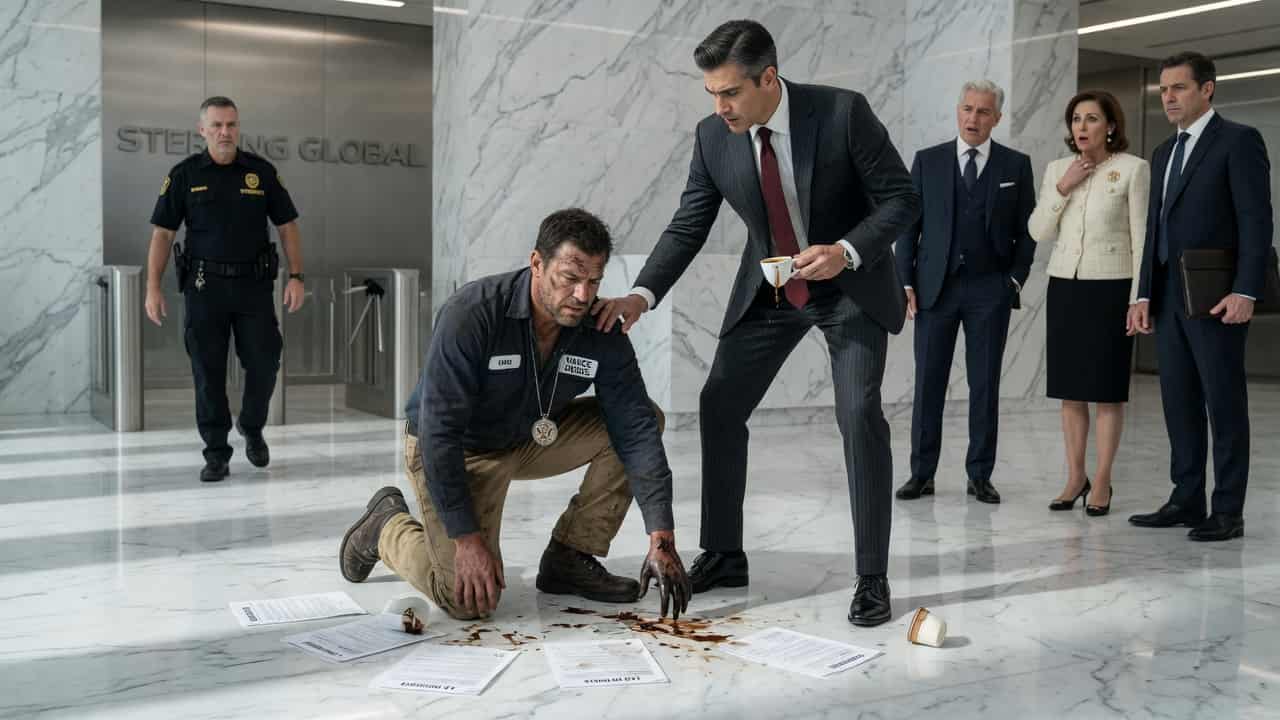
Julian Sterling didn’t even look down as he emptied his espresso cup onto the medical forms my mother needed to stay in her facility. The dark brown liquid soaked into the paper, blurring the doctor’s signature—the only thing standing between my mom and the street.
I reached for them, my fingers trembling from a double shift at the shop, but Julian’s boot slammed down on my knuckles. The weight of his $2,000 shoes pinned my hand to the cold marble. I looked up at him, the grease under my fingernails making me look like a vagrant in his pristine world.
“Get your boot off me,” I said, my voice low enough to vibrate in my chest.
Behind him, a group of high-profile investors watched in silence. Some looked shocked, but nobody moved. They just stood there in their tailored suits, watching a man being treated like a stray dog.
“Security, toss this trash out,” Julian sneered, his eyes full of a strange, inherited hatred. “He’s staining the floor.”
He didn’t know who I was. He didn’t know that the silver medal hanging from my neck was the twin to the one his father had kept on his desk for thirty years. But then the elevator dings, and the man who built this entire empire is wheeled out.
The room goes silent. The power in the lobby shifts in a single second.
Chapter 1: The Weight of Tuesday
The shop smelled like a slow death. It was a cocktail of burnt transmission fluid, cold coffee, and the metallic tang of grinding iron. Caleb Vance slid out from under a Ford F-350, his back popping in three places as he hit the concrete. He wiped his hands on a rag that was already too saturated with oil to do any good.
He looked at the clock on the cinderblock wall. 4:30 PM.
Tuesday was the day the world reminded Caleb exactly where he stood. On Tuesdays, the invoices for the Willow Creek Memory Care unit arrived in his inbox, a digital executioner’s blade. Twelve thousand dollars a month for a room that smelled like lavender-scented bleach and a bed his mother, Martha, spent half her time trying to climb out of because she thought she was still twenty-two and late for her shift at the diner.
“Caleb, you’re bleeding,” Silas said, not looking up from the ledger on the scarred wooden desk in the corner.
Caleb touched his forehead. His fingers came away red, mixed with black grease. “Socket slipped. It’s fine.”
Silas, the shop foreman, was seventy if he was a day. He’d spent fifty of those years in this garage, and his lungs sounded like they were filled with wet gravel. He looked over the tops of his glasses, his eyes sharp with the kind of pity Caleb hated most.
“You’re doing double shifts, boy. You’re gonna crack. And when you crack, who’s gonna look after Martha?”
“I’ve got the money, Silas,” Caleb lied. It was a habit now, like breathing.
“You don’t have twelve grand. Not unless you’re selling a kidney on the side.” Silas stood up, his knees clicking. He walked over and leaned against the truck. “I told you years ago. You’ve got that silver thing around your neck. You’ve got that photo in the trunk. You know who your old man is. Why are you killing yourself under these heaps of junk when he’s sitting in a tower downtown?”
Caleb felt the familiar heat rise in his throat. He reached into his shirt and felt the tarnished silver St. Christopher medal. It was the only thing his father had ever given him, though “given” was a generous word for an object left on a nightstand thirty years ago.
“He isn’t my old man,” Caleb said, his voice flat. “He’s just a guy who paid for a mistake. My mother didn’t raise me on Sterling money. She raised me on waitressing tips and sheer spite.”
“Spite doesn’t pay for dementia care,” Silas countered. “Look, I know you’re proud. Proud is great when you’re twenty. At thirty-two, with a mother who doesn’t know your name half the time, proud is just another word for stupid.”
Caleb didn’t answer. He couldn’t. If he spoke, the exhaustion would turn into a sob, and he didn’t have the time or the hydration for that. He grabbed his bag, a battered canvas thing, and headed for the bathroom to scrub the worst of the grease off his face.
The water in the shop sink was never quite warm. He splashed it over his head, the grit stinging the cut on his forehead. He looked at himself in the cracked mirror. He looked ten years older than his ID said. The lines around his eyes were permanent, etched there by the stress of counting pennies and the fear of the phone ringing in the middle of the night.
He had a plan. It wasn’t a good one, but it was the only one he had left. His mother’s pro-bono lawyer, a guy named Miller who worked out of a basement office, had told him there was a “care directive” that needed a signature from the original benefactor of Martha’s old trust.
Caleb had found the papers in his mother’s cedar chest. They weren’t just medical forms. They were links. A legal trail that led directly to the front door of Sterling Global.
He didn’t want a handout. He wanted the truth. He wanted to know why his mother’s trust—the one that had paid for his childhood surgeries—had suddenly dried up the moment her mind started to go.
“I’m heading out,” Caleb called out as he walked toward the door.
“Caleb,” Silas called back.
Caleb paused, his hand on the heavy steel handle.
“Don’t go in there expecting them to be human,” Silas said. “People in towers don’t look down. They just look at the horizon. If you get in their way, they don’t even know they’re stepping on you.”
“I’m a mechanic, Silas. I’m used to things being broken.”
Caleb stepped out into the humid Chicago afternoon. His truck, a 2008 Chevy with a rusted-out wheel well, groaned as he climbed in. He placed the manila folder on the passenger seat. Inside were the prescriptions, the eviction notice from Willow Creek, and the old photo.
The photo was black and white, curled at the edges. It showed a younger Martha, smiling, holding a baby. Standing next to her was a man with sharp features and eyes that looked like they were already calculating the cost of the moment. Arthur Sterling.
Caleb started the engine. It idled rough, a reminder that even his own life needed a tune-up he couldn’t afford. He drove toward downtown, the skyline rising up like a wall of glass and ego.
He felt the silver medal against his skin, a cold weight. He didn’t know then that by the time the sun went down, the weight would be unbearable. He didn’t know that Julian Sterling was already waiting in that lobby, a man who had never had grease under his fingernails and never intended to start.
Caleb parked three blocks away because he couldn’t afford the twenty-dollar valet fee. He walked toward the Sterling Plaza, his boots echoing on the concrete. He felt small. He felt out of place. He felt like a glitch in a very expensive system.
He adjusted the folder under his arm and pushed through the heavy glass doors. The air inside was chilled to exactly sixty-eight degrees and smelled of nothing. No oil. No sweat. No struggle.
It was the smell of money. And Caleb Vance was about to find out exactly what it cost to breathe it.
Chapter 2: Marble and Glass
The lobby of Sterling Global was a cathedral dedicated to the god of “More.”
White marble floors stretched out so far they seemed to curve with the earth. Enormous glass panels rose sixty feet to a ceiling of brushed steel. In the center, a digital ticker-tape ran in a continuous loop, a neon heartbeat of stock prices and global acquisitions.
Caleb stopped just inside the door. He felt the sudden urge to wipe his boots, though there was no mat. He looked down at his navy work shirt. He’d scrubbed it, but the ghost of a hydraulic fluid stain still bloomed near the pocket. He was a smudge on a masterpiece.
“Can I help you, sir?”
The receptionist sat behind a desk that looked like it had been carved from a single block of obsidian. She was twenty-five, perfectly polished, and her voice had the tonal quality of a pre-recorded message. She didn’t look at Caleb’s face; she looked at the grease-stained cuff of his sleeve.
“I’m here to see someone in the legal department,” Caleb said. “I have papers regarding Martha Vance.”
The girl’s fingers hovered over a keyboard. “Do you have an appointment?”
“No. But this is urgent. It’s about a trust.”
“Legal is by appointment only, sir. If you’d like to leave the documents, I can—”
“I’m not leaving them,” Caleb interrupted. He felt the pressure in his chest, the Tuesday-weight. “I need to speak to someone today. My mother is being evicted.”
A group of people emerged from the elevator bank to the left. They moved in a phalanx of expensive wool and clicking heels. In the center was a man who looked like he’d been manufactured in a lab to represent “Success.”
Julian Sterling was thirty-five, lean, and possessed a jawline sharp enough to cut glass. He was mid-laugh, gesturing with a white ceramic espresso cup as he spoke to three older men in charcoal suits—investors, by the look of them.
Julian stopped as he saw Caleb. The laugh didn’t die; it just curdled into something else.
“Is there a problem, Sarah?” Julian asked, his voice smooth and dangerously polite.
The receptionist looked relieved. “Mr. Sterling. This gentleman is asking for the legal department. He doesn’t have an appointment.”
Julian turned his gaze toward Caleb. It wasn’t the look a man gives a rival. It was the look a man gives a cockroach that has somehow found its way onto the dinner table. He took a slow sip of his espresso, his eyes scanning Caleb from his messy hair down to his scuffed work boots.
“The loading dock is around the back, pal,” Julian said. “Deliveries go there.”
“I’m not a delivery guy,” Caleb said, his jaw tightening. “I’m here for my mother. Martha Vance.”
The name didn’t trigger a flicker of recognition in Julian’s eyes. Why would it? To Julian, people like Martha were just numbers on a spreadsheet, the “overhead” of a world he’d been born to rule.
“I don’t care if you’re here for the Queen of England,” Julian said, stepping closer. He smelled of sandalwood and arrogance. “You’re standing in the middle of a private lobby, looking like you just crawled out of a sewer. You’re making my guests uncomfortable.”
One of the investors, a man with silver hair and a heavy gold watch, shifted his weight. “Julian, let’s just get to the conference room.”
“In a moment, Harold,” Julian said. He was enjoying this. He liked the power of the room. He liked the way the marble made Caleb look smaller. “What’s in the folder, Sparky? Some kind of sob story? A lawsuit?”
“It’s a care directive,” Caleb said, his voice straining. “My mother was part of a trust funded by this company thirty years ago. The payments stopped. I need to know why.”
Julian’s eyes narrowed. “A trust? From thirty years ago? Let me guess—your mother was a maid or a mistress, and now that she’s old, you think you’ve found a golden ticket.”
“Watch your mouth,” Caleb said, stepping forward.
The security guard, a man the size of a refrigerator, moved in instantly, his hand hovering near his belt. Caleb froze. He thought of his mother. He thought of the twelve thousand dollars. He couldn’t get arrested. Not today.
Julian saw the hesitation and smirked. He reached out and flicked the edge of Caleb’s folder with his free hand. “Let’s see this ‘evidence’ then.”
In a sudden, jerky movement, Julian snatched at the folder. Caleb pulled back, but the cheap manila gave way. The folder tore, and the papers erupted into the air like white birds.
They fluttered down, scattering across the pristine white marble. The eviction notice. The prescriptions. The black-and-white photo.
Caleb dropped to his knees. It was an instinctive move, a desperate attempt to protect the only things that mattered. He began grabbing at the papers, his hands shaking.
“Look at you,” Julian sneered, standing over him. “On your knees where you belong.”
Julian tilted his espresso cup. A stream of dark, hot liquid poured out, splashing directly onto the medical forms Caleb was trying to reach. The coffee soaked into the paper, turning the “Urgent” stamp into a brown blur.
“Oops,” Julian said, his voice devoid of any apology.
Caleb’s hand moved toward the photo, but Julian’s black oxford boot slammed down on the marble, pinning Caleb’s grease-stained hand to the floor. The pain was sharp and immediate, the weight of Julian’s ego pressing into his knuckles.
“Get your boot off me,” Caleb rasped, looking up.
“This isn’t a shelter, pal,” Julian said, loud enough for the investors to hear. “You come in here with your garbage and your dirt, thinking you’re owed something. You’re nothing. You’re the trash we pay to keep out of our sight.”
The investors watched in a horrifying, frozen silence. The woman in the group looked down at her shoes. The men looked away, their faces masks of professional indifference. They were witnesses to a slow-motion car crash, and they were too polite to help.
“Security,” Julian said, his voice rising with theatrical authority. “Toss this animal out before he stains the floor. And call the janitor. I want this marble bleached.”
Caleb’s heart hammered against his ribs. He felt the silver medal swing out from his shirt, dangling just inches above the coffee-stained marble. He wanted to swing. He wanted to break Julian’s perfect face. But he stayed still, his hand trapped under the boot, the humiliation burning hotter than any engine fire.
Then, a sound cut through the lobby.
Ding.
The VIP elevator, the one that required a biometric scan and led only to the top floor, opened.
A motorized wheelchair glided out. Seated in it was a man who looked like a ghost of the man in Caleb’s photo. Arthur Sterling was pale, his skin like parchment, but his eyes were a piercing, terrifying blue.
The room didn’t just go quiet; it seemed to lose its oxygen.
“Julian,” a voice croaked. It was a thin, rasping sound, the result of a stroke that had stolen half the man’s speech but none of his presence. “What… are you… doing?”
Julian’s foot shifted, but he didn’t lift it. He turned, his face shifting from bully to dutiful son in a heartbeat. “Father. This vagrant was making a scene. I was just having security handle it.”
Arthur’s wheelchair rolled closer. He didn’t look at Julian. He didn’t look at the investors. He looked down at the floor. He looked at the coffee-soaked papers. He looked at the man on his knees.
And then his gaze locked onto the silver St. Christopher medal hanging from Caleb Vance’s neck.
Arthur’s hand, gnarled and trembling, reached out toward the air between them. A sound came from his throat—a wet, choked gasp.
“The boy,” Arthur whispered. “My… boy.”
Chapter 3: The Silver Medal
The silence in the lobby was no longer uncomfortable; it was lethal.
Julian’s foot finally slid off Caleb’s hand, but it didn’t feel like a release. It felt like a retreat. Julian stood there, his face paling as he looked between his father and the man on the floor.
“Father, you’re confused,” Julian said, his voice losing its polished edge. “This is just some… some mechanic. He’s here about some old trust. He’s nobody.”
Arthur didn’t even blink. He gestured with a trembling finger toward Caleb. “Help… him… up.”
The security guard, sensing the change in the atmosphere, moved forward. This time, he didn’t reach for his belt. He reached for Caleb’s arm, his grip firm but careful. Caleb pulled away, standing on his own. His hand was throbbing, the knuckles starting to swell where Julian’s boot had pressed into the bone.
Caleb stood there, breathing hard, his navy shirt damp with sweat and his face streaked with grease and blood from the cut on his forehead. He looked at the dying man in the wheelchair. He saw the same blue eyes he saw in the mirror every morning—the same eyes he’d spent thirty years trying to forget.
“I don’t need help,” Caleb said, his voice raw. He reached down and snatched the photo from the floor. The coffee had missed it by an inch. He held it up. “I came for my mother. I came to find out why you left her to rot.”
Arthur’s face crumpled. It wasn’t the face of a CEO; it was the face of a man looking at a debt he could never pay. He turned his chair toward the investors, who were now backing away like they were trying to escape a crime scene.
“Leave… us,” Arthur commanded.
Julian stepped forward, his hands out as if to catch a falling glass. “Father, we have the board meeting. You’re not well. Let me take you back upstairs.”
“Julian,” Arthur said, and for a second, the old power returned to his voice, sharp and biting. “Shut… up.”
Arthur looked at Caleb. He looked at the silver medal again. He reached into the pocket of his cardigan and pulled out a matching chain. At the end of it was a St. Christopher medal, identical to Caleb’s, except this one was polished and bright.
Caleb felt a cold shiver run down his spine. It was one thing to suspect. It was another to see the proof held in a trembling hand.
“Upstairs,” Arthur said, gesturing to the elevator. “Now.”
“I’m not going anywhere with you,” Caleb said, though his knees felt weak. “I want an answer about the care facility. That’s it. Give me the signature and I’m gone.”
“You want… the truth?” Arthur asked. “Then… come… up.”
The elevator ride was the longest ten seconds of Caleb’s life. Julian stood in the corner, his jaw so tight it looked like it might snap. He wouldn’t look at Caleb. He stared at the floor, his hands curled into fists. Arthur sat in his chair, his eyes closed, his chest rising and falling in shallow, ragged bursts.
They reached the penthouse. It was a world of dark wood, leather, and windows that showed the entire city as if it were a toy set. This was the engine room of the Sterling empire.
A woman in a nurse’s uniform, Evelyn, met them at the door. She looked at Caleb with a mixture of curiosity and wariness.
“Arthur, you’re overexerting yourself,” she said softly.
“Get… Miller,” Arthur said. “And the… Vance… file.”
Julian finally snapped. “The Vance file? The one from the ’89 settlement? Father, that’s been sealed for three decades. You can’t just open that for a man who walked in off the street!”
“He didn’t… walk in,” Arthur rasped, his eyes snapping open. “He was… born into… it. My son. Not… yours.”
The words hit the room like a physical blow. Julian recoiled as if he’d been slapped.
“Your son?” Julian laughed, a jagged, hysterical sound. “You’re saying this… this greasemonkey is a Sterling? You’re saying I’m—”
“I’m saying… I made… a choice,” Arthur said, his voice failing. “The wrong… one.”
Arthur gestured for Evelyn to wheel him into the study. Caleb followed, his boots leaving faint, dirty prints on the deep pile carpet. He felt like he was walking into a dream, or a nightmare.
The study was lined with books that looked like they hadn’t been touched in years. On the desk sat a thick, leather-bound folder with the name VANCE embossed on the spine in fading gold letters.
“Open… it,” Arthur said.
Caleb walked to the desk. He felt Julian’s eyes burning into his back, a mixture of terror and pure, unadulterated hatred. Caleb opened the folder.
Inside were bank records. Legal documents. And a checkbook with a carbon copy of a final payment made thirty years ago.
Five hundred thousand dollars.
Caleb’s eyes scanned the fine print. Full and final settlement. Forfeiture of all future claims. Non-disclosure of paternity. Permanent relocation.
The signature at the bottom was Martha Vance’s.
“She took the money?” Caleb whispered. “She told me you left us with nothing. She told me you were a drifter who died on a highway.”
“I paid… her… to say… that,” Arthur whispered. “My family… the board… they wouldn’t… allow… a bastard. I was… weak. I gave… her… the money… and I… let her… go.”
“Five hundred thousand dollars,” Caleb said, the number feeling like a weight in his gut. “We lived in a trailer, Arthur. She worked three jobs. I had three surgeries on my legs when I was ten. She said we were lucky the hospital had a charity fund.”
“The money… was spent,” Arthur said. “The surgeries… the moves… the debt. She… protected… you. She didn’t… want you… to know… you were… a secret.”
Caleb looked at the papers. He looked at the man in the chair. The Tuesday-weight was back, but now it was crushing his heart.
“She’s in a home, Arthur. She’s dying. And she doesn’t remember any of this. She doesn’t remember the money, or you, or the lie. She just remembers that she’s alone.”
“She isn’t… alone,” Arthur said. He looked at Julian. “Get… the NDA.”
Julian stepped forward, his face a mask of cold calculation. He had recovered his composure, and it was more terrifying than his rage. He pulled a fresh document from his briefcase—a document that had clearly been prepared for this exact moment.
“My father wants to make things right, Caleb,” Julian said, his voice dripping with false sincerity. “He wants to provide for Martha. The best care in the world. Private doctors. A penthouse suite at the most exclusive facility in the country.”
He slid the document across the desk.
“But there’s a condition,” Julian said. “You sign this. It’s a total non-disclosure agreement. You legally waive any claim to the Sterling name. You acknowledge that Arthur Sterling is not your father. You agree that Martha Vance was never associated with this family.”
Caleb looked at the paper. To save her life, I have to erase her existence.
“If I sign this,” Caleb said, “the money for her care is guaranteed?”
“Guaranteed,” Julian said. “But if you ever speak a word of the truth, the funding stops. And you’ll be sued into the stone age.”
Caleb looked at Arthur. The old man was watching him, his eyes pleading. He wanted to be a father now, at the end, but he was still a Sterling. He was still trying to buy his way out of a scandal.
“She spent every penny of your hush money keeping me alive,” Caleb said. “And now you want me to sell her memory back to you just to keep her from dying on the street.”
He looked at the pen. He looked at Julian’s smug, expectant face. He looked at the silver medal.
The residue of the lobby humiliation was still there—the ache in his hand, the coffee on his papers. He realized then that Julian didn’t just hate him because he was poor. He hated him because he was the truth.
And the truth was the only thing the Sterlings couldn’t afford.
Chapter 4: The Half-Million Dollar Lie
The air in the penthouse felt thin, as if the wealth of the room was literal, displacing the oxygen until only the rich could breathe.
Caleb stared at the NDA. The legal jargon blurred before his eyes. Party of the first part… irrevocable waiver… permanent erasure. It was a contract for a ghost.
“Sign it, Caleb,” Julian said. He was leaning against the mahogany bookcase, his arms crossed. The espresso cup was gone, replaced by a sense of impending victory. “It’s a simple transaction. Your silence for her survival. Isn’t that what a ‘good son’ does?”
Caleb looked at his hand. The knuckles were blue now, a bruised landscape. Every pulse of pain reminded him of the lobby. He thought about Silas back at the shop, the smell of diesel, the constant, grinding fear of the next bill.
“She never told me,” Caleb said, his voice barely a whisper. He wasn’t talking to Julian. He was talking to the ghost of the mother he thought he knew. “She let me believe we were nobody. She let me think I was the son of a drifter so I wouldn’t have to carry the weight of being unwanted.”
He looked at Arthur. “Is that why you did it? To protect your ‘superior’ bloodline? Or were you just scared of what the board would say?”
Arthur’s head bowed. “Scared,” he admitted. The word was a rattling breath. “I was… a coward. Julian… he doesn’t… know… the cost.”
“I know the cost perfectly well, Father,” Julian snapped. “The cost is the reputation of this company. The cost is the merger next month. We cannot have a ‘Diesel Mechanic Sterling’ surfacing in the press. It’s bad for the brand. It’s bad for the bottom line.”
Julian walked over to the desk and tapped the paper. “Twelve thousand a month is pocket change for us, Caleb. To you, it’s a mountain. Sign the paper, take the money, and go back to your garage. We’ll even throw in enough to buy you a new truck. A nice one. Without the rust.”
Caleb felt a surge of nausea. The casual cruelty of the offer was worse than the boot on his hand. To Julian, everything was a commodity. Loyalty, family, memory—all of it had a price tag.
“What happens if I don’t sign?” Caleb asked.
Julian smiled. It was a cold, clinical expression. “Then you leave this building exactly as you entered it. A man with no money, a mother who’s about to be homeless, and a folder full of coffee-stained papers that no court in this city will touch. My legal team will bury you before you can even file a motion.”
“And Arthur?” Caleb looked at the old man. “You’d let him do that? You’d let her go to a state ward?”
Arthur’s eyes filled with a helpless, watery grief. He reached for Caleb’s sleeve, his fingers catching on the grease-stained fabric. “I… I have… no… power… left. Julian… controls… the trusts.”
The betrayal was complete. Arthur wanted to be a savior, but he’d already handed the keys of the kingdom to the monster he’d created. He was a prisoner in his own tower, watching his sins come home to roost.
Caleb picked up the pen. It was heavy, gold-plated, and felt like a weapon.
He thought about the black-and-white photo. He thought about the three surgeries. He realized now that the “charity fund” his mother had talked about wasn’t charity at all. It was blood money. She had spent the price of her own dignity to make sure he could walk.
And now, he was being asked to do the same for her.
“One condition,” Caleb said, his voice hardening.
Julian sighed, an exaggerated sound of boredom. “No negotiations, Caleb. This is a take-it-or-leave-it—”
“I don’t want your truck,” Caleb interrupted, his eyes locking onto Julian’s. “And I don’t want a penthouse suite for her. I want her moved to a facility of my choosing. Somewhere far away from here. Somewhere you can’t touch.”
“Fine,” Julian said. “As long as the checks are cleared through our shell company, I don’t care if she lives in a palace or a cave.”
Caleb looked at the signature line. Caleb Vance.
If he signed it, he was accepting the lie. He was agreeing that he was nothing. He was letting Julian win the lobby battle, confirming that the man under the boot was indeed “trash.”
But if he didn’t, Martha would wake up on Wednesday morning in a facility that didn’t know her name, being moved to a bed in a crowded ward where she would fade away in a blur of neglect.
He thought of her face when she had a moment of clarity. The way she would touch his cheek and say, ‘You’ve got your father’s eyes, Caleb. Use them to see the good in people.’
She had lied to him for thirty years to keep him whole.
Caleb lowered the pen to the paper. The ink flowed black and smooth.
Caleb Vance.
The moment he finished the last stroke, Julian snatched the document away. He checked the signature, a triumphant glint in his eyes. He tucked it into his briefcase and clicked the locks shut.
“Smart move, Sparky,” Julian said. “Now, Evelyn will show you out. The first payment will be wired to Willow Creek within the hour. Don’t come back. Don’t call. As far as the world is concerned, you don’t exist.”
Julian turned to leave, but Caleb stood up, his height finally registered in the small room. He was a head taller than Julian, and broader, his body built by labor, not by gym memberships.
“I exist,” Caleb said. “And you know it. That’s why you’re so scared.”
Julian laughed, but it was hollow. “Scared of you? Please.”
“You’re scared that one day, you’ll look in the mirror and see that you’re just a suit wrapped around a void,” Caleb said, his voice calm and lethal. “You’ve got the money. You’ve got the name. But you’re the one who’s actually unwanted. Arthur didn’t call for you when he came out of that elevator. He called for me.”
The mask slipped. For a split second, the polished Julian Sterling was gone, replaced by a boy who had spent his life trying to earn the love of a man who was looking for someone else.
Julian didn’t answer. He turned and walked out of the study, his heels clicking sharply on the wood.
Caleb looked at Arthur. The old man was slumped in his chair, the effort of the confrontation having drained the last of his strength.
“I’m going now,” Caleb said.
“Caleb…” Arthur whispered. “I… am… sorry.”
“I know,” Caleb said. He reached into his shirt and pulled the silver medal over his head. He walked to the desk and laid it on top of the black-and-white photo.
“Keep it,” Caleb said. “I don’t need a reminder of what I am. I already know.”
He walked out of the study, through the penthouse, and back into the elevator.
When the doors opened in the lobby, the investors were gone. The coffee on the floor had been cleaned, the white marble polished until it shone like new. There was no trace of the struggle. No sign that a man had been stepped on.
Caleb walked out the glass doors and into the Chicago twilight. The air was thick with the smell of exhaust and rain.
He got into his rusted truck and started the engine. It shook, it groaned, and it struggled to life. He drove toward the care facility, his hand throbbing on the steering wheel.
He had the money. He had saved her.
But as he looked at his reflection in the rearview mirror, he saw the blue eyes. The Sterling eyes. And he realized that while he had saved his mother’s life, he had just started a war with himself that he wasn’t sure he could win.
The Tuesday-weight was gone, replaced by something much heavier.
The weight of being a Sterling in secret.
He reached for the necklace that was no longer there, his fingers brushing against his bare skin. He felt the cold air where the silver used to be.
He was a ghost now. A well-funded ghost.
Caleb Vance took a deep breath, shifted the truck into gear, and drove into the dark.
Chapter 5: The Gilded Cage
The sun didn’t rise on Wednesday so much as it bruised the sky a dull, metallic grey. I was back at the shop by six, my hands moving by rote, but the rhythm was gone. Every time I reached for a wrench, the ache in my right hand—the one Julian had pinned to the marble—flared up like a warning light. My knuckles were a mottled map of purple and yellow, a permanent souvenir of the Sterling lobby.
Silas didn’t say a word when I walked in. He just handed me a cup of coffee that tasted like battery acid and pointed toward the F-150 with the blown head gasket. We worked in a silence that felt heavy, pressurized. The air in the garage was thick with the smell of old grease and the unspoken truth that had followed me home from downtown.
Around ten, my phone buzzed. It was a notification from the business office at Willow Creek. Account Balance: $0.00. Status: Transfer Initiated.
I stared at the screen until the numbers blurred. The money was real. The lie had been paid for. Within the hour, a private medical transport team—not the rattling county van I was used to—arrived at Willow Creek to move my mother to “The Gables.” It was the kind of place that didn’t have a sign out front, just a discreet stone gate and an annual fee that could buy a fleet of the trucks I spent my days fixing.
“You’re going to see her,” Silas said, wiping a grease-stained hand on his apron. It wasn’t a question.
“I have to,” I said. “I have to make sure she’s… okay.”
“She won’t know the difference between the wallpaper there and the wallpaper at the old place, Caleb. But you will.” Silas looked at me, his eyes clouded with a weary kind of wisdom. “Money doesn’t buy a new memory. It just buys a softer place to forget.”
I drove out to The Gables in the early afternoon. The facility sat on a bluff overlooking the lake, surrounded by manicured gardens that looked like they’d been brushed with a comb. The air here didn’t smell like bleach; it smelled like expensive candles and fresh-cut lilies. It was a beautiful, silent tomb for the living.
I found Martha in a sunroom that had more glass than my entire apartment building. She was sitting in a high-backed velvet chair, a cashmere throw over her knees. She looked tiny, swallowed by the luxury around her.
“Hey, Ma,” I said, kneeling beside her. I was careful not to let her see my bruised hand.
She turned her head slowly. For a second, the fog in her eyes seemed to thin. “Caleb? Is it Tuesday? You’re late for the diner, honey. The lunch rush is starting.”
“It’s Wednesday, Ma. And you don’t work at the diner anymore. Remember? We moved. You’re in a new place now. Look at the view.”
She looked out at the lake, her brow furrowing. “It’s very quiet here. Where are the sirens? I like the sirens. They make me feel like people are going places.”
“It’s better here, Ma. It’s safe. You have your own nurse now. A lady named Evelyn is coming by.”
She reached out and touched the sleeve of my work shirt, her fingers lingering on a faint oil stain. “You’ve been working too hard. You smell like the garage. Your father always smelled like the garage.”
The words felt like a punch to the solar plexus. “My father?”
“He’d come home and the smell would fill the kitchen,” she whispered, her gaze drifting back to the water. “He’d tell me stories about the things he’d build. Bridges. Towers. He said one day he’d build a tower just for me, so I could see the whole world without ever having to walk a step.”
“He told you that?” I asked, my voice tight. “Before he… left?”
“He didn’t leave,” she said, her voice suddenly sharp, a flicker of the old Martha Vance returning. “He was taken. The men in the suits came, Caleb. They told me I was a mistake. They told me you were a mistake. They gave me the suitcase and said I had to choose. Your life, or the truth. I chose you. I’d always choose you.”
She slumped back into the velvet, the flicker dying out as quickly as it had ignited. She started picking at the hem of the cashmere throw, her mind retreating into the safety of the haze.
I sat there for a long time, the silence of The Gables pressing in on me. I realized then that the five hundred thousand dollars hadn’t just been for my surgeries. It had been the price of her sanity. She had spent thirty years keeping a secret that had slowly eroded the foundation of her mind. She hadn’t forgotten who Arthur Sterling was; she had been forced to bury him so deep that she’d lost herself in the process.
“Mr. Vance?”
I looked up. Evelyn, the nurse from Arthur’s penthouse, was standing in the doorway. She wasn’t in her uniform today; she wore a simple wool coat and looked older, more tired.
“How is she?” Evelyn asked, stepping into the room.
“She’s confused,” I said, standing up. “She thinks she’s in a hotel. She wants to hear sirens.”
Evelyn walked over and checked Martha’s pulse with a practiced, gentle hand. “It will take time for her to adjust. But the medical team here is the best. They’ve already adjusted her medication. She’ll be more comfortable.”
“Why are you here, Evelyn? Julian made it pretty clear I wasn’t supposed to have any contact with anyone from that building.”
“Julian is a man who thinks he can control the wind because he owns a fan,” Evelyn said, her voice low. She reached into her bag and pulled out a small, worn leather journal. “Arthur wanted you to have this. He didn’t want Julian to find it. He was terrified of what Julian would do if he knew the whole truth.”
I took the journal. The leather was soft, scented with tobacco and old paper. “The whole truth? I thought the NDA covered that.”
“The NDA covers the legal paternity,” Evelyn said. “It doesn’t cover the crime.”
I looked at her, my heart beginning to hammer. “What crime?”
“Arthur didn’t just pay your mother to disappear, Caleb. He was the one who authorized the ‘accident’ thirty years ago. The one where your mother was run off the road in that old sedan. He didn’t want her dead, but he wanted her scared. He wanted her to know that if she ever tried to claim a piece of the Sterling name for you, the next accident wouldn’t be a warning.”
I gripped the journal so hard my bruised knuckles throbbed. “He did that to her? He almost killed her while I was in the back seat?”
“He spent thirty years trying to atone for it by funding that trust,” Evelyn said. “But the guilt is what caused the stroke. He saw you in that lobby—saw what Julian had become, saw the man you had become despite everything—and his heart simply gave out. He knew he’d built a kingdom on a grave.”
I looked at my mother, sleeping now in her velvet chair, blissfully unaware that the man who was paying for her comfort was the same man who had nearly taken her life.
“There’s someone you need to talk to,” Evelyn said. “A man named Miller. He’s an old detective who used to work security for Sterling. He was the one who handled the ‘hush money’ for the accident. He’s been waiting for you to find him for a long time.”
I left The Gables with the journal tucked under my arm, the luxury of the place now feeling like a physical weight. I drove back to the shop, my mind racing. I was a Sterling by blood, a Vance by name, and a witness to a thirty-year-old crime that was currently paying for my mother’s life.
When I got back to the garage, a black sedan was parked in the alley. A man was leaning against the brick wall, smoking a cigarette. He was in his sixties, wearing a rumpled trench coat and a hat that looked like it had seen better decades.
“Caleb Vance?” the man asked, flicking his ash onto the pavement.
“Who’s asking?”
“Detective Miller. Retired. Though ‘retired’ is just a fancy word for ‘waiting for the check to bounce.'” He stepped into the light of the alley. His face was a map of old regrets, his eyes narrowed and cynical. “I heard you had a little run-in with Julian yesterday. Bold move, kneeling on that marble. Most people just run.”
“What do you want, Miller?”
“I want to show you the rest of the file,” Miller said, reaching into his coat and pulling out a heavy manila envelope. “The part Arthur didn’t have the stomach to keep in the penthouse. The part that proves the Sterling Global merger isn’t just about money. It’s about burying the evidence of how this company actually started.”
He handed me the envelope. “Open it. But once you do, that NDA you signed? It won’t just be a piece of paper. It’ll be a target on your back. Julian isn’t just protecting the name, Caleb. He’s protecting the empire. And he’ll do exactly what his father did thirty years ago if he thinks you’re going to talk.”
I looked at the envelope. I thought about the soft life I’d just bought for my mother. I thought about the smell of the garage, the grease under my nails, and the man who had stepped on my hand because he thought I was nothing.
I tore the envelope open.
The first thing I saw was a police report from 1996. A hit-and-run on Highway 41. The car described was a black Sterling executive sedan. The driver was listed as Unknown. But clipped to the back was a handwritten note from Arthur Sterling to his legal team.
Make it go away. Whatever the cost. Ensure the woman understands the next time there won’t be a survivor.
The residue of the lobby was gone now, replaced by a cold, sharp clarity. I wasn’t just a secret. I was a survivor of an attempted murder. And the man who had authorized it was the same man I’d just called ‘Father.’
“What do you want me to do with this, Miller?” I asked, my voice as cold as the marble floor.
“I don’t want you to do anything,” Miller said. “I want you to decide if that soft bed your mother is sleeping in is worth the silence. Because Julian is about to go public with the merger. Once that happens, the Sterling name becomes untouchable. You have forty-eight hours to decide who you really are, Caleb. A Vance, or a ghost.”
Miller turned and walked away, disappearing into the shadows of the alley.
I stood there in the dark, the envelope in one hand and the journal in the other. I looked up at the Chicago skyline, the Sterling tower glowing like a beacon of stolen light.
I wasn’t a glitch in their system. I was the poison in their blood. And it was time to let the fever break.
Chapter 6: The Victory that Costs Everything
The news broke at six a.m. on Friday.
Sterling Global Finalizes Landmark Merger with Harlington International.
I watched the broadcast on the small, grease-filmed TV in the shop’s breakroom. Julian was there, standing at a podium in front of a swarm of flashing cameras. He looked perfect. Every hair in place, every word calibrated for maximum confidence. He spoke about “legacy” and “the future of American industry.” He looked like a man who had successfully deleted the past.
Beside him, Arthur was absent. A spokesperson had issued a brief statement about the patriarch’s “declining health” and his “total confidence in his son’s leadership.”
The phone in the shop rang. It was Evelyn. Her voice was trembling.
“He’s gone, Caleb. Arthur passed away an hour ago. He died in his sleep.”
I didn’t feel sadness. I didn’t feel relief. I felt a strange, hollow sense of completion. The man who had created me, tried to kill me, and then tried to buy me was finally beyond the reach of his own lies.
“Julian is already moving the documents,” Evelyn whispered. “He’s at the penthouse now, clearing out Arthur’s personal safe. He’s going to burn everything, Caleb. The original trusts, the letters… everything.”
“Let him,” I said. “I have what I need.”
I hung up and looked at Silas. He was standing by the door, his hat in his hand. He’d heard the news.
“What are you going to do, boy?”
“I’m going to finish it, Silas. I’m going to use the eyes my mother told me I had.”
“You sign that NDA, Julian will take everything,” Silas warned. “The money for Martha. Your life. He’ll bury you.”
“He already tried,” I said. “Thirty years ago. It didn’t take.”
I drove to the Sterling Plaza one last time. This time, I didn’t park three blocks away. I drove my rusted Chevy right up to the valet stand and left it idling in the center of the lane.
The security guard from the lobby—the one who had watched Julian step on my hand—stepped forward, his face hardening. “You again. I told you, Vance, you’re banned from the premises.”
“Call Julian,” I said, leaning against the side of my truck. “Tell him I have the Highway 41 file. Tell him I’m standing in front of the news crew at the fountain, and I’m about to give them a very different kind of legacy story.”
The guard hesitated. He looked at the news vans parked across the street—the same ones that had been there for the merger announcement. He looked at me, a grease-stained mechanic with a look in his eyes that said I had nothing left to lose.
He keyed his radio.
Five minutes later, Julian Sterling emerged from the glass doors. He wasn’t smiling today. His face was a mask of sheer, vibrating fury. He marched across the plaza, his expensive shoes clicking on the stone.
“You’re dead, Vance,” Julian hissed, stopping inches from my face. “I’ll have you in a cell by midnight. I have the signed NDA. I have the wire transfer records. You’re a thief and a blackmailer.”
“I’m a Sterling,” I said, my voice low and steady. “And I have the police report Arthur tried to burn. The one with his signature authorizing the ‘accident’ that almost killed my mother. You think the Harlington board wants to merge with a family of attempted murderers, Julian? You think your stock price survives the truth about how this empire was built?”
Julian’s eyes flickered toward the news crew. They were starting to notice the confrontation. A cameraman began to shoulder his rig.
“What do you want?” Julian whispered, the arrogance finally cracking. “More money? Another million? Name it.”
“I want you to look at me,” I said. “Look at my hands. Look at the grease you hate so much. It’s the only honest thing in this whole family.”
I reached into my pocket and pulled out the St. Christopher medal I’d taken back from Arthur’s desk after I’d signed the NDA. I hadn’t left it. I’d realized it wasn’t a gift—it was a reminder.
“I’m not signing anything else,” I said. “I’ve already released the files to Miller. He’s at the DA’s office right now. The merger is dead, Julian. And so is the lie.”
“You’ve killed your mother,” Julian sneered, his voice shaking. “The funding stops now. Every doctor, every nurse, every drop of medicine—it’s gone. You’ve condemned her to a state ward just to satisfy your pride.”
“No,” I said. “I sold the story to a national syndicate this morning. The advance is more than enough to cover her care for the rest of her life. I don’t need your blood money, Julian. I just needed you to know that the ‘trash’ you stepped on is the one who took your tower down.”
I turned away from him and walked toward the news crew. I didn’t look back. I didn’t need to. I could feel the eyes of the city on me, the weight of thirty years of silence finally lifting.
The fallout was spectacular. Within forty-eight hours, the merger collapsed. Sterling Global’s stock plummeted, and the board of directors issued a vote of no confidence in Julian. The investigation into the 1996 accident was reopened, and while Arthur was gone, the paper trail led to a dozen other “settlements” that stripped the family of their credibility and most of their fortune.
Julian was seen leaving the building a week later, carrying a single cardboard box. He didn’t look at the cameras. He looked like a man who had finally realized he was a suit wrapped around a void.
I went back to The Gables on Sunday.
The facility was still beautiful, still silent. But the atmosphere had changed. The staff knew who I was now. I wasn’t the “problematic relative” anymore; I was the man who had paid the bill in full, with honest money.
I found Martha in the sunroom. She was looking out at the lake, her hands folded in her lap.
“Hey, Ma,” I said, sitting beside her.
She turned to me. Her eyes were clear for a second, a rare moment of absolute presence. She reached out and touched my face, her thumb brushing over the scar on my forehead.
“Caleb,” she whispered.
“I’m here, Ma.”
“You look… different,” she said. “The weight. It’s gone.”
“It is,” I said. “I found the truth. I used my eyes.”
She smiled, a small, weary thing. “Your father… he always said the truth was like a bridge. You have to be strong enough to walk across it, even if you’re scared of the height.”
“I walked across it, Ma. We’re on the other side now.”
“Good,” she said, her gaze drifting back to the lake. “Is it Tuesday? I think I hear the sirens. People are going places, Caleb. It’s a busy world.”
I sat with her until the sun went down, watching the light fade over the water. She didn’t remember the Sterling name. She didn’t remember the accident or the hush money. She just knew that she was safe, and that her son was there.
The victory had cost everything. I’d lost my anonymity. I’d lost the life I knew. I’d become the face of a scandal that would follow me for years.
But as I walked out of The Gables and got into my rusted truck, I looked at my hands. They were still stained with grease. My knuckles still ached.
I started the engine. It idled smooth this time—I’d finally found the time to fix the timing belt.
I drove back toward the city, back to the shop, back to the life I’d chosen. I wasn’t a Sterling. I was a Vance. And for the first time in my life, that was enough.
The Tuesday-weight was gone. In its place was a quiet, steady strength. The kind of strength you only find when you’ve been on your knees and decided, finally, to stand up.
I looked at the silver medal hanging from my rearview mirror, glinting in the streetlights. It wasn’t a symbol of a father anymore. It was a symbol of the man I had become to protect the woman who had sacrificed everything for me.
I shifted the truck into gear and drove into the night, the road ahead clear, the past finally where it belonged—buried, but no longer a secret.