“Why is he in DC, Director?”
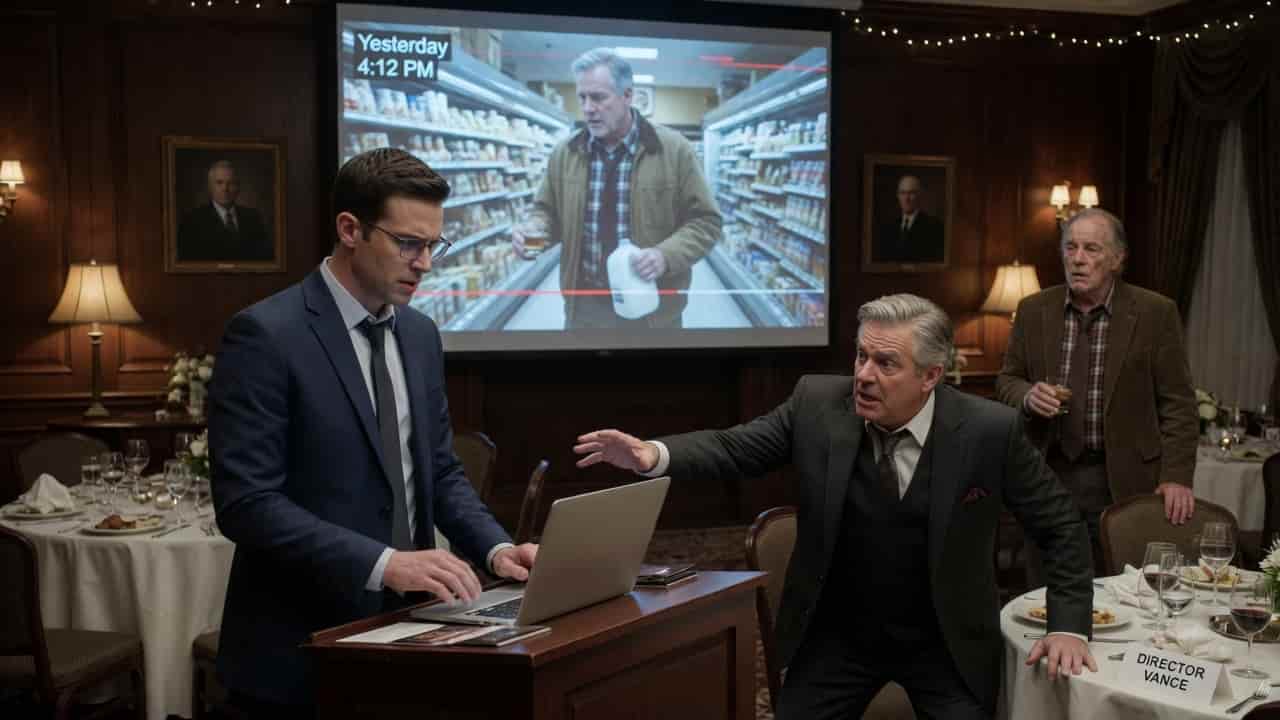
I stood at the podium, my heart hammering against my ribs like a trapped bird. The room was full of the most powerful people in the city—Senators, Marshals, the elite of the Justice Department. They had all come to toast Director Vance on his retirement. They thought they were celebrating a hero.
Vance’s face went from a smug, self-satisfied mask to a shade of gray I’d only seen on a slab. He didn’t answer. He just stared at the giant screen behind me.
“Shut it down,” he hissed, the microphone catching the tremor in his voice. “Jax, shut that damn thing off right now.”
I didn’t move. I wanted everyone to see it. I wanted them to see the man in the tan jacket, standing in a Safeway aisle, holding a gallon of 2% milk. My father. The man the US Marshals told me was ‘lost’ in the system two decades ago. The man they said had abandoned us.
“He’s buying milk three miles from your house, Vance,” I said, my voice echoing through the dead-silent ballroom. “You told my mother he was dead. You told my sister he ran. But you didn’t erase him. You just hid him.”
Vance lunged for the laptop, his polished shoes skidding on the parquet floor, but it was too late. The room had already seen the truth. My father wasn’t a ghost. He was a prisoner of the man everyone was currently clapping for.
Chapter 1: The Ghost in the Machine
The air in the US Marshals’ National Data Center always smelled like ozone and expensive filtration. It was a cold, sterile scent that Jax had lived with for six years. It was the smell of secrets being filed, cross-referenced, and occasionally, buried.
Jax sat in Pod 4, his eyes burning from the twin glow of his monitors. To the rest of the world, he was a senior data analyst. To the Marshals, he was a “janitor.” He cleaned up fragmented identities, fixed broken social security links, and made sure the Witness Security (WITSEC) database was a fortress of digital shadows.
A notification blinked in the corner of his screen—a low-level parity error in a legacy file. Normally, he’d ignore it until morning. Parity errors were usually just digital noise, a bit of corrupted code from the nineties that hadn’t survived a server migration. But this one had a familiar string of digits.
Case File 99-Delta-402.
Jax felt a sharp, familiar ache in his jaw. He’d memorized that case number when he was twelve years old, hiding under the kitchen table while his mother screamed at a man in a suit.
He glanced around the bullpen. It was 7:15 PM. Most of the analysts had cleared out, headed to happy hours or home to families that didn’t know what they actually did for a living. Director Vance’s office was dark, though the light under his door indicated his assistant was still cleaning up for the big retirement gala tomorrow.
Jax’s fingers hovered over the mechanical keyboard. He shouldn’t open it. Accessing personal files was a breach of protocol that could land him in a windowless room in Quantico. But the code was screaming at him.
He clicked.
The file was a mess of red text and “Data Corrupt” placeholders. It was the file of Samuel Miller—his father. Or rather, the man Samuel Miller had become before he vanished. Twenty-four years ago, Samuel had been a mid-level accountant for the Moretti family in Philadelphia. He’d seen the wrong ledgers, heard the wrong conversations, and made the only choice a man with a wife and two kids could make. He’d turned.
The Marshals had taken him. Then, according to the official report Jax had spent a decade trying to disprove, Samuel had “opted out.” The story Vance had told Jax’s mother was that Samuel had panicked, fled the safe house in the middle of the night, and likely been caught by the Morettis. No body was ever found. No trail. Just a hole in Jax’s life that had filled up with poverty and his mother’s slow slide into a bottle of cheap gin.
Jax began to run a recovery script. His hands were shaking. He told himself it was just the caffeine, but he knew better.
“Still at it, Jax?”
Jax nearly jumped out of his skin. He hit a hotkey to minimize the window just as Miller—not his father, but Bill Miller, a retired Marshal who worked part-time as a security consultant—walked past his pod.
Bill was a man who looked like he’d been carved out of a piece of old hickory. He smelled of tobacco and the kind of weariness that didn’t wash off.
“Just cleaning up some legacy fragments, Bill,” Jax said, his voice sounding thin to his own ears. “You’re out late.”
Bill leaned against the partition, his eyes narrowed. He’d been the one who recruited Jax. He’d known Samuel. He was the only one who didn’t look at Jax with pity. “The Director’s retirement is tomorrow. Everyone’s jumpy. Vance wants the digital heritage display perfect for the gala. He’s obsessed with the legacy he’s leaving behind.”
“He’s a man who values his image,” Jax said carefully.
Bill grunted. He looked at Jax’s screen—now displaying a generic system maintenance log. “Don’t dig too deep into the old dirt, kid. The problem with digging is you eventually hit something that’s meant to stay buried. And once the air hits it, it starts to rot everything else.”
“I’m just doing my job, Bill.”
“I hope so,” Bill said, his voice dropping an octave. He patted Jax on the shoulder, his hand heavy and lingering a second too long. “See you at the party tomorrow. Wear the navy suit. It makes you look like you belong here.”
Jax watched Bill walk away. The old man knew. He had to know.
Jax brought the window back up. The recovery script had finished. The “Data Corrupt” flags were gone, replaced by a single high-resolution image file that shouldn’t have been there. It wasn’t a scan of a paper document. It was a digital capture from a modern surveillance system.
Jax opened it.
The image was grainy, taken from a high angle in a grocery store. A man stood in the dairy aisle. He was older, his hair white and thinning, but the set of his shoulders was unmistakable. He was holding a gallon of milk.
Jax checked the metadata. Location: Safeway, 4th Street SW. Timestamp: Yesterday, 16:12:08.
His father hadn’t died twenty years ago. He hadn’t been killed by the mob. He was three miles away, buying milk in the city where Jax worked for the men who claimed he was gone.
Jax sat back, the ozone of the room suddenly feeling like it was choking him. The system hadn’t lost his father. The system was holding him. And Director Vance, the man who had mentored Jax, the man whose retirement he was supposed to toast tomorrow, was the one holding the leash.
Chapter 2: The Algorithm and the Anchor
The hospice ward smelled like lavender and bleach, a combination that made Jax’s stomach turn every time he stepped off the elevator. It was a scent designed to mask the reality of what was happening behind the heavy oak doors.
He walked into Room 412. His sister, Lily, was propped up against a mountain of pillows, her skin the color of old parchment. An oxygen cannula was hooked into her nose, the machine beside her bed giving off a rhythmic, mechanical hum that felt like a countdown.
She was twenty-eight. She should have been finishing a law degree or arguing about wedding venues. Instead, she was waiting for her lungs to stop working.
“You look like hell,” Lily rasped, her eyes flickering open. She tried to smile, but it looked more like a grimace of pain.
Jax pulled a plastic chair close to the bed and took her hand. It felt as fragile as a bird’s wing. “Just a long shift. The Director’s party is tomorrow.”
“The great Vance,” Lily whispered, a spark of the old bitterness returning to her eyes. “Our savior. The man who gave you a job because he felt bad about Dad being a coward.”
Jax didn’t say anything. For fifteen years, that had been the narrative. Their father was a coward who had left them to rot in a two-bedroom apartment in a neighborhood where the streetlights were always broken. Their mother had believed it. Lily had believed it. Jax had almost believed it.
“I had a dream about him last night,” Lily said, her voice drifting. “He was at the lake. Remember the lake house? Before everything? He was wearing that old tan jacket with the grease stain on the sleeve. He was laughing.”
She turned her head to look at Jax, her gaze suddenly piercing. “I just want to know why, Jax. Why did he leave us? If I’m going to… if I’m going, I just want to know if he ever thought about us.”
Jax felt the weight of the flash drive in his pocket. It felt like it was burning a hole through his suit. On that drive was the photo from the Safeway. On that drive was the proof that the man they had spent half their lives hating was alive, less than ten minutes away.
“I’m working on it, Lil,” he said, his voice cracking.
“You’re a data analyst, not a detective,” she sighed, closing her eyes. “Let it go. Just be there for Mom. She’s already starting early today. I could smell the gin on her over the phone.”
Jax stayed until she fell into a shallow, fitful sleep. He walked out into the cool night air of DC, the city lights shimmering on the wet pavement. He didn’t go home. He went to a small, windowless office he’d rented six months ago under a false name.
Inside, three high-end servers hummed on a folding table. This was his “back-door.” For three years, he’d been building an algorithm he called Ghost-Tracker. It didn’t look for names or social security numbers—those were too easy to fake. It looked for patterns. It looked for the residue people left behind: specific grocery habits, prescription refills for a rare blood pressure medication his father used to take, the way someone’s movement through a city mimicked the walking speed of a man with a bum knee.
He sat down and initiated a deep-layer scrape of the grocery store’s loyalty program records. If his father was buying milk, he was using a card. And if he was using a card, there was an address.
The screen filled with lines of data. It was like watching a ghost materialize out of a fog.
Name: Arthur P. Vance.
Jax froze. His father wasn’t just in the system. He was using the Director’s last name. It was the ultimate insult, a brand of ownership. Vance hadn’t just hidden his father; he had claimed him.
He dug deeper. The address was a small apartment in a complex owned by a shell company—Blue Ridge Holdings. Jax cross-referenced the company. The board of directors was a list of retired Marshals and a sitting US Senator named Sterling.
The pieces began to click into place with a sickening finality. His father hadn’t “opted out.” He’d been kept as leverage. His father was a living insurance policy. If Senator Sterling ever turned on Vance, or if the mob ever came looking for their lost accountant, Vance had the man. He had the witness. He could play both sides of the board.
And Jax? Jax had been brought into the Marshals not out of pity, but to be watched. He was the loose end. By giving Jax a job, Vance had ensured that the person most likely to find Samuel Miller was kept in a digital cage, spending his days cleaning up the very records that could expose the truth.
Jax looked at the photo again. His father looked tired. He looked like a man who hadn’t seen the sun in a long time.
He had twenty-four hours until the gala. Twenty-four hours to decide if he was going to be the loyal protégé Vance expected him to be, or if he was going to burn the whole system down.
He thought of Lily’s fragile hand. He thought of his mother’s hollow eyes.
He began to draft the slideshow for the retirement presentation. He kept the “Legacy of Service” template, the one with the soaring music and the photos of Vance shaking hands with Presidents. But in the final folder, hidden behind a layer of encryption that only he could break, he placed a new file.
He titled it: The Cost of the Secret.
Chapter 3: The Mentor’s Shadow
Director Vance’s office was a shrine to institutional power. The walls were covered in framed commendations, photos of Vance with every Attorney General since the Reagan era, and a glass-encased flag that had flown over the Capitol.
Vance sat behind his mahogany desk, looking every bit the elder statesman of law enforcement. He was nursing a glass of sparkling water, his silver hair perfectly coiffed.
“Jax, come in,” Vance said, his voice a warm, authoritative baritone. “Sit. Have you finished the digital heritage reel? The board is expecting something spectacular tonight.”
Jax sat, keeping his back straight. He could feel the sweat beginning to prickle at his hairline. “It’s done, Director. I think it captures the… full scope of your influence on the service.”
Vance smiled, but it didn’t reach his eyes. It never did. “You’ve been a good soldier, Jax. I know it hasn’t been easy, given your family history. I’ve always admired your ability to separate the personal from the professional. It’s a rare trait in this city.”
“I learned from the best,” Jax said. The words felt like ash in his mouth.
Vance leaned forward, his expression softening into something that looked like genuine affection. “I want you to know, after I’m gone, I’ve put in a word for you with the new Deputy Director. You’re headed for a leadership role in Cyber-Intelligence. You’ve earned it.”
It was the bribe. The final piece of the cage. Vance was handing him a career built on the silence he’d maintained for years.
“Thank you, sir,” Jax said. “I appreciate everything you’ve done for my family.”
“Family is everything,” Vance said, standing up and smoothing his suit jacket. “Never forget that. Now, I have a final briefing with the Senator. I’ll see you at the ballroom at seven. And Jax? Make sure the transition between the 1990s section and the modern era is smooth. We want the narrative to be seamless.”
Jax left the office, his heart hammering. Seamless. That was the word Vance used for a lie that worked.
He headed down to the basement, to the service entrance where the catering trucks were unloading. He needed to find Bill Miller. The old Marshal hadn’t been at his desk all day.
He found Bill in the back of a parked SUV, nursing a coffee that smelled suspiciously like bourbon.
“You’re looking twitchy, kid,” Bill said, not looking up from his paper.
“I found him, Bill,” Jax whispered, leaning into the window.
The paper froze. Bill slowly lowered it, his weathered face looking ten years older in the gray light of the garage. “I told you not to dig.”
“He’s in the city. He’s using Vance’s name. Why?”
Bill sighed, a long, ragged sound. He opened the door and gestured for Jax to get in. Once the door was shut, the silence of the SUV felt heavy.
“Your father wasn’t just an accountant, Jax,” Bill said. “He was the one who handled the off-book accounts for the Moretti family’s political ‘contributions.’ One of those contributions went to a young, ambitious Marshal named Vance. It was the money that bought him his first appointment.”
Jax felt the world tilt. “So my father has the proof that Vance is corrupt.”
“Had,” Bill corrected. “Vance made a deal. He ‘lost’ your father in the system to protect himself. But he couldn’t kill him. Samuel was too smart. He hid the original ledgers somewhere. As long as Samuel is alive, Vance is safe from the mob. And as long as Vance is in power, Samuel is safe from the Morettis. It’s a Mexican standoff that’s lasted twenty years.”
“And my mother? Lily? We were just collateral damage?”
Bill looked away. “Vance convinced himself he was doing you a favor. He kept you close to make sure you didn’t become like your father. He thought he was saving you.”
“He destroyed us,” Jax hissed. “Lily is dying, Bill. She thinks her father hated her. She thinks he was a coward.”
“What are you going to do, Jax?”
Jax looked at the gala invitation sitting on the dashboard. “I’m going to give the Director the retirement he deserves.”
Bill looked at him for a long time, then reached into his pocket and pulled out a small, encrypted key card. “This gets you into the service elevator of the Blue Ridge apartments. If you’re going to do this, don’t just show the photo. Give the man his life back.”
Jax took the card. “Why are you helping me?”
“Because I’m tired of the smell of ozone,” Bill said, staring out the windshield. “And because your father was my friend before he was a case file. Go. Before I change my mind.”
Jax didn’t go to the apartment. Not yet. He went back to his pod. He had one more change to make to the slideshow. He needed to make sure that when the truth hit the air, it didn’t just rot. He wanted it to burn.
Chapter 4: The Public Humiliation
The ballroom of the Willard InterContinental was a sea of black ties, silk gowns, and the forced laughter of people who spent their lives calculating their next move. The air was thick with the scent of expensive perfume and the clinking of champagne flutes.
Jax stood at the tech table in the back of the room, his fingers hovering over the control board. He felt like a ghost haunting his own life.
Director Vance was at the center of the head table, flanked by Senator Sterling and the Attorney General. He looked magnificent—a lion in winter, basking in the glow of a hundred admiring gazes.
“Ladies and gentlemen,” Senator Sterling said, tapping his glass. The room fell into an expectant hush. “We are here to honor a man who has dedicated his life to the shadows so that we might live in the light. Director Vance is the architect of the modern Marshals Service. He is a man of integrity, of vision, and above all, of loyalty.”
The room erupted in applause. Vance stood, nodding with practiced humility.
“And now,” the Senator continued, “to lead us through a visual history of this storied career, I give you the Director’s protégé, Jax Miller.”
Jax walked toward the podium. The walk felt like it took hours. Every eye in the room was on him. He could see his mother in the third row, her dress a decade out of style, her hands trembling as she clutched her glass. She looked terrified, as if she expected the room to realize she didn’t belong here.
Jax reached the podium and looked out at Vance. The Director smiled at him—a warm, fatherly expression that made Jax want to retch.
“Thank you, Senator,” Jax said, his voice amplified by the room’s speakers. It sounded steady, colder than he felt. “Director Vance often tells me that the Marshals Service is built on the things we choose to remember. But tonight, I want to talk about the things we choose to forget.”
A small ripple of confusion went through the room. Vance’s smile faltered, just for a fraction of a second.
“Vance taught me that a seamless narrative is the mark of a successful career,” Jax continued. “But a narrative is only seamless if you cut out the parts that don’t fit.”
He hit the first key.
The screen behind him flared to life. It didn’t show Vance’s first swearing-in. It showed a bank transfer from 1999—a Moretti-linked shell company moving half a million dollars into a blind trust.
The room went dead silent. Vance stood up, his chair scraping loudly against the floor. “Jax, that’s enough. There’s a technical error. Someone get the tech team—”
“It’s no error, Director,” Jax said, his voice rising.
He hit the second key.
The photo from the Safeway appeared. It was massive, filling the screen. The grainy, tired face of Samuel Miller looked out over the elite of Washington DC.
“This is Case File 99-Delta-402,” Jax said. “Most of you know him as the man who ‘opted out’ of the program. The man who supposedly abandoned his family. My father.”
Vance reached the podium, his face a mask of panicked rage. He grabbed Jax’s arm, his fingers digging into the bone. “Shut it down. Now! You’re finished, boy. You’re destroying yourself.”
Jax leaned into the microphone, ignoring the pain in his arm. “He’s buying milk at the Safeway on 4th Street, Vance. He’s been living in an apartment owned by your shell company for twenty years. You didn’t lose him. You kept him like a dog in a kennel.”
The room was no longer silent. Whispers were breaking out like wildfire. Senator Sterling was halfway to the exit, his face pale.
“You told my mother he was dead!” Jax shouted, the sound echoing off the gold-leafed ceiling. “You let my sister believe her father was a coward while she’s lying in a hospice bed wasting away! You didn’t protect the witness, Vance. You stole him.”
Vance lunged for the laptop, slamming his palm onto the lid, but Jax shoved him back. The Director stumbled, his polished shoes skidding on the parquet floor, and he fell against the head table, knocking over a tower of champagne glasses.
The crash was deafening. Vance sat on the floor, his silver hair disheveled, a puddle of Moët soaking into his charcoal suit. He looked old. He looked small.
Jax looked at his mother. She was standing up, her eyes wide, tears streaming down her face as she stared at the photo of her husband.
“He’s alive, Mom,” Jax whispered into the microphone.
Then he grabbed the laptop and the flash drive and walked off the stage. He didn’t look back at Vance. He didn’t look at the security guards rushing toward him.
He had the address. He had the key card. And for the first time in twenty years, he had the truth.
But as he hit the exit, he saw Bill Miller standing by the door. The old man wasn’t smiling. He was looking at his phone, his face grim.
“You did it, kid,” Bill said. “You burned it down. But you just signaled the Morettis that their accountant is still on the board. We have about twenty minutes before this ballroom isn’t the only thing that’s on fire.”
Jax felt the adrenaline of the moment vanish, replaced by a cold, sharp dread. He hadn’t just exposed Vance. He’d painted a target on his father’s chest.
“Let’s go,” Jax said, his voice low. “We’re going to get him.”
Chapter 5: The Gilded Cage
The interior of Bill’s SUV smelled of stale coffee and the cold, metallic scent of a sidearm that had been drawn but not fired. Outside, the neon blur of DC streaked past the windows, a smear of red and white light against the wet asphalt. Jax sat in the passenger seat, his laptop bag gripped between his knees like a shield. His heart was still performing a frantic, irregular rhythm against his ribs, a frantic percussion echoing the crash of the champagne glasses in the Willard ballroom.
“You’re shaking,” Bill said. It wasn’t an observation of weakness; it was a tactical report. He didn’t look over. His eyes were locked on the rearview mirror, watching for the headlights that would inevitably detach themselves from the flow of traffic to follow them.
“I just told three hundred people that the Director of the US Marshals is a kidnapper,” Jax whispered. He looked down at his hands. They were trembling so violently he had to lace his fingers together. “My mother… the look on her face, Bill. It wasn’t relief. It was like I’d hit her.”
“Truth is a blunt instrument, Jax. You don’t use it to perform surgery. You use it to break things,” Bill said, swerving the SUV onto the ramp for I-395. “Vance is a cornered animal now. But cornered animals don’t go to the police. They go to the people who owe them favors. In this town, that means the kind of men who don’t leave fingerprints.”
“And the Morettis?”
“They’ve had a dormant cell in Northern Virginia for a decade just waiting for Samuel Miller to surface. You didn’t just give a toast, kid. You rang a dinner bell.”
They drove in a silence that felt heavy and suffocating. Jax kept thinking about the photo. The gallon of milk. The mundane, crushing reality of his father’s life. For twenty years, Jax had imagined his father in a dozen different scenarios: a high-stakes gambler in Macau, a broken drunk in a Florida trailer park, or a cold-blooded traitor living on a beach in Brazil. He had never imagined him in a Safeway in DC, choosing between skim and two percent.
The Blue Ridge Apartments weren’t what Jax expected. He’d imagined a fortress, something with barbed wire and armed guards. Instead, it was a sleek, glass-fronted mid-rise in an upscale neighborhood where the sidewalks were lined with manicured trees and the air smelled of blooming jasmine and expensive mulch. It was a place designed for anonymity through wealth—the kind of building where neighbors didn’t know each other’s names because they were too busy being important elsewhere.
Bill pulled into the underground garage, using the key card he’d given Jax earlier. “Fourth floor. Apartment 412. Fitting, isn’t it? Same as your sister’s room.”
Jax felt a surge of nausea. “Vance is a psychopath. He’s obsessed with the symmetry of it.”
“He’s a collector,” Bill corrected, killing the engine. “He collects people’s lives and files them where he can keep an eye on them. Stay behind me. And Jax? If someone is already inside, you run. You don’t play hero. You get to the nearest precinct and you start screaming.”
The elevator ride was agonizingly slow. Jax watched the floor numbers climb in the reflection of the polished brass doors. He saw himself—a man in a navy suit that was now wrinkled and stained with sweat, looking like a stranger. He didn’t feel like the sharp data analyst who could find a needle in a digital haystack. He felt like a ten-year-old boy waiting for his father to come home from work.
When the doors opened, the hallway was silent. The carpet was a thick, neutral beige that swallowed the sound of their footsteps. Bill drew a small, compact Glock from a holster at the small of his back, holding it low against his thigh. He gestured for Jax to stay back.
They reached 412. Bill pressed his ear to the wood, then looked at Jax and nodded. He slid the key card into the lock. The light turned green with a soft, electronic chirp that sounded like a death knell.
The apartment was dim, lit only by the blue glow of a television muted in the corner. It smelled of old paper, frozen dinners, and the sharp, medicinal tang of the liniment his father used to use for his knee.
“Samuel?” Bill called out, his voice low and cautious.
A shadow moved in the armchair facing the window. A man stood up, slowly, his joints popping with an audible stiffness. He was wearing a tan work jacket over a plaid shirt—the same clothes from the photo. In the dim light, he looked like a charcoal sketch of the man Jax remembered. The jawline was the same, but the skin hung loose on his frame, and his eyes were clouded with a deep, permanent exhaustion.
The man stared at Bill, then his gaze drifted to Jax. He squinted, his brow furrowing in confusion.
“Bill?” the man asked, his voice a dry rasp. “Is it time? Did he send you?”
“No, Sam,” Bill said, lowering the weapon but not holstering it. “Vance didn’t send us. We’re here to take you out.”
Samuel Miller stepped into the light of a floor lamp. He looked at Jax, his eyes widening as a flash of recognition struggled against two decades of forced forgetting. He looked at Jax’s silver-rimmed glasses, the set of his mouth, the way he stood with one shoulder slightly higher than the other.
“Jax?” Samuel whispered. The name sounded like it was being pulled out of a deep well.
Jax couldn’t speak. The air in his lungs felt like concrete. He looked at the man who had been a ghost, a monster, and a hero in his mind, and all he saw was a tired old man who looked like he wanted to lie down and never get up.
“You… you’re so big,” Samuel said, taking a halting step forward. His hands were shaking. “Your mother. Is she—”
“She’s alive,” Jax managed to say, his voice thick with a rage he hadn’t expected. “She’s a drunk, and she’s broken, but she’s alive. Lily is dying, Dad. She’s in a hospice ward three miles from here, and she thinks you hated her.”
The words hit Samuel like a physical blow. He slumped back against the arm of the chair, his face crumbling. “He told me… Vance told me you were all safe. He said he was taking care of you. He said if I stayed quiet, if I stayed in this room, the Morettis would never find you. He showed me photos. He showed me your graduation, Jax. He showed me Lily’s wedding.”
“Lily never got married,” Jax spat. “He lied to you. He used us to keep you in this cage, and he used you to keep us under his thumb. You weren’t protecting us. You were his leverage.”
Samuel put his head in his hands, a low, keening sound escaping his throat. It was the sound of twenty years of sacrifice being revealed as a hollow, cruel joke. “I thought I was saving you. Every day… every day I sat by this window and I told myself that my silence was the price of your lives. He said if I ever stepped foot outside this neighborhood, he’d stop the protection. He said the Morettis would find you in an hour.”
“He was the one who told them where we were in the first place, Sam,” Bill said softly. “He played both sides of the street.”
Suddenly, a red light flickered on the wall near the door—a silent alarm triggered from downstairs. Bill swore, his head snapping toward the door.
“They’re here,” Bill said. “Vance’s clean-up crew or the Philadelphia boys. It doesn’t matter which. We have to go. Now.”
“I’m not leaving,” Samuel said, his voice suddenly flat. He looked up, his eyes glassy. “If I leave, she dies. He told me—”
“He lied!” Jax screamed, grabbing his father by the lapels of the tan jacket. He felt the thinness of the man underneath, the fragility of the bones. “Lily is dying anyway, Dad. She’s waiting for a man who doesn’t exist. If you want to do one thing—one real thing—for her, you get in that elevator and you come with me.”
Samuel looked at Jax, and for a moment, the ghost of the man who had stood up to the Morettis flickered in his eyes. He nodded once, a sharp, jerky movement.
They ran for the hallway just as the elevator at the end of the corridor chimed. Bill shoved them toward the stairwell door. “Go! Down to the garage. I’ll hold the landing.”
“Bill, no—” Jax started.
“Go, Jax! You have the data. You have the man. You’re the only one who can finish this. Go!”
Jax grabbed his father’s arm and hauled him into the concrete stairwell. They descended in a frantic, clattering rush, the sound of their shoes echoing like gunshots against the cinderblock walls. Above them, Jax heard the heavy thud of a door being kicked in, followed by the sharp, rhythmic barks of Bill’s Glock.
He didn’t look back. He couldn’t. He practically carried his father down the last two flights, bursting out into the garage. The air was cool and smelled of exhaust. He spotted Bill’s SUV, but a black sedan was already idling near the exit, blocking the path.
“In the service van,” Jax hissed, pointing toward a white maintenance vehicle parked near the trash compactors. He’d noticed the keys hanging from a magnetic box under the wheel well when they’d arrived—a habit of the building’s overnight crew.
He fumbled for the keys, his fingers slick with sweat. He got the door open, shoved his father into the passenger seat, and scrambled behind the wheel. The engine turned over with a rough, rattling growl.
As he shifted into gear, he saw two men in dark suits emerge from the stairwell. One of them raised a weapon. Jax didn’t think. He slammed his foot on the gas, the van lunging forward. He steered toward the side exit, the one used for trash pickup, crashing through the plastic gate.
He didn’t stop until they were five miles away, lost in the labyrinth of the suburban outskirts. He pulled into the parking lot of a closed 24-hour diner, the neon sign flickering a sickly yellow.
He turned to look at his father. Samuel was staring out the windshield, his chest heaving. His tan jacket was torn at the shoulder, and there was a smear of grease on his cheek.
“Twenty years,” Samuel whispered. “I missed twenty years for a lie.”
“We’re going to see Lily,” Jax said, his voice trembling. “And then we’re going to find Vance. And I’m going to make sure he never sees the sun again.”
Jax reached for his laptop. He didn’t just have the photo anymore. He had the man. But as he looked at his father’s broken reflection in the window, he realized the residue of Vance’s secret had stained them all. The truth hadn’t set them free. It had just revealed the depth of the grave they were all standing in.
Chapter 6: The Residue of Truth
The hospice ward was quiet, the kind of silence that felt heavy with the weight of things left unsaid. It was 3:00 AM. The night nurse, a woman with tired eyes and a soft step, didn’t even look up as Jax and the older man in the tan jacket walked past the station. In this place, the arrival of a stranger in the middle of the night usually meant only one thing, and it wasn’t a secret worth keeping.
Jax pushed open the door to Room 412.
The only light came from the small lamp over the bed, casting long, skeletal shadows across the walls. Lily looked smaller than she had that afternoon. Her breathing was a shallow, wet rattle—the sound of a machine running out of fuel.
Samuel Miller stopped at the foot of the bed. He looked like he was seeing a ghost, but he was the one who had spent two decades in a grave. He reached out a hand, his fingers hovering inches from the railing, trembling.
“Lily?” he whispered.
Jax stood by the window, watching his father. He felt a strange, cold distance from the scene. He had spent his entire life wanting this moment, engineering it, dreaming of the justice it would bring. But now that it was happening, all he felt was a profound, aching sense of waste.
Lily’s eyes fluttered open. She squinted against the dim light, her gaze drifting across the room until it landed on the man in the tan jacket. She didn’t scream. She didn’t cry. She just stared at him with a terrifying, lucid intensity.
“Dad?” she breathed, the word barely a puff of air.
Samuel moved to the side of the bed and sank to his knees. He took her hand—the one that looked like a bird’s wing—and pressed it to his cheek. “I’m here, Lily. I’m so sorry. I’m so, so sorry.”
“You… you came back,” she said, a tiny, fractured smile touching her lips. “I knew… I knew the dream was real.”
“I never left you,” Samuel sobbed, his shoulders shaking. “I thought I was keeping you safe. I was so stupid. I was so God-damned stupid.”
Lily looked past him to Jax. Her eyes were clear for the first time in weeks. “Jax. You did it.”
“I did it, Lil,” Jax said, his voice cracking.
She closed her eyes then, her grip on her father’s hand tightening for a second before it began to slacken. The rhythmic hum of the oxygen machine continued, indifferent to the apology being whispered into the sheets.
“Stay with her,” Jax said to his father. “I have one more thing to finish.”
He walked out of the room and down the hall to the small sunroom at the end of the corridor. Director Vance was sitting in one of the floral-patterned armchairs, looking out at the dark skyline of the city. He was still wearing his charcoal suit, though the maroon pocket square was gone and his shirt was unbuttoned at the collar. He looked like a man who had already started his retirement in hell.
“You knew I’d come here,” Jax said, standing in the doorway.
Vance didn’t turn around. “You’re predictable, Jax. That was always your greatest strength as an analyst. You follow the logic of the heart. It’s why I chose you.”
“You chose me because you thought I was easy to control,” Jax said, walking into the room and sitting opposite him. He laid his laptop on the small coffee table between them. “You thought you could buy my soul with a career and a navy suit.”
Vance turned his head then. His eyes were bloodshot, his face a map of ruin. “I saved his life, Jax. If I hadn’t taken him that night, the Morettis would have put him in a meat grinder. I gave him twenty years of peace.”
“You gave him twenty years of solitary confinement,” Jax hissed. “You stole his children’s lives. You let my mother rot. And for what? So you could have a witness in your back pocket in case the Senator ever got cold feet?”
“It’s called leverage, Jax. It’s how this city works. You’re part of it now. You think that little display at the Willard made you a hero? It made you a pariah. You’re done in this town. You’ll be lucky if you aren’t in a federal cell by sunrise.”
Jax opened the laptop. The screen flickered to life, displaying a complex web of digital connections. “I’m not interested in being a hero, Vance. And I’m not interested in my career. I ran the Ghost-Tracker algorithm on your personal accounts while we were driving here. Do you know what I found?”
Vance stiffened.
“I found the offshore account where the Morettis have been paying you ‘rent’ for keeping Samuel out of the way,” Jax said, his voice cold and precise. “I found the digital signatures on the ‘lost’ file orders. And I found the private server where you’ve been keeping the Senator’s dirty laundry.”
Jax turned the laptop toward Vance. “I’ve already uploaded the entire cache to a dead-man’s switch. If I don’t check in every six hours, it goes to the Times, the Post, and the internal affairs division of every agency in the beltway. You’re not going to jail, Vance. You’re going to be erased. Just like you tried to erase my father.”
Vance stared at the screen. He looked like he was trying to find a hole in the logic, a flaw in the data. But Jax was the best janitor he’d ever hired. There were no fragments left.
“What do you want?” Vance asked, his voice a hollow ghost of its former authority.
“I want the keys to the Blue Ridge apartment transferred to my mother. I want a full, unconditional pardon for Samuel Miller, signed by the Senator before he resigns. And I want you to walk out of here and never speak my name again.”
Vance sat in silence for a long time. The city lights outside seemed to dim as the first grey fingers of dawn began to touch the horizon. Finally, he nodded. “You’re more like me than you think, Jax. You just used a witness to get what you wanted.”
“No,” Jax said, standing up. “I used the truth to end the lie. There’s a difference.”
Vance stood, his movements slow and brittle. He walked past Jax without a word, his footsteps fading down the quiet hallway.
Jax went back to Room 412.
The room was silent now. The oxygen machine had been turned off. Samuel was still sitting by the bed, his head resting on Lily’s motionless hand. He looked like he was sleeping, but his eyes were open, staring at the wall.
Jax’s mother was there now, too. She had arrived in a taxi, her hair a mess, her breath smelling of peppermint and gin. She was standing in the corner, looking at the husband she hadn’t seen in twenty years.
Samuel looked up at her. For a moment, the two of them just stared at each other—two people who had been ruined by the same man in different ways.
“Sam?” she whispered.
Samuel stood up. He walked toward her, his bum knee hitching with every step. He didn’t say anything. He just reached out and touched her face, his thumb tracing the lines of age and grief that hadn’t been there the last time he’d seen her.
Jax walked out onto the small balcony of the hospice ward. The sun was beginning to rise over the Potomac, a cold, pale orange light reflecting off the water. The air was crisp and smelled of rain.
He felt a strange, hollow lightness in his chest. He had won. Vance was gone. His father was home. The secret was out.
But as he looked down at his hands, he saw the silver-rimmed glasses, the navy suit, the laptop bag. He saw the tools of the system that had raised him. He realized that Bill Miller was right—once you dig up the rot, it stays with you. You can’t just walk away from the shadows. You just learn to live in them differently.
He thought of Lily. She had died seeing the man she loved, but she had died because of the man she hated. The cost of the truth was her entire life.
Jax pulled his phone from his pocket and deleted the Ghost-Tracker algorithm. He didn’t need to track ghosts anymore. He was one of them now.
He walked back inside, the door closing with a soft, final click. The residue of the past was everywhere—in the smell of the room, in the silence of his father, in the weight of the morning light. It was a story that was finished, but it was a story that would never be clean.
He sat down in the plastic chair and waited for the police to arrive. He wasn’t afraid. For the first time in twenty-four years, he knew exactly who he was, and he knew exactly what he had lost.
The sun climbed higher, burning away the fog over the river, but in the small room of the hospice, the shadows stayed right where they were.