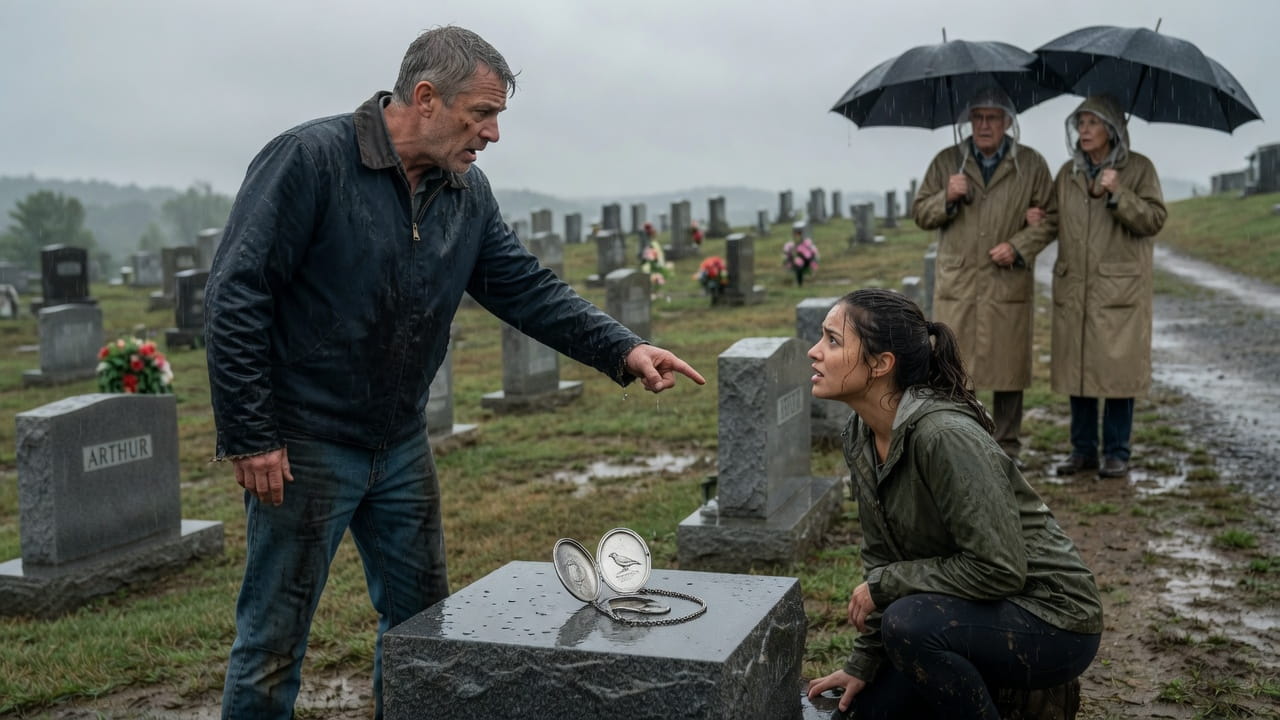
“You don’t belong here,” Arthur rasped, his voice cutting through the damp Pennsylvania mist. He stared at the girl kneeling by his wife’s stone—a girl who looked far too much like the woman he’d buried a year ago.
The girl didn’t flinch. Instead, she reached into her pocket and dropped a tarnished silver locket onto the wet granite. It clicked against the stone, the sound echoing in the quiet cemetery. Arthur froze. He knew that locket. He’d buried the matching half around Sarah’s neck.
“Who gave you that?” he demanded, his heart hammering against his ribs. He could feel the eyes of the elderly couple three rows over. This wasn’t supposed to happen. Not here. Not in front of the whole town.
“The woman who owned this spot,” the girl said, standing up to face him. Her voice was steady, but her hands were shaking. “The woman who spent thirty years pretending I didn’t exist while she lived a perfect life with you.”
Arthur felt the world tilt. Sarah had been his everything. They’d spent decades grieving the children they could never have, a shared silence that had defined their home. Or so he thought.
“Sarah didn’t have secrets,” he whispered, though the lie felt heavy in his mouth.
The girl stepped closer, her eyes burning with a lifetime of rejection. “She had one. And I’m standing right here.”
Chapter 1: The Weight of Clean Steel
The air in the garage always tasted the same: a thick, metallic cocktail of 10W-30, old coffee, and the damp, heavy scent of Western Pennsylvania rain. Arthur Pendleton liked it that way. It was a predictable atmosphere. If a diesel engine was coughing white smoke or a transmission was grinding itself into fine grey dust, there was a reason for it. There was always a part you could hold in your hand, a bolt you could torque until it stopped moving, a physical solution to a physical problem.
At fifty-eight, Arthur’s hands were a map of his life. The skin was permanently stained around the cuticles, the knuckles swollen from forty years of busting wrenches against stubborn steel. He was currently hunched over the open maw of a Peterbilt 389, his flashlight carving a bright, clinical circle into the dark recesses of the engine block. He was looking for a leak that shouldn’t be there, a hairline fracture in a cooling line that was bleeding the machine dry.
“Art, you still in there?”
Arthur didn’t pull his head out. He recognized the voice. It was Joe, a driver who’d been hauling coal since the mills were still breathing fire. “I’m in here, Joe. Unless you want this thing to seize up on the Grade, let me find this damn leak.”
“Suit yourself. Just saying, the sun’s going down. And it’s Sunday.”
Arthur’s hands went still. Sunday. The word hit him with the dull thud of a dropped sandbag. He pulled himself out, the joints in his hips screaming as he straightened up. He wiped his hands on a rag that was more grease than cloth and looked at the clock on the wall. 4:15.
He’d missed the window for the early afternoon light, the kind Sarah used to say made the hills look like they were covered in velvet. Now, the light was just a flat, bruised purple, dying behind the skeletal remains of the old Bethlehem Steel plant.
“I’m leaving,” Arthur said, tossing the rag onto his workbench. “Lock up for me, Joe.”
“You going up there?” Joe asked, his voice softening. It was that specific tone people used when they were talking to the bereaved—part pity, part awkwardness, like they were afraid grief was a virus they might catch if they spoke too loudly.
“I’m going up there,” Arthur confirmed. He didn’t look at Joe. He didn’t want to see the expression. He just grabbed his navy canvas jacket from the hook, the one Sarah had bought him for his birthday three years ago because she said his old one made him look like a vagrant.
He climbed into his Ford F-150, the cab smelling of the same oil as the garage, but mixed with something else now—the faint, lingering ghost of Sarah’s laundry detergent. It had been fourteen months since she passed, but he hadn’t cleaned the passenger side. There was still a crumpled napkins from the last time they’d gone to the Dairy Queen in the glove box. He kept it there like a relic.
The drive to St. Jude’s was five miles of cracked asphalt and shuttered storefronts. This town, Oakhaven, was a place that had forgotten how to thrive. It just endured. Much like Arthur. He passed the diner, seeing Helen’s silhouette through the window as she wiped down the counter. He’d be there tomorrow morning at 6:00 AM for his black coffee and dry toast. It was the architecture of his survival—the garage, the diner, the cemetery.
He pulled into the cemetery gates, the tires crunching on the gravel. The rain was starting to pick up, a fine, cold mist that clung to the windshield like a shroud. He parked near the old oak tree and reached into the footwell for the bouquet of yellow roses he’d picked up at the Sunoco. They were overpriced and slightly wilted, but they were yellow. Sarah’s favorite.
He walked up the slope, his boots sinking slightly into the soft, rain-soaked earth. He knew the path by heart. Past the big granite mausoleum of the town’s founding family, past the row of tiny markers for the infants who didn’t survive the winter of ’54, and up to the quiet corner overlooking the valley.
Sarah’s stone was simple. Sarah Elizabeth Pendleton. 1967–2025. Beloved Wife.
That was it. That was all thirty years of marriage boiled down to. Beloved Wife. It felt inadequate, like trying to describe a thunderstorm by talking about a puddle. They had been a unit, a closed system. Everyone in Oakhaven knew the Pendletons. They were the ones who didn’t have kids, the ones who were always seen holding hands at the high school football games they had no reason to attend other than to feel the life of the town.
Arthur stood over the grave, the roses clutched in his hand. The silence was heavy, but it wasn’t empty. It was a silence filled with all the things he hadn’t said because he thought they had more time. He thought they’d be the old couple on the porch, complaining about the cold and watching the neighbors’ kids grow up.
“It’s raining again, Sar,” he whispered. The words felt foolish in the open air, but they were the only bridge he had left. “Joe’s Pete is giving me hell. Transmission’s shot, I think. I told him he should’ve traded it in years ago.”
He knelt down to clear away a few stray leaves from the base of the stone. His knees cracked, a sharp sound in the quiet. He started to place the roses, but his hand stopped mid-air.
There was something already there.
Tucked into the corner where the granite met the earth was a small, tarnished silver object. Arthur frowned, leaning closer. At first, he thought it was a piece of trash, maybe something blown in by the wind. But as he reached out and touched it, he felt the cold, hard weight of metal.
It was a locket. A small, heart-shaped piece of silver, darkened by the elements but still recognizable.
Arthur’s heart did a strange, erratic dance in his chest. He picked it up, his thumb brushing over the surface. There was an engraving on the front. A sparrow, its wings spread wide, rendered in delicate, custom lines.
The air left Arthur’s lungs in a sudden, violent rush.
He knew this sparrow. He’d seen it every day for three decades. He had commissioned a local jeweler to make a pair of lockets for their tenth anniversary. One for Sarah, one for… well, he’d told her they’d keep the other one for the child they were going to have. When the years passed and the doctors’ appointments became more frequent and the news became more devastating, Sarah had taken the second locket and put it in her jewelry box.
“We’ll keep it,” she’d said, her eyes red-rimmed but her voice firm. “It’s a promise, Art. Even if it’s a promise to something that hasn’t happened yet.”
He’d buried her with the first one. He’d stood over her casket and watched the funeral director tuck the silver sparrow under the lace of her dress.
So why was the second one sitting here, in the mud, on top of her grave?
“You found it.”
The voice came from behind him, sharp and unexpected. Arthur spun around so fast he nearly lost his footing on the slick grass.
A girl was standing ten feet away. She was young, maybe mid-twenties, with dark hair that was plastered to her forehead by the rain. She wore a green utility jacket that looked two sizes too big and a pair of muddy boots. She looked tired, her eyes shadowed with a kind of weary sorrow that didn’t belong on a face that young.
But it wasn’t her clothes or her age that made Arthur’s blood turn to ice. It was her face.
She had Sarah’s chin. The same slight, stubborn cleft. She had Sarah’s eyes—a startling, clear grey that seemed to hold the light even in the gloom of the cemetery.
“Who are you?” Arthur asked, his voice coming out as a strangled growl. He clutched the locket so hard the metal bit into his palm. “What are you doing here?”
The girl didn’t back away. She took a step forward, her chin lifting in that way Sarah’s used to when she was about to say something she knew he wouldn’t like.
“I’m the one she gave that to,” the girl said. She pointed to the locket in his hand. “She sent it to me six months before she… before she went.”
“You’re lying,” Arthur said, the anger rising up to drown out the confusion. “My wife didn’t know you. She didn’t have any family left but her brother Dave. We didn’t have… we didn’t have anyone.”
“She had me,” the girl said, her voice trembling now, though she tried to hide it. “She had me for twenty-seven years, Mr. Pendleton. She just didn’t tell you.”
Arthur felt like he was back in the garage, but the engine had exploded in his face. The heat, the pressure, the sudden, deafening roar of reality failing. He looked down at the locket, then back at the girl.
In the distance, near a large marble monument, he saw the Millers. They were an elderly couple who spent every Sunday morning tending to their son’s grave. They were standing perfectly still, their umbrellas tilted back, watching him. Watching the local mechanic have a breakdown in front of a stranger.
Arthur felt the shame prickling at the back of his neck. This was Oakhaven. Nothing was private. Not even your wife’s ghost.
“Get out of here,” Arthur hissed, stepping toward the girl. He wanted to scare her. He wanted her to vanish so he could go back to his roses and his quiet, predictable grief. “I don’t know what kind of game you’re playing, but Sarah and I… we didn’t have secrets. We were married thirty years. I knew every breath she took.”
The girl laughed, a short, bitter sound that cracked the silence. “You knew the woman she wanted you to see. You knew the wife. You didn’t know the girl who got shipped off to a convent in Ohio when she was seventeen because her parents couldn’t handle the shame.”
She stepped into the circle of Arthur’s space, her face inches from his. “My name is Maya. I’m her daughter, Arthur. And I think it’s time we talked about why she was so afraid of you finding out.”
Arthur stared at her, the rain dripping off the brim of his hat and onto the locket. The silver sparrow seemed to mock him, its wings spread wide as if it were about to fly away with everything he thought he knew. He looked at the Millers, who hadn’t moved an inch. He looked at the headstone.
Beloved Wife.
The words felt like a punch to the gut now. A label on a box that he’d never actually opened.
“She couldn’t have had a daughter,” Arthur whispered, his voice failing him. “She wanted kids more than anything. We tried for ten years. We spent every cent we had on specialists. She cried every time her period came. You think she would’ve kept a child from me? You think she would’ve lived with that kind of hole in her heart and never said a word?”
“Maybe she didn’t think you could handle the truth,” Maya said, her voice softening just a fraction. “Or maybe she was just tired of being ashamed.”
She reached out as if to touch his arm, but Arthur recoiled, his back hitting the rough bark of the oak tree. The roses fell from his hand, the yellow petals scattering in the mud like broken glass.
“Get away from me,” he said, his voice low and dangerous. “If I see you here again, I’m calling the Sheriff. I don’t care who you look like. You’re a liar.”
Maya didn’t move. She just watched him as he scrambled back toward his truck, her expression not one of anger, but of a deep, echoing pity that hurt worse than any insult.
Arthur climbed into the cab and slammed the door, his breath coming in ragged, shallow gasps. He looked in the rearview mirror. Maya was still standing there, a lone, dark figure against the grey stones. The Millers were still watching.
He put the truck in gear and tore out of the cemetery, the gravel spraying behind him. He didn’t look back. He couldn’t.
He drove straight to the garage, the only place where things made sense. He sat in the dark for an hour, the smell of oil and old coffee surrounding him. He opened his palm. The silver sparrow was still there, cold and indifferent.
He thought of Sarah’s face—the way she looked when she was sleeping, the way she hummed when she was making toast, the way she held his hand at those football games. He tried to reconcile that woman with the girl Maya described, the girl who had a secret child and a lifetime of hidden shame.
He couldn’t do it. The gears didn’t mesh. The teeth were stripped.
He stood up and walked over to his workbench, picking up a heavy ball-peen hammer. He looked at the locket. For a second, he wanted to smash it, to turn the silver into a shapeless lump of metal so it couldn’t tell its story anymore.
But his hand wouldn’t move.
Because deep down, in the part of him that knew how to read a failing engine before it even started to smoke, he knew. He knew the locket was real. He knew the girl’s eyes were real.
And he knew that his thirty-year marriage had just become a house built on sand, and the tide was finally coming in.
Chapter 2: The Sound of Closing Doors
The diner was a sanctuary of grease and fluorescent humming. At 6:00 AM on Monday morning, the only people inside were the regulars—the men who had nowhere to be but couldn’t sleep, and the women who had been up since 4:00 AM making sure the world didn’t fall apart.
Arthur sat in the corner booth, his back to the window. He’d spent the night in his armchair, staring at the locket until the sun began to bleed through the curtains. He hadn’t slept. Every time he closed his eyes, he saw Maya’s face—Sarah’s face—looking at him with that devastating pity.
Helen approached the table, the glass coffee pot in her hand a familiar weight. She was a woman who had buried a husband and two brothers, and she wore her tragedies like a comfortable sweater. She didn’t ask how he was. She just poured.
“You look like you’ve been dragged through a rock crusher, Arthur,” she said, her voice a low rasp.
“Didn’t sleep much,” Arthur muttered, wrapping his hands around the warm mug. The heat felt good against his stiff joints.
“Thinking about the Pete?”
“Thinking about Sarah,” he said, the name feeling heavy on his tongue.
Helen paused, the steam from the coffee rising between them. She knew. In a town like Oakhaven, the “news” traveled faster than the morning fog. The Millers had probably made their phone calls before they’d even finished their Sunday dinner.
“People are talking, Art,” Helen said softly. She slid into the booth opposite him, a move she only made when she had something serious to say. “They’re saying there was a girl at the cemetery yesterday. Saying she looked like a ghost.”
Arthur looked up, his eyes bloodshot and hard. “She’s a liar, Helen. Some girl from out of town trying to stir up trouble.”
Helen didn’t blink. She just watched him, her expression unreadable. “The Millers said she had a locket. They said you looked like you’d seen a spirit.”
“I don’t care what the Millers said. They should mind their own damn business.”
“Maybe,” Helen agreed. “But Oakhaven doesn’t have a lot of business to mind. And Sarah… Sarah was a good woman, Art. But everybody’s got a shadow. Even the saints.”
Arthur felt a surge of irrational anger. He wanted to defend Sarah, to shout that she was perfect, that their life was a masterpiece of honesty. But the silver sparrow was in his pocket, a cold weight against his thigh.
“I’m going to see Dave,” Arthur said, sliding out of the booth. He didn’t finish his coffee. He couldn’t stomach it.
“Dave won’t tell you anything he doesn’t want you to know,” Helen warned as he walked toward the door. “He’s a Miller by blood, but he’s a Pendleton by choice. He likes things neat.”
Arthur didn’t answer. He walked out into the cold morning air, the sky a bruised yellow.
Dave’s hardware store was on the main drag, a red-brick building that had survived three floods and two recessions. Dave was Sarah’s older brother by four years, a man who believed in order, discipline, and the Republican party. He’d been a pillar of the community since he took over the shop from their father.
When Arthur walked in, the bell above the door chimed—a cheerful, annoying sound. Dave was behind the counter, counting out a box of galvanized nails. He looked up, his eyes narrowing behind his spectacles.
“Arthur. You’re early. Need some more of that penetrating oil?”
“I need to talk to you, Dave,” Arthur said. He walked up to the counter and didn’t stop until he was looming over it. He reached into his pocket and pulled out the locket, dropping it onto the wood.
The sound was small, but the effect was instantaneous.
Dave froze. His hand, midway to the box of nails, trembled. He looked at the silver sparrow, his face draining of color until he looked like he’d been carved out of soap.
“Where did you get that?” Dave whispered.
“A girl,” Arthur said, his voice dangerously low. “At the cemetery. Yesterday. She said her name was Maya. She said Sarah gave it to her.”
Dave didn’t look at Arthur. He looked at the locket as if it were a live grenade. “I told her,” he muttered, more to himself than to Arthur. “I told Sarah this would happen. I told her the past doesn’t stay buried if you keep feeding it.”
Arthur felt his heart crack. Not a clean break, but a jagged, splintering fracture. “So it’s true. Sarah had a child.”
Dave finally looked up. His expression wasn’t one of guilt, but of a cold, stubborn pride. “It was forty years ago, Arthur. Before you even knew her. She was seventeen. She was a kid who made a mistake.”
“A mistake?” Arthur’s voice rose, echoing off the rows of shovels and power drills. “You call a human being a mistake? You call keeping a daughter a secret for thirty years a mistake?”
“Lower your voice,” Dave hissed, glancing toward the back of the store where a young clerk was stocking shelves. “You don’t understand the way things were back then. Our father… he wouldn’t have survived the scandal. Sarah would’ve been ruined. We did what we had to do. We sent her away, she had the baby, and the baby was gone. End of story.”
“Except it wasn’t the end,” Arthur said, his hands curling into fists. “Because she kept in touch. She sent that girl a locket. She lied to me, Dave. Every single day for thirty years, she looked me in the eye and she lied.”
“She didn’t lie to hurt you,” Dave said, his voice hardening. “She lied to protect you. She knew how much you wanted kids. She knew it would kill you to know she’d already had one and given it away. She was trying to save you, Arthur.”
“Save me?” Arthur laughed, a harsh, jagged sound. “She stole thirty years of my life! She let me think we were in this together, that we were sharing the same grief. I spent every anniversary for a decade at those specialists, watching her cry, thinking I was the one failing her. And all the time, she had a daughter out there? She knew what it felt like to hold a child, and she never told me?”
“It wasn’t her choice to tell,” Dave said, stepping around the counter. He was smaller than Arthur, but he carried the weight of a man who had never been questioned. “It was a family matter. We settled it. Sarah moved on. She became the wife you loved. Why are you trying to dig this up now? The girl is gone. Let her stay gone.”
“She’s not gone,” Arthur said, grabbing the locket back. “She’s at the motel. And she’s not leaving until she gets what she came for.”
“And what’s that?” Dave sneered. “Money? A piece of the estate? She’s a stranger, Arthur. She’s nothing to you.”
“She’s Sarah’s daughter,” Arthur said, his voice trembling with a mix of rage and a sudden, terrifying realization. “Which makes her the only piece of Sarah I have left that isn’t a lie.”
He turned and walked out of the store, the bell chiming behind him like a funeral knell. He could hear Dave calling his name, but he didn’t stop. He couldn’t breathe in there. The air was too full of galvanized nails and thirty-year-old secrets.
He drove to the garage, but he didn’t go inside. He sat in the truck, watching the rain start to fall again. The grey hills of Pennsylvania seemed to be closing in on him, the trees like skeletal hands reaching out of the mist.
He thought about the years they’d spent trying to conceive. He remembered the night Sarah had finally broken down, her face buried in his chest, sobbing because another test had come back negative. He’d held her for hours, promising her that they were enough for each other. That he didn’t need a child to love her.
He realized now that those tears weren’t just for the child they couldn’t have. They were for the child she’d already lost. She hadn’t been grieving a void; she’d been grieving a memory.
And he had been a spectator in his own life.
He reached into the glove box and pulled out the crumpled napkin from the Dairy Queen. He looked at it for a long time, then slowly, deliberately, he tore it into tiny pieces and let them fall onto the floor mat.
The sanctuary was gone. The oil and the steel couldn’t fix this.
He needed to find the girl. He needed to know if Sarah had ever talked about him. He needed to know if he was just the man who provided the “neat” life Sarah needed to hide her shame, or if he had actually been loved by a woman he never truly knew.
He put the truck in gear and headed toward the Sunset Motel. It was a low-slung, neon-lit place on the edge of town, the kind of place people stayed when they were passing through or when they had nowhere else to go.
As he pulled into the lot, he saw her. Maya was sitting on the walkway outside room 14, her green jacket huddled around her. She was smoking a cigarette, the smoke curling up into the damp air.
She looked up as he approached, and for a second, the defiance was gone. She just looked like a girl who had traveled a long way to find a mother and found a headstone instead.
Arthur parked the truck and got out. He felt like he was walking through deep water. His legs were heavy, his heart a dull, rhythmic thud.
“My brother-in-law says you’re a mistake,” Arthur said as he reached her.
Maya took a long drag of her cigarette and blew the smoke out slowly. “He’s been saying that since before I was born. I’m used to it.”
“He says Sarah was protecting me.”
Maya looked him dead in the eye. “Is that how it feels, Arthur? Do you feel protected?”
Arthur looked at the flickering neon sign of the motel, the red light casting long, bloody shadows across the wet pavement.
“No,” he said, his voice barely a whisper. “I feel like I’ve been living in a room with no windows for thirty years. And you just kicked the door down.”
Maya stood up, stubbing her cigarette out on the railing. “I didn’t come here to hurt you. I just wanted to see where she lived. I wanted to see the man she chose over me.”
“She didn’t choose me,” Arthur said, the truth finally landing in his gut like a lead weight. “She chose the lie. I was just the one who made it easy to keep.”
He looked at Maya, really looked at her, and saw the curve of Sarah’s mouth, the way she tilted her head when she was listening. It was a ghost standing in front of him, but this one breathed. This one bled.
“Come on,” Arthur said, turning back toward his truck.
“Where are we going?”
“To my house,” Arthur said. “To the place she lived. If you’re going to shatter my life, the least you can do is help me pick up the pieces.”
Chapter 3: The House of Quiet Rooms
The Pendleton house was a two-story craftsman on the quiet end of Willow Street. It had a wraparound porch that Arthur had painted every three years and a garden that Sarah had tended with a kind of desperate intensity. It was the house of a successful man, a respected man.
But as Arthur pulled into the driveway with Maya in the passenger seat, the house looked different. It looked like a museum—a collection of things curated to project a specific image, while the real life was tucked away in the drawers and the crawlspaces.
He led Maya inside, the air in the hallway smelling of lemon wax and the faint, lingering scent of Sarah’s rosewater perfume. He watched Maya as she looked around, her eyes taking in the framed photos on the walls, the lace doilies on the end tables, the perfectly arranged pillows on the sofa.
“It’s so… clean,” Maya said, her voice small.
“Sarah liked things in their place,” Arthur said. He felt a strange defensiveness, a need to protect the version of Sarah that lived here, even as he was hunting for the version that didn’t.
“I grew up in foster homes until I was ten,” Maya said, her fingers grazing the back of a chair. “Then a group home in Pittsburgh. It wasn’t exactly ‘in its place.'”
Arthur flinched. The contrast was too sharp. Sarah had lived here, in this cocoon of middle-class comfort, while her daughter had been shuffled through the system like a piece of lost luggage.
“Did she… did she ever see you?” Arthur asked. He went to the kitchen and started making a pot of coffee, his hands moving on autopilot.
“Three times,” Maya said. She followed him into the kitchen, sitting at the small wooden table where Arthur and Sarah had eaten breakfast for thirty years. “Once when I was six. She came to the foster home. She told me she was my aunt. She gave me a doll with yellow hair. I still have it.”
Arthur stopped, the coffee scoop poised over the filter. “An aunt.”
“Then again when I was twelve. She met me at a park. She cried the whole time. She kept touching my hair and saying she was sorry. She gave me the locket then. She told me it was a secret, that if I showed anyone, she wouldn’t be able to come back.”
“And the third time?”
“Two years ago,” Maya said. “In Pittsburgh. We had lunch. She told me she was sick. She told me she had a husband named Arthur who was the best man she’d ever known. She said she’d spent her whole life trying to be the woman he deserved.”
Arthur turned around, the coffee forgotten. “She said that?”
“She loved you, Arthur,” Maya said, and for the first time, her voice wasn’t defensive. It was soft, almost pleading. “That’s why she couldn’t tell you. She thought if you knew she’d given up a baby, you wouldn’t see the ‘good woman’ anymore. She thought you’d see a monster.”
“I would have loved her anyway,” Arthur shouted, the frustration boiling over. He slammed his hand onto the counter, making the cups rattle. “I would have taken you in! We could have been a family. We spent thirty years mourning a child that didn’t exist, when you were right there! We could have had everything!”
“No, you couldn’t,” Maya said, standing up. “Because Dave and your ‘good’ neighbors wouldn’t have allowed it. Sarah knew that. She knew this town. She knew that in Oakhaven, a secret is only a secret until someone needs a weapon.”
She walked over to the counter and looked at Arthur, her eyes hard again. “She sent me a letter right before she died. It took me a year to find the courage to come here. She said that if I ever needed to know who she was, I should find you. She said you were the only thing in her life that was real.”
Arthur felt the breath leave him. He leaned against the sink, his head bowed. The “best man she’d ever known.” The “only thing that was real.”
He realized then that Sarah hadn’t been protecting herself from him. She’d been protecting the one thing she felt she had left that wasn’t tainted by her past—his love. She’d been so afraid of losing the way he looked at her that she’d sacrificed the daughter she clearly adored.
It was a tragedy of her own making, a prison built of lace and rosewater.
“I need to see her things,” Maya said. “I want to see the things she didn’t show me.”
Arthur nodded slowly. He led her upstairs to their bedroom. It was exactly as it had been the day she died. Her slippers were still tucked under the bed. Her hairbrush was still on the vanity, a few strands of silver hair caught in the bristles.
Maya walked over to the vanity and picked up the hairbrush. She held it to her face for a moment, her eyes closing.
Arthur went to the closet. He’d avoided this for fourteen months. He’d lived out of a laundry basket in the guest room because he couldn’t bear to open these doors. He pulled them open now, the scent of her cedar blocks and her perfume hitting him like a physical blow.
Rows of floral dresses, sensible cardigans, the navy blue suit she’d worn to church. He started pulling things out, his hands shaking. He didn’t know what he was looking for, but he knew it was here.
He found a small wooden box tucked into the back corner, behind her winter coats. It was an old cigar box, the edges worn smooth. He brought it over to the bed and sat down.
Maya sat next to him, her breath hitching.
He opened the lid.
Inside were hundreds of photographs. Not the ones in the frames downstairs—not the ones of Arthur and Sarah at the beach, or Dave’s kids’ birthdays. These were photos of a girl.
A toddler in a red dress. A ten-year-old on a bicycle. A teenager at a graduation ceremony.
And tucked between the photos were letters. Dozens of them. They were addressed to ‘Sarah Elizabeth,’ but the envelopes were never mailed.
My Dearest Maya, one started. I saw you today from across the street. You’re getting so tall. You have my mother’s smile. Arthur bought me a new stove today. He’s so proud of it. I wanted to tell him about you, but the words got stuck in my throat. I’m a coward, my sweet girl. I’m a coward who loves you more than my own life.
Arthur read the words, and the image of Sarah he’d held for thirty years dissolved. In its place was a woman who lived a double life of agonizing complexity. A woman who cooked his dinners and mended his socks while her heart was miles away in a group home in Pittsburgh.
He looked at Maya, who was holding one of the photos—the one of her at her graduation. Her tears were falling freely now, spotting the old polaroid.
“She was there,” Maya whispered. “She was at my graduation. I never saw her.”
“She was always there,” Arthur said. He felt a sudden, fierce protectiveness toward this girl, this stranger who was the living embodiment of his wife’s deepest pain.
He realized then that he couldn’t hate Sarah. He could be angry, he could be devastated, he could feel betrayed—but he couldn’t hate her. She’d lived a life of quiet desperation that he couldn’t even imagine. She’d carried a weight that would have crushed a lesser person.
And she’d done it all to keep him happy.
It was a gift he didn’t want, a sacrifice he hadn’t asked for, but it was hers.
“What are you going to do?” Maya asked, looking up at him. “Dave wants me gone. He told me he’d call the cops if I stayed in town.”
Arthur looked at the photos scattered on the bed. He looked at the silver sparrow in his hand. He looked at the girl who had Sarah’s eyes.
“Dave doesn’t run this house,” Arthur said, his voice regaining its steel. “And he doesn’t run me.”
He stood up and walked to the window, looking out at the town of Oakhaven. The rain had stopped, and a sliver of moon was trying to break through the clouds.
“You’re staying here,” Arthur said. “In the guest room. We’re going to go through every one of these letters. And then, I’m going to take you to the diner for breakfast.”
“Arthur, you don’t have to—”
“Yes, I do,” he said, turning back to her. “The whole town is waiting for me to throw you out. They’re waiting for the ‘good man’ to do the ‘right thing’ and keep the secret buried. But I’m tired of secrets, Maya. I’m tired of living in a room with no windows.”
He walked over and put his hand on her shoulder. It was the first time he’d touched her, and he felt a jolt of recognition. She felt like Sarah. She felt like family.
“I spent thirty years wanting a daughter,” Arthur said, his voice cracking. “I’m not going to let Dave or this town take her away from me now that she’s finally here.”
Maya reached up and put her hand over his. Her skin was warm, her grip firm.
In that moment, the house on Willow Street stopped being a museum. It started being a home again—messy, complicated, and full of the kind of truth that hurts before it heals.
Chapter 4: The Public Reckoning
The sun rose on Tuesday morning with a clarity that felt like a challenge. The mist had been burned away by a cold north wind, leaving the valley sharp and unforgiving.
Arthur was in the kitchen at 5:30 AM, frying bacon. He’d barely slept again, but the exhaustion was different now. It wasn’t the heavy, suffocating weight of grief; it was the humming tension of a man about to go into battle.
Maya came down a few minutes later, wearing one of Sarah’s old oversized sweaters—a soft, cream-colored wool thing that she’d only worn on the coldest winter days. Seeing her in it made Arthur’s heart ache, but it also felt right. Like a hand-me-down that had finally found its owner.
“You’re sure about this?” Maya asked, sitting at the table. She looked nervous, her fingers twisting a loose thread on the sweater.
“I’m sure,” Arthur said. He plated the eggs and bacon, setting them in front of her. “Eat. You’re going to need your strength.”
They didn’t talk much during breakfast. The silence was comfortable, the kind of quiet that exists between two people who have already said the most important things.
At 7:00 AM, they climbed into the Ford F-150. Arthur could feel the neighbors’ eyes behind their lace curtains. He knew the phone lines were already buzzing. Arthur Pendleton is driving that girl around in Sarah’s sweater. Can you believe it?
He drove straight to the diner. This was the arena. This was where the social fabric of Oakhaven was woven and torn.
As they walked in, the bell chimed, and for the first time in forty years, the diner went completely silent.
The clinking of silverware stopped. The low murmur of gossip died in the throats of the men at the counter. Even the sizzle of the grill seemed to mute itself.
Helen stood behind the counter, her hand frozen on the coffee pot. She looked at Arthur, then at Maya, her eyes widening as she took in the cream-colored sweater.
Arthur didn’t hesitate. He led Maya to the center booth—the one usually reserved for the town’s elite, the one Dave usually occupied on Tuesday mornings.
“Morning, Helen,” Arthur said, his voice loud and clear in the stillness. “I’ll have my usual. And Maya here will have whatever she likes.”
Helen blinked, then a slow, secret smile spread across her face. She walked over, the coffee pot in hand. “Morning, Arthur. Maya.” She poured the coffee with a steady hand. “Nice sweater, honey. Sarah always said it was too big for her.”
The tension in the room shifted. It didn’t vanish, but it transformed from a cold, judging silence into a low, buzzing energy.
Ten minutes later, the door chimed again.
Dave walked in, his face flushed with the morning cold—or rage. He stopped dead when he saw Arthur and Maya. He looked at the room, seeing the way everyone was watching, the way the power had already shifted.
He marched over to the booth, his heels clicking on the linoleum. “Arthur. What the hell do you think you’re doing?”
Arthur didn’t look up from his coffee. “I’m having breakfast with my daughter, Dave. Would you like to join us?”
The word ‘daughter’ hit the room like a physical blow. A collective gasp went up from the tables.
Dave leaned over the table, his voice a low, furious hiss. “You’ve lost your mind. You’re dragging our name through the mud. You’re making a spectacle of Sarah’s memory.”
“No, Dave,” Arthur said, finally looking up. His eyes were cold, flinty, like the steel he worked with every day. “I’m honoring her memory. I’m honoring the part of her that was too afraid to live out loud because of people like you.”
He stood up, his massive frame towering over his brother-in-law. “Sarah lived thirty years in fear. She spent her life mending a reputation that you helped her break. But I’m done mending, Dave. I’m starting to build.”
He reached into his pocket and pulled out the cigar box. He set it on the table and opened the lid, revealing the hundreds of photos and letters.
“Look at these, Dave,” Arthur said, his voice echoing through the diner. “Look at the life you tried to erase. These are thirty years of letters that Sarah never got to send because she was afraid of your ‘scandal.’ These are photos of a girl who had to grow up without a mother because you thought a ‘neat’ life was more important than a real one.”
He picked up a photo of Maya as a toddler and held it up for the room to see. “This is Maya. She’s Sarah’s daughter. And she’s staying here. With me.”
Dave looked around the room, his face turning a deep, mottled purple. He saw the judgment in the eyes of his neighbors. He saw that the “order” he’d spent his life maintaining had vanished in a single morning.
“You’ll regret this, Arthur,” Dave spat, but his voice lacked conviction. He was a man who only had power as long as the secret stayed in the dark. In the light, he was just a small, bitter man with a hardware store.
He turned and practically ran out of the diner, the bell chiming behind him like a mocking laugh.
Arthur sat back down, his legs shaking slightly under the table. He felt a hand on his arm. Maya was looking at him, her eyes bright with tears.
“Thank you,” she whispered.
“Don’t thank me yet,” Arthur said, his voice thick. “We’ve still got a lot of work to do.”
He looked around the diner. The silence was gone, replaced by a new kind of chatter—a messy, complicated, human noise. People were looking at Maya with curiosity, some with pity, but many with a strange kind of respect.
Helen came back with a plate of pancakes, setting them in front of Maya. “On the house, honey,” she said. “Welcome to Oakhaven.”
Arthur picked up his coffee mug. It was cold, but he didn’t care. For the first time in fourteen months, the air didn’t taste like oil and old coffee. It tasted like rain on a dry road. It tasted like the truth.
He looked at Maya, seeing Sarah in the curve of her jaw and herself in the strength of her eyes.
“So,” Arthur said. “Tell me about the girl on the bicycle. What happened after that photo was taken?”
And as Maya started to talk, the house of quiet rooms finally began to fill with the sound of a living story.
Chapter 5: The Residue of Truth
The air in the kitchen felt heavy, not with the silence of the dead, but with the vibrating energy of a storm that had passed through and left the power lines sparking on the pavement. Maya sat at the table, her fingers tracing the wood grain, her eyes fixed on the empty space where the cigar box had been.
Arthur stood by the sink, his back to her. He was staring out the window at the neighbor’s yard, where a plastic tricycle lay overturned in the grass. He felt a strange, hollow buzzing in his ears. The diner scene had been a release, a violent shedding of the skin he’d worn for thirty years, but the new skin felt raw and exposed. He’d told the town. He’d told Dave. But the hardest person to tell was the man he saw in the mirror every morning—the man who had lived a parallel life with a woman who didn’t exist.
“You didn’t have to do that,” Maya said quietly. Her voice was steady, but there was a tremor in it that she couldn’t quite iron out. “You didn’t have to blow up your whole life for me.”
Arthur turned around. He looked older than he had forty-eight hours ago, the lines around his eyes etched deep like irrigation ditches in dry soil. “I didn’t do it for you, Maya. I mean, I did. But I did it for me, too. And for her. Sarah spent her whole life holding her breath. I’m just letting the air out.”
He walked over and sat down opposite her. He looked at the cream-colored sweater she was wearing—Sarah’s sweater—and for a second, the overlap of the two women was so strong it made his vision blur.
“What happens now?” Maya asked. She looked at him with a directness that made him want to look away. “Dave’s not going to just let this go. Men like him… they don’t like being made to look small in front of the neighbors.”
“Dave is a bully who’s lost his leverage,” Arthur said, though he knew Maya was right. Dave’s power was built on the curated reputation of the Pendleton-Miller name. By dragging the secret into the light, Arthur had burned the currency Dave traded in. “He’ll bark. He might even try to bite. But he can’t undo what happened at the diner. The town knows. The story belongs to everyone now, and Dave can’t control the ending.”
“I should go back to the motel,” Maya said, pushing her chair back. “I’ve caused enough trouble. You need space to… I don’t know, mourn the version of her you actually liked.”
Arthur reached out, his large, grease-stained hand covering hers on the table. “Stay. Please. I don’t want to be in this house alone right now. Every room feels like a lie I haven’t finished reading.”
Maya looked at his hand, then up at him. She didn’t pull away. “I don’t know how to be a daughter, Arthur. I really don’t. My ‘mother’ was a social worker named Mrs. Gable who smelled like peppermint and ignored me until I turned eighteen. I’m not exactly built for Sunday dinners and family photos.”
“I don’t know how to be a father,” Arthur countered, a ghost of a smile touching his mouth. “I’ve spent thirty years practicing for a job I never got. We can be bad at it together.”
The afternoon turned into a long, quiet negotiation of space. Arthur went to the garage to clear his head, but for the first time in his life, the machines didn’t offer him comfort. He stood over a disassembled fuel pump, the parts laid out in a logical, perfect sequence, and all he could think about was the box of letters upstairs. The letters Sarah had written to a girl she saw from across the street. The girl she’d described as having her mother’s smile.
He realized then that he wasn’t just angry at the lie. He was jealous. He was jealous of the secret life Sarah had lived, the intensity of the love she’d felt for Maya that he’d never been allowed to share. He felt like he’d been invited to a party and kept in the hallway while the real celebration happened in the next room.
He went back inside around 4:00 PM. Maya was in the living room, sitting on the floor with the cigar box. She had the photos spread out around her in a semi-circle.
“She followed me,” Maya whispered as Arthur walked in. She held up a photo of a high school track meet. Maya was in the background, a blur of motion in a blue jersey. “This was in Harrisburg. I was sixteen. I didn’t even know she knew where I was.”
Arthur sat on the sofa, looking down at the sprawl of Maya’s life captured through Sarah’s lens. “She must have spent half her life in that car, driving back and forth, just to catch a glimpse of you. Think of the logistics, Maya. The excuses she must have made to me. ‘I’m going to see my cousin in Erie,’ or ‘I’m spending the weekend at a retreat.’ All of it was for this.”
“It’s stalking, if you think about it,” Maya said, her voice cracking. “It’s obsessive. Why couldn’t she just… why couldn’t she just stop the car and get out? Why couldn’t she just say ‘I’m your mother’ and take the hit?”
“Because she was terrified,” Arthur said. He leaned forward, his elbows on his knees. “She was terrified of Dave, terrified of her parents’ ghost, and mostly, I think she was terrified of me. She thought I was a better man than I am, Maya. She thought my love was something she had to earn by being perfect. She didn’t realize that I loved her because she was messy, not despite it.”
The phone rang, the sharp, mechanical trill cutting through the room. Arthur stood up and answered it in the kitchen.
“Arthur.” It was Dave. His voice was cold, stripped of its usual hardware-store joviality. “I’ve spoken to my lawyer. And to Sarah’s executor. If you think you’re going to hand over any of the Miller family assets to that… that girl, you’ve got another thing coming.”
Arthur felt a cold, hard calm settle over him. “There are no Miller family assets, Dave. Sarah and I built this life. The house, the garage, the savings—that’s Pendleton money. And Sarah’s jewelry? That’s hers. If she wanted Maya to have it, she’ll have it.”
“You’re making a mistake, Art. You’re letting grief cloud your judgment. That girl is a grifter. She probably found that locket in a pawn shop. You’re being played.”
“I saw her face, Dave,” Arthur said, his voice dropping to a dangerous rumble. “I saw Sarah’s eyes looking back at me. You can call her whatever you want, but you can’t tell me what I’m seeing. And if you call this house again with that tone, I’m going to come down to that store and we’re going to have a conversation that doesn’t involve lawyers. Do you understand me?”
There was a long pause on the other end of the line, then a sharp click.
Arthur hung up the phone. He felt a surge of adrenaline, the kind he used to get when he was younger and someone would pick a fight in a bar. It felt good to protect something. It felt good to finally have an enemy he could see.
He went back into the living room. Maya was looking at him, her expression guarded. “Was that him?”
“He’s worried about the money,” Arthur said, sitting back down. “Typical Dave. Thinks everything can be solved with a ledger and a threat.”
“I don’t want your money, Arthur. I didn’t come here for an inheritance.”
“I know you didn’t. But you’re getting it anyway. Not because you asked for it, but because it belongs to you. Everything Sarah had… it’s yours. That’s the law of the heart, Maya, even if Dave doesn’t recognize it.”
They spent the evening reading the letters. They were heartbreakingly mundane and devastatingly profound. Sarah wrote about the weather, about the way Arthur snored, about the yellow roses he bought her every anniversary. And in every letter, she apologized. I’m sorry I’m not there to teach you how to drive. I’m sorry I’m not there to help you pick out a dress for the prom. I’m sorry I’m a ghost in your life.
By midnight, they had reached the last letter. It was dated three weeks before her stroke. It was different from the others—shorter, the handwriting jagged and hurried.
My Dearest Maya, it read. The secret is getting too heavy. I can feel it crushing me. Arthur looks at me with so much love, and all I feel is the weight of what I haven’t told him. I’m going to tell him, Maya. After the holidays. I’m going to show him the box and I’m going to ask him to go with me to see you. I’m so tired of being afraid. I just want to be your mother in the light. Please wait for me. Just a little longer.
Maya let the letter fall to the floor. She covered her face with her hands, her shoulders shaking with silent, racking sobs.
Arthur didn’t say anything. He just sat there in the quiet of the house on Willow Street, the yellow light of the lamp casting long shadows across the floor. He felt a profound, aching sorrow for the woman he’d lost—not the saint he’d buried, but the woman who had finally found the courage to be real, only to have time run out on her.
He realized then that he wasn’t just the man who had been lied to. He was the man who had been loved by a woman who was willing to break herself to keep him happy. It was a terrible, beautiful, tragic truth.
He reached out and put his hand on Maya’s head, his fingers brushing the dark hair that was so much like Sarah’s.
“She was coming for you,” Arthur whispered. “She was finally coming.”
Maya looked up, her face wet with tears, her eyes searching his. “Do you think he would have gone? If she’d told him? Do you think the Arthur she knew would have gone to see me?”
Arthur looked at the silver sparrow locket resting on the coffee table. He thought of the thirty years of quiet dinners and football games and the shared grief of infertility.
“He would have been halfway to Pittsburgh before she’d even finished the sentence,” Arthur said. And for the first time in fourteen months, he knew it was the absolute, unvarnished truth.
Chapter 6: The Sparrow’s Flight
The following Sunday was one of those rare Pennsylvania spring days where the air feels scrubbed clean and the light has a golden, liquid quality to it. The hills were beginning to haze with the first faint green of budding leaves, a promise of life returning to a landscape that had spent too long in the grip of winter.
Arthur stood on the porch, wearing a clean flannel shirt and his good boots. He looked at the garden, noticing the crocuses pushing their way through the mulch. Sarah would have been out there already, her knees in the dirt, her hands stained with the earth.
The door opened behind him, and Maya stepped out. She looked rested, her eyes clear, her dark hair pulled back into a neat braid. She was still wearing the cream sweater, but she’d paired it with a pair of jeans and sturdy boots. She looked like she belonged here. Not as a guest, but as a part of the house.
“Ready?” Arthur asked.
“Ready,” Maya said.
They drove to the cemetery in silence, but it wasn’t the tense, brittle silence of the previous week. It was a quiet born of understanding. As they pulled through the gates, Arthur noticed that the Millers weren’t there. The hillside was empty, the grey markers standing like silent sentinels under the bright blue sky.
They walked up the slope together. Arthur carried a new bouquet of yellow roses—fresh ones from the florist, not the wilted Sunoco variety. Maya carried the silver sparrow locket.
When they reached the headstone, Arthur knelt down. He cleared away the dead petals from the previous week and placed the new roses at the base of the stone. He looked at the words Beloved Wife and didn’t flinch.
“I’m not going to change the stone, Maya,” Arthur said, his voice low but firm. “She was my wife. And she was beloved. That’s a truth that doesn’t go away just because we found another one.”
Maya knelt beside him. She reached out and touched the cold granite. “I used to hate this stone,” she said. “I used to look at it and think it was a wall she’d built to keep me out. But I get it now. It wasn’t a wall. It was a shield.”
She took the silver locket and placed it carefully on top of the headstone, right in the center. The silver caught the sunlight, the engraved sparrow looking as if it were ready to take flight.
“She wanted to be a mother in the light,” Maya said, looking at the stone. “So here we are. In the light.”
Arthur stood up, his joints popping. He looked out over the valley, at the town of Oakhaven nestled in the curve of the river. He saw the smoke rising from the mills, the cars moving along the highway, the quiet, steady rhythm of a world that didn’t stop for grief or secrets.
He thought of Dave, sitting in his hardware store, clutching his ledgers and his pride. He thought of Helen at the diner, pouring coffee for men who were finally starting to talk about something other than the Pendletons. The scandal had broken, the shock had faded, and what was left was just the truth—a messy, complicated human story that was already being absorbed into the history of the town.
“What are you going to do now, Maya?” Arthur asked. “The motel’s paid for through Tuesday, but… well, there’s plenty of room on Willow Street. And I could use some help at the garage. You said you grew up in a group home—I bet you know how to handle a wrench better than most of the guys I hire.”
Maya looked at him, a flicker of surprise in her eyes, followed by a slow, genuine smile. “I’m pretty good with a socket set. But I’ve got a life in Pittsburgh, Arthur. A job. A cat. I can’t just move into your guest room forever.”
“I know,” Arthur said. “But Pittsburgh’s only two hours away. And I’ve got a truck that’s built for the highway. Maybe we start with Sundays. You come up, we go through more of those letters, we eat at the diner. We let the town get used to seeing us together.”
Maya stood up and brushed the grass from her knees. She looked at Arthur, and for a second, he saw the twenty-seven years of rejection and longing melt away, replaced by a cautious, budding hope.
“I’d like that,” she said. “I’d like that a lot.”
They walked back down the hill together, their shadows stretching out long and thin across the grass. Arthur felt a lightness in his chest that he hadn’t felt in years. The weight of the secret was gone, and in its place was a connection that felt solid and real.
As they reached the truck, Arthur looked back at the hillside one last time. The silver locket was still there, a bright spark of light on the dark granite.
He realized then that he hadn’t lost the Sarah he loved. He’d just found the rest of her. He’d found the woman who was brave enough to keep a daughter in her heart for thirty years, and the woman who was finally getting ready to let her in.
He climbed into the driver’s seat and started the engine. It hummed with a perfect, rhythmic clarity. No leaks, no fractures, no hidden damage. Just a machine doing exactly what it was built to do—moving forward.
“Where to?” Maya asked as she buckled her seatbelt.
“The diner,” Arthur said. “Helen says the blueberry pie is fresh today. And I think it’s time I introduced you to Joe. He’s going to have a lot of questions about how you know so much about diesel engines.”
Maya laughed, a clear, bright sound that filled the cab of the truck. “Tell him I learned from the best.”
Arthur put the truck in gear and drove out of the cemetery. He didn’t look back. He didn’t need to. The past was where it belonged—not forgotten, but finally understood.
As they drove through the town, Arthur saw Dave standing outside the hardware store, adjusting a display of lawnmowers. Dave looked up as the truck passed, his expression unreadable behind his spectacles. Arthur didn’t wave, and he didn’t look away. He just kept driving, his hand steady on the wheel, his daughter sitting beside him.
Oakhaven was still a town of shadows and secrets, but on Willow Street, the windows were finally open. The air was moving. The story was continuing.
And somewhere in the quiet hills of Pennsylvania, a silver sparrow finally found its way home.
The ending wasn’t a perfect, polished bow. There were still lawyers to deal with, and neighbors who would whisper for years, and a thirty-year gap in a relationship that could never be fully closed. But as Arthur pulled into the driveway of the house he’d shared with Sarah, he didn’t see a museum anymore. He saw a home.
He saw a place where a man and a girl could sit on a porch and talk about a woman they both loved, in a way that was finally, beautifully, and painfully true.
Arthur turned off the engine and looked at Maya. “Welcome home,” he said.
Maya looked at the house, then back at him. “Thanks, Dad.”
The word hung in the air for a second, heavy and new and completely right. Arthur felt a tear prickle at the corner of his eye, but he didn’t wipe it away. He just opened the door and stepped out into the light.