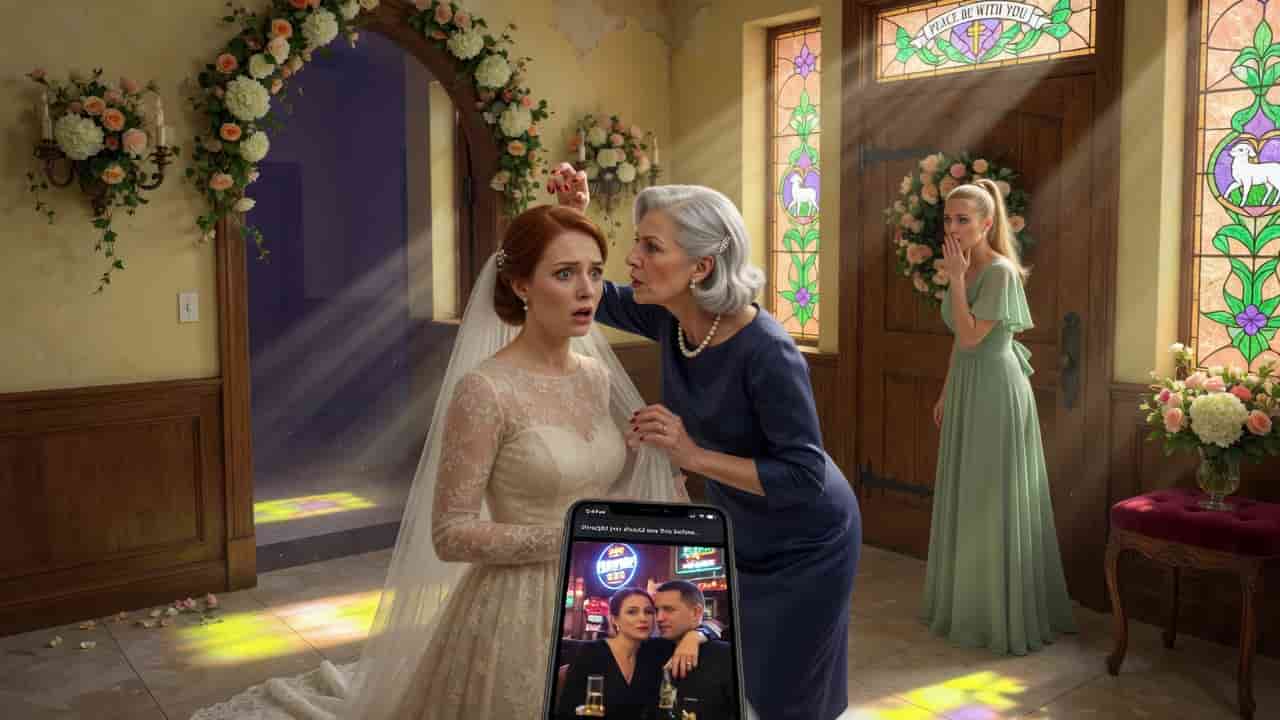
Judith didn’t blink. She just reached up, her fingers cold as grave-dirt, and tucked a loose strand of auburn hair behind Nina’s ear. She leaned in, the scent of expensive lily-of-the-valley perfume clogging Nina’s lungs.
“Why would I do that, dear? Everyone already knows. Look at the front row. Vanessa is wearing white, too. And Liam? He just got that photo I sent. The one of you in that dive bar in Savannah. He’s standing at that altar right now wondering if he’s marrying a placeholder or a lie.”
Nina’s heart felt like it was being squeezed by a fist. The photo was a fake—a grainy, photoshopped mess Judith had manufactured to bridge the gap between Liam and his ‘soulmate’ ex. Nina looked past Judith’s shoulder to where her bridesmaid, Sarah, stood by the heavy oak doors of the chapel. Sarah’s face was ashen. She had heard enough.
The organ music began to swell—the signal that the world was waiting for a happy bride. But Nina wasn’t moving. She felt the weight of the phone in her hidden dress pocket, the recording she’d accidentally started when Judith entered the room still running, capturing every venomous word.
Judith smiled, a sharp, terrifying expression of triumph. “Time to go, Nina. Don’t keep the man who doesn’t want you waiting.”
Chapter 1
The air in the bridal suite was thick with the scent of hairspray and expensive lilies, a cloying sweetness that made Nina feel like she was being smothered in silk. It was a high-ceilinged room in the back of the St. Simons chapel, all white wainscoting and mirrors that seemed to stretch her reflection into something unrecognizable.
Nina sat on the edge of the velvet stool, her hands knotted in the skirt of a dress that had cost more than her first car. It was a pale, ivory lace, chosen because Judith—her soon-to-be mother-in-law—had deemed it “appropriate for a girl of her standing.” That was the phrase Judith used for everything. Standing. It was a polite way of saying Nina didn’t have any.
“You’re breathing too hard, Nina. You’ll pop a seam,” Sarah said, though her voice was gentle. Sarah had been Nina’s best friend since they were waiting tables together at a greasy spoon in Athens, long before Liam had walked in and changed the orbit of Nina’s life. Sarah was currently struggling with the zipper of her sage-green bridesmaid dress, her face flushed with the humidity that even the chapel’s over-taxed AC couldn’t kill.
“I feel like I’m walking into a trap, Sarah,” Nina said. She looked at her reflection. The auburn hair was pinned back so tightly it pulled at her temples. She looked like a prestige-drama version of herself, a polished, hollowed-out woman ready to be presented to the Georgia elite.
“It’s just jitters,” Sarah said, finally winning the battle with the zipper. She stepped over, placing a hand on Nina’s shoulder. “Judith is a nightmare, we know this. But you aren’t marrying Judith. You’re marrying Liam. And Liam loves you.”
Nina wanted to believe that. She needed to. But for three years, she had been the “placeholder.” That was the word she’d overheard Judith use at a garden party two summers ago. Liam is just in a phase. Nina is a lovely placeholder until he remembers who he is. Liam was the son of the Calhoun timber fortune. Nina was the daughter of a woman who ran a mobile dog-grooming business and a father who had disappeared into the Florida Panhandle when she was six. The disparity wasn’t just about money; it was about the way people looked at her in this town—as if they were waiting for the spell to break, for the pumpkin to return to its original form.
The door to the suite clicked open. It didn’t swing; it glided, as if the wood itself was afraid of the woman entering.
Judith Calhoun walked in wearing navy blue silk that shimmered like oil on water. She didn’t look like a woman attending her only son’s wedding; she looked like a general inspecting a front line she intended to sabotage.
“Sarah, dear,” Judith said, not looking at Sarah at all. “The florist is having a crisis with the boutonnières. Be a lamb and go tell them that if the baby’s breath isn’t replaced with sprigs of rosemary in five minutes, I’ll withhold the final check.”
Sarah hesitated, looking at Nina.
“It’s okay,” Nina said, though her stomach performed a slow, sickening roll. “Go ahead.”
Once Sarah was gone, the room felt smaller. The mirrors seemed to lean in. Judith walked over to the vanity, picking up a silver-backed brush and turning it over in her hands as if checking for dust.
“You look… adequate, Nina,” Judith said. Her voice was a low, cultivated purr. “The lace is a bit much for a girl with your complexion, but we do what we can with what we have.”
“Thank you, Judith,” Nina said, her jaw aching from the effort of staying civil.
Judith set the brush down with a sharp clack. She turned, her eyes scanning Nina with a surgical precision that made Nina feel naked. “I saw the guest list again this morning. I noticed your mother didn’t bring a guest. Probably for the best. We wouldn’t want the reception looking like a carnival siding, would we?”
Nina felt the heat rise in her neck. “My mother is happy to be here for me, Judith. That’s all that matters.”
“Is it?” Judith stepped closer. She reached out and touched the lace on Nina’s shoulder, her fingers cold. “Liam is a very sensitive boy, Nina. He values tradition. He values a certain… pedigree. I’ve spent thirty years protecting him from mistakes. You have to understand how difficult it is for me to watch him make the biggest one of his life.”
“I love him,” Nina said.
“Love is a very loud word for such a quiet girl,” Judith replied. She reached into her small, beaded clutch and pulled out a smartphone. She tapped the screen and held it out. “I thought you should see this before we go out there. A little bird sent it to me this morning.”
Nina looked. It was a photo, grainy and poorly lit. It showed a woman who looked remarkably like Nina, her auburn hair messy, leaning over a bar in a dark room, laughing while a man with heavy tattoos whispered in her ear. It was Savannah. It was a bar Nina had never stepped foot in. The woman in the photo was wearing a shirt Nina didn’t own.
“It’s a fake,” Nina said, her heart hammering against her ribs. “That’s not me.”
“It looks exactly like you,” Judith said, her voice dropping to a conspiratorial whisper. “And more importantly, it looks like the version of you Liam’s friends always suspected existed. The girl from the wrong side of the tracks who couldn’t quite leave the tracks behind.”
“You did this,” Nina realized, the horror dawning on her. “You photoshopped this.”
Judith tucked the phone back into her bag, her expression unchanging. “I don’t know what you’re talking about. But I did show it to Liam. Just a few minutes ago. He was… distraught. He’s at the altar right now, Nina. He’s looking at the door, wondering if the woman walking through it is the woman he thought he knew, or just another girl looking for a paycheck.”
Judith leaned in then, her face inches from Nina’s. The smell of lily-of-the-valley was nauseating.
“And just so you don’t feel too lonely,” Judith whispered, “I made sure Vanessa was sitting in the front row. She’s wearing white, too. A beautiful silk slip dress. It reminds him of the summer they spent in Italy. The summer before you crawled into his life.”
Nina couldn’t speak. Her throat had closed up.
“He’s only marrying you to make me happy, Nina,” Judith said, her voice a sharp, jagged edge. “He thinks he’s being a gentleman. He thinks he’s fulfilling a promise. But by midnight? When the champagne wears off and he looks at that photo again? He’ll be back in her bed. You’re just a placeholder, dear. And placeholders eventually get put back on the shelf.”
Judith reached up and adjusted Nina’s veil, yanking it slightly so it bit into her scalp. “Now, smile. There are two hundred people out there waiting to see the girl who thinks she’s a Calhoun.”
Chapter 2
The walk from the bridal suite to the vestibule felt like a slow-motion descent into a fever dream. The hallway was lined with black-and-white photos of past Calhoun weddings—generations of stoic men and pearl-draped women who all seemed to be judging Nina through the glass.
Judith walked three paces ahead of her, the clicking of her heels on the hardwood sounding like a ticking clock. Nina felt the weight of her phone in the hidden pocket of her dress—a small, modern detail that felt like a lead weight. She hadn’t even realized she’d hit record when Judith walked in. It had been a reflex, a habit born from years of dealing with a boss who liked to change instructions and then blame the staff. She hadn’t checked it yet, but she knew the red light had been glowing on the screen when she tucked it away.
As they reached the heavy oak doors that led into the back of the chapel, Sarah was waiting. Her face was pale, her eyes darting between Judith and Nina.
“Everything okay?” Sarah whispered, stepping toward Nina.
Judith didn’t let Nina answer. She stepped between them, her navy silk rustling. “Everything is perfect, Sarah. Nina is just experiencing a little pre-ceremony realization. It’s quite common when one realizes they’re punching above their weight.”
“Judith, that’s enough,” Sarah said, her voice surprisingly sharp.
Judith turned on her, eyes narrowing. “Careful, Sarah. I know who your father owes money to at the lumber yard. Don’t make today more difficult for your family than it needs to be.”
Sarah froze. The air left her in a quiet huff of defeat. This was how Judith operated—not with hammers, but with scalpels, finding the exact social or financial pressure point and pressing until the bone cracked.
The music changed. The deep, rumbling chords of the pipe organ began to vibrate through the floorboards. It was the “Processional.”
“Wait,” Nina said, her voice raspy. She grabbed the doorframe to steady herself. “I can’t go out there. Not with Vanessa sitting there. Not with that photo…”
“You will go out there,” Judith said, turning back to her. She stepped close again, her voice low and dangerous. “Because if you don’t, I will tell everyone that you ran because you knew you’d been caught. I’ll make sure your mother’s little business is shut down by the health inspector by Monday morning. You think you’re the first girl who tried to climb this fence? You’re just the latest.”
Nina looked at the doors. Beyond them was the long center aisle, the rows of white-covered chairs, and the two hundred guests who represented everything she had tried so hard to belong to. And at the end of that aisle was Liam.
She pictured him standing there. She pictured the way he looked when he was stressed—the way he rubbed his thumb against his ring finger, the way his jaw tightened. If Judith had shown him that photo, he would be a wreck. He was a man built on a foundation of loyalty, and Judith had just dropped a bomb on it.
“Why?” Nina whispered. “Why do you hate me this much?”
Judith looked at her, and for a second, the mask of the refined socialite slipped. There was a raw, jagged bitterness underneath. “Because you are nothing. You are a distraction. My son has a legacy to maintain, and he chose a girl who smells like wet dogs and cheap perfume. You don’t belong in this story, Nina. You’re just a footnote that I’m about to erase.”
Judith reached out and gave the doors a sharp shove.
The light hit Nina like a physical blow. The chapel was stunning—soaring ceilings, stained glass that painted the white walls in bruised purples and deep reds, and flowers. Thousands of dollars of white roses and lilies that now felt like funeral arrangements.
The guests stood up in a wave of rustling fabric. The sound of two hundred people rising at once was like a giant intake of breath.
Nina stepped forward, her legs feeling like they belonged to someone else. Sarah followed behind, her head bowed.
As Nina reached the back of the aisle, her eyes immediately went to the front row. It wasn’t hard to find her. Vanessa was sitting on the aisle seat, directly next to where Nina would have to stand. She was leaning back, her legs crossed, wearing a white silk slip dress that was an intentional, screaming insult to the bride. She wasn’t looking at the altar. She was looking directly at Nina, a slow, pitying smile on her face.
And then there was Liam.
He was standing next to the priest, his hands clasped in front of him. He looked handsome in his charcoal suit, but even from thirty yards away, Nina could see the tension in his shoulders. He wasn’t smiling. When his eyes met hers, there wasn’t the usual spark of warmth. There was doubt. A deep, jagged hole where his trust used to be.
The walk felt miles long. Every step was a struggle against the urge to turn and run. She could hear the whispers. The Georgia social circle was a shark tank, and they smelled blood. They saw the ex-girlfriend in white. They saw the bride’s pale, terrified face.
Nina passed the midway point. She saw Judith’s sisters—three women who looked like older, meaner versions of Judith—watching her with cold, appraising eyes. She saw the town mayor, the bank president, the people who decided who got loans and who got invited to the country club. They were all watching the “placeholder” fail.
As she got closer to the front, Vanessa leaned out slightly into the aisle. As Nina passed, Vanessa whispered just loud enough for the first three rows to hear.
“Nice dress, Nina. Does it come with a refund policy?”
A few people in the front pews muffled titters. Nina’s face burned. She felt the shame like a physical weight, pulling at her shoulders, making the silk of her dress feel like lead.
She reached the altar. Liam stepped forward to take her hand, but his grip was loose, distant. His palm was sweaty.
“You okay?” he whispered, his voice sounding like it was coming from the bottom of a well.
Nina looked at him, searching for the man she loved. But all she saw was a man who had been poisoned.
“Liam, I need to tell you—”
“Not now,” he said, cutting her off. He looked toward the priest, his face a mask of duty. “Let’s just get through this.”
Let’s just get through this. The words landed in Nina’s gut like stones. He didn’t want to marry her. He wanted to survive the day. He was doing exactly what Judith said he would do—acting like a gentleman while his heart was already back in the front row.
Chapter 3
The priest began to speak, his voice a rhythmic, comforting drone that felt entirely at odds with the violence happening inside Nina’s chest.
“Dearly beloved, we are gathered here today…”
Nina stood there, her bouquet of white anemones trembling in her hands. She could feel Judith’s eyes on the back of her head, a cold pressure that made her skin crawl. She looked at Liam. He was staring at a point just above the priest’s head, his jaw so tight a muscle was pulsing in his cheek.
She felt the phone in her pocket. It felt like it was humming.
The humiliation was a living thing now. It was in the way the guests were shifting in their seats, the way Vanessa was casually checking her nails in the front row, the way the light caught the white silk of Vanessa’s dress—a constant, visual reminder of Nina’s status as the “second choice.”
The priest moved into the homily, a standard speech about the sanctity of marriage and the building of a house on a firm foundation. Nina wanted to laugh. Her foundation was a photoshopped lie and a mother-in-law who wanted her ruined.
“Liam,” the priest said, turning toward him. “Do you take this woman…”
“Wait,” Liam said.
The word was quiet, but in the silence of the chapel, it sounded like a gunshot. The priest stopped. The rustling in the pews ceased instantly. Two hundred people held their breath.
Liam looked down at Nina. His eyes were red-rimmed. “I have to ask you something. Before I say the words.”
“Liam, don’t,” Nina whispered, her heart failing.
“I saw the photo, Nina,” he said, his voice cracking. “My mother showed me. She said it was taken last week. In Savannah.”
A collective gasp went up from the pews. The socialites in the front rows leaned forward, their faces lit with a macabre curiosity. This was better than a wedding; this was an execution.
“It’s not me, Liam,” Nina said, her voice small but firm. “You know me. You know I wasn’t in Savannah.”
“She had proof, Nina,” Liam said, his voice rising with a desperate, wounded anger. “She had a receipt from the hotel. She had a statement from the guy in the photo. She said you’ve been seeing him for months. That you were just waiting for the wedding to… to secure your place.”
Nina looked toward the front row. Judith was sitting there, her hands folded primly in her lap, her expression one of deep, performative sorrow. She looked like a mother watching her son’s heart break, when in reality, she was the one holding the hammer.
“She’s lying, Liam,” Nina said. “She’s been planning this since the day we got engaged.”
“Why would she do that?” Liam asked, and the sheer naivety of the question broke Nina’s heart. He wanted to believe in the goodness of his mother because the alternative—that his mother was a monster—was too much for his world to handle. “She’s my mother, Nina. She wants what’s best for me.”
“No,” Nina said, stepping closer, ignoring the priest, ignoring the crowd. “She wants what’s best for the Calhoun name. And she decided a long time ago that I wasn’t it.”
From the front row, Vanessa stood up.
“Liam, honey,” Vanessa said, her voice honey-sweet and dripping with manufactured pity. “Don’t do this to yourself. Everyone knows who she is. Just look at her. She doesn’t even belong in that dress.”
“Sit down, Vanessa,” Sarah snapped from behind Nina.
“Make me, waitress,” Vanessa retorted, her eyes flashing with a cruel, class-based contempt.
The chapel erupted into low, urgent murmurs. The “placeholder” was being dismantled in real-time, and the town was enjoying every second of it. Nina felt the shame washing over her in waves, a hot, suffocating tide. She looked at the faces in the pews—the judging eyes, the smirks, the way they were all looking at her as if she were a stain on the white carpet.
She looked at Judith. Judith gave her a tiny, infinitesimal nod. It was a victory lap.
Nina reached into the hidden pocket of her dress. Her fingers brushed the cool glass of the phone. She felt a sudden, sharp clarity. The “placeholder” wasn’t going to be put back on the shelf. Not today.
“Liam,” Nina said, her voice gaining a strength that surprised even her. “I have something you need to hear.”
“Nina, please,” Liam said, shaking his head. “I don’t think I can listen to more excuses.”
“It’s not an excuse,” Nina said. She pulled the phone out. The screen was still glowing. She swiped to stop the recording and then tapped the file. “It’s your mother.”
She turned the volume to the maximum and held the phone toward the microphone on the priest’s lectern.
The chapel went silent. The only sound was the faint hum of the AC and the distant call of a bird outside.
And then, Judith’s voice filled the room. It was tinny, but unmistakable.
“He’s only marrying you to make me happy, Nina. He’s at the altar right now, wondering if the woman walking through it is the woman he thought he knew, or just another girl looking for a paycheck… By midnight? He’ll be back in her bed. You’re just a placeholder, dear.”
The recording continued, capturing the cold, clinical way Judith had described the photoshopped image, the way she had boasted about planting Vanessa in the front row, the way she had threatened Nina’s mother.
The silence that followed was absolute. It was the kind of silence that felt heavy, like it was pressing against the walls of the chapel.
Nina looked at Liam. He looked like he had been struck. He was staring at his mother, his face pale, his mouth slightly open.
Nina then turned her gaze to Judith.
The mask wasn’t just slipping anymore; it was gone. Judith was frozen, her face a contorted mask of fury and shock. For the first time in her life, the room wasn’t under her control. The scalpel had been turned around.
Chapter 4
The residue of Judith’s voice seemed to hang in the air, vibrating against the stained glass. Nina didn’t lower the phone. She held it like a shield, her hand trembling but her gaze fixed on the woman who had tried to erase her.
“Is that enough tradition for you, Judith?” Nina asked. Her voice wasn’t a whisper anymore. It carried to the back of the chapel, ringing off the rafters.
Judith didn’t answer. She couldn’t. She looked around the room, seeing her peers—the people whose opinions were her only currency—looking at her with a new kind of intensity. It wasn’t just shock; it was the look people gave a predator that had finally been cornered. They had all played her games, they had all whispered her rumors, but hearing the raw, naked cruelty of it out loud was different. It was uncouth. It was a breach of the very standing she claimed to protect.
Vanessa slowly sank back into her seat, her face drained of its smugness. She looked small in her white silk dress, a cheap imitation of a role she’d never earn.
Liam turned toward his mother. He took a step off the altar, moving toward the front row.
“Mother?” he said. His voice was hollow, stripped of everything but a raw, bleeding confusion. “The photo… you told me you saw her. You told me you had the receipts.”
Judith stood up then. She tried to pull the wreckage of her dignity around her. She smoothed her navy dress, her chin lifting. “Liam, don’t be dramatic. I did what was necessary. You were blinded by a sentiment that would have ruined this family. I provided the clarity you were too weak to find yourself.”
“Clarity?” Liam’s voice rose, a sudden, violent burst of sound. “You lied to me. You made me stand here and look at the woman I love and wonder if she was a whore.”
A collective gasp hit the pews. The word was a jagged glass shard in the air.
“Language, Liam,” Judith said, though her voice wavered.
“Don’t you talk to me about language!” Liam shouted. He turned back to Nina, his face crumpled. “Nina, I… I didn’t know. I should have trusted you. I should have known she was capable of this.”
Nina looked at him. She saw the regret, the pain, the genuine love. But she also saw the residue of the day. The doubt had been planted. The public humiliation had happened. Even if they finished the ceremony, every time they looked at their wedding photos, they would see Vanessa in white. They would remember the whispers. They would remember the moment Liam hesitated to say I do.
“You should have,” Nina said. She felt a strange, cold peace. “But you didn’t, Liam. You listened to her. You looked at me like I was a stranger.”
“I was scared!” Liam said, reaching for her hand.
Nina stepped back. “We were both scared. But I was the one being hunted. And you were standing with the hunter.”
She looked at the guests. She saw the mayor’s wife whispering behind her hand. She saw the bank president looking at his watch. The social structure of the town was already re-knitting itself, preparing to digest this scandal, to turn it into a story they would tell for the next twenty years. Nina Calhoun—the girl who almost made it.
“Nina, please,” Liam pleaded. “Let’s just… let’s finish this. We can go away. We can leave her behind.”
“You can’t leave her behind, Liam,” Nina said softly. “She’s in your head. She’s in the way you look at me now, wondering if there’s another photo, another secret. She didn’t just break my heart today. She broke us.”
Nina looked at Sarah, who was crying silently in her sage-green dress. Then she looked at the heavy oak doors at the back of the chapel. The sunlight was streaming through them, bright and uncompromising.
Nina reached up and unpinned the veil. It came away with a small tug, a whisper of lace against her hair. She let it fall to the floor—a crumpled, white ghost on the carpet.
“I’m not a placeholder, Judith,” Nina said, looking directly at the woman in navy blue. “But I’m not a Calhoun, either. And thank God for that.”
Nina turned. She didn’t look at Liam again. She didn’t look at the guests. She began to walk back down the aisle.
The silence followed her. Two hundred people watched as the bride walked away from the altar, her silk dress rustling against the pews. She passed the mayor, the sisters, the town elite. She walked past the empty chairs at the back.
As she reached the doors, she didn’t stop. She pushed them open and stepped out into the Georgia heat. The air was thick and humid, but for the first time in three years, Nina felt like she could breathe.
Behind her, in the chapel, she heard the first sounds of the fallout—Judith’s voice rising in a shrill, desperate defense, Liam’s angry shout, and the low, buzzing roar of a hundred people finally allowed to speak.
Nina kept walking. She walked down the stone steps, her heels clicking on the pavement. She walked toward the parking lot where her mother’s old, dented van was parked.
She didn’t know where she was going, but she knew she wasn’t going back. The placeholder was gone. The woman who remained was finally free.
Chapter 5
The gravel of the church parking lot crunched under Nina’s satin heels, a harsh, rhythmic sound that felt like it was echoing inside her skull. The Georgia sun was a physical weight, beating down on her bare shoulders, turning the expensive silk of her dress into a humid cage. She didn’t look back at the chapel. She didn’t need to. The sound of the heavy oak doors closing behind her had been the most honest thing she’d heard in three years.
Her mother’s van, a 2014 white Econoline with “Joanne’s Joyful Groomers” decaled on the side in fading purple letters, was parked near the edge of the lot, under the meager shade of a spindly water oak. Joanne was leaning against the passenger door, a cigarette dangling from her lip, her eyes squinted against the glare. She was wearing a floral dress that was a little too tight and a fascinator that sat crooked on her head—her best attempt at “Calhoun-adjacent” elegance.
When she saw Nina, Joanne’s jaw dropped, the cigarette tumbling to the pavement.
“Nina? What in the hell—?”
“Drive, Mom,” Nina said. Her voice was flat, the adrenaline having left her in a sudden, cold rush. She reached the passenger door and yanked it open, the lace of her sleeve catching on the handle. She didn’t care. She heard the fabric tear, a small, violent sound, and felt nothing but relief.
“Honey, the ceremony… the guests…” Joanne scrambled around to the driver’s side, her face a mask of panicked confusion.
“There is no ceremony. There are no guests. Just drive.”
As Joanne pulled the van out of the lot, Nina caught a glimpse of the chapel in the side mirror. A few people had spilled out onto the steps—black suits and colorful dresses milling about like ants after someone had kicked the hill. She thought she saw a flash of navy blue silk, Judith’s armored silhouette, but then they turned the corner onto the main road, and the chapel vanished behind a wall of loblolly pines.
They drove in silence for ten minutes, the only sound the rattling of the dog-grooming equipment in the back—clippers, metal tubs, and the faint, lingering scent of oatmeal shampoo. It was the smell of Nina’s real life, the one she’d tried so hard to polish away.
“We’re going to your place, right?” Joanne asked, her voice trembling.
“No,” Nina said, staring out the window at the passing peach stands and weathered barns. “Judith has a key to my apartment. She probably has a key to my soul by now. Take me to the house.”
The “house” was a two-bedroom cottage on the edge of the marsh, miles away from the manicured lawns of the Calhoun estate. It was a place where the salt air ate the paint and the porch screens were always slightly torn. It was exactly where Nina belonged.
When they arrived, Nina didn’t wait for her mother. She hiked up the skirt of her ruined dress and marched into the house. The cool, dim interior felt like a sanctuary. She went straight to the kitchen, grabbed a pair of heavy-duty craft scissors from the junk drawer, and began to hack at the dress.
“Nina! What are you doing? That cost six thousand dollars!” Joanne cried, hovering in the doorway.
“It cost more than that, Mom,” Nina said, her breath coming in short, jagged huffs. She sliced through the delicate lace, the ivory silk falling away in jagged strips. She didn’t stop until she was standing in her slip, the remnants of the Calhoun-approved bride lying in a heap on the linoleum floor.
She went to her old bedroom—the one she still kept a few things in—and pulled on a pair of frayed denim shorts and an oversized grey t-shirt. She scrubbed the makeup from her face until her skin was raw and red, and yanked the remaining pins from her hair. When she looked in the mirror, she didn’t see a “placeholder.” She saw a woman who had survived a car wreck.
She was sitting at the small wooden kitchen table, drinking a lukewarm cup of coffee Joanne had pressed into her hands, when a car engine rumbled up the gravel driveway. It wasn’t the rattling hum of a local truck; it was the smooth, expensive purr of a European engine.
Liam.
“Don’t let him in,” Nina said, her voice cracking.
“Nina, honey, he looks like he’s been through a thresher,” Joanne said, looking out the window. “He’s still in his suit. He’s crying, baby.”
“I don’t care.”
But Joanne, whose heart had always been her greatest weakness, was already opening the door.
Liam pushed past her, his charcoal jacket gone, his white shirt stained with sweat at the collar. He looked older than he had an hour ago, the lines around his eyes etched deep by the afternoon’s revelations. He stopped in the kitchen doorway, his chest heaving.
“Nina,” he breathed.
“You should be at your reception, Liam,” Nina said, not looking up from her coffee. “I’m sure the catering is excellent. I hear the lobster puffs are Judith’s favorite.”
“She’s gone, Nina. I told her to leave. I told her if she ever spoke to you again, if she ever stepped foot on my property, I’d walk away from the company. I meant it.”
Liam walked toward her, his hand reaching out, but he stopped when he saw the pile of ivory silk on the floor. He stared at the shredded lace, the physical remains of the day he’d spent his life leading up to.
“I’m so sorry,” he whispered. “I was a coward. I listened to her because… because it was easier than admitting my mother was a monster. I wanted the lie to be a mistake, not a plan.”
“It wasn’t just a plan, Liam. It was a career for her,” Nina said. She finally looked at him. Her eyes were hard, the tears dried into salty tracks on her cheeks. “She didn’t just want to stop the wedding. She wanted to break me so thoroughly that I’d never be able to look at you without feeling small. And the worst part? It almost worked.”
“It didn’t work,” Liam said, stepping closer, his voice urgent. “You stood up there and you took the power back. You were incredible. Everyone saw it.”
“Everyone saw a girl from the marsh being humiliated by a woman in navy silk,” Nina countered. “They saw you hesitate. That’s the residue, Liam. That’s what stays. Every time your friends see us, they won’t think of our ‘beautiful love story.’ They’ll think of the recording. They’ll think of Vanessa in white. They’ll think of the fact that you had to be told by a cell phone that your mother was a liar.”
“We can fix it,” Liam insisted. He knelt on the floor beside her chair, his expensive trousers pressing into the linoleum. “We’ll leave. We’ll go to Atlanta. We’ll start over where nobody knows the name Calhoun. I have my own money, Nina. Not much compared to the timber fortune, but enough. I’ll do whatever it takes.”
Nina looked at him—the man she’d loved for three years, the man who had been her anchor and her escape. She saw the desperation in his eyes, the genuine grief. But she also saw the Calhoun chin, the Calhoun privilege, the way he expected that a grand gesture could erase three years of being treated like a “placeholder.”
“You want to fix it for you, Liam,” she said softly. “You want to feel like the hero who saved the girl. But you didn’t save me. I saved myself. And I realized something while I was walking down that aisle, watching you look at me with doubt.”
“What?”
“That I’ve been trying to fit into a room that was never built for me. I spent three years apologizing for where I came from, for what my mom does, for the way I talk when I’m tired. I let Judith make me feel like I was a project. And you let her do it too, because it made your life easier.”
“That’s not true,” he protested, but his voice lacked conviction.
“It is true. You liked that I was ‘grateful’ to be with you. You liked that I didn’t cause trouble. Well, I caused enough trouble today to last a lifetime.”
Nina stood up, moving away from him, toward the sink. She looked out at the marsh, the tall grass swaying in the afternoon breeze. The tide was coming in, the dark water filling the muddy veins of the earth.
“I need you to go, Liam.”
“Nina, please. Just one more chance. We’ll go to a justice of the peace. Right now. No guests, no Judith, no white dresses. Just us.”
“There is no ‘just us,'” Nina said, turning back to him. “There’s you, and there’s the hole where your mother used to be, and there’s the girl you didn’t trust. Maybe in a year, or five, you’ll be the kind of man who doesn’t need a recording to know the truth. But you aren’t that man today.”
Liam looked at her for a long time, his shoulders slumping. The silence in the kitchen was heavy, filled with the smell of old coffee and shredded silk. He looked down at the floor, at the ruined dress, and then back at her.
“I love you,” he said.
“I know,” Nina replied. “But love isn’t enough to bridge the gap between who we are and who they want us to be. Not today.”
Liam stood up slowly. He looked like a man who had lost his way in his own house. He walked to the door, pausing to look at Joanne, who was standing by the fridge, clutching a dish towel.
“Take care of her,” Liam said.
“I always have,” Joanne replied, her voice steady.
When the sound of his car faded into the distance, Nina finally let out the breath she’d been holding. She sank back into the chair, her body feeling heavy and hollow all at once. The adrenaline was gone, replaced by a deep, aching exhaustion that felt like it had reached her bones.
“You okay, baby?” Joanne asked, coming over to rub her shoulders.
“No,” Nina said, leaning her head against her mother’s arm. “But I think I’m going to be.”
Chapter 6
The week that followed the wedding-that-wasn’t felt like living inside a localized hurricane. The town of St. Simons was many things, but quiet wasn’t one of them, especially when the Calhoun family was involved.
The recording Nina had played in the chapel didn’t just stay in the chapel. Sarah, in a fit of righteous fury, had sent the file to a few well-placed friends before the reception was even officially cancelled. By Monday morning, it was the only thing anyone was talking about at the country club, the grocery store, and the local diners.
Judith Calhoun had retreated to her estate, the iron gates locked tight. The rumors were that she was planning to sue for defamation, but the legal reality was a brick wall—you couldn’t sue someone for playing a recording of your own voice. The social reality was even harsher. The very people who had whispered about Nina’s “standing” were now looking at Judith with a new kind of distaste. It wasn’t that they suddenly loved Nina; it was that Judith had been caught being obvious. In their world, cruelty was fine, but losing control of the room was an unpardonable sin.
Nina stayed at her mother’s house. She spent the days helping Joanne with the dogs, the physical labor of washing and grooming providing a much-needed distraction. She didn’t check social media. She didn’t answer the door. She didn’t respond to the dozens of texts from Liam, each one more desperate than the last.
On Thursday, a delivery truck pulled up the driveway. Two men in jumpsuits unloaded a series of heavy cardboard boxes and a garment bag.
“Nina Calhoun?” one of them asked, looking at a clipboard.
“Just Nina,” she said, wiping soap suds from her forearms.
They left the boxes in the middle of the small living room. Nina opened the first one. It was filled with her things from the apartment—her books, her clothes, the small collection of sea glass she’d gathered over the years. The apartment had been in Liam’s name, another way Judith had ensured Nina remained a guest in her own life.
She opened the garment bag last. Inside was a navy blue silk sheath dress.
It was the dress Judith had worn to the wedding.
There was a note pinned to the silk, written in Judith’s sharp, aggressive script:
You think you won. You think a few minutes of noise can undo forty years of architecture. You are a temporary shadow, Nina. My son will come back to himself, and you will go back to the mud. Keep the dress. Consider it a down payment on the life you’ll never have.
Nina stared at the dress. It was beautiful, expensive, and utterly soulless. It represented everything she had almost traded her dignity for.
She didn’t cry. She didn’t scream. She simply walked into the kitchen, grabbed the heavy-duty scissors again, and went to work.
By the time she was done, the navy silk was a pile of ribbons. She stuffed them into a trash bag, along with the remnants of her ivory wedding lace, and walked out to the burn pit in the backyard.
She watched the fire catch, the silk melting and curling into black smoke. The smell was acrid, chemical, a harsh contrast to the salty marsh air. As the last of the Calhoun finery turned to ash, Nina felt a shift inside her—a settling of the earth, a closing of a door.
On Friday, she drove back to the chapel. Not to go inside, but to meet Sarah. They sat on the stone wall overlooking the water, the same place they used to eat lunch when they were teenagers dreaming of bigger lives.
“The town is losing its mind,” Sarah said, handing Nina a paper cup of iced tea. “Vanessa tried to go to the salon yesterday, and three different women walked out. They’re calling her ‘The White Lady.’ Not in a good way.”
“And Liam?” Nina asked.
Sarah hesitated. “He’s at the estate. He hasn’t left. My dad says he’s been drinking quite a bit. He’s arguing with the board members of the company. It’s a mess, Nina.”
“It’s his mess now,” Nina said. She looked out at the ocean, the blue-grey water stretching toward the horizon. “I’m leaving, Sarah.”
“Leaving? Where?”
“Savannah. For real this time. Not the dive bar Judith made up, but a real job. An old friend of my mom’s runs a veterinary clinic there. They need a tech. It’s not a timber fortune, but it’s mine.”
“What about Liam? He’s going to come looking for you.”
“He already did,” Nina said. “And he found exactly what he was looking for—a woman who doesn’t need him. He’ll be fine. He’ll find another placeholder. Someone who doesn’t know how to hit record.”
Nina stood up, smoothing her jeans. She felt light, almost buoyant. The residue of the wedding—the shame, the doubt, the public exposure—was still there, but it was no longer the main character of her story. It was just background noise, the static before the song starts.
“I’m going to miss you,” Sarah said, standing up and pulling her into a tight hug.
“I’m only two hours away,” Nina laughed. “And you have an open invitation. Just… don’t wear white.”
Nina walked back to her mother’s van. As she pulled out of the chapel parking lot, she saw a black SUV idling near the gates. It was Liam’s car. He was sitting in the driver’s seat, his face shadowed, watching her.
Nina didn’t stop. She didn’t wave. She didn’t even slow down. She drove past him, her eyes fixed on the road ahead.
She drove past the Calhoun timber yards, past the country club, past the boutique where she’d had her final fitting. She drove until the Spanish moss gave way to the marsh, and the marsh gave way to the highway.
As the sun began to set, painting the Georgia sky in streaks of fire and gold, Nina reached into her bag and pulled out her phone. She looked at the recording one last time—the file that had saved her life.
She tapped the screen. Delete.
The phone asked for confirmation. Are you sure? This cannot be undone.
Nina smiled. “I’m sure.”
She pressed the button. The file vanished. The silence that followed wasn’t deafening; it was peaceful.
She rolled down the window, letting the wind whip her auburn hair around her face. She wasn’t the “wrong bride” anymore. She wasn’t a “placeholder.” She was just a woman on the road, heading toward a life she had finally earned.
The road ahead was clear, the pavement stretching out into the dark, and for the first time in her life, Nina didn’t care who was watching. She was the only witness that mattered.
As she crossed the bridge into Savannah, the city lights twinkling like fallen stars, Nina realized that the residue of the disaster wasn’t just pain. It was the grit she needed to build something real. The wedding was over, but the story was just beginning.
And this time, she was the one holding the pen.