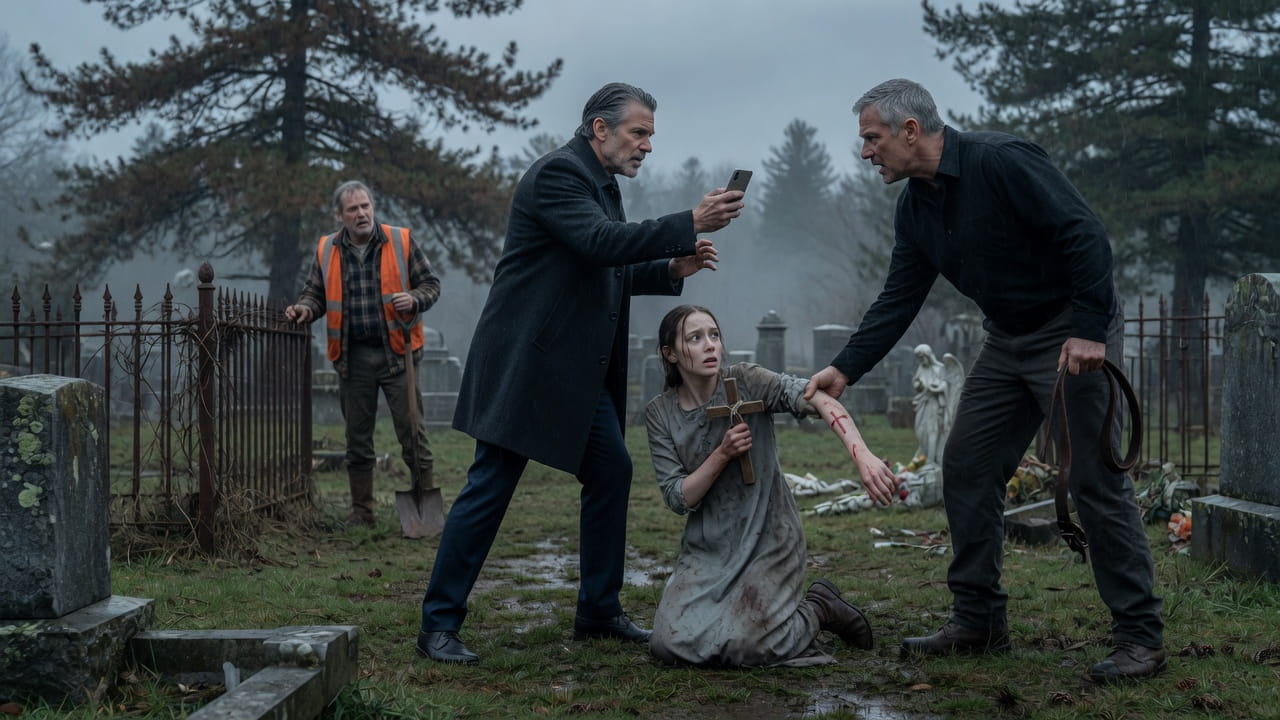
“Show him the mark, Leah. Let the architect see the filth he’s trying to protect.”
I didn’t know the man in the black shirt, but I knew the way the girl was shaking. She was curled into a ball on the wet grass of my wife’s final resting place, looking like she expected the earth to open up and swallow her whole.
I’d spent ten months grieving Rachel. Ten months missing the way she’d look at the pine trees behind our house with a look that wasn’t peace—it was vigilance. I always called it her ‘commune upbringing.’ A strict, quiet life she’d walked away from to become the woman I loved.
But when that man yanked up the girl’s sleeve, my heart didn’t just stop. It shattered.
The brand on her wrist was raw, red, and identical to the mark Rachel told me was a childhood accident. The same twisted cross. The same jagged edges.
“Get your hands off her,” I said, my voice sounding like it belonged to someone else. I stepped between them, my phone recording every second of the man’s cold, predatory sneer.
“She’s a runaway, Mr. Harris,” the man said, his voice as smooth as polished stone. “Just like your Rachel was. And you know what we do to things that run from the Wall.”
The girl, Leah, grabbed the hem of my coat. Her fingers were ice. “He’s going to take me back,” she whispered. “Please. He’s going to put me in the hole.”
The groundskeeper was watching us from the gate, his hand hovering over his radio, but he didn’t move. No one moved. In that second, I realized that my wife hadn’t left a commune. She’d escaped a nightmare. And that nightmare just followed her home.
Chapter 1
The rain in Sullivan County didn’t fall so much as it drifted, a fine, grey needle-point mist that turned the hemlocks into ghosts. David Harris stood by the granite headstone, his boots sinking into the soft, over-saturated turf of the Hillside Cemetery. He was a man of lines and right angles—an architect who found comfort in the structural integrity of a well-placed beam—but standing here, everything felt unanchored.
Rachel Harris. 1980–2025. Beloved Wife.
It was a lie. Not the dates, and certainly not the “beloved” part, but the name itself. Rachel hadn’t been Rachel until she was twenty-one. Before that, she was someone else, a girl from a place she only referred to as “the Farm.” She’d told him stories of hand-cranked wells and kerosene lamps, of a childhood of silence and labor that made her appreciate the humming electricity and loud, chaotic beauty of the modern world. He’d bought it. He’d bought it because he wanted to believe he was her savior, the man who had given her the life she deserved.
A twig snapped.
David didn’t turn immediately. He was used to the local deer, or the occasional groundskeeper moving through the back plots. But the sound was heavy, followed by a sharp, hitched breath that didn’t belong to an animal.
He turned slowly. Twenty feet away, near a massive, moss-covered oak, a girl was huddled against the trunk. She looked like an apparition from the nineteenth century. She wore a long, shapeless dress of heavy grey cotton, the hem caked in red mud. Her blonde hair was pulled back in a braid so tight it looked painful, and her skin was the color of unbaked dough.
“Hello?” David said. His voice felt too loud for the mist.
The girl flinched. It wasn’t a startle; it was a total bodily collapse, a frantic cowering that sent her onto her knees. She covered her head with her hands, her shoulders shaking with a violence that made David’s stomach roll.
“Hey, it’s okay,” he said, taking a cautious step forward. “I’m not going to hurt you. Are you lost?”
The girl looked up. Her eyes were wide, the pupils blown out despite the dull light. She looked at the headstone, then back at David. Her lips moved, but no sound came out.
“Rachel?” she finally whispered. Her voice was thin, reedy, and used a cadence David hadn’t heard in years—the same precise, antique way Rachel used to speak when she was exhausted or dreaming.
David froze. “How do you know that name? Who are you?”
The girl didn’t answer. She scrambled toward the headstone on all fours, her movements desperate and animalistic. She reached out a hand, her fingers trembling as she traced the carved letters of Rachel’s name. Tears began to carve tracks through the dirt on her cheeks.
“She’s gone,” the girl said. It wasn’t a question. It was a realization that seemed to break the last of her strength. She slumped against the granite, her forehead resting against the cold stone. “The Father said she burned. He said the fire took her the night she broke the covenant. He said the demons claimed her.”
“What are you talking about?” David knelt beside her, his hand hovering over her shoulder. He was afraid to touch her; she looked like she might shatter if he applied even a pound of pressure. “Who is the Father? Did Rachel know you?”
The girl pulled back, looking at him with a sudden, piercing intensity. “She was my sister. She was my Mercy.”
David’s heart did a slow, heavy thud against his ribs. Rachel had told him she was an only child. She’d told him her parents had died in a barn fire shortly after she left. He’d spent fifteen years believing in a vacuum, a history that began and ended with her arrival in New York City with nothing but a bus ticket and a change of clothes.
“She had a sister?” David asked, his voice barely audible.
The girl didn’t answer. Instead, she reached for the cuff of her left sleeve. She hesitated, her eyes darting toward the cemetery entrance as if expecting a predator to crest the hill. Then, with a sudden, jerky motion, she yanked the fabric up.
David recoiled.
On the inside of her wrist, the skin was a mess of puckered, angry scar tissue. It was a brand—a twisted cross with a horizontal bar that hooked downward at the ends, like a scythe. It was fresh, the edges still weeping a clear, yellowish fluid, the center a raw, blistered red.
“The Wall is high,” the girl whispered. “But the Father’s reach is longer.”
David stared at the mark. He knew it. He knew it with a sickening, visceral certainty. Rachel had the same mark on the same wrist. She’d told him it was a birthmark, a “strawberry hemangioma” that had scarred over when she was a toddler. He had kissed that mark a thousand times. He had traced it with his thumb while they watched movies. He had never once questioned it.
“My name is David,” he said, trying to keep his voice from shaking. “I was Rachel’s husband. I… I lived with her for fifteen years. She never told me about you.”
The girl’s face hardened, a flicker of old, inherited resentment crossing her features. “She couldn’t. To speak of the lost is to invite the shadow. She chose the world. She chose the fire. But she was supposed to come back for me.”
“I didn’t know,” David said. “If I had known—”
“It doesn’t matter,” the girl snapped. She looked toward the road again, her body tensing like a coil. “He’s coming. He’s been behind me since the crossing. He smells the rot on me.”
“Who?”
“Thomas.” The name came out as a hiss of pure terror. “The Hound of the Wall. He doesn’t stop, David Harris. He doesn’t sleep. He brings the rod and the rope.”
Before David could ask another question, a black SUV pulled onto the gravel shoulder of the cemetery road. The engine didn’t die; it idled with a low, predatory rumble. The door opened, and a man stepped out. He was tall, dressed in black canvas that seemed to absorb the grey light. He didn’t run. He didn’t shout. He simply began to walk toward them with the measured, inevitable pace of a man who knew his prey had nowhere left to run.
The girl let out a low, keening sound and tried to bury herself behind the headstone. David stood up, his hands balling into fists. He was an architect, not a fighter. He spent his days arguing about zoning laws and load-bearing walls. But as the man in black approached, David felt a surge of something primal and protective, a residue of the love he still held for the woman buried beneath his feet.
“Stay behind me,” David told the girl.
The man stopped ten feet away. He had a face like a topographical map of a desert—dry, lined, and merciless. His eyes were a pale, washed-out blue that seemed to look right through David.
“Peace be with you, friend,” the man said. His voice was a deep, melodic baritone that belonged in a pulpit. “I see you’ve found our wayward lamb. We’ve been very worried about her.”
“She’s not going anywhere with you,” David said.
The man smiled. It was a small, thin movement of the lips that didn’t reach his eyes. “You must be the husband. The one who lived in the shadow of Mercy’s sin. You have my pity, David. To love a liar is a heavy burden.”
“Who the hell are you?”
“I am Thomas,” the man said. He took a step forward, and the girl behind David whimpered, a sound of such absolute brokenness that David felt a chill go down his spine. “And that girl is Leah. She belongs to a family that misses her dearly. Now, step aside. We don’t want to bring the world’s noise into this sacred place.”
David didn’t move. He felt the cold rain on his neck and the weight of the girl’s hand clutching his coat. He looked at the brand on the man’s own hand—the same twisted cross, tattooed in black ink on his webbing. The secret was out, the wall was crumbling, and David Harris was the only thing standing between the girl and the shadow.
Chapter 2
The drive back to David’s house was a blur of wipers and silence. Leah sat in the passenger seat, curled so tightly into the footwell that she was almost invisible. Every time David hit a pothole or changed gears, she flinched, her eyes darting to the side-view mirror.
“He’s not behind us,” David said, his voice sounding hollow in the cabin of his Audi. “I checked. I took the back roads through Neversink. We’re safe for now.”
Leah didn’t look at him. She was staring at the dashboard, specifically the digital clock. “The numbers change,” she whispered. “Without the sun. How do you know when to pray?”
“We don’t,” David said. “We just… we live.”
His house was a masterpiece of modern glass and cedar, perched on a ridge overlooking the valley. It was a house built on transparency, on light, on the idea that nothing should be hidden. Standing in the driveway, David felt a sudden, sharp irony. He had built this for Rachel. He had designed every window so she could see the world she had chosen. He never realized she was using them to watch for the world she’d left behind.
Inside, the air was still and smelled of the cedar oil Rachel had loved. Leah stood in the foyer, her boots leaving clumps of red mud on the polished concrete. She looked at the high ceilings and the open-concept living room with a look of profound physical illness.
“It’s too big,” she said. “The air is too thin. Where are the walls?”
“It’s an open plan,” David said, trying to sound normal. “I’m an architect. I design houses.”
“You design cages of light,” Leah said. She walked over to a floor-to-ceiling window and touched the glass with one trembling finger. “In the Wall, we have small windows. To keep the focus on the Spirit. This… this is an invitation for the Eye.”
“Sit down, Leah. I’ll get you some water. Some food.”
“I cannot eat the bread of the world,” she said, though her stomach let out a treacherous, audible growl.
David went into the kitchen, his hands shaking as he poured a glass of filtered water. He leaned against the marble island, closing his eyes. His life had been a series of calculated risks and structural certainties. He had a reputation. He had a legacy. And now, he had a girl in his living room who looked like she’d escaped a labor camp, and a man named Thomas who looked like he’d enjoy burning his house to the ground.
He returned to the living room to find Leah standing in front of a framed photo of Rachel. It was from their honeymoon in Big Sur. Rachel was laughing, her hair windblown, the Pacific Ocean a crashing blue behind her.
“She looks happy,” Leah said. There was no joy in her voice, only a deep, stinging resentment. “She looks like she forgot the price.”
“What price, Leah? What was the ‘Wall’?”
Leah turned to him, her face illuminated by the stark, late-afternoon light. “The Compound of the Seventh Seal. The Father says the world ended in 1994. He says everything outside the Wall is a projection of the Enemy. A test. A beautiful, rotting lie designed to trap the soul.”
“And Rachel? She escaped?”
“She was the first,” Leah said. She sat on the edge of the designer sofa, looking like a piece of grit in a precision-machined engine. “She was the Mercy. She was supposed to lead the way. She told me she would find a place, a safe house, and then she would send for me. I waited ten years, David Harris. I waited in the silence. I waited through the cleansings. I waited through the branding.”
She held up her wrist again. The raw red scythe seemed to pulse in the twilight.
“I didn’t know,” David whispered. “She never said a word. She told me she was from a farming commune. She told me it was just… old-fashioned.”
“She was protecting herself,” Leah said. “And she was protecting you. If you knew the truth, you became an accomplice. The Father doesn’t just punish the runaway. He punishes the one who hides them.”
David looked out the window. The valley was darkening, the lights of the small town below beginning to flicker on. For the first time in his life, those lights didn’t look like progress. They looked like targets.
“I need to call the police,” David said, reaching for his phone.
“No!” Leah lunged for him, her movements surprisingly fast. She grabbed his arm, her grip like iron. “No police. Thomas has friends in the low places. The Sheriff in the valley… he’s a Brother. The judge in the county… he’s a Friend. If you call them, you are just calling the Hound to the door.”
David pulled back, his mind racing. He thought of the local cops he’d worked with on building permits. He thought of the small-town handshakes and the quiet, insular nature of Sullivan County. Was it possible? A fundamentalist cult operating in the shadows of the Catskills, its influence seeping into the very infrastructure of the town?
“Then what do I do?” David asked.
“You find the map,” Leah said.
“The map?”
“Mercy—Rachel—she told me she would hide the map to the Wall. She said if I ever got out, I should find her, and we would find the others. There are twelve of us still inside, David. Twelve girls who haven’t seen the sun without a veil in a decade. She promised.”
David looked at his wife’s desk in the corner of the room. It was a simple, elegant piece of mid-century modern furniture. He’d gone through it a dozen times after the funeral—bills, old letters, fabric swatches. There was nothing there.
“I’ve looked through everything, Leah. There’s nothing.”
“She wouldn’t put it where the world could see,” Leah said. She stood up and walked toward the master bedroom. “She would put it in the architecture. She said you were a man who built secrets into the wood.”
David followed her, a cold sweat breaking out on his forehead. He hadn’t built any secrets. He prided himself on the honesty of his materials. But as he watched Leah run her hands along the cedar paneling of their bedroom, he remembered the week Rachel had spent ‘refinishing’ the built-in headboard while he was away at a conference in Chicago. She’d claimed she wanted to surprise him.
Leah stopped. She pressed her ear against the wood, tapping lightly. Thump. Thump. Hollow.
“Here,” she said.
David stepped forward. He felt the seam of the wood, a nearly invisible line where the grain didn’t quite match. He pressed his thumb into a knot in the cedar, and with a soft, mechanical click, a small panel popped open.
Inside was a leather-bound journal and a hand-drawn map on vellum. But it wasn’t the map that caught David’s breath. It was the photograph tucked into the front cover.
It was Rachel. She was nineteen, her head shaved, her eyes hollow and haunted. She was standing in front of a high, windowless wall of grey stone. Beside her was a man David recognized instantly—Brother Thomas, younger, but with the same cold, predatory eyes. He had his hand on her throat.
On the back of the photo, in Rachel’s elegant, precise handwriting, were four words:
The Wall never ends.
A heavy thud echoed from the front of the house. Someone was kicking the door. Not a frantic kick, but a steady, rhythmic pulse of violence.
“David Harris!” Thomas’s voice boomed through the glass, distorted and terrifying. “The sun has set. The grace period is over. Open the door and give us the girl, or we will bring the fire to the ridge.”
David looked at the map, then at Leah. He was a man of logic. He was a man of safety. But as he looked at the brand on the girl’s wrist and the photo of his wife’s suffering, the architect in him realized that the only way to save the structure was to burn the rot at the foundation.
“Get in the closet,” David said, his voice flat and dangerous. “And don’t come out until I tell you.”
He walked to the mudroom and grabbed the heavy iron fire-poker. He didn’t know if he could kill a man, but as he stood in his house of glass, watching the shadow of Brother Thomas grow long against the floor, he knew he was done being a witness.
Chapter 3
The morning air in the valley was thick with the scent of wet pine and woodsmoke. David hadn’t slept. He sat in a booth at Miller’s Diner, a nondescript grease-trap on the edge of town where the locals gathered to complain about the weather and the taxes. Leah was beside him, hooded in one of Rachel’s old oversized sweatshirts, her hands buried in the sleeves to hide the brand.
He had driven her away from the house at three in the morning, slipping out the back through the woods before Thomas could make good on his threat. He didn’t know where else to go. The diner felt like a neutral ground—a place with too many witnesses for a kidnapping, or so he hoped.
“Eat something,” David urged, pushing a plate of dry toast toward her.
Leah stared at the fluorescent lights humming above them. “The light is angry,” she whispered. “It sounds like bees.”
“It’s just electricity, Leah. Focus on the food.”
The bell above the door chimed. David’s muscles locked. He watched the reflection in the window as two men walked in. They weren’t Thomas. They were younger, wearing flannel shirts and work boots, looking like any other crew heading to a job site. But they didn’t go to the counter. They took a booth three rows back, facing David.
One of them, a man with a thick red beard and eyes that were too still, caught David’s gaze and nodded. A slow, deliberate nod.
“They’re here,” Leah breathed, her voice trembling. “The Watchmen. They’re everywhere in the valley, David. They provide the labor. They fix the roofs. They keep the peace.”
“They’re just guys, Leah,” David said, though his pulse was drumming in his ears.
He saw Detective Mills at the far end of the counter, nursing a mug of black coffee. Mills was a twenty-year veteran of the Sullivan County Sheriff’s Department—a man who prided himself on knowing every secret in the zip code. David stood up, ignoring Leah’s panicked hiss, and walked over to the counter.
“Detective,” David said.
Mills looked up, his eyes bleary and rimmed with red. “Harris. Sorry about your wife. Tough break.”
“I need to talk to you about something. Something serious.”
Mills sighed, setting his coffee down. “If this is about the zoning on that new development, David, you know I can’t—”
“It’s not about zoning. It’s about a girl. And a cult.”
The entire diner seemed to go quiet. The clatter of silverware stopped. The hum of the grill felt suddenly deafening. Mills’s expression shifted from boredom to a sharp, guarded neutrality.
“You want to repeat that, David?”
“There’s a group,” David said, lowering his voice. “They call themselves the Seventh Seal. They’ve got a compound somewhere in the hills. They’re branding people, Mills. Holding them against their will.”
Mills looked past David, toward the booth where Leah sat huddled. He looked at the two men in flannel. Then he looked back at David, and for a split second, David saw something in the detective’s eyes—not surprise, but a deep, weary recognition.
“David,” Mills said, his voice low and dangerous. “This is a small county. We have a lot of… eccentric groups in the woods. Survivalists, monks, people who just want to be left alone. As long as they don’t break the law, we don’t bother them.”
“They are breaking the law! They’re kidnapping runaways. They tried to break into my house last night.”
“Did you see a face?”
“Brother Thomas. He’s the leader, or a tracker.”
Mills let out a short, dry laugh. “Thomas Miller? He’s a deacon at the Grace Chapel. He runs a youth outreach program. He’s probably just trying to get that girl back to her legal guardians.”
“She’s nineteen, Mills! She doesn’t have guardians. She has captors.”
The two men in the back booth stood up. They didn’t move toward David. They moved toward Leah.
“Excuse me,” the one with the red beard said, his voice surprisingly gentle. “Miss? I think you dropped this.”
He held out a small, black book—a Bible.
Leah looked up, her face white. She didn’t reach for the book.
“We’ve been looking for you, Leah,” the man said. “The Father is very disappointed. He says the spirit is willing, but the flesh is weak.”
“Leave her alone,” David shouted, turning away from the counter.
“David, sit down,” Mills commanded, his hand moving toward his belt. Not his gun, but his radio.
The man with the red beard reached out and grabbed Leah’s hood, yanking it back. The girl screamed, a raw, jagged sound that tore through the diner. In the harsh fluorescent light, her pale, terrified face and the bruised skin around her neck were exposed for everyone to see.
“Look at her!” David yelled at the room. “Does this look like a ‘youth outreach’ project?”
The waitress behind the counter looked away. An old man in the corner booth went back to his newspaper. No one moved. The silence in the diner wasn’t accidental; it was practiced. It was the silence of a town that had been bought and paid for in small favors and quiet threats.
The man with the red beard leaned down, his face inches from Leah’s. “You’re making a scene, sister. It’s unseemly. You remember what happens to the unseemly.”
He didn’t hit her. He didn’t shove her. He simply picked up her glass of water and poured it slowly over her head. The water soaked through her sweatshirt, making her shiver.
“Purity through water,” the man whispered. “But the fire comes next.”
“That’s enough!” David lunged forward, shoving the man back.
The red-bearded man didn’t fight back. He stepped away, holding up his hands, a mocking smile on his face. “Assault, Detective. You saw that, right?”
Mills stood up, his face a mask of bureaucratic indifference. “Harris, I think you need to go home. You’re grieving. You’re not thinking straight. And the girl… maybe she belongs with people who understand her ‘condition’.”
David looked around the diner. He saw the “Watchmen” in their flannel shirts, the silent locals, and the detective who was looking at his watch. He realized then that he wasn’t in a diner in upstate New York. He was in the foyer of the Wall.
He grabbed Leah’s hand. She was limp, her spirit seemingly crushed by the public display of power.
“We’re leaving,” David said.
He marched her toward the door. As he passed Mills, the detective leaned in and whispered, “Don’t go back to the ridge, David. The roads are closed for ‘maintenance’ today. You’d be better off heading toward the city. And don’t stop for gas.”
It was the only piece of help Mills was willing to give—a warning wrapped in a dismissal.
As they stepped out into the cold morning air, David saw the black SUV idling at the edge of the parking lot. Brother Thomas was behind the wheel, his eyes fixed on David. He didn’t follow them. He didn’t have to. He knew where they were going, because there was only one place left for David to look.
The map in Rachel’s journal didn’t lead to a safe house. It led to the center of the labyrinth.
Chapter 4
The cabin was a rotting husk of timber and tarpaper, hidden at the end of a logging road that even the local topographic maps ignored. According to the vellum sheet David had found in the headboard, this was the “Anchor”—the place where the runaways were supposed to meet the “Saviors.”
David killed the lights a mile back and coasted the Audi into a thicket of mountain laurel. He and Leah walked the rest of the way, the woods pressing in on them. Leah was clutching the leather journal to her chest like a shield.
“This is it,” David whispered, looking at the coordinates.
The cabin wasn’t empty. A faint orange glow flickered through the cracks in the boards. David gripped the fire-poker, his knuckles white. He signaled for Leah to stay back and approached the door. It was hanging on one hinge. He pushed it open.
Inside, the air was thick with the smell of old paper and wood rot. A woman was sitting at a rickety table, illuminated by a single kerosene lamp. She looked sixty, but her hands were as steady as a surgeon’s as she sorted through piles of old photographs and handwritten ledgers.
She looked up as David entered. She didn’t look surprised.
“You took your time, Architect,” she said. Her voice was like gravel in a tin can.
“Who are you?”
“I’m the one who didn’t get out,” the woman said. She gestured to her legs, which were covered by a heavy wool blanket. She was in a makeshift wheelchair made from a kitchen chair and bicycle wheels. “Name’s Sarah. I was Rachel’s ‘Mercy’ before she was yours.”
Leah stepped into the light, her eyes wide. “Apostate Sarah?”
The woman smiled, a grim, toothless thing. “That’s what the Father calls me. I call myself the Librarian. I keep the records Thomas tries to burn.”
David stepped forward, laying the journal on the table. “My wife… Rachel. She left this for us. She said there was a map. A way to stop them.”
Sarah opened the journal, her fingers tracing the handwriting with a tenderness that made David’s throat ache. “Rachel was the best of us. She knew the Wall wasn’t just stone and wire. It’s money, David. It’s land. It’s the deeds to half the county.”
She flipped to the back of the journal, where a series of bank routing numbers and offshore account details were listed in tiny, cramped script.
“The Seventh Seal isn’t a religion,” Sarah said. “It’s a laundering operation. The Father—his real name is Elias Thorne—he’s been buying up the valley for thirty years. He uses the ‘Brothers’ as cheap labor to build his developments, and the ‘Sisters’ to… well, to keep the Brothers happy and the bloodlines pure.”
“And the brands?” David asked.
“Ownership markers,” Sarah said. “Like cattle. If a girl runs, the brand tells the world she’s ‘damaged goods.’ It tells the police she’s a mental patient from the Farm. It’s a genius system of social exile.”
David looked at the ledgers. He saw names he recognized—local contractors, the head of the school board, the cousin of the county DA. It was a network of corruption that made his stomach churn. Rachel hadn’t just been hiding from a cult; she’d been hiding the evidence of a criminal empire.
“Why didn’t she go to the FBI?” David asked.
“Because the FBI doesn’t care about a ‘crazy’ girl with a burn on her wrist,” Sarah said. “And because she knew that as soon as she spoke, the Father would kill everyone still inside. Including Leah.”
Leah let out a sob. “He’s going to kill them anyway. He said the cleansing is coming. He said the Wall must be purified with fire before the world ends.”
“When?” David asked.
“Tonight,” Sarah said, her voice dropping to a whisper. “The winter solstice. It’s their ‘Day of Accounting.’ They’re moving all the girls to the inner sanctum. Once the doors are barred, they won’t open again.”
David looked at the map. The Compound was located in a natural basin called Dead Man’s Hollow. It was surrounded by steep ridges, with only one road in and out.
“I can’t call the cops,” David said, mostly to himself. “I can’t go to the feds in time. I’m an architect. I know how structures fail.”
“You’re going to try to break in?” Sarah asked. “Thomas has guards. They have rifles.”
“I don’t need to break in,” David said, his mind clicking into gear, the architectural blueprints of the county’s infrastructure surfacing in his memory. “The Compound was built on the site of an old iron mine. I did the survey for the drainage system for the new development nearby three years ago. They tapped into the old mine shafts for their greywater.”
He pointed to a spot on the map. “There’s a vent. A reinforced concrete shaft that leads directly into the basement of the main hall. If I can get in there, I can open the doors from the inside.”
“And then what?” Leah asked. “They’ll hunt us down.”
“Then,” David said, reaching for his phone, “we make sure the whole world is watching.”
He began to type—not a message to the police, but a series of emails to every major news outlet in the state, attached with scans of the bank records from Rachel’s journal. He set them on a delayed-send timer.
“In four hours, this goes public,” David said. “If we’re not out by then, at least the Father won’t be able to hide the smoke.”
A sharp, metallic ping echoed through the cabin. A bullet shattered the kerosene lamp, plunging the room into darkness.
“Down!” David yelled, tackling Leah to the floor.
Outside, the woods were alive with the sound of engines. Headlights cut through the trees, sweeping across the cabin like searchlights.
“David Harris!” Thomas’s voice was closer now, amplified by a megaphone. “You’ve entered the sanctuary of the wicked. You have the Word of the Father in your hands, but you have the heart of a thief. Give us the girl and the book, and we will let you walk back to your glass house.”
David looked at the darkness, then at the girl trembling beside him. He felt the weight of the fire-poker in his hand. He thought of Rachel, and the fifteen years of silence she’d endured to keep him safe.
“The glass house is already broken, Thomas!” David shouted back.
He grabbed the journal and the map, shoving them into Leah’s hands. “Sarah, can you get to the cellar?”
“There’s a tunnel to the creek,” the old woman said, pulling a sawed-off shotgun from beneath her blanket. “Go. I’ll give them something to think about.”
“David, don’t leave me,” Leah pleaded.
“I’m not leaving you,” David said, his voice cold and certain. “We’re going to the Wall. And we’re going to tear it down.”
He kicked out the back window of the cabin just as the first volley of gunfire ripped through the front door. They tumbled into the snow, the cold stinging David’s skin, but all he could feel was the heat of a fifteen-year-old lie finally catching fire.
The architect was done building. It was time to demolish.
Chapter 5
The snow didn’t crunch under David’s boots; it yielded with a wet, heavy sigh. He and Leah moved through the dense stand of hemlocks behind the cabin, the sounds of the assault still echoing through the valley. The sharp, rhythmic crack-crack of the Watchmen’s rifles was answered by the sudden, guttural roar of Sarah’s shotgun. It was the sound of a woman who had been waiting twenty years to settle a debt, and it made David’s chest tighten with a mixture of gratitude and guilt. He was leaving her to die in a rotting cabin so he could chase a ghost and a mining shaft.
“Don’t look back, Leah,” David whispered, his hand tight on her shoulder. Her breath was coming in ragged, shallow hitches, her sweatshirt already soaked through from the melting snow and the water the Watchman had poured over her. She was shivering with a violence that felt structural, as if her very bones were vibrating loose.
“The Father said the woods belong to the shadows,” Leah murmured, her voice sounding small and distant. “He said the trees have eyes that report to the Wall.”
“The trees are just wood and bark, Leah. Focus on my footsteps. Just my footsteps.”
David checked his watch. The glowing dial read 5:15 PM. The winter solstice meant the sun was already a memory, replaced by a bruised purple twilight that was rapidly fading into a total, oppressive black. He pulled the small LED flashlight from his coat pocket but didn’t turn it on. He didn’t need to. He knew this terrain. He had spent three months surveying the adjacent property for the Highland Estates project, a high-end development that Thorne’s front companies had successfully blocked in court. At the time, David thought it was just local NIMBYism. Now he knew it was a perimeter defense.
They reached the edge of the ridge overlooking Dead Man’s Hollow. Below them, the Compound was visible as a cluster of stark, windowless buildings arranged in a perfect, chilling circle. It looked less like a farm and more like a panopticon. A high stone wall, topped with jagged glass and rusted wire, enclosed the inner sanctum. In the center of the courtyard, a massive bonfire was being built. Even from the ridge, David could see the figures moving around the flames—men in dark coats, and a line of smaller, pale figures in grey dresses. The girls.
“They’re starting,” Leah whispered, her fingers digging into David’s arm. “The Accounting. They bring the ledgers out first. Then the cleansings.”
“We’re going to get them out. All of them.”
David led her down the steep, icy incline toward the eastern slope. This was the site of the old Blackwood Iron Mine, closed since the late fifties. The entrance had been blasted shut decades ago, but the ventilation shafts remained—hidden, reinforced concrete tubes designed to draw air from the deep pockets of the mountain. David had found one during his survey, tucked behind a screen of invasive knotweed and rusted equipment.
The vent was exactly where he remembered it. It looked like a tombstone for an industrial giant, a four-foot-wide concrete pipe protruding from the earth at a forty-five-degree angle. The heavy iron grate was secured by a rusted chain and a padlock the size of a man’s fist.
David pulled the fire-poker from his waistband. It was a crude tool for a man used to precision instruments, but he jammed the hooked end into the link of the chain and put his entire weight behind it. He wasn’t thinking about leverage or torque; he was thinking about the photo of Rachel with Thomas’s hand on her throat. He was thinking about fifteen years of nightmares he had tried to medicate with architecture.
The chain snapped with a metallic ping that felt loud enough to wake the valley. David shoved the grate aside, the rusted hinges screaming. A rush of warm, damp air hit him—the breath of the earth, smelling of wet stone and ancient iron.
“I go first,” David said. “I’ll reach back for you. It’s a ten-foot drop to the first landing, then a ladder.”
“I can’t go into the dark,” Leah said, her eyes fixed on the black maw of the pipe. “The Father says the dark is where the unmade live.”
David took her face in his hands. Her skin was freezing, her pulse erratic beneath his palms. “Leah, listen to me. Your sister went through darker things than this to get to me. She spent fifteen years building a world for us so you would have somewhere to run. Don’t let her work go to waste. The dark is just a place without light. It doesn’t have power over you unless you give it permission.”
He saw a flicker of Rachel’s steel in the girl’s eyes. She nodded, once, a jerky motion of the head.
David lowered himself into the pipe. The concrete was slick with condensation, and he slid down the incline until his boots hit a rusted steel platform. He clicked on the LED light. The beam cut through the heavy, stagnant air, revealing a vertical shaft that dropped another thirty feet into the belly of the mountain. A series of iron rungs were bolted into the wall, orange with thick, flaky rust.
He reached up and helped Leah down. She landed beside him, her grey dress catching on a jagged edge of the pipe. She didn’t cry out. She just stared down into the abyss.
“One step at a time,” David said.
The descent was a slow-motion nightmare. Every rung groaned under their weight, sending showers of rust into the dark below. David went first, placing his feet carefully, testing each bolt before letting Leah follow. The air grew thicker, tasting of copper and old oil. His architect’s mind began to map the space—the resonance of their breathing, the way the sound of the wind died away, replaced by a low, mechanical hum.
That hum was his North Star. It was the ventilation system for the Compound’s basement.
They reached the bottom of the shaft after what felt like hours. It opened into a narrow, low-ceilinged tunnel where the walls were reinforced with rotting timber beams. Water dripped from the ceiling, creating shallow, black pools on the uneven floor. David checked the map Sarah had given him.
“This way,” he whispered.
They moved through the tunnel, David’s light dancing across the walls. He saw the marks of the old miners—initials carved into the rock, rusted pickaxe heads, a discarded leather boot that looked like a mummified foot. But then, the texture of the tunnel changed. The rough-hewn rock gave way to smooth, poured concrete. The hum grew louder, a vibrating pulse that David could feel in his teeth.
He found the access hatch. It was a heavy steel door set into the concrete wall, marked with a faded stencil: SECTOR 4 – MAINTENANCE.
David pressed his ear to the cold steel. He heard the sound of footsteps—heavy, rhythmic, and numerous. Then, a voice. It wasn’t Thomas. It was older, more resonant, carrying a weight of absolute, unshakeable authority.
“The ledgers are full, Brothers,” the voice said. “The debt of the world has reached its limit. Tonight, we settle the accounts. Bring the first group.”
“That’s him,” Leah whispered, her voice a ghost of a sound. “Elias Thorne. The Father.”
David felt a cold, sharp clarity wash over him. He wasn’t just in a basement; he was under the foundation of the thing that had broken his wife. He looked at the fire-poker, then at the smartphone in his pocket. The delayed-send timer had one hour left. One hour until the bank records hit the wires. One hour until the “Watchmen” became targets for the FBI.
But a lot could happen in an hour.
David gripped the handle of the access hatch. It was locked from the other side, but he noticed the hinges were on his side—a security oversight common in structures built by people more concerned with keeping people in than keeping them out.
He pulled a small multi-tool from his pocket and began to work on the hinge pins. His hands were steady. He was an architect. He knew that even the strongest wall was only as good as its weakest joint. He tapped the first pin loose, then the second. The heavy door groaned, leaning inward.
David caught it before it could slam, easing it down onto the concrete floor.
The room beyond was a stark, windowless cellar filled with industrial-sized shelving. Thousands of glass jars were lined up in neat, obsessive rows—preserved peaches, green beans, carrots. It looked like a survivalist’s dream, a hoard against the end of the world. But at the end of the aisle, a heavy oak door was slightly ajar, spilling a sliver of golden light onto the floor.
David and Leah crept toward the light.
Beyond the door was the Main Hall of the Compound. It was a massive, barn-like structure with high, vaulted timber ceilings. In the center of the room, dozens of girls in grey dresses were huddled together, their heads bowed. They were surrounded by men in dark coats, each holding a heavy leather-bound ledger. At the head of the room, standing on a raised wooden platform, was Elias Thorne.
He was a man who looked like he had been carved out of an old cedar stump—gnarled, grey, and immovable. He wore a simple white linen shirt and black trousers, his feet bare. He didn’t look like a monster. He looked like a grandfather who had spent too much time in the sun. But in his hand, he held a long, iron rod, the end glowing orange in a small portable brazier.
“Mercy was the first to fail us,” Thorne said, his voice filling the hall. “She brought the rot of the world into our sanctuary. She lied, she stole, and she ran. And now, her sister has followed in her footsteps.”
He looked at the empty space in the line where Leah should have been.
“But the Father is just,” Thorne continued. “The debt must be paid. If the sister will not stand for the cleansing, then the group must share the burden.”
He stepped toward a small girl at the front of the line. She couldn’t have been more than twelve. She was shaking so hard the hem of her dress was fluttering.
“No,” Leah whispered, her hand reaching for the door.
“Wait,” David said, catching her wrist. “We need to get them to the mine shaft. If we just run out there, they’ll kill us.”
“He’s going to burn her, David! Look at the rod!”
Thorne raised the glowing iron. The girls in the room let out a collective, low moan—a sound of practiced, ritualized grief. The “Watchmen” stood like statues, their faces devoid of pity. This wasn’t a punishment to them; it was a transaction.
David looked at the high vaulted ceiling. He saw the main support beams—massive, hand-hewn timbers that held up the weight of the roof. And he saw the fire suppression system—an old, dry-pipe sprinkler array that looked like it hadn’t been tested since the Nixon administration.
He turned to Leah. “Can you lead them back through the mine? If I open the path?”
“What are you going to do?”
“I’m going to change the atmosphere,” David said.
He stepped back into the storage cellar and grabbed two large jars of preserved peaches. He broke the glass against the concrete floor, the sweet, syrupy smell filling the room. He took his lighter—the one he used for the fireplace in the house Rachel loved—and set fire to a stack of dry burlap sacks in the corner.
The fire caught instantly, licking up the wooden shelves. Smoke began to billow, thick and black, swirling toward the ventilation intake.
David waited until the smoke began to pour through the cracks in the oak door. Then, he grabbed the fire-poker and stepped into the Main Hall.
“Thorne!” David yelled.
The room froze. A hundred heads turned toward him. Thorne lowered the iron rod, his eyes narrowing as he peered through the gathering haze.
“The Architect,” Thorne said, a faint smile touching his lips. “You’ve come to see the foundation of your wife’s soul. I’m afraid you’re a bit late for the tour.”
“The foundation is rotten, Elias,” David said, his voice steady. “And the world is about to find out exactly how deep the rot goes.”
He pointed to the ceiling. The smoke had reached the heat sensors. With a sudden, violent clatter, the old pipes began to groan.
“Leah, now!” David shouted.
As the first jet of black, stagnant water erupted from the ceiling, the Main Hall descended into chaos.
Chapter 6
The water from the sprinkler system wasn’t clean; it was a foul, oily sludge that had sat in the pipes for decades, smelling of rust and decay. It rained down on the congregation in a drenching, suffocating torrent, dousing the brazier and turning the dirt floor into a slick, black mire.
The girls screamed, a high, chaotic sound that broke the ritual silence of the hall. The “Watchmen” hesitated, their discipline faltering as the smoke from the storage room began to fill the vaulted space. Thorne stood on his platform, the glowing iron rod now a cold, blackened piece of metal.
“Order!” Thorne bellowed, his voice cracking with rage. “Brothers, secure the lambs! The Enemy is among us!”
David didn’t wait for them to recover. He lunged toward the center of the room, swinging the iron fire-poker with a desperate, unrefined strength. He caught a Watchman in the shoulder, sending the man sprawling into the mud.
“Leah! The basement door! Go!”
Leah had emerged from the shadows, her hood down, her face a mask of terrifying resolve. She grabbed the twelve-year-old girl Thorne had been targeting and pulled her toward the cellar door. “Follow me!” she shouted to the others. “To the mine! To the light!”
It was a slow, agonizing break. The girls were terrified, their years of indoctrination fighting against the primal urge to flee. But when they saw Leah—the one they had been told was burned in the shadows—standing there alive, the spell broke. They began to surge toward the back of the hall, a wave of grey cotton moving through the black rain.
David stood his ground at the cellar door, a one-man bottleneck. A Watchman lunged at him, a heavy knife in his hand. David parried the blow with the poker, the vibration rattling his teeth, and shoved the man back into the darkness.
“You can’t save them, Harris!” Thomas’s voice cut through the din.
The tracker appeared from the smoke, his face streaked with soot and water. He wasn’t panicked; he was focused. He held a heavy-duty taser in one hand and a zip-tie restraint in the other. He didn’t want to kill David; he wanted to process him.
“You’re an architect, David,” Thomas said, stepping through the mud. “You should know when a structure is condemned. This place… it’s all they have. You take this away, they have nothing but the fire of the world.”
“They have a choice, Thomas,” David said, his chest heaving. “Something you never gave my wife.”
Thomas lunged. He was faster than David, a lifetime of hunting runaways making his movements efficient and brutal. He dodged David’s swing and drove his shoulder into David’s ribs, slamming him against the concrete doorframe. The air left David’s lungs in a sickening wheeze. He felt the cold prick of the taser against his neck.
A sudden, sharp crack echoed through the hall.
Thomas stiffened. He looked down at his chest, where a small, dark hole had appeared in his black canvas coat. He looked up at David, his eyes filled with a profound, quiet confusion. Then, his knees buckled, and he sank into the black mud.
David looked past him. Standing at the far end of the hall, framed by the smoke and the falling water, was Sarah. She was slumped in her makeshift wheelchair, her sawed-off shotgun resting on her knees, the barrels still smoking. She looked exhausted, her face the color of ash, but her eyes were fixed on Elias Thorne.
“The Accounting is here, Elias,” she croaked.
Thorne didn’t look at her. He was looking at the girls disappearing into the cellar. His empire was leaking out through a hole in the basement, and for the first time, the “Father” looked small.
“You’ve destroyed them,” Thorne said, looking at David. “They won’t survive a week in your world. They’ll be chewed up and spat out by the noise and the filth.”
“Maybe,” David said, sliding down the wall to catch his breath. “But they’ll be free to choose their own filth. That’s the deal, Elias. That’s the part you couldn’t stand.”
He pulled his phone from his pocket. The screen flickered to life. 100% Uploaded.
“The emails just went out, Elias. The bank records. The deeds. The photos of the brands. In twenty minutes, the state police will be at the gate. And they won’t be looking for ‘wayward lambs.’ They’ll be looking for a racketeering charge.”
Thorne looked at the phone, then at the burning storage room. The fire was spreading to the main timbers. The high, vaulted ceiling was beginning to groan as the heat warped the wood.
“Then let the fire have it,” Thorne whispered.
He didn’t run. He sat down on his wooden platform, folding his hands in his lap, and closed his eyes. He was a man who had built a wall to keep out the end of the world, and now that the wall was falling, he had nowhere else to go.
David scrambled to his feet. He grabbed Sarah’s wheelchair and began to pull her toward the cellar. “We have to go! The roof is coming down!”
They reached the mine shaft just as the first of the support beams shattered. The sound was like a thunderclap, a final, structural groan that shook the mountain.
The return trip through the mine was a blur of adrenaline and terror. David helped the girls up the ladder, one by one, their small hands shaking as they gripped the rusted rungs. Leah was at the top, pulling them into the cold, night air. When the last girl was out, David reached back for Sarah.
“Leave me, Architect,” she said, her voice barely audible over the roar of the fire above them. “I’ve been underground long enough.”
“No!” David reached down, grabbing her by the collar of her wool coat. He hauled her up with a strength born of pure, stubborn refusal. He wasn’t losing anyone else to this mountain.
They emerged from the ventilation vent into a world that felt fundamentally different. The valley was alive with sirens—blue and red lights snaking up the ridge road, a mechanical cavalry arriving just in time to witness the funeral pyre. The Main Hall was a column of orange flame, lighting up the sky, the smoke casting long, dancing shadows across the snow.
Leah was standing with the girls, a huddle of grey cotton in the white landscape. She looked at David, her face illuminated by the fire. She wasn’t crying. She looked like someone who had just woken up from a very long, very cold dream.
“Is it over?” she asked.
“The Wall is down, Leah,” David said.
The aftermath was a slow, messy reconstruction. The news of the Seventh Seal broke across the country like a levee failing. The “Watchmen” were rounded up, the bank accounts frozen, and the girls were moved to a state-run facility where they were met with a legion of therapists and social workers. It wasn’t a clean win. Some of the girls went back to their families; others drifted into the foster system, their eyes still searching for the Father in every crowd.
Leah stayed with David. There were lawsuits, of course— Thorne’s lawyers tried to claim David had kidnapped her—but the evidence in Rachel’s journal was too damning. Detective Mills “resigned” a month later, and the Grace Chapel was shuttered.
Six months later, David sat on his back porch, watching the sun set over the valley. The glass house didn’t feel like a cage anymore. It felt like a lens.
Leah came out, wearing a pair of blue jeans and a bright yellow t-shirt. Her hair was loose, falling over her shoulders in soft, blonde waves. She sat on the railing, looking at the distant ridge where the Compound had once stood. The state had razed the buildings, leaving nothing but a scar of red earth.
“I had a dream about her last night,” Leah said. “Mercy. She was in a garden. She wasn’t hiding.”
“She would be proud of you, Leah,” David said.
He looked at his own hands. They were scarred from the mine rungs, the skin calloused and rough. He had spent his life building things that were meant to last, but he realized now that the most important thing he’d ever done was help something fall apart.
He reached into his pocket and pulled out a small, silver locket he’d found in the debris of the Main Hall. Inside was a lock of Rachel’s hair and a tiny, hand-drawn map of the stars. It wasn’t a map to a place. It was a map to a feeling.
“What are we going to do now?” Leah asked.
David looked at the valley, the lights of the town flickering on, one by one. They didn’t look like targets anymore. They looked like possibilities.
“We’re going to build something else,” David said. “Something without walls.”
He stood up and walked toward the door, his shadow long and steady against the glass. He was an architect, and for the first time in his life, he knew exactly where the foundation began. It didn’t start with stone or wood. It started with the truth, and the courage to stand in the rain until the light came back.