
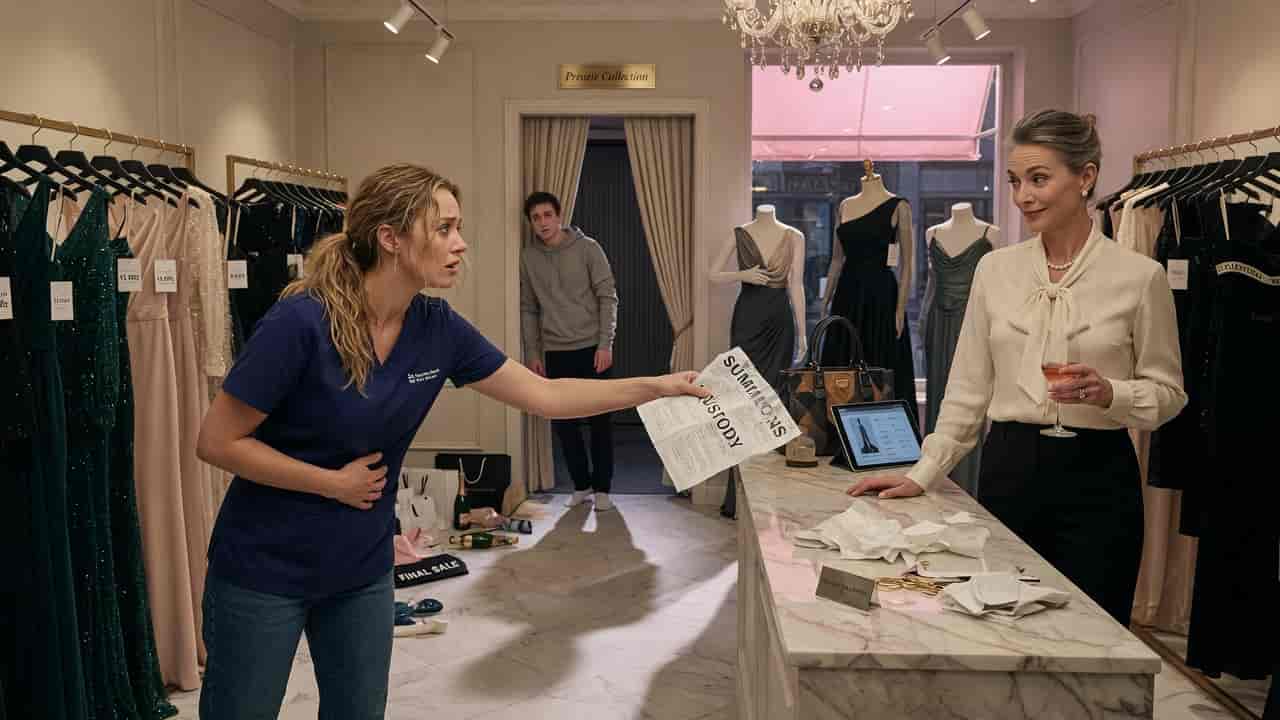
“You forged my name, Eleanor! You signed for a quarter-million dollars using my life as collateral!”
I stood in the middle of Eleanor’s boutique, the air smelling of expensive French lilies and the metallic tang of my own panic. I held the crumpled process server’s papers like a weapon, but Eleanor didn’t even blink. She just stood behind her marble counter, adjusted her pearl necklace, and took a slow, agonizing sip of Chardonnay.
“Don’t be so hysterical, Tess,” she said, her voice as smooth as the silk blouses she sold to women who actually had money. “Family helps family. You have a stable job and a roof over your head. I have a legacy to protect. It’s only fair that we share the burden.”
“Share the burden?” I looked at Marcus, my husband, who was standing by the door. He wouldn’t look at me. He was staring at his shoes, the same shoes I’d bought him for his birthday because he’d complained about his feet hurting. “Marcus, tell her. Tell her she can’t do this.”
Marcus cleared his throat but didn’t look up. “Tess, she was desperate. The shop was going under. We’ll figure it out.”
“We?” I felt the room spinning. The bank was coming for our house in thirty days because of a boutique I’d never even stepped foot in until today. Eleanor reached out, her perfectly manicured finger pushing the legal notice back toward me with utter contempt.
“Go home, Tess. You’re making the customers uncomfortable. It’s just paper. We’re family.”
The betrayal tasted like copper in my mouth. I realize now that I’m not just losing my house—I’m losing the man I thought I knew.
Chapter 1: The Public Serving
The fluorescent lights in the Great Lakes Dental Clinic always had a way of making everyone look like they were already dead. Tess leaned over the tray, carefully organizing the explorers and mirrors for Dr. Aris. It was 2:15 PM on a Tuesday, the kind of afternoon that usually bled into a blur of fluoride treatments and insurance paperwork.
“Tess, honey? There’s someone at the front desk for you.”
That was Brenda, the office manager. Her voice had a strange, tight quality to it. Tess straightened her navy blue scrub top, checking her reflection in the glass of the sterilization cabinet. She looked tired—the kind of tired that sleep didn’t fix. She and Marcus had been fighting about the “car repair” bills again, and the extra shifts she’d been picking up were starting to etch permanent lines around her eyes.
“Is it Marcus?” Tess asked, stepping into the hallway. “If he forgot his keys again, tell him I’m in the middle of a cleaning.”
“It’s not Marcus,” Brenda said, her eyes darting toward the waiting room.
The waiting room was full. Mrs. Gable was there with her twin toddlers, and Mr. Henderson was leafing through a three-month-old copy of National Geographic. Standing near the water cooler was a man in a wrinkled tan suit, holding a manila envelope. He looked bored, the way people look when they do a job that involves ruining someone else’s Tuesday.
“Tess Miller?” the man asked. His voice was loud enough to make Mr. Henderson look up.
“Yes?” Tess felt a cold prickle at the base of her neck.
“You’ve been served.”
He didn’t hand her the envelope; he practically shoved it against her chest. Tess caught it instinctively. The man checked a watch on his hairy wrist, scribbled something on a clipboard, and walked out the glass double doors without a second glance.
The silence in the clinic was heavy. Brenda was staring. Mrs. Gable was pretending not to stare while holding her twins a little tighter. Tess felt the blood drain from her face, leaving her skin feeling tight and cold. She looked down at the envelope. It was from the Kent County Circuit Court.
Summons and Complaint: First National Bank vs. Tess Miller, Marcus Miller, and The Eleanor Collection, LLC.
“Tess?” Brenda whispered. “Do you need to sit down?”
Tess didn’t answer. She tore the envelope open. Her hands were shaking so hard the paper rattled. She skipped past the legal jargon, her eyes searching for a number. She found it on the third page. $242,000. Underneath it, in bold, clinical type: Notice of Foreclosure Proceeding.
Her mind went blank. Two hundred and forty-two thousand dollars? They didn’t even have forty-two thousand dollars. They owed eighty thousand on the little ranch-style house in the suburbs—the one with the leaky gutters and the garden Tess spent every Sunday weeding.
She turned the page. Attached was a copy of the loan agreement. Her eyes scanned the signature line.
Tess Miller, Co-Signer.
The signature was perfect. It had the little loop on the ‘T’ she always made, the slight slant of the ‘s’ that she’d developed in nursing school. But she hadn’t signed this. She had never been to First National Bank. She had never even heard of The Eleanor Collection, LLC as a legal entity. She knew it as “The Shop”—her mother-in-law’s vanity project, a boutique in the high-end district that sold two-hundred-dollar scarves and silk wraps to women who lunch.
“I didn’t sign this,” Tess whispered.
“What is it, Tess?” Brenda stepped closer, her professional curiosity giving way to genuine concern.
“It’s my house,” Tess said, the words feeling like shards of glass in her throat. “They’re taking my house for a loan I never took out.”
She looked back at the signature. It was so identical it was terrifying. It was a violation deeper than a physical blow. Someone had sat down with her name and practiced it until they could steal her life with a flick of a pen.
“I have to go,” Tess said, grabbing her purse from the breakroom.
“Tess, you have the four o’clock!” Brenda called out.
Tess didn’t stop. She ran to her ten-year-old Honda, the engine groaning as she peeled out of the parking lot. Her heart was hammering against her ribs like a trapped bird. She called Marcus. It went to voicemail. She called again. Voicemail.
She drove toward the West End, where the buildings were made of glass and the sidewalks were swept twice a day. The Eleanor Collection was nestled between a high-end chocolatier and a yoga studio that smelled like expensive incense.
As she pulled up to the curb, she saw Marcus’s truck—the new one he’d bought six months ago, the one he said he’d gotten a “great deal” on. It was parked right in front of the boutique.
Tess sat in her car for a moment, staring at the truck. A great deal. A new car. A boutique that was always empty of customers but always full of new inventory. The pieces of her life were shifting, reassembling into a picture she didn’t want to see.
She got out of the car, the legal papers clutched in her hand. Her scrubs felt thin and cheap against the crisp autumn air. She pushed open the door of the boutique. A bell chimed—a delicate, silver sound that felt like an insult.
The shop was beautiful. It was all white marble and gold leaf, with mannequins draped in silks that cost more than Tess made in a week. And there, at the back of the room, was Eleanor. She was holding a crystal glass of white wine, her hair perfectly coiffed, talking to Marcus.
They both looked up when the door slammed.
“Tess?” Marcus said, his face going the color of ash. “What are you doing here? You’re supposed to be at work.”
Tess didn’t look at him. She looked at Eleanor, who was raising her glass in a slow, mocking toast.
“Hello, Tess,” Eleanor said, her voice dripping with a practiced, lethal sweetness. “You look a bit disheveled, dear. Rough day at the office?”
Tess held up the papers. “I was served, Eleanor. At the clinic. In front of everyone.”
Eleanor didn’t flinch. She took a sip of her wine, her eyes never leaving Tess’s. “Well,” she sighed, “I suppose the bank was always going to be a bit impatient.”
The residue of the humiliation at the clinic was still burning in Tess’s chest, but it was nothing compared to the cold, calculating look in her mother-in-law’s eyes. This wasn’t a mistake. It was a plan.
Chapter 2: Family Helps Family
The boutique was too quiet. The soft jazz playing over the hidden speakers felt like it was mocking the frantic beat of Tess’s pulse. She took two steps forward, her sneakers squeaking on the polished floor—a sound that felt loud and low-class in a room full of silk.
“You forged my signature,” Tess said. The words were flat, stripped of everything but the sheer, horrifying truth. “You took a loan for a quarter of a million dollars and signed my name to it.”
Eleanor didn’t move from behind her marble counter. She looked like a queen surveying a peasant who had wandered into the throne room. She adjusted a stack of silk pocket squares, her movements deliberate and calm.
“Forged is such a nasty, legalistic word, Tess,” Eleanor said. “I prefer to think of it as an executive decision. This shop is the legacy of the Miller family. It’s about more than just clothes. It’s about standing. Something you’ve never quite understood, coming from… well, where you come from.”
Tess felt the old wound throb. Her parents had lost their home when she was nineteen—a slow, agonizing slide into debt after her father’s factory closed. She had spent a decade building a life that felt safe, a life where the bills were paid on time and the mailbox didn’t contain threats.
“My ‘standing’ is currently being liquidated by First National Bank,” Tess snapped. “They’re foreclosing on the house, Eleanor. Our house. The one Marcus and I have been paying for since we got married.”
She turned to Marcus. He was still standing by a rack of cashmere sweaters, his hands shoved deep into the pockets of his hoodie. He looked smaller than he had this morning. “Marcus? Did you know?”
Marcus looked at the floor. He wouldn’t meet her eyes. “I… I knew she was having some trouble with the cash flow, Tess. She said she just needed a little boost to get through the season.”
“A little boost?” Tess waved the papers in the air. “It’s two hundred and forty-two thousand dollars! She co-signed with my credit, Marcus! Not yours. Not hers. Mine! Why would she use mine?”
Eleanor stepped out from behind the counter, her silk trousers whispering against each other. She walked toward Tess, the wine glass held like a scepter. “Because your credit was clean, dear. Untouched. Unlike Marcus’s, which was already tied up in the truck, or mine, which has been… stretched. You were the only viable option.”
“I wasn’t an option!” Tess shouted. “I’m a person! You stole my identity!”
Eleanor stopped a few feet away. She was taller than Tess, bolstered by three-inch heels and a lifetime of entitlement. She leaned in, the scent of expensive lilies and expensive Chardonnay hitting Tess like a physical blow.
“Family helps family, Tess,” Eleanor whispered. “That is the Miller way. You have a stable little job cleaning teeth. You have a modest little life. I am building something here. If the shop fails, the Miller name is tarnished. Do you want your husband to be the son of a failure? Or do you want to be a part of something bigger?”
“I want my house!” Tess’s voice cracked. “I want the life I worked for!”
“You’re being hysterical,” Eleanor said, her voice sharpening. She turned her back on Tess, walking back to the counter as if the conversation was over. “Marcus, take her home. Give her some tea. She’s making a scene.”
“I’m not going anywhere,” Tess said, her heart hammering. “I’m going to the police. I’m going to tell them exactly what you did.”
Marcus finally moved. He stepped between Tess and Eleanor, his hands reaching out to grab Tess’s shoulders. “Tess, wait. Don’t. If you go to the police, she’ll go to prison. Forgery is a felony.”
“She should go to prison!” Tess cried, trying to pull away. “She stole from me!”
“She’s my mother, Tess!” Marcus’s voice rose, a desperate, thin sound. “You’d send my mother to jail? Think about what that would do to our family. The scandal. The legal fees. We’d lose everything anyway.”
“We’ve already lost everything, Marcus! Look at these papers!”
Tess looked at her husband—the man she’d shared a bed with for seven years, the man she thought was her partner. And in his eyes, she didn’t see outrage for her. She saw a terrified little boy trying to protect the woman who had spent his whole life convincing him that her happiness was his only responsibility.
“It’s just paper, Tess,” Eleanor called out from the counter, her voice bored. “Sip some water and calm down. We’ll figure out a way to delay the bank. I have connections.”
“Connections don’t pay back a quarter of a million dollars,” Tess said.
She looked at the two of them—the elegant predator and her silent accomplice. The residue of this moment was already settling in her gut, a heavy, cold weight of realization. She wasn’t a wife or a daughter-in-law to these people. She was a resource. A line of credit to be tapped when the “legacy” got thirsty.
Tess looked down at the document in her hand. One specific detail caught her eye. The loan hadn’t been signed at a branch. It had been handled by a mobile notary.
“Who was the notary, Eleanor?” Tess asked, her voice suddenly quiet.
Eleanor paused, her hand hovering over a display of jewelry. For the first time, a flicker of something—uncertainty, perhaps—crossed her face. “I don’t recall. Some person the bank sent over.”
“You’re lying,” Tess said.
She turned and walked out of the boutique. Marcus called her name, but he didn’t follow her. He stayed in the warmth of the marble and silk, with his mother and her wine.
Tess sat in her car, the Honda shaking as she started the engine. She didn’t go home. She drove to the library. She needed to see the original documents, not just the copies the process server had given her. She needed to see the ink.
Chapter 3: The Ghost in the Ink
The library was quiet, smelling of old paper and damp coats. Tess sat at a computer terminal, her fingers flying across the keys as she searched the county’s public records. Because the loan was secured against her property, the lien was a matter of public record.
She found it. A scanned PDF of the original deed of trust.
She zoomed in on the signatures. There it was. Her name, written in that perfect, looped script. And next to it, the notary’s stamp.
Sarah Vance. Commission expires 2028.
Tess stared at the name. Sarah Vance. It sounded familiar. She closed her eyes, trying to reach back through the blur of family dinners and holiday parties. Vance. Vance.
Then it hit her.
Two years ago, Eleanor’s boutique had a “grand reopening” after a minor flood. There had been a young woman there, a cousin of some sort—Eleanor’s sister’s daughter. A quiet girl who worked as a receptionist at a law firm.
Sarah.
Tess’s stomach turned over. It wasn’t just Eleanor. It was a conspiracy. They had kept it all in the family. They had used a relative to notarize a forged signature, knowing she wouldn’t ask questions—or perhaps, knowing she was just as desperate for Eleanor’s approval as Marcus was.
Tess printed the document. As the printer whirred, she felt a strange, cold clarity descending over her. This wasn’t just a financial crisis. It was an execution. Eleanor had waited until Tess’s credit was at its peak, until the house had enough equity to satisfy the bank’s hunger, and then she had struck.
She thought about her parents. She remembered the day the men in the dark suits came to take the furniture. She remembered her mother crying in the kitchen because she couldn’t afford the property taxes. Tess had promised herself she would never be that woman. She had worked two jobs through nursing school. She had saved every penny.
And Marcus had watched her do it. He had watched her scrimp and save, all while knowing his mother was bleeding them dry.
She left the library and drove to the address listed for Sarah Vance. It was a small, cramped apartment complex on the edge of town, the kind of place where the stairwells smelled of stale cigarettes and the rent was paid in cash.
Tess knocked on the door of 3B.
A young woman opened it. She was in her mid-twenties, wearing a frayed sweatshirt, her eyes rimmed with red. When she saw Tess, she didn’t ask who she was. She just started to cry.
“I told her I didn’t want to do it,” Sarah sobbed, leaning against the doorframe. “I told Aunt Eleanor it was wrong. But she said you knew. She said you’d agreed to it but didn’t want Marcus to know yet because of his ‘pride.'”
Tess felt the anger flare, hot and sharp. “She told you I agreed to sign away my house?”
“She said it was a surprise,” Sarah said, wiping her face with her sleeve. “She said she’d pay me five thousand dollars to cover my car loan if I just… looked the other way. I needed the money, Tess. My mom is sick, and the bills—”
“Everyone has bills, Sarah,” Tess said, her voice hard. “But not everyone steals a house to pay them.”
Tess stepped into the apartment, her presence forcing Sarah back. The room was cluttered with medical supplies and unpaid utility notices. This was the reality Eleanor ignored—the human cost of her “legacy.”
“I need the original logbook, Sarah,” Tess said. “The one you used to record the signing. I know the law requires you to keep one.”
Sarah shook her head. “I don’t have it. Eleanor took it. She said she’d keep it in the shop safe for ‘safekeeping.'”
“The shop safe,” Tess repeated.
She looked at Sarah—really looked at her. The girl was a wreck, a pawn in Eleanor’s game who had been discarded the moment she served her purpose.
“If the bank finds out this was a fraudulent notarization, they’ll come for you too, Sarah. You’ll lose your commission. You could go to jail for notary fraud.”
Sarah’s eyes went wide. “I didn’t think… she said it would be fine!”
“It’s not fine,” Tess said. “But I can help you. If you give me the code to the boutique’s back door and the safe, I can get the book. If the book disappears, there’s no record of the fraud on your end. The bank will have to prove I didn’t sign it some other way.”
It was a lie, or at least a half-truth. Tess didn’t want to destroy the book; she wanted to own it. She needed the proof that Eleanor had orchestrated the entire thing.
Sarah hesitated, her breath coming in shallow hitches. “The code is 1024. It’s Eleanor’s birthday. The safe is 44-12-08. Marcus’s birthday.”
Tess felt a fresh wave of nausea. Of course the codes were birthdays. Eleanor’s world was entirely self-contained, a closed loop of ego and manipulation.
“Thank you, Sarah,” Tess said.
As she walked back to her car, the sun was setting, casting long, bruised shadows across the pavement. She had the codes. She had the motive. Now, she just needed the nerve.
She called Marcus one last time.
“Tess?” he answered, his voice hopeful. “Are you okay? I’m at the house. I made some dinner. We can talk about this.”
“I’m not coming home tonight, Marcus,” Tess said.
“Where are you? Tess, please. Mom is really upset. She thinks you’re going to do something rash.”
“Upset?” Tess let out a short, harsh laugh. “Tell her to have another glass of wine, Marcus. Tell her I’m just taking an executive decision of my own.”
She hung up before he could respond. She drove back toward the West End, parking two blocks away from the boutique. She sat in the dark, watching the streetlights flicker on.
She wasn’t just fighting for a house anymore. She was fighting to see if there was anything left of the woman she used to be before she became a “Miller.”
Chapter 4: The Night Audit
The West End at night was a different world. The shoppers were gone, replaced by the hushed movements of private security and the hum of street-sweepers. The Eleanor Collection sat behind its glass storefront, the gold leaf lettering gleaming under the streetlights like a gilded cage.
Tess walked around to the alley. Her heart was a frantic drum against her ribs. She had never stolen anything in her life. She was the woman who returned the extra change to the cashier, the woman who followed every protocol at the clinic.
But the protocols had failed her. The law had been weaponized against her by the people she was supposed to trust.
She reached the back door—heavy steel, painted a discreet charcoal grey. She punched in the code. 1-0-2-4.
The lock clicked open with a sound that felt like a gunshot in the quiet alley. Tess stepped inside, the air immediately smelling of those damn lilies. The shop was dark, illuminated only by the faint glow of the security lights reflecting off the marble.
She made her way to the office at the back. It was a small, windowless room filled with more expensive clutter—silver picture frames, a velvet chaise lounge, and a massive mahogany desk.
The safe sat in the corner, partially hidden by a silk screen.
Tess knelt in front of it, her fingers slick with sweat. 44-12-08.
The heavy door groaned as it swung open. Inside were stacks of cash—Eleanor’s “walking around money”—and a pile of leather-bound ledgers. At the very bottom was a slim, black book with Notary Public embossed on the cover.
Tess grabbed it. She flipped through the pages until she found the date.
August 14th. Loan Agreement. Signer: Tess Miller. Identification verified: Driver’s License.
Underneath, in the space for the signer’s thumbprint—a requirement in their state for real estate transactions—there was a smudge of ink. It wasn’t a thumbprint. It was a blurred mess, as if someone had intentionally wiped the ink before it could dry.
Beside it, in the notes section, was a small, handwritten note in Eleanor’s unmistakable elegant script: Gift for the girl. Make it look clean.
Tess felt a surge of cold triumph. It was all there. The premeditation. The corruption of a minor relative. The utter disregard for the person whose life was being dismantled.
“I told her you’d come here.”
Tess froze. She didn’t turn around. She didn’t have to. She knew that voice. It was the voice that had whispered “I love you” in the dark of their bedroom, the voice that had promised to protect her.
“Marcus,” Tess said, her voice steady.
She stood up, clutching the notary book to her chest. She turned to find her husband standing in the doorway of the office. He wasn’t wearing his hoodie anymore. He was wearing a suit jacket, his face set in a mask of grim determination.
“Give me the book, Tess,” Marcus said.
“You knew,” Tess said, the realization hitting her like a physical weight. “You didn’t just find out today. You were there when she did it, weren’t you?”
Marcus stepped into the room, his eyes darting to the safe. “She was going to lose the shop, Tess. They were going to take everything. Her house, her car, her name. I couldn’t let that happen.”
“So you let her take my house instead?” Tess’s voice rose, vibrating with a decade of suppressed resentment. “You watched me work sixty-hour weeks to pay our mortgage while you were helping her forge my name?”
“We were going to pay it back!” Marcus shouted, his face reddening. “The holiday season was going to be huge. We just needed to bridge the gap. It was a business decision!”
“It was a crime, Marcus!”
Tess tried to push past him, but he grabbed her arm. His grip was tight—tighter than it had ever been. “Tess, stop. If you take that book to the bank, they’ll press charges. My mother is sixty years old. She won’t survive prison. You’re part of this family. You’re supposed to protect us.”
“Who protects me, Marcus?” Tess asked, looking him directly in the eyes. “Who was protecting me while you were at the bank with her, watching her sign my name?”
Marcus flinched. His grip loosened just enough for Tess to yank her arm away.
“She’s already sold the truck,” Marcus said, his voice dropping to a desperate whisper. “She’s trying to raise the cash. Just give us a month. One month, and we’ll settle the arrears.”
“The arrears are sixty thousand dollars, Marcus. She doesn’t have sixty thousand dollars. She has a closet full of clothes she can’t sell and a wine habit she can’t quit.”
Tess looked at the man she had married. She saw the cowardice etched into the lines of his mouth, the way he looked toward the door as if waiting for his mother to come and save him.
“The bank officer is meeting me tomorrow morning,” Tess said. “I’m showing him this book. And then I’m going to the District Attorney.”
“Tess, don’t do this,” Marcus pleaded. “If you do this, we’re over. You realize that, right? I can’t stay with a woman who puts my mother in a cage.”
Tess looked at him, and for the first time in seven years, she felt nothing. No love, no anger, no grief. Just a vast, empty space where a relationship used to be.
“We were over the second you let her pick up that pen, Marcus,” Tess said.
She pushed past him, her shoulder hitting his chest. He didn’t stop her this time. He just stood in the dark office, surrounded by his mother’s silks and lies, as Tess walked out into the cool night air.
The residue of the night was thick in her throat. She had the proof. She had the truth. But as she drove away from the boutique, she realized that the house wasn’t the only thing that had been built on a foundation of sand. Her entire life—her marriage, her sense of safety, her belief in “family”—was collapsing, and she was the only one left to dig through the ruins.
She stopped at a 24-hour diner, ordered a coffee she didn’t drink, and sat with the notary book open on the laminate table. She looked at the smudged ink, the ghost of a thumbprint that was supposed to be hers.
Tomorrow, she would burn it all down. Not because she wanted revenge, but because it was the only way to see what was left of the truth.
Chapter 5: The Cold Architecture of Truth
The sun rose over the industrial edge of the city, bleeding a dull, bruised orange across the horizon. Tess watched it from the window of the diner, her reflection ghost-like against the glass. She hadn’t slept. Her eyes felt like they had been rubbed with sand, and her mouth tasted of bitter, lukewarm coffee and the metallic tang of adrenaline that refused to subside. The notary book sat on the table next to her half-eaten toast, a heavy, black-bound brick of evidence that felt like it weighed a thousand pounds.
She spent the hour between 6:00 and 7:00 AM tracing the lines of her own forged signature. It was an uncanny experience, looking at a lie that looked exactly like her truth. Eleanor hadn’t just stolen her credit; she had studied her. She had watched the way Tess signed her name on Christmas cards and birthday checks, cataloging the flick of her wrist, the way she hurried through the double ‘s’. It was a level of intimacy that made Tess’s skin crawl.
At 8:45 AM, Tess pulled into the parking lot of First National Bank. The building was a monolith of grey stone and reflective glass, designed to look like a fortress of stability. To Tess, it looked like a mausoleum. She checked her reflection in the rearview mirror. She was still in her scrubs from the day before, wrinkled and stained with a splash of coffee, her hair a chaotic mess of honey-blonde strands. She looked like a woman on the verge of a breakdown, which was exactly how Eleanor would want the bank to see her.
Let them see me, Tess thought, gripping the steering wheel. Let them see exactly what they’re trying to take.
She walked through the heavy glass doors, the sudden hush of the climate-controlled lobby pressing against her ears. The carpet was thick, muffling her footsteps as she approached the reception desk.
“I have an appointment with Mr. Sterling,” Tess said. Her voice sounded thin, vibrating with a fatigue she couldn’t hide.
“Name?” the receptionist asked, not looking up from her monitor.
“Tess Miller.”
The receptionist’s fingers paused over the keyboard. She looked up then, her eyes sweeping over Tess’s scrubs with a flicker of professional pity. “The foreclosure matter?”
“The fraud matter,” Tess corrected.
She was led down a long hallway lined with framed prints of local landmarks—the bridge, the courthouse, the old mill. They were all symbols of a community built on commerce and trust, things that felt like fairy tales to Tess now.
Mr. Sterling’s office was at the very end. He was a man in his late fifties with a face like a crumpled road map and eyes that had seen every version of a sob story the world had to offer. He didn’t rise when she entered. He just gestured toward a leather chair that felt too large for her.
“Mrs. Miller,” he said, tapping a pen against a thick file. “I’ll be honest. I was surprised you called for a meeting. Usually, at this stage, people are calling their lawyers or just… packing.”
“I’m not packing,” Tess said. She sat on the edge of the chair, her back rigid. “I’m here because the loan agreement your bank is using to seize my house is a forgery.”
Sterling sighed, a slow, weary sound. He’d heard this before. Everyone in debt claimed it wasn’t their fault. “The signatures were notarized, Mrs. Miller. By a Sarah Vance. We’ve verified the commission. The documents are legally binding.”
“Sarah Vance is my mother-in-law’s niece,” Tess said. “She was paid to look the other way. And the signatures weren’t mine.”
“That’s a very serious allegation,” Sterling said, leaning back. “One that would require a forensic handwriting expert and a criminal investigation. In the meantime, the foreclosure clock doesn’t stop. Unless you have proof that changes the status of the notary’s record, we proceed.”
Tess reached into her bag and pulled out the black book. She didn’t hand it over immediately. She held it in her lap, her fingers digging into the leather. “This is Sarah Vance’s official notary journal. It was being held in a safe at my mother-in-law’s boutique. It contains the record for the loan signing on August 14th.”
Sterling’s eyebrows twitched. He reached across the desk, his palm up. “Where did you get that?”
“It doesn’t matter where I got it,” Tess said, finally sliding it across the desk. “Look at the entry for August 14th. Look at the thumbprint.”
The office door swung open before Sterling could touch the book.
“Mr. Sterling, I am so sorry for the interruption.”
Eleanor Miller swept into the room like she owned the building. She was dressed in a charcoal wool coat with a fox-fur collar, her face a masterpiece of composed, tragic dignity. Marcus was behind her, looking like a man being marched to his own execution. He looked at Tess for a split second—a look of pure, agonizing betrayal—before dropping his gaze to the carpet.
“Mother,” Marcus whispered, trying to catch Eleanor’s arm.
“Hush, Marcus,” Eleanor said. She ignored Tess entirely, stepping up to Sterling’s desk with a bright, brittle smile. “I heard my daughter-in-law was here making a nuisance of herself. She’s been under a tremendous amount of stress lately. The nursing shifts, the… well, the family transition. She isn’t herself.”
Tess felt the air leave the room. It was the boutique all over again. Eleanor was taking over the narrative, painting Tess as the unstable, “hysterical” woman who simply couldn’t handle the reality of her life.
“Eleanor,” Tess said, her voice surprisingly steady. “What are you doing here?”
Eleanor finally looked at her, her eyes as cold as a frozen lake. “I’m trying to save you from yourself, Tess. I know you took that book. I know you broke into my shop. That’s theft. That’s a police matter. If you give it back now, we can tell Mr. Sterling this was all a misunderstanding. We can go home and handle this as a family.”
“Handle it how?” Tess stood up, her scrubs rustling. “By letting you take my house? By letting you treat my life like a line of credit for your failing ego?”
“Don’t speak to me about ego,” Eleanor snapped, her voice dropping an octave into a low, dangerous growl. “I built a name in this town while you were still scrubbing floors in a trailer park. I am trying to protect the Miller legacy. What are you protecting, Tess? A few hundred square feet of drywall and some weeds?”
Tess looked at Marcus. “Are you going to let her do this? In front of the bank? She’s calling me a thief, Marcus. She’s calling me crazy.”
Marcus looked like he wanted to dissolve into the floor. “Tess… just… please. Just give her the book. We’ll find a way. My mom has a friend at another lending firm, we can—”
“Another lie,” Tess interrupted. “Another bridge to nowhere.”
She turned back to Sterling, who was watching the scene with a look of profound distaste. He looked like a man who had just realized he was watching a slow-motion car crash.
“Mr. Sterling,” Tess said, pointing to the book. “Open it. Page 42. August 14th.”
Eleanor lunged for the book, her gloved hand snapping out like a snake. “That is my property!”
Sterling was faster. He pulled the book toward him, his face hardening into a mask of professional authority. “Actually, Mrs. Miller, a notary’s journal is a public record, regardless of who is holding it. And as this bank is the primary stakeholder in the loan in question, I have every right to examine it.”
The room went silent. The only sound was the ticking of a grandfather clock in the corner and the heavy, ragged breathing of Eleanor Miller.
Sterling flipped the pages. He found the date. He pulled a magnifying glass from his desk drawer—the old-fashioned kind, with a heavy brass handle—and leaned over the entry. He spent a long time looking at the smudged ink where a thumbprint should have been. Then, he looked at the handwritten note in the margin.
Gift for the girl. Make it look clean.
Sterling looked up. He didn’t look at Tess. He looked at Eleanor. The pity was gone. The weariness was gone. There was only the cold, sharp edge of a man who realized he had been made a fool by a woman who thought her “standing” made her untouchable.
“Mrs. Miller,” Sterling said, his voice as quiet as a grave. “Who is ‘the girl’?”
Eleanor didn’t answer. Her face seemed to sag, the Botox and the makeup unable to hold back the sudden, crushing weight of reality. She reached for her throat, her fingers fumbling with the pearl necklace.
“It… it was a joke,” Eleanor whispered. “A family joke.”
“A quarter-million dollar joke?” Sterling closed the book with a heavy thud. He picked up his desk phone. “Get me the legal department. And call Detective Vance at the county precinct. No, I don’t care if he’s her cousin. Tell him we have a felony fraud in progress inside the branch.”
“No!” Marcus shouted, stepping forward. “Wait! You can’t call the police!”
“I already have,” Sterling said.
The residue of the moment was thick, suffocating. Tess looked at Marcus, who was now holding his mother as she began to weep—not out of regret, but out of the sheer, panicked realization that the world didn’t care about her silk blouses or her gold-leaf labels.
Tess felt a strange sense of emptiness. She had won. The house was safe, or at least, the foreclosure would be halted pending the fraud investigation. But as she looked at her husband, she realized she was looking at a stranger. A man who would rather she lose her home than his mother lose her pride.
“I’m going now,” Tess said.
She walked out of the office, past the hushed receptionists and the prints of local landmarks. She walked out into the bright, unyielding morning sun. She sat in her car and waited.
Ten minutes later, the police cruisers arrived, their sirens silent but their lights flashing blue and red against the glass of the bank. She watched as they led Eleanor out. Eleanor wasn’t crying anymore. She was walking with her head high, her fox-fur collar pulled tight, as if she were simply being escorted to a gala.
Marcus followed behind, his face buried in his hands. He didn’t see Tess sitting in her car. He didn’t look for her.
Tess put the car in gear and drove away. She didn’t go to the house. She drove to the clinic. She had a ten o’clock cleaning, and for the first time in years, she felt like she could actually breathe the air.
Chapter 6: The Residue of Silence
The house felt like a museum of a life that belonged to someone else.
A month had passed since the morning at the bank. The legal wheels were turning with the slow, grinding precision of a machine designed to strip away illusions. Sarah Vance had turned state’s evidence to avoid prison, her testimony acting as the final nail in Eleanor’s coffin. Eleanor was currently out on bail, awaiting a trial that she was almost certain to lose. The boutique was shuttered, a “Space for Lease” sign taped to the marble-framed window.
Tess stood in the kitchen of the ranch-style house, a cardboard box open on the counter. She was packing the small things—the ceramic salt and pepper shakers they’d bought on their honeymoon, the “World’s Best Dental Assistant” mug Brenda had given her.
The house was quiet, but it wasn’t a peaceful quiet. It was the silence that follows a storm—the kind that lets you hear the wood rot and the foundations shift.
The front door opened. The floorboards in the hallway groaned under a familiar weight.
Marcus walked into the kitchen. He looked different. He had lost weight, his face gaunt, his eyes rimmed with a perpetual, defensive exhaustion. He was staying with his sister now, in a cramped apartment across town.
“You’re really doing it,” Marcus said. He didn’t come closer. He stayed by the refrigerator, his hands hanging limp at his sides.
“The papers are on the table, Marcus,” Tess said, not looking up from the box. “I’ve already signed the quitclaim. The bank is allowing me to sell the house to cover the remaining legitimate debt. Whatever is left after the sale is yours. You can use it for her lawyers.”
“I don’t want the money, Tess,” he said. His voice was cracked, a thin, pathetic sound. “I want to come home.”
Tess stopped. She held a glass bowl in her hands, feeling the cold weight of it. “This isn’t a home anymore, Marcus. It’s just a crime scene with better lighting.”
“She’s broken, Tess,” Marcus said, stepping closer. “She’s an old woman. She’s sleeping on a cot in my sister’s guest room. She’s… she’s not the same person.”
“She’s exactly the same person,” Tess said, finally looking at him. “She just doesn’t have an audience anymore. And you… you’re still trying to be her stagehand.”
“I did it for us!” Marcus shouted, the old, familiar anger flickering for a second. “I did it so we wouldn’t have to worry about money! If the shop had succeeded—”
“But it didn’t,” Tess interrupted. “And it was never about the money, Marcus. It was about the fact that you looked at me every morning for six months, knowing that your mother had put a noose around my neck, and you didn’t say a word. You watched me cry over the heating bill. You watched me pick up double shifts at the clinic. You watched me lose sleep over our ‘safety,’ all while you were holding the chair out for her so she could sit down and steal more.”
Marcus looked away. The silence stretched between them, thick and heavy with the residue of seven years of half-truths and avoided conversations.
“I loved you,” he whispered.
“No,” Tess said, and the word felt like a final, clean cut. “You loved the idea of a wife who wouldn’t ask questions. You loved having a ‘stable’ person to offset the chaos your mother created. You didn’t love me, Marcus. You used me as a shock absorber.”
She taped the box shut. The sound of the packing tape—a sharp, aggressive skritch—seemed to punctuate the end of the conversation.
“The movers are coming tomorrow,” Tess said. “I’m taking the bed and the dresser. Everything else, you can have. Or she can have. It doesn’t matter.”
“Where are you going?”
“A place where the name on the lease belongs to me,” Tess said. “And only me.”
Marcus stood there for a long time, watching her. He looked like he wanted to say something—some grand, cinematic line about forgiveness or destiny—but he couldn’t find the words. The psychological weight of his own choices had finally rendered him silent. He was a man who had chosen a queen over a partner, and now he was left with a fallen throne and a woman who didn’t recognize him.
He turned and walked out of the house. He didn’t say goodbye. The front door clicked shut, and the silence returned, heavier than before.
Tess walked through the empty rooms. She looked at the spot on the wall where their wedding photo used to hang. She remembered the day it was taken—the way the sun had hit Marcus’s face, the way she had felt like the luckiest woman in the world because she finally had a family.
She realized now that she’d spent her whole life trying to build a fortress to keep out the ghosts of her parents’ failure. But you can’t build a fortress with someone who is secretly digging a tunnel under the walls.
The next morning, Tess stood on the sidewalk as the moving truck pulled away. She had one suitcase and a box of documents in the passenger seat of her Honda. She looked back at the ranch-style house. It was a good house. A simple house. It deserved a family that didn’t treat truth like a negotiable commodity.
She drove to her new apartment. It was small—a one-bedroom on the third floor of an old brick building near the hospital. The floors creaked, and the radiator hissed like an angry cat, but the windows were large and let in a flood of clear, unblinking light.
She spent the evening unpacking. She put her ceramic salt and pepper shakers on the small laminate counter. She hung her scrubs in the closet. She sat on her new, mismatched sofa and looked at her phone.
There was a message from Brenda. We missed you today. Dr. Aris says the four o’clock is waiting for you tomorrow. See you at eight?
Tess smiled. It was a small, tired smile, but it was real.
“See you at eight,” she whispered to the empty room.
She picked up her purse and pulled out her wallet. She took out her driver’s license and looked at her name. Tess Miller. It was a name that had been dragged through the mud of a boutique’s marble floors and stamped into the cold ledgers of a bank. It was a name that had been used as a weapon and a shield.
She took a black marker from the kitchen drawer. She didn’t cross the name out. Instead, she turned the card over and wrote on the back: Owned by No One.
The story was over, but the life was just beginning. The debt was settled, the house was gone, and the man she loved was a memory of a person who never existed. But as the sun set over the city, casting a long, golden glow across her new, empty living room, Tess felt something she hadn’t felt in a decade.
She felt safe.
She lay down on her bed, the sheets smelling of detergent and fresh air. She closed her eyes, and for the first time since the man in the tan suit had walked into the clinic, she fell into a deep, dreamless sleep.
The residue of the Millers had finally washed away. There were no more secrets. No more hidden loans. No more legacies to protect. There was only Tess, the quiet hum of the radiator, and the absolute, unshakeable certainty that she would never sign her name to a lie again.



