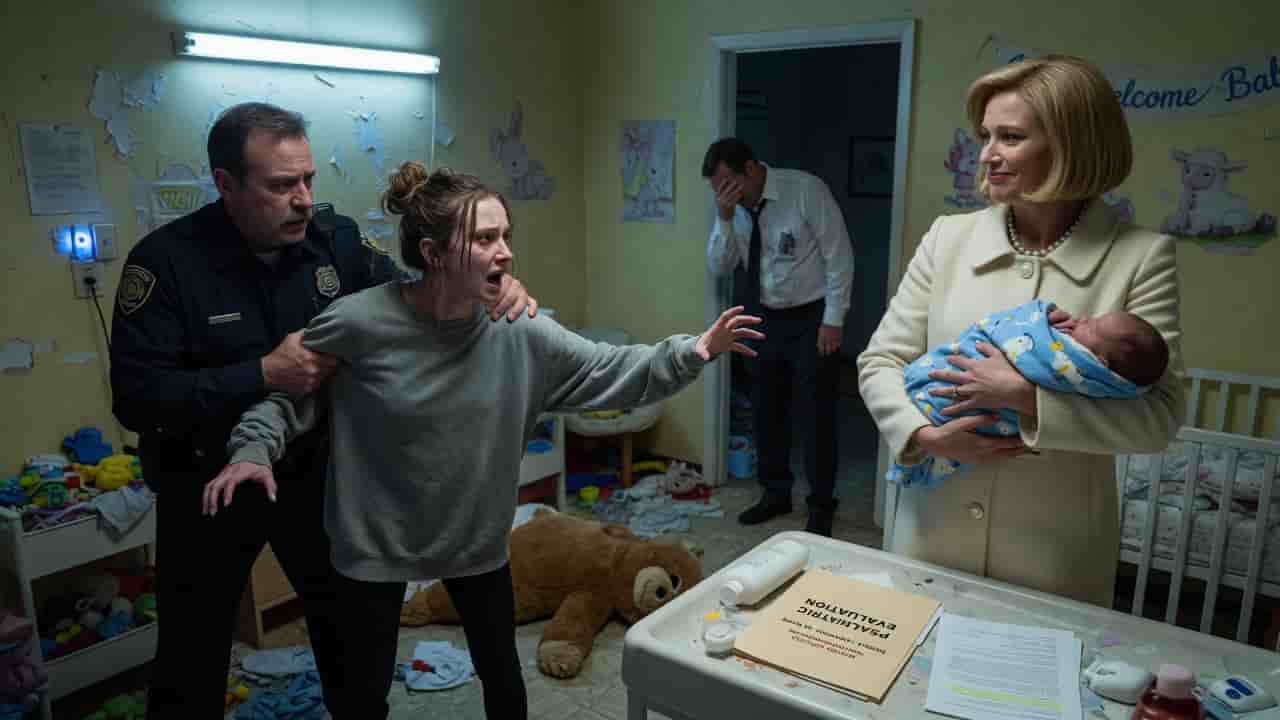
“Look at yourself, Sofia. You’re in no state to be a mother.”
I was still in my pajamas, the scent of baby formula and unwashed hair clinging to me like a second skin. I hadn’t slept in three days because Leo had colic, but in Lydia’s eyes, my exhaustion wasn’t motherhood—it was a breakdown.
She stood in the center of the nursery, looking like she’d stepped off a country club porch, holding my three-week-old son as if he were a trophy she’d finally won. The two police officers stood by the crib, their faces masks of professional pity, while they looked at the “evidence” Lydia had handed them.
“That’s my son!” I screamed, my voice cracking, raw from days of shushing a crying infant. “Lydia, give him back to me right now!”
I tried to reach for him, but a heavy hand landed on my shoulder, shoving me back toward the wall. “Ma’am, stay back,” the officer said. “We have a court-ordered emergency removal. The report says you’re a danger to the child.”
I looked at David, my husband, begging him to say something. To tell them that the “pills” were vitamins. To tell them that the report was a lie. But he just stood in the doorway, staring at his shoes, his silence a knife in my ribs.
Lydia leaned over, her voice a melodic, cruel whisper that only I could hear. “He’s safe now, Sofia. Why don’t you tell the nice officers about your ‘episodes’?”
I realized then that this wasn’t a mistake. It was a heist. And they were taking my baby away in the back of a black SUV while I was left screaming on the lawn.
Chapter 1: The Nursery Heist
The nursery smelled like lavender laundry detergent and the sour, sharp tang of spit-up—the scent of my life for the last twenty-two days. It was a small room, tucked into the back of our colonial in a suburb where the lawns were too green and the neighbors were too quiet. I was sitting in the rocking chair, the wooden slats groaning under a weight I didn’t recognize as my own anymore. My body felt like a house that had been looted; everything was soft, aching, and hollowed out.
Leo was finally quiet. His small, rhythmic breaths were the only thing keeping me anchored to the floor. I was staring at the monitor, watching the tiny rise and fall of his chest, when the front door chime echoed through the house. It wasn’t the soft, hesitant knock of a neighbor. It was the sharp, authoritative ring of someone who owned the air they breathed.
“Sofia? Dear, are you up?”
Lydia’s voice drifted up the stairs, polished and sharp as a diamond-tipped drill. My stomach did a slow, sick roll. I hadn’t invited her. I hadn’t invited her in three days, not since she’d told me I looked “gray” and suggested that perhaps David should handle the night feedings entirely so I could “get my head right.”
I didn’t answer. I stayed in the dark, my fingers gripping the velvet arms of the chair. Maybe if I was silent enough, she’d think I was asleep. Maybe she’d leave the Tupperware of kale salad on the counter and go back to her estate across the lake.
But then came the heavy footsteps. More than one person. The stairs creaked under a weight that didn’t belong to Lydia’s slender frame.
I stood up, my knees popping. My nursing pads were soaked through, the cold dampness of milk pressing against my sweatshirt. I felt exposed, a mess of leaking fluids and frayed nerves. I stepped into the hallway just as they reached the landing.
Lydia was in the lead, wearing a cream-colored wool coat that probably cost more than my first car. Behind her were two men in dark navy uniforms. Police. Their utility belts jingled—a metallic, terrifying sound in a house that was supposed to be a sanctuary.
“What is this?” my voice came out as a dry croak. “David? David, where are you?”
David appeared from the shadows of the master bedroom. He looked like he hadn’t slept either, but his exhaustion was different—it was the weariness of a man who had already surrendered. He wouldn’t look at me. He stayed three paces behind his mother, his hands shoved deep into the pockets of his khakis.
“Sofia,” Lydia said, her voice dropping into that fake-tender register she used when she was about to do something monstrous. “We’re here to help. You’ve been struggling, darling. We all see it.”
“I’m not struggling,” I said, my heart beginning to hammer against my ribs like a trapped bird. “I’m tired. I have a three-week-old. Everyone is tired.”
One of the officers, a man with a thick neck and a face that looked carved out of granite, stepped forward. “Ma’am, we have a signed emergency custody order. Under Section 4, the child is to be removed from the home and placed in the temporary care of Lydia Thorne.”
The world tilted. I reached out to steady myself against the doorframe, my fingers slipping on the polished wood. “Removal? On what grounds? David, tell them! Tell them I’m fine!”
David finally looked up, but his eyes were glassy, distant. “The doctor’s report, Sofe. The one from yesterday. The evaluation.”
“What evaluation?” I shrieked. “I haven’t seen a doctor since the six-day checkup!”
Lydia pulled a manila folder from her handbag. She didn’t hand it to me. She handed it to the officer. “The signature is right there, Officer Miller. Dr. Halloway was very concerned about the postpartum psychosis symptoms. The history of clinical depression makes the situation… volatile.”
“Postpartum psychosis?” The words felt like stones in my mouth. “I don’t have psychosis. I’ve never even met a Dr. Halloway!”
I tried to push past them, to get to the nursery door, but Officer Miller moved with a speed that was terrifying for a man his size. He didn’t grab me—not yet—but he stepped into my path, his chest a wall of navy blue.
“Ma’am, don’t make this harder,” he said. His voice wasn’t mean; it was worse. It was patient. He thought I was a ticking bomb.
Lydia didn’t wait. She brushed past me, her silk scarf fluttering in the draft. She entered the nursery. I heard the soft click of her heels on the hardwood, and then the sound that shattered me: the rustle of the blue blanket.
“No!” I lunged.
Miller’s arm came up, a solid bar of muscle that caught me across the collarbone. I hit the wall hard, the breath leaving my lungs in a sharp woof.
“Let me go! That’s my son! You’re stealing my son!” I was screaming now, the sound tearing at my throat. I didn’t care about being “stable” anymore. Every instinct in my body was screaming for me to claw through that officer’s face to get to the door.
Lydia stepped back out into the hallway. She was holding Leo. He was stirring, his small face puckering as he let out a thin, confused cry. He smelled her perfume—something expensive and floral—instead of me.
“Look at yourself, Sofia,” Lydia said, her eyes tracing the salt-tracks of tears on my face, the stains on my shirt, the way I was trembling. “You’re in no state to be a mother. You can barely stand.”
“David, please,” I sobbed, looking at my husband. He was the one who had held my hand during the thirty-six hours of labor. He was the one who had promised we would protect him. “David, she’s lying. She’s taking him. Do something!”
David took a half-step forward, his mouth opening, but Lydia cut him off with a single, sharp glance. “David, go start the car. It’s cold out. We need the heat running for the baby.”
He hesitated for a second—the longest second of my life—and then he turned around. He walked down the stairs. I heard the front door open and close. He left me.
“He’s safe now, Sofia,” Lydia whispered, leaning in as the second officer began to lead her toward the stairs. She leaned close to my ear, her voice a low, venomous hiss. “Tell the officers about the pills, dear. Tell them about the bottles you’ve been hiding.”
“I don’t have any—”
But she was already moving. They were all moving. I tried to follow, but Officer Miller kept his hand on my chest, pinning me to the hallway wall.
“Stay here, ma’am. If you come outside, I’ll have to restrain you. Don’t let the neighbors see you like this.”
I watched through the window at the end of the hall. I saw the black SUV idling at the curb. I saw Lydia climb into the back seat, cradling my life in her arms. I saw David behind the wheel. The brake lights flared once, red and mocking, and then they were gone.
The house fell silent, except for the hum of the refrigerator downstairs and the sound of my own ragged, broken breathing. I sank to the floor, my back against the nursery door that was now wide open and empty. I looked at the changing table. The manila folder was still there. They’d left it behind, a parting gift.
I crawled toward it, my fingers shaking so hard I could barely grip the paper. I opened it.
There it was. A psychiatric evaluation on letterhead from a clinic across town. It described a woman I didn’t recognize: a woman who heard voices, a woman who had “expressed ideation of harm” toward her infant, a woman who was “non-compliant with medication.”
And at the bottom, there was a signature. Sofia Thorne.
It looked like my handwriting. Almost. It had the same loopy ‘S,’ the same sharp ‘f.’ But I hadn’t signed it. I hadn’t been to that clinic.
I looked at the date. It was from two days ago. Two days ago, I’d been at home with David and Lydia. Lydia had asked me to sign a “release form” for the pediatrician so she could help pick up Leo’s records. I’d signed a blank sheet of paper because I was too tired to read the fine print.
I hadn’t signed a release. I’d signed my own eviction notice from my son’s life.
I sat there in the middle of the empty nursery, the moonlight beginning to bleed through the curtains, and realized that I wasn’t just a mother who had lost her child. I was a ghost in my own home, and the woman who had taken him had a plan that started long before I ever went into labor.
Chapter 2: The Ghost in the House
The first twenty-four hours were a blur of physical pain. My breasts were engorged, hard as stones and throbbing with a rhythmic ache that reminded me, every second, that my body was still preparing for a baby who wasn’t there. I sat in the bathtub with the water running hot, crying until the steam filled the room, the milk mixing with the bathwater in a pale, ghostly swirl.
I had called David forty-two times. He hadn’t answered once.
Lydia’s phone went straight to voicemail.
I tried to call the police station, but the desk sergeant told me the same thing the officer in the hallway had: “It’s a civil matter, ma’am. There’s a court order. You’ll have to take it up with your attorney.”
Attorney. I didn’t have an attorney. We had a joint bank account that Lydia’s family had seeded with “startup capital” for David’s firm. Every dime we had was tied to the Thorne name.
I stood in the kitchen at 3:00 AM, the house feeling massive and predatory. Every creak of the floorboards sounded like a footstep. I kept expecting to hear Leo’s cry through the monitor, but the little plastic unit on the counter just hissed with white noise.
I looked at the folder again. Dr. Aris Halloway.
I pulled out my laptop, my vision swimming. I searched the name. Halloway was a high-priced forensic psychiatrist who specialized in “high-conflict custody cases.” His reviews were a graveyard of mothers claiming he’d been bought and paid for by wealthy fathers and grandparents.
“You think you’re so smart, Lydia,” I whispered to the empty kitchen.
My history of depression was the weapon she’d used to sharpen the blade. Five years ago, after my mother died, I’d spent two weeks in a voluntary wellness center. I’d been grieving, drowning in the kind of silence that only comes when the person who raised you is gone. David had been my rock then. Or I thought he had. Now I realized he’d been taking notes.
I went to the cabinet where I kept my vitamins. There, tucked behind the bottle of prenatal DHA, was something I hadn’t put there. A small orange prescription bottle.
My heart stopped.
I pulled it out. The label was fresh. Sofia Thorne. Clozapine. An antipsychotic. The bottle was half-empty.
I had never taken a single one of these pills. I hadn’t even seen the bottle before.
Lydia hadn’t just forged a report; she was planting evidence. If the police came back with a search warrant, they’d find a half-empty bottle of heavy-duty meds in my cupboard. They’d see a mother who was “non-compliant” because the bottle was half-full, or “unstable” because she was on them at all.
I wanted to throw the bottle through the window. I wanted to scream until the neighbors called the cops back so I could show them the lie. But I stopped.
Residue. That was what my father used to say about crime scenes. Everything leaves a trace.
I took a photo of the bottle where it sat. Then I took a photo of the seal. It had been filled at a pharmacy in the city, thirty miles away. A place I hadn’t visited in months.
The doorbell rang again. I froze, the pill bottle clutched in my hand. It was 8:00 AM.
I walked to the door, my heart in my throat. I looked through the peephole. It wasn’t Lydia. It wasn’t the police.
It was a woman in a sensible navy blazer and khakis, carrying a leather briefcase. She looked tired in a way that had nothing to do with sleep. She looked like she’d seen too much of the world’s underside.
I opened the door six inches. “Yes?”
“Sofia Thorne? My name is Sarah Miller. I’m with Child Protective Services.”
I felt a surge of pure, unadulterated terror. “The police already took him. He’s not here.”
“I know,” she said. Her voice was quiet, lacking the performative pity Lydia used. “I’m the caseworker assigned to oversee the emergency placement. I’m here to do a home inspection and conduct an initial interview.”
I looked at her, searching for the trap. “Did Lydia send you?”
Sarah Miller paused, her eyes shifting to the overgrown weeds by my porch. “I work for the county, Mrs. Thorne. Not for your mother-in-law.” She lowered her voice. “Can I come in? It’s better if we talk inside.”
I stepped back, letting her into the foyer. The house felt like a crime scene. I hadn’t washed the dishes. There were piles of baby clothes on the sofa. I looked like a disaster.
“I’m sorry about the mess,” I said, my voice trembling. “I haven’t… I haven’t been doing well since they took him.”
“That’s understandable,” Sarah said. She walked into the living room, but she didn’t start taking notes. She just stood there, looking at the photos on the mantle. Me and David at the beach. Me, pregnant and glowing, holding a tiny pair of socks.
“The report I received is very specific,” Sarah said, turning to face me. “It describes a level of impairment that usually results in a hospital hold, not just a removal. But when I called Dr. Halloway’s office this morning to verify the intake notes, the receptionist told me they didn’t have a Sofia Thorne in their system.”
The air left the room. I stared at her. “What?”
“She said she’d check the archives, but the file number on this order…” she tapped her briefcase, “…it doesn’t match their current sequence. It’s an old format.”
I felt a spark of something—not hope, but a cold, hard rage that felt like it. “She forged it. Lydia forged the whole thing. She made me sign a blank paper, and she filled it in. And she planted pills in my kitchen.”
I grabbed the orange bottle from the counter and shoved it toward her. “Look at this! I’ve never seen this before! It’s from a pharmacy in the city. I haven’t been there in months!”
Sarah didn’t take the bottle. She looked at it, her brow furrowing. “Mrs. Thorne, if what you’re saying is true, this is more than a custody dispute. It’s a felony.”
“Then help me,” I pleaded, stepping closer. I could smell the stale coffee on my breath, the desperation coming off me in waves. “She has my son. She took him to her house in Vermont. She told the police it was a ‘temporary safety move,’ but she’s not coming back. I know her. She’s going to erase me.”
Sarah looked at me for a long time. She saw the mess. She saw the unwashed hair. But she also saw the eyes of a woman who was perfectly, terrifyingly sane.
“I can’t just give him back,” Sarah said. “The order is signed by a judge. Until a hearing is held, that order stands. And Lydia Thorne has hired Marcus Vane.”
“Who?”
“The most ruthless family lawyer in the tri-state area,” Sarah said. “If I go back and file a report saying the medical records are suspicious, Vane will have me fired before lunch. He has friends in the department. He has friends on the bench.”
“So what do I do?” I felt the darkness closing in again. “I just wait while she teaches my son that I don’t exist?”
Sarah reached into her bag and pulled out a card. She didn’t hand it to me; she set it on the table.
“I’m going to conduct my inspection now,” Sarah said, her voice becoming professional and loud enough to carry if someone were listening. “I need to see the nursery. I need to see the supplies. I’ll be noting the lack of hygiene in the kitchen.”
She leaned in, her lips barely moving. “There’s a man named Elias Vance. He’s a private investigator. He used to be a cop. He specializes in the ‘untraceable’ parts of the Thorne family business. Call him. Tell him I sent you.”
She stood up and walked toward the stairs. “Now, show me the nursery, Mrs. Thorne. And try to act like the ‘volatile’ woman the report describes. There’s a car parked down the street. Black sedan. They’ve been there since I arrived.”
I looked out the window. A black sedan with tinted windows was idling three houses down.
Lydia wasn’t just holding my son. She was watching the cage.
Chapter 3: The Broken Vow
David came home at 6:00 PM.
I was waiting for him in the living room, the lights off, the only glow coming from the streetlamp outside. I heard his key turn in the lock—that familiar, domestic sound that used to mean safety. Now, it sounded like a predator entering the den.
He didn’t call out my name. He moved through the foyer like a thief, heading straight for the stairs.
“Where is he, David?”
He jumped, his briefcase hitting the floor with a dull thud. He looked at me, silhouetted in the armchair, and I saw the sheer, cowardly terror in his eyes.
“Sofia. Jesus. You scared me.”
“I scared you?” I stood up, my joints stiff. “Our son was kidnapped by your mother yesterday. You drove the getaway car. And you’re scared?”
“It’s not kidnapping, Sofe,” he said, his voice high and defensive. “It’s a transition. My mother… she’s just worried. We’re all worried. You haven’t been yourself. You cry all the time. You don’t eat.”
“I have a newborn!” I screamed, the sound echoing through the empty house. “I’m not supposed to be myself! I’m supposed to be his mother! And you gave him to her!”
I walked toward him, and he actually backed away, his heels hitting the front door. He was a foot taller than me, broader, stronger, but he looked like a child cornered by a ghost.
“She showed me the report, Sofia,” he stammered. “The ideation. The harm. How could I stay in the house knowing you might—”
“You know that’s a lie!” I shoved my phone into his face, the picture of the forged signature glowing. “Look at it, David! Look at the ‘f’! I don’t write my ‘f’s’ like that when I’m tired. I cross them higher. You know that. You’ve seen my grocery lists for seven years!”
He didn’t look. He swiped the phone away. “It doesn’t matter. The judge signed it. It’s done. My mother has a team of nurses at the lake house. Leo is getting the best care. Better than… better than what we were doing here.”
The words hit me harder than the officer’s arm. Better than what we were doing here.
“Is that what she told you?” I whispered. “That I’m not enough? That the Thorne name deserves a ‘proper’ upbringing?”
“She’s just trying to protect the family legacy, Sofia. If you have a breakdown and it gets into the papers… my firm is just starting to take off. We can’t have this.”
I stared at him, and for the first time in our marriage, I didn’t see the man I loved. I saw a hollowed-out shell. He wasn’t David anymore; he was just another piece of Lydia’s furniture.
“She bought you,” I said. “How much, David? Was it the partnership? Or did she just threaten to cut off the trust fund?”
“Shut up,” he snapped, his face turning a blotchy, ugly red. “You don’t know what it’s like. Growing up with her. You don’t just say ‘no’ to Lydia. You manage her. This is just… management.”
“You managed our son right out of my arms.”
I walked past him to the kitchen and grabbed the orange pill bottle. I didn’t say a word. I just set it on the counter between us.
David looked at it. He didn’t look surprised. He looked guilty.
“You put these here,” I said. It wasn’t a question.
“I didn’t… I just…” He trailed off, his eyes darting to the door. “My mother said you’d forgotten to take them. She said she found them in your purse and asked me to put them somewhere safe so the baby wouldn’t get them.”
“I don’t have a prescription for Clozapine, David! I’ve never even heard of Dr. Halloway!”
“Maybe you forgot!” he shouted. “Maybe you’re so far gone you don’t even remember the appointments!”
He was gaslighting me. My own husband, the man who had seen me at my most vulnerable, was standing in our kitchen trying to convince me I was insane because it was easier than standing up to his mother.
“Get out,” I said. My voice was cold, flat. The fire had gone out, replaced by a glacier.
“Sofia—”
“Get out of this house, David. Go to your mother. Go tell her you did a good job. Go sit in the nursery in Vermont and watch her hold our son.”
“This is my house too,” he muttered, but there was no conviction in it.
“Then call the police,” I said, picking up a steak knife from the counter. I didn’t point it at him. I just held it, feeling the weight of the steel. “Call them back. Tell them I’m having an ‘episode.’ Tell them I’m dangerous. Let’s see how that looks on the 11:00 news. ‘Local Attorney’s Wife Arrested in Empty House While He Watches.'”
David stared at the knife, then at me. He saw something in my face that he couldn’t “manage.”
He grabbed his briefcase and backed out the door. “You’re crazy,” he hissed. “My mother was right. You’re absolutely losing it.”
The door slammed. A moment later, his car roared down the driveway.
I dropped the knife. It clattered into the sink. I wasn’t crazy. But I was alone.
I picked up the card Sarah Miller had left on the table. Elias Vance. Investigations.
I dialed the number. It rang four times before a gravelly voice answered.
“Vance.”
“My name is Sofia Thorne,” I said, my voice cracking. “Sarah Miller told me to call you. My mother-in-law took my son.”
There was a long silence on the other end. I heard the flick of a lighter, the intake of breath.
“Lydia Thorne?” the voice asked.
“Yes.”
“Kid, if you’re looking for a lawyer, you’re calling the wrong guy. If you’re looking to get your kid back, you better have a lot of money or a very good reason why I should risk my neck against that woman.”
“I don’t have money,” I said. “But I have the report she forged. And I have the pills she planted. And I have the silence of my husband.”
“The silence of a Thorne husband is the loudest thing in this state,” Vance said. “Where are you?”
“My house. She’s watching me. There’s a black sedan outside.”
“The sedan is for show,” Vance said. “Lydia likes people to know they’re being watched. It makes them sloppy. Pack a bag. Don’t take your car. Go out the back fence, through the neighbor’s yard. There’s a dive bar three miles East called The Rusty Nail. I’ll be in the back booth. And Sofia?”
“Yes?”
“Don’t bring the knife. It won’t help you where we’re going.”
Chapter 4: The Residue of Truth
The Rusty Nail was the kind of place where the air felt thick with old grease and bad decisions. It was tucked behind a warehouse district, far enough from the manicured lawns of my neighborhood that I felt like I’d crossed into another country.
I’d hiked through the woods behind my house, my postpartum body screaming at every step. My chest was tight, my core felt like it was going to unravel, but I didn’t stop. I couldn’t stop. Every minute I spent sitting in that house was a minute Lydia spent cementing her place as Leo’s mother.
I found the back booth. A man was sitting there, obscured by a cloud of blue cigarette smoke. He looked like an unmade bed—rumpled flannel shirt, a three-day beard, and eyes that looked like they’d seen the bottom of a thousand cold cases.
“You look like hell,” Elias Vance said, not moving as I slid into the booth.
“I feel like hell,” I said. “Are you going to help me?”
He set a grainy photograph on the table. It was Lydia, standing on a pier in Vermont, holding a bundle in a blue blanket. She was smiling—a genuine, warm smile that made my skin crawl. Beside her was a man I recognized: Marcus Vane, the lawyer.
“They’re already filing for permanent termination of parental rights,” Vance said. “Vane is fast. He’s using your ‘history’ to argue that you’re a chronic risk. He’s pushing for a closed hearing in forty-eight hours.”
“Forty-eight hours? They can’t do that!”
“They can when they own the judge,” Vance said. He leaned forward, the smell of stale bourbon and tobacco wafting over me. “Listen to me, Sofia. You’re playing a game where the rules were written before you were born. The Thornes don’t lose. They buy their way out of scandals and bury the people who cause them.”
“I’m not a scandal,” I whispered. “I’m his mother.”
“To them, those are the same thing.” Vance tapped the photo of Lydia. “I did some digging into that pharmacy where your ‘pills’ came from. The pharmacist is a guy named Leo—ironic, right?—who owes a lot of gambling debt to a firm Lydia’s holding company owns. He didn’t just fill a prescription. He created a ghost record.”
“Can you prove it?”
“I can get him to talk,” Vance said. “But a pharmacist’s word against a Thorne’s? It’s not enough. We need something from the inside. Something that proves Lydia knew exactly what she was doing.”
I thought about the nursery. The way she’d leaned in. The way she’d hissed about the pills.
“She’s arrogant,” I said. “She thinks I’m already broken. She thinks I’m just waiting to be institutionalized.”
“That’s our leverage,” Vance said. “Arrogance leaves residue. She’s going to have a ‘charity gala’ tomorrow night at the lake house. It’s her victory lap. All the local power players will be there. David will be there, looking like the grieving, dutiful husband.”
“I have to go there,” I said.
“It’s suicide,” Vance said. “They’ll have security. They’ll call the cops and have you committed on the spot.”
“No,” I said, a cold clarity settling over me. “She wants me to be the ‘crazy mother.’ So I’ll give her exactly what she wants. But I’m not going alone.”
I pulled out my phone. I hadn’t looked at the voice memos in months. But there was one from the night before the removal. I’d been nursing Leo in the kitchen, and Lydia had come in. I’d started the recording because I wanted to show David how she talked to me when he wasn’t around.
I hit play.
“You’re so fragile, Sofia,” Lydia’s voice came through the speaker, silk and steel. “It’s almost a mercy, really. Imagine trying to raise a boy with that… taint in your blood. David deserves better. Leo deserves a legacy, not a liability. Don’t worry, dear. I’ve already spoken to the judge. He understands that some women just aren’t built for the weight of a name like ours.”
Vance listened, his expression unchanging. When the clip ended, he whistled softly.
“The ‘taint in your blood.’ That’s classy. Even for her.”
“Is it enough?” I asked.
“It’s a start,” Vance said. “But we need her to say it again. We need her to admit to the forgery. In front of witnesses who aren’t on her payroll.”
“I know how to get her to talk,” I said. “She can’t help herself. She needs me to know she won. She needs to see the light go out in my eyes.”
I stood up, the pain in my body fading into a dull, manageable hum. I wasn’t just a victim anymore. I was a hunter.
“I need a dress,” I said. “Something cream. Like hers.”
Vance looked at me, a grim smile tugging at the corner of his mouth. “You’re going to crash the party.”
“I’m going to end the party,” I said.
We left the bar, the cold night air biting at my skin. As we walked toward Vance’s battered truck, a black sedan pulled out from the shadows across the street. It followed us, a silent, predatory shape in the rearview mirror.
“They’re still there,” I said.
“Let them watch,” Vance said, shifting into gear. “They think they’re watching a woman fall apart. They have no idea they’re watching the fuse burn down.”
We drove toward the city, the lights of the suburbs fading behind us. Tomorrow, the Thorne family would gather to celebrate their legacy. Tomorrow, Lydia would hold my son in front of the world and pretend she had saved him.
And tomorrow, I would show them what happens when you try to steal the one thing a mother has left.
The residue of the lie was everywhere—in the forged papers, the planted pills, the cowardice of my husband. But the truth was still there, buried under the weight of the Thorne name. I just had to dig it up. Even if I had to burn the whole house down to find it.
I looked at the small blue blanket I’d tucked into my bag—the one Leo had been wrapped in before she took him. It still smelled like him. Like milk and new life and hope.
“I’m coming for you, Leo,” I whispered.
Vance glanced at me, his eyes hard. “Hold onto that. You’re going to need it when the doors lock behind you.”
Chapter 5: The Glass Fortress
The lake house wasn’t a house; it was a monument to the Thorne ego, a sprawl of glass, cedar, and fieldstone perched on a cliff overlooking the dark, choppy waters of Lake Champlain. As Vance’s truck rumbled up the winding mountain road, I could see the glow of the property from miles away, a crown of artificial light cutting through the Vermont wilderness. It looked impenetrable. It looked like the kind of place where truths went to be buried under layers of velvet and top-shelf scotch.
I was shivering, and it wasn’t just the mountain air. My body felt like it was held together by piano wire. Every time I moved, the stitches from my delivery pulled, a sharp, stinging reminder that I was barely three weeks out from the most traumatic physical event of my life. I was wearing a cream silk gown that Vance had procured from a high-end consignment shop in the city. It was beautiful, elegant, and utterly wrong for the woman I was inside. It felt like armor made of paper.
“You okay?” Vance asked, his eyes fixed on the road. He looked strange in a suit—like a bear forced into a tuxedo.
“I’m leaking,” I said, my voice flat. I looked down at the nursing pads I’d doubled up inside the bodice of the dress. “My body doesn’t know he’s gone. It’s still trying to feed him.”
Vance gripped the steering wheel tighter. “That’s the most honest thing anyone’s going to say in that building tonight. Use it. Use the rage. Lydia thinks she’s playing a game of chess. Remind her she’s in a knife fight with a mother.”
We pulled into the long, gravel driveway. Valets in white gloves moved like ghosts through the mist, whisking away Lexuses and Range Rovers. I saw the black sedan from my neighborhood parked near the service entrance. They knew I was missing from the house, but they didn’t expect me here. They expected me to be huddled in a motel room or crying in a church pew.
“I’ll be by the service bar,” Vance said, handing me a small, flesh-colored earpiece. “If things go sideways, or if you find where she’s keeping the kid, you tap the mic twice. I’ve got a friend on the catering staff who can get us to the nursery wing.”
I stepped out of the truck, the silk of the dress swishing against my legs. I walked toward the massive oak doors, my head held high, my heart a frantic drum in my chest. I wasn’t Sofia the victim. I wasn’t Sofia the ‘unstable’ wife. I was a Thorne tonight, and I was going to use their own gravity to pull the house down.
The Great Room was a sea of black ties and shimmering cocktail dresses. The air was thick with the scent of expensive perfume and the low, hummed roar of polite conversation—the sound of people who had never had to fight for anything in their lives. I saw David almost immediately. He was standing near a massive stone fireplace, a crystal glass of amber liquid in his hand, laughing at something a man in a judicial robe was saying.
He looked comfortable. He looked relieved. It was the laugh of a man who had finally been ‘managed’ back into his proper place.
I didn’t go to him. I scanned the room for the predator.
I found her on a raised dais at the far end of the room, standing beneath a portrait of David’s late father. Lydia was in her element. She was wearing a gown of midnight blue, her diamonds catching the light every time she tilted her head. And there, in a bassinet made of hand-carved heirloom wood, sat Leo.
The sight of him hit me like a physical blow. He was wearing a tiny white smock, his small hands waving aimlessly in the air. A crowd had gathered around them, cooing and pointing, treating my son like a centerpiece, a new acquisition to be admired alongside the art collection.
“She’s using him as a prop,” I whispered into the mic.
“Steady,” Vance’s voice crackled in my ear. “Wait for the toast. That’s when the room goes quiet.”
I moved through the crowd, a ghost in cream silk. I took a glass of champagne from a passing tray and held it, not drinking, just feeling the cold condensation on my palms. I saw Sarah Miller, the caseworker, standing near the hors d’oeuvres. She saw me, her eyes widening in a flash of recognition and terror, but she didn’t move. She gave me a single, imperceptible nod. She was the witness. She was the one who would have to testify when the dust settled.
Lydia tapped a silver spoon against her crystal flute. The room began to settle, the laughter dying down into an expectant hush.
“Friends, family, colleagues,” Lydia began, her voice projecting with the effortless authority of someone who had never been told to be quiet. “Thank you for joining us on this very special night. As many of you know, the Thorne family has always believed in stewardship. We protect what is ours. We cherish our legacy.”
She looked down at the bassinet, her expression melting into a choreographed display of grandmotherly devotion. “The last few weeks have been… challenging. Our family faced a crisis that no one wants to speak of aloud. A crisis of health, of stability. But through the grace of God and the strength of our bonds, we have brought this beautiful boy into the safety of this home.”
She looked up, her gaze sweeping the room. “To Leo. The future of the Thorne name. May he always know the security of a family that does what is necessary, no matter how painful.”
“What’s painful is the lie, Lydia.”
The voice was mine, but it sounded like it belonged to someone else—someone colder, someone who had already died and come back.
The room turned. A hundred pairs of eyes locked onto me. I walked forward, the crowd parting like the Red Sea. I saw David’s glass slip from his hand, shattering on the hardwood. He looked like he wanted to vanish into the floorboards.
Lydia didn’t flinch. She set her flute down on a side table, her smile remaining perfectly intact, though it didn’t reach her eyes. Her eyes were twin stones of blue ice.
“Sofia,” she said, her voice dripping with artificial pity. “Darling, you shouldn’t be here. You’re clearly overwhelmed. David, please, help your wife. She’s had a… setback.”
David stepped forward, his face pale. “Sofia, come on. Let’s go upstairs. You’re making a scene.”
“I’m not making a scene, David. I’m making a statement,” I said, stopping ten feet from the dais. I looked at the judge standing next to Lydia—Judge Hennessey, the man who had signed the emergency order. “Judge, did you know that the medical report you used to take my son was signed by a doctor who has no record of me? Did you know it was typed on a format that hasn’t been used in five years?”
A murmur rippled through the room. Hennessey’s brow furrowed, his gaze darting to Lydia.
“Sofia, please,” Lydia said, her voice rising slightly, the first crack in the porcelain. “We all know you’ve been struggling with your… reality. The delusions are part of the diagnosis. It’s the depression talking, dear. The ‘episodes’ David told us about.”
“The episodes David was coached to report?” I turned to the crowd, my voice clear and steady. “My mother-in-law bribed a pharmacist to plant antipsychotics in my kitchen. She forged a signature on a blank piece of paper I signed in a moment of exhaustion. She used my grief over my mother’s death as a weapon to convince my husband that I was a danger to my own child.”
“Security!” Lydia snapped, her face finally losing its composure. The mask slipped, revealing the jagged, ugly thing beneath. “Get her out of here! She’s dangerous! Look at her—she’s hysterical!”
Two large men in black suits moved in from the periphery. They grabbed my arms, their fingers digging into the soft tissue. I didn’t fight them. I didn’t scream. I just looked at Lydia.
“You want to talk about reality, Lydia?” I reached into the bodice of my dress and pulled out my phone. I tapped the screen.
Lydia’s voice filled the Great Room, amplified by the high ceilings and the sudden, deathly silence of the guests.
“Imagine trying to raise a boy with that… taint in your blood… I’ve already spoken to the judge. He understands that some women just aren’t built for the weight of a name like ours.”
The recording looped once, twice. The words ‘taint in your blood’ echoed off the glass walls. I saw the guests—the donors, the politicians, the socialites—pulling back, their faces twisting in distaste. Even in this world, there were lines you didn’t cross. You didn’t talk about ‘blood taint’ in the twenty-first century. Not out loud.
“That’s a fabrication!” Lydia shrieked. “She’s a liar! She’s mentally ill!”
“Then explain the pharmacist,” a new voice boomed.
Elias Vance walked through the main doors, and he wasn’t alone. Beside him was a man in a rumpled shirt, looking terrified. It was the pharmacist from the city.
“This is Mr. Aris,” Vance said, his voice cutting through the chaos. “He just gave a recorded statement to the county sheriff’s office. He confessed to falsifying a prescription record for Sofia Thorne at the request of a representative of the Thorne holding company. He has the wire transfer receipts, Lydia. Your arrogance was a little too digital this time.”
The security guards let go of my arms. They looked at each other, then at Lydia, and slowly backed away. They knew when a ship was sinking.
Lydia looked around the room, searching for an ally, but she found only the cold, judgmental stares of the people she had tried so hard to impress. She looked at David, but he had turned his back to her, his head buried in his hands.
I walked up the steps of the dais. I didn’t look at the crowd. I didn’t look at the lawyer. I looked at my son.
Leo was awake now, his big blue eyes watching me. He didn’t know about the Thorne legacy. He didn’t know about the forgeries or the glass houses. He just knew the smell of me.
I reached into the bassinet and lifted him out. The weight of him against my chest was the only thing in the world that felt real. The milk leaked through my dress, soaking into his white smock, but I didn’t care.
“He’s coming home with me,” I said, my voice a whisper that carried to every corner of the room.
Lydia reached out, her hand claw-like, as if she might try to snatch him back one last time. “You’ll never be one of us, Sofia. You’re nothing. You’re a common girl from a common family.”
“I’m his mother,” I said, stepping past her. “And that’s more than you’ll ever be.”
I walked out of the Great Room, through the stunned silence of the Thorne gala. Vance was waiting by the door, his truck idling in the driveway. Sarah Miller followed us out, her phone already in her hand, calling the judge who would vacate the order within the hour.
The residue of the night was thick in the air—the smell of perfume, the sound of breaking glass, the taste of a victory that felt like woodsmoke. I climbed into the truck, cradling Leo against my heart.
As we pulled away, I looked back at the glass fortress on the cliff. The lights were still on, but the crown was gone. The Thornes hadn’t just lost a child; they had lost the one thing they valued more than life itself.
They had been seen.
Chapter 6: The Long Way Home
The drive back from Vermont was the quietest four hours of my life. Leo slept in the car seat Vance had installed, his tiny chest rising and falling in the moonlight. Vance drove with a steady, practiced hand, his eyes never leaving the road. He didn’t ask questions. He didn’t offer platitudes. He just existed in the space beside me, a buffer between the nightmare I’d left behind and the life I had to rebuild.
“Where are we going?” I asked as we crossed the state line.
“Not back to that house,” Vance said. “David’s there, or he will be. And Lydia’s lawyers are already filing motions to suppress the recording. You need a neutral ground.”
“I want to go home,” I said. “My mother’s house. The one in the valley.”
“It’s been empty for three years, Sofia.”
“It has a crib,” I whispered. “And it doesn’t have any Thornes in it.”
The house in the valley was a small, white-sided bungalow with a porch that groaned and a yard that was mostly overgrown clover. It was the house where I’d grown up, where my mother had taught me how to bake bread and how to survive a cold winter. It was a place of soft edges and low ceilings—the exact opposite of the glass tomb on the cliff.
Vance dropped us off at dawn. The air was cool and smelled of damp earth and pine. He helped me carry the few bags I had into the foyer. The air inside was stale, thick with the scent of old wood and the lingering memory of my mother’s lavender sachets.
“You’ll be safe here,” Vance said, standing in the doorway. “Sarah Miller is filing the final paperwork this morning. The emergency order is being vacated as ‘fraudulently obtained.’ Lydia’s going to be too busy dealing with the sheriff’s department to worry about you for a few days.”
“Thank you, Elias,” I said. I looked at him—this man who had lived in the shadows of my husband’s family for so long. “Why did you do it? Why did you help me?”
Vance shrugged, his eyes softening for a fraction of a second. “I spent twenty years watching people like Lydia Thorne erase people like you. I figured it was time someone wrote something back. Besides, your kid looks like he’s got a good set of lungs. He deserves to use them in a house that isn’t afraid of the noise.”
He left, the rumble of his truck fading into the distance. I was alone with my son.
I spent the morning cleaning. I moved with a slow, deliberate rhythm, my body still aching but my mind sharp. I wiped the dust from the windows, letting the morning sun spill onto the faded rugs. I set up the old wooden crib in the small bedroom next to mine—the one that had once been my nursery.
Around noon, a car pulled into the driveway. My heart spiked, the old fear clawing at my throat, but it wasn’t a black SUV. It was David’s silver sedan.
I walked onto the porch, Leo balanced on my hip. David got out of the car. He looked older. The polish was gone. His suit was wrinkled, his tie undone, and his eyes were red-rimmed. He stood at the bottom of the porch steps, looking up at me like a man standing at the edge of a cliff.
“Sofia,” he said.
“Don’t come up here, David.”
“I left her,” he said, his voice cracking. “I told her I’m resigning from the firm. I’m moving my things out of the house.”
“You should have left her three weeks ago,” I said. “You should have left her the second she stepped into our nursery with those police officers.”
“I know,” he whispered. He sat down on the bottom step, his head in his hands. “I was a coward. I thought… I thought she was right. I thought I was protecting you both by letting her handle it. I didn’t realize she was the one creating the fire so she could play the hero.”
I looked down at him. Part of me wanted to reach out, to comfort the man I had loved for seven years. But that man was gone. He had died in the hallway of our home when he watched his mother steal our child and did nothing.
“You let her tell you I was crazy,” I said. “You watched her plant those pills. You knew, David. Somewhere in your gut, you knew it was a lie, and you chose the Thorne name over your wife.”
“I can change,” he said, looking up at me, his eyes pleading. “We can start over. Away from her. Away from all of it.”
“There is no ‘over,’ David. There’s just the residue. Every time I look at you, I’ll see you standing in that doorway. I’ll see the way you looked at your shoes while I was screaming.”
I shifted Leo’s weight. The baby stirred, let out a soft, sleepy sigh.
“You can see him,” I said. “On a schedule. Supervised by Sarah Miller. But you aren’t staying here. And you aren’t coming back to my bed.”
David looked at me for a long time, the reality of what he had lost finally sinking in. He wasn’t just losing a wife; he was losing his soul. He had traded his integrity for a seat at a table that had just been kicked over.
“I’m sorry,” he said.
“I know you are,” I said. “But sorry doesn’t fix a forged life.”
He stood up, his shoulders slumped, and walked back to his car. I watched him drive away, the silver metal disappearing behind the bend in the road. I didn’t feel the triumph I’d felt at the gala. I just felt a profound, heavy sadness. A family had been broken, and while the truth had saved my son, it hadn’t saved us.
I went back inside and closed the door.
That night, I sat in the rocking chair in the small bedroom. The house was quiet, but it was a good quiet. It was the silence of a place that was breathing again. I held Leo, his warmth a constant, anchoring presence against my chest.
Lydia Thorne would face charges. The scandal would be in the papers. The ‘Thorne Legacy’ would be forever stained by the story of the mother who fought back. They would try to spin it, of course. They would hire better lawyers and buy more silence. But they could never take the recording back. They could never un-ring the bell.
I looked down at Leo. He was staring up at me, his tiny fingers curled around my thumb. He didn’t know he was a ‘liability’ or a ‘legacy.’ He didn’t know he was supposed to carry the weight of a name.
“You’re just Leo,” I whispered to him. “And you’re mine.”
The moon rose over the valley, casting long, silver shadows across the floorboards. I thought about the cream dress, still hanging in the closet of my old house, stained with milk and truth. I thought about Vance, sitting in his dive bar, watching the world go by. I thought about the woman I used to be—the one who was afraid of the dark and the silence.
She was gone. In her place was someone who knew exactly what she was capable of. Someone who had walked into the lion’s den and walked out with her heart in her hands.
I closed my eyes and began to hum a low, soft tune—a song my mother used to sing when the winters got too long. It wasn’t a song about kings or glass houses. It was a song about the earth and the rain and the things that grow when the storm finally passes.
The residue of the nightmare would always be there, a faint scar on the surface of my life. But as I rocked my son in the house in the valley, I knew that the truth didn’t just set you free. It gave you the ground to stand on.
And for the first time in a long time, the ground was solid.
How does the ending reflect Sofia’s growth from a “fragile” victim to a woman who sets her own terms for the future?