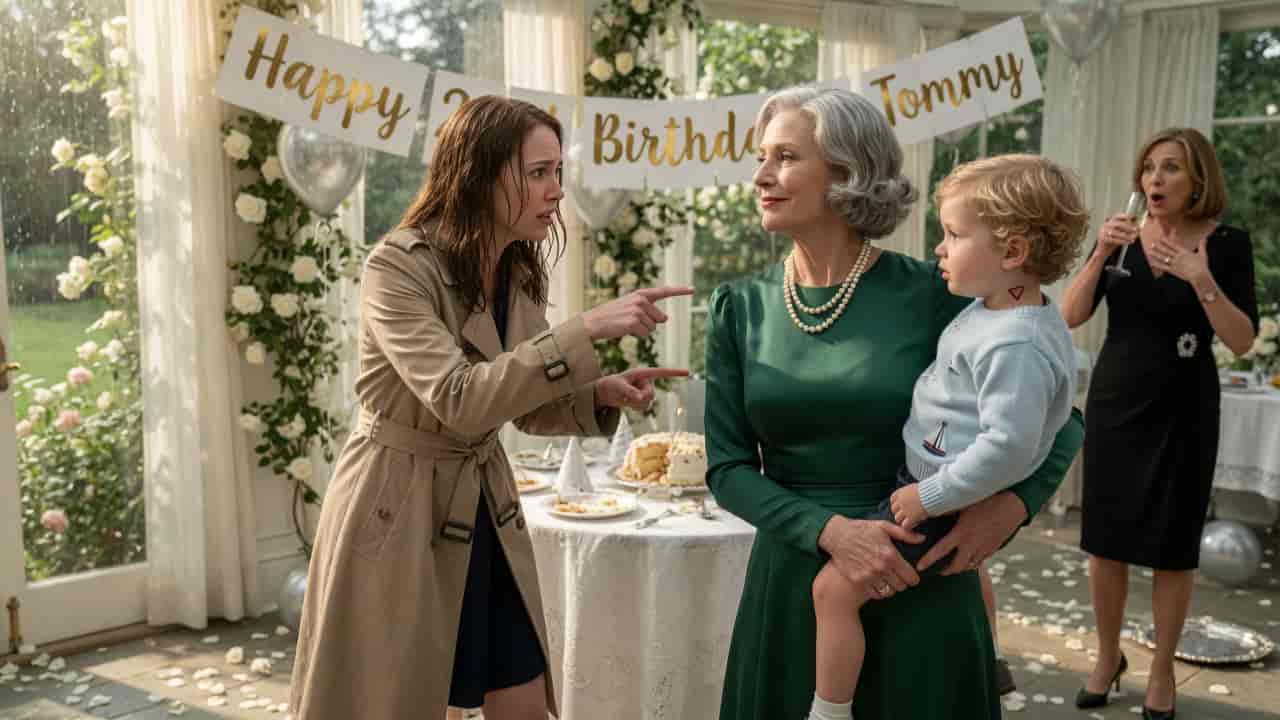
“Look at his neck, Evelyn. Look me in the eye and tell me that isn’t my son’s birthmark.”
Claire’s voice was shaking, her coat still dripping rain onto the pristine marble of the sunroom. Two years ago, they told her the birth had gone wrong. They told her the surrogate had vanished and the baby hadn’t made it. She’d felt the world go gray, her marriage fracturing under the weight of a grief that didn’t have a face.
But standing there, holding a toddler with the exact same delta-shaped mark her husband carried, was the woman who had held Claire’s hand at the “memorial.”
Evelyn didn’t even have the grace to look ashamed. She just adjusted the boy on her hip, her emerald silk shimmering in the light of a party Claire wasn’t invited to.
“Don’t be dramatic, Claire,” Evelyn said, her voice loud enough for the guests in the hallway to hear. “You were always too fragile, too unstable to handle the reality of it. You couldn’t even carry him yourself. I simply did what was necessary for the family legacy. I’m doing the boy a favor by keeping him away from your… complications.”
The room went silent. The betrayal wasn’t just in the kidnapping—it was in the way Evelyn smiled, watching Claire break all over again in front of the local elite.
Claire looked at the boy—her boy—and realized the woman she’d called mother was the monster who had stolen her life. And she wasn’t leaving this house without him.
Chapter 1: The Echo in the Drywall
The nursery was still the quietest room in the house, even though it wasn’t a nursery anymore. It was a “flex space” now, according to the real estate agent who had visited six months ago, though Claire hadn’t followed through on the listing. It had a desk she never used, a guest bed with a stiff, decorative pillow, and walls that were a neutral, soulless beige. But if she pressed her ear to the drywall, Claire could still hear the ghost of the mint-green paint she’d rolled on with such frantic, hopeful energy three years ago.
She sat on the edge of the guest bed, her hands folded in her lap. The late afternoon sun of northern Virginia crawled across the hardwood, highlighting the dust she hadn’t bothered to clean.
It was April 13th. The two-year mark.
In the American suburbs, grief was supposed to be a seasonal thing, something you wore like a heavy coat in the winter and tucked into the cedar chest by spring. But for Claire, grief was the air. It was the way the coffee tasted—burnt and metallic. It was the way her husband, Mark, looked at her—not with love, but with a weary, flinching sort of pity that made her want to scream until her lungs gave out.
The phone on the nightstand vibrated. It was a text from Evelyn, her mother-in-law.
Thinking of you today, dear. Why don’t you come over for dinner? I’ve had the cook make that lamb you like. We shouldn’t be alone on days like this.
Claire stared at the words. Days like this. Evelyn always spoke of the tragedy as if it were a shared family burden, a communal cross they all carried. It was Evelyn who had found the surrogate, Sarah. It was Evelyn who had vetted the clinics when Claire’s own body had refused to cooperate, month after agonizing month of hormone shots and bruised thighs and the hollow, echoing silence of a failed womb.
“She’s a godsend,” Evelyn had said back then, patting Claire’s hand with her perfectly manicured fingers. “Sarah is healthy, she’s stable, and she needs the money for her own tuition. It’s a transaction of grace, Claire.”
The transaction had ended in a blood-soaked hospital room in a city three hours away. A frantic call in the middle of the night. A distraught Evelyn meeting them at the entrance, her face a mask of tragedy. The surrogate panicked, Claire. There were complications. She fled the hospital. The baby… he didn’t make it. They couldn’t save him.
There had been no body to see. Complications with the private clinic’s paperwork, Evelyn had explained later through tears. A legal nightmare. A quiet cremation. A small, heavy urn that sat on Evelyn’s mantle because Claire couldn’t bear to look at it.
Claire stood up, her joints popping in the silence. She went to the window and looked out at the street. A neighbor was pushing a jogging stroller. The sight of it usually sent a spike of physical pain through Claire’s chest, but today, it was just a dull thud. She was numb. She was the “fragile” one now. That was the label the family had given her. Poor Claire. She never quite recovered. She’s a bit… thin. A bit distant.
Mark came home at 6:00 PM. He didn’t go to the nursery—the flex space—to find her. He went to the kitchen and opened a beer. Claire listened to the rhythmic thud-clink of the fridge door. She came down the stairs slowly, her hand trailing on the banister.
“Your mother invited us for dinner,” Claire said, standing in the doorway.
Mark didn’t turn around. His shoulders were slumped, his dress shirt wrinkled from a day of defending corporate contracts. “I know. She called me. Do you want to go?”
“No.”
“Claire.” He turned then, and the pity was there, thick and suffocating. “It’s been two years. She’s trying. She’s the only one who really knows what we went through.”
“She knows what she went through, Mark. She lost a grandson. I lost a life.”
“We both did,” he said, but his voice lacked conviction.
Mark had moved on in the way men in their thirties were taught to move on—by working ten-hour days and buying an expensive mountain bike he rode until his legs burned. He had buried his grief under a layer of sweat and billable hours. Claire had just stayed in the hole.
“I’m going to take a walk,” Claire said.
“It’s starting to rain.”
“I don’t care.”
She grabbed her trench coat from the hook by the door. It was an old thing, a bit frayed at the cuffs, but it felt like armor. She stepped out into the humid Virginia evening. The rain was a fine mist, the kind that got under your skin without you noticing.
She walked past the manicured lawns and the dark SUVs parked in circular driveways. This was a neighborhood of “success,” of people who had figured out the mechanics of a good life. Claire felt like a glitch in the software.
She was two blocks away when she saw the car—a nondescript gray sedan parked under a weeping willow. As she passed, the window rolled down.
“Mrs. Vance?”
Claire stopped, her heart fluttering like a trapped bird. The man in the car was older, with a face like a crumpled paper bag and eyes that looked like they hadn’t seen a full night’s sleep since the Bush administration. He was holding a manila envelope.
“Who are you?” Claire asked, her voice tight.
“My name is Miller. I’m a private investigator. Well, I was. Mostly I just do records searches for insurance companies now.”
“I didn’t hire a private investigator.”
“I know you didn’t,” Miller said. He stepped out of the car, ignoring the rain. He was tall and skeletal, his suit jacket hanging off his frame. He looked at her with a weird sort of intensity—not pity, but something sharper. Something like recognition. “I was hired eighteen months ago by a woman named Sarah Jenkins.”
The name hit Claire like a physical blow. The surrogate. The woman who had “panicked and fled.” The woman Evelyn had spent two years calling a “low-life” and a “criminal” whenever Claire brought up the lack of closure.
“Sarah is… where is she?” Claire stepped closer, the rain now matting her hair to her forehead.
“She’s in a lot of trouble, Mrs. Vance. But that’s not why I’m here. She stopped paying me six months ago. But I don’t like leaving things unfinished. Especially not things like this.”
He handed her the envelope. It was damp.
“What is this?”
“Truth is a funny thing,” Miller said, leaning back against his car. “In your tax bracket, truth is something you buy and sell. But in mine? Truth is just the thing that keeps you awake at four in the morning.”
Claire opened the envelope. Inside was a single photograph. It was a long-range shot, slightly grainy, taken in a park. It showed a woman from the back—a woman with silver hair, wearing an emerald coat. Evelyn.
She was holding the hand of a small boy. He was wearing a blue sweater. He was walking with that drunken, beautiful toddler gait.
“That’s… that’s my mother-in-law,” Claire whispered. “Who is the child?”
“Look at the second photo,” Miller said.
Claire pulled out a smaller print. It was a close-up, cropped from a different angle. The boy was laughing, his head tilted back. On the right side of his neck, tucked just behind the lobe of his ear, was a small, unmistakable red mark. A delta. A “v” shape, identical to the one Mark had. Identical to the one Mark’s father had carried.
The world didn’t shatter. It didn’t go silent. Instead, every sound became agonizingly loud. The patter of the rain on the car roof sounded like gunfire. The distant hum of a lawnmower sounded like a scream.
“He’s two years old, Mrs. Vance,” Miller said quietly. “His name is Tommy. He lives in a house in Great Falls. A house owned by a shell company called ‘Heritage Trust.’ Do you know who the sole trustee of Heritage Trust is?”
Claire didn’t need to ask. She knew.
“Evelyn,” she breathed.
The residue of the last two years—the hollow nursery, the heavy urn, the pitying looks, the “transaction of grace”—all of it began to curdle in her stomach. It wasn’t grief. It was a lie. A massive, coordinated, expensive lie.
“Why are you telling me this now?” Claire asked, her voice sounding like it was coming from a long way off.
“Because Sarah Jenkins didn’t flee,” Miller said. “She was paid to leave. And then she was threatened to stay gone. But she couldn’t live with it. She wanted you to know. She just didn’t have the courage to tell you herself.”
Miller got back into his car. He didn’t offer her a ride. He didn’t offer her a tissue.
“What are you going to do, Mrs. Vance?”
Claire looked at the photo of the boy—her boy—and the woman holding his hand. The woman who was currently waiting for her to come over for lamb and sympathy.
“I’m going to go to dinner,” Claire said.
Chapter 2: The Delta and the Brush
Claire walked back to her house in a trance. The rain was heavier now, soaking through her trench coat, chilling her to the bone, but she felt a strange, electric heat radiating from her center. She stepped inside, the foyer lights blindingly bright.
Mark was in the living room, staring at a cycling magazine. He looked up, his brow furrowing.
“Claire? You’re soaked. What happened?”
She looked at him—the man she had shared a bed with for ten years, the man who had grieved a ghost while his mother held his son in a house twenty miles away. Was he part of it? She looked for the “v” on his neck, visible just above his collar.
“I fell,” she said. It was a simple lie, the kind they had been trading for years. “I tripped on the sidewalk. I’m fine.”
“You don’t look fine. You look… white.”
“I’m just cold. I’m going to change. We need to get to your mother’s.”
“I thought you didn’t want to go.”
“I changed my mind,” Claire said, already moving toward the stairs. “We shouldn’t be alone today, right? That’s what she said.”
She went into the bathroom and locked the door. She pulled the photos from the envelope and stared at them again under the harsh vanity lights. The birthmark. The “Vance Delta.” It was a genetic quirk, a cluster of capillaries that had appeared in the men of Mark’s family for three generations. It was the one thing you couldn’t bribe or threaten away.
She felt a surge of nausea so violent she had to grip the edge of the sink. Evelyn had stolen him. She had taken a grieving mother, a fractured marriage, and a desperate surrogate, and she had engineered a world where she got to be the savior. She had the baby, and she had the control.
Claire stripped off her wet clothes, her movements jerky. She put on a dark navy dress—the one Mark liked because it made her look “composed.” She brushed her hair until her scalp stung.
Residue. The word Miller used. The residue of a lie.
“Ready?” Mark called from the hallway.
“Ready,” Claire whispered to the mirror.
The drive to Evelyn’s estate in McLean was twenty minutes of stifling silence. Mark navigated the winding, wooded roads with practiced ease. He talked about a merger. He talked about the interest rates. He talked about anything that wasn’t the date on the calendar.
Evelyn’s house was a colonial fortress, surrounded by black iron gates and ancient oaks. When they pulled up, the exterior lights were amber and welcoming. It looked like the home of a woman with nothing to hide.
Evelyn met them at the door. She was wearing a soft cashmere wrap, her silver hair shimmering. She smelled of Chanel No. 5 and expensive soap.
“Oh, my poor Claire,” Evelyn said, pulling her into a hug. Claire felt the dry, cool skin of her mother-in-law’s cheek. She felt the strength in the older woman’s arms. It wasn’t a hug of comfort; it was a cage. “You look so tired. Mark, why haven’t you been making sure she eats?”
“She’s fine, Mom,” Mark said, heading for the bar in the library.
“I brought you something,” Claire said. Her voice was steady, a miracle of willpower.
“You didn’t have to bring anything, dear.”
“It’s just… something I found in the back of the closet. While I was cleaning.”
Dinner was an exercise in psychological torture. Evelyn sat at the head of the mahogany table, presiding over the lamb and the mint jelly. She talked about her charity board. She talked about the “unfortunate” state of the neighborhood. And then, as she always did, she pivoted to the grief.
“I visited the site today,” Evelyn said, her voice dropping to a reverent whisper. “The memorial bench. The flowers were lovely. I think it’s important we keep his memory alive, even if the world wants us to forget.”
Claire felt the bite of the silver fork against her palm. The memorial bench. A piece of wood dedicated to a child who was currently sleeping in a nursery in Great Falls.
“Evelyn,” Claire said, setting her fork down. The sound clattered in the quiet room. “Do you ever wonder about Sarah? The surrogate?”
Mark stiffened. Evelyn’s expression didn’t change, but her eyes sharpened. “Why on earth would you bring her up today, Claire? She was a deeply troubled girl. We’ve discussed this. Her choices were her own.”
“I just wonder where she went. If she’s… happy.”
“She’s where people like that go,” Evelyn said dismissively. “Into the shadows. She took the final payment and disappeared. It’s for the best. She wasn’t fit for the responsibility she took on. Some women simply aren’t built for motherhood, Claire. It’s a harsh truth, but a truth nonetheless.”
Some women aren’t built for it. The barb landed exactly where Evelyn intended—in the soft tissue of Claire’s own sense of failure.
“I need to use the powder room,” Claire said, standing abruptly.
She didn’t go to the powder room. She went down the back hallway, toward Evelyn’s private study. She knew the layout of this house like her own. She knew where Evelyn kept her “treasures.”
The study was locked, but the key was where it always was—tucked inside a decorative ginger jar on the console table. Claire’s hands were shaking so hard she nearly dropped it. She slipped inside and closed the door.
She didn’t have much time. She went to Evelyn’s desk. It was organized with terrifying precision. She searched the drawers—files on the estate, files on the charity, files on Mark’s trust. Nothing about a “Heritage Trust.”
Then she saw it. A small, silver-backed hairbrush sitting on a side table next to a framed photo of Evelyn as a young woman. It was a child’s brush. Soft bristles. Tucked into the bristles were several strands of fine, blonde, curly hair.
Claire pulled a small plastic baggie from her pocket. She carefully extracted the hairs.
This was the residue. This was the DNA.
She was about to leave when her eye caught a folder tucked under a stack of stationery. It was a printed invitation.
You are cordially invited to celebrate the 2nd Birthday of Thomas ‘Tommy’ Vance. Sunday, April 14th. 2:00 PM. The Heritage Estate.
Sunday. Tomorrow.
“Claire?”
Evelyn’s voice was right outside the door. Cold. Suspicious.
Claire shoved the baggie into her bra and the invitation back under the papers. She unlocked the door and stepped out just as Evelyn reached for the handle.
“The light was on,” Claire said, her face a mask of dull confusion. “I thought… I thought I left my phone in here earlier.”
Evelyn’s eyes went to the ginger jar, then back to Claire. She smiled, but the smile didn’t reach her eyes.
“You really are becoming quite forgetful, dear. Perhaps we should see about getting you a new prescription. The stress of the anniversary is clearly getting to you.”
“Perhaps,” Claire said.
She walked past her mother-in-law, the stolen hair pressed against her skin, burning like a brand.
Chapter 3: The Ghost of the Surrogate
The next morning, Claire didn’t tell Mark where she was going. She waited until he left for his morning ride, then she drove. Not to Great Falls. Not yet. She drove to a part of Arlington that the real estate agents didn’t put on the brochures—a stretch of crumbling garden apartments and payday loan shops.
Miller had given her an address.
Sarah Jenkins lived in 4B. The hallway smelled of boiled cabbage and industrial cleaner. Claire stood in front of the door, her heart hammering against her ribs. She was terrified of what she would find. For two years, Sarah had been the villain in Evelyn’s stories—the girl who “vanished,” the girl who “let them down.”
Claire knocked.
The woman who opened the door looked ten years older than the twenty-four Sarah was supposed to be. Her blonde hair was lank, her eyes sunken and rimmed with red. She was wearing an oversized hoodie that swallowed her thin frame.
She saw Claire and tried to slam the door.
Claire shoved her shoulder into the gap. “Sarah. Wait. Please.”
“I can’t talk to you,” Sarah whispered, her voice cracking. “I signed the papers. They’ll take everything. They’ll put me in jail.”
“They can’t put you in jail for the truth, Sarah. I know. I know about Tommy.”
Sarah froze. She stopped pushing the door. Her face crumpled, and she began to sob—not a cinematic cry, but a ragged, ugly sound of a woman who had been holding her breath for two years.
“She told me you didn’t want him,” Sarah gasped, leaning against the wall of the cramped entryway. “She told me you’d had a breakdown. She said you were dangerous. That you’d hurt the baby if you got him.”
Claire stepped into the apartment. It was a single room, cluttered with textbooks and empty coffee cups. A ghost of a life.
“She told me the baby died,” Claire said, her voice flat. “She told me you ran away.”
Sarah looked up, horror dawning in her eyes. “No. No, I was there. In the recovery room. She came in with a man—a lawyer, I think. They had a suitcase. They had a check for fifty thousand dollars. And they had a file on me. Every mistake I’d ever made. Every party I’d gone to in college. They said they’d destroy me. And then she said… she said the baby needed a ‘real’ home. A stable home. She said you were… ‘unfit.’”
“She used me,” Claire said. “She used both of us.”
“She made me move three times,” Sarah said, her hands shaking. “She sends a man every month to check on me. To make sure I haven’t talked. I hired Miller because I couldn’t sleep. I just wanted to know if the baby was okay. I didn’t think… I didn’t think he’d find you.”
“He found me,” Claire said. She reached out and took Sarah’s hands. They were ice cold. “Sarah, I need you to tell me everything. The name of the clinic. The name of the doctor. Every paper you signed.”
“It won’t matter,” Sarah said, pulling away. “She has the money. She has the lawyers. She’s a Vance. Who are you? You’re just the woman she’s been telling the whole town is ‘unstable.’ If you try to take him, she’ll just use that against you. She’ll have you committed.”
“Let her try,” Claire said.
She felt a cold, hard clarity settling over her. She thought of the “memorial bench.” She thought of the silver hairbrush. She thought of the way Evelyn had looked at her last night—with that predatory, satisfied pity.
“She’s having a party today,” Claire said. “For his second birthday.”
“Don’t go there,” Sarah pleaded. “She’ll destroy you.”
“She already did,” Claire said. “She just doesn’t know I’m still standing.”
She left the apartment and sat in her car, the engine idling. She looked at her reflection in the rearview mirror. She looked different. The “fragility” was gone, replaced by something sharper, something jagged.
She took out her phone and called Miller.
“I have the hair,” she said. “And I have the surrogate.”
“What’s the move, Mrs. Vance?” Miller’s voice was gravelly.
“The move is a public one,” Claire said. “Evelyn loves her reputation. She loves the way people look at her. She loves being the ‘pillar of the community.’”
“You’re going to crash the party?”
“I’m going to end the lie,” Claire said. “Can you get the lab to rush the DNA? I need it by tomorrow, but today… today I just need a witness.”
“I’ll follow you,” Miller said. “But be careful. A woman like that? She’s a cornered animal in an emerald dress.”
Claire hung up. She looked at the invitation she’d photographed on her phone. The Heritage Estate. 2:00 PM.
It was 1:15 PM.
She drove home and changed one last time. She didn’t wear the “composed” navy dress. She wore her old trench coat. She didn’t fix her hair. She let the rain, which had started again, mat it to her head. She wanted them to see the woman they had created. She wanted to look like the “fragile” one they were so afraid of.
Because the fragile ones were the ones who had nothing left to lose.
Chapter 4: The Lion’s Den
The Heritage Estate was a sprawling piece of property in Great Falls, hidden behind a tall stone wall and a thick screen of hemlocks. It was more modern than Evelyn’s main house—all glass and steel and soaring ceilings. It was the kind of place that was designed to be seen, but also to keep the world out.
Claire pulled her car onto the shoulder of the road a hundred yards from the entrance. She saw the line of luxury SUVs and sedans winding through the gate.
“You sure about this?”
Miller was standing by his car, a cigarette dangling from his lip. He looked out of place in this neighborhood, like a smudge of grease on a silk tie.
“I’m sure,” Claire said.
“If things get ugly, I’ll be by the catering entrance. I’ve got my phone on record.”
“Thanks, Miller.”
Claire walked toward the gate. The security guard, a man in a crisp white shirt, looked at her damp coat and messy hair with immediate suspicion.
“Invitation, ma’am?”
Claire held up her phone, showing the photo of the invitation she’d seen in Evelyn’s study.
“I’m Mrs. Vance,” she said.
The name worked like a magic word. The guard’s posture changed instantly. He bowed slightly and gestured her through.
The walk up the driveway was long. The air was thick with the scent of expensive mulch and the distant sound of children’s laughter. As she approached the house, she could see into the sunroom—a massive glass box filled with light, white roses, and people in shades of cream and pastel.
She saw Mark.
He was standing near a table of hors d’oeuvres, talking to a man in a suit. He looked comfortable. He looked like he belonged. Claire felt a fresh wave of betrayal. Did he know? Had he been visiting this house for two years while Claire sat in the “flex space”?
She stepped through the side door. The air conditioning was a cold shock against her skin. She walked toward the sunroom, her boots clacking on the limestone floors.
The room fell silent as she entered.
It was a slow ripple of quiet, starting at the entrance and spreading toward the center. People turned, their champagne glasses frozen, their smiles faltering. They saw the “unstable” daughter-in-law, the woman who had lost her mind after the “tragedy.”
Evelyn was at the center of the room. She was holding the boy.
He was even more beautiful in person. He had Mark’s chin, his father’s eyes. And he was laughing as he reached for a blue balloon.
Evelyn saw Claire. Her face didn’t register fear—only a deep, simmering irritation. She handed the boy to a nanny and stepped forward, her emerald silk dress rustling.
“Claire,” Evelyn said, her voice a masterclass in performative concern. “What on earth are you doing here? You aren’t well. Mark, come help your wife.”
Mark was across the room in three strides, his face pale. “Claire? What are you doing? How did you even find this place?”
“Whose house is this, Mark?” Claire asked. Her voice was quiet, but it carried in the silent room.
“It’s a… it’s a family trust property. Mom uses it for events. Claire, let’s go. You’re making a scene.”
“I haven’t even started,” Claire said.
She looked past him, her eyes locking onto Evelyn. The older woman was standing with her chin tilted up, the very picture of aristocratic grace.
“Evelyn,” Claire said. “Show me the boy’s neck.”
The room gasped. A woman in a black cocktail dress—Diane, one of Evelyn’s oldest friends—actually stepped back, her mouth hanging open.
“Don’t be absurd,” Evelyn said, her voice dropping into a cold, hard register. “You’re having an episode, Claire. It’s the anniversary. We all understand, but this is enough. You’re frightening the guests.”
“Show me the birthmark, Evelyn,” Claire stepped forward, her hand outstretched, her fingers trembling. “The delta. The one that belongs to my husband’s blood. The one on the son you told me was dead.”
Evelyn didn’t move. She didn’t flinch. She looked at the crowd, then back at Claire, and a slow, cruel smile spread across her lips. It was the smile of a woman who knew she owned the room, the law, and the narrative.
“Mark,” Evelyn said, her voice loud and clear. “Call the clinic. We need to have her admitted. She’s become a danger to herself and to the memory of our family.”
She stepped closer to Claire, leaning in until Claire could smell the Chanel No. 5.
“Don’t be dramatic, Claire,” Evelyn whispered, low enough that only Claire could hear. “You were too weak to handle the grief anyway. You couldn’t even keep your own marriage together. I’m doing the child a favor. He deserves a mother with steel in her spine, not a ghost who cries in empty rooms.”
She straightened up and looked at her guests. “I’m so sorry, everyone. My daughter-in-law has had a very difficult time. We’ll get her the help she needs.”
Claire looked at Mark. He was looking at the floor. He wasn’t defending her. He wasn’t even looking at her. He was choosing the “steel,” the money, the safety of his mother’s lie.
The humiliation was total. The room was looking at her with a mixture of pity and disgust. She was the interloper. She was the “crazy” one.
But then, Claire looked past Evelyn.
The nanny was standing near the window, holding the boy. He had turned his head to watch a bird outside. The light hit his neck.
The red delta. The “Vance Delta.”
Claire didn’t look at Evelyn. She didn’t look at Mark. She looked at the boy—her boy—and for the first time in two years, the gray world flared into violent, living color.
“He isn’t a memory, Evelyn,” Claire said, her voice no longer shaking. It was cold. It was final. “And I’m not a ghost.”
She turned to the room, her eyes landing on Diane, on the lawyers, on the socialites.
“My name is Claire Vance,” she said, her voice ringing out like a bell. “And that boy is my son. And if any of you want to be on the right side of the kidnapping trial that starts tomorrow, I suggest you start looking very closely at that birthmark.”
She turned and walked out of the sunroom, leaving the silence of the room to collapse into a roar of whispers behind her.
She walked past the security guard, past the luxury SUVs, and straight to Miller’s car.
She didn’t cry. She didn’t shake.
“You got it?” Miller asked, holding up his phone.
“I got it,” Claire said. “Now, get me that DNA report. I’m going to burn her world down.”
She sat in the passenger seat and watched the Heritage Estate disappear in the rearview mirror. The residue of the humiliation was there, but beneath it was something else—a primal, predatory heat.
The birthday party was over. The war had just begun.
Chapter 5: The Weight of the Evidence
The rain didn’t stop. It turned into a relentless, rhythmic drumming that seemed to echo the throbbing in Claire’s temples. She was sitting in Miller’s office—a cramped, windowless space above a dry cleaner’s in Falls Church—watching the neon sign across the street flicker through the grime on the glass. The air smelled of stale coffee and the chemical tang of perchloroethylene drifting up from downstairs.
“The lab in Baltimore says they can have the preliminary match by tomorrow morning,” Miller said. He was leaning back in a squeaky swivel chair, his feet propped up on a desk cluttered with paper mountains. He looked tired, but there was a spark in his eyes that hadn’t been there before. He was no longer just a man looking for a paycheck; he was a hunter who had caught the scent.
“Tomorrow morning,” Claire repeated. The words felt heavy, like stones in her mouth. “What happens until then? Evelyn isn’t just going to sit there. You saw her face. She’s already moving.”
“She’s moving fast,” Miller agreed. He pulled a cigarette from a crumpled pack, then hesitated, looking at Claire. She nodded, and he lit it. The smoke curled toward the yellowed ceiling. “I’ve got a guy who keeps an eye on the county’s emergency psychiatric filings. Your name popped up an hour ago. She’s petitioning for an emergency hold, Claire. She’s citing your ‘disruptive and delusional behavior’ at the party as evidence of a total mental collapse.”
Claire felt a cold shiver crawl down her spine. It was exactly what Sarah Jenkins had warned her about. Evelyn didn’t need to prove Claire was wrong; she only needed to prove Claire was crazy. In the eyes of the law, a “delusional” mother was no threat to a “stable” grandmother.
“She can’t do that,” Claire whispered. “I’m fine. I’m more than fine. I’m awake for the first time in two years.”
“In this state, with her connections? She can do a lot,” Miller said. “She’s got Judge Halloway on her Christmas card list. If that order gets signed, the police will show up at your door to take you to a state facility for a seventy-two-hour observation. By the time you get out, that boy will be on a private jet to a villa in France or a ranch in Montana. She’ll bury him so deep you’ll never find him again.”
Claire stood up, her movements sharp and jerky. The “fragility” that had defined her for so long was being burned away, replaced by a crystalline, predatory focus.
“Then we don’t go home,” Claire said.
“You have to go somewhere. And you need a lawyer who isn’t on the Vance payroll. I called a woman I know—Janine Vance. No relation to your lot, thankfully. She’s a pit bull. She handles high-stakes custody and kidnapping. She’s waiting for us at a diner in Annandale.”
The drive to the diner was a blur of wipers and taillights. Claire felt like she was watching her life through a long-distance lens. The suburbs she had lived in for a decade—the manicured parks, the high-end shopping centers—now looked like a stage set designed to keep the ugly truths hidden.
Janine was waiting in a corner booth, a stack of legal pads and two empty coffee cups in front of her. She was a woman in her late fifties with a voice like sandpaper and a handshake that could crush bone.
“Miller gave me the highlights,” Janine said, not wasting time with pleasantries. “It’s a nightmare, Claire. Even with the DNA, we’re looking at a jurisdictional quagmire. The surrogate signed away her rights to a ‘John and Jane Doe’ through a blind trust. Evelyn has established herself as the de facto guardian for two years. To the state of Virginia, she’s the only mother that boy has ever known.”
“He has a mother,” Claire said, her voice dropping into a low, dangerous register. “She’s sitting right here. She stole my son. She lied about his death. That’s kidnapping. That’s fraud.”
“It is,” Janine said, leaning forward. “But Evelyn will argue that she did it for the ‘protection of the child.’ She’ll use your history of depression—which she carefully documented, I’m sure—to prove that you weren’t capable of caring for him. She’ll say she ‘saved’ him from a life of neglect. And she has the money to make that argument sound like gospel.”
“What do we do?”
“We need the surrogate,” Janine said. “Sarah Jenkins has to come forward. We need her testimony to prove the coercion. We need the paper trail of the fifty thousand dollars. And we need that DNA match to be public before Evelyn can bury it.”
“I’ll get Sarah,” Claire said.
“You stay away from her,” Miller interrupted. “If Evelyn’s people see you near her, they’ll spook her. Or worse. I’ll handle the surrogate. You need to handle your husband.”
The mention of Mark felt like a physical blow. Claire hadn’t spoken to him since she walked out of the sunroom. She realized now that her marriage wasn’t just a casualty of the “tragedy”—it was the foundation the lie was built on. Mark’s silence wasn’t just grief; it was complicity.
“He’s at the house,” Claire said. “He won’t leave. He’s waiting for his mother to tell him what to do.”
“Go home,” Janine instructed. “But don’t go alone. Miller will stay in the car. If the police show up with that hold order, he’ll call me immediately. Do not—I repeat, do not—let them take you without a witness.”
The drive back to her own house felt like heading toward a gallows. When they pulled into the driveway, the house was dark except for the light in the kitchen. Claire’s breath hitched. She looked at Miller.
“I’m right here,” he said, his hand on the radio. “Go in. Get the truth. Or at least get the fallout.”
Claire stepped into the house. It felt cold, the air thick with the smell of the “flex space” and the dust of two years of stagnation. She found Mark in the kitchen, sitting at the island with a half-empty bottle of bourbon. He looked older, his face etched with a weariness that went deeper than bone.
“You’re back,” he said. His voice was thick, slurred.
“Where did you think I’d go, Mark? To the cemetery? To visit the empty box your mother bought?”
Mark flinched. He looked up at her, and for the first time, Claire saw the fracture in him. It wasn’t just pity anymore. it was fear.
“She says you’re having a breakdown, Claire. She says the party… she says you’ve finally snapped.”
“Is that what she says?” Claire walked toward him, her boots clicking on the tile. “And what do you say, Mark? You saw the boy. You saw the mark on his neck. You know that delta as well as I do. You’ve seen it in the mirror every morning of your life.”
Mark didn’t answer. He took a long pull of the bourbon, his hand shaking.
“Did you know?” Claire asked. The question was a whisper, but it felt like a scream. “When you were holding me while I cried myself to sleep for seven hundred nights… did you know he was alive? Did you visit him at the Heritage house? Did you hold him while I was staring at a grave?”
“I didn’t know at first,” Mark whispered. He looked at the bottle, unable to meet her eyes. “I swear, Claire. At the hospital… I believed her. We all did. But then… six months later… she took me there. She showed him to me.”
Claire felt the world tilt. The floor seemed to liquefy beneath her feet.
“Six months,” she breathed. “For eighteen months, you knew. You knew our son was twenty miles away, and you let me believe he was ashes.”
“She said it was for the best!” Mark suddenly erupted, slamming the bottle onto the granite. “She said you were too far gone! She said if we told you then, the shock would kill you. She said Sarah was a mess and the legal situation was a disaster. She said she was protecting us, Claire! Protecting the family!”
“She was protecting herself,” Claire said, her voice ice-cold. “And you let her. You traded your son for your mother’s approval. You traded your wife for a quiet life.”
“I wanted him back!” Mark sobbed, his head dropping into his hands. “Every time I saw him, I wanted to tell you. But she had the trust… she threatened to cut me out of the firm, to ruin us. She said she’d take him away where neither of us would ever see him if I breathed a word.”
“So you chose the money,” Claire said. “You chose the firm.”
“I chose you!” he shouted, looking up with eyes full of desperate, pathetic justification. “I thought if I just stayed quiet, eventually… eventually things would settle. Eventually, she’d let us have him. I was playing the long game, Claire!”
“The long game?” Claire laughed, a harsh, jagged sound. “There is no long game, Mark. There is only the truth. And the truth is that you’re a coward. You’re a man who watched his wife die inside every single day and didn’t have the guts to give her the one thing that could save her.”
She turned to leave, but the front door burst open.
Two men in dark suits stepped into the foyer. They weren’t police. They were private security—the kind of men Evelyn Vance kept on retainer for “difficult situations.” Behind them was a man in a white lab coat, carrying a briefcase.
“Mrs. Vance,” the lead security guard said. His voice was polite, professional, and terrifyingly empty. “Your mother-in-law is very concerned about your well-being. Dr. Aris is here to help you get some rest.”
“Get out of my house,” Claire said. She backed into the kitchen, her hand searching the counter for anything—a knife, a heavy bowl.
“Claire, please,” Mark said, standing up, his face a mask of panicked indecision. “They’re just here to help. Just for a few days. Just until things calm down.”
“You’re letting them do this?” Claire looked at him, and the last shred of her love for him vanished. He wasn’t her husband anymore. He was just another obstacle.
“She’s not going anywhere,” a voice boomed from the doorway.
Miller stepped inside, his raincoat dripping onto the hardwood. He was holding his phone up, the screen glowing.
“I’m recording this,” Miller said, his voice steady. “And I’ve got Janine Vance on the other line. She’s already filing a counter-injunction. If you touch her, it’s kidnapping, assault, and civil rights violations. Is that what you want on your record, boys? Because I’m sure Mrs. Vance won’t pay your legal fees once the FBI gets involved in a kidnapping case.”
The security guards hesitated. They looked at each other, then at the man in the white coat. They knew the rules. They worked for the elite, and the first rule of the elite was never to get caught in a messy, documented crime.
“We have a signed order from Judge Halloway,” the doctor said, though he looked less certain now.
“And we have a DNA sample and a witness who will testify to a multi-year kidnapping conspiracy,” Miller countered. “I’d say the kidnapping trumps the observation order. Now, get out of here before the news crews I called arrive. I told them the daughter-in-law of Evelyn Vance was being forcibly medicated to cover up a baby-snatching scandal. They should be here in about ten minutes.”
It was a bluff—Claire knew it, and Miller knew it—but the mention of the news crews was the magic bullet. For a woman like Evelyn, scandal was worse than death.
The security guards backed away. The doctor closed his briefcase.
“We’ll report that the patient was uncooperative,” the lead guard said, his eyes flicking to the camera.
They left as quickly as they had arrived. The silence that followed was heavy and suffocating.
Mark was still standing by the island, his shoulders shaking. “Claire… I didn’t think she’d actually send them. I didn’t think…”
“Don’t,” Claire said. She didn’t look at him. She didn’t want to see the ruin of the man she had once trusted. “I’m leaving, Mark. And I’m taking the boy. If you have any soul left in you, you’ll stay out of my way.”
She walked out of the house, leaving the lights on and the doors open. She got into Miller’s car and didn’t look back at the neutral, beige walls of her life.
“Where to?” Miller asked.
“The lab,” Claire said. “I’m not waiting until tomorrow morning. I’m going to sit on their doorstep until they give me that paper. And then I’m going to Great Falls.”
“It’s midnight, Claire.”
“Then it’s the perfect time for a homecoming,” she said.
The residue of the confrontation stayed with her—the smell of the bourbon, the cowardice in Mark’s eyes, the cold clinical threat of the doctor. But above it all was the image of the boy in the blue sweater. He was her son. He was the truth. And she was the storm that was about to break over the Heritage Estate.
Chapter 6: The Primal Truth
The lab was a sterile, fluorescent-lit fortress in a suburban office park. Claire sat in the lobby for six hours, watching the second hand of the wall clock tick with agonizing slowness. Miller slept in the car, but Claire couldn’t even close her eyes. Every time she blinked, she saw the “Vance Delta” on the boy’s neck. She saw the emerald silk of Evelyn’s dress. She saw the two years of her life that had been stolen, one lie at a time.
At 6:45 AM, a technician in a lab coat emerged from the back. He looked at Claire—her hair matted, her trench coat stained, her eyes burning with a terrifying intensity—and handed her a single sheet of paper.
“The match is 99.99%,” he said quietly. “Based on the hair sample and the paternal DNA profile you provided from the brush… the child is the biological offspring of Mark Vance and Claire Vance.”
Claire took the paper. The ink felt like it was vibrating. It wasn’t just a document; it was a weapon. It was the end of the “fragility.” It was the proof that she wasn’t crazy, wasn’t “unstable,” wasn’t the ghost Evelyn had tried to make her.
“Call Janine,” Claire said to Miller as she walked out into the gray morning light. “Tell her we have the match. Tell her to meet us at the Heritage Estate with the Sheriff. Not the McLean police. The Sheriff. I want someone who doesn’t owe Evelyn Vance a favor.”
The drive to Great Falls was a blur of high-speed determination. The rain had finally stopped, replaced by a cold, biting wind that stripped the trees bare. As they pulled up to the stone walls of the Heritage Estate, the gates were closed.
“They’re not going to let us in,” Miller said.
“They don’t have a choice,” Claire said.
A black SUV pulled up behind them. Janine Vance stepped out, followed by a county sheriff’s vehicle. The Sheriff, a tall man with a face like granite named Miller (no relation to the PI), walked toward the gatehouse.
“I have a court order for the recovery of a minor,” Janine said, her voice echoing in the quiet morning air. “And I have a DNA report proving parentage. Open the gate, or we’ll remove it.”
The security guard looked at the Sheriff’s badge, then at the legal papers Janine was brandishing. He didn’t hesitate this time. The gates swung open with a heavy, mechanical groan.
They drove up the long, winding driveway. The house looked different in the morning light—less like a modern marvel and more like a mausoleum.
Evelyn was waiting for them on the front steps. She wasn’t wearing the emerald silk today. She was in a sharp, charcoal grey suit, her silver hair perfectly coiffed, her expression one of amused boredom. She looked like a woman who was prepared for a minor annoyance, not a revolution.
“Sheriff,” Evelyn said, her voice smooth as glass. “I assume there’s been some mistake. My daughter-in-law is in the middle of a psychiatric crisis. I’ve already filed the paperwork.”
“Mrs. Vance,” the Sheriff said, his voice level. “We have a DNA match proving that the child in this house is the biological son of Claire Vance. We also have a statement from the surrogate, Sarah Jenkins, alleging kidnapping, coercion, and fraud. I’m here to execute an emergency custody transfer.”
Evelyn’s eyes flicked to Claire. The amusement vanished, replaced by a cold, calculating rage. “You think a piece of paper changes anything? I’ve raised that boy. I’ve protected him. I’ve given him a life you could never provide. You’re a broken woman, Claire. You’ll destroy him within a week.”
“He’s my son,” Claire said, walking up the steps until she was inches from her mother-in-law. She could see the fine lines around Evelyn’s eyes, the tiny tremor in her lower lip. The goddess was human after all. “And you’re going to give him to me. Now.”
“Mark,” Evelyn called out, her voice sharpening.
Mark stepped out of the front door. He looked like a ghost. His eyes were red, his clothes wrinkled. He looked at his mother, then at Claire, then at the Sheriff.
“Mark, tell them,” Evelyn commanded. “Tell them she’s unstable. Tell them we’re protecting the boy.”
Mark looked at Claire. He saw the paper in her hand. He saw the fire in her eyes. And for the first time in his life, he saw his mother for exactly what she was—a woman who used love as a weapon and truth as a commodity.
“She’s his mother, Mom,” Mark said. His voice was quiet, but it was the strongest thing he had ever said. “And I’m his father. And we’re taking him home.”
Evelyn recoiled as if he had slapped her. The betrayal by her own son was the one thing she hadn’t planned for. Her face crumpled, the mask of aristocratic grace finally shattering to reveal a hollow, desperate old woman.
“You’ll lose everything,” Evelyn hissed. “The firm, the trust, the name. I’ll ruin you both.”
“You already did,” Mark said. He turned and walked back into the house.
A moment later, he emerged holding the boy.
Tommy was wearing his pajamas—small, faded dinosaurs. He was rubbing his eyes, confused by the crowd and the cold wind. He looked at the Sheriff, then at the crying woman on the steps, and then his eyes landed on Claire.
He didn’t know her. Not yet. To him, she was a stranger in a damp trench coat. But when Mark handed him to her, the boy didn’t pull away. He settled into her arms, his small, warm weight fitting against her chest like a missing piece of her own soul.
Claire felt the sob break loose—not a cry of grief, but a primal, guttural sound of a mother who had finally reached the other side of the fire. She buried her face in the boy’s neck, right against the delta-shaped mark, and breathed in the scent of milk and baby soap.
“Let’s go,” Janine said, her hand on Claire’s shoulder.
They walked down the steps, past the frozen, silent Evelyn Vance. They walked past the security guards and the luxury SUVs.
“You’re coming?” Claire asked, looking at Mark as they reached the car.
Mark looked at his mother, then back at the house. He looked at the ruined life he had lived for the last two years. “I… I have to handle some things here. With the lawyers. With her.”
“Don’t come for the boy, Mark,” Claire said. Her voice was steady, but there was no warmth in it. “Not yet. Maybe not ever. You had eighteen months to find your spine. You’re too late.”
She got into the back seat of the car, pulling Tommy into her lap. Miller got into the driver’s seat.
“Where to?” he asked.
“The house,” Claire said. “The one with the flex space. We have some painting to do.”
The drive back to Arlington was quiet. The boy fell asleep in her arms, his head resting against her heart. Claire watched the world go by through the window. The suburbs looked different now—less like a cage and more like a landscape she had survived.
The residue of the last two years would never truly leave her. The memory of the empty grave, the smell of the bourbon in the kitchen, the cold dismissal in Evelyn’s voice—it was all part of her now. She was a woman who had been broken and put back together with jagged edges. She would never be “fragile” again.
When they pulled into her driveway, the sun was finally breaking through the clouds, casting long, golden shadows across the lawn. Claire carried Tommy into the house. She walked past the kitchen, past the living room, and up the stairs.
She went into the nursery.
She sat on the floor in the middle of the beige room, holding her son. She looked at the walls, at the neutral, soulless space that had been her prison for seven hundred days.
She reached out and touched the drywall.
“It’s okay,” she whispered to the boy, though he was still asleep. “We’re going to make it green again. A bright, living green.”
She stayed there for a long time, listening to the quiet breathing of the child she had brought back from the dead. The war was over, but the recovery was just beginning. And for the first time in two years, Claire Vance wasn’t afraid of the silence. She was finally, painfully, beautifully home.