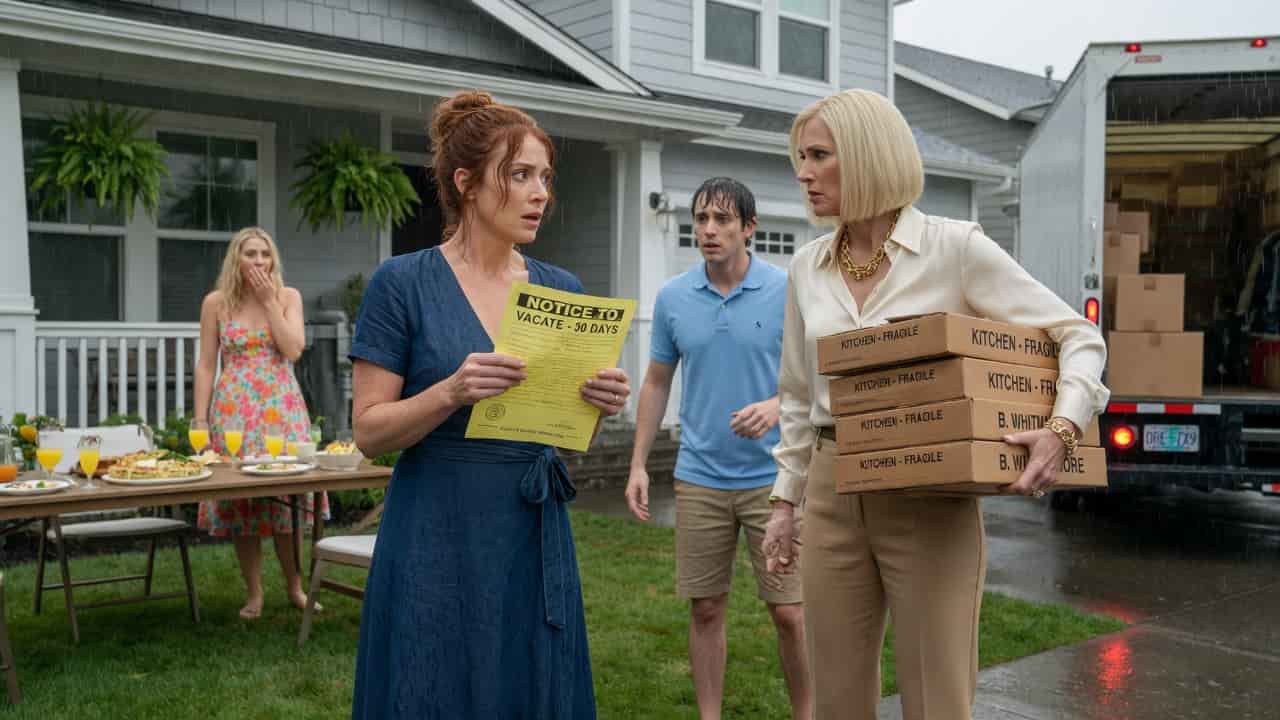
“The buyers want you out by noon. I hope you enjoyed your little ‘playhouse’ while it lasted.”
I stood there in my navy dress, the one I’d bought specifically for this brunch, holding a stack of mimosas for our neighbors. I thought this was the start of our new life. After years of foster homes and rentals, my mother-in-law, Brenda, had finally given us the stability I craved. She’d handed us the keys as a wedding gift, telling us the house was ours, free and clear.
We spent six months and every penny of our savings renovating the kitchen. I picked out the quartz countertops. I painted the twins’ rooms. I finally felt safe.
Then the moving trucks pulled into the driveway.
“Brenda, what are you talking about?” I asked, my voice cracking as our friends and neighbors went silent at the table. “This is our home.”
She didn’t even blink. She just shoved a stack of flattened cardboard boxes into my chest. “No, dear. It was my house. I just let you stay here to keep it from falling apart while I looked for a developer. The papers were never in your name.”
The yellow notice was still damp from the Oregon rain, taped right over the ‘Welcome’ wreath I’d hung last week. My husband stood there, looking at his mother like he didn’t even recognize her, but he didn’t step in. He didn’t say a word.
She’d sold our life out from under us to pay her own debts, and she chose the moment all our friends were watching to tell me I was nothing but a live-in caretaker.
Chapter 1
The smell of “Evergreen Mist” paint was the scent of victory. Maya stood in the center of the kitchen, her socks sliding slightly on the newly polished oak floors, and let out a breath she felt like she’d been holding since she was seven years old. Across the room, the morning sun hit the white quartz countertops, making the tiny flecks of grey sparkle like frost.
This was the Nest. That’s what she called it in her head, though she knew it sounded a little sentimental for a thirty-two-year-old freelance designer. But for Maya, who could still recite the addresses of the four different foster homes she’d lived in before high school, the word carried the weight of iron. Stability wasn’t just a concept; it was a physical structure with four bedrooms, two and a half baths, and a mortgage-free deed.
“Mommy! Look at the bug!”
Leo, one half of the three-year-old whirlwind that occupied her life, was crouching by the floor-to-ceiling windows that looked out over the damp, emerald-green Oregon yard. His twin, Sam, was busy trying to jam a plastic dinosaur into the HVAC vent.
“Don’t put Rex in the vent, honey,” Maya said, her voice soft, rooted in a calm she only felt within these walls. She picked Sam up, kissing the top of his head, which smelled like maple syrup and sleep. “Today is a big day. We have to be on our best behavior for the neighbors.”
“And Nana?” Sam asked.
Maya’s smile faltered for a fraction of a second. “And Nana.”
Brenda was the architect of this peace, a fact Maya never forgot. Three years ago, when the twins were born and Maya and Ben were drowning in medical bills and a cramped two-bedroom apartment in Portland, Brenda had stepped in. She was a woman of “gestures.” She’d inherited a portfolio of properties from her late husband—a man Ben rarely spoke of—and she’d chosen this one, a slightly dated but sturdy ranch in a quiet suburb, as their “wedding gift.”
I want my grandbabies to have a yard, Brenda had said, sliding the keys across a mahogany restaurant table. I want you two to focus on building a life, not paying a bank. Consider the deed your inheritance, given early.
Ben had been moved to tears. Maya had been wary—she was always wary of things that didn’t come with a struggle—but after six months of Ben’s mother insisting the paperwork was “being handled by the family trust lawyer,” Maya had finally let her guard down. She’d poured fifty thousand dollars of her own hard-earned savings into the house. New windows. A new roof. The kitchen of her dreams.
She looked at the kitchen now, at the high-end range and the custom cabinetry. She had earned this through sweat and design hours, even if the shell of the house had been a gift.
“Maya? Are the mimosas ready?”
Ben walked into the kitchen, looking every bit the successful suburban dad. He was a middle manager at a tech firm, a man who liked things to be “smooth.” He wore a sky-blue polo that matched his eyes, his dark hair combed back with just a hint of gel. He looked happy. For Ben, the house was a birthright. For Maya, it was a miracle.
“Chilling in the fridge,” Maya said, stepping into his personal space. She adjusted his collar, her fingers lingering on his neck. “Are you okay with this? The neighbors are kind of a lot.”
“It’s a housewarming, babe. We’ve lived here three years, but with the renovations finally done, it’s like we’re officially starting.” Ben kissed her forehead. “My mother should be here any minute. She’s bringing the quiche from that bakery she loves.”
“I made my own quiche, Ben,” Maya reminded him, a small spark of irritation flickering in her chest.
“I know, I know. But you know Mom. She likes to contribute. Let her have her moment. She gave us the house, after all.”
There it was. The permanent footnote to their lives. Every argument, every choice, every milestone was footnoted by Brenda’s generosity. Maya swallowed the retort. She couldn’t afford to be ungrateful. Not when she had so much to lose.
By 11:00 AM, the house was full of the sound of clinking glasses and the low hum of neighborhood gossip. Sarah and Dave from across the street were admiring the backsplash. Mrs. Gable from two doors down was trying to convince the twins that her dog didn’t want to eat their Legos.
The rain had started—a classic Oregon drizzle that turned the cedar trees in the backyard into dark, brooding giants. But inside, it was warm. Maya moved through the crowd, playing the part of the gracious hostess, her navy denim dress rustling as she walked. She felt a profound sense of belonging. She was the woman who owned the house with the “Evergreen Mist” kitchen. She wasn’t the girl with the trash bag full of clothes anymore.
Then, the doorbell rang.
It wasn’t a normal ring. It was a rhythmic, insistent demand.
Maya moved to the door, a practiced smile on her face. She expected Brenda to be carrying a steaming box of expensive pastries and a critique of the landscaping.
When she opened the door, Brenda was there. But she was empty-handed. She looked sharp—a cream silk blouse, tan trousers, her platinum bob perfectly in place despite the mist. Behind her, a large white moving truck was idling at the curb, its diesel engine a low, guttural growl that seemed to vibrate through the floorboards.
“Brenda? You’re early,” Maya said, her heart giving a strange, prophetic thump. “The brunch is just getting started. Come in, the mimosas are—”
“I’m not here for the brunch, Maya,” Brenda said. Her voice was different. It wasn’t the airy, performative tone she used in public. It was cold. It was the voice of a woman closing a deal.
Brenda didn’t move to enter. Instead, she reached into her designer handbag and pulled out a stack of flattened brown cardboard boxes. She held them out, the weight of them awkward between them.
“The buyers want you out by noon,” Brenda said.
Maya stared at the boxes. Then at the truck. Then back at Brenda. A nervous laugh escaped her throat. “The buyers? Brenda, what are you talking about? It’s Saturday. Is this some kind of joke?”
“The house sold on Thursday,” Brenda said, her eyes flicking past Maya to the crowd in the kitchen. She saw the neighbors watching. She didn’t lower her voice. If anything, she spoke louder. “The developer was very insistent on a quick closing. I need you to start packing. I brought these to help.”
“Sold?” Maya’s voice was a whisper now, the air in her lungs turning to lead. “You gave us this house. Ben! Ben, get over here!”
Ben appeared at her side, his face pale as he looked from his mother to the moving truck. “Mom? What’s going on? Why is there a truck in the driveway?”
“The house is sold, Benjamin,” Brenda said, her expression softening only slightly for her son, but the steel remained. “I told you months ago that the property taxes and the upkeep on these older places were becoming a burden on the trust. I’ve made a very good deal. It’s for the best.”
“A burden?” Maya stepped forward, the “Notice to Vacate” she hadn’t noticed earlier catching her eye. It was taped to the door, right next to the brass handle she’d polished yesterday. “We pay the taxes! I paid for the roof! I paid for this kitchen!”
“You paid to live in a beautiful home for three years for free,” Brenda countered, her voice ringing out so the entire room could hear. The neighbors had gone deathly silent. Sarah was standing on the porch steps, her hand over her mouth. “That was your ‘gift.’ I never signed a deed over to you, Maya. You’re a designer. You should know that unless it’s in writing, it’s just a nice idea.”
Brenda shoved the stack of boxes toward Maya’s chest. The cardboard was rough and smelled of dust. Maya stumbled back, the weight of the boxes forcing her to catch them or let them fall and humiliate her further.
“I hope you enjoyed your little ‘playhouse’ while it lasted,” Brenda said, her eyes cold and triumphant. “But the grown-up world requires real assets. Now, don’t make a scene in front of your friends. It’s so… unseemly.”
Maya looked at the boxes in her arms. She looked at Ben, who was staring at the floor, his shoulders hunched, his silence more devastating than anything Brenda had said. The “Nest” wasn’t a nest. It was a cage, and the door had just been slammed shut.
Chapter 2
The silence that followed Brenda’s declaration was the kind that had weight. It pressed against Maya’s eardrums, thick and suffocating. Behind her, in the kitchen she had agonized over—selecting the exact shade of grey for the grout, the specific brushed brass for the hardware—her life was curdling.
“Wait,” Ben finally whispered. His voice was thin, the sound of a man watching his world dissolve. “Mom, you said… at the wedding… you said this was ours.”
Brenda sighed, a sound of practiced maternal patience that set Maya’s blood on fire. “I said I wanted you to have a place to start your life, Benjamin. And you did. You’ve lived here three years without a single mortgage payment. Do you have any idea what that’s worth in this market? I’ve given you a head start worth hundreds of thousands of dollars.”
“We put fifty thousand into the renovations!” Maya yelled. She didn’t care about the neighbors anymore. She didn’t care about the ‘Evergreen Mist’ or the quiche. She felt the old, familiar panic of the foster kid—the realization that the floor was actually a trapdoor. “I have the receipts! I have the contracts!”
“And you have the benefit of living in a house with a new roof,” Brenda snapped. She stepped onto the threshold, effectively pushing Maya back into the foyer. “Which improved the resale value immensely. Thank you for that, by the way. It made the developer’s offer much more attractive.”
“You used us,” Maya said. The boxes in her arms felt like lead weights. “You let us spend our life savings to flip your property for you.”
“I let you live like royalty while I carried the risk,” Brenda corrected. She looked over Maya’s shoulder at the crowd of guests who were now awkwardly setting down their drinks and looking for their coats. “I’m sorry, everyone. The brunch is over. We have a lot of work to do. Maya, the movers are on the clock. I suggest you start with the breakables.”
Sarah, Maya’s closest friend in the neighborhood, stepped forward, her face a mask of pity. “Maya? Do you… do you need help? You can stay with us tonight.”
“She won’t be staying anywhere but a hotel if she doesn’t get moving,” Brenda said, turning her icy gaze on Sarah. “This is family business, Sarah. I’m sure you have things to do.”
Sarah flinched and looked at Maya. Maya couldn’t meet her eyes. The shame was a physical heat, a rash spreading up her neck. This was her nightmare—being the charity case again. Being the girl whose life didn’t belong to her.
One by one, the neighbors trickled out. They offered mumbled condolences and “let us know if you need anything,” but they moved quickly, escaping the radioactive zone of Maya’s humiliation. Dave, who had helped Ben install the new light fixtures just last month, didn’t even look at them as he hurried to his truck.
Within ten minutes, the house was empty of everyone except the family and the low, rhythmic beep-beep-beep of the moving truck backing closer to the front porch.
Maya dropped the boxes. They hit the oak floor with a dull thud.
“Ben,” she said, her voice dangerously quiet. “Tell me you have the deed. Tell me you saw the paperwork.”
Ben wouldn’t look at her. He was staring at the “Notice to Vacate” that Maya had ripped off the door. It was crumpled in his hand. “She said… she said the trust was holding it for tax purposes. She said it was for our protection.”
“Your protection?” Maya walked over to him, her fingers digging into his arm. “Ben, look at me. Did you ever sign anything? Anything at all?”
“I signed the residency agreements,” he murmured. “I thought… I thought they were just formalities.”
“Residency agreements?” Maya’s laugh was sharp and jagged. “You signed a lease? You signed a lease on our ‘wedding gift’?”
“I didn’t think! She’s my mother, Maya! Why would she lie about this?”
“Because she’s Brenda!” Maya screamed. “Because she’s been ‘gesturing’ us into a corner for three years! She knew I wouldn’t have put a dime into this place if I knew we were just tenants!”
Brenda walked back into the room, her phone in her hand. She was ignoring the emotional carnage as if it were a minor spill on the rug. “The movers are starting in the garage. They have instructions to pack everything. If you want to keep your personal items separate, I suggest you get a move on.”
“The garage?” Maya’s heart stopped. “My office is in the garage. My computer, my portfolio, my… Ben, the trunk.”
Maya didn’t wait for an answer. She shoved past Brenda, ignoring the woman’s indignant “Excuse me!”, and ran out the front door. The Oregon rain was coming down harder now, a grey curtain that blurred the world. She ran toward the driveway, where Brenda’s silver Mercedes was parked.
Brenda had left the trunk slightly ajar—she’d probably been taking out more of those godforsaken boxes.
Maya yanked the trunk open.
Inside, tucked under a designer trench coat and a bag of high-end groceries, was a large, heavy sign. It was professional, made of thick corrugated plastic with a glossy finish.
SOLD.
And underneath the bold red letters: Future Site of Hawthorne Luxury Townhomes.
Maya pulled the sign out, the cold rain slicking the plastic. There was a date on the back, handwritten in black marker: Sold – Oct 12th.
Thursday.
Brenda had sold the house three days ago. She had known when she called Maya on Friday to ask if she should bring the quiche. She had known when she told Maya how beautiful the new “Evergreen Mist” paint looked in the sunlight.
“Maya! Get away from my car!” Brenda was standing on the porch, her arms crossed.
Maya turned, holding the ‘Sold’ sign like a shield. She walked back toward the house, her navy dress soaked, her hair plastered to her skull. She looked like a drowned rat, but her eyes were cold, hard diamonds.
She marched up the steps and shoved the sign into Brenda’s face.
“A developer?” Maya hissed. “You didn’t just sell the house. You sold the land. You sold the yard you wanted the ‘grandbabies’ to have. You sold their rooms so someone can build townhomes?”
Brenda didn’t flinch. She reached out and pushed the sign away with one manicured finger. “Suburban real estate is about timing, Maya. The market peaked. This lot is worth three times the house value if it’s cleared. I have debts—debts your father-in-law left me that you know nothing about. I am securing my future.”
“By destroying ours?” Maya looked past her at Ben, who was standing in the foyer, watching the movers carry a heavy dresser—Maya’s grandmother’s dresser—out the door. “Ben, do something! Call a lawyer! Stop them!”
“He can’t,” Brenda said, her voice dropping to a terrifyingly calm whisper. “I checked the residency agreement Benjamin signed. It has a ‘Sale of Property’ clause. Thirty days’ notice. I mailed the notice thirty days ago, to this address. I assume it got ‘lost’ in the mail.”
Maya looked at the pile of mail on the quartz counter—the pile she’d been too busy to go through while she was finishing the renovation. Her stomach turned.
“You planned this,” Maya whispered. “Every step. The ‘gift,’ the renovation, the timing. You waited until the house was perfect so you could get top dollar.”
“I am a businesswoman, Maya. Something you clearly lack the stomach for.” Brenda turned to the movers. “The master bedroom next. Be careful with the headboard, it’s an antique.”
Maya stood in the rain, the ‘Sold’ sign at her feet, watching her life being loaded into the back of a truck while her husband stood silent in the house that was no longer theirs. The residue of the ‘gift’ was nothing but ash in her mouth.
Chapter 3
The rain didn’t stop. It settled into a relentless, rhythmic drumming on the roof of the Honda, a sound that felt like a countdown. Maya sat in the driver’s seat, her hands gripped so tightly on the steering wheel that her knuckles were the color of bone. Beside her, the twins were strapped into their car seats, mercifully asleep after the chaos of the afternoon.
Ben was in the passenger seat, his head leaning against the window. He hadn’t spoken since they’d been forced to watch the movers wrap the quartz island in moving blankets.
“We have to go back,” Maya said. Her voice was brittle, a thin wire stretched to the breaking point.
“Go back where, Maya? The locks are changed. She had the locksmith there before the truck was even half-full.” Ben’s voice was flat, the sound of a man who had already surrendered.
“To the lawyer. To that office in Lake Oswego. There has to be a way. A ‘gift letter,’ Ben! You said she signed a gift letter for the mortgage company when we were thinking about refinancing!”
Ben finally looked at her. His eyes were bloodshot, his face haggard. “Maya, we never refinanced. We didn’t have to. The house was ‘free.’ The gift letter… she probably never even filed it. It was just a piece of paper she showed us to make us feel good.”
“I am not going to a motel, Ben. I am not taking my children to a Motel 6 because your mother decided to play Monopoly with our lives.”
Maya shifted the car into gear and pulled out of the driveway of the house that used to be hers. She didn’t look back at the “Evergreen Mist” front door. She drove.
The lawyer’s office was a sleek, glass-and-steel building that looked like it belonged to people who never had to worry about residency agreements. Maya marched into the lobby, her damp dress clinging to her, her auburn hair a wild mess. She looked like a woman on the edge of a breakdown, which was exactly what she was.
“I need to see Mr. Aris,” she told the receptionist.
“Do you have an appointment?”
“No. But I have a house that was stolen from me by the woman who supposedly put it in his ‘trust.’ Tell him Maya Vance is here. Tell him it’s about Brenda Vance.”
Ten minutes later, they were sitting in a plush office that smelled of expensive tobacco and leather. Mr. Aris was an older man with a sympathetic face that Maya immediately distrusted.
“Mrs. Vance,” he said, spreading a thin file on his desk. “I was afraid I’d be seeing you.”
“You knew?” Maya leaned forward, her heart hammering against her ribs. “You knew she was selling the house?”
“I am the trustee for the Vance Family Trust,” Aris said carefully. “Brenda is the sole beneficiary and the only person with signing authority. She informed me months ago that she intended to liquidate the suburban holdings to cover some… significant tax liabilities.”
“She told us it was a gift,” Maya hissed. “She gave us the keys. She told us to renovate. She watched us spend fifty thousand dollars!”
Aris sighed, a sound of genuine pity that made Maya want to scream. “I looked for the deed transfer, Maya. I really did. I suggested it to her several times. She always demurred. She said she wanted to keep the assets ‘unified’ for now. Without a recorded deed in your name, or a legally binding contract of sale, the property remains an asset of the trust.”
“What about the gift letter?” Ben asked, his voice small.
“A gift letter is a statement of intent for a lending institution,” Aris explained. “It’s not a transfer of title. Even if I could find the one she showed you, it wouldn’t supersede her right to sell the property she legally owns.”
“So that’s it?” Maya stood up, her chair screeching against the carpet. “She can just lie? She can just humiliate us in front of everyone we know, throw our things in a truck, and sell our children’s rooms to a developer, and it’s… legal?”
“Technically, yes,” Aris said. “However, there is the matter of the ‘Sale of Property’ clause in the residency agreement Benjamin signed. It requires a thirty-day notice. If you can prove you weren’t served, you might be able to sue for damages. The cost of the renovations, perhaps. But it won’t get you the house back. The sale to the developer is already in escrow. It’s a done deal.”
Maya felt a cold, hard knot form in her stomach. Damages. A lawsuit that would take years and cost money they no longer had. Brenda knew they were broke. She knew the renovation had cleared them out.
“Thank you, Mr. Aris,” Maya said, her voice dropping into a register Ben had never heard before. It was the voice of the girl who had learned how to survive the system by finding its cracks.
“Maya?” Ben followed her out of the office. “What are we doing? Where are we going?”
“We’re going to Brenda’s,” Maya said.
“What? No. Maya, that’s a mistake. She’s probably at the club or—”
“She’s at her penthouse, Ben. Celebrating. And she has something of mine.”
The drive to Brenda’s high-rise in the Pearl District was silent. The rain turned the city lights into blurred streaks of neon. Maya’s mind was racing. She wasn’t thinking about the house anymore. She was thinking about the leverage.
Brenda’s penthouse was a fortress of white marble and floor-to-ceiling glass. When Maya buzzed the intercom, Brenda’s voice came through, sounding annoyed.
“Maya? It’s late. I told you, we can discuss the storage of your furniture on Monday.”
“I don’t want to talk about furniture, Brenda,” Maya said into the metal grate. “I want to talk about the ‘gift’ you gave me. The real one. The one you forgot I have.”
There was a long pause. Then, the buzz of the door.
They took the elevator up in silence. When the doors opened directly into the foyer of the penthouse, Brenda was waiting. She was wearing a silk robe, a glass of red wine in her hand. She looked relaxed, the victor in a war that hadn’t even been a fight.
“You’re persistent, I’ll give you that,” Brenda said, sipping her wine. “But it’s over, Maya. The papers are signed. The developer has the keys.”
“I know,” Maya said. She walked into the living room, her wet sandals leaving dark prints on the white rug. She didn’t care. “I talked to Aris. He explained everything. The trust, the lack of a deed, the residency agreement.”
“Then why are you here? To beg? It’s beneath you.”
“I’m here because I remembered something,” Maya said. She looked at Ben, then back at Brenda. “Do you remember the night of the twins’ first birthday? We were all here. You were so happy. You’d had a little too much to drink, Brenda. You started talking about ‘the inheritance.’ About how your husband hadn’t just left you properties. He’d left you a ‘legacy’ of how he acquired them.”
Brenda’s hand tightened on her wine glass. The relaxed posture vanished, replaced by a rigid, brittle tension. “I have no idea what you’re talking about.”
“You talked about the ‘arrangement’ with the city council back in the nineties,” Maya continued, her voice steady. “About how he managed to get the zoning changed for the suburban lots. The ones that are now being sold to developers for townhomes. You said it was a ‘family secret.’ You even showed me the ledger, Brenda. The one you keep in the safe in your office. The one with the names and the dates.”
Ben stared at Maya. “Maya, what ledger? What are you talking about?”
“The one your mother uses to make sure she never loses a deal, Ben,” Maya said, her eyes never leaving Brenda’s. “The one that shows exactly how this ‘gift’ of a house became part of the trust in the first place. It wasn’t a purchase, was it, Brenda? It was a settlement. For a debt that was never supposed to be on the books.”
Brenda’s face went from pale to a sickly, mottled grey. “You’re bluffing. You were never in my office alone.”
“The twins were crying,” Maya said. “You told me to go get the diaper bag from your desk. I didn’t find the bag first. I found the ledger. And I have a very good memory for numbers, Brenda. Especially numbers that look like bribes.”
The silence in the penthouse was different now. It wasn’t the silence of humiliation. It was the silence of a predator realizing it was in a cage.
“What do you want?” Brenda whispered.
Maya looked out the window at the rain-slicked city. “I don’t want the house. I can’t live in a place that smells like you anymore. I want the fifty thousand I spent on the renovation. I want another fifty thousand for the ‘residency’ we paid you in labor. And I want you to sign over the small cottage in Cannon Beach. The one that’s not in the trust. The one in your personal name.”
“You’re insane,” Brenda hissed. “That’s extortion.”
“No,” Maya said, stepping closer until she could smell the expensive wine on Brenda’s breath. “It’s a ‘wedding gift.’ Given early. And this time, Brenda, the deed will be in my name before the sun comes up.”
Chapter 4
The psychological weight of the last twelve hours had settled into Maya’s bones like a fever. She stood in the center of Brenda’s white marble living room, a ghost in a damp denim dress, watching the woman who had tried to erase her life crumble into a chair.
Ben was frozen near the elevator doors. His entire identity—the son of a “generous” mother, the man who had it all figured out—was shattering. He looked at Maya as if he were seeing a stranger. And in a way, he was. He was seeing the woman who had lived through four foster homes and learned that every “gift” had a price tag and every secret was a weapon.
“Maya,” Ben whispered. “Is this true? The ledger? The bribes?”
Maya didn’t look at him. She couldn’t. If she looked at Ben, she might see the judgment in his eyes, or worse, the pity. She had to stay in the cold, hard place she’d built. “Ask your mother, Ben. Ask her why she was so worried about the developer seeing the old zoning records.”
Brenda didn’t answer. She was staring at her wine glass, her hand trembling. The “gesturing” was over. The performance had failed.
“I can’t give you the cottage,” Brenda finally said, her voice a ragged ghost of itself. “It’s… it’s promised to someone else.”
“Then un-promise it,” Maya said. “Or I call the Oregonian. I’m sure they’d love a story about a prominent socialite selling out her own family to cover up thirty-year-old zoning fraud. Think about the ‘residue’ that will leave on your reputation, Brenda. No more charity boards. No more ‘moments’ at the club.”
“You would destroy Benjamin’s name, too,” Brenda spat, her eyes flicking to her son. “You’d destroy the twins’ future.”
“Their future was loaded into a moving truck this morning!” Maya shouted, her voice echoing off the glass walls. “You destroyed their future when you decided their rooms were just ‘liquidity.’ Don’t you dare talk to me about their future.”
The room went silent again, save for the hum of the high-rise’s ventilation. The power dynamic had shifted so violently that the air felt thin. Brenda looked at the phone on the side table. She looked at Ben. Then, she looked at the marble floor.
“Fine,” Brenda whispered. “The cottage. And the money. But you sign a non-disclosure. You sign a release of all claims against the trust.”
“I’ll sign whatever the lawyer drafts,” Maya said. “But the deed transfer happens tonight. I’m not leaving this room until I have proof.”
“It’s Saturday night, Maya! No title company is open.”
“You have a notary on your payroll, Brenda. I know you do. Call him. Tell him it’s an emergency.”
The next three hours were a blur of cold, professional hostility. Brenda made the calls. A man in a grey suit arrived at midnight, looking confused and exhausted. Papers were produced. Ben sat at the dining table, his head in his hands, as Maya scrutinized every line of the documents.
She wasn’t a lawyer, but she knew what a trap looked like. She made Aris—who Brenda had also summoned—verify that the Cannon Beach property was free of liens.
“It’s clean,” Aris said, his voice quiet, almost respectful as he looked at Maya. “The transfer is valid.”
When the final signature was blotted and the notary had stamped the last page, Maya picked up the folder. It was thin, just a few pages of legal bond paper, but it weighed more than the fifty thousand dollars Brenda was transferring via a wire that would hit their account on Monday.
“We’re done,” Maya said.
She walked toward the elevator. Ben followed her, moving like a sleepwalker.
“Maya,” Brenda called out. She was standing by the window, looking out at the city she’d tried so hard to own. She looked small. “You think you’ve won. But you’ve lost everything. You’ve lost your family. You’ve lost me.”
Maya stopped, the elevator doors sliding open. She turned back, her face illuminated by the harsh foyer lights.
“I never had you, Brenda,” Maya said. “I had a landlord who liked to play dress-up. And as for family… my family is in the car, waiting for me to take them to a home that actually belongs to them.”
The elevator doors closed.
In the car, the twins were still asleep. The silence between Maya and Ben was a canyon. He started the engine, the wipers swiping away the relentless Oregon rain.
“Did you really see a ledger, Maya?” Ben asked as they pulled away from the curb.
Maya leaned her head back against the seat. She closed her eyes. The adrenaline was fading, replaced by a crushing, hollow exhaustion. The image of Brenda shoving those boxes into her chest flashed through her mind—the public humiliation, the neighborhood watching her fall.
“I saw a diaper bag, Ben,” Maya whispered.
Ben gripped the steering wheel, the car swerving slightly. “What?”
“I never saw a ledger. I didn’t even know where her safe was.”
“You… you lied? You extorted her with a guess?”
“It wasn’t a guess,” Maya said, her voice flat. “I know how people like Brenda work. They don’t get that much power without cutting corners. I just aimed at the wound I knew she had. She was terrified of the developer looking too closely at the lot. I just gave her a reason to be even more terrified.”
Ben was silent for a long time. The city lights faded as they hit the highway, heading toward the coast. “I don’t know who you are,” he finally said.
“I’m the woman who just got us a house, Ben,” Maya said. “The kind of house nobody can take away from us. If you can’t live with how I got it, you can get out at the next exit.”
Ben didn’t stop the car. He kept driving into the dark, toward the sound of the ocean, while Maya held the folder to her chest and finally, for the first time in three years, felt the weight of the Nest. It was cold. It was hard. But it was hers.
The residue of the day—the ‘Evergreen Mist’ kitchen, the ‘Sold’ sign, the look on Sarah’s face—was still there, clinging to her like the dampness of her dress. She knew the consequences were coming. She knew her marriage might not survive the truth of what she’d done. But as she looked at her sleeping sons in the rearview mirror, she knew she’d do it again.
The humiliation had been public. The revenge had been private. And the cost was yet to be determined.
Chapter 5
The headlights of the Honda cut through a wall of coastal fog so thick it felt like driving into a bale of wet wool. They had reached the edge of Cannon Beach, the salt in the air already aggressive enough to sting Maya’s eyes through the vents. Behind them, the twins were slumped against their seatbelts, their breathing deep and rhythmic—the only peaceful sound in a car that felt like a pressure cooker on the verge of exploding.
Ben hadn’t looked at her since they’d crossed the Coast Range. He drove with both hands at ten and two, his posture so rigid he looked like a statue carved from anxiety.
“It’s the third driveway after the Haystack viewpoint,” Maya said, her voice sounding thin and metallic in the cramped cabin. She held the folder with the deed in her lap as if it were a physical shield. “The one with the cedar shake siding and the blue door.”
“I know which one it is, Maya,” Ben said. His voice was flat, devoid of the warmth that usually defined him. “I spent my summers here. My father bought this place for my mother when she was pregnant with me. It was the only thing she kept in her own name when the trust was formed.”
“The only thing she didn’t let the ‘family’ touch,” Maya corrected. “And now it’s ours. Truly ours.”
Ben pulled the car into a narrow, gravel-crunching driveway. The cottage was small—dramatic and weathered, huddling against the wind-bent pines. It wasn’t the “Evergreen Mist” dream. It was a salt-crusted relic of a different era, with small windows and a porch that groaned under the weight of the mist. It looked like a place where secrets went to hide, not a place where a family went to start over.
“It’s small,” Ben whispered, staring at the blue door.
“It’s legal,” Maya countered. She stepped out of the car, the cold ocean air hitting her like a slap. Her navy dress, still damp from the Portland rain, felt like a second, colder skin.
She walked to the door, the key Brenda had tossed onto the marble table feeling heavy in her pocket. When she turned the lock, the sound was a sharp, final clack. She pushed the door open and was met with the smell of old cedar, mothballs, and the peculiar, metallic scent of an empty house.
She fumbled for the light switch. A dim, yellow glow filled a living room packed with mismatched wicker furniture and faded floral cushions. It was a time capsule of Brenda’s younger life, before she’d traded sentiment for “liquidity.”
Ben carried the boys in, one on each shoulder. He didn’t ask where to put them. He just walked down the narrow hallway to the back bedroom, his footsteps heavy on the uneven floorboards.
Maya stood in the kitchen—a tiny galley with a laminate counter and a fridge that hummed with a low, mournful vibration. She looked at her hands. They were still shaking. The adrenaline that had carried her through the penthouse confrontation was beginning to leak out, leaving behind a cold, hollow ache.
She had won. She had a deed. She had a wire transfer pending. But as she looked around the cramped, salt-stained room, she realized she had also brought the “residue” with her. She could still see the look on Sarah’s face when Brenda had shoved those boxes into her arms. She could still feel the weight of the neighbors’ pity.
“They’re down,” Ben said, appearing in the doorway. He didn’t come into the kitchen. He leaned against the doorframe, his blue polo shirt wrinkled and stained with toddler juice and rain. “Sam woke up for a second. He asked if we were back at the other house. I told him we were at a cabin. He started crying, Maya. He wanted his Rex dinosaur. The one he put in the vent.”
“We’ll get him a new one,” Maya said, her voice tight. “We’ll get him ten new ones.”
“With the extortion money?”
Maya flinched. She turned to face him, her back against the laminate counter. “Don’t call it that, Ben. Don’t you dare use that word.”
“What else do you call it, Maya? You stood in my mother’s home and lied to her face. You threatened her with a secret you didn’t even know existed. You used her fear of her own shadow to strip her of her property.” Ben stepped into the light of the kitchen, and for the first time, Maya saw the true depth of the fracture. His eyes weren’t just sad; they were wary. “You played her. You played her better than she played us.”
“She was going to put us on the street!” Maya’s voice rose, hitting the low ceiling and bouncing back. “She used us as free labor to flip a house! She lied to our faces for three years, Ben! She watched me pick out paint and tile and furniture, knowing the whole time she’d already talked to a developer! Why are you defending her?”
“I’m not defending her,” Ben shouted back, his voice cracking. “I’m mourning the woman I thought I married! The woman who told me she wanted a ‘nest’ because she believed in the sanctity of a home. Not a woman who treats people like targets in a zoning war!”
“I did what I had to do to protect my children,” Maya hissed, stepping toward him. “I didn’t have the luxury of sitting in the foyer and staring at the floor while my life was loaded into a truck. I didn’t have a mother who gave me everything and then took it back just to see me crawl. I had to earn my safety, Ben. I’ve been earning it since I was seven years old, and if that makes me a ‘liar’ in your eyes, then maybe you should have married someone who didn’t know what it felt like to have nothing.”
The silence that followed was different from the silence in the car. This was a silence that had teeth. It chewed on the space between them until there was nothing left but the sound of the wind rattling the old window frames.
Ben looked away. He looked at the tiny, outdated stove, at the cracked linoleum. “She’s my mother, Maya. Regardless of what she did, she’s the only family I have left.”
“And what am I?” Maya asked, her voice dropping to a whisper. “What are the boys?”
“You’re the people I’m currently hiding with in a stolen cottage,” Ben said.
He walked past her, his shoulder brushing hers, and went out onto the small back porch. Maya heard the screen door bang shut. She stood alone in the kitchen, the folder with the deed still gripped in her hand.
She walked to the window and looked out. Through the fog, she could just make out the dark, churning mass of the Pacific. The waves were invisible, but she could hear them—a constant, grinding roar that seemed to mock the idea of permanent foundations.
She reached into her pocket and pulled out her phone. There were sixteen missed calls. Twelve from Sarah. Three from the real estate agent who had handled the “sale.” And one from a number she didn’t recognize.
She hesitated, then tapped the unknown number.
A man’s voice answered on the first ring. It was clipped, professional, and entirely devoid of warmth. “Mrs. Vance? This is Marcus Thorne. I’m the lead developer for the Hawthorne project.”
Maya’s heart did a slow, heavy roll. “Mr. Thorne. It’s late.”
“I’m aware. I’m also aware that your mother-in-law has attempted to halt the demolition permits for the Oregon property. She claims there is a… legal complication regarding the residency agreements.”
Maya leaned against the sink, the cold metal pressing into her hip. “There is no complication, Mr. Thorne. The property is yours. My mother-in-law was just feeling a bit of seller’s remorse.”
“She sounded more than remorseful, Mrs. Vance. She sounded terrified. She mentioned something about an audit. About the zoning history of the lot.”
Maya closed her eyes. She could see Brenda now, panicked and desperate, trying to find a way to get the cottage back, trying to see if Maya really had the ledger. She was digging her own grave.
“My mother-in-law is an elderly woman under a great deal of stress,” Maya said, her voice steady, practiced. “She’s confused. The sale is valid. We’ve vacated the premises. If you have any further questions, you should speak to her trustee, Mr. Aris. But if I were you, I’d move fast. Before she changes her mind again.”
There was a long pause on the other end of the line. “I appreciate the clarity, Mrs. Vance. We start the teardown on Tuesday morning. I’d suggest you make sure you haven’t left anything behind.”
“Nothing I want to keep,” Maya said.
She hung up and set the phone on the counter. She felt a strange, cold peace. The “Evergreen Mist” house was gone. In forty-eight hours, it would be a pile of splinters and drywall. The kitchen she’d dreamed of, the rooms she’d painted, the stability she’d bought with her own sweat—it was all being erased.
She walked out onto the porch. Ben was sitting on the top step, his back to her. The fog had turned into a fine, stinging mist that coated everything in a layer of grey.
“That was the developer,” Maya said.
Ben didn’t turn around. “What did he want?”
“To know if we were out. To know if the ghosts were gone.”
“Are they?” Ben asked.
Maya sat down beside him. She didn’t touch him. She just watched the fog. “No. I think we brought them with us. I think they’re going to be living in the walls of this place for a long time.”
Ben finally looked at her. The anger was gone, replaced by a hollow, weary resignation. “Was it worth it, Maya? This place? The money? Knowing that every time I look at you, I’m going to wonder what else you’re capable of?”
Maya looked at the blue door of the cottage. She thought about her childhood—the smell of other people’s laundry, the feeling of sleeping in a bed that wasn’t hers, the constant, low-level hum of knowing she could be moved at any moment.
“Yes,” Maya said, her voice like iron. “It was worth it. Because tomorrow morning, my sons are going to wake up in a house that belongs to their mother. And they’re never going to have to wonder if they’re allowed to stay.”
Ben didn’t answer. He just looked back out at the ocean. They sat there together in the dark, two people who had won a war only to realize they no longer recognized the territory they were fighting for. The residue of the day—the public shame, the private betrayal, the lie that had saved them—was the only thing they had left.
Chapter 6
Monday morning arrived with the kind of clarity that only a storm can leave behind. The fog had been chased away by a sharp, biting wind, leaving the sky a hard, brilliant blue over Cannon Beach. The ocean was still violent, great white plumes of spray crashing against the base of Haystack Rock, but the air felt scrubbed clean.
Maya sat at the small, wobbly wicker table in the cottage’s breakfast nook. A mug of bitter coffee sat untouched in front of her. She was watching the screen of her laptop, her finger hovering over the refresh button for her bank’s website.
At 9:14 AM, the number changed.
The balance jumped by one hundred thousand dollars. The “gift” had arrived.
Maya stared at the digits. It should have felt like a symphony. It should have felt like the moment the hero gets the girl or the treasure is found. Instead, it felt like the receipt for a transaction she couldn’t take back.
Ben came into the room, holding Leo, who was complaining about the “crunchy” cereal. Ben saw the screen, saw the numbers, and then looked away. He didn’t celebrate. He just walked to the fridge and poured a glass of milk.
“It’s in,” Maya said.
“Good,” Ben replied. “I’ll start looking for a contractor for the roof here. The shingles are practically disintegrating.”
“Ben—”
“I’m going to the hardware store,” he interrupted, setting Leo down. “We need locks. Real ones. Not these old skeletons.”
He left without looking at her again. The silence he left behind wasn’t angry anymore; it was worse. It was functional. He was staying, he was helping, he was being a father and a husband, but the “Ben” who had looked at her with unalloyed pride during the housewarming brunch was gone. He had been replaced by a man who was simply doing the math.
Maya spent the morning unpacking the few boxes they had managed to throw into the car. Most of their lives were still in a storage unit in Portland, under Brenda’s control, but she had the essentials. She found the twins’ stuffed animals. She found her laptop. She found the small, framed photo of her and Ben on their wedding day, standing in front of the very house they had just watched die.
Her phone buzzed on the laminate counter. It was a text from Sarah.
I saw the trucks this morning, Maya. They’re already tearing off the siding. Everyone is talking. Brenda told Mrs. Gable that you ‘had a breakdown’ and forced her to sell to cover your debts. Is that true? Please tell me you’re okay.
Maya’s vision blurred. The public humiliation wasn’t over; it was just evolving. Brenda was doing what she did best—controlling the narrative. She was turning Maya into the villain of the piece, the unstable daughter-in-law who had ruined the family’s stability.
Maya started to type a response, her thumbs hovering over the glass. She lied, Sarah. She sold it to a developer for townhomes. We’re at the coast.
She deleted it.
What was the point? To Sarah and the neighbors, Maya was already gone. She was the woman who had been kicked out of her own brunch. The truth was too complicated, too ugly, and too drenched in the “extortion” Ben was so disgusted by.
She put the phone face down.
“Mommy? Look!”
Sam was standing in the doorway of the small bedroom, holding a dusty, blue-bound book he’d found under the bed. “A story?”
Maya took the book from him. It wasn’t a story. It was an old photo album, the pages yellowed and smelling of dampness. She flipped it open and saw a young Brenda, her hair long and dark, standing on the porch of this very cottage. She was holding a baby—Ben. Beside her was a man Maya had only seen in a few formal portraits. Ben’s father.
They looked happy. They looked like people who believed in the “Nest.”
Maya flipped through the pages. Toward the back, she found a loose piece of paper. It was a handwritten note, the ink faded but legible.
To my dearest Benjamin, the note read. This house is the only place where the world can’t find us. No trusts, no lawyers, no ‘obligations.’ Just the salt and the wind. Keep it safe. Don’t let the business take it.
Maya felt a sudden, sharp pang of guilt that nearly took her breath away. Brenda hadn’t just given them a cottage. She had given them the only piece of her heart she hadn’t already sold off to pay her debts. It was the only place she was a person instead of a “businesswoman.”
And Maya had taken it by threatening to destroy the very thing Brenda had spent thirty years trying to protect: the “legacy” of the family name.
She closed the album and sat on the floor, the cold wood pressing into her legs. She looked at Sam, who was now busy trying to stack sea shells on the windowsill.
“We’re staying here, Sam,” she whispered.
“For always?” he asked.
“For as long as we want,” Maya said.
That afternoon, Maya drove into the small town center of Cannon Beach. She needed supplies—real food, cleaning products, and a new Rex dinosaur for Sam. The town was bustling with tourists, people in fleece jackets carrying overpriced coffee, oblivious to the fact that just a few miles away, a woman’s life had been dismantled and reconstructed with the wreckage of a lie.
As she walked through the aisles of the local grocery store, she felt invisible. It was a strange, liberating feeling. In the suburb, she was “The Designer.” She was “The Woman with the Kitchen.” Here, she was just another mother in a denim dress, buying milk and bread.
She was at the checkout when she saw the headline on a local paper near the register. Development Boom Hits Suburbs: Historic Lots Cleared for Luxury Housing.
She didn’t buy the paper. She didn’t need to.
When she got back to the cottage, Ben was on the roof. He was tearing away the rotted shingles, his movements methodical and aggressive. He didn’t look down when she pulled in.
Maya went inside and started to clean. She scrubbed the grime off the windows until the ocean was visible in high definition. She polished the old cedar walls. She threw away the mothballs and opened every window, letting the cold, clean Pacific air roar through the house.
By sunset, the cottage felt different. It still wasn’t the “Evergreen Mist” dream, but it was starting to feel like a place that could hold a family.
Ben came in as the sun was dipping below the horizon, painting the sky in violent shades of orange and purple. He was covered in dust and grit, his hands scratched and bleeding.
“The roof is secure for the night,” he said, taking a seat at the table. “I’ll need to order the new cedar shakes tomorrow.”
Maya set a plate of pasta in front of him. “I found a note,” she said.
She placed the photo album on the table and opened it to the letter. Ben read it in silence. His jaw tightened, and for a moment, Maya thought he might cry.
“She kept it for me,” Ben whispered. “She really did keep one thing for me.”
“I think she did,” Maya said. “And I think she’s going to hate me for the rest of her life for making her give it up.”
Ben looked at her then. The wariness was still there, but it was softened by a flicker of understanding. “She would have let us drown, Maya. I know that now. I saw the ‘Sold’ sign. I saw the trucks. She would have watched us go to a shelter if it meant her trust stayed solvent.”
“She made her choice, Ben,” Maya said. “And I made mine.”
“We’re going to have to live with them,” Ben said. “Both of us.”
“I know.”
They ate in silence as the light faded from the room. The twins were playing in the corner, building a fortress out of the moving boxes Brenda had shoved into Maya’s arms only two days ago. They were laughing, oblivious to the fact that their “playhouse” had been traded for a fortress of salt and cedar.
Maya walked out onto the porch one last time before bed. The wind had died down, and the ocean was a vast, dark mirror. She looked toward the north, toward Portland, and imagined the “Evergreen Mist” kitchen falling. She imagined the quartz cracking, the custom cabinets splintering, the paint she’d agonized over turning into dust.
She felt a momentary pang of grief for the woman she used to be—the woman who thought safety was something you could buy with a specific shade of grey paint. That woman was gone, buried under the rubble of the house.
She reached into her pocket and felt the key to the blue door. It was cold. it was real.
She wasn’t a ghost of herself. She was the architect of a new, harder reality. The residue of the humiliation would always be there, a faint, bitter taste in the back of her throat. The rift in her marriage would take years to heal, if it ever did. But as she looked at the dark horizon, Maya realized she wasn’t afraid.
She had learned the most important lesson of the “grown-up world,” the one Brenda had tried so hard to teach her.
Safety isn’t a gift. It’s a settlement.
And Maya had finally paid the price in full.
She turned and went back inside, closing the blue door behind her. The lock clicked—a sharp, final sound that echoed through the house, marking the beginning of a life that finally, undeniably, belonged to her.