“Am I your son, or am I just a pharmacy?”
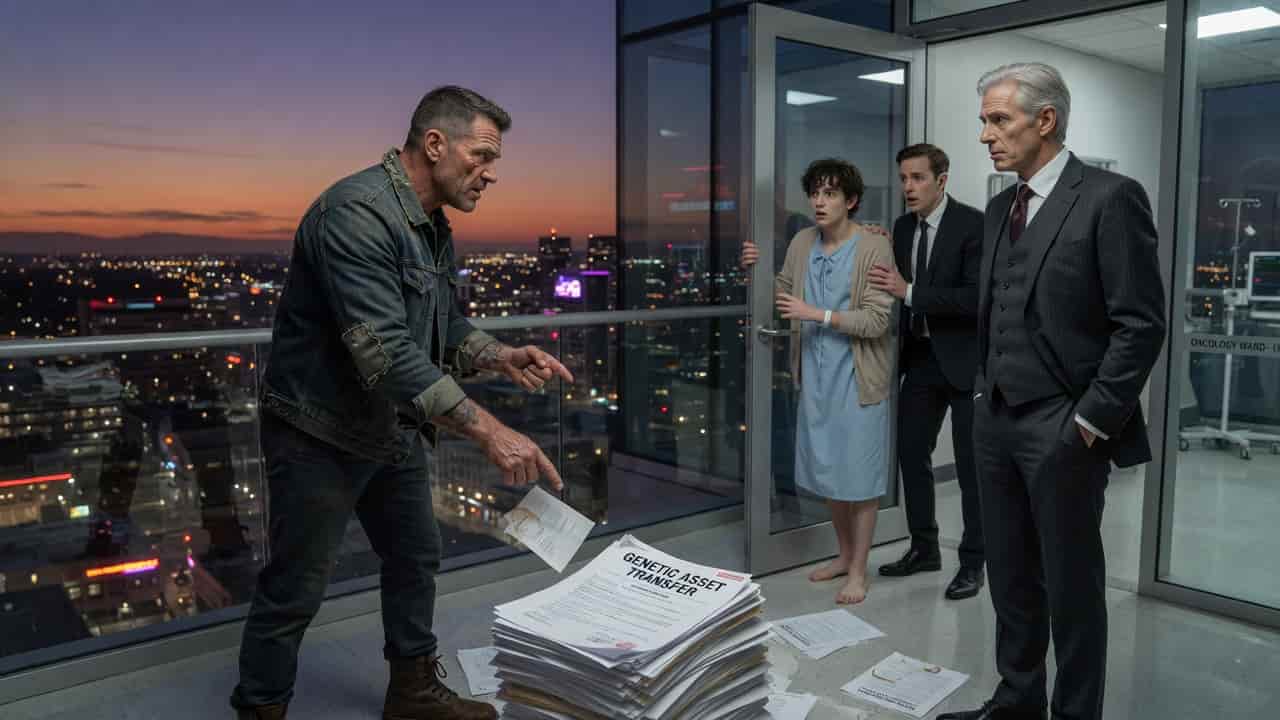
Leo stood on the balcony of the most expensive hospital wing in the city, the wind whipping the pages of the document he’d just found in his father’s office. For three weeks, Sterling had played the part of the grieving, repentant parent. He’d talked about “making up for lost time” and “reconnecting the family line.”
Then Leo found the folder.
It wasn’t a family history. It was a “Genetic Asset Transfer.” A price list for his bone marrow. A legal waiver that would allow Sterling to harvest whatever Julian needed, then send Leo back to the gutter with a check that felt like hush money.
In front of the cameras and the hospital board, the mask finally slipped.
“You’re a match, Leo,” Sterling said, his voice as cold as the glass walls surrounding them. “Don’t get sentimental. You were always a runner. I’m just making sure you’re useful before you disappear again.”
Julian, the younger brother Leo had actually grown to care for, stood in the doorway, clutching his hospital gown. He looked at the scattered papers on the floor—the proof that his life was being bought with his brother’s dignity.
The room went silent. The “loving reunion” was over. The real war had just begun.
Chapter 1: The Weight of the Hands
The gym smelled like old leather, bleach, and the kind of sweat that stays in the walls for decades. It was a basement space in South Philly, the kind of place where the lightbulbs flickered in rhythm with the speed bag. Leo sat on a low wooden bench, his hands resting on his knees. His knuckles were thick, distorted by years of impact, the skin across them a map of faded white scars.
He wasn’t a pro anymore. He hadn’t been a pro since a right hook in Atlantic City turned his orbital bone into a jigsaw puzzle. Now, he was thirty-five and he worked for a man named Sal. He didn’t hit people for Sal—not usually. He just stood in their kitchens or their small-business offices and reminded them that the world was a very heavy place.
His phone buzzed on the bench beside him. It was a text from Maria, his foster mother. The pharmacy called again. They won’t release the insulin until the balance is cleared. $412. I’m sorry, Leo.
Leo rubbed his face with his heavy hands. He had sixty bucks in his pocket and a week until Sal’s next envelope. He looked at the heavy bag hanging in the corner, its black vinyl surface taped over in a dozen places. He stood up, walked over to it, and hit it once. No wrap, no glove. Just bone on dense sand. The pain was sharp, grounding. It reminded him he was still there.
“Leo?”
The voice didn’t belong in the basement. It was too crisp, too polished.
Leo turned. A man was standing at the bottom of the concrete stairs. He was wearing a suit that cost more than the gym’s entire lease. He looked like he’d been scrubbed with expensive soap and dried in a vacuum. This was Vaughn.
“I told Sal I wasn’t doing any more pickups today,” Leo said, his voice gravelly and low.
“I don’t work for Sal,” Vaughn said. He stepped further into the room, his eyes scanning the peeling paint with a look of mild clinical interest. “I work for Sterling Thorne.”
Leo froze. The name hit him harder than the Atlantic City hook ever had. Sterling Thorne. The man on the news. The man on the Forbes list. The man who had walked out of a two-bedroom apartment in 1996 to “buy cigarettes” and ended up buying a software empire instead.
“Tell him to go to hell,” Leo said. He turned back to the bag.
“He’s dying, Leo,” Vaughn said quietly.
Leo laughed, a dry, hacking sound. “Good. Tell him I’ll send a wreath. A cheap one.”
“Not Sterling,” Vaughn corrected, stepping closer. “His son. Your brother. Julian.”
Leo stopped. He hadn’t known there was a brother. He’d spent thirty years thinking he was the only mistake Sterling Thorne had ever made. He pictured a younger version of himself—another kid left in the dark, another kid waiting for a car that never came back.
“I don’t have a brother,” Leo said.
“You do. He’s nineteen. He’s in a private wing at Penn Medicine. He has a rare form of aplastic anemia. His marrow is failing. And his father… your father… is not a match.”
Vaughn pulled a thick cream-colored envelope from his jacket and laid it on the bench where Leo’s phone sat.
“There’s a car outside. Sterling isn’t asking for a favor, Leo. He knows he has no right to. He’s asking for a meeting. He’s already cleared Maria’s debts at the pharmacy. And her mortgage. In full.”
Leo felt a coldness spread through his chest. It wasn’t gratitude. It was the feeling of a trap closing. Sterling Thorne didn’t give; he invested. He’d found the one string Leo couldn’t afford to cut—Maria—and he’d pulled it.
“He paid the house?” Leo asked.
“He paid everything,” Vaughn said. “The car is a black Mercedes. It’s double-parked.”
Leo looked at his scarred knuckles. He looked at the envelope. He thought of Maria’s tired eyes and the way she’d hidden the “Past Due” notices under the fruit bowl for three years. He picked up his t-shirt from the bench, pulled it over his head, and walked toward the stairs without looking at Vaughn.
The ride uptown was silent. The city changed through the tinted windows, moving from the grey-brick reality of the South Side to the glass and steel of the University City high-rises. The Mercedes felt like a sensory deprivation tank. Leo felt out of place, his work boots leaving faint mud stains on the deep-pile carpet.
They didn’t go to a house. They went to the Thorne Pavilion, a shimmering tower of medicine that felt more like a five-star hotel. The lobby was filled with orchid arrangements and silent people in soft shoes. Vaughn led him to a private elevator.
When the doors opened on the penthouse floor, Sterling Thorne was waiting.
He didn’t look like the man on the magazine covers. He looked like a wolf that had been shaved and forced into a tuxedo. He was standing by a floor-to-ceiling window, looking out over the Schuylkill River. He turned when the elevator dinged, and for a second, Leo saw his own face reflected in an older, colder mirror.
“Leo,” Sterling said. He didn’t move to shake hands. He didn’t offer a hug. He just assessed him. “You look like your mother. You have her jaw. And her temper, if the reports from your employer are accurate.”
“Don’t talk about my mother,” Leo said.
Sterling nodded, as if checking a box. “Fair. Sit down. We have very little time.”
“I’m not staying,” Leo said, staying by the elevator. “You paid Maria’s house. Thank you. Now tell me what you want so I can tell you no and go back to my life.”
Sterling walked over to a mahogany desk and picked up a crystal glass of water. “What I want is my son to live. Julian is… he’s the best of me. He’s brilliant, he’s kind, and he’s currently dying because his body is eating itself. I’ve spent forty million dollars on research in the last six months. The conclusion is always the same. He needs a perfect match. A sibling match.”
“And I’m the spare part,” Leo said.
“You’re the only hope,” Sterling corrected. “I am prepared to make you a very wealthy man, Leo. Not because I want to buy you, but because it’s the only language I have left. I failed you. I know that. I can’t fix 1996. But I can make sure 2026 doesn’t end in another funeral.”
Leo looked at the man. He wanted to see a flickering of guilt. He wanted to see a father. But all he saw was a man closing a deal. Sterling Thorne was a predator who had realized he needed something from the prey he’d discarded.
“I want to see the kid,” Leo said.
“He doesn’t know about you,” Sterling said quickly. “Not yet. He thinks we found a donor through the international registry. I don’t want him to feel the weight of what he’s asking from a brother he’s never met.”
“You mean you don’t want him to know you’re a liar,” Leo snapped. “I see him, or I walk. Right now.”
Sterling’s eyes narrowed. The polished mask slipped for a fraction of a second, revealing a sharp, jagged edge of authority. Then, he sighed.
“Vaughn. Take him to Room 901. Tell the nurses he’s the new security consultant.”
As Leo followed Vaughn back to the elevator, he felt Sterling’s gaze on the back of his neck. It wasn’t the gaze of a father watching a long-lost son. It was the gaze of a man measuring a resource.
Chapter 2: The Harvest Room
Room 901 wasn’t a room. It was a suite. It had a kitchen, a sitting area with a velvet sofa, and a wall of monitors that looked like a NASA command center. In the center of the bed sat a boy who looked like he was made of glass.
Julian was nineteen, but he looked fourteen. He was remarkably handsome in a fragile, ethereal way, with the same sharp Thorne nose and deep-set eyes that Leo had. He was currently trying to sketch something in a leather-bound notebook, his fingers thin and trembling slightly.
Vaughn cleared his throat. “Julian. This is Leo. He’s… helping with the logistics for the procedure next week.”
Julian looked up, and his smile was the first genuine thing Leo had seen in this building. It was bright and warm, unburdened by the cynicism that coated everything else.
“The donor?” Julian asked, his voice thin but eager. “Did they clear the final screening?”
“They did,” Leo said, stepping closer. He felt a sudden, sharp pang of protectiveness that he wasn’t prepared for. This kid didn’t look like a Thorne. He didn’t have the wolf in him. He just looked like a kid who wanted to go outside.
“Thank God,” Julian whispered. He looked at Leo’s hands. “You’re a fighter, aren’t you? My dad mentioned he hired some extra security. You have the hands for it.”
Leo tucked his hands into his pockets. “Something like that.”
“I’m going to be a fighter too,” Julian said, gesturing to his drawing. It was a bridge—complex, architectural, beautiful. “As soon as I can stand up for more than ten minutes without fainting. I want to build things that last. My dad builds companies, but they’re just numbers. I want to build steel.”
Leo sat on the edge of the velvet chair by the bed. For twenty minutes, they talked. Julian didn’t talk about being sick. He talked about music, about the university he’d had to defer from, about a girl named Sarah he was worried would move on if he stayed in this room much longer.
Leo listened, and the anger he’d brought into the building began to shift. He’d come here to spite Sterling. He’d come here to demand a pound of flesh for every year he’d spent in foster care. But Julian wasn’t Sterling. Julian was just a victim of the same biology, trapped in a different kind of cage.
The door opened, and a woman in a white lab coat entered. She was followed by two nurses and Sterling himself.
“Time for the evening draw, Julian,” Sterling said, his voice taking on a performative softness. He patted Julian’s hand, but his eyes were on Leo. “Leo, a word?”
Leo followed him into the hallway.
“He’s a good kid,” Leo said before Sterling could speak.
“He’s exceptional,” Sterling said. “Which is why we’re moving the timeline up. The doctors are worried about his blast counts. We need to harvest on Tuesday.”
“Harvest,” Leo repeated. The word felt like lead in his mouth. “You talk about him like he’s a crop.”
“I’m being practical,” Sterling said, leaning against the wall. “You’ll be admitted on Monday night. We’ll do a series of growth factor injections to move the marrow into your bloodstream. It’s painful. Like a deep ache in your bones. But you’re a boxer. You know how to take a hit.”
“And after?” Leo asked. “What happens when Julian is better?”
Sterling smiled, and it didn’t reach his eyes. “Then you get your check. And you go back to your life. We’ll set you up with a trust. You’ll never have to stand in a kitchen for Sal again.”
“You’re just going to let me go?” Leo asked. “Thirty years of nothing, and now you’re just paying for the parts and sending the car back?”
“Isn’t that what you wanted?” Sterling asked. “You told me to tell you what I wanted so you could say no. I’m giving you a reason to say yes. Don’t make it complicated, Leo. It’s a transaction. Your marrow for your freedom.”
Sterling turned and walked away, his footsteps silent on the expensive carpet.
Leo stood in the hallway, the smell of antiseptic burning his nose. He felt a deep, pulsing throb in his knuckles. He realized he hadn’t agreed to anything yet. He hadn’t signed a single paper. But in Sterling’s mind, the deal was already closed.
He walked back into Julian’s room. The nurses were gone. Julian was leaning back against the pillows, looking exhausted.
“Leo?” Julian whispered.
“Yeah, kid.”
“Tell me the truth. My dad… he says the donor is an anonymous volunteer from Germany. But he keeps looking at you like you’re the most expensive thing in the room. Who are you?”
Leo looked at the kid. He saw the hope in his eyes, and he saw the fear. He thought about Sterling’s “transaction.”
“I’m just a guy who knows what it’s like to be stuck,” Leo said. “Get some sleep, Julian. I’ll be around.”
As he left the suite, he saw Vaughn standing by the elevator, holding a black leather folder.
“Mr. Thorne would like you to review these,” Vaughn said, handing the folder to Leo. “They’re the legal disclosures. For the insurance. And the… asset management.”
Leo took the folder. He didn’t open it until he was back in the Mercedes, heading back to the smell of bleach and old leather.
He flipped it open under the dim interior light of the car. He expected medical forms. He expected liability waivers.
Instead, he saw a document titled STRATEGIC ASSET ACQUISITION AND BIOLOGICAL TRANSFER AGREEMENT.
He started to read. By the time the car reached the South Side, Leo’s hands were shaking. It wasn’t just a donor agreement. It was a contract that treated him as a piece of proprietary hardware. There was a clause about “future requirements.” A clause about “exclusive biological access.”
Sterling Thorne wasn’t just buying his marrow. He was buying a life-long subscription to Leo’s body. If Julian’s body rejected the transplant, Leo was legally bound to provide more. If Julian needed a kidney in five years, the contract already had a price tag for it.
Leo looked out the window at the dark, crumbling streets of his neighborhood. He realized Sterling Thorne hadn’t come back for a son. He’d come back for an insurance policy.
Chapter 3: The Price of a Soul
Leo spent the next three days in a fever dream of reality. He went back to the gym, but he couldn’t hit the bag. Every time he closed his eyes, he saw the words “Biological Asset” typed in a clean, professional font.
He went to see Maria. She was sitting in her small kitchen, the sunlight hitting the clean white surface of her new appliances. She looked younger. The weight of the world had been lifted off her shoulders by a man she’d never met.
“He’s a saint, Leo,” she said, her voice trembling with relief. “The man from the bank… he said the mortgage is gone. He said I don’t ever have to worry about the heat being turned off again. How did you do it?”
Leo sat at the table, his coffee cooling in front of him. He looked at the woman who had taken him in when he was seven, who had cleaned his scraped knees and cheered for him in humid high school gyms.
“I just met a guy who owed me a favor,” Leo said. He couldn’t tell her. If he told her the truth—that her house was the collateral for his bone marrow—she’d move out tomorrow. She’d go back to the cold and the debt before she let him sell himself for her.
“Is he a good man?” she asked, reaching across the table to touch his hand.
Leo looked at his scarred knuckles. “He’s a businessman, Maria. He knows what things are worth.”
That night, he went back to the hospital. He didn’t call Vaughn. He didn’t wait for the Mercedes. He took the bus and walked through the front doors like a stranger.
He found Vaughn in the second-floor cafeteria, drinking black coffee and looking at a tablet. When Vaughn saw Leo, he didn’t look surprised. He just looked tired.
“You read the agreement,” Vaughn said. It wasn’t a question.
“You people are sick,” Leo said, sitting down opposite him. “’Future requirements’? You’re treating me like a scrap yard.”
Vaughn sighed and put the tablet down. “Sterling Thorne doesn’t believe in loose ends, Leo. He’s spent thirty years building a world where he controls every variable. Julian is the only variable he can’t compute. This contract… it’s his way of feeling like he’s won. It’s not about the money. It’s about the certainty.”
“And what about what I want?” Leo asked.
“What do you want, Leo? Truly? You want to be a father? He’s not that. You want to be a Thorne? You aren’t that either. You’re a man who needs a way out, and he’s providing it. Is it ugly? Yes. Is it better than the alternative?”
“The alternative is Julian dies,” Leo said.
“Exactly,” Vaughn said. “Sterling knows you won’t let that happen. He’s betting on your conscience. It’s the one thing he knows how to weaponize because he doesn’t have one of his own.”
Leo stood up. “Where is he?”
“He’s at the hospital gala. It’s a fundraiser for the new oncology wing. He’s the keynote speaker. He’s planning to announce the ‘miraculous discovery’ of a donor for his son. He wants the world to see him as the hero.”
“Take me there,” Leo said.
“Leo, don’t do anything reckless. The procedure is in thirty-six hours.”
“I’m not going to hurt him,” Leo said, his voice terrifyingly calm. “I’m just going to finish the deal.”
The gala was held in the hospital’s glass-domed atrium. It was a sea of black ties, silk gowns, and the delicate clinking of champagne flutes. Sterling Thorne stood at the center of it all, the sun of his own solar system.
Leo felt the eyes on him as he walked through the crowd. He was still in his denim jacket. He hadn’t shaved. He looked like a tear in the fabric of the evening.
Sterling saw him and didn’t miss a beat. He excused himself from a group of doctors and walked toward Leo, a practiced smile on his face.
“Leo. You’re early. I thought you were resting for Monday.”
“I was reading,” Leo said. He pulled the leather folder from under his arm. “This is a hell of a story, Sterling. Very thorough.”
Sterling’s smile didn’t falter, but his eyes turned to flint. “It’s a standard protective filing for an asset of your value. Surely you understand the need for security.”
“I’m not an asset,” Leo said, his voice rising just enough to make a nearby couple turn their heads. “I’m your son. And that kid up in Room 901? He’s your son too. But you don’t see us, do you? You just see a problem and a solution.”
“Keep your voice down,” Sterling hissed. “This is not the place.”
“This is exactly the place,” Leo said. “You’re about to go up there and tell all these people how much you love your family. You’re going to talk about ‘hope’ and ‘legacy.’ But you’re not talking about me. You’re talking about the part you bought.”
Sterling stepped closer, his presence suddenly suffocating. “Listen to me, you ungrateful brat. I have saved that woman’s life. I have saved your life. You were a bottom-feeder collecting pennies for a low-life thug. I have given you a throne. All you have to do is sit on it and give me what I need.”
“I’ll give you the marrow,” Leo said. “For Julian. Because he’s the only person in this family worth a damn. But I’m not signing this.”
He held up the folder.
“If you don’t sign, the deal for the house is voided,” Sterling said. “The trust is gone. You’ll be back in that gym by Tuesday morning, and Maria will be on the street by Friday. Is that what you want?”
Leo looked at the man. He saw the absolute lack of soul. He saw the bully who had been hiding behind a checkbook for thirty years.
“You think you’re the only one who knows how to fight, Sterling?” Leo asked. “I’ve spent my whole life taking hits from people bigger than you. You think a house is going to stop me?”
Leo turned and walked toward the stage.
“Leo!” Sterling barked.
But Leo wasn’t going for the microphone. He was going for the stairs to the private wing. He needed to see Julian. He needed to see the one thing that was real.
As he reached the elevator, he saw Vaughn watching him. Vaughn didn’t move to stop him. He just nodded, a small, almost invisible gesture of respect.
Chapter 4: The Balcony of Truth
Monday morning was grey and heavy. The hospital was buzzing with the final preparations for the “Thorne Miracle.” The press had been invited to a small briefing on the balcony of the penthouse suite—a carefully curated moment where Sterling would announce the successful donor match and the start of the procedure.
Leo stood in Julian’s room. The kid was being prepped. He looked smaller than ever, his skin almost translucent.
“Are you scared?” Leo asked, sitting by the bed.
Julian looked at him and nodded. “A little. My dad says it’s a sure thing. But he always says that. He thinks if he says something loud enough, the universe has to obey.”
“The universe doesn’t take orders,” Leo said. “But you’re strong, Julian. You’ve got a lot of building left to do.”
“Leo… why are you really here? You haven’t left for two days. You look like you’re waiting for a fight.”
“I am,” Leo said.
The door opened. “It’s time,” Sterling said. He was in his charcoal suit, looking impeccable. “The cameras are ready. Julian, give us a moment. I need to speak with the ‘logistics team.’”
Sterling led Leo out onto the balcony. The air was cool, smelling of rain. A dozen reporters and photographers were gathered at the far end, their lenses trained on the podium that had been set up against the glass railing.
Vaughn was there, holding the final version of the contract. He looked at Leo, then at Sterling.
“Did he sign?” Sterling asked, not looking at Leo.
“He hasn’t,” Vaughn said.
Sterling turned to Leo. The coldness was gone, replaced by a terrifying, quiet rage. “This is your last chance. Sign the agreement, or I walk into that room and I stop the procedure. I’ll tell Julian the donor backed out. I’ll let him wither away, and I’ll tell him it was your fault. Do you understand me? I will destroy you both before I let you defy me.”
Leo looked at the man. He looked at the cameras, waiting to capture the image of the Great Humanitarian. He looked at the leather folder in Vaughn’s hand.
“You’d really do it,” Leo said. “You’d kill your own son to win an argument.”
“I don’t lose,” Sterling said. “Now sign.”
Leo reached out and took the folder from Vaughn. He didn’t look at the signature line. He walked past Sterling, straight toward the podium.
The cameras flashed. The reporters leaned in.
“Mr. Thorne?” one of them called out. “Is this the donor representative?”
Sterling scrambled to catch up, his face shifting instantly into a mask of fatherly pride. “Yes! This is Leo. He’s been instrumental in our search. Leo, would you like to say a few words?”
Sterling leaned in close, whispering into Leo’s ear. “Sign it now, or I swear to God, the house is gone by noon.”
Leo didn’t look at him. He looked at the glass doorway. Julian was there, being wheeled toward the balcony by a nurse. He wanted to see the city one last time before the surgery. He saw Leo at the podium. He saw his father.
Leo reached into the folder and pulled out the STRATEGIC ASSET ACQUISITION AND BIOLOGICAL TRANSFER AGREEMENT.
He held it up for the cameras.
“My name is Leo,” he said, his voice steady and echoing off the glass. “And I’m not a representative. I’m Sterling Thorne’s eldest son.”
A collective gasp went through the crowd. The cameras went into a frenzy. Sterling froze, his face draining of color.
“And this,” Leo said, shaking the papers. “This isn’t a medical form. It’s a bill of sale. My father didn’t find me because he wanted a son. He found me because his ‘good’ son needed a match. And he wouldn’t let me save my brother unless I signed a contract that turned me into his property for the rest of my life.”
“Leo, stop this,” Sterling hissed, reaching for the papers.
Leo stepped back, his boxer’s reflexes leaving Sterling grasping at air. Leo turned to Julian, who was staring at them from the doorway, his face a mask of dawning horror.
“Am I your son, or am I just a pharmacy, Sterling?” Leo yelled, his voice cracking with thirty years of built-up pain.
He flung the papers into the air.
The wind caught them. The stapled pages tore apart, white sheets fluttering like broken wings over the balcony railing. They rained down on the city below—the legal proof of Sterling Thorne’s soul, scattered into the gutter.
“Look at the floor, Julian!” Leo shouted, pointing at the scattered pages. “Look at what he calls us! Look at the price tag he put on my marrow and your life!”
Julian looked down. He saw the title on a page that had landed at his feet. GENETIC ASSET.
The boy looked up at his father. For the first time in nineteen years, the light in his eyes wasn’t hope. It was a cold, devastating clarity.
“Is it true?” Julian whispered.
Sterling looked at the cameras, then at the son he actually loved. He tried to speak, but for the first time in his life, the words didn’t come. The wolf was trapped in the light.
Leo stepped off the podium. He walked toward Julian, ignoring the reporters who were swarming around Sterling. He knelt by the wheelchair.
“I’m doing the surgery, Julian,” Leo said, his voice low and fierce. “But I’m doing it for you. Not for him. We’re going to get you better, and then we’re going to walk out of this building and never look back.”
Julian reached out and touched Leo’s scarred knuckles. A thin, trembling hand meeting a heavy, broken one.
“Brother,” Julian whispered.
Leo looked back at Sterling. The billionaire was surrounded by flashing lights, his empire cracking in real-time. He looked old. He looked small.
Leo stood up and wheeled Julian back into the building. He didn’t care about the house. He didn’t care about the trust. He had spent his life fighting for scraps, and he knew how to survive. But for the first time, he wasn’t fighting for himself.
The elevator doors closed on the chaos, leaving them in the silence of the hospital.
The residue of the explosion was everywhere—in the way the nurses avoided Leo’s eyes, in the way the air in the suite felt charged with ozone. The “miracle” was dead. The war had just begun.
Chapter 5: The Marrow of the Bone
The hospital wing didn’t just feel different after the gala; it felt like the air had been sucked out of the vents and replaced with a static charge. The silence wasn’t empty; it was heavy, the kind of silence that happens right before a building collapses. The high-gloss floors and the soft, ambient lighting of the Thorne Pavilion suddenly looked like what they were: a very expensive stage set for a play that had just been cancelled.
Leo sat in a recliner in Julian’s room, his denim jacket draped over the back of the chair. He felt the first real pulse of the growth factor injections they’d started an hour after the explosion on the balcony. Sterling had tried to delay the medical start to “manage the narrative,” but the lead surgeon, a woman named Dr. Aris with a voice like dry sandpaper, had shut him down. Julian was crashing. The PR disaster didn’t change the fact that the kid’s blood was turning into water.
“It feels like my teeth are growing,” Leo muttered, rubbing his jaw.
Julian looked over from the bed. He was hooked up to three different IV bags now, the clear liquids dripping with a rhythmic, mechanical click. He looked older than he had twenty-four hours ago. The shock of the balcony had carved deep lines around his mouth, and the innocence that had made him look like a teenager had vanished.
“Bone pain,” Julian said, his voice a ghost of itself. “The doctors said that’s how you know it’s working. Your marrow is overproducing. It’s crowding the space inside the bone.”
“Great,” Leo said. He shifted, trying to find a position that didn’t make his hips feel like they were being pried apart with a crowbar. “I’ve had my ribs cracked in the third round and my nose flattened twice in the same night. I can handle a little dental work in my shins.”
“You shouldn’t have to,” Julian said. He looked toward the door, which was being guarded by two of Sterling’s private security team—men in black suits who looked like they’d been told to expect an assassination attempt. “He hasn’t come back.”
“He’s busy,” Leo said, though the words tasted like ash. “Vaughn said there are six different news vans in the parking lot. Your dad’s lawyers are currently trying to sue the wind for carrying those papers off the balcony. He’s in a war room, Julian. That’s where he lives.”
“I don’t want to see him anyway,” Julian whispered. He turned his head away, staring at the monitors. “Everything he told me… about finding a donor in Berlin, about the ‘miracle of science’… it was all just a script. He was never going to tell me it was you. He was going to let me believe a stranger saved me so he could keep you in a box.”
Leo watched the kid’s profile. He saw the Thorne jawline—the same one Sterling used to bark orders and the same one Leo used to take punches. He realized that the “Asset Transfer” contract hadn’t just been about owning Leo’s body. It had been about preserving the lie for Julian. Sterling wanted to be the hero who bought a miracle, not the father who had a discarded son in the wings.
The door opened, and Vaughn stepped in. He looked like he’d been through a thresher. His tie was loose, his glasses were smudged, and his skin had a grey, translucent quality. He didn’t look at Julian. He looked straight at Leo.
“He wants to see you,” Vaughn said.
“Tell him I’m busy growing marrow,” Leo said.
“Leo. Please.” Vaughn’s voice cracked. “He’s… he’s not in a war room. He’s in the chapel on the fourth floor. He’s been there for three hours.”
Leo frowned. The idea of Sterling Thorne in a chapel was like picturing a shark in a bathtub. It didn’t fit the biology of the creature. He looked at Julian, who gave a small, weary nod.
“Go,” Julian said. “See what he’s offering now. Maybe he’s moved on to buying God.”
Leo stood up, his joints screaming. He followed Vaughn out of the suite and down the silent hallway. They took the elevator in silence. When they reached the chapel, Vaughn stopped at the heavy oak doors.
“I didn’t know about the contract, Leo,” Vaughn said quietly, his eyes on the floor. “I knew there were papers. I knew there was a trust. But I didn’t know he’d framed it as an asset transfer. I’m a lot of things, but I’m not a human trafficker.”
“You’re the one who handed it to me,” Leo said.
“I’m the one who didn’t stop you from reading it,” Vaughn countered. He looked up, and for the first time, Leo saw a flicker of something human behind the corporate mask. “He’s going to try to fix this. Just… remember that he doesn’t know how to apologize without a pen in his hand.”
Leo pushed the doors open. The chapel was small, lit by flickering votive candles and the dim, blue light of a stained-glass window that depicted a scene of a shepherd and a lost lamb. Sterling was sitting in the front pew. He wasn’t praying. He was sitting with his head back, eyes closed, his hands resting on his knees.
He looked old. In the clinical light of the hospital, he’d looked like a titan. Here, surrounded by shadows and the smell of beeswax, he just looked like a man whose suit didn’t fit quite right anymore.
“Sit down, Leo,” Sterling said without opening his eyes.
Leo sat in the pew behind him, his knees hitting the back of Sterling’s seat. The ache in his bones was a dull, constant roar now.
“You ruined it,” Sterling said. His voice was flat, devoid of the theatrical power he usually wielded. “I spent thirty years building a name that meant something. I built a legacy that would protect Julian for the rest of his life. And in ten seconds on a balcony, you turned it into a punchline for the tabloids.”
“I didn’t ruin it,” Leo said. “I just told the truth. There’s a difference.”
“The truth is a luxury for people who don’t have anything to lose,” Sterling snapped, finally turning around. His eyes were bloodshot. “You think you’re a hero? You’ve put Julian’s recovery at risk. The stress, the press, the legal fallout—all of it makes the procedure more dangerous. If he rejects that marrow, it won’t be because of biology. It’ll be because you broke his heart in front of a million people.”
“Don’t you dare,” Leo said, leaning forward, his face inches from Sterling’s. “Don’t you dare pin this on me. You’re the one who treated him like a recipient and me like a donor. You’re the one who forgot we were brothers. You’re the one who forgot you were a father.”
Sterling laughed, a bitter, jagged sound. “A father? You want a father, Leo? Go to the park. Go find some man throwing a baseball. I’m a builder of worlds. I don’t have the time for the small, sentimental things you’re looking for. I provided for you. I made sure you were healthy. I made sure your mother was taken care of.”
“You sent a check once a month through a lawyer,” Leo said. “You didn’t provide. You paid for silence.”
“And it worked until you decided to get loud,” Sterling said. He stood up, towering over Leo in the small space. “But here is the reality, Leo. The cameras are gone. The papers are in the trash. Tomorrow morning, you go under the needle. You give him what he needs. And then, we go back to the deal.”
“There is no deal,” Leo said.
“The house, Leo. Maria’s life. Your debt to Sal. It’s all still on the table. I haven’t cancelled the payments yet. I’m giving you one last chance to be a professional. You do the surgery, you sign a non-disclosure agreement that we’ll draft tonight, and you go back to your gym. I’ll double the trust. You can buy the whole neighborhood.”
Leo felt a surge of pure, unadulterated disgust. He looked at Sterling Thorne and finally understood why he’d left in 1996. It wasn’t because he was scared of being a father. It was because he found people inconvenient. We were just numbers on a balance sheet that hadn’t balanced yet.
“Keep the money,” Leo said.
Sterling blinked. “What?”
“Keep the house. Keep the trust. Keep the neighborhood. I already told Maria. I called her before I came down here. I told her I made a mistake, and we’re moving her into an apartment in the city. A small one. One I can pay for by working two jobs if I have to.”
Sterling’s face twisted. “You’d let her lose her home out of pride? You’re a fool.”
“No,” Leo said, standing up, his bones screaming as he straightened his back. “I’m a man who doesn’t want to owe you a single breath. I’m doing the surgery because Julian is my brother. Not because you’re my father. And as soon as he can walk out of this hospital, I’m taking him with me.”
“He won’t go,” Sterling said, though his voice lacked conviction. “He’s a Thorne. He’s built for this world.”
“He’s built for steel,” Leo said. “You heard him. He wants to build bridges. You just want to build walls. He’s already seen what’s on your side of the wall, Sterling. And he’s terrified of it.”
Leo walked toward the chapel doors. He felt the weight of the marrow in his bones, the “genetic asset” that was currently expanding, ready to be harvested.
“You’ll have nothing,” Sterling called out after him. “You’ll be back in that basement, hitting a bag until your hands give out. You’ll be a nobody.”
Leo stopped at the door, his hand on the heavy oak. He didn’t turn around.
“I’ve been a nobody my whole life, Sterling. It’s not as scary as you think. But being you? Being trapped in a room with nothing but your money and the people you’ve bought? That’s what keeps me up at night.”
He pushed the doors open and walked back into the clinical white light of the hallway. The ache was worse now, a deep, throbbing pressure in his pelvis and his spine. It felt like his body was trying to burst out of its own skin.
He went back to Julian’s room. The boy was asleep, his chest rising and falling in the shallow, quick rhythm of the very ill. Leo sat back down in the recliner. He watched the IV drip. He watched the monitor.
He thought about the surgery. He thought about the giant needles they would drive into his hip bones to suck out the liquid life. He thought about the risk—the infections, the potential for his own body to fail under the strain of the growth factors.
He wasn’t scared of the pain. He was a boxer. He’d been bleeding for money since he was nineteen.
But as he sat there in the dark, watching his brother breathe, Leo realized that the residue of the gala wasn’t just the scandal. It was the fact that for the first time in thirty-five years, he knew exactly who he was. He wasn’t a Thorne. He wasn’t a debt collector. He wasn’t an asset.
He was a brother. And that was the only thing Sterling Thorne couldn’t buy.
Chapter 6: The Steel and the Scars
The day of the surgery began at 4:00 AM.
The hospital was quiet, a low-voltage hum vibrating through the walls. Leo was prepped in a cold, sterile room adjacent to the surgical suite. They’d given him a gown that was too small, his muscular shoulders straining against the thin fabric. His hips and lower back felt like they were made of molten lead. The growth factor injections had done their job; his blood was thick with stem cells, a biological gold mine waiting to be tapped.
Dr. Aris came in, her surgical cap already on. She looked at Leo’s chart, then at his scarred knuckles.
“You’re sure about the general anesthesia?” she asked. “We can do a local with heavy sedation. You’d be awake, but you wouldn’t feel the marrow being drawn.”
“Knock me out,” Leo said. “I’ve spent enough time being awake while people tried to take things from me. I want to be somewhere else for this part.”
She nodded. “We’re taking a significant volume, Leo. Because of Julian’s size and the severity of the anemia, we need a high cell count. You’re going to be very weak for a few weeks. Your immune system will be compromised. No boxing. No heavy lifting. No debt collecting.”
“I’m retired,” Leo said.
They wheeled him into the operating room. The lights were blinding, a series of high-intensity LEDs that turned the world into a flat, white void. He saw the trays of needles—long, stainless steel bores that looked more like construction tools than medical instruments.
As the mask was lowered over his face, Leo thought of Julian. He pictured the kid’s sketches of bridges—the way the steel arcs met the stone, the way they held up under the weight of the world.
Hold on, kid, he thought. The steel is coming.
The world went black.
He woke up in a haze of nausea and a pain so deep it felt like it had been etched into his DNA. Every time he moved, a white-hot spike of agony shot from his hips to the base of his skull. He was back in the private wing, but the room was different. It was smaller, further down the hall from the penthouse suite.
“Easy, Leo.”
It was Vaughn. He was sitting in a chair by the window, his laptop closed. He looked different—no tie, his shirt sleeves rolled up.
“Julian?” Leo rasped. His throat felt like it had been scrubbed with sand.
“The transplant was a success,” Vaughn said, standing up and pouring a glass of water. He held the straw to Leo’s lips. “His counts started to stabilize within six hours. The doctors are calling it an optimal engraftment. Your cells… they’re aggressive, Leo. They’re already rebuilding him.”
Leo closed his eyes, relief washing over him with more force than the pain meds. “Where’s Sterling?”
“He left,” Vaughn said. “The board of directors for Thorne Industries held an emergency meeting this morning. The ‘Asset Transfer’ contract became public on every major news outlet. They’ve asked him to step down as CEO. He’s currently at the estate in Connecticut, surrounded by lawyers and crisis managers.”
Leo tried to laugh, but it turned into a groan. “The board actually has a conscience?”
“The board has a bottom line,” Vaughn corrected. “And being associated with a man who tries to legally own his children is bad for the stock price. He’s finished, Leo. At least in the way he cares about.”
“And you?” Leo asked, looking at the man. “Why are you still here?”
Vaughn looked out the window at the Philadelphia skyline. “Because I’m the one who coordinated the logistics for the donor. And the donor is still a patient in this hospital. My job isn’t finished until you walk out of here.”
“He’s not paying you anymore, Vaughn.”
“I know,” Vaughn said. He turned back to Leo. “I’ve been his shadow for twelve years, Leo. I’ve seen him ruin lives with a phone call. I’ve seen him buy silence and sell the truth. I think… I think I’d like to see what happens when someone finally says no.”
The recovery was slow. For two weeks, Leo lived in a world of physical therapy and liquid diets. He walked with a cane, his once-powerful stride reduced to a hesitant shuffle. His body felt hollow, like the marrow had been his only source of gravity.
But every day, he went to Room 901.
Julian was transformed. The grey tint to his skin was gone, replaced by a faint, healthy flush. He was sitting up, eating real food, and filling his sketchbook with more than just bridges. He was drawing people now—the nurses, the doctors, and a rugged, scarred man sitting in a recliner.
“They’re going to discharge me in three days,” Julian said one afternoon. The sun was streaming through the windows, making the room feel warm and alive. “My dad called. He wants me to come to the estate. He says he’s built a medical wing there just for me.”
Leo gripped the handle of his cane. “Is that what you want?”
Julian looked at his drawings. “I want to go to school, Leo. I want to see the river from a bridge I helped design. I don’t want to be a ‘Thorne’ anymore. I want to be a person.”
“I have a place,” Leo said. “It’s small. It’s in a part of the city you’ve never seen. The neighbors are loud, and the coffee is terrible. But the doors don’t have security guards, and nobody is going to ask you to sign a contract to eat breakfast.”
Julian looked at his brother. He saw the scars on Leo’s hands, the way Leo’s body still tilted to the left to compensate for the pain in his hip. He saw the cost of his own life written in the wreckage of his brother’s body.
“Can I bring my pencils?” Julian asked.
“You can bring whatever you want,” Leo said.
The day they left, the hospital was quiet. There were no cameras. There were no news vans. The “Thorne Miracle” had been buried by the next cycle of scandals and tragedies.
Vaughn met them at the entrance. He wasn’t in a Mercedes. He was driving a ten-year-old Volvo that smelled like upholstery cleaner.
“Your things are in the trunk,” Vaughn said, opening the door for Julian.
Leo stopped at the curb. He looked up at the Thorne Pavilion, the glass shimmering in the afternoon sun. He thought of Sterling, sitting in a mansion in Connecticut, counting the money that could no longer buy him a family.
“You okay, Leo?” Julian asked from the backseat.
Leo felt the ache in his bones. It would probably never fully go away. He would never be a pro again. He would never be the man who could stand in a kitchen and make the world feel heavy.
But as he climbed into the front seat of the Volvo, he felt a different kind of weight. It was the weight of a life that finally belonged to him. It was the weight of the kid in the back seat who was breathing because of the cells Leo had grown in the dark.
“I’m good, Julian,” Leo said. “I’m better than good.”
They drove away from the glass tower, heading south. They passed the high-rises, the boutiques, and the private clubs. They moved into the grey-brick reality of the city, where the streets were narrow and the air smelled like exhaust and hope.
When they reached Leo’s neighborhood, Maria was standing on the sidewalk in front of her new apartment. She wasn’t wearing an apron. She was wearing a bright yellow sweater, and she was holding a key.
Leo got out of the car, leaning heavily on his cane. Maria ran to him, her eyes wet, her hands reaching out to touch his face.
“You look tired, Leo,” she whispered.
“I’m just recovering, Maria,” he said. He gestured to the car. “This is Julian. He’s staying with us for a while.”
Julian stepped out of the car, looking around at the cracked sidewalks and the laundry hanging from the fire escapes. He didn’t look scared. He looked like a man who had finally found the ground.
“Nice to meet you, Maria,” Julian said, offering a thin, steady hand.
That night, they sat in the small kitchen. The table was crowded with mismatched chairs. The light over the stove flickered. Outside, a siren wailed in the distance, and someone was arguing about a parking spot three stories down.
Leo looked at his hands. The scars were still there. The knuckles were still thick. He thought about the “Genetic Asset Transfer” contract. He thought about the word “Asset.”
He picked up a piece of bread. He looked at Julian, who was laughing at one of Maria’s stories about Leo’s childhood.
The marrow was gone. The money was gone. The “Thorne” name was a stain on the front page of the morning paper.
But as Leo watched his brother eat, he realized that Sterling Thorne had been wrong about one thing. You can’t buy a legacy. A legacy isn’t something you build with lawyers and contracts and glass towers.
A legacy is what’s left when the towers fall. It’s the ache in your bones that tells you you’re alive. It’s the scars on your hands that tell you you fought for something real.
And it’s the person sitting across from you, breathing the same air, sharing the same blood, finally free of the price tag.
Leo reached out and patted Julian’s hand. The heavy, broken hand meeting the thin, healing one.
“Welcome home, kid,” Leo said.
And for the first time in thirty-five years, the world didn’t feel heavy at all.
[The End]