“You’re just a gutter nurse, Sarah. Don’t you dare tell me who I can see.”
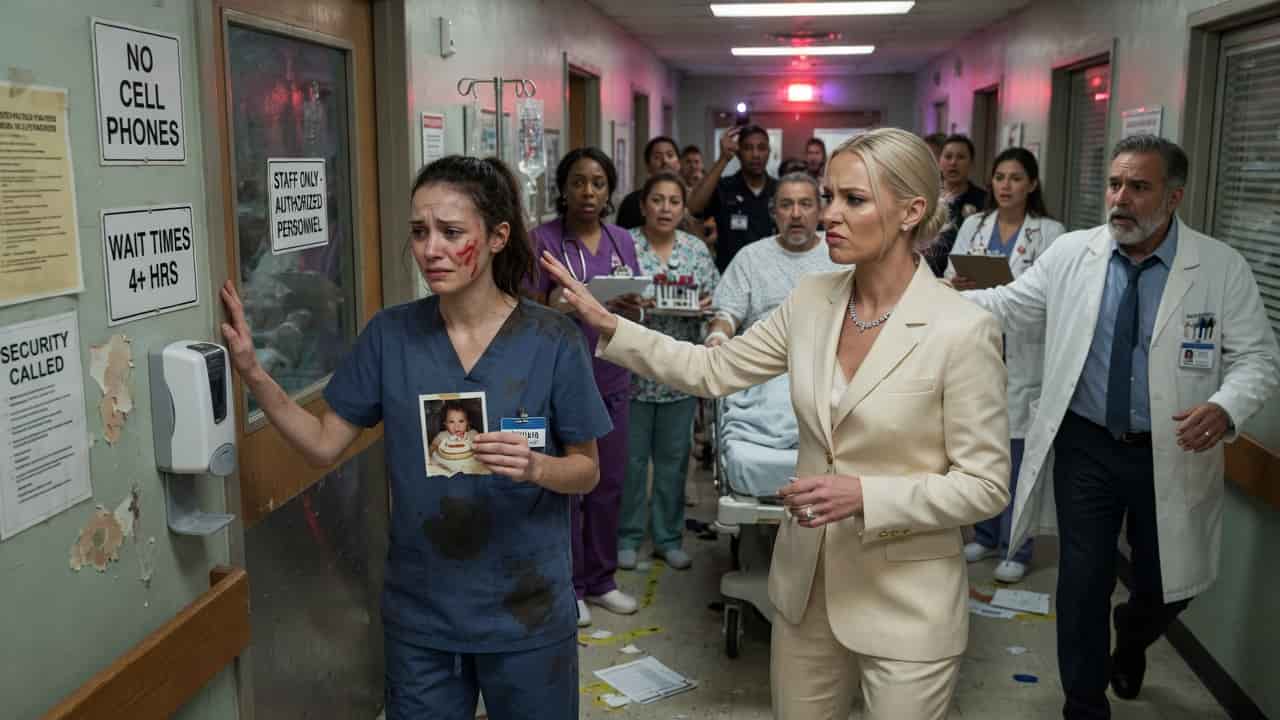
The hallway of St. Jude’s Public was packed, the air thick with the smell of floor wax and unwashed bodies, but you could have heard a pin drop when Isabella Vance slapped me. She stood there in her two-thousand-dollar silk suit, smelling like expensive peonies and pure, concentrated malice.
I didn’t move. I couldn’t. Not because I was scared of her, but because of the man lying in Bay 4. The “John Doe” they found huddled under a bridge in a snowstorm.
Twenty years ago, that man was Arthur Vance. The man who owned half of Chicago. The man who walked out on my mother and me during the worst blizzard of the decade, leaving us to freeze in a trailer with nothing but a torn photograph and a mountain of debt.
Now, he’s back. He doesn’t remember his name. He doesn’t remember the empire he built or the “perfect” family that replaced us. But he has the other half of my photograph tucked into his matted beard.
Isabella wants him to sign a paper. She wants the “trash” disposed of so she can keep the inheritance. She thinks I’m just a girl in stained scrubs who can be bought or bullied.
She has no idea who I actually am. Or what I’m about to do with the truth.
Chapter 1: The Weight of the Shift
The clock above the nursing station was a cheap, plastic relic that hummed with a low-frequency buzz, a sound that seemed to vibrate directly into the base of Sarah’s skull. It was 3:14 AM. In the ER of St. Jude’s Public, time didn’t move in minutes; it moved in traumas, refills, and the steady, rhythmic beeping of monitors that never seemed to harmonize.
Sarah reached for the lukewarm coffee sitting in a Styrofoam cup. It tasted like burnt beans and the bottom of a pot that hadn’t been washed since the previous Tuesday. She didn’t care. The caffeine was the only thing keeping her upright. Her navy blue scrubs felt heavy, as if the fabric had absorbed the collective misery of the twelve patients she’d seen since her shift began.
“Sarah, we’ve got a Doe coming in. EMS says hypothermia, possible respiratory distress. Found him under the 4th Street overpass,” Marcus, the head triage nurse, called out without looking up from his screen. Marcus was a large man with a voice that could cut through a siren’s wail, but tonight, even he sounded frayed.
Sarah set the cup down. “Bay 4?”
“Bay 4. He’s a mess, Sarah. Real rough sleeper. Watch for lice.”
She nodded, pulling on a fresh pair of nitrile gloves. The snap of the blue plastic against her wrists was the only thing that felt crisp in this building. St. Jude’s was where the city’s forgotten ended up. It was a place of peeling linoleum, flickering fluorescent tubes, and a budget that had been slashed so many times it was barely a suggestion.
She walked toward the ambulance bay doors just as the gurney rattled in. The paramedics were moving fast, their movements practiced and grim. On the gurney lay a mountain of tattered wool and frozen grime. The man was a tangle of grey beard and skin the color of old parchment.
“Vitals are low. Pressure is eighty over fifty. We had to cut three layers of coats off him just to get the leads on,” one of the EMTs said, handing Sarah the clipboard.
As they transferred him to the hospital bed, the smell hit her—a suffocating mix of stale alcohol, woodsmoke, and the sour tang of long-term neglect. Sarah didn’t flinch. She’d smelled it a thousand times. She began the routine, her hands moving with the efficiency of a machine. She checked his pupils, listened to the shallow, rattling air in his lungs, and began the process of cleaning the grit from his face so the doctor could see what they were working with.
It was when she was cutting away the final layer of a grease-stained flannel shirt that something fell out of the breast pocket.
It was small, light, and landed on the floor with a soft click.
Sarah paused, her scissors mid-air. She glanced down. It was a scrap of paper, or maybe a photo. She reached down, her gloved fingers trembling slightly—a rare occurrence for a woman who had once held a man’s femoral artery shut with her bare hands.
She picked it up. It was the top-right corner of a Polaroid. The edges were scalloped, the way they used to be in the eighties. The image showed a sliver of a blue sky and the top of a dark-haired man’s head.
Sarah’s breath hitched. She felt a sudden, sharp coldness that had nothing to do with the hospital’s failing HVAC system.
She knew this photo. She knew it because she had the other eighty percent of it tucked into the back of her worn leather wallet, a wallet that currently sat in a locker three hallways away.
She looked back at the man on the bed. With the dirt wiped away, his features began to emerge. The high, stubborn bridge of the nose. The deep-set eyes, now closed and fluttering with the strain of staying alive. The specific, jagged scar running through his left eyebrow—a souvenir from a car accident forty years ago.
“Sarah? You okay?”
She looked up. Dr. Miller was standing there, his brow furrowed. He was a man who had seen everything, a man who had been a mentor to Sarah since she was a nervous student. He looked at the scrap in her hand.
“Just… trash from his pocket, Dr. Miller,” she said, her voice sounding thin to her own ears. She shoved the scrap into her scrub pocket.
“Let’s get a line in him. He’s crashing,” Miller said, stepping toward the bed.
Sarah worked the rest of the hour in a trance. She pushed the fluids, monitored the intubation, and adjusted the warming blankets. Her body performed the tasks, but her mind was in a trailer in Ohio, twenty years ago. She was eight years old, huddled under a thin quilt, listening to her mother sob as the wind howled outside. She remembered the man in the expensive wool coat standing by the door, his suitcase already in the car.
“This isn’t for me, Elena,” he had said. “I can’t be the man you want me to be in a place like this. I have a life waiting for me. An actual life.”
He had left them in a record-breaking blizzard. He had left them with four dollars in the jar and a heating bill that was three months overdue. He had never looked back. Not when the trailer park was buried. Not when Sarah’s mother had to work three cleaning jobs just to buy generic cereal. Not when the letters they sent came back “Return to Sender” from a mansion in Lake Forest.
Arthur Vance. The King of Chicago Real Estate.
And now, he was a John Doe in a public ER, dying in a bed that smelled like bleach and failure.
Sarah reached into her pocket and felt the sharp edge of the photo scrap. The irony wasn’t just cruel; it was surgical.
“He’s stable for now,” Miller said, wiping his brow. He looked at Sarah, really looked at her. “Go take ten, Sarah. You look like you’ve seen a ghost.”
“I’m fine,” she said, her voice hard.
“That wasn’t a request. Go. Eat something.”
Sarah walked out of the bay, her legs feeling like they belonged to someone else. She didn’t go to the breakroom. She went to the locker room. Her hands shook as she dialed the combination. She pulled out her wallet and flipped it open.
In the very back, behind her nursing license and a punch card for a taco stand, was the photo. It was a picture of her father holding her when she was three. He was laughing, looking at the camera with the confidence of a man who owned the world.
She took the scrap from her pocket and laid it against the missing corner.
It fit perfectly. The blue sky aligned. The edge of his hair matched the jagged tear.
Sarah leaned against the cold metal of the locker and closed her eyes. She thought about the debt collectors who called her twice a week. She thought about her grandmother’s mounting medical bills, the reason she was working eighty hours a week at a hospital that was falling apart.
She looked at the photo.
In Bay 4, the man who had the power to change everything was fighting for a breath he didn’t deserve.
She could tell Miller. She could call the papers. She could demand the twenty years of back-pay her mother had died waiting for.
Or, she realized with a dark, heavy thud in her chest, she could do nothing. She could let him remain a John Doe. She could let him slip away into the quiet, anonymous night of the public health system.
It would be so easy. A missed alarm. A slightly slower response to a heart rate drop.
Sarah tucked the photo back into her wallet. Her face was a mask of professional neutrality, but inside, the eight-year-old girl in the snow was finally starting to get warm.
Chapter 2: The Ghost in Bay 4
The hospital at 5:00 AM had a specific, haunting stillness. The initial rush of the night had tapered off, leaving only the long-term patients and the skeletal staff to drift through the dim hallways. Sarah walked back to Bay 4, her footsteps echoing on the tile.
Arthur Vance—or the man who used to be him—was asleep. The ventilator made a rhythmic, wheezing sound, huffing air into lungs that looked too small for his frame. The monitors showed a steady, if fragile, heartbeat.
Sarah stood at the foot of the bed. She didn’t feel the rush of daughterly love she might have imagined in a better world. She felt a cold, analytical curiosity. How does a man go from a penthouse to a bridge? How does a man who sold skyscrapers end up with nothing but a torn photo of a daughter he abandoned?
She reached out and picked up his chart. John Doe #442. “Any change?”
Sarah jumped, the chart nearly slipping from her fingers. It was Dr. Miller. He was leaning against the doorframe, his glasses pushed up onto his forehead.
“Stable,” Sarah said, regaining her composure. “Temp is up to ninety-six. BP is holding.”
Miller walked over and looked at the man. “Found some ID on him?”
“No,” Sarah lied. The word felt heavy in her mouth, but she didn’t take it back. “Nothing but rags.”
Miller sighed, rubbing his eyes. “He looks familiar, doesn’t he? I can’t place it. Maybe he’s been in before. The frequent fliers all start to look the same after a decade.”
“Maybe,” Sarah said.
“You know, Sarah, I saw your grandma’s chart yesterday,” Miller said softly. “The Medicare extension was denied.”
Sarah felt the familiar tightening in her stomach. It was like a physical knot that never quite unraveled. “I know. I’m working on an appeal.”
“You’re working too hard. You’re going to burn out before you’re thirty. If you need a shift covered, or if you need…” He trailed off, knowing Sarah’s pride was a fortress.
“I’m fine, Dr. Miller. I just need to get through the week.”
“Well, let’s hope our friend here has some family who gives a damn,” Miller said, nodding toward the bed. “Otherwise, he’s headed for the county facility once he’s off the vent. And you know what happens there.”
Sarah knew. The county facility was where people went to be forgotten. It was a warehouse for the living.
“He’ll get what he needs,” Sarah said, though she wasn’t sure which ‘he’ she was talking about.
Miller left, and Sarah was alone again. She began the morning rounds, but her mind kept circling back to the photo. Why did he have it? Did he regret it? Or was it just a piece of paper he’d picked up, a random relic of a life he’d forgotten?
She decided to check the “lost and found” from his arrival one more time. The EMTs had left his belongings in a clear plastic bag at the bottom of the gurney. She pulled it out.
Inside were the remains of his life. A rusted pocketknife. A single glove. A handful of damp, unidentifiable receipts. And a small, leather-bound notebook, its cover warped by moisture.
Sarah opened the notebook. The pages were stuck together, the ink bled into blue-black Rorschach blots. But on the very first page, written in a cramped, shaky hand, were three words:
Find the girl.
Sarah felt a surge of nausea. The girl. Was she the girl? Or was there another one? A “real” daughter from the life he’d built after them?
She flipped through the pages. Most were illegible, but dates appeared here and there. 2014. 2018. 2022. He’d been keeping track of something. Or someone.
A sudden noise from the bed made her snap the notebook shut. The man’s eyes were open.
They weren’t the piercing blue eyes from the photograph. They were cloudy, rimmed with red, and filled with a terrifying, vacant panic. He began to thrash against the restraints, the ventilator alarm screaming as he fought the tube in his throat.
“Easy, easy,” Sarah said, her nurse-mode overriding her personal ghost. She grabbed his shoulders, pinning him down. “You’re in the hospital. You’re safe. Don’t fight the air.”
He looked at her, and for a split second, the vacancy vanished. He stared at her face with an intensity that made her heart stop. His hand, gnarled and scarred, reached up and grabbed her wrist.
His grip was surprisingly strong. He tried to speak, but the tube turned his voice into a wet, guttural rattle.
“Don’t,” she whispered, leaning close. “Don’t try to talk.”
He didn’t let go. His eyes searched hers, roaming over her features as if he were trying to solve a puzzle. He looked at her name tag. Sarah.
A sound came out of him then. Not a word, but a sob. A deep, racking sound that vibrated through his entire chest.
“Sarah,” he wheezed. It was barely a breath, a ghost of a sound, but she heard it.
She froze. He remembered. Or he knew.
“Nurse! We’ve got a situation in Bay 2!” someone shouted from the hallway.
Sarah pulled her wrist away, her skin tingling where he’d touched her. She stepped back, her heart hammering against her ribs.
“I’ll be back,” she said, though it felt like a threat.
She spent the next hour in a blur of activity, assisting with a cardiac arrest in the next bay. But the image of his eyes, the way he’d said her name, haunted her. He wasn’t just a John Doe. He was a man who had realized, too late, that the world he’d built was made of sand.
When she finally returned to Bay 4, the man was sedated again. Dr. Miller was there, but he wasn’t alone.
Standing in the small, cramped space were two people who looked like they had been air-dropped from a different planet.
A woman in a cream-colored silk suit, her hair a perfect, icy blonde. And a man in a tailored charcoal coat, looking at his watch with visible impatience. They stood in the middle of the crowded ER like they were afraid the air might stain their clothes.
“Sarah, this is Isabella and Julian Vance,” Dr. Miller said, his voice unusually formal. “It seems our John Doe isn’t a Doe after all. He’s Arthur Vance.”
Sarah felt the world tilt. She kept her face perfectly still. “The real estate developer?”
“Our father,” Isabella said, her voice like glass. She didn’t look at the man on the bed. She looked at the peeling paint on the wall. “We’ve been looking for him for months. We had no idea he’d sunk… this low.”
She said ‘this low’ with a flick of her eyes toward the other patients, as if poverty were a contagious disease.
“How did you find him?” Sarah asked, her voice steady.
“The hospital’s facial recognition software finally hit a match with the missing persons report,” Julian said. He looked at Sarah’s navy scrubs with a faint, condescending smile. “We’d like him moved immediately. To a private facility. Somewhere… appropriate.”
Sarah looked at Arthur. He lay there, helpless, sedated, surrounded by the family that had clearly replaced her.
“He’s too unstable to move,” Sarah said.
Isabella turned her gaze toward Sarah. Her eyes were sharp, cold, and entirely devoid of grief. “I’m sorry, what was your name?”
“Nurse Sarah,” Sarah said.
“Well, Nurse Sarah, I don’t think you understand,” Isabella said, stepping closer. The smell of her perfume—expensive, floral, suffocating—filled the bay. “We are the Vance family. We decide what is stable. Now, get the paperwork ready. We have a lot of things to settle with him.”
Sarah saw the way Isabella looked at the man on the bed. It wasn’t the look of a daughter who had found her lost father. It was the look of a predator checking to see if the prey was finally still enough to skin.
The battle lines were drawn. And Sarah, for the first time in her life, realized she wasn’t just a nurse. She was the only person in the room who actually knew what Arthur Vance was worth.
Chapter 3: The Price of a Name
The presence of the Vance siblings turned the ER into a theater of the absurd. Within an hour, two black SUVs were idling in the ambulance bay, and a pair of private security guards stood outside Bay 4, looking uncomfortable in their suits as they tried not to touch the grime-streaked walls.
Sarah tried to do her job, but Isabella was everywhere. She paced the narrow hallway, her heels clicking like a metronome, her voice loud as she argued with someone on her cell phone about “asset liquidation” and “probate delays.”
“She can’t be here,” Sarah told Dr. Miller in the hallway. “She’s disrupting the triage. I have a kid with a broken arm and a woman in labor out there, and she’s treating this like a boardroom.”
Miller looked exhausted. The lines on his face seemed deeper under the harsh lights. “Sarah, they’re big donors to the downtown hospitals. The board is already calling the Chief of Medicine. They want him out of here, and frankly, so do I. He’s a liability now.”
“He’s a patient,” Sarah snapped. “He’s got a fever of 103 and his white cell count is spiking. If they move him to some luxury hospice right now, he’ll be dead by morning.”
“Maybe that’s what they want,” Miller whispered, leaning in close. “Watch yourself, Sarah. These people don’t play by the rules we do.”
Sarah felt a surge of protectiveness that surprised her. It wasn’t for the man who had abandoned her; it was for the integrity of her floor. This was her world.
She walked back into Bay 4 to check Arthur’s IV. Isabella was standing over the bed, looking down at her father with a expression of pure, unadulterated disgust.
“Look at him,” Isabella said, not even glancing at Sarah. “The great Arthur Vance. Reduced to a bag of bones in a charity ward. It’s pathetic.”
“He’s sick,” Sarah said, her voice tight.
“He’s a nuisance,” Isabella countered. She turned to Sarah, her eyes scanning Sarah’s worn shoes and the coffee stain on her scrubs. “You’ve been taking care of him all night, haven’t you? What did he say to you?”
“He’s intubated. He can’t talk.”
Isabella narrowed her eyes. “He’s a wanderer, but he’s a hoarder. He always carries something. A ledger? A key? What was in his pockets?”
“Nothing but trash,” Sarah said.
Isabella stepped closer, her silk suit rustling. She was taller than Sarah, bolstered by four-inch heels and a lifetime of being told she was superior. “Don’t lie to me, honey. I know how this works. You see a man like this, you think there’s a payday. You think you can hold onto something and wait for the reward.”
“I’m a nurse, Ms. Vance. I don’t look for rewards. I look for vitals.”
“Is that so?” Isabella reached out and flicked Sarah’s name tag. “Sarah. Just Sarah. No last name? Well, Just Sarah, let me be very clear. My father is not himself. Anything he might have given you, or anything you might have ‘found,’ belongs to the estate. If you’re smart, you’ll hand it over now and I might forget to mention your attitude to the board.”
Sarah felt the heat rising in her neck. The humiliation was calculated, a sharp, public display of power. A few other nurses were watching from the station. The security guards were smirking.
“I don’t have anything of his,” Sarah said, her voice low and steady.
“We’ll see about that,” Isabella said. She turned back to the bed and reached for the small plastic bag of Arthur’s belongings that Sarah had tucked under the gurney.
“That’s hospital property until the patient is discharged,” Sarah said, stepping forward.
Isabella ignored her, dumping the contents onto the small stainless steel tray. She sifted through the rusted knife and the receipts with a gloved hand. Her face fell when she didn’t find what she was looking for.
“Where is it?” Isabella hissed. “The notebook. He always had a notebook.”
Sarah’s heart skipped. The leather notebook was currently shoved deep into the pocket of her own coat, locked in her locker.
“I told you. There was nothing else,” Sarah said.
Isabella looked at her, and for a second, Sarah saw something behind the coldness—panic. Isabella wasn’t just here for her father. She was here for something he possessed. A secret? A piece of evidence?
“You’re a terrible liar,” Isabella said. She stepped into Sarah’s personal space, her voice dropping to a venomous whisper. “My father stole years of my life with his brilliance. I’m not letting some bottom-tier nurse steal the ending. I know you have it.”
“I have work to do,” Sarah said, turning away.
Isabella grabbed her arm. It wasn’t a violent grip, but it was a controlling one. “I can have your license by noon. I can make sure you’re cleaning toilets in a bus station for the rest of your life. Give me the notebook, Sarah.”
“Let go of her.”
Dr. Miller was standing at the entrance of the bay. His voice wasn’t loud, but it had the weight of thirty years of authority.
Isabella slowly released Sarah’s arm, smoothing her silk sleeve. “Dr. Miller. Your staff is being… uncooperative.”
“My staff is following protocol,” Miller said. “Now, I suggest you go to the waiting room. We are preparing the transfer papers, but until the ambulance arrives, this is a medical zone.”
Isabella smiled, a thin, sharp line. “Of course. We wouldn’t want to get in the way of such… vital work.”
She turned to Sarah one last time. “We’re not done, Sarah. I’ll see you in the hallway.”
As Isabella and Julian walked away, Sarah felt the room begin to spin. She looked at Arthur. He was still sedated, but his hand was twitching, his fingers brushing against the thin hospital sheet.
“You okay?” Miller asked, his hand on Sarah’s shoulder.
“I’m fine,” she said, but her voice was trembling.
“She’s right about one thing,” Miller said quietly. “They won’t stop. Whatever you’re holding onto, Sarah—if you are—you need to decide if it’s worth the war.”
Sarah reached into her pocket and touched the scrap of the photograph. She thought about her mother’s funeral, a small, lonely affair in a rain-slicked cemetery. She thought about the man on the bed who hadn’t even sent a card.
“It’s not about the money,” Sarah said.
“Then what is it about?”
“It’s about the fact that they think he’s trash,” Sarah said. “They think he’s something to be disposed of. And they think I am, too.”
She walked out of the bay and toward the locker room. She needed to see what was in that notebook. She needed to know why Isabella was so afraid.
But as she reached the end of the hallway, she saw a crowd forming near the entrance. The flashes of cameras illuminated the glass doors.
“Is it true?” a reporter shouted. “Is Arthur Vance alive?”
The secret was out. The world was coming for Bay 4. And Sarah was the only thing standing between the King of Chicago and the family that wanted him dead.
Chapter 4: The Slap Heard Round the Ward
By 6:30 AM, the ER looked like a besieged fortress. The hospital administration had called in extra security to deal with the press, but the Vance siblings remained the primary source of chaos. They had occupied the small family consultation room, turning it into a makeshift war room.
Sarah was exhausted. The adrenaline was wearing off, replaced by a deep, bone-aching fatigue that made every movement feel like she was wading through molasses. She was trying to change the dressing on a patient’s leg in Bay 6 when the yelling started.
It was Isabella. Her voice carried across the triage area, sharp and entitled.
“I don’t care about the policy! I am his daughter, and I am telling you he is leaving now!”
Sarah stepped out of the bay. Isabella was standing in the middle of the hallway, facing off against Marcus. Marcus looked like he was about five seconds away from losing his professional cool.
“Ma’am, the transport team isn’t here yet,” Marcus said, his voice straining for patience. “We can’t just wheel a patient onto the sidewalk.”
“He is my father! He is not a piece of equipment!” Isabella screamed.
Sarah walked toward them. “Is there a problem?”
Isabella turned, her face flushed with rage. When she saw Sarah, her eyes lit up with a predatory gleam. “You. I knew it. You’ve been stalling. You’ve been whispering in the doctor’s ear, trying to keep him here.”
“I’ve been doing my job,” Sarah said calmly. “The transport team is delayed because of the press outside. It’s for your father’s safety.”
“Safety?” Isabella laughed, a harsh, brittle sound. She stepped toward Sarah, her heels clicking aggressively. “You don’t give a damn about his safety. You’re just a parasite. You’re looking at him and seeing a lottery ticket. You think if you keep him here long enough, he’ll wake up and remember you in his will?”
The room went silent. The other nurses stopped what they were doing. A few patients leaned out of their bays, watching the drama unfold.
“I don’t even know who he is,” Sarah lied, her voice cold.
“Liar!” Isabella shrieked. She was inches from Sarah now. “I saw the way you looked at him. I saw you holding that piece of paper. You’re just like the rest of them. A gutter-born nurse with delusions of grandeur. You’re nothing but a servant, Sarah. Remember that.”
“I remember who I am,” Sarah said, her voice dropping to a dangerous level. “The question is, do you? Because right now, you look like a woman who’s terrified that a dying man might have one last secret.”
Isabella’s face went white. Then, it went red.
Crack.
The sound of the slap echoed off the linoleum walls. Sarah’s head snapped to the side. The sting was immediate, a hot, searing pain that bloomed across her cheek.
Gasps erupted from the hallway. Marcus stepped forward, his face a mask of shock. “Hey! You can’t do that!”
Sarah didn’t move. She didn’t cry. She slowly turned her head back to face Isabella. Her cheek was already beginning to swell, a bright red mark in the shape of a hand.
Isabella stood there, breathing hard, her hand still raised. “Don’t you ever speak to me like that again. I own people like you. I buy and sell people like you every single day.”
“Isabella! That’s enough!”
Dr. Miller came rushing down the hallway, pushing through the witnesses. He looked at Sarah’s face, then at Isabella. “Ms. Vance, you need to leave. Now. I am calling the police.”
“Go ahead,” Isabella sneered, though her voice wavered. “Call them. Tell them I defended myself against a hostile employee.”
“Defended yourself?” Miller’s voice was trembling with rage. “There are twenty witnesses. There are security cameras. You just assaulted a member of my staff in a public hospital.”
“She has something of mine!” Isabella pointed a shaking finger at Sarah. “She’s a thief! Check her pockets! Check her locker!”
“I have nothing of yours,” Sarah said, her voice incredibly calm. She reached into her scrub pocket and pulled out the torn scrap of the photo. She held it up so the whole room could see it. “This is what she’s so afraid of. A twenty-year-old photograph.”
Isabella lunged for it, but Marcus caught her by the shoulders, holding her back.
“That’s it,” Miller said. “Security, escort Ms. Vance out of the building. She is barred from this floor until further notice.”
“You can’t do this!” Isabella screamed as the guards took her arms. “Julian! Do something!”
Julian Vance stood in the background, looking at his sister with a mix of embarrassment and calculation. He didn’t move to help her. He watched as she was dragged toward the elevators, her screams fading into the distance.
The hallway remained silent for a long time. Sarah felt the eyes of everyone on her. The pity. The shock. The residue of the humiliation clung to her like a second skin.
“Sarah,” Miller said softly, reaching out to touch her face.
She flinched. Not because of him, but because she couldn’t handle the kindness. Not yet.
“I’m going to my locker,” she said.
“Sarah, take a break. Go home. I’ll handle the police report.”
“No,” she said. “I’m not going home.”
She walked to the locker room, her heart pounding. She felt a strange, cold clarity. Isabella had made a mistake. She had shown her hand. She wasn’t just cruel; she was desperate.
Sarah opened her locker. She pulled out the leather notebook. She sat on the bench, her cheek throbbing, and began to read the pages she hadn’t been able to see before.
The ink was faded, but as she reached the middle of the book, the writing became clearer. It wasn’t a ledger. It wasn’t a list of assets.
It was a confession.
To my daughter, Sarah, the first legible page began. If you are reading this, it means I have finally found the courage to look for you. I know I don’t deserve your forgiveness. I know the blizzard never ended for you. But I have spent twenty years trying to undo the mistake I made that night. The Vance empire isn’t mine. It was built on the money I stole from your mother’s family trust. Isabella knows. Julian knows. They have spent years keeping me silent, keeping me drugged, keeping me away from the truth.
Sarah felt the air leave her lungs. Her mother’s family trust? Her mother had died thinking they were penniless. She had died in a trailer because she didn’t know she was an heiress.
I am coming for you, Sarah, the writing continued, the hand getting shakier. I have the documents. I have the proof. I am going to make it right.
The last entry was dated two months ago. They found out. They’re taking me to the clinic. If I don’t make it, the proof is hidden where the sky meets the hair.
Sarah looked at the torn photograph in her hand.
Where the sky meets the hair.
She looked at the jagged line where the photo had been torn. She ran her finger along the edge. There was a slight thickness to the paper.
She took her medical shears from her pocket and carefully, delicately, sliced into the side of the Polaroid.
A tiny, micro-SD card slid out onto her palm.
Sarah stared at it. This was it. The evidence. The reason Isabella was willing to kill. The reason her father had been wandering the streets as a homeless man—he’d escaped their “clinic” to find her.
A shadow fell over the locker room door.
Sarah looked up. Julian Vance was standing there. He wasn’t yelling. He wasn’t angry. He was smiling, but it was the smile of a man who was about to finish a very long, very tedious job.
“I told Isabella she was being too dramatic,” Julian said, stepping into the room. “A slap? So cliché. But you, Sarah… you’re much more interesting. You found it, didn’t you?”
He looked at the SD card in her hand.
“My father was a very sick man,” Julian said, taking another step. “His mind was gone. He wrote a lot of fantasies. But unfortunately, fantasies can be… expensive. For everyone.”
“Stay back,” Sarah said, her hand tightening around the card.
“Give it to me, Sarah. And I’ll make sure your grandmother’s bills vanish. I’ll make sure you never have to wear those navy scrubs again. You can have the life he promised you.”
Sarah looked at him. She thought about the twenty years of cold. She thought about the slap on her face. And she thought about the man in Bay 4 who had finally remembered her name.
“I already have a life, Julian,” Sarah said, her voice cold and hard as ice. “And I think it’s time I showed you exactly what it’s worth.”
Outside, the first light of dawn was hitting the hospital windows. The night was over. But for the Vance family, the storm was just beginning.
Chapter 5: The Glass Fortress
The locker room was a symphony of cold metal and the distant, rhythmic thumping of the hospital’s industrial laundry downstairs. Julian Vance stood perfectly still, his charcoal overcoat draped over one arm, his other hand buried deep in his pocket. He looked like a man waiting for a delayed flight, not a man cornered in a room that smelled of sweat and cheap deodorant.
“You’re making a mistake, Sarah,” Julian said. His voice was smooth, devoid of the jagged edges that Isabella used to cut through a room. It was the voice of a man who was used to settling lawsuits before they ever hit the news. “You’re operating on emotion. I understand that. You’ve had a traumatic night. You’ve been assaulted. You’re exhausted. But emotion is a poor foundation for a career.”
Sarah didn’t move from the bench. She felt the weight of the micro-SD card in her palm, a tiny sliver of plastic that felt as heavy as a lead weight. Her cheek was pulsing with a dull, rhythmic throb where Isabella had struck her, a reminder of exactly what kind of people she was dealing with.
“Career?” Sarah asked, her voice rasping. She cleared her throat, trying to find the steel she’d felt just moments ago. “My career is in that ER, Julian. It’s not in your boardroom. And it’s definitely not in whatever ‘clinic’ you had your father locked in.”
Julian sighed, a small, weary sound. He stepped closer, his polished shoes clicking on the cracked linoleum. “My father is eighty years old, Sarah. He has Lewy body dementia. He hallucinates. He wanders. He once tried to buy a park bench in Lincoln Park because he thought it was a distressed asset. That notebook you found? It’s the product of a broken mind. It’s a narrative he constructed to make sense of his own failures. People like Arthur Vance—men who build empires—they can’t handle the idea that they simply grew old and lost their grip. They have to invent a conspiracy. They have to invent a villain.”
“And the money?” Sarah countered, her eyes locked on his. “The family trust? My mother’s name is in that book, Julian. Elena Rossi. He wrote down the account numbers. He wrote down the dates of the transfers. That’s a very specific hallucination.”
Julian didn’t blink. “Names he saw in old files. Numbers he remembered from decades ago. Look at the world around you, Sarah. Look at this hospital. It’s a tomb. You’re working double shifts to pay for a grandmother who is dying in a room that probably looks just like this one. You’re tired of being the girl who gets left behind. I get it. But that card? It’s not a golden ticket. It’s a lit match. And you’re standing in a room full of gasoline.”
He stopped three feet from her. He smelled like cedarwood and something clinical—the scent of a man who never had to touch anything dirty. “Give me the card. I will personally see to it that your grandmother is moved to the North Shore facility this afternoon. Private suite. Twenty-four-hour nursing. Experimental treatments that Medicare won’t even look at. And for you? A settlement. Seven figures. Enough to walk out of these doors and never look back. No more navy scrubs. No more ‘Just Sarah.'”
Sarah looked down at the SD card. For a heartbeat, the offer was a siren song. She could see it—her grandmother, Mrs. Gable, finally resting in a bed with high-thread-count sheets, looking out at a garden instead of a brick wall and a dumpster. She could see herself finally sleeping for more than four hours at a time. She could see the debt vanishing like smoke.
But then she remembered the way Isabella had flicked her name tag. She remembered her mother’s hands, cracked and red from bleach, scrubbing the floors of people who looked exactly like Julian. She remembered the man in Bay 4—the man who had grabbed her wrist with the strength of a drowning man reaching for a rope.
“The thing about gasoline, Julian,” Sarah said, standing up slowly, “is that it doesn’t care who started the fire. It burns the silk suits just as fast as the scrubs.”
Julian’s expression didn’t change, but his eyes went flat. The “reasonable man” mask was beginning to slip, revealing something cold and hollow underneath. “You think Dr. Miller can protect you? You think the police will care about a homeless man’s notebook when our lawyers get finished with it? You’ll be lucky if you aren’t charged with elder abuse and theft by the time the sun is fully up.”
“Then call them,” Sarah said. She stepped past him, her shoulder brushing his expensive coat. “Call everyone. I’m going back to my patient.”
She walked out of the locker room before he could respond. Her heart was hammering a frantic rhythm against her ribs, but her hands were steady. She didn’t go to the breakroom or the station. She went straight to the small, cramped office of the night-shift tech, a guy named Leo who spent most of his time fixing monitors and trying to bypass the hospital’s firewall to watch movies.
“Leo,” she said, leaning into the small, dark room. “I need a card reader. And I need a computer that isn’t logged into the hospital network.”
Leo looked up from a half-disassembled tablet. He was nineteen, with skin like a topographical map of acne and a nervous twitch. “Nurse Sarah? What’s up with your face? Who hit you?”
“Never mind my face. Can you do it or not?”
Leo saw the look in her eyes—the kind of look that usually preceded a code blue—and nodded. He reached into a drawer and pulled out a battered laptop. “This is my personal rig. It’s air-gapped. What are we looking at?”
Sarah handed him the SD card. “Just open the files. Don’t copy anything. Don’t upload anything. I just need to know what’s on it.”
Leo slotted the card in. The laptop whirred, its fan struggling. A folder popped up on the screen. It was filled with video files, each one timestamped and titled with a string of numbers.
Sarah pointed to the most recent one. “Open that.”
The video was graining, shot from a low angle—likely a hidden camera in a button or a pen. The setting was unmistakable: a high-end private medical suite, all beige leather and soft lighting. Arthur Vance was sitting in a chair, looking older than he did now, but his eyes were clear.
Standing over him were Isabella and Julian.
“It’s over, Dad,” Isabella’s voice came through the laptop’s tinny speakers. She sounded bored, as if she were discussing a change in the lunch menu. “The board has already approved the transition. You’re incompetent. The signature on the Rossi trust transfer was all we needed.”
“I didn’t sign it,” Arthur’s voice was a whisper, but it was firm. “I know what you did. I know you forged the documents. I’m going to find the girl. I’m going to make it right.”
Julian stepped into the frame. He looked exactly as he had ten minutes ago in the locker room—calm, collected, deadly. “There is no girl, Dad. Elena Rossi is dead. Her daughter is a ghost. You’re chasing shadows. And if you keep chasing them, we’re going to have to increase your dosage. The clinic in Switzerland is very quiet. You wouldn’t like the silence.”
“You stole her life,” Arthur said, his voice breaking. “You stole everything from her.”
“No,” Isabella snapped, leaning down into his face. “We took what was ours. You wasted years pining for a trailer-park mistake. We’re the ones who kept the company afloat. We’re the ones who deserve the name. You’re just a legacy we’re tired of managing.”
The video cut to black.
Sarah sat in the dark office, the only light coming from the glowing screen. The residue of the conversation felt like a physical weight. It wasn’t just a business dispute. It was a slow-motion execution. They hadn’t just stolen the money; they had tried to erase the very existence of the people they’d taken it from.
“Whoa,” Leo whispered, his eyes wide. “Is that… is that the guy in Bay 4? And those people in the hallway?”
“Delete the cache, Leo,” Sarah said, her voice sounding like it was coming from a long way off. “Eject the card.”
“Sarah, if you show this to the cops—”
“I know,” she said. She took the card back and stood up.
As she walked back out into the triage area, the social pressure of the hospital hit her like a physical wave. The news had spread. The morning shift was starting to trickle in, and everyone was whispering. They looked at her swollen cheek, then at the security guards standing outside Bay 4.
“Sarah, wait!”
It was Dr. Miller. He was jogging toward her, his white coat flapping. He looked pale, his hand clutching a piece of paper.
“They’re doing it, Sarah. The board just signed off. A private ambulance is five minutes out. They’re transferring him to ‘The Reach’—that private facility in the suburbs. I tried to stop it, but the CEO personally called me. He said if I interfered, I’d be escorted out by security.”
“They can’t,” Sarah said, her voice rising. “He’s still febrile. He’s not stable for transport.”
“They don’t care,” Miller said, his eyes filled with a helpless, burning anger. “They’ve got their own doctor signing the release. Some guy named Dr. Aris. He just pulled into the bay.”
Sarah looked toward the glass doors of the ER. A white ambulance, devoid of any city markings, was backing into the bay. Two men in tactical-style uniforms stepped out, carrying a specialized gurney.
In the hallway, Isabella and Julian were standing together. Isabella had a fresh coat of lipstick on, and she was smiling. It was the smile of someone who had just won a bet she knew was rigged.
She saw Sarah and her smile widened. She didn’t say a word, but the look in her eyes was clear: I told you. You’re nothing.
Sarah looked at Dr. Miller. She looked at the staff who were watching, their faces filled with a mix of curiosity and fear. She looked at the black SUVs still idling outside.
“They’re going to kill him,” Sarah said quietly. “As soon as he’s behind those private gates, he’s never coming back out. And the truth goes with him.”
“There’s nothing we can do, Sarah,” Miller said, his voice breaking. “The law is on their side. They’re the next of kin. They have the power of attorney.”
Sarah felt the SD card in her hand. She thought about the “Just Sarah” tag. She thought about the girl in the snow.
“The law might be on their side,” Sarah said, her voice steadying as a cold, hard resolve settled over her. “But they’ve forgotten one thing.”
“What’s that?”
“This is a public hospital,” Sarah said, stepping toward the center of the triage area. “And in this building, the only thing that matters is the chart.”
She didn’t run. She walked with a slow, deliberate pace toward Bay 4. The security guards shifted, preparing to block her, but Marcus stepped into their path, his large frame acting as a human shield.
“Let her through,” Marcus said, his voice booming through the hallway. “She’s the primary nurse. She has to hand over the vitals.”
The guards hesitated. They were private contractors, and Marcus looked like he was ready to throw them through a window. They stepped aside.
Sarah entered the bay. Arthur was awake again, his eyes darting around the room. When he saw her, the panic seemed to subside, replaced by a desperate, reaching hope.
“Don’t worry,” she whispered, leaning over him. She wasn’t just checking his pulse. She was leaning down so her ear was right next to his. “I have it. I have the proof. And I’m not letting them take you.”
His hand found hers, his fingers gripping her wrist with a strength that shouldn’t have been possible.
“Sarah,” he wheezed.
“I’m here,” she said.
Behind her, the curtain was ripped open. Isabella and Julian stood there, flanked by the two men from the private ambulance.
“Time to go, Nurse,” Isabella said, her voice dripping with mock sympathy. “Your shift is over. In more ways than one.”
Sarah didn’t move. She turned slowly, her hand still locked in Arthur’s grip. The mark on her cheek was a dark purple now, a badge of the war they’d started.
“He’s not going anywhere,” Sarah said.
“Get out of the way,” Julian said, his voice losing its veneer of calm. “Now.”
“No,” Sarah said. She reached into her pocket and pulled out her cell phone. She hadn’t called the police. She hadn’t called the board.
She had called the one person Isabella Vance feared more than the truth.
She had called the press.
“The front doors are locked,” Sarah said, glancing at the clock. “But the delivery entrance isn’t. And I think those reporters outside would love to hear why the ‘Vance Family’ is trying to kidnap a man in the middle of a septic crisis.”
As if on cue, the sound of shouting and the glare of camera flashes erupted from the hallway entrance.
“What did you do?” Isabella shrieked, her face contorting in a mask of pure, unadulterated rage.
“I did my job,” Sarah said. “I protected my patient.”
The room became a pressure cooker. The private ambulance team hesitated, looking at each other. They weren’t paid enough to deal with a media circus.
Julian looked at Sarah, and for the first time, she saw it—the crack in the glass. The realization that the “gutter nurse” had just changed the rules of the game.
“You’re ruined,” Julian whispered, his voice shaking. “You’ll never work in this city again.”
“Maybe,” Sarah said, her eyes burning with a light they’d never seen. “But at least I’ll be able to look in the mirror and know I wasn’t the one who broke the world.”
Chapter 6: The Residue of Truth
The lobby of St. Jude’s Public had never seen so much light. It was usually a cavernous, dim space filled with the smell of wet wool and the low hum of people waiting for news they couldn’t afford. But now, it was a blinding arena of flashbulbs and television lights.
Sarah stood at the center of it. She still wore her navy scrubs, the coffee stain a dark mark over her heart. Her hair was a mess, her cheek was a map of Isabella’s violence, and her hands were shaking, but she stood tall.
Beside her sat Arthur Vance in a wheelchair. He was pale, his breathing assisted by a portable oxygen tank, but he was conscious. For the first time in twenty years, he was looking at the world without the fog of the “clinic” or the sedation of his children’s “care.”
“My name is Sarah Rossi,” she began, her voice echoing through the silent lobby. Every camera was trained on her. Every reporter held their breath. “And this is my father, Arthur Vance.”
The ripple of shock through the crowd was audible. Isabella and Julian were being held back by a line of hospital security and a few police officers who had arrived just as the situation turned into a standoff. Isabella was screaming, her voice a shrill, hysterical sound that was being captured by a dozen microphones.
“She’s a liar! She’s a thief! She’s trying to steal our heritage!”
Sarah didn’t look at her. She looked into the lens of the lead camera from Channel 5.
“Twenty years ago, my mother was erased,” Sarah said. “She was told she had nothing. She was left to raise me in a trailer while the man she loved was told she was dead. This wasn’t a tragedy. It was a heist. A heist carried out by the people standing over there.”
She pointed to Isabella and Julian. The cameras swung toward them, capturing their panic, their rage, and the sudden, horrific realization that the narrative was no longer theirs to control.
“I have the proof,” Sarah said. She held up the micro-SD card. “I have the videos of them discussing the forgery. I have the documents showing the transfers from the Rossi trust. And most importantly, I have the testimony of the man they tried to bury.”
Arthur reached up then. His hand was thin, his skin like translucent paper, but he grabbed the edge of Sarah’s scrub top. He pulled himself up slightly, his eyes clearing for one final, lucid moment.
“She is my daughter,” Arthur said into the nearest microphone. His voice was a rasp, but it carried the weight of a man who had built a city. “She is the only thing I have left that is real. And everything I built… it belongs to her.”
The lobby exploded. The reporters surged forward, a wall of shouting voices and flashing lights. The police stepped in, finally moving toward Isabella and Julian.
The siblings tried to run, but there was nowhere to go. They were surrounded by the very public they had spent their lives looking down upon. They were caught in the glare of the truth, stripped of their silk suits and their diamond necklaces and their carefully constructed lies.
As the police led them away, Isabella turned back one last time. Her face was a ruin of makeup and tears. She looked at Sarah—really looked at her—and for a second, the hatred was replaced by something else.
Poverty.
Not the kind Sarah had lived with. Not the lack of money. But a poverty of soul. A sudden, crushing realization that she was nothing without the name she had stolen.
The crowd eventually thinned. The cameras moved on to the next story. The hospital staff returned to their stations, their faces filled with a strange, quiet reverence as they passed Sarah.
Dr. Miller walked over to her. He looked like he had aged a decade in the last six hours. He put a hand on her shoulder.
“The board wants to talk to you, Sarah,” he said quietly. “They’re talking about a promotion. They’re talking about naming the new wing after your mother.”
Sarah looked at the sterile, white hallway of the hospital. She thought about the promotion. She thought about the money that was coming—more money than she could ever spend.
“I don’t want a wing, Dr. Miller,” she said.
“What do you want?”
“I want to finish my shift,” Sarah said.
She turned to Arthur. He was watching her, his eyes filled with a deep, aching regret. He knew what he’d missed. He knew the cost of the twenty years.
“I’m sorry, Sarah,” he whispered.
Sarah looked at him. She felt the residue of the night—the anger, the pain, the betrayal. It wasn’t gone. It wouldn’t be gone for a long time. She didn’t feel like a hero. She felt like a woman who had survived a wreck.
“I know,” she said. She reached out and touched his hand. It was a simple gesture, devoid of the grand drama of the lobby. “But the blizzard is over, Arthur. You’re inside now.”
She wheeled him back toward Bay 4.
The aftermath of the truth was messy. The lawsuits would take years. The Vance empire would be dismantled, piece by piece, as the creditors and the lawyers and the victims all took their share. Sarah’s grandmother was moved to the best facility in the state, and for the first time in her life, the old woman had a view of the lake.
Sarah didn’t quit her job. Not immediately. She stayed at St. Jude’s for six more months. She worked the double shifts. She wore the navy scrubs. She dealt with the drunkards and the traumas and the broken hearts.
But things were different. When she walked through the ER, she wasn’t “Just Sarah” anymore. She was a woman who knew the value of a name.
On her last day, she went to the cemetery. Her mother’s grave was no longer a lonely, weed-choked plot. It was covered in fresh peonies—the same flowers Isabella had smelled like, but here, they smelled like peace.
Sarah sat on the grass and pulled out her wallet. She took out the two pieces of the photograph. She had taped them back together, the jagged line still visible, a scar running through the blue sky.
She looked at the image of the man holding the child.
“We got it back, Mom,” she whispered. “Everything they took.”
She felt a breeze kick up, carrying the scent of the city—the exhaust, the lake water, the distant sound of a siren. It was a gritty, imperfect world. It was a world that had tried to break her, and failed.
She stood up and tucked the photo back into her wallet. She walked toward her car—a new one, but one that still had a coffee stain on the passenger seat.
As she drove away, she passed the old trailer park where she’d grown up. It was gone now, replaced by a row of generic townhomes. But the snow was still there, piled in the corners of the parking lots, a reminder of where she’d been.
Sarah didn’t look back. She drove toward the hospital, toward the life she had earned, one heartbeat at a time.
The story didn’t end with a wedding or a victory lap. It ended with a woman walking into a building filled with sick people, picking up a chart, and asking the first question that mattered:
“How can I help you?”
And as she spoke, the red mark on her cheek finally began to fade, leaving behind nothing but the quiet, unshakable strength of a woman who had survived the storm.