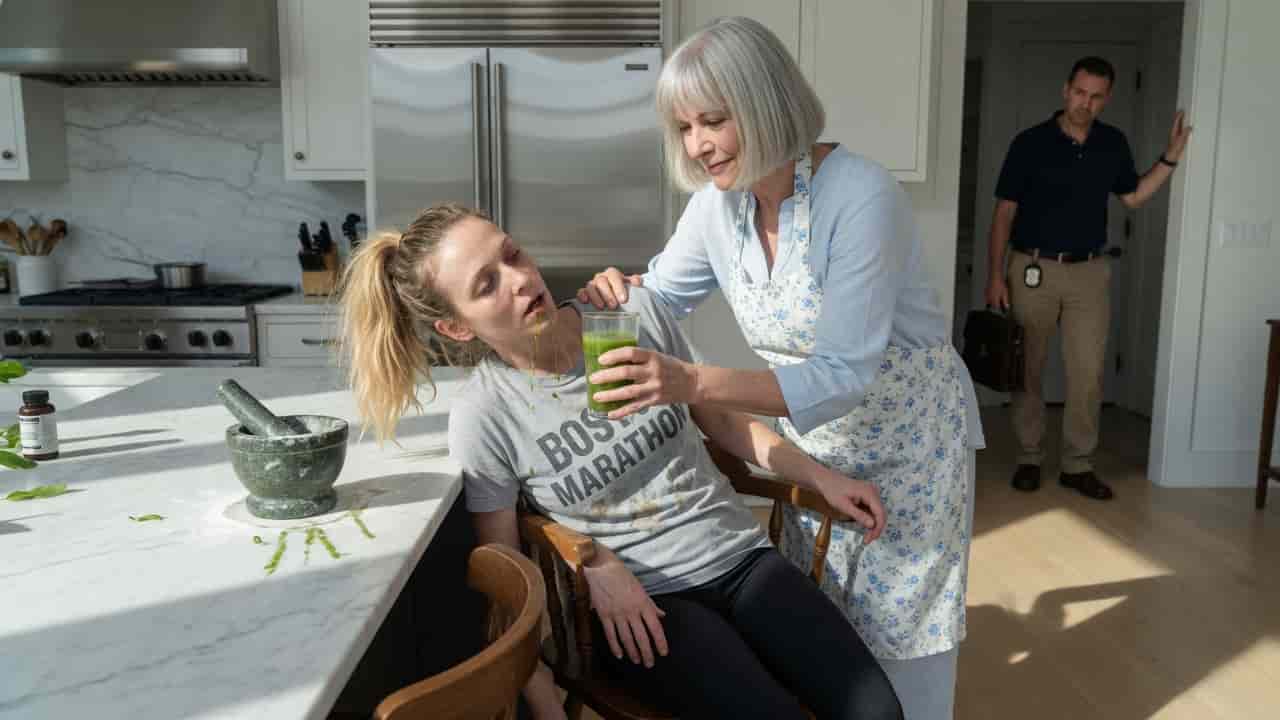
“Drink it, Jen. You’re making a scene in front of Mark.”
Rose’s voice was like honey poured over a blade. She held the glass so tight against my lips that I could feel the glass chime against my teeth. I looked at the doorway, desperate for Mark to see the way her fingers were digging into my shoulder, but all my husband saw was a patient woman dealing with a “lazy, hysterical” wife.
“Please,” I whispered, my voice sounding like it belonged to a stranger. “I don’t want it anymore. It makes me feel… heavy.”
“She’s starting again, Mark,” Rose sighed, looking over her shoulder with a saintly expression of pity. “The paranoia. It’s the exhaustion talking. She hasn’t been herself since she failed that last qualifying race.”
Mark didn’t step in. He didn’t come to take the glass away. He just stood there, his briefcase a barrier between us, his eyes full of a disappointment that hurt worse than the sickness. “Just drink the smoothie, Jen. Mom’s just trying to help you get your strength back. You can’t even make it to the bathroom without help.”
He turned away, and that’s when the mask slipped. Rose leaned in, her breath smelling of peppermint and something metallic. Her lips brushed my ear as she stroked my hair with a terrifying tenderness.
“If you can’t walk, you can’t leave me,” she hissed, her voice too low for the hallway to catch. “It’s better this way, isn’t it? No more running away from your responsibilities.”
I looked at the counter, at the stone mortar and pestle she thought I hadn’t noticed. The white residue was still there. The proof of the lie she was feeding me every single morning. I wasn’t sick. I was being erased.
Chapter 1: The Weight of the Miles
The track at the local high school always smelled the same: baked rubber, cut grass, and the faint, metallic tang of the chain-link fence. For ten years, that smell was my oxygen. It was the scent of a sub-three-hour marathon, the scent of the only thing I was ever truly good at.
I checked my Garmin. My heart rate was at 145, a light jog for most, but my legs felt like they were filled with wet concrete. I tried to push, to find that extra gear that usually sat waiting in my lungs, but there was nothing. Just a cold, sucking vacuum where my endurance used to live.
I tripped. It wasn’t a dramatic fall, just a pathetic clip of my toe against the transition of the lane. I went down on one knee, the red grit of the track biting into my skin. I sat there for a moment, staring at my hands. They were shaking. Not the high-octane tremor of an adrenaline dump, but a weak, rhythmic shudder.
“Jen? You okay?”
I looked up. Coach Miller was walking toward me, his brow furrowed under the brim of a faded Red Sox cap. He’d seen me break thirty miles on a Sunday morning without breaking a sweat. Now, he was looking at me like I was an injured bird.
“Fine,” I said, the word catching in my throat. I stood up, but the world tilted ten degrees to the left. I had to grab the fence to keep from spilling over. “Just… didn’t eat enough breakfast. Blood sugar, probably.”
Miller stopped six feet away. He didn’t offer a hand. He knew better. “That’s the third time this week, Jen. You’re gaunt. Your splits aren’t just slow; they’re regressing. You look like you’re fighting off a flu that won’t break.”
“I’m training through it,” I snapped. The anger felt good. It was the only thing that felt solid. “The New York qualifiers are in six weeks. I don’t have time for a flu.”
“You don’t have time for a collapse, either,” Miller said quietly. “Go home. See a doctor. If you’re not right by Monday, I’m pulling your slot for the elite start. I can’t have you passing out at mile ten.”
I didn’t argue. I couldn’t. The effort of standing was starting to make my vision swim with silver needles. I walked to my car—a practical SUV that usually smelled like sweat and ambition—and sat in the driver’s seat for twenty minutes before I felt safe enough to turn the key.
The house was quiet when I pulled into the driveway. It was a sprawling, suburban colonial that Mark and I had bought three years ago, back when we were the “power couple” of the neighborhood. He was a rising architect; I was a senior VP at a logistics firm. We were fast-tracked for everything.
Now, the house felt too big. It felt like a museum of a life I was losing.
I walked into the kitchen, my footsteps heavy. Mark was at the island, his laptop open, a blueprint spread out like a battle map. He didn’t look up when I came in. He didn’t have to. He could hear the way I was breathing.
“Miller sent you home?” he asked. His voice was flat, the sound of a man who had grown tired of a problem he couldn’t fix.
“He thinks I need rest,” I said, leaning against the refrigerator.
“We all think you need something, Jen,” Mark said, finally looking up. His eyes were tired. There was a time when he looked at me with something approaching awe. Now, there was only a clinical sort of pity. “You’ve missed four days of work this week. Your boss called. Again.”
“I’ll call him back. I just need to lie down for an hour.”
“Rose is in the garden,” Mark said, turning back to his blueprints. “She made you something. Try to be nice, okay? She’s been here for two weeks, doing all the things you’re too tired to do. She’s just trying to help us get through this.”
Rose. My mother-in-law. She had arrived with a suitcase full of floral blouses and a mission to “save our domestic peace.” To Mark, she was a saint. To me, she was a constant, hovering presence that smelled of lavender and unspoken judgment.
The back door creaked open, and Rose stepped in, carrying a basket of late-summer tomatoes. She smiled when she saw me, but the smile didn’t reach her eyes. They stayed sharp, calculating.
“Oh, Jennifer,” she cooed, crossing the kitchen to press a cool hand to my forehead. I flinched, but she didn’t let go. “You look even worse than this morning. You’re positively gray, dear.”
“I’m just tired, Rose. It’s the training.”
“It’s more than that,” Rose said, her voice dropping to a theatrical whisper so Mark could hear. “It’s a breakdown. The body knows when the mind is trying to run away from itself. My poor Mark has been so worried.”
She moved to the blender, the centerpiece of her morning ritual. She started tossing in kale, protein powder, and thick chunks of frozen fruit. “I’ve got your health smoothie ready. I added some extra magnesium and those herbal supplements I told you about. They’ll help with the tremors.”
I watched her back. She moved with a terrifying efficiency. She had been a nurse for thirty years before retiring, a fact she reminded me of every time I tried to insist I was fine. ‘I know the signs of a body in revolt, Jennifer,’ she’d say.
She turned the blender on. The roar of the motor felt like a physical assault on my ears. I closed my eyes, the world spinning. I remembered my father in the final months of his cancer—the way he became a ghost in his own skin, the way he stopped fighting and started letting people do things to him.
I wasn’t my father. I was a runner. I was strong.
The blender stopped. Rose poured the thick, vibrant green liquid into a tall glass. She brought it over to me, her face a mask of maternal concern.
“Drink up,” she said. “Every drop. We need to get you back on your feet, don’t we? For Mark’s sake.”
I looked at the glass. I looked at Mark, who was still staring at his blueprints, his shoulders hunched. I felt a wave of shame so thick I could taste it. I was a VP. I was a marathoner. And here I was, being spoon-fed by a woman who had never liked me, while my husband looked at me with the silent resentment of a man who felt he’d been sold a defective product.
I took the glass. The first sip was bitter, hiding under the sweetness of the berries. It felt heavy as it went down, a leaden weight settling in my stomach.
“There’s my girl,” Rose whispered, her hand moving to stroke my hair. “Don’t you worry. Mama’s here. I’m going to make sure you never have to feel that pressure again.”
I finished the drink. Within twenty minutes, the concrete in my legs had moved to my brain. I didn’t make it to my home office. I barely made it to the sofa before the world went black.
Chapter 2: The Fog of Care
The ceiling of the living room was a white desert. I’d spent more time staring at it in the last month than I had in the previous three years combined. There was a crack near the crown molding, a tiny jagged line that looked like a lightning bolt. I used to think about fixing it. Now, I just wondered if it was getting longer, or if my eyes were just getting worse at focusing.
The clock on the mantel chimed three times. Three in the afternoon. I’d been asleep for five hours.
I tried to sit up, and a wave of nausea rolled over me, followed by a dizzying drop in blood pressure. I slumped back, my heart thumping a slow, heavy rhythm against my ribs. It felt wrong. My resting heart rate used to be forty-eight. Now, it was a sluggish sixty, but it felt labored, like an engine trying to turn over in sub-zero weather.
“Awake at last,” a voice said from the armchair.
Rose was sitting there, a knitting project in her lap. The needles clicked together with a rhythmic, predatory sound. She didn’t look up from her work.
“What time is it?” I croaked.
“Late enough for you to have missed your conference call,” Rose said, her voice light, almost cheerful. “Mark took the message for you. He told them you were having another… episode. I think they understood. People are very sympathetic toward burnout these days.”
“It’s not burnout,” I said, my voice rising with a pathetic flicker of my old self. “I have an appointment with Dr. Aris at four. I need to get ready.”
“I called and rescheduled, dear,” Rose said, finally looking up. Her eyes were flat and blue, like frozen milk. “You were in such a deep sleep. It seemed cruel to wake you just to drag you to a sterile office so they could tell you what we already know. You’re exhausted. Your body is demanding a stop.”
“You did what?” I pushed myself up, my head throbbing. “Rose, those tests are important. My white cell count was borderline last time. He wanted to do a neurological panel.”
“Dr. Aris is a very young man,” Rose said, clicking her needles again. “He sees a successful woman with a high-stress job and a frantic exercise routine, and he looks for a physical cause because it’s easier than telling you that you’re having a nervous collapse. I’ve seen it a thousand times in the clinic. Women like you… you think you can outrun your own shadow. And then your legs give out.”
“I’m not having a nervous collapse.”
“Then why are you crying, Jennifer?”
I reached up. My cheeks were wet. I hadn’t even realized it. The shame was a physical weight now, a suffocating blanket. I felt like I was losing my mind. Maybe she was right. Maybe the miles had finally broken something inside me that couldn’t be mended with Gatorade and rest.
“Where’s Mark?”
“He’s at the office. He has that big presentation for the city council tonight. He was very stressed this morning. I told him not to worry about you, that I’d handle everything.” Rose stood up, setting her knitting aside. “I’ve made you some tea. And I have your afternoon supplement.”
She walked into the kitchen. I stayed on the sofa, listening to the sounds of my own house—the hum of the fridge, the distant bark of a neighbor’s dog. It felt like I was a ghost haunting my own life. I used to be the one who handled everything. I was the one who remembered the dry cleaning, who managed the investments, who ran eighteen miles before breakfast.
Now, I couldn’t even keep a doctor’s appointment.
Rose returned with a tray. On it was a cup of herbal tea and a small white ramekin containing two blue capsules and one large, chalky white pill.
“I don’t recognize these,” I said, looking at the white pill.
“They’re just high-potency vitamins, dear. And something for the anxiety. You were tossing and turning so much last night. Mark hardly got any sleep, and he needs his rest for work.”
She held the ramekin out. I hesitated. There was something in the way she was watching me—a stillness, a hunger. It reminded me of the way she used to look at Mark when we first started dating, a look that said ‘You’re mine, and she’s just an interloper.’
“I don’t think I need the anxiety medication,” I said.
Rose’s face didn’t change, but the air in the room seemed to get colder. “Jennifer. Are we going to do this again? The resistance? The suspicion? Mark is at his breaking point. He told me this morning that he doesn’t know how much longer he can watch you do this to yourself. If you won’t do it for your own health, do it for your marriage.”
The words hit me like a physical blow. Mark had said that? Mark, who used to wait at the finish line of every race with a massive jug of water and a look of pure, unadulterated pride?
“He said that?” I whispered.
“He’s a man, Jennifer. He wants a partner, not a patient. He needs a home that feels like a sanctuary, not a hospital ward. Now, take your medicine. Let’s have a nice, quiet evening so when he comes home, he sees a wife who is trying, not one who is fighting everyone who loves her.”
I took the pills. I washed them down with the lukewarm tea, which tasted faintly of licorice and something bitter, something that lingered on the back of my tongue.
Rose smiled. It was a terrifyingly wide, satisfied expression. She reached out and patted my cheek. Her skin was dry and felt like parchment.
“Good girl. Why don’t you head up to bed? I’ll bring you some soup later. I’ve started some bone broth. It’s what you need. Strength from the inside out.”
I made it halfway up the stairs before the heaviness returned. It wasn’t just my legs this time; it was my eyelids, my tongue, my very thoughts. I crawled the rest of the way, dragging myself across the carpet of the landing like a wounded animal.
I fell onto the bed, still in my leggings, still smelling of the track I could no longer run. As I drifted off, I heard the distant sound of the blender starting up again in the kitchen. Rose was making something else. Something for later.
The last thing I thought before the darkness took me was that I had forgotten to lock the front door. But then I realized it didn’t matter. Rose was here. Rose would keep everyone out. And she would keep me in.
Chapter 3: The Residue of Truth
I woke up at 2:00 AM.
The house was silent, that heavy, pressurized silence that only exists in the middle of the night. My head felt clear—not energized, but sharp, like a wound that had been cleaned with alcohol. The fog had lifted slightly, leaving behind a jagged, raw edge of panic.
I sat up. Mark was beside me, his back turned, his breathing deep and even. He looked so solid, so safe. I reached out to touch his shoulder, to wake him up and tell him that something was wrong, but I stopped. What would I say? ‘I think your mother is making me tired?’ He would just look at me with that exhausted pity again. He would call Rose.
I got out of bed, my movements slow and deliberate. My legs were weak, but the tremor was gone. I felt a strange, cold clarity.
I needed to see the kitchen.
I crept down the stairs, avoiding the third step that always groaned. The moon was out, casting long, skeletal shadows across the hardwood floors. I made it to the kitchen and stood in the center of the room, my heart hammering against my ribs.
The kitchen was spotless. Rose was a fanatic for order. The blender was washed and dried, sitting on the counter like a silent sentinel. The sink was empty. Even the dishcloths were folded with military precision.
I started opening drawers. I didn’t know what I was looking for, but the impulse was driving me, a survival instinct that had finally clawed its way through the sedation.
Nothing in the junk drawer but batteries and menus. Nothing in the spice rack but expensive organic herbs. I moved to the pantry. Rose had rearranged it, putting the things I used—the protein powders, the hydration salts—on the highest shelf where I couldn’t reach them without a stool. In their place were rows of supplements I’d never seen before: “Calm Mind,” “Deep Sleep,” “Root Vitality.”
I stepped back, my foot hitting something hard under the edge of the island.
I knelt down. Tucked away in the very back of the bottom cabinet, behind a giant pot we only used for Thanksgiving, was a small, heavy stone mortar and pestle. It didn’t belong to me. It wasn’t part of our kitchen set.
I pulled it out. It was cold, the granite rough against my palms. I brought it up to the counter, into the sliver of moonlight coming through the window.
The inside of the bowl was coated in a fine, white powder. I ran my finger through it. It was chalky, odorless. I touched my tongue to the tip of my finger.
The bitterness.
It was the same sharp, metallic aftertaste that lingered at the back of every smoothie, every cup of tea, every “restorative” soup.
My stomach dropped. I felt a rush of ice-cold adrenaline. She wasn’t giving me vitamins. She wasn’t giving me herbal supplements. She was grinding something up.
I looked at the mortar and pestle, and then I looked at the guest suite door down the hallway. Rose was in there. Sleeping.
I should have called the police. I should have woken Mark. But the gaslighting had gone too deep. I still doubted my own eyes. Maybe it was just… crushed aspirin? Maybe it was a magnesium supplement that didn’t dissolve well?
I needed to see her room.
I walked down the hall, my breath coming in shallow hitches. I pushed the guest suite door open. It didn’t creak. Rose had probably oiled the hinges herself.
The room smelled of lavender and old-lady perfume. Rose was a dark shape under the covers, her breathing shallow. I moved to the vintage vanity she’d insisted on bringing from her house.
I opened the top drawer.
Stationery. A Rosary. A pair of reading glasses.
I opened the second drawer.
Tucked under a stack of silk scarves was a prescription bottle. It was a large, amber plastic vial. I picked it up, my hands shaking so hard I almost dropped it.
The label was from a pharmacy three towns over. It was made out to Rose Thorne.
Phenobarbital.
I recognized the name. My father had taken it during his final weeks to control his seizures. It was a powerful sedative, an old-school barbiturate. It caused extreme fatigue, dizziness, loss of motor control, and memory fog.
The bottle was half-empty. The date on the fill was only ten days ago. The dosage was for one tablet at night. There were forty tablets missing.
I stood there in the dark, the bottle heavy in my hand. She was drugging me. She was systematically stripping away my strength, my career, my marriage, my very ability to stand. And she was doing it while “caring” for me in front of my husband.
“Looking for something, Jennifer?”
The voice was a whip-crack in the dark.
I spun around. Rose was sitting up in bed. She wasn’t rubbing her eyes. She wasn’t confused. She was perfectly, terrifyingly awake. She reached over and clicked on the bedside lamp.
The light was blinding. She sat there, her silver hair perfectly smooth, her eyes fixed on the bottle in my hand.
“It’s for my nerves, dear,” she said, her voice calm and steady. “Moving is so stressful at my age. I told you I had a prescription.”
“You’ve been putting this in my food,” I said. My voice was a ghost’s whisper, but the words felt like boulders. “You’ve been grinding these up in the mortar and pestle. I found it, Rose. I found the residue.”
Rose didn’t flinch. She didn’t deny it. She just leaned back against her pillows and smiled that wide, hollow smile.
“You were so busy, Jennifer. Always running. Always working. Mark was so lonely. He needed a home. He needed a mother’s touch. But you… you wouldn’t stop. You wouldn’t give him the space to be the man of the house.”
“You’re poisoning me.”
“I’m helping you find peace,” Rose corrected. She stood up, her movements fluid and predatory. She walked toward me, and for the first time, I realized how much taller she was than me now that I was wasting away. “Look at you. You’re trembling. You can’t even hold a bottle of pills without shaking. Who do you think Mark is going to believe? His mother, the nurse who gave up her retirement to care for his failing wife? Or the woman who’s been having a documented mental breakdown for the last two months?”
“I’ll tell him. I’ll show him the bottle.”
“Go ahead,” Rose said, gesturing toward the door. “Wake him up. Tell him his mother is a monster. Tell him you broke into my room in the middle of the night to steal my nerve medication because you’re so paranoid and unstable. See how he looks at you then, Jennifer. See if he sees a wife, or a tragedy he needs to move on from.”
I looked at the door, and then back at her. The trap was perfect. It was built of silk and lavender and thirty years of “caring.” If I screamed, I was the crazy one. If I stayed silent, I was the victim.
“Give me the bottle, dear,” Rose said, stepping closer. “You’ve had a bad dream. Let’s go back to the kitchen. I’ll make you some warm milk. It’ll help you sleep. And tomorrow… tomorrow we’ll talk about finding you a more permanent facility. Somewhere you can really rest.”
I backed away, my heel catching on the rug. I didn’t give her the bottle. I shoved it into my pocket and bolted for the door.
Chapter 4: The Whisper and the Wall
I didn’t go to Mark.
I locked myself in the bathroom and sat on the cold tile floor, clutching the pill bottle like a talisman. My heart was racing, a frantic, stuttering beat that felt like it was trying to escape my chest.
Who do you think Mark is going to believe?
Her words echoed in the small, tiled space. She was right. Mark was already halfway out the door. He’d been conditioned for weeks to see me as a burden, a puzzle with missing pieces. If I came to him now, clutching a bottle of his mother’s pills and babbling about poison, I would be checking myself into a psych ward by morning.
I needed to be smart. I needed to be the VP again. I needed a plan.
I stayed in the bathroom until the sun started to bleed through the frosted window. I heard the house wake up. The floorboards groaning under Mark’s weight. The clatter of the coffee maker. And then, the unmistakable roar of the blender.
The morning smoothie.
I splashed cold water on my face. My reflection was a horror show—dark circles like bruises under my eyes, skin the color of old parchment. I looked exactly like the broken woman Rose wanted the world to see.
I walked into the kitchen.
Mark was at the island, drinking coffee and scrolling through his phone. Rose was at the blender, her back to me. She didn’t turn around, but I saw her shoulders stiffen.
“Morning, honey,” Mark said, not looking up. “You’re up early. You feeling any better?”
“A little,” I said. My voice was steady. I was amazed at how well I could lie when my life depended on it. “I think the rest is finally starting to help.”
Rose turned around, a bright, false smile on her face. She held the tall green glass in her hand. “That’s wonderful news, Jennifer! I knew a good night’s sleep was all you needed. And here’s your morning boost. I’ve put extra ginger in this one for the nausea.”
She walked toward me. I looked at Mark. He was finally looking at me, his eyes searching for a sign of the woman he’d married.
“Drink up, Jen,” he said, his voice encouraging but tinged with that lingering edge of “please just be normal.” “Mom’s been up since six making that.”
Rose reached me. She held the glass out. Her fingers were steady, the nails buffed to a soft pink.
“I’m not really hungry this morning, Rose,” I said, keeping my eyes on the green liquid.
The temperature in the room seemed to drop. Rose’s smile didn’t waver, but her eyes turned into chips of blue ice. “Oh, but Jennifer, you have to. Your electrolytes are all out of balance. Dr. Aris would be so upset if he knew you were skipping your nutrition.”
“Just have a few sips, Jen,” Mark said, his voice losing its encouraging tone and shifting back toward irritation. “Don’t start a thing. Not this morning. I have a meeting with the partners in an hour.”
Don’t start a thing.
He had already chosen his side. He’d chosen the side of “no conflict.”
Rose stepped closer, her body blocking me from Mark’s view. She held the glass to my lips. It was the same motion as the video, the same possessive, terrifying tilt.
“Drink it, Jen,” she whispered, her voice too low for Mark to hear over the hum of the refrigerator. “You’re making a scene in front of Mark. You don’t want him to think you’re being difficult again, do you?”
I looked at her. I saw the triumph in her eyes. She thought she’d won. She thought I was too weak to fight back.
I took the glass.
I brought it to my lips, but instead of drinking, I let my hand “tremble.” I let it shake with a violent, sudden spasm. The glass flew from my hand, shattering against the marble island and splashing green liquid across Rose’s pristine blue tunic and the white floral apron.
“Oh! My god!” I cried, pulling my hand back and tucking it against my chest. “I’m so sorry! It just… my hand just gave out!”
Rose froze. For a split second, the mask shattered. Her face contorted into a look of pure, unadulterated rage. She looked like she wanted to wrap her hands around my throat and squeeze.
“Jennifer!” Mark stood up, his stool clattering back. He rushed over, grabbing a roll of paper towels. “Are you okay? Did you get cut?”
“I’m fine,” I sobbed, the tears coming easily now. “I’m just so weak, Mark. I can’t even hold a glass. I’m so sorry, Rose. I didn’t mean to ruin your dress.”
Rose recovered faster than I expected. She slumped her shoulders, her face melting back into a look of martyred patience. She looked down at the mess on her clothes and then at Mark, her eyes welling with false tears.
“It’s alright, Mark,” she sighed, her voice trembling. “It’s just a dress. I’m just… I’m so worried about her. This is the second time her motor control has just vanished this morning. I had to help her back to bed last night when she got confused and wandered into my room.”
“You wandered into her room?” Mark turned to me, his face hardening. “Jen, what is going on?”
“I was looking for my phone,” I lied, my heart pounding. “I must have been sleepwalking. I don’t remember it clearly.”
“She was holding my prescription bottle, Mark,” Rose said, her voice a hushed, tragic whisper. “She was looking at my pills. I’m so afraid she’s… she’s looking for a way out. People in her state, they get so desperate when they feel they’ve lost control.”
Mark’s face went pale. He looked at me, and I saw the final spark of trust die in his eyes. He didn’t see a VP. He didn’t see a marathoner. He saw a suicide risk. He saw a liability.
“I’m not looking for a way out, Mark!” I shouted, but it sounded hysterical, even to me. “She’s lying! She’s the one who—”
“That’s enough!” Mark snapped. He looked at Rose. “Mom, go get changed. I’ll clean this up. I… I think we need to call that inpatient center you mentioned. The one in the valley.”
Rose nodded, her head bowed in faux-grief. She started to walk past me, toward the guest suite. As she brushed against my shoulder, she leaned in.
The whisper was a jagged blade in my ear.
“If you can’t walk, you can’t leave me,” she hissed, her voice a frozen needle. “It’s better this way, isn’t it? No more running, Jennifer. No more running ever again.”
She kept walking.
I stood in the center of the kitchen, surrounded by broken glass and green poison, while my husband cleaned the floor and refused to look me in the eye. I had the bottle in my pocket, but it didn’t matter. The wall was too high. The lie was too perfect.
And I could feel my legs starting to go numb again.
Chapter 5: The House of Quiet Voices
The sound of Mark’s voice from the hallway was a low, rhythmic drone, the kind used by people negotiating a hostage release or a corporate merger. It was his “architect voice”—measured, structural, designed to reassure. But he wasn’t talking about blueprints. He was talking about a bed in a specialized psychiatric wing three hours away.
I sat on the edge of the bed in our master suite, my hands tucked under my thighs to hide the tremor. The room, which used to be my sanctuary, felt like a staged set. The high-thread-count sheets, the expensive linen curtains, the framed photos of our honeymoon in Amalfi—it all looked like a lie.
I reached into my pocket and felt the hard, plastic cylinder of the pill bottle. It was my only weapon, but the longer I sat there, the more it felt like it was made of lead. If I showed it to him now, Rose would simply claim I’d stolen it from her vanity. She’d already planted the seed. She was looking at my pills, Mark. I’m so afraid she’s looking for a way out. The door creaked open. Mark walked in, closing it softly behind him. He didn’t look at me directly. He looked at the floor, then at the window, then finally at the space just above my head.
“The transport will be here at ten tomorrow morning,” he said. His voice was thick with a forced, clinical kindness that made my skin crawl. “It’s a good place, Jen. Pine Ridge. They specialize in… complex fatigue and psychosomatic burnout. They have a great nutrition program.”
“I’m not burnt out, Mark,” I said. My voice was sandpaper. “I’m being poisoned.”
Mark let out a long, shuddering breath. He rubbed his face with both hands, the wedding band on his finger catching the light. “Jen, please. We’ve been over this. The paranoia is part of the collapse. Mom has done nothing but cook for you and clean this house for three weeks. She’s exhausted. She’s crying in the kitchen right now because she thinks she failed you.”
“She is failing me!” I stood up, my legs buckling for a second before I caught the bedpost. “She’s giving me Phenobarbital, Mark. It’s a sedative. A heavy one. I found the bottle in her room. I found the mortar and pestle she uses to grind it into my smoothies.”
Mark finally looked at me, and what I saw in his eyes wasn’t anger. It was a profound, soul-deep exhaustion. “She told me you went into her room. She told me you were obsessed with her medication. Jen, she’s sixty-two years old and she has a heart condition. Of course she has sedatives. She takes them so she can sleep while her daughter-in-law screams at her in the kitchen.”
“I haven’t been screaming!”
“You’re screaming now,” he said quietly.
I froze. I was. My voice was high and jagged, vibrating with a desperate, frantic energy that looked exactly like the madness they were projecting onto me. I forced myself to sit back down. I forced my breathing to slow.
“Mark,” I said, trying to find the woman who used to lead board meetings. “Look at me. Really look at me. Two months ago, I ran twenty miles on a Saturday morning. I was up for a promotion. Do you honestly believe I just… decided to stop? That I wanted to be this? To have you look at me like I’m a broken toy?”
Mark’s expression softened for a fleeting second, a shadow of the man who used to wait for me at the 26-mile marker with a look of pure worship. “I think you pushed too hard, Jen. I think you broke something. And I think the shame of that is making you look for someone to blame. It’s easier to believe Mom is a villain than to believe you can’t run anymore.”
He walked over and knelt in front of me, taking my hands in his. His palms were warm and dry. “Just go to Pine Ridge. For thirty days. If you’re right—if there’s some physical toxin—they’ll find it in the blood work there. But you have to give them a chance. You have to stop fighting us.”
“Will you come with me?” I asked.
“I have to stay here and finish the Highland Project, Jen. You know that. But Mom will stay here and help me close up the house, and then she’ll come visit you on the weekends.”
The thought of Rose visiting me in a locked facility, bringing me “restorative” teas while I was under a doctor’s observation, sent a jolt of pure terror through me. I realized then that I wasn’t just fighting for my health. I was fighting for my life. If I went to Pine Ridge, I would never come back. Not as myself. I’d come back as a compliant, sedated version of Jen, a woman who lived in a house governed by Rose’s “care.”
“Okay,” I whispered.
Mark let out a sob of relief. He leaned forward and pressed his forehead against my knees. “Thank you. Thank you, Jen. God, I just want my wife back.”
You don’t even know who your wife is, I thought, my hand instinctively moving to the pocket of my leggings.
He stayed there for a few minutes, clinging to me like a man who had just survived a shipwreck. When he finally stood up, he looked lighter. He kissed my forehead and told me to get some rest, that he’d handle the packing.
As soon as the door clicked shut, I moved.
I didn’t have much time. Rose would be up soon to check on me, to bring me the “nightly tea” that would ensure I was too groggy to resist the transport in the morning.
I didn’t go for my phone. I knew Rose had been checking it. I’d seen her scrolling through my messages while I was “napping” on the sofa. Instead, I went to the one thing she’d overlooked.
Six months ago, Mark and I had been having trouble with a neighborhood kid stealing packages from our porch. We’d installed a high-end security system, including a small, discreet camera in the pantry that overlooked the kitchen island. It was meant to catch anyone coming through the back door.
I’d forgotten it was even there. So had Mark. And Rose, for all her nursing efficiency, wasn’t tech-savvy.
I crawled to the corner of the room where my laptop sat on the vanity. I opened it, the screen brightness searing my eyes. My fingers felt like thick sausages as I typed in the password for the home security portal.
Loading…
The circle spun. My heart felt like a trapped bird beating against my ribs.
Connection established.
I navigated to the “Kitchen Pantry” feed. I scrolled back through the archives. It took forever. My vision kept blurring, the lingering effects of the morning’s dose making the screen swim.
Yesterday. 7:45 AM.
The video was grainy but clear enough. I watched Rose enter the kitchen. She looked different when Mark wasn’t in the room. Her posture was straighter, her face set in a mask of grim, focused intensity. She moved to the cupboard and pulled out the stone mortar and pestle.
I watched as she took a small white bottle from her apron pocket. She tapped two pills into the bowl. She began to grind. The sound wasn’t there, but I could see the rhythmic motion of her wrist. She was thorough. She spent nearly three minutes making sure the powder was fine.
Then, she moved to the blender. She poured in the kale, the berries, the protein powder. And then, with a casual flick of her wrist, she scraped the white powder from the mortar into the mix.
She stirred it. She tasted a tiny bit on her finger, her face twisting in a momentary grimace of distaste before she smoothed it over.
I felt a wave of nausea so violent I had to clamp my hand over my mouth. There it was. The proof. It wasn’t paranoia. It wasn’t a nervous breakdown. It was a slow-motion assault caught in 1080p.
I went to download the clip, but my finger froze over the trackpad.
If I showed this to Mark now, what would happen? He’d confront her. She’d cry. She’d say she was doing it for his own good, to “calm me down” so he could work. And Mark, in his desperate need for peace, might still find a way to forgive her. He might still send me to Pine Ridge just to get me out of the line of fire.
I needed more. I needed a witness who wasn’t compromised by blood or guilt.
I looked at the clock. 8:30 PM.
I opened my email. I didn’t write to Mark. I wrote to Coach Miller.
Miller, I typed, my hands shaking so much I had to delete every third word. I’m in trouble. Don’t call me. Just come to the house tomorrow at 9:30 AM. Don’t knock. Just walk in. The back door will be unlocked. Bring the police. I have video.
I hit send. Then I deleted the sent message and cleared the browser history.
I sat back, my head spinning. I was exhausted, the kind of exhaustion that feels like it’s in your marrow. I heard footsteps in the hall.
I shoved the laptop under the bed and scrambled back onto the mattress, pulling the duvet up to my chin.
The door opened. Rose stood there, silhouetted by the hallway light. She was carrying a small ceramic mug. The steam rose in a gentle, mocking curl.
“Jennifer?” she whispered. “Are you awake, dear?”
“I’m awake,” I said, my voice flat.
She walked over, her footsteps silent on the carpet. She sat on the edge of the bed, the mug held out like an offering. “Mark told me the news. I’m so glad you’ve decided to be sensible. Pine Ridge is a beautiful place. You’ll be so happy there.”
She held the mug to my face. The scent of chamomile was overwhelmed by that sharp, metallic tang.
“Drink your tea,” she said. Her eyes were fixed on mine, searching for any sign of defiance. “It’ll help you have one last, peaceful night in your own home.”
I looked at her. I saw the monster behind the silver hair and the floral apron. I saw the woman who would rather see me in a casket or a padded room than lose her grip on her son.
I took the mug.
“Thank you, Rose,” I said. “You’ve been so… attentive.”
I brought the mug to my lips. I let a tiny bit of the liquid touch my tongue, but I didn’t swallow. I pretended to take a long, deep gulp, then I let out a sigh of “satisfaction.”
“There’s my girl,” Rose whispered. She reached out and smoothed my hair back from my forehead. Her hand was cold. “Everything is going to be so quiet now. Just the way it should be.”
She stayed until she thought I was drifting off. She took the empty mug and crept out of the room, clicking the door shut.
As soon as she was gone, I leaned over the side of the bed and spat the mouthful of tea into a potted silk plant on the floor.
I lay there in the dark, my eyes wide, watching the crack in the ceiling. I didn’t sleep. I couldn’t. I spent the night counting my heartbeats, waiting for the sun to rise, waiting for the men in the white van, and waiting for the only person left in the world who might still see me as a runner instead of a ghost.
Chapter 6: The Finish Line
The morning of the transfer was a study in suburban stillness. The sun was bright, mocking the gray reality of the house. I could hear the sounds of life below—the clink of silverware, the low murmur of Mark and Rose talking in the kitchen. They sounded like a normal family. They sounded like people who weren’t about to disappear me.
I stood in the shower, the water as hot as I could stand it, trying to shock the last of the Phenobarbital out of my system. My legs felt like they belonged to someone else, heavy and unresponsive, but my mind was a white-hot coal.
I dressed slowly. My gray marathon shirt. Black leggings. My running shoes. I laced them tight, the familiar pull of the fabric against my feet giving me a flicker of phantom strength.
I looked at the clock. 9:15 AM.
I grabbed my laptop and shoved it into my gym bag. I tucked the pill bottle into my waistband, the plastic cold against my skin.
When I walked down the stairs, Rose was waiting at the bottom. She was wearing a pale yellow sweater and her “trustworthy” nursing smile.
“You’re dressed!” she chirped. “And look at those shoes. Are we feeling a bit more like ourselves this morning?”
“I’m feeling clear, Rose,” I said. I walked past her into the kitchen.
Mark was standing by the back door, looking out at the driveway. He looked like he hadn’t slept either. His face was etched with a guilt he couldn’t name.
“The van should be here any minute, Jen,” he said, his voice cracking. “Do you have your bag?”
“I have everything I need,” I said.
I sat down at the kitchen island. Rose moved behind me, her hand landing on my shoulder like a claw. “Would you like some juice, dear? Or a little toast? It’s a long drive.”
“I’d like to see the pantry,” I said.
Mark turned around, his brow furrowing. “The pantry? Why?”
“I think I left my hydration salts in there,” I said, my voice steady. “The ones Miller gave me. I want to take them with me to Pine Ridge.”
Rose’s grip on my shoulder tightened for a fraction of a second. “Oh, I think I threw those out, Jennifer. They were past their expiration date. I didn’t want you taking anything that wasn’t fresh.”
“I’ll just check,” I said. I stood up, swaying only slightly.
I walked toward the pantry. Rose stepped in front of me, her smile becoming a sharp, frantic thing. “Jennifer, really. We don’t have time for this. Mark, tell her.”
“Jen, let it go,” Mark said, walking over. “We can buy you new salts.”
“I don’t want new ones,” I said. I looked directly at Rose. “I want to see what’s on the top shelf. The stuff you hidden.”
Rose’s face paled. She looked at Mark. “She’s having an episode. Mark, look at her eyes. She’s getting that look again. Maybe we should call the facility and ask them to come inside to help her out.”
“I’m not having an episode, Rose,” I said. I reached into my gym bag and pulled out the laptop. I set it on the marble counter with a deliberate clatter. “I’m having a premiere.”
“Jen, what are you doing?” Mark asked, stepping closer.
I didn’t answer. I opened the laptop and hit play on the saved clip.
The screen showed the kitchen island from three angles. There was Rose, clear as day, grinding the blue and white pills into the mortar. There was the casual, practiced way she scraped the poison into the blender.
The kitchen went deathly silent. The only sound was the low hum of the laptop’s fan.
Mark froze. He stared at the screen, his mouth slightly open. I watched the realization wash over him like a physical blow. I saw the moment his brain tried to reject it, and then the moment the weight of the evidence became too heavy to ignore.
“Mom?” he whispered.
Rose didn’t look at the screen. She looked at me. The mask was gone now. The “caregiver” had vanished, replaced by something ancient and jagged.
“I did it for you, Mark,” she said, her voice dropping the honeyed tone and becoming a cold, flat rasp. “She was killing you. She was obsessed with her work, with her running, with everything that didn’t include you. She was never going to give you a family. She was never going to be the wife you deserved.”
“You drugged her,” Mark said, his voice trembling. He looked at the mortar and pestle sitting on the counter—the one I’d left out on purpose. “You were poisoning my wife.”
“I was saving your marriage!” Rose shouted, her face contorting. She turned on me, her fingers curling into talons. “You think you’re so special because you can run? You’re nothing! You’re a selfish, arrogant girl who didn’t know how to take care of a man. I gave him peace! I gave him a home!”
She lunged for the laptop, her hands reaching to smash the screen.
“Don’t!” Mark shouted, grabbing her arms.
They struggled for a second, a mess of blue linen and navy cotton. It was ugly. It was the sound of a family breaking apart in real time.
The back door opened.
Coach Miller stepped in, followed by two uniformed police officers. Miller looked at the kitchen—the shattered glass from my “accident” yesterday, the laptop on the counter, the middle-aged woman screaming in her son’s arms.
He looked at me.
“Jen?” he asked.
I stood up. I felt a strange, cold lightness in my limbs. The adrenaline was doing what the medicine couldn’t.
“I have the video, Miller,” I said. I reached into my waistband and pulled out the prescription bottle, sliding it across the marble toward the officers. “And I have the pills. And I’d like to go to the hospital now. A real one.”
The next twenty minutes were a blur of motion. The officers took Rose’s statement—which was mostly a stream of vitriol aimed at me—and then they took her out in handcuffs. She didn’t cry. she didn’t plead. She just looked at Mark with a terrifying, possessive pity.
“She’ll leave you now, Mark,” Rose said as they led her toward the cruiser. “Now that she’s strong again, she won’t need you. You’ll see. I was the only one who stayed.”
Mark didn’t answer. He sat at the kitchen island, his head in his hands, sobbing with the sound of a man who had lost everything.
Miller walked over to me. He looked at my gaunt face, the way my clothes hung off my frame.
“You look like hell, kid,” he said softly.
“I feel like I’ve run a hundred miles,” I said.
“Let’s get you checked out,” he said, offering me his arm.
I took it. I walked toward the door, passing Mark. I stopped for a second. I wanted to say something. I wanted to tell him I was sorry, or that I hated him for not believing me, or that I hoped he found some version of the peace his mother had tried to manufacture.
But I didn’t have the words. The residue was too thick. The silence between us wasn’t a sanctuary anymore; it was a graveyard.
I walked out the back door, into the bright, indifferent sun.
The hospital tests confirmed it. High levels of Phenobarbital in my system. My liver was strained, my nervous system fried. The doctors said it would take months, maybe a year, to get back to my baseline.
I didn’t go back to the house. I stayed with Miller and his wife for a while, and then I got my own apartment. Small. Minimalist. No blender.
Six months later, I went back to the high school track.
It was a Tuesday morning. The air was crisp, smelling of baked rubber and the promise of rain. I sat on the bleachers for a long time, just watching the local kids run their laps.
I stood up. I walked down to the edge of the red grit.
I didn’t have a Garmin. I didn’t have a coach. I just had my breath and the slow, steady beat of a heart that had survived.
I took a step. Then another.
I wasn’t fast. My legs still felt heavy, a lingering ghost of the concrete Rose had poured into my veins. But I was moving.
I wasn’t running away from anything anymore. I was just running. And for the first time in a very long time, the world didn’t feel like a cage. It felt like a road.
I reached the far turn, the wind catching my hair. I looked back at the empty bleachers, at the life I’d left behind, and I kept going.
I didn’t stop until I reached the finish line. And then, I kept going anyway.