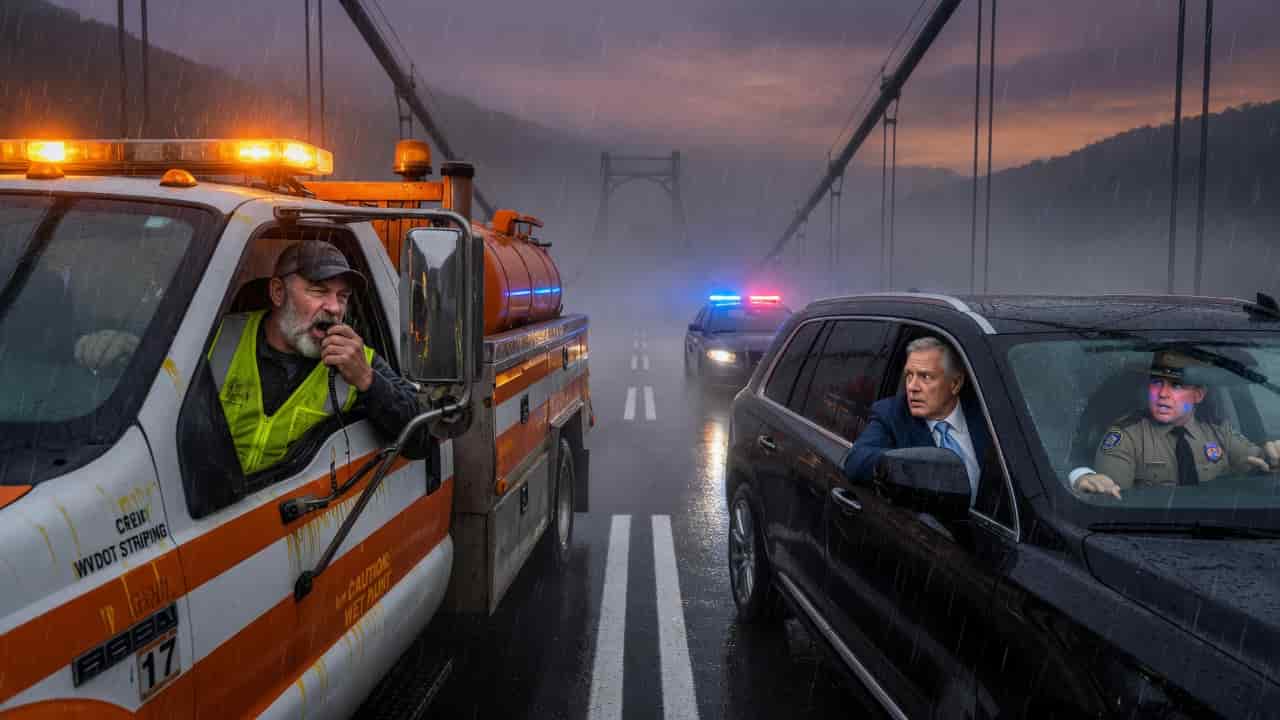
“I used the cheap paint for your lane, Bill. Let’s see if it holds.”
Silas didn’t shout. He didn’t have to. The roar of the mountain rain and the screaming tires of the Commissioner’s luxury SUV did the talking for him. For three years, Silas had sat in that striping truck, painting the same mountain passes where his wife’s car had spun into the void. He knew every crack, every pocket of slick, substandard oil, and every lie the county had told to save a few million dollars.
Commissioner Bill looked through the glass, his expensive suit and his high-rise office offering no protection against the physics of a road built on corruption. He’d signed the papers. He’d taken the kickbacks. And he’d told Silas it was just an accident—a “tragic twist of fate.”
But Silas was a man of precision. A former sniper who understood that a single miscalculation changes everything. He hadn’t just been painting lines; he’d been laying a trap. And as the State Trooper who had been paid to look the other way watched from the shadows, the truth finally began to slide.
The road was failing, just like Bill promised it wouldn’t. Now, with the fog closing in and the bridge humming under the weight of a thousand secrets, Silas was finally ready to show the world what happens when you build a kingdom on a foundation of sand and slippery oil.
Chapter 1: The Weight of the Mix
The jar sat on Silas’s dashboard, a small, unassuming glass container filled with what looked like charred granola. To a tourist driving the Highland Scenic Highway, it was just debris. To Silas, it was a confession. He reached out, his calloused thumb tracing the lid. Every time he hit a pothole in the heavy striping truck, the contents rattled—a dry, brittle sound that reminded him of bones.
It was 4:00 AM. The West Virginia air was thick with the kind of mountain fog that didn’t just obscure the road; it swallowed it. Silas adjusted the dial on the truck’s radio. The signal was weak, buried under layers of static, but he found it: 98.7, “The River.” It was the only station Sarah ever listened to. A soft folk ballad from a decade ago hummed through the cabin, the singer’s voice thin and mournful. Silas didn’t sing along. He just let the sound occupy the space where his thoughts usually turned into a riot.
He pulled the truck into the staging area at the base of the Gauley Bridge. The massive white-and-orange rig groaned, its hydraulic systems hissing like a tired animal. This was his world now—beacons, reflective beads, and the sharp, chemical tang of thermoplastic paint. He’d spent twenty years as a Marine Scout Sniper, a man whose entire existence was defined by the math of windage, elevation, and the cold reality of a trigger pull. Now, he measured his life in miles per hour and the steady flow of a pressurized nozzle.
“Morning, Silas,” a voice crackled over the handheld.
Silas didn’t pick up the radio. He watched the headlights of a black SUV cut through the mist. It was a Cadillac Escalade, polished to a mirror finish that felt like an insult in a county where most people were choosing between gas and groceries. The door opened, and Commissioner Bill stepped out. He was wearing a Gore-Tex jacket that cost more than Silas’s monthly mortgage, his silver hair perfectly coiffed despite the humidity.
Bill walked toward the truck, his boots clicking on the fresh asphalt Silas had laid the week before. He stopped, looking down at the road surface, then up at Silas’s window. Silas rolled it down just enough to let the smell of the damp earth in.
“Running behind, Silas?” Bill asked. His voice was that practiced, political baritone—all warmth on the surface and ice underneath.
“The humidity is at ninety percent, Bill,” Silas said. He didn’t look at the man. He looked at the bridge. “The paint won’t cure. It’ll smear. You want the lines straight, or you want them pretty?”
Bill chuckled, a dry sound. “I want them done. We’ve got the ribbon-cutting for the new bypass on Friday. The Governor is coming down. I can’t have a half-painted bridge appearing in the Charleston Gazette.”
Silas finally turned his head. His eyes were the color of slate, hard and unblinking. “The Governor isn’t the one who has to drive this in the rain.”
Bill’s smile faltered, just for a second. It was a hairline fracture in the mask. Everyone in Nicholas County knew about Sarah. They knew about the rainy Tuesday three years ago when her sedan had lost traction on the “Low Bid” section of Route 39, sliding across the center line and into the path of a timber hauler. The official report cited “unpredictable road conditions” and “excessive speed,” though Sarah had never driven more than five miles over the limit in her life.
“We all miss her, Silas,” Bill said, leaning a hand against the truck’s door. “But you’ve been holding onto that jar of aggregate for three years. The lab results came back. The asphalt met the state spec.”
“The lab that’s owned by your brother-in-law?” Silas asked quietly.
Bill straightened up, his eyes narrowing. The politician vanished, replaced by the man who held the purse strings of every contract in the district. “Careful, Silas. You’re a contractor. A good one. But there are plenty of guys with a striping rig and a clean record who would love this route. Don’t let your grief turn into a liability.”
“I’m just a man with a paint bucket, Bill,” Silas said, his voice flat. “Nothing to worry about.”
Bill patted the side of the truck twice, a gesture of dismissal, and walked back to his SUV. As the Cadillac pulled away, Silas picked up the jar from the dashboard. He unscrewed the lid and poured a small amount of the black stones into his palm. He squeezed.
The aggregate didn’t hold. It didn’t have the structural integrity of true granite or trap rock. It crumbled into dust under the pressure of his grip. It was slag—industrial byproduct disguised with a thin coat of bitumen. It was cheap. It was slippery. And it was exactly what Bill had used to pave the entire county road system, pocketing the difference between the high-grade bid and the low-grade reality.
Silas wiped his hand on his jeans, the black dust staining the denim. He looked back at the bridge. In his mind, he wasn’t seeing a construction zone. He was seeing a range. He was calculating the curve of the bridge, the camber of the asphalt, and the exact point where the “cheap paint” he’d been mixing in the back of the truck would create a friction coefficient of nearly zero when hit with enough water.
He reached into the glovebox and pulled out a small, ruggedized tablet. On the screen was a map of the county, overlaid with red dots. Each dot represented a marker he’d painted over the last six months—invisible to the naked eye, but visible under a specific ultraviolet frequency he’d rigged into his truck’s spotlights.
He wasn’t just a painter. He was a surveyor of ghosts.
The radio played the final notes of the folk song. The DJ’s voice came on, cheerful and oblivious. “That was ‘The Long Way Home’ for all you early risers. Stay safe out there on the roads, folks. It’s a wet one.”
Silas put the truck in gear. The heavy tires rumbled onto the bridge. He had four days until the ribbon-cutting. Four days to finish the “invisible” work. He felt the weight of the rifle case bolted under his seat, though he hadn’t touched the weapon in years. He didn’t need a bullet for Bill. He just needed the road to do what Bill had designed it to do.
He flipped the switch for the rear sprayers. A thin, precise line of white thermoplastic began to hit the road. To anyone watching, it was the start of a standard workday. To Silas, it was the first line of a long-overdue sentence.
Chapter 2: The Witness at the Cross
The roadside memorial was a simple thing—a white wooden cross, a faded plastic wreath of lilies, and a small, rusted die-cast car that Sarah had kept on her keychain. It sat on a narrow shoulder of Route 39, right at the apex of the curve where the guardrail was still scarred and twisted.
Silas pulled his truck onto the gravel, the amber lights still slowly revolving, casting a rhythmic orange glow over the grass. He stepped out, the wet mountain air instantly clinging to his lungs. He didn’t come here to pray. He came here to remember why he couldn’t stop.
A state cruiser pulled in behind him. The engine cut, and Trooper Miller stepped out. Miller was younger than Silas, a man who still believed the uniform meant something, even if he’d spent the last year trying to avoid looking Silas in the eye.
“Checking the lines, Silas?” Miller asked, adjusting his hat against the drizzle.
“Checking the ground,” Silas replied. He knelt by the cross, straightening the plastic lilies. “The soil is shifting. The shoulder wasn’t compacted right when they did the re-pave. Another heavy rain, and this whole section of the hill is going to slide.”
Miller sighed, a sound of exhausted complicity. “I told the DOT. I put it in the supplemental report after… after the accident. They said it wasn’t in the budget this cycle.”
“Budgets are funny things,” Silas said, standing up. He turned to face Miller. “You got promoted six months ago, didn’t you? Sergeant?”
Miller’s face flushed. He looked away, toward the dark wall of pines across the road. “I worked for it, Silas. I’ve put in twelve-hour shifts for three years.”
“I’m sure you did. And I’m sure it had nothing to do with the fact that you were the first on the scene that day. The one who saw the asphalt peeling up like wet cardboard before the Commissioner’s crew arrived with a patch truck three hours later.”
The silence that followed was heavy, punctuated only by the drip of water from the trees. Miller’s hand drifted toward his belt, a nervous habit. “There were no photos, Silas. My body cam failed. It was an equipment malfunction.”
“Convenient,” Silas said. He walked closer, his presence looming. He was several inches taller than Miller, and despite the neon vest, he still moved with the predatory stillness of a man who had spent years in a hide-site. “How does the new house feel, Miller? The one on the hill with the paved driveway? Did Bill’s brother-in-law give you a good deal on the stone?”
Miller’s jaw tightened. “You need to go home, Silas. You’re over-tired. You’re seeing ghosts where there are just bad roads.”
“I see both,” Silas said quietly.
He walked back to his truck, but he didn’t leave. He waited. He wanted Miller to feel the pressure. He wanted the man to remember the smell of the oil and the sight of Sarah’s car.
Later that afternoon, Silas met Maya in a diner ten miles outside the county line. Maya was twenty-six, with thick-rimmed glasses and a nervous energy that manifested in her constantly tapping her pen against a notebook. She ran a local blog that most people ignored, focusing on municipal corruption and environmental runoff.
“I went through the shipping manifests for the paving company,” Maya said, sliding a folder across the Formica table. Her voice was low, glancing around at the other patrons. “You were right. They didn’t buy the aggregate from the quarry in Greenbrier. They bought it from a processing plant in Ohio that handles coal slag.”
Silas opened the folder. His eyes scanned the numbers with the same cold efficiency he used to calculate wind-drift. “Slag isn’t road-rated. It’s too porous. It absorbs water, then expands when it freezes. By the third winter, the road is basically a sponge.”
“It’s worse than that,” Maya whispered. “The company that sold it is a shell. It leads back to a holding firm in Delaware. One of the directors is Bill’s wife.”
Silas felt a familiar coldness settle in his chest. It wasn’t anger—anger was hot, messy, and prone to error. This was the “Zero,” the moment when the crosshairs settled and the world went quiet.
“Why are you doing this, Maya?” he asked.
“My dad worked for the county for thirty years,” she said, her eyes welling up. “He was a foreman. He tried to blow the whistle on the bridge project ten years ago. They fired him, took his pension, and sued him into silence. He died thinking he was the failure. I just want the truth on a piece of paper that someone can’t burn.”
Silas nodded. He reached into his pocket and pulled out a small USB drive. “This is the audio from the recording device I buried in the Commissioner’s driveway last month. He’s been having meetings in his garage. He talks about the ‘Highland Project’ like it’s a piggy bank. He mentions the bridge. He mentions the paint.”
Maya took the drive, her fingers trembling. “If I post this, they’ll come for me, Silas.”
“They’ll be too busy,” Silas said. “The bridge opens on Friday. Bill is going to drive across it in that heavy SUV of his. He’s going to show everyone how safe it is.”
“What are you going to do?”
Silas stood up, dropping a twenty-dollar bill on the table. “I’m going to make sure the lines are straight, Maya. Like I always do.”
He walked out into the rain. He had two days left. The technical work was done. The “invisible” markers were set. He’d replaced the standard reflective beads in the bridge’s center line with a proprietary polymer he’d developed in his garage—a substance that looked like paint but acted like a lubricant when it reached a certain temperature under tire friction.
He drove back to the yard, the radio playing another song Sarah loved. He found himself huming the melody, a low, gravelly sound that felt foreign in his throat. He thought about the cross on the side of the road. He thought about Miller’s new house.
He wasn’t a vigilante. He was a contractor. And he was about to deliver the most honest piece of work the county had ever seen.
Chapter 3: The Ghost in the Machine
The night before the bridge opening, the mountains were screaming. A cold front had slammed into the ridge, bringing a torrential downpour that turned the steep county roads into sluices of mud and debris.
Silas sat in the darkness of his garage, the only light coming from the glowing tubes of an old ham radio he used to monitor the county’s emergency frequencies. He was cleaning his striping nozzles, his hands moving with rhythmic, mechanical precision. Beside him sat a jar of the polymer. It was a pale, milky blue in its liquid state, smelling faintly of ammonia and scorched plastic.
His phone buzzed. A text from Maya: “It’s live. The audio is everywhere. Bill is panicking. He’s calling an emergency press conference at the bridge site for tomorrow morning. He’s going to deny everything.”
Silas didn’t reply. He didn’t need to. He could hear the response on the scanner.
“All units, be advised. We have protesters gathering at the Commissioner’s residence. Sergeant Miller, what’s your ETA?”
“Ten minutes,” Miller’s voice came through, sounding strained, brittle. “The roads are getting bad up here. We’ve got standing water on the bypass.”
Silas stood up and walked to the back of the garage. He pulled a tarp off a second vehicle—a nondescript, beat-up Chevy pickup with a heavy-duty brush guard. He’d spent the last month reinforcing the frame and installing a high-intensity UV spotlight bar on the roof.
He drove out into the storm. The world was a blur of gray and black, the windshield wipers struggling to keep up with the deluge. He headed for the bridge.
When he arrived, the site was deserted, save for the ghost-flicker of a single security light near the construction trailer. The bridge spanned the gorge like a skeletal finger, the new asphalt glistening under the rain. Silas didn’t turn on his headlights. He used his night-vision goggles, the world turning into a grainy, lime-green landscape.
He drove the striping truck out onto the bridge. This was the final coat. He began to spray the “cheap paint” over the invisible markers he’d laid earlier. To the eye of a reporter or a politician tomorrow, it would look like fresh, safety-compliant white lines. But Silas knew the chemistry. When a vehicle’s tires generated enough heat—even the small amount created by a heavy SUV traveling at forty miles per hour—the polymer would liquefy. It would turn the center of the lane into a sheet of ice, while the outer edges remained grippy.
The result would be a violent, uncontrollable yaw. A physics problem that no amount of anti-lock braking could solve.
He was halfway across the bridge when a set of headlights appeared at the far end. He didn’t flinch. He continued to spray, the machine humming.
The vehicle approached and skidded to a halt. It was the paving company owner, a man named Henderson. He was a thick-necked bully who had made his fortune by cutting corners and intimidating inspectors. He stepped out of his truck, a tire iron in his hand, his face red with a mix of rain and rage.
“What the hell are you doing out here, Silas?” Henderson roared over the wind. “The bridge is closed!”
“Just finishing the job, Henderson,” Silas said, stepping down from the cab. He didn’t reach for a weapon. He didn’t need one. He stood in the rain, the neon vest making him look like a spectral figure. “You know how it is. Quality control.”
Henderson walked toward him, the tire iron swinging at his side. “I heard the audio. I know what you gave that girl. You think you’re some kind of hero? You’re a washed-up grunt who couldn’t keep his wife on the road.”
Silas moved so fast Henderson didn’t even have time to lift the iron. He stepped into the man’s space, his hand snapping out to grip Henderson’s throat, pinning him against the side of the striping truck. The tire iron clattered to the asphalt.
“My wife died because you put slag in the mix,” Silas whispered, his voice vibrating with a low, terrifying frequency. “She died because you and Bill decided two million dollars was worth more than the lives of the people who pay your taxes.”
Henderson clawed at Silas’s hand, his eyes bulging. “It was… business… Silas…”
“No,” Silas said, tightening his grip. “It was a calculation. And you forgot to carry the one.”
Silas leaned in closer, his face inches from Henderson’s. “Tomorrow morning, Bill is going to drive his SUV across this bridge. He’s going to tell the world that the road is safe. And you’re going to be sitting in the passenger seat, Henderson. Because if you aren’t, I’m going to take that recording Maya has and I’m going to make sure the FBI finds the literal bodies you buried in the foundation of the courthouse annex ten years ago.”
Henderson went pale. The fight left him instantly. He knew Silas wasn’t guessing. Silas had been the one who did the striping on that project, too. He’d seen the midnight concrete pours.
“Go home, Henderson,” Silas said, releasing him. “Get some sleep. You’ve got a big day tomorrow.”
Henderson scrambled back into his truck and fled, his tires spinning on the very asphalt he’d sold as “premium.”
Silas turned back to the bridge. He finished the line. As he drove back to the yard, he felt a strange sense of peace. The residue of the confrontation didn’t feel like guilt. It felt like the clicking of a bolt into place.
The radio played a slow, quiet instrumental. Silas looked at the empty passenger seat. For the first time in three years, he didn’t feel like he was waiting for Sarah to come back. He felt like he was finally going to meet her.
Chapter 4: The Bridge to Nowhere
The morning of the ribbon-cutting was gray and ominous. The rain had slowed to a persistent, oily drizzle that coated everything in a fine sheen. A small crowd had gathered at the entrance to the Gauley Bridge—reporters from the local stations, a few grim-faced protesters holding signs about “The Blood Road,” and a dozen county employees who looked like they wanted to be anywhere else.
Commissioner Bill stood at a makeshift podium, a pair of oversized scissors in his hand. He looked tired. The scandal was breaking wide, the audio clips playing on every social media feed in the state, but he was a man who had survived on arrogance for forty years. He believed he could talk his way out of the abyss.
“These allegations are a desperate attempt to derail the progress of this county!” Bill shouted into the microphones, his voice cracking slightly. “This bridge is a testament to our resilience. And to prove its safety, I will be the first to drive across it.”
Silas sat in his striping truck, parked fifty yards away on the shoulder. He watched through the rain-streaked glass. He saw Henderson climb into the passenger seat of Bill’s Escalade. Henderson looked like a man heading to the gallows, his face a sickly shade of gray.
Trooper Miller stood by his cruiser, his eyes fixed on Silas’s truck. He knew. He didn’t have proof, but he knew the math of Silas’s soul. He started to walk toward the truck, but the crowd surged forward as Bill cut the ribbon.
The black SUV lurched forward, its engine a low, powerful growl. The cameras followed it as it rolled onto the bridge.
Silas put his truck in gear. He didn’t wait. He pulled out onto the road, accelerating until he was hovering just behind and to the left of the Escalade.
“Silas! What are you doing?” Miller’s voice crackled over the CB radio.
Silas picked up the handset. “Just doing a final inspection, Sergeant.”
He pulled the heavy truck alongside the SUV. Through the glass, he saw Bill. The Commissioner looked over, his eyes widening as he recognized Silas. He tried to speed up, but the bridge was narrow, and the rain was intensifying.
Silas brought the mic to his lips. He switched the channel to the one he knew Bill monitored.
“I used the cheap paint for your lane, Bill,” Silas said. His voice was steady, devoid of the static that plagued the rest of the mountain. “Let’s see if it holds.”
Bill’s SUV hit the midpoint of the bridge—the exact spot where the polymer had been layered thickest. Silas watched as the Escalade’s rear tires touched the white line.
In an instant, the friction vanished. The heavy SUV didn’t just slide; it pirouetted. The back end swung out toward the bridge rail, the tires screaming as they fought for grip on the slag-filled asphalt.
“Silas, stop this!” Bill’s voice came over the radio, a frantic, high-pitched shriek.
Silas didn’t move. He kept his truck perfectly centered in the left lane, his heavy tires—outfitted with specialized high-grip treads—cutting through the water like saws. He was the wall. He was the boundary.
“You told her it was an accident, Bill,” Silas said into the mic. “You told me it was the road’s fault. Well, here’s the road.”
The SUV slammed into the guardrail, the metal groaning as it buckled. The vehicle teetered, the front tires spinning in the empty air over the gorge. Below them, the Gauley River was a churning white torrent.
Henderson scrambled out of the passenger door, falling onto the wet pavement, sobbing. He didn’t look back. He ran toward the shore.
But Bill was trapped. The driver’s side door was jammed against the rail. He looked through the window at Silas, his face pressed against the glass, eyes pleading.
Silas idled the truck. The amber beacons reflected in Bill’s eyes, a rhythmic, pulsing reminder of every warning ignored.
In the distance, Miller was running toward them, his boots splashing in the puddles. He was shouting, but the wind swallowed the words.
Silas looked at the jar on his dashboard one last time. He reached out and tipped it over, the black dust spilling across the console.
“The spec met the state requirements, didn’t it, Bill?” Silas asked softly.
He put the truck in reverse and backed away, leaving the Escalade hanging by a prayer over the edge. He didn’t need to push it. The wind and the rain were already doing the work.
He turned the truck around and drove back toward the staging area. As he passed Miller, the two men locked eyes for a split second. Miller stopped running. He looked at the SUV, then back at Silas. He didn’t draw his weapon. He just stood there, the rain soaking through his uniform, the weight of the truth finally becoming too heavy to carry.
Silas didn’t stop until he reached the highway. He turned on the radio. 98.7 was playing a song Sarah used to hum while she made coffee. He settled into the seat, adjusted his mirrors, and started the long drive out of the county.
He had painted the last line. The road was finally clear.
Chapter 5: The Friction of Conscience
The sound of the Escalade’s frame groaning against the buckled guardrail was a high, thin metallic scream that pierced through the roar of the Gauley River. Sergeant Miller stood frozen for a heartbeat, his boots sinking into the saturated gravel at the edge of the new asphalt. He watched the white-and-orange striping truck disappear into the curtain of gray rain, its amber beacons fading like dying embers. Silas was gone, leaving behind a physics problem that was rapidly turning into a public execution.
“Miller! Get me out of here!” Bill’s voice was distorted by the glass, a frantic, wet sound.
Miller moved then, not because he wanted to save the man, but because the training took over. He ran onto the bridge, his feet slipping on the very lines Silas had just finished. He felt the slickness—that unnatural, oily lack of resistance Silas had promised. It was like running on a frozen lake covered in dish soap. He went down hard on one knee, the impact jarring his hip, but he scrambled up, grabbing the cold steel of the rail to pull himself toward the dangling SUV.
The front left tire of the Cadillac was spinning in empty space, three hundred feet above the jagged rocks of the gorge. The vehicle was balanced on its belly, the heavy engine block acting as a counterweight to the rear end that was still hooked into the twisted guardrail.
“Don’t move, Bill!” Miller shouted, his voice raw. “If you shift your weight, the whole thing goes.”
Inside the cabin, Commissioner Bill was a pathetic sight. The silver hair was disheveled, plastered to his forehead with sweat. He was clawing at the driver’s side door, which was jammed tight against the buckled metal of the bridge. Behind him, the interior of the luxury car looked like a showroom display tilted at a thirty-degree angle. Henderson, the paving contractor, was nowhere to be seen, having already scrambled into the safety of the rain-slicked dark.
“He tried to kill me,” Bill wheezed, his eyes wide and bloodshot as he looked at Miller through the window. “Silas… he did something to the road. You saw him, Miller. You saw him back away.”
Miller reached the door and gripped the handle, bracing his feet against the bridge’s concrete curb. He pulled, the muscles in his back bunching. The metal screeched, but the door wouldn’t budge. He looked down through the gap between the car and the rail. He could see the white water of the Gauley below, a churning graveyard for anything that fell.
“The road did what you built it to do, Bill,” Miller said, his breath coming in short, ragged gasps.
“What? What are you talking about? Get the jaws of life! Call for backup!”
“Backup is ten minutes out. The bridge is blocked by the construction trailers. They can’t get a heavy wreckers in here fast enough.” Miller stopped pulling. He leaned his forehead against the cold glass. The blue light from his cruiser, parked back at the staging area, flickered rhythmically against the rain, a reminder of the authority he wore like a lead weight. “I saw the reports, Bill. I saw the core samples Henderson’s crew ‘lost’ last summer. I took the promotion. I took the help with the house. I let you buy my silence with a title and a paved driveway.”
“This isn’t the time, Miller!” Bill screamed, the SUV shifting an inch further over the edge. A piece of the undercarriage snapped, falling into the void with a faint clink. “I’ll double it. Whatever you want. Just get me out!”
Miller looked at the man—the man who had presided over the county like a king, who had stood at podiums and talked about ‘the safety of our families’ while signing off on substandard aggregate and coal-slag foundations. Miller thought about Sarah. He remembered her car, a crushed soda can at the bottom of the embankment on Route 39. He remembered the smell of the spilled groceries and the way the rain had washed the blood into the cracks of the crumbling asphalt.
He reached into his belt and pulled out his heavy-duty glass breaker.
“You’re going to crawl out the passenger side,” Miller said, his voice dropping into a flat, professional tone that felt like a lie. “I’m going to smash the window. You don’t grab me. You don’t lunge. You move slow, or we both go over.”
Miller smashed the rear passenger window first. Glass sprayed into the cabin like diamonds. He climbed onto the rear bumper, his weight causing the SUV to groan in protest. He reached inside, grabbing the headrest of the passenger seat.
“Now,” Miller commanded.
The rescue took an eternity. Bill moved like a man made of brittle glass, his expensive loafers slipping on the leather upholstery. Every time the car shifted, Miller felt his heart hammer against his ribs. He wasn’t doing this for Bill. He was doing it for the uniform. He was doing it because if he let the man fall, he’d be no better than the corruption that had built the bridge.
When Bill finally tumbled out onto the wet asphalt, he didn’t thank Miller. He crawled away from the edge, sobbing, his navy-blue suit ruined, his hands scraped and bleeding. He curled into a ball near the center line, the white paint Silas had laid staining his sleeve.
Miller stood up, wiping the rain from his face. He looked at the SUV. It was still there, a monument to greed, hanging over the edge. He walked back to his cruiser, ignoring Bill’s whimpering. He picked up the radio.
“Dispatch, this is Miller. I have the Commissioner. He’s out of the vehicle. Requesting EMS for shock and abrasions.” He paused, looking at the dark mountains where Silas had vanished. “And be advised… I have a statement to make regarding the Highland Project. A full statement. Put me through to the State Police Bureau of Criminal Investigations.”
Thirty miles away, Silas pulled the striping truck into a gravel turn-off near an abandoned fire tower. The engine ticked as it cooled, the sound swallowed by the steady drum of the rain on the roof. He didn’t turn off the amber beacons. They continued to rotate, casting orange ghosts across the pines.
He reached into the glovebox and pulled out a thermos. The coffee was lukewarm and bitter, but it grounded him. He felt the ‘residue’ now—not the adrenaline of the confrontation, but the heavy, hollow ache that followed a long-overdue debt being settled. He wasn’t relieved. He wasn’t happy. He just felt finished.
He looked at his hands. They were steady. That was the sniper in him—the part of his brain that could detach the soul from the action. He’d spent years in the high country of Afghanistan, watching targets through a Steiner lens, waiting for the wind to drop, waiting for the world to align. He’d learned then that every shot carried a price, not just for the person in the crosshairs, but for the man behind the glass.
He picked up the handheld CB. The static was thick, but he could hear the chatter of the county units. They were calling for the wreckers. They were talking about the ‘incident’ on the bridge. He heard Miller’s voice, clear and cold, calling for the BCI.
“Good man, Miller,” Silas whispered to the empty cab. “A little late, but good.”
He reached into the back of the truck and pulled out a small, heavy bag. Inside were the last of the proprietary beads and the remaining gallon of the polymer. He walked to the edge of the turn-off, looking down into the dark valley. He didn’t want the technology falling into the hands of the county’s insurance investigators. He didn’t want them to figure out the math.
He tossed the bag into the ravine. It disappeared into the brush with a muffled thud.
He climbed back into the truck and looked at the dashboard. He’d emptied the jar of slag earlier, but a few grains remained in the corner of the console. He picked one up, rolling it between his forefinger and thumb. It was so small. A tiny piece of waste. It was hard to believe something so insignificant could hold the weight of a human life.
He thought about the “Grave of the Interstate.” That’s what the local bloggers would call it once the news broke—the idea that the very roads they traveled were built on the bones of small-town greed. He imagined the crews that would eventually come to strip the bridge, the lab techs who would analyze the paint and find the “invisible” markers. They’d call him a madman. They’d call him a terrorist.
But they wouldn’t call him a liar.
He started the engine. He didn’t have a destination. He had a house with a mortgage he wouldn’t be paying and a truck that was currently the most wanted vehicle in the state. He didn’t care. He put the truck in gear and headed deeper into the mountains, following an old logging road that didn’t appear on the county’s official maps.
He turned the radio back to 98.7. The signal was nearly gone, just a faint, melodic pulse beneath the mountain static. He didn’t need to hear the words anymore. He knew the song by heart.
Chapter 6: The Unraveling
Two weeks later, the rain had stopped, replaced by the crisp, biting air of a West Virginia autumn. The mountains were a riot of orange and deep red, a beautiful, deceptive skin over the rugged coal-country terrain.
The Gauley Bridge was closed to all traffic, cordoned off with yellow police tape that fluttered in the wind like a warning. A team of federal investigators from the NTSB and the FBI’s Public Corruption unit were crawling over the span, taking core samples and scraping the white paint from the asphalt.
Maya sat in her small apartment in Summersville, her face illuminated by the glow of three different monitors. Her blog, The Mountain Truth, had gone from a few hundred hits a week to three million. The audio files she’d posted—the recordings Silas had buried in Bill’s driveway—had been picked up by every major news outlet in the country.
The headline on the Charleston Gazette was simple: SLAG AND SILENCE: THE FALL OF NICHOLAS COUNTY.
Commissioner Bill was in a federal holding cell, awaiting trial on charges of racketeering, involuntary manslaughter, and wire fraud. Henderson had turned state’s evidence within forty-eight hours of the bridge incident, handing over a decade’s worth of double-ledger books in exchange for a reduced sentence.
But it was Sergeant Miller’s testimony that had truly broken the case. He’d sat in front of a grand jury and detailed every conversation, every ‘gift,’ and every time he’d looked the other way. He’d lost his badge, his pension, and the house on the hill, but according to the local rumors, he was sleeping through the night for the first time in three years.
Maya scrolled through a new set of photos sent to her by an anonymous source—a hiker who had found an abandoned white-and-orange striping truck in a remote ravine near the Maryland border. The truck had been stripped of its specialized equipment, the nozzles cleaned and capped, the chemical tanks drained and neutralized.
On the dashboard of the truck, the hiker had found a single object: a small glass jar, empty and clean, with a note taped to the side.
The lines are straight now.
Maya closed her laptop. She felt a strange emptiness. She’d gotten what she wanted—the truth was out, her father’s name had been cleared in a supplemental report, and the people responsible were finally facing the music. But the man who had made it happen, the ghost in the machine, was gone.
She walked to her window and looked out at the distant ridge of the interstate. She could see the headlights of the evening commuters, thousands of people hurtling across the asphalt, trusting their lives to the integrity of the road and the honesty of the men who built it. She wondered if any of them knew how fragile that trust really was.
Silas sat on a weathered wooden bench in a small town in Pennsylvania, three hundred miles from the Gauley Bridge. He was wearing a plain gray sweatshirt and a ballcap pulled low over his eyes. He looked like any other retired blue-collar worker enjoying the afternoon sun.
He was watching a local road crew patch a series of potholes near the town square. They were using a small, aging steamroller and a crew of four men who laughed and joked as they shoveled the steaming black asphalt into the craters.
Silas watched the way they worked. They were taking their time. They were tamping the edges. They were using a high-quality mix, the aggregate dark and sharp against the old, faded road.
A young man, no more than twenty, was operating the manual tamper. He caught Silas watching him and offered a tired, friendly wave.
“Looks like a long day,” Silas called out, his voice sounding scratchy from disuse.
“Always is,” the kid replied, wiping sweat from his brow. “But if you don’t do it right the first time, you’re just coming back in six months to do it again. My old man says the road never forgets a shortcut.”
Silas felt a small, genuine smile touch the corners of his mouth. “Your old man is a smart man.”
“He’s a pain in the ass,” the kid laughed. “But he’s usually right.”
Silas stood up, his joints popping. He reached into his pocket and felt the small, smooth stone he’d kept—a piece of real granite he’d picked up from the quarry in Greenbrier months ago. It was heavy, solid, and honest.
He walked toward a small diner at the end of the block. He was hungry, a physical sensation he hadn’t fully felt in years. He stepped inside, the bell over the door chiming a bright, clear note. The smell of bacon and burnt coffee enveloped him, a warm, lived-in scent that felt like a homecoming.
He sat at the counter and ordered a black coffee and a piece of apple pie. The waitress, a woman with tired eyes and a kind smile, set the mug down in front of him.
“You from around here?” she asked.
“Just passing through,” Silas said.
“Well, you picked a quiet day for it. Most people stay on the interstate. They like the speed.”
“Speed is overrated,” Silas said, taking a sip of the coffee. “I prefer the local roads. You can see the work better.”
The waitress nodded, as if he’d said something profound, and moved off to refill a customer’s cup. Silas looked at his reflection in the chrome of the napkin dispenser. He looked older. There were new lines around his eyes, and his beard was more silver than salt. But the hardness was gone—the predatory stillness had been replaced by a quiet, watchful presence.
He thought about the cross on Route 39. He knew the state would eventually remove it during the reconstruction project. They’d widen the shoulder, replace the guardrail, and pave the curve with the highest-grade asphalt in the country. It would be the safest mile of road in West Virginia.
He finished his pie and left a generous tip on the counter. He walked back out into the cool afternoon air. He had a small bag in his room at the local boarding house—just a change of clothes, some cash he’d saved over the years, and a few old photos.
He didn’t have a plan, but for the first time in a long time, he didn’t feel like he was running a calculation. He was just a man walking down a street, his boots making a steady, rhythmic sound on the concrete.
He looked up at the sky. The clouds were breaking, revealing a sliver of pale, autumn blue. It looked like a fresh start.
He reached the corner and turned, disappearing into the flow of the afternoon crowd. He didn’t look back at the road. He didn’t need to. He knew exactly where the lines were, and for once, they were leading him home.