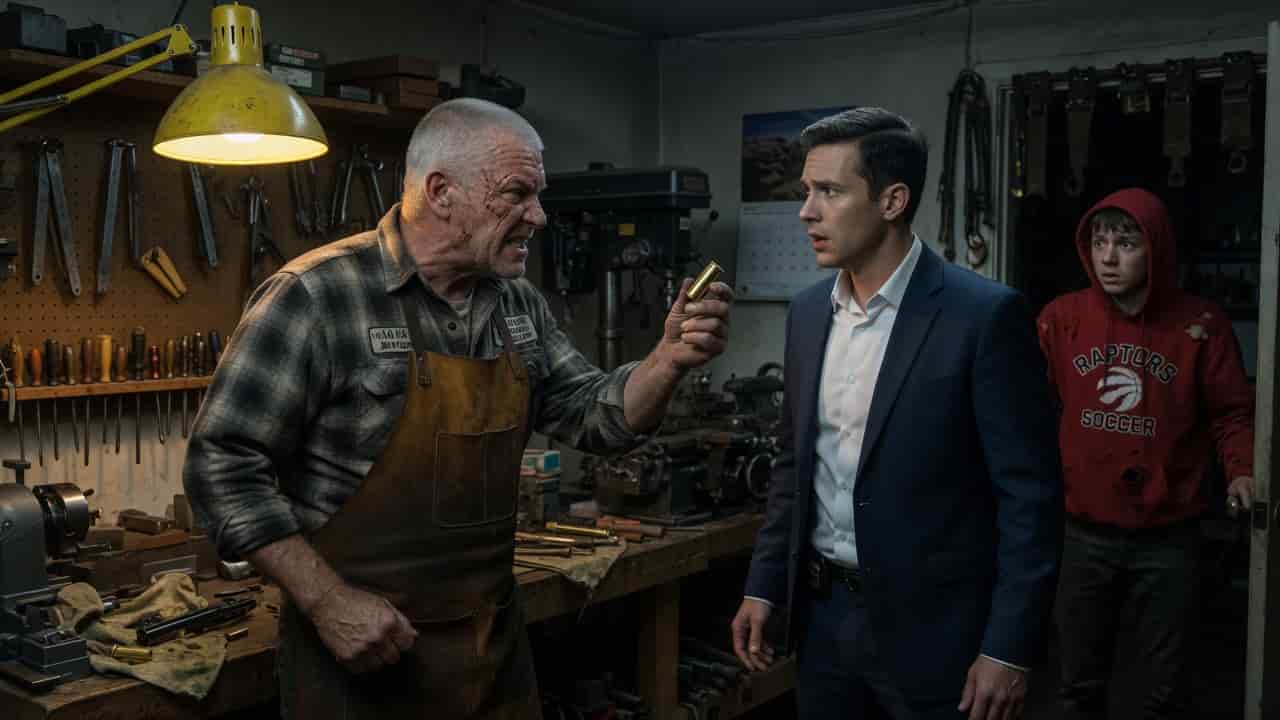
“Look at the stamp on this brass, Caleb. Tell me what you see.”
Silas didn’t shout. He didn’t have to. The air in the workshop was already too thick to breathe. He held the single shell casing—the one he’d pulled from the evidence locker years ago—just inches from the young agent’s face. Caleb, usually so polished in his navy suit, looked like he was about to get sick. He knew that marking. It wasn’t supposed to exist. It was a ghost, a government-only serial number from a shipment that had supposedly been destroyed before it ever reached the street.
“I wasn’t there,” Caleb whispered, his voice cracking. “I was still in the academy when that shipment went missing. I didn’t know they used these.”
Silas stepped closer, his heavy leather apron brushing against the agent’s expensive jacket. In the corner of the room, Silas’s grandson, Leo, watched from the shadows, his face pale with a realization he wasn’t ready for. His grandfather wasn’t just a craftsman; he was a man holding a match to a very large, very high-level fuse.
“You knew enough to come here and tell me my son’s case was closed,” Silas said, his voice a low, jagged blade. “You knew enough to try and buy my silence with a pension increase and a handshake. Now, you’re going to look at the blood on this brass and tell me exactly whose name was on the manifest.”
The room went silent, the only sound the hum of the lathe and the boy’s shallow breathing. The truth was finally out of the box, and there was no way to put it back in.
Chapter 1
The smell of 3-in-One oil and cold steel was the only thing that ever stayed consistent in Silas’s life. It was a heavy, honest scent that didn’t lie. It didn’t make promises it couldn’t keep. It just existed, marking the boundaries of his world. He stood over the South Bend lathe, his hands—thick-fingered and mapped with old scars—moving with a delicacy that most people wouldn’t expect from a man his size. He was truing a barrel for a precision rifle, a task that required him to think in thousandths of an inch. If he missed by the width of a human hair, the bullet would drift. And in Silas’s world, drifting was a failure of character.
“Steady, Leo. Don’t look at the tool. Look at the reflection on the steel,” Silas said, his voice a low gravel.
Beside him, twelve-year-old Leo leaned in, his face tight with concentration. The boy was thin, all elbows and knees, wearing a red hoodie that had seen better days. He was at that age where the world was starting to look complicated, and Silas was trying to give him something simple to hold onto. Something like physics. Something like the Law of the Craftsman.
“It’s vibrating,” Leo whispered, pointing at the tiny ripple in the oil.
“That’s the machine telling you it’s unhappy,” Silas said. He reached over and adjusted the feed rate, his hand covering Leo’s smaller one for a brief second. “You listen to the metal. It’ll tell you when you’re pushing too hard. People lie, Leo. Wood rots. But steel… steel is honest about what it can take before it breaks.”
It was a Tuesday afternoon in Bedford County, Virginia. The sun was slanting through the high, dirt-streaked windows of the workshop, hitting the dust motes that danced over the workbenches. Outside, the gravel driveway was empty, but Silas’s internal clock was already ticking. He knew someone was coming. He’d known since he saw the black SUV pass the mailbox twice that morning.
He’d spent twenty-two years as an ATF field agent, most of it in the deep weeds of undercover arms trafficking. He knew the rhythm of surveillance. He knew the way a man looked when he was trying to appear like he belonged in a place he didn’t.
When the crunch of tires finally came, Silas didn’t stop the lathe. He let the cut finish, the long, curly silver shavings falling into the tray like tinsel. He wiped his hands on his leather apron, a heavy piece of hide that felt like armor.
“Go to the house, Leo,” Silas said, not looking up.
“Is it the man from the bank?” Leo asked, his voice Small.
“No. It’s a man who’s lost his way,” Silas said. “Go. Tell your grandmother to put the kettle on, but don’t come back out until I call you.”
Leo hesitated, his eyes lingering on the door, then he slipped out the back toward the farmhouse. Silas waited until the screen door clicked shut before he turned to face the front.
Caleb stepped into the shop like he was walking onto a stage. He was young, under thirty, wearing a navy suit that cost more than Silas’s first three trucks combined. He had that look of Ivy League ambition tempered by a year or two of Bureau paperwork. He looked like he’d never had grease under his fingernails.
“Mr. Vance,” Caleb said, stopping just past the threshold. He didn’t offer a hand. He knew better.
“Agent Miller,” Silas replied, using the boy’s last name like a challenge. “Or is it ‘Special Agent’ now? I heard they were fast-tracking the ones who know how to use a spreadsheet.”
Caleb’s jaw tightened. He looked around the shop, his eyes lingering on the racks of rifles and the rows of specialized tools. It was a master’s space, and Caleb looked uncomfortable in the presence of so much utility.
“I’m here about the David Vance file,” Caleb said.
Silas felt the name hit him in the center of his chest, a dull, familiar ache that never quite went away. David. His son. The boy who had followed him into the Bureau and paid for it with his life in a warehouse outside of Richmond three years ago.
“That file is closed,” Silas said, his voice dropping an octave. “That’s what your Director told me at the funeral. He said the shooters were gone, the guns were gone, and the investigation was a dead end. He told me to go home and be a grandfather.”
“Things change, Silas,” Caleb said, stepping further into the light. He looked genuinely troubled, which was the first honest thing Silas had seen about him. “Some of the inventory from that sting—the one David was on—it’s turning up. We found a cache in DC. Ghost guns. But they aren’t exactly ghosts.”
Silas walked over to a velvet-lined box on his workbench. He picked up a small brass object and held it up to the light. It was a shell casing, polished to a mirror shine.
“You know what this is, Caleb?” Silas asked.
“It’s a .300 Blackout casing,” Caleb said, trying to regain his professional footing.
“It’s more than that,” Silas said, stepping toward him. “It’s a witness. I found this in the body of my son. The coroner missed it. The forensics team missed it. But I didn’t. I’m a gunsmith, Caleb. I know how a firing pin strikes. I know the signature of a chamber.”
He thrust the casing toward Caleb’s face. The young agent flinched, his eyes darting down to the brass.
“Look at the headstamp,” Silas commanded.
Caleb leaned in, squinting. His face went through a rapid series of changes—confusion, realization, and then a creeping, grey terror. The stamp wasn’t a standard manufacturer’s mark. It was a series of four digits and a star. A government manifest code.
“This came from the ‘lost’ inventory, Caleb,” Silas said, his voice vibrating with a decade of suppressed rage. “This bullet was manufactured in a federal facility. It was shipped to an ATF evidence locker. And then it was fired into my son’s heart by a gun your Director said didn’t exist.”
Caleb backed away, his heel catching on a stray piece of scrap metal. He hit the edge of the lathe, his hands coming up in a frantic, useless gesture.
“Silas, listen to me,” Caleb stammered. “If you have this… if you’ve been holding onto this, you’re in danger. The Director is looking for the leaks. He knows someone kept a piece of the puzzle.”
“I’m not holding a piece of the puzzle, son,” Silas said, his eyes burning into Caleb’s. “I’m holding the whole damn picture. And you’re going to tell me exactly who signed the release for that shipment, or I’m going to walk into that Congressional hearing next week and make sure the world sees what a ‘ghost’ looks like when it’s covered in a hero’s blood.”
Caleb looked at the door, then back at Silas. He looked like a man who had realized he was standing in a room full of high explosives with a man who wasn’t afraid to strike a spark.
“They’ll kill you, Silas,” Caleb whispered.
“They already did,” Silas said, turning back to his workbench. “They just haven’t realized I’m still standing. Now, get out of my shop. And tell Miller that the Gunsmith has a new project. Tell him I’m building something he’s going to remember for the rest of his very short career.”
Chapter 2
The night in the Virginia foothills didn’t just fall; it settled in like a heavy blanket. Silas sat on his back porch, the screen door slightly ajar so he could hear his wife, Martha, humming in the kitchen. She was making stew, the scent of carrots and seared beef drifting through the air. It was a normal sound, a normal smell, but it felt like a thin veil over a gaping wound.
He held a glass of rye whiskey in his hand, the ice long since melted. On the small table beside him sat the velvet-lined box. Inside, the shell casing rested like a dormant insect.
He thought about David. David had been the best of them. He had Silas’s hands but his mother’s heart. When he’d joined the Bureau, Silas had tried to talk him out of it. He’d seen too much—the way the politics of the top floors always filtered down to the blood on the pavement. But David wanted to make a difference. He wanted to be the man who stopped the flow of iron into the cities.
The “ghost gun” sting, codenamed Operation Silver Shroud, was supposed to be the jewel in Director Miller’s crown. The plan was to flood the market with untraceable weapons, track them to the big cartels, and then swoop in for the headlines. But the tracking failed. The “ghosts” disappeared into the system, and one of them ended up in a warehouse in Richmond where David was working deep undercover.
The official report said it was a tragic accident—a deal gone wrong, a nervous shooter. But Silas had seen the bodies. He’d seen the way the scene had been scrubbed. And he’d seen the Director’s face at the funeral—eyes as cold as river stones, offering a folded flag and a scripted apology.
The sound of the screen door opening broke his reverie. Martha stepped out, wrapping a knit shawl around her shoulders. She was a small woman, but she held the house together with a strength Silas still didn’t fully understand.
“The boy’s asleep,” she said, leaning against the railing. “He’s worried about you, Silas. He says you were talking to a man in a suit today.”
“Just Bureau business, Martha,” Silas said, his voice softening. “Nothing for him to worry about.”
“Don’t lie to me,” she said, her voice quiet but firm. “I know that look. You’ve had it for three years. It’s the look you get when you’re trying to fix something that’s too broken to save.”
She walked over and put her hand on his shoulder. Her fingers were warm, a stark contrast to the cold glass in his hand.
“He’s gone, Silas,” she whispered. “David’s gone. And no amount of steel or brass is going to bring him back. Leo needs a grandfather, not a soldier.”
“I’m doing this for Leo,” Silas said, looking out into the dark woods. “If I let this go, then the world Leo grows up in is one where men like Miller get to decide who lives and who dies based on a budget report. I can’t let that be the legacy.”
“Miller is a powerful man,” Martha said. “He has friends in places we can’t even name. You’re just one man in a workshop.”
“I’m a man who knows how things are made,” Silas said. “And I know how they come apart.”
He thought back to his meeting with the old gun shop owner, Saul, earlier that day. Saul was a relic, a man who had been selling firearms in the valley since the sixties. He knew every serial number, every back-alley deal, and every rumor that floated through the trade.
“You’re digging in a graveyard, Silas,” Saul had told him, his breath smelling of peppermint and tobacco. “Those guns? They weren’t just lost. They were sold. Miller needed the black-bag money to fund his transition into the private sector. He’s got a seat waiting for him at a defense firm that’ll make him a billionaire. You go after him, you’re not just hitting a man. You’re hitting a machine.”
“Machines have gears, Saul,” Silas had replied. “And gears can be jammed.”
Silas took a sip of his watered-down whiskey. The pressure was mounting. He knew the ATF would be back. They wouldn’t just let him sit on the casing. They’d try to find a way to discredit him, or worse.
The phone on the table vibrated. It was a restricted number. Silas let it ring three times before he picked it up.
“Vance,” he said.
“You’re a hard man to reach, Silas.” The voice was smooth, cultured, and utterly devoid of empathy. Director Miller.
“I’m easy to find, Arthur,” Silas said. “I’m exactly where you left me. In the dirt you kicked over my son.”
“Let’s not be melodramatic,” Miller said. “We both know the risks of the job. David was a hero. He knew what he was signing up for.”
“He didn’t sign up to be a target for your side-hustle,” Silas said. “I have the brass, Arthur. I have the manifest codes. I know you sold those guns to the Vipers.”
There was a long silence on the other end of the line. Silas could almost hear the gears turning in Miller’s head, calculating the risk, the fallout, the cost of a cleanup.
“That casing is a fantasy, Silas,” Miller finally said, his tone turning icy. “It’s a piece of scrap metal found by a grieving father who’s lost his grip on reality. If you try to bring that into a hearing, we will destroy you. We’ll look into your own record. All those years undercover? I’m sure we can find enough ‘irregularities’ to put you in a cage for the rest of your life.”
“Then you’d better start looking,” Silas said. “Because I’m not coming for a cage. I’m coming for the whole damn building.”
He hung up and stared at the phone. He felt a strange sense of peace. The war was no longer in the shadows. It was in the room.
He looked back at the house. Through the window, he could see Leo’s room, the light of a small desk lamp still burning. The boy was probably reading one of Silas’s old manuals on ballistics. He was a smart kid. Too smart for his own good.
Silas stood up and walked into the workshop. He didn’t turn on the main lights. He navigated by memory and the faint glow of the moon. He reached under his main workbench and pulled a hidden lever. A small section of the floorboards shifted.
Inside was a long, padded case. He pulled it out and laid it on the bench. He opened the latches with a series of rhythmic clicks.
Inside lay a rifle like no other. It was a masterpiece of engineering—sleek, matte-black, and perfectly balanced. It had no serial numbers, no manufacturer’s marks. It was a “perfect” rifle, built from scratch using specialized alloys and a custom-rifled barrel. Silas had built it over the last two years, a project born of grief and technical obsession.
It was a ghost gun. But unlike Miller’s cheap, mass-produced junk, this one was a scalpel.
He ran his hand over the cold metal of the receiver. This was the contradiction he lived with. He hated what Miller had done with the ghosts, yet he had built his own. He told himself it was for protection. He told himself it was his insurance policy. But deep down, he knew it was a temptation.
He wasn’t just a gunsmith. He was a man who knew how to balance a scale. And the scale was currently tipped way too far in Miller’s favor.
Chapter 3
The next morning, the fog was so thick it swallowed the oak trees at the edge of the property. Silas was back in the shop, the smell of fresh coffee competing with the metallic tang of the lathe. He was working on a simple repair—a broken sear on a local farmer’s shotgun—but his mind was miles away, in the marble hallways of D.C.
A shadow crossed the doorway. It wasn’t the heavy, purposeful stride of an agent. It was lighter, hesitant.
“Mr. Vance?”
It was Caleb. The young agent was dressed in jeans and a thermal shirt, looking less like a Bureau shark and more like the kid he actually was. He looked like he hadn’t slept in forty-eight hours. His eyes were bloodshot, and his hands were tucked deep into his pockets.
“I told you to get off my land,” Silas said, not looking up from the shotgun.
“I’m not here as an agent,” Caleb said, stepping inside. He looked over his shoulder at the driveway. “I’m here because I looked at the file. The real one. The one Miller kept on a private server.”
Silas stopped what he was doing and looked at him. The shotgun sat disassembled on the bench, a mess of springs and pins.
“And?”
“You were right,” Caleb said, his voice barely a whisper. “The Silver Shroud shipment wasn’t lost. It was diverted. Three hundred units. They went to a middleman in Newport News, and from there, they were sold to the cartels. The money… it didn’t go into a black fund. It went into a shell company owned by Miller’s brother-in-law.”
Silas felt a cold, sharp satisfaction. It wasn’t just a hunch anymore. It was a fact. But facts without leverage were just stories.
“Why are you telling me this, Caleb?” Silas asked. “You’re throwing away your career. You’re probably throwing away your life.”
“Because I grew up in a town where people like you were the heroes,” Caleb said, his voice gaining a bit of strength. “My dad was a deputy. He died in a traffic stop because some kid had a gun he shouldn’t have had. I joined the ATF to stop that. Not to be a salesman for the people doing the shooting.”
Silas studied the boy. He saw the struggle in his face—the conflict between loyalty to the badge and loyalty to the truth. It was the same struggle David had faced.
“Miller is moving fast,” Caleb continued. “He knows I came here. He’s already started the process to flag you as a ‘domestic threat.’ They’re going to raid this place, Silas. They’re going to look for the casing, and they’re going to plant enough evidence to make you look like a crazed militia leader.”
“When?” Silas asked, his voice calm.
“Soon. Maybe today. They’re waiting for the warrant to clear a friendly judge.”
Silas nodded. He’d seen this play before. The Bureau didn’t just arrest you; they erased you. They turned you into a caricature that the public would be happy to see locked away.
“I need a witness,” Silas said. “Someone who isn’t me. Someone who isn’t a scared kid in a suit.”
“Who?”
“Hank,” Silas said.
An hour later, a rusted Ford F-150 pulled into the driveway. A man climbed out who looked like he’d been carved out of a piece of old hickory. Hank was seventy, a retired Marine sniper who had served with Silas in the early days of the Bureau’s tactical teams. He had a limp and a missing finger, but his eyes were as sharp as a hawk’s.
“Silas,” Hank said, nodding to Caleb with a look of pure suspicion. “You’re keeping strange company these days.”
“He’s got the keys to the kingdom, Hank,” Silas said. “But the king is trying to burn the palace down.”
They sat in the back of the shop, the three of them, around a small wooden table. Silas laid out the casing and the information Caleb had brought.
“It’s a suicide mission,” Hank said, lighting a cigarette despite Silas’s ‘No Smoking’ sign. “You walk into that hearing with this, Miller’s people will have you picked off before you reach the microphone. Or they’ll just say the evidence is tainted.”
“Not if the evidence is already in the hands of the press,” Silas said.
“The press is scared of the Bureau,” Caleb interrupted. “Miller has friends at the big networks. He can kill a story before it even gets to the editor.”
“Not all stories,” Silas said. He looked at Caleb. “You said the money went to a shell company. Do you have the account numbers?”
“I have the routing numbers for the first three transfers,” Caleb said. “But they’re encrypted.”
“I know a man in Baltimore who can handle encryption,” Hank said, a slow grin spreading across his face. “An old crypto-guy from the Agency who owes me a very large favor. If we can link that money directly to Miller’s accounts, it doesn’t matter what he says about the guns. The money is the anchor that’ll drown him.”
Suddenly, the sound of a heavy engine rumbled from the driveway. Not an SUV. A truck. A big, armored van.
“They’re here,” Caleb said, his face going pale. “They’re early.”
Silas stood up, his hand instinctively going to the heavy wrench on his workbench. He looked at Hank, who was already reaching for a concealed pistol.
“No shooting,” Silas said firmly. “If we fire a shot, they win. They’ll call it a shootout with a terrorist. We play this by the book. My book.”
He turned to Caleb. “Go out the back. Take the casing. If they find it on me, it’s gone forever. You get it to Hank’s guy. You don’t stop, you don’t call anyone, and you don’t look back.”
“What about you?” Caleb asked.
“I’m going to give them a show,” Silas said.
He walked to the front door of the shop and opened it wide. Two black armored vans had pulled into the gravel. Men in tactical gear, carrying short-barreled rifles, were spilling out, forming a perimeter. At the head of the group was a man Silas recognized—Special Agent Vance, no relation, a man who had earned the nickname ‘The Eraser’ for his work in the Internal Affairs division.
“Silas Vance!” the man shouted through a megaphone. “We have a federal warrant for the search and seizure of this property. Step away from the door with your hands visible!”
Silas didn’t move. He stood in the doorway, his leather apron stained and his shoulders broad. Behind him, he could hear the faint sound of Caleb and Hank slipping through the woods.
“You’re on private property, Agent!” Silas shouted back. “I suggest you show me that warrant before you scuff my gravel.”
The agents moved in, a wall of black nylon and cold steel. This was the humiliation Silas knew was coming. They weren’t just here for the evidence. They were here to break him in front of his neighbors, in front of his family.
He saw Leo standing on the porch of the farmhouse, his small hands gripped into fists. Martha was right behind him, her face a mask of frozen terror.
The lead agent reached Silas and shoved him back into the shop. Silas didn’t resist. He let himself be pushed, his back hitting the lathe.
“Search everything!” the agent barked. “If it’s made of metal, I want it checked. If it’s got a serial number, run it. And find that casing.”
The agents began to tear the shop apart. They knocked over the racks of rifles, the wood splintering on the concrete floor. They swiped the delicate measuring tools off the workbenches, the precision instruments clattering like trash. They dumped the jars of pins and springs, thousands of tiny pieces of Silas’s life scattering into the oil and dust.
Silas watched, his face expressionless, though every crash felt like a blow to his ribs. They were destroying thirty years of craftsmanship in thirty seconds.
“Where is it, Silas?” the lead agent asked, leaning in close. He smelled of peppermint and gun oil. “We know you have it. Don’t make this harder on your family than it already is.”
He pointed out the door at Leo. One of the agents was standing near the porch, his rifle held at a low ready. The boy was shaking, his eyes fixed on Silas.
“I don’t know what you’re talking about,” Silas said, his voice steady. “I’m just a gunsmith. I fix things that are broken.”
“We’ll see about that,” the agent said. He turned to his men. “Check the floorboards. Check the rafters. If you have to tear this building down to the studs, do it.”
Silas stood there, a prisoner in his own temple, while the men in black moved through his life like a locust swarm. He looked at the floor, at the silver shavings of the rifle barrel he’d been truing only yesterday. They were being crushed under the heavy boots of the agents.
But Silas wasn’t thinking about the tools. He was thinking about the brass casing currently moving through the woods in the pocket of a young man who had finally found his way.
The humiliation was real. The damage was done. But the fire was just getting started.
Chapter 4
The raid lasted six hours. By the time the black vans pulled out of the driveway, the sun was dipping below the ridge, casting long, bloody shadows across the yard. Silas stood in the center of his workshop, surrounded by the wreckage of his life.
The lathes had been overturned. The workbenches were scarred by pry bars. His collection of vintage gunsmithing manuals—books he’d studied for decades—lay in a heap in the corner, some of them torn, others soaked in spilled solvent.
But the worst part was the silence. The hum of the shop, the heartbeat of his daily existence, was gone.
Martha and Leo walked into the shop. Leo was crying silently, his small shoulders shaking. Martha looked around at the destruction, her eyes hard and dry. She walked over to Silas and took his hand. It was cold and covered in a fine layer of dust.
“They didn’t find it,” she whispered.
“No,” Silas said. “They didn’t find it.”
“They took your tools, Silas,” Leo sobbed, looking at the empty racks. “They took everything.”
Silas knelt down so he was eye-level with the boy. He placed a hand on Leo’s shoulder. The boy flinched at first, then leaned into the touch.
“Listen to me, Leo,” Silas said, his voice low and firm. “They took the steel. They took the wood. But they can’t take the knowledge. They can’t take the code. A man isn’t defined by what he owns. He’s defined by what he stands for when everything else is gone.”
“But how are you going to work?” Leo asked.
“We’ll rebuild,” Silas said. “But first, we have to finish the job.”
He stood up and looked at Martha. “I have to go to D.C. The hearing is in three days. Hank is meeting me at the safe house in Manassas.”
“You can’t go alone,” Martha said. “They’ll be watching the roads. They’ll have your face at every checkpoint.”
“I’m not going as Silas Vance,” he said.
He walked over to the corner of the shop, where a heavy iron stove sat. He reached behind it and pulled a small, weather-beaten leather bag from a hidden recess. Inside was a set of documents—a driver’s license, a passport, and a credit card in the name of Thomas Miller. No relation to the Director, just a generic name Silas had set up years ago as an undercover contingency.
He also pulled out a small, high-frequency radio. He keyed it twice.
“The shop is closed,” Silas said into the mic.
“Copy that,” a voice crackled back. Hank. “The package is in transit. The crypto-guy says the routing numbers are a gold mine. We’ve got links to three offshore accounts in the Cayman Islands. All of them connected to the Director’s private foundation.”
“Keep moving,” Silas said. “I’ll see you at the rally point.”
He turned back to his family. The weight of what he was about to do pressed down on him. He was leaving behind the only things that mattered to him to face a man who had forgotten the meaning of the word ‘honor.’
“I’ll be back,” Silas said, though he wasn’t sure if it was a promise he could keep.
“You’d better be,” Martha said, pulling him into a brief, fierce embrace. “Because if you’re not, I’m going to come to D.C. and finish it myself.”
Silas managed a small, tired smile. He kissed her forehead, then patted Leo on the head. He didn’t look back as he walked out to his old truck—the one he’d parked in the woods behind the barn two days ago.
The drive to Manassas was a blur of backroads and adrenaline. He stayed off the main highways, weaving through the small towns of the Shenandoah Valley. He saw several state trooper cars, but none of them pulled him over. The ‘Thomas Miller’ identity held.
He reached the safe house—a nondescript suburban rancher—just before midnight. Hank was waiting in the garage, his F-150 tucked away behind a stack of old tires. Caleb was there, too, sitting on a milk crate, staring at a laptop screen.
“We’ve got him, Silas,” Caleb said, his voice vibrating with excitement. “The money trail is direct. Miller wasn’t just selling guns; he was selling intel. He was providing the Vipers with the locations of other ATF stings so they could hijack the shipments. Your son wasn’t just collateral damage. He was a witness to a hijacking.”
Silas felt a wave of nausea. It was worse than he’d thought. His son hadn’t just died in a botched operation; he’d been betrayed by his own commander.
“How do we get into the hearing?” Silas asked. “The security will be airtight. Miller’s personal security detail is handling the perimeter.”
“We don’t go through the front door,” Hank said, laying out a map of the Rayburn House Office Building. “There’s a service tunnel that connects to the heating plant. It’s old, it’s dirty, and nobody’s checked the sensors in five years. I’ve got a friend in maintenance who can get us the keycards.”
“And then?”
“Then you walk into that room,” Hank said. “But you’re going to need more than just a shell casing and a laptop. You need to make sure he can’t lie his way out of it.”
“I have the rifle,” Silas said quietly.
Hank and Caleb both looked at him. The silence in the garage was heavy.
“The ghost gun?” Caleb asked. “Silas, if you bring that into the building, they’ll shoot you on sight.”
“I’m not going to use it,” Silas said. “I’m going to show it. I’m going to show the committee what a real ghost looks like. I’m going to show them the weapon that shouldn’t exist, built by a man who shouldn’t have known how. It’s the ultimate proof of his failure.”
“It’s a gamble,” Hank said. “A big one.”
“It’s the only hand I have left,” Silas said.
He spent the next two days in the safe house, prepping. He disassembled the ghost rifle and hid the components inside a specialized technician’s toolkit. He practiced the route through the tunnels until he could do it blindfolded.
The night before the hearing, he sat alone in the small living room. He thought about the residue of the last three years—the empty chair at Thanksgiving, the way Martha’s laughter had become a rare thing, the way Leo looked at him like he was a stranger.
He realized that even if he won, things would never go back to the way they were. The shop was a wreck. His reputation would be forever linked to a scandal. But as he looked at the components of the rifle spread out on the coffee table, he felt a strange sense of clarity.
He was a gunsmith. He was meant to fix things. And the system was the biggest broken machine he’d ever encountered.
The morning of the hearing was grey and drizzly. D.C. was a sea of umbrellas and dark suits. Silas, dressed in a grey jumpsuit and carrying a heavy toolbox, walked toward the service entrance of the heating plant.
He saw the news crews gathered near the main entrance, their cameras pointed at the sleek black limousines as they arrived. He saw Director Miller step out of one of them, looking confident and statesman-like in a charcoal suit. He was smiling for the cameras, waving to the crowd.
Silas felt a surge of cold fury. Enjoy the sun while it lasts, Arthur, he thought. Because the ghost is coming for you.
He swiped the keycard Hank had provided. The heavy steel door clicked open. He stepped into the darkness of the tunnel, the smell of damp concrete and old steam rising to meet him.
He moved quickly, his boots echoing in the narrow space. He reached the junction that led to the Rayburn building. He could hear the muffled sound of voices above him—the hum of a city that had no idea what was about to happen.
He climbed the final ladder and pushed open a small access hatch. He was in a storage closet just behind the main hearing room. He could hear the gavel banging.
“The Committee on Oversight and Reform will come to order,” a voice boomed through the wall.
Silas took a deep breath. He opened the toolkit and began to reassemble the rifle. His hands moved with the same precision they had in the workshop. Click. Snap. Slide. In less than a minute, the ghost gun was whole.
He tucked it under his arm, covered by a heavy canvas sheet. He adjusted the brass casing in his pocket.
He walked to the door of the hearing room and paused. He could hear Miller’s voice—smooth, lying, and perfectly controlled.
“…and I want to assure the American people that the ATF remains committed to the highest standards of transparency and accountability. Operation Silver Shroud was a complex endeavor, and while there were challenges, we have learned from them…”
Silas pushed the door open.
The room was packed. Legislators sat on the high dais, their faces illuminated by the bright TV lights. The press gallery was a sea of clicking shutters. And there, at the witness table, was Arthur Miller.
The room went silent as Silas walked down the center aisle. He wasn’t running. He wasn’t shouting. He was just walking, a heavy-set man in a work jumpsuit, carrying a canvas-wrapped object.
Security guards moved toward him, their hands on their holsters.
“Stop right there!” one shouted.
Silas didn’t stop. He walked right up to the witness table and stood beside Director Miller. He reached into his pocket and pulled out the brass shell casing. He slammed it down on the mahogany table with a sound like a gunshot.
“This came from your ‘lost’ inventory, Director,” Silas said, his voice carrying to every corner of the room. “My son’s blood is still on it. And I have the routing numbers for the offshore accounts where you stashed the profit.”
The room exploded into chaos. The guards lunged for him, but Silas was faster. He pulled the canvas sheet away, revealing the matte-black ghost rifle. He didn’t point it at anyone. He held it up high, for the cameras, for the world, for Leo.
“And this,” Silas shouted over the noise. “This is what happens when you tell a craftsman that his son is acceptable collateral damage. You get a ghost that won’t stay buried.”
Miller’s face went from pale to a sickly, grey ash. He looked at the rifle, then at the shell casing, and finally at Silas. For the first time, the Director’s eyes weren’t like stones. They were full of the realization that his machine had finally met a jam it couldn’t overcome.
Silas stood his ground as the guards tackled him, the cold steel of the rifle pressing against his chest. He saw the flash of the cameras, the shocked faces of the committee members, and the crumbling mask of the man who had destroyed his life.
He had earned his residue. And now, the world would have to live with the fallout.
Chapter 5
The floor of the hearing room was cold, the kind of institutional marble that had been polished by a century of ambitious men until it was as slick as ice. Silas felt the weight of three security guards on his back, their knees digging into his kidneys, their gloved hands twisting his wrists into the biting grip of zip-ties. His face was pressed against the stone, the scent of floor wax and old dust filling his lungs. But he didn’t struggle. He didn’t scream. He simply watched Director Miller’s shoes—polished oxfords that cost more than Silas’s first truck—as they retreated toward the back exit.
The chaos was a dull roar above him. Shouting, the rhythmic clicking of cameras, the frantic barking of orders into radios. It was the sound of a carefully constructed machine suddenly throwing a rod.
“Subject is secured! Get the weapon! Get the weapon out of here!”
The ghost rifle was snatched away, handled like a live grenade. Silas felt a strange sense of relief as it left his side. It had done its job. It wasn’t a weapon of war anymore; it was a piece of evidence that couldn’t be scrubbed, a physical manifestation of a lie that had finally outgrown its box.
They hauled him up, dragging him through a side door and into a windowless holding room beneath the Rayburn building. The room smelled of ozone and stale coffee. They shoved him into a bolted-down chair and left him there, the zip-ties cutting into his skin, the silence of the room a sharp contrast to the madness he’d just ignited.
He waited. He knew how this worked. They would check his background, find the ‘Thomas Miller’ alias, and realize they were dealing with a ghost of their own making.
An hour passed before the door opened. It wasn’t a guard. It was Director Miller, accompanied by two men in suits who looked like they’d been manufactured in the same factory as the oxfords. Miller looked older than he had on the dais. The TV lights had been kind to him; the fluorescent hum of the holding room was not. His skin was the color of damp newsprint, and there was a slight tremor in his hand as he adjusted his tie.
“You’re a dead man, Silas,” Miller said, his voice a low, jagged whisper. He didn’t sit down. He stood over Silas, trying to reclaim the height advantage he’d lost the moment the shell casing hit the table.
“I’ve been dead for three years, Arthur,” Silas said, his voice steady. “You just didn’t have the decency to bury the rest of me. How’s the hearing going? I imagine the committee has a few new questions about those Cayman accounts.”
Miller’s jaw tightened. “Those accounts are a fabrication. A hack. We’ve already traced the digital footprint back to a known domestic extremist group. By tomorrow morning, the narrative won’t be about guns or money. It’ll be about an unstable former agent who walked into a federal building with an illegal firearm.”
“You can spin the money,” Silas said, leaning back as much as the chair would allow. “You can even spin the rifle. But you can’t spin the brass. That casing has the manifest stamp from the 2023 Silver Shroud shipment. The one you testified under oath was destroyed in the Newport News fire. Forensics doesn’t care about your narrative, Arthur. Neither does the DOJ Inspector General.”
“The IG is a friend of mine,” Miller snapped.
“Everyone’s a friend until the subpoena arrives,” Silas replied. “Then they’re just people looking for an exit.”
Miller leaned in, his face inches from Silas’s. He smelled of expensive cologne and the sour tang of panic. “You think you’re a hero? You’re a footnote. We’ll bury you in a black site before the sun goes down. Your wife, that boy… they’ll be lucky if they ever see a pension check again.”
Silas felt a surge of heat in his gut, but he kept his face like granite. He thought about Leo standing on the porch, watching the tools being tossed into the dirt. He thought about the ‘Law of the Craftsman.’
“You keep talking about burying things,” Silas said. “But that’s the problem with being a salesman instead of a builder, Arthur. You don’t understand how foundations work. You build on top of a lie, and the whole structure is compromised. I didn’t just walk into that room with a rifle. I walked in with the truth, and once that’s in the air, you can’t vacuum it back out.”
The door opened again, and a woman in a dark charcoal suit stepped in. She was younger, with sharp eyes and a legal pad tucked under her arm. Silas recognized her—Assistant U.S. Attorney Sarah Jenkins. She was known for being a shark, the kind of prosecutor who didn’t care about political friendships.
“Director,” she said, her voice clipped. “We need the room. Now.”
“This is a Bureau matter, Sarah,” Miller said, not turning around.
“It’s a federal crime involving a discharge-threat in a Congressional building,” she said, her eyes fixed on Silas. “And more importantly, it’s a matter of the evidence currently being uploaded to the DOJ secure server by a Special Agent Caleb Miller. Who, I believe, is currently sitting in my office with a very detailed deposition.”
Miller froze. The name hit him like a physical blow. He turned slowly, his face sagging.
“Caleb?” Miller whispered.
“He didn’t just have the accounts, Director,” Jenkins said, her voice devoid of pity. “He had the recorded calls. Turns out, he’s been wearing a wire for the last forty-eight hours. Every conversation you had about ‘cleaning up’ the Vance problem? It’s all on tape.”
She looked at Silas, a flicker of something—respect, maybe, or just curiosity—crossing her face. “Mr. Vance, we’re going to move you to a secure facility. Not for punishment, but for protection. Things are about to get very loud, and I’d prefer you were alive to testify.”
As they led Silas out, he passed Miller. The Director was slumped against the wall, his polished shoes scuffing the floor. He looked small. He looked like a piece of metal that had finally reached its fatigue point and snapped.
The drive to the safe house was long. Silas sat in the back of a black Suburban, his hands finally free of the zip-ties. He watched the D.C. skyline recede in the rearview mirror. The monuments looked like headstones in the grey afternoon light.
He thought about the residue. He’d won, but the cost was already visible. His shop was a wreck. His name was being dragged through the mud on every news channel. And somewhere back in Virginia, his grandson was waiting for a man who might never be the same.
He reached into his pocket and found a small, jagged piece of metal—a shaving from the rifle barrel he’d been working on. He rolled it between his thumb and forefinger. It was sharp, honest, and real.
The machine was broken. Now came the hard part: living with the pieces.
The safe house was a converted farmhouse in Maryland, surrounded by cornfields and federal agents. It was a quiet place, but Silas couldn’t sleep. Every time he closed his eyes, he heard the gavel. He heard the sound of the rifle being snatched away. He heard the silence of his son’s grave.
Caleb arrived the next morning. He looked exhausted, his suit rumpled, his eyes shadowed with the weight of what he’d done. He sat across from Silas on the back porch, a cup of lukewarm coffee in his hands.
“He’s done, Silas,” Caleb said. “The board of directors at the firm he was joining? They’ve already rescinded the offer. The DOJ is preparing the indictment for arms trafficking, money laundering, and obstruction of justice. They’re calling it the ‘Ghost Scandal.’”
“And you?” Silas asked.
“I’m out,” Caleb said, a small, sad smile touching his lips. “Internal Affairs is going through my files. They’ll probably give me a medal and a forced resignation. You can’t betray the Director and keep a desk in that building, even if he was a crook.”
“You did the right thing, son,” Silas said.
“I did the only thing I could,” Caleb replied. “I saw the manifest. I saw David’s name. I couldn’t unsee it.”
They sat in silence for a long time, watching the wind ripple through the corn. It was a peaceful scene, but both of them knew the peace was a thin layer over a deep, dark well.
“What happens now?” Caleb asked.
“Now,” Silas said, standing up, “I go home. I fix my shop. And I teach my grandson that the most important thing you can ever build isn’t a rifle. It’s a life that can stand up to the truth.”
But as he looked at his hands—hands that had spent a lifetime working with the tools of violence—he wondered if he still knew how to do that. He felt the weight of the last three years pressing down on him, a heavy, cold residue that no amount of solvent could wash away.
He was a master gunsmith. He knew how to take things apart. He knew how to put them back together. But some things, once broken, stayed broken. And as he thought about David, he realized that the biggest ghost in the room wasn’t the rifle or the shipment. It was the man he used to be, before the world told him his son was acceptable collateral damage.
He walked inside and picked up the phone. It was time to call Martha. It was time to tell her that the war was over, even if the peace felt like a battlefield of its own.
Chapter 6
The drive back to Bedford County felt longer than the trip to D.C. The air changed as he crossed the Blue Ridge, turning from the heavy, humid heat of the capital to the crisp, pine-scented breeze of the mountains. Silas drove his old truck, the one he’d hidden in the woods, the engine humming a low, steady rhythm that felt like a heartbeat.
He didn’t have the rifle. He didn’t have the casing. He didn’t even have his old toolkit. All he had was the clothes on his back and the ‘Thomas Miller’ ID in his pocket—a ghost identity for a man who was finally stepping back into the light.
When he turned into the gravel driveway, he stopped the truck and just sat there. The workshop looked different in the late afternoon sun. The door was still hanging slightly crooked from where the agents had shoved their way in. The windows were still streaked with dirt. But it was his.
He saw Leo sitting on the porch steps, whittling a piece of cedar with a small pocketknife Silas had given him for his tenth birthday. The boy looked up, his eyes widening, the knife pausing mid-stroke.
Silas climbed out of the truck. His knees popped, and his back ached with a deep, bone-weary fatigue. He felt older than sixty-five. He felt like a man who had walked a thousand miles through a desert only to find the well was dry.
“Grandpa?” Leo whispered, standing up.
“I’m home, Leo,” Silas said.
The boy didn’t run. He walked slowly down the steps, his face a mix of relief and fear. He looked at Silas’s hands, then at his face, searching for something.
“Did you fix it?” Leo asked.
Silas looked at the workshop, then back at the boy. “I fixed the part that was broken, Leo. But the shop… the shop’s going to take some work.”
Martha stepped out onto the porch then. She didn’t say a word. She just stood there, her hands folded over her apron, watching him. There was no joy in her face, only a quiet, profound relief that looked a lot like exhaustion. She knew the cost better than anyone. She knew that every headline in D.C. was a chip taken out of their lives.
Silas walked up to the porch and stood before her. He smelled of wood smoke and the road.
“It’s over, Martha,” he said.
“I know,” she replied. “I saw it on the news. They’re saying the Director is going to prison. They’re calling you a whistleblower.”
“I’m a gunsmith,” Silas said, his voice cracking slightly. “I just wanted the truth to have a serial number.”
She stepped forward and leaned her head against his chest. Silas wrapped his arms around her, feeling the familiar strength of her, the way she anchored him to the earth. For a moment, the world was just the two of them and the quiet hum of the mountain.
The next morning, Silas walked into the workshop. It was worse than he remembered. The smell of spilled solvent was overpowering, and the sight of his overturned lathes felt like a personal violation. He spent the first three hours just picking up the pieces—the thousands of tiny pins, springs, and screws that had been dumped like trash.
He was kneeling on the floor, sorting through a jar of trigger springs, when a shadow fell across the doorway.
It was Saul, the old gun shop owner. He was carrying a heavy wooden crate, his face twisted into a grimace of effort.
“Heard you were back,” Saul said, grunting as he set the crate down on the one workbench that hadn’t been smashed. “Heard you made quite a mess in the big city.”
“I did what I had to do, Saul,” Silas said, standing up and wiping his hands on his trousers.
“Well,” Saul said, gesturing to the crate. “I figured you’d be short on supplies. The Bureau usually isn’t very careful with their ‘search and seizure.’ I brought you some files, some fresh oil, and a set of micrometers. Good ones. Starrett.”
Silas looked at the crate. It was a peace offering, a sign that the world hadn’t completely turned its back on him.
“Thanks, Saul,” Silas said.
“Don’t thank me,” Saul replied, turning to leave. “Just get back to work. There’s a lot of broken things in this valley that need a man who knows how to listen to the metal. And Silas…”
“Yeah?”
“David would have been proud. He was a good agent, but he was a better son. You made sure the world knew that.”
Saul left, his truck kicking up dust as he drove away. Silas stood alone in the wreckage, the silence of the shop feeling a little less heavy.
Leo walked in a few minutes later, carrying a broom. He didn’t ask questions. He just started sweeping the brass shavings into a neat pile. They worked in silence for hours, a grandfather and a grandson, slowly reclaiming the space from the chaos.
“Grandpa?” Leo said, stopping near the lathe. “Are you going to build another one? Another ghost gun?”
Silas stopped what he was doing. He looked at the boy, at the honest, curious face of the next generation. He thought about the matte-black rifle, the perfection of its engineering, and the poison of its purpose.
“No, Leo,” Silas said, his voice firm. “I’m done with ghosts. A ghost is something that hides in the dark because it’s afraid of the light. From now on, everything that comes out of this shop is going to have a name. It’s going to have a history. And it’s going to be built for a world that doesn’t need to hide.”
He walked over to the lathe—the one he’d adjusted for Leo just a few days ago. He picked up a piece of raw steel, a solid, heavy bar that hadn’t yet been shaped by anything but the forge.
“Come here,” Silas said.
Leo stepped up to the machine. Silas stood behind him, his large, scarred hands covering the boy’s smaller ones. He felt the vibration of the motor, the rhythmic hum of the machine as it came to life.
“The Law of the Craftsman, Leo,” Silas whispered. “You don’t fight the metal. You listen to it. You find the flaw, and you work around it. You make it stronger because of the break, not in spite of it.”
They began the first cut. The silver shavings curled away, bright and new in the morning light. The smell of oil and steel filled the room, the same honest scent that had defined Silas’s life.
It wasn’t a cure. The ache for David was still there, a permanent resident in the corners of the room. The shame of the raid, the anger at Miller, the residue of the betrayal—those things weren’t going away. They were part of the metal now, part of the history of the man and the shop.
But as Silas watched his grandson’s face—focused, intense, and full of a budding, quiet strength—he realized that he hadn’t just fixed a scandal. He’d preserved a legacy. He’d taught the boy that while the world might be full of ghosts, the truth was something you could hold in your hand. It was something you could build, one thousandth of an inch at a time.
He looked out the window at the Blue Ridge mountains, solid and unchanging against the sky. He was Silas Vance, a master gunsmith. He was a man who knew how things were made, and he knew how they came apart.
And for the first time in three years, he knew exactly how to put himself back together.
The cut finished. Silas turned off the lathe, the silence that followed feeling not like an ending, but like a breath held before a new beginning. He wiped the oil from the steel, the metal cool and honest against his palm.
“Good job, Leo,” he said.
“Thanks, Grandpa,” the boy replied, looking up with a smile that reached his eyes.
Silas patted him on the shoulder, then turned back to the workbench. There were still a thousand pieces on the floor, and a long road ahead. But the light was coming through the windows, and for now, that was enough.
He picked up a file and began to work, the steady, rhythmic rasp of metal on metal the only sound in the valley. The Gunsmith’s Law was back in session, and this time, the records were permanent.