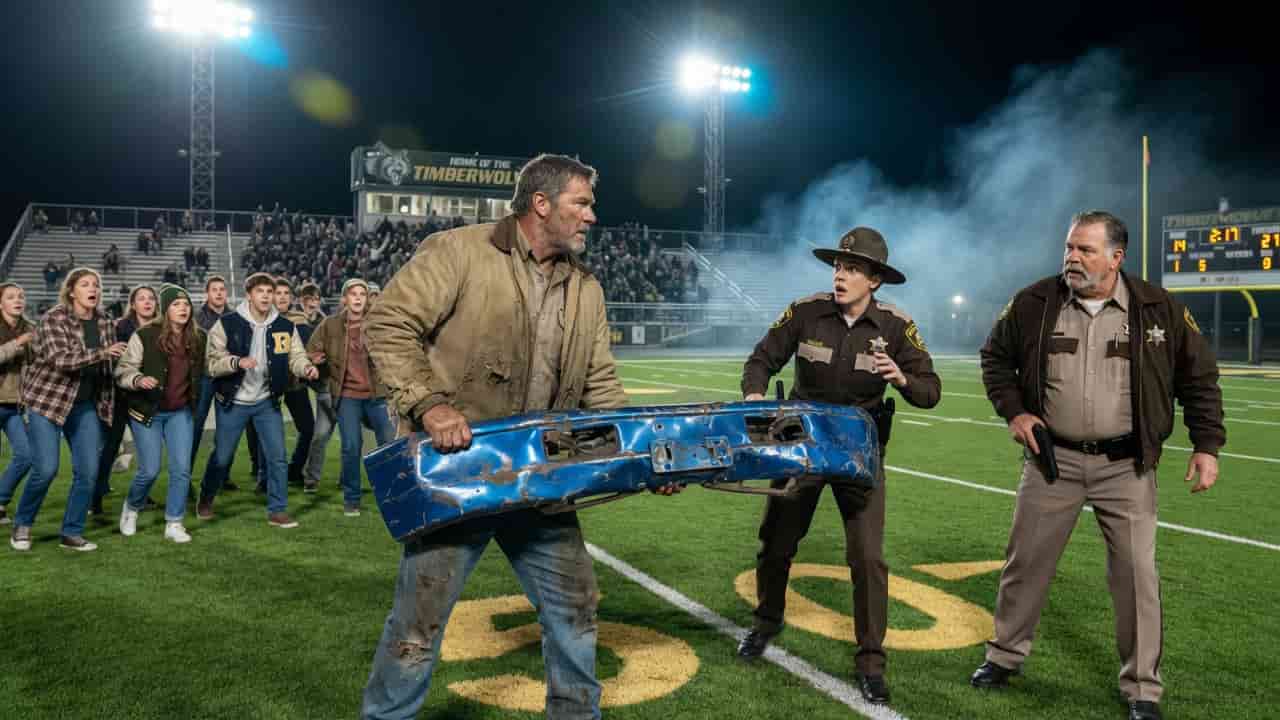
Silas stood on the grass of the high school field, his boots caked in mountain mud, holding the one thing the Sheriff’s Department thought they had buried months ago. The stadium lights were blinding, but they weren’t bright enough to hide the way Deputy Vance’s face turned the color of ash.
Vance was the town’s golden boy. The hero. The man they were all there to honor tonight. But Silas didn’t see a hero. He saw the man who had left a mother on the side of Miller Road and kept driving. He saw the man who had stolen the voice of his seven-year-old daughter, who hadn’t spoken a single word since that night.
“Get that thing out of here, Silas,” the Sheriff barked, stepping forward with his hand on his belt, his eyes darting to the crowd of neighbors and friends watching from the bleachers. “You’re drunk. You’re making a scene.”
Silas didn’t blink. He slammed the heavy, dented blue bumper onto the turf at the Deputy’s feet. The sound of metal hitting the ground echoed through the silent stadium.
“It’s off a personal truck. A blue one. Like the one you sold to the scrapyard two days after the accident,” Silas said, his voice low and jagged. “Tell them, Vance. Tell them what you did before you called it in.”
The whole town was watching. The silence was heavy enough to break. And for the first time in months, the man who held all the power was the one who looked like he couldn’t breathe.
Chapter 1: The Sound of the Axe
The fog in the Cascades doesn’t just sit; it breathes. It’s a heavy, wet lung that presses against the Douglas firs until the needles weep. Silas felt it in his marrow as he swung the six-pound splitting maul. He didn’t need the wood for the stove—not yet—but he needed the rhythm. He needed the impact. Every time the steel bit into the cedar, the shock traveled up his thick forearms, through his scarred elbows, and settled in his teeth. It was the only thing that drowned out the quiet coming from inside the house.
The house was too quiet. It had been since October.
Silas wiped a mixture of sweat and mist from his forehead with the back of a gloved hand. He was forty-two, but his joints felt like they belonged to a man of sixty who’d spent his life wrestling timber. His tan canvas jacket was frayed at the cuffs, and his boots were darkening with the damp. He picked up another round of cedar, set it on the block, and exhaled.
Thwack.
The wood gave way with a clean, satisfying crack. Silas reached for another, but his hand stayed hovering in the air. He looked toward the porch.
Lily was there. She was seven years old, wearing a mismatched outfit of a purple puffer jacket and yellow leggings that she’d picked out herself. She sat on the top step, her knees pulled to her chest, clutching a stuffed rabbit that was missing an ear. She was looking at him, her eyes wide and dark, as deep as the pools in the creek bed after a storm.
“Hey, Lil,” Silas said. His voice was a low rumble, rusty from disuse.
Lily didn’t blink. She didn’t smile. She didn’t say a word. She hadn’t said a word in five months. Not since the night Silas found her huddled in the front seat of their wrecked Subaru, her mother’s hand cold in hers, while the blue mountain mist swallowed the road.
The doctors called it selective mutism. A trauma response. Silas just called it a hole in the world.
“Hungry?” he asked.
She stared at him for a beat longer, then stood up and walked back into the house, the screen door clicking shut behind her.
Silas let out a breath he didn’t know he was holding. He leaned the maul against the chopping block and walked to the edge of the clearing. His property sat on a ridge overlooking the town of Blackwood. From here, the town looked like a handful of spilled dice in the valley. The steeple of the Lutheran church, the neon sign of the Sawmill Grill, and the high school stadium, where the lights were already flickering on for the Friday night game.
Blackwood loved its Friday nights. It loved its heroes. And tonight, they were honoring a new one. Deputy Vance. The man who had “risked his life” during the winter floods. The man the Sheriff called the backbone of the department.
Silas looked away, his eyes drifting toward the barn. It was a sagging, grey structure that smelled of old hay and motor oil. Inside, under a heavy tarp and a pile of rotted tack, sat the thing that kept him awake until three in the morning. The thing he’d dragged out of the ravine two miles below the crash site, weeks after the police had finished their “investigation.”
He walked toward the barn, his pulse beginning to thrum in his neck. It wasn’t just the bumper. It was the knowledge of what it meant.
For weeks, Silas had been a ghost in the town. He’d lost his job at the mill after he couldn’t stop shaking. He’d lost his wife, Clara, to a “hit and run by an unknown vehicle.” The Sheriff, Miller—a man who had played ball with Silas’s father—had sat in Silas’s kitchen, drank his coffee, and told him they were doing everything they could.
“Roads were slick, Silas. Probably some logger from out of state. We’re checking the registries,” Miller had said.
But Silas knew how to track. He knew the woods better than he knew his own palms. He’d found the skid marks that didn’t match the police report. He’d found the blue paint on the bark of a hemlock. And then, he’d found the bumper.
He stepped into the cool, dim light of the barn. The smell of grease was stronger here. He walked to the back, where his workbench was cluttered with tools. Next to it sat a series of small glass jars.
He hadn’t just been tracking. He’d been working.
Last Tuesday, he’d spent four hours in the shadows behind the Sheriff’s annex. He’d crawled under three patrol SUVs. He didn’t cut brake lines—he wasn’t looking for a massacre. He was looking for frustration. He’d loosened bleeder valves just enough so the pedals would feel soft, spongey. He’d swapped out spark plugs with fouled ones he’d pulled from a junked tractor.
He wanted them to feel a lack of control. He wanted them to feel the way he felt every time he looked at his silent daughter.
He reached under the tarp and ran his hand over the cold, dented metal of the bumper. The blue paint was unmistakable. It was a specific shade—Pacific Blue. The same shade as the personal truck Deputy Vance had driven every day for three years. The same truck that had vanished from his driveway forty-eight hours after Clara’s death, replaced by a shiny new white Ford.
Vance had told the guys at the diner he’d traded it in at a dealership in Portland. Silas had called that dealership. They’d never heard of him.
Silas gripped the metal until his knuckles turned white. The rage was a physical weight, a stone in his gut. He could go to the papers, but the Blackwood Gazette was owned by Miller’s brother-in-law. He could go to the State Police, but Miller had been a captain there for a decade.
The system in Blackwood didn’t have cracks. It had walls.
He heard a soft sound behind him. He spun around, his hand instinctively dropping to the heavy wrench on the bench.
Lily was standing in the doorway of the barn. The light from the grey afternoon silhouetted her small frame. She was looking at the tarp, at the shape beneath it.
“Lil, I told you not to come out here,” Silas said, his heart hammering.
She didn’t move. She looked from the tarp to his face. There was something in her expression that wasn’t just sadness. It was a question. She knew he was hiding something. She knew her father was changing, turning into something hard and sharp.
“Go back inside, honey. I’ll be in to make grilled cheese in a minute,” he said.
She lingered for a second, then turned and vanished back toward the house.
Silas sank onto a stool, his head in his hands. He was losing her. Every day he spent obsessing over the blue paint and the loosened bolts, he was losing the only thing Clara had left him. But he couldn’t stop. If he stopped, the lie won. If he stopped, Vance got to stand on that field tonight and hear ten thousand people cheer for him while Clara’s grave sat cold and ignored under the pines.
He looked at the clock on the wall. 5:30 PM.
In two hours, the ceremony would start.
He stood up and pulled the tarp completely off the bumper. He didn’t hide it this time. He carried it over to the workbench and began to scrub the mountain grime off it with a rag. He wanted it to shine. He wanted that blue paint to scream under the stadium lights.
He wasn’t going to be a ghost anymore.
He walked out of the barn and headed for his truck—a 2008 Chevy with a rusted bed and a winch that had seen better days. He threw the bumper into the back, covered it with an old horse blanket, and climbed into the cab.
The engine groaned but turned over. Silas sat there for a moment, the vibration of the truck rattling his teeth. He looked at the house, at the window where he knew Lily was watching.
He didn’t know if he was doing the right thing. He didn’t know if this was justice or just a slow-motion suicide. But as he shifted the truck into gear and started down the long, winding driveway toward the town, he knew one thing for certain.
The silence in Blackwood was about to end.
He drove past the Miller Road turnout—the place where the world had broken. There were fresh flowers there, wilting in the rain. Silas didn’t stop. He couldn’t look at them. He kept his eyes on the road, watching the fog swirl in his headlights.
As he entered the town limits, the traffic picked up. Everyone was heading toward the high school. He saw the patrol cars parked near the entrance, their light bars reflecting off the wet pavement. He saw Sheriff Miller standing by the gate, shaking hands, looking like the king of a very small, very crooked hill.
Silas parked at the far end of the lot, near the woods. He sat in the cab, the heater blowing lukewarm air on his feet. He reached into the glove box and pulled out a small, folded photograph. It was Clara and Lily at the county fair. Clara was laughing, her hair caught in the wind, a piece of blue cotton candy in her hand.
“I’m sorry,” he whispered to the empty cab.
He tucked the photo back and looked at himself in the rearview mirror. His eyes were bloodshot, his skin sallow. He looked like a man who had already lost everything.
Which meant he had nothing left to fear.
He stepped out of the truck, walked to the bed, and pulled back the horse blanket. The bumper was there, cold and heavy. He hoisted it onto his shoulder, the metal biting into his collarbone.
He didn’t go through the main gate. He knew the holes in the chain-link fence behind the locker rooms from his own days as a linebacker. He slipped through the shadows, the sound of the marching band growing louder, a rhythmic thumping that felt like a second heartbeat.
He reached the edge of the track. The field was a bright, artificial green. The ceremony had already started.
“And now,” the announcer’s voice boomed over the PA system, “to honor a man who embodies the spirit of Blackwood. A man who reminds us that service and sacrifice are not just words. Please join us in welcoming Deputy Marcus Vance.”
The crowd erupted. The roar was deafening.
Silas stepped out from behind the bleachers. He felt the cold air on his face. He felt the weight of the metal on his shoulder.
He started to walk.
Chapter 2: The Weight of the Hero
The grass of the football field felt different under Silas’s boots than the forest floor. It was too soft, too manicured. It felt like a stage. As he walked past the bench, he saw the players—teenagers with eyes full of adrenaline and borrowed glory—staring at him. They didn’t see a man; they saw a specter in a canvas jacket carrying a piece of a car.
Silas didn’t look at them. He kept his eyes on the podium at the fifty-yard line.
Deputy Vance stood there, looking perfect. He was wearing his dress browns, the brass on his shoulders gleaming under the stadium floods. He had that practiced, humble smile—the one he used when he was writing a warning for a broken tail light or flirtatiously checking the ID of a waitress at the Sawmill. Beside him stood Sheriff Miller, beaming like a proud father, his chest puffed out so far the buttons on his shirt looked strained.
Silas was fifty feet away when the first few people in the stands noticed him. The cheering didn’t stop, but it began to fray at the edges. A murmur rippled through the front row.
“Is that Silas?” someone whispered loud enough for him to hear.
“What’s he got?”
He reached the edge of the ceremony circle. The marching band had gone quiet. The only sound was the hum of the lights and the distant idling of a generator.
Sheriff Miller saw him first. The Sheriff’s smile didn’t just fade; it curdled. His eyes went from pride to a sharp, predatory suspicion. He stepped away from the microphone, his hand moving habitually toward his waist, though he wasn’t wearing his duty belt with the dress uniform.
“Silas,” Miller said, his voice dropping into that low, authoritative register he used to end arguments. “You’re off the field. Now.”
Silas didn’t stop. He walked until he was ten feet from Vance. The Deputy’s face had gone from humble to confused, and then, as his eyes drifted to the object on Silas’s shoulder, to a terrified, twitching mask.
Vance knew. He knew the curve of that metal. He knew the way the light hit that Pacific Blue paint.
“You lost something, Marcus,” Silas said. His voice wasn’t loud, but in the sudden vacuum of the stadium, it carried.
Vance swallowed. Silas could see the pulse jumping in the man’s throat. “Silas, look, you’re not well. We’ve talked about this. The grief, it’s—”
“Shut up,” Silas said.
The word hit like a physical blow. The crowd in the stands was completely silent now. Thousands of people, holding their breath, watching the broken logger and the golden deputy.
Silas shifted the weight and slammed the bumper onto the turf. The metallic thud was heavy, final. It sat there between them like a carcass.
“Miller Road,” Silas said, pointing down at the twisted metal. “October twelfth. Rain was coming down hard. You were coming back from the lodge, weren’t you? Had a few too many of Miller’s specials?”
“That’s enough!” Miller shouted, stepping between Silas and Vance. He put a hand on Silas’s chest, trying to shove him back. It was like trying to push a mountain. Silas didn’t move an inch. “You’re trespassing, Silas. You’re harassing an officer of the law. I’m giving you one chance to walk away before I have you in a cell.”
“Call the state boys then, Miller,” Silas said, his eyes locked on Vance, who was staring at the bumper as if it were a ghost. “Call them down here. Let’s have them run a paint match on this. Let’s have them look at the scrape marks on the hemlock tree three miles up from the crash. Because I already did.”
The Sheriff’s face turned a deep, bruised purple. “You’re a drunk, Silas. Everyone knows you’ve been hitting the bottle since Clara passed. This is a delusion.”
“I haven’t had a drink in three months,” Silas said, and it was the truth. He’d traded the whiskey for the rage. It was a much more efficient fuel. “And I wasn’t the one who called the scrapyard in Gresham to crush a blue 2021 Ford. That was Marcus here. Two days after the funeral. Funny timing, wouldn’t you say?”
Vance’s mouth opened and closed. No sound came out. He looked at the crowd, looking for a way out, but the town wasn’t cheering anymore. They were looking at the bumper. They were looking at the man they’d called a hero and seeing the sweat break out on his upper lip.
“He’s lying!” Vance finally yelled, his voice cracking. “I sold that truck months ago!”
“To who?” Silas stepped forward, bypassing the Sheriff. He was towering over Vance now. The smell of the deputy’s expensive aftershave was sickening. “Give me a name, Marcus. Give me a bill of sale. Because I looked for one. And Miller here made sure the registry was ‘lost’ in a system update, didn’t he?”
The silence that followed was the loudest thing Silas had ever heard. It was the sound of a foundation cracking.
Sheriff Miller realized he’d lost control of the moment. He turned toward the sideline, signaling to the two on-duty officers standing by the gate. “Get him off the field! Now! He’s a danger to himself and others!”
The officers, young guys who had grown up watching Silas play on this very field, hesitated for a split second. Then they started to move.
Silas didn’t fight them. He didn’t have to. He’d done what he came to do. He looked at Vance one last time—a long, cold look that promised the night was only beginning.
“My daughter doesn’t talk anymore, Marcus,” Silas whispered, loud enough only for the three of them. “She saw the blue light. She saw the truck drive away. She remembers. And soon, everyone else will too.”
The officers grabbed Silas’s arms. They were rougher than they needed to be, fueled by the embarrassment of the scene. They dragged him toward the tunnel. Silas kept his head up. He didn’t look at the crowd. He looked at the sky, at the cold, indifferent stars peeking through the fog.
As they pulled him into the darkness of the tunnel, he heard the announcer try to start the music again, but it was hollow. The “Hero’s Night” was dead.
They threw him into the back of a patrol car. The plastic seat was hard against his spine. He watched through the reinforced glass as the stadium lights grew smaller. He saw Sheriff Miller standing on the field, alone now, staring down at the blue bumper.
Miller didn’t pick it up. He looked like he was afraid it would burn him.
The car started moving.
“You really screwed up, Silas,” the officer driving said. It was a kid named Joey, whose older brother had worked the mill with Silas. “Miller’s gonna bury you for this.”
“He already tried,” Silas said, leaning his head against the cold window. “He’s running out of dirt.”
He closed his eyes. He thought of Lily. He thought of the way she looked at the barn. He wondered if she could feel the shift in the air, miles away. The hunt was no longer in the shadows. It was in the light.
And in Blackwood, the light was a dangerous place to be.
Chapter 3: The Cell and the Shadow
The Blackwood County lockup smelled of floor wax and stale cigarettes. It was a small, four-cell block at the back of the Sheriff’s annex, a place usually reserved for weekend drunks and the occasional brawler from the Sawmill Grill. Tonight, Silas had it all to himself.
He sat on the narrow cot, his back against the cinderblock wall. The officers had taken his belt, his laces, and his canvas jacket. He was left in his t-shirt, the dampness of the night still clinging to his skin.
He didn’t mind the cell. It was quieter than the house.
Around midnight, the heavy steel door at the end of the hall creaked open. The footsteps were heavy, deliberate. Silas didn’t need to look up to know who it was.
Sheriff Miller stood in front of the bars. He’d changed out of his dress uniform into his work khakis. He looked tired. The skin under his eyes was saggy, like wet paper.
“You always were a stubborn son of a bitch, Silas,” Miller said. He leaned against the opposite wall and lit a cigarette. He wasn’t supposed to smoke in the cells, but Miller had been the law here so long the rules were just suggestions.
“Runs in the family,” Silas replied.
“Your daddy was a good man. He knew when to hold ‘em and when to fold ‘em. You? You just want to burn the whole house down because you don’t like the color of the drapes.”
Silas looked up then, his eyes flat. “My wife is in the ground, Miller. My daughter is a ghost in a seven-year-old’s body. You call that the color of the drapes?”
Miller exhaled a long cloud of smoke. “Accidents happen. It was a bad night. The fog, the rain… no one could have seen her.”
“So you admit it was him.”
Miller stiffened. He realized he’d stepped into a trap. “I’m admitting nothing. I’m saying that even if—and that’s a big if—Vance was on that road, what would justice look like? You ruin a man’s life? A man who has done more for this town than you ever did? You tear apart the department? For what? To feel better for five minutes?”
“To hear the truth,” Silas said. “To let Lily know that the world isn’t just a place where people get killed and the killers get trophies.”
Miller stepped closer to the bars. His voice dropped to a hiss. “Listen to me, Silas. I’ve known you since you were in diapers. I don’t want to see you hurt. But you’re playing a game you can’t win. That bumper? It’s gone. Evidence locker? No. It’s at the bottom of the lake by now. Your ‘paint match’? No lab in the state is going to take a request from a man with a history of alcohol-related incidents and a documented mental breakdown.”
“I’m sure you’ve already taken care of that,” Silas said.
“I take care of this town,” Miller snapped. “And right now, this town needs stability. Not a crusade from a broken-down logger.”
Miller reached into his pocket and pulled out a set of keys. He unlocked the cell door.
“Go home, Silas. Joey’s going to drive you. Your truck’s been impounded for a few days—safety inspection. You stay on your ridge. You take care of your girl. You say one more word about Vance, one more word about that night, and I won’t just lock you up. I’ll call Child Protective Services. I’ll tell them you’re an unfit father. I’ll tell them about the sabotage you’ve been doing to the patrol cars. Yeah, I know about that, too.”
Silas felt a chill that had nothing to do with the temperature of the room.
“You’d take her from me?”
“I’ll do what I have to do to protect the peace,” Miller said. He stepped back, holding the door open. “Don’t test me. You think you’re the only one who can play rough? I’ve been holding this county together since before you could drive. You’re a grain of sand, Silas. Don’t make me blow you away.”
Silas stood up. His legs felt heavy, but his head was clear. He walked out of the cell, past Miller, and into the hallway. He didn’t say thank you. He didn’t look back.
Joey was waiting in the lobby. The ride back up the mountain was silent. The fog had thickened, turning the world into a wall of white. As they pulled into Silas’s driveway, Joey turned the engine off but didn’t unlock the doors.
“Silas,” Joey said, looking at the steering wheel. “My brother… he says you’re right. He says Vance used to brag about how fast he could take those mountain turns after a few beers at the lodge.”
Silas looked at the young officer. “Why didn’t he say anything?”
Joey gave a bitter laugh. “And work where? Move where? This is Blackwood, man. You either stay in the circle or you’re out in the cold. And it’s real cold out there.”
He unlocked the doors. Silas stepped out into the mud.
“Thanks for the ride, Joey.”
He walked toward the house. The lights were off, except for the porch lamp. He entered quietly, his heart aching. He went to Lily’s room. She was asleep, her stuffed rabbit tucked under her chin. She looked so small in the big bed.
He sat on the floor by her bed and leaned his head against the mattress.
Miller’s threat was real. The man could take Lily. He had the judges, the social workers, the records. He could erase Silas as easily as he’d erased the blue truck.
But Silas looked at his daughter’s face and he knew he couldn’t stop. Because if he stopped, he was teaching her that the bullies own the world. He was teaching her that her mother’s life didn’t matter as much as a deputy’s reputation.
He stayed there until the sun began to bleed through the fog, a pale, sickly yellow.
He had a secret of his own, one he hadn’t told Miller.
He went to the kitchen and made a pot of coffee. His hands were steady. He sat at the table and opened a drawer, pulling out a small, high-definition camera—the kind hunters use to track game. He’d bought three of them months ago.
One was aimed at the turnout on Miller Road.
One was aimed at the back of the Sheriff’s annex.
And the third… the third was hidden in the rafters of the old garage behind Deputy Vance’s house.
Silas hadn’t checked the memory cards in weeks. He’d been too focused on the physical proof. But now that the physical proof was at the bottom of a lake, he needed something else. He needed the one thing Miller couldn’t bury.
He needed a confession.
He finished his coffee, kissed Lily’s forehead as she stirred, and walked out the back door. He didn’t take the road. He took the deer trails, moving through the brush like a shadow.
He was a logger. He knew every inch of these woods. And he knew that even a hero has to sleep eventually.
He reached the ridge above Vance’s suburban-style home on the edge of town. It was a nice place—too nice for a deputy’s salary. Silas watched as Vance came out onto the back deck, clutching a mug of coffee. The man looked terrible. He was pacing, his shoulders hunched, his head snapping around at every sound of a bird in the trees.
He wasn’t a hero. He was a man waiting for the axe to fall.
Silas pulled a pair of binoculars from his pocket. He watched Vance go back inside. A few minutes later, a car pulled into the driveway. It wasn’t a patrol car. It was a silver SUV.
Sarah Vance. The deputy’s wife.
Silas had seen her around town. She was a teacher at the elementary school. Soft-spoken, kind. People said she was the best thing about Marcus Vance.
She got out of the car, her face set in a hard, grim line. She didn’t go into the house. She went straight to the garage.
Silas watched, his breath hitching, as she opened the garage door and started throwing things into the back of her SUV. Suitcases. Boxes.
She was leaving him.
Silas moved closer, sliding down the embankment until he was just behind the tree line. He could hear them now. The windows of the house were open to let out the damp morning air.
“You lied to me, Marcus!” Sarah’s voice was sharp, echoing off the neighbor’s fence. “You told me you hit a deer! You told me that’s why the truck had to go!”
“Sarah, keep your voice down,” Vance pleaded. “It’s not what you think. Silas is crazy. He’s grieving and he’s looking for someone to blame.”
“He had the bumper, Marcus! I saw the paint! I know that dent! I’m the one who hit the trash can with it last summer, remember? I know that mark!”
There was a silence. A long, terrible silence.
“Miller said he’d handle it,” Vance whispered. It was so quiet Silas almost missed it. “He said it was an accident. He said the department couldn’t afford the scandal. He told me to stay quiet.”
“An accident? You left her there! You left a woman to die in the rain!”
Silas felt the world tilt. He gripped a cedar branch so hard the bark bit into his palm. There it was. The truth, spoken in the quiet of a Saturday morning.
He reached for his pocket, for the camera he’d hidden. He needed to make sure it was catching this. He needed the audio.
But then he heard a different sound. The crunch of gravel.
A patrol car was pulling into the driveway.
Sheriff Miller stepped out.
Chapter 4: The House of Cards
Silas stayed low in the brush, the wet earth soaking into his jeans. His heart was a frantic bird against his ribs. He watched Miller walk up the driveway, his gait heavy and purposeful. The Sheriff didn’t look like a man coming to help a friend; he looked like a man coming to clean up a mess.
“Sarah,” Miller said, his voice loud and calm, the voice of a man who owned the air he breathed. “Why don’t you go back inside? Marcus and I need to have a word.”
Sarah Vance turned, her eyes red-rimmed, clutching a cardboard box of books. “No, Roy. No more words. I’m done. I’m going to my mother’s.”
Miller stepped into her path. He didn’t touch her, but he used his size to block the garage door. “Sarah, you’re upset. That scene last night… Silas is a sick man. He’s been harassing Marcus for months. That bumper was a fake. He had it painted. It’s part of a campaign to discredit this office.”
“Don’t lie to me too,” Sarah said, her voice trembling. “I saw him. I saw Marcus’s face. He’s a killer, Roy. And you’re making sure he gets away with it.”
Miller’s face went stone-cold. The mask of the “kindly family friend” dropped. “You need to think very carefully about what you say next, Sarah. You’re a teacher in this district. Your father’s pension comes through the county. This town is a delicate thing. You start throwing around words like that, and people get hurt. Not just Marcus. Everyone.”
“Are you threatening me?”
“I’m reminding you of your responsibilities,” Miller said. He turned to Vance, who was standing in the doorway of the kitchen, looking like a ghost. “Marcus, get her inside. Now.”
Vance moved, but he was sluggish, his spirit broken. He reached for Sarah’s arm. “Sarah, please. Just come inside. Let’s talk.”
“Get off me!” she screamed, shoving him back. The box she was holding spilled onto the driveway.
In the chaos, Silas saw his opening. He wasn’t thinking about the camera anymore. He wasn’t thinking about Miller’s threats or the law. He was thinking about the way Miller had spoken about his wife. “Accidents happen.” He stepped out of the woods.
“She’s right, Sarah,” Silas said, his voice cutting through the argument like a blade.
Everyone froze.
Miller spun around, his hand flying to his holster. He saw Silas standing there, covered in mud, his eyes burning with a terrifying clarity.
“Silas!” Miller barked. “I told you to stay on the ridge! You’re under arrest! Trespassing, violating a direct order—”
“You don’t have orders for me anymore, Roy,” Silas said. He walked down the embankment, his boots sliding on the grass. He stopped ten feet away from the three of them. “I heard you, Marcus. I heard you tell her. Miller told you to stay quiet. Miller handled it.”
Vance looked like he wanted to vanish into the earth. Miller’s face was a mask of pure, unadulterated rage.
“You didn’t hear a damn thing,” Miller said, drawing his weapon. He didn’t point it at Silas, but he held it at his side, the barrel aimed at the ground. “You’re hallucinating. You’re having a breakdown.”
“Then why are you shaking, Roy?” Silas asked.
It was true. The Sheriff’s hand, the one holding the Glock, was trembling.
“Sarah,” Silas said, turning to the woman. “You know where the truck is. You know where he took it. You don’t want this on your soul. You’re the one who taught my daughter how to read. You’re a good person. Don’t let them turn you into what they are.”
Sarah looked at Silas, then at her husband, then at the Sheriff. The realization of the choice before her was written in the agony of her expression.
“I…” she started.
“Don’t say a word, Sarah,” Miller warned.
Suddenly, Vance broke. He didn’t run. He didn’t fight. He collapsed. He sank to his knees on the gravel of his own driveway and put his head in his hands.
“I’m sorry,” he sobbed. “I’m so sorry. I didn’t see her until it was too late. I panicked. I called Roy. He told me he’d fix it. He told me he’d take care of everything.”
The silence that followed was absolute.
Miller looked at Vance with a look of such profound contempt it was almost physical. “You pathetic coward.”
The Sheriff looked back at Silas. The barrel of the gun began to rise.
“You think this is over?” Miller whispered. “You think you win because a weak man cried? This is my county, Silas. I built it. I protect it. And I’m not letting a piece of trash like you tear it down.”
“Roy, put the gun down,” Sarah said, her voice a whisper of terror.
“Get in the house, Sarah,” Miller said, his eyes never leaving Silas’s.
Silas didn’t move. He stood his ground. He felt a strange sense of peace. He’d heard it. He’d heard the words. The truth was out in the air, and no matter what Miller did now, he couldn’t put it back in the bottle.
“Go ahead, Roy,” Silas said. “Do it. In front of witnesses. In front of your Deputy and his wife. Show them what ‘protecting the peace’ really looks like.”
Miller’s finger tightened on the trigger.
At that moment, the sound of another engine drifted up the hill. Not one car. Several.
Silas had made one more call before he left the house. He hadn’t called the police. He’d called the one person in town who hated Miller more than he did.
The local reporter, a woman named Elena who had been trying to find the “rot in the valley” for years. And he’d told her to bring her camera.
A black sedan screeched into the driveway, followed by two more cars—people from town who had seen Silas at the game and followed the drama. Elena stepped out of the first car, her phone held high, the red recording light glowing like a malevolent eye.
“Sheriff Miller!” she shouted. “Is it true? Did Deputy Vance just confess to the hit-and-run on Miller Road?”
Miller froze. He looked at the cameras. He looked at the growing crowd of neighbors peering over fences. He looked at Silas, who was smiling—a small, sad, broken smile.
The Sheriff slowly lowered his gun. He looked down at the gravel. He looked like an old man who had finally run out of road.
“Everyone back,” Miller said, but the authority was gone. It was just a tired man making a suggestion.
Silas walked past him. He didn’t look at Vance, who was still weeping. He didn’t look at Sarah. He walked straight to the reporter.
“He said it,” Silas told the camera. “He said he did it. And he said Miller helped him.”
He didn’t wait for the questions. He didn’t wait for the handcuffs that would surely come later for someone in this mess. He turned and started walking back toward the woods.
He had to get home.
He had to tell Lily that it was okay to speak now.
But as he climbed the ridge, he felt a sudden, sharp pain in his chest. The adrenaline was fading, leaving behind the raw, jagged edge of the last five months. He sat down on a fallen log, gasping for air.
He looked down at the town. The blue lights of more patrol cars were winding their way up the hill. The House of Miller was falling.
But the victory felt like ash.
He closed his eyes and saw Clara’s face. He saw her laughing at the fair.
“I did it, Clara,” he whispered.
The woods didn’t answer. The fog just continued to breathe, heavy and cold.
He stayed there for a long time, watching the lights, waiting for the world to decide what to do with a man who had finally finished his hunt.
He didn’t know if Lily would talk today. He didn’t know if he’d go to jail for the sabotage or the trespassing. But for the first time since October, the air in his lungs didn’t feel like lead.
The debt was paid.
But the silence… the silence was still there.
And as the first sirens began to wail in the valley, Silas realized that justice wasn’t an ending. It was just the beginning of a different kind of pain.
He stood up, wiped the mud from his hands, and started the long walk home.
The story wasn’t over. Not yet.
There was still the aftermath. There was still the trial. And there was still a little girl waiting on a porch, looking for a father who had finally come back from the dark.
He disappeared into the trees, a ghost returning to a house that was no longer haunted by a lie.
But the mountain… the mountain never forgets.
And as Silas walked, he didn’t see the dark SUV parked at the trailhead, its engine silent, its driver watching him through the glass.
Sheriff Miller wasn’t the only power in the county.
And some people didn’t like it when the heroes fell.
Chapter 5: The Residue of the Truth
The walk back up the ridge was a slow, agonizing tally of every year Silas had spent breaking his body for the valley. His lungs burned with the damp, pine-heavy air, and the sharp stitch in his chest had settled into a dull, rhythmic throb that timed itself to his heartbeat. He didn’t take the road. He stayed in the trees, moving through the sword ferns and the rotting nurse logs, watching the blue and red strobe of emergency lights through the canopy like a distant, neon fever.
He reached his porch as the first real rain of the morning began to fall—a cold, vertical needle-wash that turned the dust on his tan jacket into streaks of mud. He stopped at the top step, his hand shaking as he reached for the brass knob. He looked at his fingers, caked in the grit of Vance’s driveway, and felt a sudden, violent urge to be sick.
The victory didn’t feel like air. It felt like the moment after a tree falls—the terrifying, vibrating silence that follows the crash, where you’re just waiting to see if you’re still standing or if the kickback caught you in the ribs.
He entered the house quietly. The smell of cold coffee and old wood greeted him. He walked to the kitchen sink and scrubbed his hands with Palmolive, rubbing until the skin was raw and pink.
“Lil?” he called out, his voice sounding like it was coming from the bottom of a well.
There was no answer. He felt a spike of cold panic. He hurried toward her bedroom, his heavy boots thudding on the floorboards. He pushed the door open. The bed was empty, the covers thrown back in a messy tangle.
“Lily!”
He spun around and saw her. She was in the living room, sitting on the floor by the window that faced the valley. She hadn’t put on her shoes. She was just in her nightgown, her small shoulders hunched, staring down at the town. From here, the emergency lights looked like tiny, flickering embers in a bowl of grey soup.
Silas exhaled, leaning against the doorframe. He felt the weight of the last twelve hours trying to buckle his knees. “You shouldn’t be out of bed, honey. It’s early.”
Lily didn’t turn around. She pointed a small, pale finger at the window. Down there, the sirens were finally audible—a low, mournful wailing that rose from the valley floor.
Silas walked over and sat on the floor behind her. He didn’t touch her. He knew she didn’t like to be touched when the world felt too loud. He just sat there, two feet away, two ghosts watching the fire they’d started.
“The truth is out, Lil,” he whispered. “Everyone knows. They’re taking him away.”
He expected something. A nod, a look, a sigh. But Lily remained as still as a stone carving. The silence in the room wasn’t peaceful; it was heavy with the residue of the trauma that had started on Miller Road. Silas realized then, with a crushing clarity, that catching the man who killed her mother wouldn’t magically bring back her voice. The damage was a physical thing, a bridge that had been burned, and he was still standing on the wrong side of the river.
An hour later, a car pulled into the driveway. Silas stood up, his hand instinctively reaching for the heavy iron fire poker near the hearth. He watched through the curtain. It wasn’t a patrol car. It was the silver SUV from earlier.
Sarah Vance stepped out. She looked smaller than she had in the driveway, her coat buttoned up to her chin, her hair matted by the rain. She stood by her car for a long time, looking at the house, before she started the walk to the porch.
Silas met her at the door. He didn’t open the screen.
“Silas,” she said. Her voice was thin, frayed at the edges.
“Sarah.”
“I left him at the station. They have him in an interview room. Miller’s… they’ve got Miller in his office. There are men there I’ve never seen. From the city. State investigators.”
Silas nodded. “Good.”
Sarah looked down at her boots. “I didn’t know, Silas. I swear to you. I knew he was drinking more. I knew he was jumpy. But I thought it was the stress of the job. I thought it was the floods.”
“He let you believe a lie while my wife was rotting in the ground, Sarah. He let you live in a house bought with the silence of a dead woman.”
She flinched. The words were cruel, but Silas didn’t have any tenderness left in him. He was a hollowed-out husk of a man.
“I brought something,” she said. she reached into her pocket and pulled out a small, leather-bound ledger. “I found this in the floorboard of the truck—the white one. Marcus must have taken it from the station when Miller wasn’t looking. It’s a log. Not just of the accident. It’s names. Dates. Timber tallies that don’t match the mill records.”
Silas frowned, finally unlatching the screen door. “What does timber have to do with Clara?”
Sarah stepped inside, shivering. She looked at Lily, who was still staring out the window, then back at Silas. “Miller wasn’t just protecting Marcus because they’re friends, Silas. Marcus was the one running the night shifts. The ‘ghost loads.’ They’ve been skimming from the County Board for years. Hundreds of thousands of dollars in lumber moved out of state without taxes or permits. If Marcus went down for the hit-and-run, the investigation would have opened up his whole life. His bank accounts. His phone records. Miller’s empire was built on those logs. That’s why he had to bury her. She wasn’t just a victim. She was a liability.”
Silas took the ledger. His hands felt heavy. He flipped through the pages—rows of neat, cramped handwriting. Miller’s handwriting. It was a map of the town’s corruption, a ledger of every bribe and backroom deal that had kept Blackwood running.
“He’s going to come for this,” Silas said.
“He’s already coming,” Sarah whispered. “There was a car following me up the hill. A dark SUV. It wasn’t the police. It was the men from the Board. The ones who buy the timber.”
Silas looked out the window. The dark SUV he’d seen at the trailhead was parked at the end of his driveway, its engine idling, its headlights off. It sat there like a predator in the tall grass.
The rescue force had arrived, the truth had been spoken, but the consequences were escalating into something far more dangerous than a small-town cover-up. Silas realized that by pulling on the thread of his wife’s death, he’d started to unravel the entire economy of the valley. And the men who owned that economy didn’t care about justice. They cared about the ledger.
“Go into the back room, Sarah,” Silas said, his voice dropping into the low, commanding tone of a man back in the woods. “Take Lily. Lock the door. Don’t come out until I tell you.”
“Silas, what are you going to do?”
“I’m going to finish the work,” he said.
He watched them go—Sarah clutching Lily’s hand, the two of them disappearing into the hallway. Silas walked to the gun rack. He didn’t take the rifle. He didn’t want a shootout. He took the heavy, double-bitted axe he used for the big cedar logs. It was a tool he understood. It was a tool that didn’t miss.
He walked out onto the porch. The rain was coming down harder now, a grey curtain that blurred the world. He sat in the old wicker chair, the axe resting across his knees, and waited.
The dark SUV began to move. It crawled up the gravel driveway, the stones crunching under its heavy tires. It stopped twenty feet from the porch. The driver’s side window rolled down halfway.
A man in a charcoal suit and a clean, expensive haircut looked out. He didn’t look like a killer. He looked like an accountant.
“Mr. Thorne,” the man said. His voice was smooth, educated. “My name is Henderson. I represent the interests of the Cascade Development Group.”
“You’re on private property, Henderson,” Silas said.
“I’m aware. I’m also aware that you have something that doesn’t belong to you. A book. A collection of… misunderstandings.”
“I have the truth,” Silas said. “It belongs to me more than anyone.”
Henderson sighed, a sound of genuine disappointment. “Truth is a fluid concept in the timber industry, Silas. What you have is a list of names that could cause a lot of unnecessary legal trouble for people who provide the jobs in this town. People who keep the mill open. People who make sure your daughter’s school stays funded.”
“The school where the Deputy’s wife teaches?” Silas asked. “The one who’s inside right now, hiding from you?”
Henderson’s eyes flickered toward the house. “The situation is regrettable. Deputy Vance is a weak man. Sheriff Miller is a sloppy one. We are prepared to offer you a settlement, Silas. A significant one. Enough to move you and your daughter anywhere you want. A house in Portland. Specialized doctors for her… condition. All we ask is for the ledger and your silence regarding the specifics of the Board’s involvement.”
Silas looked down at the axe. He thought of the blue paint. He thought of Clara’s cold hand.
“You think you can buy the silence she didn’t choose?” Silas asked.
“I’m trying to save your life, Silas,” Henderson said, his voice losing its polish. “Miller is done. He’ll be the scapegoat. The hit-and-run will be prosecuted. You get your justice. We get our ledger. Everyone wins.”
“Except the truth,” Silas said.
He stood up. He felt the weight of the axe, the familiar balance of the hickory handle. He walked to the edge of the porch, the rain soaking his hair.
“Tell your bosses that the ledger is already being scanned,” Silas lied. He knew Elena the reporter was still at the station, but he knew how to move. “It’s on a cloud drive. If I don’t check in every hour, it goes to the Attorney General. You want to talk settlements? Talk to the State Police.”
Henderson stared at him for a long beat. The air between them was electric with the threat of violence. Then, the man gave a curt nod.
“You’re a fool, Silas. You’ve traded a future for a memory. This valley will chew you up and spit you out.”
The window rolled up. The SUV backed down the driveway, the red taillights disappearing into the fog.
Silas stood there until the sound of the engine was gone. He felt the adrenaline leave him, replaced by a crushing, bone-deep exhaustion. He turned back toward the house, but as he reached the door, he saw Lily standing in the hallway.
She was looking at him. For the first time, her eyes weren’t dark and distant. They were sharp.
She walked toward him, her bare feet silent on the floorboards. She stopped at his waist and reached out, her small hand touching the cold steel of the axe.
“Done?” she whispered.
The word was so quiet Silas thought he’d imagined it. It was a rasp, a ghost of a sound, but it was there.
He dropped the axe. It hit the floor with a heavy thud. He sank to his knees and pulled her into his chest, burying his face in her hair.
“Yeah, Lil,” he choked out, the tears finally coming, hot and jagged. “It’s done.”
But as he held her, he looked over her shoulder at the ledger sitting on the kitchen table. He knew the man in the charcoal suit wouldn’t stay gone. The bullying of the town was over, but the war for the mountain had just begun.
Chapter 6: The Voice in the Fog
The aftermath of the confession didn’t feel like a victory parade; it felt like a slow, communal funeral. For the next three days, Blackwood was a town under siege by the outside world. News vans from Portland and Seattle clogged the narrow streets, their satellite dishes pointing at the grey sky like skeletal fingers. The Sawmill Grill was packed with reporters trying to coax stories out of loggers who only answered in grunts and downward glances.
Silas stayed on his ridge. He had to. The State Police had taken the ledger, and two troopers were stationed at the end of his driveway—not to arrest him, but to keep the “Cascade Development Group” away.
Inside the house, the atmosphere had shifted. It was no longer a tomb. Sarah Vance was still there, sleeping on the couch, her life in a suitcase by the door. She and Silas moved around each other with a quiet, mutual respect, two people who had been ruined by the same lie and were now trying to figure out how to build something from the debris.
Lily was the center of it all. Since that one word on the porch, she hadn’t spoken again, but the wall was cracked. She followed Silas everywhere. When he went to split wood, she sat on the block. When he made stew, she handed him the salt. She was watching him, waiting to see if the world was safe enough for the rest of her words to come out.
On the fourth morning, the fog finally lifted, leaving behind a sky the color of a bruised plum. Silas was on the porch, drinking coffee, when a black sedan pulled up. This time, the troopers let it through.
Elena, the reporter, stepped out. She looked exhausted, her makeup smudged, but her eyes were bright with a predatory satisfaction.
“It’s over, Silas,” she said, walking up the steps. She didn’t wait for an invitation; she sat on the railing. “Miller made a deal. He’s testifying against the Board. He’s naming names—the Commissioners, the mill owners, the whole lot of them. He’s trying to avoid a life sentence by handing them the keys to the kingdom.”
“And Vance?” Silas asked.
“Vance is in the county jail. He’s being charged with vehicular manslaughter and obstruction. His lawyer is talking about ‘coerced silence,’ but nobody’s buying it. Sarah’s testimony about the ledger sealed it.”
Silas looked out at the valley. He could see the mill in the distance, its smokestacks cold for the first time in years. “What happens to the town?”
“The mill’s going to close for a while. Federal investigation. A lot of people are going to lose their jobs, Silas. Some of them aren’t going to be happy with you. They see you as the man who broke the town’s back.”
“The town’s back was already broken,” Silas said. “It was just held together by rot.”
Elena nodded. She pulled a small recorder from her pocket. “I’m doing the final piece. The human cost. I wanted to know… what happens to you now? You got what you wanted. You heard the truth.”
Silas looked at the screen door. He could see Lily inside, helping Sarah fold laundry.
“I don’t know,” Silas said. “I think I’m going to take her to the coast for a while. Get away from the trees. She needs to see something that doesn’t have a memory attached to it.”
“And the rage?” Elena asked, her voice softening. “Is it gone?”
Silas felt the dull throb in his chest. It wasn’t a stitch anymore; it was a scar. “Rage doesn’t just go away. It just runs out of fuel. I’m tired, Elena. I’ve been hunting a ghost for five months, and now that I’ve caught him, I realized I’ve been a ghost too.”
He stood up, ending the interview. Elena got the hint. She stood, offered a hand that he didn’t take, and walked back to her car.
“You’re a good man, Silas Thorne,” she called out before she left. “Even if this town never forgives you for being right.”
That afternoon, Silas began to pack. He didn’t have much. A few changes of clothes, Clara’s jewelry box, and Lily’s favorite books. Sarah came into the bedroom as he was shoving a flannel shirt into a duffel bag.
“I’m going to stay with my sister in Eugene,” she said. “I filed for divorce this morning.”
“I’m sorry, Sarah. About everything.”
She gave him a sad, fragile smile. “Don’t be. You gave me my life back. I was living in a dream, Silas. A bad one. I’d rather be awake and alone than asleep with a killer.”
She reached out and touched his arm. “Take care of her. She’s special.”
“I will.”
Sarah left an hour later. Silas watched her SUV disappear down the road, and then the silence returned. But it was different now. It was the silence of an empty house, not a haunted one.
He found Lily in the barn. She was standing by the workbench, looking at the spot where the blue bumper had been. The horse blanket was still on the floor.
Silas walked up behind her. “We’re going on a trip, Lil. Just us. We’re going to see the ocean. You ever see the ocean?”
She shook her head.
“It’s big. Bigger than the mountain. It makes a lot of noise, but it’s a good noise. Like the wind in the hemlocks, but louder.”
He reached down and picked up the heavy wrench he’d used for the sabotage. He looked at it for a moment, then tossed it into the scrap bin.
“I’m sorry I was so angry, Lily,” he said, his voice thick. “I was trying to find your mom. I thought if I found the truth, I’d find her. But she’s not in the truth. She’s not in that ledger. She’s just… she’s just gone.”
Lily turned around. She looked at him for a long time, her eyes searching his face. She stepped closer and wrapped her arms around his waist, burying her face in his canvas jacket.
Silas held her, his large, rough hands stroking her hair. He felt the tension leave her small body, a slow unfurling of five months of terror.
“Mommy,” she whispered into his chest.
It wasn’t a question. It was an acknowledgement.
“Yeah,” Silas said, his voice breaking. “Mommy.”
He picked her up and carried her out of the barn. He locked the doors, not because he was hiding anything, but because he was finished with the work. He walked to the truck—his own truck, returned that morning by a silent, shamed-faced Joey.
He put Lily in the front seat and buckled her in. He threw the duffel bag in the back. He stood by the driver’s side door and looked at the house one last time.
The mountain was still there. The fog was starting to roll back in, a white tide reclaiming the ridges. The town below was still hurting, and the men in the charcoal suits were still out there, somewhere, planning their next move.
But as Silas shifted the truck into gear and started down the driveway, he didn’t look back. He looked at the road ahead. He looked at the way the light caught the moisture on the windshield, turning the world into a blur of silver and green.
He drove past Miller Road. He didn’t stop at the turnout. The flowers were gone, washed away by the rain, but the hemlock tree with the blue paint was still standing. It would grow over the scar eventually. The bark would thicken, the sap would seal the wound, and one day, nobody would even know it was there.
That was how it worked. You didn’t get over it. You just grew around it.
As they reached the highway, Lily reached over and put her hand on Silas’s arm. She didn’t say anything, but she didn’t have to. The silence wasn’t a hole anymore. It was a bridge.
Silas turned the radio on. A low, country song filled the cab—something about home and the long road back. He accelerated, the engine of the old Chevy humming a steady, honest tune.
The hero of Blackwood was a killer. The Sheriff was a thief. And the logger was just a man with a daughter and a long drive ahead of him.
The fog swallowed the truck as it headed west, toward the coast, toward the water that never stopped moving.
Behind them, the mountain remained, cold and indifferent, keeping the secrets that Silas Thorne had finally refused to carry.
The debt was paid. The hunt was over.
And for the first time in a very long time, Silas Thorne breathed.