“You’re getting old and forgetful, Tank. Or maybe just soft.”
Iron Mike said it with that same smirk he’d used for twenty years, the one that used to mean brotherhood but now just felt like a boot on my neck. He wanted the club to laugh. He wanted them to see the man who kept their books as nothing more than a tired old dog waiting for the porch.
The whole room was watching. The prospects, the lieutenants, even young Jax, who still looked at Mike like he was a god. They were waiting for me to take the insult, to lower my head and go back to the ledgers.
But I wasn’t just holding the books anymore. I was holding a piece of denim I’d pulled out of a trash bin behind the Police Chief’s house. A piece of denim that belonged to a man we all swore to protect—a man Mike told us had been taken out by a rival crew.
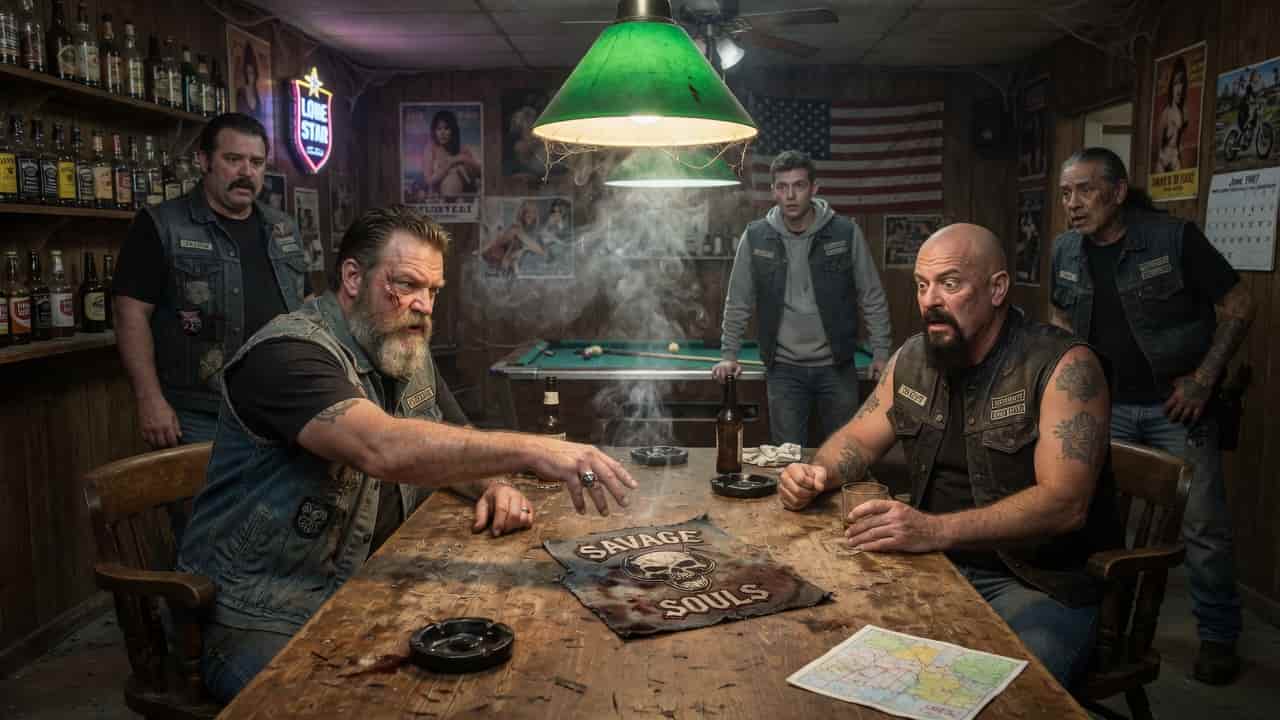
I didn’t argue. I didn’t shout. I just put the proof exactly where Mike couldn’t pretend it didn’t exist. When that stained patch hit the wood, the laughter in the clubhouse didn’t just stop. It evaporated.
Mike’s face went the color of a New Mexico sunrise—pale and cold. He knew exactly what he’d done. And now, the rest of the club was starting to realize that the man leading them had sold their souls for a badge and a promise of safety.
Chapter 1: The Weight of the Ledger
The heat in the Savage Souls clubhouse didn’t just sit; it pressed. It was a physical weight, smelling of stale Miller High Life, primary oil, and forty years of bad decisions baked into the drywall. I sat at the small, scarred desk in the back office—which was really just a converted storage closet—with a green-shaded lamp casting a sickly glow over the stacks of bills and the heavy leather-bound ledger that was my life’s work.
My hands felt like they were made of rusted hinges. At sixty-two, the arthritis in my knuckles was a constant, low-grade thrum, a reminder of every bike I’d laid down and every man I’d had to hit. I picked up the pen, my fingers thick and clumsy, and entered another three hundred dollars into the “Maintenance” column.
In reality, that three hundred was going into a separate account, one that didn’t exist on any paper Mike ever saw. It was the “Widow’s Fund,” though that sounded too soft for a club like this. It was a legal defense fund, a survival tax I’d been skimming for three years, ever since Caleb disappeared.
Caleb hadn’t just been my vice president. He’d been the man who pulled me out of a ditch in ’84 and told me I was worth more than a bottle of cheap bourbon. When he didn’t come back from a routine run to Las Cruces, Mike told us the Vipers had ambushed him. We burned a lot of Viper property for that. We spent a lot of nights swearing vengeance.
But I’d seen the way Mike looked when he told the story. He looked relieved.
The door to the office creaked open. It was Jax, the newest prospect. He was a wiry kid from up near Santa Fe, all nervous energy and a “Prospect” patch that still looked too clean. He reminded me of myself forty years ago—eager for a family that didn’t share his last name.
“Tank? Mike wants the numbers for the month,” Jax said. He didn’t come all the way in. Nobody liked coming into the treasurer’s office. It was where reality hit the myth of the biker lifestyle. It was where you realized that “freedom” cost about four thousand dollars a month in insurance, bribes, and bail money.
“Tell him I’m almost done, Jax,” I said, not looking up. “And tell him if he wants them faster, he can start paying the electric bill on time.”
The kid lingered. “He’s in a mood, Tank. Just… FYI.”
“He’s always in a mood. It’s part of the job description.”
I waited until I heard Jax’s boots retreat across the concrete floor of the main room. Then, I reached under the desk and pulled out a small, heavy lockbox. Inside wasn’t money. It was a digital recorder I’d bought at a RadioShack in Albuquerque three weeks ago, and a manila envelope.
Inside that envelope was a photo. Not a good one—it was grainy, taken from a distance—but clear enough. It showed Iron Mike’s black Harley parked behind a nondescript suburban house in the heights. The house belonged to Chief Miller.
I’d been a Savage Soul for four decades. I’d bled for the patch. I’d spent six years in Taft because I wouldn’t talk to a grand jury. The idea of a President sitting down for coffee with the man whose department’s sole mission was to dismantle us… it was a sickness in my gut that wouldn’t quit.
I closed the ledger. My heart wasn’t in the math today. It was in the residue of the past.
I stood up, my knees popping like small-caliber rounds, and made my way out into the main room. The “Church” table sat in the center, a massive slab of oak that had seen more blood and beer than most dive bars. Mike was at the head of it, leaning back, a cigar clamped between his teeth. He was a big man, though most of it was starting to go to his middle, and his eyes had a way of settling on you like he was looking for a place to put a knife.
“Tank,” he grunted, the smoke curling around his bald head. “You got my money?”
“The club’s money, Mike,” I corrected him, setting a slim folder on the table. I made sure to stay out of the reach of his arms. Not because I was afraid—I was too old to be afraid of a man I’d known since he was a hang-around—but because I didn’t want him to feel the tremor in my hands. “Collections are down. The Vipers are cutting into the northern routes.”
Mike spat a bit of tobacco on the floor. “The Vipers are gnats. We crush ’em when we’re ready.”
“We’re losing three grand a month, Mike. We aren’t crushing anyone if we can’t keep the lights on.”
A few of the other patched members—Deacon and Mouse—looked up from their drinks. They knew I was the only one who talked to Mike this way. I was the memory of the club. I knew where the bodies were, mostly because I’d helped dig the holes.
“You worry too much about the paper, Tank,” Mike said, his voice dropping an octave. It was a warning. “I worry about the power. You just keep the ink black, and I’ll keep the streets clear.”
“Hard to keep the ink black when the President is taking long rides to the Heights,” I said. It was a gamble. A small one, a needle prick.
The room went still. The sound of a pool ball clacking into a pocket felt like a gunshot. Mike didn’t move, but his eyes narrowed until they were just slits of dark glass.
“What was that?”
“Nothing,” I said, leaning against the bar. “Just saying. You’ve been out a lot. Thought maybe you were scouting new territory.”
Mike stared at me for a long beat. The silence stretched, uncomfortable and heavy, until he let out a short, harsh bark of a laugh. “Scouting. Yeah. That’s it. Always looking for the next move, Tank. Unlike you. You’re still looking at the same page from 1998.”
He stood up, his chair scraping loudly on the concrete. “I’m heading out. Jax! Get the bikes ready.”
I watched them go. I watched the kid scramble to obey. And then I looked at Sarah, Caleb’s widow, who had just walked through the front door to pick up her “stipend.” She was a woman in her late fifties, her hair gone silver, her eyes carrying a permanent shadow of grief. She didn’t look at Mike as he passed. She looked at me.
She knew. She didn’t have the proof, but she knew. And as I handed her the envelope of skimmed cash—money that was hers by right, but would have been denied her by Mike—I realized that the weight of the ledger wasn’t the numbers. It was the debt. The debt of a man who was still alive to the man who wasn’t.
Chapter 2: The Prospect and the Ghost
The following Tuesday, I took Jax out on a “training run.” That’s what I told Mike. In reality, I just needed to get away from the clubhouse before I choked on the tension. New Mexico in April is a deceptive thing; the sun is hot enough to blister paint, but the wind coming off the mountains still carries the bite of winter.
We rode north, toward the foothills. Jax rode a decent enough Sportster, though he handled it like it was made of glass. I was on my ’92 Fat Boy, a bike that had more miles on it than most of the members had heartbeats.
We pulled into a roadside bar called The Thirsty Goat. It was a hole-in-the-wall place where the beer was cold and the questions were nonexistent. We sat at a corner table, the sunlight cutting through the dust motes in long, golden slashes.
“You’re thinking about quitting,” Jax said suddenly. He was nursing a Coke. I had a water. I hadn’t touched the hard stuff in twelve years, ever since the night I realized I couldn’t remember where I’d parked my bike or whose blood was on my boots.
“Is that what the guys are saying?” I asked.
“Some of ’em. Mouse says you’re getting ‘civilian brain.’ Says you spend too much time with Caleb’s widow.”
I felt a flash of heat in my chest, but I kept my face flat. “Mouse has a big mouth for a man who can’t even fix his own carburetor. Sarah is family. Or she was, before the club decided to treat her like a bill they didn’t want to pay.”
Jax looked down at his glass. “My dad was a biker. Not club, just… a rider. He always said the club was the only place where a man’s word actually meant something. That’s why I joined, Tank. I wanted that.”
I looked at him—really looked at him. He had that raw, desperate need to belong that makes a young man dangerous. It’s the same thing that makes a man join the Army or a gang. It’s the hunger for a tribe.
“Your dad was a dreamer, Jax,” I said softly. “The club is a business. It’s a family, sure, but families are messy. They’re full of secrets and people who think they know what’s best for you while they’re picking your pocket.”
“Is that why Mike is always on your case?”
“Mike is on my case because I’m the only thing standing between him and the total collapse of his ego,” I said. “And because I remember what this club was before it became his personal piggy bank.”
I reached into my pocket and pulled out a small, silver coin. It was a challenge coin Caleb had given me years ago. “Caleb used to say that the patch doesn’t make the man. The man makes the patch. You remember that, kid. If the men around you are rotten, the patch is just a piece of dirty laundry.”
We rode back as the sun began to dip, turning the desert into a sea of bruised purples and deep oranges. As we pulled into the clubhouse lot, I saw Mike’s bike, but there was another car there, too. A black sedan with tinted windows.
I felt a prickle at the base of my neck.
Inside, the mood had shifted. The music was off. Mike was sitting at the Church table, but he wasn’t alone. A man in a cheap suit—the kind that screams “public servant on a private payroll”—was sitting across from him.
Mike looked up as I walked in, his expression unreadable. “Tank. Just in time. This is Mr. Henderson. He’s here about the property tax on the lot.”
I looked at Henderson. He didn’t look like a tax man. He looked like a fixer. I’d seen a thousand of them in my time. They all had the same eyes—dead and calculating.
“I handle the taxes, Mike,” I said, my voice steady. “Mr. Henderson should be talking to me.”
“He was just leaving,” Mike said, standing up. Henderson rose, too, offering a thin, oily smile that didn’t reach his eyes.
“Always good to meet the men who keep the wheels turning,” Henderson said. He walked past me, and for a split second, I smelled something familiar. Not cologne. It was the scent of a specific type of floor wax—the kind they use in the precinct on 4th Street.
After Henderson left, Mike turned to me, his face darkening. “I told you to stay out of the business end of things today, Tank.”
“I was out with the prospect. Doing my job.”
“Your job is to keep the books, not to interrogate my guests,” Mike snapped. He stepped closer, his physical presence designed to intimidate. He was a head shorter than me, but he was broader, a wall of muscle and misplaced authority. “I’m the President. I make the deals. You just make sure the checks don’t bounce.”
“Caleb didn’t like deals with men like that,” I said.
Mike’s hand moved so fast I barely saw it. He grabbed the front of my vest, his knuckles digging into my chest. “Caleb is dead, Tank. And if you don’t start remembering who’s still alive, you’re going to find yourself joining him in that ditch.”
The room went cold. Jax was standing by the door, his eyes wide, his myth of the brotherhood shattering in real-time. I looked down at Mike’s hand, then up at his face. I could have broken his wrist. I could have laid him out right there. But I didn’t. I just stood there, letting him feel my lack of fear.
“Get your hands off me, Mike,” I said, my voice a low, dangerous rumble.
He held on for a second longer, trying to win the stare-down, before he shoved me back. “Get out of my sight. Go count your pennies.”
I walked back to my office, but I didn’t count pennies. I sat in the dark, the smell of Henderson’s floor wax still in my nose, and I realized that the ghost of Caleb wasn’t just a memory anymore. He was a warning. And Mike wasn’t just a bad leader. He was a traitor.
I reached for the manila envelope. It was time to find out what Henderson was really fixing.
Chapter 3: The Discovery
I met Lou in a diner that saw its best days during the Reagan administration. Lou was a retired DEA agent who had spent twenty years trying to put people like me behind bars, but we’d developed a strange, begrudging respect over the decades. He was the only man I knew who hated Mike more than I did.
“You’re late, Tank,” Lou said, not looking up from his coffee.
“The bike’s acting up. Like its owner,” I said, sliding into the vinyl booth.
Lou pushed a manila folder across the table. “You were right. That guy Henderson? He’s not a tax man. He’s a liaison. He works for the D.A.’s office, specifically the task force focused on organized crime in the valley.”
I felt a cold stone settle in my stomach. “And Mike?”
“He’s been on the payroll for eighteen months. He’s been feeding them the Vipers, one shipment at a time. That’s why the souls have been untouched. He’s the crown prince of New Mexico because he’s a professional rat.”
I closed my eyes. The betrayal was so complete it was almost beautiful in its ugliness. Mike hadn’t just sold out a friend; he’d sold out the entire club. He’d turned a brotherhood into a government-sponsored gang.
“There’s more,” Lou said, his voice dropping. “I dug into the Las Cruces incident. The night Caleb went down.”
“The Vipers,” I whispered.
“The Vipers were tipped off, Tank. By a burner phone traced back to a tower two miles from your clubhouse. The tip said Caleb was carrying three kilos and no backup. He was a sacrificial lamb. Mike used him to settle a debt with the Vipers so they’d stay out of his hair while he made his deal with the feds.”
I felt the world tilt. The grease on the table, the smell of burnt coffee, the sound of the waitress clinking silverware—it all became sharp and unbearable. Caleb hadn’t died in a war. He’d been murdered by his own brother for a tactical advantage.
“I need proof, Lou. Something I can show the table. My word against his… I’m just an old man with a grudge.”
Lou reached into his pocket and pulled out a small USB drive. “I have the audio from a wire Henderson was wearing during a meeting last month. Mike talks about ‘cleaning house.’ He mentions you, Tank. Says you’re the last piece of the old guard that needs to be ‘retired.'”
I took the drive. It felt heavy, like it was made of lead. “Why are you helping me, Lou? You spent your whole life trying to bury us.”
Lou looked at me, his face etched with the weariness of a man who had seen too much. “Because I hate a rat, Tank. Even a rat that helps my side. And because Caleb… he was a decent man, for a criminal. He didn’t deserve to be sold for parts.”
I rode back to the clubhouse with the USB drive taped to the inside of my thigh. I didn’t go inside. I went to the small garage I kept a few miles away. I spent the night listening.
The voice on the recording was unmistakably Mike’s. It was cold, arrogant, and devoid of any loyalty. He talked about the club like it was a herd of cattle. He laughed when Henderson mentioned the “tragic loss” of the Vice President.
“Caleb was a dinosaur,” Mike’s voice crackled through the speakers. “He believed in the code. People who believe in the code are easy to point toward a cliff. Tank’s the same way. But he’s the treasurer. I need him until the transition is complete. Then… well, the desert is big.”
The transition. Mike was planning to dissolve the club once he’d made enough money and secured enough immunity to walk away. He was going to leave forty men with nothing but targets on their backs while he retired to a beach somewhere.
I sat in the dark garage, the only light coming from the glowing red end of a cigarette I shouldn’t have been smoking. I thought about the skimmed money. I had nearly fifty thousand dollars hidden. It was enough to hire someone. Enough to end Mike without ever having to look him in the eye.
But that wasn’t the Savage Souls way. Not the way Caleb taught me.
I thought about the patch. Caleb’s patch. I’d kept it in a box in my office, the one I’d “found” in the wreckage of his bike. I’d always told myself it was a memento. Now I knew it was a subpoena.
I looked at my hands. They weren’t shaking anymore. The arthritis was still there, but the purpose had burned the pain away.
I was going to call a Full Table meeting. And I was going to bring the ghost of Caleb into the room.
Chapter 4: The Full Table
The air in the clubhouse was thick enough to chew. I’d called the Full Table for Thursday night. Emergency session. I didn’t give a reason. I just told them it was about the future of the Savage Souls.
Every patched member was there. Twenty-two men sitting around the oak table, their faces grim in the flickering light of the neon signs. Mike sat at the head, his eyes tracking me as I walked from my office to the center of the room. He looked confident, but there was a tightness in his jaw that wasn’t there before. He knew I’d been meeting with Lou.
“This better be good, Tank,” Mike said, his voice echoing off the concrete walls. “Some of us have lives to get back to.”
“This is about our lives, Mike,” I said. I didn’t sit down. I stood at the foot of the table, opposite him. “It’s about what we are. And what we’ve become.”
“We’ve become the strongest club in the state,” Deacon said, though he sounded like he was trying to convince himself.
“We’re a franchise,” I said, looking around the room. I saw Jax standing in the back, the prospect who still believed in the myth. I saw Mouse, who was already looking for the exit. “We’re a franchise owned by the D.A.’s office, managed by a man who thinks brotherhood is a commodity you sell to the highest bidder.”
The room erupted. Shouts of “What the hell?” and “Watch your mouth, Tank!” filled the air.
Mike stood up, his palms flat on the table. “You’ve finally lost it. The years have rotted your brain. You’re done, Tank. Give me your colors. You’re out.”
“I’m not going anywhere,” I said, my voice cutting through the noise like a cold wind. “Because before I go, we’re going to talk about Caleb.”
The mention of his name silenced the room. Caleb was still a sacred memory to most of these men.
“Caleb died for this club,” Mike sneered. “Unlike you, who just sits in a closet and hides from the world.”
“Caleb didn’t die for the club,” I said. I reached into my vest and pulled out the stained denim patch. I held it up so the lamp light hit the dark, brownish-red stains. “He died because he was in the way. He died because he wouldn’t have let you take that meeting with Henderson. He died because you told the Vipers exactly where to find him.”
I stepped forward and slammed the patch onto the table. It slid across the scarred oak, stopping inches from Mike’s hand.
The silence that followed was absolute.
“I found this in the Chief’s trash, Mike,” I lied. It didn’t matter where it came from; what mattered was what it represented. “Along with a recording. Want to hear what you think of these men? Want to hear what you called Deacon and Mouse when you thought nobody was listening?”
Mike’s face went a shade of gray I’d never seen on a living man. His hand twitched, reaching for the patch, then pulling back as if it were white-hot.
“You’re a liar,” Mike whispered, but the conviction was gone. He looked around the table, and for the first time, he saw the eyes of his brothers not as followers, but as judges.
“Am I?” I pulled out the digital recorder and set it on the table. I pressed play.
Mike’s voice filled the room. The transition. The “dinosaurs.” The plan to leave them all for dead.
As the recording played, the atmosphere in the room changed. It wasn’t just anger. It was a profound, soul-deep realization of betrayal. Deacon stood up, his hand moving toward the knife at his belt. Jax looked like he was going to vomit.
Mike saw the walls closing in. He didn’t apologize. He didn’t explain. He did what a cornered animal does. He lunged.
He didn’t go for me. He went for the recorder, his heavy hand sweeping across the table to smash it. But I was faster. I grabbed his wrist, my arthritic fingers locking like iron bands. The pain in my knuckles was immense, but I didn’t let go.
“Say it again, Mike,” I growled, pulling him closer until our faces were inches apart. “Tell them how much we’re worth.”
Mike’s eyes were full of a desperate, panicked rage. He reached for the pistol tucked into his waistband, but a dozen hands were already on him. The club—the real club—had finally woken up.
They dragged him back, pinning him against the wall. The Church table was a mess of spilled beer and overturned chairs.
“What do we do with him, Tank?” Deacon asked, his voice trembling with a mixture of grief and fury.
I looked at Mike. He looked small now. Just a man who had traded everything for a lie. Then I looked at the stained patch on the table. The ghost of Caleb was finally at rest, but the residue of what Mike had done was going to stain us forever.
“We do it by the code,” I said, my voice sounding older than the mountains. “We strip him of his colors. We take everything the club gave him. And then… we decide if he’s worth the price of a bullet.”
I looked at Jax, who was watching me with a new kind of fear. The myth was dead. Only the truth remained. And the truth was a heavy thing to carry.
I walked back to my office and closed the door. I didn’t need to see what happened next. I just needed to hear the sound of the President’s vest being ripped away.
Chapter 5: The Sound of Tearing Leather
The violence didn’t come in a scream. It came in the sound of heavy metal snaps being forced open, a rhythmic, ugly pop-pop-pop that echoed like small bones breaking in the sudden, tomb-like silence of the clubhouse.
Mike didn’t fight them anymore. That was the most sickening part. Once Deacon and Mouse had him pinned against the wood-paneled wall, the bravado that had fueled Iron Mike for two decades simply evaporated, leaving behind a gray, middle-aged man who smelled of sour sweat and desperation. His eyes, usually so sharp and predatory, were darting around the room, looking for a single face that still carried an ounce of loyalty. He found nothing but stone and shadow.
“Hold him steady,” Deacon growled. His voice was thick with a rage that went beyond the betrayal of the club; it was the rage of a man who realized his entire adult life had been a lie told by a coward.
I stood by the Church table, my hands resting on the scarred oak. The stained patch—Caleb’s patch—was still there, a silent witness to the proceedings. I watched as Deacon reached for the “President” rocker on Mike’s chest. He didn’t use a knife. He used his bare hands, his thick, grease-stained fingers hooking under the edge of the leather and pulling until the threads groaned and snapped.
The sound of the patch being ripped away was louder than any shout. It was the sound of a man’s identity being erased.
“You think you’re better than me, Tank?” Mike hissed, his voice cracking. He looked at me, a strand of saliva hanging from his lip. “You’ve been skimming for years. I know about the accounts. I know about the money you give to Sarah. You’re just a thief in a different vest.”
“I stole to keep people alive, Mike,” I said, and my voice felt like it was coming from the bottom of a well. “You stole to buy a retirement you didn’t earn. There’s a difference in the math.”
“The feds are coming,” Mike sneered, a flicker of his old malice returning. “Henderson knows everything. If I don’t check in by midnight, this place is going to be swarming with tactical teams. You didn’t save the club. You just lit the fuse.”
Deacon slammed Mike’s head back against the wall. The dull thud made me flinch, a sharp spike of pain shooting through my arthritic knuckles. “Shut up,” Deacon whispered. “You don’t get to say the word ‘club’ anymore.”
They finished stripping him. They took the vest, the rings, even the heavy silver chain he wore around his neck. When they were done, Mike stood there in a tattered t-shirt, looking diminished, his shoulders slumped. He looked like a civilian. In our world, that was a fate worse than a shallow grave.
“Throw him in the back room,” I said. “Lock the door. Jax, stay on the door. No one talks to him. No one touches him until I say so.”
Jax nodded, his face pale and eyes wide. He looked like he wanted to be anywhere else in the world, but he took the heavy iron key from Deacon and led Mike away. The rest of the men stayed in the main room, standing in small clusters, their shadows long and jagged under the flickering neon.
The silence that followed was the residue of the disaster. It wasn’t a peaceful silence; it was heavy, filled with the unspoken realization that the Savage Souls were effectively dead. Whether Mike lived or died didn’t change the fact that the shield was broken.
Deacon walked over to the table and dropped Mike’s “President” vest in front of me. It sat there like a dead animal. “What now, Tank? You’re the one who pulled the thread. You tell us how to stop the rest of it from unraveling.”
I looked at the vest, then at the men. Mouse was biting his nails, his eyes darting toward the door. Two of the younger guys were already whispering about heading for the border.
“We do what we should have done three years ago,” I said, pulling the heavy ledger from my office and setting it on the table. “We clean the house. Everything that ties us to Henderson, everything that ties us to the Vipers—we burn it. Tonight.”
“And Mike?” Mouse asked, his voice shaking. “We can’t just keep him in the closet. The cops—”
“The cops aren’t coming for Mike,” I interrupted. “They’re coming for the information he has. If we remove the information, Mike is useless to them. He becomes just another ex-con with a grudge and no friends.”
I looked at Deacon. “I need you to take three guys. Go to the storage unit on 12th. Everything in the blue trunk—bring it here. It’s the backup records Mike thought I didn’t know about. All the ‘special’ deliveries.”
Deacon nodded, his face hardening into a mask of purpose. Having a task kept the panic at bay. That was the secret to leading men like this; you couldn’t give them time to think about the consequences. You had to keep their hands moving.
As they left, I felt the weight of the room settle on me. I wasn’t the President, and I didn’t want to be. I was just the man who knew where the matches were kept. I walked into the back office and sat in the dark for a moment, the only light the faint glow of the Albuquerque skyline through the high, barred window.
My phone buzzed on the desk. A text from an unknown number.
WHERE IS THE PACKAGE? WE ARE TIRED OF WAITING.
Henderson.
I didn’t answer. I reached into the bottom drawer and pulled out the small digital recorder. I listened to Caleb’s voice again, just for a second, just to remember why I was doing this. It wasn’t for the club. It wasn’t for the brotherhood. It was for a man who believed in something that didn’t exist anymore.
I stepped back out into the main room. Jax was leaning against the door to the back room, his hand resting nervously on his holster.
“How is he?” I asked.
“Quiet,” Jax said. He looked at me, his eyes searching. “Tank… did he really do it? Did he really sell out Caleb?”
“He did,” I said. I walked over and put a hand on the kid’s shoulder. His muscles were tight as guitar strings. “The world is full of Mikes, Jax. They’re the ones who talk the loudest about loyalty because they’re the ones most likely to sell it.”
“I don’t think I want to be a Savage Soul anymore,” the kid whispered.
“Good,” I said. “That means you’ve got a chance to be something else. But tonight, you’re with us. Tonight, we finish the story.”
We spent the next four hours in a fever of destruction. We dragged every file, every ledger, every scrap of paper into the gravel lot behind the clubhouse. We threw in the old computers, the hard drives, even the framed photos of the early days that had Mike’s face in them.
The fire was high and hot, the flames licking at the New Mexico sky. The smell of burning ink and plastic was acrid, stinging my eyes. We stood around the fire like a tribe of ghosts, watching our history turn to ash.
As the last of the ledgers curled into black flakes, I felt a strange lightness in my chest. For forty years, my life had been defined by those pages. Every dollar, every drop of blood, every debt owed. Now, the books were finally balanced.
But as I looked toward the highway, I saw the twin pinpricks of headlights approaching. Not a police cruiser. A black sedan.
“Deacon,” I called out, my voice steady. “Get the men inside. Put out the fire.”
“Is it him?” Deacon asked, his hand going to his belt.
“It’s Henderson,” I said. “He’s early. And he’s not going to like what we’ve done with the paperwork.”
I walked back inside, the heat from the fire still radiating off my skin. I went to the back room and unlocked the door. Mike was sitting on the floor, his head in his hands. He looked up, his eyes bloodshot and hollow.
“He’s here, Mike,” I said. “Your partner.”
Mike let out a dry, hacking laugh. “You think he’s my partner? He’s my owner, Tank. And now that you’ve burned the house down, he’s going to be yours, too.”
“We’ll see,” I said. I reached down and grabbed Mike by the arm, hauling him to his feet. “Let’s go see what your soul is actually worth on the open market.”
Chapter 6: The Residue of the Ride
Henderson didn’t look like a man who belonged in a biker clubhouse. In the harsh fluorescent light of the main room, his charcoal suit looked too sharp, his shoes too polished, his face too clean. He stood by the pool table, his hands clasped behind his back, surveying the room with a look of mild distaste.
When he saw Mike, stripped of his vest and looking like a beaten dog, Henderson didn’t even blink. He didn’t offer a word of comfort or a look of recognition. He just looked at me.
“Mr. Thompson,” Henderson said. He used my real name. It felt like a slur. “I assume the bonfire out back was your doing? A bit theatrical for a man of your experience.”
“It was a spring cleaning,” I said. I shoved Mike toward a chair. Mike collapsed into it, staring at the floor. “The books are closed, Henderson. The partnership is over.”
Henderson sighed, a small, weary sound. “Partnerships are over when I say they are. Michael here was a valuable asset, even if he was a bit… exuberant. But the information still exists. Papers can be burned, but memories are harder to erase.”
“Mike’s memory is a bit foggy tonight,” I said. I sat across from Henderson, the Church table between us. Deacon and the others were gathered in the shadows at the edge of the room, their presence a low-frequency hum of violence. “And as for the rest of the club, we don’t remember a thing. We’re just a bunch of old men who like to ride motorcycles. Isn’t that right, Deacon?”
“That’s right,” Deacon growled from the dark.
Henderson leaned forward, his eyes turning cold. “Let’s skip the posturing, Tank. You have a recording. You have proof of Michael’s cooperation with my office. If that gets out, it’s not just Mike who’s in trouble. It’s the D.A. It’s the Chief. It’s a lot of people who have the power to make this clubhouse disappear beneath a mountain of building code violations and RICO indictments.”
“I’m not interested in the D.A.,” I said. “I’m interested in Caleb. I want to know exactly what happened in Las Cruces. I want the names of the Vipers who pulled the triggers, and I want the names of the officers who stood down while it happened.”
Henderson smiled. It was a thin, predatory thing. “Information for information. A classic trade. But you see, I don’t need to trade with you. I have Mike. And Mike wants to go to a place where people don’t want to kill him. He’ll tell me everything I need to know to bury you all, just for a bus ticket to Florida.”
I looked at Mike. He didn’t look back. He looked like he was already gone.
“Mike isn’t going anywhere,” I said. I reached into my vest and pulled out the USB drive Lou had given me. I held it up between two fingers. “This isn’t just Mike’s voice, Henderson. It’s yours. It’s you talking about ‘cleaning house.’ It’s you admitting to orchestrating the hit on a Vice President of a motorcycle club to protect an informant. That’s not a liaison’s job. That’s conspiracy to commit murder.”
Henderson’s face didn’t change, but his pupils dilated. The air in the room seemed to thin.
“You think a jury in this county is going to believe a biker treasurer over a decorated investigator?” Henderson asked.
“I don’t need a jury,” I said. “I just need the internet. And a copy sent to the Vipers. And maybe a copy to the State Attorney General. I’m sixty-two years old, Henderson. I’ve got high blood pressure and a bad knee. I don’t care if I go back to Taft. But you? You’ve got a long way to fall.”
The silence stretched. In the background, I could hear the crackle of the dying fire in the lot. A dog barked somewhere out in the desert.
Henderson stood up. He smoothed his suit jacket, his movements slow and deliberate. “You’re making a mistake, Tank. You’re choosing a dead man over a future.”
“The future you’re offering is just a different kind of grave,” I said. “Now, get out of my clubhouse. And take your asset with you.”
I looked at Mike. “Go on, Mike. Get in the car. You got what you wanted. You’re out.”
Mike stood up, his legs shaking. He looked at the men he’d called brothers for twenty years. No one said a word. No one moved. He walked toward the door, his head down, his gait heavy. He looked like a ghost passing through a room of the living.
Henderson followed him, pausing at the door. “We’ll be in touch, Mr. Thompson. One way or another.”
“I’m sure,” I said.
I watched the black sedan pull out of the lot, its taillights fading into the darkness. I stayed at the table until the sound of the engine was completely gone.
“Tank?” Jax asked, stepping out of the shadows. “Is it over?”
“The club is over, Jax,” I said. I stood up, my joints screaming. “Deacon, give the men the money from the safe. Tell them to clear out. Go to their families. Go to the hills. Just don’t be here in the morning.”
“What about you?” Deacon asked.
“I’ve got one more stop to make.”
I rode through the cool night air toward the small house on the edge of town. Sarah was sitting on her porch, a glass of iced tea in her hand, watching the stars. She didn’t look surprised to see me.
“It’s done, Sarah,” I said, leaning against my bike.
“I heard the fire,” she said softly. “I could smell it from here.”
“Mike’s gone. The feds have him. He won’t be coming back.”
She nodded, a single tear tracking down her weathered cheek. “Does it feel better? Knowing?”
I thought about the sound of the leather tearing. I thought about the look in Jax’s eyes when the myth died. I thought about the forty years I’d given to a patch that ended up as ash in a gravel lot.
“No,” I said. “It doesn’t feel like anything. It just feels… quiet.”
I reached into my pocket and pulled out the small silver coin Caleb had given me. I set it on the porch railing beside her. “There’s an account at the bank in Santa Fe. It’s in your name. It’s enough for the house and whatever else you need. It’s Caleb’s money. The real kind.”
“Where are you going, Tank?”
“I don’t know,” I said. “Somewhere the air doesn’t smell like primary oil and regret. Maybe I’ll just ride until I run out of gas.”
I got back on the Fat Boy and kicked it over. The engine roared to life, a steady, rhythmic thrum that felt like a heartbeat. I didn’t look back. I rode past the clubhouse one last time. The neon signs were off. The gate was open. It looked like what it was: an empty shell in the middle of a vast, indifferent desert.
As I hit the highway, the wind caught my beard, and for the first time in three years, the weight in my chest felt a little lighter. I wasn’t a treasurer anymore. I wasn’t a Savage Soul. I was just an old man on a heavy bike, moving through the dark, headed toward a horizon that didn’t have any names on it.
The residue of the club would always be there—the scars on my knuckles, the sound of the tearing leather, the memory of Caleb’s laugh. But as the miles clicked by, those things began to feel like parts of a story someone else had written.
I twisted the throttle, and the desert swallowed me whole.
The books were finally balanced. And for once, the ink was clean.