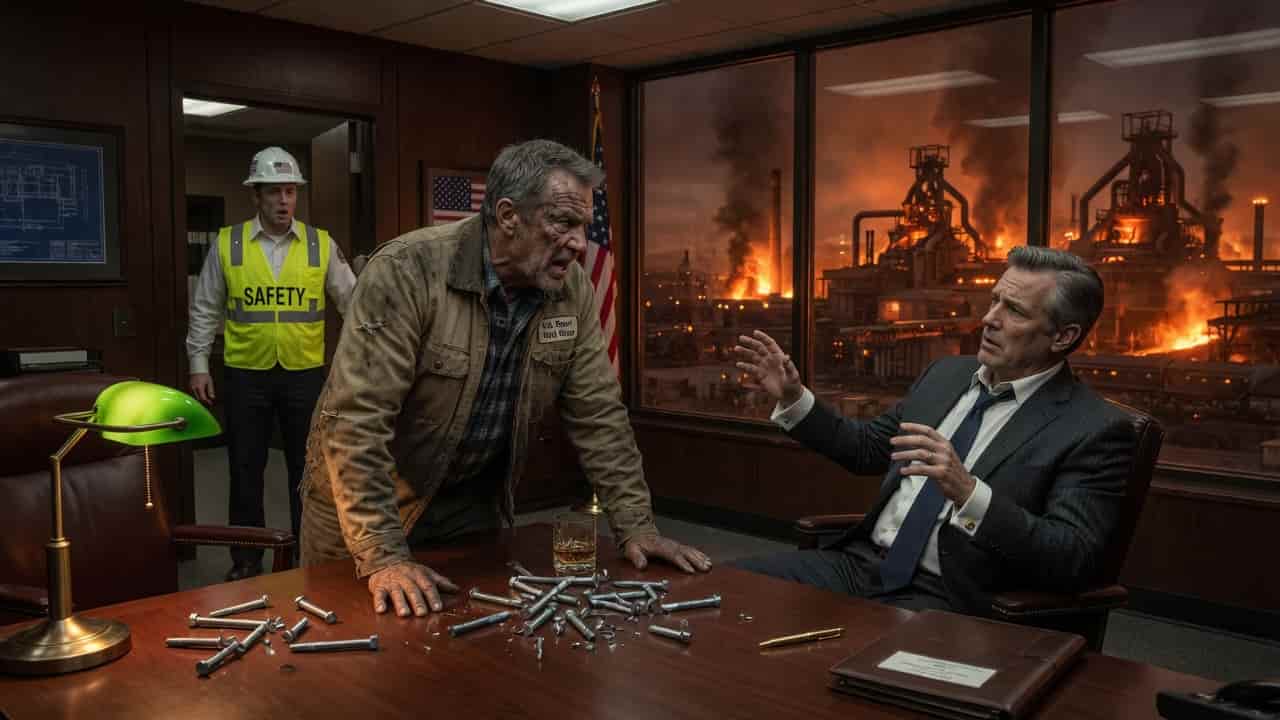
“You’re as broken as your son was, Elias. Just go home before I have security drag you out.”
Vance Sterling didn’t even look up from his gold-plated tablet. He sat in his glass office, sixty stories above the soot and the screaming machinery of the Gary steel mill, acting like the man standing in front of him was just another piece of outdated equipment.
Elias didn’t move. He didn’t shout. He just stood there in his oil-stained jacket, feeling the weight of the metal in his fist—the same metal he’d spent weeks carefully compromising in his garage. He looked at the man who had ordered the emergency shut-offs disabled just to hit a third-quarter quota. The man who had turned Elias’s son into a statistic.
“Look at the desk, Vance,” Elias said, his voice like grinding gravel.
Sterling sighed, finally looking up with a smirk of pure contempt. “I don’t have time for—”
CLANK.
Elias slammed his hand down, scattering the jagged, brittle shards of steel across the mahogany. They weren’t just scraps. They were the custom-grade bolts from the CEO’s private helipad—the ones Sterling thought were holding his world together.
“What is this trash?” Sterling hissed, his face reddening.
“That’s your legacy,” Elias whispered, leaning in until he could smell Sterling’s expensive cologne. “And it’s about to fall as fast as my boy did.”
The room went ice-cold as Sterling realized exactly what he was looking at.
Chapter 1: The Weight of the Heat
The air in Gary doesn’t move; it just vibrates. It’s a thick, sulfurous soup that sits in your lungs and tastes like copper and old Pennies. Elias stood on the gantry of Furnace Four, his boots vibrating with the rhythmic thrum of the rollers a hundred feet below. At sixty-two, the heat didn’t just make him sweat anymore; it made his bones ache, a deep, marrow-dry throb that reminded him he was made of the same carbon and iron as the slag he spent twelve hours a day directing.
He wiped a smear of grease across his forehead with a rag that was more dirt than fabric. Below him, the mill was a cathedral of fire. Great orange rivers of molten steel snaked through the darkness, casting long, dancing shadows against the corrugated steel walls. It was beautiful if you didn’t know what it could do to a man. If you hadn’t seen the way a splash of liquid metal could erase a person in the time it took to blink.
“Elias! Check the pressure on the three-line!”
The voice came from Leo, the safety officer. He was a kid, maybe twenty-four, with skin that hadn’t yet been cured by the furnace heat and a neon safety vest that looked absurdly clean against the grime of the shop floor. Leo was a good kid, but he carried a clipboard like a shield, as if a few checkmarks could stop the laws of physics from asserting themselves when the machinery got tired.
Elias didn’t answer right away. He just watched the flow. He knew the rhythm of Four better than he knew the sound of his own wife’s breathing before she’d passed. He knew when the bearings were screaming for oil and when the scrap mix was too heavy on the zinc.
“Pressure’s fine, Leo,” Elias said, his voice a low rumble that barely carried over the roar of the blowers. “It’s the sensors you should be worrying about. They’re sticking again.”
Leo climbed up the ladder, his movements hesitant. He stood next to Elias, looking out over the floor. “The office says the sensors are within spec. Vance Sterling is coming down for the walkthrough on Thursday. Everything has to be green on the dashboard.”
Elias felt a sharp, familiar knot tighten in his gut at the mention of the name. Vance Sterling. The man who owned the Apex Steel Group, the man whose face was plastered on the billboards for the new “sustainable” high-rise downtown, and the man who hadn’t stepped foot on this floor since the night the emergency shut-offs were bypassed.
“Spec doesn’t mean safe, kid,” Elias said. He turned to look at Leo. The boy’s eyes were darting around, avoiding the spot near the ladle tracks where the concrete was still a slightly different shade of grey. Everyone knew why. Nobody talked about it.
“I know,” Leo whispered, the clean line of his jaw tightening. “But my mom’s meds aren’t getting cheaper, Elias. I can’t be the one to flag the sensors again. Not after what happened to Miller.”
Miller had been the last inspector who tried to pull a red-tag. He’d been escorted out by security forty-eight hours later, his pension “re-evaluated” into nothingness.
“I’m not asking you to flag anything,” Elias said, turning back to the fire. “I’m just telling you. Don’t stand too close to the tracks when they’re pouring the high-carbon. The slag’s spitting more than usual.”
He left the kid standing there and started the long descent down the iron stairs. Every step was a reminder of Jamie. Jamie at twenty-two, laughing as he wiped a smudge of soot off his nose. Jamie, who had been the best of them—the one who was supposed to go to college, who was supposed to get out of the shadow of the smoke stacks.
Elias reached the floor and walked toward the breakroom, passing the massive rollers that crushed the slabs into sheets. The noise here was a physical weight, a rhythmic thump-hiss that timed itself to his heartbeat. He saw Miller, the corrupt OSHA inspector, sitting in the foreman’s shack, drinking coffee with the shift lead. They didn’t look at Elias. They knew he was a ghost. A man who stayed because he had nowhere else to go, and because the mill was the only place he could still feel the heat of the fire that had consumed his world.
He went to his locker and pulled out a dented tin lunchbox. Inside, tucked beneath a sandwich wrapped in wax paper, was a charred, half-melted hard hat. It was twisted, the plastic bubbled and blackened, the name JAMIE barely legible on the brim. Elias didn’t touch it. He just looked at it.
It had been eighteen months. Eighteen months since the “unfortunate industrial incident.” The official report said Jamie had been distracted, that he’d bypassed the safety gate himself to clear a jam. But Elias knew. He’d seen the maintenance logs before they vanished. He knew Sterling had ordered the line kept running despite the sensor failures. He knew the shut-offs had been jumpered out to save six hours of downtime.
A heavy hand landed on his shoulder. It was ‘One-Eye’ Jack, the crane operator. Jack had lost the eye to a snapped cable back in the nineties and had stayed on the payroll because he knew where all the bodies were buried—metaphorically, and in Gary, sometimes literally.
“Walkthrough’s in three days, Elias,” Jack said, his gravelly voice barely audible. “Sterling’s bringing the press. They’re talking about the ‘New Era of Steel.’ You gonna be okay?”
Elias closed the locker and turned the dial. “I’ll be fine, Jack. Just another shift.”
“Don’t do nothing stupid,” Jack warned, his one good eye searching Elias’s face. “Toby needs his grandpa. That boy’s the only thing you got left that isn’t made of rust.”
“I know,” Elias said.
But as he walked out of the mill and into the grey Indiana afternoon, his mind wasn’t on the grandson waiting for him at home. It was on the garage behind his small, sagging house. It was on the lathe he’d spent his life savings on, and the crate of high-strength aeronautical steel he’d smuggled out piece by piece over the last year.
The “New Era of Steel” was coming, alright. And Elias was the one who was going to make sure the foundations were exactly as strong as the promises Vance Sterling had made to his son.
He got into his rusted F-150, the engine groaning as it turned over. The drive home took him past the new Apex Tower. It was a needle of glass and chrome, stabbing up into the smoggy sky. It looked clean. It looked untouchable. On top, he could see the skeletal frame of the helipad, the place where Sterling would land every morning, looking down on the people who bled and burned to pay for his view.
Elias gripped the steering wheel until his knuckles went white. His son was dust. His son was a memory in a locker. But the bolts—the tiny, essential things that held the world together—those were something Elias understood. And in the dark of his garage, he was becoming a master of making them fail.
Chapter 2: The Garage
The garage smelled of cutting oil and cold resentment. It was a small space, tucked behind a house that had been built for a family of four and now only housed a man and his ghosts. Elias flicked on the overhead fluorescent lights. They flickered, humming with a low-frequency buzz that filled the silence.
He sat at the lathe, his hands moving with the practiced grace of a man who had spent forty years shaping metal. In front of him was a pile of bolts. To the untrained eye, they were beautiful—shining, heavy, and stamped with the Grade 8 certification marks required for structural aviation support. They were the exact specifications for the Apex Tower’s helipad.
Elias picked one up. He’d spent months studying heat treatment. He knew exactly how to make a bolt look perfect on the outside while turning its internal structure into something as brittle as dry glass. It was a delicate process: overheating the core, quenching it too fast in the wrong oil, and then polishing away the evidence.
He began the finish work on the final set. The lathe spun, a high-pitched whine that drowned out the sound of the wind rattling the garage door. As he worked, the memories came back, unbidden and sharp.
Jamie as a toddler, trying to lift a heavy wrench. Jamie at eighteen, telling Elias he wanted to follow him into the mill because “somebody’s got to keep the lights on in this town, Pop.”
Elias had tried to stop him. He’d begged him to take the scholarship to Purdue. But the mill has a way of pulling you in. It’s the gravity of the fire.
There was a soft knock on the side door. Elias froze, his hand hovering over the power switch. He quickly pulled a greasy rag over the pile of “spoiled” bolts and turned around.
The door opened, and a young woman stood there, holding a toddler who was rubbing sleep from his eyes. It was Sarah, Jamie’s widow. She looked tired, the kind of deep, permanent exhaustion that comes from working double shifts at the clinic and raising a two-year-old alone.
“Hey, Elias,” she said softly. “Toby wouldn’t go down. He kept asking for ‘Grampa’s garage.’”
The toddler, Toby, reached out his chubby arms, his face lighting up. “Broom! Broom!”
Elias felt the ice in his chest crack, just a little. He wiped his hands on his pants and took the boy, the small weight of him a sudden, painful contrast to the cold steel he’d been handling. Toby smelled like baby shampoo and graham crackers. He was the only thing in Elias’s life that didn’t smell like the mill.
“Hey there, little man,” Elias whispered, tucking the boy’s head into the crook of his neck. “What are you doing up so late?”
“You’re still working,” Sarah said, leaning against the doorframe. She looked at the lathe, then at the pile of metal under the rag. “The mill is taking enough from us, Elias. Don’t give it your nights, too.”
Elias didn’t look at her. “Just some side work, Sarah. A guy from the machine shop needs some custom fittings. It helps with the bills.”
It was a lie, and they both knew it. Elias hadn’t cared about bills since the funeral. He’d been selling off his furniture, his old tools, everything but the lathe and the truck.
“The lawyer called again,” Sarah said, her voice dropping. “The one from the union. He says Sterling’s people are offering a final settlement. If we sign the non-disclosure, it’s enough to put Toby through college. It’s enough for us to leave Gary.”
Elias felt a surge of heat, a flash of the furnace fire in his blood. “It’s blood money, Sarah. They want to buy your silence so they can keep killing kids like Jamie.”
“I know what it is!” Sarah snapped, her eyes suddenly wet. “But Jamie’s gone, Elias! Nothing we do is going to bring him back. And I’m looking at his son, and I’m seeing a boy who deserves a life that isn’t lived in the shadow of those stacks. If I take the money, we can go to Florida. My sister is there. There’s sunshine, Elias. There’s air you can actually breathe.”
Toby whimpered, sensing the tension. Elias bounced him gently, his eyes fixed on the blackened hard hat sitting on a shelf near the door.
“You do what you have to do, Sarah,” Elias said, his voice flat. “But I can’t sign it. I saw his face that night. I saw the way he looked at the floor while they were still pulling the slag out. He didn’t see a person. He saw a delay in the schedule.”
“He’s a monster, Elias. We know that. But monsters don’t lose. Not in the real world.”
Sarah took Toby back, her movements stiff. She looked at Elias with a mixture of pity and fear. “Please. Just come inside soon. It’s cold out here.”
She left, and the silence that followed was heavier than the noise of the lathe. Elias turned back to the workbench. He picked up one of the sabotaged bolts and held it under the light.
To the world, Vance Sterling was a visionary. To the world, the Apex Tower was a triumph of American engineering. But the world didn’t see the tiny fractures. They didn’t see the way the molecules had been forced into a state of permanent, hidden stress.
He thought about the helipad. He’d seen the blueprints—Sterling had insisted on a custom, cantilevered design so he could land his private chopper right outside his penthouse suite. It was a feat of ego, a thousand tons of steel held up by a few dozen high-strength fasteners.
Elias placed the bolt into the quenching tank. Toby deserves a life, Sarah had said.
Elias agreed. And he was going to make sure that the man who had stolen Jamie’s life would never have the chance to look down on Toby from sixty stories up.
He worked until the sun began to bleed a sickly grey over the Gary horizon. By dawn, the crate was full. Thirty-two bolts, each one a masterpiece of failure.
The walkthrough was in two days. He had the maintenance codes. He had the old uniform. And he had a debt that couldn’t be paid in settlements or sunshine.
As he turned off the lights, the garage was plunged into a cold, metallic darkness. He stood there for a moment, his breath hitching in his chest. He wasn’t a murderer. He told himself that every night. He was just a foreman, ensuring that the materials matched the man who bought them.
Brittle. Hollow. Ready to snap.
Chapter 3: The Humiliation
The day of the walkthrough was colder than usual, a biting wind whipping off Lake Michigan and carrying the scent of dead fish and industrial chemicals. The mill was a swarm of activity. The usual grime had been swept into the corners, and the safety lines had been repainted in a jarringly bright yellow.
Vance Sterling arrived in a motorcade of black SUVs that looked like predators in the grey dust of the parking lot. He stepped out, flanked by a phalanx of assistants, PR people, and the corrupt OSHA inspector, Miller, who was wearing a suit that cost more than Elias made in six months.
Elias stood with the rest of the crew near the main rollers. They’d been told to stand at attention, to look “productive but respectful.”
Sterling was exactly as Elias remembered him from the night of the accident. He was polished, his skin tanned and smooth, his hair perfectly coiffed despite the wind. He wore a high-end designer hard hat—pure white, without a single scratch—and a charcoal-grey suit that seemed to repel the soot of the mill.
“Gentlemen,” Sterling said, his voice amplified by a portable PA system one of his assistants was carrying. “Today, we aren’t just looking at a factory. We are looking at the heartbeat of the new American economy. The steel produced here in Gary is the skeleton of the Apex Tower. It is the strength of our future.”
He started walking down the line, nodding at the men as if they were prize cattle. When he reached the gantry of Furnace Four, he stopped. He looked up at the spot where Jamie had died.
“I know this facility has seen its share of challenges,” Sterling said, his voice dropping into a well-rehearsed tone of mock-solemnity. “We lost a good man here last year. A young man with a bright future.”
Elias felt the air leave his lungs. He stepped forward, his boots crunching on the grit.
“His name was Jamie,” Elias said.
The room went silent. The roar of the rollers seemed to dim as every eye turned to the old foreman.
Sterling turned, his eyes narrowing. He looked at Elias’s grease-stained jacket, then at his face. A flicker of recognition passed behind his eyes, followed quickly by a cold, sharp annoyance.
“Ah, Elias. The father,” Sterling said. He didn’t move toward him. He stayed in the center of his circle of suits. “I remember you. You were very vocal during the investigation.”
“I’m still vocal,” Elias said, his voice steady. “The sensors on Four are still sticking, Mr. Sterling. The safety gates on the lower track are being held open with zip-ties because the hydraulics are shot. You’re talking about the future, but you’re building it on the bodies of men you’ve already forgotten.”
Leo, the young safety officer, stood a few feet away, his face pale. He looked at the floor, his clipboard trembling in his hands.
Sterling smiled. It wasn’t a kind smile. it was the smile of a man who knew he owned the air everyone else was breathing. He walked closer to Elias, stopping just outside of arm’s reach.
“You see, this is the problem with the old guard,” Sterling said, turning back to the PR cameras. “They’re trapped in the past. They see a minor technical glitch and they turn it into a tragedy. They lack the vision to see the progress.”
He turned back to Elias, his voice dropping so only the men nearby could hear. “Your son didn’t die because of a sensor, Elias. He died because he was careless. He was slow. He was a product of a generation that doesn’t know how to keep up with the speed of modern industry. You’re just like him—broken, outdated, and full of excuses.”
The insult landed like a physical blow. Elias felt the heat of the furnace behind him, but it was nothing compared to the fire in his chest. He looked at Miller, the inspector, who was looking at his shoes. He looked at Jack, who was gripping his crane controls so hard his knuckles were white.
“Go home, Elias,” Sterling said, loud enough for everyone to hear now. “Take your pension and find a rocking chair where you can tell your stories to people who have time to listen. We’re building a world here. We don’t have room for ghosts.”
Sterling turned his back and continued the tour, laughing at something one of his assistants whispered.
Elias didn’t move. He stood there while the motorcade eventually pulled away. He stood there until the shift ended and the lights dimmed.
He didn’t go home. He waited until the night shift took over, until the chaos of the floor provided enough cover. He went to the maintenance locker, keyed in the code he’d seen Miller use, and pulled out the work orders for the Apex Tower.
He saw the schedule. The final structural inspection of the helipad was tomorrow morning. The final bolts were to be tightened by the third-party contractors before the grand opening ceremony on Saturday.
Elias went to his truck. In the back, hidden under a tarp, was the crate of brittle steel.
He drove to the downtown site. The tower was a skeleton of light against the black Lake Michigan sky. The security was tight, but Elias knew the rhythm of a construction site. He knew that at 2:00 AM, the guards were in the trailer drinking coffee and the freight elevators were often left on manual override for the late-night material deliveries.
He put on a high-vis vest, shouldered his tool bag, and stepped into the elevator.
As he rose, the city of Gary shrank below him. The fires of the mills looked like small, angry embers in the dark. By the time he reached the sixtieth floor, he was above the clouds.
The wind up here was a physical force, screaming through the exposed girders. Elias walked out onto the helipad. It was a beautiful, terrifying piece of engineering, jutting out over the abyss like a diving board for gods.
He knelt down and began his work. One by one, he backed out the genuine high-tensile bolts and replaced them with his masterpieces. He used a torque wrench, ensuring that every single one felt exactly right to the touch.
As he tightened the last bolt, he looked out over the edge. Far below, he could see the lights of the clinic where Sarah was working the night shift. He thought about Toby, sleeping in his crib.
“You said monsters don’t lose, Sarah,” Elias whispered into the wind.
He stood up, his bones aching, his heart a cold stone.
“But they sure as hell can fall.”
Chapter 4: The Tipping Point
The morning of the grand opening arrived with a cruel, brilliant sun. The sky was a hard, cold blue, and the glass of the Apex Tower shimmered like a diamond.
Elias stood in the lobby, his old suit cleaned but frayed at the cuffs. He had an invitation—a “legacy guest” pass sent out to the long-term employees of the mill. It was a PR move, a way to show that Sterling cared about the “roots” of his empire.
The lobby was filled with the elite of Chicago and Gary. Men in thousand-dollar shoes and women in furs, all sipping champagne and talking about “urban revitalization.”
Elias felt like a stain on the marble floor. He kept his hand in his jacket pocket, his fingers curled around a small, heavy object.
He saw Leo near the buffet, looking uncomfortable in a cheap suit. The boy saw Elias and made his way over, his eyes darting nervously.
“Elias, what are you doing here?” Leo whispered. “I thought you were done with this place.”
“Just watching the show, Leo,” Elias said. “Where’s the man of the hour?”
“Upstairs. The first flight is landing in twenty minutes. Sterling’s bringing in his family for the ribbon cutting. He wants the cameras to see him landing on his own building.”
Elias felt the floor tilt. “His family?”
“Yeah,” Leo said, grabbing a glass of water. “His daughter, Sarah. She just got back from school in London. He’s obsessed with her. Says she’s the real reason he built all this.”
Elias’s heart hammered against his ribs. Sarah. The name was like a ghost in his ear.
He looked at the digital display near the elevators. HELI-TRANSPORT: EST. ARRIVAL 10:15 AM.
Elias pushed past Leo, his mind racing. He hadn’t known about a daughter. He hadn’t known there was an innocent life on that flight. He’d pictured Sterling alone, or with his board of directors—men who were just as guilty as he was.
He lunged for the executive elevator, but a security guard stepped in his path.
“Pass, sir?”
Elias showed his legacy badge. The guard frowned, looking at Elias’s worn face and calloused hands. “This doesn’t give you access to the penthouse, pal. Lobby and ballroom only.”
“I need to talk to Sterling,” Elias said, his voice rising. “It’s about the safety specs on the pad. There’s a discrepancy.”
The guard’s radio crackled. “Eagle One is on approach. Clear the pad. Clear the pad.”
Elias didn’t think. He shoved the guard, a quick, powerful move he’d learned on the mill floor, and dived into the elevator as the doors were closing. He hit the button for the 60th floor.
The ride was agonizingly smooth. The numbers climbed—20… 30… 40…
He reached the top and the doors opened into the penthouse office. It was a cathedral of ego. Glass walls, white leather, and Vance Sterling standing near the window, a radio in his hand, a look of pure, predatory joy on his face.
“Eagle One, you are clear for touchdown. Welcome home, baby girl.”
Elias stepped out, his boots loud on the polished floor.
Sterling turned, his smile vanishing instantly. “How the hell did you get up here? Security!”
“Tell the pilot to wave off, Vance,” Elias said. He was panting, his chest burning.
Sterling laughed, a sharp, cold sound. “You really are losing it, aren’t you? You think you can just walk in here and stop my daughter’s homecoming because you’re still crying about your son?”
“The bolts, Vance,” Elias said, stepping closer. He pulled the object from his pocket—one of the genuine bolts he’d removed. “I replaced them. The ones on the north cantilever. They’re heat-treated fakes. They’re brittle. They won’t hold the weight of a bird, let alone a Sikorsky.”
Sterling’s face went from anger to confusion, then to a dark, dangerous amusement. “You’re lying. You’re just a pathetic old man trying to scare me. My contractors signed off on those yesterday.”
“I was here after they left,” Elias said.
Outside the window, the roar of a helicopter grew louder. A sleek, white chopper appeared, banking gracefully toward the cantilevered pad.
Sterling looked at the helicopter, then back at Elias. He saw the genuine bolt in Elias’s hand. He saw the look in the old man’s eyes—not fear, but a terrible, weary truth.
“You’re as broken as your son was, Elias,” Sterling hissed, grabbing Elias by the collar. “You’re bluffing. You wouldn’t kill a girl.”
“I’m not killing her, Vance. You are. You built a world on lies and cheap steel. I just gave you exactly what you paid for.”
Sterling looked at the helicopter. It was hovering just feet above the pad now. He looked at the bolts visible on the edge of the frame. He saw the jagged, brittle texture he’d seen a thousand times on the mill floor when a pour went wrong.
He lunged for the radio. “Eagle One! Wave off! Wave off!”
But the wind was screaming, and the pilot was already committed. The skids touched the metal.
SNAP.
The sound was like a gunshot, echoing through the glass office. Then another. And another.
The north side of the pad groaned, a deep, metallic scream of agony. The helicopter tilted, its blades clipping the edge of the tower, sending a shower of sparks into the blue Indiana sky.
Elias stood there, watching the man he hated most in the world drop to his knees, screaming his daughter’s name as the steel he’d stolen Jamie’s life to build began to fail.
The residues of the fire were finally coming home.
Chapter 5: The Screaming of the Steel
The sound of a structural failure at sixty stories is not a single noise. It is a symphony of industrial agony. It started with the sharp, rhythmic crack-crack-crack of the brittle bolts Elias had manufactured, followed by the deep, subsonic groan of the cantilevered steel beams as they lost their purchase. Then came the high-pitched, metallic shriek of the helicopter’s rotor blades as they bit into the side of the Apex Tower, spraying a fountain of white-hot sparks and shredded aluminum into the freezing Indiana sky.
In the penthouse office, the world tilted. A floor-to-ceiling glass panel shattered, the vacuum of the high-altitude wind howling into the room like a physical beast. It sucked the blueprints off the mahogany desk and sent a cloud of expensive stationery swirling into the abyss.
Vance Sterling was no longer a CEO. He was a man stripped of his tailored charcoal suit and his billion-dollar poise. He was a father on his hands and knees, crawling toward the jagged edge of the helipad, his fingers clawing at the white marble floor.
“Sarah!” he screamed, but the wind tore the name from his lips and tossed it away.
The Sikorsky was perched precariously on the edge of the collapsing pad. One skid was hooked into a twisted railing; the other hung over the emptiness. The engine was still whining, a dying mechanical beast, and fuel was beginning to leak, a shimmering rainbow of kerosene dripping down the glass face of the building toward the streets of Gary below.
Elias stood in the center of the office, his boots planted firmly as the wind whipped his tan canvas jacket. He looked at the scene with a cold, detached clarity. This was what he had built. This was the precise mechanical outcome of his grief. The math was perfect. The metal had failed exactly where it was meant to fail.
But then he saw her.
Through the cracked windshield of the helicopter, he saw a young woman. She was pinned against the door by the tilt of the craft. Her face was a mask of pure, unadulterated terror—eyes wide, mouth open in a scream he couldn’t hear. She looked nothing like Vance Sterling. She looked like Jamie. She had the same desperate, wide-eyed realization that the world she had been promised was suddenly, violently, coming to an end.
Sterling reached the edge of the glass. He looked down at the helicopter, which was vibrating with the strain of the failing beams.
“Elias!” Sterling turned, his face contorted, tears carving tracks through the dust on his skin. “The cable! The emergency tether in the corner—it’s manual! You know how to rig it! Please!”
Elias didn’t move. He looked at the bolt in his hand—the genuine, high-tensile steel he’d kept in his pocket. It felt heavy. It felt like a verdict.
“Why should I?” Elias’s voice was low, but it cut through the roar of the wind. “You told me to go home, Vance. You told me the world didn’t have room for ghosts. Maybe it’s time for some new ones.”
“She’s twenty-two!” Sterling shrieked, his voice breaking into a sob. “She hasn’t done anything! She doesn’t even know about the mill! Elias, please, I’ll give you anything. The company, the money, the truth—I’ll sign whatever you want!”
“You already signed it,” Elias said. “You signed it the night you bypassed the sensors on Four. You signed it when you told me my son was a statistic because he was ‘slow.’”
The helicopter shifted. A secondary support beam snapped with the sound of a falling redwood. The craft slid another six inches toward the edge. Inside, the girl—Sarah—pressed her palm against the glass. She was looking right at Elias.
In that moment, the ghost of Jamie didn’t feel like a weight. It felt like a mirror.
Elias looked at the girl and didn’t see Sterling’s legacy. He saw a person who was about to become dust because of two men who couldn’t stop playing god with steel and fire. If he let her fall, he wasn’t avenging Jamie. He was just finishing Sterling’s work. He was proving that life really was just a calculation of stress and failure.
“Leo!” Elias roared, turning toward the elevator bank.
The young safety officer was huddled against the far wall, his hands over his ears. He looked up, his eyes glassy with shock.
“Leo, get over here!” Elias lunged for the kid, grabbing him by the shoulder and dragging him toward the maintenance locker in the corner of the office. “The manual winch for the window-washing rig—it’s on the same structural spine as the pad. It hasn’t been sabotaged. Grab the harness!”
“I… I can’t,” Leo stammered, his teeth chattering. “The height, Elias… I’m not certified for—”
“Forget the certification!” Elias slammed the kid against the locker. “You wanted to save people, right? You wanted to be more than a clipboard? This is it. This is the only time it matters. Grab the damn harness!”
Leo’s eyes cleared for a second. He nodded, his movements jerky as he fumbled with the heavy nylon straps.
Elias turned back to the edge. He grabbed a heavy steel grappling hook from the locker and began wrapping a high-tensile cable around the main structural pillar of the penthouse. His hands, gnarled and scarred by forty years in the mill, moved with a speed and precision that defied his age. He wasn’t thinking about revenge anymore. He was back on the floor, clearing a jam, fighting the machinery to save a life.
“Vance, get back!” Elias shoved the CEO aside.
Elias stepped out onto the groaning metal of the helipad. The wind tried to tear him off, pushing him toward the sixty-story drop. He could feel the vibration of the failing bolts beneath his feet. He knew exactly how many seconds he had before the entire north cantilever gave way. It was a matter of resonance.
He crawled toward the helicopter, the cable trailing behind him.
“Sarah!” he yelled as he reached the door.
The girl looked at him, her breath fogging the glass. He saw the name on her locket: Sarah.
“I’m going to break the glass!” Elias signaled for her to shield her eyes. He took the heavy bolt from his pocket—the one meant for the tower’s strength—and used it as a punch. He slammed it into the corner of the reinforced acrylic.
The glass spider-webbed, then shattered inward.
The smell of aviation fuel was overwhelming now, thick and cloying. Elias reached in and grabbed the girl’s hand. Her skin was ice cold.
“Come on, girl! Move!”
He hauled her out of the cockpit just as the helicopter’s engine gave one final, dying cough and died. The sudden shift in weight caused the pad to lurch.
“Elias!” Leo’s voice came from the office. “It’s going! The main spar is buckling!”
Elias threw the harness over Sarah, clipping her into the winch cable. “Go! Pull her in!”
Leo engaged the winch. The cable snapped taut, dragging the girl across the metal and into the safety of the penthouse.
Elias turned to follow, but he felt the world go soft beneath him. The last of the brittle bolts—the ones he had made with such careful, hateful precision—snapped simultaneously.
The north side of the helipad dropped away.
Elias lunged for the edge of the permanent floor. His fingers caught the jagged lip of the marble just as the thousand-ton slab of steel vanished into the clouds. He hung there, his legs dangling in the empty air, the wind screaming past him.
He looked up.
Vance Sterling was standing there. He had his daughter in his arms, clutching her so tight she was gasping for air. He looked down at Elias, hanging from the edge of his empire.
For a long, terrible second, Sterling didn’t move. He looked at the man who had tried to destroy him. He looked at the man who had just saved the only thing he actually loved. The arrogance was gone, replaced by a raw, naked horror at the cost of his own life.
“Grab him!” Leo screamed, rushing forward.
Sterling didn’t wait for Leo. He dropped to his chest, reaching his hand down over the edge. His expensive suit sleeve tore against the broken glass.
“Take my hand!” Sterling roared.
Elias looked at the CEO’s hand. It was soft. It was clean. It was the hand that had signed the orders that killed Jamie.
Elias almost let go. He felt the weight of his sixty-two years, the weight of the soot in his lungs and the grief in his heart. It would be so easy to just slip away, to join Jamie in the quiet ash of the past.
But then he thought about Toby. He thought about the boy waiting for his grandpa to come home from the garage. He thought about the look on Sarah’s face—his Sarah, Jamie’s Sarah—when she talked about the sunshine in Florida.
He reached up and gripped Sterling’s hand.
It was a clumsy, desperate anchor. Sterling pulled with everything he had, his face turning a deep, vein-popping purple. Leo grabbed Elias’s belt, and together, they hauled the old foreman back over the threshold and onto the solid, unmoving floor of the office.
Elias lay there, gasping, the cold air burning his throat. He could hear the sound of sirens rising from the streets below—thousands of them, a city-wide response to the collapse.
Vance Sterling sat back against his mahogany desk, his daughter shivering in his lap. He looked at the shattered window, at the empty space where his helipad used to be.
“You did it,” Sterling whispered, his voice trembling. “You proved it.”
Elias sat up slowly, wiping a smear of blood from his cheek. He reached into his pocket and pulled out the very last bolt. It was the genuine one. The one that was supposed to hold the world together.
He tossed it onto the desk. It rolled across the polished wood and stopped against Sterling’s gold tablet.
“It’s not the steel that fails, Vance,” Elias said, his voice as cold as the wind. “It’s the men who use it.”
He stood up, his bones screaming in protest. He didn’t look at the helicopter wreckage falling through the sky. He didn’t look at the cameras that were undoubtedly hovering in the distance.
He walked toward the elevator.
“Where are you going?” Sterling called out.
Elias didn’t stop. “I’m going to the mill. I have a locker to clean out.”
As the elevator doors closed, the silence in the penthouse was heavier than the roar of the wind. The residue of the fire was everywhere—in the broken glass, in the spilled fuel, and in the eyes of a man who realized he had built a monument to himself out of nothing but brittle, hollow promises.
Chapter 6: The Residue of the Fire
The fallout wasn’t quick. In the world of high-stakes construction and industrial negligence, the truth is something that has to be ground out of the gears, one tooth at a time.
Three weeks after the “Apex Incident,” the steel mill in Gary was quiet. It wasn’t the silence of a holiday; it was the silence of a tomb. The gates were chained, and the massive blowers of Furnace Four had finally stopped their rhythmic thrum. The EPA and a dozen federal agencies had descended like locusts, triggered by the structural failure of the tower and the subsequent “leak” of maintenance logs that Leo, the safety officer, had hand-delivered to the Gary PD.
Elias sat on the back porch of his sagging house, watching the sun set behind the smoke stacks. The air was clearer than he’d ever seen it, which only made the town look more skeletal. Without the haze of the sulfur, you could see the rust on everything.
There was a crunch of gravel in the driveway. A black SUV pulled up—not a fleet this time, just one.
Elias didn’t get up. He didn’t even turn his head when he heard the car door close and the heavy, hesitant footsteps of someone walking through the overgrown grass.
Vance Sterling stepped into the light of the porch lamp. He looked different. The charcoal suits were gone, replaced by a simple navy windbreaker and jeans. His face was thinner, the skin under his eyes sagging. He looked like a man who hadn’t slept since the day the sky fell.
“The lawyers told me not to come here,” Sterling said, stopping at the bottom of the porch steps.
“Lawyers usually have the right idea,” Elias replied. “You’re trespassing, Vance.”
“I’m not here as the CEO of Apex. There is no Apex anymore. The board liquidated the assets this morning to cover the class-action from the mill workers. I’m broke, Elias. Or as close to it as a man like me can get.”
Elias finally looked at him. “You want a medal? Or a glass of water?”
Sterling didn’t flinch. He reached into his pocket and pulled out a small, blue envelope. “I found this in my daughter’s room. She wrote it a week ago. She’s… she’s not the same, Elias. She won’t go near a tall building. She won’t even get in an elevator. She says the sound of the metal is always in her head.”
He laid the envelope on the porch railing.
“She wanted me to tell you thank you. And she wanted you to know that she testified at the grand jury. She told them everything she saw in that office. She told them what you said about the sensors.”
Elias looked at the envelope but didn’t touch it. “She’s a good girl, Vance. You should have kept her further away from you.”
Sterling nodded, a slow, painful movement. “I know. I realized that when I was holding her hand over sixty stories of nothing. I looked at the tower, and I didn’t see a legacy. I saw a pile of junk. I saw a grave I’d spent twenty years digging for my own family.”
He stepped back into the shadows of the yard. “The settlement for your daughter-in-law went through. The real one. Not the one with the non-disclosure. It’s enough for the boy. It’s enough for all of you.”
“I don’t want your money, Vance.”
“It’s not my money. It’s the insurance payout from the fraud investigation. It’s the money that was supposed to go into the safety gates three years ago. It’s just… returning to the source.”
Sterling turned to leave, then stopped. He looked back at Elias, his expression unreadable. “Why did you do it, Elias? You could have let her fall. You had the perfect revenge. Nobody would have ever known the bolts were yours. They would have just blamed the contractors.”
Elias stood up, his joints popping in the quiet evening air. He walked to the edge of the porch and looked out at the dead mill.
“Because if I let her fall, I would have been just like you,” Elias said. “I would have been a man who thinks people are just materials to be used up. And I couldn’t go to my grave knowing I was the last thing that failed Jamie.”
Sterling stood there for a long time, the weight of the silence between them like a physical pressure. Then, without another word, he got back into his SUV and drove away, the taillights disappearing into the Gary gloom.
Elias picked up the blue envelope. He didn’t open it. He walked inside the house, where the air was warm and smelled of frying onions.
Sarah was in the kitchen, packing boxes. Toby was on the floor, playing with a set of plastic blocks, trying to build a tower that kept falling over.
“He was here, wasn’t he?” Sarah asked, not looking up from the crate she was filling.
“He was here,” Elias said. He laid the envelope on the counter. “It’s over, Sarah. The settlement is cleared. The mill is staying closed.”
Sarah stopped what she was doing. She leaned against the counter, her shoulders dropping as a year of tension finally began to bleed out of her. She looked at the boxes, then at Elias.
“We’re leaving on Tuesday,” she said. “The house in Florida… the one near the coast. I put a deposit down. There’s a yard for Toby. There are trees that aren’t covered in soot.”
Elias looked around the kitchen. This house was full of Jamie. His height marks were on the pantry door. His old baseball trophies were in the cabinet. It was a museum of a life that had been cut short.
“You go, Sarah,” Elias said softly. “You take the boy and you run. You don’t look back at this place. Not even once.”
Sarah walked over and took his hand. Her grip was strong, the grip of a woman who had survived the worst the world could throw at her. “Elias, come with us. There’s room. Toby needs his grandpa.”
Elias looked at his hands—the permanent grease under the nails, the scars from the sparks, the tremors that wouldn’t go away. He was a man of the mill. He was made of Gary iron and Indiana ash. If he went to the beach, he’d just be a piece of industrial scrap in the sand.
“I’ll come visit, Sarah. I promise. But I have some things to finish here first.”
“What things?”
“The mill,” Elias said. “They’re going to tear it down. They’re calling for bids on the demolition. I think… I think I’d like to be the one to press the button. I want to see Furnace Four turn into a pile of bricks.”
Sarah looked at him for a long time, then she nodded. She understood. Some fires don’t go out until you bury the hearth.
On Tuesday morning, Elias stood in the driveway and watched the U-Haul pull away. Toby waved from the back window, his small hand pressed against the glass, a bright spot of life in the grey neighborhood.
Elias waved back until the truck turned the corner and was gone.
He went into the garage one last time. He looked at the lathe. He looked at the scraps of steel on the floor. He picked up the charred hard hat—Jamie’s hat—and held it to his chest.
He didn’t feel the rage anymore. He didn’t feel the cold, sharp need for the world to break. He just felt tired. A deep, honest tiredness that comes from a long shift finally coming to an end.
He took the hard hat and walked out to the truck.
He drove down to the lakefront, to the small park where he used to take Jamie to fish when the mill was down for maintenance. The water was grey and choppy, the waves hitting the rocks with a rhythmic thump-hiss that sounded like the old rollers.
He walked out onto the pier. The wind was cold, but it felt clean.
He looked toward the horizon. In the distance, he could see the silhouette of the Apex Tower. It was still there, but it was dark. No lights in the penthouse. No helicopters on the roof. It was just a hollow shell, a monument to a man who had forgotten that even the strongest steel has a breaking point.
Elias took the hard hat and placed it on a rock near the water. He didn’t say a prayer. He didn’t make a speech. He just turned his back on the tower and the mill and the fire.
He got into his truck and started the engine. It groaned, a familiar, industrial sound, but it held.
He put the truck in gear and started driving south. He didn’t have a map, and he didn’t have a plan. He just kept his eyes on the road, watching the grey of Gary fade into the green of the open fields.
The residue of the fire was still there, in his lungs and in his memories. But for the first time in eighteen months, Elias felt like he was moving at exactly the right speed.
He wasn’t a ghost anymore. He was just a man, driving toward the sun, carrying the only thing that hadn’t snapped—the truth of who he was, and the weight of the life he had managed to protect.
The road ahead wasn’t certain, but it was open. And in the rearview mirror, the smoke stacks were finally, beautifully, silent.