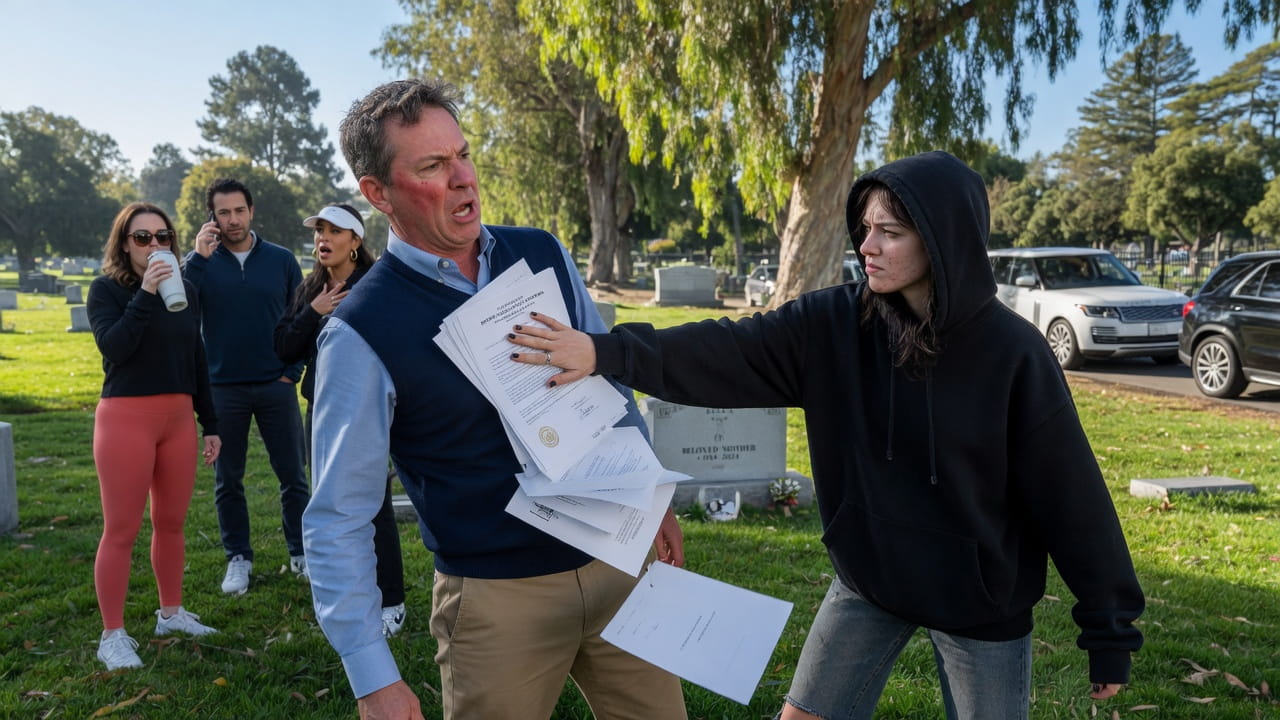
“Get your hands off that headstone!”
Paul’s voice carried across the quiet rows of Oak Hill, sharp enough to make the three mothers from the fundraising committee stop their weeding. He was the Principal of the Year, the man who had carried his wife Nora’s casket with a dignity that made half the town cry. Seeing a girl in a dirty hoodie hovering near Nora’s marble marker felt like a physical violation.
But the girl didn’t run. She didn’t even look scared.
As Paul reached her, face flushed with the kind of righteous authority he used on rowdy seniors, the girl reached into her jacket. She didn’t pull out a weapon. She pulled out a stack of documents bound by a heavy-duty clip and slammed them into Paul’s chest with enough force to knock the air out of him.
“She wasn’t a saint, Paul,” the girl said, her voice loud enough for the PTA president to hear every syllable. “She was a coward. She told you my father died in a crash because she didn’t want a convict’s blood in her perfect house. She signed me over to the state the day after the funeral.”
Paul gripped the papers, his fingers shaking as he saw the letterhead. Department of Child and Family Services: Voluntary Relinquishment of Parental Rights. Below it, in the elegant, looping cursive he’d seen on a thousand grocery lists and anniversary cards, was Nora’s signature.
The silence from the women behind him felt like a heavy weight pressing into his back. The girl leaned in, her eyes hard and dry. “She threw me away so she could marry a man with a clean reputation. How does that reputation feel now?”
Chapter 1
The morning air in Rolling Hills always smelled like expensive mulch and damp eucalyptus. It was a clean, curated smell, the kind of scent that suggested nothing bad ever happened here because the homeowners’ association wouldn’t allow it. Paul Brenner stood by the cemetery’s wrought-iron gates, checking his reflection in the window of his Volvo. He adjusted his navy sweater vest, smoothing the fabric over a stomach that was just beginning to betray his forty-eight years.
He looked like exactly what he was: a man who held the keys to the future. As the principal of Rolling Hills High, Paul wasn’t just an educator; he was a gatekeeper. He was the one who signed the recommendations for Stanford and Yale, the one who mediated between warring tiger moms and the school board.
“Paul! Over here!”
Mayor Higgins waved a gloved hand from the shade of a massive oak tree. The mayor was wearing a pristine “Volunteer Day” t-shirt that looked like it had never seen a speck of dirt. Beside him stood Sarah Gable, the PTA president, her blonde ponytail swinging as she organized the flats of marigolds.
“Morning, Art. Sarah,” Paul said, falling into his practiced stride. It was a walk that projected calm, empathy, and absolute control. “Beautiful turnout. Nora would have loved this. She always said the cemetery was the heart of the community’s history.”
A soft, sympathetic murmur went through the small group of parents nearby. Nora had been gone for two years, but her shadow was still the most graceful thing in town. She’d been the principal’s wife, the volunteer coordinator at the library, the woman who made grief look like a quiet, dignified art form. When she’d died of a sudden, aggressive lymphoma, the town had practically gone into mourning for six months. Paul had become the “Sacred Widower,” a role he wore with a mixture of genuine sorrow and a subtle, polished pride.
“We’re starting at the east wall today, Paul,” Sarah Gable said, her eyes lingering on him with that specific look of pity he’d grown accustomed to. “We thought we’d leave Nora’s section for you. For privacy.”
“I appreciate that, Sarah. Truly.”
He picked up a hand trowel and a bag of premium soil. He liked the work. It felt like maintenance, and Paul was a man who believed in maintenance. You maintained your lawn, you maintained your school’s test scores, and you maintained your wife’s memory.
He walked toward the north quadrant, the section where the newer marble markers caught the morning light. As he approached Nora’s plot, he felt the usual tightening in his chest—a localized grief that he managed like a budget deficit.
But then he saw her.
A girl was standing directly over Nora’s grave. She wasn’t one of his students; he knew every face in his hallway. This girl was thin, wearing a black hoodie that was too big for her frame and jeans that were frayed at the hems. She was hunched over, her hand moving against the white marble of Nora’s headstone.
Paul’s pace quickened. The “Principal Brenner” voice, the one he used to stop fights in the cafeteria, rose in his throat.
“Hey! Excuse me!”
The girl didn’t jump. She didn’t even flinch. She just continued whatever she was doing. As Paul got closer, he saw the black tip of a permanent marker in her hand. She was scrawling something across the pristine face of the stone.
“I said get away from there!” Paul shouted. The calm, managed widower vanished, replaced by a man seeing his sanctuary defiled.
The girl finally turned. Her face was pale, almost gray in the harsh light, with dark circles under her eyes that made her look thirty instead of eighteen. She looked at him with a flat, hollow expression that chilled his blood.
“Is this yours?” she asked. Her voice was raspy, like she hadn’t used it in days.
“That is my wife’s grave,” Paul snarled, reaching out to grab her arm. He was aware, in a peripheral, panicked way, that Sarah Gable and the Mayor were watching from fifty yards away. They were dropping their shovels, moving toward the commotion. “You’re defacing private property. I’m calling the police.”
The girl didn’t pull away. She leaned into him, her jaw set. “Your wife? The one everyone says was such a saint? The one who did all that charity work?”
“Get out,” Paul hissed, his fingers tightening on the sleeve of her hoodie.
“She wasn’t a saint, Paul,” the girl said. She reached into the front pocket of her hoodie and pulled out a thick stack of papers held together by a heavy black binder clip. She didn’t hand them to him. She slammed them against his chest, right over his heart, with a force that made the clip bite into his skin. “She was a liar. And she was a thief.”
Paul instinctively caught the papers as they began to slide. His eyes darted to the top page. It was a legal document. A state seal. Department of Child and Family Services. “What is this?” he asked, his voice losing its edge, replaced by a sudden, cold hollow in his stomach.
“Paul? Is everything okay?” Mayor Higgins was ten feet away now, his face a mask of concern that was rapidly shifting into social alarm. Sarah Gable was right behind him, her eyes wide as she took in the girl’s ragged appearance and the graffiti on the headstone.
The girl didn’t look at the Mayor. She kept her eyes locked on Paul’s.
“Nora told you her brother died in a car crash in 2006, didn’t she?” the girl asked. Her voice was rising, vibrating with a decade’s worth of pressurized rage. “She told you there was no family left. No one to take in his kid.”
Paul felt the air leave the room, even though they were standing in an open field. “Yes. Silas. He died in… in Humboldt.”
“Silas didn’t die in a crash, Paul,” the girl spat. “He went to Pelican Bay for ten years. And he left behind a three-year-old daughter. My name is Chloe. I’m your niece, you arrogant prick.”
A gasp broke from Sarah Gable. Paul felt the world tilt. The papers in his hand felt like they weighed fifty pounds. He looked down, his eyes scanning the lines of the document. Voluntary Relinquishment of Parental Rights. I, Nora Brenner (née Vance), being of sound mind, do hereby surrender all rights, claims, and responsibilities regarding the minor child, Chloe Vance…
“She signed me over to the state the week after you guys got back from your honeymoon,” Chloe said, her voice cracking for the first time. “She told the social worker she was ‘starting a new life’ and couldn’t have the stigma of a convict’s child in her home. She told you I didn’t exist.”
Paul looked at the signature. He’d know that N anywhere. The way the r trailed off into a graceful little hook. It was the same signature that was on their marriage license. The same one on the deed to their four-bedroom colonial.
“This… this can’t be real,” Paul whispered. He looked at Mayor Higgins, whose face had gone pale. The Mayor was looking at the grave, then at Paul, then at the girl. The social hierarchy of Rolling Hills was screaming in Paul’s ears, telling him to fix this, to call it a prank, to protect the image.
“It’s real,” a new voice said.
A woman walked out from behind a line of cypress trees. She was in her mid-fifties, wearing a worn denim jacket and smoking a cigarette in defiance of the cemetery rules. She had the hard, leathery skin of someone who had spent her life working outdoors and a look of deep, settled exhaustion.
“I’m Rita,” the woman said, flicking ash onto the gravel. “I’m the one who picked up the pieces after your ‘saint’ of a wife threw that baby into the system. Chloe’s been in my house since she was six. And she’s done being a secret.”
Paul looked back at the headstone. The marker Chloe had used had left a thick, black word across the white marble of Nora’s name.
COWARD.
“Paul?” Sarah Gable’s voice was small, horrified. “Paul, what is she talking about?”
Paul didn’t answer. He couldn’t. He was looking at Chloe—at the curve of her jaw, the specific, piercing blue of her eyes. They were Nora’s eyes. They were the eyes he’d woken up to for fifteen years.
He looked at the papers, then at the women who ran his town, and for the first time in his professional life, the Principal of Rolling Hills High had absolutely nothing to say.
Chapter 2
The drive back from the cemetery was a blur of gray asphalt and the frantic, rhythmic ticking of Paul’s turn signal. He had left the cleanup drive in a state of clinical shock, mumbling something about a “misunderstanding” to Mayor Higgins that sounded pathetic even to his own ears.
Rita and Chloe had disappeared into a rusted-out Ford F-150, but not before Rita had leaned out the window and told Paul they were staying at the Budget Inn on the edge of the county line. “We’ll give you two hours to read those papers, Principal,” she’d said. “Then we’re coming to your house.”
Now, Paul sat in his kitchen, the granite countertops gleaming under the designer pendant lights. The house was silent, as it usually was since Nora died, but today the silence felt predatory. It felt like it was waiting for him to admit what he was looking at.
The stack of papers sat on the kitchen island. He’d spread them out like a deck of cards.
There was a birth certificate: Chloe Elizabeth Vance. Mother: Deceased. Father: Silas Vance. There were intake forms from a foster agency in Redding.
There was a letter, handwritten on the stationery of the hotel where he and Nora had spent their honeymoon in Maui.
He picked up the letter. His heart was hammering against his ribs, a dull, thudding pain.
To whom it may concern at the Department of Child Services, the letter began. I am writing to confirm my decision. My husband is a man of significant standing in our community. He has a vision for our future that involves a certain… standard of life. Bringing a child with my brother’s history into our home would be a catastrophe for his career and our marriage. I trust the state will find a suitable placement. Please do not contact me at my home address again.
Paul dropped the letter as if it had turned red-hot.
He remembered that honeymoon. He remembered Nora sitting on the balcony of their suite, her hair blowing in the Pacific breeze, writing in her journal. He’d asked her what she was working on, and she’d smiled—that perfect, radiant smile that made him feel like the luckiest man in California—and said she was just writing down her dreams for their life together.
She hadn’t been writing dreams. She’d been negotiating the disposal of a three-year-old girl.
The phone on the counter buzzed. It was a text from Sarah Gable.
Paul, we’re all so confused. The women are talking. Is everything okay? Who was that girl? Please tell us this is some kind of sick scam.
He didn’t reply. He couldn’t. If he told the truth, the “Principal of the Year” was dead. If he lied, he was a monster.
He walked into the living room, his eyes scanning the framed photos on the mantel. Nora at the library fundraiser. Nora at the school gala. Nora at the beach. In every photo, she looked like a masterpiece of American womanhood—graceful, kind, impeccable.
“You did this,” he whispered to the empty room. “You let me believe he was dead.”
He remembered the night Nora had told him about Silas. They’d been dating for six months. She’d cried into his shoulder, telling him her only brother had been killed in a head-on collision on I-5. She’d said she was all alone in the world now. Paul had held her, promising he would be her family, that he would protect her from ever feeling that kind of loss again.
He’d built his entire identity on that promise. He was the protector. The man who saved the girl.
He went to the liquor cabinet and poured four fingers of Scotch. He didn’t usually drink before dinner, but the room was spinning. He swallowed the burning liquid and looked back at the kitchen island.
The documents were a map of a parallel life. While he and Nora had been hosting faculty dinners and choosing paint swatches for the guest room, a girl had been moving from one foster home to another. According to the records, Chloe had been in four different placements before landing with Rita when she was six.
He thought about the “Nora Brenner Scholarship for At-Risk Youth” he’d established after her funeral. The irony was so thick it felt like he was choking on it.
A heavy knock sounded at the front door.
Paul froze. He looked at the clock. It had been exactly two hours. He wiped his mouth with the back of his hand, straightened his vest out of habit, and walked to the door.
When he opened it, Rita was standing there, her denim jacket smelling of cheap tobacco. Chloe was behind her, staring at the manicured lawn of the colonial across the street with a look of pure, unadulterated loathing.
“Nice place,” Rita said, pushing past him without waiting for an invitation. “Lots of rooms. I bet one of them would have been real nice for a toddler.”
“Please,” Paul said, his voice cracking. “Just… sit down. Let’s talk about this quietly.”
“Quietly?” Chloe snapped, spinning around to face him. She didn’t come into the house; she stayed on the threshold, as if the air inside were toxic. “You want to talk about this quietly so your neighbors don’t hear? So the Mayor doesn’t find out his favorite principal is living in a house built on my life?”
“Chloe, I didn’t know,” Paul said, his hands out in a pleading gesture. “I swear to you. On everything I hold sacred, I thought your father was dead. I thought there was no one else.”
“And you never checked?” Rita asked, sitting on the edge of Paul’s expensive leather sofa. She looked out of place, a jagged rock in a room full of silk and polished wood. “You’re a principal. You handle records for a living. You never asked for a death certificate? You never looked into her family history?”
Paul sank into the armchair opposite her. The Scotch was making his head heavy. “She was my wife. I loved her. Why would I think she was lying about something like that?”
“Because it was convenient,” Chloe said, stepping into the foyer now. She walked over to the mantel and picked up a silver-framed photo of Nora. “She knew what you wanted, Paul. You wanted the perfect wife for the perfect principal. You wanted the trophy. And she knew I was a dent in the metal.”
She looked at the photo, then back at Paul. Her eyes were wet now, but her voice was like ice.
“I spent my tenth birthday in a group home because Rita was in the hospital with a broken hip,” Chloe said. “I sat on a plastic chair and cried for my aunt. I remembered her, you know? I remembered her perfume. I remembered her singing to me before the police took my dad away. I thought she was looking for me. I thought she just hadn’t found me yet.”
Paul looked down at his feet. The shame was a physical weight, pressing his chin toward his chest.
“She wasn’t looking for you, honey,” Rita said softly, looking at Chloe. “She was busy being the First Lady of Rolling Hills.”
Rita turned back to Paul. “We didn’t come here for an apology, Mr. Brenner. We don’t want your Scotch and we don’t want your pity.”
“Then what do you want?” Paul asked.
“Justice,” Chloe said. She walked over to the kitchen island and picked up the stack of papers. “I want everyone to know. I want the school board to know. I want the newspaper to know. I want that fancy scholarship with her name on it to be torn down.”
Paul felt a jolt of pure, instinctual terror. “Chloe, wait. If you do that… it won’t just hurt Nora. She’s gone. It will destroy everything I’ve worked for. I’ll lose my job. The school’s reputation—”
“Oh no,” Rita said, standing up. “Not your reputation. Anything but that.”
She walked toward the door, Chloe following close behind.
“We’re staying at that motel,” Rita said. “You have until tomorrow morning to decide how you’re going to tell the town. If you don’t do it, we’ll do it for you. At the school board meeting. In front of everyone.”
They walked out, the front door clicking shut with a finality that sounded like a gavel hitting a block. Paul stood in the center of his perfect, empty house, and for the first time, the silence was louder than he could bear.
Chapter 3
Paul didn’t sleep. He spent the night in his office, the one room in the house that Nora hadn’t decorated. It was a space of steel filing cabinets and educational journals, a place where logic was supposed to live. But logic had deserted him.
At 3:00 AM, he found himself doing something he hadn’t done in years. He went into the attic and pulled out Nora’s “memory trunk.” He’d kept it sealed since the funeral, a time capsule of their life together.
He dug through old theater programs, pressed flowers, and photo albums. At the very bottom, tucked inside an old jewelry box, he found a small, cheap burner phone. It was dead, but he plugged it into a charger he kept in his desk.
While it powered up, he looked at a photo he’d never seen before. It was Nora and a man who looked like a rougher, harder version of her. They were standing in front of a trailer, and Nora was holding a baby. The man had his arm around her, and they were both laughing.
This was Silas. The brother who was supposed to be a smear of blood on a highway. He looked happy. He looked like he loved his sister.
The burner phone chimed as it came to life. Paul scrolled through the messages. Most were old, but the last few were from a decade ago.
Nora, please. Just come visit her once. She asks for you every day. Nora, they’re moving her to a new county. I can’t reach her from here. Help her.
Fine. Keep your fancy life. But don’t think she’ll forget. I won’t let her forget who you are.
Paul closed his eyes. The evidence was insurmountable. Nora hadn’t just made a mistake; she’d maintained a cold, calculated silence for over a decade. She had watched him build a career based on “moral leadership” while she sat on a secret that would have ended it in an afternoon.
By 7:00 AM, Paul was sitting in a booth at “The Rusty Spoon,” the diner Rita had mentioned. It was on the outskirts of town, where the paint was peeling and the coffee tasted like battery acid. It was the kind of place Paul usually avoided, but today, he felt like he belonged there. He felt like the gloss had finally been stripped off him.
Rita was already there, sitting in a corner booth, staring at a plate of cold toast. She looked up as he approached, her expression unimpressed.
“You look like hell, Principal,” she said.
“I feel like it,” Paul said, sliding into the booth. “Where’s Chloe?”
“Sleeping. Kid hasn’t had a good night’s rest since we crossed the state line. She’s been wound tight for years, waiting for this.”
Paul looked at Rita. He saw the callouses on her hands, the way she squinted as if she was used to looking into the sun. “Why now? Why wait until Nora was gone for two years?”
Rita took a long drag of a fresh cigarette, ignoring the ‘No Smoking’ sign. “Because Chloe turned eighteen. And because Silas died in prison three months ago. He made me promise not to come here while Nora was alive. He said he didn’t want to ruin her life, despite everything. He was a screw-up, but he loved that sister of his.”
Rita leaned forward, the smoke curling around her head.
“But then Chloe found the letters,” Rita continued. “She found the ones Nora sent to the agency. The ones where she called Chloe ‘a burden’ and ‘a risk to her husband’s social standing.’ That broke the kid, Paul. It wasn’t just being left. It was being treated like a piece of hazardous waste.”
Paul felt a wave of nausea. “I want to help. I have money. I can set up a trust. I can get her into a good school—”
“Stop,” Rita snapped. “Just stop. You think this is about a check? You think you can buy your way out of the shame?”
“No,” Paul said, his voice rising in desperation. “I’m trying to do what’s right! If this goes public, I lose everything. The school—”
“The school,” Rita mocked. “Always the school. You know what Chloe did for her eighteenth birthday? She worked a double shift at a car wash so she could save enough for the bus ticket here. She didn’t have a party. She didn’t have a cake. She had a plan to face the man who let her aunt throw her away.”
“I didn’t know!” Paul shouted. A few truckers at the counter turned to look. Paul lowered his voice, his face burning. “I am telling you the truth, Rita. I had no idea.”
“Maybe you didn’t,” Rita said, her voice dropping to a dangerous whisper. “But you benefited from it, didn’t you? You got the perfect, grieving-widow-hero narrative. You got the status. You got the town’s sympathy. You lived a lie for fifteen years, and you liked the way it felt.”
She stood up, tossing a five-dollar bill onto the table.
“The board meeting is at six tonight,” she said. “Mayor Higgins will be there. The parents will be there. You can get up and tell them the truth about Nora and about Chloe. Or we can walk in and show them the papers ourselves.”
“Rita, please,” Paul said, reaching for her arm.
She pulled away, her eyes hard. “You’re a principal, Paul. You’re supposed to be an educator. Well, here’s a lesson: the truth doesn’t care about your sweater vest. It’s coming for you.”
She walked out, leaving him alone in the booth. Paul looked at his hands. They were shaking.
He walked out to his car and sat there for a long time. He looked at the high school on the hill, the sprawling campus that was the crown jewel of Rolling Hills. He thought about the students who looked up to him. He thought about the speech he’d given at graduation last year about “integrity being the bedrock of a life well-lived.”
He was a fraud. Even if he hadn’t known, he was the reason the lie existed. Nora had done it for him. Or at least, for her version of him.
He drove to the school. He had a board prep meeting with Mayor Higgins at 10:00 AM.
When he walked into the administration building, his secretary, Brenda, looked up with a worried expression. “Paul, thank God you’re here. Mayor Higgins is in your office. He looks… upset.”
Paul nodded, his heart sinking. He walked into his office. The Mayor was standing by the window, looking out at the football field. He didn’t turn around when Paul entered.
“Art,” Paul said.
“The cemetery yesterday,” Higgins said, his voice flat. “Sarah Gable called me last night. She’s distraught, Paul. She says that girl… she says there were papers. She says the girl claimed to be Nora’s niece.”
The Mayor turned around. His face was a mask of political calculation. “Tell me it’s a lie. Tell me she’s a grifter looking for a payout from the estate.”
Paul looked at the man who had been his mentor and friend for a decade. He saw the desperation in Higgins’ eyes—the need for the scandal to go away so the town’s image remained intact.
“She’s not a grifter, Art,” Paul said quietly.
Higgins closed his eyes for a second. “God dammit, Paul. Do you have any idea what this does to the district? To the fundraising for the new arts wing? If people find out Nora Brenner abandoned a child to the foster system so she could play house in Rolling Hills… the backlash will be catastrophic.”
“She’s my niece,” Paul said, the words feeling strange and heavy in his mouth.
“She’s a liability,” Higgins snapped. “Look, I’ve already talked to the school’s legal counsel. We can offer them a settlement. A non-disclosure agreement. We’ll say it was a private family matter that’s been resolved. We get them on a bus back to wherever they came from by tonight.”
“And what about the truth?” Paul asked.
Higgins stepped closer, his voice dropping. “The truth is whatever we put in the press release, Paul. You’ve been a great principal. Don’t throw it all away for a girl you didn’t even know existed twenty-four hours ago. Think about your legacy. Think about Nora.”
“I am thinking about Nora,” Paul said. He looked at the photo of her on his desk. “I’m thinking about the fact that I didn’t know her at all.”
“Ten thousand,” Higgins said. “I can pull it from the discretionary fund. They take the money, they sign the paper, they disappear. It’s for the best, Paul. For everyone.”
Paul looked at the Mayor, and for the first time, he saw the man for what he was: a curator of illusions. And he realized that he had been the head curator.
“I have a board meeting to prepare for,” Paul said, his voice devoid of emotion.
“Good,” Higgins said, patting him on the shoulder. “I’ll have the NDA drafted. Just get through the night, Paul. We’ll bury this.”
Higgins walked out, leaving Paul alone in the room. He looked at the stack of papers he’d brought from home. He looked at the word COWARD scrawled in his mind’s eye.
He picked up his desk phone and dialed the number for the Budget Inn.
Chapter 4
The school board meeting was held in the high school auditorium to accommodate the expected crowd. Usually, these meetings were sparsely attended—a few retirees and the occasional angry parent—but tonight, the room was packed.
The air was thick with the scent of floor wax and nervous sweat. Rumors had spread through Rolling Hills like a brushfire. The incident at the cemetery had been dissected in a hundred group chats.
Paul sat at the long mahogany table on the stage, flanked by the five board members. Mayor Higgins sat in the front row, his arms crossed, his eyes fixed on Paul with a warning glare.
In the back row, Rita and Chloe sat quietly. Chloe was wearing the same black hoodie, her hood down now, revealing her face to the room. She looked small in the vast auditorium, but her presence felt like a ticking bomb.
“The meeting will come to order,” the Board President said, rapping the gavel.
The first twenty minutes were a blur of budget approvals and maintenance reports. Paul felt like he was watching the scene from underwater. His skin felt too tight for his body. He kept looking at Chloe. She wasn’t looking at the stage; she was looking at her hands.
“And now,” the President said, clearing her throat, “we have the Principal’s Report. Mr. Brenner?”
Paul stood up. The auditorium went silent. It was a silence so profound he could hear the hum of the overhead projectors.
He looked at the notes Higgins had prepared for him—a sanitized speech about the school’s recent test scores and the upcoming spring gala. He looked at the Mayor, who gave a sharp, imperceptible nod. Stick to the script.
Paul looked at the microphone. He thought about Nora. He thought about the three-year-old girl who had been left in a social worker’s office while he was sipping champagne in Maui.
“Before I begin my report,” Paul said, his voice steady but low, “I need to address something that happened yesterday at the Oak Hill Cemetery.”
A collective intake of breath swept through the room. Higgins shifted in his seat, his face darkening.
“Many of you saw, or heard about, a confrontation,” Paul continued. “You heard things about my late wife, Nora. You heard things that seemed… impossible.”
He looked back at Chloe. She was looking up now, her eyes narrowed.
“I spent fifteen years believing a story,” Paul said. “I believed my wife was a woman of unparalleled honesty and compassion. I built my life, and much of the culture of this school, on that belief. I sat in this chair and judged students for their lapses in character. I spoke about integrity as if I were its primary practitioner.”
He gripped the edges of the podium so hard his knuckles turned white.
“But yesterday, I was presented with proof that the woman I loved—the woman this town holds up as a paragon—built our life on a foundation of profound cruelty.”
“Paul!” Mayor Higgins stood up, his face purple. “This is not the time or place for private family matters. We have an agenda to follow.”
“Sit down, Art,” the Board President said, her voice sharp with curiosity. “Let him speak.”
Paul didn’t wait. “Nora had a niece. A child named Chloe. When Chloe’s father—Nora’s only brother—was sent to prison, Nora didn’t take the child in. She didn’t tell me. She didn’t ask for help. She surrendered that three-year-old girl to the state because she was afraid of the ‘stigma.’ She was afraid that a child with ‘convict’s blood’ would ruin the image we were trying to build in this town.”
The auditorium erupted in a low, shocked murmur. Sarah Gable, sitting in the third row, covered her face with her hands.
“I am the principal of this school,” Paul said, his voice rising over the noise. “I am the man who tells your children that their choices matter. But for fifteen years, I lived in a house that was bought with the abandonment of a child. I was a party to a lie, even if I didn’t know it, because I created an environment where Nora felt she had to hide the truth to keep me.”
He looked directly at Chloe.
“Chloe is here tonight,” Paul said. “She has spent her life in the system that my wife chose for her. She has every right to be angry. She has every right to want this town to know the truth.”
He turned back to the board.
“I cannot, in good conscience, continue to lead this school while hiding behind the myth of the Brenner name,” Paul said. “I am here tonight to announce my resignation, effective immediately.”
The silence that followed was absolute. Then, a voice shouted from the middle of the room.
“So what? You’re just quitting? That doesn’t help the girl!”
It was one of the teachers—a man Paul had mentored for years.
“You’re right,” Paul said. “It doesn’t.”
He walked away from the podium, ignoring the calls from the board and the Mayor. He walked down the stairs from the stage and down the center aisle. Every eye in the room followed him.
He stopped at the back row. He stood in front of Chloe and Rita.
Chloe was standing now, her face pale, her eyes wet. She looked stunned. She had come for a fight, for a public shaming, but she hadn’t expected a surrender.
“I can’t change what she did,” Paul said, his voice barely a whisper, meant only for them. “And I can’t give you back the last fifteen years. But I’m done lying for her. I’m done lying for me.”
“You lost your job,” Chloe said. It wasn’t a question.
“It wasn’t mine to keep,” Paul said.
He looked at Rita. “The trust I mentioned? I’m setting it up tomorrow. And it’s not for silence. It’s for whatever you want to do next. School, a house, anything. It’s the least I owe you.”
Rita looked at him, her expression softening for the first time. She looked at the auditorium full of people whispering and staring, then back at Paul.
“You’re still a principal, Paul,” she said. “You just finally taught a class that mattered.”
Paul turned to leave, but Chloe reached out and caught his sleeve.
“Wait,” she said.
She looked at the room, at the Mayor who was still fuming, at the parents who were looking at her with a mixture of pity and fear.
“I want to see the house,” she said. “I want to see the room she said I would ruin.”
Paul nodded, a lump forming in his throat. “Okay. Let’s go home.”
As they walked out of the auditorium together, the “Principal of the Year” felt the weight of the world drop from his shoulders, replaced by a cold, sharp, and terrifyingly honest reality. The social structure of Rolling Hills was collapsing behind him, but for the first time in his life, Paul Brenner was walking toward something real.
Chapter 5
The drive from the high school to the colonial on Hawthorne Lane took exactly six minutes, a route Paul had navigated thousands of times with a sense of quiet, proprietary satisfaction. Usually, the sight of the white pickets and the perfectly spaced Japanese maples acted as a balm, a visual confirmation that he had reached the summit of his life. Tonight, the house looked like a stage set after the actors had fled. The automatic spotlights illuminated the facade with an unforgiving, theatrical glare, making the white siding look like bleached bone.
Paul pulled the Volvo into the circular driveway, his hands trembling as he cut the engine. In the rearview mirror, he saw the rusted Ford F-150 pull up behind him, its engine idling with a rough, rattling sound that felt like a deliberate insult to the neighborhood’s silent evening.
He didn’t get out immediately. He sat in the leather-scented dark, watching the headlights of Rita’s truck reflect off his garage door. He had just nuked his career in front of the most influential people in Northern California. He was a man without a title, a man without a future, and for the first time in a decade, he didn’t have Nora’s graceful hand to guide him through the fallout.
When he finally stepped out, the air was cool and smelled of jasmine. Rita and Chloe were already standing on the pavement. Chloe was looking up at the house, her hands shoved deep into her hoodie pockets. She looked smaller here, framed by the towering oaks and the sprawling architecture of a life she had been denied.
“It’s bigger than I thought,” Chloe said. Her voice was flat, devoid of the jagged anger she’d carried in the auditorium. Now, she just sounded tired. “In the photos Aunt Nora used to send my dad, it looked like a castle. I thought maybe she was exaggerating.”
“She wasn’t one for exaggerating,” Paul said, his voice sounding hollow to his own ears. “She liked things to be exactly as they appeared.”
He led them to the front door, his key fumbling in the lock. As the door swung open, the scent of the house hit him—the specific, curated aroma of expensive vanilla candles and lemon polish that Nora had insisted upon. It was the smell of a sanctuary, but as Chloe stepped into the foyer, it felt like the smell of a crime scene.
Chloe stood on the Persian rug in the entry hall, her eyes scanning the crown molding, the crystal chandelier, and the curved staircase. She walked slowly, her sneakers squeaking on the polished hardwood. She stopped at a small alcove where a collection of blue-and-white porcelain vases sat on a mahogany console.
“These are nice,” she said, her finger hovering an inch from the glaze. “Are they real?”
“They are,” Paul said. He stood by the door, feeling like a guest in his own home. “Nora collected them. She said they represented tradition.”
Rita walked past them both, heading straight for the kitchen. She moved with a strange, heavy-footed confidence, as if she were inspecting a property she already owned. She sat at the granite island and looked at the professional-grade espresso machine.
“Tradition,” Rita muttered, pulling a crumpled pack of cigarettes from her pocket before remembering where she was and shoving them back in. “Is that what she called it? Keeping the convict’s kid in a Redding group home while she picked out vases? That’s one hell of a tradition, Paul.”
Paul didn’t answer. He walked into the kitchen and opened a cabinet, his movements mechanical. He pulled out three glasses and filled them with water from the filtered tap. His mind was racing, trying to find a way to bridge the chasm between the man he was and the man these women saw.
“I want to see the room,” Chloe said from the doorway.
Paul handed a glass to Rita and kept one for himself. “The guest room?”
“The room I would have ruined,” Chloe corrected.
Paul led her up the stairs. The second floor was a gallery of Nora’s taste—soft greys, muted blues, framed botanical prints. He stopped at the end of the hall and opened the door to the room Nora had kept in a state of perpetual readiness. It was decorated in soft cream tones, with a queen-sized bed covered in a plush duvet and a window seat that looked out over the backyard pool.
Chloe stepped inside. She didn’t touch anything. She just stood in the center of the rug, looking at the empty bookshelves and the pristine white pillows.
“She told me once in a letter—the only one she sent directly to me, when I was seven—that she wished she could have me over,” Chloe whispered. Her voice was barely audible. “She said her house was very delicate. She said children were like storms, and she had spent too long building her shelter.”
Paul felt a sharp, cold spike of grief in his chest. “She told me this was the room for the children we were going to have. She said we had to wait until the timing was right. Until my career was stable. Until the world was ready for us.”
“The world was already ready,” Chloe said, turning to face him. Her blue eyes were bright with unshed tears. “I was three years old, Paul. I was right there. I wasn’t a storm. I was just a kid who wanted to know why my aunt didn’t want me.”
She walked over to the closet and pulled it open. It was empty, save for a few cedar hangers. “She had space for everything else. She had space for the vases and the rugs and the reputation. She just didn’t have space for a person.”
Paul leaned against the doorframe, his legs feeling like they might give out. “I spent fifteen years thinking I was a good man because I loved her. I thought my devotion to her was my greatest virtue. But I was just a shield, wasn’t I? I was the reason she felt she had to be perfect.”
“You were the excuse,” Chloe said. She walked past him, heading back toward the stairs. “Don’t give yourself too much credit for her choices, Paul. She knew what she was doing.”
They went back down to the kitchen, where Rita was staring at a stack of mail on the counter. The atmosphere in the house had shifted; the silence was no longer peaceful. It was heavy with the weight of the missing pieces.
“There’s more, isn’t there?” Rita asked, looking up at Paul.
“More what?”
“More than just the surrender papers. Nora wasn’t just a liar by omission. She was a record-keeper. I saw the way she handled the agency. She wanted every ‘t’ crossed and every ‘i’ dotted. She wouldn’t have just thrown the past away. she would have filed it.”
Paul thought about the memory trunk he’d found in the attic. He thought about the burner phone. He realized he hadn’t looked through everything. There was a small, locked drawer in the antique secretary desk in the library—a drawer Nora had always told him held “sentimental nonsense” from her childhood.
“Wait here,” Paul said.
He went into the library, the room where Nora used to spend hours “organizing the household.” He found the small silver key hidden inside a hollowed-out book on the shelf. He unlocked the drawer and pulled it open.
Inside was a leather-bound ledger. He brought it back to the kitchen and laid it on the granite.
As he flipped through the pages, his breath hitched. It wasn’t a diary. It was a log.
Starting in 2007, Nora had kept a meticulous record of every cent she had spent. But there were entries that didn’t match their household expenses.
Oct 12: Cash withdrawal, $500. Reference: S.V. account.
Dec 20: Money order, $200. Reference: R.M. facility.
Paul’s eyes scanned the dates. It went on for years. Every month, a withdrawal. Every month, a note.
“She was paying for Silas’s legal fees,” Paul whispered. “And she was sending money to Rita.”
Rita stood up, her face goind pale. “She wasn’t sending it to me. I never saw a dime from her. I worked three jobs to keep Chloe fed. I didn’t even have her address until two years ago.”
Paul turned the page. He found a series of receipts from a private investigator based in Sacramento. The dates coincided with Chloe’s movements through the foster system. Nora hadn’t just abandoned her; she had tracked her. She had watched the child suffer from a distance, documenting the damage like a scientist observing a specimen.
“She knew everything,” Paul said, his voice trembling. “She knew when you were in the hospital, Rita. She knew when Chloe changed schools. She sat in this kitchen, drank her expensive coffee, and read reports on how my niece was failing her math classes.”
Chloe reached out and touched the ledger, her fingers tracing the cold, clinical entries. “She watched me. Like I was a ghost. She knew I was hungry, and she knew I was scared, and she just… she just wrote it down?”
The cruelty of it was more profound than the abandonment. It was the intentionality of it. Nora hadn’t just made a panicked choice as a young bride; she had made a thousand choices over fifteen years to keep the wound open but at a safe distance.
The quiet of the house was suddenly shattered by the shrill ringing of the landline. Paul ignored it, but the answering machine picked up.
Paul, it’s Sarah Gable. Look, the school board is in an absolute panic. Mayor Higgins is talking about a lawsuit for breach of contract. We need you to come to a private meeting tomorrow morning. We can still fix this, Paul. We can say you were under extreme emotional stress. Just call me back.
The voice faded, leaving a stale, bitter taste in the air.
“Fix it,” Chloe mocked. “They want to fix the image. They don’t even care that I’m standing in your kitchen.”
“I don’t care about them,” Paul said. He looked at Chloe, really looked at her, seeing the exhaustion and the resilience etched into her young face. “I spent my whole life being the man the town wanted me to be. I don’t even know who that man is anymore.”
He reached for his wallet and pulled out a key. “There’s a small apartment above the garage. It’s fully furnished. Nora used it for her ‘creative projects.’ I want you both to stay there. Not in a motel. Here.”
Rita looked at him, her eyes searching for the trap. “Why?”
“Because the silence in this house is killing me,” Paul said. “And because it’s the only thing I have left to give you.”
Rita looked at Chloe, who nodded slowly.
“We’ll stay,” Rita said. “But don’t think this makes us family, Paul. This is just a place to sleep while we figure out how to bury the rest of her.”
As Paul led them out to the garage apartment, he looked back at the main house. The lights were still on, the “castle” shining in the dark. But as he stood in the cool night air, he realized the foundation was gone. There was only the residue of a life that had never been as perfect as it looked, and the long, hard work of finally telling the truth.
Chapter 6
The morning brought a different kind of clarity. The Northern California sun was bright and sharp, illuminating every speck of dust in the colonial that Paul had previously ignored. By 8:00 AM, the local news cycle had caught up with the events of the school board meeting. The Rolling Hills Gazette had a headline that made Paul’s stomach churn: PRINCIPAL RESIGNS AMIDST FAMILY SCANDAL: THE DARK SECRET OF NORA BRENNER.
Paul sat on his back porch, a mug of coffee growing cold in his hands. He watched the sunlight hit the pool, the water a shimmering, artificial blue. For years, this had been his kingdom. Now, it was a museum of a dead woman’s lies.
The side gate creaked open, and Rita walked into the backyard. She looked like she hadn’t slept either, her denim jacket crumpled and her eyes bloodshot. She sat in the wicker chair opposite him without asking.
“She’s still asleep,” Rita said, nodding toward the garage apartment. “First time in years I’ve seen her sleep past dawn. I think the anger finally ran out of fuel.”
“What happens now, Rita?” Paul asked. “For her?”
“She wants to go to community college. She’s smart, Paul. Brighter than she lets on. But she’s spent so long surviving that she forgot how to plan.” Rita leaned forward, her voice dropping. “Higgins called the motel this morning. He didn’t know we’d moved. He offered me fifty thousand dollars to take her and go back to Redding. He said he’d personally see to it that the story ‘fades’ from the archives.”
Paul felt a surge of cold, focused rage. “He’s trying to protect the district’s donor base. If the Brenner name is tarnished, the scholarship fund dries up. The arts wing loses its funding.”
“He doesn’t care about the girl,” Rita said. “He just wants the ghost to stay in the closet.”
Paul stood up. “He’s not going to get what he wants.”
He went inside and spent the next three hours on the phone. He called his lawyer. He called the school’s financial officer. He called the editor of the Gazette. He didn’t ask for permission, and he didn’t offer excuses. He gave them the facts.
He authorized the full liquidation of Nora’s estate—the jewelry, the antiques, the “sentimental” collections she had spent a decade curated. He directed every cent into an irrevocable trust for Chloe Vance. Then, he did the one thing that he knew would finally break the seal on the town’s golden era.
He called a local contractor.
By noon, Chloe had joined them on the porch. She was wearing a clean t-shirt Paul had found in a drawer, one that Nora had bought for a “casual” faculty BBQ but never wore because it wasn’t the right shade of navy. Chloe looked refreshed, but the wary, guarded look remained in her eyes.
“You’re busy,” she said, watching Paul flip through a stack of legal documents.
“I’m finishing it, Chloe,” Paul said. “The scholarship. The Nora Brenner Foundation. It’s being renamed. It’s going to be the Silas Vance Memorial Fund. And it won’t be for ‘at-risk youth’ in Rolling Hills. It’s going to be for children of the incarcerated across the state.”
Chloe sat down, her hands interlaced. She looked at the pool, then back at Paul. “You’re losing the house, aren’t you? If you do all this… if you pay for the legal fees and the trust…”
“The house was never really mine,” Paul said. “It was the set we built for a play that’s over. I’ve already listed it. We’re moving, Chloe.”
“We?” Chloe asked, her voice small.
“I found a small place in Davis,” Paul said. “Near the university. It’s a two-bedroom bungalow. It’s… it’s not a castle. It has a yard that needs work and a porch that creaks. But it’s close enough for you to commute to the community college, and it’s far enough away from here that no one will care who your aunt was.”
A silence stretched between them, but it wasn’t the suffocating silence of the past. it was a quiet of possibility.
“Why are you doing this, Paul?” Chloe asked. “You could have taken the Mayor’s deal. You could have kept your reputation. You could have lived in this big, beautiful house and just sent me a check every month.”
Paul looked at the girl who carried his wife’s eyes and his brother-in-law’s pain.
“Because for fifteen years, I let a child suffer so I could feel important,” Paul said. “I didn’t know, but I should have known. I should have looked for the cracks in the perfection. I chose the comfort of the lie because it was easier than the mess of the truth. I don’t want to be that man anymore.”
A loud, grinding noise from the front of the house interrupted them.
Paul stood up and gestured for them to follow. They walked around to the front yard, where a small crew of workers had just arrived. A truck with a crane attachment was idling at the curb.
Mayor Higgins’ black sedan pulled up a moment later. He stepped out, his face a mask of fury.
“Paul! What the hell is going on? I told you we were handling this!”
Paul pointed to the stone pillar at the entrance of the driveway—the one that held a bronze plaque reading: THE BRENNER ESTATE.
“The plaque is coming down, Art,” Paul said. “And I’ve already called the cemetery. The headstone is being replaced. No more ‘Saint Nora.’ Just her name and her dates. No more lies carved in marble.”
“You’re destroying your life!” Higgins shouted, conscious of the workers watching them. “You’re a disgrace to this community!”
“No, Art,” Paul said, his voice calm and resonant. “I’m the first honest thing this community has seen in years. You want to protect the image? Go ahead. But the image doesn’t live here anymore.”
The crane operator lowered the hook, and with a sharp, metallic screech, the bronze plaque was ripped from the stone. It hit the gravel with a heavy thud.
Higgins looked at Chloe, then back at Paul, realized he had lost the leverage of shame. He got back into his car and sped away, his tires kicking up dust.
Paul turned to Chloe. “Is that enough?”
Chloe looked at the empty space on the pillar, then at the house that was no longer a sanctuary. For the first time since she had arrived, she smiled. It wasn’t a large smile, but it was real.
“It’s a start,” she said.
Two weeks later, the colonial was empty. The furniture had been auctioned, the vases packed away, and the memory trunk burned in a quiet fire in the backyard.
Paul stood in the empty foyer, his footsteps echoing on the hardwood. He had one suitcase and a box of books. He looked at the spot where the chandelier had hung, the ceiling now marked only by a hole where the wires had been.
The front door opened, and Chloe stepped in. She was wearing a backpack, her dark hair pulled back in a ponytail. She looked like a student. She looked like a girl with a future.
“Rita’s in the truck,” she said. “She says if we don’t leave now, we’re going to hit the commuter traffic into Davis.”
“I’m ready,” Paul said.
He took one last look at the house. He thought about Nora. He felt a flicker of the old grief, but it was different now. It wasn’t the grief of a man who had lost a saint; it was the grief of a man who had finally seen the woman he loved for who she truly was—flawed, fearful, and tragically mistaken.
He stepped out onto the porch and pulled the door shut. He didn’t lock it; the new owners were arriving in an hour. He walked down the steps to the Volvo, where Rita was idling in the F-150 behind him.
Chloe climbed into the passenger seat of Paul’s car. She reached out and turned on the radio, filling the cabin with the sound of an upbeat, messy pop song.
“You okay, Paul?” she asked as he put the car in gear.
Paul looked at the “Principal of the Year” plaque sitting on the floor of the backseat, destined for a dumpster in the next county. He looked at the girl beside him, the niece he was finally getting to know.
“I’m fine, Chloe,” he said, and for the first time in his life, he didn’t care if anyone believed him.
He drove out of Rolling Hills, leaving the curated lawns and the expensive silence behind. As they hit the highway, the sun began to set, casting long, honest shadows across the California gold country. The road ahead was uncertain, and the reputation he had spent decades building was gone, but as Paul Brenner accelerated into the dusk, he felt something he hadn’t felt in fifteen years.
He felt light. He felt true. He felt like he was finally going home.