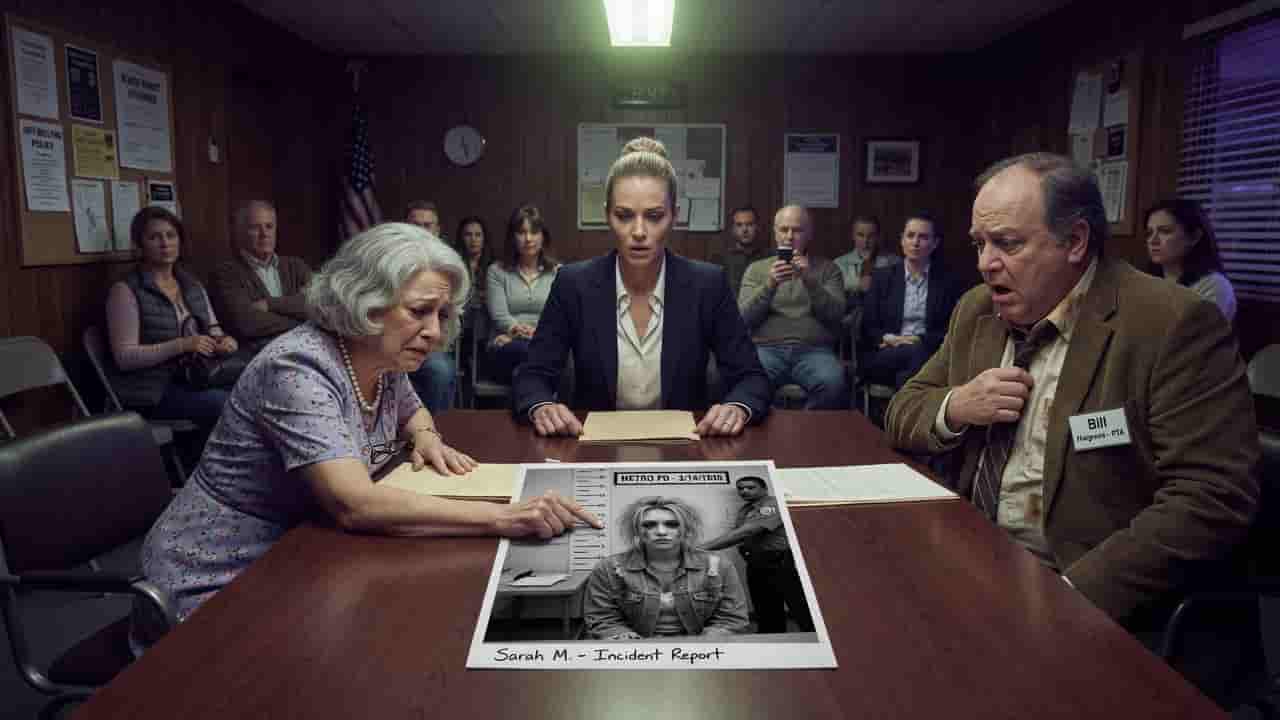
“Do you really want to do this, Dolores? In front of everyone?”
Sarah looked around the room, the same room where she’d fought for school lunches and better pay for her teachers. Now, the air felt like it had been sucked out through the vents. Her mother-in-law, a woman who never missed a Sunday service, was standing there with a manila envelope that felt like a loaded gun.
“I’m doing what’s best for the community, Sarah,” Dolores said, her voice dripping with that fake, sweet honey she used when she was about to ruin someone’s life. “Fairview deserves a principal with a clean slate. Not someone who spent her twenties in a precinct waiting for a fix.”
The room went dead. Bill, the head of the board, looked like he’d been slapped. He reached for the paper Dolores slid across the table—a grainy photo of Sarah that she’d spent fifteen years trying to forget.
Sarah’s husband was in the back row, his face as white as a sheet, stuck between the woman he loved and the mother who held the keys to their family’s reputation.
Sarah knew if she didn’t speak now, her career was gone. But she also knew what was in the file she had hidden in her own desk. A secret about Dolores that would burn the whole town down.
Chapter 1: The Fortress
The smell of Fairview High never changed: floor wax, industrial-strength lavender cleaner, and the faint, metallic tang of two thousand lockers. To Sarah Miller, it was the smell of safety. It was the scent of a life she had built brick by brick, from the ground up, out of the rubble of a girl who hadn’t existed for twenty years.
She walked the hallway at 7:15 AM, her heels clicking a rhythmic, disciplined beat against the linoleum. She didn’t hurry. Principals who hurried looked like they were losing control, and Sarah never lost control. She stopped to pick up a stray gum wrapper near the trophy case, her fingers steady. She nodded to the janitor, Ray, who gave her a respectful tip of his cap. In this town, in this building, Sarah was the gold standard. She was the woman who had turned a failing rural school into a regional powerhouse. She was the woman who remembered every student’s middle name and every teacher’s preferred coffee order.
When she reached her office, she sat behind the heavy oak desk that had once belonged to her predecessor—a man who had been forced out for “moral failings” that everyone in town still whispered about over church potlucks. Sarah’s desk was different. It was a workspace of absolute transparency. On the corner sat a framed photo of her husband, Mark, and their two golden retrievers. Next to it was a small, polished stone with the word Integrity etched into it.
The envelope was sitting right in the center of her blotter.
It was a standard white business envelope. No return address. Her name was printed on the front in block letters that looked like they’d been stamped by a machine. Sarah felt a small, cold finger of dread trace a line down her spine. She didn’t open it immediately. She took a sip of her lukewarm black coffee, centered herself, and then slid a silver letter opener through the crease.
Inside was a single sheet of paper. It wasn’t a letter. It was a printout of an email thread, the header stripped of its origin, but the content was unmistakable. It was a photo—a digital scan of a Polaroid. In the image, a young woman with matted hair and sallow skin sat on a metal bench in a police precinct. Her eyes were glazed, her pupils blown wide, a look of hollow, desperate terror on her face. Beside her, a police officer was holding a small plastic baggie of white powder.
Sarah’s vision tunneled. The air in the office suddenly felt too thick to breathe. It was her. It was a version of her that she had buried under a master’s degree, a marriage, and fifteen years of impeccable service to the state of Ohio.
“Principal Miller? You got a minute?”
The voice was sharp, a sudden intrusion into the silence. Sarah reacted with the muscle memory of a woman who had spent years hiding in plain sight. She slid the paper into her top drawer and locked it in one fluid motion before looking up.
Standing in the doorway was Brenda, the school’s administrative assistant. Brenda had been at Fairview for thirty years and saw herself as the unofficial gatekeeper of the town’s morality.
“The Board meeting tonight,” Brenda said, her eyes lingering just a second too long on the desk drawer Sarah had just locked. “Bill called. He says they’ve added an ‘executive session’ to the end of the agenda. Something about ‘personnel matters.’”
Sarah forced her face into a mask of calm. “Thank you, Brenda. I’m sure it’s just the budget adjustments for the new athletic wing.”
“He sounded… formal,” Brenda added, her tone suggesting she knew exactly what ‘formal’ meant in the context of Fairview politics. “And your mother-in-law called. Dolores. She said she’d be stopping by the house later. Said she has something she needs to discuss with you and Mark.”
“Dolores is always welcome,” Sarah said, the lie tasting like copper in her mouth.
When Brenda left, Sarah didn’t move. She sat there for ten minutes, her hands flat on the desk. The fortress she had built was still standing, the walls were thick, the gates were barred. But someone had just thrown a stone over the ramparts, and it had landed right at her feet.
She knew the look of that block lettering. She knew the way the ink bled slightly on the paper. She had seen it before on the notes Dolores sent to the church choir members when she wanted to “gracefully suggest” someone step down from their solo.
Sarah stood up and walked to the window. Outside, the yellow school buses were beginning to roll in, a long, disciplined line of them. She watched the students spill out—the athletes, the outcasts, the quiet ones who looked at the floor. She saw herself in all of them. She had been the quiet one. Then she had been the outcast. Then she had almost been nothing at all.
She reached into her pocket and felt the small, hard shape of her fifteen-year sobriety coin. She carried it every day, not because she was afraid of slipping, but because it reminded her that everything she had was a gift she had earned through fire.
Mark didn’t know about the precinct. He knew she had a “wild past,” a phrase she’d used to bridge the gap during their engagement. He knew she’d struggled with “substances” in her early twenties. But he didn’t know the specifics. He didn’t know about the night in the precinct, or the dealer who had shared her name to save his own skin. He didn’t know that the only reason she hadn’t been charged was a technicality involving a search warrant and a sympathetic public defender who saw a girl who was worth saving.
And Dolores… Dolores was a woman who didn’t believe in saving anyone who didn’t already belong to her version of a “good family.”
The phone on her desk buzzed. It was a text from Mark.
Mom’s coming over for dinner. She says she’s worried about the school board’s ‘new direction.’ You okay?
Sarah didn’t reply. She couldn’t. She opened the drawer, took out the photo, and looked at the girl on the bench again. The girl looked back with eyes that knew exactly how this was going to end. Sarah took a lighter from her bag—a relic she kept for lighting the candles at school vigils—and held the flame to the corner of the paper. She watched it curl and blacken in the metal trash can, the smoke rising in a thin, accusatory line toward the ceiling.
She wasn’t that girl anymore. But in Fairview, people only ever saw the version of you that served their narrative. And Dolores was the best storyteller in town.
Chapter 2: The Social Asphyxiation
The grocery store was the first place Sarah felt the shift. It was subtle, like a change in barometric pressure before a storm.
She was in the dairy aisle of Miller’s Market—no relation to her husband’s family, though Dolores liked to pretend they owned the town—when she saw Patty Higgins. Patty was the head of the PTA and usually the kind of woman who would corner Sarah for twenty minutes to discuss the merits of gluten-free cupcakes for the fall festival.
Sarah smiled as she reached for a carton of eggs. “Morning, Patty. How’s the—”
Patty didn’t look up. She adjusted the strap of her handbag, stared intently at a tub of margarine, and pushed her cart past Sarah without a word. It wasn’t a mistake. It was a deliberate, surgical excision.
Sarah stood there, the cold air from the dairy case chilling the back of her neck. The rumor wasn’t just out; it was already the gospel. In a town like Fairview, information didn’t travel; it saturated. It was in the pipes.
She finished her shopping, her movements stiff. At the checkout, the teenage girl behind the register—a girl Sarah had personally helped get a scholarship to the local community college—wouldn’t meet her eyes. She bagged the groceries in silence, her movements hurried, as if Sarah’s presence was a contagion.
When Sarah got to her car, she sat in the driver’s seat of her 2022 Subaru, the engine idling. She felt a familiar, sickening hollow in her chest. It was the feeling of being hunted. She’d felt it years ago, in the dark corners of her life, but this was different. This was being hunted by people she had served, people she had loved.
She drove home, the familiar streets of Fairview feeling alien. The manicured lawns, the American flags, the silent houses—they all felt like they were watching her.
The driveway was already occupied by Dolores’s pristine, white Cadillac. It sat there like a throne.
Inside, the house smelled of pot roast. Mark was in the kitchen, looking harried. He was a good man, a high school history teacher with a gentle soul and a naive belief that people were fundamentally decent. It was why he’d married Sarah, and it was why he’d never seen through his mother’s cruelty.
“Hey,” he said, coming over to kiss her cheek. His eyes were tight. “Mom’s in the living room. She’s… she’s in a state, Sarah.”
“What kind of state, Mark?” Sarah asked, setting the groceries on the counter.
“She says people are talking. At the church. About your… before-time. She’s worried about the school’s reputation. She says the board is getting calls.”
Sarah walked into the living room. Dolores was sitting on the edge of the floral armchair, a cup of tea in her hand. She looked up, her expression a masterpiece of mournful concern.
“Sarah, dear,” Dolores said, her voice soft and treacherous. “I’ve been praying for you all morning. Truly I have.”
“What for, Dolores?” Sarah asked, standing her ground. She didn’t sit. She wanted the height advantage.
“The darkness has a way of coming back to the light,” Dolores said, setting her tea down with a delicate clink. “People are saying such awful things. They’re saying you were… involved with the law. That there are records. Photos.”
“And where are they getting these ideas?” Sarah asked.
Dolores sighed, a long, dramatic sound. “You know how this town is. Secrets are like weeds. They always find a way through the cracks. But Sarah, the school board… they have a standard to uphold. And with the ‘Family First’ initiative coming up, they can’t have any… distractions.”
“You mean they can’t have me,” Sarah said.
“I’m just worried about the children,” Dolores said, her eyes flashing with a sudden, sharp coldness. “And about Mark. He’s worked so hard to build his own name here. To have it tarnished by… well, by the gutter you came from… it wouldn’t be fair, would it?”
Mark stepped into the room, his face pained. “Mom, that’s enough. Sarah’s the best principal this town has ever had. Her past is her past.”
“Is it, Mark?” Dolores turned her gaze on her son, her voice sharpening. “When the parents start pulling their kids out of Fairview because they don’t trust the woman at the top? When the funding for the new stadium is pulled because the donors don’t like ‘controversy’? Is it just the past then?”
Dolores stood up, smoothing her dress. She walked over to Sarah and touched her arm. It was a gesture of faux-comfort that felt like a snake’s dry skin.
“There’s a way to handle this quietly, Sarah. A graceful exit. You could resign for ‘health reasons.’ Move back to the city. I have a dear friend—you remember Robert, don’t you? He’s looking for a way to give back to the community. He’d be a wonderful fit for the school. A steady hand.”
Sarah pulled her arm away. “Robert? The man who’s been your ‘family friend’ for twenty years and owes you half his net worth in favors? That Robert?”
Dolores’s smile didn’t reach her eyes. “He’s a man of character, Sarah. That’s what matters in Fairview.”
“I’m not resigning, Dolores,” Sarah said, her voice low and dangerous. “I earned that office. I earned this life. And if you think you can push me out with some ancient history and church gossip, you’ve forgotten who you’re dealing with.”
Dolores tilted her head. “Oh, I haven’t forgotten, Sarah. I know exactly who you are. I’ve known since the day Mark brought you home. You smell like a project, dear. And projects eventually fall apart.”
She walked to the door, her heels clicking on the hardwood. At the threshold, she paused. “The board meeting is tonight, Sarah. I’d suggest you think very carefully about what you want to be remembered for. Because by tomorrow morning, the whole town is going to see that photo. And no amount of school spirit is going to wash away that stain.”
She left, and the house felt suddenly, violently empty.
Mark looked at Sarah, his eyes searching hers. “Sarah… what photo? What is she talking about?”
Sarah looked at her husband, the man she loved, the man who represented the safety she’d almost killed herself to find. She realized then that the silence she’d maintained for years wasn’t a shield; it was a cage. And the bars were finally breaking.
“I need to go to the school,” Sarah said, ignoring his question. “I have work to do.”
“Sarah, wait—”
She didn’t wait. She grabbed her keys and walked out, her heart hammering against her ribs like a trapped bird. She wasn’t going to the school to work. She was going because there was one person in town who might be able to help her fight back. And he was currently sitting in third-period detention.
Chapter 3: The Witness Pressure
The hallways of Fairview High were eerily quiet during the school day, but the silence felt different now. It was the silence of a held breath.
Sarah found Leo Vance in the back of the media center. Leo was seventeen, brilliant, and possessed a level of cynicism that most adults in Fairview couldn’t fathom. He was also the son of the town’s only private investigator, a man who had spent his life digging up the dirt that people like Dolores tried to bury.
Leo was hunched over a laptop, his fingers moving with a speed that suggested he was doing something the school’s IT department wouldn’t approve of.
“Leo,” Sarah said, standing behind him.
He didn’t jump. He just closed a window and looked up, his expression neutral. “Principal Miller. I thought I was supposed to be in detention for ‘unauthorized network access.’”
“You are,” Sarah said. “But I’m the principal. I can authorize whatever I want.”
She sat down across from him. The media center smelled of old paper and the ozone of too many computers. In the corner, a group of teachers were huddled together, whispering. When they saw Sarah, they immediately dispersed, their eyes darting away.
“They’re talking about you,” Leo said, his voice flat. “In the group chats. The parents, the students. Everyone.”
“I know,” Sarah said.
“It’s coming from an encrypted server,” Leo said, turning his laptop toward her. “Someone’s been drip-feeding the staff photos and documents for the last forty-eight hours. The ‘anonymous whistleblower’ bit. It’s very 1950s Red Scare.”
“Can you trace it?”
Leo leaned back, his eyes narrowing. “Why would I? My dad says in this town, it’s better to be the one holding the shovel than the one in the hole.”
“Because I know your dad’s firm is struggling, Leo,” Sarah said, her voice steady. “And I know that Dolores Miller hasn’t paid a bill to a local contractor in ten years without a fight. She thinks she’s untouchable because of her name. But untouchable people usually have the biggest holes in their armor.”
Leo stared at her for a long time. Then he sighed and reopened his laptop. “The emails were sent using a VPN, but they’re amateur. They were routed through a server owned by the Grace Community Church. The church’s secretary isn’t exactly a cyber-security expert.”
“Dolores’s church,” Sarah whispered.
“And there’s more,” Leo said, his voice dropping. “I didn’t just look at the emails. I looked at the church’s financial records. My dad… he’s been keeping a file on Dolores for years. He’s obsessed with her. He calls her the ‘Cleanest Thief in Ohio.’”
“A thief?”
Leo pulled up a spreadsheet. “Dolores has been the treasurer of the church’s building fund for twenty years. She’s also the head of the Fairview Historical Society. Since 2014, about two hundred thousand dollars has moved from those accounts into a series of shell companies registered to a ‘family friend’ named Robert Vance. Not my Vance, obviously. Some guy from the city.”
Sarah felt a sudden, sharp jolt of adrenaline. “Robert? The man she wants to replace me with?”
“Exactly,” Leo said. “He’s her laundering partner. He takes the money, cleans it through ‘consulting fees,’ and then kicks back a percentage to Dolores. It’s a classic embezzlement scheme, wrapped in a church cloak.”
Sarah looked at the numbers on the screen. It was all there. The proof she needed to turn the table. But the cost… if she used this, she would be destroying her husband’s family. She would be ripping the heart out of the town’s social structure.
“Why are you telling me this, Leo?”
Leo looked at the group of teachers who were watching them from a distance. “Because you’re the only person in this building who treated me like a human being instead of a ‘problem student.’ And because I hate bullies.”
“So do I,” Sarah said.
She stood up, her mind racing. The school board meeting was in four hours. The town hall would be packed. Dolores would be there, her pearls gleaming, her voice full of false concern as she delivered the final blow to Sarah’s reputation.
As she walked out of the media center, she saw a group of students huddled near the lockers. They were looking at a phone, laughing. As she passed, the laughter died, replaced by a cold, mocking silence. One of the boys, a varsity quarterback whose father sat on the board, looked her dead in the eye.
“Hey, Principal,” he said, his voice loud enough for the whole hallway to hear. “I heard the school’s getting a new principal. Someone who knows how to stay out of jail.”
Sarah stopped. The hallway felt like it was closing in. She could feel the weight of their judgment, the easy cruelty of people who hadn’t yet learned that life could break you.
“Go to class, Tyler,” Sarah said, her voice iron.
“Or what?” Tyler asked, stepping forward, his chest puffed out. “You gonna call your dealer?”
The laughter erupted again, sharper this time. Sarah felt the old shame rising in her throat, thick and suffocating. She wanted to run. She wanted to disappear into the “gutter” they were all so sure she belonged to.
But then she remembered the girl in the Polaroid. The girl who had survived.
“Tyler,” Sarah said, her voice dropping to a level that made the laughter die instantly. “I have spent fifteen years making sure you have a future. If you think you can use my past to destroy mine, you’re about to learn a very hard lesson about how power actually works in this town. Now. Go. To. Class.”
Tyler blinked, the bravado flickering out of his eyes. He backed away, the other students following him like a retreating tide.
Sarah watched them go. She was trembling, but she wasn’t afraid. She had the file. She had the proof.
But as she walked back to her office, she saw Mark standing by the trophy case. He was looking at her with a look of pure, unadulterated heartbreak. He’d heard the exchange. He’d seen the hallway turn on her.
“Sarah,” he said, his voice breaking. “Tell me it’s not true. Tell me my mother is lying.”
Sarah looked at her husband, the man she’d protected with her silence. She realized then that the rescue wasn’t coming from the outside. She had to be the one to save herself, even if it meant losing everything else.
“It’s true, Mark,” she said, her voice a whisper of steel. “The photo is real. But your mother… she’s not the hero of this story. And neither am I.”
Chapter 4: The Public Humiliation
The Fairview Town Hall was a drafty, colonial-style building that smelled of damp wool and old wood. Usually, board meetings were attended by three retirees and a local reporter who spent most of the time on his phone. Tonight, the room was standing-room only.
The air was charged with a frantic, ugly energy. People were whispering, their heads bent together, eyes occasionally flicking toward the front of the room where Sarah sat at the long board table. She was flanked by the five board members, all of whom looked like they were attending a funeral.
Bill, the board president, cleared his throat. He looked exhausted. “We have a full agenda tonight, but before we begin, I believe Mrs. Dolores Miller has requested the floor for a public comment.”
A murmur ran through the crowd. Dolores stood up from the front row. She was a vision of silver-haired grace in her lavender dress. She walked to the podium with the measured pace of a woman who knew she was about to perform her masterpiece.
“Members of the board,” Dolores began, her voice projecting with practiced clarity. “I stand here tonight not as a mother-in-law, and not just as a concerned citizen, but as a woman who loves this town. Fairview is a place of values. A place where we trust the people we put in charge of our children’s futures.”
She paused, looking directly at Sarah. The silence in the room was absolute.
“We have all seen the information that has come to light over the last few days,” Dolores continued, her voice trembling with feigned emotion. “It breaks my heart. Truly. I have welcomed Sarah into my family. I have supported her. But we cannot ignore the truth. Our children deserve a leader who has always walked the path of righteousness. They deserve better than a woman who has lived in the gutter.”
Dolores reached into her handbag and pulled out a manila envelope. She walked to the board table, her pearls clicking. “I have here the evidence. The records of the arrest. The photos from that dark night. I am submitting them to the board for the public record.”
She slammed the envelope onto the table and slid it toward Bill. The sound was like a gunshot.
Bill looked at the envelope, his hands shaking. He looked at Sarah, his eyes full of a grim, disappointed pity. “Sarah? Do you have anything to say?”
Sarah stood up. Her legs felt heavy, as if she were wading through deep water. She looked out at the crowd. She saw Patty Higgins, who looked away. She saw Tyler and his friends in the back, smirking. And she saw Mark, sitting in the very last row, his head in his hands.
“I was twenty-two years old,” Sarah said, her voice surprisingly steady. “I was lost, I was hurting, and I made a mistake. A massive, life-altering mistake. I spent three days in a precinct cell, and it was the best thing that ever happened to me. Because it’s where I decided I was never going to be that person again.”
“A criminal is a criminal, Sarah,” a voice shouted from the back. It was Tyler’s father.
“I’m not a criminal, George,” Sarah said, looking him in the eye. “I’m a woman who worked three jobs to pay for a degree I was told I’d never get. I’m a woman who has spent every day for the last fifteen years making sure your son has opportunities I never had. If you want to judge me for who I was twenty years ago, that’s your right. But don’t you dare tell me I don’t care about this school.”
Dolores stepped forward, her face a mask of cold triumph. “It’s not about caring, Sarah. It’s about character. And your character is tainted. The board has a duty to act. For the sake of the children. For the sake of the ‘Family First’ initiative.”
“The initiative you and Robert Vance are heading?” Sarah asked.
Dolores stiffened. “Robert is a man of impeccable standing.”
Sarah reached into her own briefcase and pulled out a folder. It was thick, filled with the documents Leo had helped her compile.
“Let’s talk about standing, Dolores,” Sarah said, her voice rising now, cutting through the murmurs of the crowd. “Let’s talk about the two hundred thousand dollars missing from the Grace Community Church building fund. Let’s talk about the shell companies registered in Robert’s name. And let’s talk about the kickbacks that have been flowing into your personal account for the last six years.”
The room went white-noise silent.
Dolores’s face drained of color. Her hand went to her pearls, her fingers fumbling. “That’s… that’s a lie. A desperate, disgusting lie from a woman with nothing left to lose.”
“Is it?” Sarah walked around the table, holding a sheet of paper. “This is a wire transfer record, Dolores. Dated last Tuesday. Five thousand dollars from the Historical Society to an account in the Cayman Islands. Your name is on the authorization. And the IP address used to send those anonymous emails about me? It matches the one used for this transfer.”
Sarah turned to Bill. “She didn’t leak my past because she cares about the children, Bill. She leaked it because I was starting to ask questions about the school’s maintenance contracts. Contracts that were being funneled through Robert Vance’s construction firm.”
Bill took the paper from Sarah. He looked at it, then at Dolores. The shift in the room was physical. The outrage that had been directed at Sarah was suddenly, violently turning toward the woman in lavender.
“Dolores?” Bill asked, his voice low. “What is this?”
Dolores looked around the room. She saw the faces of the people she had controlled for years. She saw the doubt, the suspicion, the dawning realization. Her mask of piety began to crack, revealing a raw, jagged desperation underneath.
“I did it for the town!” Dolores hissed, her voice dropping the honeyed tone. “I did it to keep Fairview pure! To keep people like her from taking over!”
She pointed at Sarah, her finger shaking. “She’s a junkie! A gutter-rat! You’re going to believe her over me?”
“I’m the principal of this school, Dolores,” Sarah said, standing inches from her mother-in-law. “And you’re just a thief who got caught.”
Dolores lunged. It wasn’t a calculated move; it was a spasm of pure, unadulterated rage. She grabbed Sarah’s blazer, her nails digging into the silk. “I’ll ruin you! I’ll tell Mark everything! I’ll tell the whole world what you really are!”
“They already know, Dolores,” Sarah said, her voice cold and final. “I just told them.”
Mark was standing now, moving toward the front. He looked at his mother, then at Sarah. The choice he had to make was written on his face, a jagged line of grief and betrayal.
The board meeting erupted into chaos. Bill was pounding his gavel, but no one was listening. Parents were shouting, reporters were pushing toward the front, and in the middle of it all, Sarah stood her ground, her heels clicking against the wood as she stepped back from the woman who had tried to destroy her.
She had won the battle. But as she looked at Mark’s face, she knew the war had only just begun. The residue of the humiliation hung in the air like smoke, bitter and suffocating.
Sarah walked out of the town hall, the cool night air hitting her face. She didn’t look back. She didn’t wait for Mark. She walked toward her car, her shadow long and dark against the pavement.
She was still the principal. She was still sober. But the fortress was gone. And for the first time in twenty years, she had nowhere to hide.
Chapter 5: The Glass House
The silence in the Miller house wasn’t peaceful; it was a vacuum, an active thing that seemed to suck the oxygen out of the hallways. Sarah sat at the kitchen island, her coat still on, her hands wrapped around a ceramic mug of water she hadn’t touched. The kitchen clock ticked with the heavy, rhythmic thud of a judge’s gavel.
She was waiting for the sound of the garage door. She knew Mark’s routine—the way he’d pause in the driveway, the way he’d sigh before turning the key. But tonight, there were no rules. Tonight, the man she’d lived with for over a decade was a stranger who had just watched his mother be dismantled by the woman he loved.
When the front door finally opened, it didn’t click; it slammed. Mark didn’t go to the kitchen. He went straight to the hall closet, the sound of hangers rattling like dry bones.
“Mark?” Sarah’s voice was a dry rasp.
He appeared in the doorway of the kitchen. His face was a map of exhaustion and something sharper—something that looked dangerously like revulsion. He wasn’t looking at the principal of Fairview High. He was looking at the woman who had kept a suitcase full of secrets under their bed for fifteen years.
“You had it,” he said. There was no greeting, no preamble. “The file. The bank records. You’ve had them for how long, Sarah?”
“Since this afternoon,” she said, her voice steadying. “Leo Vance helped me. He found the routing numbers.”
“No.” Mark stepped into the light of the overhead pendant, and Sarah saw the redness in his eyes. “I’m not talking about the church money. I’m talking about the silence. I’m talking about the fact that I spent the last three hours at the precinct—the actual precinct, Sarah—watching my mother be processed for grand larceny while the officers looked at me like I was a character in a bad Lifetime movie.”
“She tried to destroy me, Mark. She stood in front of that board and called me a gutter-rat.”
“And she was wrong,” Mark snapped, his voice cracking. “But you let me believe you were a blank slate. You let me defend you to her for ten years, telling her she was being paranoid, telling her you were the most honest person I’d ever met. You made me a fool in my own home.”
Sarah stood up, her legs shaking. “I didn’t make you a fool. I made myself a life. I didn’t tell you because that girl—that girl in the photo—she’s dead. I killed her. I buried her under every late night at the office and every PTA meeting I sat through. I didn’t think she mattered anymore.”
“She matters when she’s the reason my mother is in a holding cell,” Mark said. He walked to the counter, his fingers tracing a scratch in the granite. “Why didn’t you come to me? Before the meeting? If you had the proof, we could have handled it. We could have gone to her. We could have stopped it before it became a circus.”
“She wouldn’t have stopped,” Sarah said, a cold certainty settling in her gut. “You know Dolores. She would have taken that file and found a way to use it against me, too. She doesn’t negotiate, Mark. She colonizes. She wanted my job for her friend, and she wanted me gone so she could have you back. There was no ‘handling it quietly.’ There was only winning or losing.”
Mark looked at her then, really looked at her, and the distance between them felt like a canyon. “Winning? Is that what you think happened tonight? You think we won?”
He turned and walked toward the stairs. Sarah followed him to the landing. “Where are you going?”
“To the guest room,” he said without looking back. “I can’t look at you right now, Sarah. Every time I do, I see that photo. And I see the woman who was holding the match tonight. You didn’t just defend yourself. You executed her.”
The door to the guest room clicked shut, a final, soft punctuation mark.
Sarah went back to the kitchen. She emptied the mug of water into the sink and watched it swirl down the drain. She felt a strange, hollow lightness. The secret was out. The monster was under the bed, but the bed was empty.
The next morning, the “residue” Sarah had feared was everywhere.
She arrived at Fairview High at her usual time, but the atmosphere was unrecognizable. The faculty lounge, usually a hub of caffeinated gossip and lesson-plan griping, went silent the moment she stepped in. Her vice-principal, a man named Henderson who had been her right hand for five years, was standing by the mailboxes. He didn’t offer his usual “Morning, boss.” He looked at his shoes.
“Bill called,” Henderson said, his voice clipped. “The Board has placed you on administrative leave, effective immediately. Pending a ‘comprehensive review’ of the events at the town hall.”
Sarah felt the blood drain from her face. “A review of what? I didn’t commit a crime, Henderson. Dolores did.”
“They’re calling it a ‘violation of the morality clause’ in your contract,” Henderson said, finally looking up. His eyes weren’t angry; they were disappointed. “Not the arrest record, Sarah. The deception. The fact that the school’s reputation is now tied to a police investigation into the town’s most prominent family. They say the ‘distraction’ is too great for the students.”
“The students?” Sarah scoffed. “The students are the ones I’m protecting.”
“Are you?” Henderson stepped closer, his voice dropping. “There’s a petition circulating among the parents, Sarah. Patty Higgins is leading it. They don’t want a principal who keeps a PI on speed-dial. They’re saying if you could do that to your own mother-in-law, what would you do to their kids if they stepped out of line?”
It was the classic Fairview flip. The truth didn’t matter as much as the social order. By exposing Dolores, Sarah hadn’t just caught a thief; she had broken the unspoken rule of the town: keep the ugliness behind the lace curtains.
Sarah walked to her office to gather her things. The door was already locked. A security guard—a man who had thanked her a month ago for helping his daughter with her college essay—stood in front of it.
“I’m sorry, Ma’am,” he said, his face a mask of professional indifference. “Board orders.”
Sarah turned and walked down the hallway. She saw Leo Vance leaning against a locker. He was wearing his usual headphones, but he’d slid one ear off. As she passed, he didn’t say a word, but he gave her a short, sharp nod. It was the only support she’d received all morning, and it felt like a lifeline thrown into a freezing sea.
Outside, the air was crisp, the smell of autumn leaves and woodsmoke thick in the nostrils. It was a beautiful day for a public execution.
She drove to the county jail. She didn’t know why she was doing it, only that the loop wouldn’t close until she saw the wreckage.
The visiting room was a dismal, fluorescent-lit space that smelled of floor wax and stale sweat. Dolores sat behind the plexiglass, her lavender dress rumpled, her silver hair finally out of place. She looked older, smaller, but her eyes were still two chips of flint.
She didn’t pick up the phone at first. She just stared at Sarah, a ghostly smirk playing on her lips. Finally, she relented.
“Come to gloat, dear?” Dolores’s voice was thin through the receiver.
“I came to ask why,” Sarah said. “You had everything, Dolores. You had the respect of the town, the church, your son. Why risk it for a construction contract and a few kickbacks?”
Dolores leaned in, her breath fogging the glass. “Because it was mine, Sarah. Everything in this town—the names on the buildings, the seats on the board—it was built by people like me. People who understand that you don’t just ‘earn’ a life. You take it. And you keep it by making sure the people around you are too afraid to look under the rug.”
“And what about Mark?”
Dolores’s expression shifted, a flicker of genuine pain crossing her face before she masked it with spite. “Mark is a Miller. He’ll survive. He’ll realize eventually that I was right about you. You’re a wrecking ball, Sarah. You think you’re a builder, but all you do is destroy. Look at your marriage. Look at your job. Was it worth it?”
“Yes,” Sarah said, and to her surprise, she meant it. “Because for the first time in fifteen years, I don’t have to wonder when the other shoe is going to drop. It dropped, Dolores. And I’m still standing.”
“Are you?” Dolores laughed, a dry, rattling sound. “Wait until the trial, dear. Wait until Robert Vance starts talking. You think you’re the only one who knows how to dig? By the time I’m done, this town will wish they’d never heard the name Sarah Miller.”
Sarah hung up the phone. She watched Dolores be led away by a guard, a small, floral-clad woman who was still trying to dictate the terms of her surrender.
As Sarah walked out into the parking lot, she saw a black SUV pull up. A man in a tailored suit stepped out—Robert Vance. He looked at Sarah, his expression unreadable, and then walked toward the jail entrance.
The “friend” was already in motion. The counter-attack was beginning.
Sarah got into her car and gripped the steering wheel. Her knuckles were white. She realized then that the truth wasn’t a destination; it was a battlefield. She had survived the first charge, but the heavy artillery was just getting into position.
She took her sobriety coin out of her pocket and rubbed it between her thumb and forefinger. Fifteen years. She hadn’t survived the gutter just to be buried in the suburbs.
She picked up her phone and dialed a number she hadn’t called in a long time.
“Leo?” she said when the boy answered. “I need you to find everything you can on Robert Vance’s offshore accounts. Not just the ones tied to Dolores. All of them.”
“That’s a big job, Principal,” Leo’s voice was cautious. “My dad might not like me digging that deep.”
“Tell your dad that the woman who’s been protecting his son’s school record for three years is asking for a favor,” Sarah said. “And tell him that if we don’t finish this now, none of us are going to have a town left to live in.”
There was a long pause on the other end of the line.
“Okay,” Leo said. “But it’s going to cost you.”
“I know,” Sarah said, looking at the looming silhouette of the jail. “Everything worth having usually does.”
Chapter 6: The Residue of Truth
The “comprehensive review” took three weeks. Three weeks of Sarah sitting in her living room, watching the town of Fairview turn into a theater of the absurd.
Mark had moved out. He was staying at a motel on the edge of town, a place with a flickering neon sign and a smell of cigarettes that he’d always hated. He wouldn’t take her calls. He communicated only through short, functional texts about the dogs or the mortgage. Every word was a needle-prick, a reminder that the secret she’d kept to protect their peace had been the very thing that destroyed it.
The trial of Dolores Miller was the only thing anyone talked about. The “Pillar of Fairview” was being dismantled in the county court, and the details were uglier than anyone had imagined. It wasn’t just the church money; it was a decades-long web of influence-peddling, small-scale extortion, and “favors” that always came with a price tag.
But as Dolores went down, she was determined to take the town’s reputation with her. Her lawyers were aggressive, painting Sarah as a vengeful, unstable woman with a history of substance abuse who had manufactured evidence to cover her own professional failings.
The day of the Board hearing arrived on a Tuesday. It was raining—a cold, relentless October drizzle that turned the football field into a marsh.
Sarah dressed with the same precision she had used for her wedding day. A gray wool suit, white silk blouse, hair pulled back so tight it hurt. She looked in the mirror and didn’t see a principal or a victim. She saw a survivor who was tired of running.
The hearing was held in the high school auditorium, not the board room. They needed the space for the “interested public,” which was a polite way of saying the mob.
Bill sat at a table on the stage, looking ten years older than he had a month ago. To his left were the other board members, their faces set in masks of bureaucratic neutrality. To his right was an empty chair.
Sarah walked down the center aisle. The room didn’t go silent this time; it hummed with a low, vibrating tension. She heard her name whispered like a curse. She saw Patty Higgins in the third row, clutching a clipboard like a shield.
“Mrs. Miller,” Bill said, his voice echoing in the cavernous space. “This is an informal hearing to determine your future employment with Fairview High. You are not under oath, but we expect full transparency. Do you understand?”
“I do,” Sarah said, sitting in the lone chair in the center of the stage. She felt like a specimen under a microscope.
For the next two hours, they grilled her. They asked about the photo. They asked about the “precinct night.” They asked why she hadn’t disclosed her history on her initial application. They asked about her relationship with the Vance family.
It was a slow-motion flaying. Every question was designed to make her feel small, to remind her that she was an outsider who had dared to judge the town’s royalty.
“The issue, Sarah,” Bill said, leaning forward, “is trust. How can we ask the parents of this district to trust their children to a woman who lied about her own identity for fifteen years?”
“I didn’t lie about my identity,” Sarah said, her voice ringing out through the auditorium. “I changed it. There’s a difference. Every person in this room has something in their past they aren’t proud of. The difference is, I spent fifteen years proving that I’m better than my worst mistake. Can any of you say the same?”
“That’s enough,” a voice boomed from the back of the room.
The double doors at the rear of the auditorium swung open. Robert Vance walked in, followed by two men in dark suits. He wasn’t looking at Sarah; he was looking at Bill.
“Mr. Vance,” Bill said, surprised. “This is a closed personnel hearing.”
“Not anymore,” Robert said, walking toward the stage. He held up a digital tablet. “I think the Board needs to see what my firm just uncovered in the district’s construction audits. Audits that were initiated by Principal Miller three months ago.”
Sarah froze. She hadn’t initiated an audit. She’d only been thinking about it.
Robert reached the stage and handed the tablet to Bill. “It seems the ‘kickbacks’ weren’t just going to Dolores Miller. They were being funneled through a series of sub-contracts for the new athletic wing. Sub-contracts approved by… well, by you, Bill.”
The auditorium went silent. Truly silent.
Bill’s face went from pale to a deep, mottled purple. “That’s… that’s an administrative error. I didn’t know the specifics of the vendors.”
“You knew,” Robert said, his voice devoid of emotion. “And so did the rest of the board. You all took the ‘donations’ for your re-election campaigns. You all looked the other way while Dolores moved the pieces. You were going to fire Sarah today not because she lied, but because she’s the only person in this building who isn’t on the payroll.”
Robert turned and looked at Sarah. For the first time, she saw a flicker of something like respect in his eyes. He wasn’t her friend. He was a shark who had decided the board members were easier prey.
“I’m withdrawing my name for consideration for the principal’s position,” Robert said to the room. “And I suggest the Board reconsider its position on Mrs. Miller. Unless you’d like the state auditor to arrive tomorrow morning.”
The hearing ended ten minutes later. No vote was taken. Bill adjourned the meeting with a shaky hand and hurried off the stage, followed by the rest of the board like rats leaving a sinking ship.
The crowd began to disperse, the energy in the room shifting from outrage to a confused, muted panic. The social structure of Fairview was collapsing, and they were all standing in the rubble.
Sarah stayed in her chair. She felt a strange, detached exhaustion. She had her job. She had her reputation. But the cost was laid out before her in the empty seats of the auditorium.
She felt a hand on her shoulder. She looked up and saw Mark.
He looked terrible. He was wearing a rumpled shirt, his hair was uncombed, and he smelled like the cheap motel. But he was there.
“Sarah,” he said.
“You came,” she whispered.
“I heard about Robert,” Mark said, sitting in the chair next to her. “I heard about Bill. I’ve been sitting in the back for an hour.”
“Are you coming home?”
Mark looked out at the empty stage. “I don’t know. I think… I think the home we had is gone, Sarah. We can’t go back to the way it was. The secrets, the silence… it poisoned the well.”
“I know,” Sarah said. “But we could build something else. Something real this time.”
Mark looked at her, and she saw the residue of the last month in the lines around his eyes. He didn’t smile. He didn’t reach for her hand. But he didn’t walk away.
“My mother is going to prison,” he said. “And this town is going to be a graveyard for a long time.”
“I’m staying,” Sarah said. “I have a school to run. A real school, this time. Not a fortress.”
She stood up and walked toward the exit. As she reached the doors, she saw Leo Vance waiting by the trophy case. He was holding his laptop, a small, triumphant smirk on his face.
“Nice work, Principal,” he said.
“You gave that file to Robert, didn’t you?” Sarah asked.
Leo shrugged. “My dad said if you’re going to kill a king, you don’t use a knife. You use a bigger king.”
Sarah looked at the trophy case—the shiny gold statuettes, the photos of smiling athletes, the “Integrity” stone she’d left on her desk. It all felt like props from a play that had finally closed.
She walked out of the school and into the rain. It was cold, and it was biting, but for the first time in twenty years, she wasn’t hiding from it. She was just a woman, standing in the middle of her own life, watching the water wash away the stains of a town that had finally run out of secrets.
She got into her car and started the engine. She didn’t look back at the building. She didn’t look at the town hall. She just drove.
The road ahead was wet and dark, and she didn’t know where it ended. But she knew she was the one behind the wheel. And for Sarah Miller, that was finally enough.