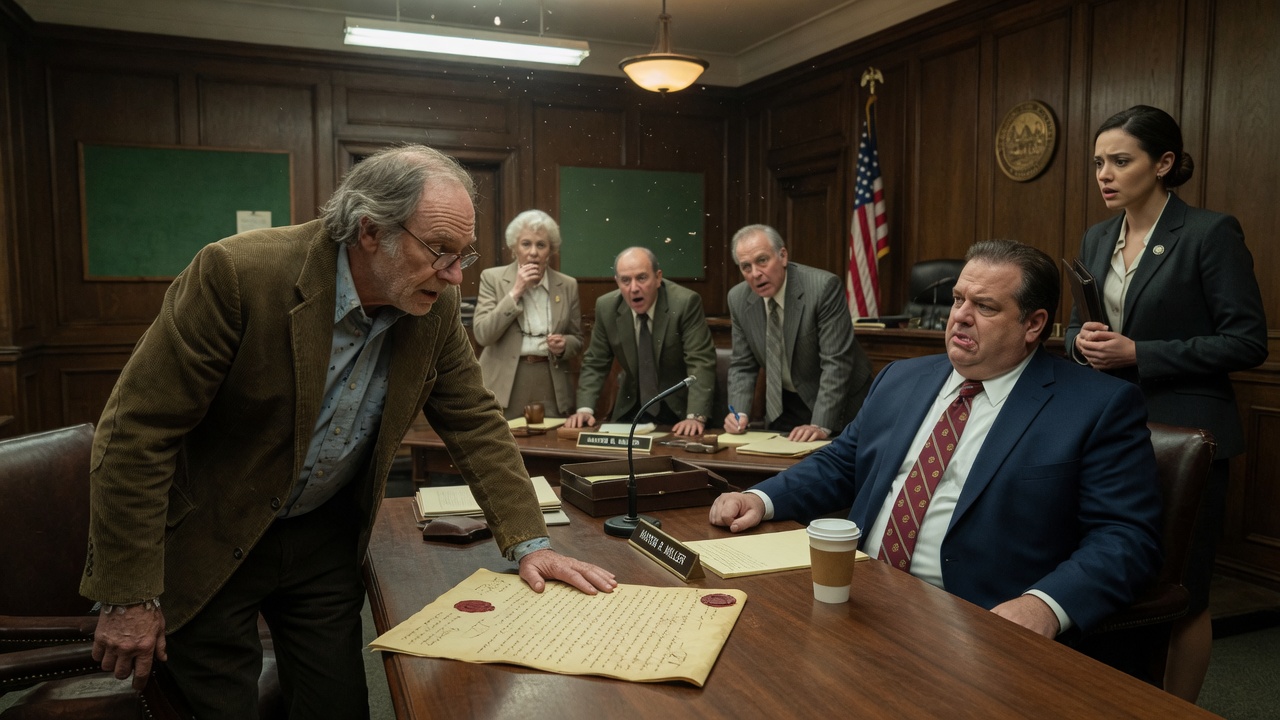
“Sit down, Arthur. You’re embarrassing yourself and whatever is left of your wife’s memory.”
Mayor Miller didn’t even look up from his coffee when Arthur walked into the council meeting. He just kept talking about the new “Urban Renewal” project—the same project that had already torn down the small bakery Arthur’s wife had spent thirty years building before she passed away.
But Arthur didn’t sit down. He didn’t apologize. He just reached into his worn leather bag and pulled out a single piece of yellowed parchment, slamming it onto the mahogany table in front of the man who had ruined his life.
“Read the bottom line, Miller,” Arthur said, his voice as dry as the archives he’d spent forty years organizing.
The room went silent. The city attorney leaned in, her eyes widening as she saw the official seal of the state land office from 1895. It wasn’t a request. It wasn’t a protest. It was a Reclamation Deed.
“You told this town that my wife’s shop had to go because the city owned the land,” Arthur whispered, loud enough for every witness in the room to hear. “But you forgot one thing. The city never actually bought this block. My grandfather did. And I never signed it over.”
The Mayor’s face turned a sickly shade of gray as he looked at the legal signature. He looked at the council, then back at the quiet librarian he’d spent a decade bullying.
“You’re trespassing, Mr. Mayor,” Arthur said. “And you have ten minutes to clear your desk before I call the Sheriff to evict the entire city government from my property.”
Chapter 1
The dust in the Oakhaven Public Library didn’t just sit on the shelves; it lived there, a fine, grey silt that recorded every movement Arthur made. It was the only thing that stayed consistent in a town that seemed determined to erase itself. Arthur Swinton moved through the stacks with the slow, deliberate gait of a man who knew exactly which floorboards would groan under his weight. He was sixty-five, though in the dim light of the archives, he felt like he’d been carved out of the same old oak as the card catalogs.
He spent his mornings in the basement, a place the “modernization” committee hadn’t bothered to visit in three years. Up on the main floor, the new director—a twenty-four-year-old named Leo who wore sneakers with suits and talked incessantly about “digital footprints”—was busy replacing the reference section with beanbag chairs and charging stations. But down here, the air was cold and smelled of vinegar and slow decay. This was where the paper lived.
Arthur pulled a ledger from the bottom shelf of the 900s. It was heavy, the leather binding cracked like old skin. The Ledger of Land Grants (1890-1910). He wiped the cover with a soft cloth, watching the gold lettering emerge through the grime.
“Arthur? You still down there?”
Leo’s voice drifted down the stairs, thin and impatient. Arthur didn’t answer immediately. He waited until he’d carefully placed the ledger on his rolling cart.
“I’m here, Leo,” Arthur said, his voice raspy from disuse.
The younger man appeared at the bottom of the stairs, squinting into the gloom. He held a tablet like a shield. “Look, the disposal crew is coming at one. We really need to clear out those back rows. Anything that isn’t logged in the last decade is just taking up server-room space.”
Arthur looked at the rows of books, then back at Leo. “These are the town’s records, Leo. You don’t throw away a skeleton just because you’re tired of looking at it.”
Leo sighed, the sound of a person who thought he was being remarkably patient with a relic. “It’s about efficiency, Arthur. Nobody looks at these. If it’s important, it’s already been scanned. If it hasn’t been scanned, it’s probably not important.”
“History isn’t efficient,” Arthur said quietly. “And scanning doesn’t capture the weight of the ink. Or the fact that someone’s hand actually pressed these pages.”
“Right. Deep. Anyway, one o’clock. If you want to save anything, put it on the ‘Keep’ shelf by the elevator. Otherwise, it’s pulp.”
Leo disappeared. Arthur turned back to the ledger. His hands were shaking, just slightly. It wasn’t just the threat of the disposal crew; it was the date on the spine. 1890. That was the year his grandfather, Silas Swinton, had come to Oakhaven. Silas had been a surveyor, a man who understood that a line on a map was a promise, and a fence was a declaration.
Arthur opened the ledger. The pages were thick, high-rag-content paper that had survived a century of humidity. He flipped through the entries: homesteads, timber rights, the original plat for the mill. He reached the middle of the book, where the script changed to a sharp, aggressive cursive.
He stopped.
The entry was dated October 14, 1895. It described a parcel of land known as “The Commons.” In the modern town of Oakhaven, The Commons was where the grand, marble-faced City Hall stood, flanked by the new parking garage and the “Urban Renewal” plaza.
Arthur’s breath hitched. He knew the history—or the history the Mayor told. According to the city’s brochures, the land had been donated to the public in 1920 by the Miller family. That donation was the bedrock of the Miller dynasty. It was why the current Mayor, Harrison Miller, could walk through town like he owned the air people breathed. It was why he’d been able to seize the adjacent properties—including the small, red-brick bakery that had belonged to Arthur’s wife, Martha—under the guise of “improving public land.”
Martha had fought them. She’d spent her last two years of life sitting at the kitchen table with a calculator and a pile of legal notices, trying to understand how a “public land improvement” could result in her being evicted from a building she’d paid for over thirty years. She’d died in her sleep four months after the bulldozers leveled the shop. The official cause was a stroke, but Arthur knew she’d simply run out of reasons to keep her heart beating.
Arthur traced the line on the page. Grantee: Silas V. Swinton.
He blinked, pulling his glasses off to rub his eyes. He looked again.
“…all rights, titles, and interests in the square known as The Commons, to be held in perpetuity by Silas V. Swinton and his heirs, contingent upon the maintenance of the public thoroughfare…”
There was no record of a transfer to the Millers. There was no “donation” recorded in the primary ledger. Below the entry was a small, hand-drawn map. The boundaries weren’t just the park; they included the entire footprint of what was now the municipal center.
Arthur felt a strange, cold sensation in his chest. It wasn’t excitement. It was a terrifying clarity. For decades, he had walked past City Hall and felt a dull, thumping ache of resentment. He’d watched the Mayor stand on those marble steps and talk about “progress” while the town’s history was hauled away in dumpsters.
If this ledger was correct, the very ground the Mayor stood on didn’t belong to the city. It belonged to Arthur.
He looked toward the stairs. He could hear the distant sound of Leo laughing at something on his tablet. Above him, the town of Oakhaven was going about its business—people paying parking tickets, filing permits, and sitting in the Mayor’s office, all of them technically trespassing on Swinton land.
Arthur didn’t put the book on the “Keep” shelf. He didn’t tell Leo. Instead, he took his old leather satchel, tucked the heavy ledger inside, and walked out the back fire exit.
The sunlight hit him like a physical blow. He walked down the street, his shoulder heavy with the weight of the book. He passed the parking garage—the grey, brutalist structure that stood where Martha’s ovens used to be. He stopped for a moment, looking at the concrete. He could almost smell the cinnamon and yeast.
“Hey, Arthur! You’re late for the wake!”
He turned. Coming out of the diner across the street was Jim, the local hardware store owner who had lost his lease to the same renewal project. Jim looked tired, his apron stained with grease.
“What wake, Jim?” Arthur asked.
“The council meeting. Miller is signing the final demolition orders for the Old Quarter today. Said it’s ‘time to put the ghosts to bed.’ I think he was talking about us, Artie.”
Arthur gripped the strap of his bag. “He’s signing them today?”
“Two o’clock. Big public ceremony in the plaza. He wants the cameras there.” Jim spat on the sidewalk. “Man loves a parade, especially if he’s the one driving the hearse.”
Arthur looked at his watch. 12:15.
“He’s not putting any ghosts to bed, Jim,” Arthur said.
“Whatever you say, Artie. Just don’t let Leo catch you skipping out early. He’s already got your desk listed as ‘surplus equipment’ on the town’s website.”
Arthur didn’t respond. He turned and started walking toward the County Clerk’s office. He didn’t have much time, and he knew that once he started this, there was no going back to the quiet safety of the stacks. He was a librarian, a man of order and silence. But as he felt the heavy leather of the ledger against his ribs, he felt something else—a jagged, sharp-edged pride that had been buried under the dust for far too long.
Chapter 2
The County Clerk’s office was a cramped, fluorescent-lit room on the second floor of the courthouse, smells of ozone and stale coffee. Behind the counter sat Sarah, a woman who had been a year behind Arthur’s daughter in school. She was sharp, efficient, and currently looking at Arthur with a mixture of pity and confusion.
“Arthur, you know the archives are digital now,” Sarah said, her voice echoing in the nearly empty room. “Whatever you’re looking for, I can probably pull up on the screen in ten seconds.”
Arthur didn’t move. He placed his satchel on the counter but didn’t open it yet. “I need the original 1895 tax rolls for District 4. And the physical deed-book for the same year.”
Sarah sighed, leaning back in her chair. “Arthur, those are in the deep storage. It’ll take me an hour just to find the key. Why do you need the physical copies? The digital scans are right here.”
“Because scans don’t show the embossed seals, Sarah. And they don’t show where pages have been tipped in or removed.”
Sarah’s expression shifted. The pity vanished, replaced by a flicker of professional curiosity. “You think something’s missing?”
“I think something was never there to begin with.”
She stared at him for a long moment, then stood up. “Wait here. If the Auditor catches me opening the vault for a non-city request, I’m blaming you.”
Arthur waited. He sat on a hard plastic chair and watched the clock on the wall. Each tick felt like a hammer blow. He thought about Martha. He thought about the day the city council had voted to declare her shop a “blighted structure.” Mayor Miller had looked her right in the eye and told her it was “for the greater good of the community.” He’d said it with a smile that didn’t reach his eyes—a smile that suggested the greater good was whatever happened to be in Miller’s bank account.
Martha hadn’t cried. She’d just stood up, smoothed her apron, and walked out of the room. She’d spent the rest of her life in a house that felt too big and too quiet, staring out the window at a town that had decided she was an obstacle.
Sarah returned forty minutes later, carrying two oversized volumes. She looked slightly shaken. She set them on the counter with a heavy thud.
“I found the 1895 deed-book,” she whispered. “Arthur… there’s a gap in the sequence. Page 412 is followed by page 415. Someone cut two pages out. A long time ago.”
Arthur opened his satchel and pulled out the library’s ledger. He opened it to the October 14 entry. “Check the ink, Sarah. Check the handwriting.”
She pulled a magnifying glass from her desk and leaned over the books. She compared the two. The script was identical—the same sharp, aggressive cursive he’d seen in the library.
“This is the missing record,” she said, her voice barely audible. “If this is real… Arthur, do you realize what this is? This deed is for The Commons. It’s for the land City Hall is sitting on.”
“It’s more than that,” Arthur said. “My grandfather never sold it. My father never sold it. And I certainly haven’t sold it. The city has been collecting taxes on land it doesn’t own, and it’s been using that land to seize the property of its citizens.”
Sarah looked toward the window. Outside, in the plaza, workers were setting up a podium and a sound system. A large banner was being unfurled: OAKHAVEN RENEWAL: BUILDING THE FUTURE.
“Mayor Miller is about to sign the orders for the West Side,” Sarah said. “If he signs those, the demolition crews start at dawn. People are going to lose their homes, Arthur. Real homes. Not just shops.”
“Not if the person signing the orders doesn’t have the legal standing to stand on the floor of the room,” Arthur said.
“You can’t just walk in there,” Sarah warned. “Miller has the city attorney, the police chief, and half the county board in his pocket. He’ll call you a senile old man. He’ll say the book is a forgery.”
“Then you better find the tax records, Sarah. Because if I’m the owner, there should be a century of unpaid property taxes the city owes me.”
Sarah’s hands moved over the second volume. She flipped through the yellowed sheets, her eyes scanning the columns of numbers. She stopped at the bottom of a page near the back.
“Here,” she said, pointing. “1921. The year the Millers supposedly donated the land. There’s an entry for ‘Swinton Estate.’ It’s marked ‘Exempt – Municipal Use.’ But there’s no transfer of title attached. It just… starts being exempt.”
“Because they just took it,” Arthur said. “They took it, and they waited for everyone who remembered to die. They waited until the only Swinton left was an old man in a basement who they thought was too tired to notice.”
“What are you going to do?”
Arthur closed the ledger. He felt a strange sense of calm. The shaking in his hands had stopped. “I’m going to go to the diner. I’m going to have a cup of coffee. And then I’m going to go to the meeting.”
“Arthur, wait.” Sarah reached across the counter and grabbed his sleeve. “If you do this, they’ll come for you. They’ll look for any reason to discredit you. They’ll go after your pension, your house—everything.”
Arthur looked at her. He thought about the empty space in his bed. He thought about the smell of cinnamon that would never come back.
“They already took everything that mattered, Sarah,” he said. “All I have left is the truth. And it turns out, I own the room where they tell the lies.”
He walked out of the courthouse and across the street to the diner. The lunch crowd was beginning to thin out. He saw Mayor Miller sitting in the corner booth, surrounded by his inner circle. Miller was laughing, a loud, braying sound that dominated the room. He was eating a steak, cutting into the red meat with aggressive, efficient strokes.
Arthur sat at the counter. He ordered a black coffee.
“Well, if it isn’t the ghost of the library,” Miller called out, his voice carry across the diner. The people around him chuckled. “How’s the dust treating you, Arthur? Still filing books that nobody reads?”
Arthur didn’t turn around. He blew on his coffee. “The books are fine, Harrison. They have a long memory.”
Miller stood up, wiping his mouth with a napkin. He walked over to the counter, leaning in close to Arthur. He smelled of expensive cologne and cheap grease. “You know, Arthur, I heard a rumor that Leo is clearing out the basement. I told him he should just haul the whole mess to the dump. Including that old chair you sit in. We need people who look forward, not back.”
Arthur turned his head slowly. He looked at the Mayor’s hand—the heavy gold ring, the manicured nails. “Forward is a dangerous direction if you don’t know where you’re standing, Harrison.”
Miller’s smile faltered for a fraction of a second, then widened. “I know exactly where I’m standing. I’m standing on the future of this town. And you’re just a footnote, Arthur. A tiny, dusty footnote.”
Miller patted Arthur on the shoulder—a patronizing, heavy-handed gesture—and walked out. His cronies followed, leaving the diner feeling suddenly cold and empty.
Arthur finished his coffee. He reached into his satchel and touched the leather of the ledger. He wasn’t a footnote. He was the author. And he was about to write the final chapter.
Chapter 3
The “Old Law” historian, a man named Whittaker who lived in a house filled with more books than the library, was Arthur’s next stop. Whittaker was eighty, with skin like crumpled parchment and eyes that seemed to see through walls. He sat in his study, a magnifying loupe held to his eye, examining the deed Arthur had brought him.
“It’s a Reclamation Deed, alright,” Whittaker whispered, his voice like dry leaves. “Common in the late 19th century. If a land grant was made but the public use wasn’t properly codified, the original owner retained a residual title. It’s a legal ghost, Arthur. A very powerful ghost.”
“Is it enforceable?” Arthur asked.
Whittaker looked up, his expression grim. “In a fair court? Yes. But Oakhaven isn’t a fair court. The Millers have spent three generations making sure the law is whatever they say it is. They’ll argue ‘adverse possession.’ They’ll say that because they’ve occupied the land for over twenty years, it’s theirs regardless of the deed.”
“Adverse possession requires ‘hostile and notorious’ occupation,” Arthur said, quoting the legal text he’d memorized that afternoon. “But you can’t have adverse possession against a title that was fraudulently suppressed. If they hid the deed, the clock never started ticking.”
Whittaker nodded slowly. “True. But you’re one man, Arthur. Miller has the city’s legal department and a million-dollar renewal budget. He’ll bury you in motions until you’re dead and buried for real.”
“He doesn’t have time for motions,” Arthur said. “He’s signing the West Side orders today. If those houses go down, the town is broken forever. I need to stop him now.”
Whittaker stood up, his joints popping. He walked to a shelf and pulled down a thin, blue volume. “Then you don’t use the deed as a lawsuit. You use it as a weapon. Under the 1895 charter—which, by the way, has never been repealed—the owner of the land beneath a municipal building has the right of summary eviction if the tenant is found to be in violation of the original grant’s ‘public harmony’ clause.”
“Public harmony?”
“It means if the city government is using the land to actively harm the citizens, the owner can revoke the lease. Immediately. No court order required for the initial lockout. You just change the locks, Arthur. And then they have to sue you to get back in.”
Arthur felt a jolt of adrenaline. “Change the locks?”
“Technically, yes. But you’d need the Sheriff. And Sheriff Higgins is Miller’s brother-in-law.”
“I don’t need the Sheriff,” Arthur said. “I need the people.”
He left Whittaker’s house and headed toward the town square. The crowd was already gathering. It was a strange mix of people—city employees in their Sunday best, and the residents of the West Side, looking grim and desperate.
Arthur saw Sarah standing near the back of the crowd. She caught his eye and nodded. She held a folder in her hand—the tax records they’d found.
At 2:00 PM sharp, Mayor Miller stepped onto the podium. The sun reflected off his polished shoes. He looked out at the crowd, his arms spread wide as if he were trying to embrace the entire town.
“Friends, neighbors,” Miller began, his voice amplified by the speakers. “Today, we take the final step in making Oakhaven a city of the 21st century. The West Side project isn’t just about buildings. It’s about progress. It’s about clearing away the old, the broken, and the obsolete to make room for greatness.”
A few people cheered. Most remained silent.
“Now,” Miller continued, reaching for a heavy fountain pen, “I have here the orders for the commencement of work. By this time tomorrow, the first of the new foundations will be poured.”
Arthur began to move. He pushed through the crowd, his corduroy blazer a sharp contrast to the suits around him. People turned to look at him, whispering as he passed.
“Arthur? What are you doing?” someone hissed. It was Leo, the library director, looking panicked. “Get back in the crowd, you’re making a scene!”
Arthur didn’t stop. He reached the front of the podium just as Miller was leaning over the document.
“Mayor Miller!” Arthur shouted.
The Mayor froze. He looked up, his eyes narrowing as he saw Arthur. A ripple of laughter went through the front row of city officials.
“Arthur,” Miller said, his voice dripping with false patience. “I believe the library is that way. We’re busy here. Why don’t you go back to your books?”
“I have a book right here, Harrison,” Arthur said, stepping up onto the first stair of the podium. Two police officers moved toward him, but Miller held up a hand. He wanted to enjoy this. He wanted to humiliate Arthur in front of everyone.
“Is it a picture book, Arthur? Or maybe a guide on how to retire gracefully?”
“It’s the Land Grant Ledger of 1895,” Arthur said, his voice clear and steady. He pulled the book from his bag and held it up. “And it says that you’re standing on my property.”
The crowd went dead silent. Miller’s smile didn’t vanish, but it turned brittle. “Arthur, you’re clearly confused. This land was donated by my family. It’s public property.”
“No,” Arthur said. “It was granted to Silas Swinton. My grandfather. The deed was never transferred. The records were stolen from the courthouse, but the primary ledger in the library—the one you tried to have pulped today—still holds the truth.”
Arthur walked to the podium and slammed the ledger down over the demolition orders. He opened it to the October 14 entry.
“Read it, Harrison,” Arthur commanded. “In front of everyone. Read who owns this square.”
Miller didn’t look. He looked at the police officers. “Get him out of here. He’s had a breakdown. It’s the grief, clearly. He’s not himself.”
“I’m exactly myself!” Arthur yelled, turning to the crowd. “And I’m the man who pays the taxes on this ground! Sarah!”
Sarah stepped forward from the crowd, holding up the tax rolls. “He’s right, Mr. Mayor. The Swinton Estate has been listed as the primary owner since 1895. The city has been marking it as exempt, but there is no record of a title transfer. Legally, the city of Oakhaven is a tenant on Arthur Swinton’s land.”
The murmur in the crowd turned into a roar. The residents of the West Side pushed forward, their faces lit with a sudden, desperate hope.
Miller’s face was no longer gray. It was a dark, bruised purple. He leaned over the podium, his voice a low growl. “You think a dusty book is going to stop me? I have the signatures. I have the power.”
“You have ten minutes, Harrison,” Arthur said, leaning in so close that only the Mayor could hear him. “Ten minutes to pack your things. Because as the owner of this property, I’m revoking your right to occupy it. You’re trespassing. And if you’re not out by the time the clock strikes three, I’m going to have the people of this town help you find the exit.”
Chapter 4
The tension in the square was a physical weight, a coiled spring waiting to snap. Mayor Miller stood behind the podium, his hand still gripping the fountain pen so hard his knuckles were white. He looked at the police officers, then at the crowd, which was no longer a passive audience. They were a wall of people, and they were leaning in.
“This is an outrage!” Miller shouted, his voice cracking. “This man is a library clerk! He’s a nobody! You’re going to listen to a nobody over your elected officials?”
“He’s not a nobody,” a voice called out from the crowd. It was Jim from the hardware store. He stepped forward, his eyes fixed on Miller. “He’s the man whose wife you killed with your ‘renewal.’ And if he says he owns this dirt, I’m inclined to believe him more than I believe a man who’s been lying to us for twenty years!”
A cheer went up. It wasn’t a happy cheer; it was a hungry one.
Miller turned to the City Attorney, a sharp-faced man named Vaughn who had been whispering frantically into his phone. “Vaughn! Do something! Tell them this is nonsense!”
Vaughn looked at the ledger on the podium, then at Sarah, who was holding the tax rolls like a weapon. He looked back at the Mayor, and for the first time, Arthur saw real fear in the attorney’s eyes.
“Mayor,” Vaughn whispered, the microphone catching the tremor in his voice. “We need to go inside. Now. We need to check the state filings.”
“We’re not going anywhere!” Miller roared. “I’m signing these orders!”
He lunged for the demolition papers, but Arthur was faster. He snatched the documents from under the Mayor’s hand and ripped them in half. The sound of the paper tearing was like a gunshot in the silence of the square.
“There are no orders, Harrison,” Arthur said. “You can’t sign away someone else’s home while you’re standing in mine.”
The crowd surged. The police officers, sensing the shift in the room, didn’t move forward to arrest Arthur. They stepped back, looking at each other with uncertainty. They lived in this town, too. Their parents lived on the West Side.
“Chief!” Miller screamed at the lead officer. “Arrest him! He’s interfering with a government proceeding!”
Chief Miller—the Mayor’s brother-in-law—looked at Arthur, then at the ledger. He looked at the hundreds of people watching him. He didn’t reach for his handcuffs.
“Harrison,” the Chief said slowly. “If he’s got a deed… and Sarah’s got the tax rolls… I can’t just haul him off. Not without a court order. And right now, it looks like you’re the one who’s out of place.”
The Mayor’s jaw dropped. He looked around the podium, realizing that the circle of power he’d built was starting to fracture. His inner circle was already backing away, looking for the nearest exit.
Arthur picked up the ledger and his bag. He looked at the clock on the courthouse tower. 2:45 PM.
“Fifteen minutes, Harrison,” Arthur said. “I’m going into the building. I’m going to sit in the lobby. And at three o’clock, I’m locking the doors. If you’re inside, you’re a guest. If you’re trying to run the city, you’re an intruder.”
Arthur turned and walked toward the massive bronze doors of City Hall. The crowd parted for him like a sea. He could hear Sarah and Whittaker following him.
Inside, the marble lobby was cool and silent. The portraits of past mayors—all of them Millers or Miller-adjacent—stared down from the walls with stony indifference. Arthur walked to the center of the room and sat down on a stone bench. He placed the ledger on his lap.
Minutes later, the heavy doors swung open. Miller burst in, followed by Vaughn and a handful of panicked assistants.
“You’re finished, Arthur!” Miller screamed, his voice echoing off the high ceiling. “I’ve already called the Governor’s office! I’ve called the State Police! You think you can just take over a city hall because of a hundred-year-old mistake?”
Arthur didn’t look up. “It wasn’t a mistake, Harrison. It was a theft. And the statute of limitations on a theft doesn’t run out as long as the thief is still holding the goods.”
“Vaughn is filing an emergency injunction right now!” Miller said, pacing the marble floor. “You’ll be out of here by sunset, and you’ll be in a cell by morning!”
“Maybe,” Arthur said. “But until then… I want everyone out of the West Side files. I want the demolition contracts suspended. And I want the keys to the archive vault.”
Miller stopped pacing. He looked at Arthur with a mixture of hatred and genuine curiosity. “Why? What could you possibly find in there that you haven’t already found?”
“The rest of the story,” Arthur said. “I want to know how much you’ve taken from people like Martha. I want to know where the money went. Because if I own the land, I own the records of everything that happened on it.”
Vaughn stepped forward, his face pale. “Mayor… he’s right. Under the old charter, the landowner has oversight of all municipal transactions conducted on the premises. If the title is valid… he has the right to audit the books.”
Miller looked like he was about to have a stroke. He turned to Arthur, his voice shaking with rage. “You think you’re a hero, don’t you? You think you’re saving the town. But you’re just a bitter old man who couldn’t protect his wife, so now you’re trying to burn everything down.”
Arthur finally looked up. His eyes were cold, but there was no bitterness in them. Only a quiet, unwavering resolve.
“I’m not burning anything down, Harrison,” Arthur said. “I’m just taking the trash out. And it’s almost three o’clock.”
The clock began to chime. The deep, resonant sound filled the lobby, vibrating in Arthur’s chest. On the third chime, Arthur stood up. He walked to the main doors, grabbed the heavy iron handles, and pulled them shut. He slid the brass bolt into place.
The sound of the bolt clicking home was final.
Arthur turned back to the room. The Mayor, the Attorney, and the assistants were frozen. Outside, the crowd began to bang on the doors, their muffled shouts turning into a rhythmic chant: “Open the books! Open the books!”
“The building is closed,” Arthur said quietly. “Now, Harrison… show me the vault.”
Chapter 5
The air in the basement of City Hall was different from the library’s. In the library, the dust felt like history settling into a long, peaceful sleep. Here, in the municipal archives, the air felt clinical, pressurized, and sharp with the scent of floor wax and ozone. It was the smell of a machine that had been running too hot for too long.
Arthur held the ring of keys Sarah had surrendered to him—or rather, the keys she had “misplaced” on the counter for him to find. Mayor Miller walked ahead of him, his navy suit jacket now draped over one arm, his silk tie loosened. He looked less like a king and more like a man who had been caught in a rainstorm without an umbrella. Every few steps, he would stop, turn, and open his mouth to speak, but the look in Arthur’s eyes—a cold, steady light that hadn’t flickered since the clock struck three—seemed to stop the words in his throat.
“Arthur, let’s be reasonable for one second,” Miller finally said as they reached the heavy steel door of the central vault. “You’ve had your moment. You’ve embarrassed me in front of the cameras. You’ve made your point about the deed. But you’re an intelligent man. You know that the world doesn’t run on hundred-year-old parchment. It runs on bonds, insurance, and federal grants. If you lock this building down, you’re not just stopping me. You’re stopping the fire department’s payroll. You’re stopping the clinic’s funding.”
Arthur stopped in front of the vault. He didn’t look at the keypad. He looked at Miller’s reflection in the polished steel. “I spent forty years listening to people tell me what was reasonable, Harrison. Martha spent her last two years being ‘reasonable’ while you sent her letters telling her that her life’s work was a blight on the community. It turns out, being reasonable is just another word for being quiet while someone else takes what’s yours.”
“I was building something!” Miller snapped, his voice echoing off the concrete walls. “This town was dying, Arthur! The mills were gone. The young people were leaving. I brought in the developers. I brought in the parking garage. I gave this place a pulse again!”
“You gave it a pulse by cutting out its heart,” Arthur said. He turned the key in the manual override. The lock clicked—a heavy, mechanical sound that felt like a sentence being passed. “You didn’t build Oakhaven. You remodeled it into a trophy for yourself. Now, open the gate.”
Miller hesitated, then punched in the code. The vault door wheezed as the vacuum seal broke. Inside, the room was lined with grey industrial shelving, stacked high with white bankers’ boxes. This wasn’t the history of Oakhaven; this was the ledger of its dismantling.
Arthur walked to the section labeled Urban Renewal: Phase I & II (2020-2024). He felt Sarah slip into the room behind him. She carried a portable scanner and a legal pad. Her face was pale, but her hands were steady. She was the one who knew the filing system; she was the one who knew where the bodies were buried in the paperwork.
“Start with the West Side appraisals,” Arthur told her.
For the next four hours, the only sounds in the vault were the rustle of paper and the low hum of the fluorescent lights. Miller sat on a stool in the corner, watching them like a caged animal. He tried to maintain a look of bored contempt, but as Sarah began pulling files and laying them out on the central table, the contempt began to flake away, revealing a raw, jagged desperation.
“Here,” Sarah whispered, her finger tracing a line on a confidential memo. “This is the West Side project’s internal assessment. It’s dated six months before the public hearing. Look at the names on the secondary developer list.”
Arthur leaned in. He recognized the names. They weren’t corporations; they were holding companies. H.M. Properties. Miller & Associates. V-Star Holdings.
“He wasn’t just clearing the land for the city,” Sarah said, her voice trembling with a mixture of anger and shock. “He was clearing it for himself. The city pays for the demolition and the infrastructure, and then the ‘private partners’—the companies he owns—buy the land back for pennies on the dollar to build the luxury condos.”
Arthur looked at Miller. The Mayor was staring at the floor, his foot tapping a rapid, nervous rhythm.
“You signed the condemnation order for Martha’s bakery,” Arthur said, his voice dropping to a whisper. “You told her the city needed the land for the ‘Urban Renewal Plaza.’ But the plaza only takes up half the block, Harrison. What’s the other half for?”
Miller didn’t answer.
Arthur walked over to the table and picked up a large, rolled-up blueprint. He unfurled it. It was the master plan for the “Miller Terrace”—a high-end residential complex. It was positioned exactly where the bakery had stood. The date on the blueprint was a full year before the city had even announced the renewal project.
“You planned it before she even knew there was a problem,” Arthur said. The weight of the realization hit him in the chest, a physical blow that made it hard to breathe. “She stayed up nights crying because she thought she was failing the town. She thought her building was an eyesore. You made her feel ashamed of the life she’d built, just so you could have a nicer view from your balcony.”
“It’s business, Arthur!” Miller suddenly stood up, his face flushed. “The bakery was a relic! It was an old brick box that smelled like flour and debt! It didn’t generate tax revenue. It didn’t bring in the kind of people Oakhaven needs to survive. I did what a leader does. I made a hard choice for the future!”
“No,” Arthur said, stepping toward him. Arthur was smaller than Miller, thinner, older. But in that moment, he felt like an avalanche. “You made a choice for your bank account. And you killed a woman to do it.”
“That’s a lie! She had a stroke! You can’t pin that on me!”
“The stroke happened because she was broken,” Arthur said. “And you’re the one who broke her. You used the law like a club, Harrison. But you forgot that the law has two ends. And I’m holding the other one now.”
Sarah looked up from the boxes. “Arthur… there’s more. The bond funds. He’s been moving money from the school district’s maintenance fund into the renewal budget to cover the cost overruns. It’s all here. Memos from the treasurer’s office warning him that the schools won’t have enough for the winter heating bills if he doesn’t stop.”
The silence that followed was absolute. Even Miller stopped moving. He looked at the box Sarah was holding—the one with the red ‘Confidential’ stamp—and for the first time, the defiance died in his eyes. He knew. He knew that this wasn’t just a property dispute anymore. This was a criminal indictment.
“If that gets out,” Miller whispered, his voice sounding small and hollow, “the town will burn. The school board, the parents… they’ll tear this building down.”
“Then they’ll be doing my work for me,” Arthur said. He turned to Sarah. “Scan everything. Every memo, every blueprint, every bank transfer. I want ten copies of everything. Put one on the cloud, give one to the newspaper, and save the rest for the Sheriff.”
“Arthur, wait.” Miller stepped forward, his hands out in a pleading gesture. “Think about what you’re doing. If you blow this open, the city goes into receivership. The state takes over. Every project stops. The town will be in limbo for a decade. Is that what you want? To destroy Oakhaven just to get back at me?”
Arthur looked at the vault around him. He looked at the stacks of paper that represented the lives Miller had commodified, the dreams he’d bulldozed, and the silence he’d bought.
“Oakhaven is already destroyed, Harrison,” Arthur said. “You just haven’t noticed because you’re still looking at the new paint. You didn’t save this town. You just gave its ghost a more expensive suit.”
Arthur walked out of the vault, leaving Miller standing among the boxes of his own ruin. He walked up the stairs, the keys heavy in his hand. He could hear the crowd outside again—it was night now, and the streetlights were on, but the people hadn’t left. They were waiting. They were waiting for the librarian to tell them what they owned.
As he reached the lobby, he saw the bronze portraits of the Miller family. He saw the pride in their eyes, the entitlement in their posture. He walked to the center of the lobby and looked at the heavy brass bolt on the front doors.
He didn’t open them. Not yet.
He went to the small security desk and picked up the microphone for the building’s external PA system. His hand was steady.
“This is Arthur Swinton,” his voice boomed over the square, startling the crowd into silence. “I have spent the last four hours in the vault. I have seen the records of the ‘Urban Renewal.’ I have seen the contracts. I have seen the money.”
He paused, looking at the door. He could see the shadows of the people outside through the frosted glass—shadows of men and women who had lost their shops, their homes, and their hope.
“The Mayor says this land belongs to the future,” Arthur continued. “But the future he’s building doesn’t have room for you. It only has room for him. He has lied to the school board. He has stolen from your children’s heating funds. And he has used the power you gave him to seize the property of his neighbors for his own profit.”
The roar from outside was louder this time, more dangerous. It wasn’t a cheer anymore. It was a demand for justice.
“I am the owner of this land,” Arthur said, his voice rising. “And as the owner, I am declaring this government in breach of its lease. This building is no longer a city hall. It is a crime scene. And I am staying right here until every record is public.”
Arthur put the microphone down. He felt a strange, cold peace. He thought of Martha. He imagined her standing in the lobby with him, her hands dusted with flour, her eyes bright with the pride she’d almost lost.
“We’re home, Martha,” he whispered to the empty room. “We finally own the ground.”
Chapter 6
Morning light bled through the high, arched windows of the City Hall lobby, casting long, dusty fingers across the marble floor. Arthur hadn’t slept. He sat on the stone bench, the 1895 ledger resting on his knees like a shield. Beside him, Sarah was slumped over her laptop, her breath slow and rhythmic, the screen still glowing with the last of the scanned documents.
The crowd outside had thinned during the small hours, but as the sun rose, they returned, larger and more organized than before. They brought thermoses of coffee and folding chairs. They brought signs. They brought a silence that was far more terrifying than the shouting of the night before.
At 8:00 AM, the sound of a heavy vehicle pulling up to the curb echoed through the glass. Arthur stood up, his joints stiff, his back aching with a pain that felt earned. He walked to the door and looked out.
It wasn’t the State Police. It was a single black SUV. Sheriff Higgins stepped out, followed by a man in a charcoal suit Arthur recognized as the District Attorney, Mark Vance. They didn’t come with sirens. They came with a somber, heavy purpose.
Higgins walked to the bronze doors and knocked—three slow, deliberate raps.
“Arthur?” the Sheriff’s voice was muffled but clear. “It’s Higgins. I’ve got the DA with me. We need to talk.”
Arthur looked at Sarah. She was awake now, rubbing her eyes and reaching for her glasses. She nodded at him.
Arthur slid the bolt back and opened one of the heavy doors just a few inches. He didn’t step out, and he didn’t invite them in.
“You here to evict me, Sheriff?” Arthur asked.
Higgins looked at the ground, then back at Arthur. He looked like a man who hadn’t slept much either. “I’m here to see the documents, Arthur. Sarah sent over the first batch of scans at four in the morning. Vance here has been reading them ever since.”
DA Vance stepped forward. He was a younger man, known for being ambitious but generally honest—a rarity in Oakhaven. He held up a tablet. “Mr. Swinton, if what’s in these files matches the physical records in that vault, the deed to this land is the least of the Mayor’s problems. We’re talking about systemic fraud, embezzlement of public funds, and a dozen counts of racketeering.”
“It’s all in there,” Arthur said. “Boxes 14 through 22. The West Side appraisals were faked. The holding companies are all tied back to Miller’s offshore accounts. And the school fund… he’s drained nearly two million dollars over three years.”
Vance’s expression didn’t change, but his jaw tightened. “I need to see the originals. And I need to secure the vault before anything ‘disappears.’”
“The vault is locked,” Arthur said. “And I’m the only one with the key. Except for the Mayor, who is currently sitting in his office trying to decide which window is low enough to jump out of.”
“Arthur, let us in,” Higgins said softly. “The crowd is getting restless. If this goes sideways, I can’t guarantee the building stays standing. Let the law take over now.”
“The law?” Arthur laughed, a dry, bitter sound. “The law is what he used to take my wife’s bakery. The law is what allowed him to stand on this marble and lie for ten years. I’m not sure I trust the law to take it back.”
“Trust me, then,” Vance said, looking Arthur in the eye. “I don’t care about the deed right now. I care about the theft. If you give me those records, I can guarantee Miller won’t spend another night in this building as anything other than a defendant. But if you keep those doors locked, you’re just an old man with a grudge, and eventually, the state is going to send people who won’t knock.”
Arthur looked past them at the crowd. He saw Jim from the hardware store. He saw the families from the West Side. He saw the town he’d lived in his entire life—a town that was finally waking up from a long, expensive dream.
He stepped back and opened the door wide.
“The records are in the basement,” Arthur said. “The Mayor is on the third floor. I suggest you start with the records.”
The next few hours were a blur of organized chaos. Forensic accountants from the DA’s office flooded the building. The Sheriff’s deputies escorted a pale, silent Mayor Miller out of the side entrance. There was no parade this time. There were no cameras. Just a man in handcuffs being led to a plain white sedan while the town watched in a silence that felt like a funeral.
Arthur didn’t watch the arrest. He went back to the basement.
He found Leo in the library archives, standing among the half-empty shelves. The younger man looked at Arthur with a mixture of awe and terror.
“The disposal crew called,” Leo said, his voice trembling. “They wanted to know if we still needed the pickup at one o’clock.”
Arthur walked to his old desk—the one Leo had marked as surplus. He sat down and ran his hand over the worn oak. “Tell them the pickup is canceled, Leo. And tell them if they want to throw anything away, they’ll have to go through the owner.”
“Arthur… I didn’t know. About the money. About your wife. I just thought…”
“I know what you thought,” Arthur said. “You thought I was part of the dust. But that’s the thing about dust, Leo. It doesn’t just sit there. It gets into the gears. It slows things down until the whole machine breaks.”
Leo nodded slowly. “What happens now? To the library? To the town?”
“Now,” Arthur said, picking up a pen and a fresh ledger, “we start writing the truth. We record what was taken. We record what is owed. And we make sure that the next person who tries to build a future in this town remembers the names of the people who were here first.”
Arthur stayed in the library until evening. He watched as the building was cleared of the Mayor’s cronies. He watched as the news vans arrived, their satellite dishes pointing at the sky like strange, metal flowers. He watched as the town of Oakhaven began the slow, painful process of looking at its own reflection.
When the sun finally began to set, Arthur took the 1895 ledger and walked out of the building. He didn’t go to the square. He didn’t go to the cameras. He walked three blocks over, to the empty lot where the parking garage stood.
He walked to the corner of the concrete structure, to the spot where the back door of the bakery used to be. He remembered the way the light used to hit the bricks in the evening. He remembered the sound of Martha huming as she cleaned the counters.
He sat down on the curb and opened the ledger to the very last page. It was blank.
He took out his pen and wrote: April 14, 2026. The Commons. Title reclaimed. The debt is settled.
He felt a sudden, sharp ache in his chest—a residue of the anger that had fueled him for the last twenty-four hours. It was leaving him now, replaced by a profound, heavy exhaustion. He had won. He had the land. He had the proof. He had ruined the man who had ruined his life.
But the bakery was still gone. Martha was still gone. The “Old Law” could return the property, but it couldn’t return the heartbeat.
He looked up at the parking garage. It was an ugly, grey thing, built on lies and stolen money. But as he sat there, he realized that he didn’t hate it anymore. It was just a building. And tomorrow, he would begin the process of tearing it down. He would use the land for something else. A park, maybe. Or a community garden. Something that grew. Something that required the sun.
A shadow fell over him. He looked up to see Sarah standing there. She looked tired, her professional bun coming loose, a smudge of ink on her cheek.
“The DA wants to talk to you tomorrow, Arthur,” she said softly. “They’re going to need your testimony for the grand jury. And the city council—the ones who weren’t in Miller’s pocket—they want to talk to you about the lease.”
Arthur stood up, tucking the ledger under his arm. “Tell them I’m retired, Sarah. If they want to use my land, they can pay the taxes. And they can start by fixing the roof on the library.”
Sarah smiled, a small, genuine thing. “I think they’ll agree to that. They’re a little bit afraid of you right now.”
“Good,” Arthur said. “They should be. Every librarian is a dangerous person if you don’t return what you borrowed.”
He started walking toward his house—the quiet, empty house that felt a little less heavy tonight. He felt the weight of the key in his pocket—the key to the building, the key to the vault, the key to the town’s secrets.
He thought about the dust in the basement. He thought about the millions of words he’d filed over the years—words that nobody read, words that people thought were obsolete. He realized now that they weren’t just records. They were witnesses. And they had been waiting for him to call them to the stand.
As he turned the corner, he looked back at City Hall. The lights were on in every window, a bright, defiant glow against the gathering dark. For the first time in ten years, the building didn’t look like a fortress. It looked like a library—a place where the truth was kept, waiting for someone with enough patience to find it.
Arthur walked home in the cool evening air, his footsteps steady on the pavement he finally, officially, owned. He didn’t feel like a hero. He didn’t feel like a king. He just felt like a man who had finally finished a very long day of work.
He reached his front door and stopped. He looked at the empty chair on the porch. He could almost see her there, waiting for him.
“I got it back, Martha,” he whispered to the shadows.
He went inside and closed the door, leaving the ledger on the hall table. The town of Oakhaven was still broken, still poor, and still facing a long, uncertain road. But for the first time in a generation, the people knew exactly where they were standing.
And that, Arthur decided as he finally drifted into a deep, dreamless sleep, was enough of a foundation to build on.
[END OF STORY]