
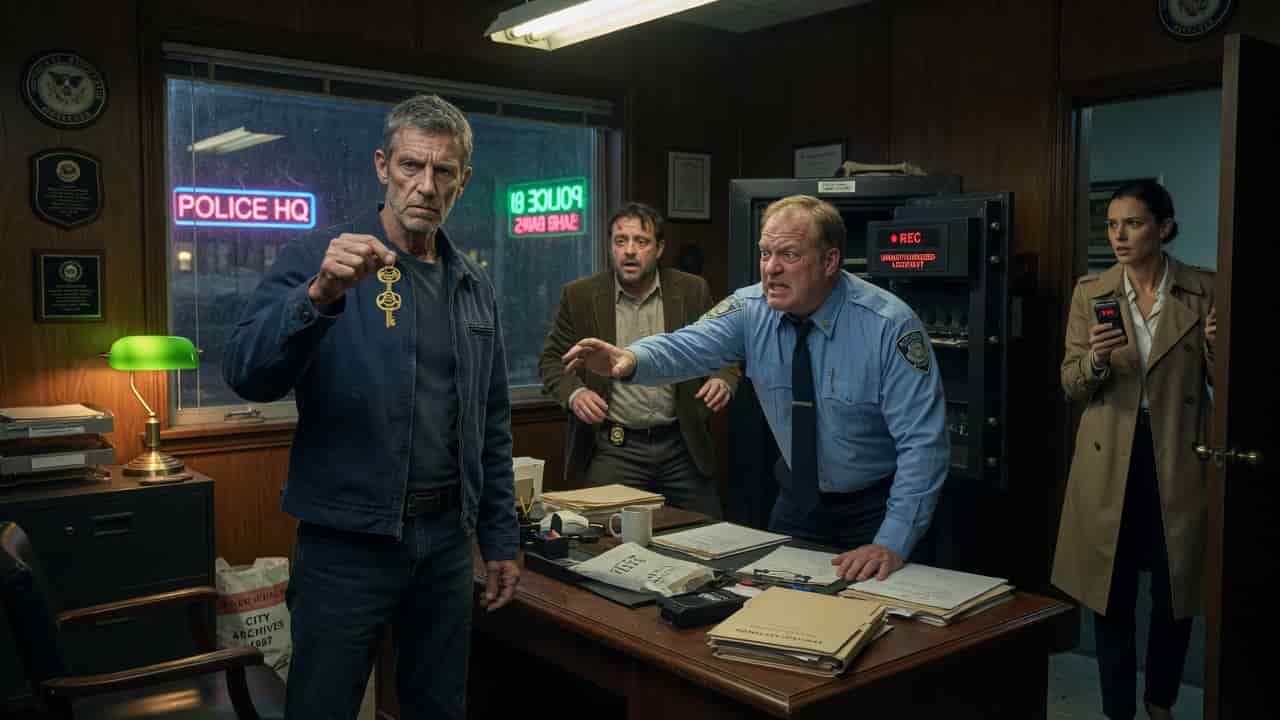
“This safe won’t open for a killer, Chief.”
Arthur stood in the center of the office, the smell of rain and old cigars clinging to his jacket. He didn’t look like a hero. He looked like a man who spent his days elbow-deep in graphite and tumblers. But the gold key he held between his fingers was the only thing standing between Chief Miller and a lifetime behind bars.
Miller lunged, his face a mask of sweating, desperate rage. “Give me that key, you piece of trash! You think you’re something? You’re a thief. A bottom-feeder. You’re exactly what your wife was when we found her.”
The room went ice-cold. Behind Arthur, Agent Vance from Internal Affairs didn’t move, but the click of her recorder echoed like a gunshot. She had heard it. Everyone in the hallway had heard it. Miller had finally said too much.
For years, they told Arthur his wife was caught in the crossfire of a heist. They told him it was an accident. But as Arthur looked at the man who had controlled this city for two decades, he didn’t see a badge. He saw the person who had pulled the trigger to keep a secret.
Arthur didn’t flinch. He just held the key higher, out of the reach of the man who thought he could bully the whole world into silence.
“You want the truth, Miller?” Arthur’s voice was steady, terrifyingly calm. “I didn’t just come here to open your safe. I came here to show everyone what’s inside.”
Chapter 1
The smell of graphite and cold steel was the only thing that made sense to Arthur anymore. It was a dry, metallic scent that got into the pores of his skin and the creases of his palms, a permanent reminder of a life spent in the service of mechanisms. His shop, The Skeleton Key, sat on a corner in the Mission District where the gentrification hadn’t quite managed to scrub away the grime. It was a small, narrow space filled with the rhythmic whir of key-cutting machines and the silent, patient presence of a hundred different locks hanging from pegboards like preserved specimens.
Arthur sat at his workbench, a jeweler’s loupe pressed to his eye. He was working on a 1920s Corbin cabinet lock, a delicate thing of brass and stubbornness. Beside him, Leo, his twenty-two-year-old apprentice, was struggling with a basic Kwikset deadbolt. Leo was impatient. He had the hands for the work—long, steady fingers—but he lacked the ear. He wanted to force the pins, to bully the cylinder into turning.
“Listen to it, Leo,” Arthur said, his voice a low gravel. He didn’t look up from the Corbin. “You’re trying to win an argument. A lock isn’t an opponent. It’s a conversation.”
“It’s a hunk of metal, Art,” Leo muttered, his forehead beaded with sweat. “And this hunk is stuck.”
“It’s not stuck. It’s waiting.” Arthur set down his pick and turned to the boy. “You feel that slight drag on the tension wrench? That’s the third pin binding. If you shove it, you’ll bend the spring. If you whisper to it, it’ll tell you when it’s ready to set.”
Leo sighed, dropping the tools. “I don’t know how you do it. Sitting here for ten hours a day, talking to doors. Don’t you ever want to, you know… use this for something else? Something bigger?”
Arthur’s eyes sharpened. The loupe felt heavy on his face. “I used it for something bigger once, Leo. That’s why I’m sitting in a shop with a leaky roof instead of a villa in France. You want ‘big’? Go join the circus. You want to be a locksmith? Pick up the wrench.”
The bell above the door chimed—a sharp, dissonant sound that set Arthur’s teeth on edge. He knew that chime. He knew the weight of the step that followed it. It wasn’t the tentative shuffle of a homeowner who’d locked themselves out. It was the heavy, rhythmic tread of authority.
Arthur didn’t turn around. He knew the smell, too. Old Spice and expensive leather.
“I’m closed, Chief,” Arthur said.
“The sign says open for another twenty minutes, Arthur. Don’t tell me you’ve started lying to the public,” a booming voice replied.
Chief Miller stepped into the light of the workbench. He was a mountain of a man, his police uniform strained at the buttons, his silver hair perfectly coiffed despite the drizzling San Francisco rain. He looked like the poster child for law and order, but Arthur saw the way his eyes roamed the shop, looking for leverage.
“What do you want, Miller?” Arthur stood up, wiping his hands on a greasy rag.
Miller smiled, but it didn’t reach his eyes. His eyes remained cold, calculating the distance between Arthur and the door. “Can’t a man visit an old friend? See how the honest life is treating him?”
“We aren’t friends. We’re a contract that ended twelve years ago.”
Miller chuckled, a dry sound. He leaned against a display case of high-security padlocks. “Twelve years. Is it really that long? Feels like yesterday we were in that warehouse. The sirens, the rain. The tragedy of it all.”
Arthur’s jaw tightened so hard he felt a phantom pain in his molars. “Get out.”
“Now, now. I’ve got a problem, Arthur. A professional problem.” Miller leaned in closer, dropping his voice. Leo was watching from the corner, his eyes wide. “I’ve got a safe. A very special safe. The kind that doesn’t exist on any manifest. It’s developed a bit of a… personality. It won’t open. And the things inside… well, they’re time-sensitive.”
“Call a commercial tech,” Arthur said.
“I did. He couldn’t handle it. Said the mechanism was too complex. Suggested I find a ‘master.’ And there’s only one master I trust with something this private.”
“I don’t do ‘private’ anymore. I do residential and light commercial. You want your safe opened? Bring it here with a court order and two witnesses.”
Miller’s expression shifted. The jovial mask slipped, revealing the predator underneath. He stepped into Arthur’s personal space, the smell of his cologne becoming suffocating. “I’m not asking, Arthur. I’m reminding you. I know where Claire lives. I know she’s still writing those little articles about police corruption. It would be a shame if she had an ‘accident’ similar to her sister’s. Rain makes the roads very slippery this time of year.”
The shop felt like it was shrinking. Arthur could hear the frantic ticking of a wall clock. The mention of Elena—the wound that never quite closed—was like a serrated blade across his throat.
“You wouldn’t,” Arthur whispered.
“I’ve done a lot of things, Arthur. You know that better than anyone. Be at the precinct tonight at ten. Back entrance. Don’t bring the kid. Just your tools and your silence.”
Miller patted Arthur’s cheek—a sharp, humiliating gesture of dominance. He turned and walked out, the bell chiming its dissonant tune once more.
Arthur stood frozen, the rag still in his hand. He could feel Leo’s gaze.
“Who was that?” Leo asked, his voice trembling. “Art, he just threatened you. He just—”
“Go home, Leo,” Arthur said, his voice flat.
“But—”
“Go home!” Arthur roared.
After the boy scrambled out, Arthur sat back down. He picked up the Corbin lock. His hands were shaking, a fine tremor he couldn’t suppress. He looked at the tumblers, the tiny, intricate pieces of metal that dictated whether a door stayed shut or opened to the world.
Twelve years. He had spent twelve years trying to bury the memory of the night Elena died. He had told himself it was a botched job, that the Shadow Unit—Miller’s hand-picked squad—had arrived and started shooting because they were scared. But he had always known the truth. They hadn’t been scared. They had been cleaning.
And now, Miller wanted him to open the vault that held the remains of that cleaning.
Arthur reached under the workbench and pulled out a small, velvet-lined box. Inside lay a set of picks he hadn’t touched since the day of Elena’s funeral. They were custom-made, balanced perfectly for his grip. He ran a finger over the steel.
He wasn’t going to the precinct to open a safe. He was going to find a way to pick the lock on Miller’s life.
Chapter 2
The rain was coming down in earnest by the time Arthur reached Claire’s apartment in the Richmond District. It was a modest place, filled with stacks of research papers and the smell of burnt coffee. Claire was Elena’s younger sister, and she carried the family resemblance like a heavy coat—the same dark, inquisitive eyes and the same stubborn set to her jaw.
She opened the door, her eyes narrowing when she saw him. “Arthur. You look like you’ve been pulled through a keyhole.”
“Can I come in?”
She stepped aside. “Coffee’s cold. Why are you here? You usually only visit when you’re feeling guilty about something.”
“Miller came to the shop today,” Arthur said, ignoring the jab.
Claire froze, a stack of folders in her hand. The air in the room seemed to thin. “What did he want?”
“He has a safe. He wants it opened. He used your name, Claire. He mentioned Elena.”
Claire sat down heavily on her mismatched sofa. She looked at the piles of paper around her—her latest investigation into the “Shadow Unit,” the group of officers Miller used to bypass the usual legal channels. “He knows I’m getting close, Arthur. I’ve found a paper trail. Disappearing evidence, ‘consulting fees’ paid to ghost companies. He’s nervous.”
“He’s more than nervous. He’s desperate. He’s forcing me to go to the precinct tonight.”
Claire looked up, her eyes fierce. “Don’t do it. If you go in there, you’re his accomplice again. That’s how he keeps you under his thumb.”
“I don’t have a choice. If I don’t go, he’ll find a way to stop you. I can’t lose you too, Claire. I won’t.”
Arthur walked to the window, looking out at the blurred streetlights. He felt the weight of his own history. He had been the one who taught Miller how locks worked. In the early days, when Miller was just an ambitious sergeant, he had hired Arthur—the “Gentleman Thief”—to help him ‘recover’ stolen goods without a warrant. It had seemed like a moral gray area then. But it had turned black very quickly.
“What’s in the safe?” Claire asked.
“He didn’t say. But he said it doesn’t exist on any manifest. That means it’s his private insurance. Ledger, cash, maybe the files on the Shadow Unit. If I can get in, and if I can get out with proof…”
“It’s a trap, Arthur. Miller doesn’t leave witnesses. You know that better than anyone.”
“I’m not a witness yet. I’m a tool. And tools are useful until the job is done.”
He left her apartment an hour later, the tension between them unresolved. Claire wanted justice; Arthur just wanted her safe. It was a fundamental contradiction that had defined their relationship since the funeral.
When he returned to the shop to gather his kit, he found Leo sitting on the curb, his head in his hands.
“I told you to go home,” Arthur said.
Leo stood up, his face pale in the streetlamp’s glow. “I did. But I couldn’t stay there. Art, that guy… he’s the Chief of Police. Why is he talking to you like you’re a dog? Why is he talking about your wife?”
Arthur sighed, the fatigue finally settling into his bones. “Sit down, Leo.”
They sat on the cold concrete. Arthur told him a version of the truth—the version where he was a man who made a mistake and the world never let him forget it. He didn’t tell him about the gold key he had kept hidden for a decade, or the fact that Miller’s ‘Private Evidence’ safe was actually a model Arthur himself had designed for a high-end security firm before his arrest.
“He wants me to open a vault tonight,” Arthur said. “And I need you to do something for me. Something dangerous.”
Leo’s eyes lit up with a mixture of fear and excitement. It was the look Arthur dreaded—the hunger for the ‘big’ thing.
“I need you to stay at Claire’s apartment. Don’t go inside, just watch the street. If you see a black SUV with tinted windows, or anyone who looks like they’re waiting, you call this number.” Arthur handed him a burner phone. “And you don’t play hero. You run. Do you understand?”
“I understand,” Leo said, his voice cracking. “But Art… what are you going to do?”
“I’m going to do what I do best. I’m going to find the weakness in the system.”
Arthur watched Leo walk away, the boy’s gait full of a misplaced sense of purpose. He felt a pang of guilt. He was dragging Leo into the same shadows that had swallowed Elena. But he needed eyes on Claire. Miller’s threats weren’t idle.
He went inside and packed his bag. He took his picks, a digital scope, and a small, high-powered magnet. Finally, he reached into the secret compartment under the floorboards and pulled out a gold key. It was a master key for the city’s municipal buildings, a relic from his days as a ‘consultant.’ It wouldn’t open the safe, but it represented the one thing Miller could never pick: Arthur’s memory.
The precinct was a fortress of concrete and glass, a monument to a power that had grown unchecked. Arthur walked to the back entrance, his heart hammering against his ribs like a trapped bird. Two men in plain clothes were waiting for him. They didn’t speak. They just flanked him and led him into the bowels of the building.
The elevator descended to a level that wasn’t marked on the buttons. When the doors opened, Arthur was in a hallway that smelled of ozone and fresh paint. This was the heart of the Shadow Unit.
He was led into a large, windowless room. Miller was there, stripped of his uniform jacket, his sleeves rolled up. In the corner of the room stood a massive, black steel safe.
“You’re late,” Miller said.
“The rain,” Arthur replied, his voice steady.
“Well, you’re here now. There’s the box. No one else can get it open. If you can’t do it in two hours, Arthur, I’m going to have to assume you’re being uncooperative. And we both know what happens to uncooperative people in this city.”
Arthur walked to the safe. He ran his hands over the cold steel. He could feel the eyes of the two guards on him. He could feel Miller’s breath on his neck.
He took out his tools. He wasn’t just opening a safe. He was opening a door he had kept locked for twelve years. And once it was open, there would be no closing it again.
Chapter 3
The safe was a masterpiece of paranoia. It was a customized Titan Series-7, a beast that combined a mechanical dial with a secondary electronic pulse-lock. Arthur knelt before it, the cold of the concrete floor seeping into his knees. He could hear Miller pacing behind him, the creak of the Chief’s leather shoes a rhythmic reminder of the pressure.
“Focus, Arthur,” Miller growled. “Every minute you spend fumbling is a minute I lose my patience.”
Arthur didn’t respond. He had entered the ‘hollow space,’ the mental state where the world outside the lock ceased to exist. He pressed his ear to the steel, his fingers feather-light on the dial. Click. Whisper. Resistance.
He was thinking about the first time he had opened a lock for Miller. It had been a simple evidence locker. Miller had called him a ‘prodigy.’ He had bought Arthur dinner and talked about ‘the greater good.’ He had made Arthur feel like part of something important. It was a classic recruitment tactic, a slow-release poison that Arthur had swallowed willingly because he was young and arrogant.
“You know,” Miller said, his voice dropping to a conversational tone that was somehow more menacing than his shouting. “The beauty of this unit is that we don’t have to wait for the system. The system is slow, Arthur. It’s bloated. It protects the wrong people. We… we protect the city.”
“Is that what you were doing at the warehouse?” Arthur asked, his voice flat as he felt the first tumbler drop.
The pacing stopped. “The warehouse was a complication. Your wife… she wasn’t supposed to be there. She was a liability. And in our line of work, liabilities are eliminated. It wasn’t personal.”
“It was personal to me,” Arthur said, his fingers tightening on the dial.
“And that’s your weakness. You let your emotions cloud your utility. That’s why you’re on the floor and I’m behind the desk.”
Arthur felt the second tumbler set. He reached into his bag for the digital scope. He needed to bypass the electronic pulse-lock. As he worked, he realized the safe wasn’t just stuck. It had been tampered with. Someone had tried to force it from the inside—or rather, someone had tried to set a trap for whoever opened it.
He paused. If he triggered the pulse-lock incorrectly, it would send a silent alarm to Miller’s personal device, and likely wipe the electronic drive inside the safe.
“Problem?” Miller asked.
“The pulse-lock is sensitive,” Arthur lied. “I need more light.”
Miller signaled to one of the guards, who stepped forward with a high-powered flashlight. The guard was young, barely thirty, with a hard, vacant stare. He looked at Arthur with the same contempt he might show a cockroach.
“Hurry up, old man,” the guard muttered.
“Don’t talk to him,” Miller snapped. “He’s a specialist. Treat him with the respect his ‘special’ talents deserve.”
Miller laughed, a jagged sound that filled the room. It was a public humiliation, a reminder that Arthur was nothing more than a trained animal. Arthur felt the shame hot in his chest, but he used it. He channeled the anger into his hands, making them even steadier.
He found the bypass. It was a tiny copper wire hidden behind the keypad. With a surgical precision, he clipped it and bridged the connection with his magnet. The red light on the keypad blinked once, then turned a steady, inviting green.
“It’s ready,” Arthur said.
Miller pushed him aside, his eyes gleaming with a manic hunger. He grabbed the handle and spun it. The heavy steel door swung open with a hiss of pressurized air.
Inside were stacks of cash—hundreds, thousands of bills bound in plastic. But Miller didn’t look at the money. He reached into the back and pulled out a thick, leather-bound ledger and a silver flash drive.
“Finally,” Miller whispered. He turned to Arthur, his face illuminated by the interior light of the safe. “You did well, Arthur. For a thief.”
“Am I done?”
“Almost. There’s one more thing. A small party tomorrow night. A fundraiser for the Mayor. I want you to perform.”
Arthur stared at him. “Perform?”
“A demonstration. The city’s elite, they love a bit of danger. I’ll introduce you as a ‘rehabilitated’ expert. You’ll open a series of locks for the crowd. It’ll show them that under my watch, even the cleverest criminals can be tampered and put to use. It’ll be… humiliating for you, I’m sure. But it’ll be very good for my image.”
“I won’t do it.”
Miller stepped close, his hand resting on the holster of his sidearm. “You will. Because if you don’t, I’ll send my boys to Claire’s apartment tonight. And this time, there won’t be any crossfire. Just a very clear message.”
Arthur looked at the ledger in Miller’s hand. He realized this was it. Miller was so arrogant, so convinced of his own untouchability, that he was parading his ‘pet thief’ in front of the very people he was defrauding.
“I’ll be there,” Arthur said.
“Good. Wear something presentable. I don’t want you smelling like a garage.”
Arthur was escorted out of the building. The rain had turned into a cold mist. He walked to a payphone three blocks away and dialed the number he had given Leo.
“Is she okay?” Arthur asked when Leo picked up.
“She’s fine. I’m across the street. A black SUV drove by twice, but they didn’t stop. Art, your voice… what happened?”
“The door is open, Leo. Now we just have to wait for the house to fall down. Listen to me carefully. I need you to get Claire. Take her to the shop. Use the back entrance. I’ve left a package in the Corbin cabinet. Open it. It’s got everything she needs for her story.”
“What about you?”
“I’m going to a party,” Arthur said, looking back at the dark silhouette of the precinct. “And I’m going to make sure the Chief gets exactly what he wants.”
Arthur spent the rest of the night in his shop. He didn’t sleep. He worked on a single object: a gold key. It wasn’t just a key; it was a Trojan horse. He used his finest files, his most delicate drills. He was building a masterpiece of deception.
Miller thought he had broken Arthur. He thought he had turned a man into a tool. But Miller had forgotten the first rule of locksmithing: every mechanism has a bypass. And Arthur was about to find Miller’s.
Chapter 4
The Fairmont Hotel was a palace of marble and gold, a place where the city’s power players came to buy and sell influence over glasses of vintage champagne. Arthur felt like a ghost in the grand ballroom. He was wearing a dark suit that felt like a straightjacket, his hands tucked into his pockets to hide the graphite stains that no amount of scrubbing could remove.
Chief Miller was the center of attention. He was holding court near the stage, a glass of bourbon in one hand, the other resting on the shoulder of the District Attorney. He looked like a king.
“Ah, here he is!” Miller called out, his voice carrying over the chamber music. The crowd turned. “The man of the hour. Our resident reformed genius, Arthur.”
Arthur walked toward the stage. He could feel the eyes of the socialites and politicians on him—pitying, curious, or filled with a casual, high-class contempt. To them, he was a curiosity, a bit of ‘street’ brought in to spice up the evening.
“Arthur here used to be quite the problem for the department,” Miller said to the room, his arm draping over Arthur’s shoulders in a suffocating display of ownership. “He could get into any room, any vault. But look at him now. A testament to the power of… proper guidance.”
There was a polite ripple of laughter. Arthur stood still, his face a mask of calm. He looked out into the crowd and saw Agent Vance. She was standing near the back, her camel coat replaced by a sharp black blazer. Her eyes were locked on him, intense and unblinking.
“Now, Arthur,” Miller said, gesturing to a table on the stage where three high-security safes were lined up. “A little demonstration for our guests. Show them how easy it is for a man like you to break the rules, and how easy it is for a man like me to stop you.”
Arthur stepped to the first safe. He could see Miller’s arrogance in the way he stood, chest out, basking in the spotlight. Miller thought this was the final humiliation, the moment where Arthur was forced to admit his subservience in front of the whole world.
But Arthur saw something Miller didn’t. He saw the way the air in the room had changed. He saw the two men from Internal Affairs standing near the exits.
Arthur opened the first safe in thirty seconds. The crowd gasped. The second safe took a minute. By the time he reached the third—the same Titan Series-7 he had opened the night before—the room was silent.
“This is the one, folks,” Miller said, his voice dripping with theater. “The best of the best. Even Arthur here struggled with this one last night.”
Arthur stopped. He turned to Miller.
“You’re right, Chief. This safe is special. But it’s not just about the lock. It’s about what’s inside.”
Miller’s smile faltered. “Just open the box, Arthur.”
“I found a key last night, Chief. A gold one. With the city crest. You remember it? It was from the warehouse. The night of the ‘accident.'”
The room went deathly quiet. Miller’s face turned a mottled red. “That’s enough. You’re rambling. Open the safe or get off the stage.”
“I will open it,” Arthur said, reaching into his pocket and pulling out the gold key he had spent all night perfecting. He held it up. The ballroom lights caught the metal, making it glow. “But I think everyone here would like to know why this key, which belonged to my wife, was found in your private evidence safe.”
Miller lunged. It was a clumsy, desperate move. He grabbed Arthur’s collar, his face inches from Arthur’s.
“Give me that key, you piece of trash!” Miller snarled, his voice a low, terrifying growl that carried through the microphone on the podium. “You think you’re something? You’re a thief. A bottom-feeder. You’re exactly what your wife was when we found her.”
Arthur didn’t flinch. He looked past Miller’s shoulder at Agent Vance, who was now moving through the crowd, her recorder visible in her hand.
“This safe won’t open for a killer, Chief,” Arthur said, his voice amplified, clear and steady.
Miller shoved him back, his hand going for his belt, but he realized too late he wasn’t wearing his service weapon. He was in a tuxedo, surrounded by the people he had spent his life trying to impress, and he had just confessed to a murder in front of every witness that mattered.
Agent Vance stepped onto the stage. “Step away from him, Miller. Now.”
The ballroom erupted into chaos. Security moved in, but they weren’t sure who to protect. Miller stood in the center of the stage, his chest heaving, his silver hair disheveled. He looked around the room and saw the faces of his peers—the horror, the realization, the immediate withdrawal of support.
Arthur stood at the edge of the stage, the gold key still in his hand. He felt a strange, hollow sensation in his chest. He had done it. He had picked the lock.
But as he looked at Miller, he realized that the residue of the night Elena died would never truly go away. The truth didn’t fix the past; it just stopped it from owning the future.
Vance took the key from Arthur’s hand. “We have the ledger, Arthur. Your apprentice and the journalist… they brought it to the precinct an hour ago. It’s over.”
Arthur nodded. He walked off the stage, through the crowd that parted for him like a dark sea. He walked out of the Fairmont and into the cool, biting San Francisco night.
The rain had stopped. The air was clear. He could see the lights of the Golden Gate Bridge in the distance. He took a deep breath, the smell of graphite and cold steel finally fading, replaced by the scent of salt and the possibility of a morning where he didn’t have to talk to doors.
But he knew, as he walked toward the Mission, that some locks were never meant to be opened. And some secrets, once out, would change the shape of the city forever.
Chapter 5
The Fairmont was a fever dream of gold leaf and velvet, but the Mission District was cold, damp, and smelled of exhaust. Arthur walked the three miles back to his shop. He didn’t want a cab. He didn’t want the sanitized hum of a Prius or the polite silence of a driver who didn’t know he was carrying the debris of a dead man’s career in his pocket. He needed the air to scrape against his lungs. He needed the physical reality of the pavement under his boots to remind him that he hadn’t drifted off the edge of the world.
He reached The Skeleton Key at nearly two in the morning. The neon sign was flickering, a rhythmic buzz that sounded like a dying insect. The back alley was a canyon of shadows, but as he approached the steel door, he saw a sliver of light bleeding from the frame.
He didn’t reach for his keys. He reached for the heavy iron pipe he kept hidden behind the dumpster.
“It’s me, Art! Don’t swing!”
Leo’s voice was high, frantic. The door cracked open, and the boy’s pale face appeared in the gap. He looked like he’d aged five years in five hours. Behind him, Claire was sitting at the workbench, her laptop open, the blue light making her look like a marble statue.
Arthur stepped inside and dropped the pipe. The shop felt different—crowded, breathless. “I told you to stay at the safe house.”
“We couldn’t,” Claire said, not looking up from the screen. Her fingers were flying across the keys. “Leo saw them, Arthur. Two men in a gray sedan. They weren’t patrol. They were the ones from your description. The Shadow Unit. They didn’t just drive by; they sat there. Watching the windows.”
Arthur looked at Leo. The boy was shaking, his hands stuffed deep into the pockets of his hoodie. “I did what you said, Art. I didn’t play hero. I grabbed her and we went out the fire escape. I think they followed us for a few blocks, but I took the alleys through the Tenderloin. I think we lost them.”
“You think?” Arthur’s voice was sharper than he intended.
“He did fine, Arthur,” Claire snapped, finally closing the laptop. “He got the ledger here. It’s scanned. It’s encrypted. And it’s already sitting in the inbox of my editor and three different federal prosecutors. Miller is done. You heard the news on the way?”
“I didn’t need the news. I was the headline,” Arthur said. He walked to the sink and splashed cold water on his face. The graphite on his hands was stubborn, a gray stain that felt like it had reached the bone. “I humiliated him in front of the Mayor, the DA, and half the police board. He confessed to Elena’s murder into a hot mic.”
“Then why are you looking at the door like you’re waiting for an executioner?” Claire asked. She stood up and walked over to him, her expression softening for the first time in years. “Arthur, it’s over. Vance has him. The Internal Affairs team was all over that stage.”
Arthur dried his face with a rough paper towel. “You don’t know Miller. You know the politician. You know the Chief. You don’t know the man who built the Shadow Unit. That man doesn’t go to a cell quietly. He has people who owe him. People who can’t afford for him to talk. If he’s in custody, he’s a leak. And the people he’s been protecting for twenty years… they’ll want that leak plugged.”
“You think they’ll kill him?” Leo asked, his voice a whisper.
“I think they’ll try to kill all of us,” Arthur said. “The ledger is out, but the physical evidence—the flash drive I opened last night—it’s still in play. Vance took the gold key, but Miller had the drive in his hand when he lunged at me. Did Vance say she recovered it?”
Claire frowned. “She said they were processing the scene. She didn’t mention a drive.”
Arthur cursed under his breath. He looked around the shop. This place was his sanctuary, but it was also a cage. One door, one back exit, and windows that were more glass than security. He had spent his life making other people’s homes safe, but he had left his own life vulnerable to a man who didn’t care about locks.
“Leo, get the shutters down. Double-bolt the floor track. Claire, get away from the windows.”
“Arthur, you’re being paranoid,” Claire said, but she moved toward the back office anyway.
“I’m being a locksmith. I know how things break.”
He spent the next hour working in a silent, methodical trance. He didn’t use his tools for repair; he used them for fortification. He rigged the front door with a tension-release wire that would trigger a high-decibel alarm if the lock was forced. He moved the heavy safe-cracking drill to the back door, wedging it against the frame to act as a secondary deadbolt.
Leo watched him, fascinated and terrified. “Is this how it used to be? When you were… before?”
“Before I was a ‘rehabilitated expert’?” Arthur didn’t look up from the wiring. “No. Before, I was the one coming through the door. I knew exactly where the blind spots were. Now, I’m the blind spot.”
“Art, I’m sorry,” Leo said suddenly. “For wanting the ‘big thing.’ I didn’t know it meant people actually wanting to kill you. I thought it was like the movies. Puzzles and cool gadgets.”
Arthur stopped. He looked at the boy—really looked at him. Leo was just a kid from the neighborhood who liked the way tumblers clicked. He deserved a life of fixing door hinges for old ladies and charging twenty bucks to pop a car lock for a distracted teenager. He didn’t deserve the residue of a twenty-year-old blood feud.
“It’s not your fault, Leo. It’s mine. I should have kept you out of the shop the second Miller walked in. I thought I could use you as eyes. I was using you as a shield. That’s what men like Miller do. I’m not going to be that man.”
“You aren’t,” Claire said from the office doorway. She held up her phone. “Vance is calling.”
Arthur took the phone. “Vance?”
“Arthur, listen to me carefully,” Vance’s voice was tight, layered with background noise—sirens, shouting, the frantic energy of a precinct in collapse. “Miller is gone. We were transporting him to the federal building. A black SUV rammed the transport van on the Bay Bridge. Two men with tactical gear. They didn’t kill the officers, but they took Miller. And Arthur… they took the evidence locker from the van.”
“The flash drive,” Arthur said.
“And the ledger. We have the digital copies, but Miller has the originals. He has the names of the judges and the senators who were on his payroll. He’s going to trade them for a way out.”
“He’s not going to the airport, Vance. He’s coming for the source.”
“We’re sending units to the shop, but the bridge is blocked. It’s a mess out here. Get out of there, Arthur. Now.”
The line went dead.
Arthur looked at Claire and Leo. The shop felt smaller than it had a minute ago. The air was thick with the scent of ozone and the looming threat of the dark alley outside.
“He’s coming,” Arthur said.
“How? Why here?” Claire asked. “He has the ledger. He has his leverage.”
“Because he still thinks I have the key,” Arthur said. He reached into his pocket and pulled out a small, heavy object. It wasn’t the gold key he’d given Vance. It was a second one—a dummy he’d made in the shop, but one that held a GPS tracker he’d scavenged from a high-end bike lock. “When he lunged at me on stage, I slipped this into his pocket. I thought it was a long shot. I thought he’d be in a cell by now.”
He turned on his tablet. A small red dot was moving slowly across the map of San Francisco. It wasn’t heading for the airport. It wasn’t heading for the docks.
It was heading for the warehouse in South San Francisco. The place where Elena died.
“He’s going back to the start,” Claire whispered, her face going white.
“He thinks that’s where the real evidence is buried. He thinks I’m the only one who knows the combination to the floor safe we never opened. The one the police ‘missed’ twelve years ago.”
“Was there a floor safe?” Leo asked.
“No,” Arthur said, his eyes hard. “But he’s spent twelve years wondering if I lied to him. And a man like Miller… his greed is the only lock I can always pick.”
“Arthur, you can’t go there alone,” Claire said, grabbing his arm. “Vance said the police are coming.”
“Vance is stuck on a bridge. The Shadow Unit isn’t. If I stay here, they’ll burn this shop down with you in it. If I go to the warehouse, I draw them away.”
“I’m coming with you,” Claire said.
“No. You take Leo. You go to the Central Station. You walk into the lobby where there are fifty cameras and a dozen officers who aren’t on Miller’s payroll. You stay there until Vance finds you.”
“Art—” Leo started.
“That’s an order, Leo. You’re a locksmith. You protect the things that matter. Right now, she’s the only thing that matters.”
Arthur didn’t wait for an argument. He grabbed his bag—the heavy one, the one that clanked with steel and purpose. He went out the back door, leaving the lights on in the shop to make it look like they were still inside. He felt the rain on his face again, but this time it didn’t feel like a weight. It felt like a countdown.
He got into his old Ford Econoline van, the engine groaning as it turned over. He didn’t look back at the shop. He didn’t look at Claire and Leo standing in the alley. He just looked at the red dot on the screen.
Miller was waiting. For twelve years, the man had lived in the space between the truth and a lie, and tonight, Arthur was going to close that gap. He drove toward the industrial district, the city lights blurring into long, jagged streaks of neon and gray. The residue of the past was finally catching up to the present, and for the first time in a decade, Arthur didn’t feel like he was running. He felt like he was finally picking the one lock that had kept him a prisoner in his own life.
Chapter 6
The warehouse was a skeletal remains of a building, a shell of corrugated tin and rotting timber that stood at the edge of the bay. It looked exactly as it had twelve years ago, except the “Police Line: Do Not Cross” tape had long since faded to a brittle, translucent gray. The smell of salt and stagnant water was overwhelming, a thick, heavy blanket that seemed to muffle the sound of the rain hitting the roof.
Arthur parked the van three blocks away and approached on foot. He moved through the shadows with the practiced silence of a man who had spent his youth avoiding the light. He could see the black SUV parked near the loading dock, its engine idling, a low growl in the darkness.
He slipped through a side door—a lock he had installed himself years ago, one that had never been changed. The interior was a cavern of rusted machinery and stacks of wooden pallets. In the center of the room, under a single, flickering work light, stood Chief Miller.
He wasn’t the polished politician anymore. His tuxedo was torn, his face was smeared with grease and blood, and his eyes were wild with a frantic, cornered energy. He was kneeling on the concrete floor, his hands clawing at a patch of dirt and debris in the corner.
“It’s not there, Miller,” Arthur said, his voice echoing in the vast, empty space.
Miller spun around, falling back against a rusted pillar. He held a heavy service pistol in a shaking hand. “Arthur. You clever, miserable bastard. Where is it? Where’s the safe?”
Arthur walked into the pool of light, his hands empty, held out at his sides. He looked at the spot where Miller had been digging. “There never was a safe here. I told you that twelve years ago. You just couldn’t believe it. You couldn’t believe a thief would walk away from that much money.”
“You lied,” Miller spat, his breath coming in ragged gasps. “You kept it for yourself. You let Elena die for nothing.”
“Elena didn’t die for money, Miller. She died because you were afraid she’d seen the ledger. She died because you ordered the Shadow Unit to open fire before anyone could talk. I didn’t lie about the safe. I lied about you.”
Miller laughed, a high, thin sound that bordered on hysteria. He stood up, using the pillar for support. “It doesn’t matter. I have the ledger. I have the drive. I’ll walk out of here, and by morning, the DA will be begging me to tell him who’s on that list. I’m still the most powerful man in this city.”
“You’re a man in a wet tuxedo holding a gun in a trash heap,” Arthur said. “Look around, Miller. The Shadow Unit? They’re gone. They rammed the van, they got you out, and then they vanished. They aren’t loyal to you. They’re loyal to the money. And you don’t have it anymore.”
“I have the drive!” Miller screamed, fumbling in his pocket. He pulled out the small silver flash drive. “This is worth millions!”
“Put the gun down, Miller,” a new voice said.
Agent Vance stepped out of the shadows near the loading dock. She was alone, her service weapon leveled at Miller’s chest. Her face was a mask of cold, professional fury.
“Vance,” Miller sneered. “The hero. You think you can take me in? You think you’re the first ‘clean’ cop to try and break me? I’ll have your badge by noon.”
“You won’t have anything but a jumpsuit,” Vance said. “The bridge is clear. The feds are five minutes out. And Arthur… thank you for the tracker.”
Miller looked at Arthur, then at his own pocket. He pulled out the dummy gold key, the small red LED blinking mockingly in the dim light. His face went through a terrifying transformation—from rage to realization to a bottomless, soul-crushing shame.
“A locksmith’s trick,” Miller whispered.
“I didn’t need to break into your safe, Miller,” Arthur said, stepping closer. “I just needed to let you out. You spent twenty years thinking you were the one holding the keys. But you were just another lock. And tonight, I finally found the bypass.”
Miller looked at the gun in his hand, then at Vance, then back at Arthur. For a second, the air in the warehouse felt like it was charged with electricity, a tension so thick it was impossible to breathe.
“I should have killed you in that shop,” Miller said, his voice suddenly calm, a terrifying, flat tone.
“You tried,” Arthur said. “For twelve years, you tried to kill me one piece at a time. But a man who knows how to fix things… he knows how to endure.”
Miller raised the gun, but he didn’t point it at Arthur. He pointed it at his own temple.
“No!” Vance shouted, stepping forward.
But Miller didn’t pull the trigger. He looked at Arthur, a final, flickering spark of the old bully in his eyes. “You think you won? You think this city is going to change? You’ll be back in that shop tomorrow, Arthur. Fixing locks for people who don’t care about your name. And I’ll be the ghost that haunts every click of those tumblers.”
He threw the gun across the floor. It skittered into the darkness, a heavy, metallic sound. Miller slumped against the pillar, his head falling forward. He looked small. He looked like the man he had been before he ever put on the badge—a man who was afraid of the dark.
Vance moved in, the zip-ties clicking as she secured his wrists. She didn’t say anything. There was nothing left to say.
Arthur walked to the edge of the warehouse, looking out at the bay. The rain had turned into a light mist, the kind that hung over the water like a shroud. He felt the weight of the last twelve years finally beginning to lift, not all at once, but in small, incremental shifts, like a lock finally reaching its set point.
“Arthur?”
He turned. Claire was standing near the door. She must have followed them, or Leo had let her go. She looked at Miller, then at Arthur. She didn’t ask if he was okay. She knew he wasn’t. Nobody was ever ‘okay’ after a night like this.
“Is it done?” she asked.
“It’s done,” Arthur said.
He walked over to her. She reached out and took his hand. Her palm was warm, a contrast to the cold steel he had been holding all night.
“What now?” she asked.
“Now… I think I’m going to close the shop for a few days,” Arthur said. “Leo needs to learn how to fix a real deadbolt. And I need to learn how to sleep without listening for the chime.”
They walked out of the warehouse together. Behind them, the blue and red lights of the federal units began to pulse against the wet pavement, a silent, rhythmic strobe that illuminated the decay of Miller’s empire.
Arthur didn’t look back. He didn’t need to. He knew exactly what was behind him. He knew the shape of the shadows and the sound of the locks. But as he got into the van with Claire, he realized he didn’t need the gold key anymore. He didn’t need the master key to the city.
He had the key to his own life. And for a locksmith, that was the only one that ever really mattered.
He drove away from the docks, the engine of the Econoline a steady, reliable hum in the quiet of the morning. The city was still there, dark and complicated and full of secrets, but for the first time in a decade, Arthur felt like he was just a man driving home.
The residue would stay. It would stay in the graphite in his skin and the way he always looked at a doorway before entering. But the pressure was gone. The conversation with the world had changed. And as the sun began to peek over the Oakland hills, turning the fog into a soft, glowing amber, Arthur realized that some doors were meant to be opened, but the best ones were the ones you could finally, safely, leave behind you.
He reached his shop as the first commuters were beginning to stir. He didn’t go inside. He stood on the sidewalk for a moment, looking at the sign. The Skeleton Key.
He reached into his pocket and found a small, brass pin—a leftover from the Corbin lock he’d been working on. He flicked it into the gutter.
“Let’s go get some breakfast, Claire,” he said.
“Real coffee?” she asked, a small smile touching her lips.
“The most expensive kind,” Arthur said. “I think we’ve earned it.”
They walked down the street, two people in the gray light of a San Francisco morning, leaving the ghosts of the warehouse to the rising tide. The locks were all set. The truth was out. And the rest, Arthur decided, was just a matter of time.



