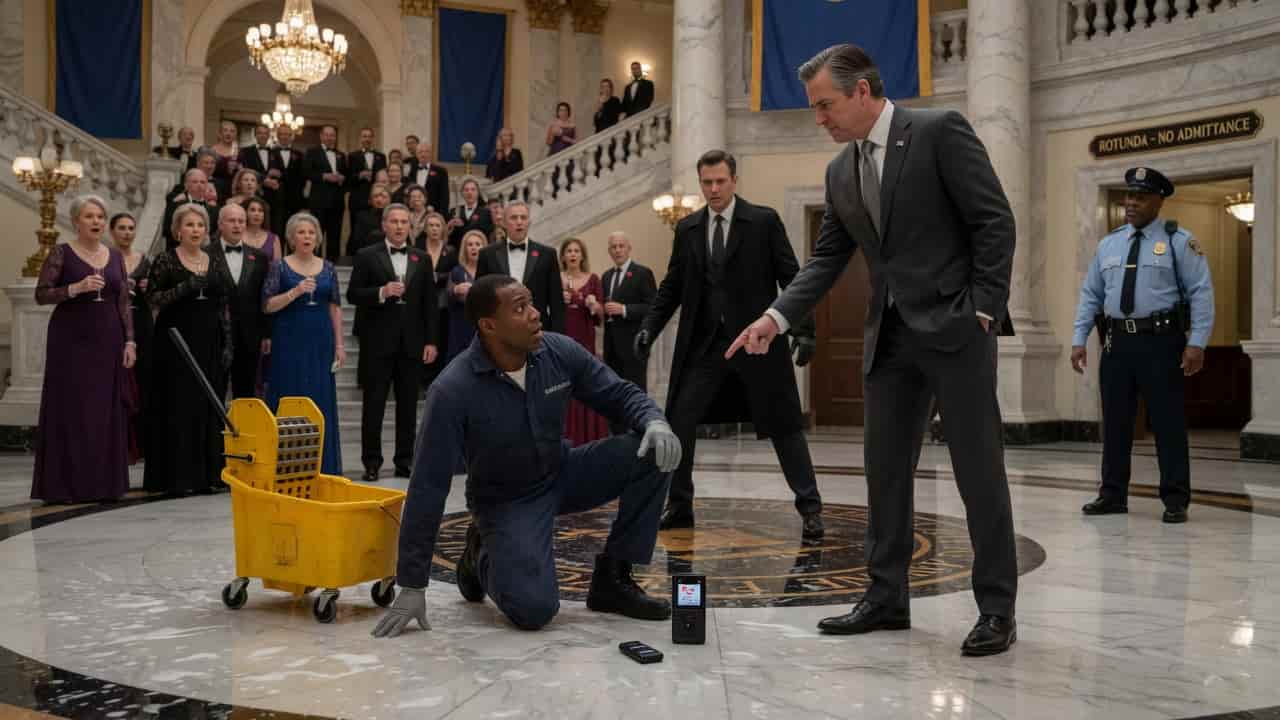
“Pick it up, Marcus. Do your job.”
Attorney General Julian Vance didn’t even look at the man he’d ruined ten years ago. To him, Marcus was just a shadow in a navy-blue jumpsuit, a clumsy janitor who had dared to trip in front of the state’s most powerful donors. Vance stood over him, his expensive leather shoe inches from Marcus’s trembling hand, mocking him for the entertainment of the crowd.
But then the recorder fell.
It didn’t just slide across the marble; it began to play. The laughter in the rotunda died a sudden, ugly death as Vance’s own voice echoed off the high ceilings—admitting to the very crime that had sent Marcus to prison a decade ago. The “Rising Star” of the justice system froze, his face turning a sickly shade of gray as the people who had just toasted his victory realized they were standing in the middle of a crime scene.
Marcus didn’t move. He stayed on one knee, looking up at the man who had stolen his youth, his career, and his father’s savings. For ten years, he had been invisible. Now, he was the only thing anyone was looking at.
Chapter 1: The Ghost in the Rotunda
The smell of Pine-Sol was the only thing Marcus had left that felt clean. It was a chemical, biting scent that stayed in the back of his throat long after he’d clocked out of the State Capitol. It was the scent of his penance, or maybe just the scent of being invisible.
He pushed the heavy industrial mop bucket across the white marble of the rotunda, the wheels squeaking in a rhythmic, lonely cadence. It was 5:00 PM, the hour when the power-players began to emerge from their wood-paneled offices like shadows stretching across a graveyard. They never looked at him. To them, he was part of the architecture—a moving piece of furniture designed to keep the floors reflective enough for them to admire their own silhouettes.
Marcus stopped near the statue of Lady Justice. He dipped the mop, wrung it out with a metallic clack, and began the slow, sweeping arcs he’d perfected over the last three years. Ten years ago, he would have been on the other side of those mahogany doors. Ten years ago, he was Marcus Thorne, the third-year law student with a 4.0 and a future that looked like a straight line to the Supreme Court.
Now, he was just Marcus. The guy who missed a spot near the water fountain.
“Hey, Thorne. You missed the corner by the elevator.”
Marcus didn’t look up. He knew the voice. It was Silas, the “special assistant” to the Attorney General. Silas was a man who wore suits that cost more than Marcus’s annual salary, but he wore them like a threat. He was the guy who cleaned up the messes that Pine-Sol couldn’t touch.
“I’m getting to it, Silas,” Marcus said, his voice low and raspy from lack of use.
Silas stepped into Marcus’s path, his polished black oxfords resting right on the line of wet marble Marcus had just finished. “The AG is having his victory gala tonight. Three hundred donors. The Governor. If I see so much as a scuff mark on this floor, you’re back at the employment office. You understand me?”
Marcus looked at the shoes. Then he looked up. Silas had eyes like a shark—flat, dark, and devoid of anything resembling empathy. He knew exactly who Marcus was. He’d been there in the courtroom ten years ago, sitting behind Julian Vance, whispering in the prosecutor’s ear while Marcus’s life was dismantled piece by piece.
“I understand,” Marcus said.
Silas leaned in, the scent of expensive cologne clashing with the bleach. “Good. Because I’d hate to see you lose the only job you’re actually qualified for.”
He walked away, his footsteps echoing with an arrogant, sharp snap. Marcus watched him go, his grip tightening on the wooden mop handle until his knuckles turned ashen. The anger was a dull, familiar ache in his chest, like an old fracture that never quite set right.
He finished the floor and retreated to the basement, a labyrinth of concrete and buzzing fluorescent lights that felt more like home than his cramped apartment. He sat on a plastic crate in the supply closet, the hum of the HVAC system the only company he had.
He reached into the hidden pocket of his jumpsuit and pulled out a small, matte-black digital recorder. It was a professional-grade Olympus, the kind reporters used. He’d spent six months’ worth of “extra shift” money on it. He pressed play, his heart hammering against his ribs.
“…don’t worry about the Thorne kid. The evidence is planted, the witness is paid, and Vance is going to ride this conviction all the way to the AG’s office. It’s a clean kill, Silas. Just make sure the file stays in the private safe.”
The voice was unmistakable. Julian Vance. Smooth, authoritative, and utterly devoid of a soul. Marcus had heard this recording a thousand times. He’d memorized every inflection, every pause for a sip of scotch, every casual chuckle at the destruction of a twenty-four-year-old’s life.
A shadow fell across the doorway. Marcus jumped, nearly dropping the recorder into his mop bucket.
“Working late again, Marcus?”
It was Benny, the head of Capitol security. Benny was sixty, with a face like a roadmap of every bad decision he’d ever made and a heart that was far too soft for a man who carried a sidearm. He was the only person in the building who called Marcus by his name without a sneer.
“Just finishing up,” Marcus said, sliding the recorder back into his pocket.
Benny walked in, leaning against the metal shelves of industrial toilet paper. He looked tired. “You heard about the party tonight? Vance is making his big speech. Word is he’s eyeing a run for the Senate next. The man’s unstoppable.”
“Nobody’s unstoppable, Benny,” Marcus said, staring at the floor.
Benny sighed, a heavy, rattling sound. “I saw your dad yesterday. At the diner. He’s looking frail, kid. He was still talking about that old case. Still trying to find that lawyer—what was his name? Miller?”
“David Miller,” Marcus said, the name tasting like copper in his mouth. “The man who forgot how to defend someone the moment the DA whispered in his ear.”
“Your dad loves you, Marcus. But that obsession… it’s eating him alive. He spent his whole pension on those private investigators. He’s living in a trailer because he wouldn’t stop trying to prove you didn’t do it.”
“I didn’t do it,” Marcus snapped, his eyes flashing.
Benny held up his hands. “I know. I believe you. I’ve watched you for three years. A man who did what they said you did doesn’t work this hard to be invisible. But Marcus… look around. This place is a fortress. Vance is the King of the Hill. You’re just the guy who mops the floor. Don’t let the ghosts win.”
Benny patted him on the shoulder and walked out, leaving Marcus alone in the hum of the basement.
The ghosts hadn’t won yet. They were just waiting for their invitation to the party.
Marcus stood up and looked at his reflection in the small, cracked mirror on the back of the door. He didn’t see a janitor. He saw a man who had been buried alive and had finally finished digging his way back to the surface.
Tonight, the King of the Hill was going to have a very public fall.
Chapter 2: The Weight of the Crown
The rotunda was transformed. The smell of Pine-Sol had been buried under the scent of lilies, roasting prime rib, and the heavy, expensive musk of old money. Red and blue banners draped from the balconies, and the white marble Marcus had scrubbed until his back throbbed was now covered by the shifting shadows of the state’s elite.
Marcus stood in the shadows of the North corridor, his mop bucket a yellow beacon of his low status. He was supposed to be “on call” for spills. In reality, he was there to be humiliated if a guest dropped a canapé or stepped in a puddle.
He watched Julian Vance. The man was a master of the room. He moved from group to group, a hand on a shoulder here, a whispered joke there, his silver hair gleaming under the chandeliers. He was the picture of American justice—stern but fair, powerful but accessible.
And Marcus was the only person in the room who knew the blood that had been used to polish that image.
“Hey! Janitor!”
A young man in a tuxedo, his face flushed with too much champagne, gestured wildly toward a small puddle of spilled wine near the buffet table. “We’ve got a situation here. Chop chop.”
Marcus moved. He didn’t look at the man. He kept his head down, eyes on the floor. He pushed the bucket forward, the squeak of the wheels drawing a few annoyed glances from women in silk dresses.
As he dipped his mop into the water, a shadow fell over him. A pair of charcoal-gray suit trousers appeared in his peripheral vision.
“Ah, Marcus. My most dedicated employee.”
Marcus’s heart gave a violent lurch. He didn’t look up, but he knew the shoes. Julian Vance was standing three feet away, a glass of crystal-clear sparkling water in his hand.
“Evening, Mr. Attorney General,” Marcus said, his voice flat.
“I was just telling the Governor about you,” Vance said, his voice loud enough for the surrounding circle of donors to hear. “Most people coming out of the system want a handout. But not Marcus. He wanted to come back to the very halls where justice was served. There’s a poetic irony in that, don’t you think?”
A few of the donors chuckled. A woman in a red dress looked at Marcus with a mix of pity and disgust, the way one might look at a stray dog that had wandered into a wedding.
“Justice is a funny thing,” Marcus said, still mopping.
Vance stepped closer, his voice dropping into a conspiratorial tone that didn’t reach his eyes. “You know, Marcus, I often think about your trial. You had such promise. It’s a shame you threw it all away for a few thousand dollars and a stolen car. But look at you now. You’re essential. Without you, we’d all be slipping on our own success.”
He reached out and patted Marcus on the head. It wasn’t a gesture of affection. It was the way a master pats a well-trained horse.
“Make sure you get all of it,” Vance said, pointing to a stray drop of wine near his shoe. “I’d hate for someone important to ruin their night because you were sloppy.”
The circle of elites laughed as Vance moved on, his arm draped around the shoulder of a wealthy developer. Marcus stayed on his knees, the mop frozen in his hand. His skin crawled where Vance had touched him. The humiliation was a cold, sharp blade, twisting in his gut.
He looked toward the entrance and saw his father.
Arthur Thorne was seventy-two, wearing a suit that was twenty years out of style and two sizes too big for his thinning frame. He was standing by the security desk, arguing with a young officer. He held a tattered manila folder against his chest like a shield.
Marcus dropped the mop and hurried over, his boots heavy on the marble.
“Dad? What are you doing here?”
Arthur’s eyes lit up when he saw his son, but the light was fractured, frantic. “Marcus! I found it. I found the witness. The girl from the diner—she’s in town. She told me she wanted to talk. She said the man in the black car told her to lie.”
“Dad, not here,” Marcus whispered, grabbing his father’s arm. “You can’t be here. This is Vance’s night. If they see you—”
“I don’t care about his night!” Arthur’s voice rose, brittle and desperate. “He took ten years from you. He took your mother’s peace. He’s standing up there like a saint, and he’s a devil, Marcus! I have the notes. I have the names.”
The young security officer stepped forward, his hand on his belt. “Sir, you need to leave. This is a private event.”
“He’s my father,” Marcus said, stepping between them. “I’ll take him out. Just give me a minute.”
He led Arthur toward the North exit, away from the glittering lights and the judgmental eyes. They stood in the cold shadows of the stone pillars.
“Marcus, please,” Arthur said, his hands shaking as he tried to open the folder. “Look at this. I’ve been tracking the payments. Vance’s campaign fund—there are holes, son. Big ones. He’s been paying off people for years. Not just in your case. In dozens of them.”
Marcus looked at his father’s face—the deep lines of grief, the sunken cheeks, the eyes that hadn’t seen a full night’s sleep in a decade. He felt a wave of love so intense it felt like drowning.
“I know, Dad,” Marcus said, his voice cracking. “I know everything.”
“Then why are we waiting? Why are you still carrying that mop?”
“Because the mop gets me into the rooms where they talk, Dad,” Marcus whispered. “Because they think I’m part of the floor. And tonight… tonight I’m going to show them exactly what they’ve been walking on.”
He kissed his father’s forehead and pushed him gently toward the street. “Go home. Get some rest. Turn on the news at eleven. I promise you, Dad. It ends tonight.”
Arthur looked at him, a flicker of the old strength returning to his gaze. “Be careful, Marcus. Men like Vance… they don’t just lose. They destroy anything in their way.”
Marcus watched his father disappear into the night, then he turned back toward the Capitol. He reached into his jumpsuit and felt the recorder. It was warm against his chest.
He wasn’t afraid of being destroyed. He’d already been through the fire. He was just waiting for the wind to change.
Chapter 3: The Ghost of David Miller
The pressure in the rotunda was mounting. The air felt thick, charged with the static of three hundred egos vibrating in a single space. Marcus moved back into the fray, his mop bucket now a tool of surveillance rather than just a badge of shame.
He was mopping near the bar when he saw him.
David Miller.
The man who had been his defense attorney. Ten years ago, Miller had been a man of principle, or so Marcus had thought. Then, midway through the trial, the fire had gone out of his eyes. He’d started suggesting plea deals. He’d “misplaced” a key deposition. He’d stood by with a bowed head as the judge read the guilty verdict.
Now, Miller was standing alone by the bar, nursing a scotch with a hand that wasn’t quite steady. He looked older than his years, his face puffy and his eyes rimmed with red. He looked like a man who spent a lot of time looking in mirrors and hating what he saw.
Marcus steered his bucket toward him. He began to mop the area around Miller’s feet.
“Move your bucket, kid,” Miller muttered without looking down.
“I remember when you used to call me Marcus,” Marcus said quietly.
Miller froze. The glass stopped halfway to his lips. He slowly looked down, his eyes widening as they landed on Marcus’s face. It took a few seconds for the recognition to settle, and when it did, it was followed by a visible wave of nausea.
“Marcus,” Miller whispered. “God. I… I heard you were out.”
“Three years now,” Marcus said, his voice cold and precise. “I’ve been here. Right under your feet. Watching you take appointments to the ethics committee. Watching you toast the man who paid you to throw my life away.”
Miller went pale. He looked around frantically to see if anyone was listening. The donors were too busy laughing at a joke the Governor had just told.
“I didn’t have a choice, Marcus,” Miller hissed, leaning over the bar. “You don’t understand how it works in this town. Vance… he had things on me. Things that would have ended my career, put me in the same cell as you. He didn’t just ask me to lose. He commanded it.”
“And what was I?” Marcus asked, leaning in until he could smell the stale scotch on Miller’s breath. “A sacrificial lamb? A stepping stone? My father lost his house, David. My mother died while I was behind bars because she couldn’t afford her heart medication once the legal fees drained us. And you didn’t have a choice?”
“I’m sorry,” Miller said, his voice trembling. “I’ve lived with it every day. I try to make it up. I take pro bono cases—”
“You can’t make up for a decade,” Marcus said. “But you can do one thing. Right now.”
“What?”
“The safe. The private one in Vance’s office. I know he keeps the ‘Blue Files’ there. The ones Silas uses for the fix. I have a key, David. I found it in the trash two years ago, discarded by a distracted intern. But the code… the code changes every week. You were in his office this morning. I saw you on the security feed. You saw him enter it.”
Miller shook his head, backing away. “No. No way. If he finds out I gave that to you—”
“He’s going to find out a lot of things tonight,” Marcus said. “Look at me, David. Look at the jumpsuit. Look at the man you made. Give me the code, and maybe you can sleep tonight without the scotch.”
Miller stared at him for a long, agonizing minute. The sound of a violin quartet swelled in the background. Finally, Miller grabbed a cocktail napkin and a pen from the bar. He scribbled four digits and pushed it toward Marcus.
“8-4-2-1,” Miller whispered. “He’s a creature of habit. It’s the year his father was born. Marcus… if you do this, don’t miss. Because if he stays standing, he’ll kill us both.”
Marcus took the napkin and tucked it into his pocket. “He’s already dead, David. He just hasn’t realized it yet.”
Marcus turned away and saw Silas watching him from across the room. Silas wasn’t drinking. He wasn’t laughing. He was standing by the pillar, his eyes locked on Marcus with a predator’s intensity. He’d seen the interaction.
Marcus didn’t flinch. He pushed his bucket toward the service elevator. He had the code. He had the recorder. All he needed was the moment.
He entered the elevator and pressed the button for the fourth floor. As the doors closed, he saw Elena, the court reporter, standing near the buffet. She caught his eye and gave a nearly imperceptible nod. She was the witness he’d spent two years cultivating—the woman who had recorded the transcripts Vance had ordered redacted.
The elevator rose. The music faded. The silence of the upper floors was heavy, smelling of old paper and expensive leather. Marcus stepped out into the hallway.
The Attorney General’s office was at the end of the hall. Two security guards stood at the door, but they were distracted, listening to the muffled sounds of the gala on their radios.
Marcus didn’t go to the door. He went to the janitor’s closet three doors down. He stepped inside and pulled a small, silver key from his pocket. He climbed into the ventilation shaft—a path he’d mapped out over a hundred night shifts.
He crawled through the dark, the dust coating his lungs. He reached the grate above Vance’s office. He looked down and saw the safe—a sleek, modern box bolted to the floor behind the mahogany desk.
He lowered himself down, his movements silent, practiced. He landed on the plush carpet.
The code worked. The safe door clicked open with a soft, mechanical sigh.
Inside were the Blue Files. Folders upon folders of names, dates, and amounts. And at the very top, a single envelope with Marcus’s name on it.
He opened it. Inside was a photo of the man who had actually committed the crime Marcus was convicted of—a nephew of a major donor. And a memo, signed by Julian Vance, ordering the destruction of the forensic evidence.
Marcus felt a cold, clear calm wash over him. It wasn’t just a recording anymore. He had the paper. He had the proof.
He tucked the files into the back of his jumpsuit and climbed back into the vent. He had ten minutes before Vance was scheduled to take the podium.
Ten minutes to change the world.
Chapter 4: The Sound of the Fall
The rotunda was at a fever pitch. Julian Vance stood on the temporary stage, the seal of the Attorney General gleaming behind him. The Governor had just finished a glowing introduction, and the applause was deafening, a wall of sound that seemed to shake the very foundations of the building.
Marcus was back on the floor. He was mopping the area directly in front of the stage. He looked like a man doing his job, but his eyes were fixed on the digital recorder he’d taped to the underside of the podium twenty minutes earlier.
Vance stepped up to the mic. He looked radiant. He looked invincible.
“Thank you,” Vance said, his voice projecting with that effortless, practiced warmth. “Tonight is not about me. It’s about the rule of law. It’s about the safety of our streets and the integrity of our institutions.”
Marcus moved closer. He was ten feet from the podium now. He saw Silas moving through the crowd, his eyes scanning the room. Silas’s gaze landed on Marcus, and his expression shifted from boredom to sharp, sudden suspicion. He noticed the slight bulge in Marcus’s jumpsuit.
Silas began to move toward him, pushing through the crowd with ruthless efficiency.
“We have worked tirelessly,” Vance continued, “to ensure that every citizen, no matter their status, is held to the same standard of justice. Because without truth, we have nothing.”
Marcus tripped.
It wasn’t a subtle move. He caught his boot on the edge of a floor vent and went down hard. His mop bucket tipped, sending a wave of gray, soapy water across the marble. The sound of the plastic bucket clattering against the stone was like a gunshot in the silent room.
Vance stopped mid-sentence. He looked down at Marcus with a flash of genuine, unscripted rage.
“For God’s sake,” Vance muttered, the mic picking it up. “Can we get this man out of here?”
The crowd chuckled nervously. Marcus stayed on one knee, gasping for air. He reached into his pocket, his hand trembling. He pulled out the digital recorder—the one he’d been carrying.
As he “struggled” to stand, the recorder slipped from his fingers. It skittered across the wet marble, sliding through the suds until it came to rest right at the toe of Vance’s charcoal-gray trousers.
The red light on the device was blinking.
Vance looked down at it. He didn’t recognize it at first. He thought it was a piece of trash. He leaned over the podium, his face contorting in a sneer.
“Pick it up, Marcus,” Vance said, his voice dripping with elite contempt. “Do your job.”
Marcus didn’t move. He looked up at Vance, his eyes raw, defiant, and terrifyingly calm.
“You’re as useless now as you were in my courtroom,” Vance hissed, stepping off the small dais. He put his leather shoe on Marcus’s hand as Marcus reached for the device, pinning his fingers to the cold stone.
The crowd went silent. The cruelty was too naked, even for this room.
“What the hell is this?” Vance asked, looking at the recorder.
Marcus didn’t answer. He just looked at the device.
And then, the recorder spoke.
“…don’t worry about the Thorne kid. The evidence is planted, the witness is paid, and Vance is going to ride this conviction all the way to the AG’s office…”
The voice echoed off the marble walls, amplified by the dead silence of the room. It was Vance’s voice. Clear. Arrogant. Damning.
Vance froze. His face went from gray to a ghostly, translucent white. He pulled his foot back as if the floor had turned into hot coals.
The recording continued. It detailed the payoffs. It mentioned the Blue Files. It mentioned the girl at the diner.
The room didn’t just go quiet; it became a vacuum. People stopped breathing. The Governor stepped back from the stage. The donors looked at each other with sudden, sharp terror.
Silas reached the front of the crowd. He lunged for the recorder, but Benny, the security guard, was faster. Benny stepped between them, his hand on his holster, his face set in a grim, righteous mask.
“Don’t touch it, Silas,” Benny said.
Marcus stood up. He didn’t brush the water off his knees. He didn’t look at the crowd. He looked only at Julian Vance.
He reached into the back of his jumpsuit and pulled out the Blue Files. He held them up, the light of the chandeliers hitting the signature at the bottom of the top memo.
“You said justice was a funny thing, Julian,” Marcus said, his voice steady, carrying through the entire rotunda without the help of a microphone. “I don’t think anyone’s laughing now.”
Vance opened his mouth to speak, but no sound came out. He looked at the files, then at the recorder, then at the hundreds of witnesses who were now recording the moment on their phones.
The “Rising Star” was falling. And the ghost of the man he’d murdered was the one holding the light.
Marcus turned and walked toward the exit. He didn’t look back as the first pair of handcuffs clicked shut behind him. He didn’t need to.
He could finally smell the air. And for the first time in ten years, it didn’t smell like Pine-Sol.
Chapter 5: The Weight of the Evidence
The air in the interrogation room didn’t smell like Pine-Sol. It smelled of stale coffee, expensive cigarettes, and the cold, ozone tang of high-powered air conditioning. Marcus sat at the metal table, his hands folded in front of him. He wasn’t in handcuffs, but the presence of two Federal Bureau of Investigation agents at the door made the distinction feel academic.
Across from him sat Agent Sarah Vance—no relation to Julian, a fact she had pointed out with a dry, mirthless smile within ten seconds of entering the room. She was a woman in her late forties with hair pulled back so tight it looked painful and eyes that had seen enough corruption to fill a library.
“You’ve turned the state inside out, Marcus,” she said, tapping a pen against a digital tablet. “The Attorney General is currently in a holding cell at the county lockup. His lawyers are screaming about entrapment, illegal surveillance, and theft of state property. They’re calling you a disgruntled felon with an axe to grind.”
“I am a disgruntled felon,” Marcus said, his voice sounding thin in the sterile room. “I’ve had ten years to sharpen the axe. But the files don’t lie. The signatures on those memos are his. The metadata on that recorder is timestamped. You can check the forensic trail.”
“We are checking it,” Sarah said. “But you know how this works. A man like Julian Vance has friends in places you didn’t even know existed. Silas, his right hand, has already vanished. We think he’s heading for a private airstrip in the northern part of the state. If Silas gets away with the encrypted drives, the ‘Blue Files’ you handed us might just be considered the tip of a very small, very legal-looking iceberg.”
Marcus felt a cold prickle of dread. Silas was the loose thread that could unravel everything. Silas was the one who knew where the bodies were buried—sometimes literally. If he disappeared, Vance could blame everything on a ‘rogue assistant’ and walk out of this with a slap on the wrist.
“He won’t get far,” Marcus said, though he didn’t feel the conviction. “He’s a creature of habit. He thinks he’s smarter than everyone else, but he’s just more entitled. He’ll go to the lodge in Blackwood. Vance bought it under a shell company three years ago. It’s where they keep the hard backups.”
Sarah paused, her pen hovering. “How do you know about a shell company lodge?”
“I’m the janitor,” Marcus said, a ghost of a smile touching his lips. “I don’t just clean floors, Agent. I empty the trash. I read the shredded documents that didn’t quite make it through the blades. I listen to the phone calls people think are private because they think I’m part of the furniture. For three years, I’ve been a ghost in that building. Ghosts see everything.”
The door opened, and a man in a rumpled suit stepped in. It was David Miller. He looked like he hadn’t slept in forty-eight hours, but for the first time in ten years, his eyes were clear. He held a briefcase like it contained the secrets of the universe.
“I’m his attorney,” Miller said, his voice firming up as he looked at Sarah. “And I’m also a witness for the prosecution. I’ve just spent the last four hours with the State Ethics Commission. I’ve turned over my own ledgers. The payments Vance made to me to throw Marcus’s trial? They’re all there. Every dirty cent.”
Sarah looked from Miller to Marcus. “You’re admitting to a felony, Mr. Miller. You’ll lose your license. You’ll likely face prison time.”
“I lost my soul ten years ago,” Miller said, sitting down next to Marcus. “Prison might be an upgrade. Marcus, I’ve been talking to your father. He’s at the diner. The news vans are starting to circle him. We need to get him somewhere safe.”
The reality of the situation began to settle into Marcus’s bones. This wasn’t just a moment in the rotunda anymore. This was a war. The system was already trying to protect its own. The Governor had issued a “cautious” statement. The donor class was scrubbing their social media. Julian Vance was a cornered animal, and those are the ones that bite the hardest.
“I need to see him,” Marcus said. “My father. He’s spent half his life fighting for this. I won’t let him face those cameras alone.”
“You’re not going anywhere yet,” Sarah said, but her tone had softened. “We need a full deposition. We need you to walk us through every recording, every file. If we miss a single beat, Vance’s team will tear this case apart on a technicality.”
The next six hours were a blur of questions, maps, and technical jargon. Marcus walked them through the architecture of the corruption. He showed them how the “Blue Files” were used to blackmail judges, how campaign donations were laundered through fake construction contracts, and how his own case had been the blueprint for Vance’s rise to power.
It was a systematic dismantling of a kingdom. Marcus spoke with a clinical detachment that surprised even himself. The anger was still there, but it had cooled into a sharp, functional tool. He wasn’t the boy who had cried in the back of a police car ten years ago. He was the man who had built the cage for the beast.
As the sun began to bleed through the blinds of the office, Sarah Vance stood up and closed her laptop.
“We have enough for a grand jury,” she said. “And we just got word from the State Police. They picked up Silas at the Blackwood lodge. He had a suitcase full of encrypted drives and a one-way ticket to Zurich. He’s already started talking. He wants a deal.”
A heavy, exhausting wave of relief crashed over Marcus. He leaned back in the chair, the metal cold against his spine. It was done. The structure was collapsing.
“Can I go now?” Marcus asked.
“There’s a car waiting downstairs,” Sarah said. “We’ll take you to the diner. And Marcus… the Governor’s office called. They’re preparing an official pardon. Not just a parole release. A full exoneration. Your record will be wiped clean.”
“It’s not clean,” Marcus said, looking at his hands. “The ten years are still gone. The record is just paper.”
He walked out of the building, Miller following close behind. The morning air was crisp, smelling of rain and asphalt. A few reporters were huddled near the entrance, but the FBI agents cleared a path to a black SUV.
As they drove through the city, Marcus watched the world waking up. People were walking to work, buying coffee, living their ordinary lives. They didn’t know that the foundation of their state had just been shaken. They didn’t know that the man who had been mopping their floors had just brought down the most powerful man in the building.
The SUV pulled up to the “Sunrise Diner,” a small, silver-sided building on the edge of town. A sea of cameras and microphones was clustered around the door, but a line of State Troopers held them back.
Marcus stepped out of the car. The flashbulbs were a blinding, chaotic strobe. He ignored the shouted questions, the “Marcus, how does it feel?” and the “Did you do it for revenge?”
He pushed through the glass door of the diner. The bell chimed—a small, silver sound that seemed to cut through the roar of the crowd outside.
The diner was quiet. A few regulars sat at the counter, their eyes glued to the television mounted above the grill. On the screen, a news anchor was standing in front of the Capitol, the headline ATTORNEY GENERAL ARRESTED scrolling in bright red letters across the bottom.
Arthur Thorne was sitting in a booth at the far end, a cup of untouched coffee in front of him. He looked smaller than he had the night before, his shoulders hunched, his hands resting on the tattered manila folder.
Marcus walked over and slid into the booth across from him.
Arthur looked up. His eyes were red-rimmed, his face pale, but when he saw Marcus, a slow, trembling smile broke across his face.
“You did it,” Arthur whispered. “You really did it.”
“We did it, Dad,” Marcus said, reaching across the table to take his father’s hand.
Arthur’s grip was surprisingly strong. He looked at the television, then back at his son. “I always knew. Even when they told me I was crazy. Even when the money ran out. I knew my boy didn’t have that in him.”
“I’m sorry it took so long,” Marcus said, the guilt finally surfacing. “I’m sorry you lost everything trying to prove it.”
“I didn’t lose anything,” Arthur said, his voice cracking. “I have my son back. The rest of it… the house, the money… it’s just wood and paper, Marcus. This? This is justice. It’s a heavy thing, isn’t it?”
“It’s the heaviest thing I’ve ever carried,” Marcus said.
They sat there in the quiet of the diner, two men who had been at war with the world for a decade, finally allowed to lay down their arms. Outside, the world was screaming for a story, but inside, there was only the smell of burnt coffee and the sound of a father and son breathing the same air for the first time in ten years.
But the residue of the gala wasn’t gone. Marcus knew the trial would be long. He knew Vance’s lawyers would try to drag his name through the mud one last time. He knew that even with an exoneration, he would always be the man who was “the janitor.”
“What now?” Arthur asked, looking out the window at the chaos of the media.
Marcus looked at the television. He saw a clip of Julian Vance being led into the courthouse, his head bowed, his silver hair disheveled. The man looked broken, but Marcus knew better. Men like Vance didn’t break; they just waited for the next opportunity to climb.
“Now,” Marcus said, “we finish it. I’m going to go to the courthouse. But this time, I’m not bringing a mop. I’m bringing the truth. And I’m going to make sure he never sees the sun as a free man again.”
He stood up, his body aching, his mind sharp. He had spent ten years as a ghost. It was time to start living as a man.
Chapter 6: The Residue of Justice
The trial of Julian Vance was less of a legal proceeding and more of an exorcism. For six weeks, the state watched as its highest law enforcement officer was stripped of his dignity, his power, and his reputation. The “Blue Files” became the most famous documents in the country, a roadmap of corruption that led to the resignation of three judges, five state senators, and a dozen high-ranking police officials.
Marcus was the star witness. He sat in the mahogany witness stand, the same one he had looked at from the defendant’s table ten years ago. He wore a simple black suit, his hair neatly trimmed, his voice steady. He wasn’t the “ghost” anymore. He was the architect of the truth.
Across the room, Julian Vance sat at the defense table. He looked haggard. The charcoal-gray suits still fit him, but the man inside them had shrunk. He no longer looked like a king; he looked like a tired old man who had been caught in a lie that was too big to manage.
His lead attorney, a high-priced shark named Sterling, tried every trick in the book. He attacked Marcus’s character, his “theft” of the files, and his “obsessive” recording of private conversations.
“Isn’t it true, Mr. Thorne,” Sterling asked, pacing in front of the jury, “that you sought out this job at the Capitol specifically to stalk my client? That you spent three years plotting a malicious revenge against a man who was simply doing his job as a prosecutor?”
Marcus looked at the jury. They were twelve ordinary people—a teacher, a mechanic, a nurse. They were the people he had spent ten years trying to reach.
“I didn’t seek revenge,” Marcus said, his voice quiet but carrying to the back of the room. “I sought the truth. For ten years, I lived in a box because someone decided my life was worth less than their career. I didn’t ‘stalk’ Mr. Vance. I just stopped being invisible. If the truth is malicious, then perhaps the problem isn’t the man who found it, but the man who hid it.”
The jury didn’t take long. When the verdict came back—guilty on all counts, from racketeering to witness tampering to obstruction of justice—the courtroom didn’t erupt in cheers. There was just a heavy, collective sigh of relief.
A week after the sentencing, Marcus was granted a final request. He wanted to see Julian Vance one last time.
The meeting took place in the visiting room of the same prison where Marcus had spent his twenties. The irony wasn’t lost on him. The smell of floor wax and stale air was the same. The sound of the buzzing fluorescent lights was the same. The only difference was the side of the glass he was sitting on.
Vance was brought in by two guards. He was wearing an orange jumpsuit—a cheap, polyester garment that made his silver hair look yellow and sickly. He sat down and picked up the phone.
“Come to gloat, Marcus?” Vance asked, his voice rasping.
“No,” Marcus said. “I came to ask you a question. One I’ve been thinking about for ten years.”
Vance leaned back, a flicker of his old arrogance returning. “Go ahead. I have nothing but time now.”
“That night ten years ago,” Marcus said. “When you looked at the evidence you’d planted. When you looked at my father crying in the hallway. Did you ever feel anything? Just for a second? Did you ever think, maybe this is too far?”
Vance stared at him through the reinforced glass. His eyes were flat, like the shark eyes Silas had. He didn’t blink. He didn’t hesitate.
“No,” Vance said. “I thought, this is how things are done. You were just a name on a docket, Marcus. You were a statistic I needed to move to the next level. If it hadn’t been you, it would have been someone else. That’s the secret of power. You don’t see the people. You only see the path.”
“Well,” Marcus said, standing up and hanging up the phone. “The path led here. Enjoy the view.”
He walked out of the prison, the heavy steel doors clanging shut behind him. The sound was final.
Outside, the air was warm. It was late spring, and the trees around the prison were in full bloom, a startling burst of green against the gray concrete.
David Miller was waiting in the parking lot. He had been disbarred and was facing two years of house arrest as part of his plea deal. He looked at Marcus and nodded.
“The Governor signed the final exoneration papers this morning,” Miller said. “And the state university… they reached out. They want to talk to you about finishing your degree. They’re offering a full scholarship. They’re calling it a ‘restitution grant.'”
“I don’t think I want to be a lawyer anymore, David,” Marcus said, looking at the distant skyline of the city.
“What do you want to be?”
“I want to be a man who doesn’t have to look over his shoulder,” Marcus said. “I want to be a man who can walk into a room and not feel like a ghost.”
He drove to his father’s new apartment. It wasn’t the old house, but it was a nice place in a quiet neighborhood, paid for by a settlement from the state.
Arthur was on the balcony, watering a row of geraniums. He looked healthy. The frailness had been replaced by a quiet, steady strength. He turned when Marcus walked in.
“Hey, son,” Arthur said. “I was just thinking about dinner. Maybe that diner? The one with the good pie?”
“Let’s go somewhere new, Dad,” Marcus said. “Somewhere with white tablecloths and windows that show the whole city. Somewhere we’ve never been.”
They sat at a restaurant overlooking the river that night. The city lights were reflected in the water, a shimmering, restless tapestry. They talked about the future—not the case, not the prison, not the janitor’s jumpsuit. They talked about books, about travel, about the ordinary, beautiful things they had forgotten how to want.
But as Marcus looked at his father, he saw the residue. He saw the way Arthur’s hand still shook when he reached for his water. He saw the way his father’s eyes still darted toward the door whenever a man in a suit walked in.
The damage didn’t go away just because the truth was out. The ten years were still a hole in the middle of their lives, a silence that could never be filled.
Justice hadn’t fixed them. it had just given them permission to stop breaking.
As they walked out of the restaurant, a young woman approached Marcus. She looked familiar—a law student, perhaps. She had a look of intense, nervous admiration on her face.
“Excuse me,” she said. “Are you… are you Marcus Thorne?”
Marcus stopped. He looked at her, then at the city around him. He felt the weight of the name, the weight of the story he would carry for the rest of his life.
“Yes,” he said, his voice clear. “I am.”
“I just wanted to say… thank you. For what you did. You showed us that the system can be held accountable. You gave us hope.”
“Don’t give the system the credit,” Marcus said, his voice firm. “The system didn’t do anything. A man with a mop did. Remember that when you’re sitting in those law classes. The truth doesn’t come from the judge’s gavel. it comes from the people they think are invisible.”
She nodded, her eyes wide, and walked away.
Marcus turned to his father. “Ready to go home, Dad?”
“I’m already there, son,” Arthur said.
They walked toward the car, their shadows stretching out across the sidewalk. The city was loud, chaotic, and indifferent. But as Marcus stepped into the light, he realized he wasn’t looking for a spot near the elevator anymore.
He wasn’t a ghost. He wasn’t a janitor. He wasn’t a felon.
He was just a man. And for the first time in his life, that was enough.
The final sentence of the final chapter didn’t need to be profound. It just needed to be true.
Marcus Thorne got into the car, closed the door, and drove away from the Capitol, leaving the smell of Pine-Sol behind him forever.