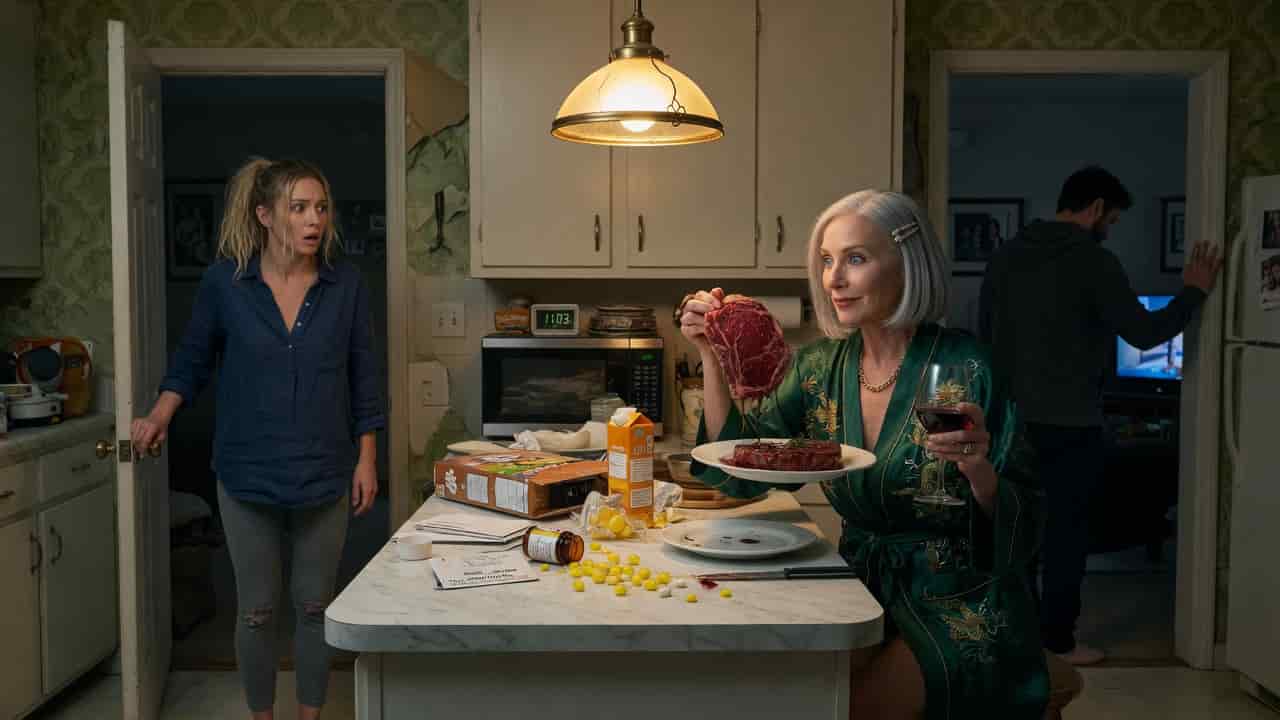
“He’ll never believe you, Sarah. You could show him this steak, you could show him the video, and he’d still choose me. I’m the one who’s sick. You’re just the one who’s tired.”
I stood in the kitchen doorway, my heart hammering against my ribs so hard it made my vision blur. Three years. For three years, I’ve emptied the commodes. I’ve missed every wedding, every promotion, and every chance to breathe. I gave up our move to London because Brenda was supposed to be gone in six months.
But there she was. No oxygen tank. No trembling hands. Just a medium-rare ribeye and a glass of Cabernet that cost more than my car payment.
In the next room, my husband Tom was weeping into his hands, mourning a woman who was currently mocking me with a mouthful of beef. He thinks he’s losing his mother. He doesn’t realize he’s already lost his wife to a lie so deep it’s become the foundation of our house.
Brenda smiled, that sharp, predatory look she only saves for when we’re alone. “Go on,” she whispered, nodding toward the hall. “Tell him. See whose side he takes.”
I looked at the amber pill bottle on the counter. It wasn’t full of morphine. It was full of lemon drops.
I had the proof in my hand, but as I looked at Tom’s broken silhouette in the living room, I realized the truth wasn’t going to set us free. It was going to burn the whole world down.
Chapter 1
The smell of bleach and lavender didn’t just sit in the air; it lived in the back of my throat, a permanent layer of chemical sweetness that made everything I ate taste like a hospital corridor. I scrubbed the baseboards of the hallway for the third time that week. It was 2:00 PM on a Tuesday, the hour when the sun hit the dust motes in the entryway of the old Victorian, making the place look more like a cathedral than a prison.
“Sarah?”
The voice came from the bedroom at the end of the hall. It was thin, reedy, and vibrating with a practiced frailty that made my spine stiffen.
“Coming, Brenda,” I said. I wiped my hands on my thighs, feeling the grit of the cleaning solution under my fingernails.
I’d been a marketing executive once. I’d had a corner office in a glass building in Chicago where the only thing I scrubbed was my browser history after a long night of research. Now, I was a full-time servant to a woman who had been “six months away” from the end for three years straight.
I pushed open the heavy oak door. The room was a museum of misery. Every surface was crowded with humidifiers, pill organizers, and framed photos of Tom as a little boy. Brenda sat propped up against a mountain of pillows, her oxygen cannula draped over her ears like a crown of thorns. She looked small—pale and grey in the dim light—but her eyes were always moving, tracking me like a hawk watching a field mouse.
“The pain is back,” she whispered. She reached out a claw-like hand, her skin translucent as parchment. “In the chest. It’s tight, Sarah. So tight.”
I didn’t move toward the morphine. I moved toward the blood pressure cuff. “Let’s check your vitals first, Brenda. Tom will be home in twenty minutes. He’ll want to see the numbers.”
A flicker of something—impatience, maybe—crossed her face before the mask of suffering slid back into place. “I don’t care about numbers. I care about my heart. It feels like it’s failing. I think today is the day, Sarah. I can feel the light dimming.”
She said that every Tuesday. And every Friday. Usually right before Tom’s conference calls.
I wrapped the cuff around her bicep. It felt like wrapping a piece of cloth around a dry stick. But as I pumped the bulb, I watched her face. Her breathing was steady. Her pupils weren’t dilated. She looked like a woman who was perfectly fine, provided she didn’t have to stand up and prove it.
The front door slammed. Heavy footsteps echoed through the house—boots on hardwood, the sound of a man who carried the world on his shoulders and didn’t realize most of the weight was an illusion.
“Mom? Sarah?” Tom called out.
Brenda’s entire body transformed in a heartbeat. Her shoulders slumped. Her head lolled to the side. She let out a soft, rattling moan that sounded like a death knell.
Tom burst into the room, still in his work vest, smelling of sawdust and diesel. He ignored me entirely, dropping to his knees by his mother’s bed. He took her hand and pressed it to his forehead, his shoulders shaking.
“I’m here,” he choked out. “I’m here, Ma. Did the doctor call back?”
Brenda squeezed his hand with surprising strength. “He says… he says it’s just a matter of time now, Tommy. Don’t be sad. I’ve had a good life. I just wanted to see you one last time before I… before I go.”
I stood by the window, clutching the blood pressure cuff. My knuckles were white. Tom looked up at me, his eyes bloodshot and desperate.
“Sarah, why aren’t you helping her? Did you give her the meds?”
“Her pressure is 120 over 80, Tom,” I said, my voice flat. “Her heart rate is 65. She’s stable.”
Tom flinched as if I’d slapped him. “Stable? She’s dying, Sarah! The specialist in the city said her stage four was aggressive. How can you be so cold?”
“I’m not being cold. I’m being accurate.”
“You’re being a robot,” he spat, turning back to his mother. “It’s okay, Ma. She’s just tired. We’re all tired. I’ll stay tonight. I’ll cancel the meeting with the London recruiters.”
I felt the floor drop out from under me. “Tom, no. That’s the third interview. This is for the European director position. This is the move we’ve been planning since the wedding.”
Tom didn’t even look back. He was busy adjusting Brenda’s blanket. “London isn’t going anywhere, Sarah. My mother is. I’m not leaving her alone in a house with someone who looks at her like she’s a nuisance.”
Brenda looked at me then. Over Tom’s shoulder, hidden from his view, she didn’t look like a dying woman. She looked like a winner. She gave me a tiny, microscopic wink, and then she went back to moaning.
I walked out of the room. I walked all the way to the kitchen, leaned over the sink, and vomited. It was just bile and the taste of lavender.
I was the “good girl.” That was my curse. My parents had raised me to be the one who handled things, the one who didn’t make a scene, the one who sacrificed. I had sacrificed my job, my social life, and my marriage to care for a woman who I was increasingly certain was a world-class actress.
But I couldn’t say it. If I said it, I was the monster. If I questioned the cancer, I was the heartless daughter-in-law who wanted her husband’s mother dead. Brenda had built a fortress of sympathy, and I was the only person who could see that the walls were made of cardboard.
I reached into the cupboard to pull out the tea set. Brenda wanted chamomile. Brenda always wanted chamomile after she’d successfully sabotaged my husband’s future.
As I reached for the box, my hand brushed against a small amber bottle tucked behind the flour canister. It wasn’t one I recognized. I pulled it out. The label was peeled off, but when I opened it, the smell hit me.
Lemon.
They were hard candies. The exact shape and color of the “specialized heart pills” Brenda’s private medical assistant, Rick, brought over every Monday.
I stared at the candies for a long time. The house was silent, except for the low murmur of Tom’s voice in the bedroom, comforting a ghost. I realized then that I wasn’t just a caregiver. I was a hostage. And the person holding the gun was a sixty-five-year-old woman in an emerald silk robe who knew exactly how much guilt a good man could carry before he broke.
Chapter 2
Elena, the hospice nurse, arrived on Wednesday morning with a heavy black bag and a frown that seemed etched into her face by forty years of watching people fade away. She was a thick-set woman with hands that smelled of peppermint and tobacco, and she was the only person in the house who didn’t treat Brenda like a porcelain doll.
“You’re late,” Brenda wheezed from the bed.
Elena didn’t even look up from her clipboard. “Traffic is the same every morning, Brenda. You’re still here, I see. That’s a miracle for someone whose lungs are supposedly eighty percent scar tissue.”
I stood in the corner, watching. Elena was my foil, the only mirror in this house that didn’t show a distorted image. She knew. She had to know.
“Sarah,” Elena said, nodding toward the door. “Go get some air. I’ll do the sponge bath.”
“I can help,” I said out of habit.
“No,” Elena said firmly. “Go.”
I walked out into the backyard. It was overgrown, the rosebushes choked with weeds. I used to love gardening. Now, the sight of things growing felt like an insult. I sat on the porch steps and pulled my phone out.
I’d been recording things. Not often, just bits and pieces. I had a video of Brenda walking to the bathroom at 3:00 AM when she thought I was asleep. She hadn’t been limping. She hadn’t been clutching the wall. She’d walked with the brisk, efficient gait of a woman who had nowhere to be but was in a hurry to get there.
I looked at the screen. If I showed this to Tom, what would happen? He’d see his mother walking. He’d see the lie. But then Brenda would have a “collapse.” She’d claim it was a burst of adrenaline, a last-ditch effort from a dying body. And Tom would believe her because he needed to. Because the alternative—that his mother had stolen three years of his life for a whim—was too painful to contemplate.
The back door opened. Elena stepped out, lighting a cigarette. She stood there for a moment, blowing smoke into the grey morning air.
“She’s a piece of work,” Elena said, not looking at me.
“Is she dying, Elena?” I asked. My voice sounded thin, even to my own ears.
Elena took a long drag. “We’re all dying, honey. Some of us just make a bigger production out of it. Her vitals are better than mine. Her lungs are clear. If she has stage four anything, it’s stage four boredom.”
I felt a rush of heat in my chest. “Then why does the doctor say… why does the medical assistant, Rick, bring the charts? Tom sees the charts.”
Elena turned to look at me, her eyes narrow. “Rick isn’t a medical assistant. He’s a failed actor who owes Brenda’s brother a lot of money. And that doctor she sees? He’s a guy in a strip-mall clinic who’ll write a script for anything if the check clears.”
I stood up, my legs shaking. “You have to tell Tom. He’ll believe you. You’re the professional.”
Elena laughed, a short, dry sound. “I’ve tried, Sarah. I told him six months ago. You know what he did? He called my agency and tried to get me fired for ‘insensitivity.’ He said I was burnt out and couldn’t recognize a mother’s suffering. The only reason I’m still here is because the agency knows me, and I’m the only one who’ll put up with her.”
She flicked her ash into the weeds. “He won’t believe anyone until the mask falls off. And Brenda is very careful about the mask.”
“She mocked me,” I whispered. “Yesterday. She winked at me while he was crying.”
Elena nodded. “She’s a narcissist. She doesn’t just want his attention; she wants your misery. It’s the fuel. She knows you’re the only threat, so she’s making sure you look like the villain.”
I thought about the lemon drops in the kitchen. “She’s faking the medication too. I found the real pills hidden in the pantry.”
“Probably sugar pills,” Elena said. “She likes the drama of the pill organizer. It makes the routine feel official.”
“What do I do?” I asked. “We were supposed to move to London. Tom is going to decline the job today. If he does that, we’re stuck here forever. She’ll never let go.”
Elena stepped closer, the smell of peppermint and tobacco surrounding me. “You can’t wait for him to see it. You have to force the mask off. You have to make her so comfortable, so sure of herself, that she forgets to be sick.”
“How?”
“Stop fighting her,” Elena said. “Be the perfect daughter-in-law. Give her everything she wants. The more you serve her, the more she’ll think she’s won. And winners always get sloppy.”
I went back inside. The house felt smaller now, the shadows longer. I walked into the bedroom. Brenda was back in her pillows, looking exhausted from the effort of being bathed.
“Sarah,” she moaned. “Water. Cold. Not too much ice.”
I didn’t argue. I didn’t check her pressure. I smiled. It was a fake, tight smile, the kind you wear to a funeral you’re glad to be at.
“Of course, Brenda. I’ll get it right away. And I was thinking… maybe we should invite the neighbors over this weekend? A ‘Living Funeral.’ A celebration of your life while you’re still here to see it.”
Brenda’s eyes snapped open. The “dying” haze vanished for a split second, replaced by a glint of pure, unadulterated vanity.
“A party?” she whispered.
“A tribute,” I corrected. “Everyone in the neighborhood. They all love you so much. They should see how brave you are.”
Brenda’s chest expanded. She didn’t wheeze. “That… that would be lovely. Tom would like that, wouldn’t he?”
“Tom would be moved to tears,” I said.
I turned to leave, and I could feel her gaze on my back. I knew what she was thinking. She thought she’d finally broken me. She thought I’d given up and accepted my place as the handmaid to her grand finale.
But as I walked to the kitchen, I wasn’t thinking about chamomile. I was thinking about the ribeye steak I’d seen in the grocery store circular. I was thinking about the bottle of Cabernet I had hidden in the basement.
Elena was right. Winners get sloppy. And I was going to make Brenda feel like the Queen of the World.
Chapter 3
The “Living Wake” was scheduled for Saturday. By Thursday, the house was a whirlwind of activity that should have been impossible for a dying woman’s home. Mrs. Higgins from next door was bringing her famous potato salad. The Petersons were bringing a honey-glazed ham.
Tom was a wreck. He spent his evenings sitting on the edge of Brenda’s bed, his face buried in his hands. He’d officially declined the London job that morning. I’d watched him do it—watched him type the email with trembling fingers while Brenda watched from her pillows, a sympathetic pout on her lips.
“It’s for the best, honey,” she’d said. “Family is everything.”
I hadn’t said a word. I’d just brought her another blanket.
The social pressure was mounting. In a small town like this, Brenda was a saint. She’d been the head of the altar guild for twenty years. She’d been the woman who brought soup to everyone else’s house. Now, the town was returning the favor.
“You’re such a blessing, Sarah,” Mrs. Higgins said, handing me a massive bowl of salad on Friday afternoon. She looked at me with a mix of pity and suspicion. “Most girls these days wouldn’t have the stomach for this. But Brenda says you’ve been a rock. Even if you do seem a bit… distant lately.”
“I’m just tired, Mrs. Higgins,” I said, keeping my voice soft.
“Of course you are. It’s hard, watching someone fade. But just think of the reward in the next life.”
I wanted to scream. I wanted to tell Mrs. Higgins that the only thing fading in this house was my sanity and Tom’s bank account. But I just thanked her and added the salad to the fridge.
The fridge was full of food Brenda “couldn’t eat.” Broths, jellos, pureed soups. But hidden in the very back, behind a head of wilted lettuce, was the ribeye I’d bought.
I was playing a dangerous game. I was the “good girl” performing a role I hated, hoping for a slip-up. But Brenda was a professional. She stayed in character even when the door was closed. She’d spent three years perfecting the art of the slow decline, and she wasn’t about to let a little party ruin her streak.
Friday night, the house finally went quiet. Tom had fallen asleep in the armchair in Brenda’s room. I stood in the kitchen, listening to the hum of the refrigerator.
I heard a floorboard creak upstairs.
It wasn’t the slow, rhythmic creak of Tom moving in his sleep. It was a light, quick step. The sound of someone who didn’t want to be heard.
I didn’t turn on the light. I pressed myself into the shadows of the dining room and waited.
Brenda appeared at the top of the stairs. She wasn’t wearing her cannula. She wasn’t leaning on the railing. She moved down the steps with the grace of a cat. She reached the bottom, glanced toward the living room where Tom was snoring, and then headed straight for the kitchen.
I followed her, my heart racing.
She opened the fridge. I watched through the crack in the door. She didn’t reach for the broth. She reached for the ham Mrs. Peterson had brought. She pulled a large slice off with her fingers and shoved it into her mouth, chewing with a hunger that was almost primal.
I reached for my phone, but the screen was dark. I’d forgotten to charge it.
Brenda finished the ham and then reached for a bottle of sparkling water. She twisted the cap off with ease—no tremors, no weakness. She took a long, deep swig, wiped her mouth with the back of her hand, and sighed.
It was the most honest sound I’d ever heard her make.
She turned to go back upstairs, and for a second, our eyes almost met through the gap in the door. I held my breath, my lungs burning. She paused, looking toward the shadows, her head tilted like she was listening for a heartbeat.
Then, she shrugged and walked back up the stairs, skipping the third step because she knew it squeaked.
I stood in the dark for an hour after she left. The evidence was right there—the missing ham, the empty water bottle. But it wouldn’t be enough. She’d say she was “trying to keep her strength up for the party.” She’d say she forced herself to eat because she didn’t want to disappoint the neighbors.
I needed more. I needed her to admit it.
The next morning, the house was flooded with people. The living wake had begun. The air was thick with the smell of lilies and old-lady perfume. Brenda was the centerpiece, draped in a lavender shawl, sitting in a rented wheelchair in the center of the living room.
People lined up to hold her hand. They whispered their goodbyes. They cried.
“She’s so brave,” I heard someone whisper.
“And that poor daughter-in-law,” someone else replied. “You can tell she’s reached her limit. She looks like she’s about to snap.”
I stood in the kitchen, prepping more trays. I felt the eyes of the room on me—the “cold” wife who wasn’t crying, the woman who was clearly counting the days until she could have her husband back.
Tom came into the kitchen to get more ice. He looked like he’d aged ten years in a week. He grabbed my arm, his grip tight.
“Could you at least try?” he hissed. “People are talking, Sarah. You’re standing here like a statue while my mother is saying her final goodbyes.”
“She’s not saying goodbye, Tom,” I said, my voice low and dangerous. “She’s taking a curtain call.”
Tom’s face went white with rage. “I can’t even look at you right now. After everything she’s done for us. After the way she welcomed you into this family.”
“She welcomed me as a servant, Tom. There’s a difference.”
“Get out,” he whispered. “If you can’t be part of this, just go. I’ll tell everyone you had a migraine.”
“I’m not going anywhere,” I said.
I picked up a tray of crackers and walked into the living room. I walked right up to Brenda. I leaned down, as if to adjust her shawl, and whispered into her ear.
“The steak is in the fridge, Brenda. And the wine. I’ll leave the back door unlocked tonight. Tom is staying at the church to help with the Sunday service prep. It’ll just be you and me.”
Brenda’s hand tightened on the arm of the wheelchair. She didn’t look at me. She kept her eyes on the priest who was reading a psalm. But I saw the corner of her mouth twitch.
She knew. She knew I was baiting her. And she knew she couldn’t resist.
Chapter 4
The house was a tomb by 10:30 PM. The neighbors had all gone home, their pity lingering in the air like the smell of stale ham. Tom had left an hour ago, his eyes red from crying, his heart full of the “grace” his mother had shown during the wake.
“I’ll be back by midnight, Sarah,” he’d said, not looking at me. “Please… just try to be kind to her. It’s her last big night.”
I’d nodded, watching him walk out the door.
I went to the kitchen. I took the ribeye out of the fridge. I seasoned it with salt and pepper. I put a heavy cast-iron skillet on the stove and turned the heat up until the oil began to shimmer.
The sizzle of the meat hitting the pan was loud in the silence of the house. I cooked it perfectly—medium rare, with a crust of seared fat that smelled divine. I poured a glass of the expensive Cabernet. I set the plate on the island.
Then, I went to the hallway and waited in the dark.
Ten minutes passed. Twenty.
Then, the floorboards creaked.
Brenda didn’t even hesitate this time. She didn’t check the living room. She was lured by the scent of real food, by the intoxicating smell of a victory she thought she’d already won.
She came down the stairs wearing her emerald silk robe. She looked radiant. The “dying” grey pallor was gone, replaced by a flush of excitement. She walked into the kitchen, her eyes fixing on the steak.
I stepped out of the shadows and stood in the doorway.
Brenda froze. For a second, the mask flickered—the wide-eyed fear of a woman caught in a lie. But then, something else took over. She realized Tom wasn’t there. She realized it was just me.
She didn’t reach for the cannula. She didn’t collapse. She sat down at the island, picked up the knife and fork, and took a slow, deliberate bite of the steak.
“It’s a little under-seasoned,” she said. Her voice was full and rich, no longer the reedy whisper she used for Tom.
“I thought you were dying, Brenda,” I said. My voice was steady, but my hands were shaking behind my back.
Brenda took a sip of the wine, swirling it in the glass. “Oh, I am. We all are. But I decided to have a little snack before the end. A miracle of the spirit, don’t you think?”
“I have the video, Brenda. I have the lemon drops. I know Rick isn’t a nurse. I know the doctor is a fraud.”
Brenda laughed. It was a sharp, ugly sound that echoed off the tile walls. She cut another piece of steak and held it up, watching the juice drip onto the plate.
“And who are you going to tell, Sarah? Tom? My sweet, grieving boy?”
“He’ll believe the truth.”
Brenda leaned forward, the emerald silk shimmering under the pendant light. “He’ll believe what he needs to believe. He needs me to be the saintly mother. He needs to be the hero who stayed behind to save me. If you tell him I’m faking, you aren’t just calling me a liar. You’re calling him a fool. You’re telling him he threw away his career and his future for nothing.”
She took a long, slow drink of the wine.
“A man like Tom can’t handle that kind of shame, Sarah. He’ll hate you for it. He’ll look at that video and tell himself you faked it. He’ll look at those lemon drops and think you planted them. Because if he doesn’t… then his whole life for the last three years has been a joke. And Tom doesn’t like being the punchline.”
I felt the weight of her words. She was right. That was the brilliance of the trap. It wasn’t just about her; it was about his ego. She had made him an accomplice in her lie, and now he was too invested to ever admit the truth.
“Why?” I whispered. “Why do this to him? He loves you. He would have visited from London. We would have brought you over.”
“I don’t want to be visited,” Brenda snapped, her eyes flashing with a sudden, cold fire. “I want to be the center. In London, I’m an old woman in a flat. Here, I’m the dying queen. I’m the reason he breathes. Being sick is the only way to keep a man like that, Sarah. You’ll learn that soon enough when he starts looking for a reason to stay with you.”
She smiled, a slow, cruel baring of teeth.
“You think you’re the ‘good girl,’ don’t you? The one who sacrifices. Well, look at you now. You’re standing in a kitchen with a ‘dying’ woman, and you’re the one who looks like a ghost. I’ve taken your job. I’ve taken your move. And by the time I’m actually done, I’ll have taken your husband’s soul.”
“I’m leaving, Brenda,” I said. “Tonight. I’m taking the car and I’m going.”
Brenda laughed again. “With what money? You haven’t worked in three years. Your accounts are drained. Tom controls the house. And if you leave tonight, while I’m ‘failing,’ what do you think the neighbors will say? What will the police say when I have a ‘relapse’ the moment you walk out the door?”
She pointed toward the background doorway, where the dark living room waited.
“He’ll never forgive you for leaving me alone. You’ll be the monster who abandoned a dying woman in her final hour. You’re trapped, Sarah. You’re the bird in the cage, and I’m the one with the key.”
She picked up the amber pill bottle from the counter and shook it. The lemon drops rattled like dry bones.
“Now, be a good girl and get me a napkin. I’ve got grease on my chin.”
I looked at her—really looked at her. I saw the vanity, the malice, and the absolute lack of remorse. I thought about the three years I’d lost. I thought about the move to London that was now a dead dream.
I didn’t get her a napkin.
I looked at the back door. I looked at the wine glass.
“You’re right, Brenda,” I said softly. “He won’t believe the truth.”
I stepped toward the island, my shadow falling over her.
“But he’ll believe a tragedy.”
I reached out and gripped the edge of the kitchen island. Brenda’s smile faltered for a fraction of a second, her eyes searching mine for the ‘good girl’ she thought she’d broken.
But that girl was gone. She’d been buried under three years of bleach and lavender.
I leaned in, my voice a whisper that barely disturbed the air.
“Enjoy the steak, Brenda. It’s the last honest thing you’re ever going to eat.”
I turned and walked out of the kitchen, leaving her sitting there in her emerald robe, the wine glass halfway to her lips. I didn’t go to the bedroom. I didn’t go to the car.
I went to the basement, where the breaker box was.
I stood in the dark, my hand on the main switch. I could hear the hum of the house—the humidifier in Brenda’s room, the refrigerator, the clock on the wall.
I thought about the residue of this night. I thought about the look on Tom’s face when he’d come home to a dark house.
Then, I pulled the switch.
The house went black. And in the silence that followed, I heard the sound of a wine glass shattering on the kitchen floor.
Chapter 5
The darkness wasn’t just an absence of light; in that house, it was a heavy, suffocating presence that smelled of old wood and the copper tang of the blood Brenda had likely drawn when she stepped on the shattered wine glass. I stood at the bottom of the basement stairs, my hand still resting on the cold metal of the breaker switch. My heart was a frantic, trapped thing in my chest, but for the first time in three years, it didn’t feel like it was beating for anyone but me.
I listened.
Above me, there was a muffled thud, followed by a sharp, guttural curse—Brenda’s real voice, stripped of the reedy, dying-bird vibrato. Then, the sound of a chair scraping across the tile. She was moving. She was scrambling in the dark to hide the evidence of her feast. I could picture her—the emerald silk robe fluttering as she shoved the ribeye bone into the trash, her hands shaking as she tried to wipe the grease from the island before the light came back.
I didn’t turn the power back on. I wanted her to sit in the blackness. I wanted her to feel the weight of the silence she’d spent three years weaponizing against me.
I walked up the basement stairs, my fingers trailing along the damp concrete wall. When I reached the kitchen, the air was thick with the scent of seared fat and something sharper—the metallic scent of spilled wine. I didn’t need light to know where she was. I could hear her breathing, a ragged, panicked sound that wasn’t coming from a failing lung, but from a cornered animal.
“Sarah?” she whispered. The reedy voice was back, but it was brittle, cracking at the edges. “Sarah, the power… I can’t breathe, Sarah. The machine… the humidifier…”
“The humidifier is a placebo, Brenda,” I said, my voice cutting through the dark like a blade. “And you don’t use the oxygen unless Tom is in the room. You’re fine.”
“I’m bleeding,” she hissed, and this time, the venom was unmistakable. “I stepped on the glass. You did this. You cut the power so I’d hurt myself.”
“I cut the power so you’d stop eating,” I said. I moved toward the island, my eyes adjusting to the faint moonlight filtering through the kitchen window. I could see the silhouette of her—a dark shape slumped against the counter. “How’s the steak, Brenda? Did it taste like the three years you took from us?”
“You think you’re so smart,” she spat. I heard her shift, a wet, sticky sound from her foot. “But you’ve already lost. Tom will be home in twenty minutes. What are you going to tell him? That you stood in the dark while his dying mother bled on the floor? That you watched her struggle while you played with the fuse box?”
“I’m going to show him the steak, Brenda. I’m going to show him the wine.”
“What steak?” she asked, and I could hear the smirk in her voice.
I reached out and felt the surface of the island. It was wet, but the plate was gone. She’d hidden it. In the three minutes it took me to walk up the stairs, she’d managed to clear the evidence. My stomach twisted. She was faster than I’d thought. She was more practiced in the art of the cover-up than I was in the art of the exposure.
“He’ll smell it,” I said, though I knew the scent of the seared meat was already being overtaken by the smell of the cleaning solution I’d used earlier that day.
“He’ll smell the dinner you made for yourself while he was at church,” Brenda countered. “The dinner you ate while I sat in my room, starving and forgotten. He’ll see the mess you left for me to find when I came down for a glass of water. And he’ll see the blood.”
The front door opened.
The sound of Tom’s boots in the entryway was like a starter pistol. Brenda didn’t even wait for him to call out. She let out a piercing, high-pitched wail—a sound of pure, unadulterated agony that made my hair stand on end.
“Tom! Tom, help me! It’s dark… I can’t see… Sarah, please, don’t hit me again!”
I froze. The lie was so audacious, so monstrous, that my brain simply refused to process it for a second. Don’t hit me again?
Tom’s footsteps became a dead run. He didn’t even go for the lights; he had a heavy-duty flashlight on his belt from work. He clicked it on, and the beam cut through the kitchen like a searchlight, blinding me.
“Sarah? What’s going on? Why is it dark?”
The light swung to the floor. It hit the shattered glass, the dark pool of Cabernet that looked exactly like blood in the harsh LED glare, and Brenda.
She was huddled on the floor, her emerald robe stained purple, her foot gashed and weeping red. She looked up into the light, her face a mask of terror, her hands shielding her head.
“Don’t let her near me, Tommy,” she sobbed. “She went crazy… she started screaming about London… she smashed the glass… she said if I didn’t die tonight, she’d make sure I did.”
Tom’s breath hitched—a wet, sobbing sound. He stepped between us, his back to me, his shoulders heaving. He didn’t ask me for my side. He didn’t look at the island. He dropped to his knees and pulled his mother into his arms.
“It’s okay, Ma. I’m here. I’ve got you.”
“Tom,” I said, my voice sounding distant and hollow. “Tom, look at the trash. Look at the bone. She was eating. She’s fine. She’s faking the whole thing.”
Tom turned his head. The flashlight beam hit me full in the face again, but this time, the light felt like it was coming from an enemy. His eyes weren’t just angry; they were dead. The man I had married, the man I had planned a life with, was gone, replaced by a hollow shell of grief and misplaced loyalty.
“I smelled the steak when I walked in, Sarah,” he whispered. “I thought… I thought maybe you were finally cooking a real meal for us. I thought maybe we were going to be a family again.”
“I didn’t eat it, Tom! She did! I caught her!”
“She can barely swallow broth, Sarah!” he roared, the sound echoing off the walls. “She’s ninety pounds! You think she sat down and ate a pound of beef while I was praying for her soul?”
“Yes! That’s exactly what happened!”
Brenda let out a soft, rattling cough and slumped against Tom’s chest. “The light… Tommy… it’s getting dark again…”
“I have to get her to the ER,” Tom said, his voice trembling. “The glass… if it’s infected… her immune system can’t handle this.”
“Tom, listen to me,” I said, stepping forward. “If you take her to the hospital, they’ll run tests. Real tests. Not the ones from Rick. Ask them to check her stomach contents. Ask them to do a scan of her lungs. Please. If you love me, just ask.”
Tom stood up, lifting Brenda in his arms. She looked like a child, small and fragile, her head tucked into the crook of his neck. He looked at me, and for the first time, I saw the residue of the last three years in his expression. It wasn’t love. It wasn’t even hate. It was a profound, weary contempt.
“I don’t love you, Sarah,” he said. The words were quiet, but they hit with more force than the scream. “I don’t even know who you are. The woman I married wouldn’t torture a dying woman because she was bored with her life. The woman I married would have been the one holding the flashlight, not the one hiding in the dark.”
He walked past me. The smell of the steak was still there, faint but unmistakable, clinging to Brenda’s robe as she was carried out.
I stood in the dark kitchen. The power was still out. The house was silent. I looked down at the floor, at the shattered glass and the wine.
I had been the “good girl” for three years. I had followed every rule, carried every burden, and sacrificed every dream. And in the end, the truth hadn’t set me free. It had simply revealed that the prison I was in didn’t have any walls. It was built entirely out of the choices I’d made to be “good” for a man who didn’t want the truth, and a woman who couldn’t live without a lie.
I didn’t turn the power back on. I went upstairs, feeling my way through the dark. I didn’t pack a suitcase. I didn’t take the photos from the mantel. I found my passport in the bottom drawer of the nightstand, tucked inside a book about London I’d bought three years ago. I found my emergency credit card—the one my mother had told me to keep for “emergencies only.”
This was the emergency.
I walked out of the house. The night air was cold and sharp, smelling of pine and woodsmoke. I didn’t look back at the Victorian. I didn’t look for Tom’s truck. I started walking toward the main road, the sound of my own footsteps the only thing keeping me company.
I had no job. I had no home. I had no husband.
But as the first light of dawn began to grey the horizon, I realized I could finally breathe. The bleach and lavender were gone. And for the first time in three years, I wasn’t waiting for someone else to die so I could start living.
Chapter 6
The airport in Chicago was a cathedral of transition, a place where no one knew my name and no one cared about my “dying” mother-in-law. I sat at a gate for a flight to London, my laptop open on my knees. I had four hours before boarding.
I wasn’t running away. I was relocating.
I’d spent the last forty-eight hours in a cheap motel near the O’Hare, doing what I should have done three years ago: I was being the “bad girl.”
I had sent the video of Brenda walking to the hospital’s patient advocacy board. I had sent a scanned copy of the lemon-drop bottle label to the local sheriff’s office, along with Rick’s full name and the address of the “clinic” he worked for. I had emailed the London recruiters, not to apologize, but to ask if the position was still open—and if not, if they knew anyone who was looking for a marketing executive with “extreme crisis management experience.”
My phone buzzed on the armrest. It was a number I didn’t recognize.
I picked it up. “Hello?”
“Sarah?”
It was Tom. His voice was different—hollow, stripped of the righteous fury that had defined him for years. He sounded like a man who had walked into a room and realized the floor was gone.
“The hospital called me this morning,” he said. He paused, and I could hear the sound of a heavy breath—the kind you take when you’re trying not to shatter. “They ran the tests. They did the scan.”
I didn’t say anything. I sat in the hard plastic chair, watching a family of four walk past with bright red suitcases.
“There’s no cancer, Sarah,” he whispered. “There never was. Her lungs are… they’re clear. They said she has the cardiovascular health of a fifty-year-old. They found the steak. They found the wine in her system.”
“I know,” I said.
“She’s in the psychiatric ward now. They’ve got her on a 72-hour hold for ‘factitious disorder.’ She’s screaming, Sarah. She’s screaming that you poisoned her, that you set her up. But the doctors… they don’t believe her.”
“They have the data, Tom. Doctors like data.”
“Why didn’t you tell me?” he asked, and the pain in his voice was so raw it almost made me flinch. “Why didn’t you make me see?”
“I tried, Tom. For three years, I tried. I showed you the vitals. I told you about the pills. I told you she was mocking us. You chose to believe her because believing her made you feel like a hero. And believing me… believing me would have meant you were just a man being played by his mother.”
The silence on the other end of the line was long and heavy. I could picture him sitting in the waiting room of the hospital, the fluorescent lights making his skin look grey, his work vest suddenly too big for him.
“I’m so sorry,” he choked out. “Sarah, please. Come home. We can fix this. We’ll get her the help she needs. We can sell the house. We can still go to London. I’ll do whatever it takes.”
I looked at the flight board. Flight 402. London-Heathrow. Boarding in 45 minutes.
“No, Tom,” I said, and I was surprised by how calm I felt. “We can’t fix it. You didn’t just fail to believe me. You called me a monster. You told me you didn’t love me because I was trying to save our lives. You stood in a dark kitchen and took the side of a lie over the woman who was bleeding for you.”
“I was scared!” he cried. “I thought I was losing her!”
“You were losing me, Tom. And you didn’t even notice.”
“Sarah, please…”
“I’m at the airport, Tom. My flight leaves in less than an hour. I’m going to London. Not with you. For me.”
“You can’t just leave! What about the house? What about the money?”
“Keep the house,” I said. “Keep the guilt. It’s the only thing you’ve ever really been committed to. As for the money, I’ve already contacted a lawyer. We’ll settle the rest through them.”
I hung up. I didn’t block the number, but I turned the ringer off.
I stood up and walked toward the window, looking out at the tarmac. The sun was coming up over the city, a pale, cold gold that glittered on the wings of the planes.
I thought about Brenda. I thought about the “Living Wake,” the neighbors’ pity, and the three years of my life that were just… gone. I thought about the residue that would stay with me—the way I’d always check the labels on pill bottles, the way I’d always be suspicious of a reedy voice, the way I’d never again let myself be the “good girl” at the expense of my own truth.
But there was another residue, too.
I felt lighter. Not the lightness of a balloon, but the lightness of a person who has finally dropped a heavy pack at the end of a long mountain climb. My muscles ached, my heart was scarred, and my feet were tired, but the path ahead was flat.
Elena had been right. Winners get sloppy. But she hadn’t mentioned what happens to the losers.
The losers get to start over.
“Flight 402 to London is now boarding,” the overhead voice announced.
I picked up my bag. I didn’t look for a reflection in the glass. I knew what I looked like. I looked like a woman who had seen the worst parts of love and the best parts of rage, and had decided that the middle ground was no longer enough.
I walked down the jet bridge. The air was pressurized and filtered, but it didn’t smell like bleach. It didn’t smell like lavender.
It smelled like jet fuel and coffee and the infinite, terrifying possibility of a life that belonged entirely to me.
As I stepped onto the plane, I felt a ghost of a smile touch my lips. Brenda had been right about one thing: being sick was the only way to keep a man like Tom.
But she was wrong about me. I wasn’t the bird in the cage. I was the one who realized the door had been open the whole time.
I sat down in my seat, buckled the belt, and closed my eyes. By the time the wheels left the ground, I was already asleep, dreaming of a city I’d never seen, and a woman I was finally getting to know.