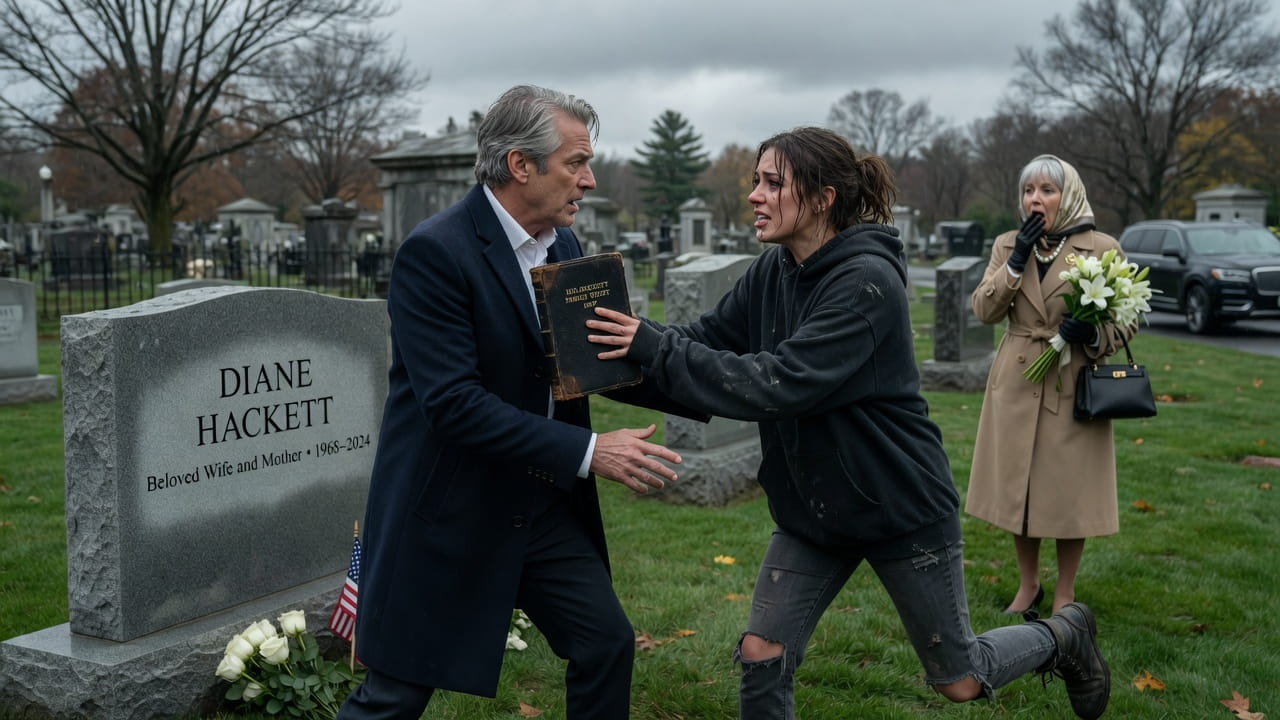
“Get away from her right now!”
I didn’t care who was watching. I didn’t care that Mrs. Gable from the Country Club was standing ten feet away with a bouquet of lilies. All I saw was this girl—this stranger in a ragged hoodie—standing over Diane’s fresh headstone like she was looking at a piece of trash.
When I grabbed her arm to pull her back, I expected her to run. I expected her to cry. I’m Tom Hackett; people in this town don’t cross me, especially not on the day I’m visiting my wife.
But she didn’t run. She looked at me with eyes so full of hate it felt like a physical blow.
“She wasn’t a saint, Tom,” the girl spat, her voice shaking with a rage I didn’t understand.
“Don’t you dare speak her name,” I growled, my grip tightening.
She didn’t flinch. Instead, she reached into her bag and slammed a heavy, black leather ledger against my chest. I recognized it instantly. It was Diane’s. The one she kept locked in the floor safe for twenty years.
“Open it,” the girl hissed, as Mrs. Gable dropped her flowers in shock. “Check the dates. Check the name on the checks. She paid my mother two thousand dollars a month for twenty-five years just to make sure you never knew I existed.”
The world didn’t stop. The birds kept chirping. The wind kept blowing. But as I looked down at the gold clasp on that ledger, I realized my entire marriage—the wealth, the status, the ‘perfect’ devotion—was a lie Diane had bought and paid for.
And I was standing right in front of the daughter I never knew I had.
Chapter 1: The Sanctity of the Grave
The air in Greenwich always felt more expensive than it did anywhere else in Connecticut. It was a filtered, silent kind of air, scrubbed clean of the grit of the turnpike and the exhaust of the common world. Tom Hackett sat in his navy blue Mercedes, the engine idling with a purr that cost more than most people’s annual salary. He was fifty-five, and for the first time in his life, the silence of the car felt like a threat.
It had been six months since Diane passed. People told him the first six months were the hardest, but they were wrong. The first three months were a blur of casseroles, sympathy cards, and the frantic logistics of the “Hackett Automotive Empire.” It was now, when the cards had stopped coming and the house on the hill felt like a museum of things he didn’t know how to use, that the weight of it really landed.
He smoothed his silk tie in the rearview mirror. He looked exactly like what he was: a man who had won. His silver hair was perfectly groomed, his skin had that healthy, year-round tan of a man who owned a vacation home in Naples, and his eyes—the same eyes that could close a ten-million-dollar inventory deal without blinking—were clear. Or they were supposed to be.
“Just a quick visit, Di,” he muttered to the empty passenger seat.
He stepped out into the crisp autumn air of St. Jude’s Cemetery. This wasn’t the kind of graveyard where people were buried in rows like a grocery store shelf. This was a place of rolling hills, ancient oaks, and granite monuments that looked like they’d been there since the founding of the colonies. Diane was at the top of the hill, in a plot that overlooked the Sound. It was the best view in the house.
As he walked the winding path, he passed Mrs. Gable. She was a fixture of the local charity circuit, a woman who had been Diane’s “best friend” for twenty years, which mostly meant they shared a tennis coach and a mutual disdain for anyone who drove a car older than three years.
“Tom, dear,” she whispered, her voice a fragile, performative trill. She was holding a massive bunch of lilies. “Heading up to see her?”
“Every Tuesday, Helen,” Tom said, forcing a polite, tragic smile. “You know how it is.”
“A saint,” Helen said, dabbing at a perfectly dry eye. “She was a saint. We’re all still so lost without her.”
Tom nodded and moved on. The “Saint Diane” narrative was one he had helped build. He had been the flashy, aggressive car salesman who had built a kingdom; she had been the grace, the polish, and the moral compass. She had forgiven him for his “misstep” twenty-five years ago—a messy, bourbon-soaked affair with a girl from the factory town over the border—and she had never thrown it in his face. Not once. She had saved him from himself, and for that, he owed her the rest of his life.
But as he rounded the final bend toward the Hackett plot, he saw something that didn’t fit the landscape.
A girl was standing by Diane’s headstone. She looked like a smudge of grease on a white tuxedo. She was wearing a faded black hoodie, the sleeves frayed at the wrists, and heavy boots that looked like they’d seen a decade of hard labor. She wasn’t praying. She wasn’t crying. She was just… staring.
Tom felt a surge of protective heat. This was his space. This was Diane’s space.
“Can I help you?” he called out, his voice carrying the authority of a man who owned the land everyone else was standing on.
The girl didn’t turn around. She leaned down and, with a deliberate, slow motion, she spat on the base of the granite headstone.
The sound of his own blood rushing in his ears was louder than the wind. Tom covered the distance in five long strides. He didn’t think about optics or Mrs. Gable watching from the path below. He saw a desecration, and he reacted.
“What the hell is wrong with you?” Tom roared, reaching out and grabbing the girl by her upper arm. He spun her around, his fingers digging into the cheap fabric of her hoodie.
She was younger than she’d looked from behind. Twenty-four, maybe twenty-five. Her face was pale, her features sharp and desperate, and her eyes—a startling, familiar shade of amber—were burning with a ferocity that made him momentarily freeze.
“Let go of me,” she said. Her voice wasn’t a scream. It was a low, jagged rasp.
“You have no right to be here,” Tom hissed, his face inches from hers. “Do you have any idea who this woman was? She was a pillar of this community. She was—”
“She was a liar,” the girl interrupted. She didn’t pull away. She leaned into him, her breath smelling of cheap coffee and cold air. “And you’re the fool who paid for the monument.”
From the corner of his eye, Tom saw Mrs. Gable freeze on the path, the lilies trembling in her hand. The social fallout of this moment would be a nightmare, but he couldn’t let go. He was shaking.
“I’m calling the police,” Tom said, his voice trembling. “I’m going to have you arrested for—”
“For what? Telling the truth?” The girl laughed, a bitter, hollow sound that seemed to rattle the very trees. She reached into the large front pocket of her hoodie and pulled something out. It was a black leather-bound ledger with a small, tarnished gold clasp.
Tom’s heart did a strange, nauseating roll. He knew that ledger. Diane had kept it in the floor safe in her dressing room for decades. She called it her “Family History.” He’d never looked inside; she’d told him it was just records of her mother’s estate and old trust details. After the funeral, he’d searched the safe, but it had been empty. He’d assumed she’d moved it or had it destroyed.
“Where did you get that?” Tom’s voice dropped to a whisper. His grip on her arm slackened.
“My mother died last month,” the girl said, and for a split second, the rage in her eyes flickered into raw, unadulterated pain. “I found this in her bedside table. Along with twenty-five years of bank statements.”
She slammed the ledger into Tom’s chest. It was a heavy, physical impact that forced him to take a step back. His hands instinctively came up to catch it, his fingers brushing the familiar grain of the leather.
“Look at the name on the accounts, Tom,” the girl hissed. “Look at the monthly payments. Two thousand dollars a month. Every month. For twenty-five years. All to Sarah Miller. You remember that name, don’t you? Or was she just the ‘factory girl’ you forgot to mention to your ‘saint’ of a wife?”
Tom felt the air leave his lungs. Sarah Miller. The name was a ghost he’d buried under a mountain of work and expensive jewelry for Diane.
“Diane knew?” Tom whispered, looking down at the ledger like it was a live grenade.
“She knew everything,” the girl said, stepping closer, her face a mask of cold triumph. “She knew my mother was pregnant. She knew I was born. And she paid my mother to keep her mouth shut. She bought my silence before I could even talk. She didn’t forgive you, Tom. She controlled you. She owned me. And she did it all with your money.”
Behind them, Mrs. Gable let out a muffled cry and dropped her lilies. They scattered across the damp grass like white feathers.
Tom looked from the ledger to the girl. He looked at the amber of her eyes, the shape of her jaw, the way her hair curled at the temples. He saw himself. He saw a version of himself that had been discarded and hidden in a factory town while he played king on the hill.
“Who are you?” he asked, though he already knew.
“My name is Jess,” she said. She reached out and tapped the “DIANE” on the headstone with a chipped fingernail. “And I’m the secret your wife died keeping.”
She turned and walked away, her combat boots crunching on the gravel. Tom stood alone by the grave, clutching the ledger to his chest, the weight of twenty-five years of lies finally breaking the silence.
Chapter 2: The Audit of a Life
The house was too bright. Tom had left all the lights on—the crystal chandeliers in the foyer, the recessed lighting in the kitchen, the sconces in the hallway—but it still felt like he was standing in a cave. He sat at the massive mahogany desk in his study, the leather ledger lying open in front of him.
He hadn’t even taken off his overcoat. He just sat there, staring at Diane’s handwriting. It was elegant, precise, and utterly soul-crushing.
July 14, 1999: S.M. – $2,000.00.
August 14, 1999: S.M. – $2,000.00.
The entries went back decades. There were notes in the margins. “Child is walking. S.M. requested extra for medical. Denied per agreement.”
Tom felt a violent surge of nausea. He pushed back from the desk, his chair screeching against the hardwood floor. He stood up and paced the room, his eyes darting to the framed photos on the wall. Diane at the yacht club. Diane at the gala. Diane smiling at him with that serene, untouchable grace.
“You knew,” he whispered to the walls. “You knew the whole time.”
The betrayal wasn’t just the money. It was the architecture of the lie. For twenty-five years, he had lived in a state of perpetual gratitude. He had spent every day trying to be “good enough” for the woman who had forgiven his one great sin. He had let her handle the finances, the social calendar, the very fabric of their lives, because he felt he owed her his soul.
He had been the one who felt guilty. He had been the one who carried the shame. And all the while, she had been the one holding the leash, making monthly payments to a woman and a child to ensure that Tom Hackett remained exactly where she wanted him: under her thumb.
The phone on the desk buzzed. It was Marv, his dealership manager. Tom ignored it. Then it buzzed again. And again.
He finally snatched it up. “What, Marv?”
“Tom? You okay? You sound like you’re underwater. I’ve got the regional VP here for the quarterly review. You were supposed to be here an hour ago.”
“I can’t, Marv. Something’s… something’s come up.”
“Is it about the cemetery? Mrs. Gable called her daughter, who calls my wife, who calls me… Tom, the whole town is buzzing. They’re saying some girl attacked you at the grave.”
Tom closed his eyes. Of course. In a town like this, a secret didn’t just leak; it exploded like a pipe in a freeze. By tomorrow, “Saint Diane” would be a martyr and he would be the man whose “messy past” had come back to haunt him.
“I wasn’t attacked, Marv. I’m fine. Just… tell the VP I had a family emergency.”
“A family emergency? Tom, you don’t have any family left.”
The words hit like a physical punch. You don’t have any family left.
He looked back at the ledger. “May 12, 2012: J. starting high school. S.M. asking for tuition help. Sent $500 as one-time ‘gift’ to maintain compliance.”
“I might,” Tom said, his voice cracking. “I might have more than I thought.”
He hung up and went back to the ledger. He needed to know everything. He spent the next four hours reading every entry, every margin note, every cold, calculated decision Diane had made. She hadn’t just paid them off; she had monitored them. There were clippings from local newspapers in the back of the book. A small photo of a girl in a graduation gown from a public high school in Bridgeport. A clipping about a local track meet.
Diane had watched his daughter grow up from a distance, like a scientist observing a specimen she’d paid to keep in a cage.
Around midnight, he found the original agreement. It wasn’t in the ledger; it was tucked into a hidden flap in the back cover. A single sheet of legal paper, drafted by Richard’s firm. Diane’s brother.
The NDA was brutal. It stipulated that Sarah Miller would receive a monthly stipend for twenty-five years or until the death of Diane Hackett, whichever came first. In exchange, Sarah and her offspring were forbidden from ever contacting Tom Hackett or any member of the Hackett family. Any breach would result in the immediate forfeiture of all funds and a legal suit for “damages” totaling five hundred thousand dollars.
Five hundred thousand dollars. To a woman living in a factory town, that wasn’t a penalty; it was a death sentence.
Tom felt a cold, hard knot of rage form in his gut. This wasn’t just Diane. This was the whole family. Richard, his brother-in-law, his “best friend” and legal counsel, had helped build this cage.
He stood up and walked to the window. The moon was high over the Sound, silvering the water. Below, the manicured lawn stretched out, perfect and silent. He thought about the girl, Jess. He thought about the hoodie and the combat boots. He thought about the way she spat on the grave.
He had spent twenty-five years building an empire, but he had lived it in a house of glass. Diane hadn’t saved his life; she had stolen it. She had stolen his fatherhood, his daughter’s childhood, and the truth of who he was.
He picked up the phone again. He didn’t call Richard. He didn’t call Marv.
He called a private investigator he’d used for business background checks.
“I need an address,” Tom said when the man answered. “Sarah Miller. Or Jess Miller. Somewhere in Bridgeport. And I need it now.”
He didn’t sleep. He couldn’t. He sat in the dark of his study, the ledger clutched in his hand, waiting for the sun to rise so he could go and see the ruins of the life he’d never known he had.
Chapter 3: The Ghost of the Factory Town
Bridgeport was only twenty miles from Greenwich, but it felt like a different century. The transition was a slow decay: the manicured hedges gave way to chain-link fences, the luxury SUVs were replaced by rusted sedans, and the silence of wealth was drowned out by the constant hum of the highway and the distant clatter of the remaining industry.
Tom drove his Mercedes through the narrow, potholed streets, feeling like a target. The address the investigator had sent was a three-story tenement building with peeling yellow paint and a sagging front porch. It sat in the shadow of a shuttered brass foundry, the air smelling of damp concrete and old grease.
He parked at the curb, the car’s proximity to a pile of uncollected trash feeling like a metaphor for his entire life. He stepped out, his expensive leather shoes clicking on the cracked sidewalk.
He found the name on the mailbox. Miller. 3B.
His hand trembled as he pressed the buzzer. There was no answer. He pressed it again, longer this time.
“She’s not there,” a voice called out from the porch next door. An older man in a stained undershirt was sitting in a plastic chair, a cigarette dangling from his lip. “The kid’s at work. And the mother… well, you’re about a month too late for her.”
“I know,” Tom said, his voice sounding thin and foreign in this air. “Do you know where the daughter works?”
The man looked him up and down, his eyes lingering on Tom’s watch. “You look like a guy who’s lost. Or looking to buy something that isn’t for sale.”
“I’m just… an old friend of the family,” Tom said, the lie tasting like ash.
“Sure you are. She’s at the diner. ‘The Greasy Spoon’ down on Main. She pulls the double shift on Wednesdays.”
Tom thanked him and got back in the car. He felt a desperate, frantic need to see her again. Not at the cemetery, not in the middle of a confrontation, but in the world she actually lived in.
The diner was a squat, brick building with a flickering neon sign. Inside, the air was thick with the smell of burnt toast and cheap cleaning fluid. It was nearly empty, just a few regulars hunched over coffee mugs.
He saw her immediately.
Jess was behind the counter, her hair tied back in a messy bun, a stained apron over her black hoodie. She was scrubbing a griddle with a ferocity that looked like it might take the metal right off.
Tom sat at a booth in the corner, far from the light. He watched her. He watched the way she moved—efficient, tired, but with a stiff-backed pride that reminded him of his own father, a man who had worked in a garage until the day he died.
She finally noticed him. She stopped scrubbing, the scouring pad still in her hand. Her eyes narrowed, and for a moment, Tom thought she might come over and throw a pot of coffee at him.
Instead, she wiped her hands on her apron and walked over, her movements deliberate and slow.
“You’ve got a lot of nerve,” she said, leaning on the table. “This isn’t your side of the tracks, Tom. Your car’s probably getting stripped for parts as we speak.”
“I don’t care about the car, Jess,” Tom said.
“Oh, right. I forgot. You have an ’empire.’ You can just buy a new one.” She pulled a pad and pen from her pocket. “What do you want? Besides a way to make this all go away?”
“I don’t want it to go away. I read the ledger.”
Jess’s face softened for a fraction of a second before hardening into a mask of pure steel. “And? Did you enjoy the accounting? Did you like the part where your wife decided my mother’s dignity was worth exactly twenty-four thousand a year?”
“No,” Tom said. “I hated it. I had no idea, Jess. I swear to you.”
“Does that make it better?” She leaned in, her voice a low, dangerous hiss. “Does it make it better that you were so busy building your ‘legacy’ that you didn’t notice your wife was running a human trafficking operation in your own basement? My mother was a good woman, Tom. She was terrified. She thought if she ever told you, that woman would take me away. She thought the Hacketts were untouchable.”
“She was right,” Tom said, his heart breaking. “We were.”
“And then she got sick,” Jess continued, her voice trembling. “Cancer doesn’t care about NDAs. But the payments stayed the same. Two thousand dollars. Do you know what a round of chemo costs without insurance? My mother died in this apartment, in pain, because she was too scared to ask for more. She was too scared of you.”
“I would have helped,” Tom said, the words feeling pathetic and small.
“You weren’t there! You were never there!” Jess’s voice rose, and the few regulars in the diner turned to look. She didn’t care. “You were just a name on a check that someone else signed. You’re not a father, Tom. You’re just a ghost.”
She turned and walked back to the counter, her shoulders shaking.
Tom sat in the booth, the smell of burnt grease and regret filling his lungs. He looked at her—the daughter he’d never held, the girl who had spent her life in the shadow of a brass foundry while he lived in a mansion built on her silence.
He reached into his pocket and pulled out the ledger. He laid it on the table.
“Jess,” he called out.
She didn’t turn around.
“I’m going to make it right,” he said.
“You can’t,” she shouted over her shoulder. “She’s dead. And so is my mother. There’s nothing left to fix.”
“I can burn it down,” Tom said, his voice gaining a sudden, terrifying clarity. “I can burn the whole thing down.”
He stood up and left the diner. He didn’t go back to Greenwich. He drove to the one place where the lie had been drafted.
Richard’s office.
Chapter 4: The Architect of the Cage
The law firm of Vance, Hackett & Sterling occupied the top two floors of a glass tower in Hartford. It was a temple of mahogany, thick carpets, and the kind of quiet that suggested that even the air was being billed by the hour.
Tom didn’t wait for the receptionist to announce him. He pushed through the heavy oak doors of Richard’s private office.
Richard Vance was sixty, with the silver hair and the athletic build of a man who spent his weekends on a road bike and his weekdays destroying people’s lives with a pen. He was Diane’s brother, and he was the man who had sat across from Tom at every Thanksgiving for twenty-five years, toast-raising and back-slapping, while holding the keys to the cage.
Richard looked up from a stack of contracts, a smile spreading across his face. “Tom! I didn’t expect you. I was just about to call. We need to go over the final estate distribution for Diane’s charitable trusts.”
Tom didn’t say a word. He walked over to the desk and slammed the black leather ledger onto the middle of Richard’s blotter.
The smile on Richard’s face didn’t vanish; it just froze, like a computer screen that had crashed. He looked at the ledger, then back at Tom.
“Where did you get that?” Richard asked, his voice losing its warmth.
“The cemetery,” Tom said, leaning over the desk until he was inches from Richard’s face. “A girl gave it to me. Your niece, Richard. Did you know she has your eyes? Amber. Just like hers.”
Richard sat back, his expression shifting from surprise to a cold, professional neutrality. “I assume you’ve read it, then.”
“Every word. Every cold-blooded, soul-sucking note your sister wrote. And I found the NDA, Richard. The one with your firm’s letterhead. The one that threatened to sue a pregnant girl for half a million dollars if she ever told the father of her child that he was a father.”
“It was for your own good, Tom,” Richard said, his voice calm and clinical. “You were a rising star. You were building the dealerships. Diane loved you. She wanted to protect you from a mistake that would have derailed everything. Your reputation, your credit, your standing in the community… one scandal in the nineties and the banks would have pulled your floor plan in a heartbeat.”
“Don’t lie to me!” Tom roared, slamming his fist onto the desk. “She didn’t do it to protect me. She did it to own me. She wanted me to spend the rest of my life feeling like I owed her my soul because she was ‘gracious’ enough to forgive me for an affair she was secretly subsidizing!”
Richard sighed, a sound of weary disappointment. “Does it matter why she did it? The result was the same. You have the empire, Tom. You have the house, the cars, the name. Diane made sure of that. She managed the ‘Sarah problem’ so you didn’t have to.”
“The ‘Sarah problem’ was my daughter!” Tom’s voice broke. “She grew up in a tenement in Bridgeport. Her mother died a month ago because she was too scared to ask for more money for treatment. My daughter is working double shifts in a diner while I’m sitting on twenty million dollars in equity.”
“And that’s exactly where she should stay,” Richard said, his voice turning sharp. “Listen to me, Tom. You’re emotional. I get it. But that NDA is still in effect. Diane is gone, but the estate is still governed by the trusts. If you try to bring that girl into the light, if you try to acknowledge her or give her a dime of the Hackett money, you trigger a series of clawback provisions that Diane put in place.”
Tom froze. “What clawback?”
Richard pulled a file from his drawer. “Diane was very thorough. She knew you might find out eventually. If you attempt to legally recognize Jess Miller or distribute more than ten thousand dollars to her, the Hackett Automotive Group trust is dissolved. The majority of the shares go to the Saint Jude’s Foundation. You’ll be left with your personal savings and maybe the house. You’ll lose the business, Tom. Everything you’ve built for thirty years.”
“She held the business hostage?” Tom whispered.
“She ensured that the legacy remained pure,” Richard said, standing up. “Now, go home. Take a pill. Mourn your wife. Forget about the girl in the hoodie. She’s been paid for. The debt is settled.”
Tom looked at Richard—this man he had called brother, this man who had helped a woman turn his life into a controlled experiment. He looked at the ledger, at the names of the people who had been “managed” out of existence.
“The debt isn’t settled, Richard,” Tom said, his voice low and steady. “It hasn’t even started to be paid.”
“What are you doing?” Richard asked as Tom picked up the ledger.
“I’m going to do what I should have done twenty-five years ago,” Tom said. “I’m going to go be a father. And if it costs me the business, then I guess I’ll finally know what it feels like to earn something that’s actually mine.”
“You’ll be ruined!” Richard shouted as Tom walked toward the door. “The town will talk! The banks will freeze you out! You’ll be a joke, Tom! A fifty-five-year-old car salesman with a bastard daughter and a bankrupt company!”
Tom stopped in the doorway and looked back.
“At least I won’t be a ghost in a glass tower, Richard.”
He walked out, the ledger tucked under his arm. He had four days before the board of directors meeting. Four days to figure out how to destroy a kingdom to save a child.
As he stepped out into the cold Hartford air, he saw Mrs. Gable standing by her car in the parking lot, her eyes wide as she watched him. The social pressure was already mounting. The whispers were turning into a roar.
But for the first time in six months, Tom Hackett felt like he could breathe.
Chapter 5: The Poison Pill
The lobby of Hackett Automotive Group was a cathedral of glass, brushed steel, and the intoxicating scent of high-grade leather and tire shine. In the center, mounted on a pedestal of Italian marble, sat a bronze plaque that had been unveiled only a month ago. In Loving Memory of Diane Vance Hackett. The Heart of the Empire. Tom stood in front of it, his reflection distorted in the polished metal. He looked like a man who was already becoming a ghost in his own building.
“Tom? You’ve been standing there for ten minutes.”
It was Marv. He was holding a stack of inventory manifests, his face etched with the kind of localized panic that only comes when a regional power structure starts to wobble. Marv had been with Tom since the first lot in East Haven, back when they were flipping rusted-out Buicks to guys with bad credit and big dreams. He was the only person in the building who didn’t call Tom “Mr. Hackett” when the doors were closed.
“The banks called, Tom. Three of them. Chase, Ally, and the local credit union.” Marv stepped closer, lowering his voice. “They’re hearing things. They’re hearing about a ‘liability’ regarding the estate trusts. Someone’s talking, and it’s not the groundskeeper.”
“It’s Richard,” Tom said, his voice flat. He didn’t look away from the plaque. “He’s poisoning the well before I even get a chance to drink from it.”
“Richard? Diane’s brother? Why would he blow up his own brother-in-law’s floor plan? If the banks freeze our credit line, we can’t move the 2026 models. We’ll be sitting on forty million in metal with no way to pay the interest. We’ll be underwater in thirty days.”
Tom finally turned. He saw the genuine fear in Marv’s eyes. Marv had a mortgage in Fairfield, two kids in college, and a retirement plan tied directly to the health of the Hackett Group. To Marv, this wasn’t about family secrets or moral choices; it was about the survival of the tribe.
“There’s a girl, Marv,” Tom said. “Sarah Miller’s daughter.”
Marv froze. The name Sarah Miller acted like a localized EMP, shutting down the conversation. Marv had been there twenty-five years ago. He had been the one who drove Tom home the night of the “misstep,” the one who helped him navigate the weeks of Diane’s icy, calculated silence.
“I thought that was handled,” Marv whispered, glancing toward the sales floor where a dozen young men in sharp suits were circling a new electric SUV like sharks. “Diane said it was… taken care of.”
“It was,” Tom said, pulling the black ledger from his overcoat pocket and tapping it against the marble pedestal. “She took care of it for twenty-five years. She paid them to stay in the dark. And she put a poison pill in the business trust. If I acknowledge the girl, if I try to give her a life, the company dissolves. The shares go to her foundation. We lose everything, Marv. You, me, the sales team… the whole kingdom.”
Marv looked at the ledger, then at the plaque, then back to Tom. He was a practical man, a man of numbers and margins. “So don’t acknowledge her,” he said, his voice devoid of judgment but heavy with the weight of survival. “Tom, look at this place. You built this. You employ two hundred people. You’re a king here. That girl… she’s a stranger. She’s a memory of a mistake you made when you were a kid. Don’t throw two hundred families under the bus for a ghost.”
“She’s not a ghost, Marv. She’s working double shifts in a diner in Bridgeport. She’s my daughter.”
“She’s a liability,” Marv countered, his voice rising slightly before he checked himself. “Diane knew what she was doing. She was protecting the legacy. She knew you’d have a soft heart when the grief hit. She was being the strong one, even from the grave.”
“She was being a jailer,” Tom snapped. “She turned my life into a scripted play, Marv. Every ‘I love you,’ every ‘I forgive you,’ every anniversary trip to Paris… it was all bought with the silence of a child. I was living in a cage she built, and I was thanking her for the privilege of being locked in.”
He walked past Marv, his footsteps echoing in the cavernous showroom. He didn’t have a plan yet, but he knew he couldn’t stay in the cathedral.
He drove back to Bridgeport. The 2026 Mercedes felt like an insult as he pulled into the cracked asphalt lot of the Greasy Spoon. The lunch rush was over, and the diner had that post-battle lethargy—the smell of stale tobacco and floor cleaner, the hum of an old refrigerator, the rhythmic clink of silverware being sorted.
Jess was at a corner table, her head down, a cigarette burning in an ashtray next to a stack of napkins she was folding. She didn’t look up when the bell chimed.
“We’re closed until five,” she said, her voice gravelly with exhaustion.
“I’m not here for eggs, Jess.”
She looked up, and for the first time, she didn’t look angry. She looked defeated. The fire from the cemetery had burned down to cold ash. She looked at Tom’s tailored coat and his expensive watch, and she let out a short, dry laugh.
“You really don’t get it, do you?” she said, stubbing out her cigarette. “You coming here… it doesn’t help. Every time you pull that silver boat into the lot, the owner asks me if I’m in trouble. The girls in the back think I’m working some kind of angle. You’re just a different kind of pressure, Tom. Just like your wife was.”
Tom sat down across from her. He didn’t ask permission. He laid the ledger on the table, along with a folded piece of paper—the copy of the NDA he’d taken from Richard’s office.
“I went to see Richard,” Tom said. “Diane’s brother. The lawyer.”
Jess’s eyes flickered to the NDA. “And? Did he offer me a bigger check to move to California? Is that how this works? The ‘Saint’ is dead, so the ‘King’ takes over the payroll?”
“No,” Tom said. “He told me that if I help you, I lose the company. He told me that Diane set it up so that my entire life is collateral for your silence. If I recognize you as my daughter, I walk away with nothing but the clothes on my back.”
Jess stared at him. She reached out and picked up the NDA, her eyes scanning the brutal, legalistic language. She read the part about the five-hundred-thousand-dollar penalty for “breach of confidentiality.” She read the part about the forfeiture of funds.
“She really hated me, didn’t she?” Jess whispered, the paper trembling in her hand. “She didn’t even know me, and she hated me enough to build a trap for my own father twenty years in the future.”
“She didn’t hate you,” Tom said, though it felt like a lie even as he spoke it. “She loved the life we had. She loved the status. And she knew that you were the only thing that could break the spell. You were the truth, Jess. And the truth is the only thing a liar can’t afford.”
Jess looked up at him, her amber eyes searching his face. “So why are you here? If you lose everything by talking to me, why didn’t you just stay in Greenwich? Why didn’t you just listen to the lawyer?”
“Because I saw you spit on that grave,” Tom said. “And for a second, I wanted to do it too. I’ve spent twenty-five years being grateful for a lie. I’ve spent twenty-five years being a ‘good man’ because I thought I was lucky to be forgiven. But I wasn’t forgiven. I was managed.”
He reached across the table and put his hand near hers. He didn’t touch her—he didn’t have the right to do that yet—but he stayed close enough to feel the coldness of the diner air between them.
“I have a board meeting on Friday,” Tom said. “Richard will be there. The banks will be there. They think they’ve cornered me. They think I’m too old and too soft to walk away from the money.”
“Are you?” Jess asked.
“I don’t know,” Tom admitted, and the honesty of it seemed to startle her. “I’ve had money a long time, Jess. I like the view from the hill. I like not worrying about the rent. But I looked at those bank statements in the ledger. I saw the dates when your mother was sick. I saw the five-hundred-dollar ‘gift’ Diane sent to keep you ‘compliant’ while your mother was dying.”
He felt a tear prick at his eye, and he didn’t wipe it away. “I can’t live in that house anymore, Jess. Not knowing that every brick was paid for with your mother’s fear. But I can’t just give you a check. If I do, Richard will sue you for the half-million before the ink is dry. He’ll ruin you just to prove he can.”
Jess leaned back, her face hardening again. “So what’s the play, Tom? You’re a car salesman. You’ve always got a play.”
“I don’t sell the car,” Tom said, a ghost of a smile touching his lips. “I sell the freedom. And right now, we’re both trapped. But if I blow up the trust… if I force the company into a public audit and name you as my heir… the NDA becomes a liability for them, not us. They can’t sue a girl for being the daughter of a man who’s already admitted the truth. The scandal would kill the foundation’s reputation before they ever saw a dime.”
“You’d lose the dealerships,” Jess said.
“I’d lose the name,” Tom corrected. “But I still know how to sell a car, Jess. And I still have the one thing Diane couldn’t lock in a safe.”
“What’s that?”
“The truth. And it’s about time someone in this family told it.”
Jess looked at him for a long time. The silence in the diner was heavy, filled with the ghosts of Sarah Miller and Diane Hackett, two women who had been at war for a quarter-century without ever meeting.
“My mother loved you,” Jess said suddenly, her voice small. “She didn’t want the money, Tom. She wanted to believe that you were the man she met that summer. The one who told her that the world was bigger than the foundry.”
“I was that man,” Tom said. “I just got lost on the way to the hill.”
He stood up, leaving the ledger on the table. “Friday morning. Ten o’clock. The Hackett Automotive Building. You don’t have to come, Jess. I’m doing this whether you’re there or not. But I’d like you to see it. I’d like you to see the moment the cage breaks.”
He walked out of the diner without looking back. He had seventy-two hours. He needed to talk to Marv. He needed to move his personal liquid assets. And he needed to prepare for the fight of his life.
As he drove away, he saw Jess in the rearview mirror. She was standing in the doorway of the diner, the ledger clutched to her chest, watching the silver Mercedes disappear into the grey Bridgeport afternoon. For the first time in twenty-five years, the road ahead didn’t look like a scripted path. It looked like a cliff. And Tom Hackett was ready to jump.
Chapter 6: The Audit of the Soul
The boardroom of the Hackett Automotive Group was located on the penthouse floor, a space designed to make men feel like gods. The walls were paneled in rare macassar ebony, and the windows offered a panoramic view of the Connecticut coastline, a shimmering blue expanse that looked peaceful from this height.
Richard Vance sat at the head of the table, flanked by two junior partners from his firm. He looked immaculate in a grey pinstripe suit, his fingers steepled, his expression one of bored authority. Across from him sat the representatives from the three major banks, men in dark suits with legal pads and expressions that said they were ready to pull the plug at the first sign of weakness.
Marv was there, too, sitting at the far end of the table, looking like a man awaiting a firing squad.
Tom walked in at exactly 10:00 AM. He wasn’t wearing his navy overcoat. He was in a simple grey suit, no tie, his sleeves rolled up. He carried a single manila folder.
“Tom,” Richard said, his voice smooth and paternal. “Glad you could join us. I’ve already briefed the gentlemen from the banks on the ‘restructuring’ of the estate. We’re here to sign the documents that will transfer the majority shares to the Saint Jude’s Foundation, as per Diane’s contingency instructions. You’ll remain as a consultant, of course. For a generous fee.”
“The ‘contingency instructions,'” Tom said, taking his seat. “You mean the poison pill. The clause that says if I ever acknowledge my daughter, I lose the company.”
One of the bank representatives cleared his throat. “Mr. Hackett, we’re not here for family drama. We’re here because the stability of our credit lines is predicated on the clarity of the ownership structure. If there’s a potential heir who hasn’t been disclosed, or a breach of trust, we have to protect our interests.”
“I understand,” Tom said. He opened the folder. “And you should protect your interests. Because as of nine o’clock this morning, I have filed a voluntary disclosure with the state’s Attorney General regarding the twenty-five years of secret payments made from the Hackett Group’s corporate accounts to Sarah Miller.”
The room went deathly silent. Richard’s face didn’t just pale; it turned a jagged, sickly grey.
“What are you doing, Tom?” Richard hissed. “You’re admitting to corporate malfeasance? You’re destroying yourself.”
“I’m admitting to a lie, Richard. Diane didn’t pay that money from her personal account. She used the dealership’s marketing and ‘community outreach’ funds to cover the monthly payments. She laundered the silence of my daughter through the company I built. Which means the Hackett Automotive Group was an active participant in the coercion of a minor and her mother for over two decades.”
Tom looked at the bank representatives. “If you stay in this deal, if you let Richard transfer those shares to the foundation, you’re inheriting a company with a twenty-five-year paper trail of systemic extortion. I don’t think your compliance departments are going to like the optics of that when it hits the Hartford Courant tomorrow morning.”
“You’re insane,” Richard spat, standing up. “You’ll go to jail for this. You were the CEO. You signed the audits.”
“I signed what my ‘trusted legal counsel’ and my ‘perfect wife’ put in front of me,” Tom said, his voice rising, filling the room with a power that had nothing to do with money. “I was negligent, Richard. I’ll own that. I’ll pay the fines. I’ll take the hit. But I’m not signing those shares over to your foundation. Because that foundation is just a tax shelter for the Vance family, and we both know it.”
The door to the boardroom opened.
Jess walked in. She was wearing a simple dark dress Tom had sent to her apartment the night before, her hair pulled back, her amber eyes fixed on Richard Vance. She looked like a blade of grass growing through the concrete—small, resilient, and impossible to ignore.
“This is Jess Miller,” Tom said, standing up. “She is my daughter. And as of this morning, I have legally recognized her as my sole heir. I have also filed a suit to dissolve the Diane Hackett Trust on the grounds that it was established through fraudulent use of corporate assets.”
Richard looked at Jess, his lip curling in contempt. “You think you can just walk in here and take what we built? You’re a waitress from Bridgeport. You’re a mistake that should have stayed in the dark.”
Jess didn’t flinch. She walked to the table and looked Richard in the eye. “I’m not here for the money, Mr. Vance. I’m here for the ledger. I want the world to see what your ‘saint’ of a sister was really like. I want people to know that for twenty-five years, the Vances and the Hacketts were built on the back of a woman who couldn’t afford her own medicine because you threatened to take her child away.”
She looked at the bank representatives. “Are you going to be the ones who tell the story? Or are you going to let my father do it?”
The bankers looked at each other. They weren’t moralists; they were risk managers. And the risk of being tied to a decades-long extortion scandal was far greater than the risk of losing a car dealership.
“We’re pausing the credit lines,” the lead banker said, closing his laptop. “We need a full forensic audit. And Richard… I think your firm should consider its position. We won’t be doing business with Vance & Associates until this is cleared.”
They stood up and walked out, leaving Richard standing in the ruins of his perfect, polished world.
“You’ve ruined it, Tom,” Richard whispered, his voice shaking with a cold, impotent fury. “You’ve burned it all down. You have nothing now. The banks will freeze you out. The town will treat you like a leper. You’ll be lucky to have a roof over your head by Christmas.”
“I’ve spent twenty-five years with a roof over my head and a hole in my chest, Richard,” Tom said. “I’ll take my chances with the cold.”
He walked over to Marv, who was still sitting at the end of the table, looking dazed.
“Marv,” Tom said. “I’m sorry about the floor plan. But I’m opening a new lot in East Haven. Small. Used cars. No glass walls, no marble pedestals. Just honest metal. I could use a good manager.”
Marv looked at the view of the Sound, then at Jess, then at Tom. A slow, weary smile spread across his face. “Used cars? Tom, we’re too old for that grind.”
“Maybe,” Tom said. “But at least we’ll know whose name is on the title.”
He turned to Jess. She was looking at the bronze plaque of Diane in the hallway, her expression unreadable.
“You okay?” Tom asked.
“I don’t know,” she said. “I still don’t have a mother. And you still don’t have a company.”
“I have a daughter,” Tom said. “It’s a start.”
They walked out of the building together. The paparazzi weren’t there yet, but they would be soon. The town of Greenwich would spend the next month feasting on the bones of the Hackett empire. The “Saint” would be stripped of her halo, and the “King” would be cast out of his palace.
As they reached the parking lot, Tom saw Mrs. Gable getting into her car across the street. She saw him, and for the first time, she didn’t offer a tragic smile. She looked away, her face tight with a social judgment that no longer had any power over him.
Tom looked at the silver Mercedes. Then he looked at Jess’s rusted sedan parked three stalls down.
“Where are we going?” Jess asked.
“To the cemetery,” Tom said. “I need to pick up some lilies. But they aren’t for Diane.”
They drove out of the city, leaving the glass towers and the expensive air behind. They headed toward the factory town, toward the cemetery where Sarah Miller was buried in a plot that didn’t have a view of the Sound, but had the honest shade of an old oak tree.
The road was long, and the sun was beginning to set over the Connecticut hills, casting long, golden shadows across the highway. For the first time in twenty-five years, Tom Hackett wasn’t looking in the rearview mirror. He was looking at the girl in the passenger seat, at the amber eyes that finally looked like they belonged to someone who was home.
The empire was gone. The legacy was in ruins. But as the car crossed the border into Bridgeport, Tom felt the weight of the lie lift from his shoulders, replaced by the simple, terrifying, and beautiful burden of the truth.
He wasn’t a king anymore. He was just a father. And for Tom Hackett, that was finally enough.