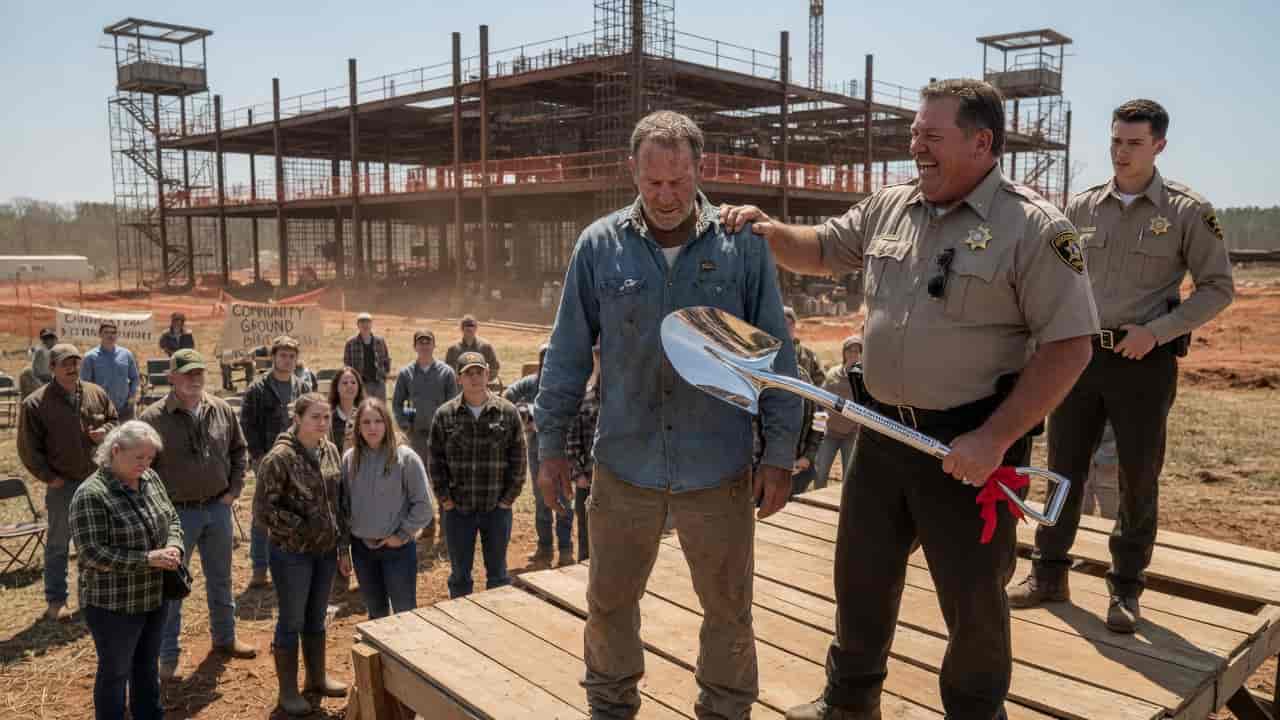
“Take the shovel, Hank. Smile for the people.”
I looked at the chrome-plated tool Bodie was shoving into my chest and then at the red clay that used to be my wife’s garden. Two years ago, this man signed the papers that took my dirt and turned it into a private prison site. He called it ‘eminent domain.’ I called it theft.
“I’m not smiling for you, Bodie,” I whispered, my voice thick with the dust of the construction site.
The Sheriff leaned in, his hand clamping like a vice on the back of my neck. He didn’t care who was watching. He wanted me to feel the weight of his badge, the weight of the money he was making off this concrete cage.
“You’ll do what I tell you,” he hissed, his breath smelling of stale coffee and arrogance, “or you’ll end up just like her. Quiet and forgotten in the ground.”
The crowd was silent. They knew what happened to Martha. They knew the truth behind the lie the papers printed. But Bodie didn’t know about the tunnel. He didn’t know about the ledgers I’d pulled from the digital shadows of his office. And he definitely didn’t know that the ground beneath his feet was already hollow.
Chapter 1
The red clay of Jessup County didn’t just stick to your boots; it claimed them. Hank Miller stood at the edge of the perimeter fence, watching the yellow excavators bite into the rise where the tobacco barn had stood for eighty years. The air was thick with the smell of overturned earth and diesel exhaust, a combination that made the back of his throat itch.
Beside him, Buster, a black lab mix with graying fur around his snout, let out a low, mournful whine. The dog didn’t like the noise. He didn’t like the way the ground vibrated under his paws every time the heavy machinery dumped a load of stone.
“I know, boy,” Hank muttered, his hand resting on the dog’s head. His fingers were stiff, the joints swollen from decades of manual labor and the damp Kentucky mornings that settled in the hollows. “I don’t like it much neither.”
The farm had been three hundred acres of rolling hills and creek-bottom loam. Now, it was a scar. A massive, rectangular wound where the Commonwealth-Private Partners Corporation was erecting a twelve-hundred-bed correctional facility. They’d called it progress. They’d called it a “job engine” for a county that had watched its coal mines shutter and its young people drift away like smoke.
Hank didn’t see progress. He saw the place where Martha used to hang the laundry. He saw the spot where they’d buried their first calf in a blizzard back in ’94.
A white SUV with the Jessup County Sheriff’s logo on the door kicked up a plume of dust as it bounced along the access road. It slowed down as it approached the fence line, the engine idling with a rhythmic thrum. The window rolled down, and a young face peered out.
“Mr. Miller,” Deputy Caleb Vance said. He looked barely old enough to shave, his uniform shirt still holding the sharp creases from the cleaners. He was a local boy, the grandson of a man Hank had once baled hay with. “You’re not supposed to be this close to the construction equipment. It’s a liability.”
Hank didn’t turn his head. He kept his eyes on the excavator. “I’m on my own property, Caleb. Or what’s left of it.”
“The easement extends fifty feet from the fence, sir,” Caleb said, his voice soft, lacking the edge of authority his boss usually carried. “Sheriff Bodie is real particular about the perimeter. Especially with the groundbreaking ceremony tomorrow.”
Hank finally looked at him. Caleb looked away first, his gaze drifting to the dog. There was a shame in the boy’s eyes that Hank recognized. It was the shame of someone who knew the difference between the law and what was right, but was too young or too scared to bridge the gap.
“Is he coming out here today?” Hank asked.
“The Sheriff? He’s at the county seat, meeting with the investors. They’re coming in from Louisville tonight.” Caleb paused, his hand tapping nervously on the steering wheel. “Mr. Miller, I heard about the… I heard they sent you another notice about the house.”
Hank’s jaw tightened. The house was a hundred-yard walk behind him, a white-clapboard farmhouse that had begun to sag in the middle, as if it were tired of holding up the memories. It was the only part of the land the county hadn’t seized yet, but the “buffer zone” requirements were closing in like a tightening noose.
“They want me in the Pines,” Hank said, referring to the assisted living facility near the interstate. “They think if they put me in a room with a TV and three meals a day, I’ll forget that my wife died in that bedroom because the ambulance couldn’t get through the construction blockade fast enough.”
Caleb’s face went pale. “That was… that was a tragedy, sir. Nobody wanted that.”
“The Sheriff wanted his road,” Hank said flatly. “The road needed the bridge. The bridge was closed for three weeks. Martha didn’t have three weeks.”
The silence that followed was heavier than the dust. Caleb didn’t have an answer. There was no protocol in the deputy’s handbook for a man who had lost his world to a blueprint.
“You should go home, Mr. Miller,” Caleb said eventually. “It’s going to rain. The hollows get real slick when the clay turns.”
“I’ve lived here sixty-five years, Caleb. I know when it’s going to rain.”
Hank watched the SUV pull away. He waited until the taillights disappeared over the ridge before he turned back toward his house. But he didn’t go inside. Instead, he walked toward the old equipment shed, a structure that looked ready to collapse under the weight of the creeping ivy.
Inside, the air was cool and smelled of oil and old burlap. He moved a stack of rotted plywood to reveal a trapdoor he’d cut into the floorboards six months ago. Below it was a ladder leading into the darkness.
Hank climbed down, his knees popping with every rung. At the bottom, a single bulb hummed, powered by a long extension cord buried under the shed’s foundation. The tunnel wasn’t sophisticated—just four feet high and three feet wide, braced with treated four-by-fours he’d scavenged from the construction site’s own scrap piles.
He picked up a hand-trowel and a bucket. He was only twenty feet from the main utility line of the prison’s administrative wing. He wasn’t a structural engineer, but he knew how dirt moved. He knew how the water table sat. And he knew that the private prison was being built on a foundation of greed and rushed permits.
He began to dig, the rhythmic scrape of the metal against the earth the only sound in the world. Every bucket of dirt he hauled out was a piece of his land he was taking back. Every inch he moved forward was a step closer to the truth he’d found in the digital files Martha had left behind.
Martha had been the county clerk for thirty years. She was a woman who believed in the order of things, in the permanence of ink on paper. When the prison corporation first started sniffing around, she’d started keeping her own records. Not the ones she filed in the courthouse, but the ones she kept on a thumb drive hidden in her sewing kit.
Hank didn’t know much about computers, but he knew how to read a ledger. He knew that the land seizure hadn’t been about public necessity. It had been about a three-million-dollar kickback scheme involving Sheriff Bodie and the board of supervisors.
He dug until his back screamed and his breath came in ragged gasps. When he finally stopped, he leaned against the damp earth wall and closed his eyes. In the dark, he could almost hear Martha’s voice.
“Don’t let them take the dignity of it, Hank. The land remembers.”
He climbed out of the tunnel as the first drops of rain began to pelt the tin roof of the shed. He walked back to the house, Buster trailing behind him. On the kitchen table sat a suicide note that wasn’t a suicide note. It was a confession Martha had written while she waited for an ambulance that would never arrive.
They’re coming for the hill, Hank. Bodie knows what I found. If I don’t make it, look in the cedar chest.
The Sheriff had told the coroner it was a heart attack brought on by stress. He’d told the papers she’d been despondent. But Hank knew. He knew the Sheriff had ordered the bridge closure specifically to keep the “troublemakers” on the far side of the creek while the final land deals were signed.
Hank sat in his dark kitchen, the only light coming from the lightning that flickered over the construction site. Tomorrow was the groundbreaking. Bodie would be there, in his dress uniform, holding a silver shovel and talking about the future.
Hank reached into his pocket and pulled out a small, heavy object. It was a detonator he’d wired to three hundred pounds of industrial-grade ammonium nitrate he’d been siphoning from the construction site’s blasting crew for months.
He didn’t want to kill anyone. He wasn’t a murderer. But he was a farmer. And sometimes, you had to burn the field to save the soil.
The rain began to fall in earnest, a Kentucky deluge that turned the red clay into a river of mud. Hank watched the prison site through the window, the steel girders looking like the ribs of a dying beast.
“Tomorrow, Buster,” he whispered. “Tomorrow we give it back to them.”
The dog rested his chin on Hank’s knee, his tail giving a single, heavy thud against the floorboards. In the silence of the house, the ticking of the grandfather clock felt like a countdown.
Hank thought about the tunnel. He thought about the Sheriff’s laughter. He thought about the way the sun used to hit the tobacco leaves in August, turning the whole world to gold. That world was gone. But as he gripped the detonator, he felt a strange, cold peace.
He wasn’t just a ghost of the county. He was the weight of the ground itself. And the ground was tired of being stepped on.
Chapter 2
The morning of the groundbreaking ceremony broke gray and humid, the kind of Kentucky heat that felt like a wet wool blanket over your face. By ten o’clock, the construction site was a sea of pressed shirts, Sunday dresses, and the polished chrome of the Sheriff’s department fleet. A wooden stage had been erected at the very center of the “Administrative Plaza,” a patch of leveled red earth that felt more like a stage for an execution than a celebration of progress.
Hank Miller stood at the back of the crowd, his hands shoved deep into the pockets of his denim jacket. He felt like a splinter in a clean thumb—unwanted, irritating, and impossible to ignore. He could feel the eyes of the townspeople on him. Some were filled with a fleeting, watery pity; others were hard with the resentment of those who had sold their own land and hated him for holding out.
Sheriff Bodie was in his element. He paced the stage like a king, his tan uniform tailored to hide the thickening of his waist, his gold badge catching the sun every time he turned. He was shaking hands with men in charcoal suits from the private prison corporation, laughing with a booming, performative jovality that carried across the field.
“Look at him,” a voice whispered beside Hank.
It was Sarah Jenkins, a lawyer from the ACLU who had driven down from Louisville three days ago. She looked out of place in her sharp navy blazer and sensible heels, her skin a shade too pale for the Jessup County sun.
“He’s got the whole board of supervisors in his pocket,” she said, her voice low and tight. “Hank, I looked at the filings. The eminent domain claim is a mess, but by the time we get a judge to stay the construction, the foundation will be poured. We need something more than just a procedural error.”
“I have it,” Hank said, his eyes never leaving Bodie.
“The ledgers you mentioned? Hank, if those are real, they don’t just stop a prison. They put that man in a federal jumpsuit. But I need to see them.”
“Not yet,” Hank murmured. “I need him to say it first. I need the whole county to hear what he thinks of us.”
The ceremony began with a local preacher offering a prayer that sounded more like a campaign speech for the Sheriff. Then, the Chairman of the Board spoke about “revitalization” and “revenue streams.” Finally, Bodie stepped to the microphone.
“Twenty years ago,” Bodie began, his voice dropping into that smooth, practiced baritone that had won him five consecutive elections, “Jessup County was a place of ghosts. We watched our boys go off to war and come back to find no work. We watched our daughters move to the city because the earth here had stopped giving.”
He gestured to the massive skeletal frame of the prison behind him.
“But today, we stop looking back. Today, we build a wall against the decline. This facility represents five hundred permanent jobs. It represents a tax base that will rebuild our schools and pave our roads.”
He paused, his eyes scanning the crowd until they locked onto Hank. A slow, predatory smile spread across his face.
“Now, we’ve had some folks who didn’t see the vision. Folks who clung to the past even when the past was nothing but dust and rot. But here in Jessup, we don’t leave anyone behind. Even the ones who fight us.”
Bodie beckoned with a heavy hand. “Hank Miller, why don’t you come up here?”
The crowd went deathly still. Hank felt Sarah’s hand on his arm, a silent warning. He ignored it. He stepped forward, the red dust puffing up around his boots as he walked toward the stage. Every eye was a weight. He felt the collective breath of the county held in suspense.
As he climbed the stairs, Bodie reached out and grabbed his shoulder. It wasn’t a friendly gesture. It was a claim of ownership. The Sheriff’s fingers dug into the muscle near Hank’s neck, a sharp, localized pain that forced Hank to stand rigid.
“Hank here has lived on this ridge his whole life,” Bodie told the crowd, his voice booming through the speakers. “And I know he’s had a hard time lately. We all lost a good woman when Martha passed. But progress waits for no man, not even a Miller.”
He reached down and picked up a chrome-plated shovel, the blade gleaming like a mirror. He thrust it into Hank’s chest, forcing him to take it.
“Take it, Hank,” Bodie hissed under his breath, though his face remained a mask of benevolent leadership. “Smile for the people. Let them see you’ve accepted it.”
“I’m not smiling for you, Bodie,” Hank said. The microphone on the podium caught it—a low, raspy growl that made the feedback hum.
Bodie’s grip tightened on Hank’s neck. He leaned in, his breath hot against Hank’s ear. “You’ll do what I tell you, or you’ll end up just like her. Quiet and forgotten in the ground. I can make your house disappear by morning, Hank. Don’t test me in front of my guests.”
Hank looked down at the shovel. He could see his own reflection in the chrome—a tired man, a broken man. But behind him, he saw the image of Deputy Caleb Vance standing by the stage stairs. The boy’s face was twisted in a grimace of pure, unadulterated disgust. He was looking at his hero, the man who had given him his badge, and he was seeing a monster.
Hank looked back at Bodie. He leaned into the microphone, his voice calm, echoing across the red clay hills.
“You’re right about one thing, Sheriff,” Hank said. “The past is buried. But the problem with things in the ground is that they don’t always stay there. Especially when the foundation is built on a lie.”
Bodie’s eyes flared with a sudden, sharp panic. He tried to pull the microphone away, but Hank held the shovel like a spear, blocking him.
“You took my land,” Hank continued, the crowd now leaning forward, the silence so profound he could hear the wind whistling through the prison’s steel ribs. “You took my wife’s time. And you took three million dollars from the Commonwealth-Private group to make sure the environmental reports disappeared. I have the sewing kit, Bodie. I have every single file Martha saved.”
The stage seemed to tilt. The men in the charcoal suits began to murmur, their faces hardening. Bodie’s hand dropped from Hank’s shoulder as if it had been burned.
“He’s crazy,” Bodie shouted, turning to the crowd, his face flushing a deep, dangerous purple. “The man is grief-stricken and senile! Caleb, get him off the stage!”
Caleb Vance didn’t move. He stood at the bottom of the stairs, his eyes locked on Bodie.
“Caleb!” Bodie roared. “That’s an order!”
Caleb took a breath, his hand resting on his belt, but he didn’t reach for his cuffs. He reached for the body camera on his chest and clicked it into the ‘On’ position.
“I think he should finish, Sheriff,” Caleb said, his voice trembling but clear. “I think we all want to hear about the sewing kit.”
Bodie lunged for Hank, his face a mask of primal rage. He grabbed Hank by the throat, shoving him back against the wooden railing of the stage. The chrome shovel clattered to the floor, the sound like a gunshot.
“I’ll kill you,” Bodie hissed, his voice no longer for the crowd, but a raw, animal snarl. “I’ll burn that house with you in it.”
Hank didn’t fight back. He looked past Bodie’s shoulder at the crowd, at the cameras, at the young deputy who was recording every second of the Sheriff’s collapse.
“You already did,” Hank choked out.
The rescue force wasn’t a squad of soldiers. It was the collective realization of a town. A few men from the front row—farmers who had worked with Hank for forty years—stepped toward the stage. They didn’t have weapons, but they had the heavy, immovable presence of the earth itself.
Bodie realized he’d lost the room. He let go of Hank’s throat, backing away, his eyes darting like a trapped rat’s. He looked at the investors, but they were already turning their backs, walking toward their black sedans.
“This isn’t over!” Bodie yelled, but the wind caught his words and scattered them over the empty construction site.
Hank stood up, rubbing his neck. He picked up the ceremonial shovel. He looked at the chrome blade, now smeared with the red mud of his home.
He walked to the edge of the stage and looked down at Caleb.
“Take the camera to Sarah,” Hank said. “The files are in the cedar chest under the floorboards of the equipment shed. The password is Martha’s birthday.”
“Where are you going, Mr. Miller?” Caleb asked.
Hank looked toward the massive prison structure. “I have to finish the tunnel, Caleb. The ground is still hollow, and I’m not done taking it back.”
He walked off the stage, the crowd parting for him like the Red Sea. He didn’t look back at the Sheriff, who was now being surrounded by his own deputies, their faces grim and uncertain. Hank walked across the scarred earth, his dog Buster falling in line beside him.
The ground felt different under his feet now. It felt like it was waiting. It felt like it was ready to receive what was coming.
As the rain began to fall again, washing the red clay off the chrome shovel, Hank knew the residue of this day would never leave the county. The lie had been exposed, but the wound was still open. And in Jessup County, wounds that deep required more than just the truth to heal. They required a settling of the earth.
Chapter 3
The rain didn’t stop. It turned the Jessup County red clay into a slick, treacherous slurry that swallowed the tires of the heavy equipment and sent the construction crews home early. Hank stood in his equipment shed, the sound of the deluge on the tin roof like a thousand hammers. He was soaked to the bone, his denim jacket heavy with water, but he didn’t feel the cold. He felt a hum in his bones, a low-frequency vibration that seemed to come from the very earth he was undermining.
He sat on a crate of old tractor parts, watching Buster shake the water off his coat. On the workbench lay Martha’s sewing kit—a faded blue tin box with a floral pattern that was peeling at the edges. Inside, nestled among the spools of thread and silver thimbles, was the black plastic thumb drive.
It looked like such a small thing. A sliver of plastic and silicon. But it contained the architecture of a man’s ruin.
Sarah Jenkins had come by an hour ago, her car fishtailing up the muddy drive. She’d taken the digital copies Caleb had recorded and the files Hank had given her.
“This is enough for a grand jury, Hank,” she’d said, her eyes wide with the adrenaline of a lawyer who had finally found the smoking gun. “The wire transfers are all here. Bodie was funneling the corporation’s ‘site prep’ funds into a shell company registered to his brother-in-law. It’s racketeering. Plain and simple.”
“Will it stop the prison?” Hank had asked.
Sarah had hesitated, her gaze drifting to the window. “It will stop the men building it. The state will have to freeze the assets. It could be years before they can resume. But Hank… you need to leave. Bodie is cornered. A cornered man with a badge is the most dangerous thing in this state.”
“I’m not leaving my land,” Hank had said.
Now, sitting in the shed, he realized he wasn’t just staying for the land. He was staying for the residue. He was staying for the moment the earth finally reclaimed what had been stolen.
He opened the trapdoor and climbed down into the tunnel.
The air down here was different—heavy, smelling of minerals and ancient, undisturbed silence. The extension cord hummed, the single bulb casting long, flickering shadows against the braced walls. He’d reached the utility hub of the prison’s admin wing. The concrete foundation was only two feet above his head, a massive, oppressive weight of gray stone.
Hank picked up his trowel. He wasn’t digging for files anymore. He was digging for the final connection.
He worked for hours, his muscles moving in a rhythmic, mindless cycle of scrape, scoop, and dump. He thought about the first year he’d married Martha. They’d had a drought that turned the tobacco leaves to brittle brown parchment. He’d spent every night hauling water from the creek in buckets, his back feeling exactly like it did now. Martha had met him at the edge of the field with a jar of sweet tea and a damp cloth for his neck.
“You’re a stubborn man, Hank Miller,” she’d said, her voice full of a pride she tried to hide. “You’d try to water the whole county if you thought it would keep things growing.”
He wiped a smear of mud from his forehead. “I’m still watering it, Martha,” he whispered to the dark. “Just a different kind of growth.”
Around 2:00 AM, the sound changed.
The scrape of his trowel hit something that didn’t sound like earth. It was a hollow, metallic ring. He cleared the dirt away with his hands, revealing a thick, black conduit pipe. This was the main fiber-optic and electrical line for the facility. It was the nervous system of the beast.
Beside it sat the three hundred pounds of ammonium nitrate, packed into plastic drums and wired with the precision of a man who had nothing else to occupy his mind.
He reached for the detonator, his fingers hovering over the switch. All he had to do was push it. The explosion would ripple through the tunnel, collapsing the support columns of the administrative wing before the concrete had even fully cured. The “job engine” would become a graveyard of twisted rebar and shattered stone.
But as he looked at the wire, he heard a sound from above.
It wasn’t the rain. It was the heavy thud of a boot on the shed floor. Then, the creak of the trapdoor.
Hank dived for the light cord, yanking it. The tunnel plunged into absolute, suffocating darkness.
“Hank?”
The voice was Caleb Vance’s. It was thin, shaking with a terror that made the hair on Hank’s arms stand up.
“Hank, if you’re down there… you gotta come up. Now.”
Hank stayed silent, pressing his back against the damp earth. He could hear Caleb’s breath—ragged, panicked gasps.
“He’s coming, Hank. Bodie didn’t go to the station. He went to the armory. He knows about the lawyer. He knows everything. He’s coming to finish it before the feds can get here in the morning.”
Hank felt a cold surge of adrenaline. He reached out in the dark, his hand finding the cool plastic of the detonator.
“Caleb,” Hank whispered, his voice sounding like it was coming from the ground itself. “Get out of the shed. Go to the house and get the dog. Take him to the hollow and stay low.”
“I’m not leaving you, Mr. Miller! He’s got two of the older deputies with him. The ones who owe him. They’re coming in through the back pasture to avoid the cameras.”
“I’m not in the house, Caleb. I’m where I need to be.”
A sudden, blinding light cut through the trapdoor opening. A heavy flashlight beam swept the tunnel entrance.
“Vance!” a voice roared from above. It was Bodie. “Get away from that hole!”
Hank heard a scuffle—the sound of bodies hitting the shed floor, a grunt of pain, and then the metallic clack of a holster being snapped open.
“He’s down there, isn’t he?” Bodie’s voice was different now. It was flat. The performative Sheriff was gone. This was the man who had let a woman die to protect a land deal. “The old rat built himself a nest.”
“Sheriff, don’t,” Caleb pleaded. “The ACLU has the files. It’s over. Just walk away.”
“It’s only over when the witnesses stop talking, Caleb. And you’re making yourself a very loud witness.”
There was a sickening thud—the sound of a pistol whip hitting bone. Hank heard Caleb groan and hit the floorboards hard.
“Hank!” Bodie shouted into the hole. “I know you’re down there with your little toys! You think you’re a hero? You’re just a pathetic old man digging his own grave! I’m going to drop a couple of tear gas canisters down there and smoke you out like the vermin you are!”
Hank gripped the detonator. He could hear Bodie’s boots on the ladder. The Sheriff was coming down. He was coming into the dark, into the hollow earth that Hank had spent two years preparing.
“Come on then, Bodie,” Hank said, his voice steady. “Come and see what the ground looks like from the inside.”
Hank felt the vibration of the ladder as Bodie began his descent. He crawled back toward the utility conduit, his heart hammering against his ribs. He had a choice. He could blow the tunnel now, killing them both. Or he could wait for the Sheriff to see the truth.
The light from Bodie’s flashlight hit the tunnel floor, reflecting off the pools of muddy water. The Sheriff reached the bottom, his heavy frame filling the narrow space. He held his service weapon in his right hand, the light in his left.
“Look at this,” Bodie mocked, his light sweeping over the timber braces and the piles of dirt. “All this work for nothing. You really thought you could bring down a hundred-million-dollar project with a shovel and some spite?”
The light finally landed on the ammonium nitrate drums. Bodie froze.
The silence in the tunnel became absolute. Even the sound of the rain above seemed to vanish.
“You’re insane,” Bodie whispered, the bravado draining out of his face. “You’ll blow the whole ridge. You’ll take your own house out.”
“The house is just wood and nails, Bodie,” Hank said, stepping into the edge of the light. He looked like a creature made of clay, his eyes the only human thing left. “My home died with Martha. This? This is just housekeeping.”
Hank held up the detonator. His thumb was on the button.
“Drop the gun,” Hank said.
Bodie hesitated, his eyes darting between the explosives and the old man in front of him. He saw the truth in Hank’s eyes—the truth that Hank didn’t care if he lived to see the sunrise.
“You won’t do it,” Bodie said, though his voice cracked. “You’re too soft, Miller. You’re the guy who bottles up his feelings and pets his dog. You don’t have the stomach for this.”
“I’ve been stomach-sick for two years, Sheriff. I’m ready for the cure.”
Above them, in the shed, a new sound erupted. It was the low, guttural snarl of a dog. Then, a scream of pain that wasn’t Caleb’s.
“Buster!” Hank yelled.
Bodie took the distraction. He lunged forward, swinging his flashlight at Hank’s head.
The world turned into a blur of mud, light, and pain. Hank felt the metal hit his temple, sending a white-hot spike through his skull. He fell back against the explosives, the detonator slipping from his fingers.
Bodie was on top of him, his heavy hands finding Hank’s throat.
“You’re done,” Bodie hissed, his face inches from Hank’s. “I’m going to tell them you went crazy, tried to blow up the site, and I had to stop you. You’ll be the villain of Jessup County for the next hundred years.”
Hank’s vision began to grey at the edges. He reached out, his hand frantically searching the mud for the detonator.
His fingers found something else.
It was the chrome-plated shovel. He’d brought it down with him. A souvenir of his humiliation.
With the last of his strength, Hank swung the heavy shovel upward. The sharp, chrome edge caught Bodie under the jaw, the impact jarring through Hank’s arms.
Bodie let go, clutching his face, a spray of dark blood hitting the tunnel wall. He fell back, his flashlight tumbling into the mud, the beam pointing straight up at the concrete foundation above.
Hank scrambled for the detonator. He found it. He stood up, his legs shaking, his breath coming in ragged sobs.
Bodie was on his knees, his hands over his mouth, his eyes wide with a sudden, primal terror. He looked up at the foundation, then at the explosives, then at the man with the shovel.
“Wait,” Bodie gargled through the blood.
Hank looked at the button. He thought about the three million dollars. He thought about the bridge closure. He thought about Martha’s garden.
Then, he heard a voice from the trapdoor.
“Mr. Miller! Don’t!”
It was Caleb. He was leaning over the opening, his face battered but his eyes clear.
“I called them, Hank! The State Police! They’re five minutes out! Sarah called the FBI! It’s over! You don’t have to do this!”
Hank looked at the boy. He looked at the future that Caleb represented—the first spark of integrity in a county that had been dark for a long time.
He looked back at Bodie, who was now weeping, a broken king in a mud palace.
Hank slowly took his thumb off the button.
“You’re right, Caleb,” Hank said, his voice barely a whisper. “I don’t have to do it.”
He dropped the detonator into the mud.
“The ground is already hollow,” Hank said to Bodie. “You’re already falling. I just wanted you to see the bottom.”
He turned and began to climb the ladder. He didn’t look back as the sound of sirens began to wail in the distance, cutting through the Kentucky rain. He climbed out of the hole, into the cool air of the shed, where Buster was standing over a groaning deputy, the dog’s tail giving a single, weary wag.
Hank walked out of the shed and onto the ridge. He looked at the prison, the steel ribs gleaming in the lightning.
The residue of the day was heavy, but as he stood there in the rain, he felt the first stirrings of something he hadn’t felt in two years.
It wasn’t peace. It was justice. And in Jessup County, that was as close to a miracle as a man could get.
Chapter 4
The aftermath of the groundbreaking ceremony didn’t just linger; it curdled. By the time the FBI and State Police converged on the Miller farm, the rain had stopped, leaving behind a thick, spectral fog that clung to the hollows like a shroud. The flashing blue and red lights reflected off the mist, turning the construction site into a surreal landscape of strobing colors and long, shifting shadows.
Hank sat on the bumper of an ambulance, a gray wool blanket draped over his shoulders. A young EMT was dabbing at the gash on his temple, but Hank barely felt the sting of the antiseptic. He was watching the figures in windbreakers move in and out of his equipment shed. They were hauling out boxes, evidence bags, and eventually, a shackled Sheriff Bodie.
Bodie looked diminished. Without the stage, without the tan uniform—which was now stained with blood and red clay—he looked like what he was: a middle-aged bully whose luck had finally run out. He didn’t look at Hank as they led him to a transport van. He kept his head down, his jaw tight, his world reduced to the width of his handcuffs.
Sarah Jenkins stood nearby, talking to a man in a dark suit who looked like he’d been carved out of granite. She walked over to Hank, her face pale but her eyes bright with a grim satisfaction.
“They found the primary ledger, Hank,” she said, crouching down to his level. “The FBI’s been tracking the shell company for months, but they didn’t have the link to the prison’s internal site-prep budget. Martha’s files provided the bridge. It’s a closed loop now.”
“What about the land?” Hank asked.
Sarah sighed, the sound lost in the hum of the idling engines. “The state has frozen all construction. The contract with Commonwealth-Private is being reviewed for fraud. Most likely, the whole thing will be tied up in litigation for a decade. The land… it’s technically still under the eminent domain seizure, but nobody’s going to be laying concrete here anytime soon.”
Hank looked toward the skeletal prison. It looked like a ghost ship anchored in a sea of mud.
“It won’t ever be a farm again,” he said.
“No,” Sarah admitted softly. “But it won’t be a cage either.”
Deputy Caleb Vance approached them, his arm in a sling and a dark bruise blooming across his cheekbone. He looked older than he had that morning. The innocence had been scorched off him, replaced by a weary, adult weight.
“Mr. Miller,” Caleb said. He stopped a few feet away, his hat in his hand. “The State Police took my statement. And the body cam footage. They’re saying I’m the primary witness for the assault on the stage.”
“You did good, Caleb,” Hank said.
“I should have said something sooner,” the boy whispered. “I knew he was taking shortcuts on the permits. I knew about the bridge. I just… I thought that was how things worked here. I thought the Sheriff was the law.”
“Sometimes the law is just a man with a louder voice than everyone else,” Hank said. “The trick is learning when to stop listening.”
Caleb nodded, his eyes moist. “I’m resigned, sir. I’m turning in my badge in the morning. I don’t think I can wear it in this county anymore.”
“Don’t do that,” Hank said, standing up. The blanket slipped from his shoulders, but he didn’t reach for it. “This county needs people who know what it’s like to be afraid of the badge. It needs people who remember what happened on this ridge.”
Caleb looked at the badge pinned to his chest, then back at Hank. He didn’t say anything, but he didn’t take it off either.
As the sun began to peek over the eastern ridge, a pale, sickly light that did nothing to warm the damp air, the investigators began to clear out. The spectacle was over. The reporters had their soundbites, the feds had their boxes, and the town had its scandal.
Hank walked back toward his house, Buster trotting slowly at his heels. The house looked different in the dawn light—smaller, more fragile. He realized he couldn’t stay there. Not because of the prison or the law, but because the silence inside was no longer filled with Martha. It was filled with the residue of what he’d had to become to save her memory.
He went into the kitchen and sat at the table. He picked up the suicide note—the confession—and read it one last time.
“Don’t let them take the dignity of it, Hank.”
He realized then that he hadn’t just been digging a tunnel. He’d been digging a way out of his own grief. He’d turned his pain into a weapon, and while the weapon had worked, it had left him hollowed out, much like the ground beneath the shed.
There was a knock on the door. It was Sarah.
“Hank, the FBI needs you to come down to the field office in Lexington for a formal deposition. They’re sending a car for you in an hour.”
“I’ll be ready,” Hank said.
“And Hank… the prosecutor asked me to tell you something. They’re not going to charge you for the explosives. They’re classifying it as ‘preventative discovery of structural hazards.’ They know you weren’t going to use them once Caleb showed up.”
Hank looked at his calloused hands. He knew the truth. He knew how close he’d come. He knew that for one heartbeat in that dark tunnel, he had wanted to pull the whole world down on top of him and Bodie.
“Tell him thank you,” Hank said.
Sarah lingered in the doorway. “What are you going to do when this is over, Hank? When the trials are finished and the news trucks leave?”
Hank looked out the window at the red clay hills. He thought about the tobacco leaves, the creek bottom, and the garden that was now a pit of mud.
“I think I’m going to go for a drive,” Hank said. “Maybe head west. See if the dirt looks the same in Missouri or Kansas. See if there’s a place where the ground doesn’t have so many secrets.”
“You’re leaving?”
“I’m not leaving,” Hank said, his voice firm. “I’m just… moving on. There’s a difference.”
Sarah nodded, a small, sad smile on her face. “I suppose there is.”
After she left, Hank went to the cedar chest. He didn’t look at the files or the ledgers. He reached to the very bottom, beneath the old blankets and the lace doilies, and pulled out a small, velvet box. Inside was a simple gold band—his wedding ring. He’d stopped wearing it the day they closed the bridge, the day his hands had become too swollen with rage to fit it.
He slipped it onto his finger. It was tight, but it fit.
He walked out onto the porch. Buster followed him, sensing the change in the air. The dog sat by his side, his ears perked toward the hollow.
The heavy machinery was silent. The prison site was empty. For the first time in two years, Hank could hear the sound of the creek. It was running high from the rain, a steady, rushing sound that felt like a pulse.
He looked at the ridge, at the place where his life had been dismantled. The scars were still there, and they would be there for a long time. The red clay would never truly be forgotten. But as the sun finally broke through the fog, casting long, golden fingers across the valley, Hank felt the weight in his chest loosen, just a fraction.
He wasn’t a hero. He wasn’t a ghost. He was just a man who had stood his ground until the ground itself gave way.
And as he watched the light hit the water, he knew that for the first time in a very long time, he was finally standing on solid earth.
Chapter 5
The morning after the feds hauled Sheriff Bodie away in a cloud of dust and disgrace, the silence in Jessup County didn’t feel like peace. It felt like a held breath, the kind that precedes a scream. Hank Miller sat on his porch, a cup of black coffee cooling in his hands, watching the sun struggle to burn through the fog that had settled in the hollow. The construction site was a graveyard of yellow steel. The roar of the excavators had been replaced by the rhythmic drip-drip-drip of water falling from the eaves of his house.
He wasn’t alone for long. By eight o’clock, a rusted Ford F-150 pulled up the driveway, its engine rattling like a box of loose nails. Out stepped Jim Varney, a man Hank had known for forty years. Jim was a heavy-set man with skin the color of old tobacco and hands that were permanently stained with grease. He worked at the local sawmill, or at least he had until it cut its shifts in anticipation of the prison opening.
Jim didn’t come up the stairs. He stood in the mud at the base of the porch, his thumbs hooked into his belt loops.
“I heard the news, Hank,” Jim said. His voice was scratchy, lacking the usual warmth of their Sunday morning greetings at the feed store.
“You heard the truth then, Jim,” Hank replied, not moving from his chair.
“The truth is a luxury some of us can’t afford,” Jim spat. He looked toward the idle construction site. “My boy was slated for the guard academy. My son-in-law had a contract for the landscaping. Now, because you had a grudge against Bodie, the whole county’s back to zero. You think you’re a hero? You’re just the man who pulled the plug on our kids’ futures.”
Hank felt a familiar, dull ache in his chest. It wasn’t a heart attack; it was the weight of being the target of a town’s desperation. “Bodie was stealing from us, Jim. He was using our land to line his pockets and building a cage for people who didn’t belong there. You wanted your son to spend his life locking doors on men who looked just like him?”
“I wanted my son to have a paycheck!” Jim roared, his face turning a mottled red. “I don’t care if he was locking up the Pope. We’re starving out here, Hank. And you’re sitting up here on your hill like a goddamn king, protected by those Louisville lawyers and the FBI. Who’s going to protect us when the bank comes for the truck?”
Hank didn’t have an answer. There was no argument for morality that could satisfy a man with an empty cupboard. He watched Jim stomp back to his truck and peel out, throwing a spray of red mud against the side of the equipment shed.
The residue of the encounter lingered like the smell of ozone after a lightning strike. Hank realized that his victory over Bodie had a high price—one he wasn’t the only one paying. He went inside to avoid the judgmental gaze of the empty hills.
Sarah Jenkins called an hour later. Her voice was sharp, professional, but underneath it, he could hear the exhaustion.
“Hank, the deposition is being moved to the courthouse in Jessup. The feds want to do it on-site to verify some of the physical evidence in the tunnel. But I need to warn you—the atmosphere in town is ugly. Bodie’s people are spinning this as a personal vendetta that’s costing the county millions. They’re calling you ‘The Wrecker.’”
“I’ve been called worse,” Hank said.
“It’s not just names, Hank. There’s talk of a protest at the courthouse. I want you to come in through the back entrance. Caleb Vance will meet you there. He’s still technically on administrative leave, but he’s acting as a liaison.”
When Hank drove into town at noon, he saw what Sarah meant. The town square, usually a sleepy patch of grass and benches, was crowded. There were handmade signs: MILLER STOLE OUR JOBS and BODIE WAS FOR BIKERS AND BREADWINNERS. It was a strange, desperate alliance—the people who had been bullied by the Sheriff were now defending him because he represented the only economic hope they’d seen in a generation.
He pulled his old Chevy around the back of the courthouse. Caleb Vance was waiting by the service door. The young man looked like he hadn’t slept since the groundbreaking. He was in civilian clothes—a flannel shirt and jeans—and his eyes darted nervously toward the crowd at the front of the building.
“Mr. Miller,” Caleb said, stepping forward to open the door. “Glad you made it. It’s a zoo out there.”
“They’re angry, Caleb. I don’t blame them for being angry, but I wish they’d point it at the right person.”
“They don’t want a person to blame. They want a solution,” Caleb said quietly as they walked down the cool, marble-floored hallway. The smell of floor wax and old paper was suffocating. “My dad’s out there. He’s one of the ones with a sign.”
Hank stopped, looking at the young man. “I’m sorry, son.”
Caleb shook his head. “Don’t be. He didn’t see Bodie in the tunnel. He didn’t see him with his hands around your throat. He just sees the mortgage. He thinks I’m a traitor for helping you.”
They entered the witness room. Sarah was there, along with two men in dark suits who didn’t introduce themselves. They spent the next four hours going over every detail of the last two years. Hank told them about the night the bridge was closed. He told them about the way Martha’s breath had sounded in the dark as her heart gave out—a rattling, desperate sound that he still heard every time the wind caught the eaves of the house.
He told them about the sewing kit. He told them about the tunnel.
“And the explosives, Mr. Miller?” the older fed asked, leaning forward. His eyes were like two pieces of flint. “You had enough ammonium nitrate to level that entire administrative wing. Were you going to use it?”
Hank looked at his hands. They were stained with the clay of the tunnel. “I thought I was. I spent every night for six months telling myself that the only way to get justice was to burn the whole thing down. I wanted Bodie to feel the earth move under him.”
“What changed?”
“The boy,” Hank said, gesturing toward the door where Caleb was waiting. “And Martha. She didn’t like fire. She liked things that grew. I realized if I blew that place up, I wasn’t saving the land. I was just making the scar deeper.”
The fed nodded slowly, scribbling something on a legal pad.
When the deposition was over, Sarah walked Hank out. The crowd in the square had grown. As they stepped out the back door, a group of men spotted them. They didn’t yell; they just stood there, watching with a cold, silent contempt that felt sharper than any insult.
Hank drove home in a daze. When he turned up his driveway, he saw that the silence had been broken again. His front door was hanging open, the wood splintered around the lock.
“Buster!” he yelled, jumping out of the truck.
He ran into the house, his heart hammering. The living room had been tossed. His few pieces of furniture were overturned. Martha’s photographs had been swept off the mantle, the glass shattered across the floorboards.
He found Buster in the kitchen, huddled under the table. The dog was shaking, his tail tucked tight between his legs. There was a smear of red paint across the white kitchen wall: LEAVE OR BURN.
Hank sat on the floor and pulled the dog into his lap. He didn’t feel anger. He didn’t feel fear. He felt a profound, crushing exhaustion. He had won the war, but he had lost his home. The ground he had fought for was now poisoned by the resentment of his neighbors.
He stayed there for a long time, the dog’s head resting on his chest. He looked at the shattered glass of his wedding photo. Martha’s face was smiling up at him, forever twenty-four, forever full of the belief that the world was a place that rewarded the honest.
He realized Sarah was right. He couldn’t stay. Not because of the threats, but because the residue of the conflict had become the only thing left. Every time he looked at the hills, he wouldn’t see the tobacco or the timber; he’d see the prison site and the faces of the men who hated him.
He reached out and picked up a shard of glass. He looked at his reflection. He saw an old man who had defended a ghost and ended up becoming one himself.
He spent the rest of the evening cleaning up. He swept the glass, uprighted the chairs, and fixed the door as best he could with a hammer and some long nails. He packed a single suitcase. He didn’t need much. Most of what mattered was already in the cedar chest or the sewing kit.
As night fell, he walked out to the equipment shed one last time. He looked down into the trapdoor. The tunnel was still there, a dark vein running through the earth. He thought about the hours he’d spent down there, the labor of his grief.
He picked up a shovel—a regular, worn garden shovel, not the chrome one—and began to fill in the hole. He worked steadily, the rhythm of the dirt hitting the floorboards a soothing, repetitive sound. He filled the entrance, packed it down, and dragged the rotted plywood back over it.
He was burying the weapon. He was burying the rage.
When he finished, he stood in the doorway of the shed and looked toward the prison. A single security light had been left on, casting a cold, blue glow over the steel. It looked lonely. It looked like a monument to a future that never was.
“It’s okay, Martha,” he whispered to the wind. “We’re going to find some new dirt.”
He went back to the house, Buster trailing behind him. He didn’t sleep. He sat in the dark kitchen, watching the clock tick, waiting for the first light of his last day in Jessup County. The air was still thick with the smell of the red clay, but for the first time in years, it didn’t feel like it was claiming him. It felt like it was letting go.
Chapter 6
The final morning in Jessup County arrived with a clarity that felt like a personal insult. The sky was a hard, brilliant blue, and the air was crisp, carrying the scent of pine and damp earth. Hank Miller stood by his truck, the tailgate down, looking at the house that had been his entire world. It looked small now. It looked like a shell left behind by something that had finally outgrown it.
He had spent the early hours loading the essentials. The cedar chest was in the bed of the truck, wrapped in a heavy tarp. Martha’s sewing kit was on the passenger seat, tucked securely into the glove box. He’d packed a few boxes of tools, his boots, and the dog’s bed. Everything else—the furniture, the old curtains, the boxes of mismatched plates—he left for the county to deal with. Or the looters. It didn’t matter anymore.
Buster was already in the cab, his head hanging out the window, watching a hawk circle above the empty prison site. The dog seemed to know. He was alert, his ears twitching at every sound, but he wasn’t whining. He was ready.
A car pulled up the drive—a modest silver sedan. Sarah Jenkins got out, her blazer replaced by a thick wool sweater. She looked around at the boxes and the empty porch.
“So it’s true,” she said, her voice soft. “You’re really going.”
“Nothing left to stay for, Sarah,” Hank said, tightening a tie-down strap over the tarp. “The feds got their man. The town has their villain. I’m just an old farmer without a farm.”
“The land will revert to the county after the litigation, Hank. We might be able to fight to get it back into your name. It’ll take years, but we could win.”
Hank turned to her. He looked at the legal papers in her hand, the tools of her trade. “I don’t have years, Sarah. And even if I did, what would I be winning? A field full of rebar and bad memories? No. Let the county keep it. Maybe they can turn it into a park. Maybe they can let the trees grow back. The earth doesn’t want to be a prison, but it doesn’t want to be a battlefield either.”
Sarah nodded, a look of profound respect in her eyes. She handed him a thick envelope. “This is the final settlement from the private prison corporation. They settled out of court to avoid a civil RICO suit. It’s more than enough to buy a good piece of land anywhere in the country. A clean start, Hank.”
Hank took the envelope and shoved it into his pocket without looking at it. The money didn’t feel like a win; it felt like a refund for a life that had been canceled.
“Where will you go first?” she asked.
“West,” Hank said. “I think I’ll stop when the dirt turns black and the hills flatten out. I want to be somewhere where I can see the horizon without having to climb a ridge to find it.”
“Caleb wanted to be here,” Sarah said, checking her watch. “But he’s in Lexington. The U.S. Attorney’s office called him in for a follow-up. He told me to tell you… he’s keeping the badge. He’s going to work for the State Police. He wants to be a different kind of officer.”
Hank smiled, a genuine, tired movement of his lips. “That’s good. That’s the best news I’ve heard in a long time. Tell him to stay honest. It’s the hardest job in the world, but it’s the only one that pays in the end.”
Sarah reached out and shook his hand. Her grip was firm. “Take care of yourself, Hank Miller. You’re the most stubborn man I’ve ever met.”
“I’ll take that as a compliment,” he said.
He watched her drive away, her car disappearing into the morning mist at the bottom of the hill. He was alone now. Truly alone.
He walked back to the house one last time. He stood in the middle of the kitchen, looking at the spot where the red paint had been scrubbed off the wall. The house felt cold. The soul had gone out of it the moment Martha’s photographs were packed away.
He reached into his pocket and pulled out his house key. He hesitated, then laid it on the counter. He wouldn’t be needing it. He walked out, closing the door behind him with a soft thud that echoed through the empty rooms.
He climbed into the truck and started the engine. The old Chevy rumbled to life, a steady, dependable sound that made Buster give a short, sharp bark.
As he drove down the long, winding driveway, he passed the perimeter fence of the prison site. The “Grand Opening” banners were still there, but they were torn, flapping in the wind like the wings of a dying bird. He looked at the administrative wing—the place where his tunnel ended. He could see the cracks in the foundation from here. Not from his explosives, but from the shifting of the earth itself. The ground was reclaiming its own.
He reached the main road and turned toward the interstate. As he passed through the town square, he saw the shops opening up. The diner was full. The hardware store had a new sign. The town was moving on, as towns always do. They would talk about Bodie for years—about the corruption and the scandal—and they would talk about Hank Miller, the man who broke the county. Some would call him a hero in whispers, and some would curse him over their coffee.
Hank didn’t care. He was a ghost to them now.
He hit the interstate and headed west. The hills of Kentucky began to soften, the deep, dark hollows giving way to rolling pastures and limestone bluffs. He watched the odometer click over, every mile a layer of the past falling away.
He stopped for gas in a small town near the Illinois border. The air smelled different here—flatter, more open. He bought a bag of jerky and a bottle of water for Buster.
“What do you think, boy?” Hank asked, leaning against the fender as the dog stretched his legs in the grass. “You think we can find a place with a good porch?”
Buster looked up at him, his tail wagging with a slow, rhythmic thud. He licked Hank’s hand, his tongue warm and rough.
Hank looked back toward the east. The sun was high now, casting a long shadow behind the truck. He thought about the tunnel. He thought about the chrome shovel. He thought about the night Martha died and the way he’d almost let the darkness win.
He realized that the “residue” he’d been so afraid of wasn’t the anger or the grief. It was the survival. It was the fact that he was still here, still breathing, still capable of looking at a map and seeing a future.
He got back in the truck and kept driving.
By sunset, he was in Missouri. The world had opened up. The sky was a vast, bruised purple, stretching out over fields of corn and soy that seemed to go on forever. He pulled over at a rest stop and walked to the edge of a fence line.
He knelt down and reached through the wire, scooping up a handful of dirt. It was dark, rich, and crumbly. It didn’t have the iron-heavy scent of Kentucky clay. It smelled of life. It smelled of a beginning.
He let the dirt sift through his fingers, watching the wind catch the fine dust and carry it away.
He thought about Martha’s garden. He thought about the way she used to look at the first sprouts of spring, her face full of a quiet, stubborn hope.
“I’m here, Martha,” he whispered.
He stood up and walked back to the truck. He didn’t look back. He didn’t think about the prison or the Sheriff or the broken house on the ridge. He thought about the morning. He thought about the sun hitting the black soil and the way the horizon looked when there was nothing left to hide.
Hank Miller put the truck in gear and drove into the dark, his headlights cutting a path through the quiet, open world. The ground under his tires was solid. The secrets were buried. And for the first time in a very long time, the man behind the wheel was home.