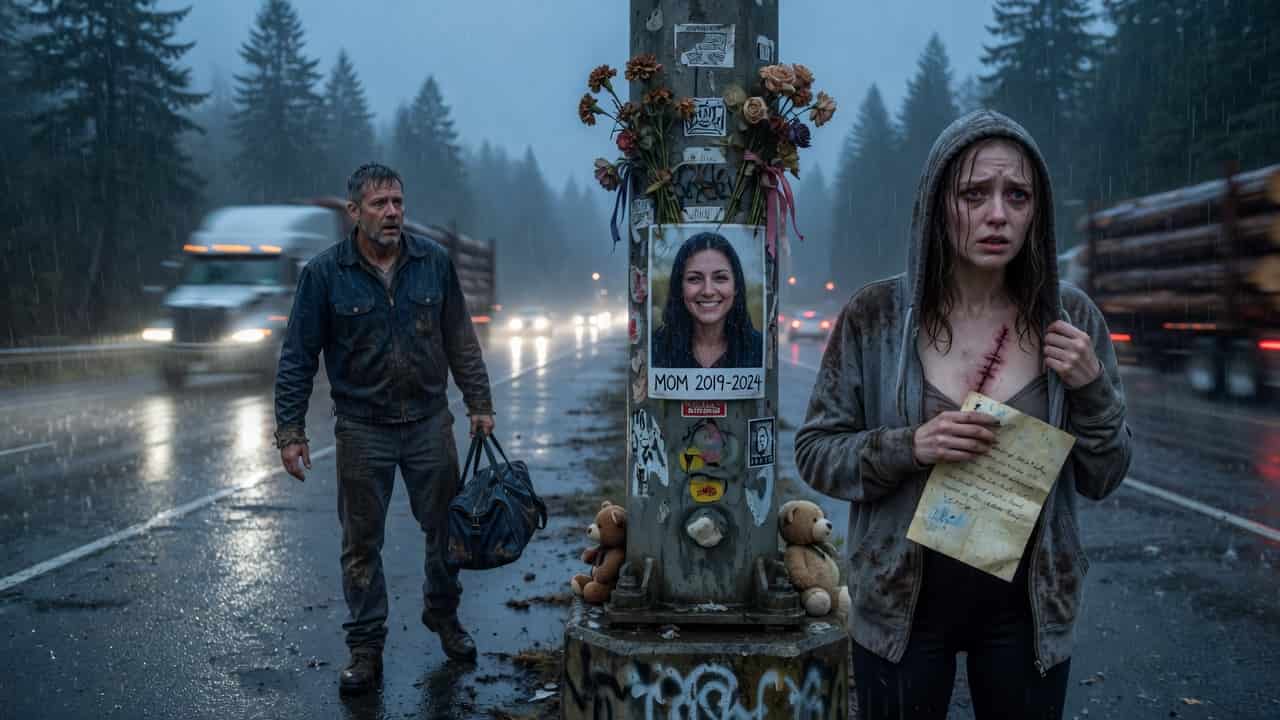
“You shouldn’t be out here, kid. It’s dangerous,” Caleb said, his voice tight with the kind of practiced authority he used on every EMT call. He looked at the girl standing by the concrete pillar—the same one that had ended his wife’s life six months ago. She looked too small for her oversized hoodie, her face so pale it was almost translucent in the Pacific Northwest gloom.
But the girl didn’t move. She didn’t look scared. She looked like she was holding a grenade.
“She didn’t skid on the ice, Caleb,” she whispered, using his name like she’d known him her whole life. “The police report was a lie. Your mother-in-law’s story was a lie.”
Caleb felt a coldness settle in his marrow that had nothing to do with the rain. “What are you talking about?”
The girl reached for her zipper. In one slow, devastating motion, she pulled it down. Beneath the fabric, a thick, jagged surgical scar ran straight down her chest—a map of a survival she didn’t seem to want. Then, she held out a piece of paper, yellowed and damp.
“She knew my blood type,” the girl said, her voice breaking. “She knew I was dying of heart failure. She didn’t lose control of the car. She aimed for this pillar because it was the only way I’d get her heart in time.”
Caleb looked at the letter, then at the girl carrying his wife’s heartbeat. His wife hadn’t just died. She had chosen to leave him for a daughter he never knew existed.
Chapter 1: The Weight of the Siren
The rain in Clallam County didn’t just fall; it inhabited the world. It turned the asphalt of Highway 101 into a black mirror and the towering Douglas firs into jagged, weeping ghosts. Inside the cab of Medic 4, the atmosphere smelled of stale coffee, industrial-grade disinfectant, and the faint, metallic tang of old adrenaline.
Caleb Vance gripped the steering wheel, his knuckles white against the worn leather. Beside him, Miller was scrolling through his phone, the blue light reflecting off his buzz cut. Miller had been his partner for seven years. They’d seen enough mangled metal and ruined lives to fill a library, but tonight, the silence between them felt heavy, like an unanchored load in the back of the rig.
“Dispatch says it’s a non-emergent transport from the clinic,” Miller said, not looking up. “Some guy with a kidney stone. Should be a quiet night.”
“Quiet is good,” Caleb muttered.
He hated quiet. Quiet was when the echoes started. It had been six months since he’d stood on this same stretch of highway, not as the driver, but as the man screaming at his own colleagues to move faster. He could still see the flickering strobes of the police cruisers reflecting in the pooling rainwater around Becca’s Honda. He could still feel the vibration of the Jaws of Life as they chewed through the door.
He’d been on shift that night. He’d heard the call come over the radio—single vehicle, high-impact, Mile Marker 14. He’d known Becca was out. She’d gone to the store for milk and a specific kind of lightbulb she liked for the bedside lamp. He’d told her to be careful. The roads were slick.
The official report said it was hydroplaning. A tragic, unavoidable accident. Becca had hit a patch of black ice, lost traction, and slammed driver-side first into the concrete bridge support. She was gone before the wheels stopped spinning.
“Hey, Vance,” Miller said, finally putting the phone away. “You still going to that benefit tomorrow? The one Ruth’s putting on?”
Caleb felt a familiar tightening in his chest. Ruth, Becca’s mother, was a pillar of the First Baptist Church and a woman who viewed grief as a public performance. She’d organized a memorial scholarship in Becca’s name, and she expected Caleb to be the grieving widower on display.
“I have to,” Caleb said. “She’s family.”
“She’s a piece of work,” Miller countered. He hesitated, looking out at the rain. “Listen, man. I was there that night. At the scene. I never told you because… well, because it didn’t seem right. But I looked at the tires on Becca’s car when we were clearing the wreck.”
Caleb’s heart skipped a beat. “And?”
“There weren’t any skid marks, Caleb. Not even a hint of a correction. It was like she just… pointed it and went.”
Caleb kept his eyes fixed on the road. “It was black ice, Miller. You don’t skid on black ice. You just slide.”
“Maybe,” Miller said softly. “I’m just saying. It’s been bothering me.”
It had been bothering Caleb, too. Every night for a hundred and eighty days. Becca had been different in the months leading up to the crash. Not sad, exactly—she’d been sad for years, struggling with a darkness that Caleb had tried to heal with kitchen renovations and weekend trips to the coast—but she’d been focused. Quietly, intensely focused. She’d started taking long drives alone. She’d stopped asking him about his day.
He’d convinced himself she was finally turning a corner. He’d seen her looking at herself in the mirror, touching her chest, her expression unreadable. He’d thought she was learning to love herself again.
They pulled into the clinic parking lot. The patient was a man in his sixties, grey-faced and doubled over in pain. Caleb went through the motions—checking vitals, establishing an IV, loading the gurney. It was muscle memory. He was good at his job because he knew how to compartmentalize the pain of others. It was his own pain that had no compartment.
“You’re gonna be okay, Bill,” Caleb told the man, his voice steady and calm. “We’ll have you at the hospital in twenty minutes. The morphine’s gonna kick in any second.”
“Thanks, son,” the man wheezed. “I thought… I thought this was the big one. Thought I was done.”
“Not tonight,” Caleb said.
As they drove toward the hospital, Caleb found himself looking at the clock on the dashboard. 9:42 PM. Almost the exact time Becca had left the house. He remembered the way she’d looked at the door. She hadn’t said goodbye. She’d just looked at him, a long, lingering gaze that he’d interpreted as affection. Now, with Miller’s words ringing in his ears, it felt more like an appraisal.
After the shift ended, Caleb didn’t go home. He couldn’t face the empty house, the half-finished lightbulb she’d never gotten to install, the smell of her shampoo that still clung to the spare towels. He drove out to the highway.
He parked on the shoulder, his hazards blinking rhythmically against the fog. He walked toward the bridge support. There were flowers there, mostly plastic ones now, bleached by the sun and battered by the rain. A small wooden cross was staked into the mud, bearing her name: Rebecca Vance. 1988–2025.
He stood there for a long time, the rain soaking through his jacket. He touched the concrete. It was cold and indifferent.
“Why, Becca?” he whispered.
He’d spent six months asking that question. He’d analyzed their last fight—a stupid argument about the electric bill—and their last meal together. He’d looked for signs of a lover, a secret debt, a terminal illness. He’d found nothing. Their life had been ordinary. Boring, even.
A movement in the trees caught his eye. A pale figure stood about fifty yards away, near the edge of the woods. Caleb froze, his EMT instincts flaring. It was a girl. She looked young, maybe sixteen or seventeen, wearing an oversized hoodie that was soaked through.
“Hey!” Caleb called out. “You okay?”
The girl didn’t answer. She just watched him. She looked fragile, her shoulders hunched against the cold. Caleb started walking toward her, his boots sinking into the soft earth.
“It’s not safe out here,” he said, keeping his voice low. “The trucks come through here fast. You need a ride?”
As he got closer, he saw her face. She was hauntingly pale, with dark hair plastered to her forehead. But it was her eyes that stopped him. They were Becca’s eyes. Not the color—Becca’s had been green, these were a dark, stormy grey—but the shape. The way they slanted slightly at the corners. The way they seemed to hold more weight than a teenager should be capable of carrying.
The girl didn’t run. She waited until he was five feet away.
“You’re him,” she said. Her voice was thin, reedy, like someone who hadn’t spoken in a long time.
“I’m Caleb. Who are you?”
The girl looked at the memorial, then back at him. “I’m the reason she’s not here.”
A cold shiver that had nothing to do with the weather raced down Caleb’s spine. “What does that mean?”
The girl reached for the zipper of her hoodie. Her hands were shaking so violently she had to use both of them. She pulled the zipper down, revealing a thin white t-shirt underneath. And then, she pulled the collar of the shirt aside.
A long, jagged scar ran from the hollow of her throat down past her sternum. It was a surgical scar, still pink and raised, the mark of someone who had been opened up and put back together.
“I was dying,” the girl whispered. “I had six weeks left. My heart was failing. Congenital, the doctors said. I needed a perfect match. A very specific, very rare match.”
Caleb felt the world tilting. He reached out and grabbed a nearby branch to steady himself. “Who are you?”
“My name is Chloe,” she said. She reached into her pocket and pulled out a piece of paper, folded into a tight square. “I didn’t know who the donor was. They don’t tell you. But I found this in my mother’s things after she died. My other mother. The one who gave me up.”
She held the paper out. Caleb’s hand trembled as he took it. He recognized the handwriting instantly. It was Becca’s slanted, hurried script, written on a page torn from her bedside journal.
To whoever finds this first, the note began. My name is Rebecca Vance. My blood type is O-negative, and I am a registered organ donor. I am making this choice with a clear mind. There is a girl in the Seattle Children’s Registry named Chloe. She is sixteen years old. She is my daughter. Please. Give her my heart. It’s the only thing I have left that’s worth anything.
Caleb dropped the note into the mud. He looked at Chloe, at the chest where his wife’s heart was currently beating, keeping this stranger alive.
“She didn’t skid,” Chloe said, her voice finally breaking into a sob. “She didn’t lose control. She knew the only way I’d get it in time was if she was already at the hospital when I was. She aimed for this pillar, Caleb. She chose me over you.”
The roar of a passing log truck drowned out the rest of her words, but Caleb didn’t need to hear them. The silence that followed was the loudest thing he’d ever heard.
Chapter 2: The Girl in the Rain
The drive back to town was a blur of neon signs and wipers slapping against the windshield. Caleb didn’t remember starting the engine. He didn’t remember telling Chloe to get into the truck, but she was there now, huddled against the passenger door, shivering so hard the plastic trim rattled.
He pulled into the parking lot of a 24-hour diner on the outskirts of town. The “Open” sign flickered with a rhythmic hum that felt like a migraine starting. He needed light. He needed to see her in a place that didn’t feel like a graveyard.
“Come on,” he said, his voice sounding foreign to his own ears.
Chloe followed him inside. The diner was nearly empty, save for a trucker in the back corner and a waitress who looked like she’d been working since the Nixon administration. They sat in a booth near the windows, the red vinyl cracked and taped.
“Two coffees,” Caleb told the waitress. “And a hot chocolate. With extra whipped cream.”
He didn’t know why he ordered the hot chocolate. It was what Becca used to order when she had a bad day at the library.
Chloe sat with her hands tucked into her sleeves. She looked even smaller under the fluorescent lights. Her skin had a translucent, waxy quality that Caleb recognized from his years in the field—the look of someone whose body had recently survived a catastrophic failure.
“How long?” Caleb asked.
“Three months since the surgery,” Chloe said. She didn’t look at him. She was staring at the sugar shaker on the table. “I spent two months in recovery. I’ve been out for four weeks.”
“And you came here? To Clallam?”
“I had to know,” she said. “I lived in a foster home in Tacoma. My biological mother… Becca… she gave me up when she was nineteen. She was just a kid herself. She kept track of me, though. I didn’t know it until the transplant coordinator gave me a sealed envelope. It wasn’t supposed to be opened until I was eighteen, but the nurse… she felt sorry for me. She saw me crying and she handed it over.”
Caleb felt a surge of anger, hot and sharp. “So she just decided? Without a word to me? She just walked out the door and…” He couldn’t finish the sentence. The image of the concrete pillar was too vivid.
“She loved you,” Chloe said softly. She finally looked up, and Caleb saw the devastating sincerity in those grey eyes. “In the letter she left for me—the one in the envelope—she said you were the best thing that ever happened to her. She said she was sorry she couldn’t be enough for you, but she couldn’t live knowing I was dying and she had the thing that could save me.”
“She could have told me,” Caleb hissed, leaning across the table. “We could have found another way. We could have fought for you together.”
Chloe shook her head. “The doctors said I had weeks. Maybe days. There were three other people ahead of me on the list. The only way to jump the line was a directed donation. And for that… the donor has to be… available.”
Caleb sat back, the air leaving his lungs in a long, shaky exhale. He was an EMT. He knew the protocols. He knew the brutal math of the organ registry. Becca had known it, too. She’d spent weeks researching, calculating, planning her own destruction with the precision of a master architect.
She’d looked for the “accident” that would preserve her organs. High-impact to the head, minimal trauma to the torso. The concrete pillar had been a calculated choice.
“Where are you staying?” Caleb asked.
“Nowhere. I took a bus. I was going to sleep at the station.”
Caleb looked at her—this girl who carried his wife’s heart, who was the living embodiment of the secret that had destroyed his life. He should hate her. He should want her out of his sight. But as he watched her pick at the edge of a napkin, he saw a tremor in her hands.
“You’re coming with me,” he said.
“I can’t go to your house,” Chloe whispered. “I know what I am to you. I’m the reminder.”
“You’re a sixteen-year-old girl with a major surgical recovery and nowhere to go,” Caleb said, his EMT voice taking over again. Professional. Detached. Safe. “My house has a spare room. You’ll stay there tonight. Tomorrow, we figure out what comes next.”
The drive to his small craftsman house was silent. Caleb navigated the familiar turns, but everything looked different. The trees looked like bars. The houses looked like tombs. When they pulled into the driveway, he saw the light he’d left on in the living room. It felt like a trap.
He showed Chloe to the guest room. It was filled with boxes—Becca’s things that he hadn’t been able to sort through yet. Old books, knitting supplies, a collection of sea glass.
“I’m sorry about the mess,” he said.
Chloe walked over to a box and picked up a small blue sweater. “She made this?”
“She tried,” Caleb said, a ghost of a smile touching his lips. “She was terrible at knitting. She always dropped stitches.”
Chloe held the sweater to her chest. She closed her eyes, and for a second, Caleb saw it—the rhythmic pulse in the hollow of her neck. Thump-thump. Thump-thump. Becca’s heart.
He had to leave the room. He walked into the kitchen and gripped the edge of the sink until his hands ached. He wanted to scream. He wanted to break every dish in the cupboard. Instead, he reached for his phone and dialed a number he knew by heart.
“Hello?” a sharp, clear voice answered.
“Ruth. It’s Caleb.”
“Caleb? Do you have any idea what time it is? I have the committee meeting at eight tomorrow, and I still haven’t finished the program for the benefit.”
“We need to talk, Ruth. Tonight.”
“Don’t be ridiculous. Whatever it is, it can wait until tomorrow. Did you pick up your suit from the cleaners? I won’t have you looking like a vagrant in front of the board.”
“I met a girl tonight,” Caleb said, his voice dropping to a dangerous whisper. “Her name is Chloe.”
The silence on the other end of the line was instantaneous. It wasn’t the silence of confusion; it was the silence of a predator that had just been spotted.
“I don’t know who that is,” Ruth said, her voice dropping an octave, becoming cold and brittle.
“Don’t lie to me, Ruth. Becca left a note. She left a directive. You knew. You knew about the daughter she had before we met. You knew why she crashed that car.”
“Caleb, you are overwrought,” Ruth said, the words coming out like a slap. “You’ve been drinking. Or you’ve been listening to those gossips at the station. Becca had an accident. It was God’s will. To suggest anything else is a sin against her memory.”
“I’m looking at her daughter right now, Ruth. She’s in my guest room. She has Becca’s heart. Literally.”
“You get that girl out of your house,” Ruth hissed. “Do you hear me? You get her out right now. If word of this gets out—if people start questioning the accident—the insurance won’t pay. The scholarship will be revoked. The church… Caleb, do you have any idea what you’re doing?”
“I’m finding out the truth,” Caleb said.
“The truth is what I say it is,” Ruth replied. “Becca was my daughter. She was a saint. I won’t have her legacy dragged through the mud by some… some gutter-child looking for a handout. You stay away from that girl, or I will make sure everyone in this town knows exactly how much of a failure you were as a husband. Why else would she want to leave you so badly?”
The line went dead. Caleb stared at the phone. The “residue” of the conversation felt like ash in his mouth. Ruth wasn’t just protecting a memory; she was protecting a brand. And she was willing to destroy Caleb to do it.
He looked toward the guest room. The door was cracked open. Chloe was standing there, her face shadowed.
“She hates me,” Chloe said.
“She doesn’t know you,” Caleb replied.
“She knows what I represent,” Chloe said. “I’m the proof that her perfect daughter had a life she couldn’t control. I’m the mistake.”
Caleb walked over to her. He didn’t know what to do with his hands, so he just stood there, a man built for saving strangers but failing his own.
“You’re not a mistake, Chloe,” he said, though he wasn’t sure if he believed it. “You’re just the only part of her that’s left.”
As he went to bed that night, Caleb could hear the rain drumming on the roof. But underneath it, if he listened closely, he could hear the faint, rhythmic thumping from the room across the hall. It was a slightly arrhythmic beat—a skip every tenth pulse. He’d heard it a thousand times while resting his head on Becca’s chest.
It was still skipping. And it was the only thing keeping him from falling apart.
Chapter 3: The Scar and the Letter
Morning in the Pacific Northwest didn’t bring light, only a shift from charcoal to slate grey. Caleb woke up on the couch, his back stiff and his mind feeling like it had been scrubbed with steel wool. He’d spent the night drifting in and out of feverish dreams where he was back at the crash site, but this time, he was the one in the driver’s seat, and Becca was the one standing on the shoulder, holding a heart in her hands.
He smelled coffee. Real coffee, not the sludge he usually made.
He walked into the kitchen to find Chloe standing by the stove. She was wearing one of Becca’s old flannels over her hoodie. It was miles too big for her, making her look even smaller, even more ghost-like.
“I hope it’s okay,” she said, gesturing to the pot. “I couldn’t sleep. The silence in this house is… loud.”
Caleb took a mug. “I know the feeling.”
He watched her as she moved. She was careful, tentative, as if she expected the floorboards to give way beneath her. He saw her reach for a cabinet, and the flannel slipped back, exposing the pale, thin skin of her wrist. There were faint scars there, too—old ones.
“What happened there?” he asked, pointing.
Chloe pulled her sleeve down quickly. “Nothing. Just… before. Life wasn’t exactly great in the foster system, Caleb. When I found out I was sick, I thought maybe it was just the world finishing the job.”
Caleb felt a pang of something he hadn’t felt in years: pure, unadulterated pity. Not the professional pity he felt for patients, but a visceral ache. This girl had been abandoned by her mother, bounced through a broken system, and then handed a second chance at life that came at the cost of the woman she’d never known.
“Let’s see the letter again,” Caleb said.
Chloe pulled the yellowed paper from her pocket. It was damp and wrinkled, but the ink was still clear. Caleb laid it flat on the kitchen table. He read it again, slower this time, looking for the things he’d missed in the rain.
Caleb, the note continued on the back, I know you’ll be the one to find the papers. I hid them in the crawlspace, under the old cedar chest. I’m sorry I couldn’t tell you. I tried a dozen times. But you have a heart that wants to fix things, and you can’t fix this. I’ve watched her for three years, Caleb. I’ve sat in my car outside her school. I’ve seen her get thinner. I’ve seen the way she looks at the world like it’s a place she doesn’t belong. She is me, Caleb. And if she dies, the best part of me dies with her. Please don’t hate her. If you love me, find a way to love the heart that’s still beating.
Caleb’s vision blurred. Find a way to love the heart that’s still beating. It was a demand from the grave. A final, cruel request that he wasn’t sure he could fulfill.
“She watched me?” Chloe asked, her voice trembling. “She was there?”
“Becca was… she was a quiet person,” Caleb said, struggling to find the words. “She noticed things other people missed. She was always looking for the hidden meaning in everything. I thought she was just being thoughtful. I didn’t realize she was being a detective.”
“I remember a car,” Chloe whispered. “A silver Honda. It used to park down the street from the group home. I used to think it was a social worker or a cop. I never thought…”
The realization hit them both at the same time—the sheer weight of the missed opportunities. The years Becca had spent in agony, watching her daughter from a distance, barred by shame or legalities or Ruth’s iron-clad control.
“We have to go to the benefit,” Caleb said, standing up. “Ruth is going to try to bury this. She’s going to try to turn you into a ghost.”
“I don’t want to cause trouble,” Chloe said. “I just wanted to say thank you. To her. And to you.”
“You don’t owe her a thank you,” Caleb said. “And you definitely don’t owe me anything. But you’re not going back to a bus station.”
The benefit was held at the Clallam Community Center, a cavernous wooden building that smelled of floor wax and wet wool. It was packed with the town’s elite—local business owners, church elders, and the police chief. At the center of it all was Ruth.
She was dressed in a sharp charcoal suit, her silver hair perfectly coiffed. She moved through the room with the practiced grace of a politician, shaking hands and receiving condolences with a tragic, brave smile.
Caleb entered with Chloe trailing behind him. The room didn’t go silent—not yet—but the ripples started immediately. People noticed the girl. They noticed the way she looked like a faded photograph of Becca.
“Caleb!” Ruth called out, her voice bright and brittle. She marched toward them, her eyes flicking to Chloe with the intensity of a searchlight. “You’re late. We’re about to start the presentation.”
She leaned in close to Caleb, her voice dropping to a hiss. “I told you to get rid of her. What is she doing here?”
“She’s here to see the scholarship her mother started,” Caleb said, his voice loud enough for the nearby table to hear.
Ruth’s smile didn’t waver, but her knuckles turned white as she gripped her wine glass. “Caleb, don’t be tedious. This is a day for honoring Becca’s memory, not for indulging in… fantasies.”
“It’s not a fantasy, Ruth,” Caleb said. He felt a strange, cold calm settling over him. He was tired of the sirens. He was tired of the rain. He was tired of the lies. “Chloe, show her.”
Chloe hesitated, looking at the dozens of eyes now turned toward them. Then, with a slow, deliberate motion, she unzipped her hoodie. She wasn’t wearing the flannel now, just a simple white camisole. The scar was there, bright and undeniable under the harsh hall lights.
A collective gasp moved through the room.
“My name is Chloe,” the girl said, her voice small but clear. “I’m Becca’s daughter. And I’m alive because she decided she’d rather be dead than let me go.”
The silence that followed was absolute. It was the sound of a hundred reputations shifting, of a carefully constructed myth shattering into a thousand jagged pieces.
Ruth’s face went from pale to a mottled, ugly purple. She looked around the room, seeing the shock on the faces of her friends, her congregation. She saw the police chief leaning forward, his brow furrowed.
“You’re a liar,” Ruth spat, the words aimed at Chloe like a weapon. “You’re some little grifter who found out about a tragedy and decided to cash in. My daughter was a saint. She would never have kept a secret like this. She would never have… committed suicide.”
She turned to the crowd, her hands outstretched. “Can you believe this? In the middle of our grief? This girl is a monster!”
“She’s not a monster, Ruth,” Caleb said. He pulled the yellowed letter from his pocket and held it up. “And she’s not a liar. I have the note. I have the medical directive. And I have the keys to the crawlspace where Becca kept the rest of the proof.”
He stepped closer to Ruth, ignoring the way she recoiled.
“You knew about the baby,” Caleb said. “You’re the one who forced her to give her up, aren’t you? You told her she’d be ruined. You told her the family name couldn’t handle the scandal. You’ve been bullying her for twenty years, making her feel like her own daughter was a sin she had to hide.”
“I protected her!” Ruth shrieked.
“No,” Caleb said. “You protected yourself. And you drove her into a concrete pillar because she realized the only way to be a mother was to die.”
He looked at Chloe, who was trembling, her hands over her ears. The “residue” of Ruth’s hatred was a physical thing, a thick, suffocating cloud. Caleb realized then that he couldn’t just be the man who found the bodies. He had to be the man who stood in front of them.
He grabbed Chloe’s hand. It was cold, but the pulse in her wrist was strong.
“We’re leaving,” Caleb said.
As they walked out of the Community Center, Ruth’s voice followed them, a shrill, desperate sound. “You’ll lose everything, Caleb! The house, the job! I’ll tell them you’re crazy! I’ll tell them you killed her!”
Caleb didn’t look back. He led Chloe to the truck and helped her inside. He sat in the driver’s seat and stared at the steering wheel.
“She’s right, you know,” Chloe whispered. “She can hurt you.”
“Let her try,” Caleb said. “I’ve spent ten years hauling people out of wrecks. I know what real damage looks like. This? This is just noise.”
He started the engine. For the first time in six months, he didn’t feel like he was drowning in the rain. He felt like he was finally steering the rig.
Chapter 4: The Anatomy of a Lie
The aftermath of the benefit hit the town like a mudslide. By the time Caleb and Chloe got back to the house, his phone was vibrating incessantly. Texts from Miller, missed calls from the Chief, and dozens of messages from numbers he didn’t recognize. The quiet logging town of Clallam had a new favorite story, and Caleb was the villain, the hero, and the madman all at once.
He ignored the phone. He sat Chloe down at the kitchen table and made her a bowl of soup. She looked hollow, her eyes fixed on a spot on the wall.
“I shouldn’t have said it,” she whispered. “I should have just stayed at the station.”
“No,” Caleb said, sitting across from her. “You did the right thing. Ruth’s been holding that house of cards together for twenty years. It needed to fall.”
“But now what?” Chloe asked. “She’s going to come for us. You heard her.”
“She’s going to try,” Caleb said.
He spent the next three hours in the crawlspace. It was a cramped, damp area beneath the kitchen floor, accessible through a small hatch in the pantry. He’d lived in this house for five years and never once thought to look down there. He found the cedar chest exactly where the note said it would be.
It was locked, but a heavy screwdriver took care of the hinges. Inside, he found the anatomy of Becca’s secret life.
There were photos—dozens of them. A baby in a hospital blanket. A toddler on a swing. A ten-year-old at a birthday party. Becca had hired a private investigator, or maybe she’d just been that good at stalking the edges of Chloe’s life. There were school reports, medical records showing Chloe’s diagnosis, and a thick stack of letters addressed to Chloe that had never been mailed.
And then, he found the ledger.
It wasn’t Becca’s. It was Ruth’s.
It was a meticulous record of payments made to a lawyer in Seattle. Payments for “Discretion Services.” Payments to a foster care consultant to “ensure placement outside Clallam County.” Ruth hadn’t just forced Becca to give up the baby; she had systematically erased Chloe’s existence using every cent of the family’s inheritance.
Caleb climbed out of the crawlspace, covered in dust and cobwebs, holding the ledger like it was a live wire.
The front door slammed open before he could even wash his hands.
It was Miller and the Police Chief, Jim Henderson. Henderson looked like he hadn’t slept in a week. He was a big man, a former logger who’d seen enough of the town’s ugly side to be perpetually weary.
“Caleb,” Henderson said, his voice low and heavy. “We need to talk.”
“Is this official, Jim?” Caleb asked, wiping his hands on a rag.
“Ruth filed a complaint,” Henderson said, glancing at Chloe, who had retreated to the corner of the kitchen. “She says you’re holding that girl against her will. She says you’ve had a mental break and you’re delusional about Becca’s death.”
“She’s scared, Jim,” Caleb said. He tossed the ledger onto the table. “She should be. Take a look at that. It’s all in there. The payments, the lawyers, the cover-up. She didn’t just hide a baby. She trafficked her own granddaughter into the system to protect her social standing.”
Henderson didn’t touch the ledger. He looked at Caleb with a mixture of pity and frustration. “Caleb, look at yourself. You’re covered in dirt, you’ve got a teenage girl in your house that nobody’s ever seen before, and you’re accusing the most prominent woman in town of a criminal conspiracy. I want to believe you, man. I really do. But Ruth’s got the board of directors and the church council calling my office every five minutes.”
“I’m not crazy, Jim,” Caleb said. “And Chloe isn’t a fantasy. Tell him, Chloe.”
Chloe stepped forward, her voice shaking but her eyes steady. “I have the records from the hospital in Seattle. I have the DNA results from the P.I. my biological mother hired. And I have the heart.”
She looked at Miller. “You were there, weren’t you? The night she died?”
Miller nodded slowly. “I was.”
“Then you know,” Chloe said. “You know there weren’t any skid marks.”
Miller looked at the floor. “I know.”
Henderson sighed, a long, ragged sound. “Listen, Caleb. I’m not going to arrest you. Not yet. But you can’t stay here. Ruth’s already talking about an emergency psychiatric hold. She’s got a judge in Port Angeles on her side. If you stay in this house, she’ll have you in a padded room by morning, and she’ll have this girl in a state facility.”
Caleb felt a cold spike of panic. He’d seen the way the system worked. Once you were in the “crazy” box, it was almost impossible to get out. Especially when the person holding the key was someone like Ruth.
“Where are we supposed to go?” Caleb asked.
“The station has a bunkroom,” Miller suggested. “Ruth can’t get to you there. Not without a warrant, and Henderson can stall that.”
“No,” Caleb said. “If we go to the station, we’re just waiting for the hammer to fall. We need to go to Seattle. We need to get these records to someone who isn’t on Ruth’s payroll.”
“You won’t make it out of the county,” Henderson warned. “Ruth’s already got the deputies looking for your truck.”
Caleb looked at the ledger, then at the girl who was the only reason he was still breathing. He realized he was standing at his own concrete pillar. He could slide into the lie, or he could aim for the truth and hope he survived the impact.
“Miller,” Caleb said. “Give me your keys.”
“My truck? Why?”
“Because they’re looking for a navy blue F-150. They’re not looking for a beat-up Toyota with a ‘I Heart Fishing’ sticker.”
Miller hesitated for a heartbeat, then tossed the keys. “Don’t wreck it, Vance. I just paid it off.”
“Chloe, get your things,” Caleb said. “We’re leaving.”
They moved fast. Caleb grabbed the ledger, the photos, and Becca’s final note. He didn’t take anything for himself. No clothes, no photos, no memories. He was leaving the man he used to be behind in the crawlspace.
As they backed out of the driveway in Miller’s truck, Caleb saw a black SUV pulling onto his street. Ruth’s car. He didn’t wait to see if she saw them. He threw the truck into gear and sped away, heading for the logging roads that cut through the mountains.
The rain was coming down harder now, a relentless gray curtain that blurred the world. Chloe was silent in the passenger seat, her eyes fixed on the road ahead.
“Are you scared?” Caleb asked.
“I’ve been scared since I was six years old,” Chloe said. “This is just a different kind of rain.”
She reached out and touched the dashboard. Caleb saw her chest rise and fall—that steady, rhythmic pulse. Thump-thump. Thump-thump. “She’s still there,” Chloe whispered. “Inside me. I can feel her getting angry. She didn’t want this for us.”
“She wanted you to live,” Caleb said. “That was the deal.”
“At what cost?” Chloe asked.
Caleb didn’t have an answer. He focused on the road, on the sharp turns and the steep drops. He thought about Becca—not the woman who had lied to him, but the woman who had sat in her car outside a school for three years, watching her heart die in someone else’s body. He thought about the courage it took to drive into a pillar so that your daughter could have a future.
He’d spent his life trying to save people from the end. Becca had found a way to make the end a beginning.
As they hit the highway and the lights of Clallam faded in the rearview mirror, Caleb felt a strange sense of residue. The house, the job, the reputation—it was all gone. But for the first time in six months, he didn’t feel like he was waiting for a call.
He was the call.
“We’re going to be okay, Chloe,” he said, though he knew the lies were only going to get bigger from here.
“I know,” she said, her voice finally losing its tremor. “I can feel her. She’s not skipping anymore.”
Caleb looked at the girl in the dim light of the cabin. She looked like Becca. She smelled like the rain. And she was the only thing in the world that was real.
Behind them, the sirens started—faint and far away, but coming closer. Ruth wasn’t done. The town wasn’t done. But as Caleb pressed his foot to the gas, he knew one thing for certain.
He wasn’t going to let this heart stop.
Chapter 5: The Geography of Ghosts
The Toyota’s heater hummed a high, desperate pitch that barely cut through the chill leaking in from the door seals. Outside, the world was a monochromatic smear of charcoal and silver. They were crossing the Hood Canal Bridge, the tires singing a hollow, metallic thrum over the grating. Caleb kept his eyes on the rearview mirror. Every pair of headlights that appeared in the mist felt like a predator’s gaze.
Chloe was asleep, or at least pretending to be. She was curled into a tight ball against the passenger door, her breathing shallow and rhythmic. Caleb found himself timing his own breaths to hers. It was a habit he’d picked up in the back of the ambulance—syncing with the patient, creating a shared frequency to keep the panic at bay. But she wasn’t just a patient. She was the physical manifestation of the six-month hole in his life.
He looked at the ledger sitting on the bench seat between them. It felt heavy, like it was made of lead instead of paper. He thought about Becca’s hands—the way she used to tuck a strand of hair behind her ear when she was concentrating, the way she’d grip her coffee mug as if it were the only thing keeping her anchored to the earth. She had been living two lives. One with him, built on quiet dinners and shared silences, and another in the shadows, fueled by a mother’s desperate, subterranean love.
The resentment he’d felt at the memorial hadn’t vanished; it had just changed shape. It was no longer a sharp, jagged thing. It had become a dull ache, like a bone that had set wrong. She hadn’t trusted him. She’d looked at the man who spent his life saving strangers and decided he wasn’t strong enough to help her save her own daughter. Or maybe she knew him too well. Maybe she knew that if she’d told him, he would have tried to find a “safe” way, a way that followed the rules, and in doing so, he would have let Chloe die.
He pulled off at a rest stop near Quilcene. It was a desolate patch of asphalt surrounded by dripping cedars. He needed to think, and he needed to check the truck.
“We stopping?” Chloe asked, her voice cracking. She hadn’t been asleep.
“Just for a minute. Stretch your legs. We’ve got a long way to go.”
They stepped out into the biting air. The rain had turned to a fine, freezing mist that clung to everything. Caleb walked to the front of the truck and checked the plates. They were covered in road grime, which was good. He looked at Chloe. She was standing by the edge of the woods, staring into the dark.
“You okay?” he asked.
“My chest feels… tight,” she said, her hand drifting to her sternum. “Not like before. Not the bad kind. Just… heavy.”
Caleb walked over, his EMT instincts overriding his exhaustion. “Is it a sharp pain? Any numbness in your left arm?”
“No,” she said, looking at him with those grey eyes that were so much like Becca’s it made his teeth ache. “It’s just like… I can feel her. Not just the heart. I can feel her being scared. She hated these woods. She told me in one of the letters she never sent. She said the trees felt like they were closing in on her.”
Caleb leaned against the truck’s fender. “She told me she loved the woods. She said they were the only place that felt quiet enough.”
“She was lying to one of us,” Chloe said.
“She was lying to both of us,” Caleb replied. He looked down at his boots. “She spent her whole life trying to be the person everyone expected her to be. Ruth’s perfect daughter. My perfect wife. The librarian who never missed a day. She was so busy being those people that there wasn’t any room left for Becca.”
“And then there was me,” Chloe whispered. “The thing she couldn’t fit into the box.”
“You were the only thing that was real to her, Chloe. Everything else… it was just theater.”
They stood in the silence for a long time, the only sound the drip of water from the trees. Caleb felt the residue of his life in Clallam falling away. He was an EMT with a sterling record, a man who was respected by the sheriff and the town council. By morning, he would be a fugitive, a kidnapping suspect, a man whose sanity was being questioned in every diner in the county. And yet, for the first time since the crash, he didn’t feel like he was waiting for the other shoe to drop. The shoe had dropped. It had shattered the floor.
“We need to find the lawyer,” Caleb said, pulling the ledger back out. “This guy in Seattle. Mr. Aris mentioned a transplant coordinator, but this lawyer… he’s the one who handled the payments. If we can prove Ruth was paying to keep you hidden, we can prove she has a motive to silence us.”
“What if he’s on her side?” Chloe asked.
“Then we find another way. But we’re not going back.”
They got back into the truck and headed for the ferry. As they pulled into the line at Kingston, Caleb saw a state patrol cruiser parked near the toll booth. His heart hammered against his ribs—a frantic, uneven beat. He pulled his hat low and stared straight ahead. The cruiser didn’t move. The officer inside was focused on a clipboard.
They rolled onto the ferry, the massive engines vibrating through the floorboards. Caleb led Chloe up to the passenger deck. It was nearly empty. They sat by the window, watching the dark water of the Sound churn white in the wake.
“Caleb?” Chloe asked, her forehead pressed against the glass.
“Yeah?”
“Why are you doing this? You don’t even know me. You could have just given her the letter and stayed home. You could have kept your job.”
Caleb looked at his reflection in the dark window. He looked older than thirty-eight. The lines around his eyes were deeper, his mouth set in a hard, permanent line.
“I spent six months thinking my wife’s death was a freak accident,” he said. “I spent six months blaming the rain and the ice. Finding out she chose to go… it changed everything. It made the world mean something again. Even if that meaning is ugly.”
He turned to look at her. “And because she asked me to. She asked me to find a way to love the heart that’s still beating. I don’t know if I can do that yet. But I can sure as hell protect it.”
Chloe didn’t answer, but she reached out and put her hand on his arm. Her grip was surprisingly strong.
They arrived in Seattle in the early hours of the morning. The city was a different kind of monster—all concrete, glass, and predatory lights. Caleb found a cheap motel on Aurora Avenue, a place that didn’t ask for ID and smelled of industrial cleaner and regret.
He didn’t sleep. He sat by the window, watching the neon sign of a nearby car wash flicker red and blue. He looked at the ledger, memorizing the names and dates. Ruth had been paying the lawyer, a man named Elias Thorne, for sixteen years. The payments increased every time Chloe moved to a new foster home. It wasn’t just “discretion.” It was a bribe. Ruth was paying to ensure Chloe stayed at the bottom of the pile, where she wouldn’t be seen, where she wouldn’t be heard.
In the morning, Chloe was pale, her face drawn. The stress was taking its toll on her recovery. Caleb checked her pulse. It was fast, but steady.
“We’re going to Thorne’s office,” he said. “It’s downtown. We’ll take a cab. I don’t want Miller’s truck being spotted.”
The office of Elias Thorne was located in a sleek glass tower overlooking the water. It was a world away from the mud and Douglas firs of Clallam. The lobby was all white marble and hushed voices. Caleb felt like a ghost in his canvas jacket and work boots.
They took the elevator to the 42nd floor. The receptionist was a young woman with a sharp bob and a neutral expression.
“I’m here to see Mr. Thorne,” Caleb said. “It’s about the Vance account.”
The receptionist’s eyes flickered. She didn’t ask for an appointment. She picked up the phone, whispered a few words, and then nodded toward a set of heavy oak doors.
“Mr. Thorne will see you now.”
The office was vast, filled with the scent of old paper and expensive leather. Elias Thorne was a man in his late sixties, with skin like parchment and eyes that looked like they’d seen the end of the world and found it boring. He didn’t stand up when they entered.
“Mr. Vance,” he said, his voice a dry rasp. “I was wondering when you’d show up. Ruth has been calling me every twenty minutes for the last twelve hours.”
“Then you know why I’m here,” Caleb said, sitting in one of the leather chairs. Chloe sat beside him, her hands folded in her lap.
Thorne looked at Chloe. He studied her for a long time, his expression unreadable. “You look just like her. At that age. The same stubborn set of the jaw.”
“You knew her?” Chloe asked.
“I’ve known the Vance and Beaumont families for forty years,” Thorne said. “I’ve handled their secrets like they were fine china. And Ruth… Ruth Beaumont is a woman who believes that if you bury a thing deep enough, it ceases to exist.”
“She paid you to bury this girl,” Caleb said, throwing the ledger onto the desk.
Thorne didn’t even look at it. “She paid me to ensure the family’s reputation remained intact. There is a difference, Mr. Vance. Legal, if not moral.”
“She’s trying to have me committed,” Caleb said. “She’s trying to put Chloe back into the system. She’s willing to destroy us to keep this quiet.”
Thorne leaned back, his chair creaking. “Ruth is a cornered animal. And cornered animals are predictable. She thinks she can control the narrative because she’s always controlled it. She doesn’t realize the world has changed.”
He reached into a drawer and pulled out a thick, sealed envelope. He slid it across the desk toward Caleb.
“What’s this?”
“Becca came to see me three months ago,” Thorne said. “Before the… incident. She knew she wasn’t going to be around to finish this. She left this in my care. She said that if a man named Caleb Vance ever walked through that door with a girl named Chloe, I was to give it to him.”
Caleb’s hands shook as he tore open the envelope. Inside were dozens of documents. Legal filings, DNA affidavits, and a sworn statement from a doctor in Seattle who had performed the original birth. But at the bottom was a letter. Not a note torn from a journal, but a formal, notarized document.
It was a power of attorney and a guardianship directive. Becca had legally established herself as Chloe’s biological mother, and she had named Caleb as the primary guardian in the event of her death.
“She did the work,” Thorne said softly. “She spent the last year of her life making sure the law was on your side. She knew Ruth would fight. She knew the town would turn. She gave you the shield, Mr. Vance. Now you just have to use it.”
Caleb looked at the papers, then at Chloe. The residue of his anger toward Becca finally dissolved. She hadn’t just left him. She had prepared a place for him. She had given him a new mission, a new life, and the tools to protect it.
“Why didn’t you tell me?” Caleb asked Thorne.
“Because Becca knew that if you had these papers while she was alive, you would have stopped her,” Thorne said. “You would have tried to save her. And she didn’t want to be saved. She wanted her daughter to be whole.”
Caleb stood up, clutching the documents to his chest. “We need to go. Ruth will be coming here.”
“She’s already in the building,” Thorne said, looking at a monitor on his desk. “Security just buzzed her up. She’s not alone. She brought her lawyers and a couple of ‘assistants’ from the county.”
Caleb felt the old adrenaline surge. He looked at Chloe. “Are you ready?”
“I’m tired of running,” she said.
“Good,” Caleb said, his voice hardening into the one he used when he was extracting a survivor from a wreck. “Because we’re done running.”
As the heavy oak doors of the office swung open, Caleb stood his ground. He wasn’t a widower, he wasn’t a fugitive, and he wasn’t a victim. He was a guardian. And he had a heart to protect.
Chapter 6: The Rhythms of Home
The lobby of the law firm felt like a stage set for a hanging. Ruth Beaumont marched through the doors, flanked by two men in suits who looked like they’d been carved out of granite. Behind them was a man Caleb recognized—the Clallam County Attorney, a man named Sterling who had been a regular at Ruth’s Sunday brunches for a decade.
Ruth stopped ten feet away. Her face was a mask of icy composure, but her eyes were frantic, darting between Caleb, Chloe, and the documents in Caleb’s hand.
“Caleb,” she said, her voice echoing in the sterile space. “I am giving you one final chance to end this madness. Give that girl to the authorities and come home. We can still fix this. We can tell people you were confused by grief. We can make it right.”
“It’s already right, Ruth,” Caleb said. He held up the guardianship papers. “Becca saw to that. She did the legal work. She named me. She claimed Chloe.”
Ruth’s composure cracked. A sharp, ugly sound escaped her throat—a laugh that sounded like breaking glass. “That paper is worthless! Becca wasn’t in her right mind. She was depressed, she was suicidal! No judge will honor the ravings of a woman who was planning to kill herself.”
“She wasn’t raving, Ruth,” Caleb said, his voice steady and low. “She was finally acting with clarity. She realized that the only thing more important than her life was the life you tried to steal from her.”
He stepped forward, closing the gap. The two granite-faced men shifted, but Caleb didn’t flinch. He’d faced down drunk drivers with tire irons; he wasn’t afraid of men in suits.
“I have the ledger, Ruth,” Caleb whispered, loud enough for Sterling to hear. “I have the records of the payments you made to Thorne. I have the names of the foster care consultants. I have the proof that you used family money to hide a child. Do you think the board of the scholarship fund is going to be okay with that? Do you think the church is going to want their name on a building funded by a woman who trafficked her own granddaughter?”
Sterling stepped forward, his brow furrowed. “Ruth? What is he talking about? What ledger?”
“He’s lying!” Ruth shrieked, her voice echoing off the glass walls. “He’s a common thief! He broke into my house!”
“I didn’t have to break in,” Caleb said. “Becca left the map. She wanted the truth out, Ruth. She knew she couldn’t live with it, so she made sure we wouldn’t have to.”
He turned to Sterling. “Take a look at these, Jim. Not as a friend of Ruth’s, but as a representative of the law. If you let her take this girl, you’re an accomplice to kidnapping. Because as of three months ago, I am her legal guardian.”
Sterling took the papers. He read them slowly, his face hardening as he went. He looked at Thorne, who was standing in his doorway, watching with a detached, clinical interest.
“Thorne? Is this legitimate?” Sterling asked.
“It is,” Thorne said. “I notarized it myself. Rebecca Vance was of sound mind and body. She was remarkably focused, in fact.”
Sterling looked at Ruth. The shift in power was visible, a physical weight moving from one side of the room to the other. He handed the papers back to Caleb.
“Ruth,” Sterling said softly. “We’re leaving. Now.”
“What?” Ruth gasped. “You can’t just leave! He has my granddaughter!”
“He has the girl your daughter entrusted to him,” Sterling said, his voice cold. “And if you say another word, I’m going to have to start asking questions about those payments. Questions that I don’t think you want answered in a courtroom.”
Ruth looked around the room. She looked at the faces of the people she’d controlled for decades. She saw the disgust in Sterling’s eyes, the indifference in Thorne’s, and the defiance in Caleb’s. Finally, she looked at Chloe.
For a second, the mask fell away. Caleb saw a glimpse of the woman Becca must have feared—a woman so consumed by the need for order that she’d sacrificed her own family on the altar of respectability.
“You’ll regret this,” Ruth hissed, her voice a poisonous thread. “You’ll both regret this. She’s just like her mother. She’ll break your heart, Caleb. She’ll leave you just like Becca did.”
“She won’t have to,” Caleb said. “Because I’m not going to give her a reason to run.”
Ruth turned and walked out, her heels clicking a sharp, angry rhythm on the marble floor. The men in suits followed her, and finally, Sterling. The lobby was silent once more.
Caleb felt a wave of exhaustion hit him, so heavy he had to lean against the reception desk. He looked at Chloe. She was crying—silent, heavy tears that tracked through the dust on her face.
“Is it over?” she asked.
“For now,” Caleb said. “She’ll try to fight the guardianship, but she’s lost her leverage. The town won’t stand behind her once the story gets out. And I’m going to make sure it gets out.”
He walked over and put his arm around her. She leaned into him, her head resting against his shoulder. Through the layers of his jacket and her hoodie, he could feel it—the steady, rhythmic beat of his wife’s heart. Thump-thump. Thump-thump. It wasn’t a skip. It was a promise.
They didn’t go back to Clallam. Not right away. Caleb called Miller and told him where the truck was. He told him the whole story, and Miller, bless him, didn’t ask any questions. He just told Caleb to take care of the kid and said he’d handle the Chief.
Caleb found a small apartment in West Seattle, overlooking the water. It was far enough from the rain-soaked woods of the Peninsula to feel like a new world, but close enough to the mountains to keep the ghosts at bay.
He got a job with a private ambulance company. It wasn’t the same as the county rig, but it paid the bills and kept his hands busy. Chloe started school. She was behind, but she was smart, and she had a focus that reminded Caleb of Becca every single day.
A month later, they drove back to the highway.
The rain was falling, as it always did, but the mist was thinner. Caleb parked on the shoulder near Mile Marker 14. He walked to the concrete pillar. The wooden cross was still there, but someone had knocked it over.
Caleb picked it up and set it straight. He looked at the flowers, now nothing but grey, mushy stems. He reached into his pocket and pulled out a small, polished piece of blue sea glass—one from the box in the crawlspace. He set it on the base of the pillar.
“I’m doing it, Becca,” he whispered. “I’m finding a way.”
Chloe walked up beside him. She was wearing a new jacket—bright yellow, easy to see in the rain. She looked healthier. Her skin had lost its waxy sheen, replaced by a faint, natural glow.
She touched the concrete. Then, she took Caleb’s hand and placed it on her chest, right over her heart.
Caleb felt the vibration. The warmth. The life. It was the most familiar thing in the world, and yet it was entirely new. It wasn’t a reminder of what he’d lost; it was a testament to what had been saved.
“She’s happy,” Chloe said.
“How do you know?” Caleb asked.
“Because she’s not angry anymore,” Chloe said. “She’s just… quiet. Like she’s finally home.”
Caleb looked out at the highway, at the cars passing by in a blur of light and sound. He thought about the sirens he’d followed his whole life, the emergencies he’d tried to fix, the damage he’d tried to undo. You couldn’t fix everything. You couldn’t undo the choices people made in the dark.
But you could stand in the light they left behind.
“Let’s go home, Chloe,” he said.
As they walked back to the truck, the sun broke through the clouds for a brief, blinding moment. It reflected off the wet asphalt, turning the road into a path of gold. Caleb didn’t look in the rearview mirror as they drove away. He didn’t need to see the pillar anymore.
He had the heart. And for the first time in a very long time, he knew exactly where he was going.