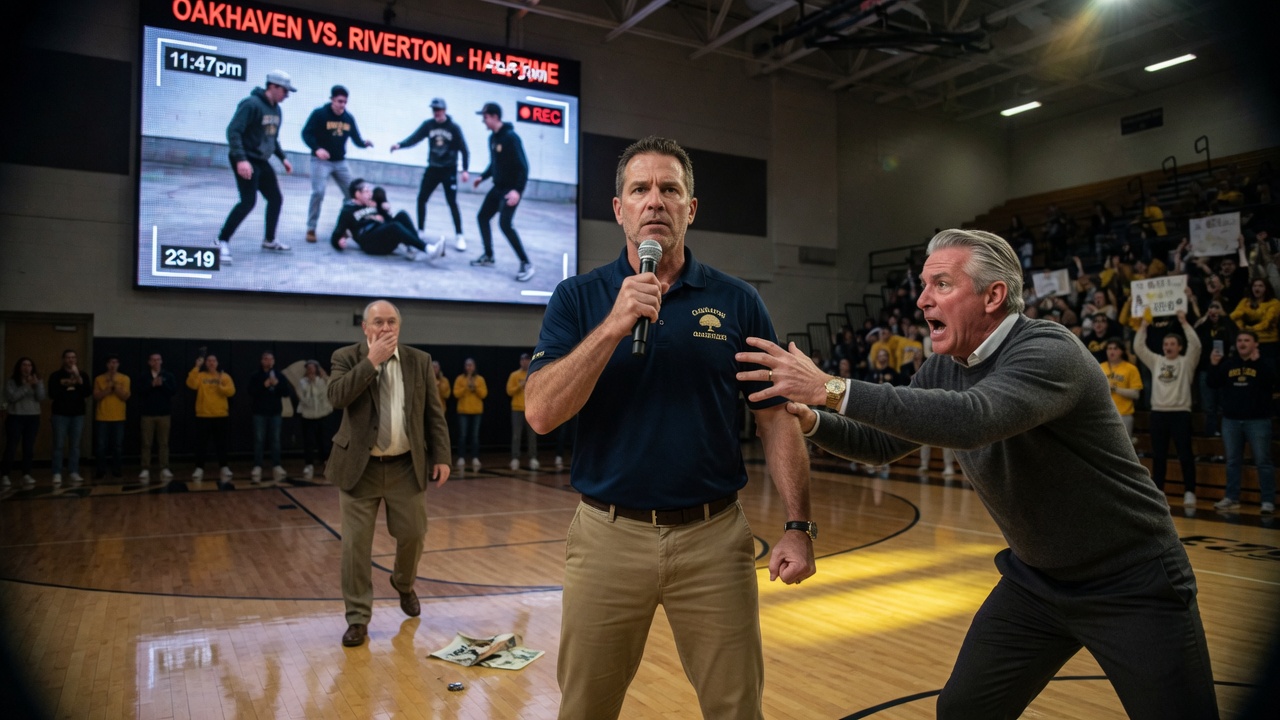
“Look at the screen, Miller. Go on, tell everyone what I’m lying about.”
Ben didn’t raise his voice. He didn’t have to. The giant scoreboard behind him was already doing the screaming.
For three years, the elite families of Oakhaven told Ben that what happened to his son was a tragic accident. They patted his shoulder at the funeral, offered him “memorial funds,” and then went right back to cheering for the five boys who were in that locker room. They thought money and a state championship ring could bury the truth forever.
But one of those boys couldn’t live with the secret. He handed Ben a phone with a cracked screen and a video that never should have existed.
As the grainy footage began to play in front of three thousand people, the wealthiest man in town lunged for the microphone, his face twisted in a panic that looked a lot like guilt.
“Shut it down!” Miller hissed, his silver hair catching the gym lights. “You’re ruining their lives, Ben! Think about the school!”
Ben looked at the man who had spent thirty-six months pretending his son didn’t matter. He looked at the “Golden Boys” frozen on the court, their jerseys suddenly feeling very heavy.
“I am thinking about the school,” Ben said into the mic, his voice echoing off the rafters. “I’m thinking about the truth you buried under this floor.”
The room went so quiet you could hear the hum of the lights. The game was over, but the reckoning had just begun.
Chapter 1: The Fabric of Oakhaven
The smell of floor wax and stale popcorn always felt like a funeral to Ben. It didn’t matter if the Oakhaven Tigers were up by twenty or down by two; the air in the gymnasium carried a weight that made his lungs feel small. Most people in town called it “the atmosphere.” They talked about the “Electric Tiger Pride” like it was a religion, something that could cure a bad harvest or a closing factory. To Ben, it was just the scent of the box they’d put his son in.
It was Tuesday, the night of the regional semi-finals. The town was there in force, a sea of black and gold polyester and expensive leather jackets. Oakhaven was a town of two worlds: the people who worked at the poultry plant and the people who owned the land the plant sat on. But on Tuesday nights, those worlds collided at the mid-court line.
Ben stood on the sidelines, his hands tucked into the pockets of his navy coaching slacks. He was forty-five, but in the gym lights, he looked sixty. His hair was thinning at the crown, and the lines around his eyes weren’t from smiling. They were from three years of squinting through the dark, trying to figure out how a healthy eighteen-year-old boy ends up gone in a locker room that was supposed to be safe.
“Coach? You with us?”
Ben blinked. His assistant, a kid named Robbie who was too young to remember the “incident,” was holding a clipboard out.
“Yeah,” Ben said, his voice like gravel. “I’m with you. Run the high-low post. Miller is leaning too far into the paint.”
Miller. Even the name tasted like copper. Young Jackson Miller was the star of the team, a six-foot-four shooting guard with a haircut that cost more than Ben’s monthly grocery bill. He was fast, arrogant, and possessed the kind of effortless grace that only comes from a life without consequences. He was also the son of David Miller, the man who sat in the front row of the boosters’ section, wearing a charcoal cashmere sweater and a watch that could buy a fleet of school buses.
Ben watched Jackson Miller drive to the hoop, shoulder-checking a defender with a sneer that the refs conveniently ignored. Jackson scored, the crowd erupted, and Ben felt a slow, cold throb behind his eyes.
Every time Jackson Miller scored, the town cheered. And every time the town cheered, they were cheering for the lie.
Three years ago, Ben’s son, Sam, had been the one driving to the hoop. Sam was the heart of the Oakhaven Tigers. He wasn’t as fast as Jackson, but he worked harder. He was the kind of kid who stayed late to help the janitors sweep the floor. Then came the “Senior Retreat” at the Miller ranch. A “tradition,” they called it. Bonding.
Sam didn’t come home from the retreat.
The official report said it was a tragic accident. A fall. A hidden heart defect. A freak occurrence that no one could have predicted. David Miller had been very vocal about how “devastated” the boys were. He’d even donated a new wing to the hospital in Sam’s name. The “Sam Walker Memorial Wellness Center.”
Ben hadn’t attended the ribbon-cutting. He’d been too busy trying to wash the smell of hospital bleach out of his son’s favorite hoodie.
The buzzer sounded for halftime. Oakhaven was up by twelve. The players trotted off toward the locker rooms, high-fiving the fans. Jackson Miller winked at a girl in the front row and then vanished into the tunnel.
Ben didn’t follow them. He stayed on the court, watching the janitors drag the mops across the floor. He felt a presence beside him.
“Big night, Ben,” a voice said.
Ben didn’t have to look. It was Superintendent Higgins. Higgins was a man made of soft edges and political compromises. He smelled like peppermint and desperation.
“It’s a basketball game, Arthur,” Ben said.
“It’s more than that. The state scout is here. Jackson’s got a real shot at D1. It’s good for the school. Good for the town’s morale.” Higgins paused, his voice dropping a semi-tone. “And the tribute is set for the championship game. David Miller wants to make sure we do it right. The big screen, the video montage of Sam… it’s going to be very emotional.”
Ben turned his head slowly. “A tribute.”
“Yes. A celebration of his life. David is even talking about a permanent statue in the lobby. He wants to ‘heal the wound,’ Ben. He’s a good man.”
Ben looked past Higgins to the front row. David Miller was standing up, shaking hands with a local judge. He looked like the king of a very small, very dirty mountain. He caught Ben’s eye and gave a somber, respectful nod—the kind of nod one gives to a wounded animal.
“He wants to bury it,” Ben said.
“Ben, please,” Higgins whispered, looking around nervously. “It’s been three years. We all loved Sam. But the investigation was closed. The boys have moved on. They’re kids. They have futures.”
“Sam doesn’t have a future,” Ben said.
“That’s… that’s not fair. And it’s not what Sam would have wanted. He was a Tiger. He loved this team.”
Ben felt the familiar rage, the one he’d learned to keep in a small, lead-lined box in his chest. It rattled the lid, but he didn’t let it out. Not yet.
“I know exactly what Sam would want,” Ben said.
He turned and walked toward the locker room, his boots echoing in the sudden quiet of the half-empty gym. He didn’t go into the main locker room where the boys were shouting and slapping lockers. He went into his private office, a cramped space filled with old balls, broken clipboards, and a single framed photo on the desk.
It was Sam, sweaty and grinning, holding the MVP trophy from his sophomore year.
Ben sat down and pulled a phone out of his pocket. It wasn’t his phone. It was a cheap burner, protected by a passcode he’d memorized weeks ago. He tapped in the numbers.
He opened the gallery. There was only one video.
He didn’t play it. He didn’t need to. He could see every frame in his mind. The shadows of the Miller ranch barn. The five “Golden Boys” standing in a circle. The way they were laughing. The way Sam was trying to stand up, his face confused and frightened. The way Jackson Miller had stepped forward, holding a heavy wooden paddle, his face twisted into something that wasn’t ” Tiger Pride.”
The video was forty-two seconds long. It ended with the sound of a dull thud and the camera dropping to the dirt.
Ben had spent three years being the “tragic figure” of Oakhaven. He’d taken the pity, the memorial funds, and the fake nods from David Miller. He’d stayed quiet while the town turned his son’s death into a heartwarming story of community resilience.
He looked at the photo of Sam.
“The tribute is going to be perfect, Sam,” Ben whispered. “Everyone is going to see it.”
He tucked the burner phone away. The door to his office creaked open. It was Leo.
Leo was a bench-warmer, a quiet kid with thick glasses and a stutter that got worse when he was nervous. He was the one who had given Ben the phone. Leo had been the sixth boy in the barn that night. The one who stayed in the shadows. The one who hadn’t participated, but hadn’t stopped it either.
Leo’s face was ghostly white. “Coach? They’re… they’re asking for you. The second half is starting.”
Ben stood up. He walked over to Leo and put a hand on the boy’s shoulder. He could feel Leo trembling.
“You okay, Leo?”
“I… I can’t do it, Coach. I can’t stay here. Every time I see Jackson… I feel like I’m going to throw up.”
“You did the right thing, Leo,” Ben said, his voice softer now. “The hardest thing is over.”
“No it’s not,” Leo whispered, his eyes darting to the floor. “They’re going to kill me. If Mr. Miller finds out I had that phone…”
“He won’t,” Ben said. “He’s too busy winning. Go out there. Sit on the bench. Don’t look at them. Just look at me.”
Leo nodded, but he didn’t look comforted. He looked like a condemned man walking to the gallows.
Ben followed him out. The gym was roaring again. The lights were too bright, the music too loud. David Miller was back in his seat, his arm around his wife, looking for all the world like the pillar of the community.
Ben took his place on the sideline. He looked up at the scoreboard. It was showing the time remaining. Twenty minutes.
Twenty minutes of basketball. Then the real game would begin.
He felt the residue of the conversation with Higgins clinging to him like grease. Heal the wound. That was the phrase they used. As if Sam’s life was a papercut that could be fixed with a bandage and a statue.
He watched Jackson Miller take the court. The boy was glowing with sweat and confidence. He looked like he owned the air he breathed.
Ben reached into his pocket and felt the cold plastic of the burner phone.
“Game on, Jackson,” he muttered.
He blew his whistle. The second half began.
Chapter 2: The Ghosts of Oakhaven
The days leading up to the championship game felt like a slow-motion car crash. Oakhaven was vibrating. “Tiger Fever” had reached a pathological level. Storefronts were painted gold and black. The local diner served “Championship Omelets.” Even the Sunday sermon at the Methodist church was about “The Spirit of the Tiger.”
Ben moved through the town like a ghost. He did his job. He ran practices. He watched film. But he felt disconnected from the physical world, as if he were watching a movie with the sound turned off.
On Thursday night, two days before the big game, the “Golden Boys” returned.
Four of the five boys involved in the hazing were now in college. They were the legends of Oakhaven, the ones who had paved the way for Jackson Miller. They had come back to town to lead the “Spirit Walk” through the downtown square.
Ben stood in the shadows of the hardware store, watching the parade. There they were, riding in the back of a vintage Ford Bronco: Cody, Tyler, Blake, and Shane. They looked older, broader, but their smiles hadn’t changed. They were the smiles of boys who had never been told no.
And then there was Jackson, standing in the middle of them, holding the regional trophy aloft.
The crowd was screaming. Women were weeping. Men were clapping each other on the back. It was a victory lap for a crime that had never happened.
“Look at them,” a voice said.
Ben turned. It was Leo. The boy was wearing a hoodie pulled low over his face, his hands shoved deep into his pockets. He looked smaller than he had at the gym.
“They look like gods, don’t they, Coach?” Leo’s voice was bitter. “That’s what Shane told me in the barn. He said we were gods. He said Oakhaven wouldn’t exist without us.”
“They’re just boys, Leo,” Ben said. “Scared boys in expensive clothes.”
“They don’t look scared. They look… untouchable.” Leo looked at Ben, his eyes glassy. “I saw Shane at the diner today. He recognized me. He came over and put his hand on my neck. He didn’t say anything. He just… squeezed. For a second. Then he laughed and bought my coffee.”
Ben felt a surge of protective heat. “Did he hurt you?”
“No. He just reminded me. He reminded me that he can touch me whenever he wants. And nobody would stop him.” Leo looked back at the parade. “Are you really going to do it, Coach? At the game?”
“The tribute is the only time the whole town will be looking at the screen, Leo. The only time David Miller won’t be able to turn it off before it’s too late.”
“They’ll hate you,” Leo whispered. “They’ll say you ruined the town. They’ll say you’re bitter. They’ll say you’re desecrating Sam’s memory.”
“Let them say it,” Ben said. “I’ve been living with their lies for three years. I can live with their hate for the rest of my life.”
Leo stood there for a long moment, the flickering lights of the parade reflecting in his glasses. “I’m leaving, Coach. Tomorrow morning. My aunt lives in El Paso. I told my mom I was going for a spring break trip. I’m not coming back.”
Ben nodded. He didn’t blame the kid. Leo was the only one with a conscience, and in Oakhaven, a conscience was a liability.
“Go,” Ben said. “Don’t look back.”
“I left the charger for the phone in your locker,” Leo said. “Make sure it’s at a hundred percent. The battery is old.”
“I will.”
Leo turned and vanished into the crowd. Ben watched him go, a solitary figure moving against the tide of gold and black.
The parade ended at the town square, where David Miller was waiting on a temporary stage. He was wearing a team jacket over his charcoal sweater, looking every bit the proud patriarch. He took the microphone, and the crowd went silent.
“Oakhaven!” he roared. “This Saturday, we don’t just play for a trophy. We play for our history! We play for the boys who came before! And we play for the one we lost!”
He pointed to a giant banner hanging from the courthouse. It was a photo of Sam.
“Sam Walker is with us!” Miller shouted. “And on Saturday night, we’re going to give him the tribute he deserves!”
The applause was deafening. It was a roar of collective absolution. By cheering for Sam, the town was cheering for their own innocence. They were saying, See? We haven’t forgotten. We’re good people. We’re a family.
Ben felt a hand on his arm. It was Sarah, his ex-wife. She looked tired, her eyes rimmed with red. They hadn’t lived in the same house since six months after the funeral. The grief had been a wedge that eventually split them into two different continents of pain.
“Are you okay, Ben?” she asked.
“I’m fine, Sarah.”
“I saw you standing here. You look… strange.” She looked at the stage, at the banner of their son. “Are you going to the tribute? David invited me to sit in the family box.”
“I’ll be there,” Ben said.
“I don’t know if I can do it,” Sarah whispered. “Seeing him up there… it feels like they’re using him. Like he’s a mascot.”
Ben looked at her, really looked at her, for the first time in months. “He’s not a mascot, Sarah. He’s the truth. And the truth is coming out.”
Sarah frowned. “What does that mean?”
“It means you should watch the screen, Sarah. Don’t look at David Miller. Don’t look at the boys. Just watch the screen.”
Before she could ask anything else, Ben turned and walked away. He needed to get to the gym. He needed to make sure the technician—a man who owed Ben a very old, very large favor—knew exactly which file to load into the halftime sequence.
The gym was dark when he arrived. He used his key and let himself in. The silence here was different than the silence at home. It was expectant.
He went to his locker and found the charger Leo had mentioned. He plugged the burner phone in.
He sat on the bench in the dark, looking at the center court. He could almost see Sam there, practicing his free throws. Thump, thump, swish.
“I’m sorry it took so long, Sam,” Ben whispered.
He thought about the “Golden Boys.” He thought about the parents who had written the checks and the lawyers who had shredded the statements. He thought about the social pressure that had kept Leo quiet for three years.
Oakhaven wasn’t just a town. It was a fortress. And David Miller was the architect.
But every fortress has a flaw. And David Miller’s flaw was his pride. He was so sure of his power that he had forgotten the one thing he couldn’t control: the ghost of the boy he’d tried to buy.
Ben stood up and walked to the scoring table. He looked at the giant LED scoreboard. It was cold and black, a blank slate.
He imagined the video playing there. He imagined the silence that would follow. Not the ” Tiger Pride” silence, but the silence of a room where the air has suddenly been sucked out.
He felt a strange sense of peace. It wasn’t happiness—he didn’t think he’d ever be happy again—but it was a clarity he hadn’t felt since before the “Senior Retreat.”
He left the gym and drove home. He didn’t sleep. He sat in his kitchen, drinking cold coffee and watching the sun come up over the Texas plains.
He was a coach. He knew how to prepare for a game. He knew how to study the opponent, how to find the weakness, how to wait for the right moment to strike.
This was his last play. And he was going to execute it perfectly.
Chapter 3: The Price of Silence
The day before the championship, the air in Oakhaven grew thick with a different kind of pressure. It wasn’t just the game anymore; it was the social weight of the “Memorial Gala.” David Miller had invited the “pillars” of the community to his ranch for a pre-game fundraiser. The goal was to finalize the funding for the “Sam Walker Statue.”
Ben didn’t want to go. He wanted to sit in his dark house and check the burner phone every ten minutes. But Superintendent Higgins had called him four times, his voice rising in pitch with every message.
“Ben, it’s about optics. David is the primary donor for the athletic department. If you’re not there, it looks like a snub. It looks like… well, it looks like there’s a problem. Just show up, shake a few hands, and leave.”
Ben showed up.
The Miller ranch was a sprawling expanse of white fences and manicured grass, a monument to old Texas money. The house was a limestone beast that looked like it had been designed to survive a siege. Valet drivers in black vests were parking luxury SUVs.
Ben walked through the front door in his best blazer—the one he’d bought for the funeral.
The interior was a blur of crystal, heavy oak, and the smell of expensive cigars. David Miller was in the center of the Great Room, surrounded by the town’s elite: the mayor, the sheriff, the school board president, and the “Golden Boys.”
Cody, Tyler, Blake, and Shane were huddled in a corner, holding beer bottles and looking like they’d never left. They were wearing polo shirts with the Oakhaven crest. When Ben walked in, the room didn’t go quiet—David Miller wouldn’t allow that—but the energy shifted.
Miller detached himself from the group and glided toward Ben, his hand outstretched.
“Ben! Glad you could make it.” Miller’s grip was like iron wrapped in velvet. “I know these things aren’t really your scene, but it means a lot to the boys. And to me.”
“I’m here, David,” Ben said.
“Good, good.” Miller leaned in, his voice dropping to a conspiratorial whisper. “Listen, I wanted to talk to you about the halftime tribute tomorrow. We’ve got a professional editor coming in to polish the video. We want it to be… dignified. Triumphant. Not too much focus on the… well, the sadness. We want to celebrate the Tiger Spirit.”
“I’ve already taken care of the video, David,” Ben said, his voice steady. “I spoke with the AV tech at the school. He’s got the final cut.”
Miller’s eyes flickered. It was a brief, sharp flash of the predator behind the philanthropist. “The AV tech? Ben, we discussed this. My team was going to handle the production. We want to make sure the narrative is right.”
“The narrative is already written, David. It’s been written for three years.”
Miller’s smile didn’t reach his eyes. “Ben. Don’t be difficult. We’re doing something good here. We’re honoring your son. We’re building a legacy. Let’s not let… personal feelings get in the way of the big picture.”
“And what is the big picture?”
“The future of this town. These boys,” Miller gestured toward the group in the corner, “are the leaders of tomorrow. Jackson is going to college on a full ride. Shane is in law school. They are the pride of Oakhaven. We need to protect that. We need to focus on the win.”
“The win,” Ben repeated.
“Exactly. Now, come have a drink. The Sheriff was asking about the defensive strategy for Saturday.”
Miller led him toward the bar, but Ben stopped halfway. Shane, the oldest of the “Golden Boys,” was standing in his path. Shane was twenty-one now, with a jawline like a hatchet and eyes that were too old for his face.
“Coach,” Shane said, nodding. “Good to see you.”
“Shane.”
“We’re all really looking forward to the tribute, Coach. It’s been a long time coming. We miss Sam every day.”
It was a perfect line, delivered with perfect sincerity. But as Shane spoke, he leaned in just an inch too far, his shoulder brushing Ben’s. It was a subtle display of dominance, a reminder of the power dynamic in Oakhaven.
“Do you?” Ben asked. “Do you miss him, Shane?”
Shane’s smile faltered for a fraction of a second. “Of course. We were brothers.”
“Brothers don’t do what happened in that barn,” Ben said, his voice a low, dangerous hum.
The air around them suddenly felt cold. The chatter of the party seemed to fade into a dull buzz. Shane’s eyes went dark, the “good boy” mask slipping.
“I don’t know what you’re talking about, Coach,” Shane said, his voice dropping to a hiss. “The investigation was clear. It was an accident. Maybe you should spend less time thinking about barns and more time thinking about the game.”
“I’m thinking about both, Shane. I’m thinking about how the truth is like a foul. You can try to hide it from the ref, but eventually, someone sees it.”
Shane let out a short, sharp laugh. “Nobody sees anything in this town unless Mr. Miller wants them to. You’re a guest here, Coach. Remember that. You’re only in that gym because we let you be.”
He patted Ben on the shoulder—the same squeeze Leo had described—and walked away.
Ben stood there, his heart hammering against his ribs. He felt the humiliation like a physical weight. They weren’t even hiding it anymore. Not here, in the safety of the Miller ranch. They were rubbing his face in their impunity, confident that the wall of money and social status they’d built was impenetrable.
He looked around the room. Every person here was part of it. The Sheriff, who had “lost” the initial witness statements. The Mayor, who had fast-tracked the memorial center. The Superintendent, who had pressured Ben to “move on” for the sake of the school’s reputation.
They weren’t just neighbors. They were co-conspirators in the erasure of his son’s life.
Ben walked out. He didn’t say goodbye to Miller. He didn’t look at the boys. He walked through the limestone foyer and out into the cool Texas night.
He drove back to the gym. He needed to be where the air was honest.
He let himself in and went straight to the AV booth. The technician, a man named Mike who had coached Sam in Little League, was waiting for him.
“You got it?” Ben asked.
Mike held up a thumb drive. “I’ve got it. I’ve layered it into the halftime presentation. It starts with the school logo, then three minutes of the photos Miller provided… then the screen goes black for five seconds. Then your file plays.”
“And the sound?”
“I’ve got it patched into the main PA system. It’ll be loud, Ben. Real loud.” Mike looked at him, his face etched with worry. “You sure about this? Once I press play, there’s no stopping it. Miller will have my job by Monday. He’ll have your head.”
“He already took everything he could take, Mike. The only thing he has left to take is my silence. And I’m done giving it to him.”
Mike nodded slowly. “Sam was a good kid. He didn’t deserve to be a footnote in David Miller’s biography.”
“No, he didn’t.”
Ben left the gym and went to his office. He sat in the dark, the burner phone on the desk in front of him. He thought about Shane’s hand on his shoulder. He thought about David Miller’s “dignified” tribute.
He felt a cold, hard resolve settle over him.
The social shame of Oakhaven was a powerful weapon. It had kept a whole town silent for three years. It had made Ben feel like he was the one who was wrong, the one who was “unstable” or “unable to cope.”
But shame works both ways.
Tomorrow night, the shame wouldn’t belong to Ben anymore. He was going to hand it back to the people who earned it. He was going to do it in front of every witness in the county.
He picked up the MVP trophy from the desk. It was heavy, solid.
“The game is about to change, David,” he whispered.
He closed his eyes and waited for the morning.
Chapter 4: The Tip-Off
Saturday arrived with a sky the color of a bruised plum. The humidity was high, the kind of Texas heat that makes the air feel thick enough to chew. Oakhaven was a pressure cooker. The streets were deserted because everyone was already at the high school, or on their way.
Ben arrived at the gym four hours early. He walked the perimeter of the court, his footsteps echoing in the empty space. He checked the hoops, the nets, the scoring table. He moved with a mechanical precision, his mind focused on the tactical execution of the night.
By 6:00 PM, the gym was a wall of sound. The Oakhaven band was playing the fight song, the drums thudding in Ben’s chest. The bleachers were packed to capacity, a solid mass of gold and black.
The “Golden Boys” were there, sitting in the front row of the boosters’ section, right next to David Miller. They looked like royalty, leaning back, laughing, acknowledging the waves from the crowd. Jackson Miller was on the court, warming up, his jumper as smooth as silk.
Ben stood by the bench, watching his team. They were nervous. They were teenagers, after all, carrying the weight of a town’s expectations. He saw Leo sitting at the end of the bench. The kid looked like he was about to faint. Ben walked over and squeezed his shoulder.
“Focus on the ball, Leo. Nothing else exists.”
“I’m scared, Coach,” Leo whispered.
“Me too,” Ben said. “That’s how you know it matters.”
The game started with an explosion of noise. It was high-intensity, physical basketball. Oakhaven was playing like they were possessed. Jackson Miller was putting on a clinic, scoring twelve points in the first quarter alone.
But Ben wasn’t coaching the way he usually did. He was quiet, his eyes constantly drifting to the scoreboard. He wasn’t watching the points; he was watching the clock.
8:00… 6:45… 4:20…
Every second that ticked away was a second closer to the end of the world as Oakhaven knew it.
The tension in the gym was palpable, but it was the “good” kind of tension—the thrill of the hunt. David Miller was on his feet, cheering every basket, his face flushed with pride. He looked at Ben and gave a thumbs-up. Ben didn’t respond.
At the end of the second quarter, Oakhaven was up by eight. Jackson Miller hit a three-pointer at the buzzer, and the gym erupted. The players began to head for the locker room, but the announcer’s voice boomed over the speakers.
“Ladies and gentlemen, please remain in your seats! Before our Tigers head into the second half, we have a very special presentation. Tonight, we honor one of our own. A hero who left us too soon, but whose spirit still leads this team. Please join us for a tribute to Sam Walker.”
The lights in the gym dimmed. A hush fell over the crowd.
Ben walked out to center court. He felt three thousand pairs of eyes on him. He saw Sarah in the family box, her hands clutched to her chest. He saw David Miller standing up, his expression one of somber, practiced grief.
A spotlight hit Ben. He was holding the microphone.
“Thank you,” Ben said, his voice amplified and echoing. “The town of Oakhaven has spent three years telling me how to remember my son. They’ve given me memorial centers. They’ve given me statues. They’ve given me ‘Tiger Pride.'”
He paused. He could feel the confusion starting to ripple through the front row. David Miller’s brow furrowed.
“But I don’t want a statue,” Ben continued. “And I don’t want a wellness center. I want the truth. I want the truth about what happened at the Miller ranch three years ago. I want the truth about the ‘Senior Retreat.'”
A murmur started in the bleachers. Superintendent Higgins stood up from the scoring table, his face pale. “Ben? What are you doing? Play the video.”
“I am playing the video, Arthur,” Ben said.
He looked directly at David Miller.
“Look at the screen, David.”
Ben signaled to the AV booth.
The giant LED scoreboard flickered to life. At first, it was what everyone expected. Photos of Sam. Sam as a toddler. Sam at the state finals. Sam laughing with his teammates. The music was a soft, swelling piano piece. The crowd was silent, many people wiping tears from their eyes.
David Miller nodded slowly, his hand over his heart. He thought he had won. He thought he had successfully packaged the tragedy into a brand-safe memorial.
Then, the screen went black.
The piano music cut out, replaced by a low, rhythmic hum.
Five seconds passed. Six. Seven.
The crowd began to rustle. “Technical difficulties?” someone yelled.
Then, the grainy footage appeared.
It wasn’t professional. It was shaky, vertical phone video. The sound was distorted, but the voices were unmistakable.
The image showed the interior of a barn. It showed Sam on the floor. It showed five boys surrounding him.
The gym went cold. The silence wasn’t respectful anymore; it was the silence of a heart stopping.
On the screen, Jackson Miller stepped forward. He was younger, but his face was clear. He was holding a heavy wooden paddle. He said something—the audio was muffled—and the other boys laughed. Then he swung.
Sam’s cry of pain echoed through the gym’s high-end PA system, raw and terrifying.
David Miller was on his feet in a second. He wasn’t the philanthropist anymore. He was a man watching his empire crumble in real-time. He lunged toward the center court, his face a mask of panicked rage.
“Shut it down!” Miller screamed, his voice cracking. “Ben! Shut it down right now! This is a lie! It’s a fabrication!”
He reached Ben and slammed a hand onto his shoulder, trying to yank the microphone away.
Ben didn’t move. He stood like a mountain. He violently shrugged Miller’s hand off and pointed a finger at the scoreboard, where the video was still playing—showing the boys laughing as Sam collapsed.
“Look at the screen, Miller!” Ben roared into the mic.
The “Golden Boys” in the front row were frozen. Shane was white as a sheet. Jackson was standing on the court, his mouth hanging open, staring at his own fifteen-year-old self committing a crime in front of his entire town.
Superintendent Higgins was frantically waving at the AV booth, but Mike had locked the door.
The video reached its climax—the moment the camera dropped and the screen went dark.
Ben looked at the three thousand people in the bleachers. He looked at the parents who had ignored the rumors. He looked at the Sheriff who had closed the case.
“Game over,” Ben said.
He dropped the microphone. It hit the maple floor with a loud, final thud.
Ben turned his back on David Miller and walked toward the locker room. He didn’t look back at the chaos, the screaming, or the “Golden Boys” who were finally, truly, seen.
He had twenty minutes of the game left, but the score had already been settled.
Chapter 5: The Shards of Oakhaven
The sound of a microphone hitting a gymnasium floor is usually a hollow, clumsy noise, but in that moment, it sounded like a gavel. It was the finality of it that stopped the air in the room. Ben didn’t look back as he walked toward the tunnel, but he felt the heat of three thousand stares burning into the nape of his neck. The silence held for three seconds—a long, agonizing stretch where the reality of what had been on the screen fought with the town’s collective desire to remain blind.
Then, the world broke.
It started with a scream from the bleachers—Sarah, Ben’s ex-wife, her voice a jagged blade of pure grief that sliced through the shock. Then came the roar. It wasn’t a cheer, and it wasn’t a boo; it was the sound of a community’s foundation cracking. People were on their feet, some lunging toward the court, others shrinking back in horror.
Ben reached the mouth of the tunnel and finally turned.
The scene was a Bosch painting rendered in gold and black. David Miller was being restrained by two assistant coaches, his face a purple mask of vein-popping fury. He was still reaching for the air where Ben had stood, his mouth moving in a silent, desperate tirade. On the court, the “Golden Boys” looked like statues in a park after a riot. Jackson Miller was on his knees at the three-point line, his head in his hands. He wasn’t crying; he looked like he was trying to fold himself into a space small enough to disappear.
Sheriff Miller—no relation to David, though he’d been on the payroll in every way that mattered—was vaulting over the scoring table, his hand on his holster, his eyes darting between the scoreboard and the man who had just destroyed the status quo.
“Ben! Stop right there!” the Sheriff barked.
Ben didn’t stop. He stepped into the dim, concrete throat of the tunnel. The air here was cooler, smelling of damp towels and the deep, industrial scent of the building’s guts. He kept walking until he reached the heavy steel doors of the locker room. He didn’t go inside. He leaned his back against the wall and waited.
He didn’t have to wait long.
The footsteps came fast, a frantic staccato on the concrete. It was Superintendent Higgins, his tie undone, his balding head glistening with sweat. He looked like a man who had just watched his house burn down and realized he’d forgotten to buy insurance.
“What have you done?” Higgins hissed, his voice trembling so hard it was barely audible over the muffled chaos from the gym. “Ben, do you have any idea… the legal ramifications? The lawsuits? The school… the school is over. Oakhaven is over.”
“The school was over three years ago, Arthur,” Ben said. He felt strangely heavy, as if his bones had been replaced with lead. The adrenaline was gone, leaving only a vast, cold clarity. “You just didn’t notice the smell of the rot until I opened the door.”
“You used a school event! A memorial!” Higgins was pacing now, his hands fluttering like trapped birds. “We had a contract. We had a plan for the statue. David was going to fund the new science wing. Now? He’ll sue us into the stone age. He’ll say the video was AI. He’ll say it was a deepfake.”
“Let him,” Ben said. “Let him stand in front of a jury and explain why his son’s voice is on that ‘deepfake’ laughing while mine is dying. Let him explain why he paid for the silence of five other families.”
Higgins stopped. He looked at Ben with a mixture of pity and genuine, deep-seated fear. “You think this makes you a hero, Ben? Tomorrow, half this town is going to want to lynch you. You didn’t just expose a crime. You exposed them. You made them look at what they cheered for. People don’t forgive you for that.”
“I don’t want their forgiveness,” Ben said.
The locker room door swung open. The players were filing in, but the usual noise—the shouting, the slapping of lockers, the bravado—was absent. They moved like ghosts. Some of them looked at Ben with wide, terrified eyes; others looked at the floor. Jackson Miller was the last one in. He walked past Ben without looking up, his shoulders hunched as if he were expecting a blow.
Ben followed them in. The room felt smaller than usual. The fluorescent lights flickered, casting a sickly greenish hue over the rows of metal lockers.
“Everyone sit down,” Ben said.
They sat. Some on the benches, some on the floor. Jackson sat in the far corner, his back to everyone, staring at a smudge on the concrete.
“I’m not going to give you a speech about basketball,” Ben said. He stood in the center of the room, his shadow long and sharp. “The game is over. Not just this one. The game you’ve been playing for three years. The one where you pretend you didn’t see what you saw. The one where you pretend Sam was just a tragic accident.”
He looked at the four other boys who had been in that barn—the ones still on the team. They were sophomores then, seniors now. They had carried this secret like a parasitic twin, letting it grow inside them while they won games and took photos for the local paper.
“Cody. Tyler. Look at me.”
They looked up, their faces pale and slick with sweat.
“Was it an accident?” Ben asked.
The room was so quiet he could hear the hum of the vending machine in the hallway.
“No,” Cody whispered. His voice broke, and he started to sob—a messy, ugly sound that had been three years in the making. “He wouldn’t… he wouldn’t do what they said. He told Jackson to stop. He said it wasn’t funny. And Jackson… he just got so mad.”
“Shut up, Cody!” Jackson yelled from the corner, but there was no power in it. It was a dying spark.
“No,” Ben said, stepping toward Jackson. “He’s not going to shut up. Not anymore. None of you are. The Sheriff is outside. The State Police are on their way. You’re going to tell them exactly what happened. Not the version David Miller wrote for you. The real version.”
Jackson finally looked up. His eyes were bloodshot, his face twisted in a look of pure, unadulterated hatred. “You think you won? My dad will have you in jail by morning. He owns this town. He owns the cops. He owns everything.”
“He doesn’t own that video, Jackson,” Ben said. “And he doesn’t own the fact that three thousand people just saw what you really are. You can buy a lawyer, but you can’t buy back the way people are going to look at you for the rest of your life. You’re not the star anymore. You’re the boy in the barn.”
The door burst open. Sheriff Miller marched in, followed by two deputies. His face was unreadable, his professional mask back in place, but his hands were shaking as he reached for his handcuffs.
“Ben Walker,” the Sheriff said. “I need you to come with me.”
“Am I under arrest, Bill?” Ben asked.
“For what? Telling the truth?” a voice said from the doorway.
It was Sarah. She was standing there, her coat disheveled, her eyes red-rimmed but fiercely clear. She walked past the deputies and stood beside Ben. She didn’t touch him, but her presence was a wall.
“If you take him, Bill, you take me,” Sarah said. “And you better be ready to explain to the state investigators why you sat on those witness statements for thirty-six months.”
The Sheriff hesitated. He looked at the boys, then at David Miller’s son, then back at Ben. The power structure of Oakhaven was a delicate thing, built on a thousand small favors and a mountain of shared secrets. Ben had just pulled the bottom brick out. The whole thing was leaning, and Bill Miller had to decide which way he wanted to fall.
“I’m taking the boys down to the station for questioning,” the Sheriff said, his voice tight. “Ben, you stay put. Don’t leave town.”
“I’m not going anywhere,” Ben said.
As the deputies began to lead the boys out, Jackson Miller stopped in front of Ben. He looked like he wanted to spit, but instead, he just looked tired. The weight of being a “god” had clearly become unbearable.
“He’s going to kill you, Coach,” Jackson whispered.
“He already did,” Ben said. “Three years ago.”
The locker room emptied. The silence that followed was heavy, filled with the residue of the explosion. Sarah stood there for a long time, looking at the MVP trophy sitting on the bench.
“You had it the whole time?” she asked.
“No,” Ben said. “Leo gave it to me. He was there. He recorded it.”
Sarah closed her eyes, a single tear tracking through the dust on her cheek. “I thought I was going crazy, Ben. I thought… I thought I was just a bitter mother who couldn’t accept a tragedy. They made me feel like my grief was a sickness.”
“It wasn’t a sickness, Sarah. It was a compass.”
Ben walked over to his locker and pulled out his keys. He felt a strange, hollowed-out sensation in his chest. He had done the thing. The secret was out. The dragon was wounded. But he realized, with a sharp pang of reality, that this didn’t bring Sam back. It didn’t change the fact that the house was still empty.
“What happens now?” Sarah asked.
“Now we wait for the lawyers,” Ben said. “And the reporters. And the neighbors who are going to blame us for ruining the championship season.”
“Let them,” Sarah said. “I’d rather be ruined by the truth than saved by a lie.”
They walked out of the gym together. The parking lot was a sea of flashing lights and shouting voices. The game had been cancelled, but the crowd wasn’t leaving. They were huddled in groups, their faces illuminated by the blue and red strobes.
As Ben walked toward his truck, he saw David Miller standing by his black Mercedes. Miller was surrounded by men in suits, but he looked small. He looked like a man who had spent his whole life building a fortress only to realize he’d built it on sand.
Miller saw Ben. He didn’t shout this time. He just stared. It was a look of pure, cold promise.
Ben didn’t look away. He got into his truck, started the engine, and drove out of the lot. He didn’t look at the gym, and he didn’t look at the scoreboard. He just drove toward the cemetery.
He needed to tell his son that the game was finally over.
Chapter 6: The Residue of Truth
The weeks that followed the “halftime reckoning” were a blur of depositions, legal threats, and a silence that was far more aggressive than the noise had ever been. Oakhaven didn’t just change; it inverted.
The “Golden Boys” were no longer the face of the town. Jackson Miller was quietly withdrawn from school, and David Miller’s Mercedes was rarely seen on the main drag. The “Sam Walker Memorial Wellness Center” stood empty, its windows boarded up after a group of kids from the poultry plant side of town—boys who had never been part of the “Tiger Pride” elite—had smashed the glass doors.
Ben sat in his kitchen, a stack of legal documents on the table. He’d been fired, of course. “Conduct unbecoming of a faculty member,” the letter had said. Higgins had signed it with a hand that must have been shaking. Ben didn’t care. He’d spent twenty years in that gym, and he didn’t think he could ever step foot on a basketball court again without smelling the floor wax of the night the world ended.
There was a knock on the door. It was Mike, the AV tech.
Mike looked like he hadn’t slept in a month. He’d lost his job too, but he was wearing a t-shirt that said Oakhaven Truth—a small, grassroots movement that had started among the families who had been pushed aside for years.
“How you holding up, Ben?” Mike asked, taking a seat at the table.
“I’m fine, Mike. Just waiting for the grand jury to finish their breakfast.”
“They’re moving,” Mike said. “David Miller tried to claim the video was a fabrication, but Leo’s testimony is a hammer. And the other boys… they’re starting to flip. Cody’s dad is a drunk, but he’s a drunk who loves his kid, and he’s not letting Cody take the fall for Jackson.”
Ben nodded. It was the messy, slow-motion collapse of a dynasty. It wasn’t like the movies; there were no grand speeches in a courtroom. It was just a series of small, painful admissions in windowless rooms.
“The town is split, Ben,” Mike said softly. “Half of them think you’re a saint. The other half… they think you’re the man who killed Oakhaven. They lost the championship, the boosters pulled the funding for the new stadium, and the property values are dropping. They’re blaming you for the smell of the rot.”
“People always blame the person who points at the fire,” Ben said. “It’s easier than admitting they were the ones who left the stove on.”
“Sarah’s been looking for you,” Mike added. “She’s at the old park. She said to tell you the ‘residue’ is starting to clear.”
Ben thanked him and grabbed his jacket. He drove through the town, noticing the subtle shifts. The “Tiger” banners were gone. The gold and black paint was peeling on the storefronts. It looked like an ordinary, struggling Texas town now, stripped of its mythic status. It looked more honest.
He found Sarah sitting on a bench near the playground where Sam used to play. She was wearing a sweater Sam had given her for Christmas four years ago. She looked lighter, the shadows under her eyes finally beginning to fade.
“I went to the school board meeting today,” Sarah said as Ben sat down beside her.
“And?”
“They’re taking the name off the wellness center. They’re going to turn it into a community hub for the whole county. No more statues. Just… a place for kids to go.” She looked at him, her expression soft. “David Miller is selling the ranch, Ben. The lawyers say he’s moving to Florida. The lawsuits are going to eat most of what he has left.”
“It’s not enough,” Ben said.
“No. It’s never enough. But it’s something. It’s the truth.” She reached out and took his hand. Her palm was warm, grounded. “I’m leaving, Ben. I took a job in Austin. I need a place where the air doesn’t taste like popcorn and memories.”
Ben felt a pang of loneliness, but he nodded. He understood. “I think I’m staying. For a while, anyway. Someone has to make sure they don’t try to build a new lie on top of the old one.”
“You’re going to be a lonely man in this town, Ben.”
“I’ve been a lonely man for three years, Sarah. At least now, I’m a man who knows why he’s alone.”
They sat in silence for a long time, watching the sun dip below the horizon. The Texas sky was a deep, bruised purple, the same color it had been on the night of the game. But the pressure was gone. The air felt thin and clear.
That night, Ben walked to the high school. He didn’t use his key; he just walked the perimeter of the building. He could hear the hum of the transformer, the rustle of the wind in the dry grass. He stopped by the gym doors and looked through the glass.
The scoreboard was dark. The court was empty. The “Sam Walker” banner had been taken down.
He thought about the “Golden Boys.” He thought about Jackson Miller, who was probably sitting in some expensive lawyer’s office right now, realizing that his life was no longer a highlight reel. He thought about the shame that had been shifted from Ben’s shoulders to theirs.
He felt a strange, quiet sense of completion. He hadn’t “won” a game, but he had finished one.
He walked back to his truck and drove to the cemetery. It was late, the gates were locked, but he knew the fence line well enough. He walked to the small, grey headstone.
There were no flowers today. No “Tiger Pride” ribbons. Just the stone.
Sam Walker. Son. Teammate. Truth-teller.
Ben sat on the grass. He didn’t cry. He just felt the cold, hard reality of the earth beneath him.
“The statue isn’t coming, Sam,” Ben whispered. “And the wellness center is just a building now. But everyone knows. Every single person in that gym saw what you were. And they saw what they were.”
He stayed there until the moon was high in the sky. He thought about the residue of the truth—the way it burns and then cools, leaving something harder and more durable behind.
Oakhaven would never be the same. It would be poorer, quieter, and less famous. It would be a town that had to look itself in the mirror every morning and remember the night the lights stayed on long after the game was over.
Ben stood up and brushed the grass from his chinos. He felt a light breeze on his face, a clean, sharp wind coming off the plains.
He walked back to his truck, his footsteps steady on the gravel. He didn’t look back at the grave, and he didn’t look back at the town. He just drove home, through the quiet streets of a place that was finally, painfully, awake.
The last thing he did before he went to bed was take the MVP trophy from the kitchen table and put it in a box in the garage. He didn’t need to look at it anymore. He didn’t need the silver or the wood to tell him who his son was.
He turned off the lights and lay in the dark. For the first time in three years, the silence didn’t feel like a funeral. It just felt like the end of the day.
And for Ben, that was enough.