“You really think you’re different from the rest of the trash I throw in these cages, Frank?”
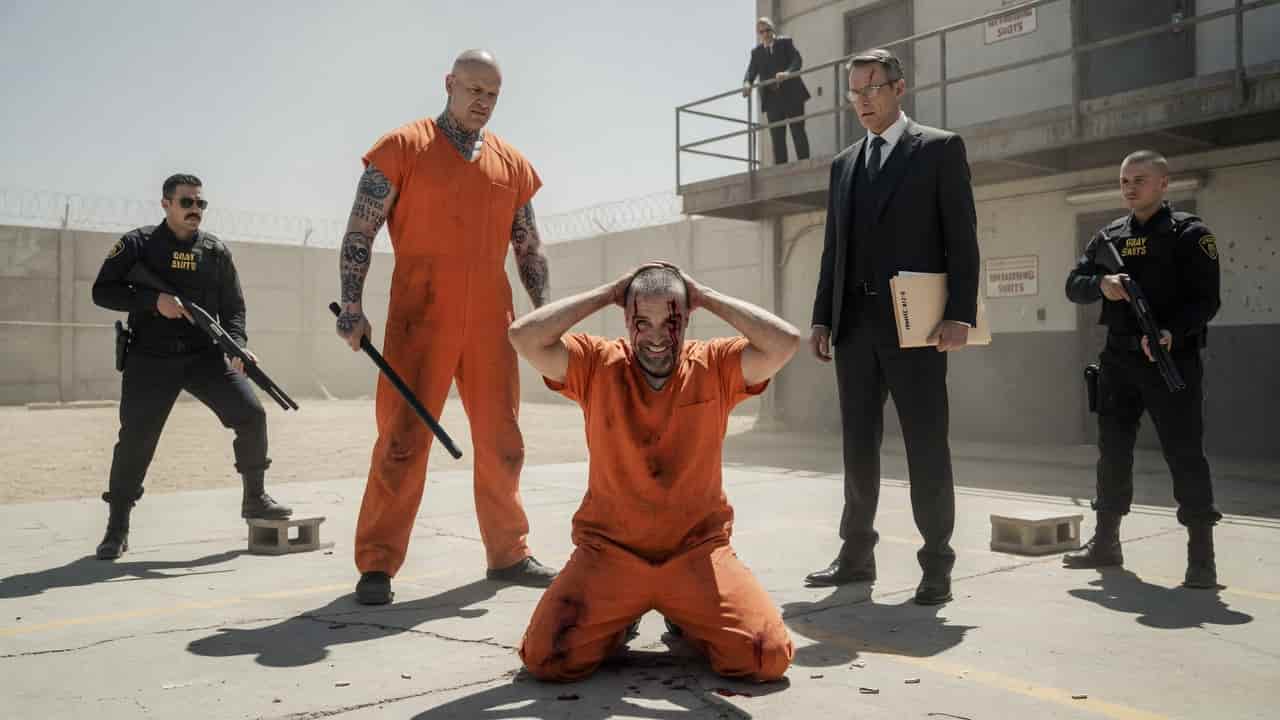
Warden Black stood on the balcony, his charcoal suit looking wildly out of place against the rusted steel and the heat of the prison yard. He looked down at Frank—a man who had spent forty years behind a butcher’s counter, a man whose hands were scarred from work and age—and he saw an easy target. He saw an old man who had come here to disappear.
The guards stood in a circle, their faces hidden behind mirrored visors, and the rest of the yard went quiet. They had seen men broken before. They had seen what happens to those who ask too many questions about the inmates who vanished during the “unrest” last summer.
Frank knelt on the hot concrete, the blood from the guard’s baton stinging his eyes, but he didn’t look away. He didn’t beg. He just looked up at the man who had signed the papers that ensured his son never came home.
The Warden gestured to the massive inmate standing behind Frank, a man they called Voss. “Give him another reason to keep his mouth shut,” Black commanded, his voice echoing off the concrete walls.
But as Voss stepped forward, Frank didn’t flinch. He just smiled—a slow, terrifying smile that stopped the room’s heartbeat.
“I’m not the one who’s trapped, Warden,” Frank said, his voice low and steady. “I’m exactly where I wanted to be. And now, the whole yard is going to find out why you’re so afraid of a man who knows how to use a blade.”
The Warden’s hand tightened on the railing. He saw it then—the look in the old man’s eyes that wasn’t about survival. It was about an ending that had been decades in the making.
Chapter 1: The Butcher’s Weigh-In
The steel doors of the processing center didn’t just close; they inhaled. It was a heavy, pneumatic sound that sucked the remaining oxygen out of the hallway, replacing it with the smell of floor wax, old sweat, and the sharp, metallic tang of industrial-grade disinfectant. Frank stood on the yellow line, his feet shoulder-width apart, exactly as the guard with the clipboard had told him three minutes ago. His boots were gone, replaced by thin, soul-crushing orange rubber slippers that made him feel like a patient in a terminal ward.
“Name and number,” the guard said. He didn’t look up. He was young, maybe twenty-four, with a neck that looked too thin for his stiff, grey tactical collar. He had a patch on his shoulder that read Gray Suits – Security Detail.
“Frank Russo. Eight-nine-four-two-seven,” Frank said. His voice was a low rumble, the sound of gravel shifting in a drum. It was the voice he’d used for forty years at the butcher shop when a customer tried to complain about the price of brisket. It was a voice that didn’t ask for permission.
The guard finally looked up, eyes narrowing. He flicked a gaze over Frank’s frame. Frank was fifty-eight, and the years had been a series of heavy lifts. His shoulders were broad, his chest thick like an old oak stump, and his knuckles were permanently swollen, the skin there thick and calloused from decades of boxing and breaking down carcasses. To the guard, he probably looked like a tired old man. Frank hoped so. Being underestimated was the only currency he had left.
“Russo, huh? The butcher from the city,” the guard sneered, checking a box on his digital tablet. “Warden’s been expecting you. He likes it when the trash takes itself out. Why’d you do it, Frank? A guy like you, no priors, suddenly decides to hold up a liquor store with a meat cleaver? You looking for a pension or just a place to die?”
Frank didn’t blink. He stared at a small rust stain on the wall behind the guard’s head. He thought about the liquor store, the plastic mask he’d worn, the way he’d stood in front of the security camera for three full seconds before running. He thought about the legal fees he’d refused to pay, the way he’d practically begged the judge for a maximum-security placement. It had been a performance, a clumsy, desperate play, and it had worked.
“I was hungry,” Frank said simply.
The guard laughed, a dry, jagged sound. “You’re gonna be starving in here, old man. Get in the cage.”
They led him through a series of checkpoints, the air growing hotter and heavier with every gate. This was the Desert Reach Correctional Facility, a place the locals called the Sinkhole. It was a sprawling complex of concrete and corrugated metal sitting in the middle of a wasteland where the sun felt like a physical weight on your head. Frank felt the heat radiating off the walls even inside.
In his mind, he wasn’t in the hallway. He was in his shop back in Philly. He could smell the sawdust on the floor and the cold, iron scent of the walk-in freezer. He could see his son, David, standing at the back table, laughing as he struggled to tie a butcher’s knot on a crown roast. David had been twenty-two, with a smile that could light up a basement and a heart that was too soft for the world he lived in.
“Don’t worry about it, Pop,” David had said the last time Frank saw him. “I’ll be out in six months. It was just a stupid mistake. I’ll come back, and we’ll get the shop back on its feet.”
David hadn’t come back. David had been “gone” after three months. The official report said it was a riot. They said David had been in the wrong place at the wrong time, caught in the crossfire of an inmate dispute. But Frank had seen the body. He’d seen the marks on David’s wrists, the ones that didn’t come from a fight between prisoners. They came from handcuffs.
They reached a set of bars that hummed with a low electric current. Behind them sat the intake sergeant, a man with a face like a crumpled paper bag.
“Russo,” the sergeant said, not bothering with the number. “You’re in Block C. High-risk. You’re gonna be cellmates with a guy named Eli. He’s a talker. Try not to kill him before morning.”
Frank felt a small, sharp spark of interest. Eli. The name on the letters David had managed to smuggle out. The only man who had been in the cell next to David when the “riot” started.
The guards led him down a long, echoing corridor where the screams of other inmates felt like white noise. It was a sensory assault—the clanging of metal, the smell of burnt food, the constant, low-frequency vibration of five thousand men trapped in a box. Frank kept his eyes down, counting his steps. He was a butcher; he knew how to wait. He knew that the most important part of the job wasn’t the cut; it was the prep.
They stopped at Cell 114. The door slid open with a mechanical groan.
The cell was a six-by-nine-foot concrete box. It smelled of old cigarettes and unwashed bedding. A man was sitting on the bottom bunk, his knees pulled up to his chest. He looked like he was made of pipe cleaners and anxiety. He was young, maybe twenty-five, with wild, greasy hair and eyes that darted around the room like trapped flies.
“You’re not the guy,” the young man said, his voice cracking. “They said I was getting a transfer. They said I was going to the farm.”
“I’m Frank,” Frank said. He stepped inside, and the door slammed shut behind him. The sound echoed in his teeth.
The young man scrambled to the corner of the bunk. “I didn’t see nothing, man. I told them. I told the Gray Suits. I was asleep. I didn’t hear the screaming. I didn’t see the Warden’s men.”
Frank stood in the center of the small space. He felt the weight of the room, the way the walls seemed to lean in. He looked at the young man, really looked at him. He saw the terror, the way the boy’s hands were shaking so hard he had to tuck them under his armpits.
“Your name Eli?” Frank asked.
The boy froze. He looked at Frank with a mixture of hope and pure, unadulterated horror. “How do you know that? Who sent you? Was it Black? Did he send you to finish it?”
Frank sat down on the edge of the opposite bunk. It creaked under his weight. He leaned forward, his large, scarred hands resting on his knees. He looked into Eli’s eyes, and for a second, the butcher was gone. In his place was the man who had spent three tours in a room with no windows, asking questions that people didn’t want to answer.
“My name is Frank Russo,” he said, his voice a low, dangerous whisper. “My son was David Russo. He lived in the cell next to yours. And I think you have something to tell me about why he never walked out of here.”
Eli’s breath hitched. He stared at Frank, his mouth hanging open. The silence in the cell became heavy, a physical presence that pushed against them. Outside, a guard shouted something, and a tray clattered against the bars, but inside 114, time had stopped.
“David,” Eli whispered. “He told me about you. The butcher. He said you were the strongest man he knew.”
“I am,” Frank said. “Now tell me what happened in the yard.”
Chapter 2: The Gray Suits and the Glass House
The first three days were a masterclass in controlled hostility. Frank didn’t eat much; the prison food was a slurry of grey starch and mystery meat that made his butcher’s soul ache. He spent most of his time watching. He watched the way the guards—the “Gray Suits”—moved in pairs, their hands always near their belts. He watched the way the inmates sorted themselves into tribes based on fear or geography. And he watched Warden Black.
Black didn’t come into the blocks often. He preferred the “Glass House,” an observation deck that sat three stories above the central yard. From there, he could look down on his kingdom like a bored god. Frank saw him up there every morning during exercise hour, a silhouette in a dark suit, his silver-rimmed glasses catching the desert sun.
Eli was a wreck. He barely slept, jumping at every mechanical click of the cell door. But slowly, in the dark hours when the prison fell into a fitful, snoring hush, he began to talk.
“It wasn’t a riot, Frank,” Eli whispered on the fourth night. He was huddled on his bunk, his voice barely audible over the hum of the ventilation system. “There were no gangs involved. It was the Gray Suits. They were moving a shipment—pills, phones, things from the outside. David saw it. He was working the late shift in the laundry, and he saw them loading the crates into the Warden’s personal transport.”
Frank felt a cold, familiar stone settle in his stomach. “And David didn’t keep his head down.”
“He couldn’t,” Eli said, his voice trembling. “He tried to tell the chaplain. He thought the chaplain was a good man. But everybody in here belongs to Black. The next day, they called a ‘security drill.’ They cleared the yard, but they left David out there. I was in the infirmary, looking through the window. I saw them, Frank. I saw Voss and three guards. They didn’t even use their hands. They used the batons.”
Frank’s knuckles turned white as he gripped the edge of his mattress. He pictured his son, alone in that vast, empty concrete space, surrounded by men who were paid to protect him. He pictured the way David would have tried to talk his way out of it, thinking there was some mistake.
“They made it look like a fight,” Eli continued, a tear tracing a path through the grime on his cheek. “They threw a shank down next to him. A blood-stained piece of scrap metal with David’s own initials carved into the handle. They said he’d tried to kill a guard. They said they had to use force.”
“Where is it?” Frank asked.
“The shank? Voss kept it,” Eli said. “It’s his trophy. He carries it in his boot during the yard rotations. He likes to show it to the new kids to remind them what happens when you talk.”
The next morning, Frank stood in the yard. The heat was already a shimmering curtain, making the distant desert mountains look like they were melting. He stood near the fence, his arms crossed over his chest, feeling the eyes of the other inmates on him. He was the “old man,” the “butcher.” He was supposed to be irrelevant.
Voss was easy to spot. He was a mountain of a man, his neck thick with tattoos of coiled serpents. He was holding court near the weight piles, surrounded by a group of younger, leaner inmates who moved like hungry dogs. Voss looked over and saw Frank. He let out a low whistle and started walking over, his gait heavy and arrogant.
The “Gray Suits” on the perimeter didn’t move. They watched with a bored, professional interest.
“You’re the one,” Voss said, stopping three feet from Frank. He smelled of cheap tobacco and unwashed skin. “The butcher. Eli’s new girlfriend.”
Frank didn’t move. He looked at Voss’s neck, identifying the carotid artery, the way he would identify a prime cut of ribeye. He looked at the man’s eyes—shallow, cruel, and profoundly stupid.
“I heard you like to collect things,” Frank said.
The circle around them tightened. Inmates drifted closer, sensing a collision. The air in the yard felt like it was charged with static.
Voss laughed, reaching down to pat his right boot. “I collect lots of things, old man. Most of them are teeth. You want to contribute?”
“I want to see the blade,” Frank said.
Voss’s smile vanished. His eyes went dark, and he stepped into Frank’s personal space, his chest bumping against Frank’s shoulder. “You’re talking about things that can get you buried, Russo. You think because you’re old, I won’t break your ribs? You think the Warden’s gonna protect you?”
High above, Frank saw the glint of sunlight on the Warden’s glasses. Black was watching. This was the test. They wanted to see if Frank was a threat or just another piece of meat.
“I’m not looking for protection,” Frank said. He leaned in, his voice so quiet only Voss could hear it. “I’m looking for the man who murdered my son. And I think I’m looking at his dog.”
Voss roared, a sound of pure, mindless rage. He swung a massive fist, a haymaker that would have shattered a normal man’s jaw. But Frank wasn’t a normal man. He was a man who had spent three decades in the ring, a man who had learned that the most dangerous weapon in a fight isn’t strength; it’s timing.
Frank slipped the punch, the air of the fist whistling past his ear. He didn’t strike back. He just stepped to the side, letting Voss’s momentum carry him forward. Voss stumbled, his boots scraping on the concrete.
“That’s one,” Frank said.
Voss turned, his face purple with embarrassment. He looked at the guards, then back at the circle of inmates who were now whispering. He reached for his boot, his hand diving toward the hidden shank.
“Voss! Stand down!”
The voice came from the loudspeaker, booming across the yard. It was Warden Black’s voice—cold, precise, and utterly in control.
Voss froze, his hand still on his boot. He looked up at the Glass House, his jaw working in frustration.
“Russo,” the Warden’s voice continued. “My office. Now.”
The guards moved in, their batons drawn. They grabbed Frank’s arms, not roughly, but with a firm, professional grip. As they led him away, Frank looked back at Voss. He didn’t look at the man’s face; he looked at his right boot.
The prep was over. The first cut was about to be made.
Chapter 3: The Cold Room
Warden Black’s office was a sanctuary of high-end wood and filtered air. It sat at the very top of the facility, accessible only by a private elevator. The walls were lined with books that looked like they’d never been opened, and a large mahogany desk sat in front of a floor-to-ceiling window that looked out over the endless, barren desert.
Frank stood in front of the desk, his hands cuffed behind his back. He felt the sweat drying on his neck, the transition from the hundred-degree yard to the sixty-degree office making his muscles ache.
Black was sitting in a high-backed leather chair, a glass of amber liquid in his hand. He looked at Frank for a long time without speaking. He was a man who understood the power of silence, the way it could make a person start talking just to fill the void. Frank let the silence sit. He was a butcher; he’d spent half his life in cold rooms.
“You’re an interesting man, Frank,” Black finally said. He set the glass down on a coaster. “Military intelligence. Three tours in the Middle East. Specialized in ‘advanced interrogation techniques.’ Then you come home, buy a butcher shop, and spend twenty years cutting pork chops.”
Frank didn’t say anything.
“And then,” Black continued, leaning forward, “you commit a clumsy armed robbery. You don’t take the money. You don’t try to hide. You basically hand the police the evidence on a silver platter. And you specifically requested this facility.”
Black stood up and walked to the window, his back to Frank. “I know why you’re here, Frank. You think there’s some grand conspiracy. You think your son was a martyr for the truth. You want revenge.”
“I want the logbook,” Frank said.
Black turned around, a genuine look of amusement on his face. “The logbook? You’ve been listening to Eli. That boy has a vivid imagination. There is no logbook, Frank. There is only the reality of running a city of five thousand violent men. Sometimes, things get messy. Sometimes, people get hurt. Your son was weak. He didn’t understand the rules of the house.”
“He understood that you were stealing from the state,” Frank said. “He understood that you were using the Gray Suits to move more than just contraband. You’re running a transit point, Warden. This prison isn’t a cage; it’s a warehouse.”
The Warden’s smile didn’t reach his eyes. He walked back to his desk and picked up a file. “You’re very smart, Frank. But you’re also very old. And you’re in my world now. In here, I am the judge, the jury, and the man who decides when you eat.”
He pressed a button on his desk. The door opened, and two guards entered. They weren’t the ones who had brought him up. These were older men, their faces hardened by years of cruelty.
“Take Mr. Russo to the ‘special housing’ unit,” Black said. “He needs some time to reflect on his career choices. And Frank? Don’t worry about Eli. He’s going to be having a very long conversation with Voss tonight.”
Frank felt a surge of cold fury, but he kept his face a mask of granite. He let the guards lead him out, his mind already racing. He had to get to Eli. He had to get the shank.
The “special housing” unit was a row of windowless cells in the basement, where the only sound was the drip of water and the hum of the cooling pipes. They threw Frank into a cell that was half the size of the one upstairs. There was no bed, just a concrete slab.
He sat on the floor, his back against the wall. He closed his eyes and began to breathe, the slow, rhythmic breathing of a man who was preparing for a marathon. He thought about the butcher shop. He thought about the way you had to handle a side of beef. You didn’t just hack at it. You found the joints. You found the places where the bone met the marrow. You found the weakness and you applied pressure.
He waited for three hours. He knew the shifts. He knew that at midnight, the guards on the basement level took a fifteen-minute break in the staff room at the end of the hall. He knew because he’d spent his first three days watching the guard rotations on the monitors in the common room.
At 12:05, he heard the heavy footsteps of the guards receding.
Frank stood up. He reached into his mouth and pulled out a small, thin piece of wire he’d scavenged from the laundry room on his second day. It was tucked into the space between his gum and his cheek.
He knelt by the door. His hands, though swollen, moved with a surgical precision. He’d spent his life working with his hands, and he knew the feel of metal against metal. The lock on the cell door was an older model, a mechanical override that hadn’t been updated in years.
Click.
The door slid open six inches.
Frank stepped out into the hallway. He moved like a shadow, his rubber slippers making no sound on the concrete. He didn’t go toward the exit. He went toward the stairs.
He reached the main block in five minutes. The prison was in “lockdown” mode, but the internal gates between the blocks were often left open for the night-shift cleaning crews. He navigated through the shadows, avoiding the sweep of the security cameras.
He reached Cell 114.
The door was standing open.
Frank’s heart hammered against his ribs. He stepped inside. The room was trashed. The thin mattresses were ripped open, and the few personal belongings Eli had were scattered across the floor.
But the room was empty.
Frank knelt down and picked up a small, torn piece of paper. It was a photograph of David. It was the one Frank had given Eli to prove who he was.
There was a smear of blood across David’s face.
“Looking for someone, Butcher?”
Frank turned. Voss was standing in the doorway, his massive frame blocking the light from the hallway. He was holding a blood-stained shank in his hand. The metal glinted in the dim light, and Frank could see the initials D.R. carved into the hilt.
“He’s in the yard,” Voss said, a cruel grin spreading across his face. “The Warden wants everyone to see this one. A public lesson. You want to come watch?”
Frank stood up. He didn’t look at the shank. He looked at Voss. He felt the old butcher’s calm descending over him, the cold, analytical focus that came when the job was finally in front of him.
“Lead the way,” Frank said.
Chapter 4: The Yard’s Verdict
The yard was bathed in the surreal, blue-white glow of the stadium lights. It was after midnight, but the air was thick with the presence of hundreds of inmates who had been forced out of their cells. They stood in a wide circle, a silent, shivering mass of humanity.
In the center of the yard, Eli was tied to a basketball pole. His head was slumped forward, and his shirt was shredded. Two “Gray Suits” stood on either side of him, their batons ready.
Warden Black was standing on the observation balcony, his charcoal suit looking almost silver under the lights. He looked down at the scene with the detached interest of a scientist watching a lab rat.
Voss shoved Frank forward, into the center of the circle. The inmates parted like a sea of orange.
“Kneel,” one of the guards commanded, stepping toward Frank with a baton raised.
Frank didn’t move. He looked at Eli. The boy was alive, but barely. His breath was coming in ragged, wet gasps.
“I said kneel!” The guard swung the baton, catching Frank across the back of his thighs.
Frank’s legs buckled, and he hit the concrete hard. The impact sent a jolt of pain through his knees, but he didn’t make a sound. He stayed there, on his knees, his hands behind his head.
Voss stepped up behind him, the shank held tight in his fist. He leaned over Frank’s shoulder. “This is the part where you beg, old man. This is the part where you tell us how sorry you are.”
Frank looked up. He didn’t look at Voss. He looked up at the balcony. He looked directly into Warden Black’s eyes.
“Is this it?” Frank’s voice echoed in the silent yard. It was clear, steady, and devoid of fear. “This is the best you can do? You bring an old man out here to beat him in front of a bunch of kids? You’re not a warden, Black. You’re a middle manager with a god complex.”
A collective gasp went up from the inmates. Nobody spoke to the Warden like that.
Black leaned over the railing, his face contorting with rage. “You’re just a butcher, Frank. You’re nothing but meat in here. You think your military record means something in this place? You’re just another number that’s about to be deleted.”
He gestured to the guards. “Finish it. Both of them.”
The guard on the left raised his baton for a killing blow. Voss tightened his grip on the shank, preparing to drive it into Frank’s neck.
But Frank didn’t flinch. He did something that stopped everyone in their tracks.
He smiled.
It wasn’t a smile of defiance or madness. It was the smile of a man who had just seen the final piece of the puzzle fall into place.
“You’re wrong, Warden,” Frank said, his voice dropping to a low, terrifying growl that seemed to vibrate through the concrete. “I’m not the meat. I’m the one who knows how to cut.”
Frank’s hand moved.
It was a blur of motion that no one expected from a fifty-eight-year-old man. He didn’t go for the guard. He reached back and grabbed Voss’s wrist—the one holding the shank.
With a sickening crack, Frank snapped Voss’s radius like a dry twig. Voss let out a guttural scream of agony as the shank fell from his useless hand.
Frank caught it before it hit the ground.
In one fluid motion, Frank spun on his knees, driving his shoulder into the guard’s stomach, sending the man sprawling backward. He stood up, the shank gripped in his hand with the practiced ease of a man who had spent forty years with a blade.
The other guard tried to raise his shotgun, but Frank was already there. He didn’t use the blade; he used the hilt, slamming it into the guard’s temple with a sound like a hammer hitting a melon. The guard went down hard.
The yard exploded into chaos. The inmates, sensing the shift in power, began to surge forward. The guards on the perimeter started firing warning shots into the air, but the sound was drowned out by the roar of five thousand men who had finally found a leader.
Frank stood in the center of the storm, the blood from the cut on his forehead running down his face, mixing with the sweat and the dust. He looked up at the balcony.
Warden Black was no longer leaning over the railing. He was backing away, his face pale, his hands trembling. He looked toward the elevator, but he saw that the inmates had already reached the doors.
Frank looked at the shank in his hand. David’s initials were clear and sharp against the steel.
“I’m not locked in here with them, Warden,” Frank shouted, his voice rising above the din of the riot. “You’re locked in here with me!”
He turned toward Eli, cutting the ropes with a single, precise stroke. He hauled the boy to his feet, shielding him from the chaos.
“Can you walk?” Frank asked.
Eli looked at Frank, his eyes wide with a mixture of terror and awe. “You… you really did it.”
“We’re just getting started,” Frank said. He looked toward the administration building, where the lights were flickering. “We still have to get the logbook.”
As the first wave of inmates breached the inner gates, Frank Russo, the butcher from Philly, led the charge. He wasn’t a prisoner anymore. He was the force of nature that was going to tear the Sinkhole apart, one piece at a time.
The Warden’s reign was over. The Butcher’s work had just begun.
Chapter 5: The Marrow of the Machine
The air in the yard had transformed into a thick, pulsing soup of smoke and adrenaline. The blue-white stadium lights flickered and died as the power grid groaned under the strain of a dozen short-circuited gates, leaving the desert night to be lit only by the orange bloom of small, localized fires. In the strobe-like flashes of burning trash cans and emergency flares, Frank saw the world through the eyes of the man he’d tried to bury two decades ago—the man who saw every hallway as a kill zone and every shadow as a tactical advantage.
“Stay on my hip, Eli,” Frank rasped, his hand gripping the boy’s shoulder. He could feel the tremors running through Eli’s frame, a rhythmic chattering of bone that threatened to collapse him. “Don’t look at the faces. Just look at my back. You see me move, you move. You see me drop, you drop. Do you hear me?”
Eli nodded, his eyes wide and glassy, reflecting the chaos like shattered mirrors. He clutched the torn photograph of David against his chest as if it were a talisman that could ward off the rubber bullets and the screaming.
They moved toward the North Gate, the heavy steel barrier that separated the yard from the administration block. The riot was a living thing now, a multi-headed beast of pent-up rage and long-simmering injustice. Inmates were stripping the Gray Suits of their gear, tearing the tactical vests off prone bodies and wielding batons like primitive clubs. But Frank didn’t join the frenzy. He kept his eyes on the prize. The riot was the distraction; the truth was in the Glass House.
A group of younger inmates, fueled by the sudden collapse of authority, tried to rush the gate. A volley of tear gas canisters arched over the wall, hissing like angry snakes as they spewed thick, acrid clouds.
“Mask up!” Frank barked, pulling a discarded t-shirt from a nearby bench and shoving it into Eli’s face. He did the same for himself, the fabric smelling of stale laundry and sweat, but it filtered enough of the sting to keep his vision clear.
He led Eli through the haze, navigating by memory. He’d memorized the structural blueprints David had described in those frantic, coded letters—the ones where he’d mentioned the old maintenance tunnels that ran beneath the yard. David had discovered them while working the plumbing crew, a detail that had seemed trivial until now.
They reached a heavy iron grate near the cooling towers. It was locked with a rusted padlock. Frank didn’t waste time looking for a key. He gripped the shank—his son’s blade—and jammed the point into the lock’s housing. He used his weight, the massive, concentrated force of his shoulder, and twisted. The metal groaned, then snapped.
“Down,” Frank said, sliding the grate aside.
The tunnel was a lightless throat of concrete and damp earth. The sound of the riot above became a muffled thrum, like a heartbeat heard through a wall. They crawled through the dark, the only light coming from the occasional red glow of a battery-operated emergency sensor.
“Frank,” Eli whispered, his voice echoing in the confined space. “What if the logbook isn’t there? What if he destroyed it?”
“He didn’t,” Frank said, his voice flat and certain. “Men like Black don’t destroy evidence of their power. They hoard it. It’s his insurance. He thinks he’s the only one who knows where the bodies are buried, and as long as he has that book, he’s untouchable. He needs it to feel safe.”
They reached a vertical ladder that led to a service hatch. Frank climbed first, his muscles screaming. He was nearly sixty, and the physical toll of the last hour was starting to settle in his joints like wet cement. But every time his grip faltered, he felt the cold steel of the shank against his thigh. He thought of David’s hands—the hands of a butcher, the hands of a son—and the strength returned.
He pushed the hatch open. They were in the basement of the administration block, a sterile, quiet world of servers and filing cabinets. The contrast to the yard was jarring. Here, the air was conditioned and smelled of ozone.
“Which way?” Eli asked, shivering in the sudden chill.
“The Glass House has its own elevator,” Frank said. “But he’ll have the guards on it. We take the stairs. The back ones, near the infirmary.”
As they moved through the corridor, a door opened suddenly. Frank spun, the shank held low, his body coiled to strike.
“Don’t! Please!”
It was the Chaplain. He was a small, balding man with a face that looked like it had been eroded by too much grief. He was wearing his clerical collar, but it was crooked, and there was a dark bruise blossoming on his cheek. He was carrying a first-aid kit.
“Father Miller,” Frank said, lowering the blade slightly. “Where’s Black?”
The Chaplain looked at the blood on Frank’s face and then at the shivering boy behind him. He sighed, a sound that seemed to carry the weight of every confession he’d heard in this hellhole. “He’s in the observation deck. He’s calling for the National Guard. He’s panicked, Frank. He’s ordered the Gray Suits to use live ammunition if anyone enters the admin wing.”
“He’s already lost,” Frank said. “He just doesn’t know it yet.”
“He has the records, doesn’t he?” Eli asked, stepping forward. “The ones about David. The ones about the shipments.”
The Chaplain nodded slowly. “I tried to stop them, Frank. I really did. But Black… he has a way of making you feel like you’re the one who’s crazy. He told me David was a danger to himself. He showed me falsified incident reports.”
“Show me where the stairwell is,” Frank commanded.
The Chaplain hesitated, then pointed toward a heavy fire door. “The keycard reader is offline because of the riot, but there’s a manual override in the security office three doors down. Frank, listen to me. If you go up there, there’s no coming back. Not as the man you were.”
“That man died when I buried my son,” Frank said.
They reached the security office. It was empty, the monitors showing a dozen different angles of the chaos in the yard. Frank found the manual override and flipped the toggle. A dull thud echoed through the floor as the magnetic locks on the stairwell door released.
They climbed. Each floor felt like a different layer of the machine. Level 1: Records. Level 2: Legal. Level 3: The Observation Deck.
As they reached the final landing, the sound of voices drifted through the door. Angry, desperate voices.
“I don’t care about the protocol! I want those gates locked down!” Black was shouting. “If the yard burns, it burns! Just make sure they don’t get to the elevator!”
Frank looked at Eli. “Stay here. If I don’t come out in ten minutes, go back to the tunnels. Find the Chaplain. He’ll get you out.”
“Frank, no,” Eli whispered.
“I have to do this alone,” Frank said. He reached out and squeezed Eli’s shoulder one last time. It wasn’t a gesture of comfort; it was a transfer of responsibility. “Live your life, kid. Don’t let this place stay inside you.”
Frank pushed the door open.
The Glass House was a wide, circular room with panoramic windows. It felt like the bridge of a ship. Warden Black was standing by the central console, two guards—the same older men who had taken Frank to the basement—standing between him and the door.
“Russo,” Black said. He didn’t sound surprised. He sounded tired. He was holding a heavy, leather-bound ledger against his chest like a shield. “I underestimated your stamina. I thought the basement would have slowed you down.”
The guards raised their sidearms. Frank didn’t stop walking. He moved into the center of the room, the blood on his orange jumpsuit dark and wet.
“The yard is gone, Black,” Frank said. “The men you bought, the ones you used to kill my son—they’re being torn apart right now. You’re the only thing left of this machine.”
“I’m the only thing keeping this place from being a graveyard!” Black screamed, his voice cracking. “You think you’re a hero? You’re a murderer who couldn’t protect his own kid! You came here to die, didn’t you? You wanted to be with him!”
“I came here for the truth,” Frank said. He held up the shank. “This blade has David’s blood on it. It has his initials. And in a few minutes, it’s going to have yours.”
“Kill him!” Black barked at the guards.
The guard on the right hesitated. He looked out at the windows, where the glow of the fires was reaching the level of the Glass House. He could hear the sound of the inmates battering the elevator doors down below.
“I said kill him!”
The guard turned his gun toward Frank, but his hand was shaking. He saw the look in Frank’s eyes—the look of a man who had already crossed the finish line.
Frank didn’t wait. He lunged.
He didn’t go for the gun. He used his forearm to sweep the guard’s arm upward, the shot whistling harmlessly into the ceiling. He slammed his forehead into the guard’s nose, the crunch of cartilage echoing in the quiet room. As the man collapsed, Frank spun, the shank leading the way.
The second guard fired, a graze that tore through the meat of Frank’s shoulder. Frank didn’t even flinch. He closed the distance in two steps, driving the hilt of the blade into the man’s throat. The guard fell back, gasping for air, clutching his neck.
Now it was just Frank and the Warden.
Black backed away, tripping over a chair, until he hit the floor-to-ceiling glass. He looked out at the desert, the moon hanging low and white over the dunes. He looked like a cornered rat, his silver-rimmed glasses crooked on his face.
“Wait,” Black panted, holding the ledger out. “Take it. Everything is in here. The names, the bank accounts, the names of the men who actually hit him. You want justice? This is justice. You can ruin them all.”
Frank stepped closer. He looked at the ledger, then at the man holding it. He saw the cowardice, the absolute lack of remorse. This man hadn’t killed David out of passion or hate; he’d done it for a line item in a spreadsheet.
“My son wasn’t a line item,” Frank said.
He reached out and snatched the ledger from Black’s hands. He didn’t look at it. He threw it across the room, where it landed in a heap by the security monitors.
“I don’t want the book, Black,” Frank said, his voice a low, terrifying whisper. “I want you to understand what it feels like to be meat.”
He grabbed the Warden by the collar and slammed him against the glass. The heavy pane groaned but didn’t break. Below them, the yard was a sea of fire and shadows.
“Please,” Black whimpered. “I’ll give you anything. I’ll give you the money. I’ll give you a way out.”
“You already gave me what I wanted,” Frank said. He held the shank up to the Warden’s throat, the tip resting right over the pulse. “You gave me the reason to finish the job.”
Frank’s hand tightened on the hilt. He felt the vibration of the riot through the floor, the sound of the elevator doors finally giving way. The end was coming. The machine was breaking. And the butcher was finally ready to make the final cut.
Chapter 6: The Final Cut
The Glass House shuddered. The elevator doors at the back of the room groaned as the safety locks were bypassed from the outside. The sound of metal screaming against metal was the only thing louder than the Warden’s shallow, panicked breathing.
Frank didn’t look back. He kept his eyes on Black, the shank pressed firmly against the man’s jugular. He could feel the pulse there—fast, erratic, the beat of a man who realized that his power had been an illusion built on paper and fear.
“Do it then,” Black hissed, a sudden, jagged defiance breaking through his terror. “Be the monster everyone says you are. Kill me and prove that I was right about you. Prove that you’re just another piece of trash that belongs in a cage.”
Frank looked at the blade. He thought about the forty years he’d spent behind the counter, the rhythm of the work, the honesty of it. He thought about the smell of the sawdust and the way David used to whistle while he cleaned the floors. He thought about the man he wanted David to remember—the father who was strong, yes, but the father who was fair.
If he killed Black now, he would be finishing the Warden’s work. He would be the final casualty of the Sinkhole.
“No,” Frank said. He pulled the blade back an inch. “Killing you is too easy. Killing you makes you a victim. And you don’t get to be a victim, Black.”
He didn’t drop the shank. Instead, he used the tip to carve a single, deep line into the mahogany of the Warden’s desk—a mark of the butcher, a sign of a job completed.
The elevator doors burst open.
A wave of inmates flooded into the room, led by Voss. The giant man was clutching his broken arm to his chest, his face a mask of pain and fury. Behind him were a dozen others, their faces smeared with soot and blood. They stopped when they saw Frank standing over the Warden.
“He’s ours, Butcher!” one of the inmates shouted, raising a heavy steel pipe. “Move aside!”
Frank turned, his body shielding the cowering Warden. He didn’t look at the mob with fear; he looked at them with a cold, weary authority.
“The book is there,” Frank said, pointing to the ledger on the floor. “Everything he did. Every man he sold out. Every cent he stole from your families. If you kill him now, the book disappears. The guards will burn it to protect themselves. But if he lives, if that book gets out… they all go down. Not just him. The whole system.”
The inmates hesitated. They looked at the ledger, then at the Warden, then at each other. The rage was still there, a hot, vibrating pressure, but the logic of Frank’s words began to take hold.
Voss stepped forward, his eyes fixed on Frank. “You broke my arm, old man.”
“You killed my son,” Frank replied. “We’re even.”
Voss looked at Frank for a long time, the silence in the room heavy enough to crack the glass. Then, slowly, he looked at the Warden. He spat on the floor at Black’s feet.
“He’s right,” Voss said to the others. “Let him rot in a cell where the Gray Suits can’t protect him. Let him see what it’s like to be on the other side of the bars.”
Two inmates stepped forward and grabbed Black by the arms, hauling him to his feet. They didn’t hit him; they handled him with a cold, clinical efficiency that was somehow more terrifying. They dragged him toward the elevator.
“Russo!” Black screamed as they pulled him away. “You think this changes anything? You’re still an inmate! You’re still going to die in here!”
Frank didn’t answer. He walked over to the ledger and picked it up. He looked at the first page—the dates, the numbers, the signatures. It was all there. The marrow of the machine.
He walked to the window and looked down. The National Guard trucks were visible now, their headlights cutting through the desert dust as they approached the perimeter. The riot was winding down, the initial explosion of rage turning into a weary, smoldering aftermath.
He felt a hand on his shoulder. It was Eli. The boy was bruised and shaking, but he was standing tall.
“We did it, Frank,” Eli whispered. “We got it.”
“Give this to the Chaplain,” Frank said, handing him the ledger. “He’s the only one left who can get this to the press before the state covers it up. Tell him it’s from David.”
“What about you?” Eli asked, his voice cracking.
“I’m staying,” Frank said. He looked at his hands—the hands of a butcher, now stained with the history of his son’s death. “I have a few more things to settle here. And someone needs to make sure the transition goes… smoothly.”
He watched Eli disappear into the stairwell with the book tucked under his arm. He knew the boy would make it. The Chaplain would see to that.
Frank walked back to the center of the room. He picked up the shank from the floor. He looked at the initials D.R. one last time. Then, he walked to the observation glass and used the handle of the blade to shatter the pane.
The desert air rushed in—hot, dry, and smelling of ancient dust and freedom.
Frank sat down in the Warden’s chair. He wasn’t a prisoner, and he wasn’t a hero. He was just a man who had finished a long, hard day’s work. He closed his eyes and listened to the sounds of the prison—the fading shouts, the sirens in the distance, and the quiet, steady beat of his own heart.
He thought of the shop. He thought of the cold room and the sharp, clean smell of the meat. He thought of David, not as a body in a graveyard, but as the boy who used to help him carry the crates.
“You did good, Pop,” he imagined David saying.
The doors to the Glass House opened again. This time, it wasn’t inmates. It was a squad of state police, their rifles leveled at his chest.
“Hands where I can see them!” the lead officer shouted.
Frank didn’t move. He didn’t raise his hands, and he didn’t reach for the blade. He just sat there, looking out at the rising sun as it began to turn the desert dunes a deep, bloody crimson.
“The Warden is in Block D,” Frank said, his voice calm and steady. “And the truth is already on its way out of here.”
The officers moved in, their boots thudding on the floor. They forced him to the ground, the cold concrete pressing against his cheek. They cinched the plastic zip-ties around his wrists, the sharp bite of the plastic a familiar, grounding sensation.
As they led him out of the Glass House, past the broken glass and the ruined monitors, Frank Russo felt a strange, profound sense of peace. The debt was paid. The cycle was broken.
Outside, the first light of dawn hit the Sinkhole. It didn’t look like a fortress anymore. It just looked like a pile of old concrete in the middle of nowhere, slowly being swallowed by the sand.
Frank walked toward the transport van, his head held high. He was a butcher. He knew that everything had an end. And he knew that the most important thing wasn’t how you started the job, but how you finished it.
The Butcher had made his final cut. And for the first time in a year, the world felt clean.