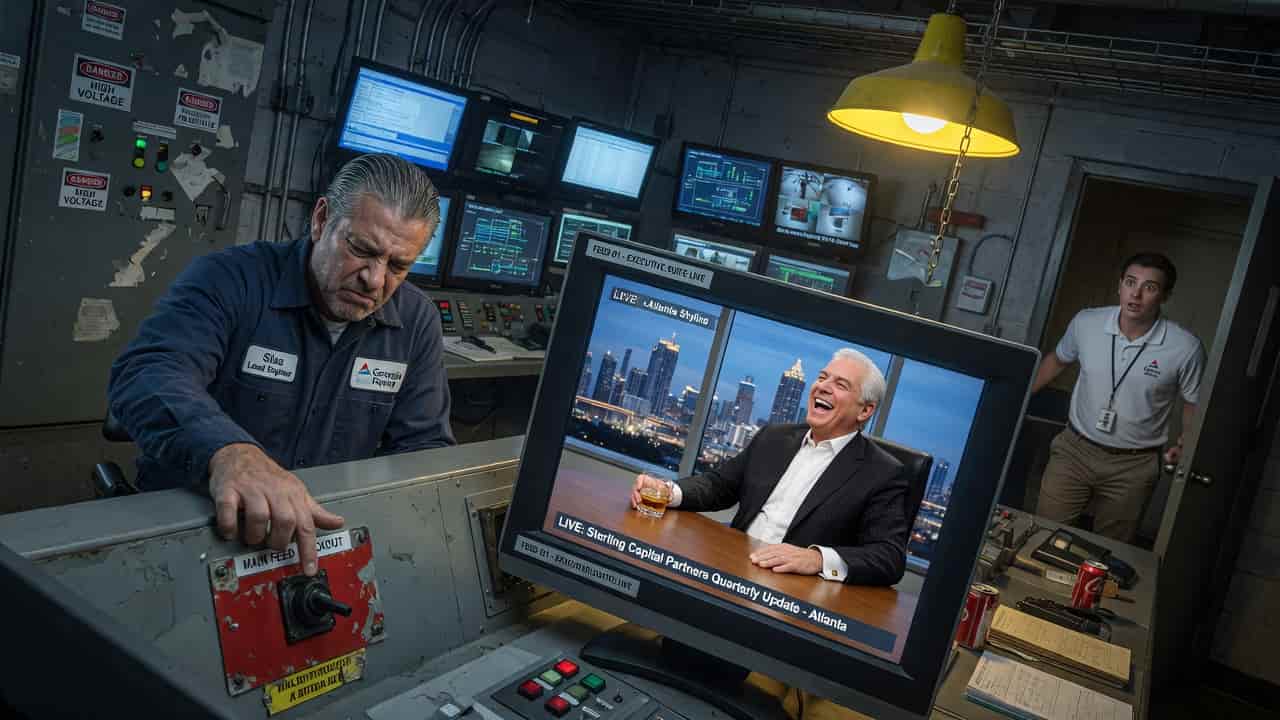
Silas didn’t look away from the monitor. He didn’t care that his hands were shaking or that the kid standing in the doorway was screaming for him to stop. He just kept his eyes on the man in the charcoal suit—the man who had signed the order to divert power away from the “Lower Zones” during the hottest week on record.
Three years ago, Silas sat in a dark, eighty-five-degree bedroom, holding his wife’s hand as her heart finally gave out. Outside, the skyline of the Gold District was glowing, a beacon of cool air and excess, while the people in the slums were left to rot in the heat.
They called it “Load Management.” Silas called it a death sentence.
He’s spent every day since then working for the very company that broke him, burying a backdoor into the grid that even the CEO didn’t know existed. Now, on live television, as Sterling brags about the company’s “record efficiency,” Silas is about to show him exactly what happens when the bill finally comes due.
One switch. One click. And the man who thought he was untouchable is about to find out how it feels to be left in the dark.
Chapter 1
The heat in Atlanta didn’t just sit on you; it owned you. It was a thick, wet wool blanket that smelled of hot asphalt and exhaust, and even inside the North Substation, the air conditioners were losing the war. Silas stood at the edge of Console 4, his boots sticking slightly to the industrial linoleum. He was fifty-four, and his knees felt every year of it, a dull, grinding ache that usually started around two in the afternoon.
He wiped a smear of graphite onto his navy blue work trousers. The fabric was stiff with the residue of a thousand shifts, a second skin that identified him as a man who kept the lights on. To the city outside, Silas was invisible—just another cog in the Grid-Tech machine. But Silas knew the truth of the grid. He knew its pulse, its fractures, and the way it groaned when the demand started to peak.
On the main array, the numbers were climbing. 104 degrees outside. The humidity was sitting at ninety percent. In the “Gold District”—the cluster of high-rises and luxury condos to the North—the consumption was astronomical. He could see the spikes on the digital readout, a jagged mountain range of privilege. Down in the “Zone,” the South and East sectors where the power lines were brittle and the transformers were decades past their prime, the numbers were being throttled.
“Load balancing, Silas. Look at the curve,” a voice chirped behind him.
Silas didn’t turn. He knew the voice. Caleb. Twenty-six years old, a degree from Georgia Tech, and a set of hands that had never actually touched a live wire. Caleb was the future of the company: clean, efficient, and entirely disconnected from the human cost of the data on the screen.
“I see the curve, Caleb,” Silas said, his voice a low gravel. “I also see the East Sector is running at sixty percent capacity. It’s a hundred and four degrees. People are going to start dropping.”
Caleb walked up beside him, tapping a tablet screen with a manicured thumb. “The algorithm prioritizes critical infrastructure and high-value economic zones. You know the protocol. If we don’t shed load in the East, we risk a cascading failure that could take out the whole metro area. We’re protecting the grid.”
“We’re protecting the rich,” Silas corrected. He looked at the junior engineer, seeing the blank, professional indifference in the kid’s eyes. It wasn’t that Caleb was a monster; it was worse. He was a bureaucrat. “My wife lived in the East Sector, Caleb. Three years ago, during the Great Blackout. You remember that one? The one the Mayor called an ‘Unfortunate Necessity’?”
Caleb’s expression shifted, a flicker of discomfort crossing his face. “I heard about that, Silas. I’m sorry. Truly. But that was a different management team. We have better sensors now. Better data.”
“Data doesn’t keep a heart beating when the room is ninety degrees,” Silas said. He turned back to the console.
His hand drifted toward the corner of the station where an old, analog temperature log sat, tucked beneath a stack of technical manuals. It was a relic, something the company had phased out years ago, but Silas kept it. Inside that log, on a page dated July 14th, three years prior, were the numbers he couldn’t erase. 85 degrees inside his apartment at midnight. 68 degrees at the Mayor’s office.
Silas felt the heat rising in his own chest, a familiar, searing pressure. He reached into his pocket and felt the small, jagged edges of a USB drive. It wasn’t corporate-issued. It contained the “backdoor”—a sequence of code he’d spent two years meticulously threading into the grid’s new “Smart Protocol.” He had been the lead engineer on the installation. He knew every relay, every digital gate, and every weakness.
For years, he’d watched the company treat the city like a game of chess, sacrificing the pawns to keep the kings cool. He’d watched the CEO, Marcus Sterling, go on television and talk about “Energy Equity” while residents in the East Sector were being told to “conserve” while their refrigerators thawed and their elderly parents gasped for air.
“Hey, Silas?” Caleb said, his tone softening slightly. “The Mayor’s having that press conference tonight. The ‘Energy Future’ event. Sterling wants the North Substation to be the showcase. We need the displays to look perfect. No red lines, okay? Keep the balancing aggressive.”
“I’ll keep it exactly where it needs to be,” Silas said.
He watched Caleb walk away, the younger man’s gait confident and light. Silas waited until the door clicked shut. The humming of the substation seemed to grow louder, a deep, vibrating drone that echoed the rhythm of his own pulse.
He looked at the master switch—a physical override he’d insisted on keeping during the digital upgrade. They had laughed at him, called him a “luddite,” but they’d let him have it because he was the only one who truly understood the old wiring.
Silas leaned forward, his reflection caught in the dark glass of an inactive monitor. He looked like a man who had been hollowed out. His wife, Elena, had been the light in his life, the person who made the long shifts and the grease-stained hands worth it. When she died, the lights didn’t just go out in the East Sector; they went out in him.
He reached for the USB drive and plugged it into the maintenance port beneath the console. The screen flickered for a fraction of a second, a tiny glitch that no one else would notice.
Blackout Protocol: Initialized.
The words weren’t on the screen, but they were in his head. Silas wasn’t just an engineer anymore. He was the man holding the bill. And tonight, when the cameras were rolling and the Gold District was shining, he was going to make sure the right people finally felt the heat.
He checked his watch. Four hours until the press conference. Four hours until the city found out that the grid didn’t belong to the company. It belonged to the people who suffered for it.
Silas took a deep breath, the air tasting of ozone and old dust. He felt a strange, cold calm settle over him. The ache in his knees was gone, replaced by a singular, electric purpose. He wasn’t going to let the East Sector burn tonight. He was going to let the fire climb the hill to the mansions.
He sat back in his chair, his eyes fixed on the jagged mountains of the power consumption graph. He waited for the sun to drop, and for the world to start screaming.
Chapter 2
The drive from the substation to the South Side took forty minutes in the kind of traffic that felt like a slow-motion funeral. Silas’s old Ford truck didn’t have functioning air conditioning; the compressor had seized two summers ago, and he’d never seen the point in fixing it. He rolled the windows down, letting the blast of humid air hit his face. It was like breathing soup.
He pulled into the parking lot of the Mercy Hill Apartments, a sprawling complex of beige brick and peeling paint. This was where the “residue” lived—the people left behind after the economic booms and the infrastructure upgrades.
He climbed the stairs to the third floor, his boots heavy on the concrete. He stopped at Apartment 312 and knocked.
“It’s open, Silas. I’m not exactly worried about intruders in this heat. Nobody has the energy to rob anyone,” a raspy voice called out.
Silas pushed the door open. The apartment was a dim cavern, the blinds drawn tight against the sun. In the corner, an ancient floor fan rattled, doing nothing more than moving the stagnant heat from one side of the room to the other. Mrs. Gable, a woman who looked like a piece of driftwood—weathered, tough, and ancient—was sitting in a recliner with a wet washcloth draped over her neck.
“How are you holding up, Martha?” Silas asked, setting a plastic bag of ice on the coffee table.
“I’m eighty-four years old, Silas. I’m holding up like a wet paper bag,” she said, though there was a spark of iron in her eyes. She reached for the ice, pressing it against her wrists. “The power flickered twice this morning. Just for a second. But the elevators stopped. I had to wait in the lobby for an hour before they reset.”
Silas sat on the edge of a wooden chair. “They’re throttling the sector again. High demand in the North.”
Martha scoffed, a dry, rattling sound. “Of course they are. Those people need their wine cellars chilled. Meanwhile, I’m sitting here wondering if my heart is going to keep time with that fan.” She looked at him, her gaze sharpening. “You still working for those bastards, Silas?”
“I am,” Silas said.
“Why? You don’t need the money. Not like this. You’re like a ghost walking around that place.”
“I have work to finish, Martha,” he said quietly.
He looked around the room. He saw the framed photo of Martha’s son, who had died in a war three decades ago. He saw the small, ceramic bird Elena had given Martha for her birthday the year before she died. The apartment was a museum of small, fragile lives that the city viewed as expendable.
“Elena would have hated this,” Martha said, her voice softening. “She was always the one bringing me cool water, telling me stories to take my mind off the sweat. She had a way of making you forget you were poor, Silas. That was her gift.”
“I know,” Silas said. The memory hit him like a physical blow.
He remembered the night the power went out for the last time. It hadn’t been a storm or an accident. It had been a “controlled shed.” He had been at the substation, screaming at his supervisor that the East Sector was hitting critical heat levels. He’d been told to sit down and do his job. He’d been told the “Gold District” had a gala that night, and the grid couldn’t afford a flicker.
He’d come home to find Elena on the floor. The apartment had been ninety-two degrees. She’d had a pre-existing heart condition, something manageable with medication and a cool environment. But the heat had turned the air into a poison.
He had sat on the floor with her body for three hours before the power finally came back on. The first thing that happened was the refrigerator hummed to life. The second thing was the television clicked on, showing a news report from the gala. Marcus Sterling was on the screen, laughing with the Mayor.
“They think we’re just numbers, Silas,” Martha said, snapping him back to the present. “They think as long as the total remains positive, it doesn’t matter who gets subtracted.”
Silas stood up. He felt a coldness in his marrow that the Georgia sun couldn’t touch. “They’re wrong, Martha. The math is about to change.”
“What are you talking about?”
“Just stay in tonight,” Silas said. “Keep the ice on your neck. If the power goes out, don’t worry. It won’t be for you.”
“Silas, look at me.” Martha gripped his forearm with a hand that felt like parchment. “Don’t go doing something that gets you buried. Elena wouldn’t want you joining her because of some grudge.”
“It’s not a grudge, Martha,” Silas said, gently disengaging his arm. “It’s a protocol. It’s long overdue.”
He left the apartment and walked back to his truck. The sun was starting to dip, turning the sky a bruised, angry purple. He could see the skyline of the Gold District in the distance, the glass towers catching the light like diamonds. They looked untouchable. They looked eternal.
He got into the truck and gripped the steering wheel. He thought about the young engineer, Caleb, and his “algorithms.” He thought about Marcus Sterling and his “efficiency.” And then he thought about Elena’s hand, turning cold in a room that was too hot to breathe.
He pulled out of the parking lot and headed back toward the North Substation. He had an hour before his shift started. He had an hour before the Mayor took the stage.
As he drove, he felt the weight of the USB drive in his pocket. It felt like a detonator. He wasn’t just an engineer; he was a witness who had finally decided to speak. And he was going to speak in the only language the city understood: the sudden, terrifying silence of a dead wire.
He pulled into the substation and saw the news vans parked outside. The “Energy Future” event was about to begin. The cameras were being set up. The lights were being tested.
Silas walked past the security guard, who gave him a nod. “Back early, Silas?”
“Gotta make sure everything’s perfect for the big show,” Silas said.
He walked into the control room. The air was colder now, the industrial chill biting into his skin. He saw Caleb standing at the central console, looking like a nervous schoolboy.
“There he is!” Caleb said, waving him over. “The Mayor just arrived. Sterling’s in his office, finishing his speech. We’re on in thirty minutes. You ready to show them how we manage the city?”
Silas looked at the monitors, at the glowing grid of Atlanta. “I’m ready, Caleb. I’m going to show them exactly how it’s done.”
Chapter 3
The tension in the control room was a physical weight, vibrating through the floorboards alongside the hum of the massive transformers. Caleb was buzzing, his fingers dancing across a touchscreen, adjusting the lighting on the display monitors. He wanted the data to look “aspirational.”
“Look at the North-Central feed, Silas,” Caleb said, his voice tight with excitement. “We’ve got the load-shedding down to a science. The East Sector is holding at a steady fifty-five percent. It’s barely a flicker on their end, but it gives us the headroom to keep the Convention Center at a crisp sixty-eight degrees for the Mayor’s speech. It’s beautiful.”
Silas stood behind him, his arms crossed over his chest. He looked at the feed from the East Sector. Fifty-five percent. That meant the streetlights were off. That meant the hallway fans in the Mercy Hill Apartments were dead. That meant Martha was sitting in the dark with a bag of melting ice.
“It’s not beautiful, Caleb. It’s a triage,” Silas said.
Caleb turned, his brow furrowing. “Why do you have to be so grim? We’re literally preventing a total blackout. This is what we were hired for. We’re the heroes here.”
“Heroes don’t choose who dies so the Mayor can have a cold podium,” Silas said.
“Oh, for God’s sake,” Caleb snapped, dropping his professional facade. “This again? Silas, you’re a brilliant engineer, but you’re stuck in the past. This isn’t the eighties. We don’t just ‘keep the lights on.’ We manage a resource. And resources have to be allocated where they provide the most value.”
“Value,” Silas repeated the word like it was a piece of rotten meat. “You think a human life has a different value depending on the zip code?”
“In terms of the city’s economic stability? Yes,” Caleb said, his voice cold and clinical. “If the financial district goes dark, the city loses millions a minute. If the East Sector goes dark for an hour, people are inconvenienced. It’s math, Silas. Pure, unemotional math.”
Silas felt a strange, quiet thrill at the boy’s honesty. It was the first time Caleb had said it out loud, stripped of the corporate jargon. The “Pure, unemotional math” that had killed Elena.
“I appreciate the clarity, Caleb,” Silas said softly. “I really do.”
He walked over to his station, the one with the physical master switch. He opened his terminal and began the final sequence. He could see the “backdoor” code sitting in the background, a silent predator waiting for the signal.
He’d designed the protocol to look like a hardware failure—a catastrophic surge in the primary relays of the North-Central line. But it wouldn’t be a surge. It would be a redirection. Every watt of power currently flowing into the Gold District would be inverted. The grid would think there was a fire in the high-rises and would dump the load into the South and East sectors to “save the infrastructure.”
It was a beautiful piece of engineering. It was the best work he’d ever done.
On the main monitor, the live feed from the Convention Center flickered to life. The room was packed with the city’s elite. Men in silk suits and women in light, expensive dresses. They looked cool. They looked comfortable.
Then the camera shifted to the Mayor, who was standing at a podium decorated with the Grid-Tech logo. Behind him stood Marcus Sterling. The CEO looked like a king, his silver hair catching the spotlights. He was smiling, a look of supreme confidence on his face.
“Ladies and gentlemen,” the Mayor’s voice boomed through the control room speakers. “Tonight, we celebrate the triumph of technology over nature. In the face of record-breaking heat, Atlanta stands strong. Thanks to the ‘Smart Grid’ initiatives led by Marcus Sterling and the team at Grid-Tech, we have achieved unparalleled efficiency.”
Caleb let out a little cheer. “That’s us! We’re the efficiency!”
Silas watched Sterling step forward to the podium. The CEO looked directly into the camera, and for a second, Silas felt like the man was looking right at him.
“Efficiency is about making choices,” Sterling began, his voice smooth as aged whiskey. “It’s about the courage to prioritize the systems that drive our city forward. We don’t just provide power; we provide the energy of progress.”
Silas reached for the toggle switch. His hand was steady now. The tremor was gone.
“Silas, what are you doing?” Caleb asked, noticing the movement. He walked toward Silas, his eyes narrowing. “That’s the override. We don’t touch that unless there’s a physical fire in the bank.”
“There is a fire, Caleb,” Silas said, not looking away from the screen. “It’s just been burning for a long time. You just haven’t been able to see it from up here.”
“Silas, back away from the console,” Caleb said, his voice rising in panic. He reached for his radio. “Security, I need—”
Silas didn’t wait. He didn’t care about the security guards or the fallout. He looked at Sterling on the screen—the man who had “prioritized” Silas’s wife out of existence.
“Sterling,” Silas whispered.
He gripped the switch.
“Silas, stop!” Caleb lunged forward, his hand outstretched to grab Silas’s arm.
Silas stepped into the younger man’s path, his shoulder catching Caleb in the chest, knocking him back toward the doorway. Silas was an old man, but he was a man made of steel and resentment. Caleb hit the doorframe with a grunt, the air leaving his lungs.
“Watch the screen, Caleb,” Silas said. “Watch the progress.”
He looked at Marcus Sterling, who was mid-sentence, talking about the “shining future of the Gold District.”
Silas slammed the switch down.
The sound was a heavy, final thunk that seemed to vibrate through the very foundation of the building. For a heartbeat, nothing happened. And then, the world on the monitor changed.
Chapter 4
The Convention Center didn’t just go dark; it vanished.
One second, Marcus Sterling was bathed in the warm, flattering glow of thousand-watt spotlights, his face a picture of corporate triumph. The next, he was a silhouette against a sudden, terrifying void. The audio feed cut out with a sharp, electronic pop, followed by the distant, muffled sound of a thousand people gasping at once.
In the control room, the primary monitors flickered and died. The cool blue light that had defined Silas’s world for the last twelve hours was replaced by the harsh, red pulse of the emergency backups. The hum of the transformers shifted pitch, dropping from a confident drone to a strained, mechanical whine.
“What did you do?” Caleb screamed, scrambling to his feet. He lunged for the main console, his fingers flying across the darkened glass. “The whole North Sector just dropped! Everything! The hospitals, the high-rises, the—”
“The hospitals are on independent backup, Caleb. You know that,” Silas said, his voice eerily calm amidst the chaos. “And the high-rises? They’re just experiencing a ‘controlled shed.’ Isn’t that the term?”
He pointed to the secondary monitors—the ones tracking the East and South sectors. On those screens, the numbers were doing something they hadn’t done in years. They were climbing.
The East Sector was at ninety percent capacity. The streetlights in front of Mercy Hill were humming. The fans in the hallways were spinning at full speed. Martha’s apartment was getting every watt of power it needed.
“You inverted the load,” Caleb whispered, his face pale in the red emergency light. “You sent the Gold District’s entire draw into the slums. The transformers over there can’t handle that kind of surge, Silas! You’re going to blow the whole South-side grid!”
“I didn’t just dump it, Caleb. I synchronized it,” Silas said. He stepped back from the console, his hands open. “I spent two years building the buffers. The East Sector can hold it. For now.”
On the main monitor, a grainy, low-light backup camera at the Convention Center showed the scene. It was a nightmare of privilege. Men and women were stumbling in the dark, their cell phone flashlights cutting through the gloom like panicked fireflies. At the podium, Marcus Sterling was still standing, his hands gripping the wood so hard his knuckles were white.
Suddenly, a physical monitor on the wall—the one linked to Sterling’s private office circuit—flickered to life. Silas had rigged it to trigger on the override.
There was Sterling, captured by his own security camera. He wasn’t the poised CEO anymore. He was a man in a dark room, fanning himself with his speech, his face twisted in a look of pure, indignant rage.
“How’s the air conditioning, sir?” Silas asked the empty room.
The office on the screen was pitch black, save for the green glow of a backup exit sign. Sterling was shouting into a dead desk phone, his expensive suit jacket tossed onto a chair. He looked small. He looked vulnerable. He looked like everyone else in the city.
“He’s going to kill you, Silas,” Caleb said, his voice trembling. “They’re going to bury you under the prison for this. This is terrorism.”
“It’s an audit, Caleb,” Silas said. He turned to the young man, his eyes hard. “Sterling wants to talk about efficiency? I’m showing him the cost of his margins. I’m making him pay the bill he’s been dodging for three years.”
Suddenly, the control room door burst open. Two security guards rushed in, their tasers drawn. Caleb pointed at Silas, his face a mask of betrayal.
“He did it! He used the manual override! Get him away from the console!”
The guards moved in, but Silas didn’t fight. He didn’t even flinch. He just kept his eyes on the monitor, on the image of Marcus Sterling sweating in the dark.
As the guards grabbed his arms, pinning him against the cold metal of the station, Silas felt a sense of peace he hadn’t known since the day he’d buried Elena. The residue of the confrontation—the fear in Caleb’s eyes, the chaos on the screens, the physical weight of the guards—didn’t bother him.
He looked at the digital readout for the East Sector. 100% capacity. Stable.
“You can take me out,” Silas said, his voice echoing in the red-lit room. “But the backdoor is locked. And the only way to get the lights back on in the Gold District is to manually reset every substation in the city. That’ll take twelve hours.”
He looked at the monitor one last time. Marcus Sterling had given up on the phone and was now pacing his office, his shirt unbuttoned, his face glistening with sweat.
“Twelve hours, Sterling,” Silas whispered. “That’s how long she waited. Now it’s your turn.”
The guards began to drag him toward the door. Silas didn’t look back at Caleb. He didn’t look back at the console. He just felt the cool air of the control room on his face, knowing that for the first time in three years, the heat was exactly where it belonged.
The city outside was a map of new shadows and new lights. The towers were dark. The streets of the East Sector were glowing. The balance had been struck.
As the elevator doors closed, Silas closed his eyes. He could almost feel Elena’s hand in his. It wasn’t cold anymore.
“I got them, El,” he whispered. “The lights are finally on.”
Chapter 5
The interrogation room was tucked into the sub-basement of Grid-Tech’s corporate headquarters, a space that felt less like an office and more like a bunker. It was a windowless box of poured concrete and fluorescent hum, designed to make a man feel small, expendable, and entirely disconnected from the sky. Silas sat at a metal table bolted to the floor, his hands cuffed behind his back. The zip-ties were biting into his wrists, a sharp, constant reminder of the physical reality he’d chosen.
He didn’t mind the pain. It was a grounding wire.
He had been sitting there for three hours. No one had spoken to him. They were letting the silence do the work, a classic psychological tactic designed to let a man’s own anxiety eat him alive. But Silas wasn’t anxious. He was watching the clock on the wall, the second hand ticking with a rhythmic, mechanical precision. Every tick was another second that Marcus Sterling spent in the heat. Every tick was another second that the East Sector stayed cool.
The door opened with a heavy, pressurized hiss.
Marcus Sterling walked in first. He had changed his shirt, but the new one—a crisp, white linen—was already beginning to stick to his back. His face was a mask of controlled, high-level fury. Behind him was a woman in a charcoal power suit, her eyes behind sharp glasses scanning Silas like he was a faulty circuit board. And then there was Caleb.
The young engineer looked like he hadn’t slept in a week, though it had only been a few hours. He was pale, his eyes darting between Silas and Sterling, caught in the gravitational pull of two colliding worlds.
Sterling didn’t sit. He stood at the head of the table, his hands planted firmly on the metal surface.
“You think you’re a martyr, Silas?” Sterling’s voice was low, vibrating with a desperate, jagged energy. “You think this is some grand gesture for the ‘little people’? You’ve put thousands of lives at risk. There are elderly people in those high-rises. There are people on home dialysis. There are children.”
“The children in the East Sector have been sleeping in ninety-degree rooms for years, Marcus,” Silas said, his voice level. “The elderly in Martha Gable’s building have been trapped in their apartments because the elevators didn’t have the load capacity to run. Where was your concern for their lives yesterday?”
“That’s a regulatory issue! It’s a resource management protocol!” Sterling slammed his fist onto the table, the sound echoing like a gunshot in the small room. “What you’ve done is a federal crime. It’s domestic terrorism.”
“It’s an audit,” Silas corrected. “I’m just showing you where the power went. It didn’t disappear, Marcus. It just finally went to the people who paid for it with their health.”
The woman in the charcoal suit stepped forward. “Mr. Vance, I am Sarah Miller, Chief Legal Counsel for Grid-Tech. Let me be very clear about your situation. We have already contacted the Department of Energy and the FBI. You are looking at twenty years to life. However, if you provide the decryption key and the manual reset sequence now—within the next ten minutes—we are prepared to discuss a plea that involves significantly less time. We might even be able to frame this as a ‘psychological break’ due to the anniversary of your wife’s passing.”
Silas looked at her. She was efficient. She was looking for the path of least resistance, the way to make the problem go away without letting the truth breathe.
“A psychological break,” Silas said, a small, cold smile touching his lips. “That’s convenient. It keeps the ‘math’ clean, doesn’t it, Caleb?”
Caleb flinched at the sound of his name. He stepped forward, his voice cracking. “Silas, please. Just give them the code. The system is beginning to destabilize. The East Sector transformers aren’t rated for this kind of continuous peak load. If they blow, you’ll leave those people in the dark for weeks, not hours. You’ll destroy the very thing you’re trying to protect.”
Silas leaned back as much as the cuffs would allow. He looked at Caleb, really looked at him. He saw the genuine fear in the kid’s eyes. Caleb wasn’t worried about the company’s stock price; he was worried about the engineering. He was worried about the grid.
“They won’t blow, Caleb,” Silas said softly. “I didn’t just dump the load. I re-routed the cooling systems from the North-Central substation to the East transformers. I used the bypass we installed in ’24. You remember that one? The one you said was ‘redundant’?”
Caleb froze. “You… you tied the coolant loops into the South-side array?”
“I did. They’re running at forty degrees. They can handle the surge for another nine hours. Exactly the time it takes for a full manual reset of the secondary breakers.”
Sterling let out a frustrated growl. “I don’t care about your engineering games! Give me the code. Now.”
“There is no code, Marcus,” Silas said. “It’s a physical lock. I’ve mechanicalized the digital gates. The only way to reverse it is to go to every substation on the list I left on my desk and manually throw the breakers in the correct sequence. One by one. In the heat. Just like my crews have been doing in the East Sector for twenty years.”
The room went silent. The weight of Silas’s words settled over them. He wasn’t giving them a shortcut. He was forcing them to do the work. He was forcing the “Gold District” leadership to send their clean, air-conditioned technicians out into the sweltering streets to fix what they had broken.
“You’re insane,” Miller whispered.
“I’m thorough,” Silas said.
Sterling leaned in close, his face inches from Silas’s. Silas could smell the expensive coffee and the sour scent of stress-sweat on the man. “You think you’ve won? By tomorrow morning, the lights will be back on, and you’ll be in a cage. No one will remember your name. No one will care about your wife. You’ll just be another glitch we fixed.”
“Maybe,” Silas said. “But for tonight, the people in the East Sector are cool. For tonight, they’re the priority. And for the rest of your life, Marcus, every time a light flickers, every time the AC hums, you’re going to wonder if I’m still out there. You’re going to wonder if there’s another backdoor you missed. You’re going to feel the heat.”
Sterling straightened up, his eyes cold and dark. “We’re done here. Sarah, call the feds. Caleb, get the tech teams ready. I want those substations reset by dawn. Use the riot squads if you have to.”
They turned to leave, but Silas called out one last time.
“Caleb.”
The young man stopped at the door, his hand on the handle. He didn’t turn around.
“The sequence matters,” Silas said. “If you do them out of order, you’ll blow the North-Central primary. You have to start with the East Sector. You have to make sure they’re stable before you even touch the Gold District. You have to protect the people first.”
Caleb stood still for a long moment. He didn’t say anything. He didn’t nod. But Silas saw his shoulders drop, just an inch. The boy was an engineer. He couldn’t ignore the logic of the system.
The door hissed shut, and Silas was alone again.
He sat in the red-tinged silence, the tick of the clock the only sound. He thought about Elena. He thought about the way she used to hum when she was making tea in the mornings. He thought about the small bird she’d given Martha.
The residue of the confrontation was a heavy, metallic taste in his mouth. He had humiliated the most powerful man in the city. He had broken the “math.” But he knew the cost. He knew he wouldn’t be going home to his apartment tonight. He wouldn’t be seeing Martha.
He looked down at his cuffed hands. They were steady.
Outside, in the city, the news was breaking. He could imagine the headlines. GRID CRISIS. SABOTAGE AT NORTH SUBSTATION. GOLD DISTRICT DARK. But he also knew what was happening in the East Sector. He could see the families gathered on the porches, not because it was too hot to stay inside, but because they were watching the lights. They were feeling the cool air from their window units. They were realizing, for the first time, that they hadn’t been forgotten.
Silas leaned his head back against the cold concrete wall. He felt a strange, weary satisfaction. He had spent his whole life keeping the lights on for people who didn’t know his name. Tonight, he had turned them off for the people who thought they owned him.
He closed his eyes and waited for the FBI. He waited for the next shift. He waited for the sun to come up on a city that would never be quite the same.
The heat was still out there, pressing against the building, but for the first time in three years, Silas felt cold. And it was the best feeling he’d ever known.
Chapter 6
The dawn didn’t bring relief; it brought a flat, grey light that revealed the exhaustion of a city that had spent the night in a state of suspended animation. Silas was being moved. They had traded his zip-ties for heavy steel cuffs and a waist chain, the metal cold and biting against his skin. Two federal agents, men with faces like stone and suits that cost more than Silas’s truck, were escorting him through the back exit of the Grid-Tech building.
He was being loaded into a black SUV, but before they pushed him inside, Silas stopped. He looked toward the horizon. The sun was a dull orange smudge through the smog and the lingering heat haze.
In the distance, the skyline of the Gold District was still dark. The towers were jagged teeth against the sky, their glass facades dull and lifeless. But further south, he could see the glow. The East Sector was still bright. The streetlights were still on. The “math” was still inverted.
“Move it, Vance,” one of the agents said, a hand heavy on Silas’s shoulder.
“Just taking a look at the work,” Silas said quietly.
He was driven to the federal courthouse, a monolithic building of white marble that felt like a tomb. The hallways were silent, the air-conditioning humming with a rhythmic, expensive thrum. He was processed, fingerprinted, and led into a small, private courtroom for an emergency hearing.
There were no cameras here. No public gallery. Just the judge, a man who looked like he’d been carved out of an old oak tree, and Marcus Sterling.
Sterling was sitting in the front row, his face haggard. He hadn’t slept. His charcoal suit was wrinkled, and there was a dark, bruised look to his eyes. He looked like a man who had lost more than just power. He looked like a man who had lost his certainty.
Beside him sat Caleb. The young engineer looked even worse. His eyes were red-rimmed, and he was staring at the floor, his hands gripped tight in his lap.
“Mr. Vance,” the judge said, his voice a deep, resonant rumble. “You are charged with multiple counts of felony sabotage, destruction of critical infrastructure, and endangerment of public safety. The prosecution is requesting that you be held without bail.”
Silas stood at the defense table. He didn’t have a lawyer yet; he’d refused the one the company had offered. “I understand the charges, Your Honor.”
“Do you have anything to say before I rule on the bail motion?”
Silas looked at Marcus Sterling. The CEO didn’t look back. He was staring at the judge, his jaw clenched.
“Only this,” Silas said. “The lights in the East Sector are still on. They’ve been on for twelve hours. In those twelve hours, the crime rate in that sector has dropped by forty percent. The hospital admissions for heat-related distress have dropped to zero. For the first time in twenty years, the people of the South Side felt like they were part of the city.”
“Mr. Vance, this is not a political forum,” the judge said, though his tone wasn’t unkind.
“It’s not politics, Your Honor. It’s engineering,” Silas said. “I proved the grid can handle it. I proved the ‘math’ was a lie. You can put me in a cage, but you can’t put the truth back in the dark. Every person in this city knows now that the power was always there. It was just being stolen.”
The judge looked at Silas for a long moment. Then he looked at Sterling. “Mr. Sterling, the court has received a report from the Department of Energy. They state that the ‘backdoor’ Mr. Vance installed has been neutralized, but the manual reset of the substations is still ongoing. Is that correct?”
Sterling stood up, his voice raspy. “It is, Your Honor. We expect the North-Central sector to be fully restored by noon.”
“And the East Sector?”
Sterling hesitated. He looked at Caleb, who finally raised his head.
“The East Sector is stable, Your Honor,” Caleb said, his voice surprisingly firm. “But… we’ve decided to maintain the current load-sharing protocol for the duration of the heatwave. If we pull the power back to the North-Central sector too quickly, we risk a total collapse of the primary transformers.”
Silas felt a jolt of electricity go through him. He looked at Caleb. The kid was lying. He knew the transformers could handle the shift. He was choosing to keep the power in the East. He was using Silas’s own logic to protect the people.
A slow, weary smile spread across Silas’s face. He had reached the boy. The engineer had won over the bureaucrat.
“I see,” the judge said. He looked back at Silas. “Mr. Vance, given the nature of the charges, I have no choice but to remand you to federal custody. However, I will take your… technical contributions… into consideration during the sentencing phase.”
The hearing was over. Silas was led out of the courtroom, the chains clinking with every step. As he passed the front row, he stopped in front of Caleb.
The young man looked up, his eyes meeting Silas’s. There was no apology in Caleb’s gaze, but there was a new kind of understanding. A residue of the night’s work that wouldn’t be easily erased.
“Keep the loops cool, Caleb,” Silas whispered.
“I will, Silas,” Caleb said. “I’ll watch the curve.”
Silas was led down into the holding cells. He knew what was coming next. Years of legal battles, a prison cell, the loss of his pension, the end of his career. He was a man who had destroyed his own life to save a few hours for a few people.
But as he sat on the thin, plastic-covered mattress of his cell, he didn’t feel like a ruined man. He felt like a man who had finally finished a long, exhausting shift.
A few hours later, a guard brought him a meal—a plastic tray of lukewarm stew and a piece of dry bread. Beside the tray was a small, hand-written note on a piece of scrap paper.
Martha says the elevators are working. She says thank you for the ice.
Silas gripped the paper, his hands trembling slightly. He closed his eyes and saw Elena. She wasn’t on the floor of a dark apartment. She was standing in the doorway of their old kitchen, the light behind her, smiling.
The city outside would move on. Marcus Sterling would find a way to spin the crisis, to rebuild his image, to tighten the grip on the grid. But the “math” would never be the same. The people in the East Sector had seen the light, and once you’ve seen it, you don’t forget where it comes from.
Silas leaned his head against the cold brick wall of his cell. He was fifty-four years old, and he was a felon. He was a ghost in the system he had helped build. But as the distant hum of the city’s power grid vibrated through the floorboards, Silas felt a deep, abiding peace.
The lights were on. And for the first time in three years, the heat didn’t feel like a death sentence. It just felt like summer.
He took a bite of the dry bread and looked at the small, barred window at the top of the cell. He could see a sliver of blue sky. It was going to be another hot day in Atlanta.
But Silas Vance was done with the load-shedding. He had balanced the scales.
He closed his eyes and let the hum of the world carry him toward sleep. He had done his job. He had kept the lights on.
The story was over, but the residue remained—a spark of rebellion, a shift in the grid, and a man who had found his way out of the dark by turning the lights off for the people who thought they owned the sun.
END OF STORY