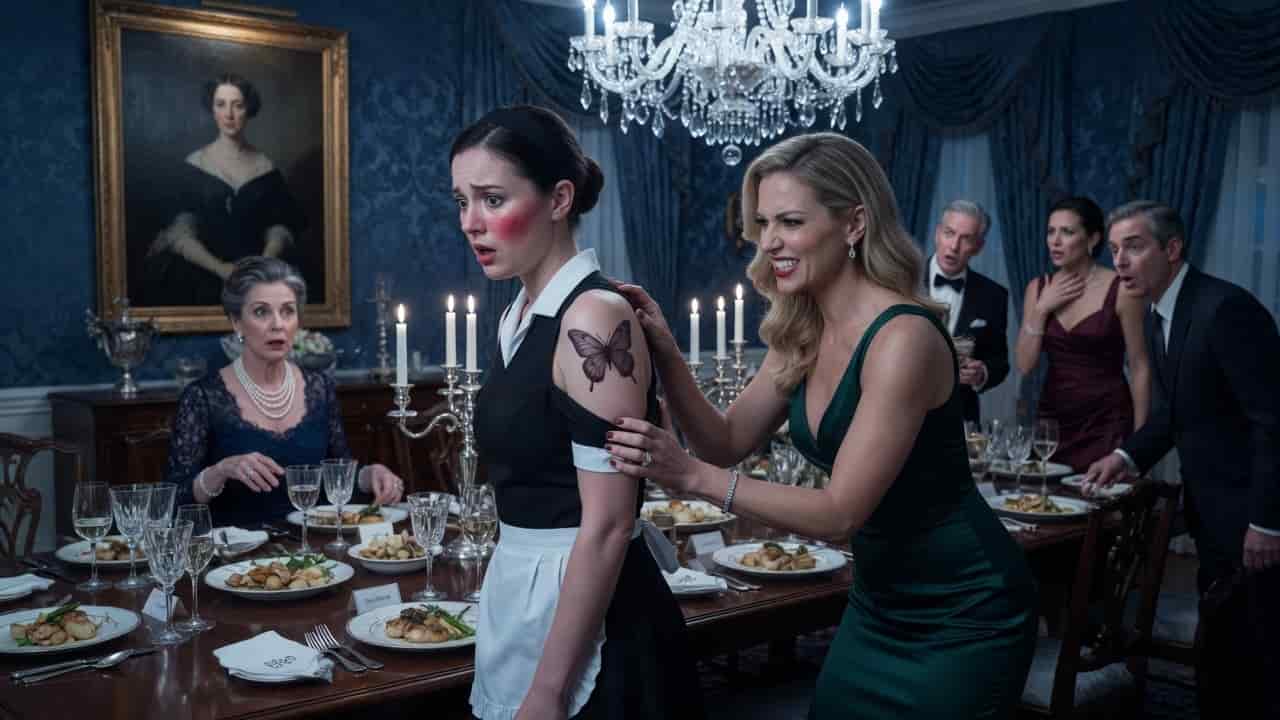
“Is the silver too heavy for you, Claire? Or are you just not used to being in a room this expensive?”
Eleanor leaned back in her chair, a smirk playing on her lips as the ten dinner guests went silent. She didn’t just want her soup served; she wanted Claire to feel the weight of every dollar in the room. She wanted her to remember she was an orphan who grew up on state-run lunches, not someone who belonged in a Hamptons mansion.
“I’m sorry, Miss Eleanor,” I whispered, my hands tightening on the porcelain. “I’ll be more careful.”
“Careful isn’t enough,” Eleanor snapped. Before I could move, she lunged forward, grabbing my arm with a grip that bruised. “You’re hiding something under these sleeves, aren’t you? Shaking like a thief.”
She yanked my uniform sleeve upward, the fabric straining against my skin. She wanted to show the room my ‘dirt,’ my ‘poverty.’ But as the black cotton slid up to my shoulder, the room didn’t just go quiet—it went cold.
At the head of the table, Mrs. Sterling dropped her wine glass. It shattered against the mahogany, red liquid spreading like a stain, but she didn’t look at the mess. She was looking at the butterfly-shaped mark on my skin. The exact same mark that sat on her own shoulder.
“Eleanor,” she gasped, her voice sounding like it was coming from underwater. “Let her go. Right now.”
Eleanor didn’t know that the girl she spent years bullying was the one person she should have been afraid of. The truth was buried in a trunk in the attic, but tonight, the whole world was going to see it.
Chapter 1
The wax on the floors of the Sterling estate always smelled like almond oil and old money. It was a cloying, heavy scent that stuck to the back of Claire’s throat, a constant reminder that she was an intruder in a museum of someone else’s history. She pushed the buffing cloth across the mahogany wainscoting in the east gallery, her knees aching against the hard floor. The Sterling family didn’t believe in automated cleaners; they believed in the quiet, invisible labor of human hands.
Claire checked her watch. It was 10:15 AM. In four hours, she had to be at the county clinic to pick up Toby. In six hours, she had to face the billing administrator who had been calling her twice a day for a week. The weight of the three thousand dollars she didn’t have felt like a physical pressure on her chest, making every breath a shallow, calculated effort.
“You missed a spot, Claire. Or maybe you just prefer the aesthetic of dust?”
The voice was sharp, polished, and came from the doorway. Claire didn’t have to look up to know it was Eleanor. Eleanor Sterling, the twenty-four-year-old heiress who treated the mansion like a personal stage and the staff like props.
Claire straightened her back, her joints popping. She kept her eyes low, fixed on the toes of Eleanor’s three-hundred-dollar leather loafers. “I’m sorry, Miss Eleanor. I’ll go over it again.”
Eleanor stepped into the room, her presence bringing the scent of expensive citrus and arrogance. She circled Claire slowly, the way a hawk circles something small and trapped. “My mother thinks you’re a ‘hard worker.’ She has this quaint, maternal pity for you because of your… situation. The whole orphan-makes-good narrative. It’s very Dickensian, isn’t it?”
Claire felt the heat rise in her neck. She had been at the Sterling estate for two years, ever since she’d aged out of the state system and realized that a high school diploma and a lack of connections meant a life of scrubbing toilets and serving tea. She was good at it because she had to be. Toby’s heart didn’t care about her dignity; it only cared about the specialists.
“I’m just doing my job, Miss Eleanor,” Claire said, her voice a flat, practiced neutral.
“Are you?” Eleanor leaned in, her face inches from Claire’s. Eleanor was beautiful in a way that felt aggressive—sharp cheekbones, eyes the color of winter ice, and a mouth that seemed perpetually set in a sneer. “Because I see how you look at the paintings. I see how you linger in the gallery. You’re not cleaning, Claire. You’re coveting. You think because you’ve got a sad story, you’re entitled to a piece of this.”
“I don’t want anything that isn’t mine,” Claire said, the words slipping out before she could catch them.
Eleanor laughed, a short, brittle sound. “Good. Because nothing here is yours. Not the air, not the silver, and certainly not the attention of this family. Go to the attic. My mother wants the lace linens brought down for the dinner party tomorrow. And try not to get your commoner germs all over them.”
Eleanor turned on her heel and vanished back into the hallway, leaving the air feeling thin and cold. Claire waited until the sound of the loafers faded before she let out a breath. Her hands were shaking. They were always shaking lately.
The attic was a place the other staff avoided. It was a sprawling, drafty labyrinth of the Sterlings’ discarded lives—steamer trunks from the 1920s, moth-eaten furs, and furniture that had fallen out of fashion but was too expensive to throw away. It was where the family’s secrets went to collect dust.
Claire climbed the narrow servant’s stairs, the air growing warmer and more stagnant with every step. The attic smelled of cedar and decay. She found the linen chest near the far window, but as she reached for the handle, her foot caught on the corner of a heavy, iron-bound trunk tucked behind a stack of old portraits.
The trunk was different from the others. It wasn’t branded with the Sterling crest. It was scarred, the leather peeling, and the lock had been forced long ago. Claire knew she should grab the linens and leave. She knew the rules. But the pressure in her chest—the debt, the bullying, the feeling of being a ghost in her own life—pushed her toward the trunk.
She knelt and pulled the lid back. It groaned, a sound that seemed to echo through the empty house. Inside were layers of yellowed tissue paper and a smell that hit her like a physical blow: lavender and baby powder.
Underneath the paper, she found a small, silver-framed photograph. It was a candid shot, poorly lit, showing a woman in a nurse’s uniform holding two infants. The woman’s face was obscured by shadow, but the infants were clear. One had a tuft of blonde hair; the other was bald and screaming.
Claire’s heart hammered against her ribs. She reached deeper into the trunk and pulled out a bundle of documents tied with a rotting silk ribbon. Hospital records. Birth certificates.
St. Jude’s Maternity Ward. June 14th.
The date was her birthday.
She opened the first certificate. Eleanor Rose Sterling. Born 11:02 PM. She opened the second. It was a copy, but the name at the top made the world tilt on its axis. Claire Marie… The surname had been scratched out, but the birth weight, the time—11:05 PM—and the hospital were identical.
Claire felt a cold sweat break out across her forehead. She looked at the photograph again. There was a note tucked into the frame, written in a cramped, frantic hand: Forgive me. One for the mansion, one for the world. I couldn’t let them have both. The mark will tell the truth when I can’t.
Claire’s hand went instinctively to her right shoulder. Beneath the scratchy fabric of her uniform, she felt the raised skin of the birthmark she’d had since the day she was born—a dark, perfectly shaped butterfly. She had spent twenty-five years believing she was a mistake, a child left on a doorstep because she wasn’t wanted.
She looked around the dusty, silent attic. Downstairs, Eleanor was likely drinking a thousand-dollar bottle of sparkling water, complaining about a smudge on a mirror. Eleanor, who had grown up in silk and certainty. Eleanor, who was currently occupying the life that had been written for Claire.
The birth records in her hand felt like a detonator. If she showed these to Mrs. Sterling, everything changed. The medical bills, the humiliation, the years of feeling like she was nothing—it all ended. But as she heard the distant chime of the grandfather clock in the foyer, reality came rushing back.
She was a maid. She was a woman with a sick son and a criminal record for shoplifting a pack of diapers three years ago. Eleanor was the daughter of the house. Who would believe her? Mrs. Sterling was kind, but she was a Sterling. She protected her own.
Claire shoved the documents and the photo back into the trunk, her breath coming in ragged gasps. She grabbed the lace linens from the chest, her fingers trembling so hard she nearly dropped them.
She had to think. She had to be smart. She wasn’t just fighting for herself anymore; she was fighting for Toby. And in this house, the only way to win was to wait for the moment when the light was brightest and the audience was largest.
She descended the stairs, the weight of the linens in her arms feeling heavier than lead. As she passed the gallery, she caught her reflection in a gilded mirror. She looked tired. She looked small. But for the first time in her life, she didn’t look like an orphan.
She looked like the rightful owner of the room.
Chapter 2
The morning after the attic discovery, the sun hit the Hamptons with a brutal, unforgiving clarity. Claire sat on the edge of her bed in the cramped two-bedroom apartment she shared with her son, watching the light catch the peeling wallpaper. Toby was still asleep, his breathing heavy and rhythmic, the sound of the nebulizer a low hum in the corner.
She looked at her hands. They were raw from the cleaning chemicals, the skin around her nails cracked and red. For years, she had accepted this as her lot. She had been told by social workers, by teachers, and by the cold eyes of the world that she was lucky to have anything at all.
Now, every time she closed her eyes, she saw that silver-framed photo. One for the mansion, one for the world.
The unfairness of it wasn’t a sharp pain; it was a dull, grinding ache. Eleanor had spent her summers in Saint-Tropez while Claire had spent hers in a crowded dormitory, wondering if the next foster family would be the one that actually kept her. Eleanor had a trust fund; Claire had a collection of past-due notices.
“Mommy?”
Toby’s voice was small. He was sitting up, rubbing his eyes, his oversized t-shirt hanging off his thin frame. He looked so much like the woman in the oil painting downstairs—the same high forehead, the same narrow, elegant nose.
“I’m here, baby,” Claire said, moving to the bed. she pulled him into her lap, burying her face in his hair. He smelled of soap and the faint metallic tang of his medication.
“Do you have to go to the big house today?” he asked, his voice muffled against her chest.
“I do. It’s a big party tonight. Lots of fancy people.”
“Can you bring me a cookie? A gold one?”
Claire smiled, though it felt like her face might break. “I’ll see what I can do, Toby. I’ll see what I can do.”
She dropped him off at the clinic at noon. The nurse, a tired woman named Elena who had seen too many mothers like Claire, gave her a sympathetic look. “The doctor wants to see you after the shift, Claire. We need to talk about the scheduling for the valve repair. The window is closing.”
“I know,” Claire said. “I’m working on it.”
“Working on it doesn’t pay the surgeons,” Elena said, not unkindly. “Just… don’t wait too long.”
Walking into the Sterling mansion an hour later felt like walking into a cage. The house was buzzing with activity. Caterers were unfolding tables, florists were hauling in massive arrangements of white lilies, and the air was thick with the scent of stress and expensive perfume.
Claire was immediately intercepted by Mrs. Sterling. The matriarch was dressed in a simple but impossibly elegant cream suit. She looked at Claire, and for a second, a strange expression crossed her face—a flicker of confusion, as if she were trying to remember a dream.
“Claire, dear, you look exhausted,” Mrs. Sterling said. Her voice was soft, cultivated. “Is everything alright with your son?”
“He’s… hanging in there, ma’am. Thank you for asking.”
Mrs. Sterling reached out, her hand hovering near Claire’s arm before she pulled it back. “If you need an advance, you only have to ask. I know how difficult things can be.”
“I’m fine,” Claire said, her voice tighter than she intended. The kindness felt like an insult now. It was the pity of a woman who had unknowingly let her own flesh and blood scrub her floors for two years.
“Mother, don’t waste your breath,” Eleanor’s voice drifted down from the grand staircase. She was wearing a silk robe, her hair in rollers, looking like a bored queen. “She doesn’t want your help. She wants to be a martyr. It’s part of the brand.”
Mrs. Sterling sighed. “Eleanor, please. It’s a stressful day for everyone.”
“Exactly. And I need Claire in my dressing room. My vanity is a disaster, and I can’t find my sapphire studs. Apparently, the ‘help’ decided to reorganize my things yesterday.”
Claire felt the trap closing. Eleanor wasn’t just bullying her anymore; she was hunting. She followed Eleanor up to the suite, the lavishness of the room feeling like a personal affront. There was more money in the rugs on this floor than in Claire’s entire neighborhood.
As soon as the door closed, Eleanor’s demeanor shifted. The bored heiress was gone, replaced by something sharper and more desperate. She walked over to the vanity and swept a row of perfume bottles onto the floor with a crash.
“Clean it up,” Eleanor commanded.
Claire stared at the broken glass, the scent of Chanel No. 5 filling the room, cloying and suffocating. “You did that on purpose.”
“And you’re going to clean it up on purpose,” Eleanor said, stepping closer. She was taller than Claire, fueled by a lifetime of superior nutrition and confidence. “I know you were in the attic yesterday, Claire. I know you were digging around in the old trunks.”
Claire’s heart stopped. She kept her face carefully blank. “Your mother sent me for the linens.”
“The linens are in the cedar chest by the door. You were at the back, near the nanny’s trunk. I saw the dust on your shoes.” Eleanor grabbed Claire’s chin, forcing her to look up. “What did you find? A little souvenir? A piece of jewelry you thought we wouldn’t miss?”
“I didn’t take anything,” Claire said, her voice trembling.
“You’re a liar. You’ve been here two years, acting so sweet, so pathetic. But I see the way you look at my mother. You think you can replace me? You think because she smiles at you, you’re special?” Eleanor’s grip tightened, her nails digging into Claire’s skin. “You’re a maid, Claire. You’re a charity project. My mother keeps you around because it makes her feel like a saint, not because she actually cares about you.”
Eleanor pushed her back, and Claire stumbled, her hand landing on the sharp edge of the vanity. She felt a sting and looked down to see a thin line of blood on her palm.
“Get on your knees and clean up the glass,” Eleanor said, her voice dropping to a whisper. “And if I ever catch you near those trunks again, I’ll have you arrested for theft. I’ll make sure your son spends the rest of his short life in a state ward, just like you did. Do you understand me?”
Claire looked up at Eleanor. She saw the fear behind the malice. Eleanor knew. Maybe she didn’t know the whole truth, but she felt the threat. She felt the bloodline calling to its own.
“Yes, Miss Eleanor,” Claire said.
She knelt. She picked up the shards of glass with her bare hands, the pain in her palm a grounding force. As she worked, she realized that she couldn’t just tell the truth. She had to force it. She had to let Eleanor’s own cruelty be the thing that exposed her.
Eleanor wanted to humiliate her? Fine. She would give her the perfect opportunity.
When Claire finished, the vanity floor was spotless, and her hands were stained red. She stood up and walked to the door.
“Oh, and Claire?” Eleanor called out as she reached for the handle.
Claire stopped.
“Wear the short-sleeved uniform tonight. The one with the starch. I want you to look exactly like what you are when you’re serving my guests. I don’t want any confusion about who belongs in this room.”
“I’ll wear it,” Claire said.
She walked out of the room, her heart beating with a cold, steady purpose. Eleanor had just handed her the key. The short-sleeved uniform. The birthmark.
The dinner party wasn’t just a social event anymore. It was an execution.
Chapter 3
The afternoon of the dinner party was a blur of high-stakes preparation. The Sterling mansion was a machine, and Claire was one of its most essential gears. She spent hours polishing silver that was already gleaming, ironed tablecloths that were already flat, and arranged crystal glasses with the precision of a diamond cutter.
Every time she passed the grand portrait in the foyer, she felt a jolt of electricity. It was a painting of Mrs. Sterling’s mother, the family’s matriarch, painted thirty years ago. The woman in the portrait was wearing an off-the-shoulder gown, and there, as clear as a signature, was the butterfly birthmark on her right shoulder.
Claire had seen that painting a thousand times, but she had always looked away, conditioned to believe that any resemblance was a trick of her own imagination. Now, it was a mirror.
She went to the kitchen to help with the prep. The chef, a temperamental Frenchman named Jean-Luc, was screaming at an assistant about the consistency of the truffle foam. He ignored Claire, which suited her. She found Frank, the chauffeur, sitting at the small wooden table near the back entrance, drinking a cup of black coffee.
Frank was sixty, with skin like worn leather and eyes that had seen everything the Sterlings tried to hide. He had worked for the family for thirty years. He had been there the night the two girls were born.
“You look like you’re carrying the weight of the world, girl,” Frank said, gesturing to the chair across from him.
Claire sat. “Just a long day, Frank.”
Frank looked at her for a long time, his gaze lingering on her face. “You have your mother’s eyes, you know. Not the woman who raised you. Your mother.”
Claire froze. “What do you mean?”
Frank took a slow sip of his coffee. “The nanny, Margaret. She was a bitter woman. She lost her own child to the state, and she never forgave the world for it. When the mistress went into labor the same night as that girl from the village… Margaret was the only one in the room for a few minutes. The doctors were busy with a complication.”
Claire’s breath hitched. “Why are you telling me this now?”
“Because I’m old, and I’m tired of watching that girl upstairs treat you like dirt,” Frank said, leaning in. “Mrs. Sterling… she knows something is wrong. She’s known for twenty-five years. But she’s afraid. She’s afraid of what it means if she’s been loving the wrong child. She’s afraid of the scandal. She needs a reason to look, Claire. A reason she can’t ignore.”
“Eleanor told me to wear the short-sleeved uniform tonight,” Claire whispered.
Frank nodded. “Then give her what she wants. Show them all. But be ready. When the truth comes out, this house will tear itself apart before it admits it was wrong.”
“I have to do it for Toby,” Claire said.
“Then do it. But don’t expect them to thank you for it.”
Claire left the kitchen and went to the staff locker room. She pulled out the uniform Eleanor had specified—the black cotton with the white piping, the sleeves ending just above the elbow. She put it on, the fabric feeling like a hairshirt against her skin.
She looked at her shoulder in the small, cracked mirror. The butterfly was dark, sharp-edged, unmistakable. She took a deep breath and pulled the sleeve down as far as it would go, pinning it from the inside so it would stay in place. It was a fragile security.
The guests began to arrive at 7:00 PM. They were the titans of industry, the keepers of old names, and the wives who spent their days maintaining the illusion of perfection. Claire moved among them with a tray of champagne, her face a mask of subservience.
She saw Eleanor in the center of the room, wearing an emerald green dress that looked like it cost more than Claire’s apartment building. Eleanor was performing, laughing at jokes she didn’t find funny, touching the arms of men she didn’t like, her eyes constantly scanning the room for any sign of weakness.
She spotted Claire and her mouth curled. She waited until Claire was near a group of local philanthropists before she spoke.
“Claire, be a dear and check the temperature of the wine,” Eleanor said, her voice loud enough to draw eyes. “You seemed a bit… distracted in the kitchen. We wouldn’t want the vintage ruined by your lack of attention.”
Claire bowed her head. “Of course, Miss Eleanor.”
“And do try to keep your hands steady,” Eleanor added, her voice dropping to a stage whisper. “I know it’s hard when you’re not used to handling things that don’t belong to you.”
One of the guests, a woman in a gold sequins, let out a soft, awkward chuckle. The humiliation was a sharp, cold needle, but Claire welcomed it. Every insult Eleanor threw was another brick in the wall she was about to kick down.
At 8:30 PM, the guests moved into the dining room. The table was a masterpiece of silver and crystal, lit by the warm glow of three dozen candles. Mrs. Sterling sat at the head, looking regal but distant. Eleanor sat to her right, and the seat to the left—the seat that should have been for a second daughter—was empty, occupied only by a massive arrangement of lilies.
Claire began the service. She moved with a ghostly efficiency, pouring wine, clearing plates, her eyes never rising above the level of the guests’ shoulders. The tension in the room was palpable. Eleanor was drinking heavily, her face becoming flushed, her movements more erratic.
She was angry. She was angry that Claire hadn’t broken yet. She was angry that her mother kept looking at the maid with that strange, haunting pity.
“The soup is cold,” Eleanor announced suddenly, her spoon clattering against the porcelain.
The table went silent. Mrs. Sterling frowned. “Eleanor, it’s perfectly fine.”
“It’s freezing,” Eleanor insisted, her eyes fixed on Claire. “Our maid is obviously too busy thinking about her own problems to do her job correctly. Claire, come here.”
Claire walked to Eleanor’s side. “Yes, Miss Eleanor?”
“Take it back. And apologize to the table for your incompetence.”
Claire leaned over to pick up the bowl. Her heart was a drum, the sound of it filling her ears. She felt Eleanor’s eyes on her, felt the heat of the girl’s rage.
“I’m sorry for the inconvenience,” Claire said softly.
As she reached for the bowl, Eleanor’s hand shot out. She didn’t grab the bowl. She grabbed Claire’s wrist, her grip like a vice.
“You’re shaking again,” Eleanor hissed, her voice cutting through the silence of the room. “What are you so afraid of, Claire? Is it the truth? Is it the fact that you don’t belong here?”
Eleanor yanked Claire’s arm toward her, and Claire stumbled, the silver ladle dropping into the bowl with a splash that sent cream-colored soup across the white linen.
“Look at this mess!” Eleanor cried, her voice rising to a shriek. “You’re pathetic. You can’t even serve a simple meal without ruin!”
She didn’t stop there. She grabbed Claire’s sleeve, her fingers catching the fabric where Claire had pinned it.
“Let’s see what you’re hiding under here,” Eleanor mocked. “Maybe that’s why you’re so clumsy. Hiding something you stole?”
With a violent, downward jerk, Eleanor ripped the sleeve upward. The pins snapped, the fabric tore, and the black cotton bunched at the top of Claire’s shoulder.
The room didn’t just go quiet; it became a vacuum.
Claire stood there, her arm held high by her tormentor, her skin exposed to the flickering candlelight. On her shoulder, the butterfly birthmark seemed to pulse with a life of its own.
It was a direct match to the portrait in the foyer. It was a direct match to the woman sitting at the head of the table.
Claire looked at Mrs. Sterling. The matriarch was ashen, her hand frozen in the air, her eyes fixed on Claire’s shoulder with a look of devastating, soul-crushing realization.
The silence lasted for an eternity. And then, the first crack appeared.
Mrs. Sterling’s wine glass slipped from her fingers. It hit the mahogany table and shattered, the red wine spreading across the lace tablecloth like a widening wound.
Chapter 4
The sound of the glass shattering was the only thing that broke the paralysis of the room. Claire didn’t move. She couldn’t. She was pinned by Eleanor’s grip and the weight of twenty-five years of lies finally collapsing.
Eleanor was still holding her arm, her face a mask of confused triumph that was rapidly curdling into horror. She looked from the birthmark on Claire’s shoulder to her mother’s face, and then back again.
“Mother?” Eleanor’s voice was small, the arrogance stripped away to reveal a frightened child. “It’s just… it’s just a mark. It doesn’t mean anything.”
Mrs. Sterling didn’t look at Eleanor. She didn’t look at the guests who were now whispering, their eyes darting between the maid and the heiress. She stood up, her chair scraping against the hardwood like a scream.
“Eleanor,” Mrs. Sterling said, her voice trembling but possessed of a terrifying, low-frequency power. “Let her go. Right now.”
Eleanor’s hand dropped as if she’d been burned. Claire pulled her arm back, her fingers instinctively covering the birthmark, though it was too late. The secret was out in the air, and it was suffocating.
“I… I found the trunk,” Claire said, her voice barely a whisper, yet it carried to every corner of the silent room. “In the attic. The nanny’s trunk.”
Mrs. Sterling walked around the table, her silk gown whispering against the floor. She stopped a foot away from Claire. The guests were leaning in now, the scandal unfolding before them like a feast more decadent than anything Jean-Luc could have prepared.
“Margaret’s trunk?” Mrs. Sterling asked. She reached out, her fingers brushing the torn fabric of Claire’s sleeve. Her touch was light, hesitant, as if she were afraid Claire might vanish if she pressed too hard. “She told me… she told me the other baby died. She said there were complications.”
“There were two certificates,” Claire said, the words coming faster now, fueled by a sudden, desperate surge of adrenaline. “Two girls. Born three minutes apart. One for the mansion, one for the world.”
Eleanor stepped forward, her face flushed with a desperate, ugly rage. “She’s lying! She’s a maid, a nobody! She found some old papers and a birthmark and she’s trying to steal my life! Mother, look at her! Look at her clothes, her hands! She’s not one of us!”
Mrs. Sterling turned to Eleanor. The look she gave her wasn’t one of anger; it was one of profound, agonizing grief. “I’ve looked at you for twenty-five years, Eleanor. And every day, I wondered why I couldn’t see my father in your eyes. I wondered why your spirit was so… different from ours.”
“That’s not fair!” Eleanor screamed. She looked around the table at the guests, her eyes wild. “Help me! Tell her she’s crazy! This is my house! I’m Eleanor Sterling!”
The guests stayed silent. They were sharks who had caught the scent of blood, and Eleanor was no longer the apex predator. She was the bait.
“I have the photo,” Claire said, looking Eleanor in the eye. “The one of the nanny holding both of us. The one where she wrote the truth on the back. Do you want me to go get it? Should we show it to everyone here?”
Eleanor lunged at Claire, her hands clawing for Claire’s throat, but Frank was suddenly there. The chauffeur had been standing in the shadows of the doorway, and he moved with a speed that belied his age, catching Eleanor by the waist and pulling her back.
“That’s enough, Miss Eleanor,” Frank said, his voice grim.
“Let me go! You’re just a driver! You’re nothing!” Eleanor thrashed in his grip, her emerald dress twisting, her hair coming loose from its expensive pins. She looked haggard, broken, the veneer of the Hamptons heiress stripped away to reveal the insecurity that had fueled her cruelty for years.
Mrs. Sterling didn’t even glance at the struggle. She was looking at Claire, her eyes filling with tears that finally spilled over. She reached out and took Claire’s face in her hands. Her palms were soft, smelling of lilies and regret.
“My daughter,” she whispered.
The words hit Claire with the force of a physical blow. She had waited her whole life to hear them, but now that they were here, they didn’t feel like a victory. They felt like a reckoning. They felt like the three thousand dollars she needed for Toby. They felt like the years of cold foster homes and the hunger in her stomach.
“I have a son,” Claire said, her voice cracking. “His name is Toby. He’s five. He has your father’s nose. And he needs surgery that I can’t afford.”
Mrs. Sterling let out a broken sob and pulled Claire into her arms. Claire went stiff at first, the sensation of being held by a mother so foreign it felt dangerous. But then, the scent of the lilies and the warmth of the woman’s silk gown broke her. She buried her face in Mrs. Sterling’s shoulder and wept—for Toby, for herself, and for the two decades that had been stolen from both of them.
In the background, Eleanor’s screams had turned into jagged, pathetic sobs. Frank was leading her out of the room, her heels dragging against the floor. The guests were starting to stand, their voices a rising murmur of shock and excitement. This was the story of the decade. This was a tragedy they would dine on for years.
Mrs. Sterling pulled back, her hands still clutching Claire’s shoulders. She looked at the guests, her face hardening into the mask of the matriarch once again.
“The dinner is over,” Mrs. Sterling announced, her voice echoing through the room. “My daughter and I have much to discuss. Frank will see you to your cars.”
She didn’t wait for them to leave. She turned back to Claire, her eyes searching Claire’s face as if trying to memorize every detail she had missed.
“We’ll get the best doctors for Toby,” Mrs. Sterling said. “Everything… everything will be handled. I promise you, Claire. You’re home now.”
Claire looked around the opulent dining room, at the shattered glass and the spilled wine, at the faces of the elite who were still staring at her as if she were a ghost. She was home. She was an heiress. She was a Sterling.
But as she looked at the empty chair where Eleanor had sat, she felt a cold residue of the life she was leaving behind. The truth had set her free, but it had also set a fire. And as she followed her mother out of the room, Claire realized that the hardest part wasn’t finding the truth.
The hardest part was going to be living with it.
Chapter 5
The silence that followed the departure of the last dinner guest was more violent than the screams that had preceded it. The Sterling mansion, usually a fortress of curated sound—the soft chime of clocks, the discreet hum of the climate control—felt hollowed out. In the dining room, the scent of spilled Cabernet and expensive truffle oil hung heavy in the air, a funeral shroud for the life Eleanor had known and the one Claire had feared.
Claire sat at the massive mahogany table, still wearing the black maid’s uniform with the ripped sleeve. She felt the cold air of the room on her exposed shoulder, the butterfly birthmark now a brand she couldn’t hide. Mrs. Sterling—Lydia, she had insisted through tears—was in the library, her voice a low, frantic murmur as she spoke to the family’s private medical coordinator.
Every few minutes, a muffled thud or a high-pitched sob drifted down from the second floor. Eleanor was still up there, barricaded in her suite, while Frank stood guard at the top of the stairs. It was a bizarre, fractured reality. One daughter was being reclaimed; the other was being mourned while she was still breathing.
“The transport is authorized,” Lydia said, stepping back into the dining room. Her eyes were rimmed with red, her perfect composure replaced by a raw, vibrating urgency. She looked at Claire, and for a second, the class divide flickered between them again. Lydia saw a daughter; Claire still saw a boss who might fire her for the broken glass on the floor.
“Toby is being moved to the Presbyterian Heart Center tonight,” Lydia continued, her voice gaining strength. “The chief of surgery is already briefed. They’re preparing a suite in the private wing. We’re leaving in ten minutes.”
“I need to go to the apartment first,” Claire said, standing up. Her legs felt like they were made of water. “I have his nebulizer, his favorite blanket—he won’t sleep without it.”
“We’ll buy new ones, Claire. We’ll buy the whole store.”
“No,” Claire said, her voice sharper than she intended. She looked at the woman who was her mother but felt like a stranger. “He doesn’t need new things. He needs his things. He’s five, and he’s scared. He doesn’t know about mansions or birthmarks. He only knows that his chest hurts and he wants his blanket.”
Lydia flinched as if Claire had struck her. It was the first moment of real friction, a collision between the world of infinite resources and the world of desperate, hard-fought survival.
“Of course,” Lydia whispered. “Frank will take you. I’ll meet you at the hospital.”
The ride to the apartment was a blur of neon lights and rainy pavement. Sitting in the back of the black town car, Claire felt the shift in the universe. Frank didn’t look at her through the rearview mirror with pity anymore. He looked at her with a quiet, somber respect.
“You did the right thing, kid,” Frank said as they pulled up to the curb of her sagging apartment building. “It’s going to be a mess for a while. The lawyers, the press—they’re going to be all over this like flies. But that boy of yours? He’s going to get his chance now.”
Claire didn’t answer. She ran up the three flights of stairs, the smell of cabbage and old carpet hitting her like a reminder of where she belonged. She packed Toby’s bag with trembling hands—the worn blue blanket, the plastic dinosaurs, the three changes of clothes that were clean but faded. She looked around the small, cramped room and realized she would never sleep here again. The thought didn’t bring relief; it brought a strange, hollow grief. She was leaving behind the only version of herself she knew.
By 2:00 AM, the Presbyterian Heart Center was a sea of white tile and hushed voices. Toby had been whisked away into a room that looked more like a hotel suite than a hospital ward. There were plush chairs, a private bathroom, and a window that looked out over the city.
Claire sat by his bed, watching the monitors. The steady beep-beep-beep of his heart was the only thing keeping her grounded. Lydia stood in the doorway, hesitant, as if she were waiting for permission to enter. She had changed into a simple sweater and slacks, but she still looked like she belonged on the cover of a magazine.
“The doctors say his vitals are stable enough for the preliminary scans,” Lydia said, stepping into the room. She looked at Toby, her face softening into a look of such intense longing it made Claire ache. “He really does have my father’s nose. And his stubborn chin.”
“He’s a fighter,” Claire said.
“He shouldn’t have had to be,” Lydia replied, her voice cracking. “I think about all the times you were worried about the bills, all the times you sat in that kitchen and I didn’t see you. I’m so sorry, Claire. I’m so sorry I didn’t know you were mine.”
“How could you?” Claire asked. “The nanny… Margaret. She made sure of it. She took twenty-five years from us because she was angry at the world. You can’t fix that with a private hospital wing.”
Lydia sat in the chair opposite Claire. “I know I can’t. But I can make sure the next twenty-five years are different. I’ve already contacted the estate lawyers. The process to legally recognize you has begun. And Eleanor…”
“What about her?” Claire asked.
The mention of Eleanor’s name brought a chill to the room. The girl who had spent years treating Claire like a disposable object was currently being erased from the family tree, one legal document at a time.
“She’s… she’s not taking it well,” Lydia said, her gaze dropping to her lap. “She’s at the house with the lawyers now. She’s threatening to sue, to go to the tabloids. She thinks if she can prove you’re an impostor, things will go back to the way they were.”
“Is that what you want?” Claire asked. “For things to go back?”
Lydia looked up, her eyes fierce. “No. I want my daughter. I want the truth. But Eleanor has lived a lie for so long she believes it’s the only thing that’s real. She doesn’t have anyone else, Claire. She’s alienated everyone who ever tried to be close to her. Even me.”
The conversation was interrupted by the arrival of a tall, sharp-featured man in a bespoke charcoal suit. This was Mr. Thorne, the Sterling family’s primary estate attorney. He looked like he was made of iron and fine print. He didn’t offer a smile; he offered a leather-bound folder.
“Mrs. Sterling,” Thorne said, nodding to Lydia before turning his cold, analytical gaze on Claire. “And you must be Claire. Or should I say, the new Miss Sterling?”
“My name is Claire,” she said firmly.
Thorne opened the folder. “We have a problem. Eleanor has refused to leave the estate. She’s claiming that as the child named in the original trust, she has a right to the property regardless of her biological status. She’s also claiming that the birthmark is a cosmetic tattoo and that the documents you found were forged.”
“The blood tests will prove it,” Lydia said. “We’ve already scheduled them for the morning.”
“Blood tests take time to process,” Thorne countered. “In the meantime, she’s doing damage. She’s been on the phone with The Post. If this breaks before we have the DNA evidence in hand, the Sterling name will be dragged through the mud. The board of the foundation is already calling. They want stability, Lydia. Not a Gothic melodrama.”
Claire felt the old pressure returning—the feeling of being a problem that needed to be solved. “I don’t care about the foundation. I don’t care about the name. I want my son to live. That’s it.”
“That’s the difference between you and her,” Thorne said, a hint of something like respect flickering in his eyes. “She cares about the name because it’s the only thing she owns. You care about the boy because he’s the only thing that’s yours.”
He turned back to Lydia. “We need to settle this quietly. Eleanor is demanding a payout. A significant one. In exchange, she’ll sign a non-disclosure agreement and relinquish all claims to the Sterling name and estate.”
“A payout?” Claire asked, her voice rising. “After what she did? After the way she treated people? You want to reward her for being a bully?”
“It’s not a reward, Claire. It’s a surgical removal,” Thorne said. “We pay her to go away so you can have the life you were supposed to have. If we fight her in court, it will take years. Toby doesn’t have years. He needs a stable environment for recovery. He needs a family that isn’t being torn apart by headlines.”
Lydia looked at Claire, the question clear in her eyes. The power had shifted. The maid was now the one who decided the fate of the heiress.
“Where is she?” Claire asked.
“She’s at the mansion,” Lydia said. “She’s in the west wing, refusing to come out.”
“I want to talk to her,” Claire said, standing up. “Alone.”
“Claire, that’s not a good idea,” Lydia warned. “She’s unstable. She’s dangerous when she’s cornered.”
“She’s been cornering me for two years,” Claire said, her voice steady. “I think I can handle one more conversation.”
Claire left the hospital as the sun began to peek over the horizon, turning the city skyline into a jagged silhouette of orange and grey. Frank was waiting by the car. He didn’t ask any questions; he just opened the door.
The mansion looked different in the morning light. It didn’t look like a palace anymore; it looked like a tomb. Claire walked through the foyer, past the portrait of her grandmother, and up the stairs to the west wing.
She found Eleanor in the morning room, surrounded by half-packed suitcases and empty wine bottles. Eleanor was wearing the same emerald green dress from the night before, but it was wrinkled and stained. Her makeup was smeared, and her hair was a tangled mess. She looked like a ghost that had stayed up past its haunting hour.
“Come to gloat?” Eleanor asked, not looking up. She was holding a silver letter opener, turning it over and over in her hands.
“I came to tell you the truth,” Claire said, staying near the door.
Eleanor laughed, a dry, rattling sound. “The truth? The truth is that you’re a thief. You stole my mother. You stole my name. You stole my future.”
“I didn’t steal anything, Eleanor. It was already mine. I was just the one who had to scrub the floors while you played with it.”
Eleanor stood up, the letter opener glinting in the light. “You think you’re so much better than me? Because you have a kid and a hard-luck story? You’re just a maid in a better dress, Claire. You’ll never be one of us. You don’t have the stomach for it.”
“You’re right,” Claire said, stepping into the room. “I don’t have the stomach for cruelty. I don’t have the stomach for making people feel small so I can feel big. That’s your world, Eleanor. And it’s a very lonely one.”
Eleanor lunged then, not with the grace of an heiress, but with the desperation of a drowning woman. She swung the letter opener, but she was drunk and exhausted. Claire caught her wrist, the same way Eleanor had caught hers at the dinner table. But Claire didn’t yank. She didn’t humiliate. She just held her.
“It’s over, Eleanor,” Claire said, her voice quiet. “The payout is on the table. Take it. Go somewhere where no one knows the Sterling name. Start over. Be someone who doesn’t have to lie to be loved.”
Eleanor’s strength vanished. She slumped against Claire, the letter opener clattering to the floor. She started to cry—not the loud, performative sobs of the night before, but a low, broken whimpering.
“She never loved me,” Eleanor whispered into Claire’s shoulder. “I could feel it. Every time she looked at me, she was looking for someone else. She was looking for you.”
Claire felt a surge of pity, a residue of the shared history they had, even if it was built on a lie. They were both victims of the same woman’s bitterness. Eleanor had been raised in a cage of gold, and Claire had been raised in a cage of concrete.
“She’ll try to love you now,” Claire said. “But you have to let her go. For both of your sakes.”
Claire stayed with her until the lawyers arrived with the papers. She watched as Eleanor signed her name for the last time as a Sterling. She watched as the girl she had feared for two years was led out of the house by a security detail, her head bowed, her emerald dress a mockery of the life she was leaving behind.
When the door finally closed, Claire stood in the center of the grand foyer. The house was silent again. She looked up at the portrait of the woman with the butterfly birthmark.
She was a Sterling. She had the money, the name, and the power. But as she looked at her hands, still red and raw from the cleaning chemicals, she knew that the house hadn’t just given her a life. It had given her a responsibility.
She walked to the phone and called the hospital.
“Is he awake?” she asked when the nurse answered.
“He just opened his eyes, Claire. He’s asking for his dinosaurs.”
“Tell him I’m coming,” Claire said. “And tell him… tell him we’re going to be okay.”
Chapter 6
Three weeks later, the Hamptons were in the full grip of autumn. The leaves on the massive oaks surrounding the Sterling estate had turned a deep, bloody red, and the air had a sharp, salty bite to it. Inside the mansion, the heavy drapes had been pulled back, letting in a cold, brilliant light that exposed every grain of dust and every fine line on the faces of its inhabitants.
Toby sat on the floor of the sunroom, his chest crisscrossed with surgical tape but his face full of a color Claire had never seen before. He was playing with a set of wooden blocks that had once belonged to a Sterling great-grandfather. He wasn’t wheezing. He wasn’t tired. For the first time in his life, he was just a boy.
Claire watched him from the doorway, a cup of tea cooling in her hands. She was wearing a soft cashmere sweater and tailored trousers—the kind of clothes she used to iron for Eleanor. They felt comfortable, but they still felt like a costume.
“He’s doing remarkably well,” Lydia said, appearing at her side. She looked younger, the tension that had lived in her shoulders for twenty-five years finally beginning to dissolve. “The doctors say he can start physical therapy next week.”
“He wants to go to the park,” Claire said. “He wants to run until he’s out of breath, just because he can.”
Lydia smiled, but it was a tentative, fragile thing. They were still learning how to be mother and daughter. They were navigating a minefield of missed birthdays, stolen milestones, and the awkwardness of a relationship built on a foundation of tragedy.
“I’ve finalized the trust for him,” Lydia said. “And for you. You never have to worry about a bill again, Claire. Not for the rest of your life.”
“I still check the mailbox for late notices,” Claire admitted. “Every time the phone rings, my stomach ties in a knot. I don’t think that ever goes away.”
“It takes time to trust the world when it’s been so cruel to you,” Lydia said. She reached out and took Claire’s hand. “I’m trying to make it better. I know I can’t erase what happened, but I’m trying.”
The doorbell rang, a deep, resonant sound that echoed through the house. A few moments later, Frank appeared in the doorway. He looked uncomfortable, his cap held in his hands.
“There’s someone at the gate, ma’am,” Frank said, looking at Lydia. “It’s a reporter from Vanity Fair. They’re asking for a statement about the… legal settlement.”
Lydia’s face hardened. The transition from mother back to matriarch was instantaneous. “Tell them the Sterling family has no comment. The matter is private.”
“They have photos, ma’am,” Frank added hesitantly. “Of Eleanor. In a motel in Jersey. They’re calling it the ‘Fall of the Heiress.’”
Claire felt a pang of something she didn’t want to recognize. Pity? Guilt? She had watched the news over the last few weeks. The story of the swapped babies had been a sensation, a real-life soap opera that the public devoured with a savage hunger. Eleanor had been hunted by the paparazzi from the moment she left the estate. The payout had been enough to live on for a lifetime, but money couldn’t buy a new identity, and it couldn’t buy a soul.
“Let them print what they want,” Lydia said coldly. “She chose her path.”
“She didn’t choose to be swapped, Lydia,” Claire said, her voice quiet but firm. “She was a baby, just like I was. She was raised to be exactly what she became. You can’t blame her for the monster the nanny created.”
Lydia turned to her, her eyes flashing. “She was cruel to you, Claire. She humiliated you in front of everyone I know. How can you defend her?”
“I’m not defending her,” Claire said. “I’m just acknowledging the residue. We’re both broken by this house. I just happened to be the one who survived the break.”
Lydia sighed, the fire leaving her. “You’re more like my father than I thought. He was always too merciful for his own good.”
She turned to Frank. “Tell them no comment. And tell security to double the patrols. I don’t want anyone near the gates.”
Frank nodded and disappeared. Claire looked back at Toby. He had built a tower out of the blocks and was now systematically knocking it down, laughing as the wood clattered against the floor.
“I want to go to the nursing home,” Claire said suddenly.
Lydia froze. “What? Why?”
“Margaret. The nanny. She’s still alive, Lydia. She’s in that facility in East Hampton. I want to see her.”
“She’s senile, Claire. She won’t even know who you are. And after what she did… after she stole your life…”
“I need to look at her,” Claire said. “I need to see the woman who decided my fate before I could even speak. I need to know why.”
The drive to the nursing home was silent. Lydia stayed in the car, refusing to step foot inside the building. Claire walked in alone, the smell of bleach and old age a sharp contrast to the lavender and cedar of the Sterling mansion.
She found Margaret in a wheelchair by a window, her skin like crumpled parchment, her eyes milky with cataracts. She was clutching a tattered doll to her chest, whispering to it in a language Claire couldn’t understand.
Claire sat in the chair beside her. For a long time, she just watched the woman. This was the architect of her misery. This was the person who had sentenced her to twenty-five years of poverty and shame.
“Margaret?” Claire asked softly.
The old woman didn’t turn. Her fingers continued to stroke the doll’s hair. “One for the mansion,” she whispered, her voice a dry rattle. “One for the world. They think they can have it all. They think they’re gods.”
Claire felt a chill run down her spine. “Why did you do it? Why me?”
Margaret finally turned her head, her blind eyes searching the air. A slow, toothless smile spread across her face. “Because you were the beautiful one. The one with the mark. I wanted to see if the mark mattered when you were hungry. I wanted to see if the blood stayed blue when it was covered in dirt.”
“It didn’t matter,” Claire said. “I’m back. And the girl you put in my place is gone.”
Margaret chuckled, a sound like dry leaves skittering across pavement. “She’s not gone. She’s inside you now. You have the money. You have the name. You’ll become just like them. Cold. Hard. Protecting what’s yours. I didn’t just swap your bodies, girl. I swapped your souls.”
Claire stood up, her heart pounding. “You’re wrong. I’m nothing like them.”
“Wait,” Margaret rasped, her hand shooting out to grab Claire’s wrist. Her grip was surprisingly strong, her fingers like cold iron. “Wait until the first time someone looks at you like you’re dirt. Wait until you have to choose between your pride and your son’s future. You’ll see. The Sterling blood always wins.”
Claire pulled her arm away and walked out of the room, the old woman’s laughter following her down the hall.
When she got back to the car, Lydia looked at her with concern. “Did she say anything? Did she recognize you?”
“She’s a ghost, Lydia. She’s already dead; she just hasn’t stopped breathing yet.”
They drove back to the mansion in a heavy, contemplative silence. As they pulled through the gates, Claire saw the house looming at the end of the drive. It looked beautiful, majestic, and utterly indifferent to the lives it consumed.
That evening, Claire went up to the attic. She found the iron-bound trunk where it all began. She pulled out the silver-framed photo of the two infants. She looked at the blonde baby—Eleanor—and the bald, screaming one—herself.
She took a lighter from her pocket and flicked it. The flame was small, but it was enough. She held the corner of the photo to the heat and watched as the image curled and blackened. She watched the nanny’s face disappear, then Eleanor’s, and finally her own.
She dropped the burning paper into a metal wastebasket and watched until it was nothing but grey ash. She didn’t feel a sense of peace. She felt a sense of finality.
She walked downstairs to the dining room. Dinner was being served. The table was set for three—Claire, Lydia, and Toby. The silver was gleaming, the crystal was sparkling, and the scent of almond oil was everywhere.
Jean-Luc’s assistant, a young girl with tired eyes and a smudge of flour on her cheek, stepped forward to pour the wine. She was shaking slightly, her hands trembling as she held the heavy crystal decanter.
Claire watched her. She saw the girl’s fear, her invisibility, her desperate need to do the job perfectly so she could go home and pay her rent.
“It’s okay,” Claire said, her voice sounding like a Sterling’s—clear, authoritative, and cold. “The wine is fine. You can go.”
The girl bowed her head, a look of immense relief crossing her face. “Thank you, Miss Sterling.”
Claire picked up her glass and looked at her mother. Lydia smiled at her, a look of pure, uncomplicated pride.
“To the future,” Lydia said, raising her glass.
“To the future,” Claire repeated.
As she took a sip of the wine, Claire caught her reflection in the darkened window. She looked elegant. She looked powerful. She looked like she belonged in the room.
But as she looked at her shoulder, hidden beneath the expensive cashmere, she felt the birthmark itch. It was a reminder of the girl who had scrubbed the floors, the girl who had been an orphan, the girl who had been nothing.
She wondered if Margaret was right. She wondered how long it would take for the Sterling blood to wash away the dirt of the world.
She looked at Toby, who was happily eating his peas, oblivious to the ghosts in the room. He was safe. He was healthy. He was a Sterling.
And for Claire, that was enough. Even if it meant becoming the very thing she had once hated. Even if it meant the triumph was as cold as the marble floors beneath her feet.
She set her glass down with a firm, decisive click. The meal continued in the quiet, perfectly controlled silence of the mansion. The story of the stolen heiress was over, and the reign of the new Miss Sterling had begun.
Outside, the wind picked up, rattling the red leaves against the glass, but inside, nothing moved. Everything was in its place. Everything was exactly where it was meant to be.