Gabe spent years in the dirt of foreign lands, losing his sense of smell to an explosion but never losing his soul.
He returned home to bake bread by the feel of the dough, creating a sanctuary for the children of his fallen brother-in-arms.
But Richard Blackwood didn’t see a hero; he saw a target with a debt and a shop he wanted to bulldoze.
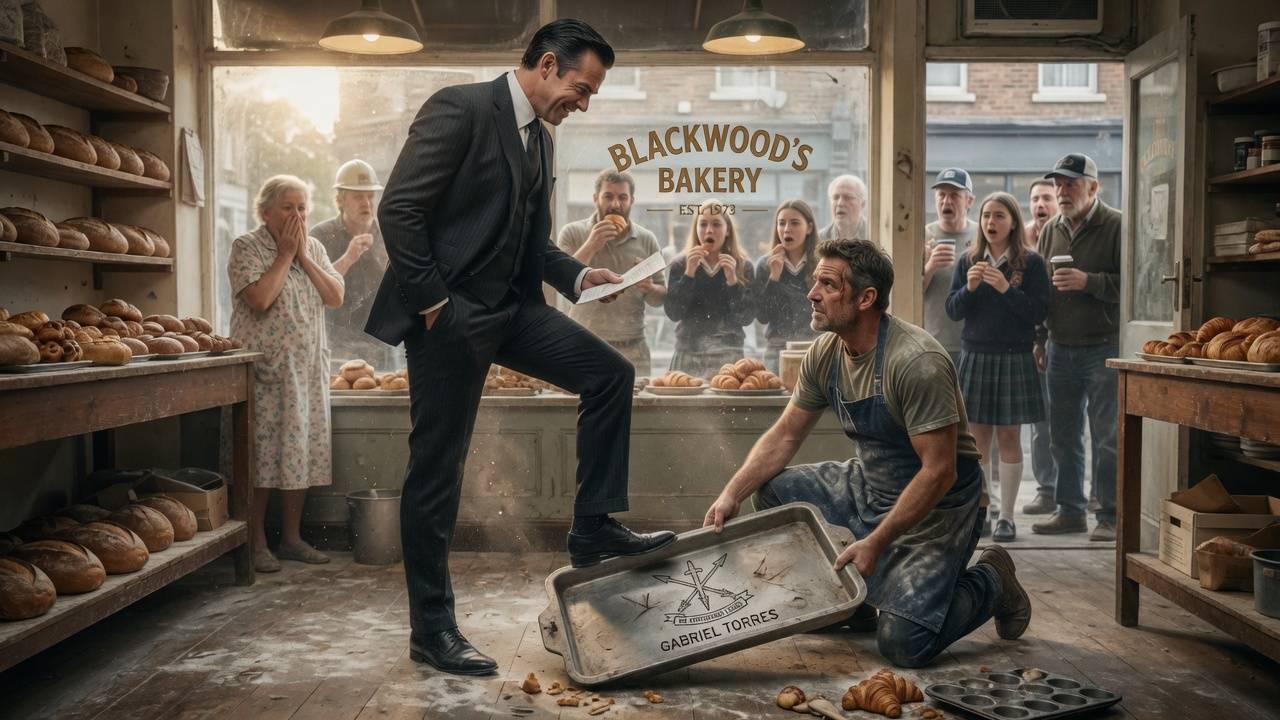
In front of the entire neighborhood, Blackwood walked into that bakery and threw Gabe’s last bit of dignity onto the floor.
He stepped on the only thing Gabe had left from his unit—a steel mold that carried the names of men who didn’t make it back.
“Melt it down,” Blackwood laughed, forcing Gabe to his knees while the regulars watched in hushed terror.
He thought Gabe was a coward because he wouldn’t fight back, not realizing Gabe was only holding back to protect the kids in the back room.
Then Blackwood made the mistake of putting his hands on him one last time.
The baker didn’t just stand up; the soldier came home.
The full story is in the comments.
Chapter 1
The smell of yeast and fermenting dough was a ghost Gabe chased every morning at 4:00 AM. He couldn’t actually smell it—not since the chemical secondary in Fallujah had burned the lining of his nose to a crisp—but he knew it was there. He felt it in the humidity of the air and the specific, tacky resistance of the sourdough under his palms.
He worked in the dark, the only light coming from the glowing amber digits of the industrial oven. His hands, scarred and thickened at the knuckles, moved with a grace that didn’t match his rugged frame. This was the ritual: the fold, the tuck, the tension. It was the only thing that kept the tremors in his legs at bay.
“Is it ready, Uncle Gabe?”
The voice came from the doorway leading to the small apartment upstairs. Leo, seven years old and wearing pajamas two sizes too small, rubbed his eyes. Behind him stood Maya, ten, already holding a stack of clean white aprons. They were the children of Sarah and Mark—Mark, who had died ten feet away from Gabe in a ditch, and Sarah, who had followed a year later from a broken heart and a failed liver.
“Ten minutes, Leo,” Gabe said, his voice a low gravel. “Get the cooling racks. Maya, start the coffee. The regulars will be at the door by six.”
They moved with practiced efficiency. Gabe had raised them on discipline and flour. They were his mission now, the only one that mattered. But as he slid the first tray of boules into the oven, his eyes drifted to the stack of envelopes on the stainless steel counter. They were all from Blackwood Holdings. “Final Notice” was stamped in red, a color Gabe didn’t need to smell to understand.
Richard Blackwood owned the block, and he wanted the bakery. He didn’t want the bread; he wanted the footprint for a luxury condo development. Gabe had held out for three years, but the property taxes were a noose that Blackwood was slowly tightening.
At 6:15 AM, the bell over the door chimed. It wasn’t a regular.
Richard Blackwood walked in wearing a suit that cost more than Gabe’s oven. He was flanked by two men in leather jackets who looked like they’d spent the morning chewing on gravel. Blackwood looked around the warm, flour-dusted shop with visible letdown, as if he’d stepped into a stable.
“Morning, Gabe,” Blackwood said, his voice smooth and artificial. “Smells like… well, I wouldn’t know. I hear you can’t either.”
Gabe didn’t look up from the counter where he was bagging a loaf for Mrs. Higgins, who was standing frozen by the pastry case. “The answer is still no, Richard. Leave the shop.”
Blackwood leaned over the counter, his shadow falling over the children who had gone quiet in the corner. “The city council meeting is tonight, Gabe. Your zoning variance is dead. You’re sitting in a ruin. Why struggle? I’m offering you enough to move those kids to a nice suburb.”
“They like it here,” Gabe said, finally meeting Blackwood’s eyes. Gabe’s gaze was flat, the stare of a man who had seen things that made debt collectors look like children. “And so do I.”
Blackwood’s smile didn’t reach his eyes. He reached out and picked up a fresh croissant, flaking the buttery crust onto the clean floor. “You’re a baker, Gabe. A man who plays with flour. Don’t mistake my patience for weakness. This ends one way.”
He dropped the rest of the pastry and ground it into the tiles with his heel. “See you at the meeting.”
As the door clicked shut, Gabe felt the old heat rising in his chest—the pressure of the “Baker’s Badge,” the nickname his unit had given him because he’d always promised to open this shop if they made it out. He looked at his hands. They were shaking again.
Chapter 2
The afternoon rush was thin, the air in the bakery heavy with a different kind of tension. Word had traveled through the neighborhood. Blackwood wasn’t just a landlord; he was a shark, and people were afraid of being in the blast zone when he finally bit down.
Gabe was in the back, cleaning the massive Hobart mixer, when the bell chimed again. He wiped his hands on his apron and walked out, expecting a late-shift nurse or a student. Instead, he found Miller and Silas sitting at the small corner table.
They were older than Gabe, gray-haired and hard-eyed. They were part of the “Ghost Net”—the informal group of veterans Gabe helped support. The bakery’s basement wasn’t just for flour storage; it was a place where men who couldn’t sleep came to talk, and where information about missing benefits or predatory lenders was traded like currency.
“He’s moving faster than we thought, Gabe,” Miller said, nodding toward the window. Two of Blackwood’s “consultants” were parked across the street in a black SUV, watching the door.
“I know,” Gabe said, pouring them coffee.
“He’s targeting the others too,” Silas added. “The clinic on 4th, the community garden. He’s trying to clear the whole district. He thinks because we’re old and tired, we won’t swing back.”
“I have the kids to think about,” Gabe whispered, glancing toward the stairs. “If I go to war with Blackwood, he’ll use the city to take them away. He’s already made hints about my ‘fitness’ as a guardian.”
“You’re the only one he hasn’t broken,” Miller said. “If you fold, the neighborhood goes. We’ve got your back, but you’re the lead on this.”
Gabe looked at the wall behind the counter. Hanging there, framed in simple wood, was his old unit’s guidon and a small, battered steel baking mold. It was a crude thing, fashioned from a shell casing by a local metalworker in a combat zone. It had the unit’s insignia etched into the side. It was the “Badge.” It represented the promise.
“I’m not folding,” Gabe said.
The pressure escalated that evening. A brick came through the front window at 9:00 PM, narrowly missing the display case. When the police arrived, the officer—a young woman named Detective Vance who usually bought a bear claw every Friday—looked at Gabe with genuine pity.
“He’s got the precinct captain in his pocket, Gabe,” she whispered while her partner was outside. “I can’t do much about the ‘vandalism’ if the cameras were coincidentally ‘down’ on this block. Just… be careful. He’s looking for a reason to have the building condemned.”
Gabe spent the night on the floor of the shop, a rolling pin in one hand and a heavy iron wrench in the other. He didn’t sleep. He watched the shadows of the SUV across the street and felt the cold seep into his bones. He realized then that Blackwood wasn’t just trying to buy the shop. He was trying to erase the last thing Gabe had that felt like a victory.
Chapter 3
By Thursday, the bakery felt like an island under siege. The power had flickered out three times, a “maintenance issue” that the city seemed in no hurry to fix. Gabe had to throw out two hundred pounds of spoiled dough.
He was standing in the kitchen, the air thick and hot without the fans, when Maya walked in. She was holding the steel baking mold. She’d taken it off the wall.
“You’re going to give it to him, aren’t you?” she asked. Her voice was small, but her eyes were sharp. She was Mark’s daughter, through and through.
“I’m trying to keep us safe, Maya,” Gabe said, his voice cracking.
“Dad said you were the strongest man he ever knew,” she said, setting the mold on the table. “He said you could find your way out of a sandstorm with your eyes closed. Why are you letting that man treat you like you’re small?”
Gabe reached out to touch the mold. The cold steel felt like a physical anchor. He remembered the night they’d made it. They were pinned down in an abandoned kitchen, and he’d found some old flour. He’d made flatbread over a Sterno can to keep their spirits up. Mark had laughed and told him he’d be the best baker in Philly.
“I’m not small,” Gabe whispered. “I’m just… I’m out of moves.”
“You always have one move left,” she said, then turned and went back upstairs.
Gabe took the mold and put it in his apron pocket. He felt the weight of it against his hip. He walked to the basement and moved a heavy pallet of rye flour. Behind it was a small, locked Pelican case. He didn’t open it, but he stared at it for a long time. It didn’t contain a gun. It contained something much more dangerous to a man like Blackwood: a ledger and three encrypted flash drives he’d recovered from a “consultant” who had defected from Blackwood’s inner circle months ago.
He’d been holding them as a deterrent, but he realized now that Blackwood didn’t believe in deterrents. He only believed in total destruction.
He went back upstairs and opened the shop. He didn’t turn on the “Open” sign. He just waited.
At noon, the door was kicked open. Not opened—kicked.
Richard Blackwood walked in, but he wasn’t alone. He had four men with him this time. Two of them were the regulars from the SUV, but the other two were new—ex-private security types with the hollow eyes of men who enjoyed their work.
A few customers were inside, including Mrs. Higgins and a young couple from down the street. They froze as Blackwood’s men stepped toward the door and flipped the lock.
“Final offer, Gabe,” Blackwood said, walking behind the counter as if he owned the air Gabe breathed. “The city inspectors are two blocks away. They’re going to find ‘structural instabilities’ that will make this place a crime scene by sunset. Sign the deed, or I walk out of here and let the bulldozers do the talking.”
“I’m not signing,” Gabe said. He felt remarkably calm. The shaking had stopped.
“You’re a stubborn little man,” Blackwood sneered. He looked down and saw the steel mold sitting on the counter where Gabe had placed it. “What’s this? Your little trophy? Your ‘Baker’s Badge’?”
Blackwood picked it up, weighing it in his hand. “Pathetic. You spent your life serving a country that forgot you, and now you’re serving bread to people who don’t care. You’re a failure, Gabe. And failures don’t get to keep their toys.”
He dropped the mold onto the floor with a clatter.
Chapter 4
The sound of the steel hitting the tile echoed in the silent bakery. The customers backed away, huddled near the window.
Blackwood looked Gabe in the eye and slowly raised his foot. He brought his heavy, polished leather sole down directly onto the mold. The steel didn’t break, but the sound of the grinding metal against the floor was like a physical strike to Gabe’s chest.
“Look at you,” Blackwood said, his voice dripping with contempt. He reached out and grabbed Gabe by the collar of his tan apron, twisting the fabric until it choked him. He pulled Gabe forward, forcing him to lean over the counter, lower and lower, until Gabe’s face was inches from the floor where the mold was being crushed. “You’re nothing but a servant. A crumb. Lick the floor clean, baker boy. Maybe then I’ll let you keep your skin.”
Gabe’s hands were flat on the counter. He could feel the eyes of the neighborhood on him—the judgment, the pity, the fear. He looked at the mold. He looked at the names etched into the side that only he knew were there.
“Move your foot off that mold, Richard,” Gabe said. His voice wasn’t loud, but it had a different frequency now. It was the sound of a detonator clicking.
Blackwood laughed, a harsh, jagged sound. “Or what? You’ll bake me a cake?” He shoved Gabe’s chest, a hard, disrespectful jolt that sent Gabe back a step. Blackwood turned to his men. “Did you hear the baker? He’s giving orders now.”
Blackwood turned back and reached out to grab Gabe’s throat, his face red with a sudden, localized rage.
He never finished the reach.
Gabe’s left foot planted like a pillar into the flour-dusted tile. In one fluid, explosive motion, he snapped his left arm upward, a sharp, bludgeoning arc that caught Blackwood’s reaching wrist and sent his arm flying off-line. The “structure break” was so violent that Blackwood’s shoulder twisted, his entire chest opening up like a target.
Gabe stepped into the gap, closing the distance in a heartbeat. He didn’t use a fist; he used his palm, the same part of the hand he used to punch the air out of the dough. He drove his right palm-heel directly into Blackwood’s upper sternum.
The contact was sickeningly solid. Blackwood’s expensive charcoal suit jacket jolted as the force traveled through his chest. His air left him in a single, ragged gasp. His shoulders snapped back, his head whipping, and his feet began a desperate, uncoordinated scramble to stay upright.
Gabe didn’t wait. He planted his standing foot, his hip driving forward as he lifted his right knee and lashed out with a front push kick. His boot caught Blackwood squarely in the center of the chest.
The impact sounded like a heavy bag being hit with a baseball bat. Blackwood was propelled backward. His heels skidded through a patch of spilled flour, and he hit the floor with a bone-jarring thud, sliding two feet until he slammed into the base of a heavy wooden display table.
Trays of fresh rolls rattled and spilled, raining down on him.
Blackwood lay there, gasping for air that wouldn’t come, his face transitioning from red to a terrifying shade of gray. He scrambled backward on his elbows, his eyes wide with a primal, animal terror. He looked up at Gabe, his hand shaking as he raised it in a pathetic, defensive gesture.
“Wait, please!” Blackwood wheezed, his voice a broken whisper. “Stop! I’m sorry! Stop!”
Gabe didn’t move toward him. He didn’t have to. He stood in the center of his shop, his apron stained with flour, looking down at the man who had tried to ruin him. The two security guards started to move, but they stopped when they saw Miller and Silas standing by the door, and three other men from the neighborhood—men with the same hard eyes as Gabe—stepping out from the shadows of the back room.
Gabe leaned down and picked up the steel mold. He wiped the dust from it with his thumb.
“Don’t ever step in my shop again,” Gabe said.
He looked toward the window. Detective Vance was standing there, her hand on her holster, watching through the glass. She didn’t move to intervene. She just nodded once.
Blackwood’s men scrambled to pick him up, dragging their boss out into the light of the street. The door swung shut, the bell chiming one last time.
Gabe turned back to the counter. His hands were steady. He looked at the kids, who were watching from the top of the stairs.
“Maya,” he called out. “Get the broom. We have work to do.”