“You’re a ghost, Elias. Go back to your books before you trip and break something.”
The Mayor didn’t even look at me. He sat there in his thousand-dollar coat, looking out at the park like he owned the air we were breathing. To him, I was just a grieving old man—a relic of a woman who had asked too many questions before she was taken away.
But I wasn’t there for an apology. I was there to show him that I’d finished her work.
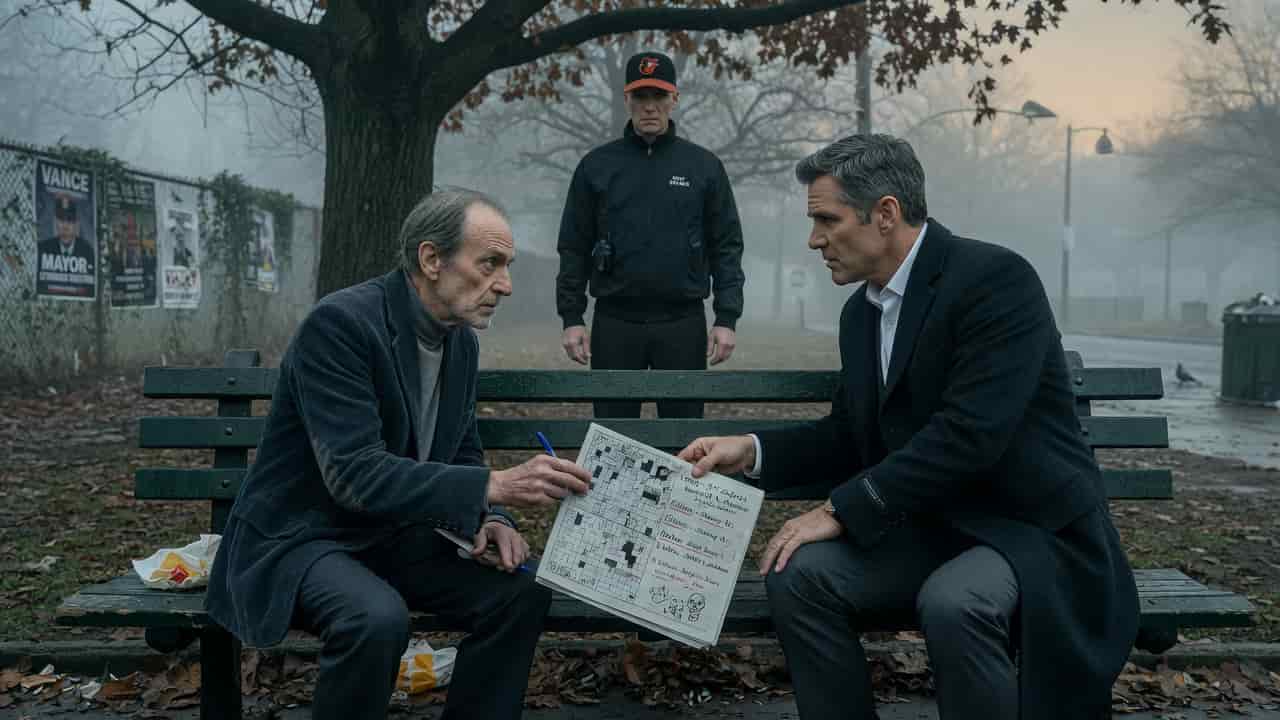
I slid the newspaper across the bench. It was a crossword, hand-drawn, messy. At first glance, it looked like the ramblings of a man who had lost his mind. But as his eyes drifted to the clues, I saw the color drain from his face.
“I’m not the one who’s falling, Leo,” I said, my voice steadier than it had been in years. “Look at seven-down. It’s a name you know. In fact, it’s a name you buried ten years ago.”
He didn’t move. He didn’t breathe. Behind us, his ‘cleanup’ man stepped out of the fog, but it was too late. The code was already out there, and if my heart stops tonight, the whole world gets the key.
The city is about to find out where the foundations are really laid.
Chapter 1
The Pratt Library smelled of vanilla, damp wool, and the slow, inevitable rot of paper. For Elias Thorne, it was the only smell that made sense anymore. At seventy-two, the world outside the library’s heavy oak doors felt like a foreign film without subtitles—loud, frantic, and increasingly indecipherable. But here, in the stacks of the Linguistics and Philology department, everything was categorized. Everything had a place.
Elias spent his mornings at a small mahogany table in the back, the one where the light hit the grain at a sharp angle around 10:30 AM. He wasn’t there to read the new releases. He was there to maintain the silence. He was a retired codebreaker, a man who had spent forty years at the NSA turning noise into signal, and now, in the twilight of a life that felt mostly like a footnote, he was looking for the signal his wife had left behind.
Maya had been a journalist for the Baltimore Sun when the Sun still mattered. She had been gone for three years—”vanished,” the police said, though Elias knew better. You don’t just vanish when you’re three weeks deep into an investigation into the City Council’s “Reclamation Project.” You get erased.
He pulled a worn, leather-bound notebook from his satchel. This wasn’t a library book; it was Maya’s. The edges were curled, and the pages were filled with her frantic, looping script. To anyone else, it looked like a diary of a woman losing her grip. To Elias, it was a Caesar cipher layered over a Vigenère square. She had known they were watching her. She had known that if she wrote the truth in plain English, it would be burned before she could file the story.
“Mr. Thorne?”
The voice was a jagged glass shard in his quiet world. Elias didn’t look up immediately. He finished the line he was tracing—a string of numbers that corresponded to the frequency of vowel usage in 19th-century municipal records.
“The library is a place for study, Sarah,” Elias said softly. “Not for surprises.”
Sarah Miller sat down across from him. She was thirty, but today she looked fifty. Her hair was a bird’s nest of blonde strands, and her eyes were rimmed with the kind of red that suggested she hadn’t slept since Tuesday. She had been Maya’s assistant—the girl who made the coffee and fact-checked the boring stuff while Maya chased the dragons.
“They’re following me, Elias,” she whispered. Her hands were trembling so violently they rattled the table. “I went to my apartment last night. The door was unlocked. Nothing was missing, but they moved my photos. They put my mother’s picture on the floor. Facing down.”
Elias finally looked up. He saw the sweat on her upper lip and the way she kept glancing toward the end of the aisle. He felt a familiar, cold pressure in his chest—the residue of a career spent waiting for the other shoe to drop.
“Who is ‘they,’ Sarah? Be specific. In this city, ‘they’ is a very crowded room.”
“The men from the Council. The ones in the grey sedans. I saw one of them outside your house this morning, too.”
Elias went still. His house was a small, brick rowhome in Fells Point. It was filled with Maya’s ghost and three thousand books. It was his fortress. “Are you sure?”
“I’m a journalist, Elias. Maya taught me how to look. I saw the plates. They’re city-issued. But the men inside… they aren’t clerks.”
She reached into her bag and pulled out a manila envelope. She didn’t hand it to him; she shoved it across the table like it was a ticking bomb.
“Maya gave this to me the night she… before she didn’t come home. She told me to keep it until someone asked the right question. She said you’d know what it was.”
Elias stared at the envelope. His heart hammered against his ribs, a frantic bird in a cage. He had spent three years thinking he had everything Maya had left. He had decoded her journals, her grocery lists, even the annotations in her favorite novels. He thought he knew the shape of her secrets.
He opened the envelope. Inside was a single sheet of paper. It wasn’t a letter. It was a grid. A crossword puzzle, half-finished.
“A crossword?” Elias muttered. He felt a wave of disappointment so sharp it tasted like copper.
“Look at the clues, Elias,” Sarah hissed. “Read them out loud.”
Elias adjusted his glasses. His eyes traced the handwritten clues at the bottom.
1-Across: The price of a silence in the West End. (6 letters)
4-Down: Where the foundations are made of bone. (9 letters)
7-Down: The Mayor’s favorite ghost. (4 letters)
Elias felt the air leave the room. He knew 1-Across. Six letters. Bribes. He knew 7-Down. Four letters. Maya.
But it was 4-Down that made his blood turn to slush. Nine letters.
“Foundations,” he whispered.
“She found it,” Sarah said, her voice breaking. “The mass grave under the new stadium site. They didn’t just move the old cemetery, Elias. They filled the holes with the people who got in the way of the contract. People like Maya.”
Elias looked at the girl. She was terrified, and she had every right to be. In a city like this, the truth wasn’t a shield; it was a target.
“Go home, Sarah,” Elias said, his voice flat and hard.
“What? Elias, they’re going to kill me!”
“No. They’re going to watch you. If they wanted you dead, you wouldn’t have made it to the library. They want to see who you talk to. They want to see if you have the key.”
“Do you have it?”
Elias looked down at the crossword. He saw the pattern now. It wasn’t just a puzzle. It was a map. The black squares weren’t random; they were a topographical overlay of the city’s old shipping district.
“I don’t have the key yet,” Elias said, closing Maya’s notebook. “But I have the lock. And I’ve spent my whole life breaking into places I wasn’t supposed to be.”
He watched her leave, her small frame disappearing into the shadows of the stacks. He waited five minutes, then stood up. He didn’t take the main exit. He went through the basement, through the boiler room where the air was thick with the smell of coal and old iron.
As he stepped out into the alley, he felt a presence. Not a sound, just a shift in the air.
“You’re getting slow, Elias.”
The man was leaning against a dumpster. He was younger than Elias, maybe forty, with the kind of face that disappeared in a crowd. He wore a black windbreaker and a baseball cap. Cillian. The Mayor’s shadow. The man who did the things the city’s “Cleanup” crew couldn’t put on a ledger.
“And you’re getting predictable, Cillian,” Elias said, his voice showing none of the tremor in his knees. “The library? It’s a bit cliché, isn’t it?”
Cillian stepped forward. He didn’t pull a weapon. He didn’t need to. His presence was the weapon. He was the physical manifestation of the city’s rot.
“The Mayor wants to see you, Elias. He’s hosting a little dinner tonight. An ‘Honoring Our Elders’ kind of thing. He thinks you should be there. He thinks it’s time you stopped living in the past.”
“I like the past,” Elias said. “The people there are much more honest.”
Cillian smiled, a cold, empty movement of the lips. “Don’t be late. Seven o’clock. The Belvedere. Wear a tie, Elias. It’s a formal affair. We wouldn’t want you to look out of place when the room turns against you.”
Cillian turned and walked away, his footsteps silent on the damp pavement. Elias stood in the alley, the manila envelope clutched to his chest. He felt the weight of it—not the paper, but the truth. Maya hadn’t vanished. She had been buried under the very progress the city was so proud of.
He looked down at the crossword. 4-Down. Nine letters.
Pavement.
No. That was too simple.
Sacrifice.
Nine letters.
Elias Thorne walked toward the bus stop. He had a dinner to attend. He had a tie to find. And he had a code to finish that would burn the city to the ground.
Chapter 2
The rowhome was too quiet. It had been three years, but Elias still expected to hear the kettle whistling or the scratch of Maya’s pen against a legal pad. Instead, there was only the low hum of the refrigerator and the ticking of the grandfather clock in the hall—a rhythmic reminder of everything he was losing.
He sat at his kitchen table, the manila envelope open before him. The crossword puzzle felt like it was humming under his fingertips. He had spent the last two hours analyzing the grid. It wasn’t a standard New York Times layout. The symmetry was off.
“You always were too clever for your own good, Maya,” he whispered.
He pulled out his magnifying glass. Under the harsh light of the kitchen bulb, he saw it—tiny, microscopic pinpricks at the intersections of certain lines. It was a needle-punch code, an old technique used by resistance fighters in occupied France. If you connected the dots, you didn’t get a word. You got a frequency.
104.3.
The pirate radio station. The one that broadcast from a van somewhere in the West End, moving every night to avoid the FCC and the city’s signal jammers.
Elias reached into his junk drawer and pulled out an old transistor radio. He turned the dial, the static Hissing like a nest of snakes. 104.1… 104.2…
“—and if you’re listening to the ghosts of the Harbor, remember that the tide doesn’t just bring things in. It hides what we’re too afraid to see.”
The voice was deep, gravelly, and filtered through a voice-changer. “The Alchemist.” Elias had heard of him. He was the last voice of dissent in a city that had been bought and paid for.
Elias listened for ten minutes. The Alchemist wasn’t just talking. He was reading a list of numbers.
“Forty-two point seven. Seventy-six point five. Nine point one.”
Elias scribbled them down. It was a coordinate set. But not for a map. It was a decryption key for a specific type of digital encryption—the kind used by the City Council’s private servers.
A knock at the door startled him. It wasn’t the heavy, rhythmic thud of the police or the silent threat of Cillian. It was a hesitant, uneven tapping.
He went to the door, his hand instinctively reaching for the heavy brass coat rack he kept near the entry. He peered through the peephole. It was Sarah. Again.
He opened the door and pulled her inside, slamming it shut behind her.
“I told you to go home,” he hissed.
“I can’t. They’re sitting in a car at the end of the block. A grey sedan. They aren’t even trying to hide it anymore, Elias.”
She was wearing a different coat now, something heavy and oversized, and she was clutching a laptop to her chest like a shield.
“I found something else,” she said, her voice trembling. “I went back to the Sun’s archives. I used Maya’s old login. I didn’t think it would still work, but they never deactivated it. She had a draft saved in the cloud. Just one sentence.”
She opened the laptop and turned it toward him.
The marrow of the city is made of the people who refused to sell their shadows.
“It’s a metaphor,” Elias said, his mind already working the logic. “Maya didn’t write metaphors when she was scared. She wrote facts.”
“That’s what I thought. So I looked up the word ‘shadow’ in the Council’s budget reports from three years ago. Do you know what I found?”
Elias shook his head.
“A line item called ‘Project Shadow.’ Four million dollars. Categorized under ‘Waste Management.’ But the contractor wasn’t a garbage company. it was a construction firm owned by Mayor Vance’s brother-in-law.”
The cold in Elias’s chest deepened. Waste management. Four million dollars to hide the bodies of the people who knew too much. It was a system. A machine that turned human lives into infrastructure.
“They’re coming for us, aren’t they?” Sarah asked.
Elias looked at her. She was young, full of a fire that hadn’t been extinguished by the city’s damp grey reality. He felt a pang of guilt. He had dragged her into this by simply being the man Maya loved.
“They’re coming for the code, Sarah. They don’t care about us. We’re just the delivery system.”
He looked at his watch. 6:15 PM. The dinner at the Belvedere started in forty-five minutes.
“I need you to take this,” Elias said, handing her Maya’s notebook. “And the crossword.”
“What? No, Elias, you need it!”
“If I walk into that room with this, I’m a dead man. If I walk in with nothing but my pride, I’m just an old man they can mock. I need you to go to the library. Not the main one. The branch in Highlandtown. The librarian there, Mrs. Gable—tell her you’re looking for ‘The Silence of the Lambs’ first edition. She’ll take you to the basement. There’s a terminal there that isn’t connected to the city’s grid.”
“What am I supposed to do?”
“Input the coordinates from the radio. Use the notebook to bridge the gaps. If I don’t call you by midnight… you broadcast it. Every server, every station, every screen in the city. You burn it down, Sarah.”
“Elias…”
“Go!”
He pushed her toward the back door, watching as she slipped into the dark alleyway. He stood there for a moment, the silence of the house pressing in on him. He felt like a man who had just set a fuse and was now walking toward the explosion.
He went upstairs to his bedroom. He pulled a suit from the back of the closet—a charcoal wool number that smelled of cedar and the perfume Maya used to wear on special occasions. He tied his tie with practiced, trembling fingers.
He looked at himself in the mirror. He looked old. He looked tired. But beneath the wrinkles and the grey hair, there was a spark of the man who had broken the Soviet codes in the eighties. A man who knew that every system had a flaw.
The flaw in Mayor Vance was his vanity. He didn’t just want power; he wanted to be loved for it. He wanted the city to cheer while he paved over their ancestors.
Elias reached into his bedside table and pulled out a small, silver device. It looked like a heart rate monitor—the kind old men wore to track their palpitations. He strapped it to his chest, beneath his shirt.
It wasn’t a monitor. It was a Dead Man’s Switch. A prototype he’d kept from his NSA days. If his heart stopped, or if he manually triggered it, a burst of high-frequency data would be sent to the Highlandtown library’s terminal. It was the final key.
He walked out of his house and toward the grey sedan at the end of the block. He didn’t wait for them to come to him. He walked straight up to the driver’s side window and tapped on the glass.
The window rolled down. It was the man in the baseball cap. Cillian.
“I’m ready for my dinner,” Elias said.
Cillian looked at him, his eyes scanning Elias’s suit, his empty hands, his calm face. “You look nice, Elias. A shame about the occasion.”
“Every occasion is what you make of it, Cillian. Now, let’s not keep the Mayor waiting. He’s a busy man, I’m sure. Lots of things to bury before morning.”
Cillian didn’t respond. He just nodded toward the back seat. Elias climbed in, the leather cold against his legs. As the car pulled away from the curb, Elias looked back at his house. He knew he wouldn’t be coming back. But for the first time in three years, he didn’t feel like a ghost. He felt like a hunter.
Chapter 3
The Belvedere Hotel was a monument to a Baltimore that no longer existed—a place of marble floors, crystal chandeliers, and a heavy, oppressive sense of history. Tonight, the grand ballroom was filled with the city’s elite. Men in five-thousand-dollar suits and women draped in silk, all clinking glasses and laughing at jokes that weren’t funny.
Elias Thorne felt like a smudge on a clean window.
As he entered, the room didn’t go silent, but the temperature seemed to drop. People whispered behind their hands. “That’s the one… Thorne… his wife went crazy, you know… such a tragedy.”
He ignored them. He walked toward the bar, his eyes scanning the room. He saw the City Council members, the developers, the police commissioner. They were all there, a collective of vultures dressed as eagles.
And then he saw him.
Mayor Leo Vance stood at the center of a circle of admirers. He was holding a glass of scotch, his face flushed with the easy confidence of a man who had never been told no. When he saw Elias, his smile widened, but it didn’t reach his eyes.
“Elias! You made it!” Vance called out, his voice booming across the ballroom. He stepped away from his circle and approached Elias, throwing an arm around the older man’s shoulders. The smell of expensive tobacco and expensive sweat was nauseating.
“I wouldn’t miss it, Leo,” Elias said, his voice quiet. “Not when you’re honoring the ‘elders.’ I assume that means anyone who remembers where you started.”
Vance’s grip tightened on Elias’s shoulder. It wasn’t a friendly gesture. It was a warning.
“Let’s have a seat, Elias. The dinner is about to begin. I’ve put you at the head table. Right next to me.”
The dinner was a masterclass in public humiliation. Vance began with a speech about the “New Baltimore,” about the stadium project and the reclamation of the West End. He spoke of progress and prosperity. And then, he turned his attention to Elias.
“We are joined tonight by a man who represents the best of our city’s past,” Vance said, his voice dripping with mock-reverence. “Elias Thorne. A man of codes and secrets. A man who, unfortunately, has spent the last few years lost in a maze of his own making.”
The room chuckled. A polite, cruel sound.
“Elias has been through a lot,” Vance continued. “The loss of his wife, Maya… it’s a burden no man should carry alone. But sometimes, in our grief, we see shadows where there are only lights. We see conspiracies where there is only hard work. We see ghosts where there are only foundations.”
Vance looked directly at Elias. “Elias has been sending some… interesting letters to the City Council lately. Puzzles. Crosswords. The ramblings of a mind that is, perhaps, a bit too tired for the modern world.”
The laughter was louder now. Elias sat perfectly still, his hands folded in his lap. He felt the Dead Man’s Switch against his skin, a steady, rhythmic pulse.
“Elias, my friend,” Vance said, leaning in close so the microphone picked up his hushed tone. “We’re all worried about you. We want to help. We’ve even arranged for a beautiful room for you. At the Rosewood Institute. Top-tier care. You’ll have all the books you want. No more puzzles. No more searching for things that aren’t there.”
Rosewood. A psychiatric facility. A gilded cage for the inconvenient.
Elias looked around the table. The police commissioner was smiling. The head of the development board was nodding. They were all in on it. They were going to disappear him in plain sight, and the city would applaud them for their “compassion.”
“Is that what Maya found, Leo?” Elias asked. His voice wasn’t loud, but it cut through the room like a blade. “A room at Rosewood? Or did you find something more… permanent for her?”
The room went stone-cold silent. Vance’s smile didn’t falter, but his eyes turned to ice.
“Elias, you’re tired. Cillian, why don’t you help Mr. Thorne to his car? I think the excitement has been too much for him.”
Cillian appeared at Elias’s side, his hand gripping Elias’s elbow. The pressure was enough to bruise.
“I’m not finished with my dessert, Leo,” Elias said, standing up. He reached into his pocket and pulled out a small, folded piece of paper. Not the crossword, but a copy of it.
“I made a new one for you,” Elias said, sliding the paper onto the table in front of the Mayor. “I thought you might enjoy a challenge. Since you’re so good at solving problems.”
Vance glanced at the paper. His expression flickered—a micro-expression of recognition that only a man trained in interrogation would catch.
“What is this?”
“It’s a list of names, Leo. People who helped build your ‘New Baltimore.’ People like Frank Rossi. Sarah Jenkins. Thomas Miller.”
Vance’s hand twitched. Those were the names of the disappeared. The ones buried under the stadium.
“The clues are simple,” Elias said, his voice gaining strength. “1-Across: The man who signed the order. 4-Down: The place where the bodies are hidden. And 7-Down… well, you already know her. She was the one who wouldn’t stop asking about the shadows.”
“Get him out of here,” Vance hissed, no longer pretending.
Cillian yanked Elias toward the exit. The ballroom was a blur of shocked faces and whispered scandals. As they reached the lobby, Cillian shoved Elias toward the heavy revolving doors.
“You’re a dead man, Thorne,” Cillian whispered in his ear. “The Mayor was going to be nice. He was going to give you a bed and a view. Now… now you’re just waste management.”
“Then do it, Cillian,” Elias said, turning to face him. “Do it right here. In front of the cameras. In front of the guests. Show them what the city is really made of.”
Cillian hesitated. He looked at the security guards, the valet, the lingering guests. He knew he couldn’t do it here. Not yet.
“Tonight,” Cillian said. “You won’t see me coming.”
Elias walked out into the cool night air. He felt the residue of the humiliation—the sting of the laughter, the weight of the pity. But beneath it, he felt a grim satisfaction. He had forced Vance’s hand. He had made the beast show its teeth.
He didn’t go to his car. He started walking. He needed to get to the park. He needed to meet the ghost he had been chasing for three years.
He reached into his pocket and touched the Dead Man’s Switch. The heart rate was steady. 72 beats per minute.
“I’m coming, Maya,” he whispered. “I’m bringing the light.”
Chapter 4
The park was a grey expanse of fog and skeletal trees. It was the kind of place where the city’s secrets went to breathe when no one was looking. Elias sat on the green wooden bench, the same one where he and Maya used to sit on Sunday mornings, back when the world was just a place they lived in, not a code to be broken.
He waited. He knew they wouldn’t be long. Vance was a man of action, and Cillian was a man of efficiency.
Ten minutes passed. The fog seemed to thicken, swallowing the streetlights of the West End. And then, a figure emerged from the gloom.
It wasn’t Cillian. It was Mayor Vance himself.
He was alone, or so it seemed. He had traded his tuxedo jacket for a heavy charcoal overcoat, and he looked smaller in the dark, less like a king and more like a man afraid of the dark.
“You’re a hard man to find, Elias,” Vance said, sitting down on the opposite end of the bench. He didn’t look at Elias. He looked out at the empty playground.
“I’ve been in the same place for forty years, Leo. You just stopped looking.”
“I never stopped looking. I just hoped you’d have the sense to stay quiet. For your own sake. For Maya’s memory.”
“Don’t talk about her memory,” Elias said, his voice cracking. “You don’t get to use her name. Not after what you did.”
“What I did?” Vance laughed, a hollow, bitter sound. “I built a city, Elias. I took a dying, rotting corpse of a town and I gave it a pulse. Do you know what that costs? It costs lives. It costs secrets. It costs the kind of morality you find in your books.”
“It costs the truth,” Elias said.
Vance finally turned to look at him. “The truth is a luxury for people who don’t have to make decisions. I have to decide who eats and who starves. I have to decide which neighborhoods thrive and which ones are paved over. And if a few people get caught in the machinery… well, that’s just the price of progress.”
“Maya wasn’t ‘caught in the machinery,’ Leo. She was murdered because she found the mass grave under the stadium. She found the proof that you were using city funds to pay off the families of the people you disappeared.”
Vance leaned in close. His breath smelled of expensive scotch and rot. “And what are you going to do about it, Elias? You’re an old man on a park bench. You have no proof. You have no friends. Even your little assistant is currently being ‘escorted’ to a very quiet place.”
Elias felt a jolt of panic. Sarah. He had hoped she was safe.
“She’s smarter than you think, Leo,” Elias said, fighting to keep his voice steady.
“Maybe. But she’s not as smart as Cillian. He’s very good at his job.”
Vance reached out and patted Elias’s knee. A gesture of patronizing pity. “You’re a ghost, Elias. Go back to your books before you trip and break something. This is your last warning. Go home. Take the pills the doctors give you. And forget you ever knew how to read a code.”
Elias didn’t move. He felt the cold damp of the bench seeping into his bones. He looked at Vance, really looked at him, and saw the hollowness behind the power.
“I’m not the one who’s falling, Leo,” Elias said.
He reached into his pocket and pulled out the folded newspaper—the real crossword. He slid it onto the bench between them.
“Look at seven-down,” Elias said. “It’s a name you know.”
Vance looked down at the paper. He tried to maintain his sneer, but as his eyes scanned the grid, his expression shifted. He saw the needle-punched holes. He saw the names in the margins. He saw the coordinates.
“What is this?” Vance hissed.
“It’s the key to your servers, Leo. The pirate station is broadcasting the first half right now. The second half… well, that’s tied to me.”
Vance looked up, his eyes darting to the shadows behind the bench. Cillian stepped out of the fog, his hand reaching into his windbreaker.
“Don’t,” Elias said, his voice ringing out in the quiet park.
He pulled his shirt open, revealing the silver device strapped to his chest. The red light was blinking—a steady, rhythmic pulse that matched his heart.
“It’s a Dead Man’s Switch, Leo. A very old, very reliable piece of NSA tech. If my heart stops, or if you try to take it off me, the final encryption key is sent to every media outlet in the tri-state area. The names, the bank accounts, the locations of the bodies… it all goes public. In ten seconds.”
Vance stood up, his face pale in the moonlight. “You’re bluffing. You’re too much of a coward to die for a story.”
“I’m not dying for a story, Leo. I’m dying for my wife. And I’ve been dead for three years anyway. This is just the paperwork catching up.”
Cillian moved forward, but Vance held up a hand. He was staring at the blinking red light. He knew codes. He knew systems. And he knew Elias Thorne.
“What do you want?” Vance asked, his voice shaking.
“I want her back,” Elias said. “I want you to tell me exactly where she is. I want a map. I want a confession. And then, I want you to walk into the police station and tell them everything.”
“I can’t do that,” Vance whispered. “I’ll lose everything.”
“You already have,” Elias said.
Behind them, the city lights flickered. A sudden, massive blackout rolled across the West End, plunging the skyline into darkness. A moment later, every cell phone in the park buzzed simultaneously.
The pirate radio station had just breached the city’s emergency alert system.
“Seven-down, Leo,” Elias said, standing up. He felt a strange, lightheaded clarity. “The answer isn’t ‘Maya.’ It’s ‘Justice.’ Seven letters. And it fits perfectly.”
Vance looked at his phone. He looked at the darkened city. He looked at Elias.
“Cillian,” Vance said, his voice a low growl. “Kill him. Now.”
“Leo, the switch—” Cillian started.
“I don’t care! Kill him and get the device! We’ll find a way to wipe the servers!”
Cillian pulled a silenced pistol from his jacket. He stepped toward Elias, his face a mask of professional indifference.
Elias didn’t run. He didn’t beg. He stood his ground, his hand over the silver device on his chest. He felt the residue of his life—the books, the codes, the quiet mornings with Maya. It all came down to this.
“Solve it, Leo,” Elias said, his voice a whisper. “Or I will.”
Cillian raised the gun. The fog swirled around them, a grey shroud for a dying city.
Chapter 5
The barrel of Cillian’s pistol was a small, black circle that seemed to swallow the remaining light in the park. Elias Thorne stood perfectly still, his heart a frantic metronome against the silver casing of the Dead Man’s Switch. The city around them was a hollowed-out shell, the blackout having wiped away the neon glow of the West End, leaving only the skeletal silhouettes of the rowhomes and the oppressive, wet fog.
“Leo, don’t be a fool,” Elias said, his voice surprisingly thin in the open air. “The signal is already out. If my pulse stops, the decryption key for the second server goes live. You can kill me, but you can’t kill the data. It’s in the air now. It’s part of the static.”
Mayor Vance took a step forward, his expensive leather shoes crunching on the gravel path. His face was a mask of sweating, desperate rage. The refined, polished statesman from the Belvedere ballroom had vanished, replaced by a man who saw his empire dissolving into the mud.
“You think I care about the data, Elias? In twenty-four hours, I’ll have the city’s technicians call it a hack. A deep-fake. A disgruntled old man’s revenge fantasy,” Vance hissed. He gestured toward Cillian, who hadn’t lowered the weapon. “But you won’t be around to argue the point. And that little device? We’ll take it to a lab. We’ll find the frequency. We’ll bury it deeper than we buried your wife.”
The mention of Maya felt like a physical blow. The residue of the humiliation Vance had heaped on him at the dinner—the mocking pity, the public dismissal of his sanity—it all curdled into a cold, hard resolve. Elias realized then that Vance wasn’t just an antagonist; he was a bully who had mistaken Elias’s age for absence.
“You still don’t get it, Leo,” Elias said, his hand tightening over the switch. “I didn’t just send the code. I sent the ledger. The one with your brother-in-law’s signature on the ‘Project Shadow’ payouts. The one that matches the GPS coordinates of the stadium’s north foundation.”
Vance’s eyes darted to Cillian. The enforcer didn’t move. He was staring at the city skyline, where the darkness was being interrupted by something new. High on the side of the towering Comcast building, a massive digital billboard—usually reserved for glowing beer ads and luxury car promos—flickered to life. It was powered by an independent backup grid, and right now, it wasn’t showing an ad.
It was showing a list of names. White text on a black background, scrolling slowly.
Rossi, Frank. Jenkins, Sarah. Miller, Thomas.
And then, in larger letters: Maya Thorne.
“The Alchemist is more efficient than you gave him credit for,” Elias whispered. “He’s patched into every independent screen in the city. The blackout didn’t stop him; it just gave him a blank canvas.”
Vance let out a sound that was half-scream, half-sob. He lunged at Elias, his hands reaching for the older man’s throat. Cillian didn’t fire. Perhaps it was the sight of his own name beginning to scroll on the billboard, or perhaps it was the realization that the power in the room—the literal and figurative room—had shifted.
Elias stepped back, his heel catching on the root of the oak tree. He tumbled toward the bench, his fingers slipping from the manual trigger of the switch. For a terrifying second, he thought he’d accidentally initiated the final burst. He waited for the crack of the pistol, the sudden heat of a bullet.
Instead, there was the sound of a heavy engine.
A rusted, white delivery van screeched onto the grass, its headlights cutting through the fog like twin blades. The side door slid open with a metallic crash.
“Elias! Get in!”
It was Sarah. She was leaning out of the van, her face pale and streaked with grease. Behind her, a man with a headset—presumably the pirate DJ known as The Alchemist—was frantically typing into a bank of laptops.
Cillian finally reacted. He leveled the gun at the van’s tires, but Elias, fueled by a sudden, desperate surge of adrenaline, grabbed the heavy newspaper from the bench—the one with the crossword—and threw it at Cillian’s face. It was a pathetic gesture, a flutter of paper, but it was enough to make the younger man flinch.
Elias scrambled toward the van. His seventy-two-year-old joints screamed in protest, his breath coming in ragged, shallow gasps. Sarah reached out, her small hand gripping his blazer, and hauled him into the back of the van just as a bullet shattered the rear-view mirror.
The van roared, tires spinning in the soft mud, and tore out of the park, leaving Vance and Cillian standing in the dark, bathed in the pale, scrolling light of the dead.
Inside the van, the air was thick with the smell of ozone and burnt coffee. The Alchemist didn’t look up from his screens. “We’ve got ten minutes before the city’s emergency overrides kick in,” he said, his voice deep and filtered even in person. “I can hold the billboards, but they’re going to start cutting the fiber lines physically.”
Elias leaned back against a stack of crates, his chest heaving. The Dead Man’s Switch was still blinking red. He looked at Sarah. She was shaking, her hands white-knuckled as she held the laptop.
“You went to the library,” Elias said, his voice a rasp.
“I did. But Mrs. Gable was already being questioned by the police,” Sarah said. “The Alchemist found me first. He’s been tracking the Project Shadow ledger for months. He just needed the key from Maya’s notebook to unlock the final encrypted file.”
“Did you get it?”
Sarah nodded. She turned the laptop screen toward him. It wasn’t a list of names this time. It was a map. A detailed architectural blue-print of the new stadium site, with a specific area highlighted in red—a void in the concrete foundations that shouldn’t have been there.
“It’s the North Pylon,” she said. “Maya didn’t just find the grave, Elias. She found the mechanism. They used a hollow-core casting. It’s not just a burial ground; it’s a waste disposal system for anyone who knew too much. They poured the concrete right over them.”
Elias felt a wave of nausea. He closed his eyes, and for a moment, he was back in his house, smelling the vanilla and paper, watching Maya work. He realized that the humiliation he’d felt at the dinner wasn’t just about him. It was Vance’s way of burying Maya all over again—by making the only person who loved her look like a lunatic.
“We have to go there,” Elias said.
“Elias, the police are everywhere. Vance will have the site locked down,” Sarah protested.
“No. He won’t. He’s going there himself. He has to. He knows that if we get a physical sample—if we can prove there’s organic matter in that pylon—the ‘hack’ excuse won’t work. It becomes a murder scene. And he’s the only one with the override codes to clear the site’s security sensors.”
Elias looked at the blinking red light on his chest. He felt the weight of the secret, the pressure of the code, and the lingering residue of a life spent in the shadows.
“Turn the van around,” Elias told The Alchemist. “We’re going to the stadium. It’s time to see what’s actually holding this city up.”
The van turned, its tires humming on the wet asphalt of the deserted streets. Elias watched the dark windows of the rowhomes passing by. People were beginning to come out onto their porches, holding flashlights, looking up at the billboards where the names of the missing continued to scroll. The code was broken. The silence was over. But as they neared the massive, skeletal structure of the stadium, Elias knew that the hardest part wasn’t the decryption. It was the recovery.
He checked the Dead Man’s Switch one last time. 78 beats per minute. He was still alive. And as long as he was, Leo Vance had something to fear.
Chapter 6
The stadium site was a landscape of mud, rebar, and yellow caution tape that fluttered like prayer flags in the wind. In the shadow of the massive cranes, the place felt less like a construction project and more like a cathedral dedicated to greed. The blackout had rendered the site a graveyard of machinery, the hulking forms of excavators looking like prehistoric beasts frozen in the muck.
The van stopped a block away, tucked into the shadows of a derelict warehouse.
“I can’t go any further,” The Alchemist said. “I have to stay with the transmitter. If I move, we lose the link to the billboards.”
Elias nodded. He looked at Sarah. “Stay here.”
“No,” she said, her voice firm. “I’m the one who found the blueprints. I know where the Pylon is. You’ll get lost in the dark, Elias. You can’t even see your own feet.”
He wanted to argue, to tell her that this was his burden, his ghost. But he saw the look in her eyes—the same fire he’d seen in Maya’s. She wasn’t just his assistant anymore; she was the witness. And a truth without a witness was just another secret.
“Fine,” he whispered. “But stay behind me. If you see Cillian, you run. Don’t look back. You go to the press, you go to the FBI, you go to anyone who isn’t on the city’s payroll.”
They slipped out of the van and moved toward the perimeter fence. Elias found a gap where the chain-link had been peeled back—likely by scavengers or perhaps by the very men they were hunting. They moved through the mud, the cold sludge seeping into Elias’s shoes, chilling him to the bone. Every step was an effort, a struggle against his own aging frame.
They reached the North Pylon. It was a massive cylinder of grey concrete, thirty feet across, rising out of a deep trench. The air here smelled different—metallic, chemical, and underneath it all, a faint, cloying sweetness that made Elias’s stomach turn.
A beam of light cut through the dark.
Elias pulled Sarah behind a stack of lumber. Fifty feet away, a lone figure was standing at the edge of the trench. It was Mayor Vance. He was holding a heavy industrial flashlight, the beam shaking as he directed it toward the base of the pylon. He was alone. No Cillian. No guards.
He looked broken. His overcoat was stained with mud, and his hair, usually so perfectly coiffed, was plastered to his forehead by the rain. He was mumbling to himself, a low, rhythmic chanting that sounded like a prayer or a curse.
“He’s looking for the access port,” Sarah whispered. “The blueprints showed a maintenance hatch at the base. If he can get inside, he can pour a neutralizing agent into the hollow core. It’ll dissolve everything. Bone, clothing, DNA. It’ll just be a slurry.”
Elias stood up. He didn’t hide. He didn’t sneak. He walked out into the light of Vance’s flashlight, his corduroy blazer soaked, his face a map of exhaustion and grief.
“It’s too late, Leo,” Elias called out.
Vance spun around, the flashlight beam blinding Elias for a second. The Mayor let out a strangled yelp, dropping the light into the mud.
“Thorne? How… how are you still here?”
“I told you. I’m a ghost. And you can’t kill what’s already dead,” Elias said, stepping closer. “Where is she, Leo? Which part of the pylon? Is she in the foundation, or is she part of the support beam? Did you put her somewhere she could at least see the sky?”
Vance scrambled back, his boots slipping on the edge of the trench. “It wasn’t me! It was the contractors! I just… I just looked the other way! We needed the stadium, Elias! The city was starving!”
“The city was starving because you were stealing the bread!” Elias roared, his voice finally breaking. “You humiliated me. You mocked her memory in front of the whole town. You called her a ghost. Well, look around, Leo. The ghosts are everywhere tonight.”
Vance reached into his coat, his hand fumbling for something. But instead of a gun, he pulled out a small, black remote—the override for the site’s security.
“I’ll blow the pylon,” Vance screamed, his voice reaching a fever pitch. “I’ve got the demolition charges set for the phase-two shift. I’ll bring the whole thing down! I’ll bury you both under ten thousand tons of concrete!”
“Go ahead,” Elias said, spreading his arms. “Do it. My heart stops, the switch goes off, and the world sees the live feed from Sarah’s laptop. She’s recording this, Leo. Right now. Every word, every scream, every confession.”
Sarah stepped out from behind the lumber, holding the laptop high. The camera light was a tiny, accusing blue star in the darkness.
Vance looked at the laptop. He looked at Elias. He looked at the massive, silent pylon behind him. The realization finally hit him—the absolute, irreversible weight of the truth. There was no more spin. There was no more ‘cleanup.’ The code had been solved, and the answer was him.
He dropped the remote. He sank to his knees in the mud, his head in his hands, and began to weep. It wasn’t the weeping of a repentant man; it was the pathetic, wet sobbing of a bully who had finally run out of people to hurt.
Elias walked over to him. He didn’t strike him. He didn’t even look down at him with hatred. He looked at him with a profound, weary pity.
“You’re a small man, Leo. I don’t know why I was ever afraid of you.”
Elias turned to the pylon. He placed his hand against the cold, damp concrete. He felt a strange vibration—not the machinery of the city, but the heartbeat of the truth.
“We found you, Maya,” he whispered.
The police arrived twenty minutes later. Not the city cops in Vance’s pocket, but the State Police and the FBI, alerted by the broadcast that had been playing on every billboard from the Inner Harbor to the county line. They moved in with floodlights and sirens, turning the graveyard back into a crime scene.
Cillian was picked up at a bus station an hour later. He didn’t put up a fight. He was carrying a bag filled with cash and a passport, but his eyes were empty. He knew the game was over.
Elias stood at the edge of the site, wrapped in a grey wool blanket provided by a young paramedic. Sarah was sitting next to him, her head on his shoulder. They watched as the forensic teams began to unload their equipment near the North Pylon.
The sun was beginning to rise over the Chesapeake, a pale, watery light that turned the fog into a translucent veil. The blackout was over; the power was coming back on, street by street, house by house. But the city felt different. The air felt lighter, as if a great weight had been lifted from the chest of the streets.
Elias reached up and unstrapped the Dead Man’s Switch. He looked at the little silver device, the red light now a steady green, indicating the data had been successfully transferred. He handed it to the lead FBI agent—a woman with tired eyes and a firm grip.
“Everything is in there,” Elias said. “The codes, the ledgers, the locations. It’s all there.”
“You did a hell of a thing, Mr. Thorne,” the agent said.
“I didn’t do anything,” Elias said, looking back at the stadium. “I just finished a crossword.”
He walked away from the site, Sarah by his side. They walked toward the West End, toward the library, toward the quiet places where the vanilla and the paper still waited. He was seventy-two years old, and his body hurt in places he didn’t know existed. He was alone, and he was tired, and he would never hear Maya’s voice again.
But as he reached the corner of his block, he saw a neighbor—an old man he’d ignored for years—standing on his porch. The man looked at Elias, then nodded. It was a small gesture, a simple acknowledgment, but it held a weight of respect that no ballroom dinner could ever provide.
Elias Thorne went into his house and closed the door. He sat at his kitchen table and listened to the silence. It wasn’t the rot of paper anymore. It was just the quiet of a house that finally had nothing left to hide.
He picked up a pen and a fresh sheet of paper. He drew a grid.
1-Across: A long-overdue rest. (5 letters)
He wrote the word in the squares. Peace.
Then he laid his head down on the table and, for the first time in three years, he slept without dreaming of codes.