“Then explain why your lights are still on, Marcus.”
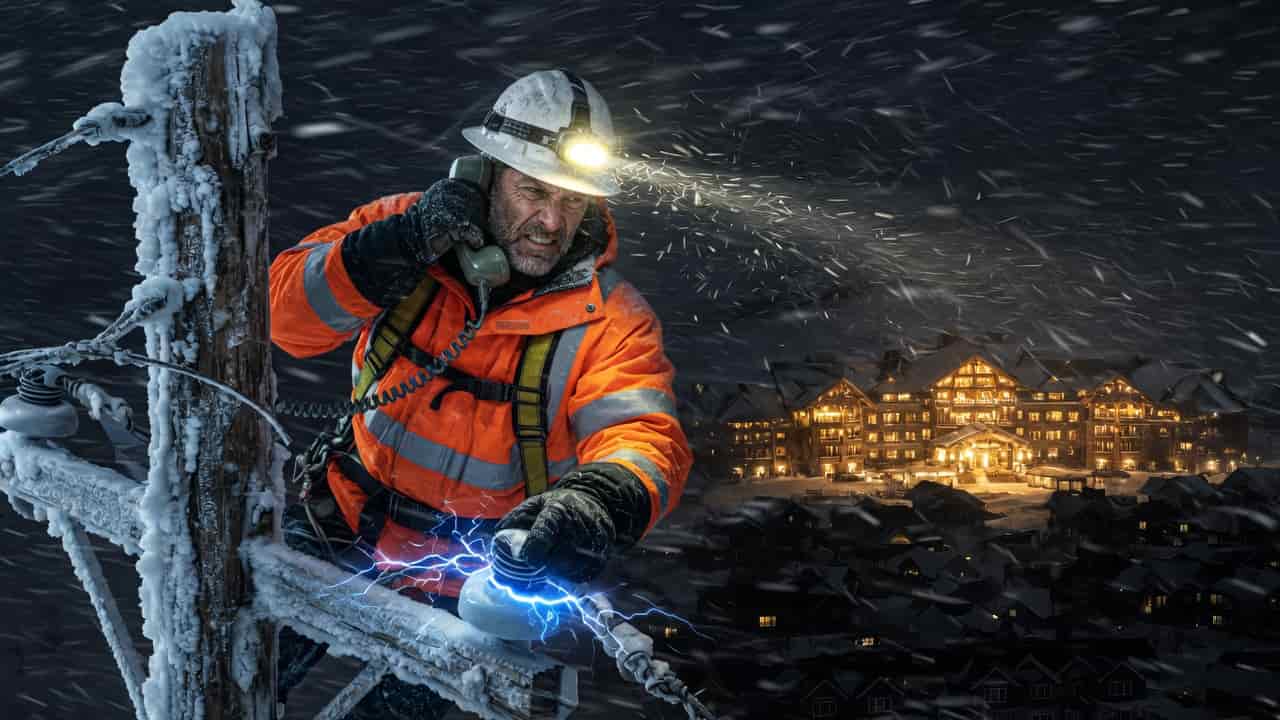
Gabe leaned into the biting Montana wind, forty feet up a pole that felt like it was made of glass. Below him, the entire valley was a graveyard of cold houses, families huddled under blankets, praying the pipes didn’t burst. But on the ridge, the CEO’s lodge was glowing like a damn sun.
Marcus Sterling didn’t even flinch on the live news feed. He just straightened his silk tie and told the reporter that the “unfortunate outages” were a matter of physics—that the residential lines were just too weak for the storm.
He didn’t mention the memo. He didn’t mention the recording where he told the dispatchers to let the suburbs wait because the ski resort had a gala.
Gabe looked at the handset in his hand. He looked at the remote bypass he’d spent six months hiding in the grid.
“Who is this?” Sterling snapped on the screen, his voice cracking as the first flicker hit his office. “Get this person off the air!”
“I’m the guy you told to go home while my wife was still breathing,” Gabe said, his voice as flat as the frozen earth. “And now, I’m the guy who’s giving you exactly what you gave us.”
He didn’t just cut the power. He exposed the one secret the company would have killed to keep buried.
Chapter 1: The Electric Silence
The wind in Montana doesn’t just blow; it hunts. It finds the gaps in your jacket, the cracks in your window frame, and the places in your soul where you’ve grown brittle.
Gabe sat in his truck, the engine idling high to keep the heater from losing the fight. Outside, the world was a monochromatic blur of horizontal white. This wasn’t a storm yet; it was just the warning. But Gabe knew the sound of a grid under pressure. It was a low, vibrating hum that lived in his teeth, the song of thousands of miles of aluminum wire sagging under the weight of frozen rain.
He looked at the photo taped to his dashboard. Sarah was laughing, her hair windblown, the background a summer meadow that seemed like a hallucination now. Next to her was Maya, three years younger then, holding a fistful of dandelions.
“Daddy?”
The small voice came from the tablet propped on the passenger seat. Maya was at his mother’s house, ten miles away in the valley.
“I’m here, bug,” Gabe said, forcing his face to soften. He hated that she could see the fatigue, the way the lines around his eyes had become permanent trenches over the last two years.
“Is the dark coming back?” she asked.
It was a specific kind of fear. Most kids were afraid of the monsters under the bed. Maya was afraid of the hum stopping. She was afraid of the moment the heater clicked off and the silence began—the same silence that had filled their house the night the “Priority 1” order came down from the head office.
“Not tonight,” Gabe lied. He was a lineman; he knew the forecast. He knew the state energy board was already bracing for a total collapse. “The lights are staying on. I’m out here making sure of it.”
“Promise?”
“Promise.”
He ended the call before she could ask anything else. Promises were expensive in Montana, and Gabe was nearly bankrupt.
He climbed out of the truck, the cold hitting him like a physical blow to the chest. He was forty-two, but in this weather, his joints felt like they were filled with crushed glass. He walked to the back of the service truck, his boots crunching on the treacherous layer of “black ice” that had coated the yard.
MP&L—Montana Power & Light—was a skeleton crew tonight. Most of the senior guys had taken “stress leave” or retired early after the scandal last winter. Gabe stayed. Not because he was loyal, but because he needed to be near the wires. He needed to be the one who heard the grid talk.
He pulled his climbing spikes from the tool rack. They were heavy, steel talons that strapped to his shins. He ran a gloved hand over the leather straps, checking for cracks. In his world, a equipment failure wasn’t a mistake; it was a gravity-powered death sentence.
“Gabe! Get in here!”
The shout came from the dispatch office. It was Miller, an old-timer who looked like he’d been carved out of a piece of hickory. He was leaning out the door, the yellow light of the office spilling into the snow.
Gabe trudged inside, the sudden warmth making his skin sting. The room smelled of burnt coffee and ozone. On the wall, the massive digital map of the regional grid was a sea of green lines, but Gabe could see the yellow flickers at the edges. The load was spiking. People were turning up their thermostats, unaware that they were collectively pulling the trigger on a catastrophe.
“Sterling just called,” Miller said, his voice low. He didn’t look at Gabe. He looked at the floor.
Gabe froze, his hand halfway to the coffee pot. “The CEO? Personally?”
“He wants a crew dispatched to the Northern Ridge. Now.”
Gabe felt the familiar heat rise in his neck. The Northern Ridge wasn’t a residential area. It was where the “lodges” were—the sprawling, timber-framed estates of the out-of-state billionaires who came to Montana to play at being rugged until the first real frost hit.
“The Ridge hasn’t lost power yet, Miller,” Gabe said, his voice dangerously quiet. “The East Valley is already dipping. We’ve got three transformers in the suburbs that are vibrating loud enough to hear in the next county.”
“He doesn’t care about the suburbs, Gabe. He’s got the Governor up there for some private ’emergency summit.’ He told me—and I’m quoting here—’Let the suburbs wait. The Ridge stays lit. If we lose the summit, we lose the funding.'”
Gabe looked at the map. The East Valley was where his mother lived. It was where Maya was sleeping. It was where Sarah had died, shivering in a house that had turned into a meat locker while Gabe was forty miles away, forced to de-ice the lines leading to a luxury ski resort that wasn’t even occupied.
“I’m not going,” Gabe said.
“You have to. You’re the only one with the certifications for the high-voltage bypass on the Ridge. If you refuse, they’ll pull your ticket. You’ll never work on a pole again.”
Gabe looked at his hands. They were scarred, calloused, and shaking slightly from the cold. He thought about the secret map tucked into his locker. He thought about the remote switches he’d been installing during his midnight shifts over the last six months—the “shadow grid” he’d built while the company wasn’t looking.
“Fine,” Gabe said, his voice sounding like it was coming from a long way off. “I’ll go to the Ridge.”
“Gabe…” Miller started, looking up. There was a flicker of something in the old man’s eyes. Pity. Or maybe a warning. “Just… stay safe out there. It’s going to be a long night.”
“It’s going to be the longest night Marcus Sterling ever had,” Gabe muttered, but the wind took the words before Miller could hear them.
He walked out back to his truck, but he didn’t grab the Ridge bypass kit. Instead, he reached into the secret compartment under the bench seat and pulled out a small, ruggedized laptop and a lineman’s handset he’d modified himself.
The grid was a machine. And like any machine, it had a heart. Gabe knew exactly where it was. And he knew exactly how to make it stop beating.
He climbed into the cab, the hum of the heater sounding like a dirge. He wasn’t going to the Ridge to save the Governor’s dinner party. He was going to the Ridge to watch the lights go out.
Chapter 2: The Sycophant and the King
The MP&L yard was a graveyard of rusting bucket trucks and spools of cable that looked like giant, forgotten coins. Gabe was loading his gear when the headlights of a pristine, white SUV cut through the snow, blinding him.
The door opened, and Tyler hopped out. Tyler was twenty-four, had a degree in “Energy Management” from a school back East, and wore a parka that cost more than Gabe’s first three trucks combined. He was the “Junior Field Coordinator,” which was a corporate way of saying he was the guy who made sure the real workers didn’t deviate from the CEO’s spreadsheet.
“Hey, Gabe! You headed to the Ridge?” Tyler shouted over the wind, his breath forming a perfect, pampered cloud.
“Loading up,” Gabe said without looking at him.
“Good man. Sterling is already up there. He’s hosting the Governor and a few ‘key stakeholders.’ He’s pretty stressed about the optics. You know how it is—if the power flickers while the Governor is cutting into a wagyu steak, it makes the whole utility look incompetent.”
Gabe stopped, a heavy coil of copper wire in his arms. He turned slowly. “Physics doesn’t care about optics, Tyler. The ice is an inch thick on the valley lines. If we don’t dump some of the load from the Ridge, the residential substations are going to blow. We’re talking weeks of repairs, not hours.”
Tyler laughed, a sharp, dismissive sound. “Gabe, Gabe. You’re thinking like a lineman. You need to think like a partner. The people in the suburbs… they’re used to it. They’ve got wood stoves. They’ve got blankets. The Ridge? Those are the people who pay the bills. They’re the ones who keep our stock price from tanking.”
“My wife didn’t have a wood stove,” Gabe said.
The silence that followed was heavy. Even the wind seemed to hesitate. Tyler’s smile faltered, just for a second, before he smoothed it back into that polished, corporate mask.
“Look, I know what happened last year was… difficult. But Sterling did everything he could. The logistics just didn’t favor the valley that night. It was a tragedy, but we have to look forward.”
“Favorite,” Gabe repeated. “That’s a hell of a word for it.”
“Just get up there and do the bypass,” Tyler said, his tone shifting from friendly to authoritative. “Sterling wants a status report by 22:00. Don’t make me have to call you on the radio, okay? It’s a bad look.”
Tyler climbed back into his heated SUV and drove off, leaving Gabe alone in the dark.
Gabe didn’t move for a long time. He felt the cold seeping into his boots, numbing his toes. He remembered the night Sarah died. He’d been on the radio, begging for permission to head back to the East Valley. He’d told the dispatcher that his wife was sick, that their furnace was electric, that the temperatures were dropping to thirty below.
And then, he’d heard it. A voice in the background of the dispatch channel. It was Sterling. The CEO hadn’t realized the line was open.
“Tell him to stay put,” Sterling had said, his voice casual, bored. “The valley is a lost cause tonight. Let the suburbs wait. The ski lodge needs lights for the arrival. We can’t have the investors sitting in the dark.”
Gabe had heard it. He’d stayed on the pole for six more hours, de-icing a line for a lodge that was empty, while ten miles away, Sarah’s heart had slowed down until it simply stopped.
He reached into his pocket and pulled out a small digital recorder. It was an old-fashioned thing, battered and scratched. He’d spent a year’s salary and a lot of favors to get the original audio file from the dispatch server before it was “routinely purged.”
He pressed play.
“Let the suburbs wait…”
The voice was clear, even over the hiss of the wind. It was the sound of a man who looked at people as numbers on a ledger.
Gabe tucked the recorder back into his pocket. He didn’t need to listen to it anymore. He had it memorized. It was the rhythm of his life now.
He finished loading the truck. He didn’t take the standard bypass kit. He took a specialized set of frequency emitters and a jumper cable he’d modified in his garage.
He wasn’t going to fix the line. He was going to “tune” it.
The grid was like a piano. If you hit the right notes, it made music. If you hit the wrong ones, the strings snapped. Gabe was about to play a masterpiece.
As he drove out of the yard, he passed the main office. Through the window, he could see the television. Marcus Sterling was on the local news, giving a live interview from his “emergency command center” at the lodge. He looked calm. He looked heroic. He looked like a man who was in total control.
Gabe gripped the steering wheel until his knuckles turned white.
“Enjoy the view, Marcus,” Gabe whispered. “It’s the last thing you’re going to see.”
He turned the truck onto the mountain road, the tires churning through the deepening snow. The hum of the grid followed him, louder now, a low-frequency vibration that felt like a pulse.
In the valley below, the first transformer blew. A bright, neon-blue flash lit up the horizon, followed by a sudden, jarring darkness that swallowed three blocks of houses.
Gabe didn’t stop. He didn’t call it in. He just kept driving up the mountain, toward the golden lights of the Ridge.
Chapter 3: The Shadow Grid
The climb was brutal.
Gabe stood at the base of Pole 402, the primary feeder for the Northern Ridge. The wind was screaming now, a sustained sixty miles per hour that threatened to rip the tools right off his belt. The pole was a pillar of ice, shimmering under his headlamp like a frozen ghost.
He kicked his first spike into the wood. Thwack. It was a solid sound, but the ice shattered around it, sending shards into his face. He ignored the sting. He kicked the second spike. Thwack.
He began to ascend. Forty feet. In good weather, he could do it in less than a minute. Tonight, it felt like climbing Everest. Every time he shifted his weight, the pole groaned, the wood contracting in the extreme cold. He could feel the vibration of the high-voltage lines above him—34,500 volts of raw power, humming with a murderous intent.
Linemen had a saying: The wire doesn’t have a heart, but it has a memory. If you disrespected it once, it waited. It waited for your glove to have a microscopic tear. It waited for your foot to slip. It waited for you to forget, just for a second, that you were a guest in its house.
Gabe reached the top. He was eye-level with the cross-arms, where the thick, black cables were held in place by porcelain insulators. Blue sparks—static discharge—danced around the ceramic. It was beautiful in a way that only things that can kill you are beautiful.
He leaned back into his safety strap, his body swaying in the wind. Below him, the world was gone. The valley was a void, a sea of shadow where thousands of people were huddling in the dark. But to the north, the Sterling Lodge was a cluster of golden sparks. He could see the silhouettes of people moving behind the floor-to-ceiling glass walls. He could see the heat rising from the chimneys.
He pulled the modified handset from his belt and clipped it onto the diagnostic port of the transformer.
“Okay, Marcus,” Gabe whispered. “Let’s see what you’re really made of.”
He opened his laptop, the screen a blinding white in the darkness. He’d spent months mapping this. He’d found the “critical failure points”—the places where the grid’s safety protocols could be exploited.
The MP&L system was designed to “shed load” automatically to prevent a total blackout. If the suburbs lost power, the system was supposed to divert that energy to keep the core infrastructure running. But Sterling had overridden that. He’d programmed the system to treat the Ridge as “Critical Infrastructure,” higher priority than the hospitals or the police stations.
Gabe wasn’t going to break the law. He was just going to restore the original programming.
He typed in a series of commands. His fingers were so cold they felt like wooden pegs, but the muscle memory took over.
Load Shed Protocol: Override.
Priority Assignment: Residential Alpha.
Target: Sector 09 (The Ridge).
He hit the enter key.
On his screen, a progress bar appeared. Redirecting… 10%… 20%…
Suddenly, his radio crackled to life.
“Gabe? This is Tyler. Status on the bypass?”
Gabe froze. He looked down. Far below, at the base of the pole, he saw the headlights of Tyler’s SUV. The kid had followed him.
“I’m working on it, Tyler,” Gabe said, his voice steady. “The ice is thick. It’s taking longer than expected.”
“Sterling is breathing down my neck, man. He says the Governor’s internet just dropped. He’s furious. Get that bypass locked in now, or he’s coming down there himself.”
“Tell him to stay in the warm, Tyler. I’m almost done.”
Gabe turned back to the laptop. 80%… 90%…
A sudden gust of wind slammed into him, nearly knocking him off his spikes. The laptop slid across the small utility shelf he’d rigged. He lunged for it, his glove brushing against the primary line.
A bolt of blue light arced from the wire to his shoulder. It wasn’t a full strike—the insulation on his parka held—but the force of the static discharge sent a jolt of pure agony through his nervous system. His vision went white. His heart skipped a beat, then hammered against his ribs like a trapped bird.
He gasped, his breath coming in ragged heaves. He looked at his shoulder. The fabric was charred, a small wisp of smoke rising from the neon orange material.
“Gabe? You okay? I saw a flash up there!” Tyler’s voice was frantic now.
Gabe didn’t answer. He looked at the laptop.
Transfer Complete.
The “Shadow Grid” was live.
In that moment, the lights in the valley—the East Valley, where Maya was—flickered once, twice, and then surged into a steady, brilliant glow. Streetlights hummed to life. Kitchen windows turned yellow. The heat began to flow back into the houses of the people who didn’t matter.
And on the Ridge, the golden lodge began to dim.
“What did you do?” Tyler screamed from below. “The Ridge just dipped to fifty percent! Gabe! Fix it!”
Gabe didn’t fix it. He reached for his handset. He didn’t call dispatch. He dialed the number for the local news station—the one currently broadcasting the live interview with Marcus Sterling.
He knew they’d pick up. He’d spent the last hour routing his call through the emergency priority line. To the station’s computer, he looked like a “Senior Grid Engineer” with an urgent safety update.
“This is Gabe Logan,” he said when the producer answered. “Put me through to the Sterling interview. I have a question for the CEO.”
Chapter 4: The Call-In
The transition was seamless.
On the small screen of his phone, Gabe watched the live feed. Marcus Sterling was in the middle of a sentence, his face lit by the warm glow of a fireplace that probably cost more than Gabe’s house.
“—and so, I want to assure the citizens of Montana that we are doing everything in our power to restore service to the residential areas. But as I said, the physical constraints of the storm are—”
“We have a caller,” the Anchor interrupted, pressing her earpiece. She looked confused, but intrigued. “This is Gabe, a senior lineman currently on a pole in the middle of the storm. Gabe, you’re on with CEO Marcus Sterling.”
Gabe leaned his head against the frozen wood of the pole. The wind was a roar in his ears, but his voice was like ice.
“Hello, Marcus,” Gabe said.
On the screen, Sterling’s eyes narrowed. He recognized the voice. He didn’t know from where yet, but the confidence in his posture wavered.
“Yes, Gabe. Thank you for your hard work out there. It’s men like you who are the backbone of this company. What’s your status report?”
“My status is forty feet up a pole on the Northern Ridge,” Gabe said. “I’m looking down at the valley. It’s a beautiful sight, Marcus. The lights are on in the suburbs. The families are warm. The kids aren’t afraid of the dark tonight.”
Sterling’s smile became a rigid, artificial thing. “That’s… that’s excellent news. I didn’t realize the crews had made such progress.”
“They didn’t,” Gabe said. “I did. I took the power from your house, Marcus. I took the priority you stole from the people who pay your salary, and I gave it back to them.”
The Anchor’s jaw dropped. The camera panned to Sterling, whose face was rapidly turning a shade of purple that matched the expensive wine on the table behind him.
“You… you’re fired,” Sterling hissed, forgetting for a second that he was on live television. “Do you hear me? You’re done! Tyler! Get him off that pole!”
“You can’t fire the grid, Marcus,” Gabe said. “And you can’t lie to physics. You told the people of this state that the residential lines were too weak. You told them it was unavoidable. But right now, your lodge is running on a secondary bypass that is vibrating at six hundred hertz. Do you know what happens when a transformer hits six hundred hertz?”
Sterling looked up at the ceiling. The recessed lights in the lodge began to flicker violently. A low, ominous thrumming sound began to vibrate through the walls—a sound the microphone picked up clearly.
“Stop this,” Sterling pleaded, his voice cracking. “We have the Governor here! This is an official summit!”
“I know,” Gabe said. “And the Governor should know that you spent four million dollars on a private grid for this ridge while the emergency generators at the East Valley clinic were failing last year. He should know that you told your dispatchers to ‘let the suburbs wait’ while my wife was dying in the cold.”
“That’s a lie!” Sterling screamed.
Gabe didn’t argue. He simply pressed the ‘play’ button on the digital recorder he held to the handset.
“Let the suburbs wait… The ski lodge needs lights… We can’t have the investors sitting in the dark.”
The voice echoed through the news studio. It echoed in the living rooms of every house that had just regained power. It echoed in the lodge, where the Governor was now standing up, looking at Sterling with a look of pure, unadulterated disgust.
“You want to know why it’s dark, Mr. Sterling?” Gabe said, his voice dropping to a whisper. “Because you decided some people don’t deserve the heat. And tonight, you’re one of them.”
Gabe reached out with his black rubber glove. He grabbed the manual cut-out switch—the one that required a physical, human hand to throw.
“Gabe, don’t!” Tyler’s voice came from below, desperate and small.
Gabe didn’t look down. He looked at the Golden Lodge.
“This is for Sarah,” he said.
He pulled the lever.
The arc of electricity was blinding, a ten-foot spear of white-hot light that hissed and popped in the frozen air. The transformer at the top of Pole 402 didn’t just stop; it died with a definitive, metallic clack.
On the television screen, the lights in the lodge didn’t flicker. They vanished. The screen went to static for a heartbeat, then switched back to the Anchor in the studio, who was sitting in stunned silence.
Below Gabe, the Northern Ridge was plunged into a darkness so thick it felt heavy. The golden sun was gone. The only light left was the steady, humble glow of the valley miles away.
Gabe hung there, suspended between the sky and the earth. He was exhausted. He was probably going to jail. He was definitely never going to work for MP&L again.
But for the first time in two years, the humming in his teeth had stopped.
He pulled his phone out and sent a single text message to his mother’s phone.
The lights are staying on, Maya. I promise.
He began his descent, the spikes biting into the wood, one slow, deliberate step at a time. The storm was still hunting, but Gabe wasn’t afraid anymore. He’d finally found his way out of the cold.
Chapter 5: The Weight of the Ground
The descent was a blur of numbing repetition. Kick, slide, lock. Kick, slide, lock. Gabe’s hands, even inside the heavy rubber and wool, felt like two blocks of frozen wood. The adrenaline that had sustained him at the top of the pole was leaking out of him, replaced by a cold that felt structural, as if his very bones were turning to slush.
When his boots finally hit the packed snow at the base of Pole 402, the world seemed to tilt. He leaned his forehead against the rough, ice-slicked timber. The pole was dead now. The hum was gone. The silence that replaced it wasn’t the peaceful quiet of a snowfall; it was the heavy, pressurized silence of a crime scene.
“Gabe.”
The voice was small, cracked by the wind. Tyler was standing five feet away, his high-end parka hood pulled tight, but not tight enough to hide the sheer terror on his face. He looked like a child who had just watched a magician pull a real, bleeding heart out of a hat instead of a rabbit.
Gabe didn’t look at him. He walked to the truck, his gait stiff, his climbing spikes clanking like a ghost’s chains against the frozen earth.
“Gabe, you have to… you have to turn it back on,” Tyler stammered, following him. “The Governor is in there. The CEO is in there. You just… you just committed a felony on live television. Do you understand that? They’re calling the Sheriff. They’re calling State Security.”
Gabe reached the tailgate and began unbuckling his shin straps. The leather was frozen stiff, and he had to yank at it with his teeth to get the buckles to move. He spat a shard of ice out of his mouth.
“They’re in the dark, Tyler,” Gabe said. His voice was raspy, a low growl that barely cleared the wind. “They’ll be fine. They’ve got cashmere blankets and enough Scotch to keep a village warm. They’re experiencing what they call ‘unavoidable physics.’ Isn’t that what Marcus said?”
“It’s not the same!” Tyler shouted, his voice pitching into a panicked whine. “You sabotaged the grid! You rerouted priority load without authorization. That’s domestic terrorism under the new energy statutes. They’ll bury you, Gabe. They’ll take your house. They’ll take everything.”
Gabe finally looked at him. The kid was shaking—not from the cold, but from the realization that his proximity to Gabe made him an accessory. In the corporate world Tyler inhabited, being near a disaster was the same as causing it.
“They already took everything, Tyler,” Gabe said quietly. “They took the only thing that mattered two years ago. The rest of this? It’s just hardware and wire.”
Gabe tossed his spikes into the bed of the truck. The heavy steel hit the metal floor with a sound that echoed across the ridge. He climbed into the cab and slammed the door, leaving Tyler standing in the dark, bathed in the red glow of the truck’s taillights.
He didn’t drive back toward the lodge. He turned the truck down the mountain, heading toward the valley.
As he descended, the view changed. The darkness of the Ridge stayed behind him, a black crown on the mountain. But below, the East Valley was a tapestry of light. It was breathtaking. The residential grid, usually a dim, flickering afterthought, was burning bright and steady. The “Shadow Grid” was doing its job—funneling the excess capacity from the industrial lines and the luxury accounts directly into the neighborhoods.
He passed a small house on the outskirts of the valley. A woman was standing on her porch, wrapped in a quilt, staring up at the streetlights as they hummed with a healthy, vibrant glow. She wasn’t cheering. She was just… standing there, bathed in the light, looking like she’d been given a second chance at a life she thought was over.
Gabe felt a lump in his throat that he couldn’t swallow. He’d done it. For one night, the math was fair.
He drove past the MP&L substation. There were three Sheriff’s cruisers parked out front, their blue and red lights dancing against the snow-covered chain-link fence. They were waiting for him. But they were waiting at the yard, expecting him to turn himself in like a good employee.
Gabe didn’t go to the yard. He drove to his mother’s house.
It was a small, white-sided bungalow with a sagging porch and a chimney that puffed steady, grey smoke. Every window was lit. It looked like a gingerbread house in the middle of a blizzard.
He parked the truck at the curb, leaving the engine running. He needed to see her. Just for a minute.
He walked up the path, his legs feeling like they belonged to someone else. He didn’t knock. He just opened the door.
The warmth hit him like a physical weight. The smell of cinnamon and woodsmoke. And then, the sound of the television.
His mother, Martha, was sitting in her recliner, her hands gripped tight on the armrests. She looked up as he entered, her face a map of shock and grief and a strange, terrifying pride.
“Gabe,” she whispered.
“Is she okay?” Gabe asked, his eyes scanning the room.
“She’s in the kitchen. She… she saw you, Gabe. On the news. We were watching the emergency update and then… then you were there.”
Maya came around the corner. She was wearing her favorite fleece pajamas, the ones with the little penguins. She stopped when she saw him. Her eyes were wide, and she was holding a mug of cocoa like it was a holy relic.
“Daddy?”
Gabe dropped to his knees. He didn’t care about the melting snow on his parka or the grease on his hands. He opened his arms, and she flew into them, the cocoa splashing onto his shoulder. She buried her face in his neck, and for the first time in years, she didn’t smell like fear. She smelled like soap and chocolate.
“You fixed the lights,” she sobbed. “You said you would.”
“I told you,” Gabe murmured, closing his eyes. “I promised.”
He held her for a long time, listening to the hum of the refrigerator and the steady blow of the furnace. These were the sounds of safety. These were the sounds he’d sold his life to buy back for her.
“Gabe,” his mother said, her voice trembling. She was looking out the front window.
The blue and red lights were turning the corner at the end of the block. They weren’t rushing. They were moving with a slow, inevitable steady pace. They knew he was here. There was nowhere else for a man like Gabe to go.
Gabe stood up, gently disengaging from Maya. He knelt back down so he was eye-level with her.
“Bug, I have to go away for a little bit,” he said. He kept his voice low, the same tone he used when they were looking for deer in the woods. “I have to go talk to some people about the lights.”
“Will the dark come back?” she asked, her bottom lip trembling.
“No,” Gabe said, and he knew it was true. The “Shadow Grid” was locked. It would take a team of engineers three days to unpick the routing he’d done, and by then, the storm would be over. The Governor wouldn’t dare order them to shut off the valley now—not after the tape had played. “The lights are staying on. Grandma is going to stay here with you. I’ll call you as soon as I can.”
He kissed her forehead, a lingering pressure that felt like a goodbye. He looked at his mother.
“The recorder,” he said. “It’s in the truck. In the secret compartment. If I don’t get out of the station by morning, you call that reporter. The one from the station. Give it to her.”
“Gabe, what have you done?” Martha asked, her eyes filling with tears.
“I balanced the books, Ma,” Gabe said.
He walked out the front door just as the first cruiser pulled into the driveway. The headlights blinded him, reflecting off the snow. He didn’t run. He didn’t reach for his belt. He just stood on the porch, his hands visible, his head held high.
The Sheriff, a man Gabe had gone to high school with named Miller, stepped out of the car. He didn’t draw his weapon. He just looked at Gabe with a heavy, tired expression.
“Gabe Logan,” Miller said. “You’re a hard man to find tonight.”
“I wasn’t hiding, Jim,” Gabe said.
“I know. I saw the news. My wife… she’s at home right now with the heater on for the first time in three days. She thinks you’re a saint.” Miller walked up the porch steps, the handcuffs jingling at his belt. “But Marcus Sterling thinks you’re a terrorist. And Marcus Sterling owns the Governor’s ear.”
“Marcus Sterling owns a lot of things,” Gabe said, holding out his wrists. “But he doesn’t own the grid anymore. Not tonight.”
The cold metal of the cuffs snapped shut. It was a sharp, final sound. As Miller led him toward the car, Gabe looked back at the house. Maya was standing at the window, her small hand pressed against the glass.
The lights stayed on.
Chapter 6: The Residue of Truth
The interrogation room at the county lockup smelled of floor wax and stale cigarettes, a scent that felt like it belonged to a different century. Gabe sat at the metal table, his hands still cuffed in front of him. They’d taken his parka and his hardhat, leaving him in his thermal shirt. He was shivering, but not from the cold. It was the “afterburn”—the physical collapse that happens when the body realizes the fight is over.
The door opened, and it wasn’t a lawyer who walked in.
Marcus Sterling looked different without the soft lighting of the lodge and the expensive Scotch. His silver hair was disheveled, and his charcoal coat was damp with melted snow. He looked smaller, his face pinched with a rage so white-hot it seemed to vibrate.
He didn’t sit down. He slammed a folder onto the table.
“You think you’re a hero,” Sterling hissed. His voice was a jagged edge. “You think this is some working-class fairy tale where the little guy wins. Do you have any idea what you’ve actually done?”
Gabe looked at him. He didn’t see a CEO. He saw a man who was terrified of his own irrelevance.
“I checked the load, Marcus,” Gabe said. “The residential lines held. No fires. No blowouts. Just heat where it was needed.”
“You cost this company sixty million dollars in private contracts tonight!” Sterling shouted, his spit hitting the table. “The Governor is under immense pressure to launch a federal investigation into our ‘priority routing’—your little stunt with the recording is being played on a loop from Seattle to New York. You’ve destroyed the reputation of Montana Power & Light.”
“Reputations are like porcelain insulators, Marcus,” Gabe said, leaning back. “They look great until they get a crack. Then they’re just dangerous. Your reputation had a crack the size of the Continental Divide the night you let the valley freeze.”
“I was doing my job!” Sterling roared. “I was protecting the viability of the grid! If the investors pull out, there is no grid! There are no jobs! There is no heat for anyone! You took a complex economic machine and you broke it because you’re a grieving widower who can’t accept that life is unfair.”
Gabe felt the anger flare in his chest, a low, steady heat. He stood up, the chair screeching against the floor. Even cuffed, he was a head taller than Sterling, his body hardened by twenty years of climbing poles while Sterling sat in climate-controlled offices.
“Life is unfair, Marcus. I know that better than you. But you didn’t just accept it. You manufactured it. You took a storm and you turned it into a weapon to use against people who couldn’t fight back. You didn’t protect the grid. You protected your bonus.”
“It won’t matter,” Sterling said, his voice dropping to a low, venomous purr. “The charges against you are being escalated to the federal level. Sabotage of public utility infrastructure. They’re going to make an example of you. You’ll be in a cell until your daughter is middle-aged. And while you’re rotting, I’ll be rebuilding. I’ll have your ‘Shadow Grid’ erased by Monday. I’ll have the priority lines restored. And the people you ‘saved’? They’ll forget your name in a month.”
The door opened again. Sheriff Miller stood there, looking at Sterling with a look of profound discomfort.
“Mr. Sterling, you need to leave. The Governor’s office is on the line. They’re… they’re requesting an immediate meeting with the Board of Directors. And Gabe’s lawyer is here.”
Sterling turned, his eyes darting between Miller and Gabe. He straightened his coat, trying to regain his composure, but the mask was slipping. He looked like a man standing on a live wire, waiting for the current to hit.
“This isn’t over, Logan,” Sterling said.
“You’re right,” Gabe said. “The recording is already on the internet, Marcus. My mother called the station an hour ago. You can erase the grid, but you can’t erase the sound of your own voice.”
Sterling froze. The color drained from his face, leaving it the color of old ash. He didn’t say another word. He turned and walked out of the room, his footsteps echoing down the hall.
The lawyer was a young woman named Sarah—the same name as Gabe’s wife. It felt like a sign, or maybe just a cruel coincidence. She was smart, sharp, and she didn’t offer him any platitudes.
“The good news is that the Governor is distancing himself from Sterling as fast as he can,” she said, laying out her notes. “The public outcry is massive. Thousands of people in the valley are calling their representatives. You’ve become a folk hero overnight.”
“I don’t want to be a hero,” Gabe said. “I just want to go home.”
“The bad news is that you did break the law. Several of them. Sabotage is a hard charge to beat, even with a ‘necessity’ defense. They’re offering a plea. Five years. Suspended sentence, ten years’ probation, and you lose your lineman’s certification. Permanently. You can never touch a power line again.”
Gabe looked at his hands. The scars, the callouses, the permanent tremor. He thought about the pole. The hum. The feeling of being forty feet up, the only thing standing between the world and the dark.
It was who he was. It was the only thing he knew how to be.
“Five years suspended?” Gabe asked.
“It means you don’t go to prison, Gabe. But you’re done. You’re out of the industry. You’ll have a felony record. You’ll be working retail or construction for the rest of your life.”
Gabe looked toward the small, barred window. The sun was coming up. The blizzard had passed, leaving behind a world that was blindingly white and still. Somewhere out there, the valley was waking up. People were making coffee. Kids were watching cartoons. The houses were warm.
“I’ll take it,” Gabe said.
Six months later.
The Montana spring had finally arrived, the snow melting into rushing creeks that filled the valley with the sound of moving water. Gabe sat on his front porch, a hammer in his hand. He was fixing the railing—something he’d put off for two years.
He was working as a carpenter now. It paid half as much, and his back ached in a different way, but he liked the wood. Wood didn’t hum. Wood didn’t try to kill you if you touched it the wrong way.
The street was quiet. MP&L had been dissolved, replaced by a state-run cooperative after the federal investigation found systemic corruption in the billing and priority systems. Marcus Sterling was currently awaiting trial for racketeering and corporate negligence.
A white utility truck drove slowly down the street. It was one of the new co-op trucks. The lineman in the bucket was a young guy, maybe nineteen, his hardhat still shiny and new. He looked up at the lines, his expression full of that familiar, nervous concentration.
He saw Gabe on the porch and slowed down. He didn’t know Gabe’s face—not many people did now that the news cycle had moved on—but he saw the way Gabe was looking at the wires.
The kid gave a small, respectful nod. Gabe nodded back.
“Daddy! Look!”
Maya ran out of the house, clutching a drawing. It was a picture of a house with a huge, yellow sun over it. The sun had lines radiating out from it that looked remarkably like power cables.
“It’s beautiful, bug,” Gabe said, taking the paper.
He looked up at the pole at the end of his driveway. It was just a piece of timber, an insulator, and a transformer. But he could still hear it—the faint, distant vibration of the world staying connected.
The residue was still there. He still reached for his climbing spikes in his sleep. He still checked the weather every hour. He still felt the ghost of Sarah in the quiet corners of the house.
But as the sun hit the valley, Gabe realized the dark hadn’t won. It had tried, and it had failed.
He picked up his hammer and went back to work. He had a house to build, a daughter to raise, and for the first time in a very long time, the lights were staying on.