FULL STORY
Chapter 1
The July heat in the city didn’t just hang in the air; it felt like a physical weight, pressing down on the asphalt, making the garbage from the night before smell twice as ripe. I was already in a bad mood, my tailored navy blazer sticking to my back despite the air conditioning in my car having died three blocks ago. My name is Detective Maya Lin, and for the last ten years, I’ve worked for the one department in the force that guarantees you’ll never be invited to the Christmas party: Internal Affairs.
I grew up in a cop house. My dad wore the badge for thirty years until a corrupt lieutenant set him up, ruining his pension and breaking his spirit. He died thinking the thin blue line was a gang, and I made a silent vow at his funeral that I would dedicate my life to scrubbing that gang clean, one dirty cop at a time.
This morning’s assignment was Officer Miller “Grizz” Thompson. The name fit the man. He was a dinosaur—six-foot-four of beer belly and entitlement, five years away from a comfortable retirement. But the complaints about Grizz were stacking up like unread mail: excessive force, missing evidence money, generalized bullying. I was there to do a quiet, routine assessment of his file before his final pension review.
I parked my dead-AC sedan a block away from the 12th Precinct to maintain some discretion. As I walked up the cracked concrete sidewalk, I saw him.
Grizz was leaning against a squad car, joking with a younger officer, Sarah Jenkins. Sarah looked uncomfortable, trying to laugh but clearly holding her breath around him. Grizz was in his element, holding court. Beside him sat a heavy, industrial-sized yellow mop bucket, filled with what looked like the runoff from a thousand dirty boots. It was gray, murky, and putrid.
As I neared, walking directly in front of him, he made eye contact. He didn’t know who I was, but he saw my blazer, my professional demeanour, and decided I was “the enemy”—probably some city lawyer or a civilian complaint filing clerk.
Without blinking, with a smile that was more of a baring of teeth, he grabbed the mop bucket and heaved it.
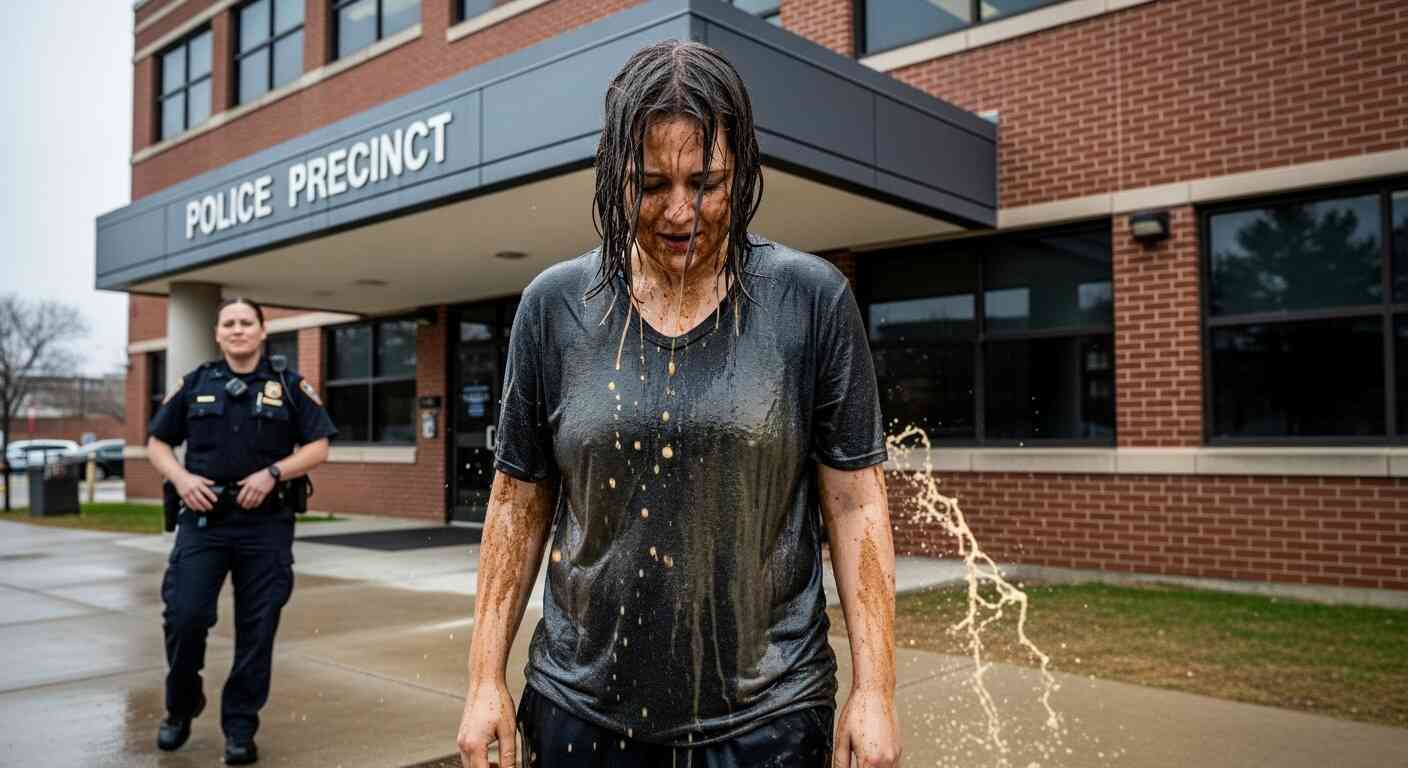
The impact was shocking. The heavy, warm, disgusting water hit me chest first, instantly soaking through my blazer, my shirt, my skin. It ran into my shoes. It splashed into my mouth. I gasped, the taste of dirt and chemicals burning my throat. The smell was overpowering—old grease and grime.
“Cool down, sweetheart,” Grizz’s voice boomed, dripping with cruel satisfaction. “You look like you’re about to burst anyway. Consider it a public service in this heat.”
Younger officer Sarah Jenkins looked genuinely horrified, gasping, “Grizz, what are you doing?” but the other male cops nearby started to chuckle.
I stood there, vibrating with a rage so intense it made my vision blur. This was precisely the kind of arrogance I lived to destroy. The kind that believed the rules didn’t apply to them, that civilians—or anyone they deemed lesser—were targets for their amusement.
I could have screamed. I could have attacked him. But I was an investigator. I didn’t get mad; I got even.
With my left hand, I calmly wiped the gray slime from my eyes, watching his sneer widen. Then, I reached inside my soaking wet blazer, under the collar of my shirt, and pulled out my polished gold shield suspended on a heavy chain. It gleamed, even through the filth.
I let it drop against my wet chest.
“I’m the Internal Affairs officer reviewing your pension today, Officer Thompson,” I said. My voice was low, terrifyingly steady. “And you have just assaulted a superior officer.”
The laughter from the sidewalk stopped instantly. You could have heard a pin drop on the hot asphalt. Grizz’s sneer didn’t disappear, though. It merely solidified into something uglier. He took a step toward me, using his massive size to intimidate.
“Internal Affairs?” He spat the words like they were poison. “You’re just a girl playing dress-up in a costume, sweetheart. You think that shiny piece of tin scares me? I’ve got friends in high places. Commissioners. Judges. We play golf together. You go run back to your air-conditioned office and file your little report. It’ll be in the trash before you even finish typing.”
He leaned in, his breath smelling of stale coffee, the power dynamic tilting back in his favor.
But I smiled. A real, terrifying smile.
With my other hand—the one that had been holding my smartphone at my side the entire time—I lifted the device.
“You’re right, Grizz. These reports can get lost. That’s why I don’t just write them anymore.”
I flipped the screen so he could see it.
It was my personal live-stream interface. The camera lens was pointed directly at him. But the important detail was in the corner: a red blinking dot and the viewer list.
“Say hello to Police Commissioner O’Connell, Grizz. We aren’t playing golf. He just watched you drench an IA detective in sewage and threaten her.”
I watched as the arrogance drained out of his massive frame. It was like pulling the plug on a bathtub. His skin went pale gray under his sunburn. His mouth opened, but no sound came out. His large hands, which had been flexing menacingly seconds ago, began to tremble.
His “friends in high places” were watching him humiliate himself on a live feed. And his pension—the only thing standing between him and financial ruin, as I already knew from my preliminary research—had just walked off a cliff.
“You should have used cleaner water, Grizz,” I whispered, holding the phone steady. “The Commissioner is big on image.”
Chapter 2
The drive back to the IA headquarters was the longest twenty minutes of my life. The filth from Grizz’s mop bucket had dried into a stiff, stinking crust on my clothes, and the humiliation was a knot in my stomach that wouldn’t untie. Every red light felt like an eternity, the air conditioning now working ironically well, making me shiver as the cool air hit the damp, dirty fabric.
When I finally walked into the sterile, fluorescent-lit halls of Internal Affairs, the looks I got were different than usual. Normally, it was a cocktail of suspicion and open disdain—the glare fellow cops give to the ‘rats.’ But today, as I walked by, looking like a swamp monster, the glances were a mix of shock and, I daresay, a tiny bit of respect for the sheer audacity of what I’d just survived.
I went straight to the locker room, the sound of my squelching shoes echoing in the empty space. I stripped out of the ruined clothes, not even bothering to save them. They went straight into the hazardous waste bin. The shower water was scalding, and I scrubbed my skin until it was raw, trying to wash away not just the physical grime, but the psychological contamination of Grizz’s entitlement.
My father’s face kept flashing in my mind.
I remembered the night he came home, the night Lieutenant Miller (different man, same species) had frame him for the missing cocaine. He’d sat at the kitchen table, his head in his hands, not crying, just broken. “They protect their own, Maya,” he had said, his voice hollow. “And I wasn’t one of their own because I wouldn’t lie for them.”
That memory was my fuel. It always had been. But today, the fire was hotter. Grizz hadn’t just bullied a woman; he had validated every cynical, dark thought my father ever had about the badge.
After I changed into a spare suit from my locker, I walked to Commissioner O’Connell’s office. I didn’t need to knock. He knew I was coming.
Commissioner James O’Connell was a man built from weary granite. He’d been in the top job for three years, trying to steer the massive, bureaucratic beast of the police force through the rocky waters of public distrust and internal corruption. He was my mentor, the one who’d pulled me out of patrol and recognized the steel in my spine.
When I entered, he was staring at his large mahogany desk, the livestream on his monitor already looped and waiting to be watched again. He looked up, his expression a complicated mix of fury and deep fatigue.
“Maya,” he said, his voice a low rumble. “Sit down.”
I sat in the uncomfortable leather chair, the smell of his expensive cologne a sharp contrast to what I’d been wearing earlier.
“You saw it,” I stated, not a question.
“I saw it,” he confirmed, leaning back, the chair groaning under his weight. “You have a knack for the dramatic, Detective. A live stream? That’s going to make a hell of a mess.”
“The mess was already there, Commissioner. I just turned on the lights.”
He sighed, rubbing his temples. “Miller Thompson is an institution, Maya. Old guard. The union is going to scream. They’ll accuse you of entrapment, of targeting him.”
“He threw a bucket of sewage on me, sir. In broad daylight. In front of witnesses.”
“I know, I know,” he waved a hand, dismissively. “That’s the easy part. The assault charge is a lock. But his pension? If we revoke that… we’re in new territory. We need more than just one ugly incident. We need a pattern. We need the corruption that generated those other complaints. Can you find it?”
He was challenging me. Giving me the leash but warning me that the stakes were higher than just one suspended cop.
“I can find it,” I said, the ghost of my father sitting beside me.
“Then do it. Quietly this time. No more theatrical live streams until the hearing. You’ve got forty-eight hours before his representation gets their hands on everything. Make your case, Detective.”
I left his office with a clear mission. Grizz Thompson’s arrogance had given me the hook, but his greed was going to be the anchor that sunk him. I went to my desk and started digging into his life, ignoring the buzzing of my phone, which was already filling with notifications about the video going viral within the department’s private groups.
I needed to understand Miller Thompson. And I knew exactly where to start: his finances. Corruption almost always left a paper trail, even for someone as old-school as Grizz. My forty-eight hours had just started.
Chapter 3
I spent the first twenty-four hours deep in the weeds of Miller Thompson’s financial history. Corruption is rarely spontaneous; it’s usually a slow creep, born of need or greed, and sustained by opportunity. Grizz seemed to fit the profile of opportunity, but as I pulled his credit reports and bank statements, a more complex—and potentially more damaging—picture began to emerge.
Grizz Thompson was broke.
Despite his thirty-year career and substantial salary, he was drowning. I found three maxed-out credit cards, a second mortgage on his home in a blue-collar neighborhood, and a series of smaller, aggressive loans from less-than-reputable lenders. The institution he represented was solid, but the man himself was a hollow shell of debt.
I dug further, looking for the why. And there it was, hidden in a series of recurring, large payments to a specialized clinic out of state: medical bills. His wife, Elena.
I pulled her file next. She’d been diagnosed with a rare, aggressive form of multiple sclerosis five years ago. Their insurance was standard city-issue, good but not enough to cover the experimental treatments they’d desperately sought out. Grizz wasn’t spending his missing evidence money on fancy cars or mistresses; he was spending it on his dying wife.
It was the first crack in my anger. The psychological depth I always looked for. He wasn’t just a monster. He was a desperate man whose desperation had turned him monstrous. It didn’t excuse what he’d done, nor the complaints of excessive force and bullying, but it gave his actions context. The pension wasn’t just his retirement comfort; it was Elena’s life support. That’s why he’d lost his mind when I threatened it.
But empathy was a luxury I couldn’t afford. My past wound—the image of my broken father—was still too raw. Grizz’s desperation had led him to abuse his power, to become the very thing I’d sworn to destroy. His pain didn’t negate the pain he caused others.
On the morning of the second day, I decided to squeeze the pressure points I’d identified. I needed a human element, a witness who could bridge the gap between financial motive and behavioral corruption. I needed someone inside his circle.
I called Sarah Jenkins into one of the windowless interview rooms at IA.
Officer Sarah Jenkins was young, barely out of the academy, with bright eyes that hadn’t quite dulled yet. She’d been standing right next to Grizz when he drenched me. In her file, I saw a history of excellent performance reviews, but also a string of partners who’d transferred or been dismissed—all older, ‘dinosaur’ cops. She’d been “mentored” by the old guard.
She walked into the room, looking terrified. She knew that simply speaking to Internal Affairs could mark her for the rest of her career.
“Sit down, Officer Jenkins,” I said, keeping my tone neutral.
“Detective Lin,” she managed, her voice tight. “I… I already gave my statement about the incident. I didn’t see him grab the bucket until it was too late. I swear.”
She was protecting him. Of course she was. Loyalty was the coin of the realm.
“I’m not here to talk about the water, Sarah. We both know what happened.” I leaned forward, spreading Grizz’s credit report on the table. It was redacted, but the red ink showing debt was clear. “I’m here to talk about your partner’s desperation.”
She looked at the paperwork, then quickly away. “His personal life isn’t my business.”
“It becomes your business when it affects the job. When he starts looking at evidence bags as ATMs.” I let that hang in the air. I saw her hand, which was resting on the table, twitch. “You’ve been his partner for six months, Sarah. You’re smart. You noticed the pattern. The ‘missing’ bags, the cash that didn’t match the booking reports.”
She remained silent, her jaw locked.
“He’s in deep trouble, Sarah. That video is just the start. He’s going to lose his pension. His wife’s treatment…” I let the pause do the work. “If you protect him, you’re not helping him. You’re just setting yourself up to go down with the ship. Do you want to be explained to the Commissioner as collateral damage?”
I could see the moral choice tearing her apart. She pain was evident—the fear of being a ‘rat’ battling against her inherent sense of right and wrong. She knew I was right. She’d seen things. Her weakness was her need to belong, her fear of being an outsider like my father had been.
“I have a kid,” she whispered, her eyes finally meeting mine, filled with tears. “If I talk… I’m done.”
“If you don’t talk, you’re done,” I said, gently. “But if you help us, you’re not a rat. You’re a witness. There’s a difference.”
She took a shaky breath, looking at the door, then back at me. “He… he keeps a ledger. In the glove box of his squad car. Not his regular one, the one he uses for night shift patrol. He writes down the dates and the amounts… ‘Elena’s Fund,’ he calls it.”
A secret ledger. It was better than I’d hoped for. Logic dictated he wouldn’t write down ‘stolen money,’ but ‘Elena’s Fund’ was almost as damning when paired with the evidence money that was missing on those specific dates.
“Which car?”
She gave me the vehicle number. “He always takes it when we do traffic stops near the industrial district. Always in the cash-only business areas.”
“Thank you, Sarah. Your involvement stops here. I’ll handle it.”
I had my moral choice. To use the information from a terrified young officer to destroy an old, desperate man. It was the right choice, the logical choice, but as I left the room, I didn’t feel like I’d won. I just felt heavy. The conflict wasn’t as black and white as I wanted it to be. The villain had a heartbreaking motive, and the hero was using a scared rookie to deliver the final blow.
Chapter 4
The realization that I had Grizz by the throat did nothing to settle the chaos in my mind. The discovery of his sick wife, Elena, was the disruptive event I hadn’t expected. It broke the normal narrative of simple corruption and introduced a shade of gray I struggled to process. Every time I looked at the red ink on his financial reports, I saw his despair, not just his greed.
But the hearing was set for the next morning. Time was up.
Commissioner O’Connell called me in one last time. He looked even more exhausted. The viral video had created a media storm, with the “Dirty Water Cop” becoming a symbol of police arrogance across social media. The public was screaming for blood, and the politicians were looking at O’Connell to provide it.
“Do you have the pattern, Maya?” he asked, not looking at me, but at the stack of newspapers on his desk.
“I have it, sir,” I said, holding the folder containing the copies of the secret ledger I’d retrieved from the night-shift squad car. Sarah’s information had been perfect. The dates of Grizz’s ‘Elena’s Fund’ deposits matched perfectly with dates where evidence money from petty drug busts—money that was notoriously under-accounted for—had been reported as “lost” or “mislabeled.”
“It’s messy, Commissioner,” I added.
He finally looked at me, his eyes sharp. “What’s the mess?”
I told him about Elena. I expected him to be sympathetic, but his reaction was cold.
“It doesn’t matter,” he said, his voice hard. “His motives are irrelevant to the violation. He is a police officer who stole. He is a police officer who assaulted a detective on live video. If we show mercy to him because his wife is sick, we set a precedent that every corrupt cop in this city will use. Do you want to be the one to tell the public that corruption is fine, as long as you have a good excuse?”
He was right. Logically, he was completely right. He’d seen a thousand excuses in his career. My pain, the image of my father, resurfaced, hardening me again. My father didn’t have a sick wife, but he also hadn’t been corrupt. He’d been punished for his honesty. Grizz should be punished for his dishonesty, regardless of his reasons.
“I understand, Commissioner.”
The hearing was held in a private boardroom at Headquarters. It was a kangaroo court of sorts—designed to be fast, efficient, and, most importantly, to provide an outcome that could be presented to the public before the outrage cycle moved on to something else.
Grizz was there, sitting next to his union representative, a sharp-featured man named Miller (it seemed the name was destined to haunt me). Miller looked confident, ready to turn the live stream into an argument about entrapment and emotional distress.
Grizz himself looked different. He wasn’t the arrogant, chest-thumping bully from the sidewalk. He was older, smaller, his eyes rimmed with red, the weight of his debt and his wife’s illness visible in the slouch of his shoulders. He didn’t even look at me when I walked in.
The meeting began with the formal assault charge based on the video. Miller, the union rep, immediately went on the offensive.
“My client was under extreme heat distress,” Miller argued, gesturing to a stack of weather reports. “He was working in a high-tension environment, the hottest week of the year. He saw a civilian—whom he did not know was IA, let me emphasize—behaving in what he perceived as a suspicious manner near a squad car. His actions, while perhaps overly aggressive, were a misjudgment born of heat and a desire to maintain security. It was a joke, a tasteless joke, but an assault? That is an extreme overreach.”
Commissioner O’Connell, presiding over the hearing, let him speak, his face a granite mask.
“However,” Miller continued, his voice rising, “the subsequent intimidation by Detective Lin—this illegal, unconstitutional live stream to the Commissioner—that is the real violation here. My client’s rights were ignored. He was humiliated publicly without due process. This whole hearing is a result of that emotional duress, not any inherent pattern of misconduct.”
It was a good defense. It was the two expected twists I had anticipated—shifting the narrative to my ‘entrapment’ and reducing the assault to a bad joke. The logic was sound, the motivation clear. They thought they could win on technicalities.
O’Connell looked at me. “Detective Lin?”
I stood up. I didn’t look at the union rep. I looked directly at Grizz.
“We aren’t here because of the water, Officer Thompson,” I said, my voice cutting through the room. “And we aren’t here because of my live stream. We are here because you are a thief.”
I walked to the table and laid down the folder. I didn’t open it immediately. I let the word hang there.
“You have a sick wife, Officer Thompson. Elena. I know about the treatments.”
Grizz’s head snapped up. His face, already pale, went ashen. For the first time, I saw real fear, not just of punishment, but of exposure. His pain—his weakness—was being laid bare.
“Don’t talk about her!” he growled, trying to stand, but his rep pulled him back.
“Her illness is a tragedy,” I continued, my voice steady, professional. “But it is not a license. For the past four years, matching dates where you reported evidence money ‘lost’ or ‘misfiled’ in your cash-only industrial district patrols, you made substantial deposits into your credit card accounts and the clinic. The total amount missing is nearly $50,000.”
I opened the folder, displaying the secret ledger pages Sarah had provided, next to bank records I’d finally managed to subpoena.
“This is your ledger, Grizz. Found in your patrol vehicle. In your handwriting. ‘Elena’s Fund,’ you called it. The numbers match the missing evidence money exactly.”
The second twist—the logic of my supporting character, Sarah, providing the key—was revealed. The moral choice I’d made to use her information was now the final, irrevocable weapon.
“You stole from the citizens you were sworn to protect,” I said. “You stole from the victims of the crimes you were investigating. And yes, you also assaulted a detective. But it’s the theft—the pattern of corruption fueled by your desperation—that makes you unfit for the badge.”
I looked at the Commissioner, then back to Grizz.
“You don’t deserve the pension you were trying to protect, Officer Thompson. Because you earned it with stolen money.”
The room was silent, the previous twists and defenses utterly obliterated by the physical, visual evidence of the ledger. Grizz didn’t shout. He didn’t threaten. He just crumpled, burying his face in his hands, his body shaking with silent, devastating grief. He had lost.